
Diverse Utilization of Bidens pilosa and Prospects for Sustainable Management

 , , and
Abstract
1. Introduction
2. Material and Methods
3. Results
3.1. Traditional Medicinal Uses
3.2. Modern Medicinal Research
3.2.1. Anti-Inflammatory and Immunomodulatory Activities
3.2.2. Antibacterial and Antioxidant Activities
3.2.3. Antitumor and Cytotoxic Activities
3.2.4. Modulatory Effects on Metabolic Diseases
3.2.5. Other Bioactivities
3.2.6. Linking Modern Pharmacological Research to Traditional Medicinal Uses
3.3. Other Resource Utilization
3.3.1. Dietary and Nutritional Applications
3.3.2. Feed and Veterinary Applications
3.3.3. Environmental Remediation
3.3.4. Industrial and Material Applications
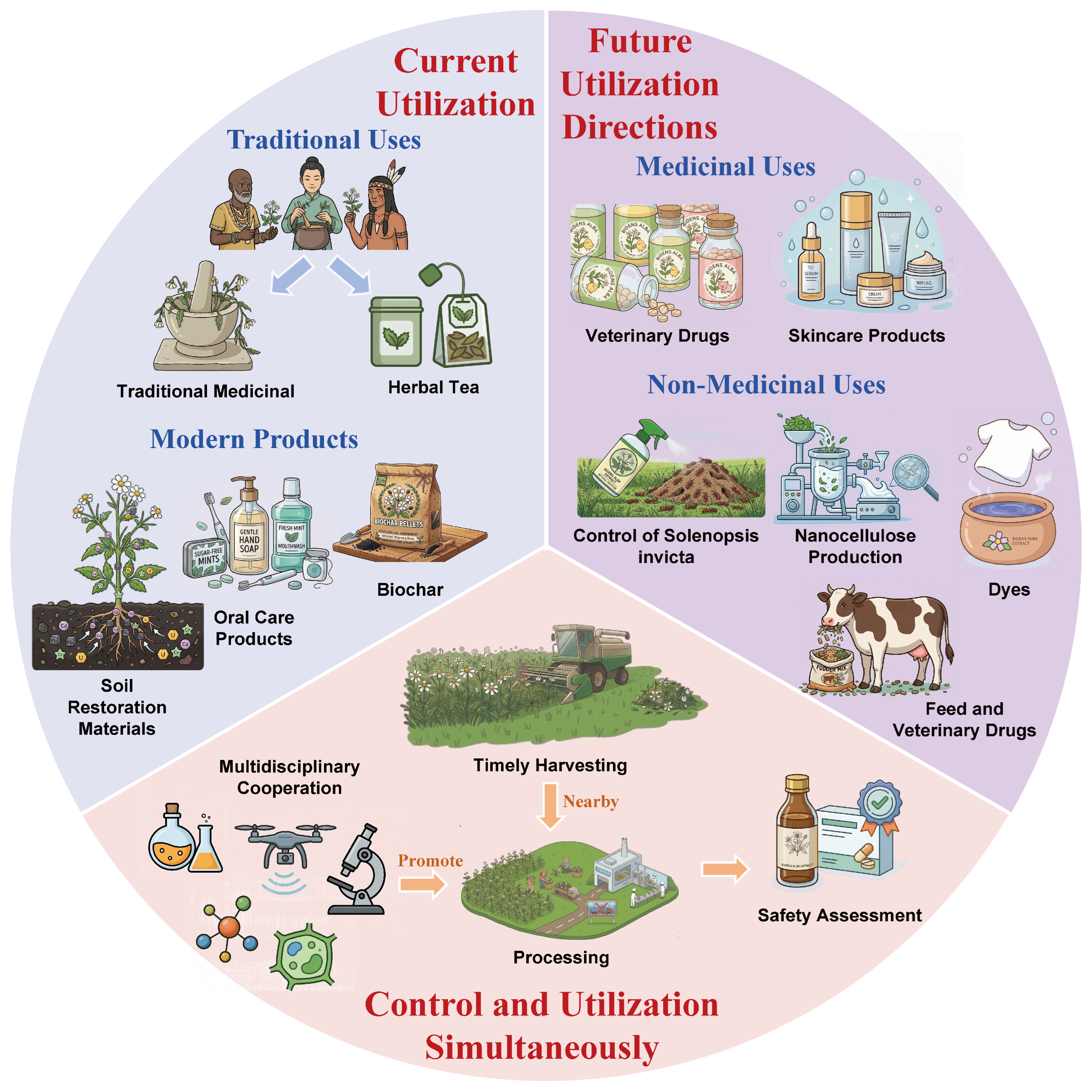
3.4. Integration of Invasion Control and Resource Utilization
4. Discussion
Author Contributions
Funding
Institutional Review Board Statement
Data Availability Statement
Acknowledgments
Conflicts of Interest
References
- Shang, C.Q.; Zhu, X.Z. Invasion mechanisms, control and utilization of alien plant species Bidens pilosa. Pratacultural Sci. 2019, 36, 47–60. [Google Scholar]
- Chen, Z.Y.; Liang, S.F.; Li, D.W.; Feng, Z.S.; Li, W.H.; Peng, C.L.; Tian, X.S.; Zhou, X.Y. Allelopathy of 12 species including Eupatorium catarium on Bidens alba seedlings. J. Trop. Subtrop. Bot. 2011, 19, 454–462. [Google Scholar]
- Roy, H.E.; Pauchard, A.; Stoett, P.; Renard Truong, T.; Bacher, S.; Galil, B.S.; Hulme, P.E.; Ikeda, T.; Sankaran, K.; McGeoch, M.A.; et al. IPBES Invasive Alien Species Assessment: Summary for Policymakers; Zenodo: Bonn, Germany, 2023. [Google Scholar] [CrossRef]
- Schirmel, J.; Bundschuh, M.; Entling, M.H.; Kowarik, I.; Buchholz, S. Impacts of invasive plants on resident animals across ecosystems, taxa, and feeding types: A global assessment. Glob. Change Biol. 2016, 22, 594–603. [Google Scholar] [CrossRef]
- Silaeva, T.; Andreychev, A.; Kiyaykina, O.; Balčiauskas, L. Taxonomic and ecological composition of forest stands inhabited by forest dormouse Dryomys nitedula (Rodentia: Gliridae) in the Middle Volga. Biologia 2021, 76, 1475–1482. [Google Scholar] [CrossRef]
- Peng, J. The harm and preventive measures of biological invasion. Mod. Agric. Sci. Technol. 2014, 2014, 125–126. [Google Scholar]
- Yuan, Z.L.; Ye, W.W.; Hou, Y.P.; Wang, Y.C. Current situation and the development of green pesticides in China. Sci. Sin. Vitae 2023, 53, 1643–1662. [Google Scholar] [CrossRef]
- Xia, X.H.; Sun, X.; Li, X.R.; Zhang, L.X.; Yang, J.; Chu, P.F. The hazard, control, and prospects for utilization of invasive plants. China Plant Prot. 2025, 45, 27–31. [Google Scholar]
- Wu, J.H.; Zhong, X.Y.; Lyu, S.Y.; Chen, H.J. Research progress on prevention, control and resource utilization of the invasive plant Bidens. Mod. Agric. Sci. Technol. 2024, 2024, 61–64. [Google Scholar] [CrossRef]
- Eshetu, A.A.; Asegie, A.M.; Addisalem, S.T.; Hailu, F.; Tamerat, T. Beyond eradication: Unveiling local voices and proactive management strategies for Prosopis juliflora in eastern Ethiopia’s arid landscape. Sci. Afr. 2024, 26, e02462. [Google Scholar] [CrossRef]
- Eshetu, A.A. A valuable or a curse resource? A systematic review on expansion, perception of local community, benefits and side effects of Prosopis juliflora. Front. Conserv. Sci. 2024, 5, 1491618. [Google Scholar] [CrossRef]
- Mtenga, D.V.; Ripanda, A.S. A review on the potential of underutilized Blackjack (Biden pilosa) naturally occurring in sub-Saharan Africa. Heliyon 2022, 8, e09586. [Google Scholar] [CrossRef] [PubMed]
- Wang, X.F. Study on the Response of Invasive Plant Bidens alba and Local Related Species Bidens biternata to Low Temperature Stress. Master’s Thesis, Yili Normal University, Yining, China, 2023. [Google Scholar] [CrossRef]
- Chen, M.Y.; Liang, Z.Y.; Shu, Q.; Nao, Z.C.; Chen, Y.; Zeng, Z.F.; La, Q.; Wang, J.W. Predicting potential distribution and adaptability of the invasive plant Bidens pilosa in China based on the MaxEnt model. Chin. J. Appl. Ecol. 2025, 36, 1749–1758. [Google Scholar] [CrossRef]
- Jin, X.H.; Lin, Q.W.; Zhao, H. Alien Invasive Flora of China; Shanghai Jiao Tong University Press: Shanghai, China, 2023; Volume 4, pp. 326–350. [Google Scholar]
- Wang, J.; Li, R.R.; Song, X.J.; Yang, Y.Z.; Chen, L.L.; Chen, Y.; Li, X.D.; Zhang, X.R.; Zhang, C.L.; Liu, G. Study on the niche conservatism and invasion risk of Bidens pilosa L. during its invasion in China based on climatic factors. Acta Ecol. Sin. 2025, 45, 10616–10627. [Google Scholar] [CrossRef]
- Nie, Y.H.; Cheng, J.P.; Fu, X.Y.; Xuan, Y.H.; Wan, A.; Zhao, H. Predicting the potential suitable habitats of invasive species in the Bidens genus in China under climate change. Chin. J. Appl. Ecol. 2025, 36, 3115–3125. [Google Scholar] [CrossRef]
- Wang, J.H.; Shi, S.J.; Chen, W.; Li, Y.; Cui, X.L. Allelopathy and invasiveness of Bidens pilosa and Mimosa pudica. Acta Pratacult. Sin. 2020, 29, 81–91. [Google Scholar] [CrossRef]
- Xu, D. The Study on the Reference Genome of Bidens alba. Master’s Thesis, Chinese Academy of Agricultural Sciences, Beijing, China, June 2023. [Google Scholar]
- Kato-Noguchi, H.; Kurniadie, D. The invasive mechanisms of the noxious alien plant species Bidens pilosa. Plants 2024, 13, 356. [Google Scholar] [CrossRef]
- Hao, J.H.; Bhattacharya, S.; Ma, L.; Wang, L.X. Breeding systems and seed production for six weedy taxa of Bidens. Weed Biol. Manag. 2018, 18, 41–49. [Google Scholar] [CrossRef]
- Hu, W.J.; Yan, S.J.; Cheng, M.; Gu, L.Z.; Lyu, W. Research progress on the invasive plant Bidens alba. J. Agric. Catastrophol. 2024, 14, 20–22. [Google Scholar]
- Balah, M.A.; Al-Andal, A.; Radwan, A.M.; Donia, A.E.M. Unveiling allelopathic dynamics and impacts of invasive Erigeron bonariensis and Bidens pilosa on plant communities and soil parameters. Sci. Rep. 2024, 14, 10159. [Google Scholar] [CrossRef]
- Pan, Y.M.; Tang, S.C.; Wei, C.Q.; Li, X.Q. Comparison of growth, photosynthesis and phenotypic plasticity between invasive and native Bidens species under different light and water conditions. Biodivers. Sci. 2017, 25, 1257–1266. [Google Scholar] [CrossRef]
- Ballard, R. Bidens pilosa complex (Asteraceae) in North and Central America. Am. J. Bot. 1986, 73, 1452–1465. [Google Scholar] [CrossRef]
- Ma, B. A Study of Bidens L. (Asteraceae) in China Based on Morphology and Molecular Phylogeny. Master’s Thesis, Zhengzhou University, Zhengzhou, China, May 2021. [Google Scholar]
- Chen, Y.T.; Ma, L.; Lu, T.Y.; Wang, Y.; Gao, G.L.; Hao, J.H. Identification of Bidens weedy taxa of Bidens in China. J. Change Inst. Technol. 2021, 35, 87–91. [Google Scholar] [CrossRef]
- Huang, Y.L.; Kao, W.Y. Different breeding systems of three varieties of Bidens pilosa in Taiwan. Weed Res. 2014, 54, 162–168. [Google Scholar] [CrossRef]
- Ge, C.J. Chromosome number of Bidens. Chin. Tradit. Herb. Drugs 1988, 19, 34+44. [Google Scholar]
- Maria, F.J.; Laughinghouse, H.D.; Da Silva, A.C.F.; Tedesco, S.B. Variability of the chromosomal number and meiotic behavior in populations of Bidens pilosa L. (Asteraceae) from southern Brazil. Caryologia 2008, 61, 164–169. [Google Scholar] [CrossRef]
- Hao, J.H.; Liu, Q.Q.; Qiang, S. Reproductive traits associated with invasiveness in Bidens pilosa (Asteraceae). Chin. Bull. Bot. 2009, 44, 656–665. [Google Scholar] [CrossRef]
- Huang, Y.L.; Chen, S.J.; Kao, W.Y. Floral biology of Bidens pilosa var. radiata, an invasive plant in Taiwan. Bot. Stud. 2012, 53, 501–507. [Google Scholar]
- Li, J.H. Flora of China. Harv. Pap. Bot. 2007, 13, 301–302. [Google Scholar] [CrossRef]
- Bartolome, A.P.; Villaseñor, I.M.; Yang, W.C. Bidens pilosa L. (Asteraceae): Botanical properties, traditional uses, phytochemistry, and pharmacology. Evid.-Based Complement. Altern. Med. 2013, 2013, 340215. [Google Scholar] [CrossRef]
- Calderín-Miranda, J.M.; Mendoza, B.A.; Díaz-Soto, M.T. Actividad farmacológica y composición fitoquímica de Bidens pilosa L. Rev. Cuba. Farm. 2021, 54, 1–23. [Google Scholar] [CrossRef]
- Kuo, T.F.; Yang, G.; Chen, T.Y.; Wu, Y.C.; Minh, H.T.N.; Chen, L.S.; Chen, W.C.; Huang, M.G.; Liang, Y.C.; Yang, W.C. Bidens pilosa: Nutritional value and benefits for metabolic syndrome. Food Front. 2021, 2, 32–45. [Google Scholar] [CrossRef]
- Yang, W.C. Botanical, pharmacological, phytochemical, and toxicological aspects of the antidiabetic plant Bidens pilosa L. Evid.-Based Complement. Altern. Med. 2014, 2014, 698617. [Google Scholar] [CrossRef]
- Namukobe, J.; Lutaaya, A.; Asiimwe, S.; Byamukama, R. An ethnobotanical study of medicinal plants used in the management of dermatological disorders in Buyende and Kayunga Districts, Uganda. Eur. J. Med. Plants 2021, 32, 15–40. [Google Scholar] [CrossRef]
- Rodríguez-Mesa, X.M.; Contreras Bolaños, L.A.; Mejía, A.; Pombo, L.M.; Costa, G.M.; Santander González, S.P. Immunomodulatory properties of natural extracts and compounds derived from Bidens pilosa L.: Literature review. Pharmaceutics 2023, 15, 1491. [Google Scholar] [CrossRef] [PubMed]
- Fotso, A.F.; Longo, F.; Djomeni, P.D.D.; Kouam, S.F.; Spiteller, M.; Dongmo, A.B. Analgesic and antiinflammatory activities of the ethyl acetate fraction of Bidens pilosa (Asteraceae). Inflammopharmacology 2014, 22, 105–114. [Google Scholar] [CrossRef]
- Chiang, L.C.; Chang, J.S.; Chen, C.C.; Ng, L.T.; Lin, C.C. Anti-Herpes simplex virus activity of Bidens pilosa and Houttuynia cordata. Am. J. Chin. Med. 2003, 31, 355–362. [Google Scholar] [CrossRef]
- Carocho, M.; Ferreira, I.C.F.R. A review on antioxidants, prooxidants and related controversy: Natural and synthetic compounds, screening and analysis methodologies and future perspectives. Food Chem. Toxicol. 2013, 51, 15–25. [Google Scholar] [CrossRef]
- Wang, Z.X.; Wu, J.G.; Cai, Q.Y.; Wu, Y.B.; Zou, X.H.; Wu, J.Z. Inhibition of proliferation and induction of apoptosis in human colon cancer cell lines RKO by Bidens pilosa var. radiata Schult. Bip. of Fujian Province. J. Fujian Coll. Tradit. Chin. Med. 2011, 21, 40–42. [Google Scholar] [CrossRef]
- Bai, Y.; Zhang, Q.; He, X.L.; Wang, H.F.; Li, W.L.; Zhu, J.F.; Meng, Y.; Long, C.L. An ethnobotanical study on medicinal plants of Shexian dryland stone terraced system in northern China. J. Ethnobiol. Ethnomed. 2022, 18, 62. [Google Scholar] [CrossRef]
- Luo, B.S.; Tong, Y.M.; Liu, Y.J.; Zhang, Y.; Qin, Y.X.; Hu, R.C. Ethnobotanical insights into the traditional food plants of the Baiku Yao community: A study of cultural significance, utilization, and conservation. J. Ethnobiol. Ethnomed. 2024, 20, 52. [Google Scholar] [CrossRef]
- Yuan, M.G.; Xu, Z.H.; Peng, X.Y.; Tang, X.G.; Ba, X.M.; Tian, Y.; Xiang, R.; Yang, X. Effects of Bidens alba (L.) DC formulation extract on growth performance and blood biochemistry of growing pigs. J. Domest. Anim. Ecol. 2024, 45, 33–38. [Google Scholar] [CrossRef]
- Wen, H.T.; Rao, Y.B.; Chen, J.W.; Yuan, H.M.; Zhong, X.Q. Study on the preparation of a kind of cosmetic raw material Bidens bipinnata extract. Pract. Clin. J. Integr. Tradit. Chin. West. Med. 2020, 20, 155–157. [Google Scholar] [CrossRef]
- Ye, S.; Lee, S.; Kang, S.; Jun, S.H.; Kang, N.G. Improvement of skin condition through RXR alpha-activating materials. Biomolecules 2025, 15, 296. [Google Scholar] [CrossRef]
- Zhang, Y.X.; Zhou, L.; Xiao, N.C.; Pang, R.; Song, B. Remediation potential of Bidens pilosa L. in cadmium-contaminated farmland. Acta Ecol. Sin. 2020, 40, 5805–5813. [Google Scholar]
- Liu, M.Y.; Chen, C.; Shen, R.; Shi, R.F.; Zi, J.Y.; Guan, H.L.; Huang, Y.Z.; Huang, J.X. Study on the effect of remediation of soil cadmium pollution by Bidens pilosa L. and Solanum nigrum L. under different planting modes. J. Yunnan Norm. Univ. Nat. Sci. Ed. 2024, 44, 54–59. [Google Scholar]
- Duan, Z.X.; Chen, X.X.; Qin, Y.X.; Nie, J.B.; Li, C.Y.; Li, F.F.; Luo, B.S. Bibliometric analysis of Bidens pilosa research. Grassl. Turf 2026, 1, 1–20. [Google Scholar]
- ISO 3166-1:2020; Codes for the Representation of Names of Countries and Their Subdivisions—Part 1: Country Code. International Organization for Standardization: Geneva, Switzerland, 2020. Available online: https://www.iso.org/obp/ui/#home (accessed on 3 June 2026).
- Owuor, B.O.; Kisangau, D.P. Kenyan medicinal plants used as antivenin: A comparison of plant usage. J. Ethnobiol. Ethnomed. 2006, 2, 7. [Google Scholar] [CrossRef]
- Hu, R.C.; Lin, C.R.; Xu, W.B.; Liu, Y.; Long, C.L. Ethnobotanical study on medicinal plants used by Mulam people in Guangxi, China. J. Ethnobiol. Ethnomed. 2020, 16, 40. [Google Scholar] [CrossRef] [PubMed]
- Li, P. Studies on Chemical Constituents of Two Ethnomedicinal Plants (Bidens pilosa and Hedyotis cryptantha) Used by Li Ethnic Group. Master’s Thesis, Minzu University of China, Beijing, China, March 2013. [Google Scholar]
- Long, X.; Ranjitkar, S.; Waldstein, A.; Wu, H.; Li, Q.; Geng, Y. Preliminary exploration of herbal tea products based on traditional knowledge and hypotheses concerning herbal tea selection: A case study in Southwest Guizhou, China. J. Ethnobiol. Ethnomed. 2024, 20, 1. [Google Scholar] [CrossRef]
- Simbo, D.J. An ethnobotanical survey of medicinal plants in Babungo, Northwest Region, Cameroon. J. Ethnobiol. Ethnomed. 2010, 6, 8. [Google Scholar] [CrossRef]
- Zhao, Y.Q.; Yang, Z.X.; Lang, B.Y.; Meng, M.S.W.; Xue, D.Y.; Gao, L.; Yang, L.X. Skincare plants of the Naxi of NW Yunnan, China. Plant Divers. 2020, 42, 473–478. [Google Scholar] [CrossRef]
- Abrogoua, D.P.; Dano, D.S.; Manda, P.; Adepo, A.J.; Kablan, B.J.; Goze, N.B.; Ehoulé, K. Effect on blood pressure of a dietary supplement containing traditional medicinal plants of Côte d’Ivoire. J. Ethnopharmacol. 2012, 141, 840–847. [Google Scholar] [CrossRef]
- Li, S.; Zhang, Y.; Guo, Y.J.; Yang, L.X.; Wang, Y.H. Monpa, memory, and change: An ethnobotanical study of plant use in Mêdog County, South-east Tibet, China. J. Ethnobiol. Ethnomed. 2020, 16, 5. [Google Scholar] [CrossRef]
- Zhang, M.S.; Li, H.T.; Wang, J.Q.; Tang, M.H.; Zhang, X.B.; Yang, S.H.; Liu, J.Q.; Li, Y.; Huang, X.L.; Li, Z.Y.; et al. Market survey on the traditional medicine of the Lijiang area in Yunnan Province, China. J. Ethnobiol. Ethnomed. 2022, 18, 40. [Google Scholar] [CrossRef]
- Clement, Y.N.; Baksh-Comeau, Y.S.; Seaforth, C.E. An ethnobotanical survey of medicinal plants in Trinidad. J. Ethnobiol. Ethnomed. 2015, 11, 67. [Google Scholar] [CrossRef]
- Xuan, T.D.; Khanh, T.D. Chemistry and pharmacology of Bidens pilosa: An overview. J. Pharm. Investig. 2016, 46, 91–132. [Google Scholar] [CrossRef]
- Garcia, D.; Domingues, M.V.; Rodrigues, E. Ethnopharmacological survey among migrants living in the southeast Atlantic forest of Diadema, São Paulo, Brazil. J. Ethnobiol. Ethnomed. 2010, 6, 29. [Google Scholar] [CrossRef]
- Maroyi, A. Use of weeds as traditional vegetables in Shurugwi District, Zimbabwe. J. Ethnobiol. Ethnomed. 2013, 9, 60. [Google Scholar] [CrossRef]
- Luziatelli, G.; Sørensen, M.; Theilade, I.; Mølgaard, P. Asháninka medicinal plants: A case study from the native community of Bajo Quimiriki, Junín, Peru. J. Ethnobiol. Ethnomed. 2010, 6, 21. [Google Scholar] [CrossRef]
- Bhat, J.A.; Kumar, M.; Bussmann, R.W. Ecological status and traditional knowledge of medicinal plants in Kedarnath Wildlife Sanctuary of Garhwal Himalaya, India. J. Ethnobiol. Ethnomed. 2013, 9, 1. [Google Scholar] [CrossRef]
- Lulesa, F.; Alemu, S.; Kassa, Z.; Awoke, A. Ethnobotanical investigation of medicinal plants utilized by indigenous communities in the Fofa and Toaba sub-districts of the Yem Zone, Central Ethiopian Region. J. Ethnobiol. Ethnomed. 2025, 21, 14. [Google Scholar] [CrossRef]
- Kigen, G.; Some, F.; Kibosia, J.; Rono, H.; Kiprop, E.; Wanjohi, B.; Kigen, P.; Kipkore, W. Ethnomedicinal plants traditionally used by the keiyo community in Elgeyo Marakwet County, Kenya. J. Biodivers. Bioprospect. Dev. 2014, 1, 11. [Google Scholar] [CrossRef]
- Molonge, L.V.K.; Zeuko’o, E.M.; Zemenjuh, M.L.; Ngounou, E.; Fondjo, A.K.; Luma, W.S.; Boyom, F.F. Ethnobotanical survey of medicinal plants used in the treatment of skin infections and arthritis in Bova, Southwest, Cameroon. Exon 2025, 2, 267–282. [Google Scholar] [CrossRef]
- Hong, C.E.; Ji, S.T.; Lyu, S.Y. Absence of mutagenicity in three Nigerian medicinal plants-Bidens pilosa, Cleistopholis paterns and Tetrapleura tetraptera. Trop. J. Pharm. Res. 2011, 10, 153–159. [Google Scholar] [CrossRef]
- Sundararajan, P.; Dey, A.; Smith, A.; Doss, A.G.; Rajappan, M.; Natarajan, S. Studies of anticancer and antipyretic activity of Bidens pilosa whole plant. Afr. Health Sci. 2006, 6, 27. [Google Scholar]
- Chien, S.C.; Young, P.H.; Hsu, Y.J.; Chen, C.H.; Tien, Y.J.; Shiu, S.Y.; Li, T.H.; Yang, C.W.; Marimuthu, P.; Tsai, L.F.L.; et al. Anti-diabetic properties of three common Bidens pilosa variants in Taiwan. Phytochemistry 2009, 70, 1246–1254. [Google Scholar] [CrossRef]
- Lans, C.A. Ethnomedicines used in Trinidad and Tobago for urinary problems and diabetes mellitus. J. Ethnobiol. Ethnomed. 2006, 2, 45. [Google Scholar] [CrossRef]
- Bussmann, R.W.; Paniagua Zambrana, N.Y.; Romero, C.; Hart, R.E. Astonishing diversity—The medicinal plant markets of Bogotá, Colombia. J. Ethnobiol. Ethnomed. 2018, 14, 43. [Google Scholar] [CrossRef]
- Miyamoto, K.; Ehara, H.; Thaman, R.; Veitayaki, J.; Yoshida, T.; Kobayashi, H. Traditional knowledge of medicinal plants on Gau Island, Fiji: Differences between sixteen villages with unique characteristics of cultural value. J. Ethnobiol. Ethnomed. 2021, 17, 58. [Google Scholar] [CrossRef]
- Maobe, M.A.G.; Gatebe, E.; Gitu, L.; Rotich, H. Preliminary phytochemical screening of eight selected medicinal herbs used for the treatment of diabetes, malaria and pneumonia in Kisii region, southwest Kenya. Eur. J. Appl. Sci. 2013, 5, 1–6. [Google Scholar]
- Gbolade, A.A. Inventory of antidiabetic plants in selected districts of Lagos State, Nigeria. J. Ethnopharmacol. 2009, 121, 135–139. [Google Scholar] [CrossRef]
- Borges, C.C.; Matos, T.F.; Moreira, J.; Rossato, A.E.; Zanette, V.C.; Amaral, P.A. Bidens pilosa L. (Asteraceae): Traditional use in a community of southern Brazil. Rev. Bras. Plan. Med. 2013, 15, 34–40. [Google Scholar] [CrossRef]
- Ezeonwumelu, J.O.C.; Ntale, M.; Ogbonnia, S.O.; Agwu, E.; Tanayen, J.K.; Adedeji, A.A.; Okonkwo, C.O.; Akunne, A.A.; Ebosie, J.C.; Byarugaba, F. Analgesic appraisal of Bidens pilosa (Asteraceae) leaf extracts used in management of oral lesion pain in HIV/AIDS patients in rodents. Pharmacol. Pharm. 2018, 9, 175–192. [Google Scholar] [CrossRef]
- Cárdenas, M.B.; Monteagudo, G.L.; Jiménez, E.M.; Oyarzum, M.S.; Chavian, Y.M.; Matos, J.J.; Loy, S. Diuretic activity of five medicinal plants used popularly in Cuba. Pharmacol. Online 2006, 3, 435–441. [Google Scholar]
- da Silva, P.H.; Ferreira Júnior, W.S.; Zank, S.; do Nascimento, A.L.B.; de Abreu, M.C. The influence of exotic and native plants on illnesses with physical and spiritual causes in the semiarid region of Piauí, Northeast of Brazil. J. Ethnobiol. Ethnomed. 2024, 20, 24. [Google Scholar] [CrossRef]
- Hankiso, M.; Warkineh, B.; Asfaw, Z.; Debella, A. Ethnobotany of wild edible plants in Soro District of Hadiya Zone, southern Ethiopia. J. Ethnobiol. Ethnomed. 2023, 19, 21. [Google Scholar] [CrossRef]
- Olivier, T.T.; Francis, N.T.; Jackson, A.S.; Justin, M.; Justin, N. Ethnobotanic survey of medicinal plants used for malaria therapy in western Cameroon. J. Med. Plants 2016, 4, 248–258. [Google Scholar]
- Lu, Z.C.; Chen, H.L.; Lin, C.R.; Ou, G.; Li, J.S.; Xu, W.B. Ethnobotany of medicinal plants used by the Yao people in Gongcheng County, Guangxi, China. J. Ethnobiol. Ethnomed. 2022, 18, 49. [Google Scholar] [CrossRef]
- Volpato, G.; Godínez, D.; Beyra, A.; Barreto, A. Uses of medicinal plants by Haitian immigrants and their descendants in the Province of Camagüey, Cuba. J. Ethnobiol. Ethnomed. 2009, 5, 16. [Google Scholar] [CrossRef]
- Tsobou, R.; Mapongmetsem, P.M.; Damme, P.V. Medicinal plants used against typhoid fever in Bamboutos division, western Cameroon. Ethnobot. Res. Appl. 2013, 11, 163–174. [Google Scholar]
- Hong, L.Y.; Guo, Z.Y.; Huang, K.H.; Wei, S.J.; Liu, B.; Meng, S.W.; Long, C.L. Ethnobotanical study on medicinal plants used by Maonan people in China. J. Ethnobiol. Ethnomed. 2015, 11, 32. [Google Scholar] [CrossRef]
- Dapar, M.L.G.; Alejandro, G.J.D.; Meve, U.; Liede-Schumann, S. Quantitative ethnopharmacological documentation and molecular confirmation of medicinal plants used by the Manobo tribe of Agusan del Sur, Philippines. J. Ethnobiol. Ethnomed. 2020, 16, 14. [Google Scholar] [CrossRef]
- Li, H.R.; Huang, C.W.; Li, Y.H.; Wang, P.J.; Sun, J.X.; Bi, Z.Z.; Xia, S.S.; Xiong, Y.; Bai, X.S.; Huang, X.Z. Ethnobotanical study of medicinal plants used by the Yi people in Mile, Yunnan, China. J. Ethnobiol. Ethnomed. 2024, 20, 22. [Google Scholar] [CrossRef]
- Gao, L.L.; Wei, N.; Yang, G.P.; Zhang, Z.X.; Liu, G.Z.; Cai, C.T. Ethnomedicine study on traditional medicinal plants in the Wuliang Mountains of Jingdong, Yunnan, China. J. Ethnobiol. Ethnomed. 2019, 15, 41. [Google Scholar] [CrossRef]
- Liu, S.L.; Zhang, B.X.; Lei, Q.Y.; Zhou, J.J.; Ali, M.; Long, C.L. Diversity and traditional knowledge of medicinal plants used by Shui people in Southwest China. J. Ethnobiol. Ethnomed. 2023, 19, 20. [Google Scholar] [CrossRef]
- Abdel-Ghany, R.H.; Barakat, W.M.; Shahat, A.A.; Abd-Allah, W.E.S.; Ali, E.A. In vitro and in vivo hepatoprotective activity of extracts of aerial parts of Bidens pilosa L (Asteraceae). Trop. J. Pharm. Res. 2016, 15, 2371–2381. [Google Scholar] [CrossRef]
- Yang, H.L.; Chen, S.C.; Chang, N.W.; Chang, J.M.; Lee, M.L.; Tsai, P.C.; Fu, H.H.; Kao, W.W.; Chiang, H.C.; Wang, H.H.; et al. Protection from oxidative damage using Bidens pilosa extracts in normal human erythrocytes. Food Chem. Toxicol. 2006, 44, 1513–1521. [Google Scholar] [CrossRef]
- Bushnell, O.A.; Fukuda, M.; Makinodan, T. The antibacterial properties of some plants found in Hawaii. Pacif. Sci. 1950, 4, 167–183. [Google Scholar]
- Tang, F.M.; Pang, X.J.; Xie, Y.; Liu, C.F. Improvement effects and mechanism of total flavonoids of Bidens pilosa on lipopolysaccharide-induced neuroinflammation in mice. China Pharm. 2023, 34, 1719–1723. [Google Scholar] [CrossRef]
- Chen, C. Clinical Application of Bidens. Chin. J. Clin. Ration. Drug Use 2013, 6, 28. [Google Scholar] [CrossRef]
- Li, J.K.; Guang, Q.; Zhang, L.Z.; Jiang, Y.M.; Cao, C.; Chen, H.B.; Qiu, L.X. Inhibitory Effect of Bidens pilosa Extract on PRRSV-Induced Inflammatory Response. Chin. J. Vet. Med. 2024, 60, 117–123. [Google Scholar] [CrossRef]
- Lai, Q.; Zhuang, M.; Yang, C.J.; Ma, Y.H.; Yi, C.D.; Wang, Q. Study on the therapeutic effect and mechanism of Bidens pilosa L. on colitis based on network pharmacology and molecular docking. J. Yunnan Minzu Univ. Nat. Sci. Ed. 2022, 31, 680–688. [Google Scholar] [CrossRef]
- Qiao, L.Y.; Chen, J. Research on the mechanism of Bidens pilosa L. on dry eye based on network pharmacology. China J. Chin. Ophthalmol. 2022, 32, 164–168. [Google Scholar] [CrossRef]
- Yang, W.F.; Wang, Y.M.; Shi, X.L.; Wang, R.; Shen, J.F. The mechanism of action of needle hoppennis in treating hepatitis inflammation based on network pharmacology. China J. Pharm. Econ. 2024, 19, 99–103. [Google Scholar] [CrossRef]
- Zhao, Z.Y.; Ma, Q.T.; Wu, Y.H.; Duan, W.L.; Zeng, G.Z.; Yin, J.L. Study on the chemical constituents of Bidens pilosa L. J. Yunnan Minzu Univ. Nat. Sci. Ed. 2022, 31, 627–632. [Google Scholar] [CrossRef]
- Shi, S.Y.; Cai, J.; Wei, X.J.; Liu, C.X.; Chen, J.F.; Zou, K.; Cheng, F. Polyacetylene compounds and cytotoxic activities of Bidens pilosa roots. J. Chin. Med. Mater. 2023, 46, 2481–2485. [Google Scholar] [CrossRef]
- Sun, Y.; Zhu, M.J.; Li, B.; Zhao, L.L.; Zhang, X.Y. A preliminary study on the treatment of hypertension with Bidens. Forum Tradit. Chin. Med. 2019, 34, 57–59. [Google Scholar] [CrossRef]
- Yuan, M.G.; Gao, Q.Y.; Xu, Z.H.; Huang, T.; Gao, B.; Zhang, L.J.; Peng, X.Y. A comparative study on the anti-inflammatory activities of two extracts from Bidens alba. Heilongjiang Anim. Sci. Vet. Med. 2018, 13, 167–169. [Google Scholar] [CrossRef]
- Horiuchi, M.; Seyama, Y. Antiinflammatory and antiallergic activity of Bidens pilosa L. var. radiata SCHERFF. J. Health Sci. 2006, 52, 711–717. [Google Scholar] [CrossRef][Green Version]
- Namuga, C.; Muwonge, H.; Lubwama, M.; Janet, N.; Sekulima, T.; Kirabira, J.B. Antibacterial activities of Bidens pilosa L., Hoslundia opposita Vahl, and Ageratum conyzoides L against some common wound pathogens. Afr. J. Pharm. Pharmacol. 2022, 16, 64–78. [Google Scholar] [CrossRef]
- Dagawal, M.J.; Ghorpade, D.S. Antimicrobial activity of an ethnomedicinal plant Bidens pilosa L. Int. J. Pharm. Sci. Res. 2011, 2, 2237. [Google Scholar] [CrossRef]
- Zhu, J. An Experiment Study on the Inhibition of Aqueous Extract of Bidens pilosa on the Activity of Enterovirus 71 (EV71) and Its Induced Inflammatory Response. Master’s Thesis, Southern Medical University, Guangzhou, China, May 2023. [Google Scholar]
- Zhang, B.W.; Li, H.X.; Weng, C.Z.; Huang, X.X.; Li, X.B.; Qiu, L.X.; Chen, H.B. The mechanism of Bidens pilosa L. in the treatment of bacterial diarrhea in poultry based on network pharmacological analysis and experimental verification. Acta Vet. Zootech. Sin. 2025, 56, 5683–5696. [Google Scholar]
- Duan, S.Z.; Liu, Y.N.; Shan, Y.G.; Liu, Q.L.; Li, Y.L.; An, J.; Zhang, J.J. The effect of Bidens pilosa on intestinal damage, immune function, and antioxidant capacity in chicks infected with Eimeria tenella. Acta Vet. Zootech. Sin. 2025, 56, 5826–5838. [Google Scholar]
- Memon, F.U.; Yang, Y.; Lyu, F.; Soliman, A.M.; Chen, Y.; Sun, J.; Wang, Y.; Zhang, G.; Li, Z.; Xu, B.; et al. Effects of probiotic and Bidens pilosa on the performance and gut health of chicken during induced Eimeria tenella infection. J. Appl. Microbiol. 2021, 131, 425–434. [Google Scholar] [CrossRef]
- Ong, P.L.; Weng, B.C.; Lu, F.J.; Lin, M.L.; Chang, T.T.; Hung, R.P.; Chen, C.H. The anticancer effect of protein-extract from Bidens alba in human colorectal carcinoma SW480 cells via the reactive oxidative species-and glutathione depletion-dependent apoptosis. Food Chem. Toxicol. 2008, 46, 1535–1547. [Google Scholar] [CrossRef]
- Zhang, C.W.; Wang, Y.L. Modern research progress of Bidens. J. Liaoning Univ. Tradit. Chin. Med. 2010, 12, 38–39. [Google Scholar] [CrossRef]
- Kviecinski, M.R.; Felipe, K.; Schoenfelder, T.; Wiese, L.P.L.; Rossi, M.H.; Goncalez, E.; Felicio, J.D.; Filho, D.W.; Pedrosa, R.C. Study of the antitumor potential of Bidens pilosa (Asteraceae) used in Brazilian folk medicine. J. Ethnopharmacol. 2008, 117, 69–75. [Google Scholar] [CrossRef]
- Han, Y.; Liu, C.; Liu, J.; Zhang, T.; Zou, Z.M. Identification of chemical constituents of Bidens pilosa and analysis of its anti-gastric cancer cell proliferation activity in vitro. Chin. J. Exp. Tradit. Med. Formulae 2025, 31, 154–164. [Google Scholar] [CrossRef]
- Cai, J. Study on the Effects and Mechanism of Polyacetylene Isomers Isolated from Bidens pilosa L. on Invasion and Metastasis of Gastric Cancer HGC-27 Cells. Master’s Thesis, China Three Gorges University, Yichang, China, May 2023. [Google Scholar]
- Chang, J.S.; Chiang, L.C.; Chen, C.C.; Liu, L.T.; Wang, K.C.; Lin, C.C. Antileukemic activity of Bidens pilosa L. var. minor (Blume) Sherff and Houttuynia cordata Thunb. Am. J. Chin. Med. 2001, 29, 303–312. [Google Scholar] [CrossRef] [PubMed]
- Wang, J.R.; Lao, Y.S.; Zeng, X.H.; Liang, H.F.; Liu, Y.Q.; Yang, D.J.; Zheng, Y.Z.; Zhang, Z.X. Inhibitory effect and mechanism of Bidens pilosa L. on esophageal cancer cells. J. Hanshan Norm. Univ. 2022, 43, 38–44. [Google Scholar] [CrossRef]
- Wang, M.X. Study on the extraction, application and antibacterial activity test of volatile oil from Bidens. Shandong Chem. Ind. 2022, 51, 39–40+43. [Google Scholar] [CrossRef]
- Fan, Q.Q.; Zhang, X.; Gao, M.D.; Wang, X.H.; Li, G.S.; Zhang, L. Screening of effective parts of Bidens for reducing blood lipid and determination of its fingerprint. Cont. Chem. Ind. 2020, 49, 581–583+587. [Google Scholar] [CrossRef]
- Liang, Y.C.; Yang, M.T.; Lin, C.J.; Chang, C.L.T.; Yang, W.C. Bidens pilosa and its active compound inhibit adipogenesis and lipid accumulation via down-modulation of the C/EBP and PPARγ pathways. Sci. Rep. 2016, 6, 24285. [Google Scholar] [CrossRef]
- Wang, X.X.; Liu, Z.J.; Lyu, L.; Zhang, S.; Gao, S.H. Progress and prospect of the antihypertensive effect from Bidens pilosa L. J. Pharm. Pract. Serv. 2025, 43, 427–430. [Google Scholar] [CrossRef]
- Shi, J.Q. Effect of Bidens pilosa L. Ethanol Extract on Inflammatory Factors in Most Model of with Chronic Fatigue Syndrome. Master’s Thesis, Yunnan Normal University, Kunming, China, May 2024. [Google Scholar]
- Pang, X.J.; Tang, F.M.; Li, Q.Q. Improvement effects and mechanism of total flavonoids from Bidens pilosa on Alzheimer’s disease. China Pharm. 2025, 36, 3066–3072. [Google Scholar] [CrossRef]
- Fokou, J.B.H.; Nanga, M.D.E.; Nyobe, J.C.N.; Fannang, S.V.; Mbock, A.; Negoue, A.F.; Ngnihamye, S.E.; Sado, J.C.K.; Tenda, M.M.; Bele, P.; et al. Wound healing and immunomodulatory effects of juice from Bidens pilosa fresh leaves. Int. J. Herb. Med. 2023, 11, 28–34. [Google Scholar] [CrossRef]
- Dieamant, G.; Pereda, M.D.C.V.; Nogueira, C.; Eberlin, S.; Facchini, G.; Checon, J.T.; Cesar, C.K.; Mussi, L.; Polezel, M.A.; Martins-Oliveira, D., Jr.; et al. Antiageing mechanisms of a standardized supercritical CO2 preparation of Black Jack (Bidens pilosa L.) in human fibroblasts and skin fragments. Evid.-Based Complement. Altern. Med. 2015, 2015, 280529. [Google Scholar] [CrossRef]
- Ye, L.L.; Li, Q.N.; Shu, Q. Evaluation of anti-wrinkle and firming effect of eye mask with Bidens pilosa L. Guangdong Chem. Ind. 2023, 50, 37–39. [Google Scholar]
- Alarcon-Aguilar, F.J.; Roman-Ramos, R.; Flores-Saenz, J.L.; Aguirre-Garcia, F. Investigation on the hypoglycaemic effects of extracts of four Mexican medicinal plants in normal and alloxan-diabetic mice. Phytother. Res. 2002, 16, 383–386. [Google Scholar] [CrossRef]
- Ajagun-Ogunleye, M.O.; Tirwomwe, M.; Mitaki, R.N.; Ejekwumadu, J.N.; Kasozi, K.I.; Pantoglou, J.; Mbiydzenyuy, E.N.; Mitaki, N.B. Hypoglycemic and high dosage effects of Bidens pilosa in type-1 diabetes mellitus. J. Diabetes Mellit. 2015, 5, 146–154. [Google Scholar] [CrossRef]
- Zou, Z.W.; Li, D.Z.; Peng, X.D.; Wang, Q.B.; Zhang, C.L.; Tan, J.B.; He, J.Q. Therapeutic effect of single Chinese medicine Bidens pilosa grain on hyperlipidemia and its influence on serum levels of MMP-9 and TIMP-1. Chin. J. Cardiovasc. Rehabil. Med. 2019, 2019, 661–665. [Google Scholar]
- Cao, Y.; Li, R.; Zhou, S.S.; Song, L.; Quan, R.C.; Hu, H.B. Ethnobotanical study on wild edible plants used by three trans-boundary ethnic groups in Jiangcheng County, Pu’er, Southwest China. J. Ethnobiol. Ethnomed. 2020, 16, 66. [Google Scholar] [CrossRef]
- Morton, J.F. Spanish needles (Bidens pilosa L.) as a wild food resource. Econ. Bot. 1962, 16, 173–179. [Google Scholar] [CrossRef]
- Masters, E.T. Traditional food plants of the upper Aswa River catchment of northern Uganda—A cultural crossroads. J. Ethnobiol. Ethnomed. 2021, 17, 24. [Google Scholar] [CrossRef]
- Cao, L.M.; Long, C.L.; Cao, L.M.; Cao, J.L.; Gu, L.W.; Ding, P. Determination of the contents of amino acids and vitamins in five kinds of wild vegetables in Gannan Hakkas area. Food Res. Dev. 2015, 36, 116–119. [Google Scholar] [CrossRef]
- Lu, X.; Huang, L.H.; Lu, G.; Pan, Y. Analysis of growth performance, immune effect and feeding cost of nursery pigs fed diets with different proportions of Bidens added to corn. Jilin Anim. Husb. Vet. Med. 2022, 43, 5–6. [Google Scholar]
- Widodo, A.; Huang, H.T.; Dewi, N.R.; Chen, B.Y.; Wu, Y.S.; Hu, Y.F.; Nan, F.H. Comparative effects of crude extracts and bioactive compounds from Bidens pilosa and Bidens alba on nonspecific immune responses and antibacterial activity against Vibrio sp. in coculture with lactic acid bacteria in hybrid grouper (Epinephelus fuscoguttatus ♀ × Epinephelus lanceolatus ♂). Animals 2024, 14, 2990. [Google Scholar] [CrossRef] [PubMed]
- Amaral, A.V.C.; Parente, L.M.L.; Conceição, E.C.; Paula, J.R.; Cunha, L.C.; Costa, A.P.A.; Oliveira, L.S.; Benatti, L.A.T.; Fioravanti, M.C.S. Bidens pilosa L. (Asteraceae) cultivated in Brazil on acute liver disease in dogs. Arq. Bras. Med. Vet. Zootec. 2020, 72, 1248–1257. [Google Scholar] [CrossRef]
- Xiong, M.Y. Study on the Method of Enhancing the Remediation of Soil Cd Pollution by the Hyperaccumulator Plant Bidens pilosa L. Master’s Thesis, Yunnan Normal University, Kunming, China, May 2024. [Google Scholar]
- Wu, R.J.; Liu, Y.; Li, J.G. Stress response of Bidens pilosa L. to uranium in soil influenced by chelating agents and its mechanism. At. Energy Sci. Technol. 2024, 58, 2077–2087. [Google Scholar]
- Xie, J.T. Study on the Phytoremediation by Bidens pilosa L. Under Light Environment Regulation Combined with Exogenous Substance Addition in Cadmium Contaminated Soil. Master’s Thesis, Zhejiang Gongshang University, Hangzhou, China, June 2023. [Google Scholar]
- Manori, S.; Shah, V.; Soni, V.; Dutta, K.; Daverey, A. Phytoremediation of cadmium-contaminated soil by Bidens pilosa L.: Impact of pine needle biochar amendment. Environ. Sci. Pollut. Res. 2021, 28, 58872–58884. [Google Scholar] [CrossRef]
- Xu, L.L.; Xiong, M.Y.; Shi, Y.X.; Nie, F.Y.; Lan, S.H.; Song, H.C.; Huang, Y.Z.; Guan, H.L.; Huang, J.X. Effects of mowing on the remediation of soil cadmium pollution by Bidens pilosa L. J. Yunnan Norm. Univ. Nat. Sci. Ed. 2024, 44, 49–53. [Google Scholar]
- Hu, Z.R.; Liu, Y.; Peng, C.L.; Li, S.B. Diversity, heavy-metal tolerance and indoleacetic acid production of bacterial endophytes in Bidens pilosa. Microbiol. China 2019, 46, 29–41. [Google Scholar] [CrossRef]
- Mthembu, Q.N. Effect of Bidens pilosa L in Sulfate Removal from Industrial Wastewater in a Hydroponic System. Master’s Thesis, University of Zululand, KwaDlangezwa, South Africa, 2018. [Google Scholar]
- Li, X.Y.; Gan, T.; Zhang, J.E.; Shi, Z.J.; Xiao, Z.H. Performance of Fe-La-Ce biochar derived from Bidens pilosa L. for adsorbing fluoride in water. Environ. Technol. Innov. 2023, 32, 103261. [Google Scholar] [CrossRef]
- Wang, J.X.; Zhao, M.; Zhang, J.E.; Zhao, B.L.; Lu, X.N.; Wei, H. Characterization and utilization of biochars derived from five invasive plant species Bidens pilosa L., Praxelis clematidea, Ipomoea cairica, Mikania micrantha and Lantana camara L. for Cd2+ and Cu2+ removal. J. Environ. Manag. 2021, 280, 111746. [Google Scholar] [CrossRef] [PubMed]
- Tran, G.T.; Nguyen, T.T.T.; Nguyen, D.T.D.; Nguyen, D.H.; Nguyen, D.T.C.; Tran, T.V. Conversion of invasive plant species (Bidens pilosa L.) into bioadsorbents for simultaneous removal of ciprofloxacin antibiotic and crystal violet dye. Biomass Convers. Biorefinery 2025, 15, 24299–24311. [Google Scholar] [CrossRef]
- Wang, X.; Zheng, W.L.; Yuan, H.M.; Kleunen, M.V.; Yu, F.H.; Li, M.H. Biochar produced from diverse invasive species improves remediation of cadmium-contaminated soils. Biol. Invas. 2024, 26, 2595–2606. [Google Scholar] [CrossRef]
- Janani, L.; Wanyama, P.A.G. Bioactivity of textile fabrics impregnated with crude extract of Bidens pilosa plant species. Int. J. Sci. Healthc. Res. 2017, 2, 29–34. [Google Scholar]
- Fan, Y.X.; Zhao, Y.Q.; Liu, A.Z.; Hamilton, A.; Wang, C.F.; Li, L.Q.; Yang, Y.K.; Yang, L.X. Indigenous knowledge of dye-yielding plants among Bai communities in Dali, Northwest Yunnan, China. J. Ethnobiol. Ethnomed. 2018, 14, 74. [Google Scholar] [CrossRef] [PubMed]
- Kyomuhimbo, H.D.; Michira, I.N.; Mwaura, F.B.; Derese, S.; Feleni, U.; Iwuoha, E.I. Silver–zinc oxide nanocomposite antiseptic from the extract of Bidens pilosa. SN Appl. Sci. 2019, 1, 681. [Google Scholar] [CrossRef]
- Zhou, M.; Liu, Y.Q.; Jiang, L.; Yang, H.X.; Li, J.; Li, C. Biological activity of essential oils from five invasive Asteraceae plants against Solenopsis invicta. Plant Prot. 2025, 51, 243–248. [Google Scholar] [CrossRef]
- Idris, O.A.; Kerebba, N.; Horn, S.; Maboeta, M.S.; Pieters, R. Phytochemical-based evidence of the health benefits of Bidens pilosa extracts and cytotoxicity. Chem. Afr. 2023, 6, 1767–1788. [Google Scholar] [CrossRef]
- Wahjudi, M.; Meira, G.; Santoso, H.; Irwansyah, A.Z. Bidens pilosa Linn.: Beautiful weed for the healthy mouth-a mini review. E3S Web Conf. 2023, 374, 1–20. [Google Scholar] [CrossRef]
- Patil, P.; Divya, M.P.; Parthiban, K.T.; Balasubramanian, A.; Raj, S.V.; Ravi, R.; Rajah, R.A. Strategic valorization of invasive alien plants: A bioeconomic review for sustainable product development. Front. Plant Sci. 2026, 16, 1697102. [Google Scholar] [CrossRef]
- Poljuha, D.; Sladonja, B. The Use and Management of Invasive Plants. Plants 2025, 14, 1031. [Google Scholar] [CrossRef]
- Xie, B.H.; Lu, F.; Han, G.X. Resource utilization of invasive Spartina alterniflora: A review. Chin. J. Eco-Agric. 2019, 27, 1870–1879. [Google Scholar] [CrossRef]
- Wang, J.; Gu, Y.F.; You, H.P. Research progress on the control measures and utilization status of Spartina alterniflora. Genom. Appl. Biol. 2017, 36, 3152–3156. [Google Scholar] [CrossRef]
- Wei, D.D.; Liu, J.Y.; Xu, M.M.; Zhao, J.J.; Zhao, M.; Guo, S.; Duan, J.A. Research progress and resource utilization strategy of invasive alien plant of Solidago canadensis. Mod. Chin. Med. 2023, 25, 1853–1865. [Google Scholar] [CrossRef]



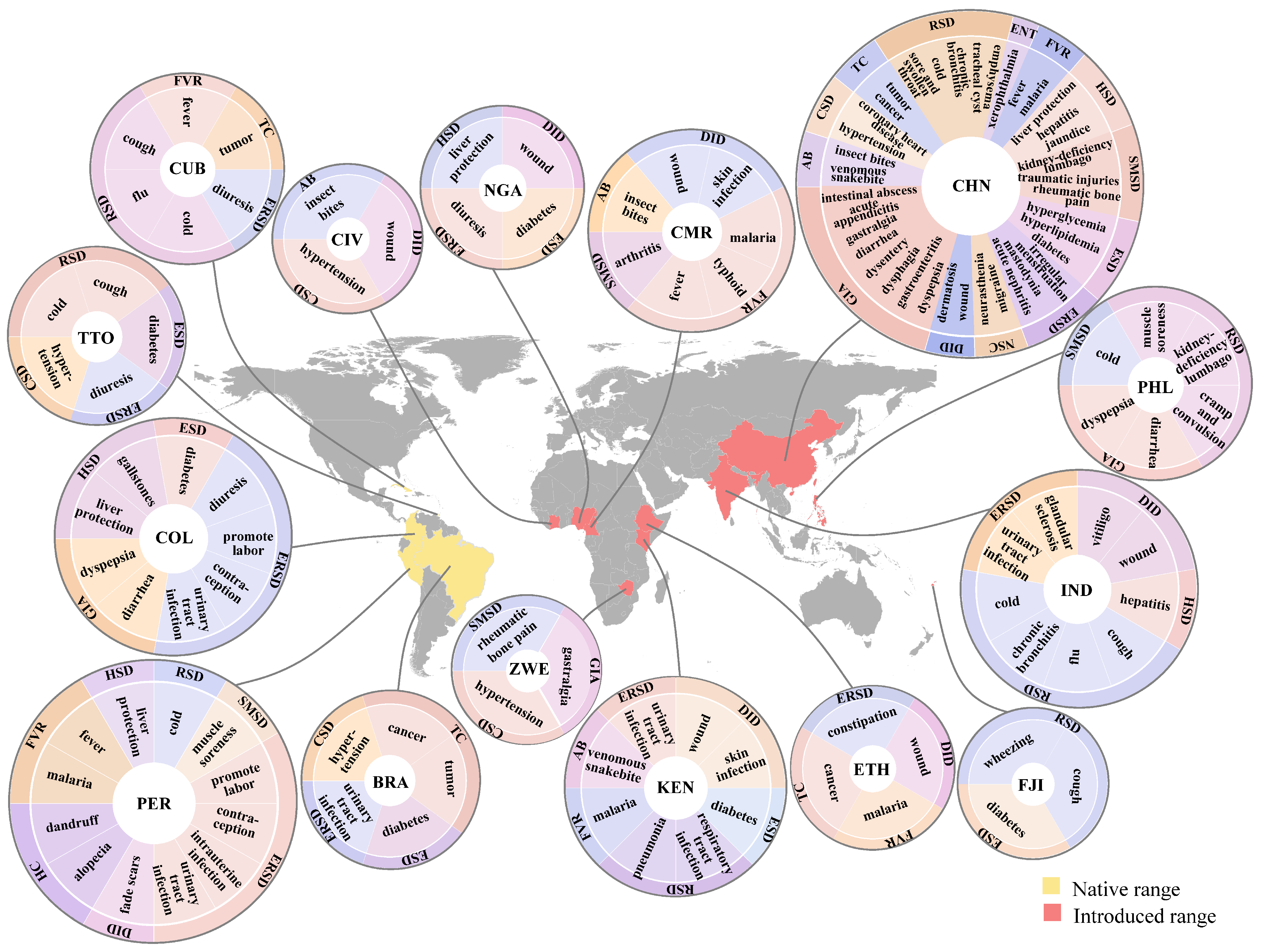
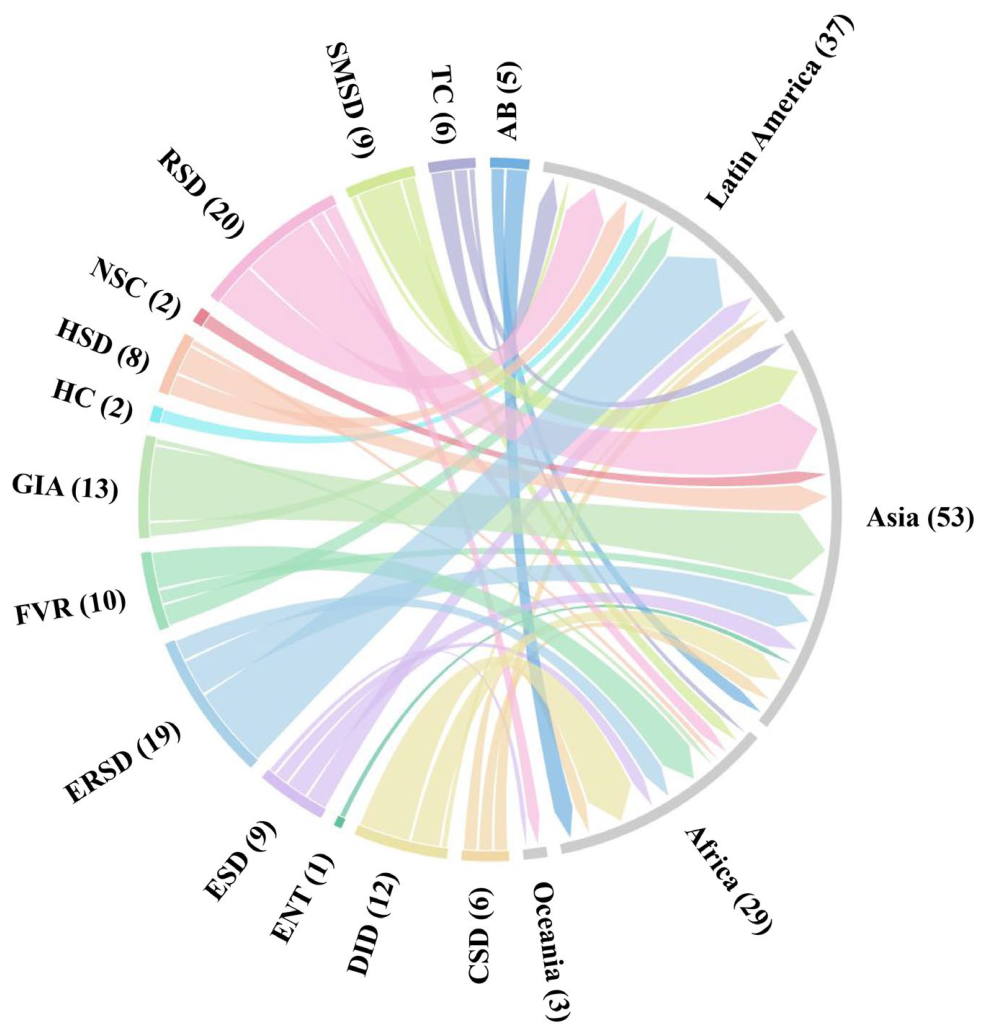
| Categories | Ailments | Country |
|---|---|---|
| Animal bites (ABs) | venomous snakebite | Kenya [53], China [44,54,55,56] |
| insect bites | Cameroon [57], China [58], Côte d’Ivoire [59] | |
| Circulatory system diseases (CSDs) | hypertension | China [44,60,61], Trinidad and Tobago [62], Brazil [63,64], Zimbabwe [65], Côte d’Ivoire [59] |
| coronary heart disease | China [44] | |
| Dermatological infections (DIDs) | fade scars | Peru [66] |
| vitiligo | India [67] | |
| wound | Côte d’Ivoire [12], China [54], Ethiopia [68], Kenya [53,69], Cameroon [70], Nigeria [71], India [72] | |
| dermatosis | China [61] | |
| skin infections | Kenya [12], Cameroon [70] | |
| Ear, nose and eye problems (ENTs) | xerophthalmia | China [44] |
| Endocrine system disorders (ESDs) | hyperglycemia | China [44,60] |
| hyperlipidemia | China [44] | |
| diabetes | China [56,73], Trinidad and Tobago [74], Colombia [75], Fiji [76], Kenya [77], Nigeria [78], Brazil [79] | |
| Excretory and reproductive systems disorders (ERSDs) | acute nephritis | China [44,54] |
| diuresis | Trinidad and Tobago [62], Colombia [71], Nigeria [80], Cuba [81] | |
| promote labor | Peru [66], Colombia [75] | |
| contraception | Peru [66], Colombia [75] | |
| urinary tract infection | Kenya [12], Peru [66], India [72], Colombia [75], Brazil [82] | |
| intrauterine infection | Peru [66] | |
| mastodynia | China [54] | |
| irregular menstruation | China [61] | |
| constipation | Ethiopia [83] | |
| glandular sclerosis | India [72] | |
| Fever (FVR) | malaria | China [44,61], Peru [66], Kenya [77], Cameroon [84], Ethiopia [83] |
| fever | Peru [66], China [85], Cuba [86], Cameroon [87] | |
| typhoid | Cameroon [87] | |
| Gastrointestinal ailments (GIAs) | diarrhea | Colombia [75], China [44,88], Philippines [89] |
| dysentery | China [44,54,90] | |
| gastralgia | China [44], Zimbabwe [65] | |
| dysphagia | China [44] | |
| intestinal abscess | China [44] | |
| dyspepsia | China [61], Colombia [75], Philippines [89] | |
| gastroenteritis | China [44,91,92] | |
| acute appendicitis | China [54,61] | |
| Hair care (HC) | alopecia | Peru [66] |
| dandruff | Peru [66] | |
| Hepatobiliary system diseases (HSDs) | liver protection | China [44,59], Peru [66], Colombia [75], Nigeria [93] |
| hepatitis | China [44], India [72] | |
| gallstones | Colombia [75] | |
| jaundice | China [61,88] | |
| Neurological system disorders (NSCs) | neurasthenia | China [44] |
| migraine | China [54] | |
| Respiratory system diseases (RSDs) | cold | China [60,85,91], Trinidad and Tobago [62], Peru [66], India [72], Philippines [89], Cuba [86] |
| sore and swollen throat | China [44,60,88,90,91] | |
| tracheal cyst | China [44] | |
| chronic bronchitis | China [44], India [67] | |
| emphysema | China [44] | |
| cough | Trinidad and Tobago [62], India [67], Fiji [76], Cuba [86] | |
| pneumonia | Kenya [77] | |
| respiratory tract infection | Kenya [12] | |
| wheezing | Fiji [76] | |
| flu | India [72], Cuba [86] | |
| Skeleto-muscular system disorders (SMSDs) | traumatic injuries | China [44,56] |
| muscle soreness | Peru [66], Philippines [85] | |
| rheumatic bone pain | China [61,88], Zimbabwe [65] | |
| kidney-deficiency lumbago | China [88], Philippines [89] | |
| cramp and convulsion | Philippines [89] | |
| arthritis | Cameroon [70] | |
| Tumors and Cancer (TC) | tumor | Brazil [79], China [44,61], Cuba [81] |
| cancer | Brazil [64], Ethiopia [83], China [94] |
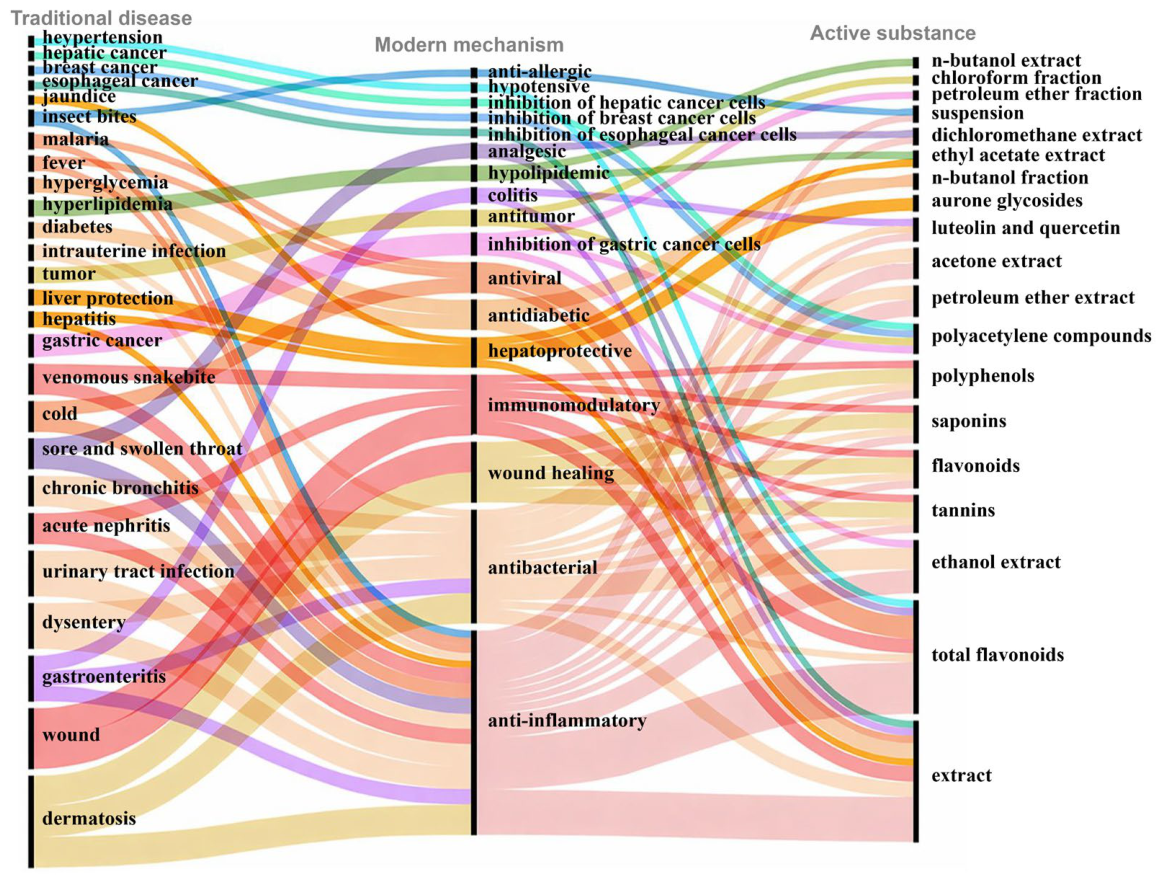
| Disease Categories | Traditional Disease Treatment | Modern Mechanism Verification | Active Substance |
|---|---|---|---|
| Animal bites (ABs) | venomous snakebite | anti-inflammatory; immunomodulatory | extract; total flavonoids |
| insect bites | anti-inflammatory; anti-allergic | suspension | |
| Circulatory system diseases (CSDs) | hypertension | hypotensive | total flavonoids |
| Dermatological infections (DIDs) | wound | wound healing; immunomodulatory | polyphenols, saponins, flavonoids, and tannins |
| dermatosis | anti-inflammatory; antibacterial; wound healing | polyphenols, saponins, flavonoids, and tannins | |
| Endocrine system disorders (ESDs) | hyperglycemia | antidiabetic | extract and n-butanol fraction |
| hyperlipidemia | hypolipidemic | ethyl acetate extract; n-butanol extract | |
| diabetes | antidiabetic | extract and n-butanol fraction | |
| Excretory and reproductive systems disorders (ERSDs) | acute nephritis | anti-inflammatory; immunomodulatory | extract; total flavonoids |
| urinary tract infection | anti-inflammatory; antibacterial | ethanol extract, acetone extract, and petroleum ether extract | |
| intrauterine infection | anti-inflammatory; antibacterial | ethanol extract | |
| Fever (FVR) | malaria | antiviral; anti-inflammatory | total flavonoids |
| fever | antiviral; anti-inflammatory | total flavonoids | |
| Gastrointestinal ailments (GIAs) | dysentery | anti-inflammatory; antibacterial | ethanol extract, acetone extract; petroleum ether extract |
| gastroenteritis | colitis; anti-inflammatory; antibacterial | luteolin and quercetin | |
| Hepatobiliary system diseases (HSDs) | liver protection | hepatoprotective | aurone glycosides, ethyl acetate extract |
| hepatitis | hepatoprotective; anti-inflammatory | extract | |
| jaundice | hepatoprotective | aurone glycosides | |
| Respiratory system diseases (RSDs) | cold | antiviral; anti-inflammatory | extract; total flavonoids |
| sore and swollen throat | anti-inflammatory; analgesic | total flavonoids; dichloromethane extract | |
| chronic bronchitis | anti-inflammatory; antibacterial | extract; total flavonoids | |
| Tumors and cancer (TC) | tumor | antitumor (via multiple mechanisms) | chloroform fraction, polyacetylene compounds |
| gastric cancer | inhibition of gastric cancer cells | petroleum ether fraction, polyacetylene isomers | |
| hepatic cancer | inhibition of hepatic cancer cells | polyacetylene compounds from roots | |
| breast cancer | inhibition of breast cancer cells | polyacetylene compounds from roots | |
| esophageal cancer | inhibition of esophageal cancer cells | extract |
Disclaimer/Publisher’s Note: The statements, opinions and data contained in all publications are solely those of the individual author(s) and contributor(s) and not of MDPI and/or the editor(s). MDPI and/or the editor(s) disclaim responsibility for any injury to people or property resulting from any ideas, methods, instructions or products referred to in the content. |
© 2026 by the authors. Licensee MDPI, Basel, Switzerland. This article is an open access article distributed under the terms and conditions of the Creative Commons Attribution (CC BY) license.
Share and Cite
Zhong, L.-L.; Zhou, X.-S.; Luo, B.-S.; Lin, R.-Z.; Shi, S.; Li, F.-F. Diverse Utilization of Bidens pilosa and Prospects for Sustainable Management. Diversity 2026, 18, 349. https://doi.org/10.3390/d18060349
Zhong L-L, Zhou X-S, Luo B-S, Lin R-Z, Shi S, Li F-F. Diverse Utilization of Bidens pilosa and Prospects for Sustainable Management. Diversity. 2026; 18(6):349. https://doi.org/10.3390/d18060349
Chicago/Turabian StyleZhong, Li-Li, Xing-Song Zhou, Bin-Sheng Luo, Ruo-Zhu Lin, Shi Shi, and Fei-Fei Li. 2026. "Diverse Utilization of Bidens pilosa and Prospects for Sustainable Management" Diversity 18, no. 6: 349. https://doi.org/10.3390/d18060349
APA StyleZhong, L.-L., Zhou, X.-S., Luo, B.-S., Lin, R.-Z., Shi, S., & Li, F.-F. (2026). Diverse Utilization of Bidens pilosa and Prospects for Sustainable Management. Diversity, 18(6), 349. https://doi.org/10.3390/d18060349