
Invasive Alien Plant Species in Black Sea Delta Protected Areas: Patterns, Impacts, and Management Recommendations

 , ,
, ,  , , , , , , ,
Abstract
1. Introduction
2. Materials and Methods
2.1. Study Areas
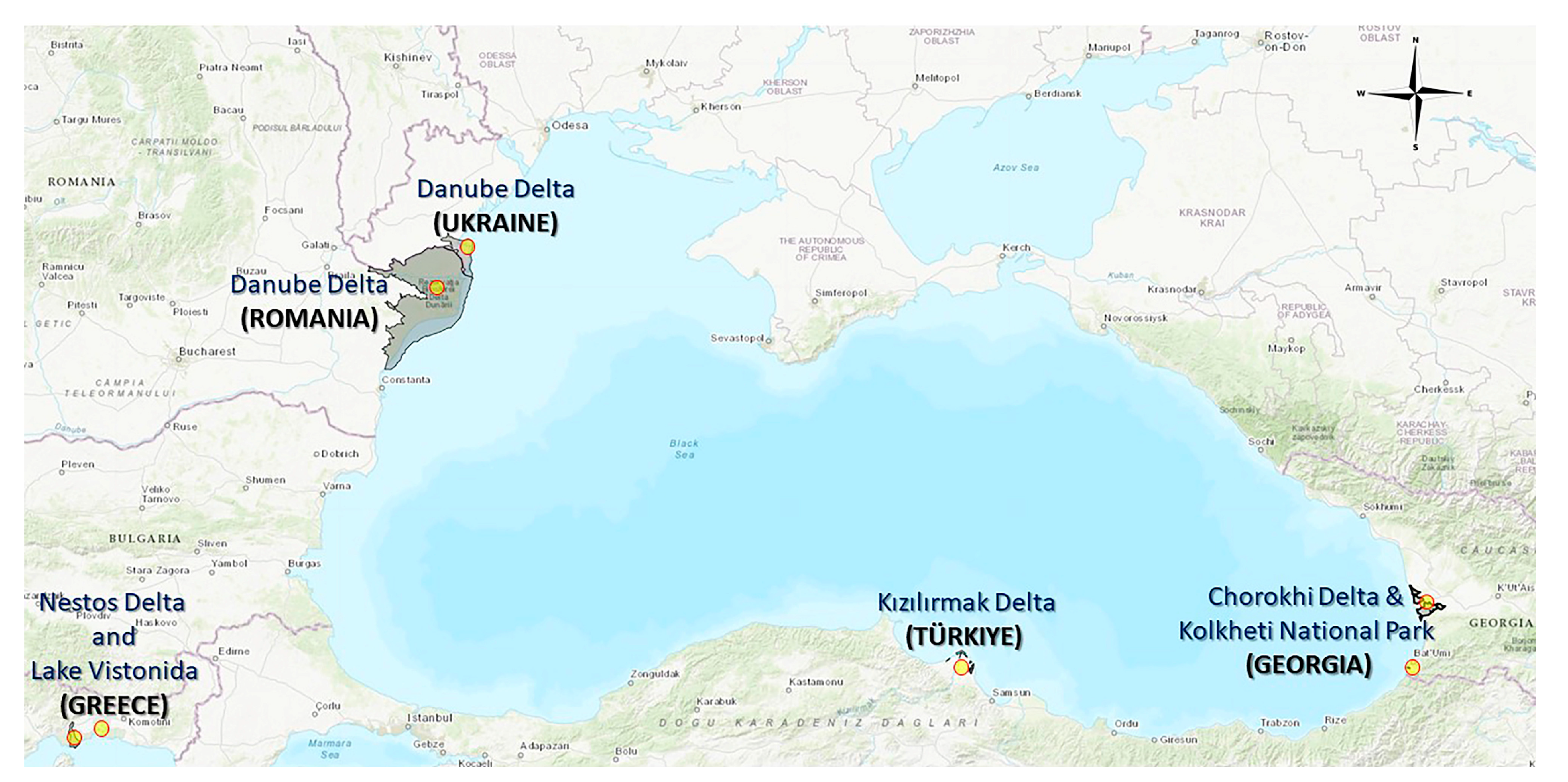
2.1.1. Danube Delta (Romania and Ukraine)
2.1.2. Nestos Delta and Lake Vistonida (Greece)
2.1.3. Kızılırmak Delta (Türkiye)
2.1.4. Chorokhi Delta and Kolkheti National Park (Georgia)
2.2. Data Sources and Field Observations
3. Results
4. Discussion
4.1. Distribution Patterns of Invasive Alien Plant Species in Deltas Around Black Sea
4.2. Reproductive Traits and Dispersal Mechanisms Driving Plant Invasions
4.3. Invasion Dynamics and Impacts of Alien Plant Species
4.4. Management Challenges and Limitations
5. Conclusions
Supplementary Materials
Author Contributions
Funding
Institutional Review Board Statement
Data Availability Statement
Acknowledgments
Conflicts of Interest
References
- Pyšek, P.; Hulme, P.E.; Simberloff, D.; Bacher, S.; Blackburn, T.M.; Carlton, J.T.; Dawson, W.; Essl, F.; Foxcroft, L.C.; Genovesi, P.; et al. Scientists’ warning on invasive alien species. Biol. Rev. 2020, 95, 1511–1534. [Google Scholar] [CrossRef]
- IPBES. Thematic Assessment Report on Invasive Alien Species and Their Control; Roy, H.E., Pauchard, A., Stoett, P., Renard Truong, T., Eds.; IPBES Secretariat: Bonn, Germany, 2023. [Google Scholar]
- European Union. Regulation (EU) No 1143/2014 on invasive alien species. Off. J. Eur. Union 2014, L317, 35–55. [Google Scholar]
- Keane, R.M.; Crawley, M.J. Exotic plant invasions and the enemy release hypothesis. Trends Ecol. Evol. 2002, 17, 164–170. [Google Scholar] [CrossRef]
- Heard, M.; Sax, D.F. Coexistence between native and exotic species is facilitated by asymmetries in competitive ability and predator tolerance. Ecol. Lett. 2012, 16, 337–344. [Google Scholar] [CrossRef]
- Chen, Y.; Xie, Y.; Wei, C.; Liu, S.; Liang, X.; Zhang, J.; Li, R. Invasive plant species demonstrate enhanced resource acquisition traits relative to native species. Diversity 2024, 16, 317. [Google Scholar] [CrossRef]
- Vilà, M.; Pino, J.; Font, X. Regional assessment of plant invasions across habitat types. J. Veg. Sci. 2007, 18, 35–42. [Google Scholar] [CrossRef]
- Kettunen, M.; Genovesi, P.; Gollasch, S.; Pagad, S.; Starfinger, U.; ten Brink, P.; Shine, C. Technical Support to EU Strategy on Invasive Species; IEEP: Brussels, Belgium, 2009. [Google Scholar]
- Haubrock, P.J.; Turbelin, A.J.; Cuthbert, R.N.; Novoa, A.; Taylor, N.G.; Angulo, E.; Ballesteros-Mejia, L.; Bodey, T.W.; Capinha, C.; Diagne, C.; et al. Economic costs of invasive alien species across Europe. NeoBiota 2021, 67, 153–190. [Google Scholar] [CrossRef]
- Pearson, R.G.; Dawson, T.P. Predicting climate change impacts on species distributions. Glob. Ecol. Biogeogr. 2003, 12, 361–371. [Google Scholar] [CrossRef]
- Nekola, J.C.; Divíšek, J.; Horsák, M. Dispersal barriers and species pool richness. Glob. Ecol. Biogeogr. 2022, 31, 1470–1500. [Google Scholar] [CrossRef]
- Rubenstein, M.A.; Weiskopf, S.R.; Bertrand, R.; Carter, S.L.; Comte, L.; Eaton, M.J.; Johnson, C.G.; Lenoir, J.; Lynch, A.J.; Miller, B.W.; et al. Climate change and biodiversity redistribution. Environ. Evid. 2023, 12, 7. [Google Scholar] [CrossRef]
- Essl, F.; Bacher, S.; Blackburn, T.M.; Booy, O.; Brundu, G.; Brunel, S.; Cardoso, A.C.; Eschen, R.; Gallardo, B.; Galil, B.; et al. Tackling pathways of biological invasions. BioScience 2015, 65, 769–782. [Google Scholar] [CrossRef]
- Thuiller, W.; Araújo, M.B.; Lavorel, S. Land-cover data in species distribution models. J. Biogeogr. 2004, 31, 353–361. [Google Scholar] [CrossRef]
- Nunn, N.; Qian, N. The Columbian exchange. J. Econ. Perspect. 2010, 24, 163–188. [Google Scholar] [CrossRef]
- Richardson, D.M.; Pyšek, P.; Rejmánek, M.; Barbour, M.G.; Panetta, F.D.; West, C.J. Naturalization and invasion of alien plants. Divers. Distrib. 2000, 6, 93–107. [Google Scholar] [CrossRef]
- Paudel, R.; Fristoe, T.S.; Kinlock, N.L.; Davis, A.J.; Zhao, W.; Van Calster, H.; Chytrý, M.; Danihelka, J.; Decocq, G.; Ehrendorfer-Schratt, L.; et al. Many plants naturalized as aliens abroad have also become more common within their native regions. Nat. Commun. 2025, 16, 8227. [Google Scholar] [CrossRef]
- Bellard, C.; Leroy, B.; Thuiller, W.; Rysman, J.F.; Courchamp, F. Drivers of invasion risks worldwide. Ecosphere 2016, 7, e01241. [Google Scholar] [CrossRef]
- Bellard, C.; Jeschke, J.M.; Leroy, B.; Mace, G.M. Climate change and invasive species geography. Ecol. Evol. 2018, 8, 5688–5700. [Google Scholar] [CrossRef]
- Scown, M.W.; Dunn, F.E.; Dekker, S.C.; Van Vuuren, D.P.; Karabil, S.; Sutanudjaja, E.H.; Santos, M.J.; Minderhoud, P.S.; Garmestani, A.S.; Middelkoop, H. Global change scenarios in river deltas. Glob. Environ. Change 2023, 82, 102736. [Google Scholar] [CrossRef]
- Hulme, P.E. Trade, transport and trouble: Managing invasive species pathways in an era of globalization. J. Appl. Ecol. 2009, 46, 10–18. [Google Scholar] [CrossRef]
- Wray, A.K.; Agnew, A.C.; Brown, M.E.; Dean, E.M.; Hernandez, N.D.; Jordon, A.; Morningstar, C.R.; Piccolomini, S.E.; Pickett, H.A.; Daniel, W.M.; et al. Understanding gaps in early detection of and rapid response to invasive species in the United States: A literature review and bibliometric analysis. Ecol. Inform. 2024, 84, 102855. [Google Scholar] [CrossRef]
- Simberloff, D.; Martin, J.-L.; Genovesi, P.; Maris, V.; Wardle, D.A.; Aronson, J.; Courchamp, F.; Galil, B.; García-Berthou, E.; Pascal, M.; et al. Impacts of biological invasions: What’s what and the way forward. Trends Ecol. Evol. 2013, 28, 58–66. [Google Scholar] [CrossRef]
- Oprea, A.; Sîrbu, C.; Doroftei, M.; Covaliov, S. Vegetation of Danube Delta. J. Plant Dev. 2024, 31, 159–181. [Google Scholar] [CrossRef]
- Coops, H.; Hanganu, J.; Tudor, M.; Oosterberg, W. Classification of Danube Delta lakes. Hydrobiologia 1999, 415, 187–191. [Google Scholar] [CrossRef]
- Sârbu, A. Inventory of aquatic plants in the Danube Delta. Arch. Hydrobiol. Suppl. 2003, 14, 205–216. [Google Scholar]
- Psilovikos, A.; Vavliakis, E.; Laggalis, T. Evolution of Nestos River delta. Proc. Hell. Geol. Soc. 1988, 20, 312–324. [Google Scholar]
- Athanasiadis, N.; Eleftheriadou, E. Nestos: Vegetation and flora. In Conference Proc. “Nestos Environment and Its Problems”; Geotechnical Chamber of Greece: Thessaloniki, Greece, 1991; pp. 133–159. [Google Scholar]
- Efthimiou, S.G. Structure and Ecological Evolution of Nestos Aquatic Forest. Ph.D. Thesis, Aristotle University, Thessaloniki, Greece, 2000. [Google Scholar]
- Delimani, P.; Xidais, G. Coastline changes in Vistonida Lake. Bull. Geol. Soc. Greece 2018, 36, 988–997. [Google Scholar] [CrossRef][Green Version]
- Key Biodiversity Areas Partnership. Porto Lagos Factsheet. 2025. Available online: https://keybiodiversityareas.org (accessed on 24 April 2026).
- BlackSea Wet Initiative. 2024. Available online: https://www.moew.government.bg (accessed on 16 February 2026).
- MERA. Kızılırmak Delta Management Plan; Turkey Ministry of Environment: Ankara, Turkey, 2019–2023. [Google Scholar]
- Starodubtsev, V.M.; Basarab, R.M. Changes in Chorokhi River delta. Sci. Res. Pract. Appl. 2017, 14. [Google Scholar]
- Archuadze, M.; Arveladze, T.; Basilashvili, K.H.; Bubashvili, T.; Budaghashvili, N.; Gurgenidze, Z.; Mikeladze, A.; Khokhiashvili, L.; Chikorashvili, G.; Jhavakhishvili, N. Chorokhi Delta (CHOROKHI DELTA—GE0000054) Emerald Area Management Plan; Sabuko: Tbilisi, Georgia, 2021. [Google Scholar]
- Mikeladze, I.; Manvelidze, Z.; Tsiskaridze, D.; Shainidze, G. Invasive plants in Chorokhi Delta. Eur. J. Environ. Sci. 2023, 13, 80–89. [Google Scholar]
- Beridze, M.; Varshanidze, N.; Turmanidze, N.; Dolidze, K.; Zarnadze, N.; Bolkvadze, G.; Tchitanava, J.; Manvelidze, N. Plant diversity in Chorokhi Delta. Int. J. Environ. Sci. 2020, 9, 74–76. [Google Scholar]
- Paposhvili, N.; Ninua, L.; Dekanoidze, D.; Temur Shvelidze, T.; Janiashvili, Z.; Javakhishvili, Z. Special Protection Areas (SPA) for birds in Georgia; Ilia State University: Tbilisi, Georgia, 2016. [Google Scholar]
- Devidze, M.; Matchutadze, I.; Phirosmanishvili, M. Wetlands of the Colchis Lowland and Its Pollution Sources; Caucasus Ecology Foundation: Tbilisi, Georgia, 2020; 28p. (In Georgian) [Google Scholar]
- Georgian National Parks. EcovVision; WWF-Caucasus Programme Office: Tbilisi, Georgia, 2021; 36p. (In Georgian) [Google Scholar]
- Denk, T.; Frotzler, N.; Davitashvili, N. Vegetation patterns in Georgia. Biol. J. Linn. Soc. 2001, 72, 287–332. [Google Scholar] [CrossRef]
- Bolqvadze, B.; Matchutadze, I.; Davitashvili, N. Rare plants of Kolkheti lowland. Bull. Acad. Sci. Ga. 2016. [Google Scholar]
- Matchutadze, I.; Memarne, Q.; Tsinaridze, M.; Tetemadze, N.; Tsertsvadze, A.; Krebs, M.; Joostem, H.; Abuladze, I. A Colchis master plan-long term development and conservation. In Proceedings of the 2nd International Conference on the Utilisation of Wetland Plants, Proceedings—RRR 2017, Greifswald, Germany, 26–28 September 2017; pp. 89–90. [Google Scholar]
- European Environment Agency (EEA). EUNIS Terrestrial Habitat Classification 2021; EEA: Copenhagen, Denmark, 2021. Available online: https://www.eea.europa.eu/data-and-maps/data/eunis-habitat-classification-1 (accessed on 20 May 2026).
- Convention on Biological Diversity (CBD). Pathways of Introduction of Invasive Species, Their Prioritization and Management; UNEP/CBD/SBSTTA/18/9/Add.1; CBD: Montreal, QC, Canada, 2014. [Google Scholar]
- Syvitski, J.P.M.; Saito, Y. Morphodynamics of deltas. Glob. Planet. Change 2007, 57, 261–282. [Google Scholar] [CrossRef]
- Best, J. Anthropogenic stresses on rivers. Nat. Geosci. 2019, 12, 7–21. [Google Scholar]
- Richardson, D.M.; Pyšek, P. Plant invasions concepts. Prog. Phys. Geogr. 2006, 30, 409–431. [Google Scholar] [CrossRef]
- Tsiftsis, S.; Merou, T. First inventory of the invasive alien plant species along Nestos River (East Macedonia, NE Greece). Phyton 2023, 62–63, 75–86. [Google Scholar] [CrossRef]
- Zehnsdorf, A.; Hussner, A.; Eismann, F.; Rönicke, H.; Melzer, A. Management options of invasive Elodea nuttallii and Elodea canadensis. Limnologica 2015, 51, 110–117. [Google Scholar] [CrossRef]
- Catford, J.A.; Jansson, R.; Nilsson, C. Reducing redundancy in invasion ecology by integrating hypotheses into a single theoretical framework. Divers. Distrib. 2009, 15, 22–40. [Google Scholar] [CrossRef]
- Lockwood, J.L.; Cassey, P.; Blackburn, T. The role of propagule pressure in explaining species invasions. Trends Ecol. Evol. 2005, 20, 223–228. [Google Scholar] [CrossRef]
- Davis, M.A.; Grime, J.P.; Thompson, K. Fluctuating resources in plant communities: A general theory of invasibility. J. Ecol. 2000, 88, 528–534. [Google Scholar] [CrossRef]
- Pyšek, P.; Richardson, D.M. Invasive species and environmental change. Annu. Rev. Environ. Resour. 2010, 35, 25–55. [Google Scholar] [CrossRef]
- Kaushik, P.; Pati, P.K.; Khan, M.; Khare, P. Functional traits and invasiveness. Trees For. People 2022, 8, 100260. [Google Scholar] [CrossRef]
- Nuñez-Mir, G.C.; Guo, Q.; Rejmánek, M.; Iannone, B.V., III; Fei, S. Predicting invasiveness. Ecology 2019, 100, e02797. [Google Scholar] [CrossRef] [PubMed]
- Vittoz, P.; Engler, R. Seed dispersal distances. Bot. Helv. 2007, 117, 109–124. [Google Scholar] [CrossRef]
- Richardson, D.M.; Rejmánek, M. Trees as invasive species. Divers. Distrib. 2011, 17, 788–809. [Google Scholar] [CrossRef]
- Dickerson, J.C.T.; Sweet, R.D. Common ragweed ecotypes. Weed Sci. 1971, 19, 64–69. [Google Scholar] [CrossRef]
- Önen, H.; Farooq, S.; Tad, S.; Özaslan, C.; Gunal, H.; Chauhan, B.S. The Influence of Environmental Factors on Germination of Burcucumber (Sicyos angulatus). Seeds: Implications for Range Expansion and Management. Weed Sci. 2018, 66, 494–501. [Google Scholar] [CrossRef]
- Schnabel, A.; Nason, J.D.; Hamrick, J.L. Understanding the population genetic structure of Gleditsia triacanthos L.: Seed dispersal and variation in female reproductive success. Mol. Ecol. 1998, 7, 819–832. [Google Scholar] [CrossRef]
- Aikio, S.; Duncan, R.; Hulme, P.E. Lag-phases in invasions. Oikos 2010, 119, 370–378. [Google Scholar] [CrossRef]
- Osunkoya, O.O.; Lock, C.B.; Dhileepan, K.; Buru, J.C. Lag times in weeds. Biol. Invasions 2021, 23, 3383–3408. [Google Scholar] [CrossRef]
- Lapin, K.; Dyderski, M.K. Expansion of Amorpha fruticosa. Reg. Environ. Change 2024, 24, 152. [Google Scholar] [CrossRef]
- Grabić, J.; Ljevnaić-Mašić, B.; Zhan, A.; Benka, P.; Heilmeier, H. Review on Amorpha fruticosa. Ecol. Evol. 2022, 12, e9290. [Google Scholar] [CrossRef]
- Brigić, A.; Vujčić-Karlo, S.; Kepčija, R.M.; Stančić, Z.; Alegro, A.; Ternjej, I. Taxon specific response of carabids (Coleoptera, Carabidae) and other soil invertebrate taxa on invasive plant Amorpha fruticosa in wetlands. Biol. Invasions 2014, 16, 1497–1514. [Google Scholar] [CrossRef]
- De Haan, L.R.; Ehlke, N.J.; Sheaffer, C.C.; Wyse, D.L.; DeHaan, R.L. Diversity of false indigo. Genet. Resour. Crop Evol. 2006, 53, 1463–1476. [Google Scholar]
- Adriaens, T.; Oldoni, D. List of Invasive Alien Species of Union Concern. Version 1.1; Research Institute for Nature and Forest (INBO): Brussels, Belgium, 2025. [Google Scholar] [CrossRef]
- Stotz, G.C.; Gianoli, E.; Cahill, J.F. Spatial invasion patterns. Evol. Appl. 2016, 9, 939–951. [Google Scholar] [CrossRef]
- Robeck, P.; Essl, F.; van Kleunen, M.; Pyšek, P.; Pergl, J.; Weigelt, P.; Mesgaran, M.B. Lag-phase detection in invasive plants. Nat. Ecol. Evol. 2024, 8, 477–488. [Google Scholar] [CrossRef]
- Novoa, A.; Richardson, D.M.; Pyšek, P.; Meyerson, L.A.; Bacher, S.; Canavan, S.; Catford, J.A.; Čuda, J.; Essl, F.; Foxcroft, L.C.; et al. Invasion syndromes: A systematic approach for predicting biological invasions and facilitating effective management. Biol. Invasions 2020, 22, 1801–1820. [Google Scholar] [CrossRef]
- Blackburn, T.M.; Pyšek, P.; Bacher, S.; Carlton, J.T.; Duncan, R.P.; Jarošík, V.; Wilson, J.R.; Richardson, D.M. Unified framework for invasions. Trends Ecol. Evol. 2011, 26, 333–339. [Google Scholar] [CrossRef]
- Vítková, M.; Müllerová, J.; Sádlo, J.; Pergl, J.; Pyšek, P. Robinia pseudoacacia invasion. For. Ecol. Manag. 2017, 384, 287–302. [Google Scholar] [CrossRef]
- Shaw, R.H.; Tanner, R.; Djeddour, D.; Cortat, G. Biological control of Fallopia japonica. Weed Res. 2011, 51, 552–558. [Google Scholar] [CrossRef]
- Nielsen, C.; Ravn, H.P.; Nentwig, W.; Wade, M. (Eds.) The Giant Hogweed Best Practice Manual; Forest & Landscape Denmark: Hoersholm, Denmark, 2005. [Google Scholar]
- Hussner, A.; Stiers, I.; Verhofstad, M.; Bakker, E.S.; Grutters, B.M.C.; Haury, J.; van Valkenburg, J.L.C.H.; Brundu, G.; Newman, J.; Clayton, J.S.; et al. Management and control methods of invasive alien freshwater aquatic plants: A review. Aquat. Bot. 2017, 136, 112–137. [Google Scholar] [CrossRef]
- Doroftei, M. Chorology of Amorpha fruticosa in the Danube Delta. Rom. J. Biol. Plant Biol. 2009, 54, 61–67. [Google Scholar]
- Sârbu, A.; Smarandache, D.; Janauer, G.; Pascale, G. Elodea nuttallii (Planchon) St. John—A competitive hydrophyte in the Romanian Danube River corridors. In Proceedings of the 36th International Conference of IAD; IAD: Vienna, Austria, 2006. [Google Scholar]
- Sîrbu, C.; Anastasiu, P.; Urziceanu, M.; Camen-Comănescu, P.; Sîrbu, I.-M.; Popa, A.-M.; Iojă, C.; Gavrilidis, A.-A.; Oprea, A. Invasive alien plant species in Romania are of European Union concern. Environ. Socio-Econ. Stud. 2021, 9, 32–44. [Google Scholar] [CrossRef]
- Mikeladze, I.; Tsiskaridze, D.; Manvelidze, Z.; Shainidze, G. Distribution and invasiveness of some invasive alien species (IAS) plants in ecosystems of the Colchis Lowland (W Georgia/Sakartvelo). Sci. Ann. Danub. Delta Inst. 2025, 30, 91–106. [Google Scholar] [CrossRef]


| Scientific Name | Occurrence of IAS by Study Area | Native Region | Habitat | Reproductive Strategy | Possible Pathway of Introduction and Factors Affecting Secondary Spread |
|---|---|---|---|---|---|
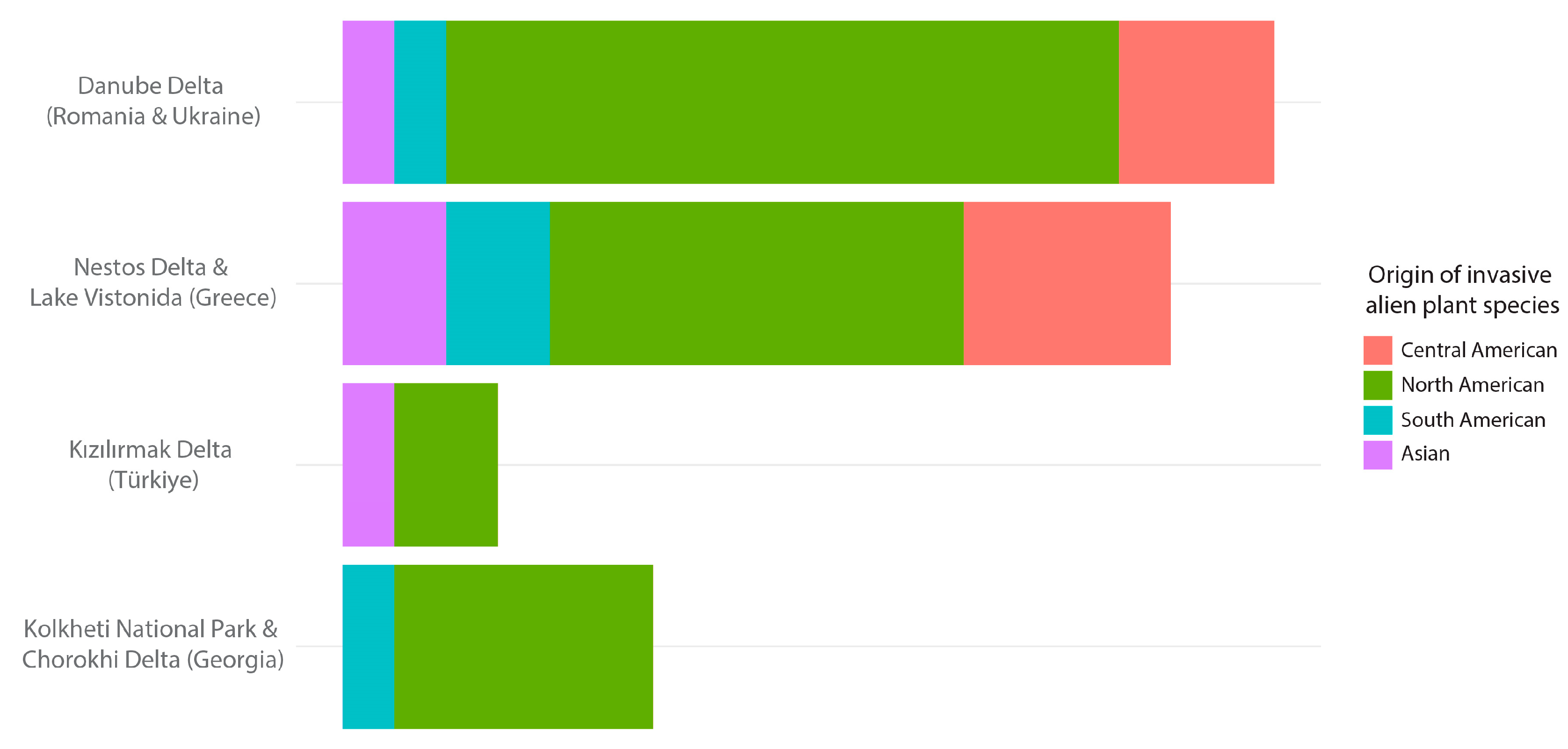
| Amorpha fruticosa L. | Danube Delta Nestos Delta and Lake Vistonida Kızılırmak Delta Chorokhi Delta and Kolkheti National Park | North American | Riparian zones and wetlands, moist open woodlands. | Produces numerous seeds, but it is also able for clonal growth. | Categories of pathways: 2, 4, 6 Silviculture, road construction, water transport, floods. |
| Acer negundo L. | Danube Delta Nestos Delta and Lake Vistonida | North American | Riparian zones, Mediterranean riparian woodland, mesic grasslands, moist and urban areas. | Produces numerous seeds, but it is also able for clonal growth. | Categories of pathways: 2, 4, 6 Wind seed dispersal, water transport, through wildlife and along transportation corridors. |
| Ailanthus altissima (Mill.) Swingle | Danube Delta Nestos Delta and Lake Vistonida Kızılırmak Delta | East Asian (China) | Urban areas, roadsides, woodland edges, riparian zones, disturbed sites, shrublands, mesic and xeric woodlands. | Produces numerous seeds, but it is also able for clonal growth. | Categories of pathways: 2, 6 Wind seed dispersal, water transport. |
| Ambrosia artemisiifolia L. | Danube Delta Chorokhi Delta and Kolkheti National Park | North American | Pioneer species establishing after disturbance, in nutrient rich and slightly acidic soils. | Produces numerous seeds. | Categories of pathways: 2, 6 Commercial bird mixes, contaminated cereal seed, like sunflower and sorghum, cultivated in Ukraine as medicinal plant. |
| Broussonetia papyrifera (L.) L’Hér. ex Vent. | Nestos Delta | East Asian | Riparian zones, forest edges, disturbed sites, urban areas. | Both sexual (seed production) and vegetative reproduction (root suckers). Clonal growth is dominant in areas of invasion. | Categories of pathways: 1, 2, 6 |
| Datura stramonium L. | Danube Delta Nestos Delta and Lake Vistonida | North and Central American | Disturbed habitats, agricultural fields, roadsides, riverbanks, urban wastelands. | Sexual reproduction and prolific seed production (thousands per plant). Seeds remain viable below ground for decades. | Categories of pathways: 3, 4, 6 Spreads through agricultural activities and soil movement. |
| Elodea canadensis Michx. | Danube Delta | North American | Freshwater lakes, ponds, slow-flowing rivers, canals, submerged habitats. | Vegetative reproduction via fragments (main). Sexual reproduction is rare in its introduced range. | Categories of pathways: 2, 5, 6 It is considered that spread in European freshwater systems occurs predominantly through vegetative fragments, dispersed by a combination of natural vectors such as water currents and animals, and anthropogenic vectors including boats, fishing gear, water management activities, and the disposal of aquatic plant material. |
| Elodea nuttallii (Planch.) H.St.John | Danube Delta | North American | Freshwater bodies (lakes, rivers, ponds, reservoirs, slow-flowing or still waters, shallow to deeper zones). Mesotrophic to eutrophic waters. | Almost entirely vegetative. | Categories of pathways: 2, 5, 6 Aquariums and ponds. |
| Erigeron canadensis L. | Danube Delta Nestos Delta | North American | Disturbed sites, agricultural fields, roadsides, urban areas, riverbanks. Rapidly spreading in agroecosystems and urban landscapes. | Sexual reproduction. Produces an extremely high number of seeds (up to >200,000 seeds per plant). Seeds are capable for long distance wind dispersal. | Categories of pathways: 3, 4, 5, 6 Secondary spread via grain trade, and transport corridors. |
| Gleditsia triacanthos L. | Danube Delta Nestos Delta and Lake Vistonida Chorokhi Delta and Kolkheti National Park | Central and North American | Riparian forests, floodplains, open woodlands, grassland edges, riverbanks, agroecosystems, disturbed and urban habitats. | Sexual reproduction via abundant seed production. Seeds dispersed mainly by livestock and waterways. It forms a permanent, long-lived seed bank. | Categories of pathways: 1, 2, 6 Used as windbreak, hedge and for fodder. |
| Phytolacca americana L. | Danube Delta Nestos Delta and Lake Vistonida | North American | Disturbed areas, field edges, clearings, roadsides, fence lines, waste places, forest edges. | Produces numerous seeds, which can live for up to 40 years in the soil. | Categories of pathways: 2, 6 Easily dispersed by birds. |
| Robinia pseudoacacia L. | Danube Delta Nestos Delta and Lake Vistonida Kızılırmak Delta | North American | Riverbanks, ruderal habitats, dry grasslands and rocky outcrops. Open, sunny, disturbed sites in well-drained soils. | Reproduces both by seed and vegetatively. Produces numerous seeds. | Categories of pathways: 1, 2, 6 Widely planted and naturalised in Europe. |
| Sicyos angulatus L. | Danube Delta Chorokhi Delta and Kolkheti National Park | North American | Sunny grasslands to shady forests. Prefers fertile, moist or even wet soils, such as floodplains, riverbanks, field edges, ditches and a variety of disturbed habitats. | Reproduces by seeds that can remain viable in soil seed bank for many years. | Categories of pathways: 2, 4, 6 Fruit dispersal in flowing water. |
| Solanum elaeagnifolium Cav. | Nestos Delta and Lake Vistonida | Central and South American | Disturbed areas, such as roadsides, field edges, wastelands, margins of agricultural land, canal banks. | Sexual reproduction and vegetative reproduction via root fragments, rhizomes, and dormant buds in the root system. | Categories of pathways: 3, 4, 6 Seeds often dispersed by water, animals or human vectors. |
| Solidago canadensis L. | Danube Delta Chorokhi Delta and Kolkheti National Park | North American | Disturbed sites, such as roadsides, abandoned fields, forest margins, grasslands, riparian margins. | Sexual reproduction and vegetative reproduction via rhizomes. | Categories of pathways: 2, 6 Wind-dispersed seeds. |
| Verbena brasiliensis Vell. | Chorokhi Delta and Kolkheti National Park | South American | Wetland/riparian zones, along canals and disturbed ground. Capable of growing in both wet and drier habitats, often found in old fields. | Sexual reproduction. It produces numerous seeds. | Categories of pathways: 2, 3, 6 Seeds can be dispersed by water, animals, or human vectors. |
| Xanthium orientale L. | Danube Delta Nestos Delta and Lake Vistonida | North, Central and South American | Wetland/riparian zones, along canals and disturbed ground. Capable of growing in both wet and drier habitats, often found in old fields. | Sexual reproduction. It produces numerous seeds. | Categories of pathways: 3, 4, 6 Seeds in spiny burs, dispersed easily via attachment to animals or humans. Burs also float and dispersed by water. |
| Scientific Name | Distribution Trend | Ecological Impact | Economic/Social Impact | Control Measures |
|---|---|---|---|---|
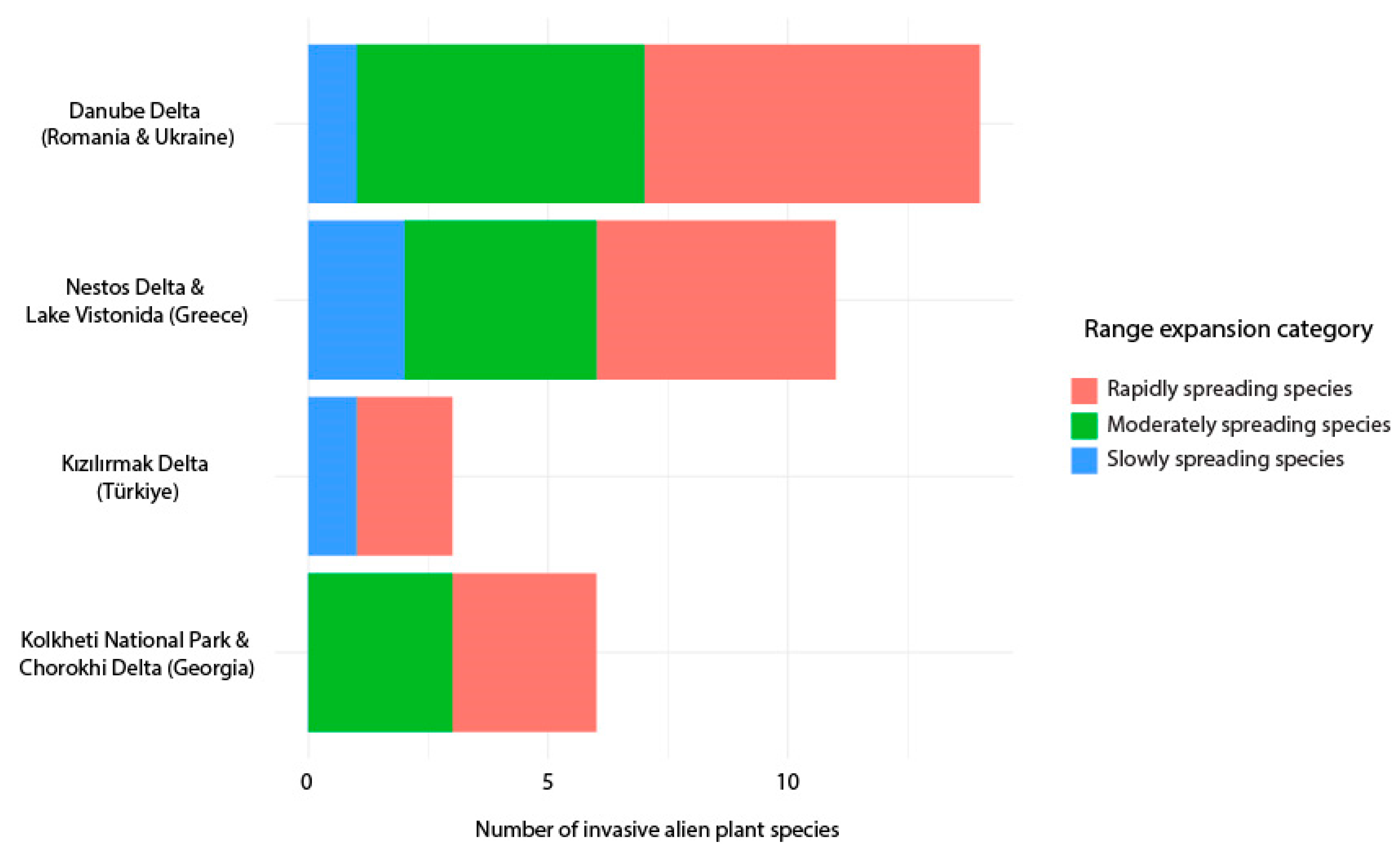
| Amorpha fruticosa L. | Rapidly spreading species | Negative. Dense thickets competing native flora, lower plant richness/diversity, alter invertebrate communities, modify riparian ecosystem processes. Nitrogen-fixing ability and reported allelopathy can shift community dynamics. | Nitrogen-fixing species, used as an ornamental, for stabilising slopes, for forage, constitutes good grazable material, and tolerant of defoliation, easy to resprout. Seeds are used as an oil source in the manufacture of glycerol. | Prevention is often the most effective strategy; mechanical control; chemical control. |
| Acer negundo L. | Moderately spreading species | Medium, decrease understory plant diversity. | Rapid growth and environmental tolerance, used as an ornamental along street pavements and shelterbelts, suitable for beekeeping, source of food and shelter, especially in the winter. | Mechanical control. |
| Ailanthus altissima (Mill.) Swingle | Slowly spreading species | Modifies communities and ecosystems, as it grows extremely rapidly and interferes with growth of native species. | Used as an ornamental, because it grows quickly, it can be trained into an attractive shape, and has attractive foliage and fruits. Tree-of-heaven is considered an important timber and fuelwood tree. | Chemical control; mechanical control; biological control. |
| Ambrosia artemisiifolia L. | Rapidly spreading species | It displaces native vegetation in its introduced range especially after a disturbance. | Seasonal aeroallergen in late summer to early fall, weed pests in agricultural crops. Its fruits can cause illness in livestock that ingests it. An essential oil of Ambrosia artemisiifolia acts as an antimicrobial, having antibacterial and antifungal compounds. | Chemical control; mechanical control; biological control. |
| Broussonetia papyrifera (L.) L’Hér. ex Vent. | Slowly spreading species | Alters forest structure and understory composition. Creates dense monospecific stands and suppresses native tree regeneration due to shading and aggressive clonal growth. | Its pollen is highly allergenic and causes respiratory problems. | Mechanical control; chemical control. |
| Datura stramonium L. | Rapidly spreading species in disturbed and agricultural areas | Competes strongly with crops, alters plant community composition in disturbed ecosystems. However, its impact in natural habitats is limited. | It reduces crop yields and increases weed-control costs. It is highly toxic to humans and livestock, as it causes poisoning. | Mechanical control (only before seed set; chemical control (in crops). |
| Elodea canadensis Michx. | Moderately spreading species | Dense submerged mats can reduce light and displace native macrophytes. It modifies habitat structure for aquatic fauna. | Impedes recreation and water management (navigation, fishing). Where dominant, it increases maintenance needs in canals and water bodies. | Prevention (avoid releases); mechanical removal/harvesting where feasible. |
| Elodea nuttallii (Planch.) H.St.John | Rapidly spreading species | It makes dense monospecific populations and colonises all of water bodies, cut off light, produce anoxic conditions and trap sediments in the system. Plant decomposition induces a secondary eutrophication toxic to many plants. Outcompete several native aquatic plants and provide a poor habitat for aquatic animals. | They interfere with recreation activities and increase the risk of adjacent land flooding. Floating Elodea mats block the entrance section of hydroelectric power plants. | Chemical control; mechanical control; biological control. |
| Erigeron canadensis L. | Rapidly spreading species in agroecosystems and urban landscapes | It dominates early successional communities suppressing native and crop species through competition. It presents limited impact on natural ecosystems. | Constitutes a major agricultural weed. | Integrated management required; mechanical control (before seed set); chemical control (increasingly difficult due to resistance). |
| Gleditsia triacanthos L. | Moderately spreading species | Forms dense stands, suppresses native vegetation through shading and competition. It alters grassland and riparian biodiversity. | Negative impacts on grazing lands due to thorny stems. It hinders livestock movement. | Mechanical control; chemical control; grazing management to reduce seed dispersal and seed bank persistence. |
| Phytolacca americana L. | Moderately spreading species | Low risk in biodiversity. | Toxic to livestock, pets, and humans. Used as ornamental. | Mechanical control. |
| Robinia pseudoacacia L. | Rapidly spreading species | Expands rapidly by root suckering and stump sprouting, and forms dense clones creating shaded islands from which most native plants are outcompeted. It modifies soil properties and favours the development of a nitrogen-demanding vegetation. | Used for erosion control and soil stabilisation. Wood is durable, used for fences and furniture. Used as ornamental tree in many urban areas. | Mechanical control; chemical control. |
| Sicyos angulatus L. | Rapidly spreading species | It forms dense mats that compete with native vegetation, especially in riparian and floodplain habitats. It reduces light under canopy and it hinders regeneration of trees/shrubs in riparian zones. It alters plant community composition and reduces plant diversity. | It can reduce crop yields as a weed. | Mechanical control; chemical control. |
| Solanum elaeagnifolium Cav. | Rapidly spreading species | Competes with native flora, especially in disturbed or marginal habitats, reducing species richness. Alters soil microbial/nematode communities. | Negatively affects crop yields. Serves as host for agricultural pests and pathogens. Toxic to livestock. | Mechanical control; chemical control. |
| Solidago canadensis L. | Moderately spreading species | Competes with native vegetation and reduces plant diversity and richness. | Contains bioactive compounds that are believed that have antioxidant, antimicrobial, and anticancer activities. Used as ornamental. | Mechanical control; chemical control. |
| Verbena brasiliensis Vell. | Moderately spreading species | Competes with native vegetation and reduces species richness. Alters native plant community structure, especially in riparian/disturbed habitats. | Used as ornamental | Mechanical control; chemical control. |
| Xanthium orientale L. | Moderately spreading species | It forms dense stands that shade out other plants and alter the microclimate of the area. This can lead to changes in soil moisture, nutrient availability, and the composition of the plant community, ultimately affecting ecosystem functioning. | Major weed of crops. Toxic to livestock. It contains medicinal substances, and is used in the traditional herbal medicine. | Mechanical control; chemical control. |
Disclaimer/Publisher’s Note: The statements, opinions and data contained in all publications are solely those of the individual author(s) and contributor(s) and not of MDPI and/or the editor(s). MDPI and/or the editor(s) disclaim responsibility for any injury to people or property resulting from any ideas, methods, instructions or products referred to in the content. |
© 2026 by the authors. Licensee MDPI, Basel, Switzerland. This article is an open access article distributed under the terms and conditions of the Creative Commons Attribution (CC BY) license.
Share and Cite
Tsiftsis, S.; Merou, T.; Doroftei, M.; Kvach, Y.; Karakoç, F.T.; Mikeladze, I.; Covaliov, S.; Damianidis, C.; Ene, L.; Erüz, C.; et al. Invasive Alien Plant Species in Black Sea Delta Protected Areas: Patterns, Impacts, and Management Recommendations. Diversity 2026, 18, 350. https://doi.org/10.3390/d18060350
Tsiftsis S, Merou T, Doroftei M, Kvach Y, Karakoç FT, Mikeladze I, Covaliov S, Damianidis C, Ene L, Erüz C, et al. Invasive Alien Plant Species in Black Sea Delta Protected Areas: Patterns, Impacts, and Management Recommendations. Diversity. 2026; 18(6):350. https://doi.org/10.3390/d18060350
Chicago/Turabian StyleTsiftsis, Spyros, Theodora Merou, Mihai Doroftei, Yuriy Kvach, Fatma Telli Karakoç, Irakli Mikeladze, Silviu Covaliov, Christos Damianidis, Liliana Ene, Coşkun Erüz, and et al. 2026. "Invasive Alien Plant Species in Black Sea Delta Protected Areas: Patterns, Impacts, and Management Recommendations" Diversity 18, no. 6: 350. https://doi.org/10.3390/d18060350
APA StyleTsiftsis, S., Merou, T., Doroftei, M., Kvach, Y., Karakoç, F. T., Mikeladze, I., Covaliov, S., Damianidis, C., Ene, L., Erüz, C., Kalashnik, K., Mastrogianni, A., Simionov, M., Tsiskaridze, D., Varsamis, G., Vasiou, A., & Lupu, G. (2026). Invasive Alien Plant Species in Black Sea Delta Protected Areas: Patterns, Impacts, and Management Recommendations. Diversity, 18(6), 350. https://doi.org/10.3390/d18060350