Article

Land-Use Change Reshapes Sand Fly Communities: Diversity Loss and Vector Persistence in Amazonian Landscapes


by
Rebeca Cristina de Souza Guimarães
1,*,
Keillen Monick Martins-Campos
2,
Emanuelle de Sousa Farias
2,
Victoria Amanda Barreto de Arruda
1,
Eric Fabricio dos Santos Marialva
1,
Gabriela Marques Peixoto
2,
Lina Maria Pelaez Cortes
1,
Jordam William Pereira-Silva
2,
Ronildo Baiatone Alencar
3,
Claudia María Ríos-Velásquez
2,
Thiago Junqueira Izzo
4,* and
Felipe Arley Costa Pessoa
2,*
1
Programa de Pós-Graduação em Biologia da Interação Patógeno-Hospedeiro (PPGBIO), Instituto Leonidas e Maria Deane (ILMD), Fiocruz Amazônia, Manaus 69057-070, Amazonas, Brazil
2
Laboratorio de Ecologia de Doenças Transmissíveis na Amazônia (EDTA), Instituto Leônidas e Maria Deane (ILMD), Fiocruz Amazônia, Manaus 69057-070, Amazonas, Brazil
3
Fundação de Vigilância em Saúde do Estado do Amazonas Dra. Rosemary Costa Pinto (FVS-RCP/AM), Manaus 69093-018, Amazonas, Brazil
4
Departamento de Botânica e Ecologia, Universidade Federal de Mato Grosso, Cuiabá 78060-900, Mato Grosso, Brazil
*
Authors to whom correspondence should be addressed.
Diversity 2026, 18(6), 339; https://doi.org/10.3390/d18060339
Submission received: 27 April 2026 / Revised: 27 May 2026 / Accepted: 2 June 2026 / Published: 4 June 2026
(This article belongs to the Special Issue Ecology and Diversity of Diptera in the Tropics)

Abstract

The Amazon Basin harbors a high diversity of phlebotomine sand flies, including several species that act as vectors of zoonotic pathogens such as Leishmania. Land-use changes, particularly forest conversion to agriculture, alter the sand fly diversity and community structure, with implications for the transmission of American Tegumentary Leishmaniasis (ATL). We evaluated the effects of forest-to-agriculture conversion on sand fly diversity and species composition in two rural areas, on opposite sides of the Amazonas River, in the Brazilian Amazon Region. Sand flies were collected using Center of Disease Control (CDC) light traps, installed in the forest and cropland environments, at the Presidente Figueiredo (North) and Urucurituba (South) municipalities, in Amazonas, Brazil. We collected a total of 1778 phlebotomine sand flies from 15 genera and 69 species. The most abundant species were Micropygomya rorotaensis (n = 436; 24.52%), Nyssomyia antunesi (n = 297; 16.70%), Sciopemyia sordellii (n = 101; 5.68%), Bichromomyia flaviscutellata (n = 84; 4.72%) and Evandromyia monstruosa (n = 72; 4.04%). In addition, four sand fly species were recorded for the first time in the Amazonas state: Brumptomyia mesai, Pressatia calcarata, Evandromyia aldafalcaoae and Lutzomyia carvalhoi. Sand fly richness, diversity, and community composition varied between riversides and environments, reflecting strong effects of anthropogenic disturbance. Although croplands supported reduced and more heterogeneous assemblages, several medically important vector species persisted across both environments. Species turnover was high, but patterns of species loss were weak, suggesting that community reorganization was driven by non-directional compositional change process. Our results indicate that land-use change reshapes sand fly communities without eliminating disease vectors, potentially increasing ATL transmission risk at the forest–anthropic interface.

1. Introduction

Phlebotomine sand flies are important medical and veterinary vectors of a wide range of pathogens, including several species of the Leishmania genus. These small insects belong to the order Diptera, family Psychodidae, subfamily Phlebotominae, and are widely distributed worldwide [1]. Currently, 1063 species are described, of which around 10% of all species are confirmed or suspected as vectors of leishmaniases worldwide [2,3]. In Brazil, the highest richness of these insects is found in the Amazon Region, which is also endemic for American Tegumentary Leishmaniasis (ATL) [4,5].
ATL is currently expanding territorially, with notable changes in its epidemiological profile, including increased domestic transmission in several regions [6,7,8,9]. In the Brazilian Amazon Region, seven species of Leishmania have been due to human causes: Leishmania (Leishmania) amazonensis (Lainson & Shaw, 1972), L. (Viannia) braziliensis Vianna, 1911, L. (V.) guyanensis Floch, 1954, L. (V.) naiffi Lainson & Shaw, 1989, L. (V.) lainsoni Shaw, Braga & Ishikawa, 1987, L. (V.) lindenbergi Silveira, Ishikawa & de Souza, 2002 and L. (V.) shawi Lainson, Braga & de Souza, 1989. They have also been transmitted by several sand fly species [3]. Between 2020 and 2024, 32,879 new ATL cases were reported in Brazil, with the Northern Region accounting for 45.63% of these cases [10]. The Amazonas state is among the most affected areas in northern Brazil, with 6309 ATL cases registered in the same period, ranking the state second in the region and fourth nationwide [11].
In the Amazonas state, 136 species of phlebotomine sand flies are currently recorded [12]. The species incriminated as main vectors of ATL are Nyssomyia umbratilis (Ward and Fraiha, 1977) and Ny. anduzei (Rozeboom, 1942), vectors of L. guyanensis [13,14]; Bichromomyia flaviscutellata (Mangabeira, 1942) and Bi. nociva (Young and Arias, 1982), vectors of L. amazonensis [15]; and Trichophoromyia ubiquitalis (Mangabeira, 1942), vector of L. lainsoni [16,17]. ATL distribution within Amazonas is heterogeneous, with most cases concentrated in the Manaus metropolitan region, particularly in the municipalities of Presidente Figueiredo, Rio Preto da Eva, and Itacoatiara [11]. In contrast, other areas show lower reported incidence, which may partly reflect underreporting due to limited access to health services in remote locations [5,11]. In addition, climate variability and environmental changes may affect the distribution and diversity of sand flies between regions, thereby affecting the spatial distribution of ATL [18,19,20,21].
The conversion of forest to agricultural landscapes has been associated with changes in the diversity and community structure of many medical important species [4,22,23,24]. In the Amazon region, studies have shown that changes in the forest cover and structure may affect the distribution and diversity of sand flies and their blood feeding resources in rural landscapes. Ramos et al. observed the highest richness and abundance of sand flies in areas where human population density was high [20]. Pessoa, Medeiros and Barret showed that vector species, naturally infected with trypanosomatids, could maintain the transmission cycle in disturbed areas [25]. Furthermore, some vector species can adapt to the human-shaped environments, consequently increasing the entomological risk of domestic transmission [6,19,26,27].
Despite increasing evidence that land-use change alters sand fly communities, it remains unclear whether these changes follow predictable ecological patterns (e.g., deterministic filtering and nested species loss) or reflect turnover processes, particularly in Amazonian rural landscapes. Furthermore, the extent to which medically important vector species persist under such disturbance remains poorly understood. Thus, this study aimed to evaluate the effects of land-use disturbance on the composition and diversity of phlebotomine sand flies in two rural areas located on opposite banks of the Amazonas River, Brazil. Specifically, we tested whether: (i) species richness would be consistently lower in agricultural environments than in forests, regardless of the riverbank; (ii) species composition would differ between opposite riverbanks and environments; (iii) land-use conversion would act as a deterministic environmental filter, leading to the loss of forest-associated species and the persistence of generalist taxa; and (iv) medically important vector species would show a relative advantage in anthropogenically disturbed environments.

2. Materials and Methods

2.1. Ethical Aspects

Authorization for the collection of sand fly specimens in the studied area was granted under permit nº 12186-9 by the Biodiversity Authorization and Information System (SISBIO) of the Chico Mendes Institute for Biodiversity Conservation (ICMBio).

2.2. Study Areas

The study was carried out in the Amazonas state, in the northern region of Brazil (Figure 1A,B) in rural areas of the municipalities of Presidente Figueiredo and Urucurituba, located in the North and South of Amazonas riverbanks, respectively (Figure 1C–E).
Presidente Figueiredo municipality is an area of high ATL rates, with 733 cases recorded (2.22/10,000 cases/inhabitants) during 2020 to 2024 [11]. Sand fly collection was carried out in the Rio Pardo rural settlement (S01°49′02.4″, W060°19′03.6″) (Figure 1E). The settlement comprises an area of about 28,000 hectares of Terra-Firme rainforest, approximately 550 inhabitants, and around 170 households. The main economic activities include livestock farming, fish pounds and monoculture crops of banana, regional fruits and cassava roots. Collections were carried out in two sites named “A” (1°48′29.0″ S, 60°19′30.7″ W) and “B” (1°45′45.6″ S, 60°17′45.2″ W).
Urucurituba municipality (S 3°07′51″, W 58°09′18″) is part of the microregion of Itacoatiara municipality; however, they are separated by the Amazon River. Interestingly, cases of ATL in this municipality are low; only four human cases were recorded in the period of 2020 to 2024 [11]. The municipality has an area of 2863,889 km2 and 25.965 inhabitants [28]. The vegetation comprises Várzea (flooded lowlands) and Terra-Firme rainforest, surrounded by lakes, islands and small hills. The economic activities in this region mainly involve monoculture plantations, timber harvest, livestock farm and fishponds. Sand fly collection was carried out in two sites named here as “C” (3°09′39.8″ S, 58°07′12.4″ W) and “D” (3°10′49.0″ S, 58°10′51.6″ W) in the rural area of the municipality (Figure 1D). The sites sampled were classified as a smallholding with approximately 100 hectares each, with cacao, banana, orange, cassava and some secondary degraded scrubs. The forest area fragments are similar in size as the croplands. All croplands are with at least 30 years of human exploitation and colonization and irrigation system.
In both areas, according to the Köppen–Geiger classification, the climate is tropical, with an average annual temperature of 27 °C and two climatic seasons: rainy (December to May) and dry (July to November).

2.3. Sand Fly Sampling

Sand fly samplings were carried out in two field expeditions in each location during the months of August and September 2023 and February and March 2024. In each location, we chose two sampling sites arbitrarily, based on satellite imagens from Google Earth, including the environments of a forest (area with high cover, undisturbed and non-flooded vegetation, with a distance of about 100 m from the cropland edge) and a cropland (area with low vegetation cover, mixed or monoculture of plant species, with a distance of about 100 m from the peridomestic area). Sand flies were collected using Center of Disease Control (CDC) light traps (EntomoTrap®, Salvador, BA, Brazil) installed simultaneously every 50 m from each other, in four sampling points by environment, from 18:00 h to 06:00 h, during nine consecutive days. The amount of 8 trap/night per sampling site was used, and a total of 288 traps were used for the expedition.

2.4. Sand Fly Processing and Identification

After collection, sand flies were conservated in 96% alcohol and maintained at −20 °C until the sampling processing. Sand flies were clarified in potassium hydroxide (10% KOH) and 10% acetic acid, washed in sterilized water and then mounted in Berlese solution. For species identification the taxonomic keys of Galati [12], Young and Duncan [29] and LutzoDex® application [30] were used. After identification, sand fly species were categorized as either a proven vector or found naturally infected with Leishmania spp., based on the classification of Shaw [31].

2.5. Data Analysis

We used descriptive analyses such as number of individuals and number of species for general abundance and richness, respectively. To verify the sand fly diversity on the environments, on both riverbanks, we applied the Hill numbers, which quantify diversity as the effective number of species, integrating species richness and relative abundances [32]. We used the parameter q based on exponential Shannon entropy (q = 1), where everyone is counted equally and each species is weighted in proportion to its abundance. To test and compare the effects of environment (forest vs. cropland) on species richness and diversity, on both and between riverbanks we performed Generalized Linear Mixed Models (GLMMs) analyses, with a Poisson distribution for species richness and a Gaussian distribution for diversity. The type of trap installed within the site’s identity (1|trap/site) was used as a random factor in the model. The car, entropart and MASS packages were used for GLMM analyses [33,34]. The adequacy and overdispersion of data were evaluated using the DHARMa package [35]. The emmeans were performed to analyze the least-squares means of each group, and the contrasts function was used to perform post hoc comparisons among groups [36].
Rarefaction curves based on the number of samples were performed to estimate differences in species richness among environments on both riverbanks, using the packages vegan [37] and iNext [38]. To evaluate the influence of environments on sand fly composition, we applied a Permutational Multivariate Analysis of Variance (PERMANOVA). After detecting significant differences (p < 0.05), we performed a paired PERMANOVA (pairwiseAdonis package) to identify which environments and riverbanks the difference was observed. We also applied a Permutational Analysis of Multivariate Dispersions (PERMDISP) to evaluate the variability of data between groups, based on Bray–Curtis dissimilarity [39]. To visualize the community structure organization between the environments and riverbanks, a Non-Metric Multidimensional Scaling (NMDS) plot was performed. To evaluate species association to the environment types, we performed the Indicator Species Analyses (IndVal) [40].
Nestedness was quantified using the NODF metric (Nestedness metric based on Overlap and Decreasing Fill), calculated with the function nestednodf from the vegan package [37]. Statistical significance of directional nestedness was assessed using null models generated with the swap algorithm, which preserves site (row) and species (column) occurrence totals, thereby controlling differences in local richness and regional species frequencies. For each matrix, 999 simulations were performed, and significance was evaluated by comparing the observed NODF value with the null distribution using the oecosimu function. All analyses and figures were generated using RStudio 2026.01.2+418 version.

3. Results

3.1. General Composition

We collected a total of 1778 phlebotomine sand flies in the North (n = 1435) and South (n = 343) riverbanks. All 69 sand fly species were identified as belonging to 15 genera (Table 1). The number of females (n= 1181) was greater than the number of males (n = 599). The most representative genera, in terms of the number of species, were Evandromyia (17 sps.), Psathyromyia (9) and Psychodopygus (7). The most abundant species were Mi. rorotaensis (Floch and Abonnenc, 1944). (n = 436; 24.52%), Ny. antunesi (Coutinho, 1939) (n = 297; 16.70%), Sc. sordellii (Shannon and Del Ponte, 1927) (n = 101; 5.68%), Bi. flaviscutellata (n = 84; 4.72%) and Evandromyia monstruosa (Floch and Abonnenc, 1944) (n = 72; 4.04%); which together represented 59.28% of the total abundance.
Among both riverbanks, 36 species were common. Another 23 species were registered exclusively on the north side, and 10 species were registered on the south side. We registered four species as new records for Amazonas state; Br. Mesai Sherlock, 1962, Ev. Aldafalcaoae (Santos, Andrade-Filho and Honer, 2001), and Lu. carvalhoi Damasceno, Causey and Arouck, 1945 occurred on both sides of the river. The species Pr. calcarata was recorded only on the south side. The new records were deposited in the Laboratory of Entomology in the Instituto Leônidas e Maria Deane—ILMD Fiocruz Amazônia, and details of each exemplar are addressed in the supplementary data.
In terms of medical importance, we identified 10 sand fly species associated as proven vector of Leishmania spp. Of these, Bi. flaviscutellata, Lutzomyia gomezi (Nitzulescu, 1931), Migonemyia migonei (França, 1920), Ny. umbratilis, Ny. whitmani (Antunes and Coutinho, 1939), Psychodopygus davisi (Root, 1934) and Th. ubiquitalis, are implicated as proven vectors in the ATL transmission cycle in Brazil (Table 1). Another 13 sand fly species have been reported as naturally infected with Leishmania spp. elsewhere in the Americas.
In the north side, Mi. rorotaensis (n = 418) was the most abundant species, found mainly in the forest environment, followed by Ny. antunesi (n = 192), which showed similar frequencies in both environments. In the South side, only the species Ny. antunesi was dominant (n = 105) in both environments.

3.2. Environmental Effect on the Sand Flies Community Among Riverbanks

The results of GLMMs indicate that sand fly species richness and diversity differed significantly between riversides and environments, with higher values on the north side (species richness: GLMM, χ2 = 61.73, df = 1, p < 0.001; Hill diversity: χ2 = 28.5, df = 1, p < 0.001). In terms of environmental effect, forest environments showed higher richness and diversity of sand flies. Forest conversion to cropland had a strong negative effect on both, species richness (χ2 = 46.24, df = 1, p < 0.001) and Hill diversity (χ2 = 15.79, df = 1, p < 0.001) on both riversides. The effect of the interaction between riverbanks (South) and environment (Cropland) showed a moderate negative (p = 0.063) effect on the species richness and marked reduction on diversity (p = 0.001) (Table 2).
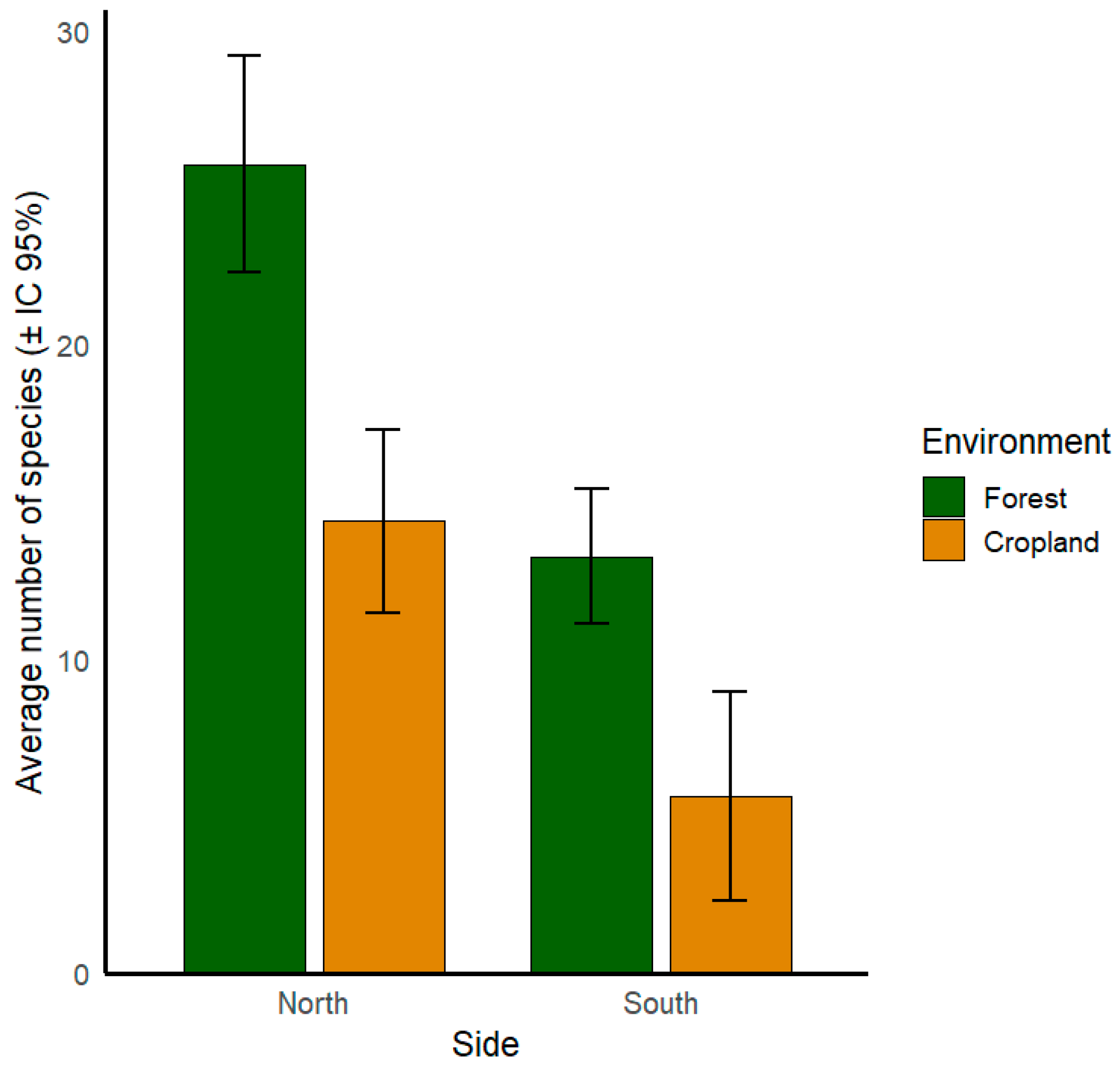
Comparison tests showed similar patterns of species richness and diversity between both riverbanks and environments. Richness on forest in the north side had the highest mean species richness (25.75) and differed significantly from all other environments (p < 0.001). Cropland on the north side and forest on the south side exhibited similar mean richness (13.25) and did not differ significantly (p = 0.93), indicating substantial diversity loss, mainly on south. Cropland on the south side had the lowest mean species richness (5.62), reflecting a strong reduction in local diversity (Figure 2).
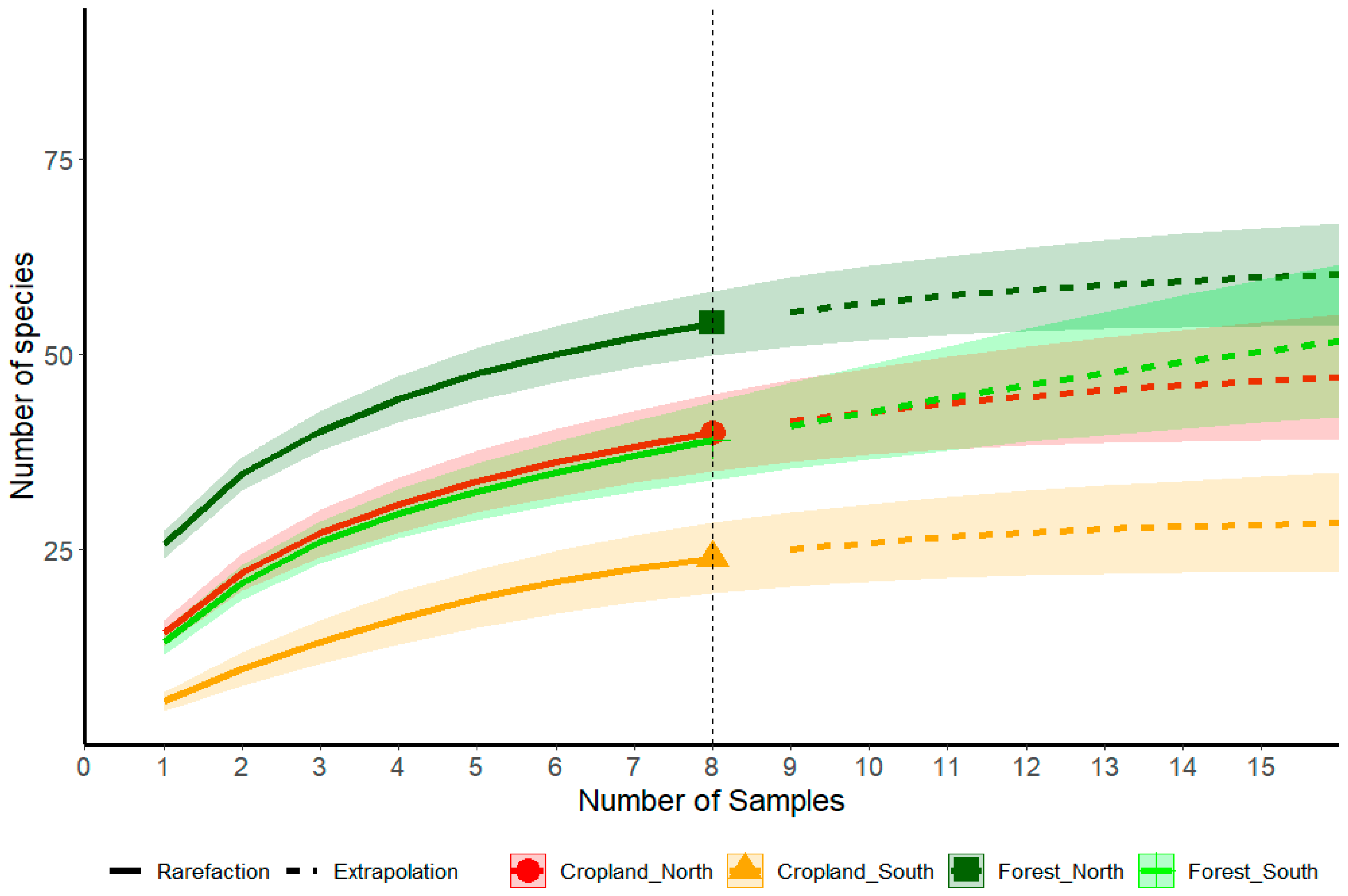
Rarefaction and extrapolation curves showed a decelerating accumulation of species with increasing sampling effort, indicating that most environments approached, but did not fully reach, asymptotic richness as common in ecological studies focusing on insects (Figure 3). Forest environments consistently exhibited higher species richness than croplands on both riverbanks, with the forest on the north bank showing the highest richness across both observed and extrapolated samples. In contrast, cropland on the south bank showed the lowest richness and a flatter accumulation curve. The forest on the south bank did not reach stabilization, and its extrapolated curve suggests that species richness in this environment may be underestimated and could approach values observed in the northern forest with increased sampling effort (Figure 3).
The species composition differed consistently among environments across both riversides (PERMANOVA, R2 = 0.316, p = 0.001). Pairwise comparisons showed that the forest on the north side differed significantly from the other environments (p = 0.012), with particularly strong differences relative to forest and cropland on the south bank (R2 = 0.35; p = 0.006). The composition among cropland environments on both sides also differed significantly (p = 0.012). In contrast, on the south side, the environments did not differ significantly (p = 0.072), indicating similar species composition between these environments. Nevertheless, multivariate dispersion analyses showed a highly significant difference in dispersion among groups (PERMDISP, p = 0.001). This variability was associated with the cropland environments from both the North and South sides, which presented greater variability among their samples. These results indicate that species composition of forest communities are more homogeneous, while cropland communities are more heterogeneous and unstable.
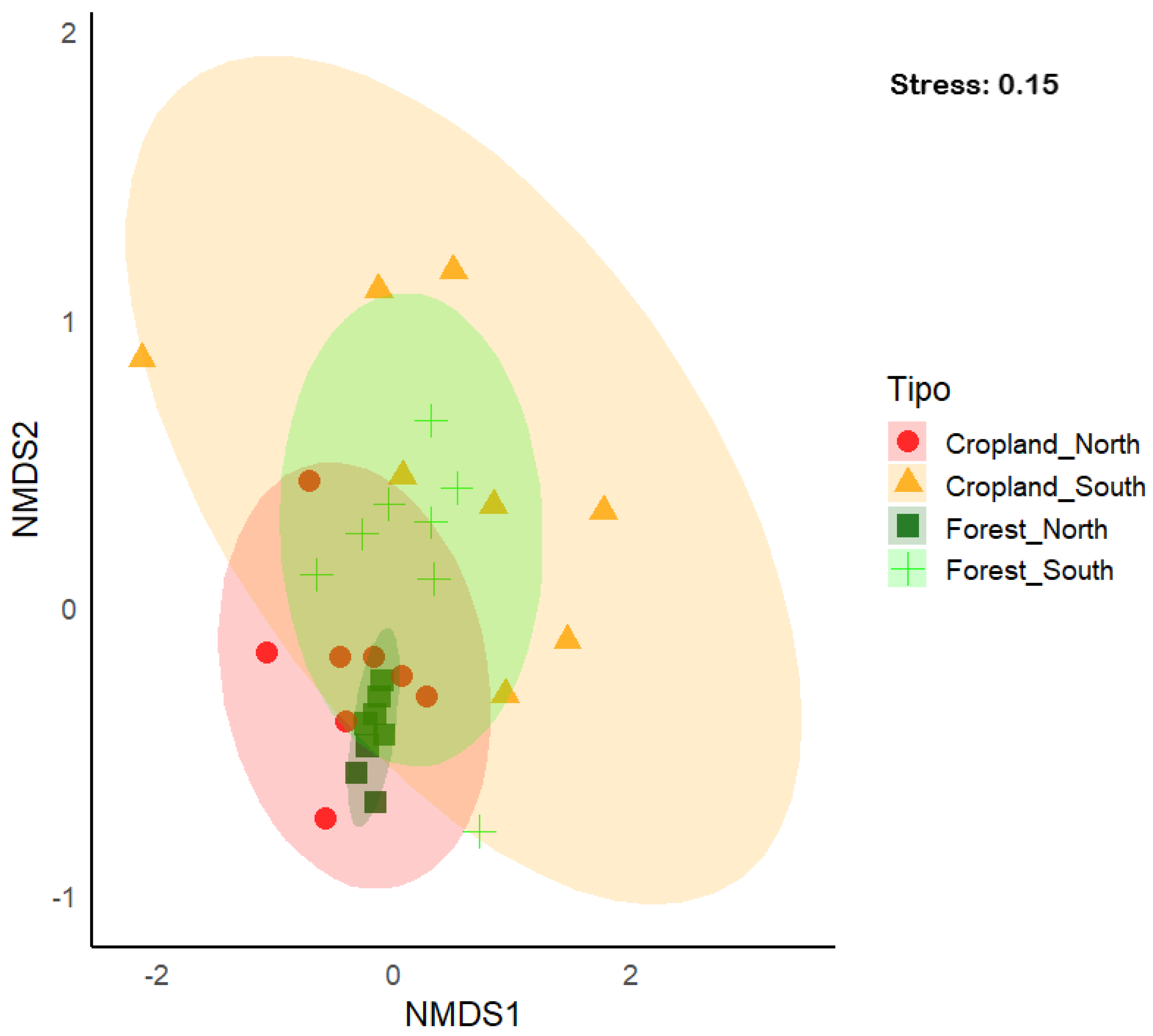
The NMDS ordination of species composition (Figure 4) showed that the forest on the north bank exhibited lower dispersion, which indicate greater homogeneity in species composition among sampling sites. Groups with higher dispersion partially overlapped those with lower dispersion, reflecting high variability in species composition. The forest environment on the south side showed reduced richness and greater compositional heterogeneity compared to northern forests, while croplands on the south side were characterized by highly variable and impoverished assemblages.
The environments on the north side shared 15 species. Eleven species occurred exclusively in the forest; three species were exclusive to the cropland environment (Table 1). On the south bank, four species occurred exclusively in the forest: Psathyromyia sp. (Shanonni series), Psathyromyia bigeniculata, Psychodopygus carreirai carreirai, and Trichopygomyia sp. and only one species was exclusive to the cropland: Trichopygomyia ratcleffei.
The indicator species analysis identified 11 species significantly associated with forest environments on both riverbanks; no species was significantly associated with croplands (Table 3). This result may indicate that most of the remaining species recorded were not strongly or exclusively associated with a single environment. Among the indicator species, four are proven vectors of Leishmania spp.: Lu. gomezi, Ny. umbratilis, Bi. olmeca nociva and Bi. flaviscutellata. Although significantly associated with forests, these species were also recorded in cropland environments.
However, the species occurrence matrix showed an intermediate level of nestedness (NODF = 47.86). When compared with null model expectations, the observed nestedness did not differ significantly from random expectations (SES = −1.79). Likewise, the nestedness components associated with sites (NODF_rows = 56.49; SES = −1.62; p = 0.140) and species (NODF_columns = 46.31; SES = −1.40; p = 0.169) were not significant. These results indicate that although there is substantial overlap in species composition between forest and crop environments, the pattern does not reflect a strong or hierarchically structured nestedness. Instead, cropland assemblages represent incomplete and variable subsets of forest communities, suggesting non-directional compositional changes.

4. Discussion

The present study evaluated the effect of forest conversion in cropland on the phlebotomine sand fly composition, richness, and diversity in two rural areas of the Brazilian Amazon Region. The Amazon biome has an immense biodiversity and an extensive territory which includes nine Latin American countries. Although its importance to global health and well-being is undeniable, the Amazon region has been facing many threats in recent decades, especially due to the increasing deforestation of the tropical rainforest associated with land use activities such as cattle grazing, small- and large-scale agricultural plots, human settlements or areas left open [41]. Deforestation also contributes to the exacerbation of climate change, which together, may affect the distribution of infectious diseases such as malaria, arboviruses, Chagas disease and leishmaniasis, through changes in the dynamics of vector species, parasites and hosts [42,43,44]. The Amazon Region has a high diversity of sand flies. According to the latest worldwide distribution of phlebotomine sand flies, approximately 230 species are recorded in the Brazilian Amazon Region [2]. We recorded a total of 69 species, distributed across both riversides and environments, including four new occurrences for Amazonas State, and 10 proven vector species [31]. Thus, our results highlight the remarkable diversity and epidemiological importance of these insects in the Amazon region.
In the Amazonas State, prior to this study, 137 species had been recorded. The new records increase the number of species to 141 and expand the acknowledge of their distribution in the Americas. The species Brumptomyia mesai (Figure S1E, Supplementary data) was described in the Colombian Amazon Region [45]. This species is distributed across Central and South American countries, such as Mexico, Belize, Honduras, Colombia and Brazil. In Brazil, it has been recorded in the states of Rondônia, Mato Grosso do Sul, Paraná and São Paulo [12]. In this study, we collected four individuals, three males and one female, on both riversides and environments. Species of the genus Brumptomyia are usually found in animal burrows and caves [46,47,48] and are not considered to be of epidemiological importance. However, L. infantum DNA was found in Br. mesai in Mexico, raising hypothesis about its possible role in the transmission cycle of this parasite [49]. The species Evandromyia aldafalcoae (Figure S1A,B, Supplementary data) was described in Mato Grosso do Sul State, in Central-West Brazil, in a forest environment [50]. This species still has restricted distribution, having also been recorded in the State of Mato Grosso [12]. In our study, nine individuals (six females and three males) were found in both riverbanks and environments. The record of this species in Amazonas expands the knowledge of its geographic distribution and habitat. The species Pressatia calcarata (Figure S1C, Supplementary data) has only been recorded in the western Amazon region, including countries such as Venezuela, Peru, Bolivia, and Brazil. In the latter, its distribution is restricted to Acre, where the species was described, and Rondônia [12]. Our record of this species in Amazon as State may suggest that its distribution is limited to the Amazon region. The geographic distribution of the species Lutzomyia carvalhoi (Figure S1D, Supplementary data) is limited to French Guiana and Brazil. The species was first recorded in Pará State, and is currently also present in Rondonia and Amapá [12]. Studies have shown the presence of this species in forest environment of both impacted areas and conservation units, which may indicate a habitat preference [51,52,53,54]. In our study, only one individual was collected, in the forest environment on the north riverbank, which may reinforce this hypothesis.
Interestingly, our sampling period coincided with an extreme drought in the Amazon Basin associated with the El Niño phenomenon, which resulted in reduced rainfall, critically low river levels, widespread wildfires, and marked shifts in abiotic conditions [55]. Although our study did not evaluate the effects of these climatic events, it was possible to notice a considerable reduction in the abundance of phlebotomine sand flies during this period. We also observed, in one of our sampling sites on the north side, wildfires had destroyed the banana crops, which may have affected the local population of insects. The effect of El Niño climate anomalies was also noticed observed by other authors [56,57]. Climate changes associated with land use activities may affect sand fly populations in different ways, due to alterations of the microclimate, such as increased temperature and reduced humidity, or increase in the rainfall level in some regions. These factors may also influence the distribution of leishmaniasis, as variations on the sand fly populations during the dry and rainy seasons, on endemic areas of leishmaniasis was observed by authors in Latin America [21,58,59]. Our results show that, although the overall abundance of sand flies were affected by the climate anomalies, the diversity of sand flies was not directly affected by climate change, as indicated by the rarefaction curves (Figure 3), which flattened most of the environments, except the forest on south side which may be affected by the climatic anomalies, especially the extreme drought and hydrological fluctuations, due the proximity of these locality to the river.
In terms of environmental effects, our previous hypotheses were supported by the GLMM results (Table 2), which show that disturbed environments negatively affect the richness and diversity of phlebotomine sand flies. The highest richness and diversity of sand flies were observed in the forest environments, which is expected, since these environments are the main habitat of most sand fly species, where they find a variety of resting and breeding sites, food resources and climatic conditions favorable for their development [60]. In the amazonian rainforests, sand flies are usually found in tree trunks [25,61,62], tree canopies [24,63], caves [64,65] and animal burrows [66,67], and the feed in a variety of vertebrates [68], which may also act as reservoir of trypanosomatids, such as Leishmania spp., compounding the sylvatic transmission cycle of these parasites [69].
Deforestation and anthropogenic changes reduce these resources (shelters and breeding sites) and affect the populations of wild mammals on which they depend, especially large mammals that require extensive foraging areas or territories and are more exposed to further disturbances [70]. Therefore, this process contributes to the disappearance of some sand flies species, which are more sensitive to environmental disturbances, while other species become adapted to modified environment, becoming more abundant and changing their feeding habits, which may affect the transmission cycle of leishmaniasis, in anthropogenic environments [24,26,27]. For instance, Ny. antunesi is a widely distributed species in the Amazon region, where it is suspected as a vector in the leishmaniasis cycle in many locations [71,72,73]. The abundance of these species is higher in the anthropogenic environment, where it is associated with animal shelters [20,24,74]. Their generalist feeding habits have been documented by many studies, including vertebrates that are known as Leishmania natural reservoirs [74,75], which highlight the hypothesis of their participation in the leishmaniasis transmission cycle in disturbed environments.
The richness and diversity were significantly higher in the forest on the north compared to the south side. These may be explained due to differences in the degree of preservation and human occupation, which may affect the structure of phlebotomine sand fly communities between this locations, as observed by studies conducted in the Eastern Amazon, where the highest richness and diversity of sand flies were recorded in a less impacted area in comparison with a more impacted area [4,18]. Nevertheless, species with the capacity to adapt to new environments may persist in impacted areas, as observed for some vector species in the Amazon region of Brazil, Venezuela and Colombia [19,76,77]. Areas with higher vegetation coverage may sustain a higher richness of sand flies, which usually dispersal between the modified environment and the forest fragment [20,78,79]. In addition, the presence of human settlements may also affect the distribution of sand flies in these areas, as observed in rural settlements in Amazonas state where the highest diversity of sand flies on a high human density and high forest coverage, and vector species, such as Ny. umbratilis, the main vector of L. guyanensis were present in fruit garden areas, closer to the houses [20]. Studies have shown that the proximity of the houses with forest fragments also facilitates the interaction of sylvatic sand flies and alternative hosts, such as human, domestic and synanthropic vertebrates [80,81,82].
The type of crop is also an important factor for the occurrence of sand flies. Croplands with more shaded areas may present a higher abundance of some sand flies species, than those with more open areas [76,77,83]. Nevertheless, the occurrence of small vertebrates, which in turns act as a Leishmania reservoir and potential blood resource for sand flies, may increase the risk of leishmaniasis outbreaks [62,83]. For instance, in areas of coffee crops, the transmission of Leishmania by sand flies has been recorded in Venezuela, Colombia and Brazil [62,76,84,85]. Anthropogenic modifications may favor certain species to colonize disturbed environments. This behavior may influence the leishmaniasis transmission dynamics in modified landscapes, by increasing vector–host contact, as observed in rural areas in the Amazon region, where high infection rates of Leishmania spp. in rodents and opossums, together with naturally infected sand fly vectors, highlight this risk [7,24,86,87,88]. Importantly, trypanosomatids infection rates in sand flies can persist even in deforested environments, indicating the maintenance of transmission cycles under anthropogenic disturbance [25].
As we hypothesized, disturbed environments showed marked reductions in species richness and diversity, on both riverbanks, with more intense effect on the south side. Nevertheless, a substantial number of species, and particularly those of medical importance, persisted in croplands, indicating that agricultural landscapes may sustain vector populations. From an epidemiological perspective, this persistence is especially relevant, as land-use change can facilitate the dispersal and establishment of phlebotomine sand flies closer to human dwellings, increasing contact with humans, domestic animals, and synanthropic reservoirs, thereby potentially enhancing the risk of ATL in rural settlements [20,74,86,89]. In this study, vector species such as Ny. umbratilis, Ny. anduzei, Bi. flaviscutellata and Lu. gomezi were significantly associated with forest environment (Table 3). However, they also occurred in the cropland environment. The presence of this species in different environments may indicate their high dispersal capacity and potential adaptation to modified environments [24,76,85,90]. Other proven vector species, such as Ny. whitmani and Mg. migonei, occurred in low abundance, among the environments, which may indicate they were occasionally caught (Table 1). Furthermore, studies have shown the presence of this species in the modified environment, where they are associated with animal shelters, in the peridomestic areas of leishmaniasis endemic areas [4,18,74,85]. The species Ps. davisi and Th. ubiquitalis were also collected in low abundance in both riversides, in this study (Table 1). The former has been found in forest and impacted areas in the Amazon region, where it is suspect to transmit L. (V.) braziliensis [54,74,87]. Th. ubiquitalis is a proven vector of L. (V.) lainsoni in Amazonas and Pará state, where it is associated mainly with forest environment [16,17].
Although our previous hypotheses, that species composition would differ between riversides and environments, were supported (Figure 4), our following hypothesis, that land-use conversion would act as a deterministic environmental filter, was not supported. Our results showed that cropland assemblages are more heterogeneous than forest assemblages. This heterogeneity was associated with a lower species richness, indicating that species loss after land-use conversion does not occur uniformly.
Nestedness analyses (NODF) reinforces this interpretation. The observed value did not differ significantly from that expected by chance, indicating that there is no deterministic hierarchical loss of species, that is, the species that disappear in cropland areas do not form a predictable subset of the original forest community. Instead, the results suggest that environmental filters associated with land-use change act selectively, restricting which species can persist in agricultural areas. This pattern, evidenced by NODF, points to species turnover: the composition of community changes in a non-nested way, with species replacements in response to new environmental conditions, rather than just an ordered reduction in forest diversity. This interpretation is particularly important, from an epidemiological perspective, since it has been shown by many studies conducted in the neotropical countries that a common pattern in Leishmania spp. transmission in these regions is the co-occurrence of several sand fly vector species, i.e., with vectorial competence and capacity, occurring with other no medically important, but with similar ecological patterns, at endemic foci [24,26,90]. Therefore, species turnover across an environmental landscape may favor the proliferation of vector species and/or species which may likely become vectors, in the future.
In our study, the species Mi. rorotaensis, Sc. sordellii and Ny. antunesi were the most abundant in all environments. The formers species are found mainly in burrows and holes in the forest ground and caves, respectively. They are also associated with the transmission of Trypanosoma sp. from cold-blood vertebrates (i.e., lizards and amphibians) and not considered of epidemiological importance [91,92,93]. However, L. infantum, L. braziliensis DNA were registered in Sc. sordellii and Mi. trinidadensis, in leishmaniasis endemic areas in the Northeastern Brazil, raising the hypothesis of their participation in the Leishmania transmission in this location [94,95]. In addition, a leishmania species associated with reptiles (L. tarantolae) has been found in sand flies, human and dogs in leishmaniasis-endemic areas in Italy, which also raised hypotheses of parasite spillover [96,97]. Nevertheless, studies have shown the presence of human DNA and domestic animals in some species of Micropygomyia and Sciopemyia genus, indicating that they might vary their feeding habits due to environmental disturbance [68]. Therefore, our findings suggests that Mi. rorotaensis and Sc. sordellii may be adapting to the altered environment and may become of medical importance in the future. Thus, our results also highlight the importance of investigating the feeding habits and anthropophilic behavior of these species in the Amazon region.
The species Ny. antunesi was the most abundant on the south side, mainly in the cropland environment. Other studies conducted in rural areas have shown this species in abundance in peridomestic environment, where it may feed on domestic animals, such as chickens and pigs, and rest in animal shelters [24,74,89]. Due to their opportunistic feeding habits and possible role in the transmission of leishmaniasis in the Amazon region, our results suggest that these species may play a role in the ATL transmission on the south side of the Amazonas river. Due to their abundance in the south side and the evidence described above, we suggest that these species may be participating in the transmission cycle of leishmaniasis in the region. Our results also suggest that medically important species, such as Bi. flaviscutellata, Ny. anduzei, Ny. umbratilis, Lu. gomezi may be favored and increase their abundance in the degraded area, therefore increasing the entomological risk of contact synanthropic hosts.
The heterogeneity of sand fly composition between sampling sites may depend on local factors such as microclimate, hosts and shelter availability [26,85,98]. For instance, in the Eastern Amazon, studies have shown persistence of Ny. whitmani and Lu. longipalpis (Lutz & Neiva, 1912) in rural areas, but there is a change in the composition of the species between impacted and more conserved areas [4,18]. Another study conducted in Panamá showed changes in vector composition between the wet and dry season [90]. Similar results have been observed for mosquitos [22,23] and sand flies [99,100]. Therefore these findings reinforce that conserving forest environments is essential not only for maintaining biodiversity, but also for reducing epidemiological unpredictability in rural landscapes, where adapted species may persist and maintain and create new accesses to interact with parasites reservoirs and accidental hosts, thereby increasing the risk of leishmaniasis outbreaks in rural landscapes in the Amazon Region.

5. Conclusions

Our study demonstrated that land-use conversion in the Brazilian Amazon significantly reorganized phlebotomine sand fly communities. Anthropic disturbance acts as a strong environmental filter, reducing overall species richness and diversity, resulting in impoverished and heterogeneous assemblages in agricultural landscapes. Importantly, this non-selective loss does not affect all species equally. Medically important ATL vectors persisted across both forest and modified environments, reflecting ecological plasticity and the ability to exploit alternative resources in anthropogenic settings. Species without proven vector capacity or competence may become dominant and play a role as a possible vector in these environmental settings. The sustained presence vector species near to human activity increases the potential for zoonotic spillovers. Thus, landscape transformation imposes a dual burden: the erosion of insect biodiversity alongside a potential increase in ATL risk in rural and peri-urban communities. These findings underscore the importance of integrating entomological surveillance into land-use planning and public health strategies.

Supplementary Materials

The following supporting information can be downloaded at: https://www.mdpi.com/article/10.3390/d18060339/s1, Figure S1: New records of sand fly species for Amazonas state, Brazil.

Author Contributions

F.A.C.P., C.M.R.-V., T.J.I., R.C.d.S.G. conceived and designed the study. F.A.C.P., C.M.R.-V. coordinated the study. F.A.C.P. and C.M.R.-V. funding acquisition; F.A.C.P., C.M.R.-V., R.B.A.; R.C.d.S.G., K.M.M.-C., E.d.S.F., V.A.B.d.A., E.F.d.S.M., G.M.P., L.M.P.C., J.W.P.-S. performed fieldwork. R.C.d.S.G. identified sand fly samples. R.C.d.S.G. and T.J.I. analyzed the data. R.C.d.S.G. Figure 1 preparation. R.C.d.S.G. wrote the first draft of the manuscript. All authors played a vital part in the preparation and revision of the final version of the manuscript. All authors have read and agreed to the published version of the manuscript.

Funding

This research was funded by Fundação de Amparo a Pesquisa do Estado do Amazonas (FAPEAM), EDITAL N. 008/2022—KUNHÃ; CHAMADA PÚBLICA N. 04/2022, and POSGRAD Program FAPEAM; PROGRAMA INOVAÇÃO NA AMAZÔNIA/FIOCRUZ No 130061557609312; Coordenação de Aperfeiçoamento de Pessoal de Nível Superior (CAPES) Grant No 001; PROEPE/ILMD.

Institutional Review Board Statement

Not applicable.

Data Availability Statement

The original contributions presented in this study are included in the article/Supplementary Material. Further inquiries can be directed to the corresponding authors.

Acknowledgments

We are grateful to the Conselho Nacional de Desenvolvimento Científico e Tecnológico (CNPq) for the productivity fellowship to F.A.C.P. and T.J.I., to the Coordenação de Aperfeiçoamento de Pessoal de Nível Superior (CAPES) for the scholarship to R.C.S.G., to the Fundação de Amparo à Pesquisa do Estado do Amazonas (FAPEAM) for the financial support. We also thank the communities of Rio Pardo in Presidente Figueiredo municipality and Urucurituba municipality for the welcome and hospitality, and all those who helped in the field collection (Ricardo Mota, Ragner Bonono, Patrick Souza and Marcos Miglioni).

Conflicts of Interest

The authors declare no conflicts of interest.

References

  1. Maroli, M.; Feliciangeli, M.D.; Bichaud, L.; Charrel, R.N.; Gradoni, L. Phlebotomine Sandflies and the Spreading of Leishmaniases and Other Diseases of Public Health Concern. Med. Vet. Entomol. 2013, 27, 123–147. [Google Scholar] [CrossRef] [Scilit]
  2. Galati, E.A.B.; De Andrade, A.J.; Perveen, F.; Loyer, M.; Vongphayloth, K.; Randrianambinintsoa, F.J.; Prudhomme, J.; Rahola, N.; Akhoundi, M.; Shimabukuro, P.H.F.; et al. Phlebotomine Sand Flies (Diptera, Psychodidae) of the World. Parasit. Vectors 2025, 18, 220. [Google Scholar] [CrossRef] [Scilit] [PubMed]
  3. Cecílio, P.; Cordeiro-da-Silva, A.; Oliveira, F. Sand Flies: Basic Information on the Vectors of Leishmaniasis and Their Interactions with Leishmania Parasites. Commun. Biol. 2022, 5, 305. [Google Scholar] [CrossRef] [Scilit]
  4. Pinto Moraes, J.L.; Marinho Santana, H.T.; Conceição Abreu Bandeira, M.; Macário Rebêlo, J.M. Effects of Forest Degradation on the Sand Fly Communities of Northeast Brazil. J. Vector Ecol. 2020, 45, 89–99. [Google Scholar] [CrossRef] [Scilit] [PubMed]
  5. Guerra, J.A.D.O.; Maciel, M.G.; Guerra, M.V.D.F.; Talhari, A.C.; Prestes, S.R.; Fernandes, M.A.; Da-Cruz, A.M.; Martins, A.; Coelho, L.I.D.A.R.C.; Romero, G.A.S.; et al. Tegumentary Leishmaniasis in the State of Amazonas: What Have We Learned and What Do We Need? Rev. Soc. Bras. Med. Trop. 2015, 48, 12–19. [Google Scholar] [CrossRef] [Scilit]
  6. Cova, B.O.; De Oliveira, L.A.; Lima Machado, P.R.; De Carvalho, E.M.; Monte-Alegre, A.F.; Schriefer, A. Diversity and Natural Infection of Phlebotomine Sand Flies (Diptera, Psychodidae) in an Endemic Area of American Tegumentary Leishmaniasis in Southeastern Bahia, Brazil. Parasit. Vectors 2025, 18, 79. [Google Scholar] [CrossRef] [Scilit]
  7. Da Silva, M.S.; Picelli, A.M.; Pereira De França, K.; Galati, E.A.B.; Andrade Filho, J.D.; Julião, G.R.; Dutra-Rêgo, F.; Medeiros, J.F.D. Entomological Inferences Highlight the Risk of Leishmania Transmission in the Urban Area of Porto Velho, Rondônia, Brazil. PLoS ONE 2024, 19, e0309168. [Google Scholar] [CrossRef] [Scilit]
  8. Neves, R.L.; Ker, F.T.O.; Dutra-Rêgo, F.; Rugani, J.M.N.; Andrade Filho, J.D.; Soares, R.P.; Gontijo, C.M.F. Increased Risk of American Tegumentary Leishmaniasis in an Urban and Rural Area of Caratinga, Brazil between 2016 and 2021. Am. J. Trop. Med. Hyg. 2023, 109, 791–803. [Google Scholar] [CrossRef] [Scilit] [PubMed]
  9. Vasconcelos Dos Santos, T.; De Pita-Pereira, D.; Araújo-Pereira, T.; Britto, C.; Silveira, F.T.; Póvoa, M.M.; Rangel, E.F. Leishmania DNA Detection and Species Characterization within Phlebotomines (Diptera: Psychodidae) from a Peridomicile-Forest Gradient in an Amazonian/Guianan Bordering Area. PLoS ONE 2019, 14, e0219626. [Google Scholar] [CrossRef] [Scilit]
  10. BRASIL LEISHMANIOSE TEGUMENTAR AMERICANA—Casos Confirmados Notificados No Sistema de Informação de Agravos de Notificação—Brasil 2025. Available online: https://tabnet.datasus.gov.br/cgi/tabcgi.exe?sinannet/cnv/ltamg.def (accessed on 6 June 2025).
  11. Ministério da Saúde, Brasil. LEISHMANIOSE TEGUMENTAR AMERICANA—Casos Confirmados Notificados No Sistema de Informação de Agravos de Notificação—Amazonas 2025. Available online: https://tabnet.datasus.gov.br/cgi/deftohtm.exe?sinannet/cnv/ltaam.pdf (accessed on 6 June 2025).
  12. Galati, E.A.B. Morfologia e Terminologia de Phlebotominae (Diptera:Psychodidae). Classificação e Identificação de Táxons Das Américas; Apostila da Disciplina de Bioecologia e Identificação de Phlebotominae do Programa de Pós-Graduação em Saúde Pública; Faculdade de Saúde Pública da Universidade de São Paulo: São Paulo, Brazil, 2026; Volume 1. [Google Scholar]
  13. Arias, J.R.; Freitas, R.A.D. Sobre Os Vetores de Leishmaniose Cutânea Na Amazônia Central Do Brasil. 2: Incidência de Flagelados Em Flebótomos Selváticos. Acta Amaz. 1978, 8, 387–396. [Google Scholar] [CrossRef] [Scilit]
  14. Paes, M.; Barros, M.; Toleto, L. de Consideracões Sobre a Produção Da Leishmaniose Tegumentar Americana No Estado Do Amazonas; Fiocruz: Rio de Janeiro, Brazil, 1998. [Google Scholar]
  15. Arias, J.R.; de Freitas, R.A.; Naiff, R.D.; Barrett, T.V. Observations on the Parasite Leishmania Mexicana Amazonensis and Its Natural Infection of the Sand Fly Lutzomyia Olmeca Nociva. Bull. Pan Am. Health Organ. 1987, 21, 48–54. [Google Scholar]
  16. Silveira, F.T.; Souza, A.A.A.; Lainson, R.; Shaw, J.J.; Braga, R.R.; Ishikawa, E.E.A. Cutaneous Leishmaniasis in the Amazon Region: Natural Infection of the Sandfly Lutzomyia Ubiquitalis (Psychodidae: Phlebotominae) by Leishmania (Viannia) Lainsoni in Pará State, Brazil. Mem. Inst. Oswaldo Cruz 1991, 86, 127–130. [Google Scholar] [CrossRef] [Scilit]
  17. Pereira Júnior, A.M.; Teles, C.B.G.; De Azevedo Dos Santos, A.P.; De Souza Rodrigues, M.; Marialva, E.F.; Pessoa, F.A.C.; Medeiros, J.F. Ecological Aspects and Molecular Detection of Leishmania DNA Ross (Kinetoplastida: Trypanosomatidae) in Phlebotomine Sandflies (Diptera: Psychodidae) in Terra Firme and Várzea Environments in the Middle Solimões Region, Amazonas State, Brazil. Parasit. Vectors 2015, 8, 180. [Google Scholar] [CrossRef] [Scilit]
  18. Rebêlo, J.M.M.; Moraes, J.L.P.; Cruz, G.B.V.; Andrade-Silva, J.; Bandeira, M.D.C.A.; Oliveira Pereira, Y.N.; Santos, C.L.C.D. Influence of Deforestation on the Community Structure of Sand Flies (Diptera: Psychodidae) in Eastern Amazonia. J. Med. Entomol. 2019, 56, 1004–1012. [Google Scholar] [CrossRef] [Scilit]
  19. Rosário, I.N.G.; Andrade, A.J.; Ligeiro, R.; Ishak, R.; Silva, I.M. Evaluating the Adaptation Process of Sandfly Fauna to Anthropized Environments in a Leishmaniasis Transmission Area in the Brazilian Amazon. J. Med. Entomol. 2016, 54, 450–459. [Google Scholar] [CrossRef] [Scilit] [PubMed]
  20. Ramos, W.R.; Medeiros, J.F.; Julião, G.R.; Ríos-Velásquez, C.M.; Marialva, E.F.; Desmouliére, S.J.M.; Luz, S.L.B.; Pessoa, F.A.C. Anthropic Effects on Sand Fly (Diptera: Psychodidae) Abundance and Diversity in an Amazonian Rural Settlement, Brazil. Acta Trop. 2014, 139, 44–52. [Google Scholar] [CrossRef] [Scilit]
  21. Da Silva, A.S.; Andreoli, R.V.; De Souza, R.A.F.; Chagas, É.C.D.S.; De Moraes, D.S.; De Figueiredo, R.C.; Doria, S.S.; Mwangi, V.I.; Moura, E.D.S.; Souza, É.D.S.; et al. Impact of El Niño on the Dynamics of American Cutaneous Leishmaniasis in a Municipality in the Western Amazon. Acta Trop. 2021, 222, 106032. [Google Scholar] [CrossRef] [Scilit] [PubMed]
  22. Almeida, J.F.; Belchior, H.C.M.; Batista, F.A.J.C.; Guimarães, R.C.D.S.; Maitra, A.; Ríos Velásquez, C.M.; Izzo, T.J.; Pessoa, F.A.C. Change in the Faunal Composition of Mosquitoes (Diptera: Culicidae) along a Heterogeneous Landscape Gradient in the Brazilian Amazon. PLoS ONE 2023, 18, e0288646. [Google Scholar] [CrossRef] [Scilit] [PubMed]
  23. Chaves, L.S.M.; Bergo, E.S.; Conn, J.E.; Laporta, G.Z.; Prist, P.R.; Sallum, M.A.M. Anthropogenic Landscape Decreases Mosquito Biodiversity and Drives Malaria Vector Proliferation in the Amazon Rainforest. PLoS ONE 2021, 16, e0245087. [Google Scholar] [CrossRef] [Scilit]
  24. Guimarães, R.C.S.; Marialva, E.F.; Feijó, J.A.; Pereira-Silva, J.W.; Martins-Campos, K.M.; Gontijo, C.M.F.; Pereira, A.A.S.; Rios-Velasquez, C.M.; Pessoa, F.A.C. Trypanosomatids in Phlebotomine Sand Flies (Diptera: Phlebotominae) From Anthropic and Sinantropic Landscapes in a Rural Settlement in the Brazilian Amazon. J. Med. Entomol. 2022, 59, 681–692. [Google Scholar] [CrossRef] [Scilit]
  25. Pessoa, F.A.C.; Medeiros, J.F.; Barrett, T.V. Effects of Timber Harvest on Phlebotomine Sand Flies (Diptera: Psychodidae) in a Production Forest: Abundance of Species on Tree Trunks and Prevalence of Trypanosomatids. Mem. Inst. Oswaldo Cruz 2007, 102, 593–599. [Google Scholar] [CrossRef] [Scilit]
  26. De Oliveira, M.D.S.; Da Silva, R.C.R.; Silva, A.S.G.E.; Rodrigues, J.C.; Pimenta, R.C..d.J.S.; Leonardo, F.S.; Rebêlo, J.M.M.; Pinheiro, V.C.S. Land Use and Cover Changes and Sand Fly (Diptera: Psychodidae) Assemblages in an Emerging Focus of Leishmaniasis. Med. Vet. Entomol. 2025, 39, 525–537. [Google Scholar] [CrossRef] [Scilit] [PubMed]
  27. Feitosa, M.A.C.; Julião, G.R.; Costa, M.D.P.; Belém, B.; Pessoa, F.A.C. Diversity of Sand Flies in Domiciliary Environment of Santarém, State of Pará, Brazil: Species Composition and Abundance Patterns in Rural and Urban Areas. Acta Amaz. 2012, 42, 507–514. [Google Scholar] [CrossRef] [Scilit]
  28. IBGE. Urucurituba. Available online: https://cidades.ibge.gov.br/brasil/am/urucurituba/panorama (accessed on 6 June 2025).
  29. Young, D.G.; Duncan, M.A. Guide to the Identification and Geographic Distribution of Lutzomyia Sand Flies in Mexico, the West Indies, Central and South America (Diptera: Psychodidae); Memoirs of the American Entomological Institute; Associated Publishers: Gainesville, FL, USA, 1994; ISBN 978-1-56665-054-0. [Google Scholar]
  30. De Almeida Rocha, D.; De Almeida, M.R.; De Sena Batista, J.A.; De Andrade, A.J. LutzoDexTM—A Digital Key for Brazilian Sand Flies (Diptera, Phlebotominae) within an Android App. Zootaxa 2019, 4688, 382–388. [Google Scholar] [CrossRef] [Scilit]
  31. Shaw, J.J. A Review of Leishmania Infections in American Phlebotomine Sand Flies—Are Those That Transmit Leishmaniasis Anthropophilic or Anthropportunists? Parasite 2025, 32, 57. [Google Scholar] [CrossRef] [Scilit]
  32. Hill, M.O. Diversity and Evenness: A Unifying Notation and Its Consequences. Ecology 1973, 54, 427–432. [Google Scholar] [CrossRef] [Scilit]
  33. Fox, J.; Weisberg, S.; Price, B. Car: Companion to Applied Regression 2001, 3.1-5; Sage: Thousand Oaks, CA, USA, 2001. [Google Scholar]
  34. Marcon, E.; Herault, B. Entropart: Entropy Partitioning to Measure Diversity 2013, 1.6-16; CRAN: Vienna, Austria, 2013. [Google Scholar]
  35. Hartig, F. DHARMa: Residual Diagnostics for Hierarchical (Multi-Level/Mixed) Regression Models; CRAN: Vienna, Austria, 2026. [Google Scholar]
  36. Searle, S.R.; Speed, F.M.; Milliken, G.A. Population Marginal Means in the Linear Model: An Alternative to Least Squares Means. Am. Stat. 1980, 34, 216–221. [Google Scholar] [CrossRef] [Scilit]
  37. Oksanen, J.; Simpson, G.L.; Blanchet, F.G.; Kindt, R.; Legendre, P.; Minchin, P.R.; O’Hara, R.B.; Solymos, P.; Stevens, M.H.H.; Szoecs, E.; et al. Vegan: Community Ecology Package 2001, 2.7-3; CRAN: Vienna, Austria, 2001. [Google Scholar]
  38. Hsieh, T.C.; Ma, K.H.; Chao, A. iNEXT: Interpolation and Extrapolation for Species Diversity 2015, 3.0.2; CRAN: Vienna, Austria, 2015. [Google Scholar]
  39. Anderson, M.J. Permutational Multivariate Analysis of Variance (PERMANOVA). In Wiley StatsRef: Statistics Reference Online; Kenett, R.S., Longford, N.T., Piegorsch, W.W., Ruggeri, F., Eds.; Wiley: Hoboken, NJ, USA, 2017; pp. 1–15. ISBN 978-1-118-44511-2. [Google Scholar]
  40. Dufrêne, M.; Legendre, P. Species assemblages and indicator species: The need for a flexible asymmetrical approach. Ecol. Monogr. 1997, 67, 345–366. [Google Scholar] [CrossRef] [Scilit]
  41. Ellwanger, J.H.; Kulmann-Leal, B.; Kaminski, V.L.; Valverde-Villegas, J.M.; Veiga, A.B.G.D.; Spilki, F.R.; Fearnside, P.M.; Caesar, L.; Giatti, L.L.; Wallau, G.L.; et al. Beyond Diversity Loss and Climate Change: Impacts of Amazon Deforestation on Infectious Diseases and Public Health. An. Acad. Bras. Ciênc. 2020, 92, e20191375. [Google Scholar] [CrossRef] [Scilit] [PubMed]
  42. Patz, J.A.; Graczyk, T.K.; Geller, N.; Vittor, A.Y. Effects of Environmental Change on Emerging Parasitic Diseases. Int. J. Parasitol. 2000, 30, 1395–1405. [Google Scholar] [CrossRef] [Scilit] [PubMed]
  43. Molleda, P.; Velásquez Serra, G. El Fenómeno Del Niño y La Prevalencia de Enfermedades Infecciosas: Revisión. La Granja 2024, 40, 9–36. [Google Scholar] [CrossRef] [Scilit]
  44. Confalonieri, U.E.C.; Margonari, C.; Quintão, A.F. Environmental Change and the Dynamics of Parasitic Diseases in the Amazon. Acta Trop. 2014, 129, 33–41. [Google Scholar] [CrossRef] [Scilit] [PubMed]
  45. Sherlock, I.A. Sôbre Alguns Phlebotomus e Brumptomyia Da Colômbia (Diptera, Psychodidae). Mem. Inst. Oswaldo Cruz 1962, 60, 321–336. [Google Scholar] [CrossRef] [Scilit]
  46. De Aguiar, G.M.; Vieira, V.R. Regional Distribution and Habitats of Brazilian Phlebotomine Species. In Brazilian Sand Flies; Rangel, E.F., Shaw, J.J., Eds.; Springer International Publishing: Cham, Switzerland, 2018; pp. 251–298. ISBN 978-3-319-75543-4. [Google Scholar]
  47. Serra, E.; Meira, P.C.L.; Abreu, B.L.; De Almeida Zenóbio, A.P.L.; De Castilho Sanguinette, C.; Rêgo, F.D.; De Lima Carvalho, G.M.; Saraiva, L.; Andrade Filho, J.D. Phlebotominae Fauna (Diptera: Psychodidae) and Molecular Detection of Leishmania (Kinetoplastida: Trypanosomatidae) in Urban Caves of Belo Horizonte, Minas Gerais, Brazil. J. Med. Entomol. 2022, 59, 257–266. [Google Scholar] [CrossRef] [Scilit] [PubMed]
  48. Araujo-Pereira, T.D.; Pita-Pereira, D.D.; Baia-Gomes, S.M.; Boité, M.; Silva, F.; Pinto, I.D.S.; De Sousa, R.L.T.; Fuzari, A.; De Souza, C.; Brazil, R.; et al. An Overview of the Sandfly Fauna (Diptera: Psychodidae) Followed by the Detection of Leishmania DNA and Blood Meal Identification in the State of Acre, Amazonian Brazil. Mem. Inst. Oswaldo Cruz 2020, 115, e200157. [Google Scholar] [CrossRef] [Scilit]
  49. Lozano-Sardaneta, Y.N.; Sánchez-Montes, S.; Sánchez-Cordero, V.; Becker, I.; Paternina, L.E. Molecular Detection of Leishmania Infantum in Sand Flies (Diptera: Psychodidae: Phlebotominae) from Veracruz, Mexico. Acta Trop. 2020, 207, 105492. [Google Scholar] [CrossRef] [Scilit]
  50. Santos, S.O.; Andrade Filho, J.D.; Honer, M.R. Lutzomyia Aldafalcaoae Sp. n. a New Species of Phlebotominae (Diptera: Psychodidae) from Mato Grosso Do Sul, Brazil. Mem. Inst. Oswaldo Cruz 2001, 96, 791–794. [Google Scholar] [CrossRef] [Scilit]
  51. Galardo, A.K.R.; Galardo, C.D.; Silveira, G.A.; Ribeiro, K.A.N.; Hijjar, A.V.; Oliveira, L.L.; Santos, T.V.D. Phlebotominae Sand Flies (Diptera: Psychodidae): Potential Vectors of American Cutaneous Leishmaniasis Agents in the Area Associated with the Santo Antônio Hydroelectric System in Western Amazonian Brazil. Rev. Soc. Bras. Med. Trop. 2015, 48, 265–271. [Google Scholar] [CrossRef] [Scilit]
  52. De Souza, A.A.A.; Dos Santos, T.V.; Jennings, Y.L.L.; Ishikawa, E.A.Y.; Barata, I.D.R.; Silva, M.D.G.S.; Lima, J.A.N.; Shaw, J.; Lainson, R.; Silveira, F.T. Natural Leishmania (Viannia) Spp. Infections in Phlebotomine Sand Flies (Diptera: Psychodidae) from the Brazilian Amazon Region Reveal New Putative Transmission Cycles of American Cutaneous Leishmaniasis. Parasite 2016, 23, 22. [Google Scholar] [CrossRef] [Scilit]
  53. Furtado, N.V.R.; Galardo, A.K.R.; Galardo, C.D.; Firmino, V.C.; Vasconcelos Dos Santos, T. Phlebotomines (Diptera: Psychodidae) in a Hydroelectric System Affected Area from Northern Amazonian Brazil: Further Insights into the Effects of Environmental Changes on Vector Ecology. J. Trop. Med. 2016, 2016, 9819723. [Google Scholar] [CrossRef] [Scilit]
  54. Gil, L.H.; Basano, S.A.; Souza, A.A.; Silva, M.G.; Barata, I.; Ishikawa, E.A.; Camargo, L.M.; Shaw, J.J. Recent Observations on the Sand Fly (Diptera: Psychodidae) Fauna of the State of Rondônia, Western Amazônia, Brazil: The Importance of Psychdopygus Davisi as a Vector of Zoonotic Cutaneous Leishmaniasis. Mem. Inst. Oswaldo Cruz 2003, 98, 751–755. [Google Scholar] [CrossRef] [Scilit] [PubMed]
  55. Santos Fleischmann, A.; Papa, F.; Hamilton, S.K.; Melack, J.; Forsberg, B.; Val, A.; Collischonn, W.; Laipelt, L.; Brusso Rossi, J.; Comini De Andrade, B.; et al. Extreme Warming of Amazon Waters in a Changing Climate. Science 2025, 390, 606–611. [Google Scholar] [CrossRef] [Scilit]
  56. Nascimento, R.E.D.; Dias, D.D.; Nascimento, B.L.S.D.; Costa, T.S.D.; Souto, R.N.P.; Casseb, L.M.N.; Neto, J.P.N.; Carvalho, V.L. Culicidae Fauna (Diptera: Culicomorpha) of the Municipality of Mazagão, Amapá, in the Brazilian Amazon. Insects 2025, 16, 1036. [Google Scholar] [CrossRef] [Scilit] [PubMed]
  57. Marengo, J.A.; Cunha, A.P.; Espinoza, J.-C.; Fu, R.; Schöngart, J.; Jimenez, J.C.; Costa, M.C.; Ribeiro, J.M.; Wongchuig, S.; Zhao, S. The Drought of Amazonia in 2023-2024. Am. J. Clim. Change 2024, 13, 567–597. [Google Scholar] [CrossRef]
  58. Altamiranda-Saavedra, M.; Gutiérrez, J.D.; Araque, A.; Valencia-Mazo, J.D.; Gutiérrez, R.; Martínez-Vega, R.A. Effect of El Niño Southern Oscillation Cycle on the Potential Distribution of Cutaneous Leishmaniasis Vector Species in Colombia. PLoS Negl. Trop. Dis. 2020, 14, e0008324. [Google Scholar] [CrossRef] [Scilit]
  59. Chaves, L.F.; Calzada, J.E.; Valderrama, A.; Saldaña, A. Cutaneous Leishmaniasis and Sand Fly Fluctuations Are Associated with El Niño in Panamá. PLoS Negl. Trop. Dis. 2014, 8, e3210. [Google Scholar] [CrossRef] [Scilit]
  60. Brazil, R.P.; Brazil, B.G. Bionomy: Biology of Neotropical Phlebotomine Sand Flies. In Brazilian Sand Flies; Rangel, E.F., Shaw, J.J., Eds.; Springer International Publishing: Cham, Switzerland, 2018; pp. 299–318. ISBN 978-3-319-75543-4. [Google Scholar]
  61. Cabanillas, M.; Castellón, E. Distribution of Sandflies (Diptera:Psychodidae) on Tree-Trunks in a Non-Flooded Area of the Ducke Forest Reserve, Manaus, AM, Brazil. Mem. Inst. Oswaldo Cruz 1999, 94, 289–296. [Google Scholar] [CrossRef] [Scilit]
  62. Freitas, R.A.; Naiff, R.D.; Barrett, T.V. Species Diversity and Flagellate Infections in the Sand Fly Fauna near Porto Grande, State of Amapá, Brazil (Diptera: Psychodidae. Kinetoplastida: Trypanosomatidae). Mem. Inst. Oswaldo Cruz 2002, 97, 53–59. [Google Scholar] [CrossRef] [Scilit]
  63. Resadore, F.; Júnior, A.M.P.; De Paulo, P.F.M.; Gil, L.H.S.; Rodrigues, M.M.D.S.; Araújo, M.D.S.; Julião, G.R.; Medeiros, J.F. Composition and Vertical Stratification of Phlebotomine Sand Fly Fauna and the Molecular Detection of Leishmania in Forested Areas in Rondônia State Municipalities, Western Amazon, Brazil. Vector-Borne Zoonotic Dis. 2019, 19, 347–357. [Google Scholar] [CrossRef] [Scilit]
  64. Ogawa, G.M.; Pereira Júnior, A.M.; Resadore, F.; Ferreira, R.D.G.M.; Medeiros, J.F.; Camargo, L.M.A. Sandfly Fauna (Diptera: Psychodidae) from Caves in the State of Rondônia, Brazil. Rev. Bras. Parasitol. Vet. 2016, 25, 61–68. [Google Scholar] [CrossRef] [Scilit]
  65. Alves, V.R.; Freitas, R.A.D.; Santos, F.L.; Barrett, T.V. Diversity of Sandflies (Psychodidae: Phlebotominae) Captured in Sandstone Caves from Central Amazonia, Brazil. Mem. Inst. Oswaldo Cruz 2011, 106, 353–359. [Google Scholar] [CrossRef] [Scilit]
  66. Feliciangeli, M.D. Natural Breeding Places of Phlebotomine Sandflies. Med. Vet. Entomol. 2004, 18, 71–80. [Google Scholar] [CrossRef] [Scilit]
  67. Vivero, R.J.; Torres-Gutierrez, C.; Bejarano, E.E.; Peña, H.C.; Estrada, L.G.; Florez, F.; Ortega, E.; Aparicio, Y.; Muskus, C.E. Study on Natural Breeding Sites of Sand Flies (Diptera: Phlebotominae) in Areas of Leishmania Transmission in Colombia. Parasit. Vectors 2015, 8, 116. [Google Scholar] [CrossRef] [Scilit]
  68. Dutra-Rêgo, F.; Silva, M.S.D.; Isnard, A.P.; Medeiros, J.F.; Andrade Filho, J.D.; Freire, M.L. You Are What You Eat: A Systematic Review Exploring the Interaction between Brazilian Sand Flies and Their Vertebrate Food Sources. Mem. Inst. Oswaldo Cruz 2024, 119, e240055. [Google Scholar] [CrossRef] [Scilit]
  69. Lainson, R. The Neotropical Leishmania species: A brief historical review of their discovery, ecology and taxonomy. Rev. Pan-Amaz. Saúde 2010, 1, 13–32. [Google Scholar] [CrossRef] [Scilit]
  70. Desjeux, P. The Increase in Risk Factors for Leishmaniasis Worldwide. Trans. R. Soc. Trop. Med. Hyg. 2001, 95, 239–243. [Google Scholar] [CrossRef] [Scilit]
  71. Thies, S.F.; Bronzoni, R.V.D.M.; Michalsky, É.M.; Santos, E.S.D.; Silva, D.J.F.D.; Dias, E.S.; Damazo, A.S. Aspects on the Ecology of Phlebotomine Sand Flies and Natural Infection by Leishmania Hertigi in the Southeastern Amazon Basin of Brazil. Acta Trop. 2018, 177, 37–43. [Google Scholar] [CrossRef] [Scilit]
  72. Vásquez-Trujillo, A.; Santamaría-Herreño, E.; González-Reina, A.E.; Buitrago-Álvarez, L.S.; Góngora-Orjuela, A.; Cabrera-Quintero, O.L. Lutzomyia Antunesi, Probable Vector de Leishmaniasis Cutánea En El Área Rural de Villavicencio. Rev. Salud Pública 2008, 10, 625–632. [Google Scholar] [CrossRef] [Scilit]
  73. Silveira, F.T.; Ishikawa, E.A.Y.; De Souza, A.A.A.; Lainson, R. An Outbreak of Cutaneous Leishmaniasis among Soldiers in Belém, Pará State, Brazil, Caused by Leishmania (Viannia) Lindenbergi n. Sp.: A New Leishmanial Parasite of Man in the Amazon Region. Parasite 2002, 9, 43–50. [Google Scholar] [CrossRef] [Scilit]
  74. Costa, T.S.D.; Ferreira, R.M.D.A.; Santos, G.S.; Garcia Júnior, M.D.; Pinto, C.B.; Souto, R.N.P. Ecological Aspects and Molecular Detection of Leishmania DNA (Kinetoplastida: Trypanosomatidae) in Phlebotomine Sand Flies (Diptera: Psychodidae) from a Rural Settlement in the Eastern Amazon, Brazil. Rev. Bras. Entomol. 2021, 65, e20210065. [Google Scholar] [CrossRef] [Scilit]
  75. Pimentel, A.C.; Sánchez Uzcátegui, Y.D.V.; De Lima, A.C.S.; Silveira, F.T.; Vasconcelos Dos Santos, T.; Ishikawa, E.A.Y. Blood Feeding Sources of Nyssomyia Antunesi (Diptera: Psychodidae): A Suspected Vector of Leishmania (Kinetoplastida: Trypanosomatidae) in the Brazilian Amazon. J. Med. Entomol. 2022, 59, 1847–1852. [Google Scholar] [CrossRef] [Scilit]
  76. Nieves, E.; Oraá, L.; Rondón, Y.; Sánchez, M.; Sánchez, Y.; Rojas, M.; Rondón, M.; Rujano, M.; González, N.; Cazorla, D. Effect of Environmental Disturbance on the Population of Sandflies and Leishmania Transmission in an Endemic Area of Venezuela. J. Trop. Med. 2014, 2014, 280629. [Google Scholar] [CrossRef] [Scilit]
  77. Travi, B.L.; Adler, G.H.; Lozano, M.; Cadena, H.; Montoya-Lerma, J. Impact of Habitat Degradation on Phlebotominae (Diptera: Psychodidae) of Tropical Dry Forests in Northern Colombia. J. Med. Entomol. 2002, 39, 451–456. [Google Scholar] [CrossRef] [Scilit]
  78. Julião, G.R.; Novo, S.P.C.; Ríos-Velásquez, C.M.; Desmoulière, S.J.M.; Luz, S.L.B.; Pessoa, F.A.C. Sand Fly Fauna Associated with Dwellings and Forest Habitats Along the BR-319 Highway, Amazonas, Brazil. J. Med. Entomol. 2019, 56, 540–546. [Google Scholar] [CrossRef] [Scilit]
  79. Chagas, E.C.D.S.; Silva, A.S.; Fé, N.F.; Ferreira, L.S.; Sampaio, V.D.S.; Terrazas, W.C.M.; Guerra, J.A.O.; Souza, R.A.F.D.; Silveira, H.; Guerra, M.D.G.V.B. Composition of Sand Fly Fauna (Diptera: Psychodidae) and Detection of Leishmania DNA (Kinetoplastida: Trypanosomatidae) in Different Ecotopes from a Rural Settlement in the Central Amazon, Brazil. Parasit. Vectors 2018, 11, 180. [Google Scholar] [CrossRef] [Scilit]
  80. Feitosa, M.A.C.; Castellón, E.G. Fauna de Flebotomíneos (Diptera: Psychodidae) Em Fragmentos de Floresta Ao Redor de Conjuntos Habitacionais Na Cidade de Manaus, Amazonas, Brasil. I. Estratificação Vertical. Acta Amaz. 2006, 36, 539–548. [Google Scholar] [CrossRef] [Scilit]
  81. Guerra, J.A.D.O.; Ribeiro, J.A.S.; Coelho, L.I.D.A.R.D.C.; Barbosa, M.D.G.V.; Paes, M.G. Epidemiologia Da Leishmaniose Tegumentar Na Comunidade São João, Manaus, Amazonas, Brasil. Cad. Saúde Pública 2006, 22, 2319–2327. [Google Scholar] [CrossRef] [Scilit]
  82. Barbosa, M.D.G.V.; Fé, N.F.; Marcião, A.H.R.; Silva, A.P.T.; Monteiro, W.M.; Guerra, J.A.D.O. Fauna de Flebotomíneos (Diptera: Psychodidae) Em Um Foco de Leishmaniose Tegumentar Americana Na Área Periurbana de Manaus, Estado Do Amazonas. Rev. Soc. Bras. Med. Trop. 2008, 41, 485–491. [Google Scholar] [CrossRef] [Scilit]
  83. Quintana, M.G.; Salomón, O.D.; De Grosso, M.S.L. Distribution of Phlebotomine Sand Flies (Diptera: Psychodidae) in a Primary Forest-Crop Interface, Salta, Argentina. J. Med. Entomol. 2010, 47, 1003–1010. [Google Scholar] [CrossRef] [Scilit]
  84. Alexander, J.B. Dispersal of Phlebotomine Sand Flies (Diptera: Psychodidae) in a Colombian Coffee Plantation. J. Med. Entomol. 1987, 24, 552–558. [Google Scholar] [CrossRef] [Scilit]
  85. Miranda, D.E.D.O.; Sales, K.G.D.S.; Faustino, M.A.D.G.; Alves, L.C.; Brandão-Filho, S.P.; Dantas-Torres, F.; Carvalho, G.A.D. Ecology of Sand Flies in a Low-Density Residential Rural Area, with Mixed Forest/Agricultural Exploitation, in North-Eastern Brazil. Acta Trop. 2015, 146, 89–94. [Google Scholar] [CrossRef] [Scilit]
  86. Achilles, G.R.; Kautzmann, R.P.; Chagas, H.D.F.; Pereira-Silva, J.W.; Almeida, J.F.; Fonseca, F.R.; Da Silva, M.N.F.; Pessoa, F.A.C.; Nava, A.F.D.; Ríos-Velásquez, C.M. Presence of Trypanosomatids, with Emphasis on Leishmania, in Rodentia and Didelphimorphia Mammals of a Rural Settlement in the Central Amazon Region. Mem. Inst. Oswaldo Cruz 2021, 116, e200427. [Google Scholar] [CrossRef] [Scilit] [PubMed]
  87. Pereira Júnior, A.M.; Souza, A.B.N.; Castro, T.S.; Da Silva, M.S.; De Paulo, P.F.M.; Ferreira, G.E.M.; De Medeiros, J.F. Diversity, Natural Infection and Blood Meal Sources of Phlebotomine Sandflies (Diptera, Psychodidae) in the Western Brazilian Amazon. Mem. Inst. Oswaldo Cruz 2019, 114, e190170. [Google Scholar] [CrossRef] [Scilit]
  88. Guerra, J.A.D.O.; Paes, M.G.; Coelho, L.I.A.R.; Barros, M.L.B.; Fé, N.F.; Barbosa, M.D.G.V.; Guerra, M.V.D.F. Estudo de Dois Anos Com Animais Reservatórios Em Área de Ocorrência de Leishmaniose Tegumentar Americana Humana Em Bairro de Urbanização Antiga Na Cidade de Manaus-AM, Brasil. Acta Amaz. 2007, 37, 133–137. [Google Scholar] [CrossRef] [Scilit]
  89. De Ávila, M.M.; Brilhante, A.F.; De Souza, C.F.; Bevilacqua, P.D.; Galati, E.A.B.; Brazil, R.P. Ecology, Feeding and Natural Infection by Leishmania Spp. of Phlebotomine Sand Flies in an Area of High Incidence of American Tegumentary Leishmaniasis in the Municipality of Rio Branco, Acre, Brazil. Parasit. Vectors 2018, 11, 64. [Google Scholar] [CrossRef] [Scilit]
  90. Rigg, C.A.; Perea, M.; González, K.; Saldaña, A.; Calzada, J.E.; Gao, Y.; Gottdenker, N.L.; Chaves, L.F. Diversity, Co-Occurrence, and Nestedness Patterns of Sand Fly Species (Diptera: Psychodidae) in Two Rural Areas of Western Panamá. Insects 2021, 12, 113. [Google Scholar] [CrossRef] [Scilit]
  91. Isnard, A.P.; Madureira, A.C.C.; Carvalho, G.M.D.L.; Freire, M.L.; Avelar, D.M.D.; Diotaiuti, L.G.; Andrade Filho, J.D.; Dutra-Rêgo, F. Beyond Leishmania: Hidden Trypanosomatid Diversity Reveals Complex Parasite-Sand Fly Networks in Southeastern Brazil. Mem. Inst. Oswaldo Cruz 2026, 121, e250260. [Google Scholar] [CrossRef] [Scilit] [PubMed]
  92. Ferreira, R.C.; De Souza, A.A.; Freitas, R.A.; Campaner, M.; Takata, C.S.A.; Barrett, T.V.; Shaw, J.J.; Teixeira, M.M.G. A Phylogenetic Lineage of Closely Related Trypanosomes (Trypanosomatidae, Kinetoplastida) of Anurans and Sand Flies (Psychodidae, Diptera) Sharing the Same Ecotopes in Brazilian Amazonia1. J. Eukaryot. Microbiol. 2008, 55, 427–435. [Google Scholar] [CrossRef] [Scilit]
  93. Costa, J.C.R.; Marchi, G.H.; Santos, C.S.; Andrade, M.C.M.; Chaves Junior, S.P.; Silva, M.A.N.; Melo, M.N.; Andrade, A.J. First Molecular Evidence of Frogs as a Food Source for Sand Flies (Diptera: Phlebotominae) in Brazilian Caves. Parasitol. Res. 2021, 120, 1571–1582. [Google Scholar] [CrossRef] [Scilit] [PubMed]
  94. Pereira-Filho, A.A.; Fonteles, R.S.; Bandeira, M.D.C.A.; Moraes, J.L.P.; Rebêlo, J.M.M.; Melo, M.N. Molecular Identification of Leishmania Spp. in Sand Flies (Diptera: Psychodidae: Phlebotominae) in the Lençóis Maranhenses National Park, Brazil. J. Med. Entomol. 2018, 55, 989–994. [Google Scholar] [CrossRef] [Scilit]
  95. Da Silva, Y.Y.; Sales, K.G.D.S.; Miranda, D.E.D.O.; Figueredo, L.A.; Brandão-Filho, S.P.; Dantas-Torres, F. Detection of Leishmania DNA in Sand Flies (Diptera: Psychodidae) From a Cutaneous Leishmaniasis Outbreak Area in Northeastern Brazil. J. Med. Entomol. 2019, 57, 529–533. [Google Scholar] [CrossRef] [Scilit]
  96. Iatta, R.; Mendoza-Roldan, J.A.; Latrofa, M.S.; Cascio, A.; Brianti, E.; Pombi, M.; Gabrielli, S.; Otranto, D. Leishmania Tarentolae and Leishmania Infantum in Humans, Dogs and Cats in the Pelagie Archipelago, Southern Italy. PLoS Negl. Trop. Dis. 2021, 15, e0009817. [Google Scholar] [CrossRef] [Scilit]
  97. Pombi, M.; Giacomi, A.; Barlozzari, G.; Mendoza-Roldan, J.; Macr ì, G.; Otranto, D.; Gabrielli, S. Molecular Detection of Leishmania (Sauroleishmania) Tarentolae in Human Blood and Leishmania (Leishmania) Infantum in Sergentomyia Minuta: Unexpected Host-parasite Contacts. Med. Vet. Entomol. 2020, 34, 470–475. [Google Scholar] [CrossRef] [Scilit] [PubMed]
  98. Azevedo, A.C.; Costa, S.M.; Pinto, M.C.; Souza, J.L.; Cruz, H.C.; Vidal, J.; Rangel, E.F. Studies on the Sandfly Fauna (Diptera: Psychodidae: Phlebotominae) from Transmission Areas of American Cutaneous Leishmaniasis in State of Acre, Brazil. Mem. Inst. Oswaldo Cruz 2008, 103, 760–766. [Google Scholar] [CrossRef] [Scilit] [PubMed]
  99. Chaves, L.F.; Añez, N. Nestedness Patterns of Sand Fly (Diptera: Psychodidae) Species in a Neotropical Semi-Arid Environment. Acta Trop. 2016, 153, 7–13. [Google Scholar] [CrossRef] [Scilit]
  100. Santini, M.S.; Fernández, M.S.; Cavia, R.; Salomón, O.D. Co-occurrence and Seasonal and Environmental Distributions of the Sandflies Lutzomyia Longipalpis and Nyssomyia Whitmani in the City of Puerto Iguazú, Northeastern Argentina. Med. Vet. Entomol. 2018, 32, 197–205. [Google Scholar] [CrossRef] [Scilit] [PubMed]
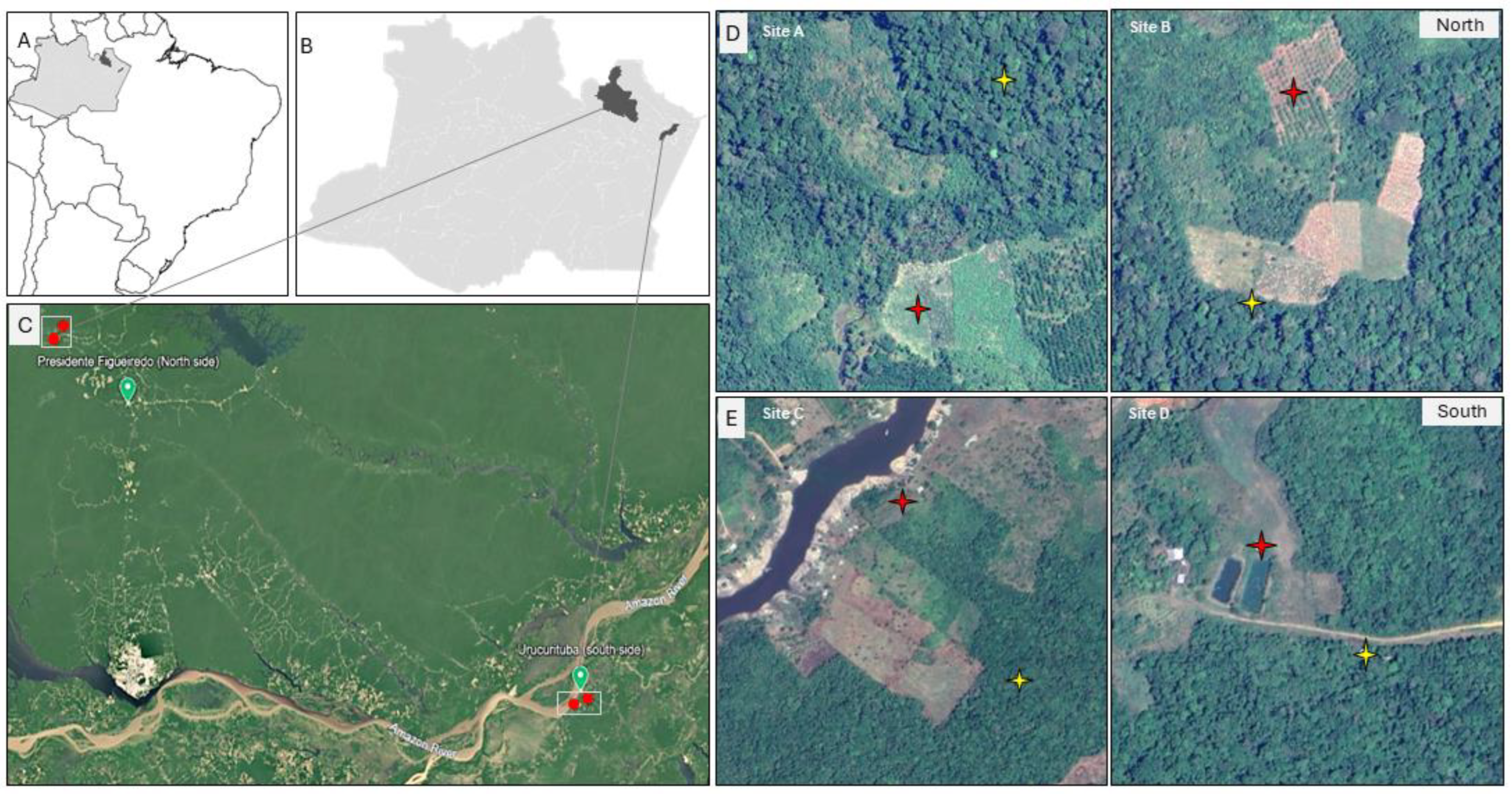
Figure 1. Geographic location of the study area. (A) General map of Brazil, highlighting the Amazonas state. (B) Map of Amazonas state, highlighting the study sites. (C) Sampling points on the North and South banks. (D) Sampling sites of sand flies, on the North bank and (E) South bank of the Amazonas River. Yellow stars refer to forest environments, and red stars refer to the crop environments. The images in this figure are courtesy of Google and were accessed from Google Earth (https://earth.google.com/web (accessed on 21 April 2026), version 10.96.0.1). The map was elaborated with SimpleMappr [26].
Diversity 18 00339 g001
Figure 2. Observed species richness of phlebotomine sand flies collected in the Forest and Cropland environments, of two rural areas, on the North and South side of Amazonas River, Amazonas, Brazil. Bars represent mean species richness per sampling unit, and error bars indicate 95% confidence intervals.
Diversity 18 00339 g002
Figure 3. Sampling-based rarefaction curves of phlebotomine sand flies, collected in the Forest and Cropland environments, on the North and South side of Amazonas River, Amazonas, Brazil.
Diversity 18 00339 g003
Figure 4. Non-metrical multidimensional scaling (NMDS) comparing the composition of phlebotomine sand flies collected in Forest and Cropland environments, on the North and South side of Amazonas River, Amazonas state, Brazil.
Diversity 18 00339 g004
Table 1. Distribution of the phlebotomine sand flies collected in the Forest and Cropland environments, during the period of August/September 2023 and February/March 2024, in two rural areas in the North and South side of the Amazonas River, Amazonas, Brazil.
Sand Fly SpeciesNorth SideSouth Side
ForestCroplandFMTotalForestCroplandFMTotalSubtotal
Bichromomyia flaviscutellata * (Mangabeira, 1942)64143939786-6-684
Bichromomyia bicolor (Fairchild & Theodor, 1971) 624481-1-19
Bichromomyia nociva * (Young & Arias, 1982)17171118-----18
Bichromomyia reducta ** (Feliciangeli, Ramirez Pérez & Ramirez, 1988)11-22-----2
Brumptomyia mesai ** Sherlock, 1962-31231--114
Evandromyia aldafalcaoae ** (Santos, Andrade-Filho & Honer, 2001).2-2-2434379
Evandromyia andersoni (Le Pont & Desjeux, 1988). 1115712-----12
Evandromyia apurinan ** Shimabukuro, Figueira & Silva, 2013.1036713415-518
Evandromyia bacula Martins, Falcao & Silva, 1965)235-54471813
Evandromyia begonae (Ortiz & Torrez, 1975)14115-15-----15
Evandromyia evandroi (Costa Lima & Antunes, 1936)5813-134-4-417
Evandromyia georgii/begonae ***52355-55-----55
Evandromyia georgii (Freitas & Barrett, 2002) 12514317-----17
Evandromyia inpai (Young & Arias,1977)63819-----9
Evandromyia monstruosa (Floch & Abonnenc, 1944)6173335684-22472
Evandromyia pinotti Damasceno & Arouck, 1956)9614115-----15
Evandromyia saulensis ** (Floch & Abonnenc, 1944)2941221336-6-639
Evandromyia sericea (Floch & Abonnenc, 1944)2212231134-----34
Evandromyia sp. ***152161171311311431
Evandromyia sp. de Baduel (Floch & Abonnenc, 1945)11-22-----2
Evandromyia walkeri ** (Newstead, 1914)24282923526262860
Evandromyia williamsi (Damasceno, Causey & Arouck, 1945)45-99-----9
Lutzomyia carvalhoi ** Damasceno, Causey & Arouck, 19451-1-1-----1
Lutzomyia gomezi * (Nitzulescu, 1931)14114-155-41520
Lutzomyia sherlocki ** Martins, Silva & Falcao 1971.44718-----8
Lutzomyia sp. ***-----145-55
Micropygomyia micropyga (Mangabeira, 1942)4-134211237
Micropygomyia pilosa (Damasceno & Causey, 1944)426-63-3-39
Micropygomyia rorotaensis (Floch & Abonnenc, 1944)3368228113741815371118436
Micropygomyia sp. ***10-10-10-----10
Migonemyia migonei * (França, 1920)224-4-----4
Nyssomyia anduzei * (Rozeboom, 1942)23133063612517-1753
Nyssomyia antunesi ** (Coutinho, 1939)100921236919262438124105297
Nyssomyia fraihaiai Martins, Falcao & Silva, 19791-1-1-----1
Nyssomyia umbratilis * (Ward & Fraiha, 1977)288221436112-238
Nyssomyia whitmani * (Antunes & Coutinho, 1939)1--11-----1
Pressatia calcarata ** (Martins & Silva, 1964)-----142-161616
Pressatia sp.-----123-33
Pressatia triacantha ** (Mangabeira, 1942)1--11-----1
Psathyromyia (serie Shanonni) *** -----1-1-11
Psathyromyia aragoai ** (Costa Lima, 1932)115610161212319
Psathyromyia bigeniculata (Floch & Abonnenc, 1941)-----1-1-11
Psathyromyia dendrophyla ** (Mangabeira, 1942)112-21-1-13
Psathyromyia dreisbachi (Causey & Damasceno, 1945)-1-11-----1
Psathyromyia lutziana (Costa Lima, 1932)1-1-1-----1
Psathyromyia pifanoi (Ortiz, 1972)1--11-----1
Psathyromyia runoides (Faichild & Hertig, 1953)-1-11-----1
Psathyromyia sp. ***112-2-----2
Psychodopygus amazonensis ** (Root, 1934).3-3-3-----3
Psychodopygus carreirai carreirai ** (Barretto, 1946)-----2--222
Psychodopygus claustrei ** (Abonnenc, Léger & Fauran, 1979)2-1123-3-35
Psychodopygus davisi * (Root, 1934).2-2-2324157
Psychodopygus hirsutus ** (Mangabeira, 1942)4-314-----4
Psychodopygus sp. (serie Chagasi) ***-11-1235-56
Psychodopygus squamiventris ** (Lutz & Neiva, 1912)1-1-11-1-12
Sciopemyia nematoducta (Young & Arias, 1984)4214233356718-864
Sciopemyia pennyi (Arias & Freitas, 1981)-1-11-----1
Sciopemyia preclara (Young & Arias, 1984)-----729-99
Sciopemyia servulolimai (Damasceno & Causey, 1945)1--11112851314
Sciopemyia sordellii ** (Shannon & Del Ponte, 1927)552149277620522325101
Sciopemyia sp. ***1-1-1-----1
Trichophoromyia eurypyga (Martins, Falcao & Silva, 1963)1810-2828-----28
Trichophoromyia gibba (Young & Arias, 1994)1--11-----1
Trichophoromyia sp.7-7-7134-411
Trichophoromyia ubiquitalis * (Mangabeira, 1942)2-2-21--113
Trichopygomyia ratcleffei (Arias, Ready & Freitas, 1983)------2-222
Trichopygomyia sp.-----1-1-11
Viannamyia furcata (Mangabeira, 1941)8475127310-1022
Viannamyia tuberculata ** (Mangabeira, 1941)-----527-77
Number of individuals1058377912512143524499263803431778
Number of species5440 593924 4069
Legend: F—female, M—male, * proven vectors in Brazil, ** species found naturally infected with Leishmania spp., *** individuals identified at the closest taxonomic level due to material lost or damage.
Table 2. Generalized linear mixed models (GLMM) of the richness and diversity (Hill numbers) of phlebotomine sand flies, in function of the fixed effects of Side, Environment, and their interaction.
ModelRichness (Poisson)Diversity (Gaussian)
EffectEstimateSEz Valuep ValueEstimateSEt Valuep Value
Intercept (North/Forest)3.4230.06353.9060.001 ***2.64110.06239.815<0.001 ***
Riverside (South)−0.7640.113−6.7720.001 ***−0.2550.10824−2.350.012 *
Environment (Cropland)−0.5180.104−4.9820.001 ***−0.1740.1036−1.6890.04 *
Riverside x Environment (South/Cropland) −0.3750.202−1.8600.063−0.7730.258−2.9940.01 *
Significance value: *** p < 0.001; * p < 0.05.
Table 3. Analysis of species indicator (IndVal) of phlebotomine sand flies collected in the forest and cropland environments, on the North and South side of Amazonas River, Amazonas, Brazil.
Sand Fly SpeciesSideEnvironmentStatisticp Value
Lutzomyia gomezi *NorthForest0.7900.0027 **
Sciopemyia nematoductaNorthForest0.7640.0020 **
Evandromyia monstruosaNorthForest0.7290.0009 ***
Bichromomyia olmeca.nociva *NorthForest0.7100.0045 **
Nyssomyia umbratilis *NorthForest0.6870.0051 **
Micropygomyia rorotaensisNorthForest0.6490.0049 **
Trichophoromyia sp.NorthForest0.6210.0242 *
Sciopemyia sordelliiNorthForest0.5800.0211 *
Evandromyia sp.NorthForest0.5660.0328 *
Bichromomyia flaviscutellata *NorthForest0.5630.0231 *
Sciopemyia servulolimaiSouthForest0.5240.0482 *
* Proven vectors of Leishmania spp.; significance value: *** p < 0.001; ** p < 0.01; * p < 0.05.
Disclaimer/Publisher’s Note: The statements, opinions and data contained in all publications are solely those of the individual author(s) and contributor(s) and not of MDPI and/or the editor(s). MDPI and/or the editor(s) disclaim responsibility for any injury to people or property resulting from any ideas, methods, instructions or products referred to in the content.