3. Species Descriptions and Key
The limata species complex
Diagnosis. Monomorphic. Scape clearly surpassing the vertexal margin. Mesosomal dorsum sometimes with short longitudinal carinae. Metanotal groove well-marked. Propodeal spines well-developed. Petiole elongate in dorsal view, narrowing towards anterior margin, its dorsal and posterior corners with teeth or tubercles each with one seta. Postpetiole never with longitudinal impression. Ventral margin of petiole and postpetiole with or without teeth or angle. Head smooth and shining, sculpture limited to area between toruli and mandibular base, rarely on genae or head frons. Long, flexuose pilosity on body; mid tibiae and hind tibiae with erect hairs and/or appressed pilosity. The identification key (see below), is restricted to Colombia, based on Longino (2003) [
7] and includes the species described in this study. For the identification key (see below), we included species from this study and characters from other species outside Colombia described in Longino (2003) [
7].
Most
Crematogaster species are arboreal, nesting in twigs and under bark. These ants prefer mesic habitats, such as rainforests, although they can also inhabit some open areas, like savannahs. Species of the
limata complex are widespread at low altitudes in the northern Neotropics, from southern Mexico (except for
C. sotobosque, with one record from Arizona, USA [
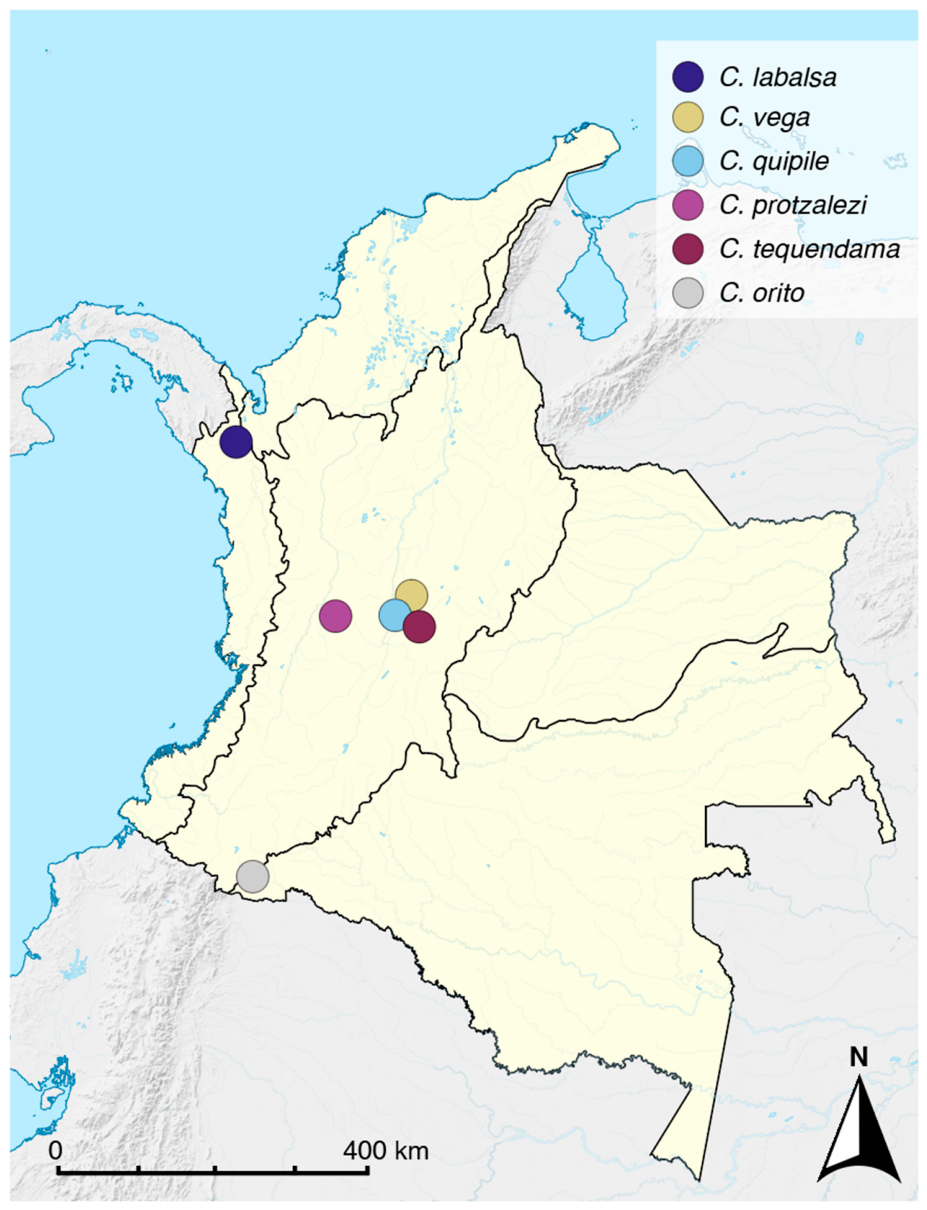
18]) to Paraguay and southern Brazil. A few species reach montane forests, such as those in the Eastern Andes in Colombia (
Figure 2). Currently, the complex includes 20 species [
7].
Species list in Colombia
Crematogaster brasiliensis Mayr, 1878;
Crematogaster carinata Mayr, 1862;
Crematogaster labalsa sp. nov.;
Crematogaster levior Longino, 2003;
Crematogaster limata F. Smith, 1858;
Crematogaster longispina Emery, 1890;
Crematogaster nigropilosa Mayr, 1870;
Crematogaster orito sp. nov.;
Crematogaster quipile sp. nov.;
Crematogaster protzalezi sp. nov.;
Crematogaster sotobosque Longino, 2003;
Crematogaster tenuicula Forel, 1904;
Crematogaster tequendama sp. nov.;
Crematogaster vega sp. nov.
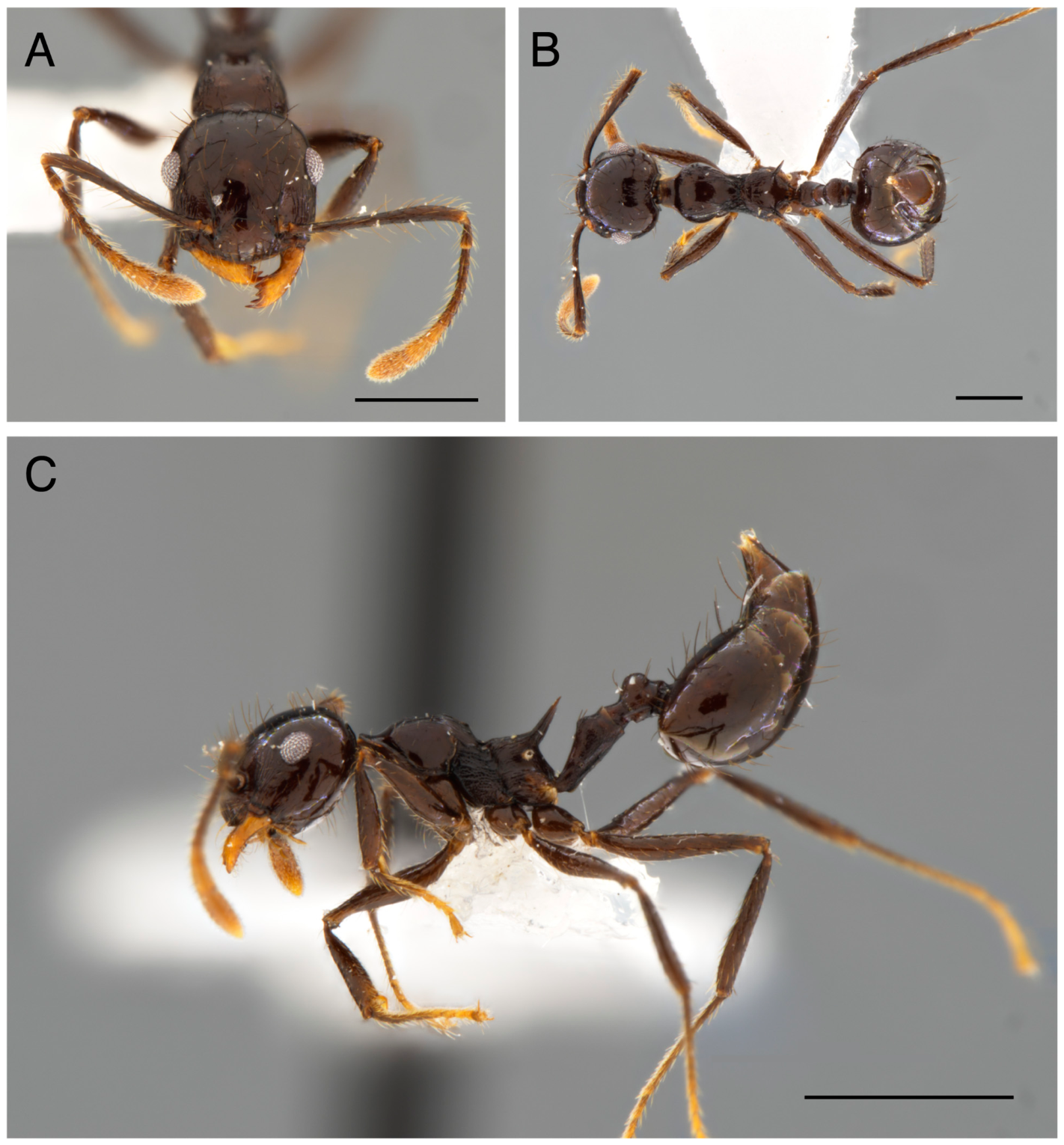
Crematogaster labalsa sp. nov. (
Figure 3)
Holotype worker. Colombia, Chocó, La Balsa, Estación Silvicultural Bajo Atrato, 7°02′ N 77°20′ W, 1 July 1992, L.F. Mendoza. Deposited in ICN (115792).
Description of worker. Color light brown. Mandibles smooth and shiny, basal half with feeble longitudinal carinulae; in full-face view anterior margin of clypeus weakly convex; clypeus convex, shiny, with 3 thin longitudinal carinulae; face smooth and shiny with a short discontinuous carinulae on the middle of the head longitudinal striation surrounding eyes on the oculo-mandibular part; scapes with longitudinal carinulae, with a combination of abundant subdecumbent setae and abundant long erect setae, erect setae much longer than width of scape; terminal 4–5 segments of antenna gradually lengthening to form club, becoming increasingly densely pubescent, terminal two segments the largest and most conspicuous; face with abundant erect black yellow setae; in full-face view with a crown of dark yellow to whitish setae projecting from sides and posterior margin of head posterior to eyes, few short curved setae projecting from sides of head anterior to eyes; ventral surface of head with few suberect setae.
In lateral view, pronotum rising above anterior collar to convex dorsal surface, mesonotum flat, strongly sloping, propodeal suture deep medially, appearing shallow in lateral view because of pronounced lateral carinae that bridge suture; dorsal face of propodeum horizontal, well differentiated from and slightly shorter than sloping posterior face; propodeal spines short (Measurements SPL:0.187), broadly triangular at base, gradually tapering to outermost; sides of pronotum smooth and shiny; anepisternum and katepisternum with microareolate sculpture; side of propodeum smooth and shiny at the half bottom and the upper part is microaerolate dorsally, faintly rugulose and microareolate below; pronotal dorsum with about 6 longitudinal carinulae, interspaces smooth and shining; mesonotum with strong lateral carinae, converging posteriorly, with a protruding medial tubercule, medial space smooth and shining; dorsal face of propodeum microareolated, posterior face smooth and shining; many setae on mesosomal dorsum long, stout, blackish yellow, about 8 hairs on pronotum, 2 on anterior mesonotum, not raising from each tubercle, 2 shorter on base of each propodeal spine; legs with abundant suberect pubescence/short pilosity, no long erect setae.
Petiole in side view trapezoidal, smooth and shiny or with faint microareolate sculpture; anteroventral tooth small, forming an obtuse angle; dorsal face elongate, tapering anteriorly, smooth and shiny or faintly microaerolate, with four long dark setae yellow on the posterior margin; posterolateral tubercles low and feebly elevated over petiole surface; postpetiole without strongly acute ventral tooth, postpetiole in dorsal view globular, well separated from petiole by cylindrical anterior peduncle, with 4 erect setae on dorsum, 2 anteriorly and 2 posteriorly and the middle; fourth abdominal tergite smooth and shining; fourth abdominal tergite with abundant long erect dark yellow setae.
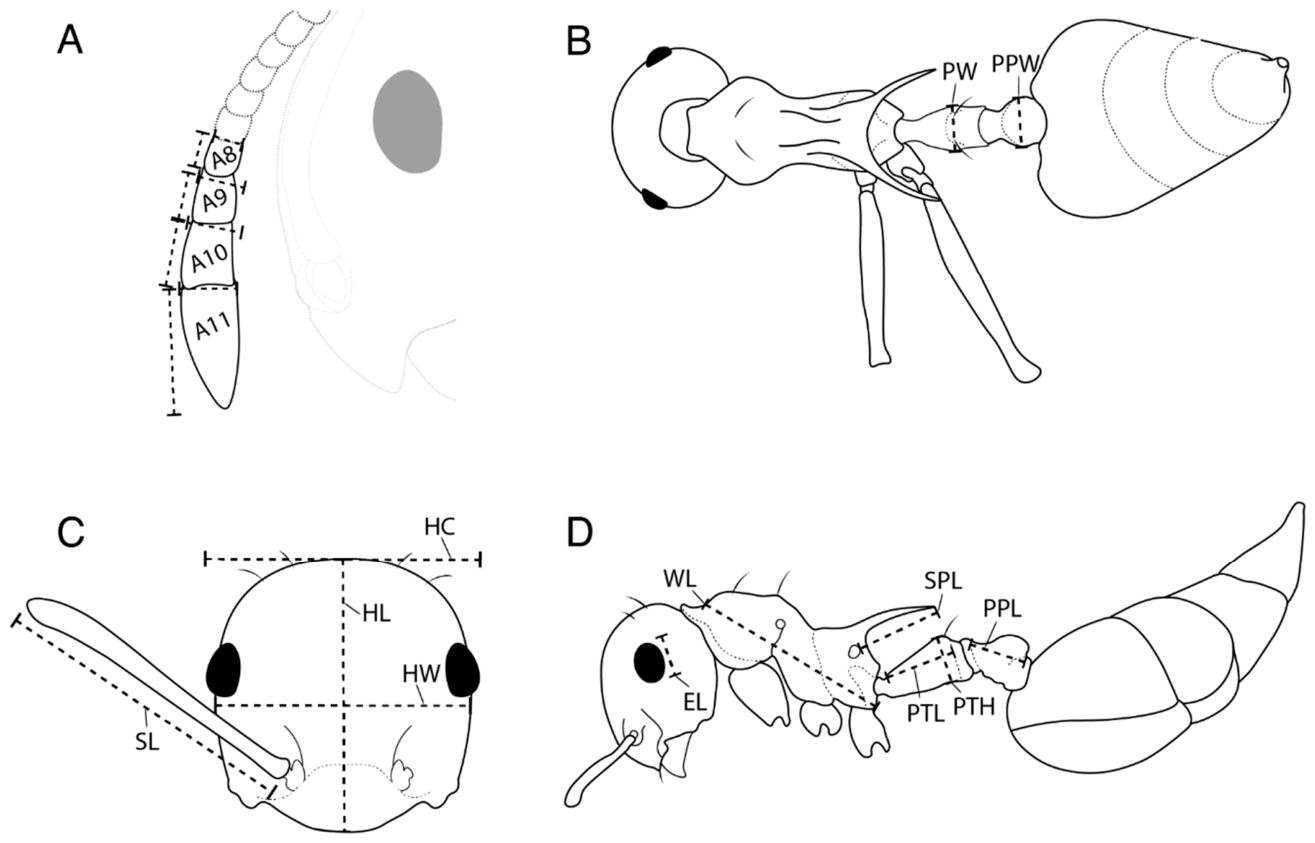
Measurements, holotype worker. HL 0.674; HW 0.63; HC 0.738; SL 0.685; EL 0.163; A11L 0.303; A11W 0.108; A10L 0.131; A10W 0.87; A09L 0.063; A09W 0.067; A08L 0.061; A08W 0.06; WL 0.824; SPL 0.187; PTH 0.21; PTL 0.376; PTW 0.18; PPL 0.235; PPW 0.2; CI 93.47; OI 24.18; SI 101.63; PTHI 55.85; PTWI 47.87; PPI 85.11; SPI 22.69; ACI 1.55.
Queen and male. Unknown.
Biology. Unknown. Worker collected by Winkler trap in coffee plantation.
Etymology. This species is named after La Balsa region in the Department of Chocó, Colombia.
Diagnosis and comments. Crematogaster labalsa sp. nov. is very similar to C. nigropilosa, with which it shares many traits, such as promesonotal longitudinal carinae and the lack of erect hairs on hind legs. The main characteristics that differentiated by its neighbor are the propodeal spines (SPI < 23), shorter than typical C. nigropilosa (SP > 33, rarely > than 29), more than 8 long erect hairs on mesonotum (4 anterior pronotum + 2 anterior mesonotum + 2 posterior mesonotum in C. nigropilosa), low posterolateral tubercles on petiole (more elevated in C. nigropilosa) and yellow setae on the body. It could be argued that these traits vary within the species C. nigropilosa across its extensive geographical distribution. However, promesonotal pilosity is generally used to delimit species in Crematogaster.
Material Examined: From the type locality. [Colombia, Chocó, La Balsa, Estación Silvicultural Bajo Atrato, 1.vii.1992, L.F. Mendoza. Deposited in ICN].
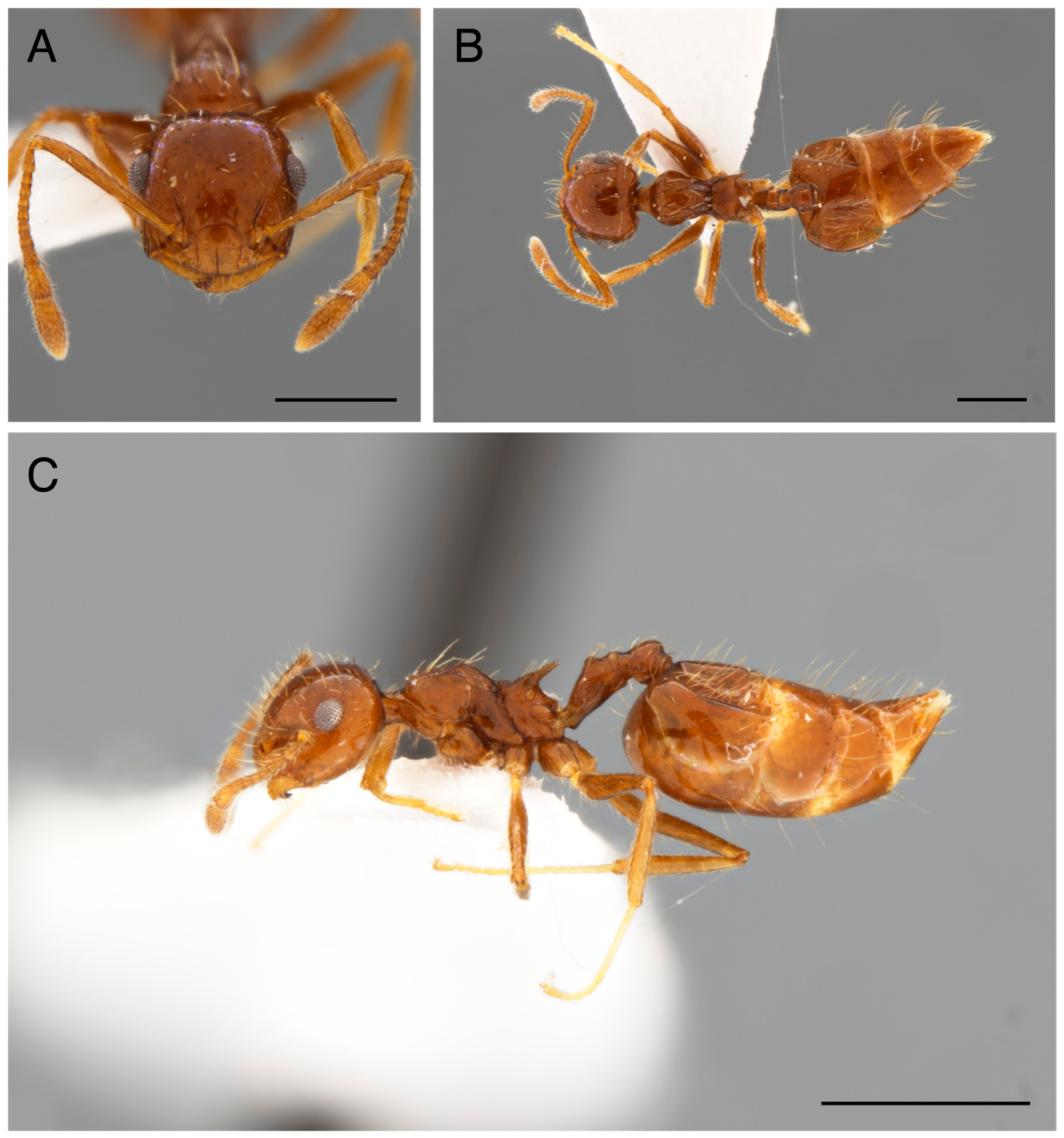
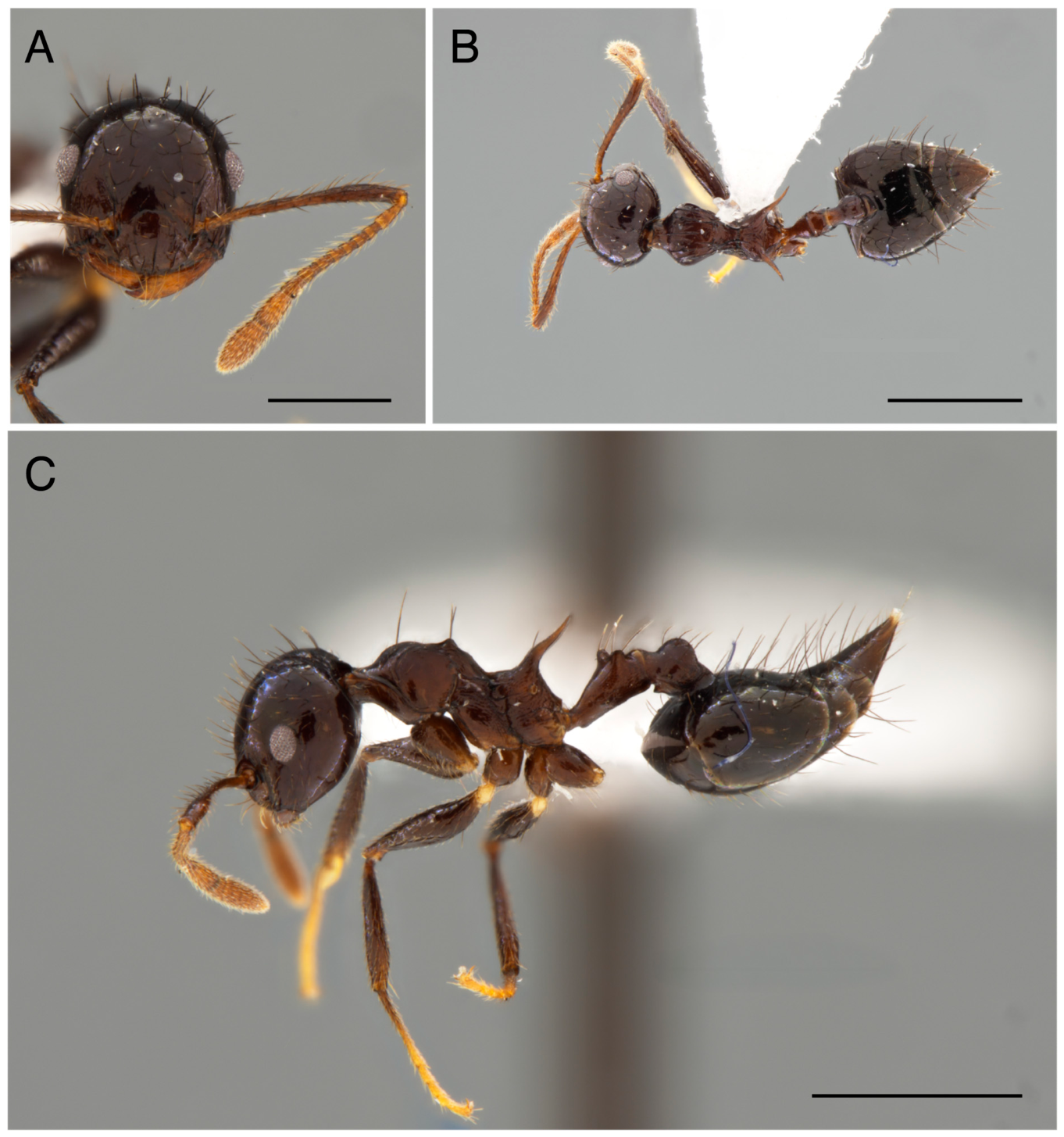
Holotype worker. COLOMBIA. Putumayo, Orito, 0.66816° N, 76.87207° W, 780 m, 26 September 1998, U.V. Rodriguez leg. Deposited in ICN (115795).
Description of worker. Color red brown, worker monomorphic. Mandibles smooth and shining; clypeus smooth and shining with a faint median longitudinal carinulae, head slightly longer than wide, with broadly convex sides and slightly evenly posterior border; antenna with terminal two segments enlarged to form a club, third segment (9) larger than the following (8), scape with abundant long erect setae; when scapes laid back from antennal insertions, they surpass clearly margin of vertex; face largely smooth and shining, without striation between antennal insertion and eye; face covered with abundant long flexuous white setae, no appressed pubescence; in full-face view abundant setae project from lateral and posterior margins.
Promesonotum in profile evenly convex, posterior face dropping to propodeal suture; propodeal suture narrow in dorsal view; propodeal spines larger, stout at base, strongly protruding outward and backward; in lateral view propodeum with a short dorsal face, medially there is a single declivity from propodeal suture to petiolar insertion; promesonotum with subparallel strong lateral carinae, these continue near to bases of propodeal spines, interspace smooth and shining; propodeal spiracle near to propodeal border at less than their maximum diameter; propodeal declivity smooth and shining; promesonotum dorsum smooth and shining; side of pronotum smooth and shining; mesopleura smooth and shining with a feebly lateral sculpture; side of propodeum smooth and shining; mesosomal dorsum with several very long flexuous dark setae, setae on pronotal humeri longest; femora and tibiae with abundant appressed hairs, no erect setae.
Petiole in side view elongate, trapezoidal, smooth and shining; anteroventral margin with a tiny angle barely noticeable, posterolateral lobes of dorsal face are distinctly higher than dorsal margin of aperture; dorsal face of petiole smooth and shining, elongate, widest posteriorly, regularly tapering anteriorly, with two long flexuous setae arising near posterolateral lobes; postpetiole without tooth, globular in dorsal view, with several erect setae; fourth abdominal tergite smooth and shining, with several long flexuous erect dark setae, no appressed pubescence.
Measurements, holotype worker. HL 0.709; HW 0.670; HC 0,606; SL 0,774; EL 0.141; A11L 0.296; A11W 0.103; A10L 0.180; A10W 0.065; A09L 0.103; A09W 0.052; A08L 0.065; A08W 0.039; WL 0.851; SPL 0.361; PTH 0.206; PTL 0.348; PTW 0.180; PPL 0.180; PPW 0.193; CI 94; OI 20; SI 109; PTHI 59; PTWI 51; PPI 107; SPI 42; ACI 0.071.
Queen and male. Unknown.
Biology. Unknown. The holotype worker was collected at “piedemonte” lowland rainforest at 780 m.
Etymology. This species is named after the municipality of Orito in Putumayo, Colombia, where the specimen was collected.
Diagnosis and comments. Crematogaster orito sp. nov has several distinct traits that differentiate it from other Neotropical species within this genus. Some traits are: body smooth and shining, including genae; propodeal spines large, strongly projecting outward; petiole and postpetiole without ventral tooth; and hind tibiae without erect setae. No other member of the Neotropical Crematogaster shares these traits. The closest species is C. nigropilosa, from which it is separated by the absence of a tooth in the ventral portion of the petiole (present in C. nigropilosa), in addition to sculpture features (see key).
Crematogaster protzalezi sp. nov. (
Figure 5)
Holotype worker: Colombia, Risaralda, SFF Otún Quimbaya, 4°43′25″ N 75°34′45″ W, 1800 m, manual, 15 June 2017, M.C. Tocora, Deposited in ICN (115796).
Paratype (4 workers): Same data, deposited in the liquid collection at ICN (115796).
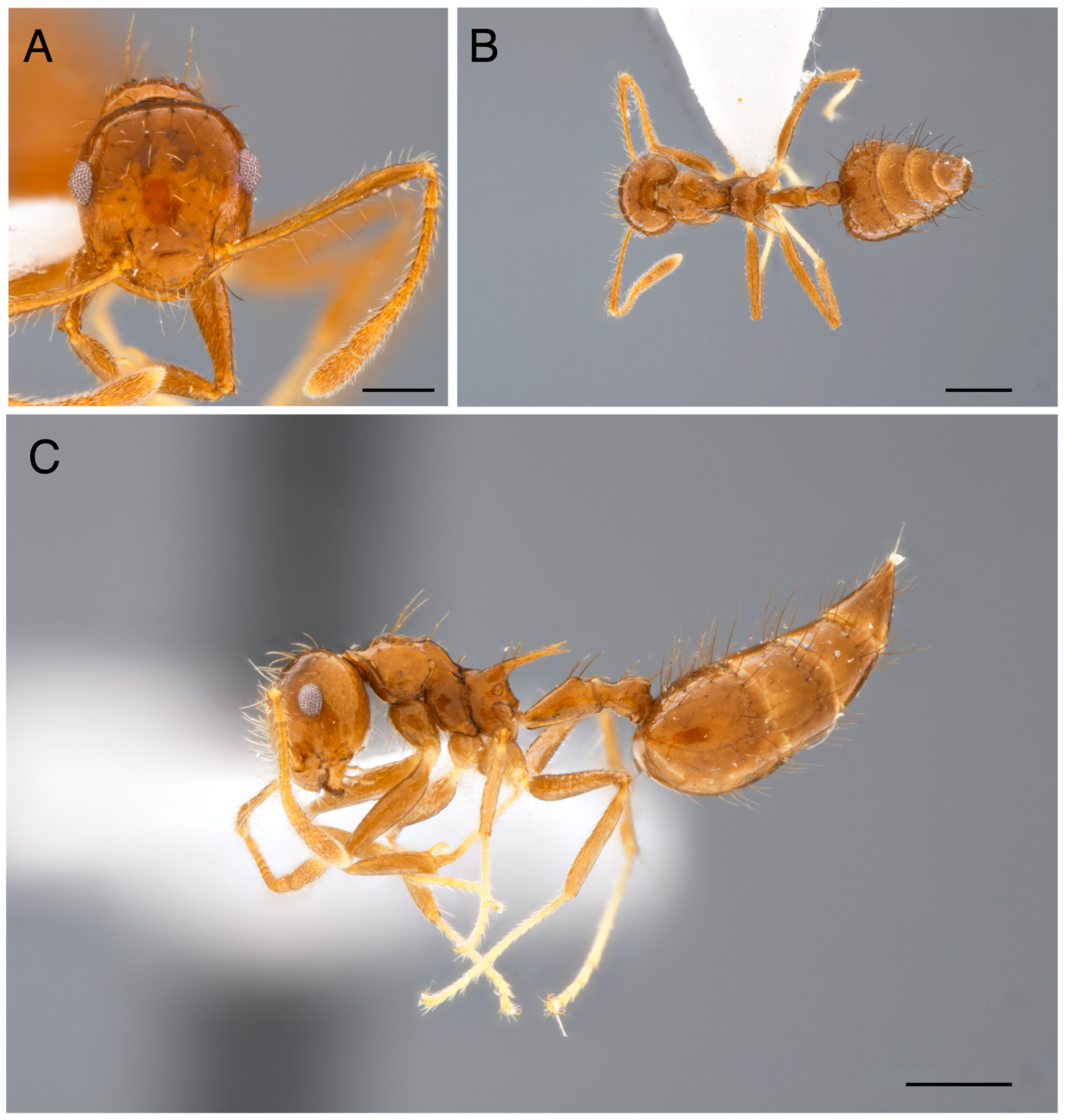
Description of worker. Color dark brown, mandibles and distal appendages lighter. Mandibles smooth and shiny; in full-face view anterior margin of clypeus weakly convex; clypeus convex, shiny, with about 6 thin longitudinal carinulae in anterior half; face smooth and shiny (longitudinal striation in the oculomandibular region); scapes with feebly sculpture, with abundant long erect setae, erect setae much longer than width of scape, no other hairs present; terminal 4 segments of antenna gradually lengthening to form club, becoming increasingly densely pubescent, terminal two segments the largest and most conspicuous; face with abundant erect black setae; in full-face view with a crown of dark setae projecting from sides and posterior margin of head posterior to eyes, few short curved setae projecting from sides of head anterior to eyes; ventral surface of head with few suberect and erect and long setae.
In lateral view, pronotum rising above anterior collar to gently convex dorsal surface, mesonotum flat, strongly sloping, propodeal suture deep medially, appearing shallow in lateral view because of pronounced lateral carinae that bridge suture; dorsal face of propodeum horizontal, well differentiated from and slightly shorter than sloping posterior face; propodeal spines thin, very large; side of pronotum smooth and shiny; anepisternum and katepisternum with microareolate sculpture mixed with irregular longitudinal carinulae; side of propodeum smooth and shiny in the middle, otherwise faintly rugulose and microareolate; promesonotal dorsum smooth and shiny with two main longitudinal carinae that extended to metanotal groove, some feebly carinulae run parallel to both carinae. In lateral view, the carinae form a small swollen at mesonotum level; dorsal face of propodeum sculptured, posterior face smooth and shining; all mesosoma, including base of propodeal spines, lacking any kind of hairs with shorter erect hairs; legs moderate suberect pilosity and long erect setae on the outer face. Hind tibiae with suberect pilosity in inner face, few erect hairs on extensor face.
Petiole in side view trapezoidal, smooth and shiny with faint microareolate sculpture; anteroventral tooth very small, forming an obtuse angle; dorsal face elongate, tapering anteriorly, smooth and shiny with faint microaerolate, with one short dark setae on each posterolateral tubercle; posterolateral tubercles very low, feebly elevated over petiole surface; postpetiole with acute ventral tooth, postpetiole in dorsal view globular, well separated from petiole by cylindrical anterior peduncle, with 4 erect and 2 suberect and short seta on dorsum; fourth abdominal tergite smooth and shining and with moderate long erect dark setae.
Measurements, holotype worker. HL 0.741; HW 0.712; HC 0.796; SL 0.837; EL 0.17; A11L 0.256; A11W 0.104; A10L 0.175; A10W 0.09; A09L 0.088; A09W 0.067; A08L 0.064; A08W 0.065; WL 0.895; SPL 0.291; PTH 0.215; PTL 0.429; PTW 0.191; PPL 0.277; PPW 0.219; CI 96.09; OI 22.94; SI 112.96; PTHI 50.12; PTWI 44.52; PPI 79.06; SPI 32.51; ACI 1.25.
Queen and male. Unknown.
Biology. Unknown.
Etymology. This species is named after the Protz and Gonzalez families, especially Dawson A. and Brian G. Protz, Gustavo A., Paula A., and Alicia Gonzalez, who have supported the first author’s scientific career.
Diagnosis and comments. Crematogaster protzalezi sp. nov is unique in the combination of several traits: Promesonotum lacking any type of pilosity in contrast to its closest species, C. longispina, with shorter erect setae scattered over the promesonotum. Additionally, propodeal spines long and thin, posterolateral tubercles of the petiole low, each with one short hair, and hind tibiae with suberect hairs on the inner side with few erect hairs on the outer side. No other Neotropical Crematogaster shares this combination of traits. The lack of hairs on the mesosoma and tibial hair combination is unique.
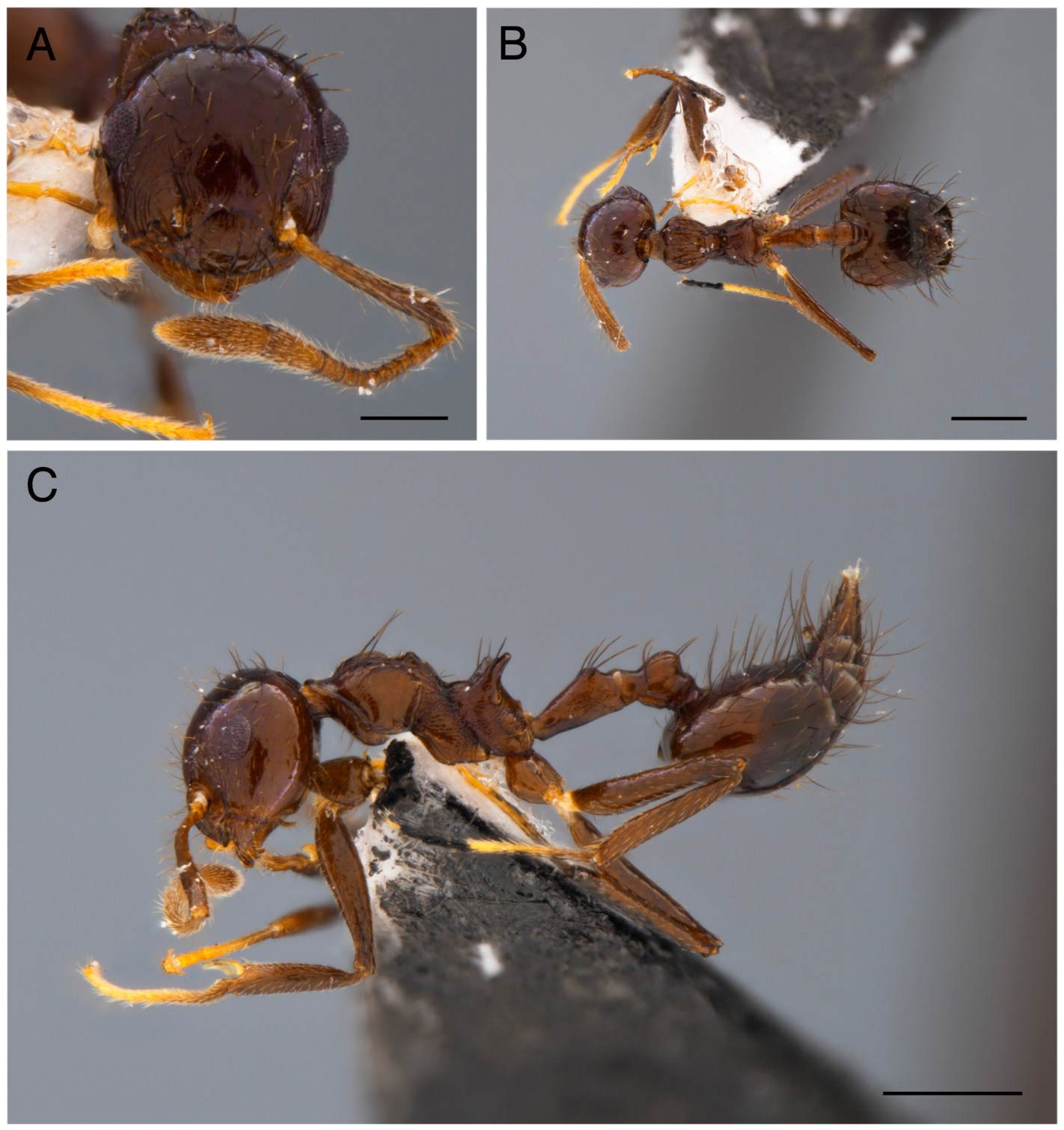
Crematogaster quipile sp. nov. (
Figure 6)
Holotype worker. Colombia, Cundinamarca, Quipile, El Tiber Venecia, 04º42″12′ N 74º33″56′ W, 1523 m, cafetal, 15 September 2011, J. Cepeda et al. Deposited in ICN (115793). Paratype: Same data, deposited in ICN (115794).
Range. Colombia.
Description of worker. Color black, mandibles and appendages dark brown. Mandibles smooth and shiny, basal half with feeble longitudinal carinulae; in full-face view anterior margin of clypeus weakly convex; clypeus convex, shiny, with 4–5 thin longitudinal carinulae; face smooth and shiny; scapes with longitudinal carinulae and faint etching, subopaque, with a combination of abundant subdecumbent setae and abundant long erect setae, erect setae much longer than width of scape; terminal 4–5 segments of antenna gradually lengthening to form club, becoming increasingly densely pubescent, terminal two segments the largest and most conspicuous; face with abundant erect black setae; in full-face view with a crown of dark setae projecting from sides and posterior margin of head posterior to eyes, few short curved setae projecting from sides of head anterior to eyes; ventral surface of head with few suberect setae.
In lateral view, pronotum rising above anterior collar to gently convex dorsal surface, mesonotum flat, strongly sloping, propodeal suture deep medially, appearing shallow in lateral view because of pronounced lateral carinae that bridge suture; dorsal face of propodeum horizontal, well differentiated from and slightly shorter than sloping posterior face; propodeal spines very large, broadly triangular at base, gradually tapering to outermost, sinuous at 1/3 their length; side of pronotum smooth and shiny; anepisternum and katepisternum with microareolate sculpture; side of propodeum smooth and shiny dorsally, faintly rugulose and microareolate below; pronotal dorsum with about 5 longitudinal carinulae, interspaces smooth and shining; mesonotum with strong lateral carinae, converging posteriorly, with a protruding medial tubercle, medial space smooth and shining; dorsal face of propodeum with carinulae that are longitudinal anteriorly, sweep outward onto bases of propodeal spines, posterior face smooth and shining; setae on mesosomal dorsum long, stout, blackish, 2 on pronotum, 2 on anterior mesonotum, raising from each tubercle, 2 shorter on base of each propodeal spine; legs with abundant suberect pubescence/short pilosity, no long erect setae. Petiole in side view trapezoidal, smooth and shiny or with faint microareolate sculpture; anteroventral tooth small, forming an obtuse angle; dorsal face elongate, tapering anteriorly, smooth and shiny or faintly microaerolate, with two long dark setae on each posterolateral tubercle; posterolateral tubercles stout and strongly elevated over petiole surface; postpetiole with strongly acute ventral tooth, postpetiole in dorsal view globular, well separated from petiole by cylindrical anterior peduncle, with 4 erect seta on dorsum; fourth abdominal tergite smooth and shining; fourth abdominal tergite with abundant long erect dark setae.
Measurements, holotype worker. HL 0.727; HW 0.727; HC 0.784; SL 0.837; EL 0.178; A11L 0.248; A11W 0.112; A10L 0.168; A10W 0.101; A09L 0.096; A09W 0.072; A08L 0.077; A08W 0.066; WL 0.968; SPL 0.364; PTH 0.275; PTL 0.445; PTW 0.19; PPL 0.297; PPW 0.233; CI 100.00; OI 24.48; SI 115.13; PTHI 61.80; PTWI 42.70; PPI 78.45; SPI 37.60; ACI 1.09.
Queen and male. Unknown.
Biology. Unknown. Worker collected by Winkler trap in coffee plantation.
Etymology. This species is named after the municipality of Quipile in Cundinamarca, Colombia, where the specimen was collected.
Diagnosis and comments. Crematogaster quipile sp. nov. is very similar to
C. nigropilosa, with which it shares many traits, such as long spines and the lack of erect hairs on hind legs. However, in this new species, several characteristics differentiate it from its neighbor, such as the presence of protruding keels or tubercles on the mesonotum, all surface of the anepisternum and katepisternum sculptured, 4 long erect hairs on promesonotum (two on pronotum, two on mesonotum), stout posterolateral tubercles on petiole, highly raised on the petiole surface. In
C. nigropilosa, there are more erect hairs in the promesonotum, the sides of the mesosoma are smoother and shinier, with little peripheral sculpture, and the posterolateral tubercles of the petiole are blunt and low. It could be argued that these traits vary across the unique
C. nigropilosa species throughout its extensive geographical distribution. However, the new species has a distinct feature that separates it from
C. nigropilosa: a strong, acute tooth on the ventral part of the postpetiole. This characteristic is sufficient to separate species within the genus
Crematogaster [
7], so it is used here as the primary basis for considering this species new.
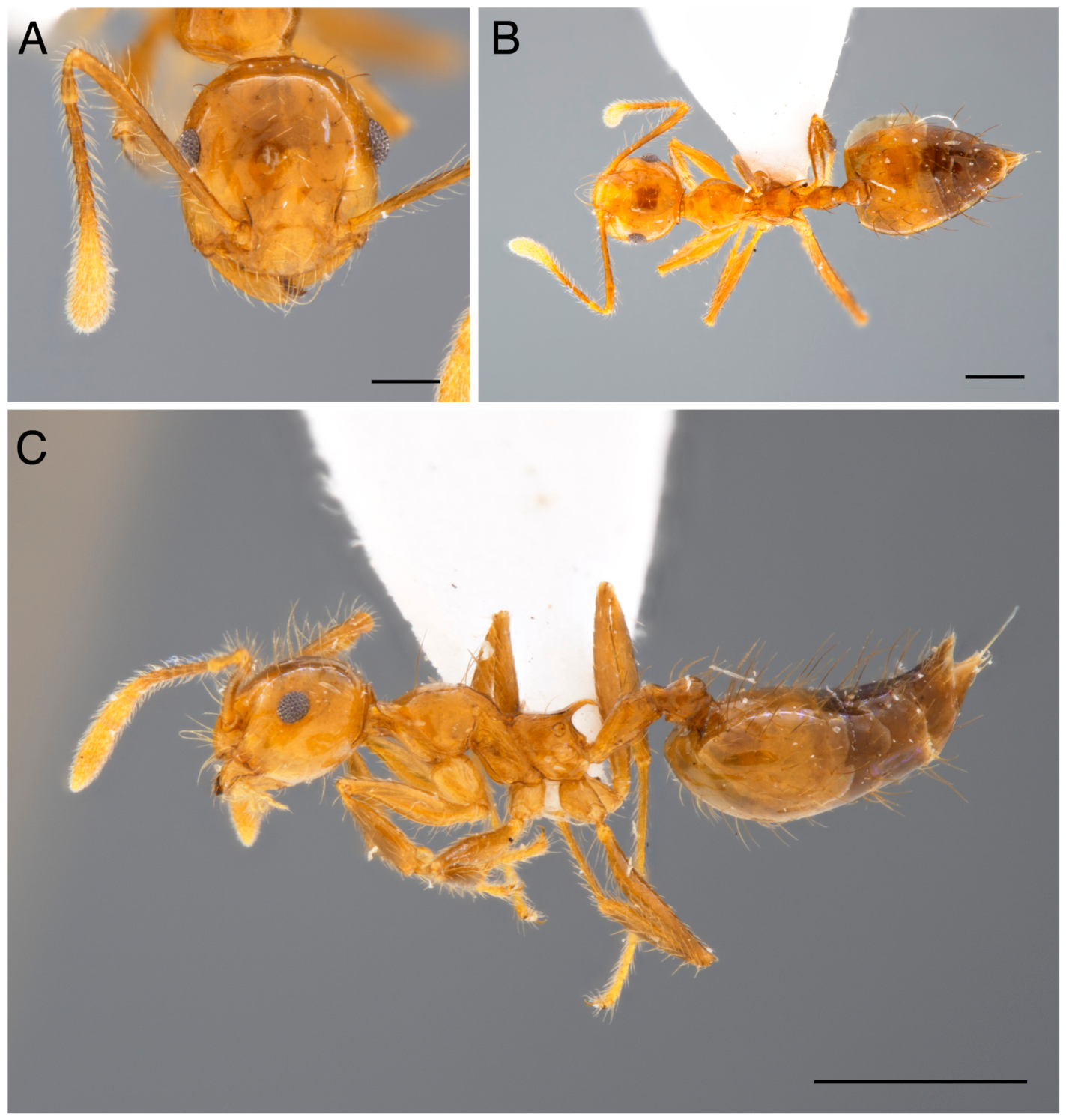
Crematogaster tequendama sp. nov. (
Figure 7)
Holotype worker. COLOMBIA. Cundinamarca, San Antonio, Tequendama, Parque Natural Chicaque, 4°37′03.3″ N, 74°18′41.7″ W, 1 August 2009, F. Helblg. Deposited in ICN (115797).
Nontype material. Two workers, COLOMBIA, Cundinamarca, San Antonio de Tena, Laguna de Pedro Palo, 4°40′53″ N, 74°23′29″ W, 2000 m, 22 February 1997, M. Ospina leg. (ICN 115799 and IAvH).
Description of worker.
Color red brown, most of mid and hind legs and posterior half of gaster darker; worker monomorphic.
Mandibles smooth and shining; clypeus smooth and shining, head about as long as wide, with broadly convex sides and evenly posterior border; in full-face view with a short but clearly visible neck; antenna with terminal two segments enlarged to form a club, third segment (9) larger than the following (8), scape with abundant long erect setae; when scapes laid back from antennal insertions, they surpass clearly margin of vertex; face largely smooth and shining, with variable extent of striated region between antennal insertion and eye; face covered with abundant long flexuous white setae, no appressed pubescence; in full-face view abundant setae project from lateral and posterior margins.
Promesonotum in profile somewhat flattened dorsally; mesonotum short dorsal face, posterior face dropping to propodeal suture; propodeal suture narrow in dorsal view; propodeal spines slightly curved, curved at tips in the holotype, projecting outward and backward; in lateral view propodeum appears to have distinct dorsal and posterior faces because profile is horizontal from propodeal suture onto propodeal spines, but medially there is a single declivity from propodeal suture to petiolar insertion; mesonotum with subparallel lateral carinae, these continue shortly onto propodeum, carinae with a small teeth at mid distance, interspace smooth and shining; propodeal spiracle near to propodeal border at less than their maximum diameter; propodeal declivity smooth and shining; side of pronotum smooth and shining; mesopleura smooth and shining with several irregular rugulae; side of propodeum smooth and shining; mesosomal dorsum with several very long flexuous white setae, setae on pronotal humeri longest; femora and tibiae with abundant long erect setae.
Petiole in side view elongate, trapezoidal, smooth, very weakly punctate; anteroventral margin with a tiny angle barely noticeable, posterior ring-like aperture that receives postpetiole large, dorsal margin distant from the low, inconspicuous posterolateral lobes of dorsal face (petiole viewed in profile with ventral margin horizontal); dorsal face of petiole smooth and shining, elongate, widest posteriorly, regularly tapering anteriorly, with two long flexuous setae arising near to posterolateral lobes; ventral postpetiolar process angulated anterad, but without a definitive tooth; postpetiole globular in dorsal view, with several erect setae; fourth abdominal tergite smooth and shining, with abundant long flexuous erect white setae, no appressed pubescence.
Measurements, holotype worker. HL 0.786; HW 0.774; HC 0,709; SL 0,890; EL 0.167; A11L 0.361; A11W 0.116; A10L 0.194; A10W 0.096; A09L 0.090; A09W 0.064; A08L 0.077; A08W 0.051; WL 0.928; SPL 0.193; PTH 0.193; PTL 0.374; PTW 0.194; PPL 0.206; PPW 0.245; CI 98; OI 21; SI 113; PTHI 52; PTWI 52; PPI 118; SPI 21; ACI 1.77.
Queen and male. Unknown.
Biology. Unknown. The holotype worker was collected at a montane forest at more than 2200 m; the two other workers were collected near the type locality, at 2000 m, near Pedro Palo Lake. This species is one of the few Crematogaster species that inhabit high-altitude Andean habitats.
Etymology. This species is named after the Tequendama Falls, located southeast of Soacha, Cundinamarca, Colombia.
Diagnosis and comments. Crematogaster tequendama sp. nov. has several distinct traits that differentiate it from other Neotropical species of the limata complex, such as the short neck, propodeal spines slightly curved, posteropropodeal lobes of the petiole poorly developed, and ventral postpetiolar process. No other members of the group share these traits, especially the neck length and inconspicuous posterolateral lobes of the petiolar dorsum. C. tequendama differs from its closest species (C. tenuicula and C. brasiliensis) in the promesonotum pilosity with six long and erect hairs, rather than distinguished long setae on the pronotal humeri.
Holotype worker. COLOMBIA. Cundinamarca, La Vega, PNN Nautatá, 05°00′ N, 74°25′ W, 1040 m, secondary forest, collected on soil, 10 November 2010, F. Fernández leg. Deposited in ICN (115798).
Description of worker. Color dark brown, antennae and tarsi lighter, all erect setae dark brown. Mandibles smooth and shiny; clypeus smooth and shiny with several longitudinal rugulae well-marked; face smooth and shiny; scapes smooth and shiny, with abundant curved erect setae, setae longer than width of scape; space between toruli and eyes with faint oblique sculpture; antennal segments becoming increasingly densely pubescent, terminal two segments the largest and most conspicuous; face with abundant erect flexuous setae; in full-face view with abundant setae projecting from sides and posterior margin of head, both anterior and posterior to eyes; ventral surface of head with moderately abundant suberect setae.
In lateral view, promesonotum elongate, pronotum forming sigmoidal curve as it rises from anterior collar to weakly convex dorsal surface, continuous with anterior half of mesonotum, posterior half of mesonotum dropping steeply to propodeal suture; promesonotum elevated above propodeum; mesonotum with pair of strongly pronounced lateral carinae, and converging to join small lateral carinulae that bridge propodeal suture; the lateral carinae form a conspicuous keel at midlength of mesonotum, breaking the promesonotal convexity; dorsal and posterior faces of propodeum not differentiated, meeting broadly; propodeal spines large, stout at bases, long, narrowly acute and spiniform, projecting upward and strongly diverging; side of pronotum always smooth and shining, pronotal dorsum smooth and shining with several strong longitudinal carinae; katepisternum shining with microareolate sculpture; side of propodeum shining with faint microsculpture; dorsal face of propodeum shining, finely areolated; posterior face of propodeum shining with faint transverse striation; pair of long erect flexuous setae on pronotal humeri and anterior mesonotum, and onto propodeal spines; hind tibiae with appressed hairs.
Petiole in side view elongate, smooth and shining or with faint microsculpture, with faint small anteroventral angle; in dorsal view, dorsal face of petiole strongly converging anteriorly, widest posteriorly, with 2 setae on each posterolateral corner; ventral margin of postpetiole without denticle; postpetiole in dorsal view globular, with 2 pairs erect setae; fourth abdominal tergite smooth and shining with abundant long flexuous erect setae.
Measurements, holotype worker. HL 0.683; HW 0.709; HC 0.645; SL 0.761; EL 0.155; A11L 0.418; A11W 0.129; A10L 0.154; A10W 0.090; A09L 0.077; A09W 0.058; A08L 0.064; A08W 0.051; WL 0.761; SPL 0.271; PTH 0.180; PTL 0.348; PTW 0.154; PPL 0.167; PPW 0.193; CI 103; OI 22; SI 111; PTHI 51; PTWI 44; PPI 92; SPI 35; ACI 1.73.
Queen and male. Unknown.
Etymology. This species is named for La Vega municipality in Cundinamarca, Colombia, where the specimen was sampled.
Diagnosis and comments. The tegument with conspicuous sculpture, including strong longitudinal carinae on the promesonotum dorsum; the SPI > 35 and appressed hairs on hind tibiae differentiate this species from other Neotropical Crematogaster. It is very close to C. nigropilosa but differs clearly in body sculpture. While in nigropilosa almost the whole body is smooth and shining, C. vega nov. sp. has sculpture in the lateral parts of the head, mesopleura, dorsum, declivity, and sides of propodeum. Notable characters include the strong longitudinal carinae on the dorsum of the promesonotum (except the lateral ones) and the postpetiole lacking a ventral tooth. All these traits could represent the end of a continuum of variation in sculpture between the typical C. nigropilosa and C. vega nov. sp., but currently we lack intermediate forms. Additionally, this new species appears to be confined to an inter-Andean valley on the Eastern Cordillera, somewhat distant from the common lower areas of nigropilosa.
Key to species of the limata complex (workers) in Colombia (based on Longino 2003)
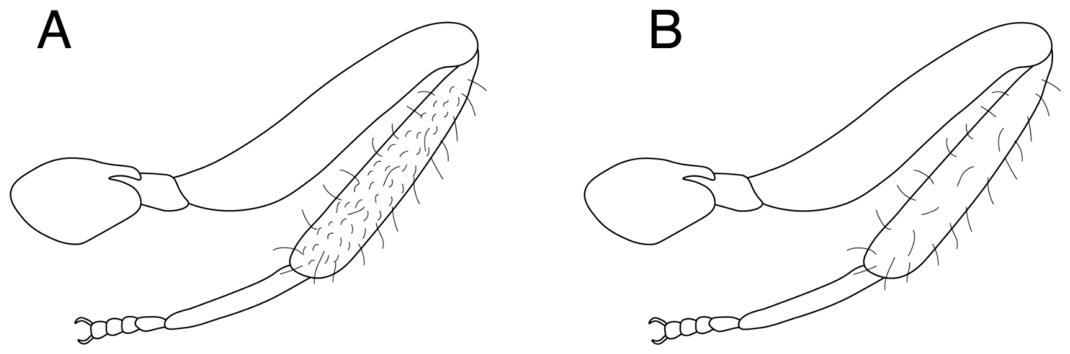
Mid and hind tibiae with appressed hairs; in some cases combined with scattered erect hairs (some
C. nigropilosa and
C. sotobosque) (
Figure 9A)………… 2
- −
Mid and hind tibiae without appressed hairs, erect hairs present (
Figure 9B) …………7
SPI more than 34 (rarely between 29 and 33)…………… 3
- −
SPI less than 29 (
Figure 3B,C) …………
C. labalsa sp. nov.
Presence of a strong and acute tooth in the ventral part of the postpetiole (
Figure 6C); all surface of the anepisternum and katepisternum sculptured; stout posterolateral tubercles on petiole, highly raised on the petiole surface ………
C. quipile sp. nov.
- −
Postpetiole without ventral tooth …………….4
Lateral sides of the head sculptured (
Figure 8A–C) ………….
C. vega sp. nov.
- −
Lateral sides of head smooth ……………5
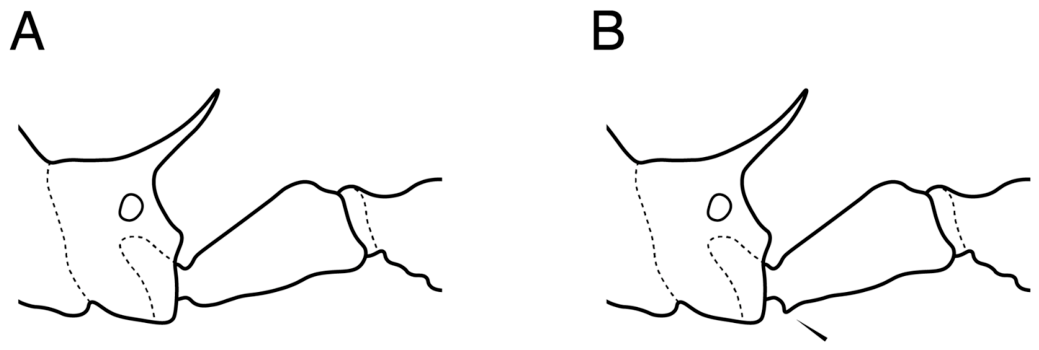
Mid and hind tibia with appressed hairs, erect hairs absent; petiole without ventral tooth (
Figure 4C and
Figure 10A) ……….
C. orito sp. Nov.
- −
Mid and hind tibia with a combination of appressed and erect hairs; petiole with ventral tooth (
Figure 10B) ……………6
Propodeal spines very long, directed upward and outward, SPI usually > 34, if in the range 29–33 (small specimens) …………C. nigropilosa
- −
Propodeal spines shorter (SPI < 22) ………….C. sotobosque
Propodeal spines very long, directed upward and outward, SPI usually > 34 ………8
- −
Propodeal spines shorter (SPI < 32), if in the range 29–33 (large specimens of C. limata) then hind tibiae with erect pilosity; propodeal spines usually directed posteriorly ……………9
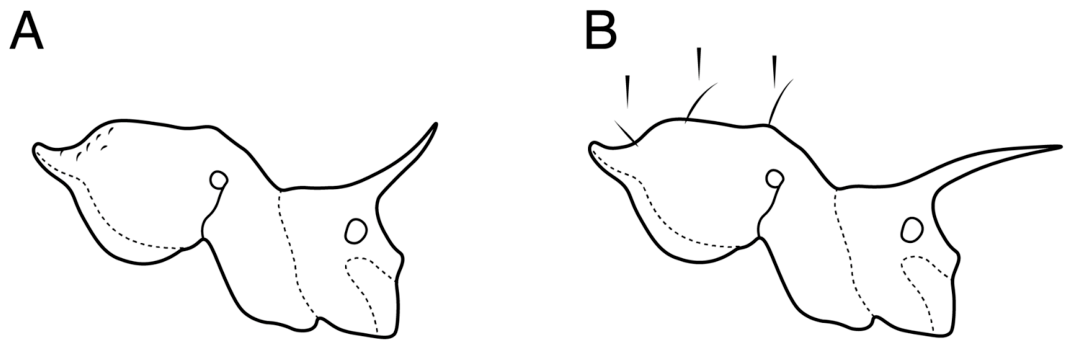
Promesonotum lacking any type of pilosity (
Figure 5C); hind tibiae with suberect hairs on the inner side with few erect hairs on the outer side (
Figure 11A) …………
C. protzalezi sp. nov.
- −
Promesonotum with erect hairs (
Figure 11B) …………
C. longispina
Postpetiole with acute anteroventral tooth …………10
- −
Postpetiole lacking anteroventral tooth …………12
Promesonotum with few erect and long hairs—up to 6 (
Figure 7C) ……….
C. tequendama sp. nov.
- −
Promesonotum with many hairs, more than 6 ……….11
Petiole relatively triangular in lateral view (PTHI > 60), usually lacking anteroventral tooth; posterodorsal tubercles distinctly higher than posterodorsal margin of tergite ……… C. tenuicula
- −
Petiole relatively elongate (PTHI < 60 in Central America, variable and often higher in South America), with angular to acute anteroventral tooth; posterodorsal border of petiole low, posterodorsal tubercles little higher than posterodorsal margin of tergite …………….. C. brasiliensis Mayr, 1878
Propodeal spines long (SPI > 25) ……………. C. limata
- −
Propodeal spines short (SPI < 21)………. 13
Promesonotum smooth ……………C. levior
- −
Promesonotum with several longitudinal rugulae …………. C. carinata