
Article

Seed-Carrying Ant Assemblages in a Fragmented Dry Forest Landscape: Richness, Composition, and Ecological Implications

1
Desert Community Ecology Research Team (Ecodes), Instituto Argentino de Investigaciones de las Zonas Áridas, Consejo Nacional de Investigaciones Científicas y Técnicas, Mendoza 5500, Argentina
2
Facultad de Ciencias Exactas y Naturales, Universidad Nacional de Cuyo, Mendoza 5500, Argentina
3
Instituto Multidisciplinario de Biología Vegetal, Consejo Nacional de Investigaciones Científicas y Técnicas and Universidad Nacional de Córdoba, Vélez Sarsfield 1611, Córdoba 5000, Argentina
4
Departamento de Diversidad Biológica y Ecología, Facultad de Ciencias Exactas, Físicas y Naturales, Universidad Nacional de Córdoba, Córdoba 5500, Argentina
*
Author to whom correspondence should be addressed.
Diversity 2025, 17(12), 866; https://doi.org/10.3390/d17120866
Submission received: 30 November 2025 / Revised: 15 December 2025 / Accepted: 15 December 2025 / Published: 17 December 2025
(This article belongs to the Special Issue Systematics, Evolution and Diversity in Ants)

Abstract

Habitat fragmentation profoundly alters ecological processes such as seed predation and dispersal. Ants play a central role as seed removers and dispersers, yet the effects of fragmentation on seed-carrying ant assemblages in dry tropical forests remain insufficiently studied. In this work, we examined the influence of forest fragmentation on seed-carrying ants in the Chaco forests of central Argentina. Ants were sampled across nine forest fragments of varying sizes and two continuous forests within an agroecosystem landscape, and species richness, composition, and occurrence were analyzed. Our results revealed that species richness did not vary significantly with fragment size; however, fragmentation caused pronounced shifts in species composition, with clear distinctions between continuous forests and fragments. Large-bodied specialist harvester ants declined in fragments, whereas small- to medium-sized generalist species from genera such as Pheidole and Solenopsis persisted. These compositional changes suggest that although overall seed removal rates may remain stable, the functional quality of seed dispersal likely diminishes. This study highlights the sensitivity of seed-carrying ant assemblages to habitat fragmentation and underscores the need for further research that integrates behavioral and landscape-scale approaches to better assess impacts on seed removal, dispersal, and forest regeneration in fragmented dry forests.

1. Introduction

The intensification and expansion of agriculture have had severe negative impacts on forest ecosystems [1]. In recent decades, extensive areas of natural forest have been cleared for cropland and pastures, resulting in highly fragmented landscapes composed of crop monocultures, secondary forests, and small, isolated forest remnants [2]. These changes in spatial configuration, combined with habitat loss, modify not only biodiversity and community composition but also disrupt biological interactions and key ecological processes [3,4,5]. Although habitat loss is universally detrimental to biodiversity, recent syntheses have shown that the ecological consequences of habitat fragmentation per se are more nuanced than previously assumed. When the total amount of habitat is controlled for, fragmentation effects are often weak or even positive, as a greater number of habitat patches can enhance landscape heterogeneity and resource complementation for some species [6,7]. Thus, rather than being inherently harmful, the outcomes of fragmentation depend on species’ ecological traits, dispersal abilities, and the degree of environmental heterogeneity among patches. Ultimately, such disruptions or, in some cases, reorganizations, can alter the capacity of ecosystems to provide essential functions and services.
In terrestrial environments, insects contribute to most ecosystem functions and play key roles in services essential to both natural and human-managed ecosystems. Among them, ants are some of the most ecologically dominant organisms on Earth, occupying nearly all terrestrial habitats, from deserts to tropical forests, and accounting for a substantial fraction of animal biomass [8]. Ants are involved in a wide range of ecological processes, including soil turnover, nutrient cycling, seed dispersal, and predation [9]. Because they are abundant, behaviorally diverse, and highly sensitive to environmental changes, their community structure can reflect shifts in ecological processes driven by habitat modification and fragmentation [10,11]. As a result, ants play a critical role in maintaining key ecological interactions and functions, and understanding how their assemblages respond to forest fragmentation is crucial for predicting cascading effects on ecosystem functioning.
Most studies examining the effects of habitat loss and fragmentation on ant communities have reported consistent changes in species composition and relative abundances, whereas effects on species richness and diversity are often weak or idiosyncratic [12,13,14,15,16]. Across a variety of ecosystems, ant assemblages exhibit high species turnover among fragments indicating strong environmental filtering and reduced dispersal [11,17,18]. These compositional changes can cascade to affect other trophic levels, especially animal and plant groups that depend on ants for mutualistic or antagonistic interactions. It has been suggested that such changes in community composition may have greater impacts on ecosystem functioning than shifts in species richness alone, leading to altered ant-mediated services such as seed dispersal, predation, and nutrient cycling [11,17,18,19].
Seed predation and seed dispersal by ants are key ecological processes that maintain plant regeneration and community dynamics in many forest ecosystems [20,21] and can be disrupted by habitat loss and fragmentation [22,23]. Ant-mediated seed dispersal (myrmecochory) facilitates seed germination and seedling establishment and may offer seedlings partial protection against herbivores and pathogens [9,20]. Foraging ants collect seeds as food items, often transporting them away from the parent plant, while selective seed predation by ants can influence plant spatial patterns and relative species abundance [24]. Both processes are sensitive to habitat fragmentation, as increased edge, altered microclimates, and reduced fragment size can shift ant composition and behavior, affecting which ant species interact with seeds [21,25]. For example, specialist myrmecochorous ants such as Aphaenogaster decline from forest interiors to edges, leading to directional seed movement and lower dispersal quality near edges [23]. In contrast, invasive species such as Linepithema humile often dominate disturbed habitats or fragmented areas, displacing native harvester and seed dispersing ants [26,27]. These native ants are typically considered seed predators, although they may occasionally disperse non-myrmecochorous seeds [28]. Consequently, the replacement of native specialist ant species in fragmented ecosystems can disrupt mutualistic networks, alter seed dispersal and predation rates, and ultimately affect seedling recruitment and forest regeneration [27,29].
In Argentina, the rapid expansion and intensification of crop production–mainly maize and soybean–over the past 25 years has driven extensive deforestation and fragmentation of native forests [30,31]. This process has been particularly intense in the Chaco forests, where the rate of deforestation and land conversion has been extremely high [32,33]. Such drastic habitat changes have caused severe declines in diversity [30], disrupted plant–animal interactions [34], and altered ecological functioning [35,36].
Despite the ecological dominance of ants, the consequences of Chaco forest fragmentation on ant communities remain largely unexplored. Available studies indicate inconsistent effects on species richness and abundance [15,16,37,38], and little is known about how fragmentation influences seed-carrying ant assemblages. Given the central role of ants in seed removal and dispersal, understanding their response to habitat fragmentation is critical to predicting broader effects on forest regeneration and ecosystem resilience. The aim of this study was to evaluate how seed-carrying ant assemblages respond to forest fragmentation in the Chaco Serrano of central Argentina. Specifically, we tested whether fragment size affects ant species richness, composition, and occurrence across forest remnants embedded in an agricultural mosaic landscape.

2. Materials and Methods

2.1. Study Site

We conducted the study in a fragmented landscape of the Chaco Serrano forest district within the Chaco Phytogeographical Province, central Argentina [36]. The study area coordinates range between 31°11′19″ S; 64°16′02″ W; and 31°13′05″ S; 64°15′55″ W, at 500–600 m a.s.l. The rainy season occurs between October and May, with a mean annual precipitation of 750 mm. Mean maximum and minimum temperatures are 26 °C and 10 °C, respectively. The predominant vegetation is a xerophytic subtropical forest, characterized by closed and open forests depending on grazing pressures and fire recurrence and it is currently restricted to isolated forest fragments within an intensely managed matrix [37]. The vegetation of the semiarid shrub–forest in fragments is characterized by Aspidosperma quebracho-blanco, Acacia spp., Zanthoxylum coco, Neltuma spp., Celtis ehrenbergiana, native and exotic herbs and grasses, vines, and epiphytic plants [39,40,41].
Forest fragments, immersed in an agricultural matrix, persist primarily due to their low suitability for agriculture and have an estimated isolation age of 60 years [36]. The surrounding matrix is dominated by soybean (spring–summer), maize (summer), and wheat (winter). All fragments share similar south-east orientation, vegetation structure, and climatic conditions within the Chaco Serrano.

2.2. Sampling Design and Site Selection

We selected 11 sites spanning a gradient of fragments size: three small (1–2 ha), three medium (3–6 ha), three large (14–19 ha) and two continuous-forest stands (>400 ha) (Figure 1). Fragment-size classes followed previous works on animal–plant interactions in this system, which identified functional differences were among classes [15,42]. Within each site, sampling locations were placed several meters inside the forest to minimize edge effects; the minimum distance to the nearest forest edge was >10 m to small fragments and >20 m for medium and large fragments and continuous forest. We avoided areas with visible soil disturbance.

2.3. Ant Survey

Ants were sampled in late summer (February 2009), following a modified protocol of Morton and Davidson [43] and implemented recently in other studies [44,45,46]. At each site, we established two parallel 100 m lineal transects separated by more than 20 m. Along each transect, 20 bait stations were placed at 5 m intervals, totaling 40 baits per site. Each bait consisted of half a plastic Petri dish (9 cm diameter × 2 cm deep) buried flush with the soil surface and filled with 10 g of Setaria italica seeds (a commercial grass seed similar to native congeneric species occurring in the area such as Setaria lachnea, Setaria pampeana and Setaria parviflora). Seeds of Setaria italica have been shown to be consistently taken and consumed by ants in several experimental studies in arid and semiarid regions of Argentina [44,45,46]. Seeds were offered whole and broken into fragments of different sizes, to be easily handled by ants of different body sizes [44]. Two strips of masking tape were attached from the rim to the base of each dish to facilitate entrance and exit of ants. Baits were checked twice a day, and seeds replenished when depleted.
Ants actively removing or loading seeds from each bait during 60 sec observation periods were collected with forceps and preserved in vials with 90% alcohol. Sampling was conducted on a single day per site. To include species with different foraging activity patterns and thermal niches, we collected ants at three times of day: morning (9:00–10:00 h), midday (11:00–12:00 h) and night (22:00–23:00 h). All ants were identified to the lowest possible taxonomic resolution (morphospecies, species or subspecies) using available keys and reference collections. Voucher specimens were stored in the Entomological Collection of the Instituto Argentino de Investigaciones de las Zonas Áridas (IADIZA), Mendoza, Argentina.

2.4. Data Analysis

Rarefaction curves were performed as a graphical tool to assess whether sampling effort was sufficient to capture the ant species present in each forest fragment. To evaluate the effect of fragment size on ant richness we conducted a Generalized Linear Mixed Model (GLMM) fitted with a Poisson distribution. Fragment area was log-transformed and included as the fixed factor, while bait station identity nested within fragment was treated as a random factor. Ant richness per bait station was used as the response variable.
To characterize relative abundance, we quantified the number of bait stations occupied by each species in relation to the total number of occupied stations across all species, and expressed this value as a proportion. A bait station was considered occupied when a species was detected in at least one of the three daily observation periods. Because ants visiting a bait station are typically foraging from nests located nearby, the number of stations occupied by a species provides a reasonable indicator of its local abundance. Although species with multiple colonies or wide foraging ranges may occupy more than one station, this metric is considered the most reliable abundance estimator for seed-bait sampling designs such as ours [43].
To examine differences in species composition among fragments, we performed a two-dimensional non-metric multidimensional scaling (NMDS) ordination based on the Jaccard similarity index. This analysis was performed using species-occurrence data from the 20 traps within each transect at each fragment. Differences among fragment-size classes were then tested using a Permutational Multivariate Analysis of Variance (PERMANOVA) [47], a non-parametric multivariate test. Models were run using the Jaccard dissimilarity metric and 999 permutations, first fitting a global model and then conducting pairwise comparisons among fragment-size classes.
Rarefaction curves were performed using functions rarefy and rarecurve in the vegan package [48]. GLMM analyses were performed using function glmer in the lme4 package [49]. NMDS and PERMANOVA analyses were conducted using metaMDS and adonis2 of vegan package, respectively. All analyses were performed in R version 4.3.1 [50].

3. Results

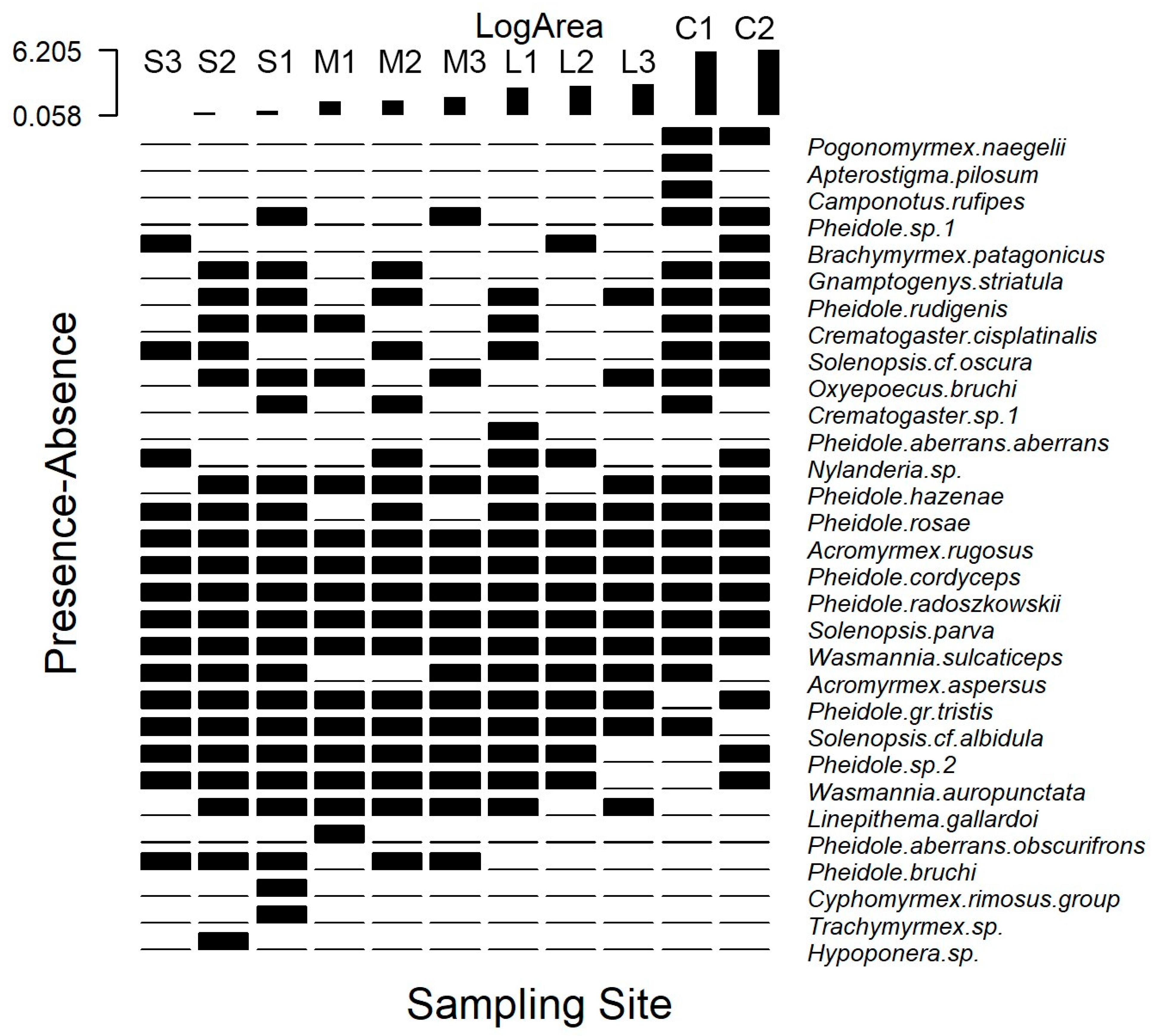
In total, we recorded 31 species of seed-carrying ants, belonging to 16 genera and five subfamilies (Figure 2). The subfamily Myrmicinae was dominant, comprising 25 species (80% of the total). The richest genera were Pheidole (11 species), followed by Solenopsis (3), Acromyrmex (2), Crematogaster (2) and Wasmannia (2) (Figure 2). Wasmannia auropunctata was the only invasive species detected in our study, occurring in 9 of the 11 sites but always at low frequencies (<12.5% of bait stations per site). Across all 11 sites, the most frequent species was Pheidole cordiceps, occurring in 37% of all records (440 bait stations in total), followed by Solenopsis cf. albidula (30%), Pheidole gr. tristis (28%), Wasmannia sulcaticeps (22%), and Acromyrmex rugosus (21%) (Table S1).
Out of 31 recorded species, seven were unique to single sites. Specifically, three species—Apterostigma pilosum, Camponotus rufipes and the harvester ant Pogonomyrmex naegelii—were exclusive to the continuous forest. One species, Pheidole aberrans aberrans, was found only in large fragments; one, Pheidole aberrans obscurifrons, exclusively in medium fragments; and three species, Cyphomyrmex gr. rimosus, Trachymyrmex sp. and Hypoponera sp., were recorded solely in small fragments (Figure 2, Table S1).
Rarefaction curves indicated that the sampling effort was sufficient to capture the species richness within each fragment (Figure S1). GLMMs revealed no significant differences in ant species richness across fragments of varying sizes (Estimate = 0.0037, SE = 0.064, z = 0.058, p = 0.95).
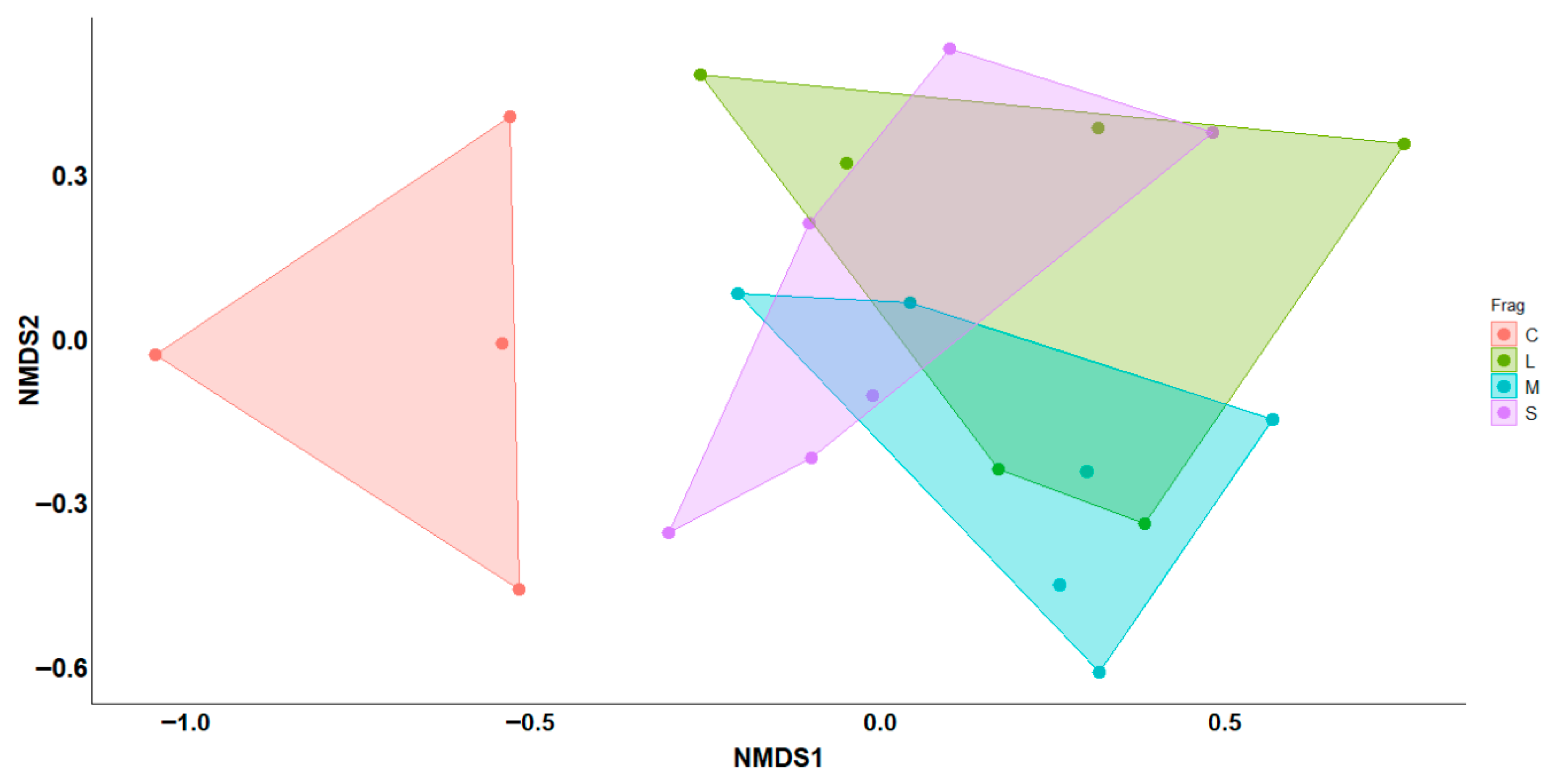
The NMDS analysis showed differences in ant community composition among fragments of different sizes (Figure 3). The stress of 0.2 indicated a reliable representation of the data in a multidimensional space. Ordination analysis showed a clear separation between seed-carrying-ant assemblage in continuous forest and those in fragmented sites, with the smaller fragments (large, medium and small) clustering relatively close to each other. PERMANOVA confirmed significant differences in species composition among fragment size classes (pseudo-F = 2.97, df = 3, p < 0.001; Figure 3; Table 1). Pairwise comparisons indicated that continuous forests differed from all fragments sizes, whereas no significant differences were detected among large, medium, small fragments (Table 1).

4. Discussion

While several studies have addressed the effects of forest fragmentation on ant communities (e.g., [15]), this study provides new insights specifically into how forest area reduction influences seed-carrying ant assemblages in subtropical dry forests. Ant species richness did not vary with fragment size. Although several studies report a negative relationship between ant species richness and habitat area [17,51,52], others have documented weak or no effect of fragmentation per se on species richness [11,12,13,14,15]. The inconsistency likely reflects the interaction of multiple, non-exclusive mechanisms operating at landscape and local scales.
One possible explanation is the long-term isolation and the historical context of fragments. Previous research indicates that historical connectivity and time since isolation modulate the effects of fragmentation on ant communities. For instance, Abensperg-Traun et al. [12] found higher richness in eucalyptus fragments connected by native vegetation corridors, whereas Suárez et al. [25] reported declining richness with longer isolation times, suggesting that few recolonizations occur following local extinctions in isolated habitats. In our study area, forest fragments isolated for around 60 years [36], show community patterns likely shaped by extinction debt, consistent with delayed biodiversity responses documented for Chaco Serrano birds [53]. This suggests local extinctions of specialist species have already occurred, favoring persistence of more generalist species adapted to fragmented landscapes.
Matrix quality and permeability further shape ant assemblages. Simplified agricultural matrices dominated by monoculture typically reduce ant richness and limit movement among fragments [51], while more complex or shaded matrices can buffer these effects [54]. In our study system, forest fragments are surrounded by intensively managed soybean and maize fields, a matrix known to be highly disturbed and exposed to fertilizers and pesticides. Pereyra et al. [15] showed that soybean and maize matrices support lower ant species richness than the edges and interiors of forest fragments, suggesting that these highly disturbed habitats are unsuitable for many native ants and may act as barriers to their movement and dispersal. In this context, the persistence of some ant species across fragments may depend on narrow strips of semi-natural vegetation along roads and fences, as also suggested by Castellarini et al. [55] for agroecosystems in the southern Dry Chaco. These remnants of vegetation likely maintain limited functional connectivity in an otherwise homogenized agricultural matrix.
Heterogeneity in fragment conservation status offers another explanation for the absence of consistent richness-area effects. For instance, continuous forests are often used for livestock grazing, while small fragments experience higher pesticide pressure. Such contrasting yet pervasive disturbances may equalize environmental stress across landscape, reducing differences between continuous forests and small remnants. Similar findings were reported by Calcaterra et al. [16], who found that ground-dwelling ant assemblages in heavily modified Chaco environments exhibited comparable levels of richness across land-use types, despite strong compositional and functional shifts. These processes may also affect seed-carrying ants in our system, as livestock herbivory, trampling and reduced vegetation complexity can limit seed availability and nesting sites, particularly for granivorous and specialist ant species [56,57], while pesticide exposure can directly reduce ant reproduction and populations [58].
Conversely, our results showed that fragmentation significantly alters species composition. NMDS analysis reveals clear segregation between continuous forests and smaller fragments, aligning with previous studies indicating that fragmentation modifies the ant assemblages even when overall richness remains unchanged [11,16,37]. Secondary effects of fragmentation, such as edge effects, microclimatic shifts, altered species interactions, and demographic constraints [59] likely drive this pattern. In smaller remnants, these processes are more pronounced, leading to the loss of forest-specialist species and the dominance of generalist, disturbance-tolerant taxa. Similar species turnover patterns have been observed in Chaco landscapes, where generalist species such as Solenopsis and Pheidole dominate disturbed fragments while specialist taxa decline [16,37,55]. Thus, the comparable richness across fragments of different sizes likely results from the replacement of sensitive species by disturbance-tolerant ones, a pattern also documented in other Neotropical dry forests [17,51].
Invasive species are often considered major drivers of compositional change in fragmented habitats [26,60]. However, in our study we found no evidence that invasive ants significantly affected native ant assemblages. The only invasive species recorded, Wasmannia auropunctata, occurred in most fragments, but at low abundance. Similar results were reported by González et al. [38] in Chaco forests, where W. auropunctata coexisted with native taxa without fully displacing them. This suggests that although the species is widespread, its low abundance likely limits its impact on native ants in this region.
Changes in ant species composition triggered by fragmentation can have functional implications, particularly for processes such as seed dispersal and predation. Suarez et al. [26] showed that harvester ants from the genera Messor and Pogonomyrmex are highly vulnerable to fragmentation, and their loss can disrupt both plant species that depend on them for seed dispersal and predators that rely on harvester ants as prey (e.g., horned lizard; [61]). Pogonomyrmex naegelii, found only in continuous forest in our study, is known as a harvester ant that consumes seeds from a wide range of plants, and may play a dual role as both predator and secondly seed disperser [62]. Its absence from smaller fragments suggests that fragmentation could modify seed fate and recruitment pattern, although further work is needed to corroborate these effects.
The ecological consequences of fragmentation on seed dispersal largely depend on which ant species are affected. Ant species differ widely in their seed-dispersal effectiveness [63,64], with larger ants generally moving seeds over greater distances, thus enhancing the spatial scale of seed dispersal [23,65]. In our study, the seed-carrying ant assemblage was composed primarily of small to medium-sized ants, mainly Pheidole (11) and Solenopsis (3) species. These ants are mostly opportunistic or generalist, with omnivorous diets that include arthropods, seeds, and vegetative plant parts [66,67,68]. Similar patterns are reported by Miretti et al. [44] for the Monte desert communities, where generalist and opportunistic species of Pheidole and Solenopsis dominate over specialized granivorous groups. Their dominance, alongside the absence of large-bodied specialists in our assemblages, suggests that although fragmentation alters community composition, overall seed removal and dispersal rates may remain stable, albeit driven by ant-species with lower dispersal quality. However, the functional implications of such ant-compositional changes remain uncertain, as differences in seed-dispersal distances or seed selectivity among ant species could influence plant recruitment. These divergent trajectories for plant communities, mediated by ant dispersal, highlight the need for future studies that directly measure how ant species turnover between forest fragments affects seed dispersal and recruitment.

5. Conclusions

This study showed that seed-carrying ant assemblages in the Chaco region are sensitive to forest fragmentation. While species richness did not significantly change with fragment size, fragmentation clearly altered species composition, resulting in distinct assemblages between continuous forest and smaller fragments. These compositional shifts likely involve the loss of large-bodied specialist species and the persistence of smaller, more generalist taxa. As a consequence, although the overall rate of seed removal might remain stable, the functional quality of seed dispersal service could decline, potentially affecting forest regeneration. Future research should integrate behavioral experiments and landscape-level sampling to assess how changes in ant community structure influence seed removal and dispersal and, ultimately, the dynamics of forest regeneration in fragmented subtropical dry forests.

Supplementary Materials

The following supporting information can be downloaded at: https://www.mdpi.com/article/10.3390/d17120866/s1. Table S1: Frequency of occurrence of seed-carrying ant species in forest fragments; Figure S1: Rarefaction curves by fragment size classes.

Author Contributions

Conceptualization, R.G.P. and L.G.; Methodology, R.G.P. and L.G.; Formal Analysis, R.G.P. and L.G.; Investigation, R.G.P., M.P. and L.G.; Resources, L.G.; Data Curation, R.G.P. and M.P.; Writing—Original Draft Preparation, R.G.P., M.P. and L.G.; Writing—Review and Editing, R.G.P., M.P. and L.G.; Visualization, R.G.P., M.P. and L.G.; Supervision, R.G.P. and L.G.; Project Administration, L.G.; Funding Acquisition, L.G. All authors have read and agreed to the published version of the manuscript.

Funding

Financial support was supplied by CONICET (PDTS 2015-17), SECyT (UNC; Consolidar 2023-27) and FONCyT (PICT 0538).

Data Availability Statement

The original contributions presented in this study are included in the article/Supplementary Material. Further inquiries can be directed to the corresponding author.

Acknowledgments

We thank Javier Lopez de Casenave for his helpful comments on earlier versions of this manuscript and three anonymous reviewers for the comments and suggestions. Laura Fornero helped with the fieldwork. We thank Estancia Santo Domingo for allowing us to work on their properties. We are grateful to Alicia and her family for their kind hospitality and logistic assistance.

Conflicts of Interest

The authors declare no conflicts of interest. The sponsors had no role in the design, execution, interpretation, or writing of the study.

References

  1. Newbold, T.; Hudson, L.N.; Arnell, A.P.; Contu, S.; De Palma, A.; Ferrier, S.; Hill, S.L.L.; Hoskins, A.J.; Lysenko, I.; Phillips, H.R.P.; et al. Global effects of land use on local terrestrial biodiversity. Nature 2015, 520, 45–50. [Google Scholar] [CrossRef] [PubMed]
  2. Haddad, N.M.; Brudvig, L.A.; Clobert, J.; Davies, K.F.; Gonzalez, A.; Holt, R.D.; Lovejoy, T.E.; Sexton, J.O.; Austin, M.P.; Collins, C.D.; et al. Habitat fragmentation and its lasting impact on Earth’s ecosystems. Sci. Adv. 2015, 1, e1500052. [Google Scholar] [CrossRef] [PubMed]
  3. Wilson, M.C.; Chen, X.Y.; Corlett, R.T.; Didham, R.K.; Ding, P.; Holt, R.D.; Holyoak, M.; Hu, G.; Hughes, A.C.; Jiang, L.; et al. Habitat fragmentation and biodiversity conservation: Key findings and future challenges. Landsc. Ecol. 2016, 31, 219–227. [Google Scholar] [CrossRef]
  4. Valiente-Banuet, A.; Aizen, M.A.; Alcántara, J.M.; Arroyo, J.; Cocucci, A.; Galetti, M.; García, M.B.; García, D.; Gómez, J.M.; Jordano, P.; et al. Beyond species loss: The extinction of ecological interactions in a changing world. Funct. Ecol. 2015, 29, 299–307. [Google Scholar] [CrossRef]
  5. Sandor, M.E.; Elphick, C.S.; Tingley, M.W. Extinction of biotic interactions due to habitat loss could accelerate the current biodiversity crisis. Ecol. Appl. 2022, 32, e2608. [Google Scholar] [CrossRef]
  6. Fahrig, L. Habitat fragmentation: A long and tangled tale. Glob. Ecol. Biogeogr. 2019, 28, 33–41. [Google Scholar] [CrossRef]
  7. Riva, F.; Koper, N.; Fahrig, L. Overcoming confusion and stigma in habitat fragmentation research. Biol. Rev. 2024, 99, 1411–1424. [Google Scholar] [CrossRef]
  8. Fayle, T.M.; Klimes, P. Improving estimates of global ant biomass and abundance. Proc. Natl. Acad. Sci. USA 2022, 119, e2214825119. [Google Scholar] [CrossRef] [PubMed]
  9. Rico-Gray, V.; Oliveira, P.S. The Ecology and Evolution of Ant–Plant Interactions; University of Chicago Press: Chicago, IL, USA, 2007. [Google Scholar]
  10. Brühl, C.A.; Eltz, T.; Linsenmair, K.E. Size does matter–effects of tropical rainforest fragmentation on the leaf litter ant community in Sabah, Malaysia. Biod. Conserv. 2003, 12, 1371–1389. [Google Scholar]
  11. Crist, T.O. Biodiversity, species interactions, and functional roles of ants in fragmented landscapes. Myrmecol. News 2009, 12, 3–13. [Google Scholar]
  12. Abensperg-Traun, M.; Smith, G.T.; Arnold, G.W.; Steven, D.E. The effects of habitat fragmentation and livestock grazing on arthropods in remnants of gimlet woodland. J. Appl. Ecol. 1996, 33, 1281–1301. [Google Scholar]
  13. Armbrecht, I.; Ulloa-Chacón, P. The little fire ant Wasmannia auropunctata as an indicator of ant diversity in Colombian dry forest. Environ. Entomol. 2003, 32, 542–547. [Google Scholar] [CrossRef]
  14. Debuse, V.J.; King, J.; House, A.P.N. Effect of fragmentation, habitat loss and within-patch characteristics on ant assemblages in semi-arid woodlands. Landsc. Ecol. 2007, 22, 731–745. [Google Scholar]
  15. Pereyra, M.; Pol, R.G.; Galetto, L. Ant community patterns in highly fragmented Chaco forests of central Argentina. Austral Ecol. 2019, 44, 668–679. [Google Scholar] [CrossRef]
  16. Calcaterra, L.A.; Chifflet, L.; Cuezzo, F.; Sánchez-Restrepo, A.F. Diversity of ground-dwelling ants across three threatened subtropical forests. Insect Conserv. Divers. 2022, 15, 86–101. [Google Scholar] [CrossRef]
  17. Leal, I.R.; Filgueiras, B.K.C.; Gomes, J.P.; Andersen, A.N. Effects of habitat fragmentation on ant richness and functional composition. Biodivers. Conserv. 2012, 21, 1687–1701. [Google Scholar] [CrossRef]
  18. Vasconcelos, H.L.; Vilhena, J.M.S.; Magnusson, W.E.; Albernaz, A.L.K.N. Long-term effects of forest fragmentation on Amazonian ants. J. Biogeogr. 2006, 33, 1348–1356. [Google Scholar]
  19. Zelikova, T.J.; Breed, M.D. Effects of habitat disturbance on ant composition and seed dispersal. J. Trop. Ecol. 2008, 24, 309–316. [Google Scholar] [CrossRef]
  20. Beckman, N.G.; Sullivan, L.L. The causes and consequences of seed dispersal. Annu. Rev. Ecol. Evol. Syst. 2023, 54, 403–427. [Google Scholar] [CrossRef]
  21. Oliveira, F.R.; Oliveira, F.M.; Centeno-Alvarado, D.; Wirth, R.; Lopes, A.V.; Leal, I.R. Rapid recovery of ant-mediated seed dispersal along succession in Caatinga. For. Ecol. Manag. 2024, 554, 121670. [Google Scholar]
  22. Mitchell, M.G.; Bennett, E.M.; Gonzalez, A. Forest fragments modulate ecosystem services. J. Appl. Ecol. 2014, 51, 909–918. [Google Scholar] [CrossRef]
  23. Ness, J.H. Forest edges and fire ants alter seed shadows. Oecologia 2004, 138, 448–454. [Google Scholar] [CrossRef] [PubMed]
  24. Brown, M.J.; Human, K.G. Effects of harvester ants on plant distribution. Oecologia 1997, 112, 237–243. [Google Scholar] [CrossRef] [PubMed]
  25. Farwig, N.; Berens, D.G. Imagine a world without seed dispersers. Basic Appl. Ecol. 2012, 13, 109–115. [Google Scholar] [CrossRef]
  26. Suárez, A.V.; Bolger, D.T.; Case, T.J. Effects of fragmentation and invasion on native ants. Ecology 1998, 79, 2041–2056. [Google Scholar] [CrossRef]
  27. Rodriguez-Cabal, M.A.; Stuble, K.L.; Nuñez, M.A.; Sanders, N.J. Argentine ants disrupt seed dispersal mutualisms. Biol. Lett. 2009, 5, 499–502. [Google Scholar] [CrossRef]
  28. Retana, J.; Xavier Pico, F.; Rodrigo, A. Dual role of harvesting ants as seed predators and dispersers. Oikos 2004, 105, 377–385. [Google Scholar] [CrossRef]
  29. Oliveira, P.S.; Christianini, A.V.; Bieber, A.G.; Pizo, M.A. Anthropogenic disturbance affects ant–fruit interactions. In Ant-Plant Interactions; Cambridge University Press: Cambridge, UK, 2017; pp. 133–153. [Google Scholar]
  30. Gasparri, N.I.; Grau, H.R. Deforestation and fragmentation of Chaco dry forest in NW Argentina. For. Ecol. Manag. 2009, 258, 913–921. [Google Scholar] [CrossRef]
  31. Fehlenberg, V.; Baumann, M.; Gasparri, N.I.; Piquer-Rodriguez, M.; Gavier-Pizarro, G.; Kuemmerle, T. Soybean production as a driver of Chaco deforestation. Glob. Environ. Change 2017, 45, 24–34. [Google Scholar]
  32. Cáceres, D.M. Accumulation by dispossession and socio-environmental conflicts. J. Agrar. Change 2015, 15, 116–147. [Google Scholar]
  33. Cagnolo, L.; Cabido, M.; Valladares, G. Plant species richness in Chaco Serrano woodland. Biol. Conserv. 2006, 132, 510–519. [Google Scholar] [CrossRef]
  34. Huais, P.Y.; Grilli, G.; Galetto, L. Impacts of soybean on plant visitation. Landsc. Urban Plan. 2024, 247, 105055. [Google Scholar]
  35. Aguilar, R.; Ashworth, L.; Galetto, L.; Aizen, M.A. Plant reproductive susceptibility to fragmentation. Ecol. Lett. 2006, 9, 968–980. [Google Scholar] [CrossRef]
  36. Grilli, G.; Urcelay, C.; Galetto, L. Forest fragment size and nutrient availability. Plant Ecol. 2012, 213, 155–165. [Google Scholar]
  37. Barrera, C.A.; Buffa, L.M.; Valladares, G. Do leaf-cutting ants benefit from forest fragmentation? Insect Conserv. Divers. 2015, 8, 456–463. [Google Scholar]
  38. González, E.; Buffa, L.; Defagó, M.T.; Molina, S.I.; Salvo, A.; Valladares, G. Loss and replacement of ant functional groups in fragmented forests. Landsc. Ecol. 2018, 33, 2089–2102. [Google Scholar] [CrossRef]
  39. Oyarzabal, M.; Clavijo, J.; Oakley, L.; Biganzoli, F.; Tognetti, P.; Barberis, I.; Maturo, H.M.; Aragón, M.R.; Campanello, P.I.; Prado, D.; et al. Vegetation units of Argentina. Ecol. Austral 2018, 28, 040–063. [Google Scholar]
  40. Giorgis, M.A.; Cingolani, A.M.; Chiarini, F.; Chiapella, J.; Barboza, G.; Ariza-Espinar, L.; Morero, R.; Gurvich, D.E.; Tecco, P.A.; Subils, R.; et al. Floristic composition of Chaco Serrano forests. Kurtziana 2011, 36, 9–43. [Google Scholar]
  41. Cabido, M.; Zeballos, S.R.; Zak, M.; Carranza, M.L.; Giorgis, M.A.; Cantero, J.J.; Acosta, A.T. Native woody vegetation in central Argentina. Appl. Veg. Sci. 2018, 21, 298–311. [Google Scholar] [CrossRef]
  42. Aguilar, R.; Galetto, L. Forest fragmentation affects reproductive success. Oecologia 2004, 138, 213–220. [Google Scholar]
  43. Morton, S.R.; Davidson, D.W. Comparative structure of harvester ant communities. Ecol. Monogr. 1988, 58, 19–38. [Google Scholar] [CrossRef]
  44. Miretti, M.F.; Pol, R.G.; Paris, C.I.; Elizalde Capellino, V.; Sosa, R.A.; Lopez de Casenave, J. Diversity of seed-carrying ants in the Monte desert. J. Insect Conserv. 2025, 29, 61. [Google Scholar] [CrossRef]
  45. Lopez de Casenave, J.; Cueto, V.R.; Marone, L. Granivory in the Monte desert, Argentina: Is it less intense than in other arid zones of the world? Global. Ecol. Biogeogr. Lett. 1998, 7, 197–204. [Google Scholar] [CrossRef]
  46. Beaumont Fantozzi, M.M.; Lopez de Casenave, J.; Milesi, F.; Claver, S.; Cueto, V.R. Efecto del tamaño y la forma de la unidad de muestreo sobre la estimación de la riqueza de hormigas acarreadoras de semillas en el desierto del Monte, Argentina. Ecol. Austral 2011, 21, 111–119. [Google Scholar]
  47. Anderson, M.J. A new method for non-parametric multivariate analysis of variance. Austral Ecol. 2001, 26, 32–46. [Google Scholar]
  48. Oksanen, J.; Simpson, G.L.; Blanchet, F.G.; Kindt, R.; Legendre, P.; Minchin, P.R.; O’Hara, R.B.; Solymos, P.; Stevens, M.H.H.; Szoecs, E.; et al. vegan: Community Ecology Package, R Package Version 2.5-2. 2013; CRAN—R Project. 2025. Available online: https://cran.r-project.org/web/packages/vegan/index.html (accessed on 12 December 2025).
  49. Bates, D.; Maechler, M.; Bolker, B.; Walker, S. Fitting linear mixed-effects models using lme4. J. Stat. Softw. 2015, 67, 1–48. [Google Scholar] [CrossRef]
  50. R Core Team. R: A Language and Environment for Statistical Computing; R Foundation: Vienna, Austria, 2023. [Google Scholar]
  51. Sobrinho, T.G.; Schoereder, J.H.; Sperber, C.F.; Madureira, M.S. Fragmentation alters ant species composition. Sociobiology 2003, 42, 329–342. [Google Scholar]
  52. Vasconcelos, H.L.; Bruna, E.M. Arthropod responses to experimental fragmentation. Zoologia 2012, 29, 515–530. [Google Scholar] [CrossRef]
  53. Silvetti, L.E.; Gavier Pizarro, G.; Arcamone, J.R.; Bellis, L.M. Delayed responses and extinction debt in Chaco Serrano birds. Anim. Conserv. 2025, 28, 277–290. [Google Scholar] [CrossRef]
  54. Perfecto, I.; Vandermeer, J.H. Coffee Agroecology: A New Approach to Understanding Agricultural Biodiversity, Ecosystem Services and Sustainable Development; Taylor & Francis Group: New York, NY, USA, 2015. [Google Scholar]
  55. Castellarini, F.; Cuezzo, F.; Toledo, E.L.; Buffa, L.; Orecchia, E.; Visintín, A. Local and landscape drivers of ground-dwelling ant diversity in agroecosystems of Dry Chaco. Agric. Ecosyst. Environ. 2024, 367, 108955. [Google Scholar] [CrossRef]
  56. Pol, R.G.; Sagario, M.C.; Marone, L. Grazing impacts on desert plants and seed banks. Acta Oecol. 2014, 55, 58–65. [Google Scholar]
  57. Heuss, L.; Grevé, M.E.; Schäfer, D.; Busch, V.; Feldhaar, H. Land-use intensification affects ants. Ecol. Evol. 2019, 9, 4013–4024. [Google Scholar]
  58. Leponiemi, M.; Schultner, E.; Dickel, F.; Freitak, D. Pesticide exposure affects ant brood and morphology. Ecol. Entomol. 2022, 47, 273–283. [Google Scholar]
  59. Turner, I.M. Species loss in tropical forest fragments. J. Appl. Ecol. 1996, 33, 200–209. [Google Scholar]
  60. Achury, R.; Holway, D.A.; Suarez, A.V. Persistent effects of ant invasion and fragmentation. Ecology 2021, 102, e03257. [Google Scholar] [CrossRef]
  61. Suarez, A.V.; Richmond, J.Q.; Case, T.J. Prey selection in horned lizards following the invasion of Argentine ants in southern California. Ecol. Appl. 2000, 10, 711–725. [Google Scholar] [CrossRef]
  62. Belchior, C.; Del-Claro, K.; Oliveira, P.S. Seasonal foraging of Pogonomyrmex naegelii. Arthropod–Plant Interact. 2012, 6, 571–582. [Google Scholar] [CrossRef]
  63. Gove, A.D.; Majer, J.D.; Dunn, R.R. Keystone ant promotes seed dispersal. Oecologia 2007, 153, 687–697. [Google Scholar] [CrossRef]
  64. Ness, J.H.; Morin, D.F.; Giladi, I. Uncommon specialization in ant–plant mutualisms. Oikos 2009, 118, 1793–1804. [Google Scholar]
  65. Gomez, C.; Espadaler, X. Ant size determines seed dispersal distance. Ecography 1998, 21, 180–184. [Google Scholar]
  66. Bestelmeyer, B.T.; Wiens, J.A. Effects of land use on ground–foraging ants in the Chaco. Ecol. Appl. 1996, 6, 1225–1240. [Google Scholar] [CrossRef]
  67. Pirk, G.I.; Di Pasquo, F.; Lopez de Casenave, J. Diet of two sympatric Pheidole species. Insectes Soc. 2009, 56, 277–283. [Google Scholar] [CrossRef]
  68. Vullo, L.; Lopez de Casenave, J.; Miretti, M.F.; Cao, A.L.; Marone, L.; Pol, R.G. Diet variation in a small harvester ant. Ecol. Entomol. 2024, 49, 191–204. [Google Scholar] [CrossRef]
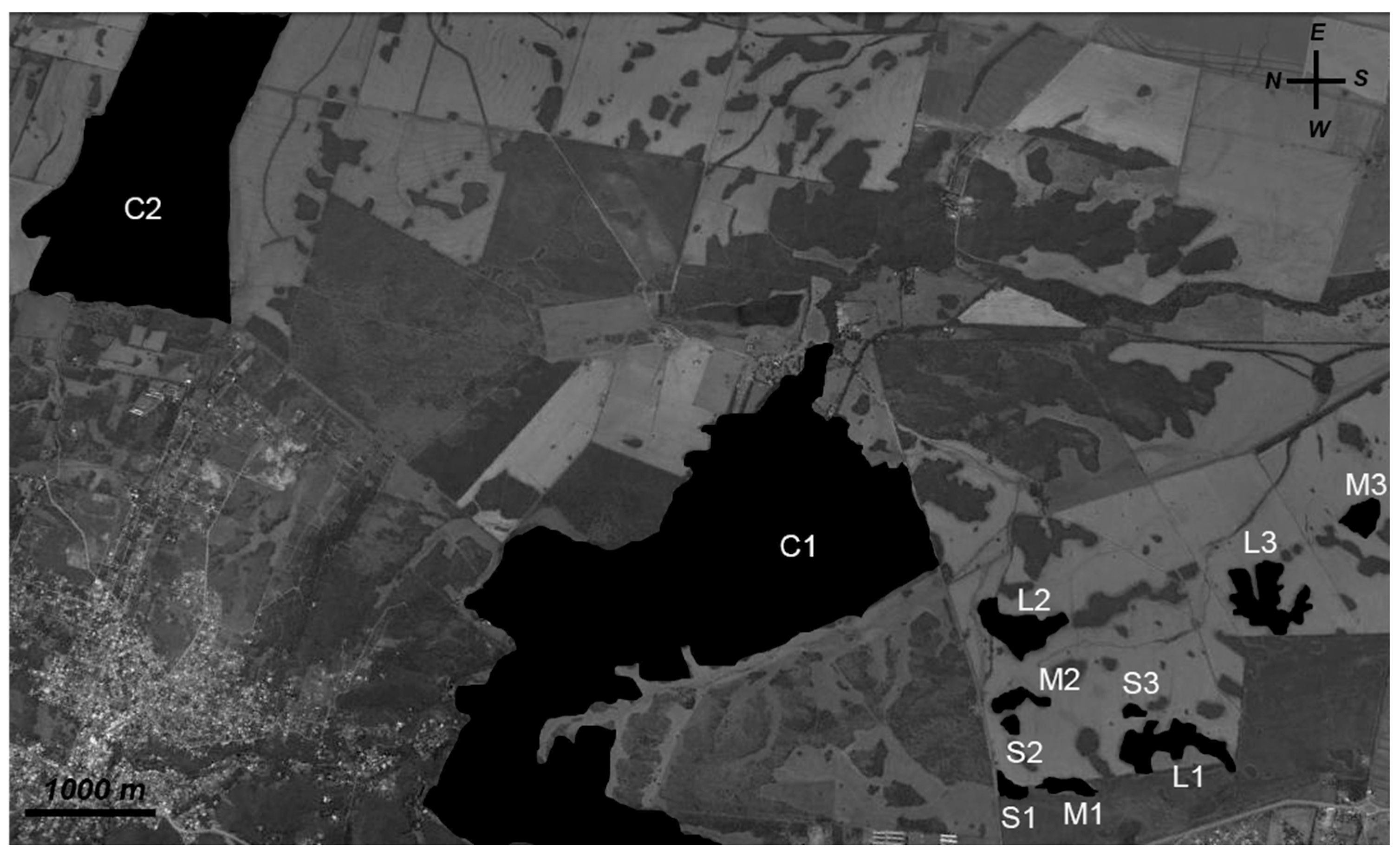
Figure 1. Map of study sites in the Chaco Serrano forest of central Argentina. Black polygons represent selected forest fragments and continuous forest areas. Site codes and areas (in hectares) are as follows: small fragments—S1: 1.61; S2: 1.33; S3: 1.06 ha; medium fragments—M1: 3.84; M2: 4.10; M3: 5.65 ha; large fragments—L1: 14.07; L2: 16.26; L3: 18.92 ha; continuous forest—C1: 495.09; C2: 431.33 ha. Basemap source: Google Earth (2009).
Diversity 17 00866 g001
Figure 2. Occurrence matrix of seed-carrying ant species across forest fragments of differing sizes (log-transformed areas) in the Chaco Serrano forest, Córdoba, Argentina. Site codes and areas (in hectares) are indicated: small fragments (S1–S3); medium fragments (M1–M3); large fragments (L1–L3); continuous forest (C1 and C2). Filled rectangles indicate species presence; horizontal lines indicate absence.
Diversity 17 00866 g002
Figure 3. Non-metric multidimensional scaling (NMDS) ordination showing differences in seed-carrying ant species composition among 11 forest sites in the Chaco Serrano forest, Córdoba, Argentina. Ordinations are based on Bray–Curtis distance of species presence–absence data (Stress = 0.2). Fragment-size classes are indicated as small (S), medium (M), large (L), and continuous forest (C).
Diversity 17 00866 g003
Table 1. Output of the PERMANOVA analysis testing the effect of fragment size on the composition of seed-carrying ant species in the Chaco Serrano forest, Córdoba, Argentina. Results of the overall model and pairwise comparisons between fragment-size classes are shown. Asterisks indicate statistically significant differences (p < 0.05).
Complete ModelDfPseudo FR2p
Fragments32.970.330.001 *
Pairwise comparisons
Continuous vs. Small16.910.460.004 *
Continuous vs. Medium14.350.350.008 *
Continuous vs. Large13.630.310.01 *
Large vs. Small11.470.130.17
Large vs. Medium11.060.090.34
Medium vs. Small12.180.180.05
Disclaimer/Publisher’s Note: The statements, opinions and data contained in all publications are solely those of the individual author(s) and contributor(s) and not of MDPI and/or the editor(s). MDPI and/or the editor(s) disclaim responsibility for any injury to people or property resulting from any ideas, methods, instructions or products referred to in the content.