Article

Trophic Ecology and Prey Selectivity of the Lake Charr (Salvelinus umbla) in Mountain Lakes of the Eastern Italian Alps


1
Istituto Zooprofilattico Sperimentale del Piemonte, Liguria e Valle d’Aosta, Via Bologna 148, 10154 Torino, Italy
2
Dipartimento di Scienze della Vita, Università degli Studi di Trieste, Via Giorgieri 10, 34127 Trieste, Italy
3
Dipartimento di Chimica, Biologia e Biotecnologie, Università Degli Studi di Perugia, Via dell’Elce di Sotto 8, 06123 Perugia, Italy
*
Author to whom correspondence should be addressed.
Diversity 2026, 18(6), 336; https://doi.org/10.3390/d18060336
Submission received: 15 May 2026 / Revised: 31 May 2026 / Accepted: 2 June 2026 / Published: 4 June 2026
(This article belongs to the Special Issue 2026 Feature Papers by Diversity's Editorial Board Members)

Abstract

Understanding the trophic ecology of fish in mountain lakes is essential for interpreting their functional roles and managing these ecosystems. This study investigated the diet, population structure, and prey selectivity of lake charr (Salvelinus umbla) in three glacial basins of the Eastern Italian Alps: Fusine Superiore, Fusine Inferiore, and Raibl Lakes. In summer 2024, 106 fish were sampled using multi-mesh gillnets, alongside Surber sampling of littoral macrobenthos. Biometric analysis revealed populations dominated by larger size classes (>18 cm), with significant sexual dimorphism, as females were longer and heavier than males. Dietary analysis showed strong reliance on littoral Hexapoda (~90% of prey). High Schoener’s overlap index values (α > 0.90) indicated no clear ontogenetic dietary shifts in the sampled size classes, suggesting that the productive littoral zone provides a stable resource. Ivlev’s electivity index revealed lake-specific prey selection patterns, with Hexapoda positively selected in Lake Fusine Inferiore, Bivalvia and Malacostraca positively selected in Lake Raibl, and weak or absent selectivity in Lake Fusine Superiore. S. umbla appears to be a broad opportunistic feeder with site-specific prey selectivity shaped by local resource structure. Given its debated native status, these findings provide an ecological baseline for assessing its potential effects on benthic communities.

1. Introduction

Understanding the trophic ecology of fish species is essential for interpreting their functional roles and interactions within aquatic ecosystems [1]. In mountain lakes, fishes often occupy high trophic levels and act as integrators of benthic and pelagic energy pathways [2,3]. Increasing evidence from alpine and subarctic lakes shows that in these environments fish populations may derive most of their energy from littoral benthic food webs [4,5]. Benthic macroinvertebrates therefore represent a key resource for many freshwater fishes, particularly in alpine and mountain ecosystems characterized by strong coupling among littoral, pelagic, and profundal habitats [1,6,7]. Incorporating benthic components into trophic analyses is thus important for a comprehensive understanding of ecosystem functioning.
Mountain lake fish communities are frequently dominated by salmonids of the genus Salvelinus, a group characterized by marked ecological plasticity and adaptability to harsh environmental conditions [8,9,10]. These species are generally opportunistic foragers, capable of adjusting their dietary niches in response to spatial and temporal variation in resource availability [11,12]. In mountain lakes, these salmonids (both native and introduced) can exert strong predatory pressure on littoral macroinvertebrate assemblages, influencing their abundance, size structure, and taxonomic composition [1,13,14,15,16].
Ontogenetic dietary shifts are common among the genus Salvelinus, with larger individuals often exploiting a broader prey spectrum, including larger benthic taxa and terrestrial inputs, reflecting increased energetic demands and foraging capacity [7,17]. Ontogenetic dietary shifts are essential processes that balance consumer-resource dynamics and facilitate species coexistence through resource partitioning [18]. These transitions are primarily driven by bioenergetic constraints, occurring when the surplus energy available for growth in a current niche is depleted [19]. Community structure further dictates these shifts; for instance, interactive segregation often forces subordinate species like Arctic charr (S. alpinus) or brook trout (S. fontinalis) into pelagic or profundal habitats when in sympatry with brown trout (Salmo trutta) [18,19,20]. In low-productivity mountain lakes, terrestrial subsidies, ranging from flying insects to small mammals, provide vital energy pulses that sustain fish populations above the carrying capacity of aquatic resources [20,21].
The present study focuses on lake charr (Salvelinus umbla Linnaeus, 1758) populations inhabiting three glacial lakes of the Julian Alps (northeastern Italy). Formerly included within S. alpinus, S. umbla is now recognized as the taxon native to central and southern Alpine regions based on morphological and genetic evidence [9,22]. However, its autochthonous status in several Alpine basins remains debated due to a long history of human-mediated translocations [23,24,25]. Historical sources and recent ichthyological assessments suggest the possible native occurrence of S. umbla in parts of northeastern Italy, including the Friuli-Venezia Giulia region [26]. The populations examined in this study are subject to recreational fishing and live in exploited mountain lake systems, where knowledge of trophic ecology is crucial for informed management and conservation.
Despite the extensive literature on Salvelinus ecology in northern Europe, detailed information on local-scale dietary patterns in southern Alpine lakes remains limited. In particular, few studies explicitly relate stomach content data to the composition of the available littoral benthic community [27,28]. Integrating diet analyses with benthic assemblage data allows for the assessment of prey selectivity, trophic opportunism, and the role of salmonids in shaping littoral food webs. Stomach content analysis remains one of the most direct and informative methods for investigating fish diet and resource use, providing detailed insights into feeding behaviour, habitat exploitation, and energy pathways [29,30].
The aim of this study was to characterize the diet of S. umbla in three alpine lakes of the Friuli-Venezia Giulia region (Fusine Inferiore, Fusine Superiore and Raibl Lake), and to evaluate spatial and ontogenetic variation in feeding patterns. While S. trutta is present in low numbers in Lakes Fusine Inferiore and Raibl, S. umbla represents the dominant and ubiquitous salmonid across all three basins, making it the ideal focus for a comparative study. Specifically, we (i) described stomach content composition across lakes and fish size classes, (ii) quantified prey selectivity in relation to the littoral macrobenthic community, and (iii) assessed the occurrence of ontogenetic shifts or sex-related differences in feeding habits. The study of these lakes is of particular interest because, despite their close geographic proximity, they exhibit distinct ecological characteristics that likely influence the trophic dynamics of S. umbla. Applying a small-scale analytical approach to these neighbouring but ecologically diverse basins allows for a detailed investigation into how site-specific factors interact with fish predation to determine dietary patterns and functional roles.

2. Materials and Methods

2.1. Study Area

The study was conducted in three glacial lakes of the Tarvisio area (Eastern Italian Alps): Raibl Lake (also known as Predil Lake) and Fusine Inferiore and Superiore Lakes (Figure 1). The Fusine Lakes form a connected hydrological system within a glacial cirque beneath the northern slopes of the Mangart massif. Fusine Superiore Lake (929 m a.s.l.) has a quadrangular shape, a surface area of 0.13 km2, and a maximum depth of ~10 m; it is fed by streams draining from the Ponza Grande–Mangart ridge. Through subsurface flow across a moraine ridge, it supplies Fusine Inferiore Lake (924 m a.s.l.), which is triangular in shape, covers 0.11 km2, and reaches ~24 m depth. Both lakes typically freeze from early December to March, and share a single outflow, the Rio del Lago.
Raibl Lake is located at 959 m a.s.l., below the Predil Pass, has an elongated glacial basin, a surface area of 0.61 km2, and a maximum depth of 27 m. The Rio del Lago (same name of the Fusine lakes outflow, but different creek) acts as both its primary inflow and outflow. The study area lies at the interface between oceanic and continental climatic influences; winters are typically cold and snowy, whereas summers tend to be warm. Annual precipitation is high, generally ranging from about 1400 to 2300 mm. Much of the surrounding landscape remains relatively wild and supports a rich assemblage of vertebrate and invertebrate species [31,32]. Angling is allowed in all these lakes [33].

2.2. Benthic Macroinvertebrates Sampling and Identification

Littoral benthic macroinvertebrates were sampled in August 2024. Sampling was restricted to nearshore areas of the lakes where light reaches the bottom and allows benthic organisms to develop. In total, five littoral sites were investigated in Lake Fusine Superiore, five in Lake Fusine Inferiore, and seven in Lake Raibl, with the higher number of sites in Raibl reflecting its larger size and shoreline heterogeneity (Figure S1 in Supplementary Materials). Sampling locations were selected following a preliminary survey of the lake perimeters to encompass the range of available littoral substrates while also considering practical accessibility of the shoreline. Geographical coordinates and a short description of the sampling sites are available in Tables S1–S3 in the Supplementary Materials.
At each site, macroinvertebrates were collected using a multihabitat sampling approach with a Surber sampler (32 × 32 cm, 250 µm mesh, SCUBLA S.r.l., Remanzacco, Italy). Samples were taken from shallow waters, from the shoreline down to approximately 90 cm depth [34]. Three replicate samples were collected per site, with effort distributed across the different microhabitat types and according to the presence of inlets or outlets [35,36]. During each replicate, the substrate was disturbed for a fixed duration of two minutes to ensure comparable sampling effort among sites.
All samples were preserved immediately in 70% ethanol and transported to the laboratory for analysis. Organisms were separated from debris, counted, and identified using stereomicroscopy (model NB50T, TEKNO Series, ORMA s.r.l, Sesto San Giovanni, Italy, led illumination, from ×8 to ×50 magnifications). Oligochaetes and chironomid larvae were further examined using microscopy (model K900BL, BIOTEK, ORMA s.r.l., Sesto San Giovanni, Italy from ×60 to ×100 magnifications) to allow finer taxonomic resolution. Identification was carried out to the lowest practicable taxonomic level, generally at genus level. Taxon-specific abundances were converted to densities (individuals m−2) for each sampling site. To facilitate statistical comparisons, ensure data robustness, and allow for the calculation of selectivity indices, the identified macroinvertebrate taxa were aggregated into broad taxonomic categories, specifically: Hexapoda, Oligochaeta, Malacostraca, Bivalvia, Gastropoda, and Hirudinea.

2.3. Fish Sampling

The aim of the fish sampling was to collect specimens of S. umbla. All activities described in the present study were performed according to European (Directive 2010/63/EU), Italian (D. Lgs. 26/2014) and regional laws and were approved by the Regional Authority for the Safeguard of the Fish Heritage of Friuli-Venezia Giulia, dealing with procedures for the protection of animals used for scientific purposes [37,38]. Fish and benthic macroinvertebrates sampling were conducted in the same period (August 2024) to ensure that prey availability reflected the conditions experienced by fish at the time of feeding.
Fish were sampled using multi-mesh gillnets following a standardized protocol adapted to lake morphology, consistent with procedures developed for the assessment of the Lake Fish Index [39]. The sampling design was based on the European standard for fish sampling in lakes using multi-mesh gillnets [40]. The benthic gillnets (B) (30 m long, 1.5 m high; total surface area 45 m2) consisted of 12 panels (2.5 m each) with mesh sizes ranging from 5 to 55 mm. The pelagic gillnets (P) (27.5 m long, 6 m high; total surface area 165 m2) followed the same mesh size sequence but included 11 panels. In Fusine Superiore, three benthic gillnets were deployed; in Fusine Inferiore, three pelagic and five benthic gillnets were used; and in Raibl Lake, three pelagic and four benthic gillnets were set. Both pelagic and benthic nets were set in deep areas, while only benthic nets were deployed in the shallow littoral zones, according to each lake’s bathymetric profile (Figure S1 in Supplementary Materials). Gillnets were placed in the evening at approximately 19:00 and retrieved 12 h later. Each lake was sampled one single night. Fish were removed from the nets, measured for total length (cm) and weight (g). Fish were assigned to five size classes based on 3 cm total length intervals: Class A (≤12 cm), Class B (12 < x ≤ 15 cm), Class C (15 < x ≤ 18), Class D (18 < x ≤ 21 cm), Class E (>21 cm). This grouping is a standard approach in salmonid diet research [28], furthermore, categorical cohorts were necessary for calculating Schoener’s dietary overlap index (α). Fish were immediately placed on ice for transport to the laboratory, where specimens were stored frozen at −20 °C until further analysis.

2.4. Stomach Content Analysis

Fish were dissected and the entire gastrointestinal tract was removed. Sex was identified whenever possible based on gonadal inspection; immature individuals without visible sexual differentiation were classified as undetermined (n.d.). The stomach was isolated, and the stomach walls were cut with scalpels and fine scissors to expose the contents. The material was gently washed with deionized water to recover all possible prey remains, which were then preserved in 70% ethanol until analysis. Stomach contents were defined strictly as the material contained between the posterior end of the esophagus and the pyloric sphincter; the pyloric caeca were not examined. Stomach dissection remains the most reliable and informative approach for diet assessment, providing higher precision and a greater amount of biological information compared to non-lethal alternatives [30,41]. Prey identification was performed under a stereomicroscope (Stereomicroscope Binocular Zoom 0.8x-8x-LED illumination, Eurotek, Orma) using standard taxonomic keys [42,43,44]. Identification was generally carried out to the family level, as the advanced digestion state of many specimens often prevented finer resolution to genus or species. To minimize systematic bias arising from differential digestion rates, prey items were identified and numerically quantified based on digestion-resistant diagnostic structures (e.g., insect head capsules, mouthparts). Amorphous, highly digested organic matter lacking these diagnostic features was excluded from the analysis. Prey taxa were grouped into broader categories (Bivalvia, Malacostraca, Gastropoda, Oligochaeta, Hirudinea, Hexapoda, and Terrestrial) for further statistical and comparative analyses.
For each stomach, the number of prey items (N) was recorded, and two quantitative indices were calculated [45,46]:
-
The frequency of occurrence (F%), defined as the proportion of stomachs containing a given prey taxon relative to the total number of non-empty stomachs:
F i = n i N 100
where n i is the number of stomachs containing prey type i, and N is the total number of stomachs examined;
-
The relative abundance (N%), representing the numerical proportion of each prey type relative to the total number of prey items in each stomach:
N i = N u m b e r   o f   i t e m s   o f   t y p e   i T o t a l   n u m b e r   o f   p r e y   i t e m s 100

2.5. Statistical Analysis

The relationship between total length (TL) and body weight (W) of S. umbla was examined using linear regression models. To test whether this relationship differed among lakes, an ANCOVA was performed with TL as the covariate and lake as a fixed factor; pairwise comparisons of slopes were then used to identify significant differences between lakes. Differences in body size between sexes were evaluated by comparing TL and W of males and females separately. Because the data did not meet normality assumptions, sex-specific differences in TL and W were tested using Wilcoxon rank-sum tests. The relationship between total length (L, cm) and total weight (W, g) of S. umbla was evaluated using the standard power function W = a L b [47]. To linearize the model, both variables were log10-transformed and a linear regression was fitted l o g   W = l o g   a + b l o g   L . Differences in the length–weight relationships among lakes were assessed using ANCOVA, with log W as the dependent variable, log L as a covariate, and Lake as a fixed factor. The interaction term ( l o g   L   × Lake) was used to test differences in slopes (b), while the Lake main effect tested differences in intercepts (a). Differences in total length and weight between males and females were assessed using Wilcoxon rank-sum tests, as the data did not meet the assumptions of normality and homoscedasticity required for parametric tests.
Differences in stomach content composition among sex, lake, and size classes were assessed using permutational multivariate analysis of variance (PERMANOVA). Analyses were based on Bray–Curtis dissimilarities calculated from prey relative abundance data. Prior to analysis, data were square-root transformed to reduce the influence of dominant prey categories. PERMANOVA models were fitted with 9999 permutations, using lake, sex, and size class as fixed factors. To verify that any observed differences were not driven by unequal multivariate dispersion among groups, we applied a test for homogeneity of multivariate dispersions (PERMDISP) using the same distance matrix and permutation scheme.
For each lake and size class, cumulative prey-group richness curves were generated using the specaccum function in the vegan R package [48]. To assess sampling completeness, asymptotic richness estimators were calculated using the specpool function, which provides Chao and Jackknife1 estimates of total prey richness [49,50,51]. Comparisons between observed and estimated values were used to evaluate whether the sampling effort was sufficient to capture the diversity of prey groups consumed by S. umbla in each lake.
Dietary overlap between size classes was quantified using Schoener’s index (α = 1 − 0.5 ∑|pxi − pᵧi|), where pi represents the proportional abundance (% N) of each prey group in the diet [52]. Overlap was interpreted qualitatively following standard thresholds (α < 0.4 = low, 0.4–0.6 = moderate, >0.6 = high). This metric has been widely used in fish diet and salmonid resource-partitioning studies [53,54] and was here applied as a descriptive measure of broad dietary similarity rather than a strict ecological threshold. To quantify prey selectivity, we calculated Ivlev’s electivity index (E) [55] for each prey group within each lake. Electivity was computed using lake-level prey composition derived from stomach contents and the corresponding lake-level benthic prey availability. Ivlev’s index was calculated for each prey group as:
E = r p r + p
where r represents the relative abundance of the prey group in stomach contents and p its relative abundance in the benthic community. Because our macroinvertebrate surveys were focused on the littoral benthic habitat, Ivlev’s electivity index was used to evaluate the degree to which S. umbla relied on this prey pool. This approach is appropriate for testing selection among benthic littoral prey, but it should be noted that it doesn’t represent a complete estimate of whole-lake prey availability.
All analyses were conducted in R (version 2023.12.1+402) [56], and figures were generated using either R or Microsoft Excel (version 16.108.1).

3. Results

3.1. Benthic Macroinvertebrates Sampling

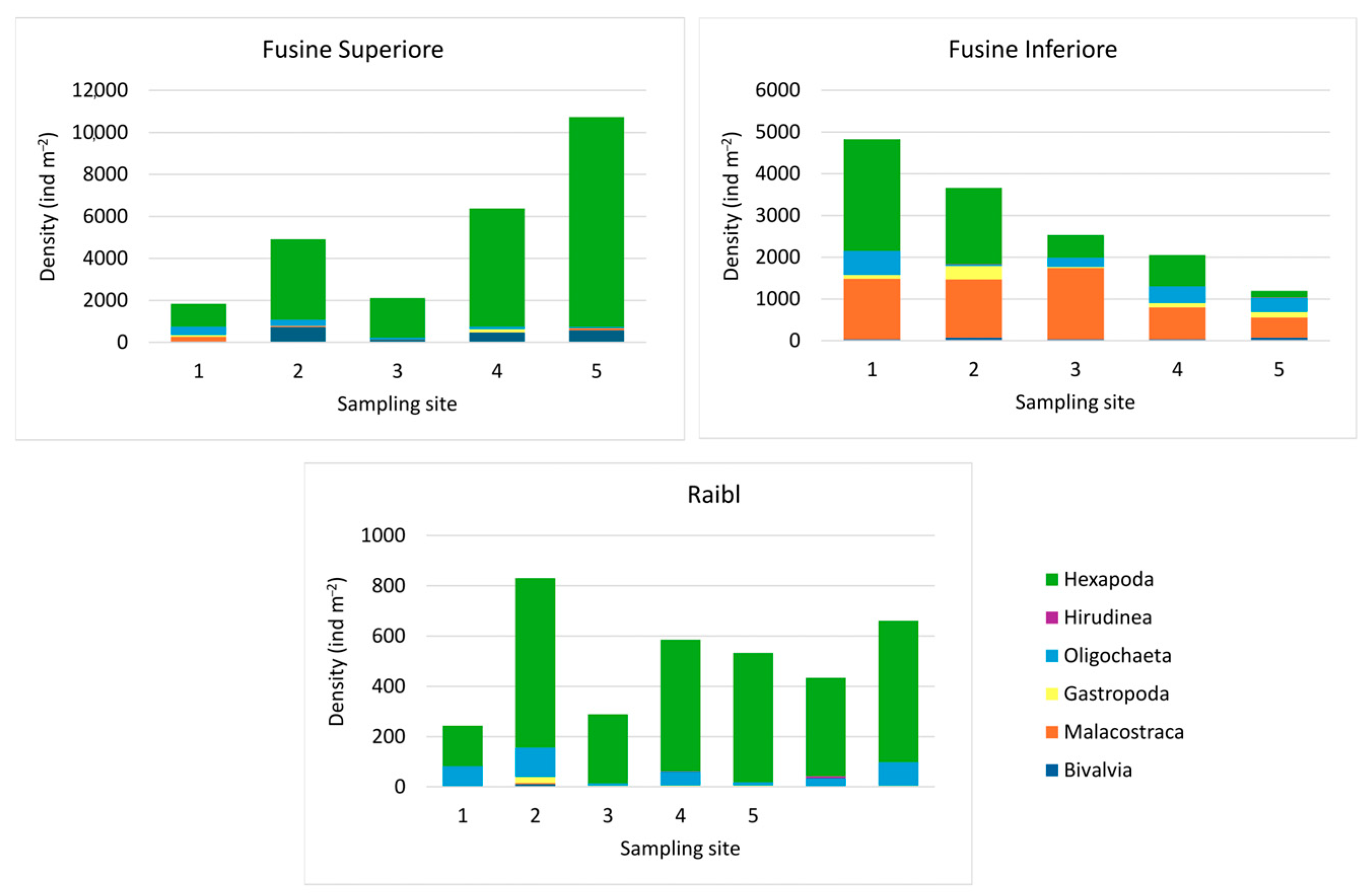
The littoral benthic macroinvertebrate assemblages showed varying patterns of density and taxonomic composition across the three study lakes (Figure 2). Lake Fusine Superiore exhibited the highest overall abundance, with peak densities exceeding 10,000 ind m−2. This community was characterized by the overwhelming dominance of Hexapoda, primarily represented by several subfamilies of Chironomidae (e.g., Tanypodinae, Tanytarsini, Chironomini and Orthocladiinae), and by Oligochaete families such as Lumbriculidae and Naididae.
In contrast, Lake Fusine Inferiore displayed intermediate densities (1200–4800 ind m−2) but hosted the greatest variety of taxonomic groups. Here, Hexapoda and Malacostraca (specifically the family Gammaridae) co-dominated the assemblage, with contributions from Odonata (e.g., family Platycnemididae), Hirudinea (e.g., family Glossiphoniidae), and a diverse range of Gastropod families, including Ancylidae, Lymnaeidae, and Planorbidae.
Lake Raibl showed moderate densities (800–2500 ind m−2) with a community primarily composed of Hexapoda and Oligochaeta. The Chironomidae (mainly Tanytarsini and Orthocladiinae) were the most abundant insect group, while the Oligochaeta were well represented by the families Enchytraeidae and Naididae. Notably, Lake Raibl was distinguished by a high richness of Gastropod families (e.g., Hydrobioidea, Valvatidae, and Planorbidae), whereas Malacostraca were virtually absent from the littoral sampling sites.
A comprehensive list of all macroinvertebrate taxa identified across the three study lakes is provided in Tables S4–S6 of the Supplementary Materials.

3.2. Results of the Fish Sampling

A total of 106 S. umbla were sampled across the three lakes (Table 1). Males were more abundant than females (except in Fusine Superiore Lake). The highest number of individuals was collected in Raibl (n = 61), followed by Fusine Inferiore (n = 25) and Fusine Superiore (n = 20). Sex could not be determined for 18 individuals, primarily due to small body size. The overall sex ratio did not differ significantly from the expected 1:1 ratio (chi-square goodness-of-fit test: χ2 = 2.27 df = 1, p = 0.13).
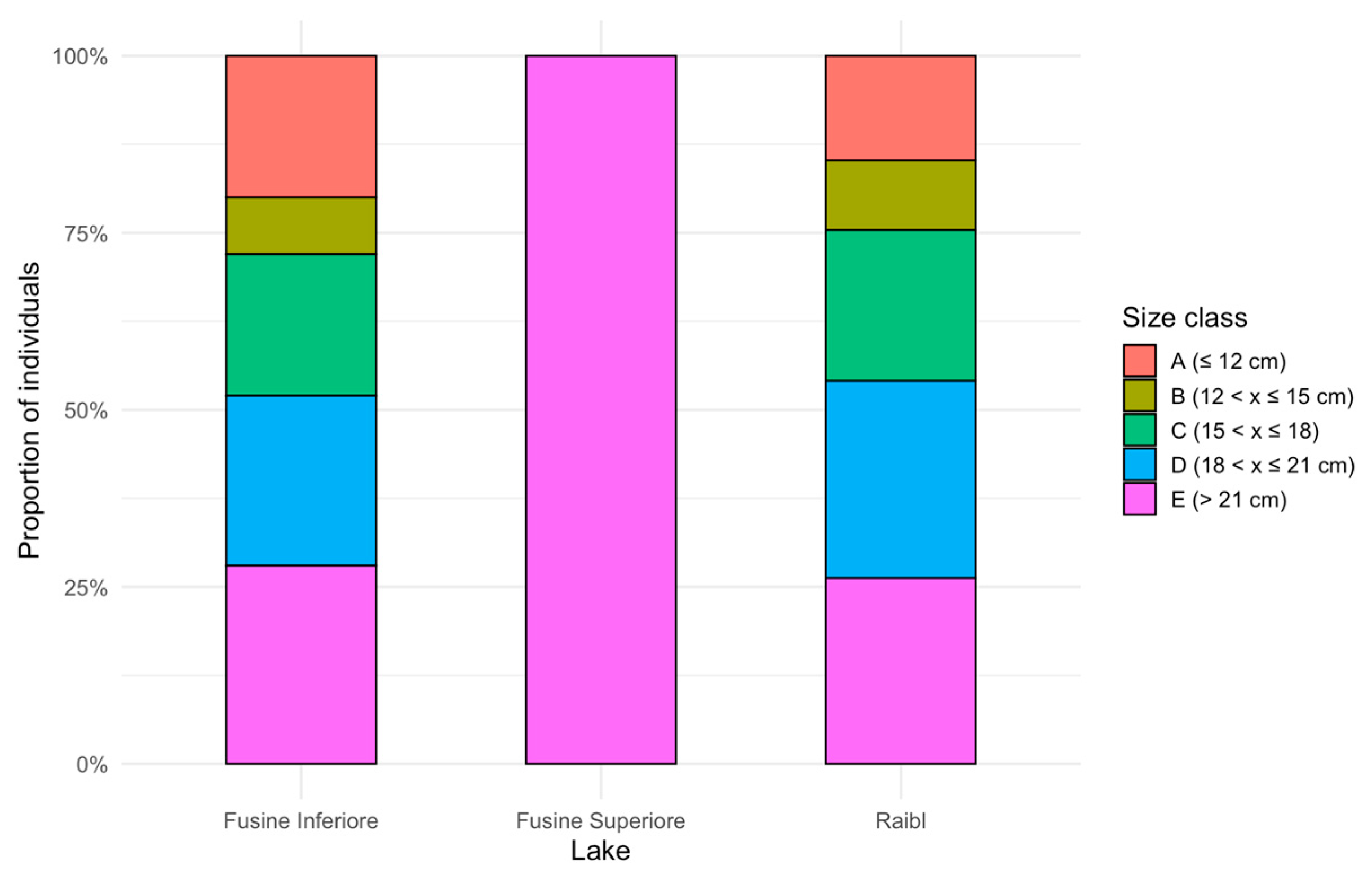
The distribution of size classes varied among lakes (Figure 3). Fusine Superiore was composed exclusively of individuals in the largest size class (E; n = 20). Fusine Inferiore and Raibl showed a wider range of size classes, although larger individuals (classes D and E) predominated, while smaller classes (A–C) were less represented (Fusine Inferiore: A = 5, B = 2, C = 5, D = 6, E = 7; Raibl: A = 9, B = 6, C = 13, D = 17, E = 16).
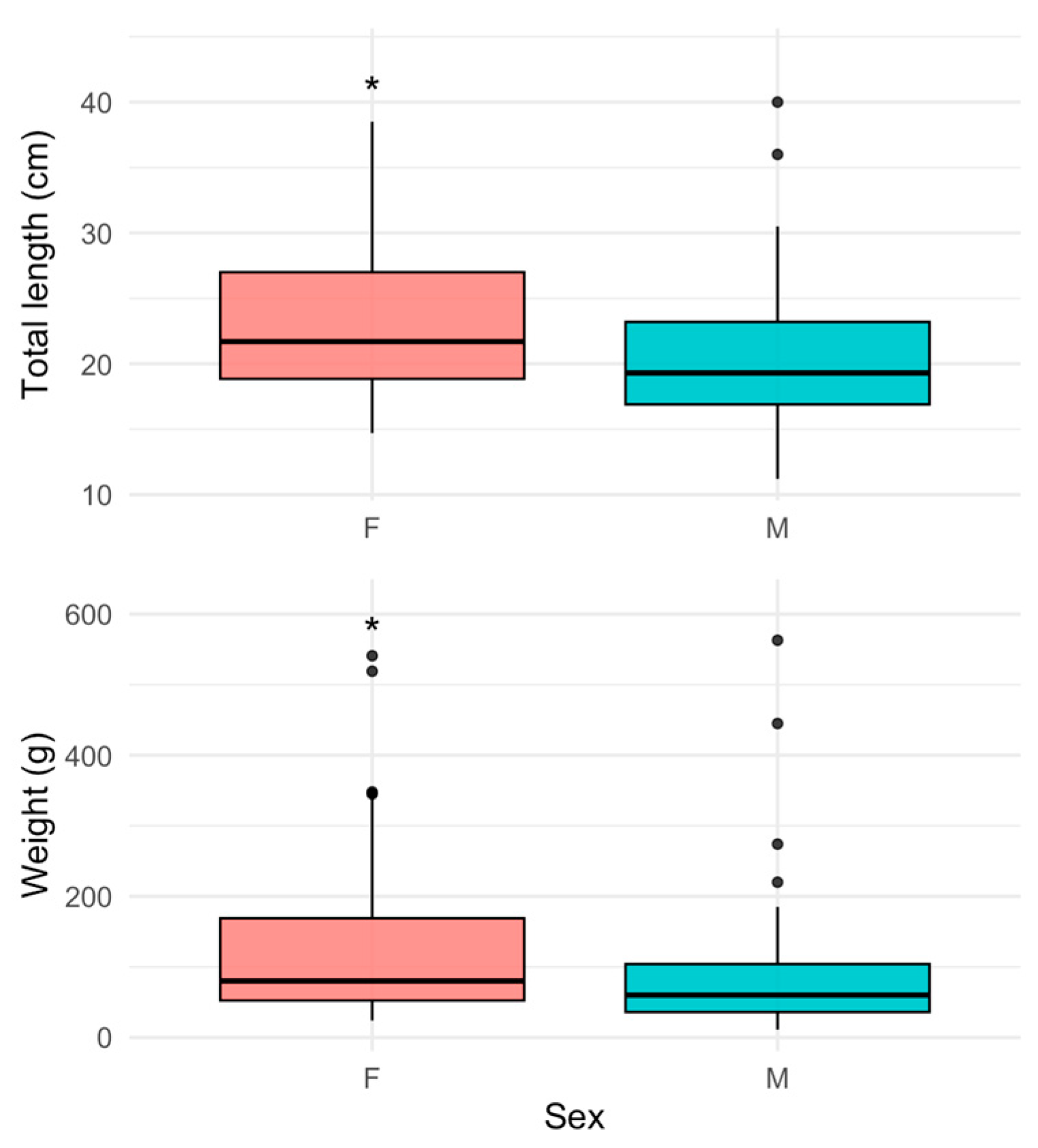
Mean total length and weight of S. umbla varied among lakes and between sexes (Table 2). Overall, females were significantly longer than males (Wilcoxon rank-sum test, W = 1178, p = 0.033) and also significantly heavier (Wilcoxon rank-sum test, W = 1172.5, p = 0.037), indicating a generally larger body size of females in the sampled population (Figure 4). The highest mean length and weight for both sexes were observed in Fusine Superiore, whereas individuals from Fusine Inferiore and Raibl showed lower and more comparable biometric values, particularly among males. Total length, weight, size class, and sex of each fish sampled in each lake are reported in detail in Tables S7–S9 of the Supplementary Materials.
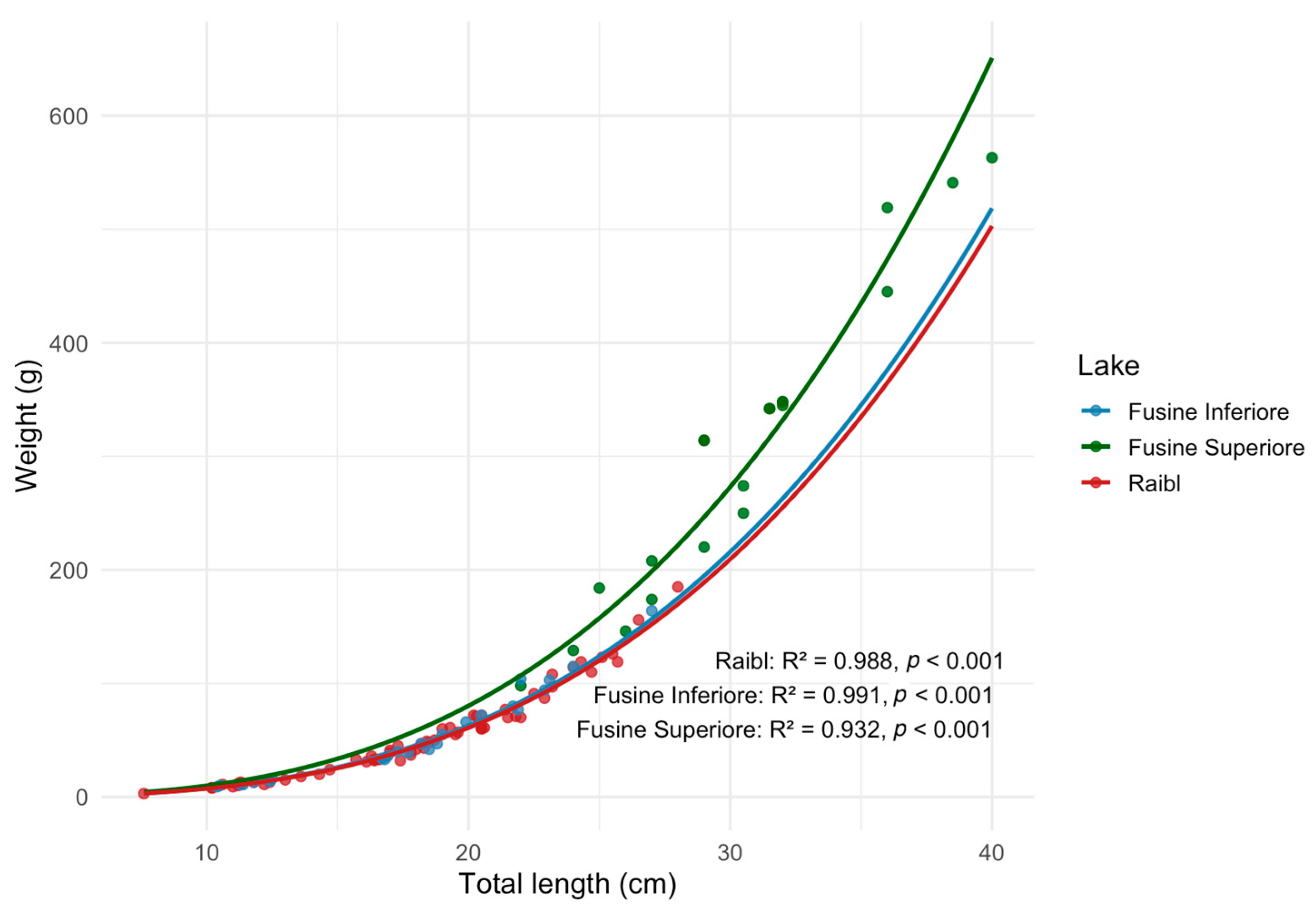
The ANCOVA on log-transformed data showed a highly significant length–weight relationship (p < 0.001), with no significant differences in slope or intercept among lakes, indicating a common growth pattern across lakes (R2 = 0.99) (Figure 5).

3.3. Comparison Between Fish Diet and Benthic Composition

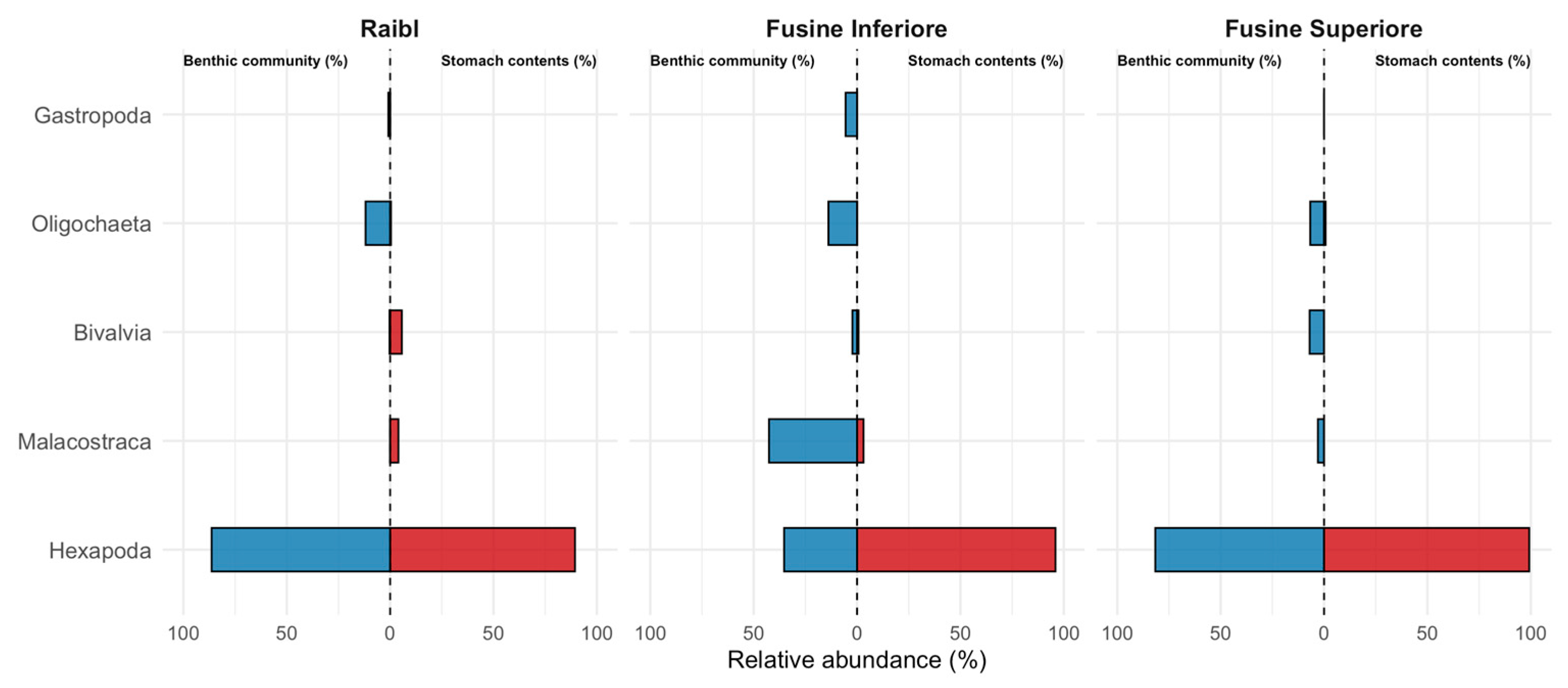
Across lakes, the comparison between littoral benthic assemblages and stomach contents showed different patterns (Figure 6). In Lake Raibl and Fusine Inferiore, some prey groups that were relatively abundant in the environment (e.g., Oligochaeta and Malacostraca) were only marginally represented in stomachs, whereas other poorly available prey (e.g., Bivalvia, Malacostraca in Raibl) were nonetheless consumed. In contrast, Lake Fusine Superiore showed a closer correspondence between environmental availability and diet composition. Overall, these patterns indicate that prey consumption does not simply mirror benthic availability.
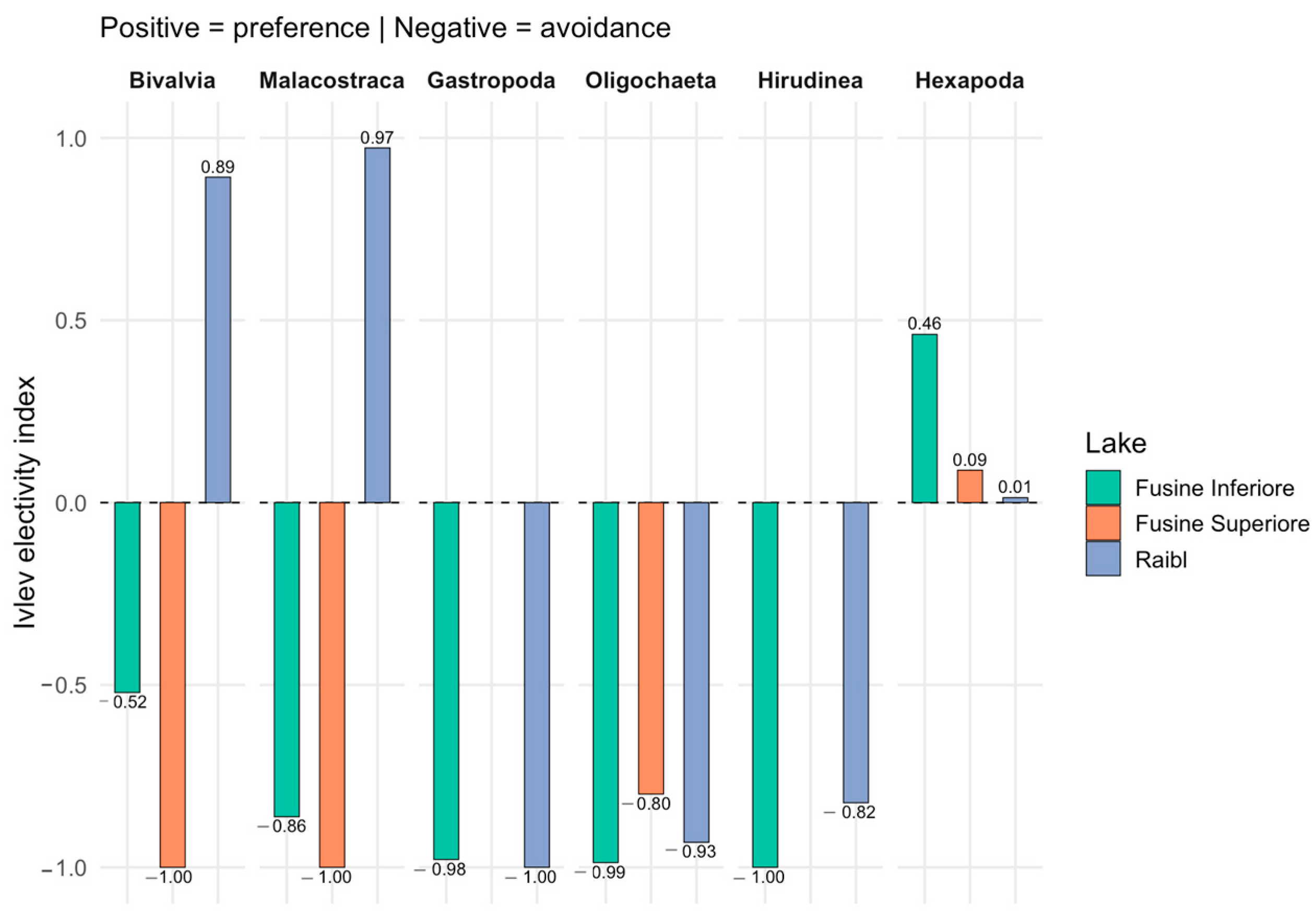
Ivlev’s electivity index revealed distinct prey selection patterns across the three lakes (Figure 7). In Lake Raibl, fish showed positive selection for Bivalvia and Malacostraca, whereas most other prey groups were avoided. In Lake Fusine Inferiore, fish displayed a moderate preference for Hexapoda but avoided all other prey groups. In Lake Fusine Superiore, electivity values were generally close to zero, indicating weak or absent prey selectivity and a diet more closely aligned with benthic availability.

3.4. Fish Diet

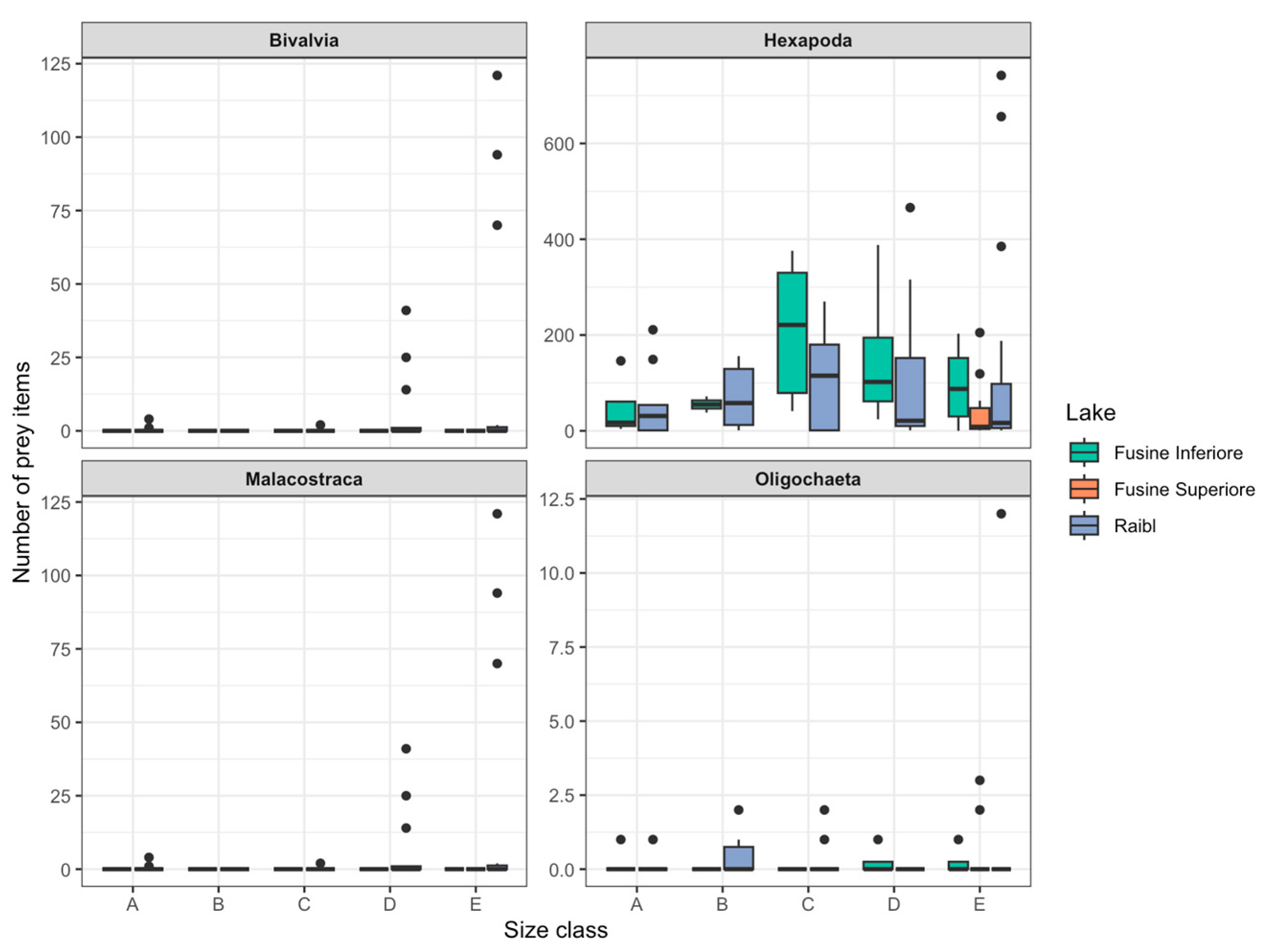
Advanced gastric digestion constrained the fine taxonomical identification of stomach contents, consequently, preys were aggregated into broader categories (Hexapoda, Oligochaeta, Malacostraca, Bivalvia, Gastropoda, Hirudinea and Terrestrial). Across all lakes, Hexapoda were the dominant prey group, occurring in nearly all stomachs examined. Other invertebrates such as Bivalvia, Malacostraca, and Oligochaeta contributed only marginally to the diet and were present in a smaller proportion. At Raibl, diet composition was slightly more diversified, with measurable contributions of Bivalvia and Malacostraca. In contrast, Fusine Inferiore and Fusine Superiore were characterized by a nearly exclusive dominance of Hexapoda (Figure 8 and Table 3).
The PERMANOVA based on Bray–Curtis dissimilarities indicated no significant differences in stomach content composition among sexes (F = 1.21, R2 = 0.023, p = 0.288). The associated PERMDISP test (F = 0.37, p = 0.718) confirmed homogeneity of dispersion. The PERMANOVA based on Bray–Curtis dissimilarities also detected no significant differences in diet composition (F = 1.25, R2 = 0.12, p = 0.235), although interpretation is constrained by the uneven representation of size classes among lakes. The associated PERMDISP tests confirmed that multivariate dispersion was homogeneous among both lakes (p = 0.463) and size classes (p = 0.65), indicating that the observed patterns are not driven by differences in within-group variability.
The proportion of Hexapoda in stomach contents did not differ significantly among size classes (Kruskal–Wallis, χ2 = 0.91, df = 4, p = 0.924). A near-significant difference was observed among lakes (Kruskal–Wallis, χ2 = 5.84, df = 2, p = 0.054), suggesting a slightly higher contribution of this group in some sites but no strong spatial effect overall.
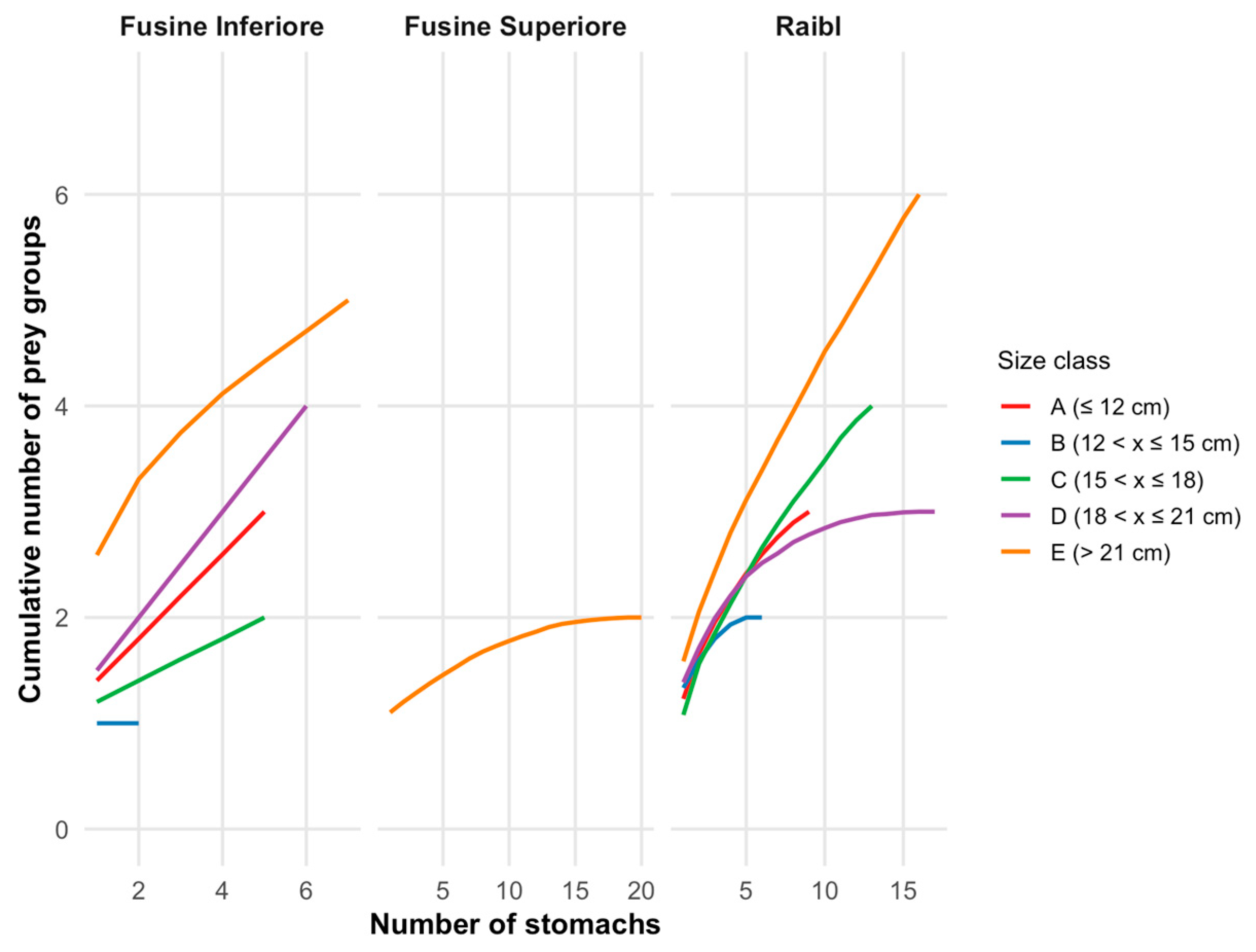
Cumulative prey-group richness curves showed that dietary diversity increased with the number of analyzed stomachs (Figure 9). Larger size classes (particularly class E) generally exhibited higher cumulative prey-group richness compared to smaller classes. In Raibl, prey-group accumulation was steeper, indicating greater dietary heterogeneity among individuals, whereas curves from Fusine Inferiore and Fusine Superiore were flatter, with more homogeneous diets. The number of observed prey groups ranged from 2 in Fusine Superiore to 6 in Raibl, with intermediate richness in Fusine Inferiore (5 prey groups). Asymptotic richness estimators were consistent with observed values, indicating that the analyzed stomach samples adequately represented the diversity of prey groups in each lake (Table 4).
Schoener’s overlap index (α) revealed high dietary similarity among size classes within lakes (Table 5, Figure S2 in Supplementary Materials). At Fusine Inferiore, α values ranged from 0.99 to 1.00, indicating near-complete overlap. Raibl showed slightly lower values (0.78–0.98), but all pairwise comparisons remained above the threshold for high overlap ( α > 0.6 ), indicating high dietary similarity with only minor differences among size classes. No comparison was possible for Fusine Superiore, where only class E was sampled. Overall, dietary composition was largely consistent across size classes.
Schoener’s overlap index (α) for the same size class across lakes showed generally high dietary similarity (Table 6). The strongest overlap was observed between Fusine Inferiore and Raibl for class B (α = 0.98) and class D (α = 0.91), indicating a largely comparable prey composition. Lower values were recorded for class C (α = 0.77) and for the largest individuals (class E, α = 0.75–0.92), suggesting some site-specific differences in the diet of small and large fish. Overall, dietary overlap across lakes was high, pointing to similar trophic niches among populations of equivalent size.

4. Discussion

4.1. Benthic Macroinvertebrates

Evaluating the trophic role of S. umbla requires a clear understanding of the resources available in its environment, as a predator’s ecological impact is defined by the relationship between its diet and the local prey pool. The littoral macroinvertebrate assemblages of Lakes Fusine and Raibl align with the general ecological patterns observed in other European mountain ecosystems, which are typically characterized by the overwhelming dominance of Hexapoda (particularly Chironomidae) and Oligochaeta. The presence of cold-adapted, stenothermal taxa confirms a strong faunal affinity with other oligotrophic alpine systems across the central and southern Alps [57,58,59]. However, our study sites exhibited some distinctive traits compared to other mountain basins. While many alpine lakes, especially those located on granitic bedrocks, are characterized by a rarity of molluscs due to acidic conditions or low calcium availability [58], Lakes Fusine and Raibl hosted a remarkable diversity of Gastropoda and Bivalvia. Additionally, the significant presence of Malacostraca (specifically Echinogammarus spp.) further distinguishes these communities from the simpler assemblages often found at higher elevations. These patterns suggest that while broad-scale factors, like altitude, structure the general community, site-specific abiotic features such as substrate composition and nutrient concentrations play a primary role in shaping local biodiversity and density, a phenomenon also observed in small-scale studies of other alpine systems [57,60]. These data establish the ecological baseline required to interpret the foraging behaviour of S. umbla in the studied lakes.

4.2. Fish Population Structure

The fish population structure in the studied lakes, characterized by a clear dominance of larger size classes (>18 cm) and the near absence of juveniles in Lake Fusine Superiore, aligns with patterns observed in other stable, demographically mature alpine salmonid populations [10,61]. Such systems often show limited representation of juvenile classes and a relatively stable size structure, consistent with a population approaching long-term equilibrium [10,62]. This pattern was particularly evident in Lake Fusine Superiore, where only the largest individuals were captured, suggesting a structurally stable population with limited recruitment of smaller size classes. This stability is often a trait of undisturbed systems where ontogenetic trajectories remain remarkably consistent over long periods, fostering community resilience despite fluctuations in abundance [18]. A notable finding is the significant sexual dimorphism in size, with females being significantly longer and heavier than males. This result aligns with observations in other lakes where females tend to outlive males, potentially allowing them to achieve greater maximum sizes [61].
The scarcity of smaller individuals (Classes A–C) must be interpreted with caution, as it may reflect the inherent selectivity of the sampling equipment [63]. Gillnets are intrinsically size-selective, and larger, fast-swimming predatory fish are significantly more likely to be captured in static nets than slower, smaller individuals [62]. Furthermore, the lack of juveniles in the samples could be a result of spatial segregation; literature on alpine Salvelinus spp. populations indicates that young fish often occupy shallow littoral microhabitats or rock shelters to avoid cannibalism by larger adults [28,64]. These marginal habitats are often difficult to sample effectively with standard net sets, leading to an underrepresentation of younger cohorts in the catch data. Therefore, while the current data suggest a stable and mature population, the potential for methodological bias to influence the captured size distribution needs to be considered.

4.3. Trophic Ecology and Diet Composition

Because many stomach items were highly digested, prey could only be identified to broad taxonomic categories. This limits inference about fine-scale prey selectivity, so our results should be interpreted as broad trophic composition and coarse-scale feeding patterns rather than exact prey-level specialization.
The asymptotic behaviour of the cumulative prey-group richness curves across all three study lakes indicates that the sampling effort was robust enough to capture most of the prey groups consumed by S. umbla during the summer.
Although more males than females were collected overall, the sex ratio did not differ significantly from the expected 1:1 proportion, suggesting the absence of a strong population-level sex imbalance. Females were significantly larger and heavier than males, but diet composition did not differ between sexes, and dietary differences across size classes were also weak. These results indicate that the observed body-size dimorphism does not correspond to clear trophic segregation. Accordingly, neither sex nor size appears to be a major driver of feeding habits in these populations, and the observed trophic patterns are better explained by local prey availability.
The dietary analysis reveals that S. umbla is a broad opportunistic feeder in the study area, a trait well-documented for the genus Salvelinus across its range [9,19]. However, prey selectivity varied among lakes, indicating that this general feeding strategy is expressed locally in different ways. Hexapoda were selected most strongly in Fusine Inferiore whereas Fusine Superiore showed weak or absent selectivity. The preference for insect larvae and pupae is common in alpine Salvelinus spp. populations, often linked to the high energy content and visibility of these prey items during the ice-free season [65,66]. Lake Raibl exhibited a more complex selection profile, with strong positive electivity for Bivalvia and Malacostraca. The selection of bivalves is particularly interesting; while in some extreme systems these are considered a survival food consumed primarily under ice when nothing else is available [65], the fish in Raibl actively selected them during the open-water season. This suggests trophic flexibility similar to that observed in some Icelandic populations, where local habitat productivity shapes functional feeding roles [67].
Oligochaeta and Gastropoda were consistently avoided across all three lakes, showing negative electivity values near −1. This strong negative selection mirrors findings in other studies, where soft-bodied or less visible organisms are frequently underrepresented in stomach contents [4,28,68,69]. Two non-exclusive mechanisms may explain this pattern: a methodological bias, because soft-bodied preys are rapidly digested and thus rendered difficult to detect, and a behavioural component, because visual predators like charr preferentially consume more conspicuous, chitinized prey such as chironomids rather than burrowing forms. Because stomach-content analysis alone cannot fully distinguish between these mechanisms, our results should be interpreted cautiously. Nevertheless, the persistent underrepresentation of these taxa despite their benthic availability suggests that prey selection likely contributed to the pattern, although digestion-related loss may also have occurred. Complementary approaches, such as prey recovery experiments or molecular diet methods, would be needed to separate these alternatives more robustly.
The total absence of zooplankton in our samples diverges sharply from several European studies, where Salvelinus showed high positive selection for cladocerans, like Daphnia spp. [69,70,71]. In our study, the abundance of littoral resources appears to have rendered the pelagic energy pathway less profitable, a phenomenon described as interactive niche segregation. As documented in other mountain lakes, when benthic prey is sufficiently abundant or when larger individuals dominate, the incentive to shift to the more energy-demanding capture of small pelagic zooplankton is significantly reduced [4,67].
Despite the potential biases, the reliance on littoral macroinvertebrates observed in our study is consistent with patterns in other ultra-oligotrophic subarctic and alpine systems, where Salvelinus spp. derives most of its energy from littoral rather than pelagic food webs [4]. Ontogenetic changes in resource use are common in fish, often involving discrete transitions from zooplankton to littoral invertebrates and eventually to piscivory as body size and energetic requirements increase [72]. These shifts typically occur when the surplus energy available for growth in a current niche becomes limited [19]. However, our data do not show clear ontogenetic dietary shifts, with high Schoener’s overlap values (α often >0.90) between all size classes. This pattern should be interpreted cautiously, because size classes were unevenly represented among lakes, and Fusine Superiore included only class E individuals. Even so, the high overlap suggests that the littoral zone provides a sufficiently productive resource to support the sampled population, reducing the energetic incentive to shift toward a pelagic or piscivorous niche [67].
The near absence of cannibalism in our samples, recorded in almost 2% of stomachs in other studies [4,28], further suggests that these populations maintain a stable equilibrium with their invertebrate prey. Likewise, the scarcity of terrestrial prey in the stomachs is notable because high-altitude salmonids often rely heavily on terrestrial insects during summer [63]. In other alpine regions, such as the Western Italian Alps, terrestrial prey has been recorded with a frequency of occurrence as high as 84% in brook trout, serving as a vital opportunistic resource when aquatic prey is limited [63]. Similarly, in the Appalachian Mountains, brook trout derive significantly more energy from terrestrial than aquatic organisms during the ice-free season [73]. The lack of such high proportions of terrestrial preys in the stomachs of the investigated populations suggests a different trophic configuration driven by the characteristics of these specific basins [74,75,76].
In contrast to granitic alpine systems where molluscs and other benthic taxa are often scarce due to low calcium or acidic conditions, the studied lakes host dense and diverse littoral assemblages [58,59]. This likely provides a stable energy source throughout the summer, potentially rendering surface foraging less efficient or unnecessary for adult fish [10]. Within this context, the populations appear to function as specialized benthivores, relying mainly on underwater resources. This strategy distinguishes these fish from populations in more barren basins that must rely heavily on the terrestrial subsidies, often documented in other mountain systems [28,74].

4.4. Native or Introduced?

The status of S. umbla in the Julian Alps remains a subject of scientific debate, positioned between the hypotheses of postglacial relics and ancient introductions. This inevitably affects the management interpretation of our results: if these populations are native in the studied lakes, our findings provide an ecological baseline for conservation and sustainable management of a long-established component of the lake fauna. Conversely, if they were introduced into lakes that were originally fishless, a plausible scenario as salmonids generally cannot surmount physical barriers like waterfalls without human aid [15], these findings establish a baseline for assessing their predatory impact on previously fish-free communities. In alpine lakes ecosystems, introduced salmonids are documented to cause profound food web alterations, typically involving a decline in large-bodied macroinvertebrates and a reduction in aquatic insect emergence [13,77,78], which disrupts energy flow to terrestrial consumers in the surrounding landscape [79,80,81].
However, in contrast to many other studies that characterize terrestrial insects as a critical summer energy subsidy, we found that the direct predatory impact on the terrestrial insect community was negligible, with such prey accounting for only 0.00% to 0.43% of the diet in the studied basins. This suggests that if the species was introduced, its negative impact is focalized mainly on the macrobenthic community. In that scenario, by acting as a “selective filter” on benthic resources rather than external inputs, the fish could drive the decline of large-bodied macroinvertebrates while leaving the terrestrial-aquatic energy link relatively undisturbed [14,51,82].
In both cases, the study offers a reference point for future monitoring and management decisions.

4.5. Limitations and Future Perspectives

While the observed results provide a characterization of S. umbla diet in the studied lakes, several methodological limitations must be acknowledged. First, the use of multi-mesh gillnets introduces an inherent size bias, as this static gear is significantly more likely to capture larger, active individuals than smaller cohorts. This may explain the predominance of larger size classes and the relative scarcity of juveniles, who often occupy shallow littoral microhabitats or rocky shelters to avoid cannibalism [62]. Second, differential digestion and anatomical constraints represent potential sources of systematic bias in our dietary estimates. Soft-bodied prey, such as rotifers, oligochaetes, and fragile macroinvertebrates, undergo rapid gastric degradation compared to heavily chitinized insect taxa. Because our analysis was strictly restricted to stomach contents, omitted the pyloric caeca (which can retain partially digested material), and excluded unidentifiable organic matrix, the trophic contribution of these rapidly digested groups may be conservatively underestimated. The complete absence or low abundance of these fragile taxa in our samples may reflect these methodological limitations rather than a true lack of consumption.
Moreover, this study relied exclusively on numerical abundance and frequency of occurrence to characterize the diet. While these are robust metrics, they do not account for the gravimetric contribution of prey items: as a result, the energetic importance of large or heavy items, such as the Bivalvia and Malacostraca observed in Lake Raibl, may be underestimated compared to small, numerous insects [30,66].
Furthermore, this study offers only a summer snapshot, and the dietary dominance of littoral Hexapoda observed here should be interpreted as a season-specific pattern. In mountain lakes, many macroinvertebrates show seasonal changes in abundance and emergence, and salmonids may alter habitat use and diet accordingly. As a result, prey availability and fish foraging behaviour may differ substantially across seasons, which can affect prey selectivity, and the species perceived functional role. This is particularly relevant for Salvelinus species, which are highly cold-adapted and remain active under ice [10,12]. Future research should therefore investigate trophic ecology across the full annual cycle, encompassing spring, autumn, and winter, to better resolve seasonal shifts in diet and littoral habitat use.
Future sampling should specifically target juvenile cohorts in shallow littoral microhabitats and rock shelters to evaluate the total predatory pressure on zooplankton communities, which may be more significant for younger fish than was observed here for adults. Finally, resolving the ongoing debate regarding the native or introduced status of these populations in the study area would require the application of palaeoecological and molecular techniques. Specifically, analysing environmental DNA from sediment cores could provide definitive evidence of the species’ presence prior to the widespread historical translocations documented across the Alps [24].

5. Conclusions

In conclusion, this study provides the first characterization of the trophic ecology of S. umbla in the Fusine and Raibl Lakes. Across the study area, populations were dominated by larger size classes, showed sexual dimorphism, showed no clear of ontogenetic dietary shift, and relied heavily on littoral Hexapoda. Despite these similarities, site-specific differences in prey selectivity were evident: the Lake Raibl population showed selection for Bivalvia and Malacostraca, whereas the Lake Fusine Superiore population was the least selective, with diets closely matching local benthic prey availability. These differences may be driven by site-specific abiotic features. Although these results provide an important ecological baseline for managing these basins, they should be interpreted as a summer snapshot of adult cohorts. Nevertheless, this research serves as a starting point; future studies covering the full annual cycle and targeting juvenile individuals will be necessary to better understand the species’ trophic dynamics and ecological role in these lakes.

Supplementary Materials

The following supporting information can be downloaded at: https://www.mdpi.com/article/10.3390/d18060336/s1. Figure S1. Sampling sites: the red lines indicate the pelagic (P) and benthic (B) gillnets, the light-blue stars indicate the littoral benthic macroinvertebrates sampling sites (S). (A) Raibl Lake, (B) Fusine Inferiore Lake, (C) Fusine Superiore Lake. Table S1. Geographical coordinates of the Fusine Superiore Lake sampling sites. Table S2. Geographical coordinates of the Fusine Inferiore Lake sampling sites. Table S3. Geographical coordinates of the Raibl Lake sampling sites. Table S4. Densities (ind m-2) of the littoral macrobenthic invertebrates sampled in the five sampling sites of Fusine Inferiore Lake. Table S5. Densities (ind m-2) of the littoral macrobenthic invertebrates sampled in the five sampling site in Fusine Superiore Lake. Table S6. Densities (ind m-2) of the littoral macrobenthic invertebrates sampled in the seven sampling site in Raibl Lake. Table S7. Total length, weight, size class and sex of Salvelinus umbla sampled in Lake Fusine Inferiore. Individuals for which sex could not be determined are indicated as n.d. (not determined). Table S8. Total length, weight, size class and sex of Salvelinus umbla sampled in Lake Fusine Superiore. Table S9. Total length, weight, size class and sex of Salvelinus umbla sampled in Lake Raibl. Individuals for which sex could not be determined are indicated as n.d. (not determined). Figure S2. Dietary overlap (Schoener’s α) among size classes of Salvelinus umbla in the lakes. Each cell represents pairwise overlap in prey composition between two size classes within the same lake. Values close to 1 indicate high dietary similarity, while lower values reflect greater differences in prey use. Only lakes with more than one size class are shown.

Author Contributions

Conceptualization, A.G., M.B., E.P. and P.P.; Methodology, A.G., M.B., G.E., C.M., A.M. (Alessandra Maganza), A.M. (Alessia Merialdi), A.S., M.P., E.P. and P.P.; Formal analysis, A.G. and P.P.; Investigation, A.G., M.B., G.E., C.M., A.M. (Alessandra Maganza), A.M. (Alessia Merialdi), A.S., M.P., E.P. and P.P.; Data curation, A.G.; Writing—original draft, A.G. and M.B.; Writing—review and editing, A.G., M.B., G.E., C.M., A.M. (Alessandra Maganza), A.M. (Alessia Merialdi), M.P., E.P. and P.P.; Supervision, M.P., E.P. and P.P.; Project administration, E.P. and P.P. All authors have read and agreed to the published version of the manuscript.

Funding

This research did not receive any specific grant from funding agencies in the public, commercial, or not-for-profit sectors.

Institutional Review Board Statement

Fish sampling was carried out in accordance with the European standard EN 14757:2005 (Water quality—Sampling of fish with multi-mesh gillnets), which was withdrawn in April 2025 but was valid at the time of fieldwork (2024). All procedures complied with the applicable national and institutional regulations in force during the sampling period. Experimental procedures were carried out according to the Guidelines of European Directive (2010)/63/EU for the protection of animals used for scientific purposes and ARRIVE guidelines.

Data Availability Statement

The data presented in this study are available on request from the corresponding author.

Conflicts of Interest

The authors declare no conflicts of interest.

References

  1. Sánchez-Hernández, J.; Cobo, F.; Amundsen, P.-A. Food Web Topology in High Mountain Lakes. PLoS ONE 2015, 10, e0143016. [Google Scholar] [CrossRef] [Scilit]
  2. Wetzel, R.G. Limnology: Lake and River Ecosystems; Gulf Professional Publishing: Houston, TX, USA, 2001. [Google Scholar]
  3. Byström, P.; Karlsson, J.; Nilsson, P.A.; Van Kooten, T.; Ask, J.; Olofsson, F. Substitution of top predators: Effects of pike invasion in a subarctic lake. Freshw. Biol. 2007, 52, 1271–1280. [Google Scholar] [CrossRef] [Scilit]
  4. Vander Zanden, M.J.; Vadeboncoeur, Y. Fishes as integrators of benthic and pelagic food webs in lakes. Ecology 2002, 83, 2152–2161. [Google Scholar] [CrossRef] [Scilit]
  5. Eloranta, A.P.; Kahilainen, K.K.; Jones, R.I. Seasonal and ontogenetic shifts in the diet of Arctic charr Salvelinus alpinus in a subarctic lake. J. Fish Biol. 2010, 77, 80–97. [Google Scholar] [CrossRef] [Scilit]
  6. Vadeboncoeur, Y.; Vander Zanden, M.J.; Lodge, D.M. Benthic Pathways into Lake. Bioscience 2002, 52, 1. [Google Scholar]
  7. Eloranta, A.P.; Knudsen, R.; Amundsen, P.A. Niche segregation of coexisting Arctic charr (Salvelinus alpinus) and brown trout (Salmo trutta) constrains food web coupling in subarctic lakes. Freshw. Biol. 2013, 58, 207–221. [Google Scholar] [CrossRef] [Scilit]
  8. Gerking, S.D. Feeding Ecology of Fish; Elsevier: Amsterdam, The Netherlands, 2014. [Google Scholar]
  9. Kottelat, M.; Freyhof, J. Handbook of European Freshwater Fishes; Publications Kottelat: Cornol, Switzerland, 2007; Volume 13. [Google Scholar]
  10. Hammar, J. Natural resilience in Arctic charr Salvelinus alpinus: Life history, spatial and dietary alterations along gradients of interspecific interactions. J. Fish Biol. 2014, 85, 81–118. [Google Scholar] [CrossRef] [Scilit]
  11. Amundsen, P.A. Fe eding strategy of Arctic charr (Salvelinus alpinus): General opportunist, but individual specialist. Nord. J. Freshw. Res. 1995, 71, 150–156. [Google Scholar]
  12. Cavalli, L.; Chappaz, R.; Bouchard, P.; Brun, G. Food availability and growth of the brook trout, Salvelinus fontinalis (Mitchill), in a French Alpine lake. Fish. Manag. Ecol. 1997, 4, 167–177. [Google Scholar] [CrossRef] [Scilit]
  13. Knapp, R.A.; Corn, P.S.; Schindler, D.E. The introduction of nonnative fish into wilderness lakes: Good intentions, conflicting mandates, and unintended consequences. Ecosystems 2001, 4, 275–278. [Google Scholar] [CrossRef] [Scilit]
  14. Tiberti, R.; Von Hardenberg, A.; Bogliani, G. Ecological impact of introduced fish in high altitude lakes: A case of study from the European Alps. Hydrobiologia 2014, 724, 1–19. [Google Scholar] [CrossRef] [Scilit]
  15. Ventura, M.; Tiberti, R.; Buchaca, T.; Buñay, D.; Sabás, I.; Miró, A. Why should we preserve fishless high mountain lakes? In High Mountain Conservation in a Changing World; Springer International Publishing: Cham, Switzerland, 2017; pp. 181–205. [Google Scholar]
  16. Perilli, S.; Pastorino, P.; Bertoli, M.; Salvi, G.; Franz, F.; Prearo, M.; Pizzul, E. Changes in midge assemblages (Diptera Chironomidae) in an alpine lake from the Italian Western Alps: The role and importance of fish introduction. Hydrobiologia 2020, 847, 2393–2415. [Google Scholar] [CrossRef] [Scilit]
  17. Hubert, W.A.; Rhodes, H.A. Food selection by brook trout in a subalpine stream. Hydrobiologia 1989, 178, 225–231. [Google Scholar] [CrossRef] [Scilit]
  18. Sanchez-Hernandez, J.; Prati, S.; Henriksen, E.H.; Smalås, A.; Knudsen, R.; Klemetsen, A.; Amundsen, P.A. Exploring temporal patterns in fish feeding ecology: Are ontogenetic dietary shifts stable over time? Rev. Fish Biol. Fish. 2022, 32, 1141–1155. [Google Scholar] [CrossRef] [Scilit]
  19. Klemetsen, A.; Amundsen, P.A.; Dempson, J.B.; Jonsson, B.; Jonsson, N.; O’connell, M.F.; Mortensen, E. Atlantic salmon Salmo salar L., brown trout Salmo trutta L. and Arctic charr Salvelinus alpinus (L.): A review of aspects of their life histories. Ecol. Freshw. Fish 2003, 12, 1–59. [Google Scholar] [CrossRef] [Scilit]
  20. Sánchez-Hernández, J.; Bærum, K.M.; Byström, P.; Arranz, I.; Cobain, M.R.; Eloranta, A.P. Differences in trophic niches and life-history traits between brook trout and brown trout in alpine lake food webs. Hydrobiologia 2025, 852, 3365–3383. [Google Scholar] [CrossRef] [Scilit]
  21. Milardi, M.; Käkelä, R.; Weckström, J.; Kahilainen, K.K. Terrestrial prey fuels the fish population of a small, high-latitude lake. Aquat. Sci. 2016, 78, 695–706. [Google Scholar] [CrossRef] [Scilit]
  22. Kottelat, M. Systematics, species concepts and the conservation of freshwater fish diversity in Europe. Ital. J. Zool. 1998, 65, 65–72. [Google Scholar] [CrossRef] [Scilit]
  23. Lorenzoni, M.; Borghesan, F.; Carosi, A.; Ciuffardi, L.; De Curtis, O.; Delmastro, G.B.; Di Tizio, L.; Franzoi, P.; Maio, G.; Mojetta, A.; et al. Check-list dell’ittiofauna delle acque dolci italiane. Ital. J. Freshwat. Ichthyol. 2019, 5, 239–254. [Google Scholar]
  24. Tiberti, R.; Splendiani, A. Management of a highly unlikely native fish: The case of arctic charr Salvelinus alpinus from the Southern Alps. Aquat. Conserv. Mar. Freshw. Ecosyst. 2019, 29, 312–320. [Google Scholar] [CrossRef] [Scilit]
  25. Riccioni, G.; Palazzo, M.; Somenzi, E.; Negrini, R.; Eufemi, E.; Gandolfi, A.; Chegdani, F.; Vajana, E.; McCarthy, I.D.; Grando, M.S.; et al. Molecular diversity patterns and introgression in alpine and Northern European populations of Arctic charr (Salvelinus alpinus). Sci. Rep. 2025, 15, 41306. [Google Scholar] [CrossRef] [Scilit]
  26. Associazione Italiana Ittiologi Acque Dolci. Check List v.3.0.0 del 05/03/2021. 2021. Available online: http://www.aiiad.it/sitoj4/index.php/temi/nomenclatura-e-sistematica/check-list-v-3-0-0-del-05-03-2021 (accessed on 6 May 2026).
  27. Cavalli, L.; Chappaz, R.; Gilles, A. Diet of Arctic charr (Salvelinus alpinus (L.)) and brown trout (Salmo trutta L.) in sympatry in two high altitude alpine lakes. Hydrobiologia 1998, 386, 9–17. [Google Scholar] [CrossRef] [Scilit]
  28. Tiberti, R.; Brighenti, S.; Canedoli, C.; Iacobuzio, R.; Pasquini, G.; Rolla, M. The diet of introduced brook trout (Salvelinus fontinalis; Mitchill, 1814) in an alpine area and a literature review on its feeding ecology. J. Limnol. 2016, 75, 488–507. [Google Scholar] [CrossRef] [Scilit]
  29. Braga, R.R.; Bornatowski, H.; Vitule, J.R.S. Feeding ecology of fishes: An overview of worldwide publications. Rev. Fish Biol. Fish. 2012, 22, 915–929. [Google Scholar] [CrossRef] [Scilit]
  30. Manko, P. Stomach Content Analysis in Freshwater Fish Feeding Ecology; University of Prešov: Prešov, Slovakia, 2016; Volume 116, pp. 1–25. [Google Scholar]
  31. Alberti, G.; Boscutti, F.; Pirotti, F.; Bertacco, C.; De Simon, G.; Sigura, M.; Cazorzi, F.; Bonfanti, P. A LiDAR-based approach for a multi-purpose characterization of Alpine forests: An Italian case study. iForest 2013, 6, 156–168. [Google Scholar] [CrossRef] [Scilit]
  32. Marcolin, F.; Iordan, F.; Pizzul, E.; Pallavicini, A.; Torboli, V.; Manfrin, C.; Quaglietta, L. Otter diet and prey selection in a recently recolonized area assessed using microscope analysis and DNA barcoding. Hystrix 2020, 31, 64–72. [Google Scholar] [CrossRef] [Scilit]
  33. Ente Tutela Patrimonio Ittico. 2026. Available online: https://www.etpi.fvg.it/it (accessed on 5 May 2026).
  34. Füreder, L.; Ettinger, R.; Boggero, A.; Thaler, B.; Thies, H. Macroinvertebrate diversity in Alpine lakes: Effects of altitude and catchment properties. Hydrobiologia 2006, 562, 123–144. [Google Scholar] [CrossRef] [Scilit]
  35. Boggero, A.; Zaupa, S.; Rossaro, B.; Lencioni, V.; Marziali, L.; Buzzi, F.; Fiorenza, A.; Cason, M.; Giacomazzi, F.; Pozzi, S. Protocollo di Campionamento ed Analisi dei Macroinvertebrati Negli Ambienti Lacustri; Manuali e Linee Guida 111/2014; CNR-IRSA: Bari, Roma, 2014. Available online: https://www.isprambiente.gov.it/files/pubblicazioni/manuali-lineeguida/metodi-biologici-acque/laghi-macroinvertebrati.pdf (accessed on 6 May 2026).
  36. Dumnicka, E.; Steingruber, S.; Colombo, L.; Zaupa, S.; Boggero, A. Oligochaete assemblages of Swiss Alpine lakes. Ital. J. Zool. 2015, 82, 112–123. [Google Scholar] [CrossRef] [Scilit]
  37. European Parliament. Directive 2010/63/EU. Available online: http://eur-lex.europa.eu/LexUriServ/LexUriServ.do?uri=OJ:L:2010:276:0033:0079:en:PDF (accessed on 6 May 2026).
  38. Gazzetta Ufficiale della Repubblica Italiana. Decreto Legislativo 4 Marzo 2014, N. 26. Available online: https://www.gazzettaufficiale.it/eli/id/2014/03/14/14G00036/sg. (accessed on 6 May 2026).
  39. Volta, P. Indice per L’analisi Dello Stato di Qualità Della Fauna Ittica Finalizzato alla Valutazione Dello Stato Ecologico dei Laghi Italiani: Lake Fish Index (LFI). Indici per la Valutazione Della Qualità Ecologica dei Laghi; CNR, Istituto per lo Studio degli Ecosistemi: Verbania, Italy, 2009. [Google Scholar]
  40. EN 14757:2005; Water Quality—Sampling of Fish with Multimesh Gillnets. British Standards Institution: London, UK, 2015; p. 27. Available online: https://standards.iteh.ai/catalog/standards/sist/7fca9d80-eb05-4517-89af-4e8c02256c13/sist-en-14757-2015. (accessed on 6 May 2026).
  41. Amundsen, P.A.; Sánchez-Hernández, J. Feeding studies take guts–critical review and recommendations of methods for stomach contents analysis in fish. J. Fish Biol. 2019, 95, 1364–1373. [Google Scholar] [CrossRef] [Scilit]
  42. Tachet, H.; Richoux, P.; Bournaud, M.; Usseglio-Polatera, P. Invertébrés d’Eau Douce. Systématique, Biologie, Écologie; CNRS Editions; Centre National de la Recherche Scientifique: Paris, France, 2000; ISBN 2-271-05745-0. [Google Scholar]
  43. Campaioli, S.; Ghetti, P.F.; Minelli, A.; Ruffo, S. Manuale per il Riconoscimento dei Macroinvertebrati Delle Acque Dolci Italiane; Provincia Autonoma di Trento: Trento, Italy, 1994; Volume 1. [Google Scholar]
  44. Campaioli, S.; Ghetti, P.F.; Minelli, A.; Ruffo, S. Manuale per il Riconoscimento dei Macroinvertebrati Delle Acque Dolci Italiane (Vol. II); Provincia Autonoma di Trento: Trento, Italy, 1999. [Google Scholar]
  45. Hynes, H.B.N. The food of fresh-water sticklebacks (Gasterosteus aculeatus and Pygosteus pungitius), with a review of methods used in studies of the food of fishes. J. Anim. Ecol. 1950, 19, 36–58. [Google Scholar] [CrossRef] [Scilit]
  46. Baker, R.; Buckland, A.; Sheaves, M. Fish gut content analysis: Robust measures of diet composition. Fish Fish. 2014, 15, 170–177. [Google Scholar] [CrossRef] [Scilit]
  47. Ricker, W.E. Computation and interpretation of biological statistics of fish populations. Fish. Res. Board Can. Bull. 1975, 191, 1–382. [Google Scholar]
  48. Oksanen, J.; Simpson, G.L.; Blanchet, F.G.; Kindt, R.; Legendre, P.; Minchin, P.R.; O’Hara, R.B.; Solymos, P.; Stevens, M.H.H.; Szoecs, E.; et al. Package “vegan” 2022. Available online: https://cran.r-project.org/web/packages/vegan/vegan.pdf (accessed on 10 January 2026).
  49. Heltshe, J.F.; Forrester, N.E. Estimating species richness using the jackknife procedure. Biometrics 1983, 39, 1–11. [Google Scholar] [CrossRef] [Scilit]
  50. Chao, A. Estimating the population size for capture-recapture data with unequal catchability. Biometrics 1987, 43, 783–791. [Google Scholar] [CrossRef] [Scilit]
  51. Martínez Sanz, C.; García-Criado, F.; Fernández-Aláez, C. Effects of introduced salmonids on macroinvertebrate communities of mountain ponds in the Iberian system of Spain. Limnetica 2010, 29, 221–232. [Google Scholar] [CrossRef] [Scilit]
  52. Schoener, T.W. Nonsynchronous spatial overlap of lizards in patchy habitats. Ecology 1970, 51, 408–418. [Google Scholar] [CrossRef] [Scilit]
  53. Sánchez-Hernández, J.; Gabler, H.M.; Amundsen, P.A. Food resource partitioning between stream-dwelling Arctic charr Salvelinus alpinus (L.), Atlantic salmon Salmo salar L. and alpine bullhead Cottus poecilopus Heckel, 1836: An example of water column segregation. Hydrobiologia 2016, 783, 105–115. [Google Scholar] [CrossRef] [Scilit]
  54. Jensen, H.; Kiljunen, M.; Amundsen, P.A. Dietary ontogeny and niche shift to piscivory in lacustrine brown trout Salmo trutta revealed by stomach content and stable isotope analyses. J. Fish Biol. 2012, 80, 2448–2462. [Google Scholar] [CrossRef] [Scilit]
  55. Ivlev, V.S. Experimental Ecology of the Feeding of Fishes; Yale University Press: New Haven, CT, USA, 1961. [Google Scholar]
  56. R Core Team. R: A Language and Environment for Statistical Computing; R Foundation for Statistical Computing: Vienna, Austria, 2024; Available online: https://www.R-project.org/ (accessed on 6 May 2026).
  57. Bertoli, M.; Pizzul, E.; Basile, S.; Perilli, S.; Tauler, R.; Lacorte, S.; Prearo, M.; Pastorino, P. Littoral macrobenthic invertebrates of two high-altitude lakes in the Alps: A small-scale analysis. Ecohydrol. Hydrobiol. 2023, 23, 211–223. [Google Scholar] [CrossRef] [Scilit]
  58. Boggero, A.; Lencioni, V. Macroinvertebrates assemblages of high altitude lakes, inlets and outlets in the southern Alps. Arch. Hydrobiol. 2006, 165, 37–61. [Google Scholar] [CrossRef] [Scilit]
  59. Fjellheim, A.; Raddum, G.G.; Vandvik, V.; Cogălniceanu, D.; Boggero, A.; Brancelj, A.; Galas, J.; Sporka, F.; Vidinova, Y.; Bitusik, P.; et al. Diversity and distribution patterns of benthic invertebrates along alpine gradients. A study of remote European freshwater lakes. Adv. Limnol. 2009, 62, 167–190. [Google Scholar] [CrossRef] [Scilit]
  60. Bartels, A.; Berninger, U.G.; Hohenberger, F.; Wickham, S.; Petermann, J.S. Littoral macroinvertebrate communities of alpine lakes along an elevational gradient (Hohe Tauern National Park, Austria). PLoS ONE 2021, 16, e0255619. [Google Scholar] [CrossRef] [Scilit]
  61. Toetz, D.; Muoneke, M.; Windell, J. Age, growth and condition of brook trout (Salvelinus fontinalis) from an unexploited alpine lake. Northwest Sci. 1991, 65, 89–92. [Google Scholar]
  62. Parker, H.H.; Johnson, L. Population structure, ecological segregation and reproduction in non-anadromous Arctic charr, Salvelinus alpinus (L), in four unexploited lakes in the Canadian high Arctic. J. Fish Biol. 1991, 38, 123–147. [Google Scholar] [CrossRef] [Scilit]
  63. Pastorino, P.; Prearo, M.; Bertoli, M.; Menconi, V.; Esposito, G.; Righetti, M.; Mugetti, D.; Pederiva, S.; Abete, M.C.; Pizzul, E. Assessment of biological and sanitary condition of alien fish from a high-mountain lake (Cottian Alps). Water 2020, 12, 559. [Google Scholar] [CrossRef] [Scilit]
  64. Tiberti, R.; Nelli, L.; Brighenti, S.; Iacobuzio, R.; Rolla, M. Spatial distribution of introduced brook trout Salvelinus fontinalis (Salmonidae) within alpine lakes: Evidences from a fish eradication campaign. Eur. Zool. J. 2017, 84, 73–88. [Google Scholar] [CrossRef] [Scilit]
  65. Cavalli, L.; Chappaz, R. Diet, growth and reproduction of the Arctic charr in a high alpine lake. J. Fish Biol. 1996, 49, 953–964. [Google Scholar] [CrossRef]
  66. Amundsen, P.A.; Klemetsen, A. Diet, gastric evacuation rates and food consumption in a stunted population of Arctic charr, Salvelinus alpinus L., in Takvatn, northern Norway. J. Fish Biol. 1988, 33, 697–709. [Google Scholar] [CrossRef] [Scilit]
  67. Woods, P.J.; Skúlason, S.; Snorrason, S.S.; Kristjánsson, B.K.; Ingimarsson, F.; Malmquist, H.J. Variability in the functional role of Arctic charr Salvelinus alpinus as it relates to lake ecosystem characteristics. Environ. Biol. Fish. 2013, 96, 1361–1376. [Google Scholar] [CrossRef] [Scilit]
  68. Hyslop, E.J. Stomach contents analysis—A review of methods and their application. J. Fish Biol. 1980, 17, 411–429. [Google Scholar]
  69. Dervo, B.K.; Hegge, O.; Hessen, D.O.; Skurdal, J. Diel food selection of pelagic Arctic charr, Salvelinus alpinus (L.), and brown trout, Salmo trutta L., in lake Atnsjø, SE Norway. J. Fish Biol. 1991, 38, 199–209. [Google Scholar] [CrossRef] [Scilit]
  70. Jamet, J.L. Reproduction, condition and food of adult arctic charr (Salvelinus alpinus, L.) in Lake Pavin (Massif Central, France). Hydrobiologia 1995, 300, 279–288. [Google Scholar] [CrossRef] [Scilit]
  71. Schabetsberger, R.; Luger, M.S.; Drozdowski, G.; Jagsch, A. Only the small survive: Monitoring long-term changes in the zooplankton community of an Alpine lake after fish introduction. Biol. Invasions 2009, 11, 1335–1345. [Google Scholar] [CrossRef] [Scilit]
  72. Werner, E.E.; Gilliam, J.F. The ontogenetic niche and species interactions in size-structured populations. Annu. Rev. Ecol. Syst. 1984, 15, 393–425. [Google Scholar] [CrossRef]
  73. Webster, J.J.; Hartman, K.J. The role of terrestrial invertebrates in allopatric brook trout headwater streams in the central Appalachian mountains. J. Freshw. Ecol. 2005, 20, 101–107. [Google Scholar] [CrossRef] [Scilit]
  74. Wilson, M.K.; Lowe, W.H.; Nislow, K.H. What predicts the use by brook trout (Salvelinus fontinalis) of terrestrial invertebrate subsidies in headwater streams? Freshw. Biol. 2014, 59, 187–199. [Google Scholar] [CrossRef] [Scilit]
  75. Kristjánsson, B.K.; Skúlason, S.; Snorrason, S.S.; Noakes, D.L. Fine-scale parallel patterns in diversity of small benthic Arctic charr (Salvelinus alpinus) in relation to the ecology of lava/groundwater habitats. Ecol. Evol. 2012, 2, 1099–1112. [Google Scholar] [CrossRef] [Scilit]
  76. Kristjánsson, B.K.; Leblanc, C.A.L.; Skúlason, S.; Snorrason, S.S.; Noakes, D.L. Phenotypic plasticity in the morphology of small benthic Icelandic Arctic charr (Salvelinus alpinus). Ecol. Freshw. Fish 2018, 27, 636–645. [Google Scholar] [CrossRef] [Scilit]
  77. Bradford, D.F.; Cooper, S.D.; Jenkins, T.M., Jr.; Kratz, K.; Sarnelle, O.; Brown, A.D. Influences of natural acidity and introduced fish on faunal assemblages in California alpine lakes. Can. J. Fish. Aquat. Sci. 1998, 55, 2478–2491. [Google Scholar] [CrossRef]
  78. Carlisle, D.M.; Hawkins, C.P. Relationships between invertebrate assemblage structure, 2 trout species, and habitat structure in Utah mountain lakes. J. N. Am. Benthol. Soc. 1998, 17, 286–300. [Google Scholar] [CrossRef] [Scilit]
  79. Pope, K.L.; Piovia-Scott, J.; Lawler, S.P. Changes in aquatic insect emergence in response to whole-lake experimental manipulations of introduced trout. Freshwat. Biol. 2009, 54, 982–993. [Google Scholar] [CrossRef] [Scilit]
  80. Epanchin, P.N.; Knapp, R.A.; Lawler, S.P. Nonnative trout impact an alpine-nesting bird by altering aquatic-insect subsidies. Ecology 2010, 91, 2406–2415. [Google Scholar] [CrossRef] [PubMed]
  81. Schindler, D.E.; Eby, L.A. Stoichiometry of fishes and their prey: Implications for nutrient recycling. Ecology 1997, 78, 1816–1831. [Google Scholar] [CrossRef]
  82. Simon, K.S.; Townsend, C.R. Impacts of freshwater invaders at different levels of ecological organisation, with emphasis on salmonids and ecosystem consequences. Freshwat. Biol. 2003, 48, 982–994. [Google Scholar] [CrossRef] [Scilit]
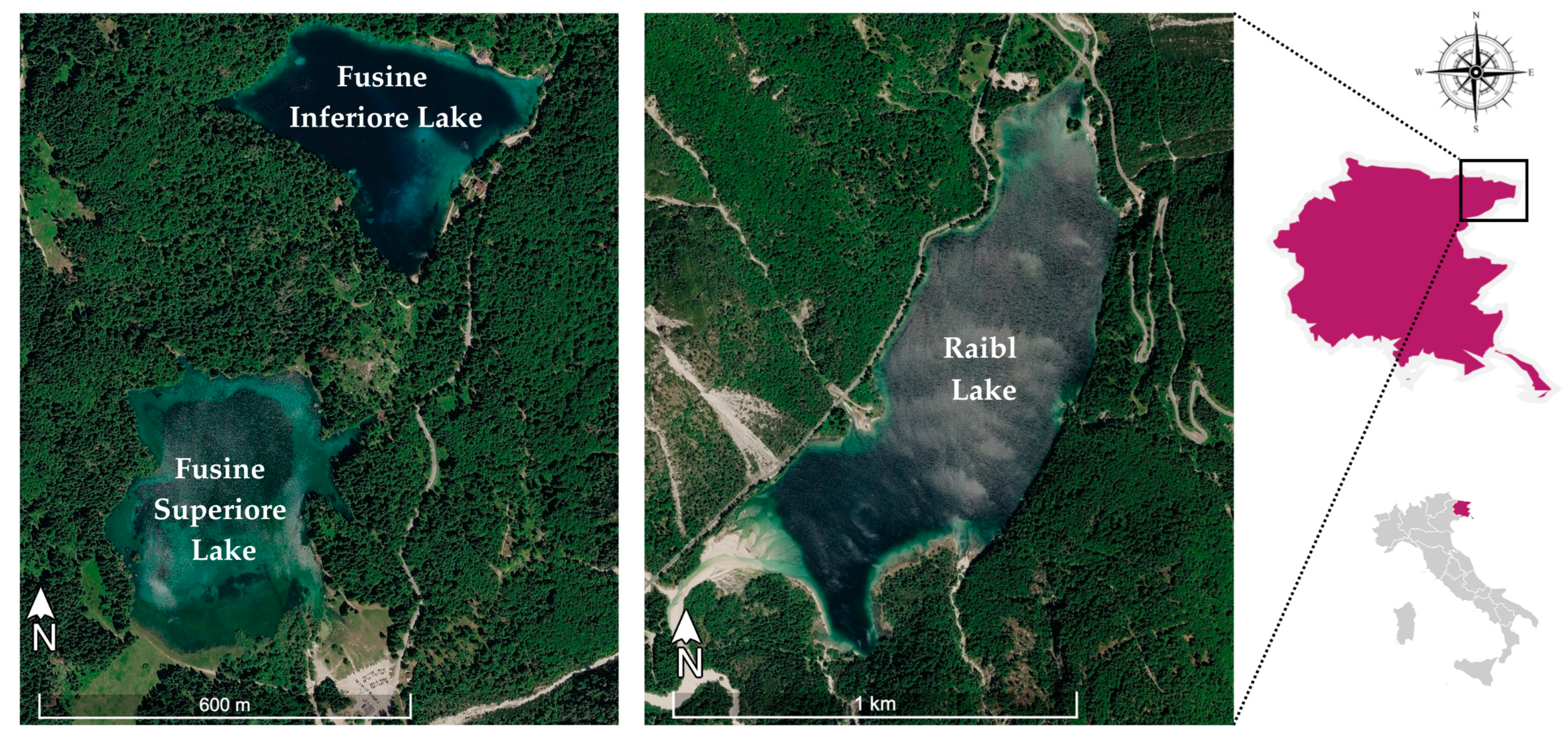
Figure 1. Study area: Fusine Superiore and Fusine Inferiore Lakes, Raibl Lake (Friuli-Venezia Giulia Region, Italy).
Diversity 18 00336 g001
Figure 2. Mean density (ind m−2) and taxonomic composition of littoral benthic macroinvertebrate assemblages across sampling sites in Lake Fusine Superiore, Lake Fusine Inferiore, and Lake Raibl.
Diversity 18 00336 g002
Figure 3. Proportional distribution of S. umbla size classes across the three study lakes. Bars represent the relative contribution of each size class to the total number of individuals sampled per lake.
Diversity 18 00336 g003
Figure 4. Boxplots showing differences in total length (top) and weight (bottom) between female (F) and male (M). A single asterisk indicates a statistically significant difference between sexes (p < 0.05, Wilcoxon rank-sum test). Only individuals with determinable sex were included in the analysis.
Diversity 18 00336 g004
Figure 5. Relationship between total length and total weight of S. umbla in the three study lakes. Non-linear length-weight regressions were fitted separately for each lake. The annotation reports, for each lake, the coefficient of determination (R2) and the significance level (p-value) of the regression model.
Diversity 18 00336 g005
Figure 6. Relative abundance of the main prey groups in the littoral benthic community and in the stomach contents of S. umbla across the three lakes. Bars represent the mean relative abundance (%). Only the dominant prey groups are shown.
Diversity 18 00336 g006
Figure 7. Ivlev’s electivity index (E) for the main prey groups of S. umbla across the three lakes. Positive values indicate selective preference for a prey group, whereas negative values indicate avoidance. Bars represent electivity per prey group for each lake, with a horizontal reference line at zero indicating neutral selection.
Diversity 18 00336 g007
Figure 8. Abundance of the main prey groups in S. umbla stomachs by size class and lake. Only the four main prey groups (Hexapoda, Oligochaeta, Malacostraca, and Bivalvia) are shown; rare prey items were excluded. Boxplots show the number of prey items per stomach for each size class: Class A (≤12 cm), Class B (12 < x ≤ 15 cm), Class C (15 < x ≤ 18), Class D (18 < x ≤ 21 cm), Class E (>21 cm).
Diversity 18 00336 g008
Figure 9. Cumulative prey group richness in S. umbla stomachs across size classes and lakes. Each line represents the accumulation of distinct prey groups per stomach.
Diversity 18 00336 g009
Table 1. Number of female, male, and undetermined individuals sampled in each lake.
LakeFemaleMaleNot Determined
Fusine Inferiore6127
Fusine Superiore1280
Raibl193111
Total375118
Table 2. Summary of biometric data of S. umbla in the three lakes. Values represent mean total length (cm) and total weight (g) ± standard deviation (SD) for females (F), males (M) and not-determined (n.d).
Fusine SuperioreFusine InferioreRaibl
Length (cm)
(mean ± sd)
Weight (g)
(mean ± sd)
Length (cm)
(mean ± sd)
Weight (g)
(mean ± sd)
Length (cm)
(mean ± sd)
Weight (g)
(mean ± sd)
F31.33 ± 3.35337.08 ± 107.4222.27 ± 2.8393.67 ± 38.6820 ± 3.1467.32 ± 35.50
M29.06 ± 6.22257.38 ± 164.7319.11 ± 2.4257.17 ± 28.2519.26 ± 4.2161.90 ± 39.40
n.d.--11.47 ± 0.8312 ± 2.4511.76 ± 2.5713.45 ± 9.67
Table 3. Stomach content composition of S. umbla from the three lakes. The table reports the absolute number of prey items recovered from all stomachs (Number of items), their relative contribution to the total prey count in each lake (N%) and the frequency of occurrence across stomachs (%F).
LakePrey GroupNumber of ItemsN (%)F (%)
RaiblBivalvia3775.6121.31
Malacostraca3375.016.56
Gastropoda00.000.00
Oligochaeta280.429.84
Hirudinea20.031.64
Hexapoda594888.5093.44
Terrestrial290.431.64
Fusine InferioreBivalvia230.7216.00
Malacostraca1023.1836.00
Gastropoda20.064.00
Oligochaeta30.0912.00
Hirudinea00.000.00
Hexapoda307695.95100.00
Terrestrial00.000.00
Fusine SuperioreBivalvia00.000.00
Malacostraca00.000.00
Gastropoda00.000.00
Oligochaeta50.7610.00
Hirudinea00.000.00
Hexapoda65199.24100.00
Terrestrial00.000.00
Table 4. Observed and estimated prey-group richness in the diet of S. umbla across the three lakes.
LakeObservedChaoJackknife1
Fusine Inferiore55.005.96
Fusine Superiore22.002.00
Raibl66.987.97
Table 5. Pairwise dietary overlap (Schoener’s α) among size classes of S. umbla in each lake. Values close to 1 indicate high overlap in diet composition between size classes, while lower values denote greater differentiation. Only lakes with more than one size class are included in the analysis.
LakeClass 1Class 2Schoener Alpha α
Fusine InferioreAB0.996
Fusine InferioreAC0.996
Fusine InferioreAD0.997
Fusine InferioreAE0.995
Fusine InferioreBC1
Fusine InferioreBD0.998
Fusine InferioreBE0.992
Fusine InferioreCD0.998
Fusine InferioreCE0.992
Fusine InferioreDE0.994
RaiblAB0.98
RaiblAC0.983
RaiblAD0.932
RaiblAE0.8
RaiblBC0.995
RaiblBD0.912
RaiblBE0.782
RaiblCD0.915
RaiblCE0.783
RaiblDE0.866
Table 6. Schoener’s overlap index (α) between lakes for each size class of S. umbla. Values close to 1 indicate a high similarity in diet composition between lakes.
Size ClassLake 1Lake 2Schoener Alpha α
AFusine InferioreRaibl0.877
BFusine InferioreRaibl0.977
CFusine InferioreRaibl0.768
DFusine InferioreRaibl0.908
EFusine InferioreFusine Superiore0.747
EFusine InferioreRaibl0.796
EFusine SuperioreRaibl0.919
Disclaimer/Publisher’s Note: The statements, opinions and data contained in all publications are solely those of the individual author(s) and contributor(s) and not of MDPI and/or the editor(s). MDPI and/or the editor(s) disclaim responsibility for any injury to people or property resulting from any ideas, methods, instructions or products referred to in the content.