1. Introduction
The evolution of vertebrates started ~568 million years ago (MYA), while gnathostomes diversified about 464 MYA [
1,
2,
3] to form fossil and recent ‘fishes’ (Chondrichthyes, Osteichthyes). Gnathostomes increase in abundance in the Silurian relative to agnathans (~443–420 MYA [
4]). Within Osteichthyes (Euteleostomi; Sarcopterygii, or lobe-finned fishes, and Actinopterygii, or ray-finned fishes) there are about 86,000 species, split roughly into actinopterygians (42,000 species) and sarcopterygians (44,000 species [
1]).
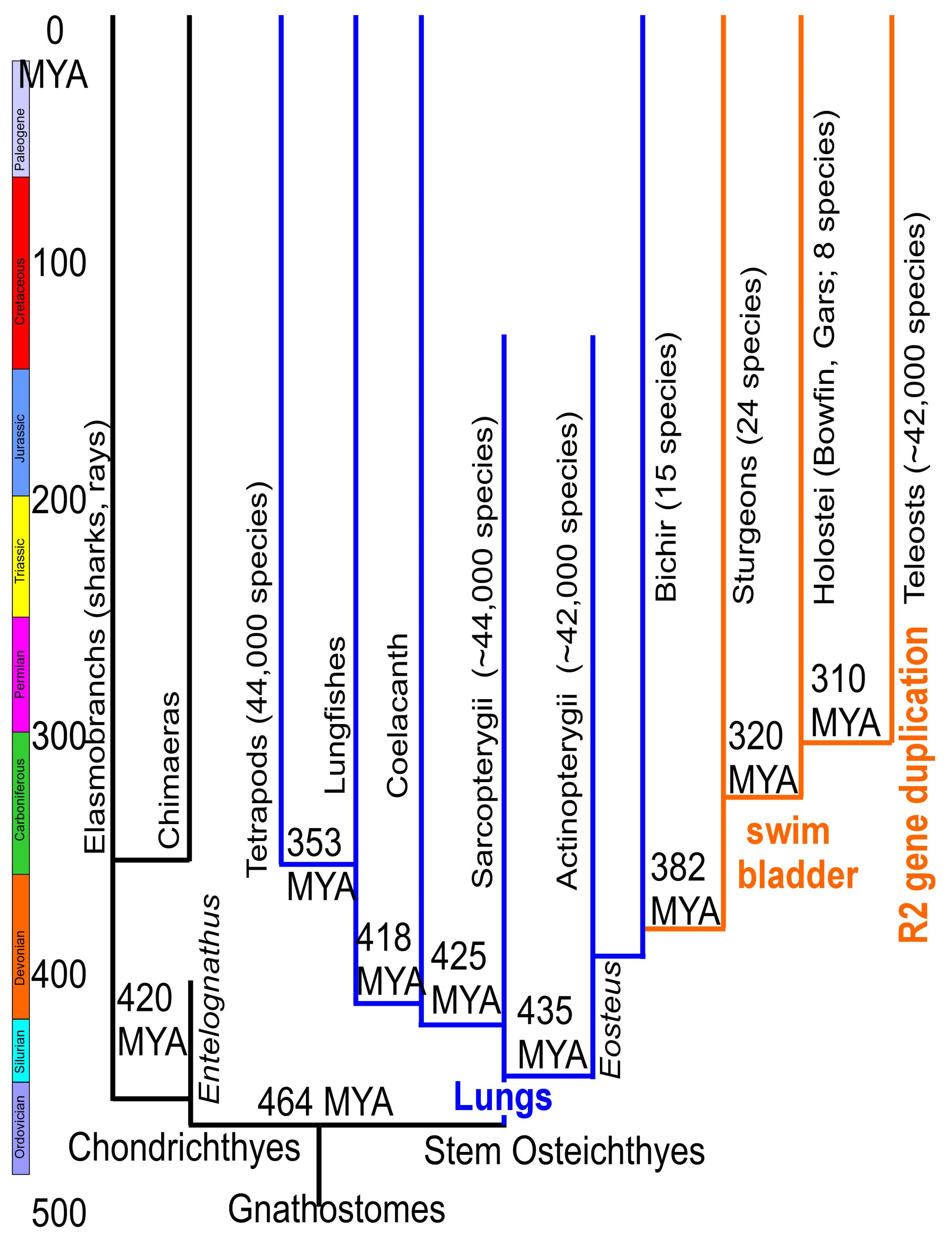
Stem Osteichthyes likely originated about ~435 MYA [
5]; ray-finned fishes appeared about 382 MYA, while lobe-finned fishes are found much earlier, at 425 MYA (
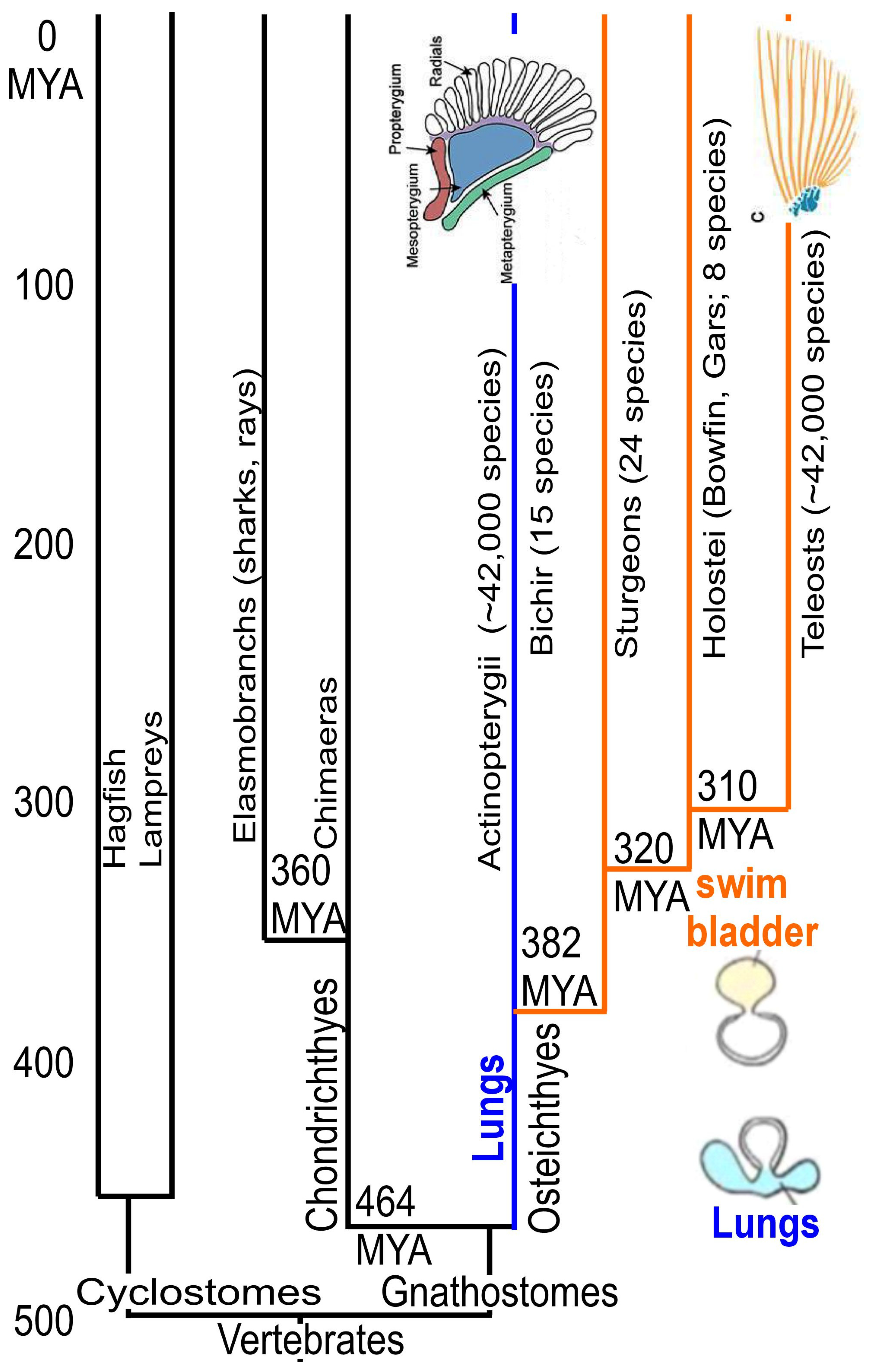
Figure 1 [
5,
6]): agnathans, conodonts, Acanthodii, Placodermi, Chondrichthyes and Osteichthyes [
4,
5,
6]. In contrast to the predominantly aquatic Actinopterygii, Tetrapoda originated around 353 MYA: Amphibians (largely semiaquatic) of about 9000 species, and Amniotes (origin ~319 MYA), mostly terrestrial, including ~36,000 species. Within mammals (origin ~180 MYA), about 4600 species belong to Rodentia and Chiroptera combined, while the remaining ~4400 comprise all other mammalian orders, including the monotremes (Tachyglossidae and Ornithorhynchidae). Here, our focus is fishes and we will deal with amphibians and amniotes later.
Major losses occurred across five Phanerozoic mass extinctions: Late Ordovician (~443–420 MYA [
4], Late Devonian (~370–360 MYA), end Permian (~251–247 MYA), end Triassic (~201 MYA), and end of Cretaceous (~66 MYA). These events—marine die-offs in the Ordovician, prolonged ecosystem collapse in the Devonian and Permian, and asteroid-driven extinction at the end of the Cretaceous—have profoundly shaped life’s history [
7,
8,
9]. Focusing on the early Paleozoic: the Ordovician extinction of agnathans was followed by a Silurian recovery and diversification that set the stage for jawed vertebrates (gnathostomes) that increased in the Devonian [
4]. The split between Sarcopterygii and Actinopterygii and the early diversification of Osteichthyes occurred during the late Silurian to Devonian (roughly 430–400 MYA [
5]), coincident with declines in many jawless groups (e.g., agnathans and conodonts end in the Triassic). The genetic and developmental changes underlying Osteichthyes radiation remain an active area of research, and the relative abundance or cryptic diversity of the two lineages between ~430 and 400 MYA is still poorly resolved in the fossil record (
Figure 1; [
6]).
Genetically, vertebrate evolution shows multiple rounds of whole-genome duplication (WGD). An early WGD (1R) preceded a further duplication that helped distinguish cyclostomes and gnathostomes (often discussed as part of the 2R events in early vertebrates). These duplications may overlap temporally with the Silurian–Devonian interval when sarcopterygians and actinopterygians emerged [
2,
3]. A later, teleost-specific WGD (TGD; [
10,
11]) occurred in the stem of the teleost lineage (commonly dated to the late Paleozoic–early Mesozoic; estimates vary between ~350–310 MYA), and the third 3R is happening in sturgeons [
12]. The discrepancy in fossils (about 435 MYA; [
6]) and genetics requires additional work. Such gene duplications create redundant copies that can escape selective constraint, permitting neo-functionalization or sub-functionalization and thereby providing raw material for evolutionary innovation [
13,
14]. Although Ohno emphasized the importance of genome doubling, subsequent work shows that functional innovation after duplication is complex, involving gene loss, regulatory change [
10,
13], and novel interactions that together can shift organisms onto new adaptive peaks [
15,
16].
Genes drive biological diversity at all levels of organization and across timescales of phenotypes [
17] and the gene regulatory network [
18,
19]: GRN dynamics of molecular interactions—primarily between transcription factors, enhancers, and genes—that govern gene expression directing cellular development and responses to other genes. New genes arise from events that span hundreds of millions of years, so lineages differ in the proportion of recently originated genes (e.g., Time Tree [
1,
20] estimates ~2% novel genes in humans over the last ~67 MYA versus ~8.2% in mice over ~27 MYA [
17]). Mechanisms generating gene novelty fall into broad categories: (A) protein → protein changes via exon shuffling, retroposition, gene duplication, lateral transfer, fusion/fission, alternative splicing, or frameshifts; (B) noncoding → protein transitions such as de novo gene birth, repeat expansion, or transposable element domestication; (C) protein → noncoding conversion through pseudogenization or the origin of noncoding RNAs (lncRNAs); and (D) noncoding → noncoding innovations that produce new lncRNAs. Regulatory small RNAs further increase complexity—humans express roughly 2000 microRNAs, of which a substantial subset remains incompletely characterized [
20]. Core RNA-processing factors (e.g.,
Dicer) are essential for early development in mammals, illustrating how gene-regulatory systems are integrated with ontogeny [
21,
22,
23]. Together, gene birth and regulatory reconfiguration (through duplication, divergence, and network rewiring) create the raw material and novel interactions that enable adaptive shifts—the “arrival of the fittest” that drives evolutionary innovation and adaptation [
15,
24,
25].
Figure 1.
The evolution of gnathostomes. Gnathostomes split into Chondrichthyes and Stem Osteichthyes, identified by early stem-group taxa (Entelognathus, Eosteus). Osteichthyes segregate into actinopterygians and sarcopterygians about 425 MAY. Lungs appeared in Osteichthyes but never evolved in Chondrichthyes. However, a new form of a swim bladder forms in sturgeons, holosteis and teleosts. Moreover, modern teleosts had another round of gene duplication. Note that the number of species is about the same in Osteichthyes of Actinopterygii and Sarcopterygii. Modified after [
2,
3,
5,
26].
Figure 1.
The evolution of gnathostomes. Gnathostomes split into Chondrichthyes and Stem Osteichthyes, identified by early stem-group taxa (Entelognathus, Eosteus). Osteichthyes segregate into actinopterygians and sarcopterygians about 425 MAY. Lungs appeared in Osteichthyes but never evolved in Chondrichthyes. However, a new form of a swim bladder forms in sturgeons, holosteis and teleosts. Moreover, modern teleosts had another round of gene duplication. Note that the number of species is about the same in Osteichthyes of Actinopterygii and Sarcopterygii. Modified after [
2,
3,
5,
26].
Having clarified the role of the Late Ordovician mass extinction (~443–420 MYA) in setting the stage for early Osteichthyes diversification [
4,
5], and with growing insight into the underlying genetics, we here speculate on the consequences of an Earth without sarcopterygians—specifically, whether a terrestrial, tetrapod-like lineage could have arisen from actinopterygians. Retrospective analysis of historical trends and patterns can help clarify the early divergence of sarcopterygians and actinopterygians and illuminate the developmental and genetic pathways that enabled the water-to-land transition [
24,
27]. Without sarcopterygians (and the terrestrial tetrapods they gave rise to), evolutionary trajectories would likely have been very different: novel ecological opportunities could have driven some ray-finned lineages toward greater terrestriality, but substantial anatomical and developmental hurdles would have shaped a distinct, potentially less tetrapod-like outcome.
3. Results
3.1. Vertebrate Evolution of Teleosts Without Sarcopterygians
The earliest post-Ordovician recovery set the stage for jawless vertebrates (agnathans, cyclostomes) to be followed by the rise of jawed groups—placoderms, Chondrichthyes (sharks) and Osteichthyes, including early lobe-finned forms such as coelacanth relatives [
4,
28,
29]. Teleost evolution would have continued from these bony fish roots and, in a world without sarcopterygians, might eventually have produced more terrestrial-adapted “teleo-animals.”
Cladistia (bichirs and reed fish) represent the earliest-diverging crown actinopterygian lineage and retain several plesiomorphic features—ganoid scales, robust pectoral fins (
Figure 2) with muscular lobes capable of substrate contact, and paired air-breathing organs, the lungs [
12,
28,
30]. Their cranial and cardiovascular traits also preserve ancestral conditions useful for reconstructing the biology of early Osteichthyes. Cladistians appear to have split from other ray-finned fishes deep in the Paleozoic (Devonian–Carboniferous interval, broadly ~390–340 MYA), conserving anatomical states lost in most later actinopterygians [
12]. Importantly, polypterids can breathe air and traverse land. Below, we outline key functional and developmental challenges that would confront any scenario in which all tetrapods were lost, and terrestrial niches were later invaded by bony fishes.
3.2. Locomotion: Diversity of Lobe-Finned as Compared to Ray-Finned Fishes
Sarcopterygians and actinopterygians, such as bichir, are predisposed to a terrestrial niche because their paired fins are built on a robust endoskeleton axis—a single proximal element (humerus/femur) plus serial distal bones articulating with strengthened pectoral/ pelvic girdles and substantial limb musculature, allowing load transfer onto substrate (well-illustrated by fossil tetrapodomorphs and extant
Latimeria and bichir [
12,
31,
32,
33]). By contrast, derived ray-finned fishes bear a fin architecture dominated by dermal lepidotrichia supported by many small radials rather than a single limb axis [
31]. Developmentally, Osteichthyes share a zone of polarizing activity (ZPA) with
Shh signaling and an apical signaling center that drives distal outgrowth: in tetrapod/sarcopterygian fins this takes the form of a sustained apical ectodermal ridge (AER) with prolonged
Fgf expression, whereas in many teleosts the program is shortened/modified into an apical fold (AF) with bichir sitting in between, promoting lepidotrichia formation (
Figure 2 [
12,
31]).
Hox gene patterning also differs: limb formation in tetrapods depends on distinct spatial/temporal deployment of posterior
HoxA/HoxD genes (e.g.,
HoxA11/A13,
HoxD11/D13) that specify endoskeleton elements and digits, while teleost fins show overlapping
Hox expression associated with ray development: ray-finned fishes show an overlap of
hoxa11,
hoxa13,
hoxd11, and
hoxd13 that develops the apical fold that forms the ray-finned lepidotrichia [
18,
31].
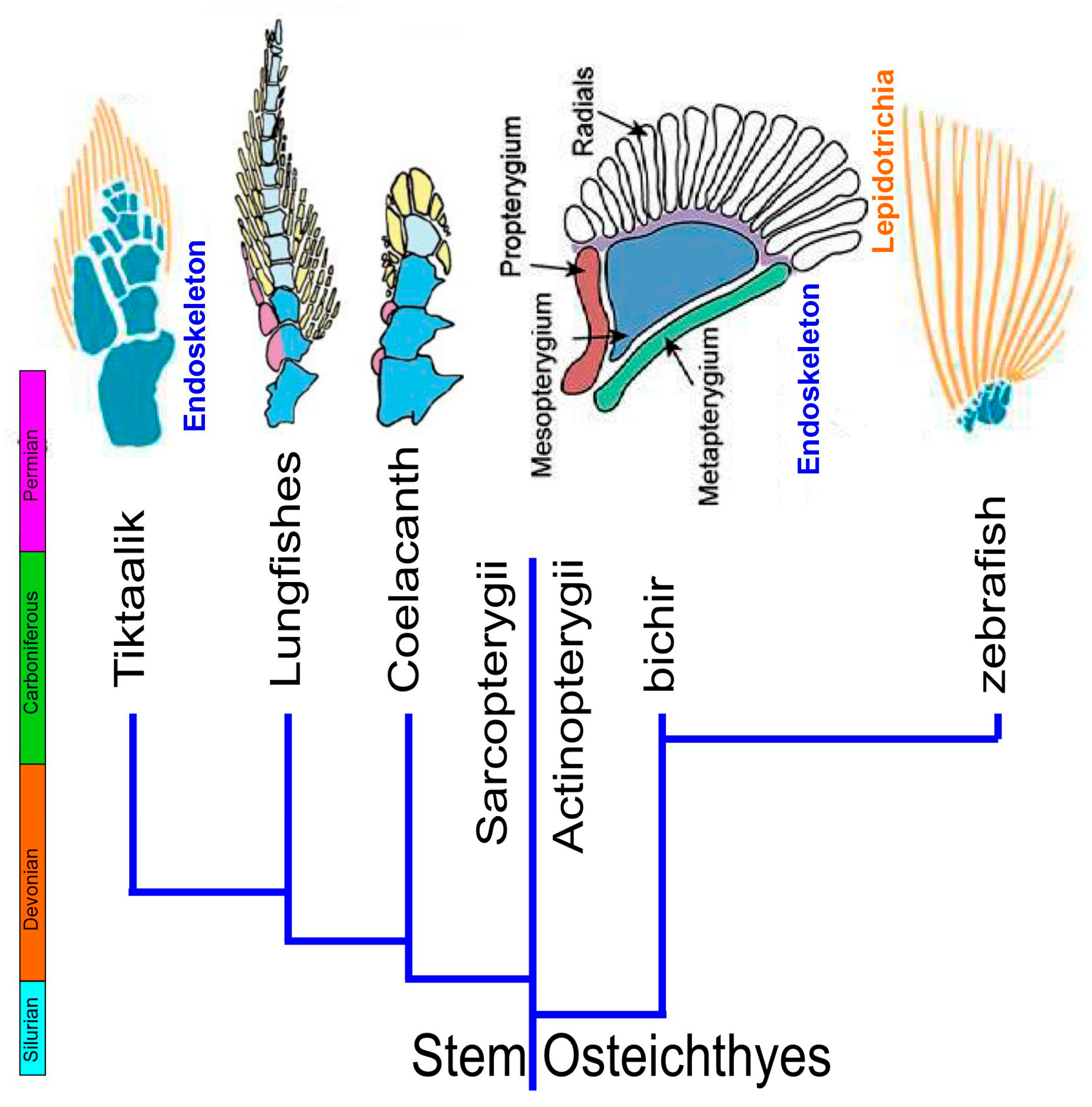
Figure 2.
Formation of endoskeleton and lepidotrichia revealed. Compared to others, the bichir shows three endoskeletons elements (propterygium, mesopterygium, metapterygium) that have a different alignment in coelacanth, lungfish, and Tiktaalik (humerus, ulna, ulnare). Eventually, they generate the three major endoskeletons shown here, and develop pre-radials and intermediate bones. Derived tetrapods have an alignment of humerus, ulna, and radius that connects with intermediate bones and the phalanges of the five digits. All five animals depicted have lepidotrichia that become more elongated in teleosts (zebrafish), while most tetrapods have lost lepidotrichia. A shift in Hox genes may explain the presence or absence of lepidotrichia: shifting the overlap of Hox genes in teleosts to segregation in tetrapods. The easiest modification would be to transform the bone formation to support the legs in the bichir, but it would require more time to develop proper ‘leg’ support in derived teleosts. Modified after [
12,
31,
33].
Figure 2.
Formation of endoskeleton and lepidotrichia revealed. Compared to others, the bichir shows three endoskeletons elements (propterygium, mesopterygium, metapterygium) that have a different alignment in coelacanth, lungfish, and Tiktaalik (humerus, ulna, ulnare). Eventually, they generate the three major endoskeletons shown here, and develop pre-radials and intermediate bones. Derived tetrapods have an alignment of humerus, ulna, and radius that connects with intermediate bones and the phalanges of the five digits. All five animals depicted have lepidotrichia that become more elongated in teleosts (zebrafish), while most tetrapods have lost lepidotrichia. A shift in Hox genes may explain the presence or absence of lepidotrichia: shifting the overlap of Hox genes in teleosts to segregation in tetrapods. The easiest modification would be to transform the bone formation to support the legs in the bichir, but it would require more time to develop proper ‘leg’ support in derived teleosts. Modified after [
12,
31,
33].

Notably, taxa such as bichir,
Latimeria, lungfish and
Tiktaalik combine a central, lobe-like endoskeleton core surrounded by lepidotrichia, illustrating an intermediate condition [
12,
31,
32]. At least one fish using pectoral fins climbs a vertical wall about 15 m high, the
Parakneria thysi [
34]. Using their pectoral fins, supported by their pelvic fins, these fish climb, even if current water pours down. Both pairs of fins have, on their ventral surface, pads bearing tiny unicellular hook-like projections. The villiform shape of the three posterior-most proximal radials appears, as well as the arrowhead-shaped extensions supporting the base of the pectoral rays in
P. thysi. Likewise, the pelvic girdle and the vertebral column can be shown with a wide basipterygium which allows more contact with the column. In addition, short processes come close to the pelvic girdle that is likely used for climbing up the wall. Other teleosts have terrestrial abilities such as mudskippers, climbing gourami, and walking catfish.
Thus, during the fin → limb transition, stem tetrapods reduced fin rays and elaborated a distal endoskeleton to gain terrestrial mobility. Converting a typical ray-fin into a tetrapod-like limb in derived teleosts would require extensive reorganization (loss/reduction of lepidotrichia, redeployment of AER-like signaling,
Hox reconfiguration, and girdle reinforcement) and, therefore, likely a much longer evolutionary time and sustained selection in actinopterygians than in sarcopterygians and bichir. Nevertheless, that ‘climbing fishes’ exist already [
34] makes it more likely that it could transform to become more terrestrial in movement, like
Tiktaalik [
32]. Given that it took about 40 million years for the simple lobe-finned to begin the transformation into a more supporting structure in
Tiktaalik (~425–385 MYA) it would take much longer to transform through gene expression that shifts the temporal progression.
3.3. Biodiversity
Without sarcopterygians, vertebrate life would lack a wide variety of land-dwelling organisms, including amphibians, reptiles, birds, and mammals. This absence would lead to the dominance of other groups, such as bony fish (assuming they can invade terrestrial space) or invertebrates, including all arthropods, resulting in greater diversity within those clades. Could teleosts fill in the gap between tetrapods and evolving terrestrial bony fishes?
Mudskippers (Gobiidae) are a major group of amphibious fish with critical adaptations that facilitated the evolution from an aquatic to a terrestrial lifestyle. The mudskipper comprises approximately 40 species and forms a monophyletic clade that diverged from other teleosts ~140 MYA. Mudskippers are found along tropical/subtropical coasts (Africa, Asia, including China, Korea, Japan, and Australia) and thrive in mangroves, mudflats, and estuaries, often near brackish water or saltwater. Their eyes are adapted to terrestrial vision to escape predators [
35], whereas ray-fins begin to alter the genetics that allow them to move onto the terrestrial fin to climb up the mangroves [
36,
37]. Hearing and communication skills are used in water and on land, making distinct “grunts” and “pulse trains” for territorial defense, mating, and individual recognition, often combining sound with visual displays (like leaping or drumming) to navigate their amphibious world, a key adaptation for their unique semi-aquatic lifestyle [
38]. Mudskippers burrow in the mud and help aerate the seafloor. They breathe by exchanging oxygen across their gills and through their skin. A unique physiology (air-breathing, burrowing) makes them sensitive to environmental changes, revealing water/soil quality in mangrove habitats.
In addition, we know the family ‘flying fishes,’ sixty-four species of Beloniformes, the Exocoetidae. Fish can make powerful leaps out of the water, gliding for considerable distances using their wing-like fins, to escape predators. The fish can fly for 40–45 s at 70 km/h, covering up to 400 m [
39,
40]. Once such a fish has adapted to a new terrestrial form with developed lungs, it may be possible for related species to evolve into true ‘flying fish’ comparable to birds, bats, and extinct pterosaurs (223–66 MYA).
3.4. Ecosystem Dynamics
Ecosystems would be structured differently in the absence of tetrapods. Without predators or herbivores, they will flourish differently, and certain plants will not produce seeds without proper pollination, except by insects, birds or mammals. Plants evolved in the Silurian phase and interacted with terrestrial life forms [
4]. However, it took a long time before tetrapods became common in terrestrial environments. Moreover, without plant-eating tetrapods, the world would change in an unusual direction that would certainly be dominated by insects, but it would take some time before the teleosts could fill the place left by the absence of tetrapods. Certain teleosts are already vegetarians in water. Such adaptation can evolve further into herbivores in teleosts, comparable with herbivorous dinosaurs and mammals.
3.5. Respiration and Locomotion
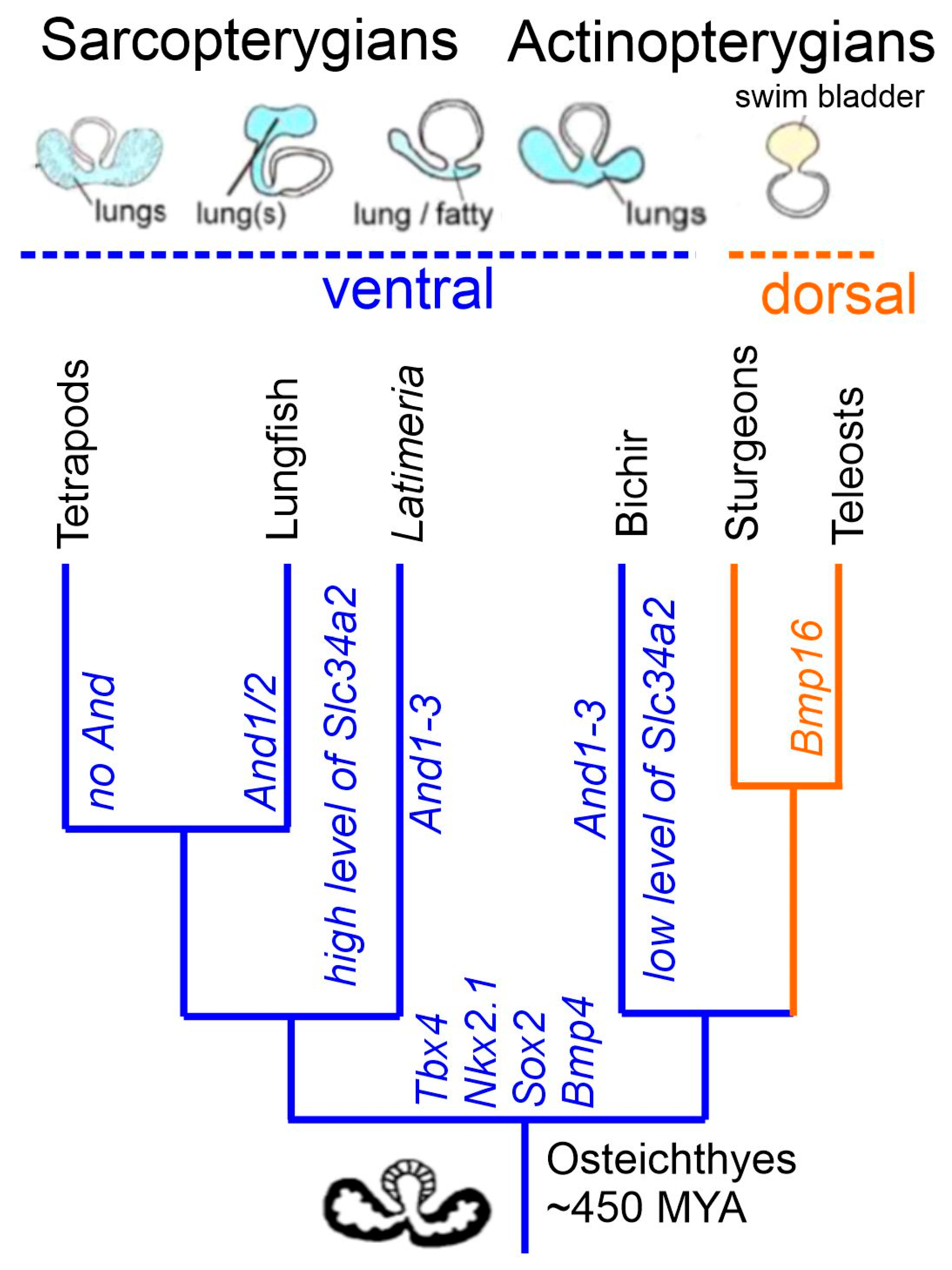
Several genes are now known to develop a ventral expansion from the endoderm to become the lung bud (
Nkx2.1,
Sox2,
Bmp4,
Fgf10, among others [
26,
29,
41]). The teleost swim bladder evolved from a lung, shared by sarcopterygians and actinopterygians (bichir, [
12]), but has since evolved to form a dorsal cavity in modern teleosts that uses a unique expression of
Bmp14 and lost the expression of
And1–3 (
Figure 3; [
41]). All sarcopterygians and bichir buds are ventral while sturgeons, bowfin and teleosts have a dorsal opening. A closer view shows that in the bowfin it starts out medial and rotates into a dorsal bud opening [
29].
Only one teleost can live transiently near water or land but outside in the air: the mudskipper. Certain urodeles lack lungs that initially develop; these are the plethodontids [
42]. Plethodonts are in the same range as the mudskipper (10–15 inches) that breathe exclusively using their moist skin (cutaneous respiration) and the lining of their mouths/throats, a vital adaptation for damp terrestrial or aquatic life. In contrast to plethodonts, mudskippers use both skin and air in the gut, a trait already observed in aquatic teleosts. For the swim bladder to evolve to function as a lung, like in Siluriformes (catfish), will take years of further evolution in most teleosts. However, bichir can already breathe with the ventral lungs, like the coelacanth [
12,
28] and catfish breathing air.
3.6. Reproductive Strategies
Teleosts’ reproductive strategies are incredibly diverse, but most involve external fertilization and oviparity (egg-laying), often with mass spawning and usually with no parental care. Strategies vary widely, including hermaphroditism, elaborate parental care (mouthbrooding, nest guarding), and even live-bearing (viviparity/ovoviviparity), with some males incubating eggs internally (e.g., seahorses) or females giving birth to live young (e.g., guppies), showcasing unique adaptations for survival. Either guppies or seahorses could be the next step toward generating new offspring once teleosts are suitable for terrestrial reproduction.
3.7. Social Structure and Behavior
Intelligence, complex social interactions, and parental care could evolve in entirely different forms in other taxonomic groups, such as insects, potentially derived teleosts, or cephalopods, thereby enabling terrestrial leaving conditions. Most teleosts have smaller brains compared to most tetrapods. However, Mormyridae have a remarkably large brain relative to body size, comparable to that of humans (around 2–3% of body mass). However, Mormyrids use weak electric fields to “see” their environment with electroreception. This requires sophisticated processing, particularly for motor planning and the interpretation of sensory feedback, tasks largely handled by the enlarged cerebellum [
43]. The large brain evolved to process the complex sensory world of weak electric fields for navigation, foraging, and socializing in dark, muddy African rivers. Unfortunately, the sense of electric fields would disappear once these fish become terrestrial. If this occurred, it would provide a new set of brain features that could be used to develop complex interactions between sound and vision.
3.8. Predation and Competition
Predator and prey exist within teleosts, but will also eat invertebrates in the aquatic realm, and would be the major terrestrial vertebrates that eat invertebrates on land. It would take several years after the loss of all tetrapods, without aquatic amniotes (e.g., Ichthyostega), many birds, and dolphins, for new ecological niches to lead to a different evolutionary trajectory for survival and thriving.
3.9. Evolution of Terrestrial Ecosystems
Plants and invertebrates may initially dominate terrestrial ecosystems in the Silurian [
4,
44]. Once terrestrial tetrapods evolved in the Devonian era, they took over the terrestrial plants later. How long would it take before they would shape the environment once teleosts become terrestrial? This could lead to unique ecosystems with specialized niches filled by alternative teleost.
In summary (
Figure 4), without tetrapods, life on Earth would have evolved into a more diverse array of organisms and ecological relationships. This would result in vastly different ecosystems and potentially unique evolutionary innovations that would make terrestrial and aquatic teleosts dominant over tetrapods.
4. Discussion
Our oldest history starts with LUCA, about 4.2 BYA [
45]. Compared to LUCA, vertebrates evolved around during the Cambrian Period (518–550 MYA) to emerge as a jawless fish with a notochord. During the Cambrian-Silurian period evolved the plants, including vascular plants, and have terrestrial arthropod lineages [
46]. The Cambrian explosion of animals and plants life and various mass extinctions were shaped by the geobiological trajectory of our planet as the evolution of oxygenic photosynthesis formed [
4,
44,
47,
48]. Here, we offer a novel insight into putative evolutionary processes leading to a major extinction, and an overview of the complete loss of all sarcopterygians and tetrapods.
Without the evolution of land-dwelling tetrapods, all terrestrial animals could have never evolved beyond early Sarcopterygii about 425 MYA. After the great mass extinction, agnathans and conodonts increased first, followed by placoderms, Chondrychthyes and Osteichthyes (
Table 1). Stem Osteichthyes were around ~435 MYA and split into sarcopterygians and actinopterygians [
2,
5,
19]. We know that the sarcopterygians led to terrestrial invasion [
48,
49]. If sarcopterygians never existed to exploit early terrestrial niches, selection for terrestriality could begin earlier among actinopterygians, so amphibious/terrestrial forms might appear sooner in the fossil record. If remaining actinopterygians evolved into terrestrial forms, likely following the bichir, with lungs and limbs like those of sarcopterygians, they would evolve much earlier and become dominant terrestrial ‘fish’. Actinopterygians—especially bichir-like/polypterid successors—could plausibly evolve lungs and limb-like appendages and become dominant terrestrial vertebrates earlier, but the anatomical details, locomotor mechanics, and ecological outcomes would likely differ from classic sarcopterygian-derived tetrapods. A deep developmental toolkit (Hox patterns, limb/fin patterning genes) is shared across Osteichthyes, so actinopterygians could, given enough selection, redeploy and reshape endoskeletal elements into limb-like structures. In the absence of terrestrial herbivores and predators, the newly emerging ‘terrestrial fishes’ would likely derive both predators and prey, following the same pattern of aquatic fishes that can provide a breeding ground for freedom and genetic creativity [
16,
24]. Without competition with tetrapods, a new ecosystem would thrive through diversity and adaptability. In nature, chaos and unpredictability are often catalysts for adaptation and survival; see, for example, the speed with which populations replace lost individuals [
4,
47]. Species that can adapt to fluctuating conditions have a greater chance of thriving, highlighting a fundamental principle that mirrors Darwinian creativity [
18].
How long would it take for eggs to evolve into an amniote-like bony fish for terrestrial dominance? Or to sidestep this egg-laying of amniotes and evolve internal fertilization, like guppies, seahorses, coelacanths, caecilians, snakes, marine reptiles, and mammals? Fish have evolved from a lung in sarcopterygians and bichir to have a new dorsal opening that becomes a swim bladder, which allows them to further adapt by using small air sacs to increase surface area for gas exchange, as in birds, or by using swim bladders for sound propagation. Walking and running is a major obstacle to the evolution of a ray-finned fish (like the bichir) rather than a lobe-finned fish (coelacanth). However, the fin-to-limb transition happened in sarcopterygians and requires minor changes in gene expression and evolution in actinopterygians [
12,
31]. Moreover, do certain fish that can climb trees (mudskippers, certain fishes) show the potential to eventually evolve into four-legged, terrestrial ‘fish’?
Tetrapods evolved from sarcopterygians, but it is possible that only amphibians evolved during either minor or major extinctions and never evolved into amniotes. Free from terrestrial invasion, without amniote competition, amphibians evolved to became predators (all amphibians are predators, including very large temnospondyls) before evolving into a group of herbivores. Thanks to unique adaptations, including pre-adaptations that enabled them to fill that ecological role, they could thrive, leading to a dynamic balance in the biosphere as terrestrial ‘fish’ that walked and ran like amniotes.