Article

First Record of Schilbetrema (Monopisthocotyla: Dactylogyridae) from Schilbe depressirostris in South Africa


DSTI-NRF SARChI Chair (Ecosystem Health), Department of Biodiversity, University of Limpopo, Polokwane 0727, South Africa
Diversity 2026, 18(3), 183; https://doi.org/10.3390/d18030183
Submission received: 24 December 2025 / Revised: 20 January 2026 / Accepted: 22 January 2026 / Published: 18 March 2026

Abstract

The study presents a survey of monopisthocotylan parasites infecting Schilbe depressirostris in the northern region of South Africa. Fish specimens were collected from five different localities and examined for gill-infesting monopisthocotylans. To date, there have been no records of monopisthocotylans associated with this host species in South Africa. Across Africa, fourteen monopisthocotylan species of the genus Schilbetrema and two species of Schilbetrematoides have been reported from schilbeid hosts. In the present study, three species of Schilbetrema were identified, each showing varying levels of infestation: Schilbetrema quadricornis was found at all five localities; Schilbetrema acornis was recorded at four localities; and Schilbetrema undinula was detected at a single locality. Seasonal variation in infestation was not significant; however, infestation was positively correlated with host size.

1. Introduction

Schilbe depressirostris (Peters, 1844) commonly known as the Eastern butter catfish is a member of the butter barbel family, Schilbeidae (Osteichthyes: Siluriformes) with Schilbe Oken, 1817 being endemic to tropical African waters. This species was previously grouped with other African schilbeids; however, it was recently reinstated as distinct from Schilbe intermedius Rüppell, 1832 based on both morphological and molecular data [1,2]. As a result, S. depressirostris was recently still referred to as S. intermedius, and caution is therefore advised when interpreting historical parasite records. Schilbeid fishes are known to host a variety of gill parasites, particularly species belonging to the African Dactylogyridae. The first dactylogyrid genus, Schilbetrema Paperna and Thurston, 1968 was described by Paperna & Thurston [3] from the host Schilbe mystus (Linnaeus, 1758) in Uganda. Subsequently, a number of authors described and recorded Schilbetrema spp. from Ghana [4,5], Tanzania [5], Egypt [6], Togo [7], Zimbabwe [8] and the Ivory Coast [9]. This genus now includes 14 species, all from schilbeid hosts. A second genus, Schilbetrematoides Kritsky and Kulo, 1992, was described from S. intermedius in Togo by Kritsky & Kulo [10], whereafter N’douba et al. [11] added a second species to this genus from Schilbe mandibularis (Guenther, 1867) in the Ivory Coast. Parasite records from this host in South Africa are limited to endoparasites and represented by Smit et al. [12], Smit & Luus-Powell [13], Tavakol et al. [14] and King et al. [15]. This study aimed to document the diversity and host associations of monopisthocotylan species infecting S. depressirostris in South Africa, providing the first national record of the genus and contributing to knowledge of parasite biodiversity in the region.

2. Materials and Methods

Schilbe depressirostris specimens were collected seasonally between 2009 and 2015 from five different localities in the northern region of South Africa using gill nets. The Nwanedi-Luphephe and Nandoni dams forms part of the Limpopo River System, and Flag Boshielo and Loskop dams, as well as the Phalaborwa Barrage, are found in the Olifants River System. The hosts (Nwanedi-Luphephe Dam, n = 60; Nandoni Dam, n = 89; Loskop Dam, n = 60; Flag Boshielo Dam, n = 65; and the Phalaborwa Barrage, n = 60) were examined for gill parasites with the aid of a stereo microscope (LEICA Microsystem, model EZ4, Wetzlar, Germany). Monopisthocotylans were removed from the gill filaments using fine forceps and entomological needles and mounted on slides using glycerine jelly or ammonium picrate–glycerine (GAP), as documented by Malmberg [16].
Line drawings were made freehand with the aid of a drawing tube connected to a Zeiss Axioplan 2 imaging microscope (Jena, Germany), and geometric analysis of selected specimens was performed. The sclerotised parts were photographed and measured using the same microscope, making use of Axiovision 4.7.2 software. Measurements were taken as proposed by Gussev [17] and given in µm (mean and range). Monopisthocotylan species were identified using the morphological features of the haptoral sclerites following Kritsky & Kulo [7].
The prevalence, mean abundance and mean intensity of the different species were calculated following standard parasitological descriptions, as defined by Bush et al. [18]. Females were larger and dominant, with a sex ratio of 4.2:1. Because of this disproportionate sex ratio, the influence of host sex on parasitic burden was ignored. Seasonal variation in infestation was calculated to determine if any significant differences occurred. May to August were considered as winter (low flow) and September to April as summer (high flow). Fish hosts were divided into three length groups (<16 cm, 16–25 cm and >25 cm) according to their standard lengths. These length groups were determined by Smit & Luus-Powell [13] using the growth curve constructed by Hecht [19] for S. depressirostris (previously known as Eutropius depressirostris) from Nwanedi-Luphephe Dam. Standard lengths less than 16 cm correspond with fish of 2 years and younger, 16 to 25 cm with fish between 2 and 4 years, and those with lengths longer than 25 cm, with fish older than 4 years. The Spearman’s rank correlation coefficient (rs) was used to correlate fish size (SL) with intensity of infection. The Kruskal–Wallis test was employed to determine significant differences in the intensity of infection during the different seasons, as well as between the different fish length groups. All p-values less than 5% (p < 0.05) were considered significant.

3. Results and Discussion

Monopisthocotylans recovered from the gills of Schilbe depressirostris during this study resulted in three dactylogyrid species, morphologically corresponding to Schilbetrema, as described by Paperna & Thurston [3] and Kritsky & Kulo [7]. Characteristics of the haptoral parts define the genus and include the presence of a prominent superficial knob on the ventral anchor base near its union with the shaft; a modified ventral anchor with a short to non-existent shaft, an elongate point and compressed basal roots; ventral and/or dorsal haptoral bars with lateral, subterminal and/or submedial anterior projections; and hooks with protruding thumbs and slender shanks.
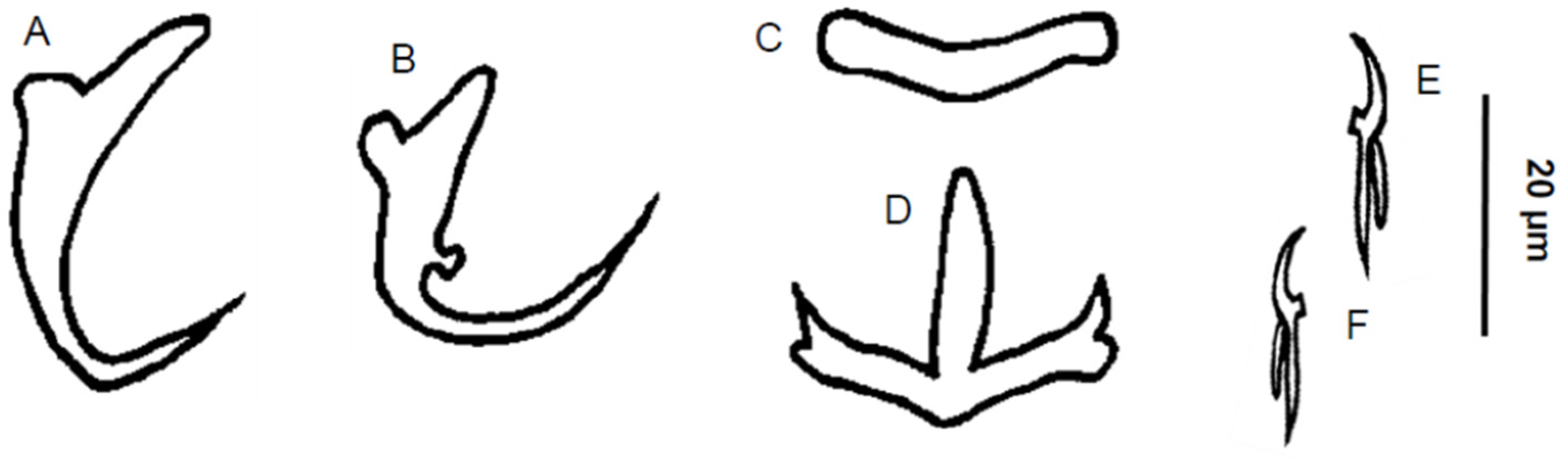
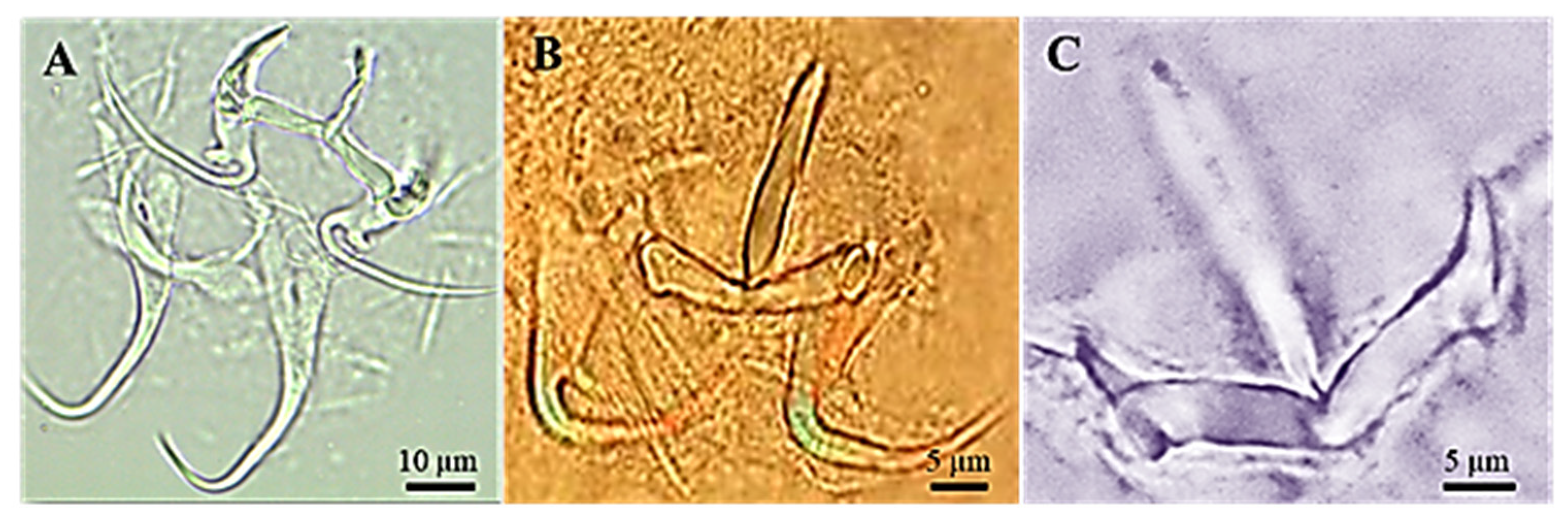
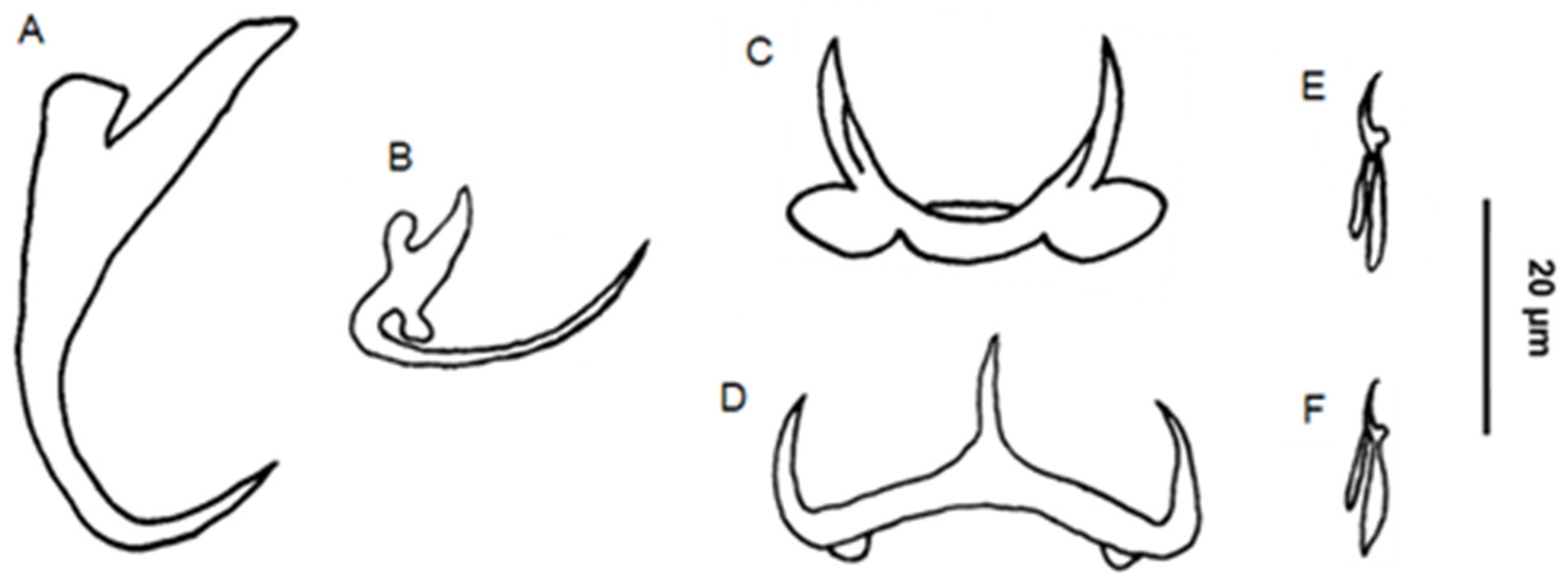
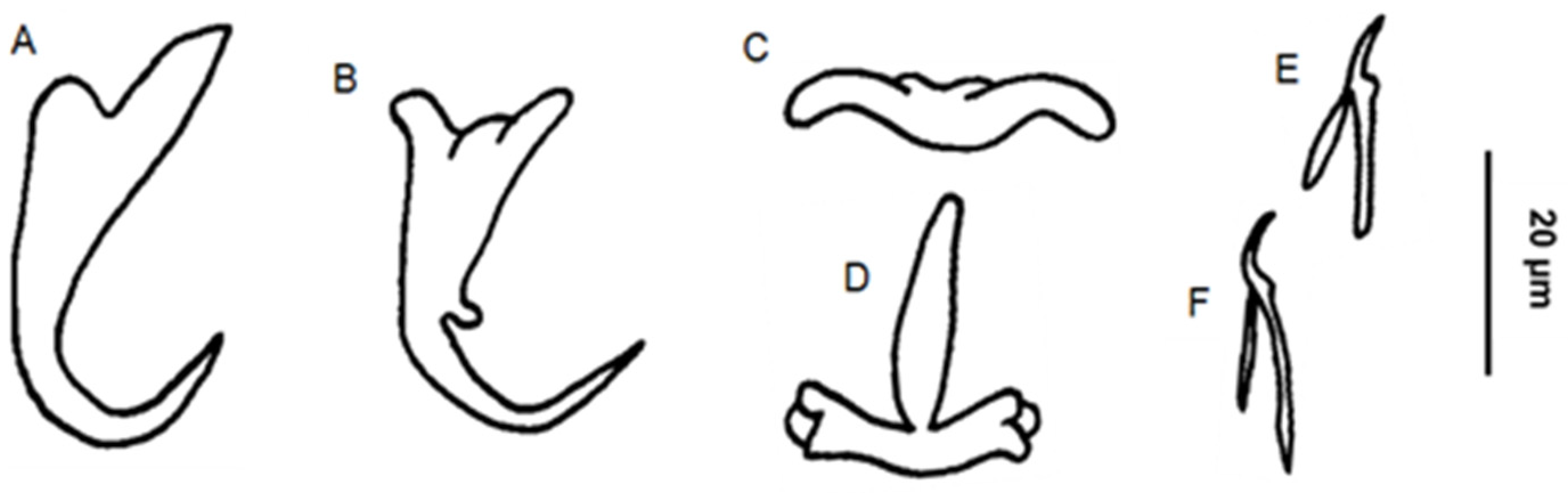
The ventral bar was the most profound feature used to differentiate among the Schilbetrema spp. collected during this study. The ventral bar of Schilbetrema quadricornis Paperna and Thurston, 1968 is long, with two bilateral horns and a delicate submedial projection without terminal ornamentation (Figure 1A and Figure 2). In Schilbetrema acornis Paperna and Thurston, 1968, this structure is shorter and stumpy, lacking terminal horns and having a flabby and bilaterally flattened submedial projection (Figure 1B and Figure 3). The ventral bar of Schilbetrema undinula Kritsky and Kulo, 1992 has short terminal horns and a simple anteromedial process (Figure 1C and Figure 4). It can thus be difficult to differentiate between S. acornis, S. undinula and even S. aegyptica. However, the ventral bar of S. acornis is short and stumpy whereas this structure is comparatively slender in S. undinula and is broad and flattened in S. aegyptica [6,7]. Specimens collected from the different localities were examined and measurements of whole worms and haptoral sclerites are presented in Table 1, Table 2 and Table 3. The measurements are compared with available morphometric data for the respective species reported by Paperna [3], Kritsky & Kulo [7] and Douëllou & Chishawa [8].
Notable differences were observed in the distribution of Schilbetrema spp. among the sampling localities, along with variation in the intensity of infestation (Table 4). Schilbetrema quadricornis was the dominant species, with a prevalence of >83.3%, and was recorded at each of the studied localities. The prevalence of S. acornis varied between the localities (25.0–70.0%) and was not recorded from Nandoni Dam. Schilbetrema undinula was only recorded from the Phalaborwa Barrage (prevalence = 13.3%). Some of the hosts were highly infested with Schilbetrema spp. (e.g., 339, 346 and 480 worms from individual host specimens at Nandoni Dam) which might have had a negative effect on the condition of those specific hosts.
The variation in physicochemical conditions measured among the study localities did not adequately explain the observed differences in Schilbetrema spp. distribution. However, Nandoni Dam, which was the only locality where the fish host harboured a single Schilbetrema species, is the youngest of the study localities and is hydrologically isolated, with the Luvuvhu River joining the Limpopo River more than 100 km downstream. The Phalaborwa Barrage, the only locality at which S. undinula was recorded, is characterised by high turbidity and pronounced seasonal variation in flow, in contrast to the other localities, which are more static impoundments. Broader environmental variation, including differences in flow regime, turbidity and seasonal hydrological instability, may drive local adaptation in parasites, particularly in attachment and reproductive structures [20,21]. These conditions may impose stronger selective pressures that favour parasite species adapted to dynamic riverine environments, which might explain the additional monopisthocotylan species at this locality.
The standard length (SL) of fish hosts collected ranged from 11.2 to 34.0 cm and the weight from 16.0 to 587.0 g. Female fish recorded were significantly (p ≤ 0.05) larger than males, and each size group was well represented. The data from for all localities were pooled and the prevalence, mean abundance and mean intensity of Schilbetrema spp. for each fish length group calculated. Fish belonging to the smallest, medium and largest length groups had calculated indices of 91.1%, 22.8, 25.0; 92.8%, 40.3, 43.4 and 95.9%, 44,1, 46.0, respectively, indicating all indices increased with fish size. The intensity of Schilbetrema spp. infestation was compared to the standard length of the host by using Spearman’s rank correlation coefficient (rs) and approached significance (p = 0.055; rs = 0.295). Larger fish therefore tended to harbour more monopisthocotylans. This is in agreement with a number of other studies on monopisthocotylan fish parasites [22,23].
Seasonal fluctuations in Schilbetrema spp. infestation are presented in Table 5. Although temperature plays a role in monopisthocotylan life cycles, a number of studies indicate no correlation between temperature and prevalence/mean abundance of monopisthocotylans [24,25,26]. This was evident in the current study with little variation in infestation levels of Schilbetrema spp. between winter and summer for most localities. It is most likely that this tendency is because the studied localities are all located within a temperate region where water temperature during winter does not drop to levels that are unfavourable for these monopisthocotylan species. However, the mean abundance recorded from Flag Boshielo Dam was significantly higher during summer (p ≤ 0.05), although no specific contributing factors could be identified.

4. Conclusions

This study increases the current knowledge of monopisthocotylans from S. depressirostris, and reports, for the first time, Schilbetrema spp. in butter catfish from South Africa. These findings are valuable to science and add relevant information on the distribution and ecology of African dactylogyrids. It is suggested that molecular data should be obtained as the only available records are from an unidentified Schilbetrema sp. (GenBank ID KP056243–44) collected from Pareutropius debauwi (Boulenger, 1900) residing in an aquarium. It is further suggested that the morphology of these monopisthocotylans should be compared to Schilbetrema spp. recorded from the rest of Africa to determine if these species are similar to the known species or if they co-evolved with the specific host.

Funding

This work is based on the research supported by the South African Research Chairs Initiative of the Department of Science, Technology and Innovation and National Research Foundation of South Africa (Grant No. 101054). Any opinion, finding and conclusion or recommendation expressed in this material is that of the author and the funding agencies do not accept any liability in this regard.

Institutional Review Board Statement

The South African National Standard for the care and use of animals for scientific purposes (SANS 10386:2008) was followed, where the keeping and handling of animals were carried out in a manner that avoided stress, injury and pain.

Data Availability Statement

The original contributions presented in this study are included in the article. Further inquiries can be directed to the corresponding author.

Acknowledgments

The author would like to thank H.E. Hattingh and P.S.O. Fouché for assistance in collecting the host specimens, and W.J. Luus-Powell and M.M. Matla for guidance throughout the study. I also thank the SARChI Research Chair lab as well as the Department of Biodiversity at the University of Limpopo for the use of their equipment and facilities.

Conflicts of Interest

The author declares that there are no conflicts of interest.

References

  1. Van Der Bank, H.F.; Greenfield, R.; Daru, B.H.; Yessoufou, K. DNA barcoding reveals micro-evolutionary changes and river system-level phylogeographic resolution of African silver catfish, Schilbe intermedius (Actinopterygii: Siluriformes: Schilbeidae) from seven populations across different African river systems. Acta Ichthyol. Piscat. 2012, 42, 307–320. [Google Scholar] [CrossRef]
  2. Van Der Bank, H.F.; Bezeng, B.S.; Skelton, P.H. Systematic reinstatement of Schilbe depressirostris (Peters, 1852), based on differences in DNA barcoding and morphology, from Schilbe intermedius Rüppell, 1832 (Siluriformes, Schilbeidae). Afr. J. Aquat. Sci. 2017, 42, 375–379. [Google Scholar] [CrossRef]
  3. Paperna, I.; Thurston, J.P. Monogenetic trematodes (Dactylogyridae) from fish in Uganda. Rev. Zool. Bot. Afr. 1968, 78, 284–294. [Google Scholar]
  4. Paperna, I. Monogenetic trematodes of the fish of the Volta basin and south Ghana. Bull. Inst. Franc. Afr. Noire 1969, 31, 840–880. [Google Scholar]
  5. Paperna, I. Monogenea of Inland Water Fish in Africa; Royal Museum for Central Africa—Tervuren: Tervuren, Belgium, 1979. [Google Scholar]
  6. El-Naggar, M. Schilbetrema aegyptica n.sp. A monogenean gill parasite of the Egyptian freshwater fish Schilbe mystus. J. Egypt. Soc. Parasitol. 1985, 15, 571–580. [Google Scholar]
  7. Kritsky, D.C.; Kulo, S.D. A revision of Schilbetrema (Monogenoidea: Dactylogyridae), with descriptions of 4 new species from African Schilbeidae (Siluriformes). Trans. Am. Microsc. Soc. 1992, 111, 278–301. [Google Scholar] [CrossRef]
  8. Douëllou, L.; Chishawa, A.M.M. Monogeneans of three Siluriform fish species in Lake Kariba, Zimbabwe. Afr. Zool. 1995, 109, 99–115. [Google Scholar]
  9. N’douba, V.; Pariselle, A.; Thys-Van-Den-Audenaerde, D.F.E.; Euzet, L. Especes nouvelles du genre Scbilbetrema Paperna & Thurston, 1968 (Monogenea, Ancyrocephalidae) parasites de Schilbe mandibularis (Günther, 1867) (Schilbeidae) en Côte-d’Ivoire. J. Afr. Zool. 1997, 111, 481–487. [Google Scholar]
  10. Kritsky, D.C.; Kulo, S.D. Schilbetrematoides pseudodactylogyrus gen. et sp. n. (Monogenoidea: Dactylogyridae: Ancyrocephalinae) from the gills of Schilbe intermedius (Siluriformes, Schilbeidae) in Togo, Africa. J. Helm. Soc. Wash. 1992, 59, 195–200. [Google Scholar]
  11. N’douba, V.; Lambert, A.; Pariselle, A.; Euzet, L. Schilbetrematoides manizani n. sp. (Dactylogyridea) monogenean parasite of Schilbe mandibularis (Günther, 1867) (Schilbeidae) in the Ivory Coast. Parasite 2000, 7, 131–134. [Google Scholar] [CrossRef][Green Version]
  12. Smit, N.J.; Van As, J.G.; Davies, A.J. Fish trypanosomes from the Okavango Delta, Botswana. Folia Parasitol. 2004, 51, 299–303. [Google Scholar] [CrossRef]
  13. Smit, W.J.; Luus-Powell, W.J. The occurrence of metazoan endoparasites of Schilbe intermedius Rüppell, 1832 from the Nwanedi-Luphephe Dams in the Limpopo River System, South Africa. Afr. Zool. 2012, 47, 35–41. [Google Scholar] [CrossRef]
  14. Tavakol, S.; Smit, W.J.; Sara, J.R.; Halajian, A.; Luus-Powell, W.J. Distribution of Contracaecum (Nematoda: Anisakidae) larvae in freshwater fish from the northern regions of South Africa. Afr. Zool. 2015, 50, 133–139. [Google Scholar] [CrossRef]
  15. King, P.H.; Smit, W.J.; Baker, C.; Luus-Powell, W.J. Morphology of Emoleptalea nwanedi n. sp. from Schilbe intermedius from Nwanedi-Luphephe Dam, Limpopo Province, South Africa. Helminthologia 2018, 55, 70–76. [Google Scholar] [CrossRef]
  16. Malmberg, G. The exretory systems and the marginal hooks as basis for the systematics of Gyrodactylus (Trematoda, Monogenea). Ark. Zool. 1970, 2, 1–235. [Google Scholar]
  17. Gussev, A.V. Order Dactylogyridea. In Key to the Parasites of Freshwater Fish of the USSR; Bychovskaya-Pavlovskaya, I.E., Gussev, A.V., Dubinina, M.N., Izymova, N.A., Smirnova, T.S., Sokolovskaya, I.L., Shtein, G.A., Shul’man, S.S., Epsthein, V.M., Eds.; Israel Program for Scientific Translations: Jerusalem, Israel, 1962; pp. 204–342. [Google Scholar]
  18. Bush, A.O.; Lafferty, K.D.; Lotz, J.M.; Shostak, A.W. Parasitology meets ecology on its own terms: Margolis et al. revisited. J. Parasitol. 1997, 83, 575–583. [Google Scholar] [CrossRef]
  19. Hecht, T. Age, growth, reproduction and mortality of the butter-catfish Eutropius depressirostris (Schilbeidae: Pisces) in the Luphephe Nwanedzi impoundment, Venda (South Africa). J. Limnol. Soc. South. Afr. 1980, 6, 39–45. [Google Scholar]
  20. Kearn, G.C. Evolutionary expansion of the Monogenea. Int. J. Parasitol. 1994, 24, 1227–1271. [Google Scholar] [CrossRef] [PubMed]
  21. Buchmann, K.; Lindenstrøm, T. Interactions between monogenean parasites and their fish hosts. Int. J. Parasitol. 2002, 32, 309–319. [Google Scholar] [CrossRef]
  22. Simková, A.; Verneau, O.; Gelnar, M.; Morand, S. Specificity and specialization of congeneric Monogeneans parasiting Cyprinid. Evolution 2006, 60, 1023–1037. [Google Scholar] [CrossRef] [PubMed]
  23. Renner, E.D.; Duggan, I.C. Season, size, and sex: Factors influencing monogenean prevalence and intensity on Gambusia affinis in New Zealand. Parasitol. Res. 2024, 123, 228. [Google Scholar] [CrossRef] [PubMed]
  24. Le Roux, L.E.; Avenant-Oldewage, A.; Van Der Walt, F.C. Aspects of the ecology of Cichlidogyrus philander collected from Pseudocrenilabrus philander philander from the Padda Dam, Gauteng, South Africa. Afr. Zool. 2011, 46, 103–116. [Google Scholar] [CrossRef]
  25. Poulin, R. Meta-analysis of seasonal dynamics of parasite infections in aquatic ecosystems. Int. J. Parasitol. 2020, 50, 501–510. [Google Scholar] [CrossRef] [PubMed]
  26. Li, W.; Yang, B.; Cheng, J.; Zou, H.; Li, M.; Wang, G. Seasonal dynamics of Dactylogyrus species (Monogenea: Dactylogyridae) on wild and farmed goldfsh (Carassius auratus): Implication for prevention of dactylogyriasis. Aquac. Rep. 2022, 26, 101327. [Google Scholar] [CrossRef]
Figure 1. Sclerotised haptoral parts of (A) Schilbetrema quadricornis; (B) Schilbetrema acornis; (C) Schilbetrema undinula, indicating variation in size and structure of the ventral bar.
Diversity 18 00183 g001
Figure 2. Sclerotised haptoral parts of Schilbetrema quadricornis. (A) dorsal anchor; (B) ventral anchor; (C) dorsal bar; (D) ventral bar; (E) hook (pairs 1,5,6,7); (F) hook (pairs 2,3,4).
Diversity 18 00183 g002
Figure 3. Sclerotised haptoral parts of Schilbetrema acornis. (A) dorsal anchor; (B) ventral anchor; (C) dorsal bar; (D) ventral bar; (E) hook (pairs 1,5); (F) hook (pairs 2,3,4,6,7).
Diversity 18 00183 g003
Figure 4. Sclerotised haptoral parts of Schilbetrema undinula. (A) dorsal anchor; (B) ventral anchor; (C) dorsal bar; (D) ventral bar; (E) hook (pairs 1,2,3,4,6,7); (F) hook (pair 5).
Diversity 18 00183 g004
Table 1. Measurements of the body and sclerotised haptoral features (mean, minimum and maximum values given in µm) of Schilbetrema quadricornis from the current study compared to available data for this species.
Measurements from
Schilbetrema quadricornis
Paperna &Thurston [3]
(Type Specimens)
Kritsky & Kulo [7]
(Redescription)
Douëllou &
Chishawa [8]
Current Study
(n = 10)
Body length439 (364–514)401 (309–513)500 (340–590)436.0 (316.0–530.0)
Body width146 (138–153)74 (56–89)68 (40–88)80.3 (69.0–105.0)
Haptor length85 (78–93)82 (71–102)-82.5 (72.0–100.0)
Haptor width82 (81–83)73 (61–85)-76.3 (68.0–83.0)
Dorsal anchor length54 (52–55)59 (52–65)61.1 (55.0–64.6)58.2 (53.0–63.0)
Dorsal anchor base width23 (20–26)22 (17–26)-22.0 (19.2–25.0)
Dorsal bar length39 (38–40)39 (36–45)38.4 (35–41)40.0 (37.4–43.0)
Ventral anchor length23 (22–25)25 (21–28)20.8 (19.9–22.5)23.1 (20.0–25.9)
Ventral bar length40 (40)40 (36–47)41 (36.4–45.9)41.7 (37.0–45.3)
Marginal hook length15–1617 (16–18)13.2–17.415.9 (14.0–17.5)
Table 2. Measurements of the body and sclerotised haptoral features (mean, minimum and maximum values given in µm) of Schilbetrema acornis from the current study compared to available data for this species.
Measurements from
Schilbetrema acornis
Paperna &Thurston [3]
(Syntype Specimens)
Kritsky & Kulo [7]
(Redescription)
Current Study
(n = 10)
Body length577430 (333–568)434.0 (380.0–540.0)
Body width14994 (68–118)96.4 (75.0–121.0)
Haptor length8761 (56–66)62.8 (58.0–67.0)
Haptor width9962–6362.8 (62.1–64.0)
Dorsal anchor length37–3835 (34–37)36.0 (35.0–38.0)
Dorsal anchor base width15 (13–17)15–1615.1 (14.8–16.5)
Dorsal bar length2327 (23–31)27.8 (24.0–31.2)
Ventral anchor length26–2728 (26–30)28.2 (26.5–30.1)
Ventral bar length2019 (18–22)19.8 (18.3–22.6)
Marginal hook length2320–22 and 23–2724.1 (20.0–27.2)
Table 3. Measurements of the body and sclerotised haptoral features (mean, minimum and maximum values given in µm) of Schilbetrema undinula from the current study compared to available data for this species.
Measurements from
Schilbetrema undinula
Kritsky & Kulo [7]
(Species Description)
Douëllou &
Chishawa [8]
Current Study
(n = 6)
Body length281 (233–314)590 (400–840)575.0 (465.0–655.0)
Body width77 (50–102)90 (70–120)87.0 (79.0–96.0)
Haptor length53 (52–55)53.4 (52.2–54.2)
Haptor width58 (50–65)58.0 (53.0–62.0)
Dorsal anchor length33 (29–36)31.8 (27.2–34.8)31.9 (28.5–35.0)
Dorsal anchor base width15 (13–17)15.7 (15.1–16.2)
Dorsal bar length26 (23–29)24.5 (23.2–25.7)25.6 (24.2–28.3)
Ventral anchor length23 (21–26)21.5 (18.2–24.8)22.1 (20.5–24.0)
Ventral bar length29 (26–35)22.9 (21.5–24.0)23.0 (22.4–23.8)
Marginal hook length18–19 and 20–2121.5 (18.0–24.0)20.1 (18.0–23.1)
Table 4. The prevalence, mean abundance and mean intensity of monopisthocotylans recorded from Schilbe depressirostris from five localities in South Africa.
Schilbetrema  quadricornisSchilbetrema  acornisSchilbetrema  undinula
Nwanedi-Luphephe Dam83.3%; 20.3; 21.325.0%; 1.5; 6.0
Nandoni Dam94.4%; 45.9; 48.6
Loskop Dam96.7%; 39.7; 41.028.3%; 4.8; 16.8
Flag Boshielo Dam90.8%; 11.2; 12.369.2%; 4.1; 5.9
Phalaborwa Barrage85.0%; 10.6; 12.570.0%; 8.3; 11.913.3%; 0.5; 3.8
Prevalence; mean abundance; mean intensity.
Table 5. Seasonal prevalence, mean abundance and mean intensity of Schilbetrema spp. recorded from Schilbe depressirostris from five localities in South Africa.
WinterSummer
Nwanedi-Luphephe Dam93.3%; 41.3; 44.390.0%; 29.8; 33.1
Nandoni Dam92.5%; 36.3; 39.295.0%; 47.9; 50.4
Loskop Dam98.3%; 47.0; 47.796.7%; 45.6; 47.1
Flag Boshielo Dam91.7%; 18.7; 20.395.4%; 24.9; 26.1
Phalaborwa Barrage93.3%; 54.7; 58.695.0%; 59.4; 62.6
Prevalence; mean abundance; mean intensity.
Disclaimer/Publisher’s Note: The statements, opinions and data contained in all publications are solely those of the individual author(s) and contributor(s) and not of MDPI and/or the editor(s). MDPI and/or the editor(s) disclaim responsibility for any injury to people or property resulting from any ideas, methods, instructions or products referred to in the content.