Article

Environmental Factors Drive Nekton Community Structure in Offshore Oil Production Zones: A Case Study of the Waters Southwest of Weizhou Island, Beibu Gulf


1
Fisheries Management and Law Enforcement Service Centre, Ministry of Agriculture and Rural Affairs, Shanghai 200040, China
2
Key Laboratory of Marine Ranching, Ministry of Agriculture and Rural Affairs, Guangzhou 510000, China
3
South China Sea Fisheries Research Institute, Chinese Academy of Fishery Sciences, Guangzhou 510000, China
4
Sanya Tropical Fisheries Research Institute, Sanya 572018, China
*
Author to whom correspondence should be addressed.
Diversity 2026, 18(3), 168; https://doi.org/10.3390/d18030168
Submission received: 10 February 2026 / Revised: 5 March 2026 / Accepted: 6 March 2026 / Published: 9 March 2026
(This article belongs to the Section Marine Diversity)

Abstract

Marine oil and gas development markedly impacts offshore ecosystems, and understanding nekton community dynamics in production areas is essential for sustainable fisheries management. However, limited research exists on the structural characteristics and environmental factors influencing nekton communities in offshore oil and gas production zones. Therefore, we investigated nekton community structure through surveys during four consecutive cruises over 2 years in waters southwest of Weizhou Island in the Beibu Gulf. We collected 250 nekton species representing 19 orders, 91 families, and 156 genera, with Perciformes constituting the largest group. Dominant species included small- to medium-sized benthic fish: Parargyrops edita, Metapenaeopsis barbata, and Leiognathus ruconius. Diversity indices showed minimal variation across cruises except spring 2023, which exhibited notably lower diversity. Abundance–biomass curves indicated community disturbance in all seasons, particularly during spring 2023 and autumn 2024. Hierarchical cluster analysis and nonmetric multidimensional scaling revealed two distinct community groups, with intergroup dissimilarity primarily driven by Parargyrops edita, Metapenaeopsis barbata, Leiognathida, Gobiidae, and Loligo. The results of Redundancy Analysis (RDA) demonstrated that the most significant factors influencing the community structure of nekton on each voyage exhibited a certain degree of variation. Nevertheless, overall, water depth, temperature, dissolved oxygen, and chlorophyll a were the primary environmental factors affecting the community structure of nekton in the southwestern waters of Weizhou Island. In certain seasons, suspended solids and petroleum also exerted influence. This research provides scientific reference materials for managing offshore fishery communities and promoting coordinated marine development.

1. Introduction

The Beibu Gulf, situated in the northwest of the South China Sea (SCS), has a tropical-subtropical climate and naturally forms a semi-enclosed bay [1]. Annually, numerous rivers along the coast transport nutrients into the Gulf, providing a robust energy basis for the growth of various organisms [2]. The Gulf’s distinct physical and chemical environment results in an abundance of biological resources, with over 500 fish species documented. Among these, more than 50 are economically valuable, including sea bream, threadfin bream, Parargyrops edita, and tuna, as well as significant shrimp species such as Penaeus penicillatus [3]. Therefore, this sea area has long served as an important traditional fishing ground for both China and Vietnam [3]. Weizhou Island, located in the northern waters of the Beibu Gulf, is surrounded by waters averaging a depth of about 20 m. Its coastal regions support a rich coral reef ecosystem characterized by high biodiversity [4]. These waters also serve as spawning grounds for various economically important fish species, such as Parargyrops edita, making them an essential production area for coastal fishermen in Guangxi [5].
Numerous scholars have conducted comprehensive studies on the resource fluctuations, species composition, and community structure of the primary economic fish species in this sea area [1,6,7,8]. Comprehensive bottom trawl surveys conducted in the Beibu Gulf as early as the 1960s revealed that populations of once-dominant species, such as Lutjanus erythropterus, Gerres filamentosus, and Gymnocranius griseus, had been severely depleted [3]. In more recent research, economically significant species like Parargyrops edita, Decapterus maruadsi, and Trachurus japonicus have exhibited notable interannual and decadal fluctuations [3,5,7]. Su et al. [9] analyzed survey data from the Beibu Gulf collected between 1998 and 2020, revealing an overall decline in fish abundance and biomass. The decline in autumn was more significant than that in spring. In 2020, the total abundance and biomass of fish in autumn accounted for merely 48.97% and 50.82% of those in 1998, respectively. Furthermore, the depletion of resources was not a continuous process. In certain years, there were sporadic rebounds in resources; however, overall, a downward trend was discerned [9]. The dominant species were primarily small benthic and mesopelagic fish, with the fish community consistently showing severe disturbance. However, indicators such as species diversity indices and average trophic level displayed an upward trend. Additionally, Wang et al. [1] conducted a large-scale survey of the Beibu Gulf in 2007, identifying a total of 323 fish species. The fish communities in this area were classified into five distinct groups based on water depth. Fu [2] further investigated the structure of nearshore fish communities in the northwestern Beibu Gulf. The study demonstrated significant spatial variation in fish distribution, with community structure characteristics linked to seasonally changing water masses. Seasonal variations in prey distribution and fish behavior also significantly influenced community structure. Zhang et al. [6] examined fish communities along the northern coast of the Beibu Gulf and found correlations between fish distribution, community structure, and parameters such as water temperature, salinity, and dissolved oxygen levels. In recent years, the intensification of global climate change has led to frequent abnormal climate events, notably the El Niño-Southern Oscillation (ENSO) [10]. These events have substantially affected the resource abundance and fish community structure in the Beibu Gulf [8,11]. Abnormal ENSO events, especially those marked by El Niño, have substantial impacts on fishery resources. More broadly, climate change alters marine environmental conditions, which in turn affect fish population dynamics and distribution patterns [12,13].
The Weizhou Oilfield Cluster, located in the waters surrounding Weizhou Island in the Beibu Gulf, is the largest oilfield cluster in the SCS. It is situated 80 km from Beihai City and approximately 37 km southwest of Weizhou Island. Water depths in the oilfield area range from 30 to 40 m. The development of offshore oil fields in the Beibu Gulf began in the 1950s, with the first field commencing production in 1986. Thus far, this sector has experienced over 70 years of development. Alongside this development, various pollutants have inevitably been generated, potentially leading to marine ecological pollution [14]. Numerous domestic and international studies have examined the effects of exploration and development activities on marine organisms at offshore oil and gas platforms. Findings indicate that blasting during development alters suspended solids and turbidity in water bodies, affecting the growth of certain marine organisms [15]. Additionally, the high noise levels from these operations negatively impact organisms such as fish [15]. Another significant consequence is the toxic effect of pollutants, primarily heavy metals, oil substances, and drilling mud, on living organisms [16]. Scholars have conducted extensive research on the impacts of oil field development in the southwestern waters of Weizhou Island on the marine environment, focusing primarily on evaluating water quality and sediment environments [14,17]. However, specialized research on the composition of fishery resources and community structure in this area remains limited. Specifically, studies incorporating indicators such as suspended solids and petroleum hydrocarbons into analyses of community structure dynamics are notably scarce.
This study analyzes the current state of the nekton community structure based on data from four bottom trawl surveys of fishery resources conducted in the southwestern waters of Weizhou Island from 2023 to 2024. The analysis focuses on species composition, dominant species, and community structure characteristics. Moreover, the spatiotemporal distribution of resources and their relationships with environmental factors (such as water depth, temperature, salinity, dissolved oxygen (DO), chlorophyll-a (Chla), chemical oxygen demand (COD), suspended solids (SS), and petroleum) are examined. This study aims to provide a theoretical foundation and scientific basis for the conservation, restoration, and management of resources within offshore oil and gas development areas.

2. Materials and Methods

2.1. Survey Area

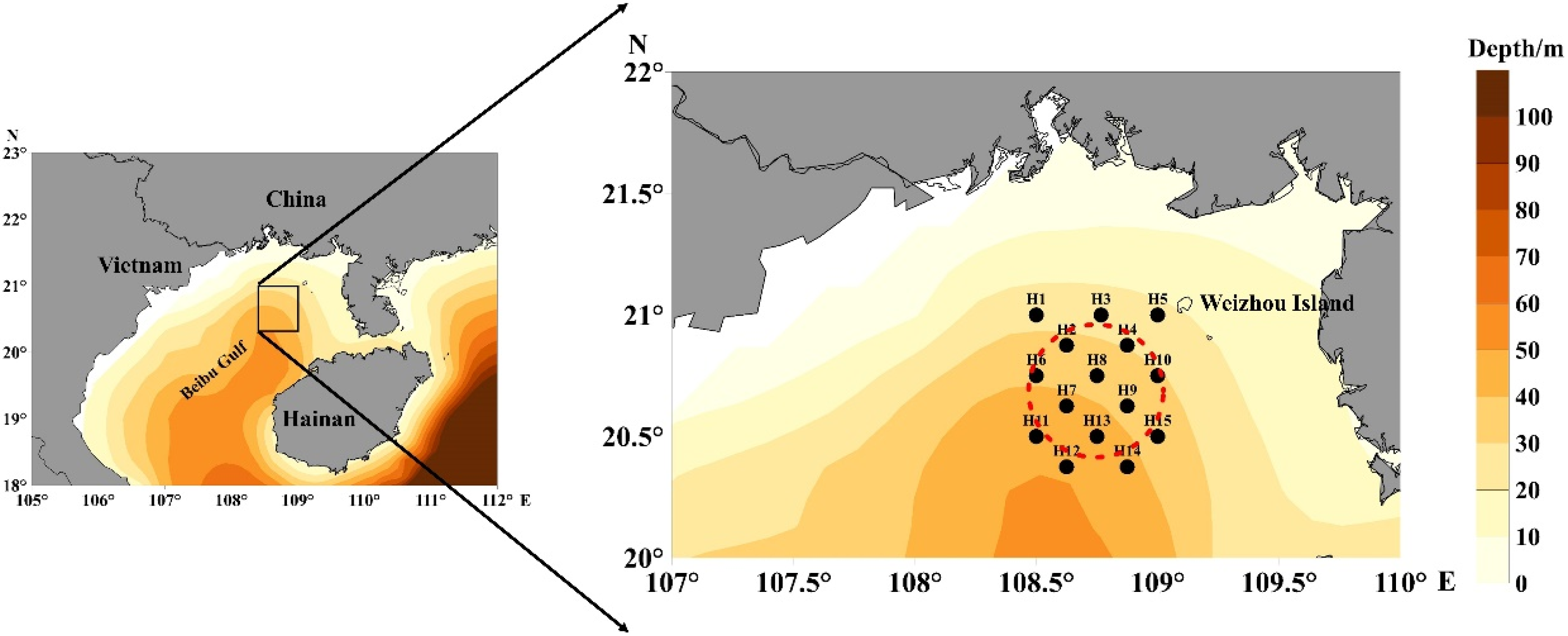
Data for this study were collected from four bottom trawl surveys conducted in April and October of 2023 and 2024 in the waters southwest of Weizhou Island in the Beibu Gulf. Although the four consecutive surveys were all carried out in spring and autumn, there were specific differences in the environment and other conditions across different years. Therefore, it can not only provide a data foundation for the comparative analysis between different seasons in different years but also offer data support for the analysis of the impact of environmental changes. The survey spanned a longitudinal range from 108.5° E to 109° E and a latitudinal range from 20.375° N to 21° N, with 15 survey stations established per cruise (Figure 1). The surveyed area encompassed water depths between 20 and 50 m. This region includes the Weizhou Oilfield Cluster, the largest oil field group in the SCS, located within the Beibu Gulf Basin. Characterized by flat seabed topography and relatively shallow waters, the area presents distinctive marine environmental conditions.

2.2. Sampling Methods and Environmental Data

The survey vessel used for this investigation was the “Guibei Yu 12075,” measuring 23.08 m in length, with a beam of 5.4 m, a draft of 2.7 m, and a gross tonnage of 90 tons. The vessel was powered by a main engine with 162 kW. The trawl gear employed featured a codend width of 10 m, a trawl height of 5 m, and a codend mesh size of 40 mm. The average trawl speed at each station was 3 knots per hour, and each trawl lasted for one hour. The calculation of trawl time commences from the instant when the net makes contact with the seabed and concludes when the net begins to be hauled in. Operations were conducted exclusively during daylight. Catches were subjected to species identification on board, and both the biomass and the number of individuals for each species at each station were recorded.
After each trawl operation, we measured salinity, temperature, and dissolved oxygen at each station using the YSI5908 MEMBRANEKIT-12.5 MILPE. The vessel’s onboard depth sounder determined the depth. Chlorophyll-a concentration (Chla) was analyzed by filtering 1 L of seawater through precombusted Whatman GF/F filters (47 mm diameter) produced in the UK. Filters were stored in the dark at −20 °C for 24 h before pigment extraction in 90% acetone. Chla was then quantified fluorometrically following the protocol of Yentsch and Menzel [18]. The equipment employed for the determination of Chla was the Turner Designs 10AU chlorophyll fluorescence meter. All of the aforementioned parameters were measured at both the surface and the bottom. Additionally, the study analyzed three water-quality parameters (COD, SS, and petroleum content) using the alkaline potassium permanganate method [19], the gravimetric method [20], and ultraviolet spectrophotometry [21], respectively.

2.3. Data Analyses

2.3.1. Dominant Species

The ecological dominance of fish species was calculated using the Index of Relative Importance (IRI) [22]:
IRI = (N + W) × F
where N and M are the percentages of abundance and biomass of a specific species relative to the total abundance and biomass of all species, respectively, and F is the frequency of occurrence of the given species. Species were considered dominant when IRI ≥ 1000, and important when 100 ≤ IRI < 1000 [9]. The higher the IRI value, the greater the relative importance of the species.

2.3.2. Diversity Indices

The analysis and measurement of nekton species diversity in the southwestern waters of Weizhou Island were conducted using several indices. These included the Margalef species richness index (D), the Shannon–Wiener diversity index (H’), and the Pielou evenness index (J) [23,24,25].
D = (S − 1)/ln(Q)
H’ = −∑PilnPi
J = H’/ln(S)
In the formula, S represents the total number of species, Q denotes the total number of individuals, and Pi indicates the proportion of the mass of the i-th species relative to the total mass of the sample. Owing to the substantial variation both among different species and within individuals of the same species in this survey, the species diversity index was calculated using catch mass. In addition, the sea area under investigation in this research contains a significant quantity of small fish. Employing mass calculation can also prevent statistical deviations arising from an excessive number of small fish. This method produces results that more accurately reflect the distribution of energy among species. In the food web, energy is typically transferred among different trophic levels in the form of biomass.

2.3.3. Abundance–Biomass Comparison (ABC) Method

The ABC curve is used to evaluate the disturbance status of a community by comparing the distribution patterns of biomass–dominance curves with abundance–dominance curves within the same coordinate system. When the biomass–dominance curve lies above the abundance–dominance curve, the community is stable. If the two curves intersect, the community has experienced moderate disturbance. Conversely, when the abundance–dominance curve is above the biomass–dominance curve, the community has undergone severe disturbance [26]. The W statistic within the curve represents the standardized sum of the area between the biomass curve and the quantity curve. A positive W value suggests that the biomass curve lies above the quantity curve, which corresponds to an undisturbed state. A W value approaching zero implies that the two curves are in close proximity or intersect, corresponding to a moderately disturbed state. A negative W value indicates that the quantity curve is positioned above the biomass curve, corresponding to a severely disturbed state [26]. Moreover, the fundamental principle of this curve is founded on the r-selection and k-selection theory in ecology. To put it simply, k-strategists are generally large-sized individuals with long life cycles (e.g., most large fish), whereas r-strategists are small-sized individuals that reproduce rapidly (e.g., small bait fish). In a stable environment, the community is predominantly composed of k-strategists, with biomass being the dominant factor. In a disturbed environment, r-strategists will reproduce in large quantities and dominate in terms of quantity [26].

2.3.4. Analysis of Community Structure

To reduce the influence of rare species on analyzing community structural similarity, species with a weight proportion below 0.01% were excluded from this study [27]. A total of 121 species were retained for analysis, with detailed lists and serial numbers provided in Table S1. The Bray–Curtis similarity coefficient matrix was calculated using the species mass-stock density as the original matrix after a square-root transformation. The linkage method employs group average linking. To guarantee the consistency of information with the non-metric multidimensional scaling (NMDS), which is based on rank similarity, group average clustering is applied to the rank similarity matrix in this study. Hierarchical cluster analysis and NMDS were then conducted to explore structural variation characteristics of the nekton community in the southwestern waters of Weizhou Island [28]. One-way ANOSIM (Analysis of Similarities) was employed to test for significant differences in fish species composition among groups. SIMPER (Similarity Percentage Analysis) analysis identified divergent species contributing to differences in community structure between distinct assemblages.
The quality of NMDS analysis results was evaluated using the stress coefficient. A NMDS two-dimensional scatter plot is considered reasonably reliable for community classification when the stress coefficient is between 0.10 and 0.20. When the coefficient is between 0.05 and 0.10, it offers good ordering, indicating a more scientifically valid community classification. A stress coefficient below 0.05 signifies excellent representation in community partitioning [28]. All analyses employed Primer 5.0 software.

2.3.5. The Relationship Between Communities and Environmental Factors

To analyze the relationship between fish community structure and environmental factors, we utilized CANOCO 5.0 software. Based on detrended correspondence analysis (DCA), it is determined whether to choose the linear model (RDA) or the unimodal model (Canonical correspondence analysis, CCA). If the maximum gradient length of the ordination axis exceeds 4, CCA should be selected; if it is less than 3, RDA should be chosen; if it falls between 3 and 4, either of the two analytical methods can be employed [29]. The environmental factors examined in this study include water depth, temperature, salinity, dissolved oxygen (DO), chlorophyll-a (Chla), COD, suspended solids (SS), and petroleum hydrocarbons. As the nekton data were collected through bottom trawl surveys, we used bottom-layer measurements for temperature, salinity, DO, and Chla (Table S2). The other three factors employed are surface measurement results. The seasonal variations in each environmental factor are presented in detail in Figures S1–S7. In addition, both the resource abundance and environmental data in this study were subjected to log-transformation.

3. Results

3.1. Species Composition and Dominant Species

During the 2023–2024 survey period, a total of 250 nekton species were collected from four cruises in the southwestern waters of Weizhou Island. These species spanned 19 orders, 91 families, and 156 genera. The species counts for the individual cruises starting from April 2023 were 116, 175, 111, and 149, respectively. Notably, the autumn cruises recorded a obviously higher number of species compared to the spring cruises. Across all cruises, the order Perciformes represented the highest number of collected species, followed by Decapoda (Table 1).
An extensive analysis of species composition for each survey voyage reveals that the dominant species in spring 2023 was Parargyrops edita. In autumn 2023, the dominant species included Metapenaeopsis barbata, Brachypleura novaezeelandiae, and Leiognathus brevirostris. By spring 2024, the dominant species were Loligo edulis, Parargyrops edita, Saurida tumbil, and Metapenaeopsis barbata. In autumn 2024, the primary dominant species were Parargyrops edita and Leiognathus ruconiu (Table 2).

3.2. Community Structure Stability

H’ in the spring of 2023 was notably lower than that in other seasons, indicating highly significant differences (p < 0.01). In contrast, no significant differences were detected among the other three seasons (p > 0.05) (Table 3 and Table S3). Both J and D demonstrated significant differences across seasons (p < 0.05) (Table 3 and Table S3). Regarding spatial distribution, all the indices in each season displayed evident spatial variations (p < 0.05) (Table S3). In spring 2023, the variation ranges for the indices H’, J, and D among stations were 0.58–2.68, 0.18–0.76, and 2.75–5.51, respectively, with average values of 1.84, 0.52, and 4.15. During autumn 2023, these indices ranged from 2.20–3.39, 0.52–0.83, and 3.83–6.34, respectively, with average values of 2.77, 0.71, and 5.11. In spring 2024, the fluctuation ranges among station indices were 1.96–3.03, 0.62–0.85, and 3.07–6.58, with average values of 2.55, 0.73, and 5.08. In autumn 2024, the variation ranges among indices were 2.30–3.11, 0.61–0.82, and 3.98–5.99, with average values of 2.81, 0.76, and 5.08.
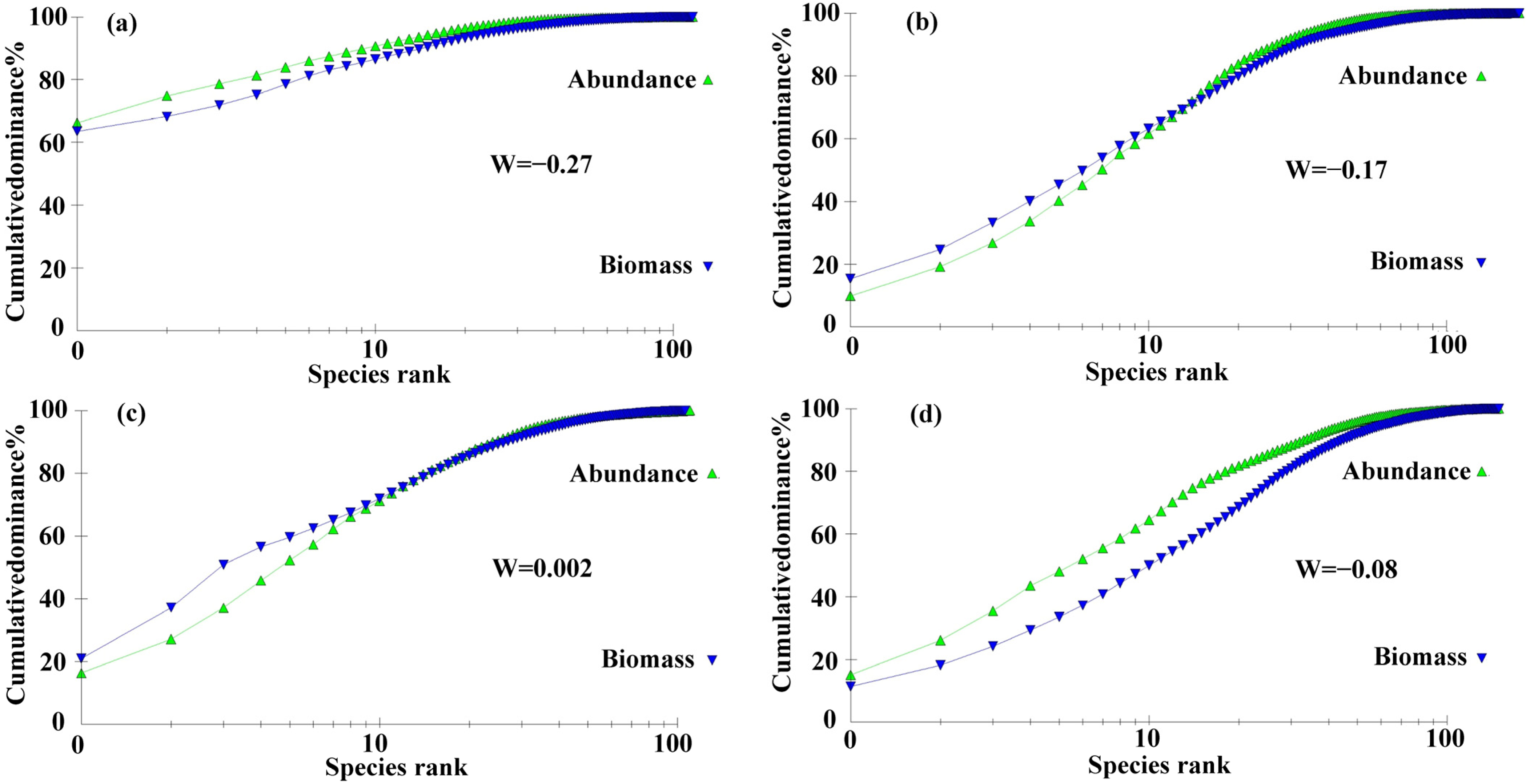
As depicted in Figure 2, the abundance curves for spring 2023 and autumn 2024 lie distinctly above the biomass curves. This indicates a high level of disturbance within the community, characterized by a higher proportion of small-sized individuals. In contrast, during autumn 2023 and spring 2024, the abundance and biomass curves intersect, suggesting the community experienced moderate disturbance. Overall, all communities in the southwestern waters of Weizhou Island have experienced some level of disturbance. r-selected individuals (smaller with rapid growth and early sexual maturity) dominate over k-selected individuals (larger with slow growth and late sexual maturity).

3.3. Community Structure Characteristics

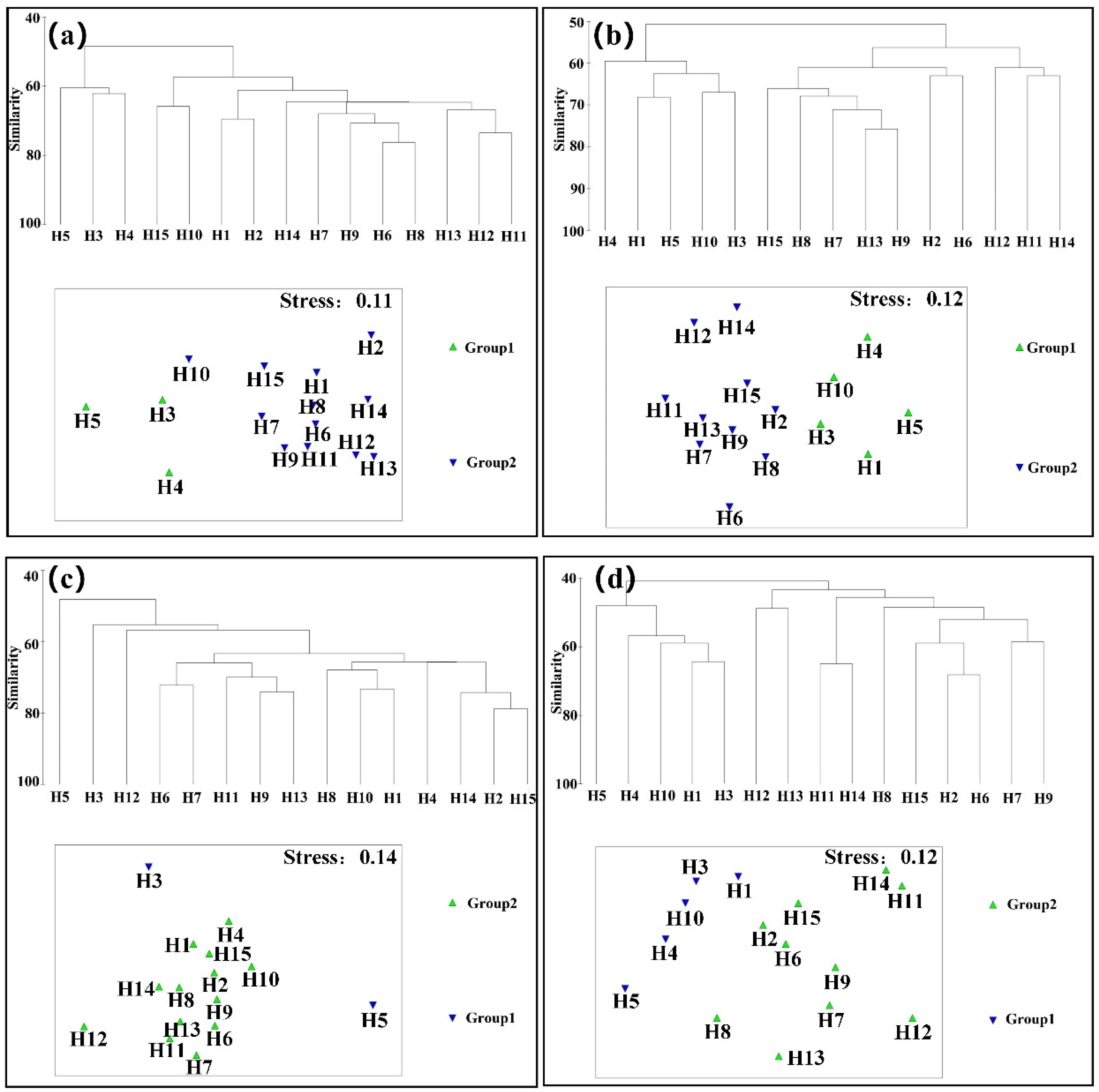
Cluster analysis and NMDS ordination, based on the composition of each site type, are depicted in Figure 3. The NMDS stress coefficient ranged from 0.11 to 0.14, suggesting that the two-dimensional NMDS plot holds interpretive significance. According to the cluster analysis and NMDS results, the survey stations from spring and autumn of 2023–2024 separate into two distinct groups. Figure 3 lists the stations included in each group. The spatial distribution of these clusters across different seasons exhibits patchy patterns. Group I comprises stations located in shallow waters (less than 30 m deep) southwest of Weizhou Island, primarily at stations H3, H4, and H5. Group II mainly includes stations in deeper waters of the southwest Weizhou Island area: H6, H7, H8, H9, H11, H12, H13, H14, and H15. ANOSIM revealed extremely significant differences in species composition between different station groups across seasons (Spring 2023: R = 0.83, p < 0.01; Autumn 2023: R = 0.71, p < 0.01; Spring 2024: R = 0.83, p < 0.01; Autumn 2024: R = 0.48, p < 0.01), thus validating this classification scheme (Table 4).
SIMPER analyses were conducted for each survey season. In spring 2023, the intragroup similarities for Group I and Group II were 45.16% and 53.03%, respectively, with an intergroup dissimilarity of 74.99%. Twenty nekton species contributed over 90% to the cumulative intergroup dissimilarity between Group I and Group II. The key indicator species were Parargyrops edita, Metapenaeopsis barbata, Loligo edulis, Harpiosquilla harpax, and Saurida tumbil. During autumn 2023, intragroup similarity values for Group I and Group II were 38.24% and 46.87%, respectively, and the intergroup dissimilarity was 70.50%. Thirty-three nekton species accounted for over 90% of the cumulative intergroup dissimilarity. Important indicator species included Oxyurichthys auchenolepis, Metapenaeopsis barbata, Ilisha indica, Charybdis truncata, and various Gobiidae species. In spring 2024, intragroup similarities for Group I and Group II were 56.01% and 32.08%, whereas the intergroup dissimilarity was 53.34%. Twenty-eight nekton species comprised over 90% of this dissimilarity. Key indicator species included Parargyrops edita, Loligo edulis, snake mullet species, Leiognathus berbis, and Leiognathus ruconius. Finally, in autumn 2024, intragroup similarities for Group I and Group II were 34.51% and 33.04%, with an intergroup dissimilarity of 78.79%. Forty-two nekton species contributed to over 90% of this dissimilarity, with key indicator species being Parargyrops edita, Harpiosquilla harpax, Carangoides kalla, Decapterus maruadsi, Siganus fuscescens, Clupanodon punctatus, and Saurida tumbil.

3.4. Relationship Between Community Structure and Environmental Factors

During the 2023–2024 survey period, the DCA results indicated that the lengths of all four axes remained below 3 throughout each season. The cumulative explanatory power of these axes was 38.50%, 36.04%, 34.35%, and 36.21%, respectively. Correlations between species and ordination axes ranged from 0.67 to 0.90 (Table S4). The parameters of the nekton community in the southwestern waters of Weizhou Island exhibited linear responses to environmental factors. This behavior suggests that using RDA to analyze community structure and environmental factors is appropriate.
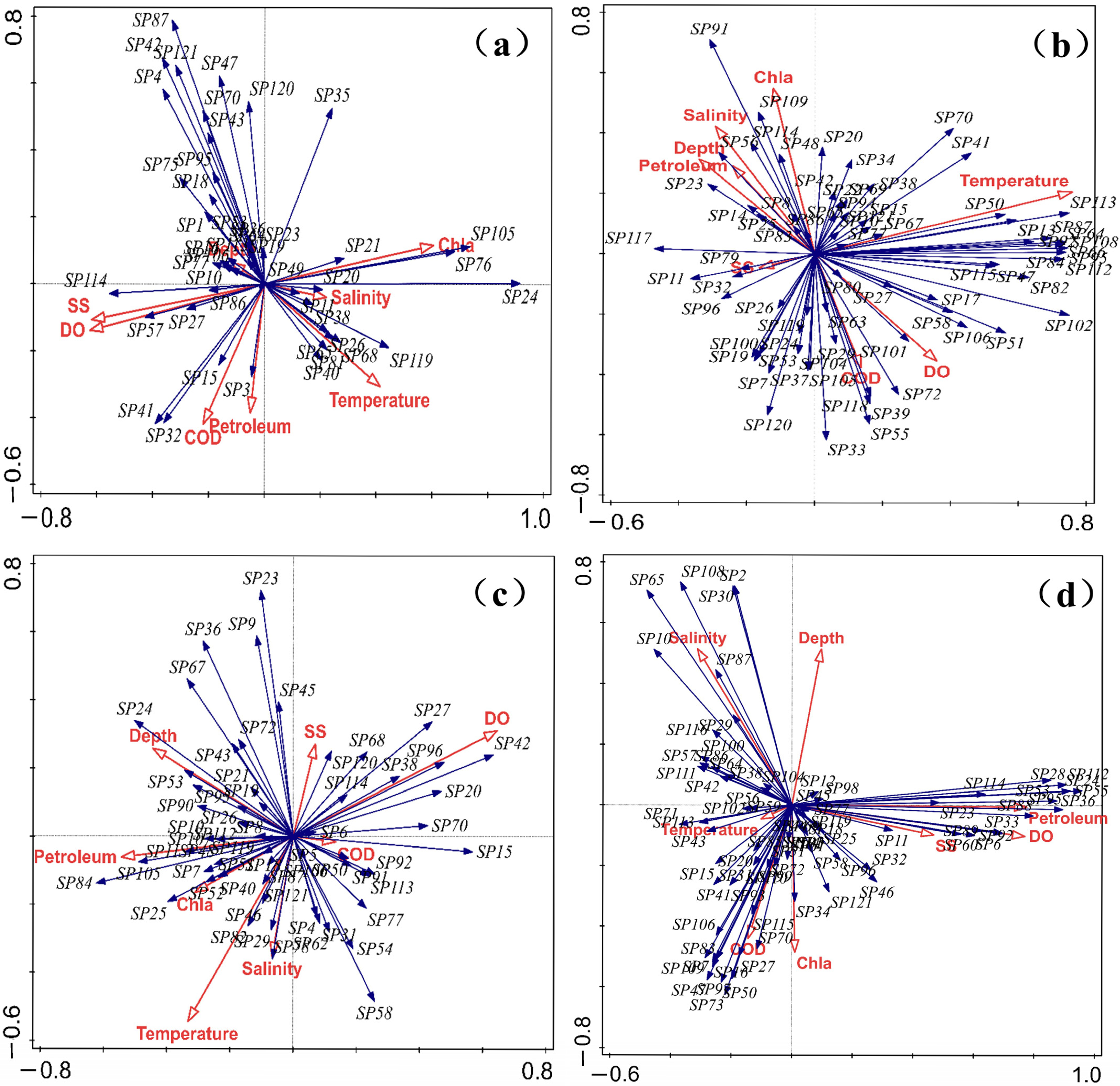
In the RDA for spring 2023 (Table S5), the cumulative explanatory power of the first and second principal component axes was 81.85% and 82.39%, respectively. Species and environmental variables showed correlations of 92% and 83% with these axes. The RDA ordination plot of spring 2023 communities against environmental factors (Figure 4a) demonstrated that the most significant environmental factors affecting community structure were chlorophyll-a (Chla) (F = 6.2, p = 0.036), dissolved oxygen (DO) (F = 7.6, p = 0.038), and suspended solids (SS) (F = 5.8, p = 0.028). All three factors were strongly positive correlated with the first axis. Chla exhibits a significant positive correlation with the distribution of Parargyrops edita, Nemipterus bathybius, and Nemipterus marginatus. In contrast, DO and SS demonstrate a significant negative correlation with the distribution of Loligo chinensis, Harpodon nehereus, and Muraenesox cinereus. Temperature, COD, and petroleum had stronger correlations with the second axis, indicating negative relationships with the distribution of Loligo edulis, Leiognathus berbis, and Gastrophysus spadiceus.
For autumn 2023 (Figure 4b), the first axis accounted for 48.85% of the variance, with the first two axes cumulatively accounting for 52.73%. Species and environmental variables correlated with the first two axes at 76% and 78%, respectively. Temperature was the most notable environmental factor influencing community structure during this season (F = 5.2, p = 0.042), showing a strong correlation with the first axis. It also demonstrated positive relationships with small, low-value species such as Charybdis truncata, Leiognathus berbis, Scalopidia spinosipes, Chaeturichthys stigmatias, Metapenaeopsis barbata, Oratosquilla nepa, and Trachypenaeus longipes.
In spring 2024 (Figure 4c), DO, temperature, and depth had the highest explanatory power for dominant species, accounting for 11.60%, 9.10%, and 7.90% of the variance, respectively. However, the influence of each factor on community structure was not statistically significant. DO was positively correlated with species such as Loligo edulis, Loligo chinensis, Leiognathus bindus, and Lepidotrigla alata, while water depth was positively associated with the distribution of key economic species like Parargyrops edita, Argyrosomus aneus, and Decapterus maruadsi.
During the fall of 2024 (Figure 4d), the first axis accounted for 33.40% of the variance, with the first two axes cumulatively accounting for 45.58%. The cumulative correlation coefficients between species and environmental variables were 98.02% and 96.74%, respectively. Petroleum was the most significant environmental factor affecting community structure during this season (F = 3.5, p = 0.012), closely positively correlated with the first axis. It significantly influenced the distribution of species such as Parargyrops edita, Saurida tumbil, Saurida undosquamis, Decapterus maruadsi, Metapenaeopsis barbata, Trachypenaeus longipes, and Loligo chinensis. Additionally, Chla and salinity correlated with the second axis, affecting the distribution of Carangoides malam, Leiognathus berbis, Harpiosquilla harpax, Clupanodon punctatus, and Oratosquilla nepa.

4. Discussion

4.1. Structural Characteristics of Nekton Communities

The Beibu Gulf’s exceptional water quality and abundant food resources create ideal conditions for marine organisms to spawn, grow, and reside, contributing markedly to the region’s biodiversity [30]. The literature suggests that approximately 500 fish species inhabit the Beibu Gulf [1]. In the 1960s, comprehensive fish surveys by China and Vietnam revealed that each country had over 400 fish species in the Gulf [3]. A subsequent survey from 1997 to 1999 identified 463 fish species [31], whereas Wang et al. [1] reported 323 species. Recent studies by Zhang et al. [6] and Luo et al. [32] along the northern coast of the Beibu Gulf indicate around 150 fish species. These discrepancies in species counts arise from variations in survey frequency, gear types, and regions over different periods. Our study documented a total of 250 species across four cruises, of which 177 were fish species; both numbers exceeded the findings of Zhang et al. [6] and Luo et al. [32] for the northern coast. Habitat diversity and scale significantly influence fish species richness, as high-quality habitats enhance fish survival rates. Furthermore, the latitude of the marine area affects species abundance [33]. It is well-established that lower latitudes, paired with consistently higher water temperatures, lead to greater biodiversity. Additionally, complex substrates and ecological environments provide diverse habitat conditions, supporting a wider range of organisms [33].
The dominant species in the Beibu Gulf have undergone substantial changes due to factors such as fishing pressure and climate change [1,8,34]. In the 1950s and 1960s, economically valuable fish like threadfin bream and trumpetfish prevailed. By the 1990s, the dominant species had shifted to white croaker, Priacanthus macracanthus, and Acropoma japonicum. Since the 21st century, Parargyrops edita, Trachurus japonicus, and white croaker have become more prevalent [1,34,35]. Dominant species play crucial roles in marine ecosystems and are essential for maintaining ecosystem stability and supporting sustainable fisheries development [36]. During the 2023–2024 survey seasons, the numbers of dominant species recorded were 1, 4, 3, and 2, respectively. Among these, Parargyrops edita and Metapenaeopsis barbata were consistently dominant across multiple seasons. Compared to historical data, there has been a shift from larger, high-value fish to smaller, lower-value species such as gobies and gobioids. Traditionally valuable species, characterized by long lifespans and slow growth, are particularly vulnerable to human activities. Once overexploited, they struggle to recover, allowing smaller species with high reproductive capacity and rapid growth to occupy their ecological niches [6]. Taking Parargyrops edita as an example, this species is of significant economic importance and is widely distributed in the Beibu Gulf. In recent years, it has continued to be one of the most important economic species in this sea area. Despite being subjected to intense fishing pressure for decades, its resources can still sustain a relatively high yield, which is closely associated with the current miniaturization of its population and the earlier onset of sexual maturity. Meanwhile, the fluctuation of its resources is readily influenced by factors such as climate and the environment [5,37]. Recent studies indicate a trend toward smaller body sizes and lower nutritional values among dominant species in coastal waters. Scheffer et al. [38] argue that fishing activities can rapidly alter fish community structures. The intensive exploitation of species at higher trophic levels, followed by continuous fishing of lower trophic levels, leads to significant changes in fish communities [9,32,39].

4.2. Stability of Nekton Communities

Diversity indices serve as crucial indicators for analyzing biocommunity structure and ecosystem stability [32]. These indices depend on species richness and abundance, which are influenced by human activities, environmental conditions, and the physiological processes of the organisms themselves [40]. In this study, the diversity indices H’ for the four cruises were 1.84, 2.77, 2.65, and 2.81, respectively. Except for the spring 2023 cruise, these indices exceeded the 2.32 figure reported by Zhang et al. [6] for the Beibu Gulf coast. However, our findings indicate that the diversity indices for the Beibu Gulf fish community are lower than those recorded in the 1990s (3.50) and in 2007 (3.31) [34,41]. Historical trends in Beibu Gulf fishery resources reveal that from the establishment of the People’s Republic of China until the late 1990s, coastal fishery resources experienced a significant decline due to increased fishing capacity. By 1999, the implementation of policies such as the fishing moratorium led to a slight recovery in resource levels, though they remained relatively low. Consequently, the diversity index initially declined and then showed a slight improvement [35]. Research by Su et al. [9], examining the H’ index for spring and autumn in the Beibu Gulf from 1998 to 2019, showed an upward trend; however, overall values remained below 3.
Within fishery biological communities, distinct species exhibit various life-history strategies and respond differently to environmental disturbances. In 1986, Warwick introduced the ABC curve as a tool for assessing community stability [26]. The ABC curves derived from four cruises in the southwestern waters of Weizhou Island reveal marked seasonal variations in the nekton community. This variability may be attributed to factors such as migration patterns of different organisms, fishing pressure, and environmental changes [42]. Although the ABC curve characteristics differed across seasons, the community’s stability was disrupted to various extents. In spring 2023 and autumn 2024, the abundance–dominance curve clearly exceeds the biomass–dominance curve, indicating a high level of disturbance. In contrast, during autumn 2023 and spring 2024, the two curves intersected. Notably, the W statistic for spring 2024 was positive, suggesting the community experienced the lowest level of disturbance in that season. Analyzing the composition of dominant species revealed that the number of dominant species was higher in autumn 2023 and spring 2024 compared to the other two seasons. Species like the longspine seabream were prominent in spring 2023 and autumn 2024, with a relatively simple composition of dominant species. Generally, communities experiencing lower disturbance levels tend to have a richer species composition, which supports community stability [42]. The ABC curve is based on the traditional evolutionary theory of r-selection and K-selection. When community structure is stable, it reflects the primary composition. As disturbance levels rise, k-selected species (slow-growing, late-maturing, large-bodied species) decline, while r-selected species (fast-growing, early-maturing, small-bodied species) increase [43]. Compared with studies by Luo et al. [32] on the coastal waters of the Beibu Gulf and those by Niu et al. [44] on the China–Vietnam joint fishing zone in the Beibu Gulf, the fish community structure in both areas exhibits evidence of disturbances to varying degrees. Based on these studies, it is clear that in the Beibu Gulf waters, particularly in the southwestern waters of Weizhou Island, r-selected species currently dominate. Due to decades of overfishing and other factors (i.e., environmental changes, marine pollution and habitat degradation), traditional large-sized commercial species have significantly depleted [1,9,34]. Presently, the resource base mainly comprises small-sized commercial species and low-value species [1,6,9].

4.3. Relationship Between the Community Structure of Nekton and Environmental Factors

The delineation of fishery biocommunities is influenced by both their life habits and marine environmental factors [1,39]. From 2023 to 2024, the nekton communities in the southwestern waters of Weizhou Island were divided into two distinct groups. Key species contributing to intergroup dissimilarity included Parargyrops edita, Metapenaeopsis barbata, Gobiidae, Leiognathidae, and Loliginidae. Both typical and divergent species in seasonal community divisions exhibited a degree of interactivity. These species, which significantly contribute to intragroup similarity and intergroup dissimilarity, were predominantly dominant in the surveyed areas. This finding aligns with Zhang et al. [6], who studied fish community divisions along the Beibu Gulf coast. It highlights that dominant fish species occupy the primary ecological niche, with key community structure characteristics closely linked to them. Seasonal variations in environmental factors directly or indirectly impact nekton’s life activities, such as feeding, growth, and spawning [45].
Results from RDA indicate that notable factors affecting nekton community structure varied across different cruises. Overall, water depth, temperature, dissolved oxygen (DO), and chlorophyll-a (Chla) were the primary environmental factors influencing these communities. Qiu [46] identified water depth as the primary factor affecting changes in fish community structure on the northern continental shelf of the SCS, with distinct water depths associated with varied environmental conditions impacting fish distribution. Thus, different water systems and depths serve as habitats for various species, forming distinct communities. It is the accompanying environmental factors, such as temperature and salinity, rather than water depth itself, that lead to community changes [46].
Water temperature also significantly affects the distribution of nearshore fish species in the Beibu Gulf [6]. It directly impacts fish growth and development [47]. Located in a subtropical region, the Beibu Gulf predominantly features warm-temperate and warm-water fish species, with water temperature being the primary influence on their distribution [1,39]. In this study, water temperature showed a significant correlation with the distribution of small species like Leiognathidae, Charybdis and gobies. DO and Chla were crucial factors influencing species distribution, as research suggests a relationship between prey abundance and dissolved oxygen content [48]. Hu et al. [49] found that as zooplankton abundance in marine waters increases, dissolved oxygen levels tend to decline, prompting benthic fish to increase tolerance to low oxygen levels to secure food.
Chla is a key indicator of phytoplankton abundance near the sea surface and is vital for primary productivity [50]. Chlorophyll concentrations can affect the distribution of large zooplankton, small fish, and crustaceans, which are prey for many fish species [47]. The SCS, known for low primary productivity, shows resource abundance and distribution patterns significantly influenced by this factor [5,51]. Li et al. [8] reported notable changes in the fish community structure of the Beibu Gulf before and after La Niña events, mainly due to altered sea surface temperatures and primary productivity, which led to species succession. In this study, RDA demonstrated significant correlations between DO, Chla, and species such as Parargyrops edita, golden threadfish, and spear squid.
This study selected SS and petroleum hydrocarbons as water-quality parameters for correlation analysis. During specific survey seasons, both factors showed correlations with the distribution of nekton. Notably, during the autumn cruise in 2024, petroleum hydrocarbons emerged as the most influential factor affecting community structure. Research indicates that when concentrations of petroleum hydrocarbons and suspended solids in seawater exceed certain thresholds, they can significantly impact marine organisms, such as phytoplankton, zooplankton, benthic organisms, and fish [15,17,52]. For species particularly sensitive to petroleum hydrocarbons, such pollution can alter biological behaviors, potentially leading to mortality, disrupting the original community structure, and undermining ecological balance [17]. However, in the present study, certain species exhibited positive responses to petroleum hydrocarbons and SS. Given that this research centered on community structure, variations in species-specific sensitivities to these factors resulted in distinctly different directions of influence. Concurrently, investigations into community structure and species distribution in relation to environmental factors necessitate integration with multiple variables, which relies heavily on future in-depth research. Petroleum substances are transported and dispersed by wind, ocean currents, and tidal flows, and are removed from the ocean through physical, chemical, biological, and sedimentary processes [53]. As for suspended solids, nekton exhibits strong motility, which allows for impacts to be managed within acceptable limits through appropriate measures. After the completion of offshore oil and gas development projects, the concentration of suspended solids in the affected sea area quickly declines and is gradually restored to natural levels [54]. Therefore, effective protective measures are essential during the development and construction of offshore oil and gas projects to mitigate or eliminate their impacts on water quality and the ecological environment.

5. Conclusions

Between 2023 and 2024, four cruises were conducted to survey nekton in the primary oil and gas development area of the Beibu Gulf, specifically in the waters southwest of Weizhou Island. Researchers collected 250 pelagic fauna species, representing 19 orders, 91 families, and 156 genera. Analyses of species composition and dominant species indicated a trend toward smaller-sized pelagic fauna in this region, accompanied by a notable succession of dominant species, primarily benthic or demersal fishes. The biodiversity indices were lower than those recorded in previous surveys, yet slightly higher than those observed in the coastal waters of the Beibu Gulf. Community stability was also disrupted to varying extents, with r-selected species occupying dominant ecological niches. Hierarchical cluster analysis and NMDS revealed distinct spatial regionalism in nekton distribution. Furthermore, community structure was substantially influenced by environmental variables such as water depth, temperature, dissolved oxygen (DO), and Chla. In certain survey seasons, strong correlations emerged between suspended solids (SS), petroleum presence, and species distribution. Consequently, a suite of protective measures should be implemented during offshore oil and gas development to prevent severe degradation of water quality and marine ecosystem health.

Supplementary Materials

The following supporting information can be downloaded at: https://www.mdpi.com/article/10.3390/d18030168/s1, Figure S1: Temperature variations across each survey season; Figure S2: Salinity variations across each survey season; Figure S3: Dissolved oxygen (DO) variations across each survey season; Figure S4: Chlorophyll a concentration (Chla) variations across each survey season; Figure S5: Chemical oxygen demand (COD) variations across each survey season; Figure S6: Suspended solids (SS) variations across each survey season; Figure S7: Petroleum variations across each survey season; Table S1: Main species composition and their designations; Table S2: Correlation of environmental factors in each season. * denotes p < 0.05. ** denotes p < 0.01.; Table S3: Distribution characteristics of biodiversity throughout survey cruises; Table S4: Detrended correspondence analysis (DCA) of nekton communities in the Southwestern Waters of Weizhou Island from 2023 to 2024; Table S5: Redundancy analysis (RDA) of nekton communities in the Southwestern Waters of Weizhou Island from 2023 to 2024.

Author Contributions

Conceptualization, Z.Z., L.W. and D.S.; data curation, L.W. and C.Y.; formal analysis, L.W., C.Y. and B.S.; funding acquisition, Z.Z. and D.S.; investigation, P.G., C.Y., Y.L. and B.S.; methodology, L.W.; project administration, Z.Z. and D.S.; resources, P.G., C.Y. and B.S.; software, L.W. and B.S.; supervision, C.Y. and D.S.; validation, Z.Z. and L.W.; visualization, D.S.; writing—original draft preparation, Z.Z. and L.W.; writing—review and editing, Z.Z. and L.W. All authors have read and agreed to the published version of the manuscript.

Funding

This work was partially supported by Science & Technology Fundamental Resources Investigation Program (Grant No. 2023FY100803), the Hainan Provincial Natural Science Foundation of China under contract No. 324QN367, biodiversity, germplasm resources bank and information database construction of the South China Sea Project (NO. HNDW2020-112).

Institutional Review Board Statement

Not applicable.

Data Availability Statement

The original contributions presented in this study are included in the article. Further inquiries can be directed to the corresponding author.

Acknowledgments

We are grateful to the entire crew of the Guibeiyu 12075 for their invaluable assistance in facilitating data collection.

Conflicts of Interest

The authors declare no conflicts of interest. The funders had no role in the design of the study; in the collection, analysis, or interpretation of the data; in the writing of the manuscript; or in the decision to publish the results.

References

  1. Wang, X.H.; Qiu, Y.S.; Du, F.Y.; Lin, Z.J.; Sun, D.R.; Huang, S.L. Fish community pattern and its relation to environmental factors in the Beibu Gulf. J. Fish. China 2010, 34, 1579–1586. [Google Scholar] [CrossRef]
  2. Fu, X.L. Distribution of Fish Populations and Structure of Fish Communities in the Coastal Waters of Northwest Beibu Gulf and Their Influential Factors; Shanghai Ocean University: Shanghai, China, 2018. [Google Scholar]
  3. Sun, D.R.; Lin, Z.J. Variations of major commercial fish stocks and strategies for fishery management in Beibu Gulf. J. Trop. Oceanogr. 2004, 23, 62–68. [Google Scholar]
  4. Han, L.J.; Zheng, X.Q.; Lan, W.L.; Shi, X.F.; Li, T.S. Variations of nutrients concentration in surface seawater in adjacent area of Weizhou Island in recent 10 years. J. Appl. Oceanogr. 2015, 34, 65–72. [Google Scholar]
  5. Wang, L.M.; Yan, L.; Yang, C.P.; Shan, B.B.; Sun, D.R.; Qiu, Y.S. Response of the spatiotemporal distribution of crimson seabream (Paerargyrops edita) to La Niña event in the northern Beibu Gulf, South China Sea. Glob. Ecol. Conserv. 2024, 54, e03076. [Google Scholar] [CrossRef]
  6. Zhang, G.J.; Yang, C.P.; Sun, D.R.; Liu, Y.; Shan, B.B.; Zhao, Y.; Zhou, W.L. Seasonal variation of fish community in north central region of Beibu Gulf. J. South. Agric. 2021, 52, 2861–2871. [Google Scholar]
  7. Zhang, K.; Li, M.; Li, J.J.; Sun, M.S.; Xu, Y.W.; Cai, Y.C.; Chen, Z.Z.; Qiu, Y.S. Climate-induced small pelagic fish blooms in an overexploited marine ecosystem of the South China Sea. Ecol. Indic. 2022, 145, 109598. [Google Scholar] [CrossRef]
  8. Li, M.; Xu, Y.W.; Sun, M.S.; Fan, J.T.; Li, J.J.; Zhang, K.; Chen, Z.Z. Variation in fish community structure in Beibu Gulf before and after La Niña event. South China Fish. Sci. 2023, 19, 1–11. [Google Scholar]
  9. Su, L.; Zhang, K.; Xu, Y.; Chen, Z. Variations in the fish community of the Beibu Gulf (South China Sea) following fishery resources protection measures. Fish. Res. 2025, 283, 107293. [Google Scholar] [CrossRef]
  10. Zscheischler, J.; Martius, O.; Westra, S.; Bevacqua, E.; Raymond, C.; Horton, R.M.; van den Hurk, B.; AghaKouchak, A.; Jezequel, A.; Mahecha, M.D.; et al. A typology of compound weather and climate events. Nat. Rev. Earth Environ. 2020, 1, 333–347. [Google Scholar] [CrossRef]
  11. Hong, X.; Zhang, K.; Li, J.; Xu, Y.; Sun, M.; Wang, Y.; Xu, S.; Cai, Y.; Qiu, Y.; Chen, Z. Effects of climate events on abundance and distribution of major commercial fishes in the Beibu Gulf, South China Sea. Diversity 2023, 15, 649. [Google Scholar] [CrossRef]
  12. Boyce, D.G.; Tittensor, D.P.; Garilao, C.; Henson, S.; Kaschner, K.; Kesner-Reyes, K.; Pigot, A.; Reyes, R.B., Jr.; Reygondeau, G.; Schleit, K.E.; et al. A climate risk index for marine life. Nat. Clim. Change 2022, 12, 854–862. [Google Scholar] [CrossRef]
  13. Daly, J.; Knott, C.; Keogh, P.; Singh, G.G. Changing climates in a blue economy: Assessing the climate-responsiveness of Canadian fisheries and oceans policy. Mar. Policy 2021, 131, 104623. [Google Scholar] [CrossRef]
  14. He, G.F.; Yuan, G.M.; Lin, D.; Cai, W.X.; Lei, F.H. Influence of oil-field exploitation on marine environment: A case study of Weizhou oilfield. Mar. Environ. Sci. 2009, 28, 84–87. [Google Scholar]
  15. Song, L.; Yang, G.J.; Wang, N.B.; Li, Y.; Wang, Z.H.; Zhao, H.B. Effects of suspended matter on marine bio-ecology. Fish. Sci. 2012, 31, 444–448. [Google Scholar]
  16. Breuer, E.; Shimmield, G.; Peppe, O. Assessment of metal concentrations found within a North Sea drill cuttings pile. Mar. Pollut. Bull. 2008, 56, 1310–1322. [Google Scholar] [CrossRef]
  17. She, R. Damage Assessment of Marine Ecological Environment Caused by Offshore Oil and Gas Development Engineering: A Case Study on Produced Water Discharge from Weizhou Oilfield; Wuhan University Technology: Wuhan, China, 2018. [Google Scholar]
  18. Yentsch, C.S.; Menzel, D.W. A method for the determination of phytoplankton chlorophyll and phaeophytin by fluorescence. Deep Sea Res. Oceanogr. Abstr. 1963, 10, 221–231. [Google Scholar] [CrossRef]
  19. Czae, M.Z.; Ly, S.Y.; Kim, M.K. Chemical Oxygen Demand based on Spectrophotometric Measurement of Permanganate. J. Korean Chem. Soc. 1994, 38, 878–882. [Google Scholar]
  20. Cao, L.; Qin, X.M.; Zhang, Q.Y. Evaluation of the uncertainty of concentration of suspended solids in sewage samples by gravimetric method. Ind. Water Treat. 2014, 34, 79–81. [Google Scholar]
  21. Winkler, I.; Agapova, N. Determination of water pollution by the oil products through UV photometry. Environ. Monit. Assess. 2010, 168, 115–119. [Google Scholar] [CrossRef] [PubMed]
  22. Pinkas, L.; Oliphant, M.S.; Iverson, L.K. Food habits of albacore, bluefin tuna, and bonito in California waters. Fish. Bull. 1971, 152, 1–105. [Google Scholar]
  23. Wilham, J.L. Use of biomass units in Shannon’s formula. Ecology 1968, 49, 153–156. [Google Scholar] [CrossRef]
  24. Ludwig, J.A.; Reynolds, J.F. Statistical Ecology; John Wiley & Sons: New York, NY, USA, 1988. [Google Scholar]
  25. Ma, K.P. Principles and Methods of Biodiversity Research; China Science and Technology Press: Beijing, China, 1994; pp. 134–145. [Google Scholar]
  26. Warwick, R.M. A new method for detecting pollution effects on marine macrobenthic communities. Mar. Biol. 1986, 92, 557–562. [Google Scholar] [CrossRef]
  27. Song, P.Q.; Lin, L.S.; Li, Y.; Zhong, Z.H. Spatial structure and seasonal changes of nekton assemblages in the Taiwan Strait. Acta Oceanol. Sin. 2016, 35, 59–67. [Google Scholar] [CrossRef]
  28. Clarke, K.R. Non-parametric multivariate analyses of changes in community structure. Austral Ecol. 1993, 18, 117–143. [Google Scholar] [CrossRef]
  29. Lepš, J.; Šmilauer, P. Multivariate Analysis of Ecological Data Using CANOCO; Cambridge University Press: Cambridge, UK, 2003. [Google Scholar]
  30. Qiu, Y.S.; Zeng, X.G.; Chen, T.; Yuan, W.W. Fishery Resources and Fisheries Management in the South China Sea; China Ocean Press: Beijing, China, 2008. [Google Scholar]
  31. Jia, X.P.; Li, C.H.; Qiu, Y.S.; Du, F.Y. Investigation, Assessment and Sustainable Utilization Countermeasures of Guangdong Marine Fishery Resources; China Ocean Press: Beijing, China, 2005; pp. 319–322. [Google Scholar]
  32. Luo, Z.L.; Yang, C.P.; Wang, L.M.; Liu, Y.; Shan, B.B.; Liu, M.T.; Sun, D.R. Spatial-temporal distribution and diversity variation of fish in the coastal waters of northern Beibu Gulf. J. South. Agric. 2023, 54, 1847–1857. [Google Scholar]
  33. Elliott, M.; Dewailly, F. The structure and components of European estuarine fish assemblages. Aquat. Ecol. 1995, 29, 397–417. [Google Scholar] [CrossRef]
  34. Wang, X.H.; Qiu, Y.S.; Du, F.Y.; Lin, Z.J.; Sun, D.R.; Huang, S.L. Dynamics of demersal fish species diversity and biomass of dominant species in autumn in the Beibu Gulf, northwestern South China Sea. Acta Ecol. Sin. 2012, 32, 333–342. [Google Scholar] [CrossRef]
  35. Prista, N.; Vasconcelos, R.P.; Costa, M.J.; Cabral, H. The demersal fish assemblage of the coastal area adjacent to the Tagus estuary (Portugal): Relationships with environmental conditions. Oceanol. Acta 2003, 26, 525–536. [Google Scholar] [CrossRef]
  36. Wang, L.M.; Li, Y.; Zhang, J.; Song, P.Q.; Zhang, R.; Zhang, L.; Lin, L.S. Studies on fish community structure in the southwestern waters of Nansha Islands. Period. Ocean Univ. China 2017, 47, 58–65. [Google Scholar]
  37. Chen, Z.Z.; Qiu, Y.S. Estimation of growth and mortality parameters of Parargyrops edita Tanaka in Beibu Bay. J. Fish. China 2003, 27, 251–257. [Google Scholar]
  38. Scheffer, M.; Carpenter, S.; Young, D.B. Cascading effects of overfishing marine systems. Trends Ecol. Evol. 2005, 20, 579–581. [Google Scholar] [CrossRef]
  39. Ma, J.J.; Chen, H.G.; Zhang, Z.; Tian, F.; Tang, Z.C.; Xiong, Q.; Zhang, L.B. Changes in fish community structure and its relationship with environmental factors in the Pearl River Estuary from 2018 to 2023. South China Fish. Sci. 2024, 20, 62–73. [Google Scholar]
  40. Tang, G.L.; Liu, Y.; Wu, P.; Sun, D.R.; Xiao, Y.Y.; Wang, T.; Xie, Y.; Li, C.; Shi, J.; Zhong, Z.; et al. Community structure of fishery resources and its relationship to environmental factors in the Wanshan Islands Sea of the Pearl River Estuary in spring. J. Fish. Sci. China 2022, 29, 1198–1209. [Google Scholar]
  41. Wang, X.H.; Qiu, Y.S.; Du, F.Y.; Lin, Z.J.; Sun, D.R.; Huang, S.L. Spatiotemporal variation of fish species diversity and dominant species in Beibu Gulf. J. Fish. Sci. China 2011, 18, 427–436. [Google Scholar]
  42. Song, P.Q.; Lin, L.S.; Li, Y.; Zhang, C.G.; Wang, L.M.; Wang, Y.B.; Luo, Z.L. Species composition and stability of nekton community structure of Sandu Bay, Fujian Province. Biodivers. Sci. 2015, 23, 519–526. [Google Scholar] [CrossRef]
  43. Li, S.F. Status of fish community in East China Sea using the method of abundance biomass comparison (ABC) curve. J. Fish. Sci. China 2008, 15, 136–144. [Google Scholar]
  44. Niu, Z.Y.; Xu, Y.H.; Wang, P.L.; Liao, Y.; Wu, H.; Huang, H.; Yu, M.; Xu, W.; Xu, S.; Lin, M.; et al. Survey of fisheries resources and biodiversity in China-Vietnam collective fishery zone in autumn by a bottom trawl. Fish. Sci. 2018, 37, 640–646. [Google Scholar]
  45. Zhang, H.S.; Song, P.Q.; Li, Y.; Liu, S.G.; Wang, X.H.; Zheng, J.S.; Lin, L.S. Diversity and community structure of nekton in the central and southern East China Sea in autumn. J. Appl. Oceanogr. 2021, 40, 575–586. [Google Scholar]
  46. Qiu, Y.S. The regional changes of fish community on the northern continental shelf of South China Sea. J. Fish. China 1988, 12, 303–313. [Google Scholar]
  47. Wang, L.M.; Yang, C.P.; Liu, Y.; Shan, B.B.; Ma, S.W.; Sun, D.R. Effects of biotic and abiotic factors on the spatiotemporal distribution of round scad (Decapterus maruadsi) in the Hainan Island offshore area. Diversity 2023, 15, 659. [Google Scholar] [CrossRef]
  48. Maes, J.; Stevens, M.; Breine, J. Modelling the migration opportunities of diadromous fish species along a gradient of dissolved oxygen concentration in a European estuary. Estuar. Coast. Shelf Sci. 2007, 75, 151–162. [Google Scholar] [CrossRef]
  49. Hu, C.L.; Zhang, H.L.; Zhang, Y.Z.; Pan, G.L.; Xu, K.D.; Bi, Y.X.; Liang, J.; Wang, H.X.; Zhou, Y.D. Fish community structure and its relationship with environmental factors in the Nature Reserve of Trichiurus japonicus. J. Fish. China 2018, 42, 694–703. [Google Scholar]
  50. Liu, K.K.; Chao, S.Y.; Shaw, P.T.; Gong, G.C.; Chen, C.C.; Tang, T.Y. Monsoon-forced chlorophyll distribution and primary production in the South China Sea: Observation and a numerical study. Deep Sea Res. Pt. I Oceanogr. Res. Pap. 2002, 49, 1387–1412. [Google Scholar] [CrossRef]
  51. Qiu, Y.; Lin, Z.; Wang, Y. Responses of fish production to fishing and climate variability in the northern South China Sea. Prog. Oceanogr. 2010, 85, 197–212. [Google Scholar] [CrossRef]
  52. Nikolopoulou, M.; Kalogerakis, N. Biostimulation strategies for fresh and chronically polluted marine environments with petroleum hydrocarbons. J. Chem. Technol. Biotechnol. 2009, 84, 802–807. [Google Scholar] [CrossRef]
  53. Hao, J.M. Research on Theoretical System of Strategic Environmental Assessment (SEA) and Its Practice in Bohai Oil Development; Tianjin University: Tianjin, China, 2003. [Google Scholar]
  54. Yu, D.T. Study on Suspended Matter Diffusion and Environmental Ecological Impact of Reclamation Engineering; Liaoning Normal University: Dalian, China, 2010. [Google Scholar]
Figure 1. Survey stations. The red dotted line represents the oilfield area.
Diversity 18 00168 g001
Figure 2. Nekton ABC curves for each survey season ((a): Spring 2023; (b): Autumn 2023; (c): Spring 2024; (d): Autumn 2024).
Diversity 18 00168 g002
Figure 3. Output of cluster analysis and NMDS on nekton community for each survey season ((a): Spring 2023; (b): Autumn 2023; (c): Spring 2024; (d): Autumn 2024).
Diversity 18 00168 g003
Figure 4. RDA of nekton communities and environmental factors across different survey seasons ((a): Spring 2023; (b): Autumn 2023; (c): Spring 2024; (d): Autumn 2024).
Diversity 18 00168 g004
Table 1. Composition of nekton in the southwestern waters of Weizhou Island, 2023–2024.
OrderFamilyGenusSpecies
Carcharhiniformes111
Orectolobiformes111
Siluriformes111
Gasterosteiformes111
Mugiliformes223
Myctophiformes111
Lophiformes111
Anguilliformes81012
Clupeiformes41019
Gadiformes111
Scorpaeniformes51215
Perciformes3660100
Pleuronectiformes5916
Tetraodontiformes255
Stomatopoda3711
Decapoda152746
Octopoda113
Teuthoidea124
Sepioidea249
Table 2. Variations in the dominant species.
Spring 2023Autumn2023Spring 2024Autumn2024
SpeciesIRISpeciesIRISpeciesIRISpeciesIRI
Parargyrops edita12977Metapenaeopsis barbata2306Loligo edulis3093Parargyrops edita1423
Brachypleura novaezeelandiae1600Parargyrops edita3035Leiognathus ruconiu1244
Leiognathus brevirostris1373Saurida tumbil2233
Metapenaeopsis barbata1394
Table 3. Variations in the diversity index.
Biodiversity IndexSeason
Spring 2023Autumn 2023Spring 2024Autumn 2024
H’1.842.772.552.81
J0.520.710.730.76
D4.155.115.085.08
Table 4. Output of SIMPER analysis in each seasonal group.
Spring
2023
SpeciesGroup I AS: (45.16%)Group II AS: (53.03%)Group I–Group II: AD (74.99%)
Metapenaeopsis barbata13.46 11.55
Loligo edulis12.771.646.66
Parargyrops edita4.2739.5524.07
Harpiosquilla harpax3.991.445.58
Gastrophysus spadiceus2.58 1.3
Argyrosomus aneus1.84 2.15
Saurida tumbil 2.612.91
Autumn
2023
SpeciesGroup I AS: (38.24%)Group II AS: (46.87%)Group I–Group II: AD (70.50%)
Oxyurichthys auchenolepis7.348.46
Brachypleura novaezeelandiae111.275.81
Metapenaeopsis barbata2.472.865.6
Ilisha indica3.01 3.96
Charybdis truncata5.290.823
Leiognathus bindus0.794.892.8
Leiognathus ruconius3.43 2.67
Leiognathus berbis5.695.352.4
Apogonichthys striatus1.281.72.39
Oxyurichthys tentacularis2.48 2.21
Apogonichthys lineatus0.650.852.15
Spring
2024
SpeciesGroup I AS: (56.01%)Group II AS: (32.08%)Group I–Group II: AD (53.54%)
Parargyrops edita10.13 9.76
Loligo edulis15.9220.334.37
Saurida tumbil9.872.734.12
Leiognathus berbis0.64 3.58
Leiognathus ruconius 3.2
Saurida undosquamis4.31 2.41
Metapenaeopsis barbata1.9 2.23
Trichiurus brevis1.532.552.13
Gastrophysus spadiceus0.792.21.52
Loligo chinensis1.051.941.08
Autumn
2024
SpeciesGroup I AS: (34.51%)Group II AS: (33.04%)Group I–Group II: AD (78.79%)
Parargyrops edita10.260.666.61
Harpiosquilla harpax1.539.445.94
Carangoides kalla2.180.634.36
Decapterus maruadsi2.33 3.5
Siganus fuscescens0.991.633.14
Clupanodon punctatus 3.05
Saurida tumbil3.37 3.04
Leiognathus ruconius1.37 2.74
Muraenesox cinereus 1.472.26
Metapenaeus affinis0.731.931.93
Leiognathus bindus0.62 1.77
Penaeus penicillatus 1.131.57
Gastrophysus spadiceus2.212.721.4
Note: AS. Average similarity; AD. Average dissimilarity.
Disclaimer/Publisher’s Note: The statements, opinions and data contained in all publications are solely those of the individual author(s) and contributor(s) and not of MDPI and/or the editor(s). MDPI and/or the editor(s) disclaim responsibility for any injury to people or property resulting from any ideas, methods, instructions or products referred to in the content.