Article

New Guests in the Romanian Fauna and Pathways for the Introduction of Alien Bush-Crickets and Grasshoppers (Insecta: Orthoptera)


by
Ionuț-Ștefan Iorgu
1,
Andrei Lobiuc
1,
Erica-Alexandra Ungurean
1,
Ioan Tăușan
2,*,
Alexandru Cazacu
3 and
Elena Iulia Iorgu
1
1
College of Medicine and Biological Sciences, “Ștefan cel Mare” University of Suceava, 13 Universității Street, 720229 Suceava, Romania
2
Biology and Ecology Research Center, Faculty of Sciences, “Lucian Blaga” University of Sibiu, 550024 Sibiu, Romania
3
Forestry Faculty, “Ștefan cel Mare” University of Suceava, 13 Universității Street, 720229 Suceava, Romania
*
Author to whom correspondence should be addressed.
Diversity 2026, 18(3), 167; https://doi.org/10.3390/d18030167
Submission received: 5 February 2026 / Revised: 3 March 2026 / Accepted: 5 March 2026 / Published: 9 March 2026

Abstract

Alien insect species are increasingly recognized as significant drivers of biodiversity change. This study documents the records of four alien orthopteran species in Romania: Meconema meridionale, Rhacocleis annulata, Yersinella raymondii and Anacridium aegyptium. Specimens were collected from various urban and peri-urban locations. The inferred pathways of introduction include accidental transport via ornamental plants, soil, and vehicles, reflecting broader European trends in anthropochorous dispersal. These findings suggest that such habitats provide suitable conditions for the settlement of non-native Orthoptera, providing a baseline for future monitoring. Our research fills a regional knowledge gap and contributes to the understanding of biological invasions in Eastern Europe, offering the necessary data for early detection and the development of future biosecurity assessments to evaluate potential ecological or economic risks.

1. Introduction

Overcoming natural biogeographical barriers, the species introduced to specific regions through human activity, whether deliberately or inadvertently, represent a significant factor in global biodiversity change and ecosystem disturbance [1]. The number of alien animal species is rapidly increasing worldwide, with biological invasions now recognized as a significant threat to native biodiversity, ecosystem services, and human well-being [1,2,3]. Certain alien species successfully establish themselves by regularly reproducing and forming self-sustaining populations. These invasive alien species are of particular concern in Europe, where transport and climate change accelerate their introduction and establishment [2,3,4].
Alien animal species have been introduced through various pathways, including intentional release, escape from captivity, stowaway transport and contamination of goods. Particularly, the increased intensity of trade of goods facilitates the wide dispersal of these species, leading to homogenization of the worldwide fauna and flora, with major consequences for native species and even human health and wealth [3,5,6]. The impacts of these introductions range from predation and competition to disease transmission and habitat alteration, often resulting in declines or extinctions of native species [2,7]. Genetic methods, especially DNA metabarcoding, are often employed in surveillance and early detection of invasive species [8,9], as well as identification of source populations and helping to reconstruct invasion pathways [10,11,12].
Even though invasive alien invertebrates can affect the environment, economy, and human well-being in various ways [13,14,15], these species received less attention compared to non-native vertebrates or plants, and their study and the awareness of potential economic impact only increased recently [16,17].
Insects represent one of the most species-rich and impactful groups of alien animals in Europe. The rate of insect introductions has accelerated in recent decades, driven by globalization and increased movement of goods and people. Their introduction pathways are diverse, with stowaway and contaminant routes being especially important for unintentional arrivals [3,18]. The establishment of alien insects is further facilitated by their adaptability, high reproductive rates and ability to exploit disturbed habitats [19,20].
The order Orthoptera consists of globally distributed insect species and their status as alien and potentially invasive species in Europe has been historically understudied. Recent research highlights a growing number of non-native Orthoptera species recorded in Europe, with at least 37 species documented, 23 of which are established in at least one European country outside their native range [21,22].
In Central Europe, the vast majority of the native orthopterans occur in grasslands, whereas the alien species, most of them being native to Southern Europe, have different habitat preferences and can quickly adapt to heavily modified, man-made habitats [16,23].
The genus Meconema Serville consists of two species, Meconema thalassinum (De Geer, 1773) and Meconema meridionale Costa, 1860 [24]. M. thalassinum is widely distributed in Europe and Asia Minor and was accidentally introduced in North America [25]. M. meridionale is one of the most studied alien orthopterans in Europe, and is currently confirmed to occur in all the Central and several Eastern European countries [26]. Bush-crickets of the genus Rhacocleis Fieber are primarily distributed in the Mediterranean region, with several species showing endemism to specific regions or islands. The genus includes 33 valid species, with several poorly known or newly described from Greece and the Balkans [27,28]. Recent records indicate that some species, especially R. annulata, are expected to expand their range in Europe, often due to human-mediated introductions. Currently, only two species of Yersinella Ramme are known: Yersinella beybienkoi La Greca, 1974 and Yersinella raymondii (Yersin, 1860), both native to the northern Mediterranean area. The latter is widespread from northeastern Spain, France, Switzerland, Italy, Slovenia, Croatia, Bosnia and Herzegovina, Albania, to western Greece, including the islands of Corsica, Sardinia and Sicily [24,29] and, outside its native range, the species was recently recorded in Austria [30], Germany [31] and Slovakia [21]. The genus Anacridium Uvarov comprises 13 species, widely distributed in Africa, Europe, western, southern and Central Asia, Southern America [24]. One of the largest European orthopterans, the Egyptian tree locust, Anacridium aegyptium (Linnaeus, 1764), inhabits Africa, Europe, Asia and South America. In Europe, the species is considered common in the warm and dry Mediterranean habitats, such as maquis scrubland and vineyards [32].
This study represents the initial documentation of four alien Orthoptera species in Romania; their probable pathways of introduction and possible effects are discussed, filling a regional knowledge gap and aiding broader efforts in monitoring biological invasions.

2. Materials and Methods

Specimen collection. During the author’s regular native species monitoring, several alien bush-cricket and grasshopper specimens were visually identified and collected by hand. The samplings originate from several localities: Florești (Cluj county), Făgăraș (Brașov county), Miercurea-Ciuc (Harghita county), Fălticeni, Suceava (Suceava county), Voluntari (Ilfov county) and Bucharest. The collected specimens are preserved in alcohol and deposited in the collections of “Grigore Antipa” National Museum of Natural History, Bucharest, Romania and in the private collection of E.I. Iorgu, Suceava, Romania. Species were identified using the field guide by Sardet et al. [33]. Photos were taken with a Canon R5 camera and a Canon RF 100 mm macro lens (Canon Inc., Tokyo, Japan).
Molecular laboratory processing and sequence analysis. Genomic DNA was extracted from the hind legs of six individuals of Meconema meridionale (Table 1), using Isolate II Genomic DNA Kit (Bioline, London, UK), following the producer’s instructions. Extracted DNA was quantified using DeNovix DS-11-Fx (DeNovix Inc., Wilmington, DE, USA) and stored at −20 °C. A 650 bp fragment of the mitochondrial COI gene was amplified using ACOIAF (5′-CWAATCAYAAAGATATTGGAAC-3′)/ACOIAR (5′-AATATAWACTTCWGGGTGACC-3′) [34].
All PCR reactions were carried out in a final 40 µL volume containing 2× GoTaq® Green Master Mix (Promega Corporation, Madison, WI, USA), 0.15 μM of each primer, and 80–200 nm of DNA template. PCR reactions were set up using the following thermal cycler protocol: 3 min at 95 °C, then 5 cycles of 30 s at 94 °C, 45 s at 45 °C and 1 min at 72 °C, followed by 35 cycles of 30 s at 95 °C, 40 s at 52 °C and 1 min at 72 °C, with a final elongation step of 10 min at 72 °C. Successfully amplified COI amplicons were purified using Wizard® SV Gel and PCR Clean-Up System (Promega Corporation, Madison, WI, USA) as per the kit’s instructions and sent to Macrogen Inc. Europe Laboratory (Amsterdam, The Netherlands) for sequencing.
DNA sequences were edited using CodonCode Aligner v.11.0 (CodonCode Corporation, Centerville, MA, USA). They were aligned and trimmed to a final length of 551 bp, and all gaps were removed using AliView v1.30 [35]. The sequences were compared to reference sequences from BOLD [36] and GenBank international databases, using the local alignment search tool (BLAST) (https://blast.ncbi.nlm.nih.gov) [37,38]. We downloaded 21 additional sequences of Meconema meridionale, and we estimated haplotype diversity (Hd), nucleotide diversity (π) [39] and standard deviations [40], using DnaSP v6 [41]. Relationships among sequences from different populations were assessed by haplotype networks constructed under a median-joining algorithm [42], implemented in PopART [43]. Kimura-2-Parameter (K2P) model, with 1000 bootstrap replicates, was used to calculate genetic distances between sequences in MEGA v.11 [44].

3. Results

3.1. Taxonomy

Class Insecta
Order Orthoptera
Suborder Caelifera
Family Acrididae
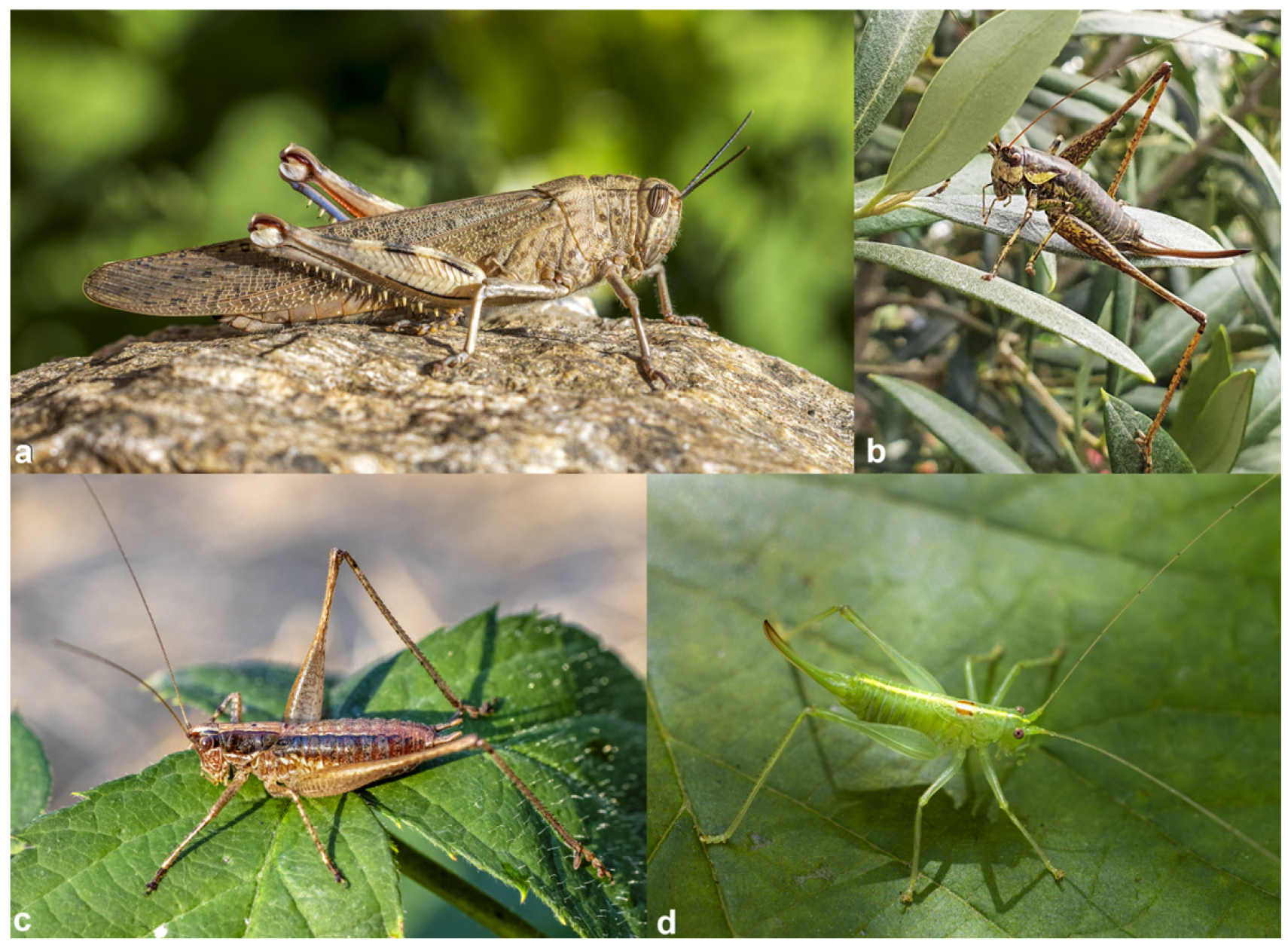
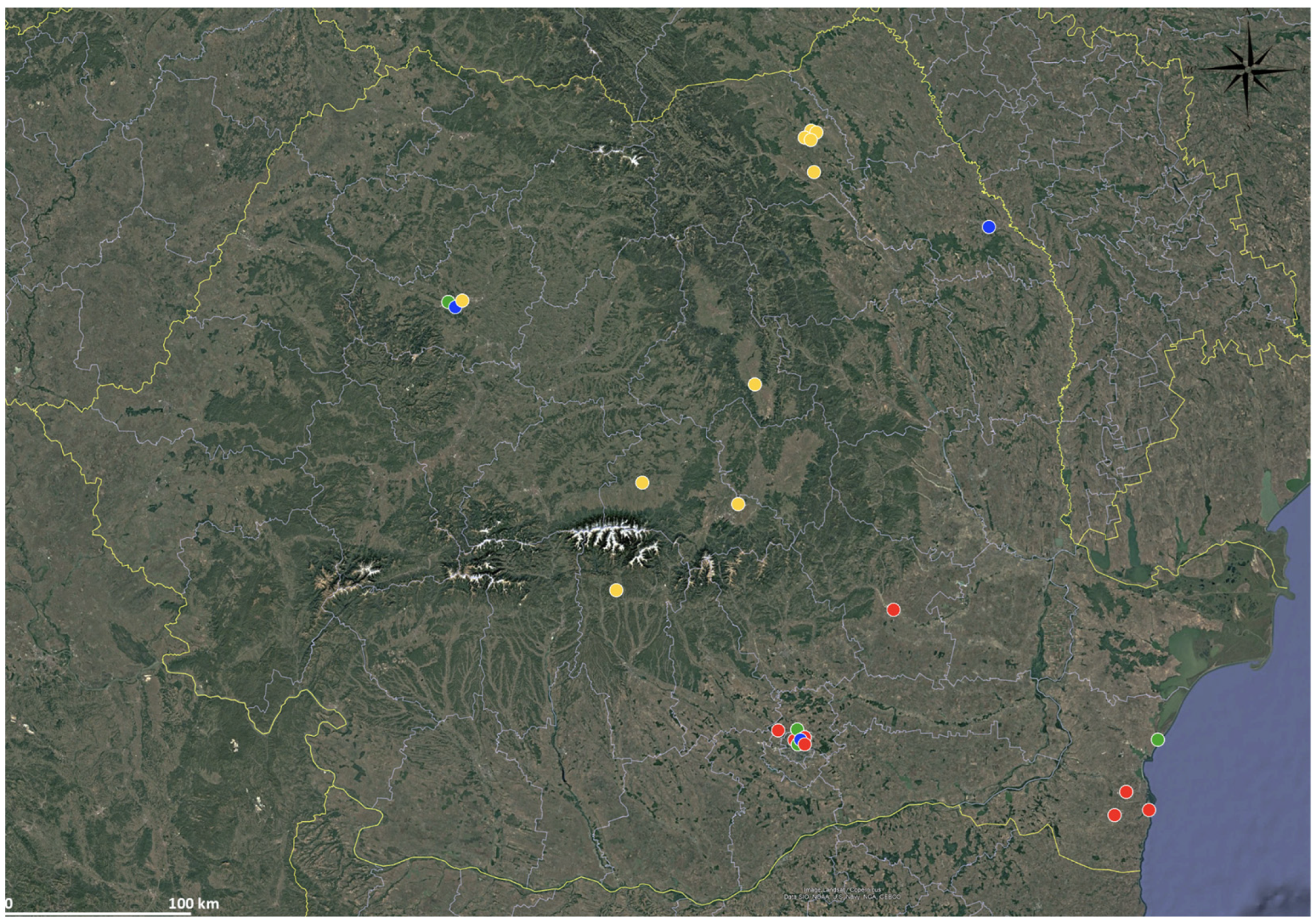
Anacridium aegyptium (Linnaeus, 1764) (Figure 1a and Figure 2)
Material: 1 ♀, Voluntari, Ilfov county, Romania, 44.534° N, 26.092° E, 7 September 2021, leg. I.Ș. Iorgu; 1 ♂, Florești, Cluj county, Romania, 46.753° N, 23.533° E, 4 September 2024, leg. A. Cazacu; 1 ♀, Bucharest, Romania, 44.468° N, 26.062° E, 18 November 2021 (naturistdude97, inaturalist.org); 1 ♂, Corbu, Romania, 44.440° N, 28.761° E, 25 May 2023 (anna1251, inaturalist.org).
Remarks: native to the Mediterranean basin, A. aegyptium is nowadays widespread in southern and central Europe, North Africa, southwestern Asia and the Middle East [24]. It is considered established in some parts of central-northern Europe: Belgium, Denmark and the Netherlands, as well as in western Europe, in Ireland [22].
Figure 1. Habitus of alien orthopterans identified in Romania: (a) Anacridium aegyptium, female (Voluntari, Romania, 7 September 2021); (b) Rhacocleis annulata, female (Florești, Romania, 17 November 2025); (c) Yersinella raymondii, male (Bucharest, Romania, 16 August 2023); (d) Meconema meridionale, female (Suceava, Romania, 28 September 2024).
Diversity 18 00167 g001
Suborder Ensifera
Family Tettigoniidae
Rhacocleis annulata Fieber, 1853 (Figure 1b and Figure 2)
Material: 1 ♀, Florești, Cluj county, Romania, 46.753° N, 23.533° E, 17 November 2025, leg. A. Cazacu; 1 ♂, Iași, Romania, 47.145° N, 27.610° E, 22 October 2023 (stanislavschi_alexandr, inaturalist.org); 1 ♂, Bucharest, Romania, 44.406° N, 26.150° E, 3 July 2025 (mariaisfan, inaturalist.org).
Remarks: The species is indigenous to Italy and has recently been recorded as an alien species in France, the Netherlands, the UK, Switzerland, Austria, Slovakia, Croatia and Slovenia, often associated with the import of ornamental plants and soil [21,45].
Yersinella raymondii (Yersin, 1860) (Figure 1c and Figure 2)
Material: 1 ♂ 1 ♀, Bucharest, Bucharest, Romania, 44.488° N, 26.079° E, 10 August 2019, leg. I.Ș. Iorgu; 1 ♂, Bucharest, Romania, 44.476° N, 26.094° E, 16 August 2023, leg. I.Ș. Iorgu; 2 ♂ 1 ♀, Bucharest, Romania, 44.466° N, 26.134° E, 10 August 2025, leg. I.Ș. Iorgu; 1 ♀, Bucharest, Romania, 44.477° N, 26.096° E, 23 August 2021 (zmihai, inaturalist.org); 1 ♀, Bucharest, Romania, 44.456° N, 26.076° E, 12 September 2022 (zmihai, inaturalist.org); 1 ♀, Buzău, Romania, 45.153° N, 26.815° E, 8 October 2023 (zmihai, inaturalist.org); 1 ♀, Bucharest, Romania, 44.515° N, 26.071° E, 21 September 2024 (hyperlexi, inaturalist.org); 1 ♀, Bucharest, Romania, 44.438° N, 26.064° E, 25 September 2024 (mattiamenchetti, inaturalist.org); 1 ♀, Valul lui Traian, Romania, 44.169° N, 28.448° E, 15 July 2025 (alexa1810, inaturalist.org); 1 ♂, Mereni, Romania, 44.028° N, 28.391° E, 3 August 2025 (ralucapaun205, inaturalist.org); 1 ♀, Buftea, Romania, 44.561° N, 25.940° E, 9 August 2025 (zmihai, inaturalist.org); 1 ♀, Eforie Nord, Romania, 44.059° N, 28.622° E, 30 August 2025 (anotheroutsider, inaturalist.org); 1 ♀, Bucharest, Romania, 44.505° N, 26.049° E, 19 September 2025 (zmihai, inaturalist.org); 1 ♀, Bucharest, Romania, 44.418° N, 26.042° E, IX.2025 (wildgardenro, inaturalist.org).
Remarks: the species is native to southern Europe, including France, Switzerland, Italy, Croatia, Bosnia and Herzegovina, Montenegro, Albania and Greece [24]. Y. raymondii has been recorded as an alien species in Slovakia, where it is considered established [21].
Meconema meridionale Costa, 1860 (Figure 1d and Figure 2)
Material: 2 ♀, Făgăraș, Brașov county, Romania, 45.841° N, 24.987° E, 22 September 2023, leg. I.Ș. Iorgu; 1 ♀, Fălticeni, Suceava county, Romania, 47.451° N, 26.295° E, 8 September 2023, leg. I.Ș. Iorgu; 1 ♀, Miercurea-Ciuc, Harghita county, Romania, 46.354° N, 25.804° E, 1 September 2023, leg. I.Ș. Iorgu; 2 ♀, Suceava, Suceava county, Romania, 47.642° N, 26.246° E, 15 September 2023, leg. E.I. Iorgu, E.A. Ungurean, I.Ș. Iorgu; 2 ♀, Suceava, Suceava county, Romania, 47.641° N, 26.244° E, 1 October 2023, leg. E.I. Iorgu, E.A. Ungurean, I.Ș. Iorgu; 3 ♂ 2 ♀, Suceava, Suceava county, Romania, 47.642° N, 26.247° E, 7 November 2023, leg. E.I. Iorgu, E.A. Ungurean, I.Ș. Iorgu; 1 ♀, Suceava, Suceava county, Romania, 47.645° N, 26.248° E, 28 September 2024, leg. E.I. Iorgu, I.Ș. Iorgu; 1 ♂ 3 ♀, Suceava, Suceava county, Romania, 47.643° N, 26.246° E, 10 October 2025, leg. I.Ș. Iorgu; 1 ♀, Cluj-Napoca, Romania, 46.763° N, 23.564° E, 11 September 2020 (gigilanseta, inaturalist.org); 1 ♀, Slămnești, Romania, 45.274° N, 24.772° E, 13 July 2024 (zmihai, inaturalist.org); 1 ♂, Moldova Nouă, Romania, 44.727° N, 21.623° E, 14 August 2024 (tintilinic, inaturalist.org); 1 ♂, Hărman, Romania, 45.710° N, 25.687° E, 17 August 2025 (ted21219, inaturalist.org); 1 ♀, Cluj-Napoca, Romania, 46.753° N, 23.558° E, 7 September 2025 (erdonmezon, inaturalist.org).
Remarks: the species is native to southern Europe and the Mediterranean region. It is widely recognized in European literature as an expanding alien species, nowadays widely established across much of Europe, including central and western Europe, the British Isles, and parts of eastern Europe. Its range has extended northward in recent decades, M. meridionale being often associated with urban and suburban environments [22,24,46].
Figure 2. Distribution map of alien orthopterans in Romania: green—Anacridium aegyptium; blue—Rhacocleis annulata; red—Yersinella raymondii; yellow—Meconema meridionale (Map data © Google).
Diversity 18 00167 g002

3.2. Genetic Data on Meconema meridionale

The percentage identities obtained from GenBank and BOLD varied between 98 and 100%. All sequences were submitted to NCBI GenBank with accession numbers provided in Table 1. All the sequences were assigned to one BIN, corresponding to M. meridionale. A total of 27 sequences of M. meridionale, 551 bp long, were analyzed. We identified a total of 10 haplotypes with 24 polymorphic sites, with 14 parsimony informative sites and an average nucleotide composition of 34.1% T, 21.2% C, 28.7% A, and 16.0% G, as well as a 4/1 transitional pairs to transversional pairs substitution ratio.
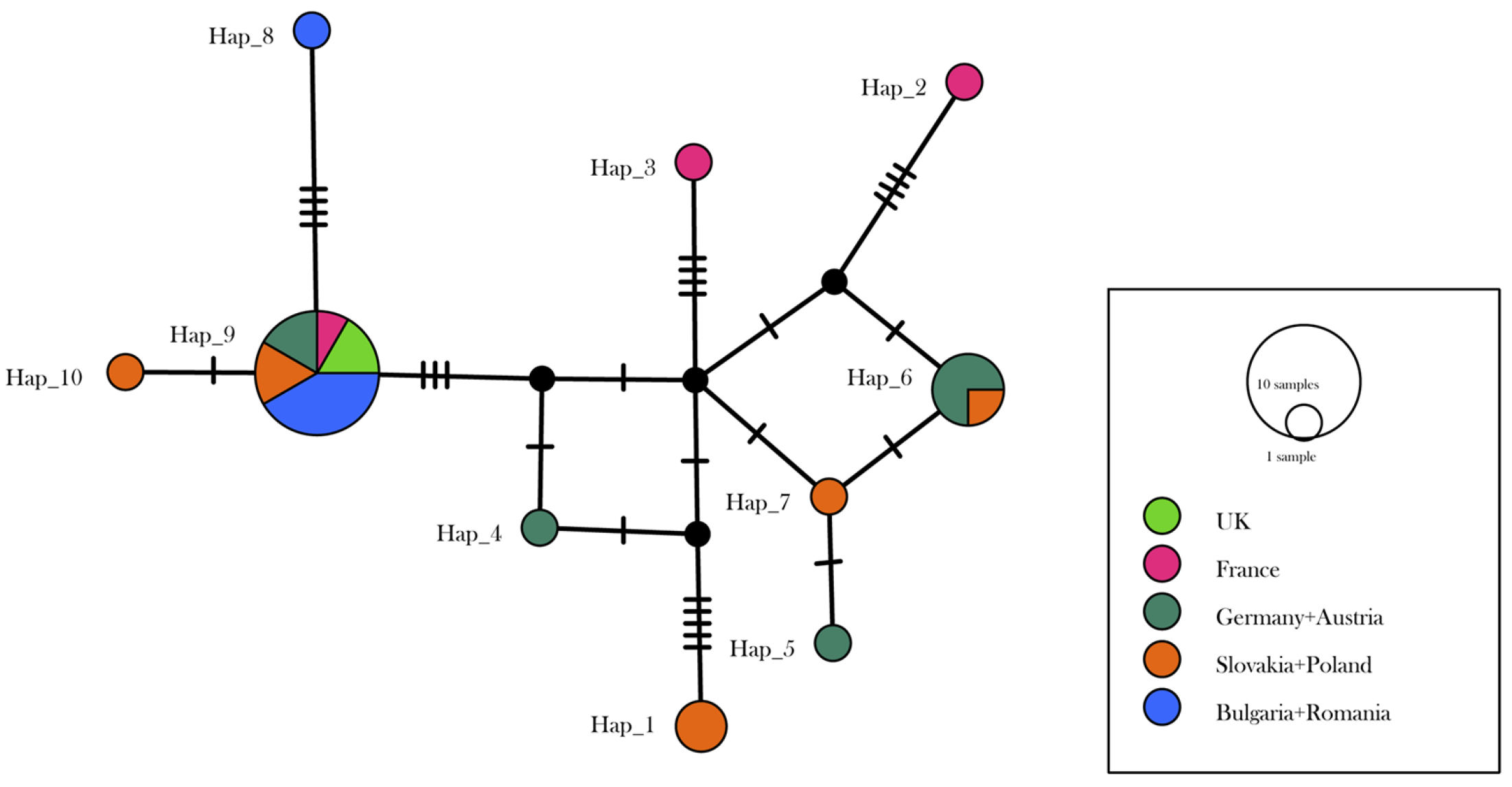
Haplotype diversity was moderate to high haplotype (Hd = 0.763 ± 0.061) and nucleotide diversity (π = 0.00908). Genetic distances between M. meridionale sequences ranged between 0.000 and 0.0259, with a net distance within the group of 0.008626 ± 0.002418. At the same time, the estimates of net evolutionary divergence between the M. meridionale and M. thalassinum sequences are 0.110 ± 0.015. The median-joining haplotype network was constructed with sequences from Romania, Poland, Slovakia, Germany, Austria, Bulgaria, France and the United Kingdom. Several sequences from Poland and one from Sicily were excluded from the analysis due to their shortness and lack of data in the sequences. The M. meridionale haplotype network revealed a diverse structured pattern with haplotype sequences found from one to five mutational steps from one another (Figure 3). The most common haplotype proved to be Hap_9, with 13 samples grouping within it, from ten localities in Germany, Poland, France, the UK, Bulgaria and Romania. The Romanian samples were grouped into two haplotypes: the majority in the common haplotype and one in a separate haplotype, Hap_8, found at 4 mutational steps from Hap_9.

4. Discussion

4.1. Anthropogenic Pathways and Urban Habitats

The human-mediated spreading of alien insect species has gradually increased in recent years in the Mediterranean region and adjacent areas, and this unintentional introduction represents one of the greatest threats to the indigenous ecosystems. Alien invasive insect species are a major and growing threat to European biodiversity, ecosystem services and economies [4]. The rapid increase in introductions is driven by globalization, trade, and climate change, which facilitate the movement and establishment of non-native species [47,48]. While the impacts of many invasive insects are well-documented, Orthoptera remains a neglected group, with few studies assessing their invasion dynamics, ecological impacts, or management needs. This lack of attention may stem from the fact that most range-expanding Orthoptera appear to have negligible immediate impacts. However, the episodic nature of outbreaks and the historical precedent for certain species to transition into significant pests under favorable climatic conditions suggest that their invasive potential should not be overlooked.
Alien bush-crickets and grasshoppers are increasingly recorded in Europe, with their establishment and spread shaped by specific introduction pathways and habitat associations. While proof of transport requires direct interception of specimens in transit, the primary introduction route for alien Orthoptera in Europe is widely hypothesized as the accidental transport of eggs or individuals with ornamental plants, horticultural material, or soil. This pathway is frequently cited for species like Rhacocleis annulata and Yersinella raymondii, which have been introduced to new areas via the plant trade, especially through the movement of mulch bark and potted plants [21,49]. These species are most frequently recorded in human-modified environments, which may serve as both initial entry points for introduction and as thermal refuges. The prevalence of records in urban areas, botanical gardens, or near gardening stores suggests a strong spatial correlation with ornamental plant abundance [49]. However, this distribution may also reflect the species’ preference for the urban heat island effect and reduced biotic resistance in disturbed habitats, which may actively draw individuals toward these sites following their arrival. For instance, all observations of Rhacocleis annulata and Yersinella raymondii in Slovakia were made in gardens with ornamental plants [21], and the Common crevice-cricket Gryllomorpha dalmatina (Ocskay) was found near a gardening store and supermarket [50]. These species are rarely found in wild or forested ecosystems, suggesting that their establishment is closely tied to anthropogenic activity—whether through passive transport or the selection of human-altered microclimates. Other examples include exotic orthopteran species transported via various goods to Europe, including locusts, e.g., Schistocerca gregaria (Forskål), found in Marchfeld and Winden am See, Austria [30] and Acanthacris ruficornis (Fabricius), recorded in a flower shop in Tübingen, Germany [51], the latter providing a clear example of a direct link between the horticultural trade and a specific sighting.
Rhacocleis annulata, Yersinella raymondii and Anacridium aegyptium were documented to spread in several countries via accidental transport vectors, such as Mediterranean plant pots [30,45,52,53] and this is also true for our findings. In Romania, A. aegyptium was found in a new urban park in Voluntari, planted with various indigenous and non-indigenous shrubs and trees, and in a large exotic plant shop in Florești. R. annulata was discovered in the same exotic flower shop in Florești, on a fresh imported olive tree (Olea europaea L.). Y. raymondii was encountered in different parks planted with Mediterranean shrubs.

4.2. Genetic Insights into the Eastern Colonization Margin

The Southern Oak Bush-cricket, Meconema meridionale, which originates from the Mediterranean region, has quickly spread into Central and Eastern Europe over recent decades. This species is now often found in cities and in caravan sites. Its rapid expansion is closely tied to passive movement by cars, trucks and trains. The bush-cricket is frequently spotted at camping grounds, hotel parking lots, highway rest stops, border crossings, and other spots directly connected to road traffic. As a micropterous species, M. meridionale has limited autonomous dispersal ability, indicating that its rapid range expansion is primarily facilitated by human transport. The fact that M. meridionale was not found in surrounding wild habitats but is clustered in busy, traffic-linked spots suggests these are recent arrivals rather than long-term residents. This pattern of vehicle-assisted dispersal suggests that a city like Suceava, with a significant recent increase in car and train traffic, was likely to become an entry point for M. meridionale by passive transport mechanisms, sooner or later. Furthermore, sightings at gas stations in Fălticeni, Miercurea-Ciuc and Făgăraș fit the typical scenario where the species is found at road stops and parking areas. The bush-cricket’s presence on vehicles and in locations where cars and trucks park confirms that passive transport explains its distribution far better than natural dispersal [54]. The haplotype network does not display a classic “star” structure, characteristic of species that have undergone recent and rapid demographic expansions, featuring a dominant central haplotype. We identified a dominant genotype, Hap_9, which proved the most successful in colonizing new territories. This haplotype is shared by individuals from geographically distant locations: the UK, Germany, Romania and Bulgaria. The fact that these populations are genetically identical (Hap_9) suggests anthropogenic passive transport. Since the species is associated with urban environments, it is highly probable that this genotype was rapidly transported across Europe via vehicles or trade, “jumping” over natural barriers. The newly discovered populations in Romania are part of the same recent expansion “wave” that colonized Central and Western Europe. However, Romania also presents a private haplotype, Hap_8, which is quite divergent (four mutational steps from the center). Since Romania is geographically closer to the native range (Mediterranean) than Germany or the UK, the presence of this unique haplotype could indicate a separate introduction from a different source, with a distinct introduction pathway. Although our genetic analysis identified two distinct haplotypes in Romania (Hap_8 and Hap_9), suggesting at least two potential sources of introduction, we acknowledge that the limited sample size constrains broader population-level inferences. To fully disentangle these colonization scenarios and accurately identify source populations, future studies will require expanded sampling. Specifically, comparing these expanding populations with individuals from their native Mediterranean range, alongside the implementation of high-resolution nuclear markers, such as microsatellites or SNPs.

4.3. The Romanian Context and Regional Biogeography

There are no previous data on the establishment of alien orthopterans in Romania; the only published studies focus on invasive plant species or forest insects [55,56]. This general lack of data and awareness regarding non-native Orthoptera species in Europe, including Romania, makes it difficult to assess their status and distribution [49]. The effects of non-native species on native orthopterans are still poorly understood [57]. While interspecific interactions have been identified as potential threats in Orthoptera, such as the hypothesized displacement of native Meconema thalassinum (De Geer) by the expanding M. meridionale in parts of Western and Central Europe [58], or the hybridization-driven displacement of Pseudochorthippus montanus (Charpentier) by P. parallelus (Zetterstedt) in Germany [59], no evidence currently indicates a significant ecological impact in Romania. For the time being, the presence of M. meridionale, R. annulata, Y. raymondii, and A. aegyptium appears to be ecologically silent in the region, though continued monitoring is required to detect long-term shifts in native community dynamics.

4.4. Management and Biosecurity Recommendations

While Orthoptera are often less prominent than other insect groups among Europe’s most damaging invasive species, their potential for ecological and economic impact is increasingly recognized. The historic “under-the-radar” nature of these expansions, often perceived as harmless or episodic, calls for greater awareness and more proactive management strategies [49]. Given the strong association between these new records and anthropogenic hubs, it is evident that both the horticultural trade and trans-border vehicle traffic serve as significant, yet under-regulated, vectors. To mitigate the risk of unintentional introductions, primary biosecurity measures should focus on targeted phytosanitary inspections of high-risk ornamental plants (e.g., Thuja, Cupressus, and Olea europaea) and the establishment of sentinel monitoring at major transportation hubs to intercept stowaway individuals. Additionally, integrating citizen science platforms with early warning networks for urban landscaping professionals will be essential for the rapid detection of newly arrived species before breeding populations can establish.

Author Contributions

Conceptualization, I.-Ș.I. and E.I.I.; methodology, I.-Ș.I., E.I.I., A.L. and E.-A.U.; software, E.I.I., A.L. and E.-A.U.; investigation, I.-Ș.I., A.L., E.-A.U., I.T., A.C. and E.I.I.; writing—original draft preparation, I.-Ș.I., E.-A.U. and E.I.I.; writing—review and editing, I.-Ș.I., I.T. and E.I.I.; funding acquisition, I.T. All authors have read and agreed to the published version of the manuscript.

Funding

I.T. was supported by Lucian Blaga University of Sibiu research grants LBUS-IRG-2023, no. 3567/24.07.2023.

Institutional Review Board Statement

Not applicable.

Data Availability Statement

The original contributions presented in this study are included in the article. Further inquiries can be directed to the corresponding author.

Acknowledgments

The authors are grateful to Alexandru Ștefan-Fotin, Adrian Derscariu, Tibor-Csaba Vizauer, Cristina Moroșan and Cătălin Moroșan for their help in the field work.

Conflicts of Interest

The authors declare no conflicts of interest.

References

  1. Richardson, D.M.; Pyšek, P.; Rejmanek, M.; Barbour, M.G.; Panetta, F.D.; West, C.J. Naturalization and invasion of alien plants: Concepts and definitions. Divers. Distrib. 2000, 6, 93–107. [Google Scholar] [CrossRef]
  2. Pyšek, P.; Hulme, P.E.; Simberloff, D.; Bacher, S.; Blackburn, T.M.; Carlton, J.T.; Dawson, W.; Essl, F.; Foxcroft, L.C.; Genovesi, P.; et al. Scientists’ warning on invasive alien species. Biol. Rev. 2020, 95, 1511–1534. [Google Scholar] [CrossRef]
  3. Turbelin, A.; Diagne, C.; Hudgins, E.; Moodley, D.; Kourantidou, M.; Novoa, A.; Haubrock, P.; Bernery, C.; Gozlan, R.; Francis, R.; et al. Introduction pathways of economically costly invasive alien species. Biol. Invasions 2022, 24, 2061–2079. [Google Scholar] [CrossRef]
  4. Haubrock, P.; Turbelin, A.; Cuthbert, R.; Nóvoa, A.; Taylor, N.; Angulo, E.; Ballesteros-Mejia, L.; Bodey, T.; Capinha, C.; Diagne, C.; et al. Economic costs of invasive alien species across Europe. NeoBiota 2021, 67, 153–190. [Google Scholar] [CrossRef]
  5. Hulme, P.E. Trade, transport and trouble: Managing invasive species pathways in an era of globalization. J. Appl. Ecol. 2009, 46, 10–18. [Google Scholar] [CrossRef]
  6. Seebens, H.; Blackburn, T.M.; Dyer, E.E.; Genovesi, P.; Hulme, P.E.; Jeschke, J.M.; Pagad, S.; Pyšek, P.; Winter, M.; Arianoutsou, M.; et al. No saturation in the accumulation of alien species worldwide. Nat. Commun. 2017, 8, 14435. [Google Scholar] [CrossRef]
  7. Wang, S.; Li, W.; Zhang, J.; Luo, Z.; Li, Y. Alien range size, habitat breadth, origin location, and domestication of alien species matter to their impact risks. Integr. Zool. 2024, 20, 520–534. [Google Scholar] [CrossRef] [PubMed]
  8. Hernández-Triana, L.M.; Brugman, V.A.; Nikolova, N.I.; Ruiz-Arrondo, I.; Barrero, E.; Thorne, L.; de Marco, M.F.; Krüger, A.; Lumley, S.; Johnson, N.; et al. DNA Barcoding of British Mosquitoes (Diptera, Culicidae) to Support Species Identification, Discovery of Cryptic Genetic Diversity and Monitoring Invasive Species. ZooKeys 2019, 832, 57–76. [Google Scholar] [CrossRef] [PubMed]
  9. Milián-García, Y.; Young, R.; Madden, M.; Bullas-Appleton, E.; Hanner, R.H. Optimization and Validation of a Cost-Effective Protocol for Biosurveillance of Invasive Alien Species. Ecol. Evol. 2021, 11, 1999–2014. [Google Scholar] [CrossRef] [PubMed]
  10. Comtet, T.; Sandionigi, A.; Viard, F.; Casiraghi, M. DNA (Meta)Barcoding of Biological Invasions: A Powerful Tool to Elucidate Invasion Processes and Help Managing Aliens. Biol. Invasions 2015, 17, 905–922. [Google Scholar] [CrossRef]
  11. Garcia-Vazquez, E.; Ardura, A.; Planes, S. DNA mtCOI Barcodes for Maritime Biosecurity: A Proof of Concept in French Polynesia Ports. Front. Ecol. Evol. 2020, 8, 179. [Google Scholar] [CrossRef]
  12. Mahon, A.R.; Grey, E.K.; Jerde, C.L. Integrating Invasive Species Risk Assessment into Environmental DNA Metabarcoding Reference Libraries. Ecol. Appl. 2023, 33, e2730. [Google Scholar] [CrossRef]
  13. Barney, J.N.; Tekiela, D.R.; Dollete, E.S.; Tomasek, B.J. What is the “real” impact of invasive plant species? Front. Ecol. Environ. 2013, 11, 322–329. [Google Scholar] [CrossRef]
  14. Bradshaw, C.J.; Leroy, B.; Bellard, C.; Roiz, D.; Albert, C.; Fournier, A.; Barbet-Massin, M.; Salles, J.M.; Simard, F.; Courchamp, F. Massive yet grossly underestimated global costs of invasive insects. Nat. Commun. 2016, 7, 12986. [Google Scholar] [CrossRef] [PubMed]
  15. Diagne, C.; Leroy, B.; Gozlan, R.E.; Vaissière, A.-C.; Assailly, C.; Nuninger, L.; Roiz, D.; Jourdain, F.; Jarić, I.; Courchamp, F. InvaCost, a public database of the economic costs of biological invasions worldwide. Sci. Data 2020, 7, 277. [Google Scholar] [CrossRef] [PubMed]
  16. Essl, F.; Zuna-Kratky, T. The checklist of alien orthopterans (Orthoptera) and mantises (Mantodea) in Austria (2nd edition). BioInv. Rec. 2021, 10, 991–996. [Google Scholar] [CrossRef]
  17. Demetriou, J.; Radea, C.; Peyton, J.; Groom, Q.; Roques, A.; Rabitsch, W.; Seraphides, N.; Arianoutsou, M.; Roy, H.; Martinou, A. The Alien to Cyprus Entomofauna (ACE) database: A review of the current status of alien insects (Arthropoda, Insecta) including an updated species checklist, discussion on impacts and recommendations for informing management. NeoBiota 2023, 83, 11–42. [Google Scholar] [CrossRef]
  18. Musolin, D.; Kirichenko, N.; Karpun, N.; Aksenenko, E.; Golub, V.; Kerchev, I.; Mandelshtam, M.; Vasaitis, R.; Volkovitsh, M.; Zhuravleva, E.; et al. Invasive Insect Pests of Forests and Urban Trees in Russia: Origin, Pathways, Damage, and Management. Forests 2022, 13, 521. [Google Scholar] [CrossRef]
  19. Drăghici, A.-C.; Pintilioaie, A.-M.; Murariu, D.; Manci, C.-O.; Ruzzier, E. New additions and further records of non-native Coleoptera in Romania. Zootaxa 2025, 5575, 409–428. [Google Scholar] [CrossRef]
  20. Renault, D.; Laparie, M.; McCauley, S.; Bonte, D. Environmental Adaptations, Ecological Filtering, and Dispersal Central to Insect Invasions. Annu. Rev. Entomol. 2018, 63, 345–368. [Google Scholar] [CrossRef]
  21. Krištín, A.; Capka, J.; Zlámal, N.; Demeš, P. First records of the alien bush-crickets Rhacocleis annulata Fieber, 1853 and Yersinella raymondii (Yersin, 1860) (Orthoptera) in Slovakia. BioInv. Rec. 2022, 11, 383–389. [Google Scholar] [CrossRef]
  22. Kulessa, A.K.; Kouba, A.; Renault, D.; Soto, I.; Haubrock, P.J. Assessing non-native invasive Orthoptera in Europe. Res. Sq. 2023. [Google Scholar] [CrossRef]
  23. Jaskuła, R.; Sulikowska-Drozd, A.; Jabłońska, A.; Banaś, K.; Rewicz, T. Undesirable immigrants: Hobbyist vivaria as a potential source of alien invertebrate species. PeerJ 2019, 7, e7617. [Google Scholar] [CrossRef]
  24. Cigliano, M.M.; Braun, H.; Eades, D.C.; Otte, D. Orthoptera Species File. Available online: http://orthoptera.speciesfile.org/ (accessed on 30 August 2025).
  25. Capinera, J.L.; Scott, R.D.; Walker, T.J. Field Guide to Grasshoppers, Katydids and Crickets of the United States; Cornell University Press: Ithaca, NY, USA, 2004; pp. 1–280. [Google Scholar]
  26. Hochkirch, A.; Massa, B.; Zuna-Kratky, T.; Krištín, A.; Puskás, G.; Ivković, S.; Presa, J.J.; Skejo, J.; Monnerat, C.; Szövényi, G.; et al. Meconema meridionale. The IUCN Red List of Threatened Species 2016: e.T68427413A74540416. Available online: https://www.iucnredlist.org/species/68427413/74540416 (accessed on 12 October 2025).
  27. Tilmans, J.; Odé, B.; Willemse, L. Rhacocleis andikithirensis a new bush-cricket from Greece (Orthoptera: Tettigoniidae: Tettigoniinae). J. Orthoptera Res. 2016, 25, 25–38. [Google Scholar] [CrossRef]
  28. Willemse, F.; Willemse, L. Two new cryptic aberrant species of Rhacocleis Fieber 1853, living under stones in the mountains of Greece (Orthoptera; Tettigoniidae). J. Orthoptera Res. 2005, 14, 161–172. [Google Scholar] [CrossRef]
  29. Hochkirch, A.; Massa, B.; Monnerat, C.; Skejo, J.; Gomboc, S.; Willemse, L.P.M.; Rutschmann, F.; Chobanov, D.P.; Kleukers, R.; Krištín, A.; et al. Yersinella raymondii. The IUCN Red List of Threatened Species: e.T68486449A74625126. Available online: https://www.iucnredlist.org/species/68486449/74625126 (accessed on 12 October 2025).
  30. Zuna-Kratky, T. Eingeschleppte, nicht dauerhaft etablierte Arten. In Die Heuschrecken Österreichs; Zuna-Kratky, T., Landmann, A., Illich, I., Zechner, L., Essl, F., Lechner, K., Ortner, A., Weißmair, W., Wöss, G., Eds.; Denisia: Linz, Austria, 2017; Volume 39, pp. 816–818. [Google Scholar]
  31. Heller, K.G.; Mosny, K. Fund einer Kleinen Strauchschrecke Yersinella raymondii (Yersin, 1860) (Orthoptera, Tettigoniidae) im Rhein-Neckar-Raum. Articulata 2019, 33, 69–72. [Google Scholar]
  32. Ivković, S.; Đurđević, A.; Popović, M. New data on the occurrence of Anacridium aegyptium (Orthoptera: Acrididae) in Serbia. Acta Ent. Ser. 2015, 20, 163–166. [Google Scholar]
  33. Sardet, E.; Roesti, C.; Braud, Y. Grasshoppers of Britain and Western Europe. A Photographic Guide; Bloomsbury Publishing Plc: London, UK, 2021; pp. 1–304. [Google Scholar]
  34. Colgan, D.J.; Hutchings, P.A.; Brown, S. Phylogenetic relationships within the Terebellomorpha. J. Mar. Biol. Assoc. UK 2001, 81, 765–773. [Google Scholar] [CrossRef]
  35. Larsson, A. AliView: A fast and lightweight alignment viewer and editor for large data sets. Bioinformatics 2014, 30, 3276–3278. [Google Scholar] [CrossRef] [PubMed]
  36. Ratnasingham, S.; Wei, C.; Chan, D.; Agda, J.; Agda, J.; Ballesteros-Mejia, L.; Ait Boutou, H.; El Bastami, Z.M.; Ma, E.; Manjunath, R.; et al. BOLD v4: A Centralized, Bioinformatics Platform for DNA-Based Biodiversity Data. In DNA Barcoding. Methods in Molecular Biology; Humana: New York, NY, USA, 2024; pp. 403–441. [Google Scholar]
  37. Altschul, S.F.; Gish, W.; Miller, W.; Myers, E.W.; Lipman, D.J. Basic local alignment search tool. J. Mol. Biol. 1990, 215, 403–410. [Google Scholar] [CrossRef]
  38. Clark, K.; Karsch-Mizrachi, I.; Lipman, D.J.; Ostell, J.; Sayers, E.W. GenBank. Nucleic Acids Res. 2016, 44, D67–D72. [Google Scholar] [CrossRef] [PubMed]
  39. Nei, M. Molecular Evolutionary Genetics; Columbia University Press: Manhattan, NY, USA, 1987; pp. 1–505. [Google Scholar] [CrossRef]
  40. Tajima, F. Unbiased estimation of evolutionary distance between nucleotide sequences. Mol. Biol. Evol. 1993, 10, 677–688. [Google Scholar] [CrossRef] [PubMed]
  41. Rozas, J.; Ferrer-Mata, A.; Sánchez-DelBarrio, J.C.; Guirao-Rico, S.; Librado, P.; Ramos-Onsins, S.E.; Sánchez-Gracia, A. DnaSP6: DNA sequence polymorphism analysis of large data sets. Mol. Biol. Evol. 2017, 34, 3299–3302. [Google Scholar] [CrossRef]
  42. Bandelt, H.J.; Forster, P.; Röhl, A. Median-joining networks for inferring intraspecific phylogenies. Mol. Biol. Evol. 1999, 16, 37–48. [Google Scholar] [CrossRef]
  43. Leigh, J.W.; Bryant, D. PopART: Full-feature software for haplotype network construction. Methods Ecol. Evol. 2015, 6, 1110–1116. [Google Scholar] [CrossRef]
  44. Tamura, K.; Stecher, G.; Kumar, S. MEGA11: Molecular evolutionary genetics analysis version 11. Mol. Biol. Evol. 2021, 38, 3022–3027. [Google Scholar] [CrossRef]
  45. Ćato, S.; Zagorac, D. Unexpected faunistic records of Rhacocleis annulata; Eyprepocnemis plorans; and Xya pfaendleri (Orthoptera) from Croatia and Slovenia. Nat. Croat. 2021, 30, 501–511. [Google Scholar] [CrossRef]
  46. Ferenca, R.; Budrys, E. First records of southern oak bush-cricket Meconema meridionale Costa, 1860: (Orthoptera, Tettigoniidae) in Lithuania. Lietuvos Entomologų Draugijos Darbai 2025, 9, 5–9. [Google Scholar]
  47. Marchioro, C.A.; Krechemer, F.S. Prevention is better than cure: Integrating habitat suitability and invasion threat to assess global biological invasion risk by insect pests under climate change. Pest Manag. Sci. 2021, 77, 4510–4520. [Google Scholar] [CrossRef]
  48. Tăuşan, I.; Markó, B. New records of the pharaoh ant Monomorium pharaonis (Linnaeus, 1758) (Hymenoptera: Formicidae) in Romania. Entomol. Romanica 2011, 16, 23–26. [Google Scholar]
  49. Kulessa, A.K.; Balzani, P.; Soto, I.; Kouba, A.; Renault, D.; Tarkan, A.S.; Haubrock, P.J. The neglect of nonnative orthopterans as potential invaders: A call for awareness. Insect Sci. 2023, 31, 994–1000. [Google Scholar] [CrossRef] [PubMed]
  50. Hemala, V.; Svetlík, J.; Nuhlíčková, S. First record of the Common Crevice-cricket Gryllomorpha dalmatina (Ocskay, 1832) (Orthoptera: Gryllidae) in Slovakia: Evidence of a viable population. BioInv. Rec. 2023, 12, 555–562. [Google Scholar] [CrossRef]
  51. Reinhardt, K.; Köhler, G. A locust Acanthacris ruficornis (Fabricius, 1787) in a flower shop of Tübingen, Germany (Acrididae: Cyrtacanthacridinae). Articulata 2014, 29, 93–97. [Google Scholar]
  52. Gojznikar, J.; Poljanec, N.; Mlakar Medved, M. An interesting new record of Egyptian locust Anacridium aegyptium (Linnaeus, 1764) (Orthoptera: Acrididae) for Slovenian inland. Nat. Slov. 2018, 20, 33–34. [Google Scholar] [CrossRef]
  53. Pavlović, M. Egyptian locust (Anacridium aegyptium) (Acrididae: Cyrtacanthacridinae) in the Pannonian part of Croatia. Articulata 2019, 34, 95–100. [Google Scholar]
  54. Vlk, R.; Balvín, O.; Krištín, A.; Marhoul, P.; Hrúz, V. Distribution of the Southern Oak Bush-cricket Meconema meridionale (Orthoptera; Tettigoniidae) in the Czech Republic and Slovakia. Folia Oecol. 2012, 39, 155–165. [Google Scholar]
  55. Olenici, N.; Bălăcenoiu, F.; Tomescu, R.; Netoiu, C.; Buzatu, A.; Alexandru, A. Invasive alien forest insect species in south-eastern Romania. Not. Bot. Horti. Agrobo. 2022, 50, 12618. [Google Scholar] [CrossRef]
  56. Sîrbu, C.; Miu, I.; Gavrilidis, A.; Grădinaru, S.; Niculae, I.; Preda, C.; Oprea, A.; Urziceanu, M.; Camen-Comănescu, P.; Nagodă, E.; et al. Distribution and pathways of introduction of invasive alien plant species in Romania. NeoBiota 2022, 75, 1–21. [Google Scholar] [CrossRef]
  57. Hochkirch, A.; Nieto, A.; García Criado, M.; Cálix, M.; Braud, Y.; Buzzetti, F.M.; Chobanov, D.; Odé, B.; Presa Asensio, J.J.; Willemse, L.; et al. European Red List of Grasshoppers, Crickets and Bush-Crickets; Publications Office of the European Union: Luxembourg, 2016; pp. 1–86. [Google Scholar]
  58. Hochkirch, A.; Willemse, L.P.M.; Szövényi, G.; Rutschmann, F.; Presa, J.J.; Krištín, A.; Kleukers, R.; Chobanov, D.P. Meconema thalassinum. The IUCN Red List of Threatened Species: e.T68427417A74540428. Available online: https://www.iucnredlist.org/species/68427417/74540428 (accessed on 12 October 2025).
  59. Rohde, K.; Hau, Y.; Weyer, J.; Hochkirch, A. Wide prevalence of hybridization in two sympatric grasshopper species may be shaped by their relative abundances. BMC Evol. Biol. 2015, 15, 191. [Google Scholar] [CrossRef][Green Version]
Figure 3. Median-joining network of mitochondrial COI haplotypes for Meconema meridionale, illustrating the genetic relationship between the newly discovered Romanian populations and broader European samples. Haplotype size reflects sample size. Each hatch mark represents one mutational step.
Diversity 18 00167 g003
Table 1. List of Meconema meridionale samples analyzed in this study. The locality index, country, collection site, coordinates, Bold ID/GenBank codes and haplotype are shown and are correlated with the numbers shown in Section 3.2.
Crt. No.CountryCollecting SiteCoordinatesBold IDHaplotype
1.PolandPulawy51.415° N, 21.956° EBGEPL2159-25Hap_6
2.PolandMroczk52.028° N, 22.225° EBGEPL2272-25Hap_7
3.PolandPulawy51.415° N, 21.956° EBGEPL2281-25Hap_9
4.PolandPustynia, Kozlowska51.404° N, 15.647° EBGEPL2297-25Hap_9
5.PolandPustynia, Kozlowska51.404° N, 15.647° EBGEPL2322-25Hap_10
6.SlovakiaRybnicna, Bratislava48.215° N, 17.18° EUZINS242-23Hap_1
7.SlovakiaRybnicna, Bratislava48.215° N, 17.18° EUZINS243-23Hap_1
8.United Kingdom-52.145° N, −0.025° ENTWE5731-25Hap_9
9.United Kingdom-51.291° N, −0.656° EPBRI772-24Hap_7
10.United KingdomCanvey Wick-DTNHM8266-23Hap_9
11.GermanyMuenchen, Bavaria48.167° N, 11.504° EFBORT177-09Hap_9
12.GermanyKarlsruhe, Baden-Wuerttemberg49.006° N, 8.400° EFBORT430-10Hap_6
13.GermanyKarlsruhe, Baden-Wuerttemberg49.006° N, 8.400° EFBORT431-10Hap_6
14.GermanyKarlsruhe, Baden-Wuerttemberg49.006° N, 8.400° EFBORT432-10Hap_6
15.GermanyKulmain, Bavaria49.896° N, 11.897° EFBORT514-13Hap_4
16.GermanyBobenheim-Roxheim, Rhineland-Palatinate50° N, 8° EGBMIX3300-16Hap_9
17.AustriaVienna48.203° N, 16.359° ETDAOE2907-23Hap_5
18.FranceIle-de-France, Paris48.845° N, 2.3625° EGMFPT579-18Hap_9
19.FranceCorsica-LPRCH586-23Hap_2
20.FranceCampu di Bonza, Corsica41.771° N, 9.124° ELPRCT662-21Hap_3
21.BulgariaBotanical Garden, Varna-PORTH057-10Hap_9
22.RomaniaFăgăraș, BV45.841° N, 24.987° EMecHap_9
23.RomaniaFălticeni, SV47.451° N, 26.295° EMh1Hap_9
24.RomaniaSuceava, SV47.641° N, 26.244° EMh2Hap_9
25.RomaniaSuceava, SV47.642° N, 26.246° EMh3Hap_9
26.RomaniaFălticeni, SV47.451° N, 26.295° EMh4Hap_9
27.RomaniaSuceava, SV47.642° N, 26.247° EMh8Hap_8
Disclaimer/Publisher’s Note: The statements, opinions and data contained in all publications are solely those of the individual author(s) and contributor(s) and not of MDPI and/or the editor(s). MDPI and/or the editor(s) disclaim responsibility for any injury to people or property resulting from any ideas, methods, instructions or products referred to in the content.