Article

The Effectiveness of Shell Bag Restoration in Enhancing Salt Marsh Expansion in Coastal Georgia

1
Institute for Coastal Plain Science, Georgia Southern University, Statesboro, GA 30460, USA
2
Coastal Resources Division, Georgia Department of Natural Resources, Brunswick, GA 30334, USA
3
Department of Biology, Georgia Southern University, Statesboro, GA 30460, USA
*
Author to whom correspondence should be addressed.
Diversity 2026, 18(3), 150; https://doi.org/10.3390/d18030150
Submission received: 30 September 2025 / Revised: 13 January 2026 / Accepted: 25 February 2026 / Published: 1 March 2026

Abstract

Salt marshes are intertidal ecosystems that provide valuable services like wave attenuation, nutrient cycling, and carbon sequestration. Unfortunately, due to a combination of factors linked to global climate warming and increased coastal development, expanses of salt marshes are being lost worldwide. This has prompted coastal land managers to seek effective techniques to enhance salt marsh growth with changing environmental conditions. We examine how restoration of fringe oyster reefs, a commonly used technique to increase sediment accretion and erosion control in salt marshes, affects marsh migration and area change over time. Salt marsh vegetation movement was determined through analysis of aerial imagery collected by unmanned aerial vehicle (UAV) surveying before and in the months following restoration at a salt marsh island in Liberty County, GA, USA that underwent oyster reef restoration in September 2023 at three sites, each spanning ~25 m of shoreline. Results after one year showed all restoration sites experienced continued growth at greater rates than nearby unrestored control sites, despite environmental differences between sites. Our results provide evidence that oyster reef restoration may be a viable method for mitigating the loss of salt marshes in coastal Georgia.

1. Introduction

Salt marshes are regularly flooded, intertidal ecosystems dominated by salt-tolerant grasses. These ecosystems have been found on all continents, except Antarctica, mainly in middle to high latitudes [1], with the greatest mapped expanses (~40%) found along North American coastlines [2]. Salt marshes provide many valuable ecosystem services to surrounding communities, such as nutrient cycling [3,4], protection from hazards like flooding and storm winds [5], erosion control and shoreline stability [5,6,7,8,9], and carbon sequestration [10,11]. However, climate change poses a serious global threat to salt marshes; concomitant with increasing temperatures, sea level is expected to rise by as much as one meter by the year 2100 due to thermal expansion and ice melt [12]. Sea level rise could be especially problematic in coastal regions with increasing development, high wave energy, and large tidal ranges, ultimately leading to dramatic negative consequences for coastal wetlands.
For salt marsh habitats, projected sea level rise may increase inundation, shift habitats landward, and alter flow patterns and nutrient availability, with adverse effects to marsh fauna. Historically, salt marshes have been able to keep pace or even grow with increased sea level rise, as both sediment accretion and productivity may increase as the salt marsh becomes lower in the tidal regime [13,14,15]. However, in recent surveys, global salt marsh coverage has been found to be declining by 0.28%·yr−1 over the last two decades [16]. This loss is being driven by a combination of factors that limit salt marsh vertical adjustment and horizontal migration, including increased erosion pressure from waves [17], limited sediment supply to allow for vertical adjustment [18,19,20], and ‘coastal squeeze’, where developed upland areas prevent the establishment of salt marsh plants [21,22,23,24]. Without intervention, 88% of salt marshes are expected to be lost by 2160 [25]. To avoid further losses in salt marshes and maintain the ecosystem services they provide, coastal land managers have been spurred to find effective methods for enhancing salt marsh resilience.
Erosion is among the leading causes of coastal habitat loss [26], so there is considerable effort to develop and implement techniques to manage coastal erosion and prevent habitat loss. Restoration efforts that use multifaceted approaches to restore natural marsh communities, while also stabilizing and maintaining the shoreline, are likely to be most effective. One approach that has been particularly successful is creating or restoring fringe oyster reefs to stabilize the shoreline. Oyster reefs are vital estuarine habitats themselves, providing a suite of ecosystem services, including food production, habitat formation, improved water quality, and shoreline buffering [27]. For marshes, the presence of oyster reefs on creek banks reduces erosion through wave attenuation [27,28,29,30] and increases accretion rates through the capture of sediment from overflowing water [28,31]. The combination of oyster reefs and salt marsh cordgrass (Spartina alterniflora) has been shown to achieve greater wave attenuation and sediment accretion than either feature can achieve alone [8]. Oyster reefs have also been found to grow vertically at rates that may surpass predicted sea level rise [32], suggesting that oyster restoration could enhance salt marsh resilience into the future. As such, management and restoration strategies have focused on creating oyster habitat to help buffer the shoreline [33,34,35].
In the southeastern United States, states like Georgia are under increased pressure to find effective methods to offset the effects of climate change-associated stressors. Georgia’s ~150,000 ha of salt marsh habitat may be especially vulnerable to sea level rise and coastal erosion, with results of vertical accretion modeling finding that salt marshes in the state rely on existing elevation capital to maintain salt marshes, which will be overwhelmed under future sea level rise scenarios and result in long-term losses in salt marshes, with only 12% of existing marsh remaining in the state by 2160 [25]. Many coastal counties in Georgia are experiencing rapid population growth, which is projected to continue over the next two decades [36]. Local subsidence and land management practices are accelerating relative sea level rise in this region, making it difficult for salt marshes to keep pace [37]. By the end of this century, research using the sea level affecting marshes model (SLAMM) under different climate warming scenarios have found Georgia salt marshes may experience decreases in salt marsh area of up to 20 to 45%, as sea level rises between 52 and 82 cm [38]. Due to the economic and ecological importance of healthy salt marshes, the Georgia Department of Natural Resources (GA DNR) prioritizes the protection of coastal marsh habitats. Since Georgia is considered a substrate-limited environment for oysters [39], the most used method used by GA DNR to enhance oyster habitat and protect marshes is the deployment of oyster shell bags along shorelines.
Although efforts to enhance oyster habitat for shoreline protection have occurred for over 15 years in Georgia, quantifying changes in shoreline location and marsh area have been challenging. Salt marshes can be expansive, with thick layers of pluff mud limiting movement across the landscape, making it difficult to collect accurate spatial data through traditional field methods. The emergence of new technologies, such as aerial imagery taken by sensors mounted to unmanned aerial vehicles (UAVs) have made it cheaper and easier to reliably monitor and map changes in focal habitats over time in comparison to traditional methods [40]. UAV aerial imagery has been frequently used in post-restoration monitoring of salt marshes to help in identifying changes in vegetation coverage and coastal geomorphology [41,42,43,44,45]. Through UAV technology, it has become possible to monitor salt marshes responses to sea level rise and restoration practices with high spatial and temporal resolution, overcoming limitations of traditional field methods. Thus, by working with the GA DNR and leveraging UAV surveys, we designed a pilot-scale restoration project to observe the horizontal migration of salt marshes and change in salt marsh area following an oyster shell bag restoration project in Liberty County, GA. We expected that the marsh edge would migrate toward restored oyster reefs, resulting in an increase in marsh area, relative to control locations without reefs.

2. Materials and Methods

2.1. Study Area

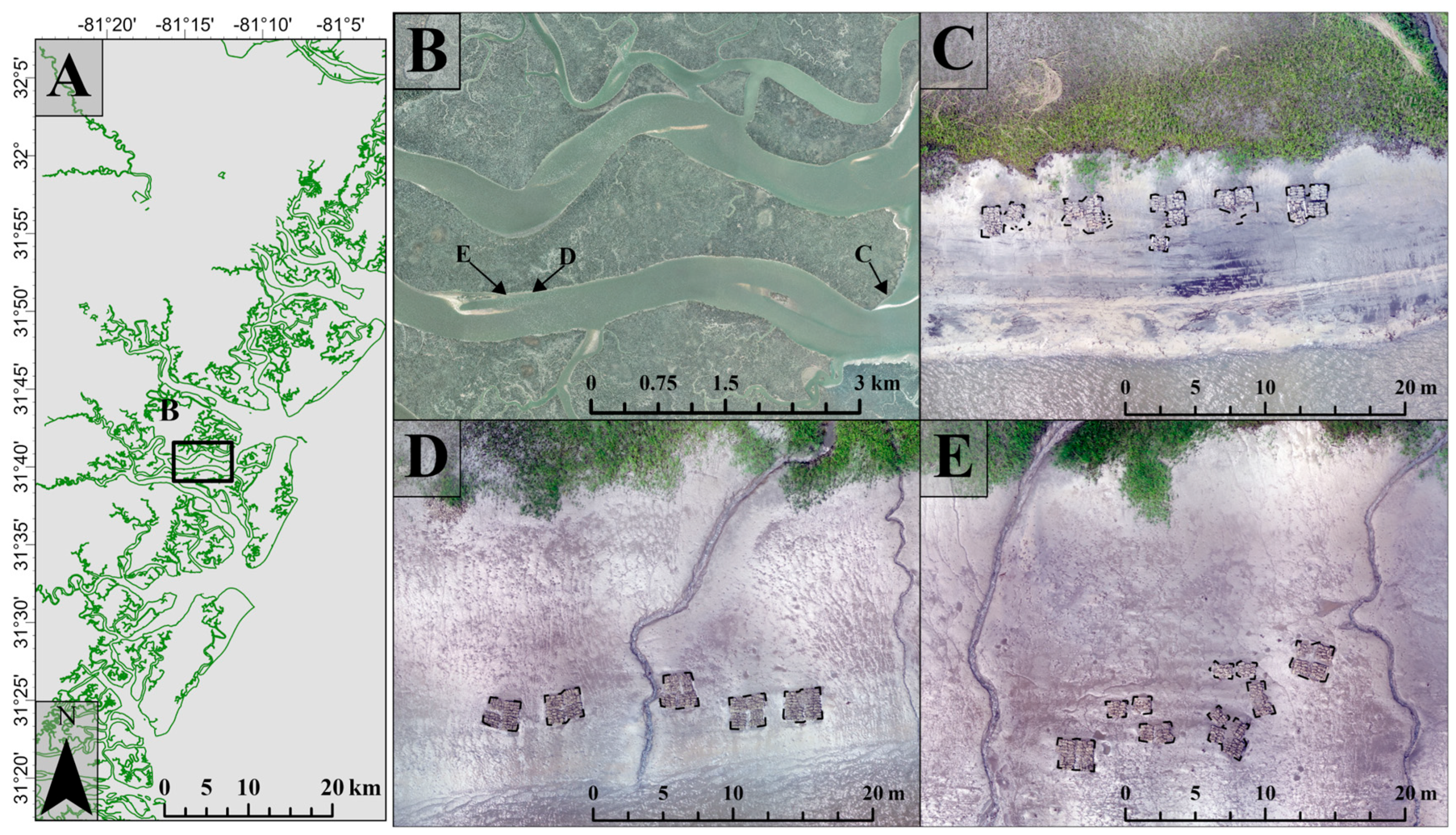
This research was conducted along the shoreline of an unnamed island, directly west of St. Catherine’s Island, Georgia, USA (Figure 1A). The island is around 600 ha in area and is bounded by the North Newport River (NNR) to the south and the Timmons River to the north, and contains around 570 ha of salt marsh vegetation (Figure 1B [2,46]), mostly comprising monocultures of salt marsh cordgrass (Spartina alterniflora) in its medium size form (heights between 0.5 and 1 m) [41,47]. Along the marine edge of the salt marsh and the creekbanks are expanses of tall form salt marsh cordgrass (>1 m), a typical pattern for salt marshes along the southeastern Atlantic coast [48]. We established one restoration site (31.6640° N, −81.2035° W) and one no-reef control site (31.6636° N, −81.2042° W) on the eastern edge of the island (Figure 1C), which experiences the highest wave energy due to the sites’ exposure and closer proximity to St. Catherine’s Sound (per. obs.). The other two restoration sites were located along the southern edge of the island, further up the NNR (31.6643° N, −81.2457° W and 31.6641° N, −81.2485° W; Figure 1D,E), which were more sheltered. However, due to logistics of the sites only being accessible by boats at low tide, and the pilot reefs being within a broader area of oyster habitat enhancement, we were only able to select one control site (31.6644° N, 81.2462° W) on the southern portion of the island.
NNR Island is a mesotidal coastline with a mean tidal range of around 2.2 m (NOAA tidal gauge station 8672875, [49]). The island experiences semi-diurnal tides, with two high and two low tides daily. Three subordinate NOAA stream gauges (ACT 7656 [50], 7661 [51], and 7666 [52]) are found surrounding the coastline of the NNR Island, and based on tidal flow estimates, suggest that the island experiences ebb-dominated tidal asymmetry with flood rates averaging 50–60 cm3/s and ebb rates between 70 and 90 cm3/s.

2.2. Shell Bag Oyster Reef Restoration

In September 2023, three shell bag oyster reef restoration sites were established on the NNR Island using pallets of recycled oyster shells placed directly on the mudflats in front of the existing salt marsh vegetation. Recycled oyster shell bags were arranged to cover standard 1.56 m2 wooden pallets. At each restoration site, 20 pallets were placed to form five “squares” of four pallets each covering around 6.25 m2 and spaced ~2 m apart. Spacing between pallets was done to facilitate water movement from behind the pallets and prevent erosion along the ends of the restored reefs, following GA DNR suggested protocols. Shell bags were left on the pallets to increase the contact surface area of the shell bags and the mudflat, preventing the bags from sinking into the mudflat and increasing the likelihood of oyster spat attachment to the shell bags.
At each of the sites, the five squares of pallets were arranged to be similar horizontal distances apart from each other (2 m), covering a span of ~25 m of the shoreline; however, some movement of the pallets occurred, especially at the westernmost restoration site (Figure 1E), as incoming tides and waves moved some pallets before they had time to settle into the mudflat surface.
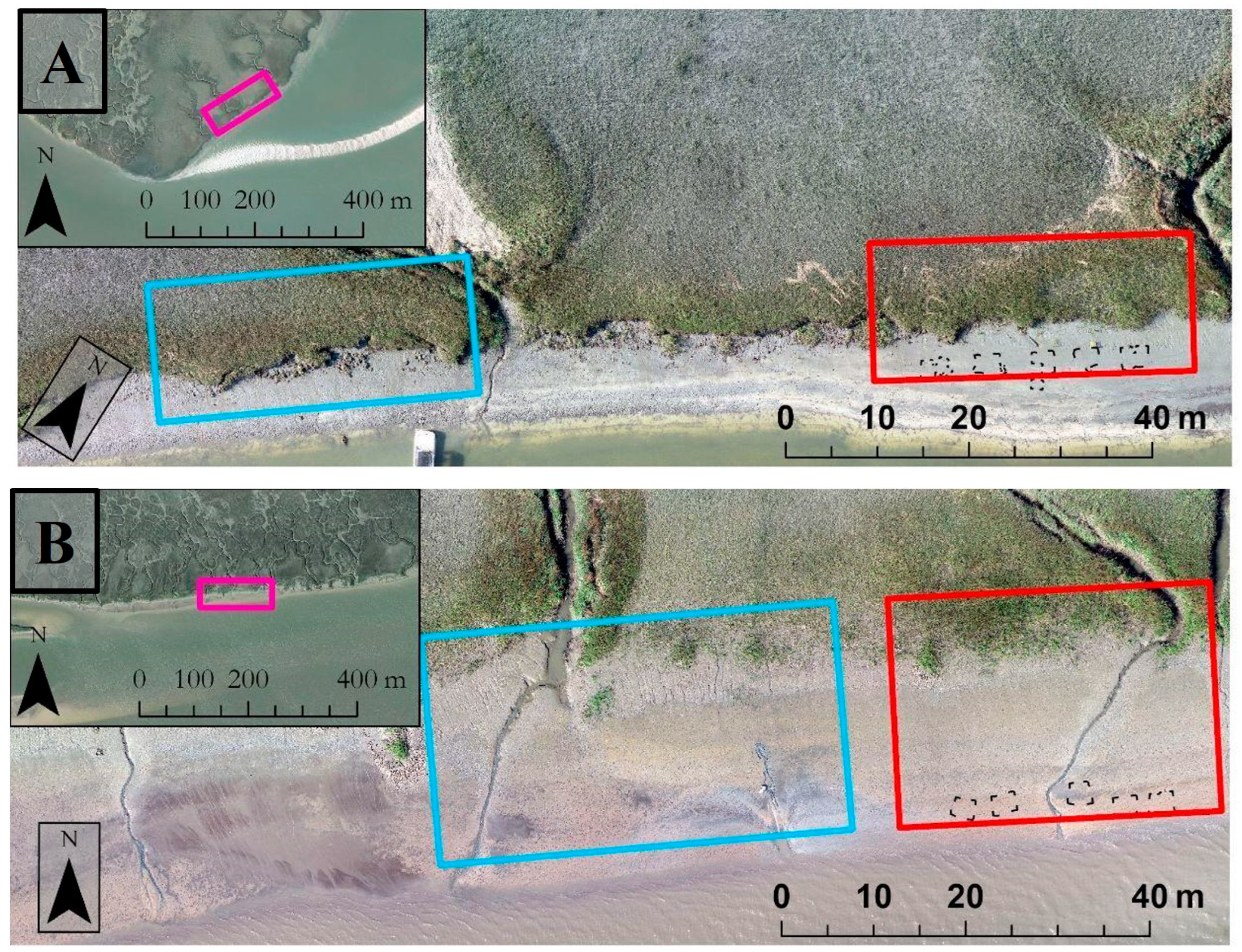
Along with the restoration sites, two control sites were also established on the NNR Island, one on its eastern flank, spanning 35 m of shoreline, and one on its southern flank between the two restoration sites on this side spanning 45 m (Figure 2). These control sites were set up to collect data with as similar conditions as possible to the restoration sites, with each control site being marked using ½ inch PVC pipes and coordinates collected using a handheld GPS. As previously mentioned, the challenging logistics for site access, along with this being an active restoration area, limited our study to only two control locations.

2.3. UAV Aerial Image Collection

Shoreline and marsh area monitoring in this study was done through aerial imagery collected by a sensor mounted to a UAV. This study used a DJI Phantom 4 pro V2 drone with an attached 2.54 cm CMOS sensor to collect 20 MP photos from each site. The UAV was flown 30 m above the salt marsh platform to collect 0.83 cm resolution imagery with a ground sample distance between pixel of 0.8 cm for large portions of the eastern and southern edges of the island containing the restoration and control sites.
During surveys, at least six ground control points (GCPs) were used to improve positional accuracy. GCPs were black and white tables placed along the shoreline with positions recorded from the center of each table through real time kinematic surveying using a Trimble R12 GNSS device (Trimble Inc., Westminster, CO, USA). Following the flights, overlapping images collected were used to create orthomosaics of the study area, with pixels containing surface reflectance values for the red, green, and blue portions of the visible light spectrum. Coordinates for GCPs were imported during orthomosaic creation as tie points for georeferencing, correcting the image layers and improving positional accuracy with root-mean square errors of only a few centimeters in each orthomosaic. All orthomosaics in this study were added to an ArcGIS Pro project file for further analysis. Changes in salt marsh vegetation following restoration were based on an orthomosaic created from a UAV survey conducted in March 2023, six months prior to shell bag deployment. Three post-restoration UAV surveys were completed 5, 8, and 13 months following shell bag deployment in February 2024, May 2024, and October 2024, respectively.

2.4. Determining Salt Marsh Edge

The position of the edge of salt marsh vegetation was determined at each time step to track migration through manual digitization. To aid in determining vegetated areas in the created orthomosaics, vegetation indices were calculated based on surface reflectance values contained in the layers. Vegetation indices are commonly used when delineating salt marsh vegetation [41], enhancing areas of vegetation by creating a single-band raster layer with pixel values related to the presence of vegetation at that location. The orthomosaics in this study were transformed using the band arithmetic raster function in ArcGIS Pro Version 3.6.0, following Equation (1), where green, red, and blue refer to the respective surface reflectance bands in each orthomosaic to create green leaf index (GLI) layers. Pixel values in the GLI layers range from −1 to 1 and correspond to the “greenness” at a given location, with negative values being non-living areas and positive values being areas with green features like plant leaves and stems [53]. After creating GLI layers, the marsh edge was manually delineated using the polyline feature creation tool in ArcGIS Pro, creating a line feature showing where vegetation ends nearest the shoreline. All marsh edges were digitized by a single researcher to reduce bias within and between the vegetation datasets analyzed.
Green Leaf Index = (2 × Green − Red − Blue)/(2 × Green + Red + Blue)

2.5. Salt Marsh Vegetation Area Change

After digitizing the salt marsh vegetation edge for the four timesteps (March 2023, February 2024, May 2024, and October 2024), the change in marsh edge vegetated area over time was determined. To accomplish this, polygon features were created using the Create Feature Class tool in the Data Management toolbox in ArcGIS Pro Version 3.6.0, delineating the five sites parallel to the shoreline. Polygons were created by casting transects from the March 2023 marsh edge feature ~5 m into the marsh platform, creating a consistent baseline to capture changes in salt marsh edge position over time. For the restoration sites, the length of shoreline covered by the five shell bag pallets and a ~5 m buffer on either side of the sites was included; due to shell bag movement following deployment at the westernmost restoration site (Figure 1E), the site was 30 m long, while the other sites were each 35 m long. For control sites, stretches of unrestored shoreline near restored sites were included, with the eastern control site spanning 35 m of shoreline and the southern control site spanning 45 m of shoreline. Salt marsh growth was determined based on area differences between time steps, and created polygon features were overlayed to explore the spatial heterogeneity of salt marsh edge movement within each site. Net area change in salt marshes at each site was determined by subtracting salt marsh area for October 2024 by the March 2023 marsh area, representing the change in salt marsh area in meters squared after 19 months. The change in marsh area was used to determine if the salt marshes were growing, remaining constant, or decreasing in area over time. Edge movement rates in meters per year at each site were calculated using the mean net area change estimates in meters squared divided by the product of the length of shoreline covered by each site in meters and the study period in years (i.e., 19 months · 12 months−1 or 1.58 years).
Measurement errors were estimated as the root mean square error (RMSE) of the resolution and manual digitization errors. The resolution error is estimated as the size of the pixels in the orthomosaic, which in this study were under 1 mm. The manual digitization error is determined by repeatedly creating line features for the salt marsh edge, which for this study meant creating five replicate line features for each orthomosaic. The rate of salt marsh vegetation movement following restoration was determined by taking the net change in salt marsh area and dividing it by the length of shoreline considered at each site.

3. Results

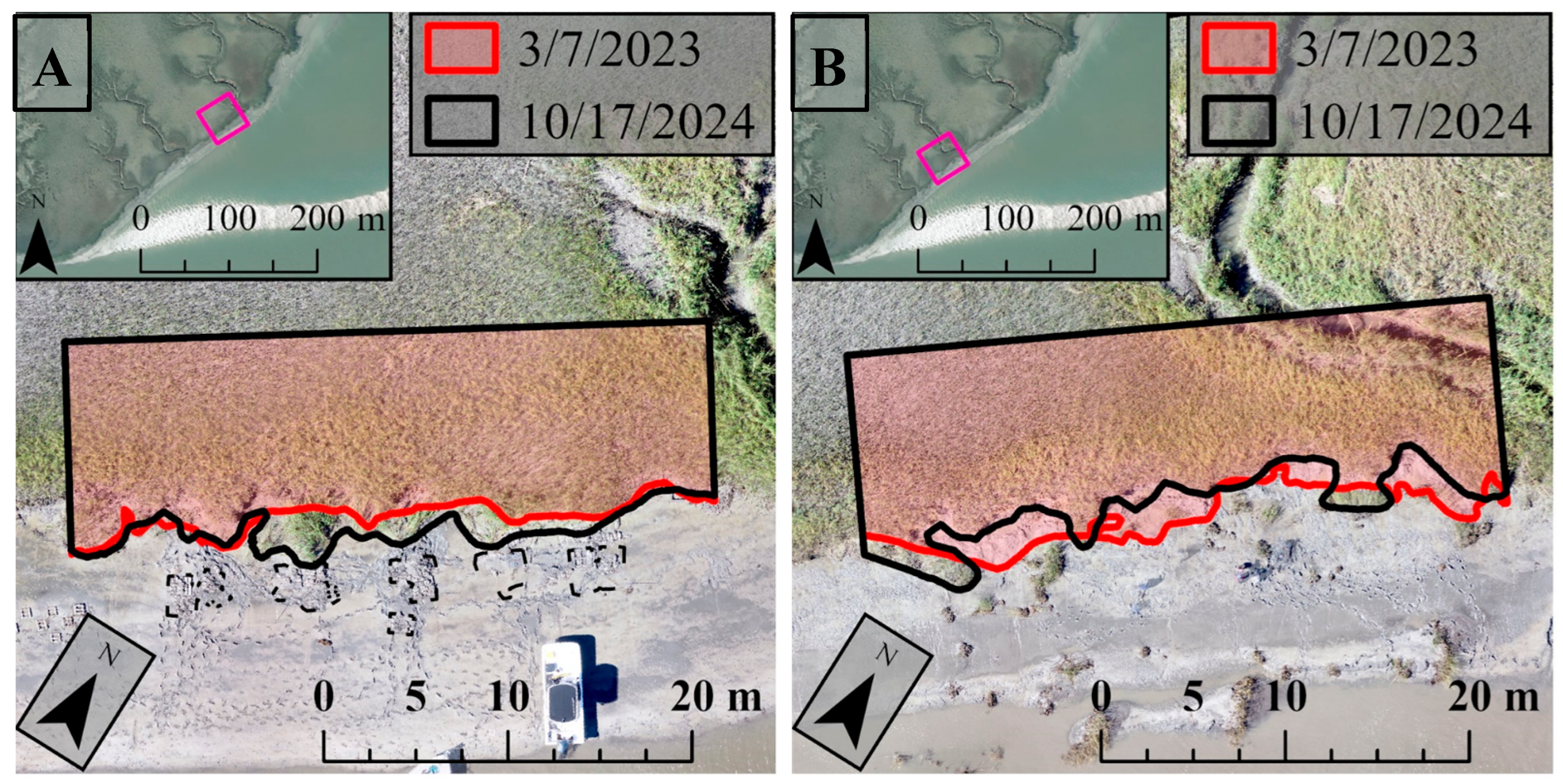
Salt marsh area and shoreline location at the three restoration sites and two control sites in this study were estimated 5, 8, and 13 months following shell bag deployment from the reference marsh edge location estimated 6 months prior to restoration. As expected, marsh edge movement was impacted by shell bag restoration on the island. On the eastern exposed sizes salt marsh area increased 53.1 ± 4.1 m2 (mean ± RMSE) at the restored reef site but decreased by over 20 m2 at the no-reef control site (Table 1, Figure 3).
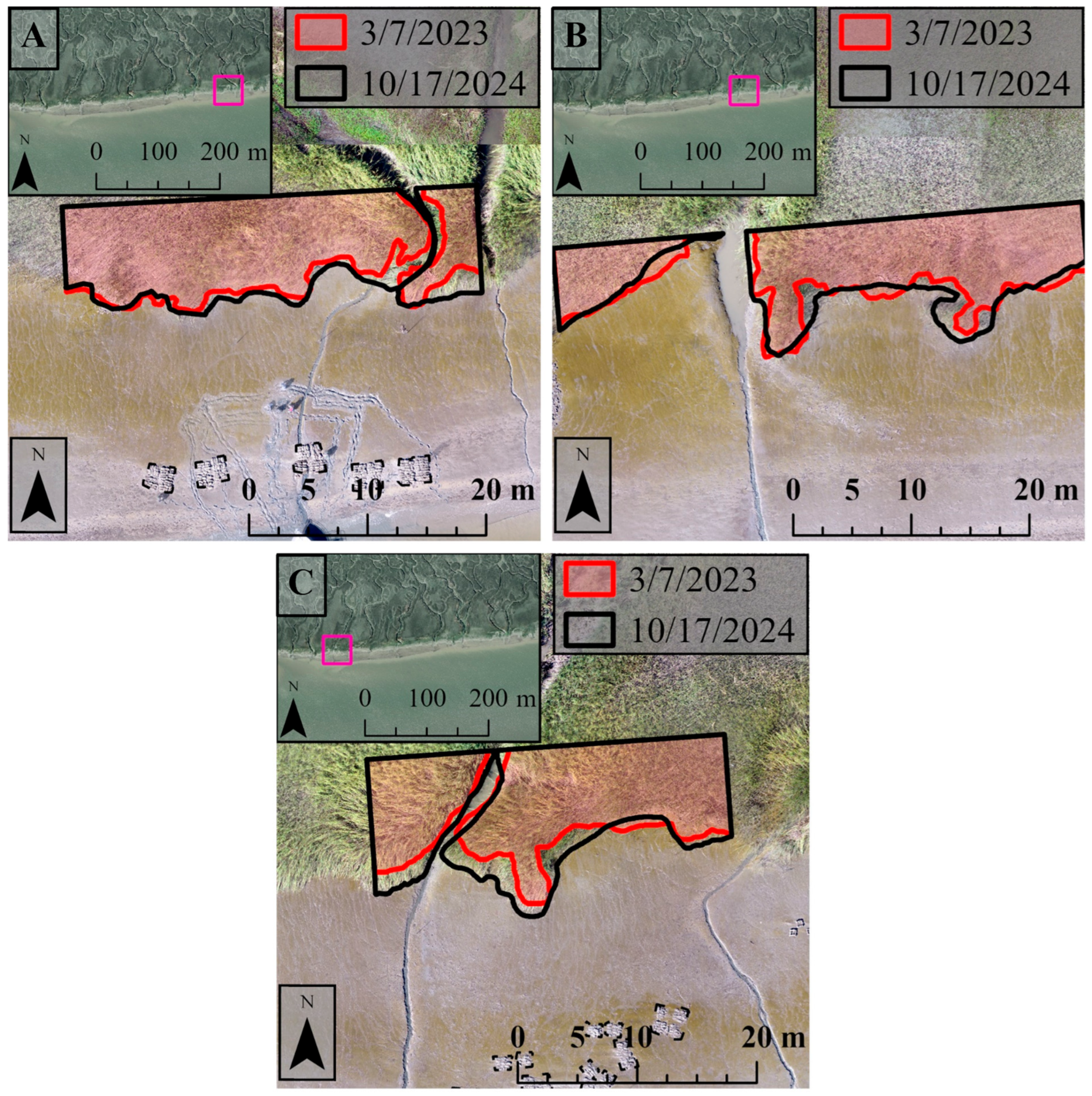
Although the marsh edge migrated seaward and marsh area expanded at both restoration and control sites along the southern edge of the island, the increase in marsh area was ~2× higher at both restoration sites than the no-reef control (Table 1, Figure 4). Likewise, seaward migration of the marsh edge was 2–3× higher at restoration sites than the control site (Table 1).
The rate of change was not consistent across sites and time points (Table 1). On the exposed eastern flank of the island, the period with the greatest growth in salt marsh area was the 11-month period between March 2023 and February 2024, with the restoration and control site growing by 34.8 ± 4.7 and 38.3 ± 4.0 m2, respectively. On the more sheltered, western sites the greatest growth was found to have occurred later in 2024, from February to May and May to October. During the May to October 2024 period, both control sites experienced habitat losses of ~55 and 7 m2 at the eastern and southern sites, respectively. Similar losses were not observed in the restoration sites during this same period; rather, all restoration sites experienced marsh area growth between 15 and 28 m2 (Table 1).
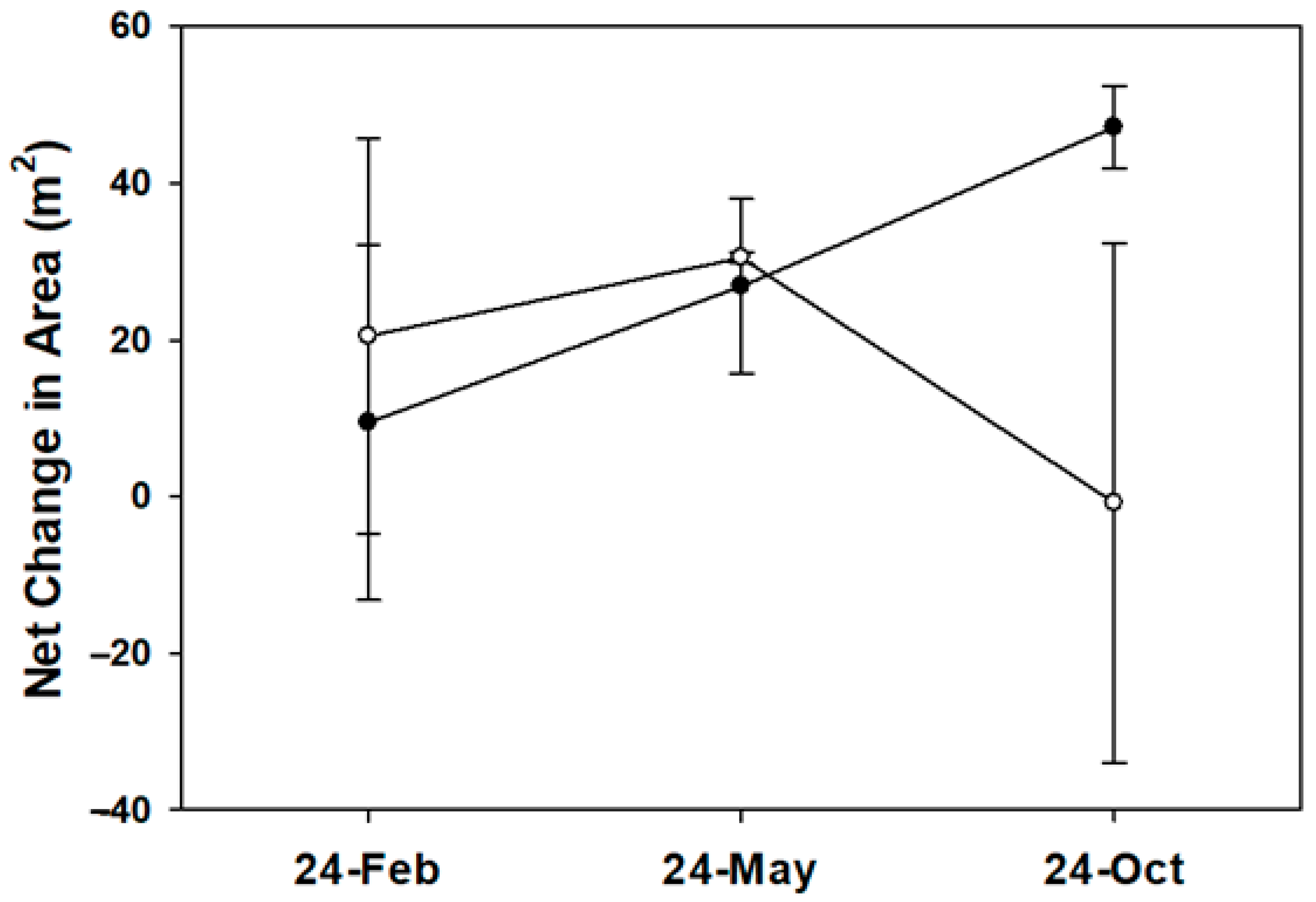
Overall, the marsh at the three restoration locations migrated 1.42 ± 0.13 m seaward towards shell bags, and marsh area increased by 47.0 ± 5.2 m2, highlighting relatively consistent net positive increases at restoration sites regardless of location (Figure 5). Control sites were much more variable based on location, resulting in minimal net change in marsh area or edge location across both control sites (Figure 5).

4. Discussion

For salt marshes to expand over time, they must be able to migrate horizontally into new areas at a greater rate than what is being lost due to factors such as erosion. For managers, a technique commonly used to help prevent erosion and increase sediment accretion is the creation of fringing oyster reefs adjacent to marsh shorelines. In this study, three restoration sites were established on the NNR Island in September 2023 through deployment of bagged recycled oyster shells. By October 2024, oyster spat was found to have recruited on shell bags at each restoration site (Georgia DNR, unpublished data), suggesting that the shell bags are attracting new oyster recruits. Measuring the marsh edge expansion at all shell bag sites showed an overall net increase in marsh area at all three restoration sites, regardless of location. By one year post restoration, marsh area increased at similar rates behind all three restored reefs due to consistent seaward expansion of the marsh edge. For control sites, marsh changes were much more variable; the sheltered site experienced a net increase in marsh area while the exposed site experienced a net decrease in marsh area, although both control sites did also experience periods of growth and erosion throughout the study period. Overall, this study provides support that the establishment of oyster reefs adjacent to marsh edges can serve to both increase marsh area and prevent erosion. However, further monitoring of salt marsh area change at the NNR sites beyond the observations in this pilot-scale study and comparison to other established oyster reef projects in Georgia is needed to determine if these observations are driven by oyster reef’s role in shoreline stabilization and sediment accretion [54,55].
Although the overall change at restoration sites was similar, the spatiotemporal difference in the timing of marsh expansion suggests that different or lagged environmental factors may be influencing salt marsh edge expansion on either side of the island. Major factors influencing vertical and horizontal growth in salt marshes include suspended sediment availability [56,57,58], riverine discharge [59,60], and wave exposure [61,62,63], which all vary with time and space. Along the Georgia coastline, total suspended sediment has been found to follow similar seasonal patterns as riverine discharge, with highest rates occurring during the winter months (January to April), steadily decreasing by the end of spring in June [60]. Riverine discharge is a source for new sediment inputs and has been shown to have a positive correlation with salt marsh horizontal migration in Georgia [60]. If riverine discharge is a major driver of sediment flux trends for marsh expansion in this region, it is expected marsh growth would be observed during and after periods of high discharge. Marsh expansion was observed at the NNR Island restoration sites from winter to spring; however, marsh expansion also occurred across all restoration sites at almost every timepoint, suggesting that the reefs were effective at trapping sediments throughout the year, allowing for horizontal marsh expansion [64]. Future monitoring efforts of restored oyster reefs should consider including seasonal sediment accretion rates to determine the impact these features have on sediment capture and its relationship to horizontal marsh migration.
Additionally, we observed drastic differences between marsh area and edge location at the restoration and control site along the more exposed eastern shore of the island. Particularly, the greatest loss of salt marsh area observed in this study was observed in the eastern control site in the five-month period from May to October 2024, in which the salt marsh lost 55 m2 of vegetation. During this period, Georgia experienced multiple hurricanes, including Debby, Helene, and Milton. While this shore already experiences high wave energy, particularly during the summer and fall when winds are predominantly from the south and southeast, large storm events that generate wind waves and storm surge can lead to large erosion events in coastal habitats [65]. High wave energy erodes sediment from the marsh edge, creating a scarp as plant roots help to hold sediment around the plant in place [66]. When erosion occurs below plant roots, parts of the marsh edge may break away, forming a slump block [67], which were observed at the eastern control site during the October surveys. However, we observed a 15 m2 increase in salt marsh area from the nearby restoration site over the same period, and no slump blocks formed at the restoration site, suggesting the reef created an effective breakwater [68]. The increased salt marsh horizontal migration observation in this study aligns with past research findings, suggesting salt marshes are effective buffer zones in areas experiencing major erosion due to challenging hydrodynamic conditions from storms and high wave energy [54,55].
The ability of oyster reefs to stabilize shorelines also appears to facilitate the recruitment and growth of emergent marsh vegetation. All restoration sites in this study were found to have increased salt marsh edge expansion in the year following shell bag deployment compared to nearby control sites at the NNR Island, and expansion occurred primarily behind the shell bag pallets. Oyster reefs act as natural breakwaters, attenuating wave energy, reducing shoreline erosion, and leading to sediment deposition [54,69,70]. The UAV imagery from this study clearly demonstrated that the restored reef at the exposed shoreline prevented erosion; this observed erosion control aligns well with the findings in other studies in the southeastern US, which showed that oyster reefs or breakwaters can significantly reduce oncoming wave energy, potentially avoiding erosion at the marsh edge [30] and promoting horizontal expansion towards the shoreline [54]. Continued monitoring will be needed to determine if the relatively consistent marsh expansion observed at the restoration sites continues, as previous oyster reef restoration work has found that higher wave energy environments, like the easternmost restoration site in this work, were unable to significantly slow the rate of marsh edge erosion over time [34]. Although we did not measure changes in elevation in this study, the migration of the marsh edge toward the oyster reefs at restoration sites suggests that accretion behind the reefs increased elevation to a suitable level for marsh expansion [54]. Thus, the restoration of oyster reefs provides a dual benefit—the reefs themselves promote biodiversity and ecosystem functioning [69,71], and by protecting shorelines from erosion, oyster reefs also support the maintenance and enhancement of adjacent marsh systems [55].
Despite the promising overall patterns observed, there are limitations to this study. Most importantly, the low replication precluded any robust statistical comparisons, and instead, limited this to an observational study, as is a challenge with pilot-scale projects [72] that are often required to provide valuable information for managers and build stakeholder relationships [73,74]. The logistical challenges of site access and timing around tides during deployment of the reefs led to slightly different reef footprints across the restoration sites, and the reef design and spacing used may not be comparable to restoration techniques in other locations. The differences in the geology and physics of the two locations on a relatively small marsh island were likely important drivers of the high variability in marsh area change at the control sites. Finally, it is necessary to monitor for change across several ‘anniversary’ timepoints to establish long-term horizontal migration; however, most restoration projects include monitoring over short time periods. Regardless of the challenges and limitations, marshes behind restored reefs grew at remarkably similar rates despite the different locations, highlighting that oyster reef restoration and enhancement efforts facilitate the expansion of coastal marsh habitats. Future research should develop predictive models for marsh enhancement by incorporating data from more restored reefs of different shapes and sizes, and including important variables that could affect both oyster and marsh establishment during restoration, such as reef location within the tidal prism [75,76], distance from the marsh edge [77,78], wind patterns and fetch [33,34], and a broader geographic scope to develop a more mechanistic understanding of oyster reef restoration impacts on coastal marshes.

5. Conclusions

Restoring oyster reefs is an effective method for shoreline stabilization and sediment accumulation, leading to horizontal marsh expansion. The presence of oyster reefs on creek banks reduces erosion [29,30] and increases sediment accretion [31], and since oyster reefs may be able to grow vertically at a rate that outpaces sea level rise [32], reefs provide a powerful tool to protect shorelines. The positive impacts of reefs on shorelines underscore the importance of oyster reef restoration into coastal management strategies, including improving marsh resilience against climate related stressors [79] and enhancing ecosystem services, including blue carbon [80]. However, to ensure these strategies are effective, shoreline and marsh change must be quantified over time. Traditional monitoring efforts are often effective but labor-intensive and costly, potentially destructive to habitats, and difficult to replicate at large spatial and/or temporal scales, so emerging technologies (i.e., drones), present a more effective mechanism to exploring shoreline change. Using aerial imagery from UAV, this study demonstrates that even pilot-scale restoration projects are effective at increasing marsh area, maintaining marsh growth, and preventing erosion, providing valuable information for coastal managers and restoration practitioners in Georgia and throughout the southeastern US.

Author Contributions

Conceptualization, Z.C., C.B. and J.M.C.; methodology, Z.C., N.B., C.B. and J.M.C.; validation, Z.C. and C.B.; formal analysis, Z.C.; investigation, Z.C., C.B. and N.B.; data curation, Z.C. and C.B.; writing—original draft preparation, Z.C. and J.M.C.; writing—review and editing, Z.C., C.B. and J.M.C.; project administration, J.M.C.; funding acquisition, J.M.C. All authors have read and agreed to the published version of the manuscript.

Funding

This research was funded by Yamaha Rightwaters. Yamaha Rightwaters is a national sustainability program encompassing all of Yamaha Marine’s conservation and water quality efforts. Program initiatives include habitat restoration, support for scientific research, mitigation of invasive species, reduction in marine debris, and environmental stewardship education. Yamaha Rightwaters reinforces Yamaha’s long-standing history of natural resource conservation, support of sustainable recreational fishing and water resources, and the Angler Code of Ethics, which requires pro anglers to adhere to principles of stewardship for all marine resources.

Institutional Review Board Statement

Not applicable.

Data Availability Statement

The raw data supporting the conclusions of this article will be made available by the authors on request.

Acknowledgments

We would like to acknowledge Kyle Mundy, Luke Sundquist, Allie Radeuge, Amanda Conner, Chessie Craig, Analee Love, Brigette Brinton, and Laura Treible for assistance in making shell bags; Wil Atencio for assistance with reef deployment; and Jessie Rivera, Reyes Umanzor Jr., Aubry Shaw, Brianna Nicholson, and Alaina Shepardson for post-restoration sampling. We would like to thank Paul Medders at the Georgia Department of Natural Resources for guidance and assistance in deploying the shell bag reefs.

Conflicts of Interest

The authors declare no conflicts of interest. The funders had no role in the design of the study; in the collection, analyses, or interpretation of data; in the writing of the manuscript; or in the decision to publish the results.

Abbreviations

The following abbreviations are used in this manuscript:
GA DNRGeorgia’s Department of Natural Resources
UAVUnmanned Aerial Vehicle
NNRNorth Newport River
GLIGreen Leaf Index
RMSERoot Mean Square Error

References

  1. Weis, J.; Segarra, K.; Bernal, P. Salt Marshes. In The First Global Integrated Marine Assessment; World Ocean Assessment I: New York, NY, USA, 2016; pp. 1–9. [Google Scholar]
  2. Mcowen, C.; Weatherdon, L.; Bochove, J.-W.; Sullivan, E.; Blyth, S.; Zockler, C.; Stanwell-Smith, D.; Kingston, N.; Martin, C.; Spalding, M.; et al. A Global Map of Saltmarshes. Biodivers. Data J. 2017, 5, e11764. [Google Scholar] [CrossRef]
  3. Sousa, A.I.; Lillebø, A.I.; Pardal, M.A.; Caçador, I. Productivity and Nutrient Cycling in Salt Marshes: Contribution to Ecosystem Health. Estuar. Coast. Shelf Sci. 2010, 87, 640–646. [Google Scholar] [CrossRef]
  4. Bowen, J.L.; Spivak, A.C.; Bernhard, A.E.; Fulweiler, R.W.; Giblin, A.E. Salt Marsh Nitrogen Cycling: Where Land Meets Sea. Trends Microbiol. 2024, 32, 565–576. [Google Scholar] [CrossRef]
  5. Möller, I.; Kudella, M.; Rupprecht, F.; Spencer, T.; Paul, M.; Van Wesenbeeck, B.K.; Wolters, G.; Jensen, K.; Bouma, T.J.; Miranda-Lange, M.; et al. Wave Attenuation over Coastal Salt Marshes under Storm Surge Conditions. Nat. Geosci. 2014, 7, 727–731. [Google Scholar] [CrossRef]
  6. Mudd, S.M.; D’Alpaos, A.; Morris, J.T. How Does Vegetation Affect Sedimentation on Tidal Marshes? Investigating Particle Capture and Hydrodynamic Controls on Biologically Mediated Sedimentation. J. Geophys. Res. 2010, 115, 2009JF001566. [Google Scholar] [CrossRef]
  7. Gedan, K.B.; Kirwan, M.L.; Wolanski, E.; Barbier, E.B.; Silliman, B.R. The Present and Future Role of Coastal Wetland Vegetation in Protecting Shorelines: Answering Recent Challenges to the Paradigm. Clim. Change 2010, 106, 7–29. [Google Scholar] [CrossRef]
  8. Manis, J.E.; Garvis, S.K.; Jachec, S.M.; Walters, L.J. Wave Attenuation Experiments over Living Shorelines over Time: A Wave Tank Study to Assess Recreational Boating Pressures. J. Coast. Conserv. 2015, 19, 1–11. [Google Scholar] [CrossRef]
  9. Cahoon, D.R.; McKee, K.L.; Morris, J.T. How Plants Influence Resilience of Salt Marsh and Mangrove Wetlands to Sea-Level Rise. Estuaries Coasts 2021, 44, 883–898. [Google Scholar] [CrossRef]
  10. Chmura, G.L.; Anisfeld, S.C.; Cahoon, D.R.; Lynch, J.C. Global Carbon Sequestration in Tidal, Saline Wetland Soils. Glob. Biogeochem. Cycles 2003, 17, 2002GB001917. [Google Scholar] [CrossRef]
  11. Duarte, C.M.; Losada, I.J.; Hendriks, I.E.; Mazarrasa, I.; Marbà, N. The Role of Coastal Plant Communities for Climate Change Mitigation and Adaptation. Nat. Clim. Change 2013, 3, 961–968. [Google Scholar] [CrossRef]
  12. Oppenheimer, M.; Glavovic, B.C.; Hinkel, J.; Van De Wal, R.S.W.; Magnan, A.K.; Abd-Elgawad, A.; Cai, R.; Cifuentes-Jara, M.; DeConto, R.M.; Ghosh, T.; et al. Sea Level Rise and Implications for Low-Lying Islands, Coasts and Communities. In IPCC Special Report on the Ocean and Cryosphere in a Changing Climate, 1st ed.; Pörtner, H.-O., Roberts, D.C., Masson-Delmotte, V., Zhai, P., Tignor, M., Poloczanska, E., Mintenbeck, K., Alegría, A., Nicolai, M., Okem, A., et al., Eds.; Cambridge University Press: Cambridge, UK, 2022. [Google Scholar]
  13. Redfield, A.C. Development of a New England Salt Marsh. Ecol. Monogr. 1972, 42, 201–237. [Google Scholar] [CrossRef]
  14. Morris, J.T.; Sundareshwar, P.V.; Nietch, C.T.; Kjerfve, B.; Cahoon, D.R. Responses of Coastal Wetlands to Rising Sea Level. Ecology 2002, 83, 2869–2877. [Google Scholar] [CrossRef]
  15. Reed, D.J. Sea-Level Rise and Coastal Marsh Sustainability: Geological and Ecological Factors in the Mississippi Delta Plain. Geomorphology 2002, 48, 233–243. [Google Scholar] [CrossRef]
  16. Campbell, A.D.; Fatoyinbo, L.; Goldberg, L.; Lagomasino, D. Global Hotspots of Salt Marsh Change and Carbon Emissions. Nature 2022, 612, 701–706. [Google Scholar] [CrossRef]
  17. Hartig, E.K.; Gornitz, V.; Kolker, A.; Mushacke, F.; Fallon, D. Anthropogenic and Climate-Change Impacts on Salt Marshes of Jamaica Bay, New York City. Wetlands 2002, 22, 71–89. [Google Scholar] [CrossRef]
  18. Portnoy, J.W.; Giblin, A.E. Effects of Historic Tidal Restrictions on Salt Marsh Sediment Chemistry. Biogeochemistry 1997, 36, 275–303. [Google Scholar] [CrossRef]
  19. Mariotti, G.; Carr, J. Dual Role of Salt Marsh Retreat: Long-term Loss and Short-term Resilience. Water Resour. Res. 2014, 50, 2963–2974. [Google Scholar] [CrossRef]
  20. Ensign, S.H.; Halls, J.N.; Peck, E.K. Watershed Sediment Cannot Offset Sea Level Rise in Most US Tidal Wetlands. Science 2023, 382, 1191–1195. [Google Scholar] [CrossRef]
  21. Doody, J.P. “Coastal Squeeze”: An Historical Perspective. J. Coast. Conserv. 2004, 10, 129–138. [Google Scholar] [CrossRef]
  22. Morris, J.T.; Edwards, J.; Crooks, S.; Reyes, E. Assessment of Carbon Sequestration Potential in Coastal Wetlands. In Recarbonization of the Biosphere; Lal, R., Lorenz, K., Hüttl, R.F., Schneider, B.U., Von Braun, J., Eds.; Springer: Dordrecht, The Netherlands, 2012; pp. 517–531. [Google Scholar]
  23. Kirwan, M.L.; Walters, D.C.; Reay, W.G.; Carr, J.A. Sea Level Driven Marsh Expansion in a Coupled Model of Marsh Erosion and Migration. Geophys. Res. Lett. 2016, 43, 4366–4373. [Google Scholar] [CrossRef]
  24. Schuerch, M.; Spencer, T.; Temmerman, S.; Kirwan, M.L.; Wolff, C.; Lincke, D.; McOwen, C.J.; Pickering, M.D.; Reef, R.; Vafeidis, A.T.; et al. Future Response of Global Coastal Wetlands to Sea-Level Rise. Nature 2018, 561, 231–234. [Google Scholar] [CrossRef]
  25. Langston, A.K.; Alexander, C.R.; Alber, M.; Kirwan, M.L. Beyond 2100: Elevation Capital Disguises Salt Marsh Vulnerability to Sea-Level Rise in Georgia, USA. Estuar. Coast. Shelf Sci. 2021, 249, 107093. [Google Scholar] [CrossRef]
  26. Concannon, T.; Hussain, M.; Hudgens, D.; Titus, J.G. The Likelihood of Shore Protection Along the Atlantic Coast of the United States; Titus, J., Trescott, D., Hudgens, D., Eds.; US Environmental Protection Agency: Washington, DC, USA, 2010; p. 70.
  27. Coen, L.; Brumbaugh, R.; Bushek, D.; Grizzle, R.; Luckenbach, M.; Posey, M.; Powers, S.; Tolley, S. Ecosystem Services Related to Oyster Restoration. Mar. Ecol. Prog. Ser. 2007, 341, 303–307. [Google Scholar] [CrossRef]
  28. Schulte, D.M.; Burke, R.P.; Lipcius, R.N. Unprecedented Restoration of a Native Oyster Metapopulation. Science 2009, 325, 1124–1128. [Google Scholar] [CrossRef]
  29. Fivash, G.S.; Stüben, D.; Bachmann, M.; Walles, B.; Van Belzen, J.; Didderen, K.; Temmink, R.J.M.; Lengkeek, W.; Van Der Heide, T.; Bouma, T.J. Can We Enhance Ecosystem-Based Coastal Defense by Connecting Oysters to Marsh Edges? Analyzing the Limits of Oyster Reef Establishment. Ecol. Eng. 2021, 165, 106221. [Google Scholar] [CrossRef]
  30. Roney, S.H.; Haas, K.; Bliss, T.; Weissburg, M.J. Restored Oyster Reefs Function as Living Shorelines to Reduce Wave Energy in Intertidal Marshes. Ecol. Eng. 2025, 221, 107774. [Google Scholar] [CrossRef]
  31. Whitman, E.; Reidenbach, M. Benthic Flow Environments Affect Recruitment of Crassostrea Virginica Larvae to an Intertidal Oyster Reef. Mar. Ecol. Prog. Ser. 2012, 463, 177–191. [Google Scholar] [CrossRef]
  32. Rodriguez, A.B.; Fodrie, F.J.; Ridge, J.T.; Lindquist, N.L.; Theuerkauf, E.J.; Coleman, S.E.; Grabowski, J.H.; Brodeur, M.C.; Gittman, R.K.; Keller, D.A.; et al. Oyster Reefs Can Outpace Sea-Level Rise. Nat. Clim. Change 2014, 4, 493–497. [Google Scholar] [CrossRef]
  33. Meyer, D.L.; Townsend, E.C.; Thayer, G.W. Stabilization and Erosion Control Value of Oyster Cultch for Intertidal Marsh. Restor. Ecol. 1997, 5, 93–99. [Google Scholar] [CrossRef]
  34. Piazza, B.P.; Banks, P.D.; La Peyre, M.K. The Potential for Created Oyster Shell Reefs as a Sustainable Shoreline Protection Strategy in Louisiana. Restor. Ecol. 2005, 13, 499–506. [Google Scholar] [CrossRef]
  35. Gittman, R.K.; Peterson, C.H.; Currin, C.A.; Joel Fodrie, F.; Piehler, M.F.; Bruno, J.F. Living Shorelines Can Enhance the Nursery Role of Threatened Estuarine Habitats. Ecol. Appl. 2016, 26, 249–263. [Google Scholar] [CrossRef] [PubMed]
  36. Terando, A.J.; Costanza, J.; Belyea, C.; Dunn, R.R.; McKerrow, A.; Collazo, J.A. The Southern Megalopolis: Using the Past to Predict the Future of Urban Sprawl in the Southeast US. PLoS ONE 2014, 9, e102261. [Google Scholar] [CrossRef] [PubMed]
  37. Sweet, W.; Kopp, R.; Weaver, C.; Obeysekera, J.; Horton, R.; Thieler, E.; Zervas, C. Global and Regional Sea Level Rise Scenarios for the United States; NOAA/NOS Center for Operational Oceanographic Products and Services: Silver Spring, MD, USA, 2017.
  38. Craft, C.; Clough, J.; Ehman, J.; Joye, S.; Park, R.; Pennings, S.; Guo, H.; Machmuller, M. Forecasting the Effects of Accelerated Sea-level Rise on Tidal Marsh Ecosystem Services. Front. Ecol. Environ. 2009, 7, 73–78. [Google Scholar] [CrossRef]
  39. Manley, J.; Walker, R. Condition Index for Georgia Oysters. Occas. Pap. Univ. Ga. Mar. Ext. Serv. 2011, 12, 1–9. Available online: https://repository.library.noaa.gov/view/noaa/35167/noaa_35167_DS1.pdf (accessed on 28 September 2025).
  40. Geesin, M.E.; Tso, G.L.; Sirianni, H.; Narayan, S.; Baillie, C.J.; Malali, P.D.; Puckett, B.J.; Ridge, J.T.; Gittman, R.K. Assessing the Effects of Engineered Oyster Reefs on Shoreline Change Using Drones. Front. Ecol. Evol. 2025, 13, 1616227. [Google Scholar] [CrossRef]
  41. Alexander, C.; Hladik, C. High-Resolution Mapping of Vegetation, Elevation, Salinity and Bathymetry to Advance Coastal Habitat Management in Georgia; Georgia Coastal Management Program: Brunswick, GA, USA, 2015. [Google Scholar]
  42. Doughty, C.L.; Cavanaugh, K.C. Mapping Coastal Wetland Biomass from High Resolution Unmanned Aerial Vehicle (UAV) Imagery. Remote Sens. 2019, 11, 540. [Google Scholar] [CrossRef]
  43. Haskins, J.; Endris, C.; Thomsen, A.S.; Gerbl, F.; Fountain, M.C.; Wasson, K. UAV to Inform Restoration: A Case Study From a California Tidal Marsh. Front. Environ. Sci. 2021, 9, 642906. [Google Scholar] [CrossRef]
  44. Pinton, D.; Canestrelli, A.; Wilkinson, B.; Ifju, P.; Ortega, A. Estimating Ground Elevation and Vegetation Characteristics in Coastal Salt Marshes Using UAV-Based LiDAR and Digital Aerial Photogrammetry. Remote Sens. 2021, 13, 4506. [Google Scholar] [CrossRef]
  45. Curcio, A.C.; Peralta, G.; Aranda, M.; Barbero, L. Evaluating the Performance of High Spatial Resolution UAV-Photogrammetry and UAV-LiDAR for Salt Marshes: The Cádiz Bay Study Case. Remote Sens. 2022, 14, 3582. [Google Scholar] [CrossRef]
  46. Murray, N.J.; Worthington, T.A.; Bunting, P.; Duce, S.; Hagger, V.; Lovelock, C.E.; Lucas, R.; Saunders, M.I.; Sheaves, M.; Spalding, M.; et al. High-Resolution Mapping of Losses and Gains of Earth’s Tidal Wetlands. Science 2022, 376, 744–749. [Google Scholar] [CrossRef]
  47. Currin, H.M. Remote Sensing of Georgia Tidal Marsh Habitats Using Aerial Photography and Planetscope Satellite Imagery. Masters Thesis, Georgia Southern University, Statesboro, GA, USA, 2023. [Google Scholar]
  48. Wiegert, R.G.; Freeman, B.J. Tidal Salt Marshes of the Southeast Atlantic Coast: A Community Profile; Department of Interior: Washington, DC, USA, 1990.
  49. National Oceanic and Atmospheric Administration Tides & Currents—Datums for 8672875, Sunbury, Sunbury Channel GA. Available online: https://tidesandcurrents.noaa.gov/datums.html?datum=MLLW&units=1&epoch=0&id=8672875&name=Sunbury%2C+Sunbury+Channel&state=GA (accessed on 28 September 2025).
  50. National Oceanic and Atmospheric Administration Tides & Currents—Current Predictions for North Newport River Above Walburg Creek (ACT7656). Available online: https://tidesandcurrents.noaa.gov/noaacurrents/annual.html?id=ACT7656_1 (accessed on 28 September 2025).
  51. National Oceanic and Atmospheric Administration Tides & Currents—Current Predictions for North Newport River, Northwest of Johnson Creek (ACT 7661). Available online: https://tidesandcurrents.noaa.gov/noaacurrents/predictions.html?id=ACT7661_1 (accessed on 28 September 2025).
  52. National Oceanic and Atmospheric Administration Tides & Currents—Current Predictions for North Newport River, East Southeast of South Newport Cut (ACT 7666). Available online: https://tidesandcurrents.noaa.gov/noaacurrents/predictions.html?id=ACT7666_1 (accessed on 28 September 2025).
  53. Louhaichi, M.; Borman, M.M.; Johnson, D.E. Spatially Located Platform and Aerial Photography for Documentation of Grazing Impacts on Wheat. Geocarto Int. 2001, 16, 65–70. [Google Scholar] [CrossRef]
  54. Chowdhury, M.S.N.; Walles, B.; Sharifuzzaman, S.; Shahadat Hossain, M.; Ysebaert, T.; Smaal, A.C. Oyster Breakwater Reefs Promote Adjacent Mudflat Stability and Salt Marsh Growth in a Monsoon Dominated Subtropical Coast. Sci. Rep. 2019, 9, 8549. [Google Scholar] [CrossRef]
  55. McClenachan, G.M.; Donnelly, M.J.; Shaffer, M.N.; Sacks, P.E.; Walters, L.J. Does Size Matter? Quantifying the Cumulative Impact of Small-scale Living Shoreline and Oyster Reef Restoration Projects on Shoreline Erosion. Restor. Ecol. 2020, 28, 1365–1371. [Google Scholar] [CrossRef]
  56. Ladd, C.J.; Duggan-Edwards, M.F.; Bouma, T.J.; Pagès, J.F.; Skov, M.W. Sediment Supply Explains Long-term and Large-scale Patterns in Salt Marsh Lateral Expansion and Erosion. Geophys. Res. Lett. 2019, 46, 11178–11187. [Google Scholar] [CrossRef]
  57. Fagherazzi, S.; Mariotti, G.; Leonardi, N.; Canestrelli, A.; Nardin, W.; Kearney, W.S. Salt Marsh Dynamics in a Period of Accelerated Sea Level Rise. J. Geophys. Res. Earth Surf. 2020, 125, e2019JF005200. [Google Scholar] [CrossRef]
  58. Liu, Z.; Fagherazzi, S.; Li, J.; Cui, B. Mismatch between Watershed Effects and Local Efforts Constrains the Success of Coastal Salt Marsh Vegetation Restoration. J. Clean. Prod. 2021, 292, 126103. [Google Scholar] [CrossRef]
  59. Windom, H.L.; Palmer, J.D. Changing River Discharge and Suspended Sediment Transport to the Georgia Bight: Implications to Saltmarsh Sustainability. J. Coast. Res. 2022, 38, 512–522. [Google Scholar] [CrossRef]
  60. Mariotti, G.; Ceccherini, G.; Alexander, C.R.; Spivak, A. Centennial Changes of Salt Marsh Area in Coastal Georgia (USA) Related to Large-Scale Sediment Dynamics by River, Waves, and Tides. Estuaries Coasts 2024, 47, 1498–1516. [Google Scholar] [CrossRef]
  61. Callaghan, D.P.; Bouma, T.J.; Klaassen, P.; Van Der Wal, D.; Stive, M.J.F.; Herman, P.M.J. Hydrodynamic Forcing on Salt-Marsh Development: Distinguishing the Relative Importance of Waves and Tidal Flows. Estuar. Coast. Shelf Sci. 2010, 89, 73–88. [Google Scholar] [CrossRef]
  62. Houser, C. Relative Importance of Vessel-Generated and Wind Waves to Salt Marsh Erosion in a Restricted Fetch Environment. J. Coast. Res. 2010, 26, 230–240. [Google Scholar] [CrossRef]
  63. Tonelli, M.; Fagherazzi, S.; Petti, M. Modeling Wave Impact on Salt Marsh Boundaries. J. Geophys. Res. Ocean 2010, 115, C09028. [Google Scholar] [CrossRef]
  64. Southwell, M.; Veenstra, J.; Adams, C.; Scarlett, E.; Payne, K. Changes in Sediment Characteristics upon Oyster Reef Restoration, NE Florida, USA. J. Coast. Zone Manag. 2017, 20, 1000442. [Google Scholar] [CrossRef]
  65. Mentaschi, L.; Vousdoukas, M.I.; Pekel, J.-F.; Voukouvalas, E.; Feyen, L. Global Long-Term Observations of Coastal Erosion and Accretion. Sci. Rep. 2018, 8, 12876. [Google Scholar] [CrossRef]
  66. Bendoni, M.; Francalanci, S.; Cappietti, L.; Solari, L. On Salt Marshes Retreat: Experiments and Modeling Toppling Failures Induced by Wind Waves. J. Geophys. Res. Earth Surf. 2014, 119, 603–620. [Google Scholar] [CrossRef]
  67. Yang, Z.; Alexander, C.; Alber, M. The Dynamics of Marsh-Channel Slump Blocks: An Observational Study Using Repeated Drone Imagery. Biogeosciences 2024, 21, 1757–1772. [Google Scholar] [CrossRef]
  68. Morris, R.L.; La Peyre, M.K.; Webb, B.M.; Marshall, D.A.; Bilkovic, D.M.; Cebrian, J.; McClenachan, G.; Kibler, K.M.; Walters, L.J.; Bushek, D.; et al. Large-scale Variation in Wave Attenuation of Oyster Reef Living Shorelines and the Influence of Inundation Duration. Ecol. Appl. 2021, 31, e02382. [Google Scholar] [CrossRef]
  69. Scyphers, S.B.; Powers, S.P.; Heck, K.L.; Byron, D. Oyster Reefs as Natural Breakwaters Mitigate Shoreline Loss and Facilitate Fisheries. PLoS ONE 2011, 6, e22396. [Google Scholar] [CrossRef]
  70. Wellman, E.H.; Baillie, C.J.; Puckett, B.J.; Donaher, S.E.; Trackenberg, S.N.; Gittman, R.K. Reef Design and Site Hydrodynamics Mediate Oyster Restoration and Marsh Stabilization Outcomes. Ecol. Appl. 2022, 32, e2506. [Google Scholar] [CrossRef]
  71. Powers, S.; Peterson, C.; Grabowski, J.; Lenihan, H. Success of Constructed Oyster Reefs in No-Harvest Sanctuaries: Implications for Restoration. Mar. Ecol. Prog. Ser. 2009, 389, 159–170. [Google Scholar] [CrossRef]
  72. Arain, M.; Campbell, M.J.; Cooper, C.L.; Lancaster, G.A. What Is a Pilot or Feasibility Study? A Review of Current Practice and Editorial Policy. BMC Med. Res. Methodol. 2010, 10, 67. [Google Scholar] [CrossRef]
  73. Benjamin, E.D.; Handley, S.J.; Hale, R.; Toone, T.A.; Jeffs, A.; Hillman, J.R. Biodiversity Associated with Restored Small-Scale Mussel Habitats Has Restoration Decision Implications. Biodivers. Conserv. 2022, 31, 2833–2855. [Google Scholar] [CrossRef]
  74. Zúniga, N.P.; Ballestero, R.M.; Schlüter, A.; Alvarado, J.J. Applying the SES Framework to Coral Reef Restoration Projects on the Pacific Coast of Costa Rica. Rev. Biol. Trop. 2023, 71, e54583. [Google Scholar] [CrossRef]
  75. Fodrie, F.J.; Rodriguez, A.B.; Baillie, C.J.; Brodeur, M.C.; Coleman, S.E.; Gittman, R.K.; Keller, D.A.; Kenworthy, M.D.; Poray, A.K.; Ridge, J.T.; et al. Classic Paradigms in a Novel Environment: Inserting Food Web and Productivity Lessons from Rocky Shores and Saltmarshes into Biogenic Reef Restoration. J. Appl. Ecol. 2014, 51, 1314–1325. [Google Scholar] [CrossRef]
  76. Carroll, J.M.; Dashiell, R.; Watts, J.C.; Hunter, E.A. Tidal Level Affects the Prevalence and Impacts of Pests and Parasites on Oysters (Crassostrea Virginica) on Intertidal Reefs in Georgia, USA. Mar. Biol. 2021, 168, 45. [Google Scholar] [CrossRef]
  77. Ridge, J.T.; Rodriguez, A.B.; Fodrie, F.J. Salt Marsh and Fringing Oyster Reef Transgression in a Shallow Temperate Estuary: Implications for Restoration, Conservation and Blue Carbon. Estuaries Coasts 2017, 40, 1013–1027. [Google Scholar] [CrossRef]
  78. Harris, R.D.; Blaze, J.A.; Byers, J.E. Facilitation between Two Dominant Ecosystem Engineers Extends Their Footprints and Degree of Overlap. J. Exp. Mar. Biol. Ecol. 2023, 568, 151944. [Google Scholar] [CrossRef]
  79. Bouma, T.J.; van Belzen, J.; Balke, T.; Zhu, Z.; Airoldi, L.; Blight, A.J.; Davies, A.J.; Galvan, C.; Hawkins, S.J.; Hoggart, S.P.G.; et al. Identifying Knowledge Gaps Hampering Application of Intertidal Habitats in Coastal Protection: Opportunities & Steps to Take. Coast. Eng. 2014, 87, 147–157. [Google Scholar] [CrossRef]
  80. Veenstra, J.; Southwell, M.; Dix, N.; Marcum, P.; Jackson, J.; Burns, C.; Herbert, C.; Kemper, A. High Carbon Accumulation Rates in Sediment Adjacent to Constructed Oyster Reefs, Northeast Florida, USA. J. Coast. Conserv. 2021, 25, 40. [Google Scholar] [CrossRef]
Figure 1. The location of the North Newport River along the Georgia USA coastline (A), an aerial image of the marsh island where the restoration project took place (B), the easternmost exposed restoration site (C), and the two southern protected sites (D,E). Basemap made using national shoreline data from the NOAA National Geodetic Survey’s Continually Updated Shoreline Product.
Diversity 18 00150 g001
Figure 2. Maps showing the location of the control sites on the North Newport River Island outlined in light blue along with nearby shell bag restoration sites outlined in red with black dashed lines, indicating the location of shell bags. The pink boxes in the inset show the location along the shoreline of the zoomed in areas for (A) the eastern control site and (B) the southern control site.
Diversity 18 00150 g002
Figure 3. Net change in salt marsh area over 19 months from March 2023 (shown in red) to October 2024 (shown in black) for restoration (A) and control (B) sites along the eastern, exposed side of the NNR Island. Pink boxes in insets show the area along the shoreline of the zoomed images.
Diversity 18 00150 g003
Figure 4. Net change in salt marsh area over 19 months from March 2023 (shown in red) to October 2024 (shown in black) for the restoration (A,C) and control (B) sites, along the southern side of the NNR Island. Pink boxes in insets show the area along the shoreline of the zoomed images.
Diversity 18 00150 g004
Figure 5. Net change in marsh area at each time point post-restoration relative to pre-restoration surveys. Filled circles represent restoration sites and open circles represent control sites. Error bars represent standard deviation of the mean net change.
Diversity 18 00150 g005
Table 1. Results of the changes in salt marsh vegetation area measured at the salt marsh edge between each time step. Net area change is the difference in salt marsh area between March 2023 and October 2024. Length of shoreline is the distance along the shoreline that was considered at each site. Net movement rate was determined by dividing the net area change by the length of shoreline at each site, and multiplying by 12 months divided by the study period length (19 months).
Site
Placement
SiteMar. 2023–
Feb. 2024
Feb. 2024–
May 2024
May 2024–
Oct. 2024
Net Area Change (m2)Shoreline Length (m)Movement Rate (m·yr−1)
EasternRestoration34.8 ± 4.73.3 ± 2.915.1 ± 1.953.1 ± 4.1351.52
Control38.3 ± 4.0−7.3 ± 1.9−55.3 ± 3.0−24.3 ± 4.935−0.69
SouthernEastern
Restoration
−9.1 ± 5.035.8 ± 4.517.7 ± 4.044.3 ± 4.5351.27
Control2.7 ± 7.127.3 ± 7.1−7.3 ± 7.522.8 ± 7.5450.51
Western
Restoration
2.6 ± 2.713.1 ± 4.728.1 ± 4.743.8 ± 2.7301.46
Disclaimer/Publisher’s Note: The statements, opinions and data contained in all publications are solely those of the individual author(s) and contributor(s) and not of MDPI and/or the editor(s). MDPI and/or the editor(s) disclaim responsibility for any injury to people or property resulting from any ideas, methods, instructions or products referred to in the content.