Article

First Record of Leiurus nigellus (Scorpiones: Buthidae) in Northern Saudi Arabia: Molecular and Morphological Insights from Ha’il Region, King Salman Bin Abdulaziz Royal Natural Reserve


by
Abdulaziz M. Al-Amri
1,2,
Mohammad A. Abdulhakeem
1,*,
Abdulaziz R. Alqahtani
3,
Ahmed M. Al-Malki
4 and
Wael M. Shohdi
4
1
King Salman Bin Abdulaziz Royal Natural Reserve Development Authority, Ha’il 55422, Saudi Arabia
2
Department of Biology, College of Science, King Saud University, Riyadh 12372, Saudi Arabia
3
Department of Biology, College of Science, University of Bisha, P.O. Box 551, Bisha 61922, Saudi Arabia
4
King Salman Bin Abdulaziz Royal Natural Reserve Development Authority, Riyadh 12213, Saudi Arabia
*
Author to whom correspondence should be addressed.
Diversity 2026, 18(3), 149; https://doi.org/10.3390/d18030149
Submission received: 13 January 2026 / Revised: 24 February 2026 / Accepted: 25 February 2026 / Published: 28 February 2026

Abstract

This study documents the first confirmed record of the Buthid scorpion Leiurus nigellus from Jabal Arnan in the Ha’il region, located within the King Salman Bin Abdulaziz Royal Natural Reserve (KSRNR) in the northwestern Kingdom of Saudi Arabia (KSA). This species was originally described by Abu Afifeh, Aloufi & Al-Saraireh (2023). This locality extends the known distribution range of L. nigellus by over 200 km southeast of the type locality in Al-Ula, Al Madinah province. A total of six specimens of L. nigellus were collected during fieldwork conducted between June 2024 and April 2025, including two adult males, one adult female, and three juveniles. The objective of this study was to confirm the taxonomic identity of Leiurus nigellus from a newly discovered locality using morphological examination and mitochondrial DNA analysis and documentation of its known geographic distribution. Adult specimens (one male and one female) were examined using comparative morphometric analysis following standard scorpion taxonomic protocols, confirming diagnostic traits consistent with the original species description. Meanwhile, habitat assessments indicated adaptation to semi-arid rocky and gravel substrates. Molecular analysis was conducted on one adult male using targeted mitochondrial 16S rRNA gene sequencing (Sanger method). Phylogenetic relationships were inferred using neighbor-joining and maximum-parsimony analyses, placing L. nigellus within the Arabian Leiurus clade with bootstrap-supported affinity to Arabian congeners and limited intraspecific divergence. The generated 16S rRNA sequence represents the first molecular record for L. nigellus and has been deposited in GenBank. Sexual dimorphism was evident in morphometric traits, but these differences reflect normal biological variation rather than taxonomic differentiation. The discovery of L. nigellus in northern Saudi Arabia emphasizes the importance of continued faunistic and genetic surveys in underexplored regions, both to refine species distributions and to inform conservation management of specialized desert arachnofauna.

1. Introduction

The Scorpion fauna in Saudi Arabia is diverse, with at least 36 confirmed species. These species belong to three families: Buthidae, Scorpionidae, and Hemiscorpiidae. Among these, the family Buthidae is the most species-rich and the most medically significant, including genera such as Androctonus Ehrenberg, 1828, Leiurus Ehrenberg, 1828, Buthacus Birula, 1908, Compsobuthus Vachon, 1949, and Orthochirus Karsch, 1891 [1,2,3,4,5,6].
The genus Leiurus was initially described in 1829 as a subgenus of Androctonus by [7]. For many years, it was considered monotypic, with Leiurus quinquestriatus Ehrenberg, 1828 considered the only recognized species. Nevertheless, the diversity of this genus has increasingly attracted research interest due to its medical importance [8,9]. Several previous publications predicted an increase in the number of Leiurus species, especially in the Middle East, which has recently been confirmed with the availability of more specimens [8,10,11].
At present, the total number of known Leiurus species is 22, distributed across North Africa and the Middle East [12,13]. Extensive studies have led to the description of many new species, replacing what was previously known as L. quinquestriatus in many areas of its original distribution range, including the Arabian Peninsula. In 2014, four new species were described in Saudi Arabia, in addition to other species discovered in subsequent years [8,14], including Leiurus nigellus, Abu Afifeh, Aloufi & Al-Saraireh 2023 [6].
The uniqueness of the species L. nigellus is associated with its particular color pattern. This species is predominantly blackish in color, a feature seldom encountered in this genus. Other Leiurus species exhibit a similar dark pattern: Leiurus ater, Lourenço, 2019 from Chad and Leiurus jordanensis, Lourenço, Modry & Amr, 2002 from Jordan and northwestern Saudi Arabia. Conversely, most other known species of Leiurus exhibit pale coloration, primarily characterized by yellow with varying degrees of darker markings [15,16]. This color distinction highlights the significance of L. nigellus as a scientific discovery. Diagnostic features include darker overall pigmentation, a narrower metasoma and pedipalp chelae, and strongly granulated ventrolateral carinae, distinguishing it from L. jordanensis and other congeners [8,17]. These traits, combined with its inclination for rocky habitats and shaded crevices, suggest ecological specialization and adaptation to microhabitats distinct from its sympatric Leiurus species. Previous studies also indicated that some populations in Saudi Arabia remain poorly defined [3,6,14], suggesting the possible existence of new distinct species, based on further morphological and molecular investigations [6,8].
Although coloration and patterns can assist in preliminary species recognition, they are primarily considered supporting diagnostic aspects rather than the basis of scientific significance. The taxonomic relevance of L. nigellus requires integrative morphological and molecular analyses to confirm species identity within a genus characterized by conservative morphology and diversity. The objectives of this study were threefold: (1) to document and morphologically verify the identity of L. nigellus from a new locality in the Ha’il region, (2) to provide the first molecular genetic data for this species using 16S rRNA gene sequencing and phylogenetic analysis, and (3) to assess morphological variation, sexual dimorphism, and the extent of the species’ geographic range. Through integrating morphological and molecular approaches, this study contributes to the growing understanding of Leiurus diversity in Saudi Arabia and provides baseline data for future population-level and phylogenomic studies.

2. Materials and Methods

2.1. Study Area and Data Collection

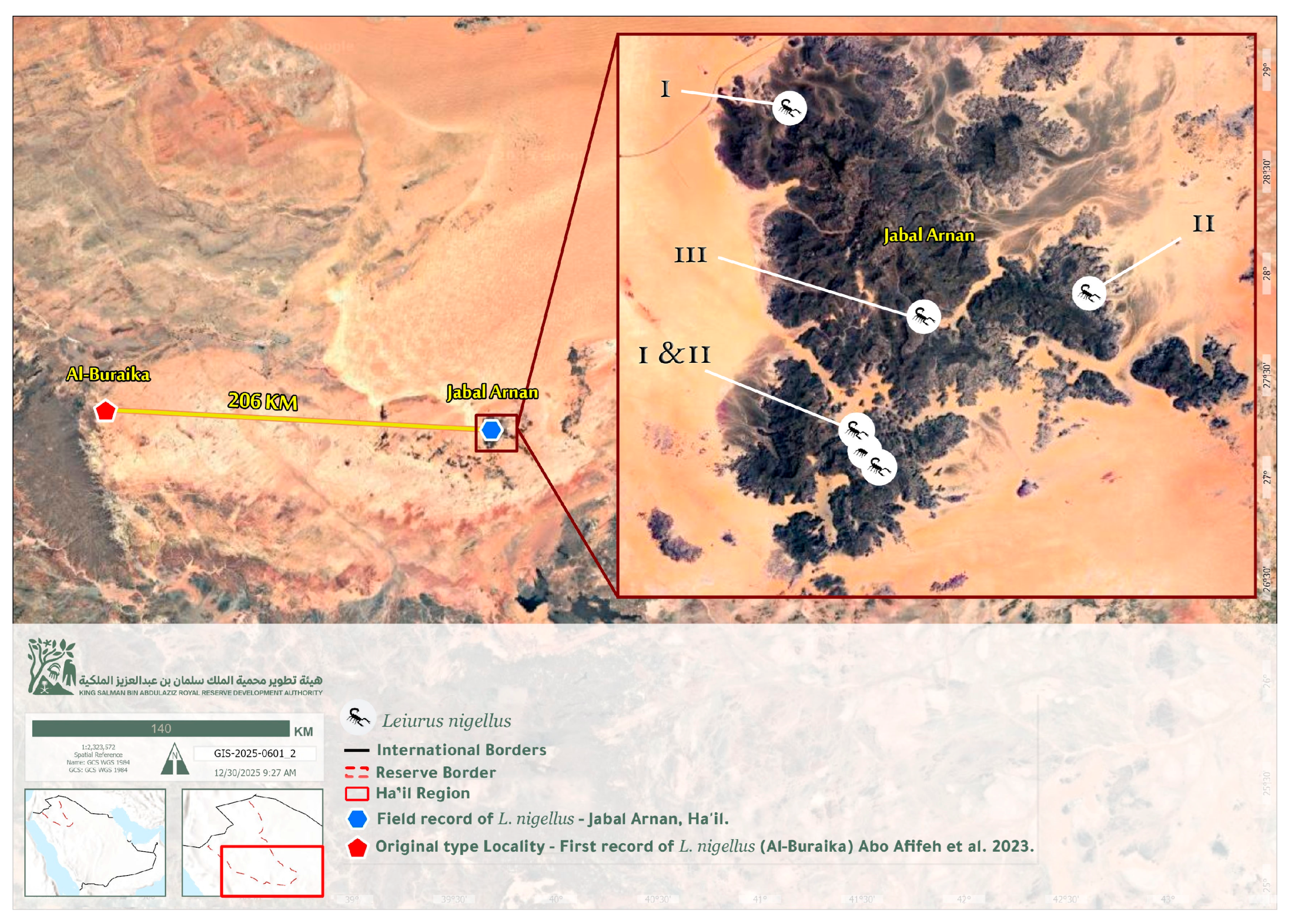
Fieldwork was conducted between June 2024 and April 2025 at Jabal Arnan, Ha’il Region, northwestern Saudi Arabia (27.174349° N, 39.685811° E; 1226 m), within the King Salman Bin Abdulaziz Royal Natural Reserve (KSRNR) (Figure 1). This is one of the largest protected areas in Saudi Arabia, covering an area of approximately 130,700 km2 and extending through the regions of Ha’il, Tabuk, Al-Jawf, and the Northern Borders. The reserve comprises a broad variety of habitats, including volcanic plateaus, sandstone mountains, gravel plains, sand dunes, and seasonal wadis, which together reflect the major habitat types according to the Habitat Classification of KSRNR [18].
The study area, Jabal Arnan in the Ha’il region, is semi-arid, with a landscape dominated by mountainous areas, rocky grounds, and wadis. These habitats provide the appropriate microhabitats for burrowing and ambush predators such as L. nigellus and offer rich assemblages of nocturnal fauna comprising arachnids, insects, and small mammals. All specimens were collected manually during nocturnal surveys using ultraviolet (UV) flashlights, which is the standard and most effective method for detecting scorpions in desert environments.
A total of six specimens of L. nigellus were collected from the field, including two adult males, one adult female, and three juvenile individuals. Specimens were temporarily retained for morphological examination, documentation, and measurement.

2.2. Morphological Examination

The collected specimens of L. nigellus were kept for morphometric measurements and analysis. While diagnostic characteristics were examined for all collected specimens to confirm their taxonomic identity, detailed morphometric measurements were specifically conducted on one representative adult male and one adult female. Juvenile specimens were under developed, and thus they were excluded from morphometric analyses. After documentation, specimens were released whenever possible in accordance with conservation guidelines applicable to protected areas. Morphological analysis followed standard scorpion taxonomy protocols [19], and diagnostic characteristics were examined under stereomicroscopy and compared directly with the original species description of L. nigellus [6]. Morphometric measurements were taken from live specimens using calibrated digital calipers, following the measurement protocols of [19]. To obtain consistency, repeated measurements were conducted. More stable and frequently observed values were recorded rather than considering the arithmetic mean calculations. Sexual dimorphism was assessed by direct comparison of adult male and female specimens.

2.3. Molecular Analysis (DNA Extraction and Sequencing)

A live adult male of L. nigellus was collected and subsequently euthanized by freezing. The specimen was preserved in 95% ethanol and stored at −18 °C for one month prior to analysis. The DNA was extracted from the entire pedipalps and purified using the Qiagen kit (Qiagen, Hilden, Germany) according to the manufacturer’s instructions. The 16S rRNA mitochondrial gene fragment was amplified using universal invertebrate primers: 16Sar (5′-CGCCTGTTTATCAAAAACAT-3′) and 16Sbr (5′-CTCCGGTTTGAACTCAGATCA-3′) [20]. PCR amplification was performed in 25 μL reactions containing 1× PCR buffer, 2.5 mM MgCl2, 0.2 mM dNTPs, 0.4 μM of each primer, 1 U Taq DNA polymerase, and approximately 50 ng template DNA. Thermal cycling conditions consisted of initial denaturation at 94 °C for 3 min; 35 cycles of 94 °C for 30 s, 48 °C for 45 s, and 72 °C for 1 min; and final extension at 72 °C for 7 min. PCR products were purified using ExoSAP-IT (USB Corporation, Cleveland, OH, USA) and sequenced in both directions on an ABI 3500 automated sequencer (Applied Biosystems, Foster City, CA, USA) using Sanger sequencing methodology.
Sequence editing was performed in BioEdit v. 7.2.5 [21]. The 16S rRNA sequence generated represents the first molecular record for L. nigellus and has been deposited in GenBank under accession number PX607344. This sequence was used for phylogenetic analysis along with additional sequences from related Leiurus species. Due to the conservation status and limited availability of specimens, molecular analysis was restricted to a single individual, with remaining specimens preserved for future morphological and ecological studies.

2.4. Phylogenetic Analysis

The newly generated sequence was combined with additional data for L. arabicus, Lowe, Yağmur & Kovařík, 2014 and L. haenggii, Lowe, Yağmur & Kovařík, 2014 from Saudi Arabia (provided by Prof. Abdulaziz Alqahtani; unpublished data, used with permission; see also [3]), together with Leiurus sequences from Egypt, Oman, and Turkey retrieved from GenBank. Androctonus crassicauda Olivier, 1807 was included as an out-group.
Sequences were aligned using ClustalW in MEGA v.11 [22]. Phylogenetic analyses of the 16S dataset (N = 18) were performed, following the method used by [3], employing maximum parsimony and neighbor-joining methods in PAUP* v.4 [23] with heuristic TBR branch swapping. Gaps were treated as missing data. Node support was evaluated using 1000 bootstrap replicates with random taxon addition [24]. Model selection was performed with MrModeltest v.2.3 [25] based on the Akaike Information Criterion [26].

3. Results and Discussion

3.1. Diagnosis

Diagnostic features of the Jabal Arnan specimens included a predominantly black coloration across the carapace, mesosoma, metasoma, telson, pedipalps, and proximal leg segments. Distal pedipalp fingers and legs were colored yellow to yellowish-brown. The carapace anterior margin was slightly concave, with strongly developed carinae; the central lateral and posterior median carinae fused into a lyre-shaped arrangement of granules. The slender, arched metasoma exhibited ten carinae on segments I–III, eight on segment IV, and seven on segment V.

3.2. Morphometric Analyses

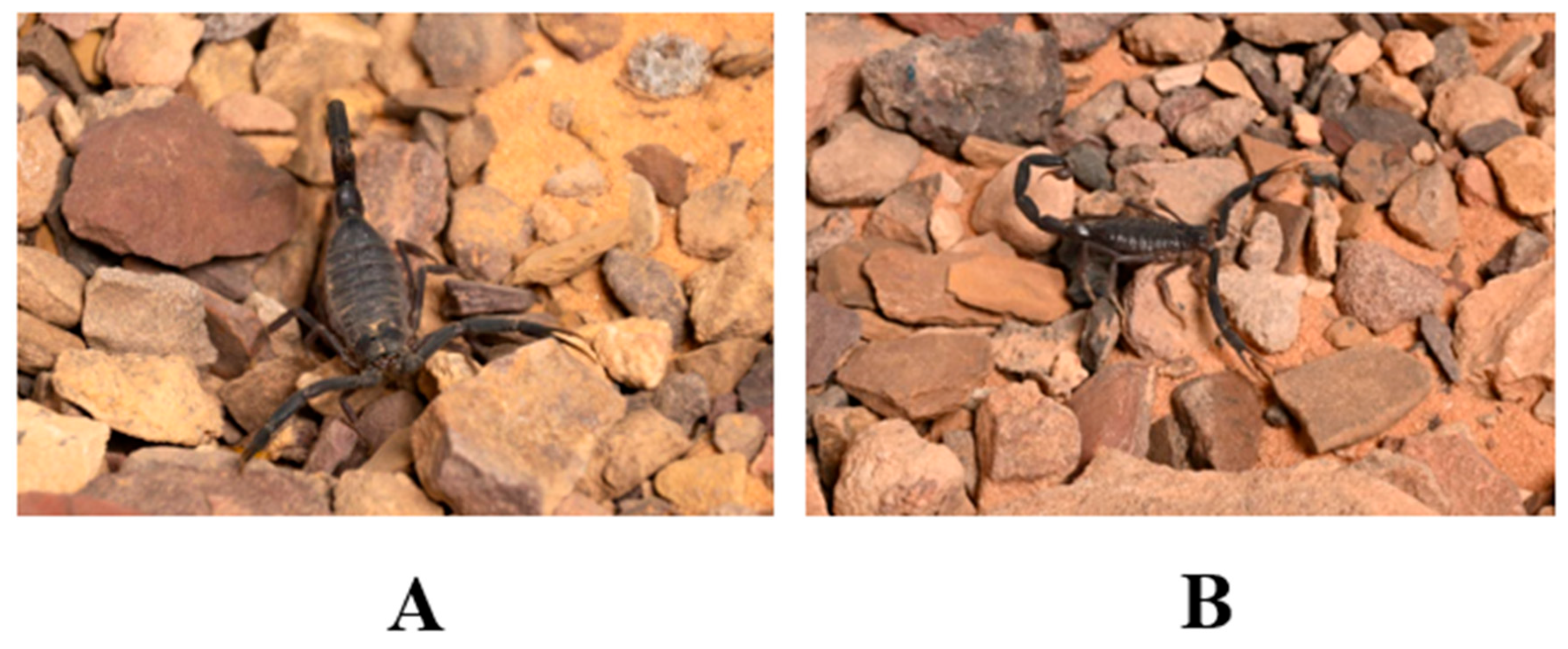
Morphometric analyses of the adult male and female L. nigellus from Jabal Arnan (Table 1; Figure 2) revealed clear sexual dimorphism, with females consistently exhibiting larger body dimensions than males. The total length reached 86.6 mm in females compared to 80.98 mm in males. Carapace measurements also reflected this trend, with females showing greater length (9.85 mm vs. 8.77 mm) and width (anterior: 6.22 mm vs. 5.16 mm; posterior: 10.68 mm vs. 9.47 mm). The mesosoma length was greater in females (21.67 mm) than in males (18.38 mm), suggesting potential reproductive adaptations.
Metasomal segments I–V demonstrated consistently larger dimensions in females, exemplified by segment V (length/width/depth: 11.27/3.12/3.04 mm in females vs. 10.20/3.00/2.86 mm in males). The telson was also longer in females (9.85 mm) than in males (8.98 mm), with broader vesicle width and depth (3.69/3.12 mm vs. 3.11/3.01 mm).
Pedipalp measurements, critical for prey capture and mating, followed the same pattern; female chela length/width/depth measured 21.65/3.12/2.86 mm compared to 20.05/2.51/2.65 mm in males. The movable finger was more extended in females (14.52 mm vs. 13.43 mm).
These results confirm that females of L. nigellus are generally larger, a pattern consistent with sexual dimorphism in many scorpions and arthropods, often linked to reproductive investment or ecological differentiation [6,27]. Pectineal tooth counts (males: 36–39; females: 29–33) matched the original description [6], further validating species identification.

3.3. Genetic Analysis and Phylogeny

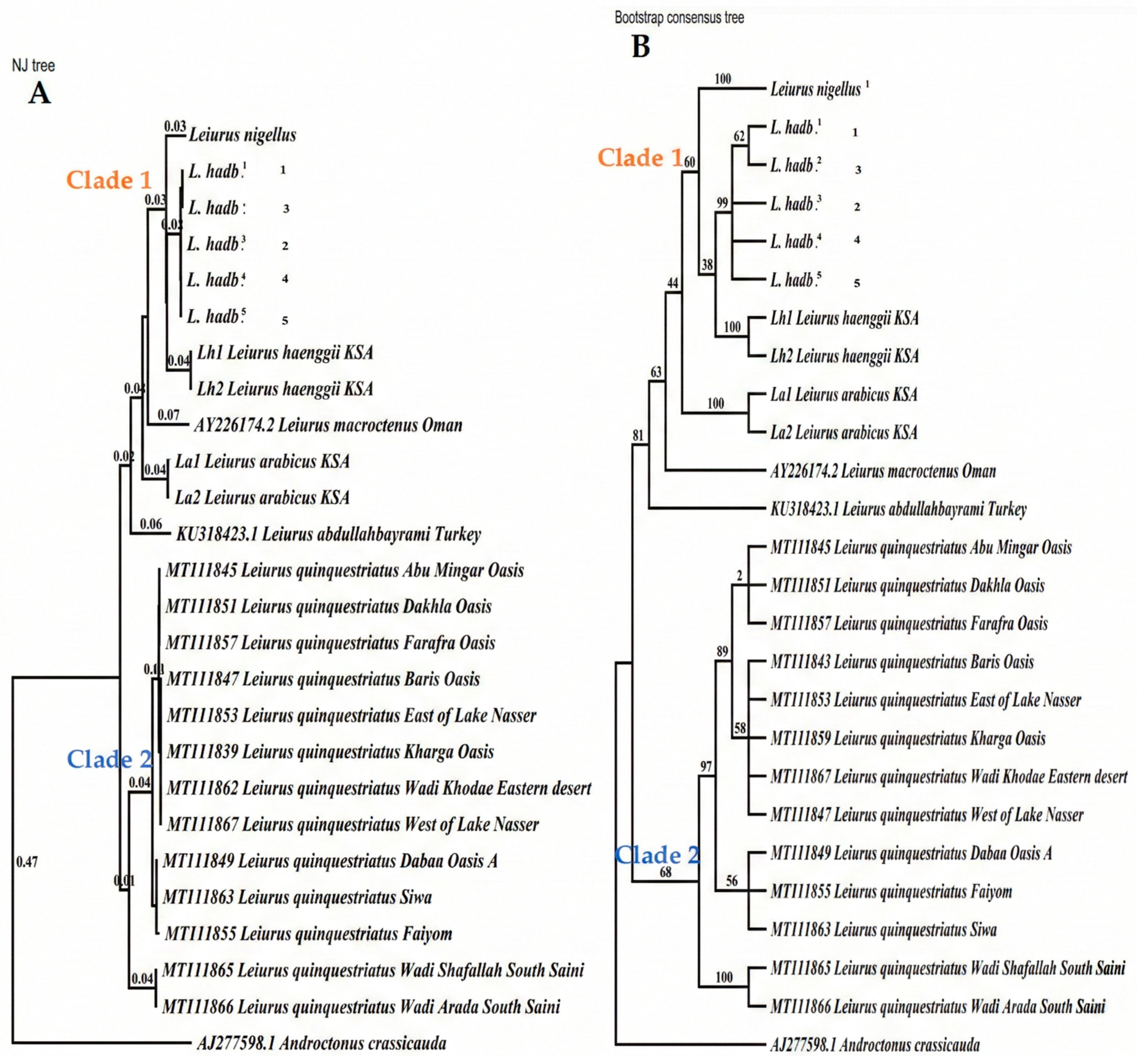
The 16S rRNA dataset (307 aligned nucleotides) included 100 constant bases (32.57%), 199 variable bases (64.82%), and 80 parsimony-informative sites (26.06%), with 119 polymorphic segregating sites [3,28,29,30]. Neighbor-joining and maximum-parsimony analyses yielded identical tree topologies, while Bayesian inference introduced minor variations (Figure 3).
Two major clades were consistently recovered within Leiurus. The first comprised Arabian and Middle Eastern species, subdivided into regional clusters: (i) L. arabicus from Riyadh; (ii) L. macroctenus Lowe, Yagmur & Kovarik, 2014 from Oman; L. abdullahbayrami Yağmur, Koç & Kunt, 2009 from Turkey; L. haenggii from southwestern Saudi Arabia; and (iii) a closely related group containing L. hadb, Al-Qahtni, Al-Salem, Alqahtani & Badry and L. nigellus. The second clade consisted of Egyptian specimens of L. quinquestriatus, which clustered on a distinct branch. Genetic divergence between these lineages ranged from 0.00 to 0.18, supporting recognition of well-separated evolutionary units. The out-group Androctonus crassicauda was consistently placed outside the Leiurus clade, reinforcing its phylogenetic structure.
The Jabal Arnan L. nigellus sequence formed a stable cluster with congeners, indicating low intraspecific divergence and supporting a genetically unified population. This congruence between genetic and morphological evidence suggests stability within the species and provides the first molecular reference for L. nigellus.

3.4. Biogeography and Habitat

The occurrence of L. nigellus at Jabal Arnan within the KSRNR represents a significant range extension of approximately 206 km southeast of the type locality in Al-Ula, Al Madinah Province [6]. This discovery demonstrates that the distribution of the species is broader than previously documented, extending into semi-arid and mountainous landscapes of northern Saudi Arabia (Figure 4). While scorpions generally exhibit low mobility, this geographical gap is likely indicative of sampling bias rather than a disjunct distribution. Crucially, as L. nigellus was only recently described, its full biogeographic range is still being defined. The discovery of this new population just one year after the species’ formal description highlights how under-surveyed these remote mountainous habitats remain. The presence of similar rocky substrates between Al-Ula and Ha’il suggests a potentially continuous distribution that has only now begun to be documented. A dubious record of Androctonus bicolor Ehrenberg, 1828 was cited based on the account of [4] and [31], which also reported from the Ha’il region following [32]. When these earlier records are viewed in light of the available images and species descriptions and compared with the newly collected material from northern Saudi Arabia, they appear to be more consistent with L. nigellus. This interpretation is further supported by the presence of similar habitats across northwestern and northern regions of the Kingdom. These records, combined with our current findings, represent the northernmost confirmed occurrence of the species to date, extending its known range approximately 206 km southeast from the Al-Ula type locality.
Historically, the mountainous and rocky habitats of northwestern Saudi Arabia have been less intensively surveyed; however, recent studies have highlighted these areas as potential points for scorpion diversity due to their complex microhabitats and environmental heterogeneity [2,33,34].
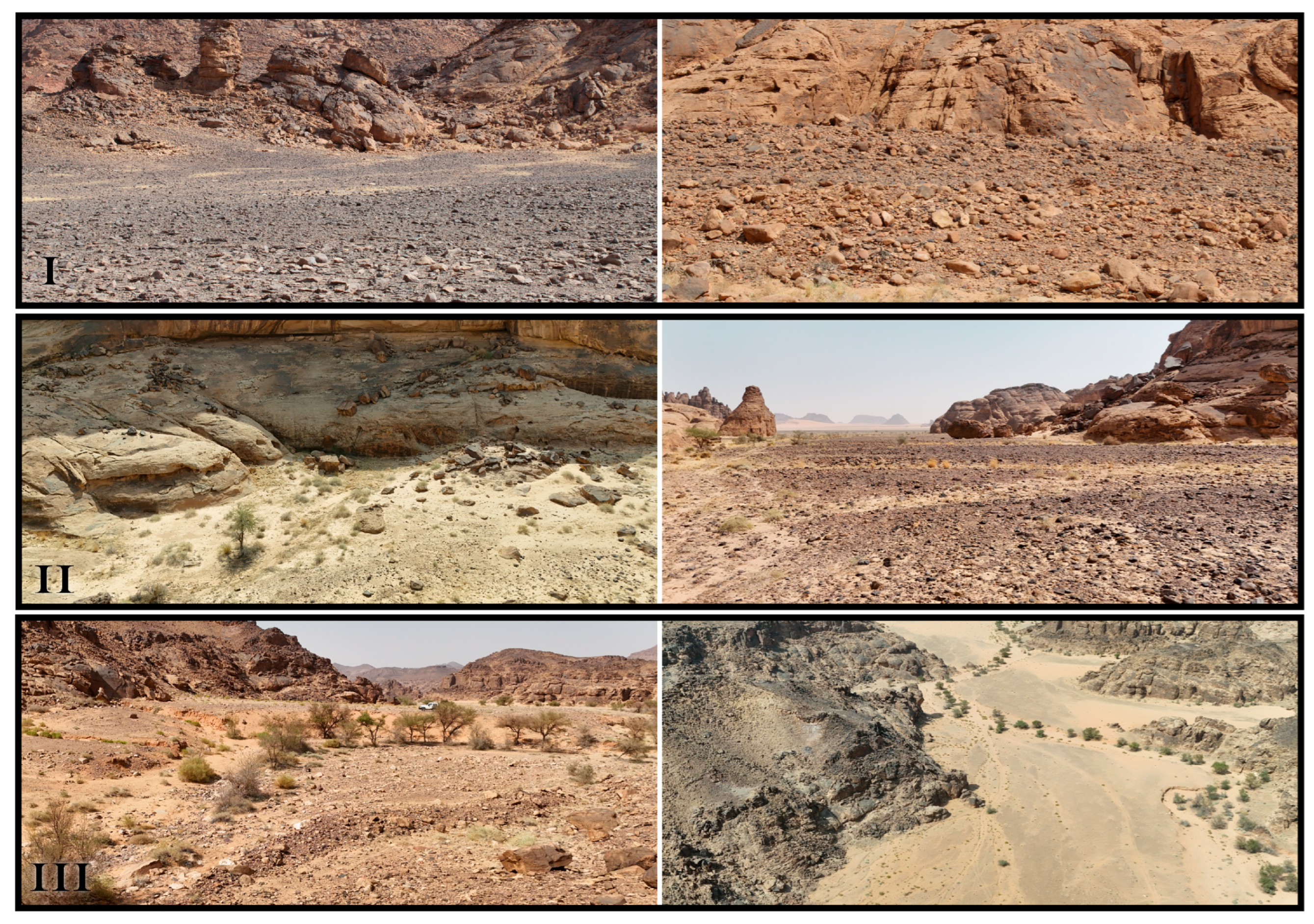
According to the Habitat Classification Study of the KSRNR [18], the ecological setting of the records from Jabal Arnan comprises a primary habitat unit of mountains, rocky terrain, and wadis (wadis refers to the upper and middle reaches of the wadi system before it merges into the floodplain and open terrain) which can be further categorized into three sub-units: (I) Mountain slopes, screes and associated wadis and mountain terrain, including rocky foothills, associated wadis, and temporary watercourses. (II) Escarpments, lithified sand dunes, and rocky exposures—outcrops of rocky material, mostly either exposures of Miocene material or aeolianite; areas covered by escarpments, lithified sand dunes (palaeodunes), and rocky exposures; (rocky exposures are characterized by small areas that are neither mesas nor cemented sand dunes); vegetation is sparse, absent, and distinctly seasonal. (III) Wadis with sandy or gravelly floors and channelized drainage systems provides terrain which can support running water after rainfall, with the surrounding areas mainly composed of gravel. Vegetation within such wadis is consistently denser than that of the surrounding hinterlands because of a seasonally raised water table. Shallow drainage channels and dry riverbeds are part of the region, usually with surface water only after heavy rainfall. These microhabitats are important for burrowing and ambush-predatory scorpions, enabling physiological and behavioral adaptations to thermal fluctuations and arid conditions. The regular co-occurrence of arthropods with small mammals during nocturnal surveys further underscores the ecological integrity of the site and coincides with previous reports on Leiurus habitat preferences in arid landscapes [1,2,8,14].

3.5. Integration and Implications

The morphological results from Jabal Arnan specimens are fully congruent with the original description of L. nigellus, reinforcing its taxonomic identity. Furthermore, the congruently obtained generated sequence of molecular results provides additional validation of the identification of the species. The uniformity across spatially disjunct populations suggests limited phenotypic variability and potentially low gene flow, with no evidence of cryptic lineages or local differentiation. Morphology confirmed diagnostic traits and provided additional support for a genetically cohesive species.
The extension of L. nigellus highlights the importance of continued faunistic and phylogenetic surveys in underexplored regions. Integrative taxonomic approaches combining morphology and molecular tools remain critical for clarifying scorpion diversity, assessing population structure, and evaluating evolutionary distinctiveness [35].

4. Conclusions

In summary, this study provides the first genetic data for L. nigellus from northern Saudi Arabia, offering new insights into its phylogenetic relationships within the genus Leiurus and contributing to a better understanding of the country’s scorpion diversity. Both morphological and genetic evidence support a unified population with no indication of taxonomic divergence beyond sexual dimorphism. This discovery highlights the importance of ongoing molecular and phylogenetic studies, combined with habitat conservation, in protecting specialized desert taxa before their ecological roles are fully understood.
Possible future studies on Leiurus nigellus focusing on complete mitochondrial genomes and genome-wide markers will help to achieve higher phylogenetic and evolutionary resolution. If broader geographic sampling becomes available, such data would enable more detailed assessments of population structure, genomic variation, and evolutionary history. The integration of next-generation sequencing methodologies would also facilitate comparative analyses across Arabian Leiurus populations and contribute to a more comprehensive understanding of intraspecific diversity and lineage differentiation. Future phylogenetic studies of Leiurus species should incorporate model-based inference methods, such as maximum likelihood and Bayesian approaches, together with multilocus or genomic datasets, to improve phylogenetic resolution and statistical robustness.

5. Recommendations

Future research should include a national survey of the scorpion fauna of the kingdom with emphasis on morphological, molecular, and ecological parameters in order to elucidate species limits, phylogenetic relationships, and variability in venom. The biodiversity of conserved areas should be monitored, for example, the King Salman Bin Abdulaziz Royal Natural Reserve, which is continuously monitored to unveil cryptic species, assess population dynamics, and implement conservation measures more efficiently for endemic desert organisms. The creation of reference material for such microorganisms in the form of a DNA library, together with linking these specimens to genetic data and georeferenced records, will greatly enhance biodiversity databases and the accuracy of regional taxonomy. Standardized long-term monitoring programs in the KSRNR will better facilitate adaptive management strategies and the evaluation of environmental responses of potentially sensitive desert taxa.

Author Contributions

Conceptualization, A.M.A.-A., M.A.A. and W.M.S.; methodology, A.M.A.-A., M.A.A. and W.M.S.; software, A.R.A. and M.A.A.; validation, W.M.S., A.M.A.-M. and A.M.A.-A.; formal analysis, A.M.A.-A., M.A.A. and W.M.S.; investigation, A.M.A.-A., M.A.A., A.R.A. and W.M.S.; resources, A.R.A.; data curation, W.M.S. and A.M.A.-M.; writing—original draft preparation, A.M.A.-A. and M.A.A.; writing—review and editing, W.M.S. and A.M.A.-M.; visualization, A.M.A.-A., M.A.A. and A.M.A.-M.; supervision, A.M.A.-M., A.R.A. and W.M.S.; project administration, W.M.S.; funding acquisition, A.M.A.-A., M.A.A., A.M.A.-M. and W.M.S. All authors have read and agreed to the published version of the manuscript.

Funding

This research received no external funding.

Institutional Review Board Statement

Not applicable.

Data Availability Statement

The DNA sequence generated in this study is available in GenBank Database (NCBI) under accession number PX607344, # and can be accessed at https://www.ncbi.nlm.nih.gov/nuccore/PX607344, accessed on 30 November 2025.

Acknowledgments

We extend our sincere thanks and appreciation to the Chief Executive Officer and the team at the King Salman Bin Abdulaziz Royal Natural Reserve for their unwavering support, which significantly contributed to the completion of our fieldwork and research.

Conflicts of Interest

The authors declare no conflicts of interest.

References

  1. Al-Sadoon, M.K.; Jarrar, B.M. A note on the scorpion fauna of Riyadh Province, Saudi Arabia. Afr. J. Herpetol. 2003, 52, 19–24. [Google Scholar]
  2. Hendrixson, B.E. Buthid scorpions of Saudi Arabia, with notes on other families (Scorpiones: Buthidae, Scorpionidae, Hemiscorpiidae). Fauna Arab. 2006, 22, 23–52. [Google Scholar]
  3. Alqahtani, A.R.; Badry, A. Genetic diversity among different species of the genus Leiurus (Scorpiones: Buthidae) in Saudi Arabia and the Middle East. Saudi J. Biol. Sci. 2020, 27, 3348–3353. [Google Scholar] [CrossRef]
  4. Alqahtani, A.; Badry, A. A contribution to the scorpion fauna of Saudi Arabia, with an identification key (Arachnida: Scorpiones). J. King Saud Univ. Sci. 2021, 33, 101396. [Google Scholar] [CrossRef]
  5. Alhamoud, M.A.; Al Fehaid, M.S.; Alhamoud, M.A.; Alzoayed, M.H.; Alkhalifah, A.A.; Menezes, R.G. Scorpion stings in Saudi Arabia: An overview. Acta Biomed. 2021, 92, e2021236. [Google Scholar]
  6. Abu Afifeh, B.A.; Aloufi, A.; Al-Saraireh, M.; Badry, A.; Al-Qahtni, A.H.; Amr, Z.S. A new remarkable species of Leiurus Ehrenberg, 1828 from Saudi Arabia (Scorpiones: Buthidae). Ecol. Montenegrina 2023, 69, 91–106. [Google Scholar] [CrossRef]
  7. Hemprich, W.F.; Ehrenberg, C.G. Vorläufige Übersicht der in Nord-Afrika und West-Asien einheimischen Scorpione und deren geographischen Verbreitung. Verh. Ges. Naturforsch. Freunde Berl. 1829, 1, 348–362. [Google Scholar]
  8. Lowe, G.; Yağmur, E.A.; Kovařík, F. Revision of the genus Leiurus Ehrenberg, 1828 in the Middle East, with description of a new species from Turkey (Scorpiones: Buthidae). Euscorpius 2014, 190, 1–129. [Google Scholar] [CrossRef]
  9. Al Asmari, A.K.; Al Saif, A.A.; Al-Yahya, M.M. Clinical and toxicological profile of scorpion envenomation in Saudi Arabia: A review. Saudi J. Biol. Sci. 2021, 28, 2821–2826. [Google Scholar]
  10. Lourenço, W.R.; Modrý, D.; Amr, Z. Description of a new species of Leiurus Ehrenberg, 1828 (Scorpiones, Buthidae) from the south of Jordan. Acta Arachnol. 2002, 51, 35–40. [Google Scholar]
  11. Lourenço, W.R.; Qi, J.X.; Cloudsley-Thompson, J.L. The African species of the genus Leiurus Ehrenberg, 1828. Bol. Soc. Entomol. Aragonesa 2006, 39, 97–101. [Google Scholar]
  12. Lourenço, W.R. A new subgenus and species of Leiurus Ehrenberg, 1828 from Iraq (Scorpiones: Buthidae). Serket 2022, 18, 421. [Google Scholar]
  13. Badry, A.; Salehi, M.; Sarhan, M.M.; Youness, M.; Lourenço, W.R.; Ythier, E. A new species of Leiurus Ehrenberg (Scorpiones: Buthidae) from Sinai, Egypt and comments on its relationships with L. quinquestriatus and L. hebraeus using morphological and molecular evidence. Faunitaxys 2023, 11, 1–10. [Google Scholar]
  14. Al-Qahtani, A.H.; Al-Salem, A.M.; Mesfer, F.; Al Balawi, M.S.; Allahyani, W.S.; Alqahtani, A.R.; Badry, A. A new species and a key to the genus Leiurus Ehrenberg, 1828 (Scorpiones, Buthidae) from Saudi Arabia. ZooKeys 2023, 1178, 293–316. [Google Scholar] [CrossRef] [PubMed]
  15. Lourenço, W.R. Nouvelles considérations sur les Leiurus Ehrenberg, 1828 collectés dans la région du Tibesti, Tchad et description d’une nouvelle espèce. Rev. Ibér. Aracnol. 2019, 34, 133–137. [Google Scholar]
  16. Lourenço, W.R.; El-Hennawy, H.K. New considerations on the Leiurus Ehrenberg (Scorpiones: Buthidae) distributed in Africa and description of a particular species from Egypt. Serket 2021, 17, 325. [Google Scholar]
  17. Fet, V.; Lowe, G. Family Buthidae C.L. Koch, 1837. In Scorpions of the World; Fet, V., Selden, P.A., Eds.; FitzRoy’s Books: New York, NY, USA, 2000; pp. 54–286. [Google Scholar]
  18. King Salman Bin Abdulaziz Royal Natural Reserve Development Authority. Habitat Mapping: Classifications from Satellite Imagery—Habitat Classification Schema Document; Version 1.0; KSRNR: Riyadh, Saudi Arabia, 2022; pp. 1–78. [Google Scholar]
  19. Stahnke, H.L. Scorpion nomenclature and mensuration. Entomol. News 1970, 81, 297–316. [Google Scholar]
  20. Gantenbein, B.; Fet, V.; Largiadèr, C.R.; Scholl, A. First DNA phylogeny of Euscorpius Thorell, 1876 (Scorpiones, Euscorpiidae) and its bearing on taxonomy and biogeography of this genus. Biogeographica 1999, 75, 49–65. [Google Scholar]
  21. Hall, T.A. BioEdit: A user-friendly biological sequence alignment editor and analysis program for Windows 95/98/NT. Nucleic Acids Symp. Ser. 1999, 41, 95–98. [Google Scholar]
  22. Tamura, K.; Stecher, G.; Kumar, S. MEGA11: Molecular evolutionary genetics analysis version 11. Mol. Biol. Evol. 2021, 38, 3022–3027. [Google Scholar] [CrossRef]
  23. Swofford, D.L. PAUP: Phylogenetic Analysis Using Parsimony (and Other Methods); Sinauer Associates: Sunderland, MA, USA, 2000. [Google Scholar]
  24. Felsenstein, J. Bootstraps and testing trees. Transition 2002, 5, 20. [Google Scholar]
  25. Nylander, J.A. Bayesian Phylogenetics and the Evolution of Gall Wasps. Ph.D. Thesis, Acta Universitatis Upsaliensis, Uppsala, Sweden, 2004. [Google Scholar]
  26. Akaike, H. Maximum likelihood identification of Gaussian autoregressive moving average models. Biometrika 1973, 60, 255–265. [Google Scholar] [CrossRef]
  27. Weinhardt, V.; Shkarin, R.; Wernet, T.; Wittbrodt, J.; Baumbach, T.; Loosli, F. Quantitative morphometric analysis of adult teleost fish by X-ray computed tomography. Sci. Rep. 2018, 8, 1653. [Google Scholar] [CrossRef]
  28. Alqahtani, A.R.; Badry, A.; Aly, H.; Amer, S.A.; Al Galil, F.M.A.; Ahmed, M.A.; Amr, Z.S. Genetic diversity and population structure of Androctonus crassicauda (Scorpiones: Buthidae) in different ecogeographical regions of Saudi Arabia and Iran. Zool. Middle East 2022, 68, 171–179. [Google Scholar] [CrossRef]
  29. Alqahtani, A.R.; Badry, A.; Amer, S.A.; Abd Al Galil, F.M.; Ahmed, M.A.; Amr, Z.S. Intraspecific molecular variation among Androctonus crassicauda (Olivier, 1807) populations collected from different regions in Saudi Arabia. J. King Saud Univ. Sci. 2022, 34, 101998. [Google Scholar] [CrossRef]
  30. Alqahtani, A.R.; Yağmur, E.A.; Badry, A. Androctonus tihamicus sp. nov. from the Mecca Province, Saudi Arabia (Scorpiones, Buthidae). ZooKeys 2023, 1152, 9–26. [Google Scholar] [CrossRef]
  31. Al-Asmari, A.K.; Al-Saief, A.A.; Abdo, N.M.; Al-Moutaery, K.R. The scorpion fauna of Al-Baha and Ha’il regions, Saudi Arabia. J. Venom. Anim. Toxins Incl. Trop. Dis. 2009, 15, 684–699. [Google Scholar] [CrossRef]
  32. Desouky, M.M.; Alshammari, A.M. Scorpions of the Ha’il Region, northern Saudi Arabia, and molecular phylogenetics of two common species, Androctonus crassicauda and Scorpio maurus kruglovi. Arachnology 2010, 15, 193–200. [Google Scholar] [CrossRef]
  33. Abushama, F.T. Preliminary survey on scorpions of Saudi Arabia. Sudanese J. Desertif. 2013, 4, 18–22. [Google Scholar]
  34. El-Hennawy, H.K. Scorpion fauna of the Arabian Peninsula: Biogeographical and taxonomical updates. Serket 2015, 14, 75–92. [Google Scholar]
  35. Wani, M.Y.; Alqarni, A.S.; El-Garhy, M.F. A review on scorpion venoms and their components: Biological and pharmacological perspectives. Acta Trop. 2022, 229, 106370. [Google Scholar]
Figure 1. L. nigellus range extension from Al-Ula [6] to Jabal Arnan, KSRNR. New locations within sites of recorded individuals are represented by scorpion icons and correspond to habitats I, II, and III; for a detailed description of the habitats at these sites, please refer to Section 3.4.
Diversity 18 00149 g001
Figure 2. L. nigellus, from Jabal Arnan, Ha’il, in the King Salman Bin Abdulaziz Royal Natural Reserve. (A) Female. (B) Male. (Note: Figure 2 is intended for illustrative purposes only).
Diversity 18 00149 g002
Figure 3. (A) The neighbor-joining phylogenetic tree of Leiurus species constructed from 16S rRNA gene sequences. Two major well-supported clades are recovered: Clade 1, comprising L. nigellus, L. hadb, L. haenggii, L. arabicus, L. macroctenus, and L. abdullahbayrami; and Clade 2, consisting of the L. quinquestriatus species complex. Branch support values are based on 1000 neighbor-joining bootstrap replicates, with additional maximum parsimony, and Bayesian posterior probabilities shown are applicable. (B) The maximum-parsimony phylogenetic tree of Leiurus species constructed from the same 16S rRNA dataset, recovering the same two major clades (Clades 1 and 2). Branch support values represent 1000 maximum-parsimony replicates, along with corresponding neighbor-joining and Bayesian posterior probabilities.
Diversity 18 00149 g003
Figure 4. Habitats at the collection sites of L. nigellus in Jabal Arnan, the KSRNR: (I) mountain slopes and screes, (II) escarpments and rocky exposures, and (III) wadis with sandy/gravelly floors. These labels correspond to the locations indicated in Figure 1; for a comprehensive ecological characterization of each unit, refer to the ‘Biogeography and Habitat’ in Section 3.4.
Diversity 18 00149 g004
Table 1. Morphometric measurements (mm) of two adult L. nigellus specimens (male and female) from Jabal Arnan, King Salman Bin Abdulaziz Royal Natural Reserve. AW/PW: anterior width to posterior width; L: length; W: width; D: depth.
MeasurementMaleFemale
Total length80.9886.6
Carapace L8.779.85
Carapace AW/PW5.16/9.476.22/10.68
Mesosoma L18.3821.67
Metasoma I L/W6.36/4.686.98/4.89
Metasoma II L/W7.79/4.088.22/4.65
Metasoma III L/W8.04/3.718.67/4.08
Metasoma IV L/W9.12/3.249.78/3.89
Metasoma V L/W/D10.20/3.00/2.8611.27/3.12/3.04
Telson L8.989.85
Vesicle W/D3.11/3.013.69/3.12
Pedipalp Femur L/W10.19/2.3910.24/2.46
Pedipalp Patella L/W11.03/2.7611.56/3.14
Pedipalp Chela L/W/D20.05/2.51/2.6521.65/3.12/2.86
Movable finger L13.4314.52
Leg III patella L/D ♀-8.65/2.07
Disclaimer/Publisher’s Note: The statements, opinions and data contained in all publications are solely those of the individual author(s) and contributor(s) and not of MDPI and/or the editor(s). MDPI and/or the editor(s) disclaim responsibility for any injury to people or property resulting from any ideas, methods, instructions or products referred to in the content.