Communication

Reassessment of the Taxonomic Identity of Artemia (Crustacea: Anostraca) from Kyêbxang Co (Tibet): Evidence for Artemia sorgeloosi Rather than Artemia tibetiana


1
College of Fisheries and Life Sciences, Hainan Tropical Ocean University, Sanya 572000, China
2
Institute of Pharmacy and Molecular Biotechnology (IPMB), Heidelberg University, 69120 Heidelberg, Germany
3
Department of Biology, Chengde Medical University, Chengde 067000, China
*
Authors to whom correspondence should be addressed.
These authors contributed equally to this work.
Diversity 2026, 18(3), 148; https://doi.org/10.3390/d18030148
Submission received: 3 February 2026 / Revised: 25 February 2026 / Accepted: 26 February 2026 / Published: 28 February 2026
(This article belongs to the Section Phylogeny and Evolution)

Abstract

Correct species identification is essential for understanding biodiversity and managing ecosystems. The bisexual Brine Shrimp Artemia tibetiana and Artemia sorgeloosi represent two regional endemic taxa on the Tibetan Plateau, yet the taxonomic status of several populations remains unresolved. In particular, the Artemia population from Kyêbxang Co (Tibet, China) has been inconsistently assigned to either A. tibetiana or A. sorgeloosi in recent ecological and genomic studies, lacking formal taxonomic evaluation. To resolve this ambiguity, we conducted a precise biosystematic assessment based on DNA analyses: In this study, we performed a taxonomic reassessment of the Kyêbxang Co Artemia population, based on complete mitochondrial genome sequences and mitochondrial gene COI haplotype analyses. Phylogenetic analysis consistently positioned the Kyêbxang Co population within the A. sorgeloosi clade, clearly separated from the polyphyletic A. tibetiana lineage. Genetic distance values corroborated this placement, revealing minimal divergence from A. sorgeloosi (0.31%) but substantial divergence from A. tibetiana (9.07%). The COI haplotype network further indicated an exclusive maternal gene pool shared with topotypic A. sorgeloosi. Collectively, these results provide conclusive molecular evidence that the Brine Shrimp population of Kyêbxang Co belongs to A. sorgeloosi, not A. tibetiana.

1. Introduction

Species identification is fundamental to assessing and understanding biodiversity within ecosystems [1,2,3]. However, for many taxa, this task remains challenging because identification keys are often inadequate or unavailable when cryptic species occur [4,5] or there is high morphological intra-specific variability [6]. As climate change and human activities intensify—driving habitat loss and fragmentation [7,8] and facilitating the introduction of non-native species into new environments [9,10]—biodiversity faces escalating threats. Consequently, inaccuracies in species identification can lead to substantial and potentially irreversible ecological consequences. The Brine Shimp genus Artemia Leach, 1819 represents one such taxonomically challenging group, in which species delimitation has long been complicated by the lack of a reliable and universal identification key [11].
Artemia consists of sexual species and polyphyletic parthenogenetic lineages that inhabit inland hypersaline environments and salterns [12]. In contrast to parthenogenetic lineages, bisexual species exhibit a natural “island biogeography” distribution pattern [11,12,13,14]. In addition, the American species A. franciscana has been widely introduced and established as an invasive species throughout the Old World [15,16,17,18,19,20,21,22,23,24]. Asia naturally harbors A. urmiana Günther, 1899 (Iran), A. sinica Cai, 1989 (Eastern Asia), and A. tibetiana Abatzopoulos, Zhang & Sorgeloos, 1998 (Tibetan Plateau), along with two recently described species: A. sorgeloosi Asem, Eimanifar, Hontoria, Rogers & Gajardo, 2023 (Tibetan Plateau), and A. amati Asem, Eimanifar, Hontoria, Rogers & Gajardo, 2023 (Kazakhstan) (see [11]).
The Tibetan Plateau is the largest high-altitude plateau, with a mean elevation exceeding 4000 m above sea level [25] and an area of approximately 3 million km2 [26]. It is characterized by extreme environmental conditions including intense solar radiation, reduced atmospheric oxygen and low temperatures [27,28,29]. The Tibetan Plateau includes athalassohaline lakes (lakes are saline inland waters whose dissolved salts are not derived from seawater vs. thalassohaline lakes, which are inland salt lakes derived from seawater) dominated by carbonate and sulphate ions [27,30].
The earliest record of Artemia from the Tibetan Plateau dates back to Dong et al. [31], although precise locality information was not provided. Later surveys documented the presence of populations mistakenly identified as “Artemia salina” (for more information see [14,32]) in sixteen saline lakes across the plateau [27]. Subsequently, Abatzopoulos et al. [33] formally described A. tibetiana from Lagkor Co (=Lagkor Lake, Gêrzê County, Tibet Autonomous Region, China).
Since 2008, the taxonomy of Artemia on the Tibetan Plateau has been the subject of increasing uncertainty and debate. Early molecular work by Wang et al. [34], based on mitochondrial COI (cytochrome c oxidase subunit I) sequence data, revealed unexpected phylogenetic structuring among Tibetan populations. Their analyses indicated the presence of two distinct evolutionary lineages: one associated with the type locality of A. tibetiana from Lagkor Co, and another encompassing populations from several other Tibetan hypersaline lakes. Subsequent studies employing COI barcoding further corroborated this pattern [17,35], consistently recovering two genetically differentiated groups within Tibetan Artemia, thereby highlighting unresolved taxonomic boundaries within the region. To resolve this taxonomic ambiguity, Asem et al. [11] applied an integrative taxonomic framework, combining multiple independent lines of evidence to reassess Tibetan Artemia. Using this approach, the second polyphyletic clade was formally described as a new species, A. sorgeloosi Asem, Eimanifar, Hontoria, Rogers & Gajardo, 2023.
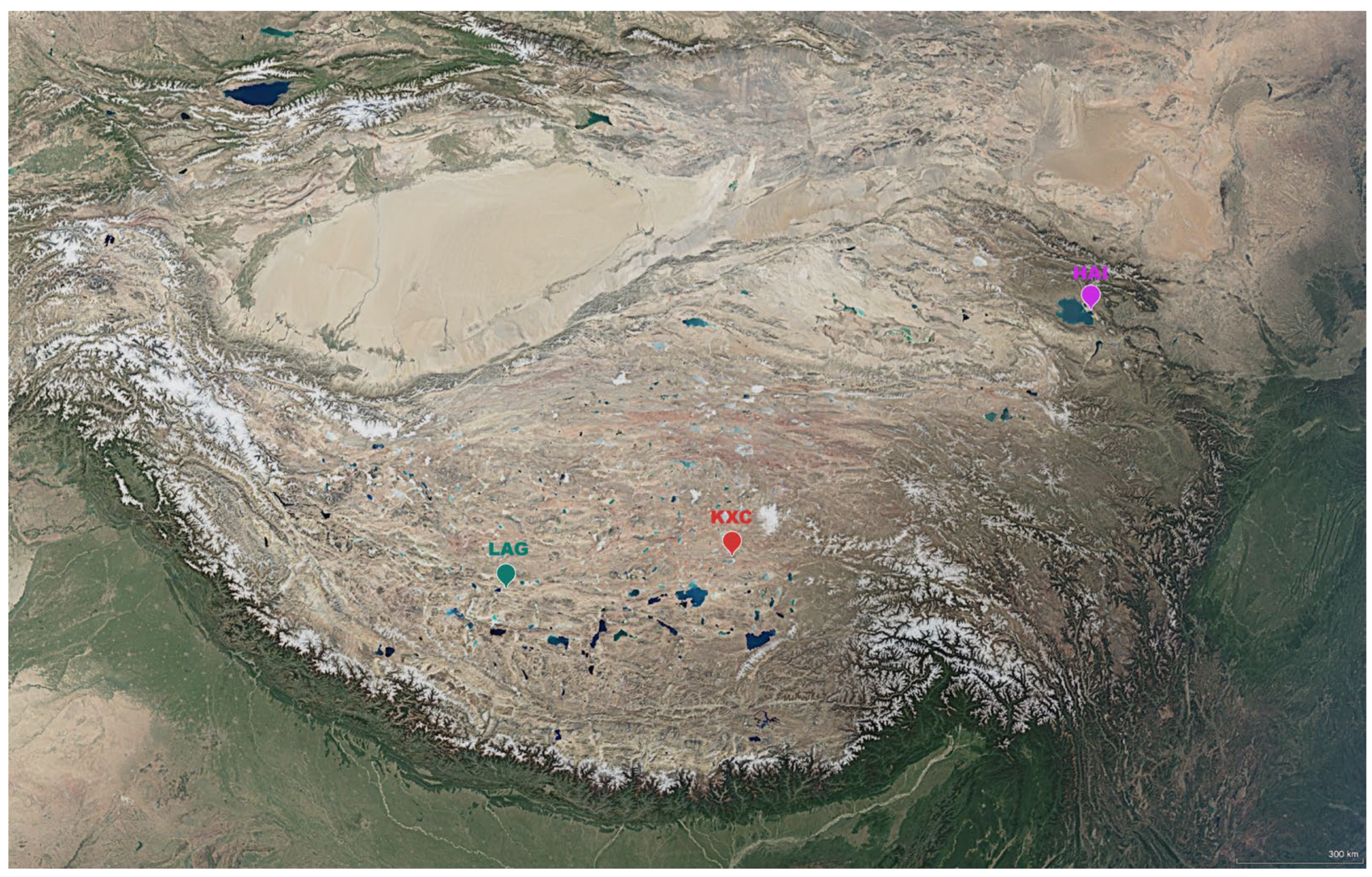
Recently, the Artemia population from Kyêbxang Co (=Kyêbxang Lake, Shuanghu County, Tibet Autonomous Region, China) has been investigated in two independent studies conducted by the same research group. These studies focused on (i) temporal genetic variation associated with salinity changes driven by climate change [36] and (ii) the chromosome-scale genome assembly of the Kyêbxang Co Artemia population [37]. This population has been indirectly referred to as A. sorgeloosi in Li et al. [36] and was later named A. tibetiana [37] in the absence of taxonomic evidence. Surprisingly, both studies treated Kyêbxang Co as a synonym of Qixiang Lake and cited it as the type locality of A. sorgeloosi. However, this interpretation is incorrect, as the type locality of A. sorgeloosi is Haiyan Lake (Qinghai Province, China following 36°48′ N 100°41′ E [11]), located approximately 1100 km from Kyêbxang Co (32°27′ N 89°57′ E) (see Section 2).
Thus, despite recent ecological and genomic investigations, the taxonomic status of the Kyêbxang Co population remains ambiguous, underscoring the need for a reassessment. The aim of this study was to reconsider the taxonomic status of populations from Kyêbxang Co using mitogenome data and population genetic structure inferred from the mitochondrial gene COI barcoding marker, in order to determine whether the Artemia population should be assigned to A. sorgeloosi or A. tibetiana.

2. Materials and Methods

2.1. Origin of Species/Populations

Two regional endemic Tibetan Artemia species (A. tibetiana and A. sorgeloosi) from their type localities and the Kyêbxang Co population were examined (Figure 1). To aid molecular analysis and species delimitation, three additional Asian species (A. urmiana, A. sinica and A. amati) and American species A. franciscana (outgroup) were included from their type localities. To draw a coherent and specific phylogenetic structure of maternal relationships between the Kyêbxang Co population and sexual Asian Artemia, only bisexual species were analyzed in this study. Species/population information and localities are provided in Table 1.

2.2. Mitogenomic Sequence

Using the genomic DNA sequences of a male individual of Kyêbxang Co Artemia (GenBank accession No. SRR30106271; [37]), we mapped its complete mitochondrial genome (GenBank accession No. PX805605). Assembly and annotation were conducted using the A. urmiana mitochondrial genome as a reference (GenBank accession No. OR423228; [12]) following Asem et al. [11].

2.3. Phylogenetic Analysis

To determine the taxonomic status of the Kyêbxang Co population, a phylogenetic tree was inferred from the mitogenomic sequences based on a concatenated alignment of 13 protein coding genes (PCGs) and two ribosomal RNAs (rRNAs).
Two different tree-building methods, Bayesian Inference (BI) and Maximum Likelihood (ML), were implemented in MrBayes on ACCESS (3.2.7a) and RAxML-HPC BlackBox 8.2.12 on the CIPRES Science Gateway (v. 3.3) online platform, respectively [39]. The best-fitting nucleotide substitution model was calculated for BI and ML by MrModeltest 2.2 [40]. The GTR + G + I was chosen as the best-fit model for both BI (lset nst = 6, rates = invgamma; mcmcp ngen = 1,000,000, samplefreq = 100, nchains = 4, sump burnin = 2500; sumt burnin = 2500) and ML (bootstrap replicates: 1000; further settings calculated automatically by the CIPRES Science Gateway online platform).

2.4. Genetic Distance

Genetic distances between the Kyêbxang Co population and the Asian species were calculated based on a concatenated sequence of 13 PCGs and two rRNAs. The uncorrected p-distance model was computed in MEGA X [41]. Resulting distances were visualized as a heat map using the heatmapper2 online platform [42].

2.5. Data Analysis for mt-COI Marker

The mitochondrial gene COI marker was used to trace the distribution patterns of haplotypes from the Kyêbxang Co population in relation to Asian species (for details see Table 1). Due to the presence of numerous sequences from parthenogenetic lineages of Artemia in the GenBank database, some of which have been registered as bisexual Artemia due to the lack of examination of their reproductive mode in certain references [see 12], we have used only our own dataset in this analysis following Asem et al. [11]. Genealogical relationships among haplotypes were analyzed using the median-joining algorithm [43] and TCS [44], as implemented in the PopART software (v. 1.7) [45].

3. Results

The assembled complete mitochondrial genome of the examined specimen from Kyêbxang Co has a typical circular DNA with 13 PCGs, 2 ribosomal RNAs, and 22 transfer RNAs and a non-coding control region, with a total length of 15,736 bp, PCGs + rRNAs length of 12,423 bp and control region length of 1723 bp, respectively. The A + T contents of mitogenome and PCGs + rRNAs sequences are 62.77and 62.09%, respectively. Both ribosomal RNAs (16S and 12S), four PCGs (ND5, ND4, ND4L and ND1), and nine transfer RNAs (tRNA-Ile, tRNA-Gln, tRNA-Cys, tRNA-Tyr, tRNA-Phe, tRNA-His, tRNA-Pro, tRNA-Leu, and tRNA-Val) are encoded on the light strand.
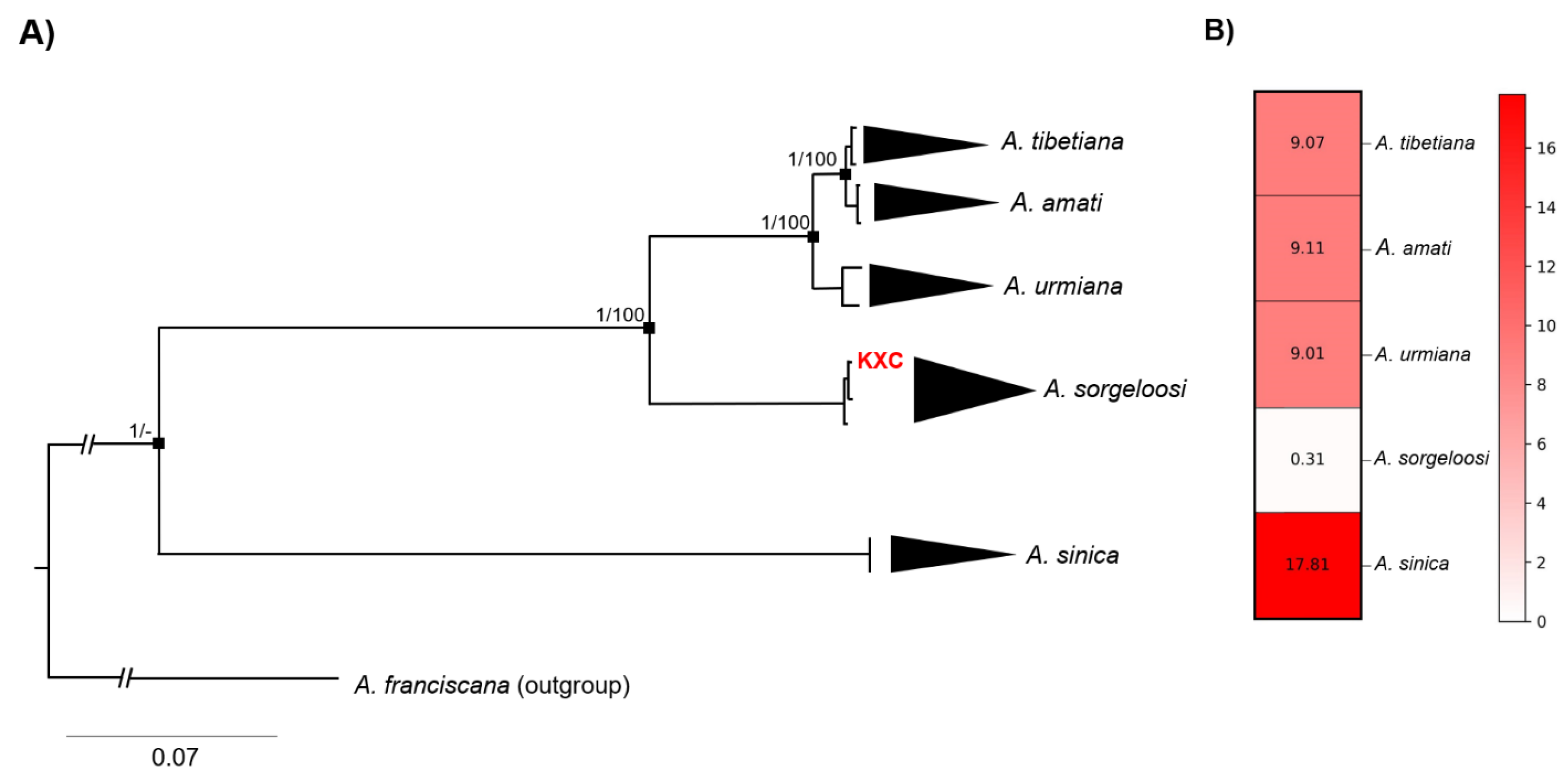
Both ML and BI analyses produce congruent tree topologies. The phylogenetic reconstruction indicates that the Kyêbxang Co Artemia clusters within the A. sorgeloosi clade, exhibiting a polyphyletic pattern with A. tibetiana, while the Western Asian lineage of A. urmiana occurs between these Tibetan taxa (Figure 2A). This result is supported by the mitogenomic genetic distance values between the Kyêbxang Co Artemia and A. sorgeloosi (0.31%) as well as A. tibetiana (9.07%) (Figure 2B).
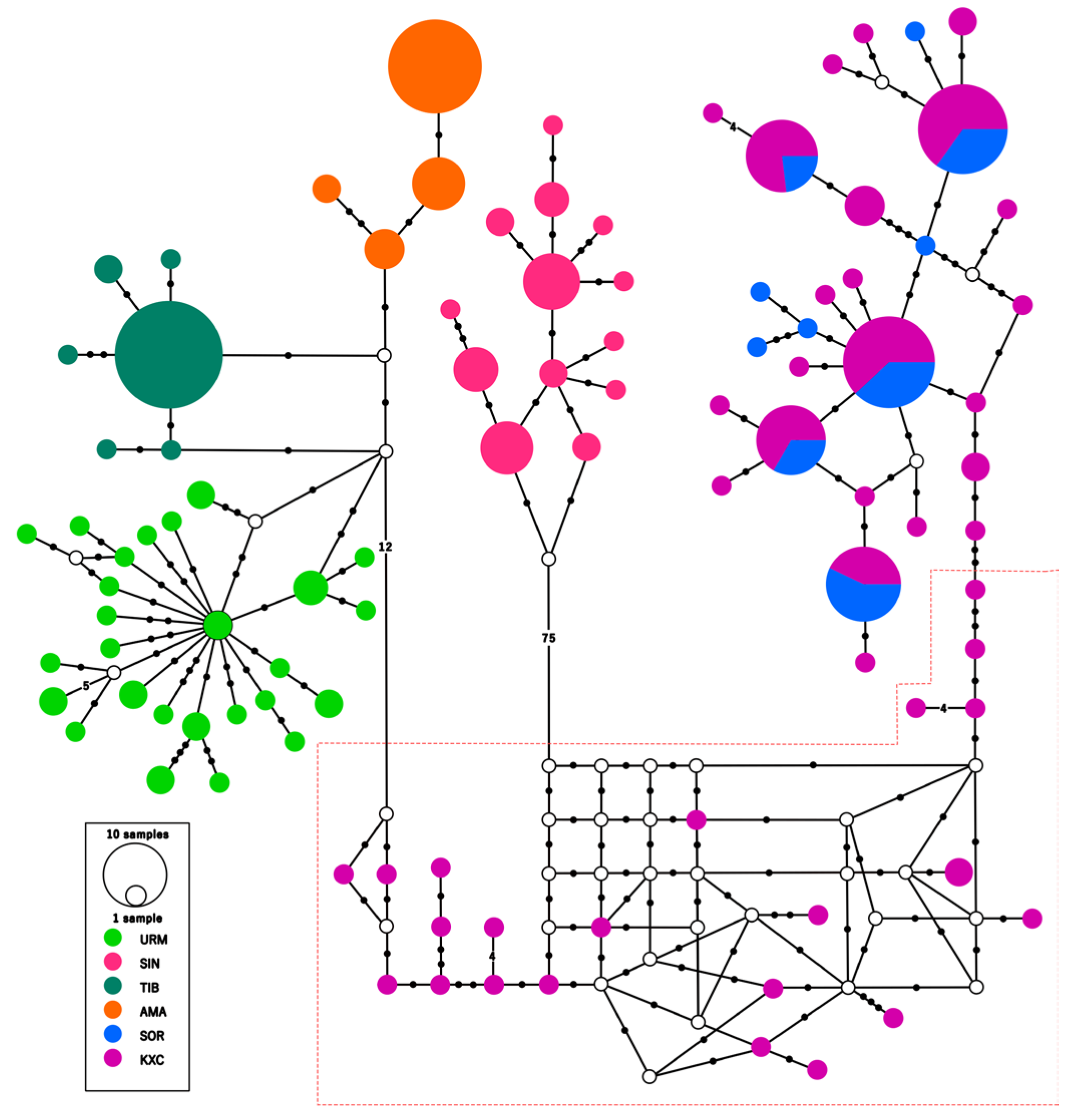
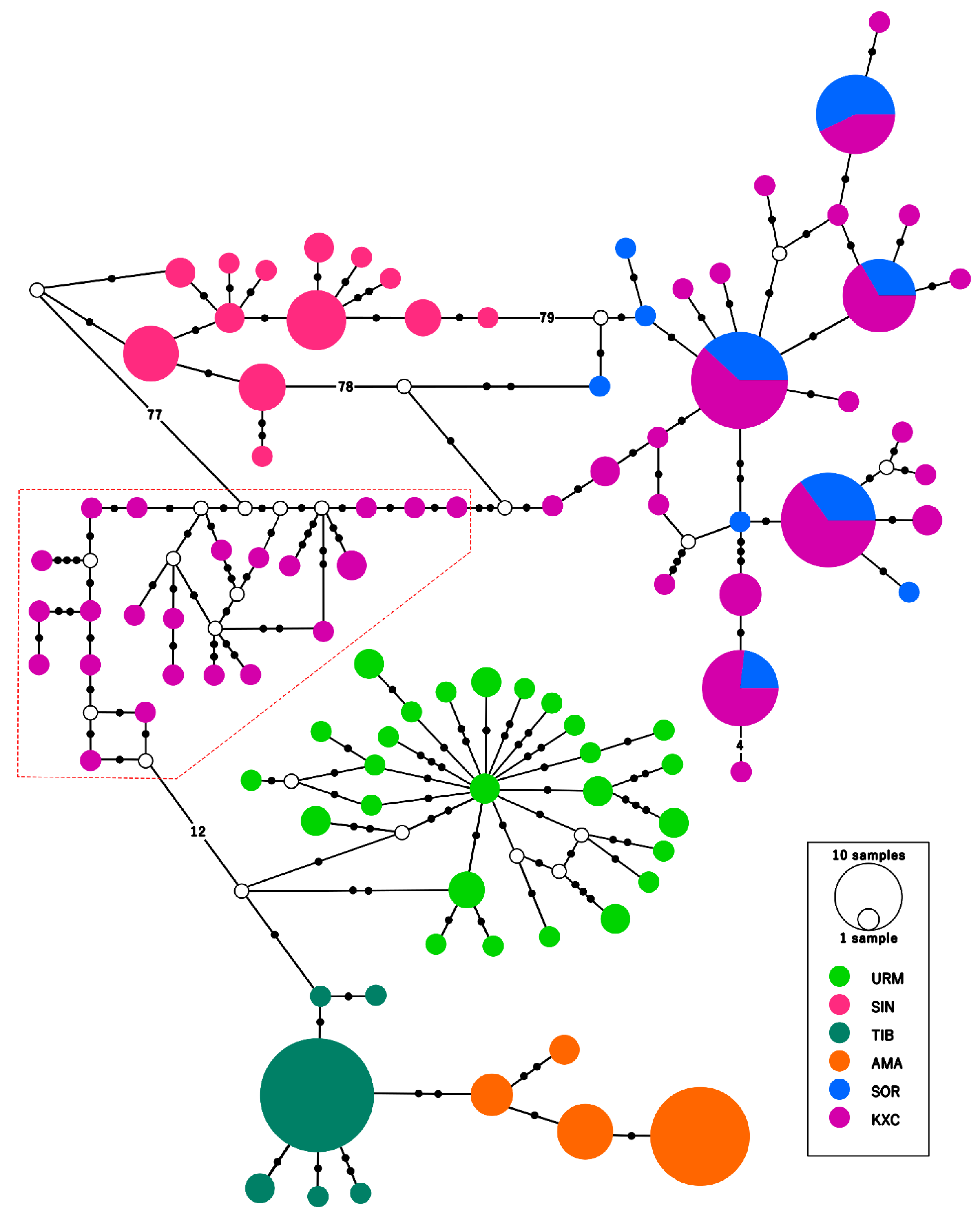
The haplotype network distribution analyses based on the mitochondrial COI marker demonstrate that the Kyêbxang Co population exhibits shared haplotypes only with A. sorgeloosi. However, both the median-joining (Figure 3) and TCS (Figure 4) models point to an unusually large number of missing intermediate and/or unsampled haplotypes in the network pattern within the Kyêbxang Co population. Furthermore, in the Kyêbxang Co population network, a relatively high number of haplotypes are represented by singleton haplotypes and form a linear structure (connected to others either directly or via missing intermediate and/or unsampled haplotypes), with each haplotype differing from the next by only one or two nucleotide substitutions (marked by a red color polygon), whereas the median-joining model exhibits a more complex structure (see Figure 3 and Section 4).

4. Discussion

The Tibetan Plateau hosts two regional endemic bisexual species, A. tibetiana and A. sorgeloosi [11,12,46], the exotic American species A. franciscana [46], as well as obligate parthenogenetic lineages (e.g., diploid and tetraploid; see [29,47,48]). A survey of biodiversity of native bisexual species on the Tibetan Plateau indicated that A. sorgeloosi is the dominant species rather than A. tibetiana [46].
Asem et al. [12] further demonstrated that A. tibetiana and the newly described A. sorgeloosi represent a case of “mitonuclear discordance”, in which “A. tibetiana may have evolved from a past ancestral hybridization via a maternal ancestor of A. tibetiana with a paternal ancestor of A. sorgeloosi on the Tibet Plateau”. Phylogenetic analyses indicated that the A. sorgeloosi lineage diverged during the Early Pliocene/Late Miocene (ca. 4.85 Mya), preceding the emergence of the A. tibetiana lineage in the Late Pleistocene (ca. 0.37 Mya). Within A. tibetiana, diversification occurred earlier (ca. 0.14 Mya) than within A. sorgeloosi (ca. 0.08 Mya). The results clearly demonstrated that the two taxa represent independent biological species that are maternally linked through four ancestral lineages, taking into account parthenogenetic lineages (see [12]).
Recent phylogenetic and population genetic studies have included the Kyêbxang Co population, yet its taxonomic designation remains inconsistent and inadequately supported. Pang et al. [49] identified this population as A. tibetiana; however, their mitochondrial COI phylogeny placed it outside the clade that includes the topotypic population from Lagkor Lake (the type locality of A. tibetiana), and no explicit taxonomic justification was provided for this identification. Separately, Li et al. [36] examined intra-population variation in the same population using nuclear microsatellites and the COI marker. Although their deposited COI sequences (GenBank accessions OR857264–OR857359) are labeled as A. sorgeloosi, the study did not apply a formal taxonomic framework, provide a binomial designation, or present evidence supporting species delimitation. Later, Chen et al. [37] generated a chromosome-level genome assembly from the Kyêbxang Co population and referred to it as A. tibetiana; nevertheless, no taxonomic analysis or evidence was provided to substantiate this species assignment. Consequently, the taxonomic status of the Kyêbxang Co population remains unresolved. In this study, the mitogenome sequence and mt-COI markers from the Kyêbxang Co population were used in molecular phylogenetic analyses and compared with those of native Asian bisexual Artemia to clarify its taxonomic status.
The topology of the mitogenomic phylogenetic tree unambiguously indicates that the Kyêbxang Co population clusters within the A. sorgeloosi clade, and its genetic distances relative to both A. tibetiana and A. sorgeloosi (9.07% vs. 0.31%) further support the phylogenetic inference. The mitochondrial gene COI haplotype network constructed in this study shows that the Kyêbxang Co population shares its maternal gene pool exclusively with the type-locality population of A. sorgeloosi from Haiyan Lake. However, we detected an abnormal pattern in the haplotype network of the Kyêbxang Co population. Specifically, the network reveals numerous missing and/or unsampled intermediate haplotypes, manifested by a high number of singleton haplotypes arranged in a largely linear structure, whereas Li et al. [36] employed the TCS model instead of the commonly used median-joining model, probably to avoid the excessive complexity of the network. Such a pattern within a single population is indicative of sequencing noise and may reflect poor sequence quality [50], particularly in cases where double peaks or multi-peak signals in chromatograms have been overlooked [51,52], or maybe due to amplified NUMTs (nuclear mitochondrial pseudogenes) [53,54]. Unresolved chromatogram peaks can substantially distort haplotype networks by artificially inflating haplotype diversity (particularly singletons), generating spurious branches, and obscuring the underlying genealogical structure.
Accordingly, we suggest that the Kyêbxang Co sequences reported by Li et al. [36] be carefully re-considered by the original authors to confirm whether any portion of the dataset is affected by poly-peak characteristics (see Section 3).
Overall, the results of the molecular analyses clearly indicate that the Kyêbxang Co population belongs to the newly identified species A. sorgeloosi. In addition, although A. sorgeloosi was previously described from Tibet [11,12] and predominantly reported from Tibetan sites [46], it is unclear why later investigations have largely disregarded these records without systematic reassessment or critical scrutiny. If the validity of A. sorgeloosi’s description is in question, the absence of explicit evaluation, refutation, or comparative analysis in subsequent research constitutes a significant methodological deficiency. Nevertheless, previous studies (i.e., [36,49]) did not address how two polyphyletic taxa occurring in Tibet could be treated as a single species under the specific name A. tibetiana.
Some recent studies seem to proceed on the implicit assumption that, because A. tibetiana is regionally endemic to Tibet, any bisexual Artemia population in the region must belong to this species. This reasoning erroneously treats a necessary condition as sufficient and does not substitute for robust phylogenetic or integrative taxonomic evidence.

5. Conclusions

Given recent reports confirming the occurrence of the exotic species A. franciscana on the Tibetan Plateau—a finding with potentially severe implications for local biodiversity and the stability of hypersaline ecosystems—the precise taxonomic identification of indigenous Artemia populations in Tibet has become especially urgent. However, an examination of existing literature indicates that many recent studies inadequately adhere to core taxonomic and biosystematic standards, frequently assigning species names without clearly articulated diagnostic characteristics or formal species-delimitation methodologies.
Collectively, these issues underscore the necessity of a comprehensive reappraisal of earlier interpretations regarding Artemia diversity on the Tibetan Plateau, coupled with the implementation of an integrative taxonomic approach firmly rooted in contemporary principles of taxonomy and biosystematics.

Author Contributions

Writing—original draft preparation, formal analysis, project administration; funding acquisition, C.Y.; investigation, data curation, software, Z.C., C.-Y.S., H.Z. and C.J.; methodology, formal analysis, investigation, conceptualization, validation, visualization, software; writing—original draft preparation, A.A.; methodology, conceptualization, validation, visualization, software; writing—review and editing A.E.; methodology, conceptualization, validation, writing—review and editing, M.W. All authors have read and agreed to the published version of the manuscript.

Funding

This research was funded by the Scientific Research Foundation of Hainan Tropical Ocean University (RHDRCZK202504) and National Key R&D Program of China (2024YFD2401804).

Informed Consent Statement

Not applicable.

Data Availability Statement

The data presented in this study are available in [NCBI] at [https://www.ncbi.nlm.nih.gov/nuccore/PX805605], reference number [PX805605, accessed on 26 January 2026].

Conflicts of Interest

M.W. is the Editor-in-Chief of Diversity. Other authors declare no conflicts of interest.

References

  1. Baerwald, M.R.; Goodbla, A.M.; Nagarajan, R.P.; Gootenberg, J.S.; Abudayyeh, O.O.; Zhang, F.; Schreier, A.D. Rapid and accurate species identification for ecological studies and monitoring using CRISPR-based SHERLOCK. Mol. Ecol. Resour. 2020, 20, 961–970. [Google Scholar] [CrossRef] [Scilit]
  2. Kürzel, K.; Kaiser, S.; Lörz, A.-N.; Rossel, S.; Paulus, E.; Peters, J.; Schwentner, M.; Martinez Arbizu, P.; Coleman, C.O.; Svavarsson, J.; et al. Correct Species Identification and Its Implications for Conservation Using Haploniscidae (Crustacea, Isopoda) in Icelandic Waters as a Proxy. Front. Mar. Sci. 2021, 8, 795196. [Google Scholar] [CrossRef] [Scilit]
  3. Wäldchen, J.; Wittich, H.C.; Rzanny, M.; Fritz, A.; Mäder, P. Towards More Effective Identification Keys: A Study of People Identifying Plant Species Characters. People Nat. 2022, 4, 1603–1615. [Google Scholar] [CrossRef] [Scilit]
  4. Heine, H.L.A.; Derkarabetian, S.; Morisawa, R.; Fu, P.A.; Moyes, N.H.W.; Boyer, S.L. Machine Learning Approaches Delimit Cryptic Taxa in a Previously Intractable Species Complex. Mol. Phylogenet. Evol. 2024, 195, 108061. [Google Scholar] [CrossRef] [Scilit] [PubMed]
  5. Danilova, M.A.; Zvychaynaya, E.Y.; Guseva, P.A.; Zaitsev, A.S. Investigating Soil Mesofauna Cryptic Diversity: Current Challenges and Perspectives. Methods Ecol. Evol. 2025, 16, 1587–1598. [Google Scholar] [CrossRef] [Scilit]
  6. Pinzón, J.H.; Sampayo, E.; Cox, E.; Chauka, L.J.; Chen, C.A.; Voolstra, C.R.; Lajeunesse, T.C. Blind to morphology: Genetics identifies several widespread ecologically common species and few endemics among Indo-Pacific cauliflower corals (Pocillopora, Scleractinia). J. Biogeogr. 2013, 40, 1595–1608. [Google Scholar] [CrossRef] [Scilit]
  7. Chase, J.M.; Blowes, S.A.; Knight, T.M.; Gerstner, K.; May, F. Ecosystem decay exacerbates biodiversity loss with habitat loss. Nature 2020, 584, 238–243. [Google Scholar] [CrossRef] [Scilit]
  8. Yuan, R.; Zhang, N.; Zhang, Q. The impact of habitat loss and fragmentation on biodiversity in global protected areas. Sci. Total Environ. 2024, 931, 173004. [Google Scholar] [CrossRef] [Scilit]
  9. Carneiro, L.D.O.; Miüller, N.O.R.; Cuthbert, R.N.; Vitule, J.R.S. Biological invasions negatively impact global protected areas. Sci. Total Environ. 2024, 948, 174823. [Google Scholar] [CrossRef] [Scilit]
  10. Haines, A.; Costante, D.M.; Freed, C.; Achayaraj, G.; Bleyer, L.; Emeric, C.; Fenton, L.A.; Lielbriedis, L.; Ritter, E.; Salerni, G.I.; et al. The impact of invasive alien species on threatened and endangered species: A geographic perspective. Wildl. Soc. Bull. 2024, 48, e1552. [Google Scholar] [CrossRef] [Scilit]
  11. Asem, A.; Yang, C.; Eimanifar, A.; Hontoria, F.; Varó, I.; Mahmoudi, F.; Fu, C.-Z.; Shen, C.-Y.; Rastegar-Pouyani, N.; Wang, P.-Z.; et al. Phylogenetic analysis of problematic Asian species of Artemia Leach, 1819 (Crustacea, Anostraca), with the descriptions of two new species. J. Crustac. Biol. 2023, 43, ruad002. [Google Scholar] [CrossRef] [Scilit]
  12. Asem, A.; Yang, C.; De Vos, S.; Mahmoudi, F.; Xia, L.; Shen, C.-Y.; Hontoria, F.; Rogers, D.C.; Gajardo, G. Mitogenomic phylogeny and divergence time estimation of Artemia Leach, 1819 (Branchiopoda: Anostraca) with emphasis on parthenogenetic lineages. BMC Genom. 2025, 26, 228. [Google Scholar] [CrossRef] [Scilit]
  13. Rogers, D.C. A conceptual model for anostracan biogeography. J. Crustac. Biol. 2015, 35, 686–699. [Google Scholar] [CrossRef] [Scilit]
  14. Gajardo, G.; Abatzopoulos, T.J.; Kappas, I.; Beardmore, J.A. Evolution and Speciation. In Artemia Basic and Applied Biology; Abatzopoulos, T.J., Beardmore, J.A., Clegg, J.S., Sorgeloos, P., Eds.; Kluwer Academic Publishers: Dordrecht, The Netherlands, 2002; pp. 225–250. [Google Scholar]
  15. Amat, F.; Hontoria, F.; Ruiz, O.; Green, A.; Sánchez, M.I.; Figuerola, J.; Hortas, F. The American brine shrimp as an exotic invasive species in the western Mediterranean. Biol. Invasions 2005, 7, 37–47. [Google Scholar] [CrossRef] [Scilit]
  16. Scalone, R.; Rabet, N. Presence of Artemia franciscana (Branchiopoda, Anostraca) in France: Morphological, genetic, and biometric evidence. Aquat. Invasions 2013, 8, 67–76. [Google Scholar] [CrossRef] [Scilit]
  17. Eimanifar, A.; Van Stappen, G.; Marden, B.; Wink, M. Artemia biodiversity in Asia with the focus on the phylogeography of the introduced American species Artemia franciscana Kellogg, 1906. Mol. Phylogenet. Evol. 2014, 79, 392–403. [Google Scholar] [CrossRef] [Scilit] [PubMed]
  18. Eimanifar, A.; Asem, A.; Wang, P.; Li, W.; Wink, M. Using ISSR genomic fingerprinting to study the genetic differentiation of Artemia Leach, 1819 (Crustacea: Anostraca) from Iran and neighbor regions with the focus on the invasive American Artemia franciscana. Diversity 2020, 12, 132. [Google Scholar] [CrossRef] [Scilit]
  19. Sánchez, M.I.; Hortas, F.; Figuerola, J.; Green, A.J. Comparing the potential for dispersal via waterbirds of a native and an invasive brine shrimp. Freshw. Biol. 2012, 57, 1896–1903. [Google Scholar] [CrossRef] [Scilit]
  20. Horváth, Z.; Lejeusne, C.; Amat, F.; Sánchez-Fontenla, J.; Vad, C.F.; Green, A.J. Eastern spread of the invasive Artemia franciscana in the Mediterranean Basin, with the first record from the Balkan Peninsula. Hydrobiologia 2018, 822, 229–235. [Google Scholar] [CrossRef] [Scilit]
  21. Saji, A.; Eimanifar, A.; Soorae, P.S.; Al Dhaheri, S.; Li, W.; Wang, P.; Asem, A. Phylogenetic analysis of exotic invasive species of the brine shrimp Artemia Leach, 1819 (Branchiopoda, Anostraca) in Al Wathba Wetland Reserve (U.A.E.; Abu Dhabi). Crustaceana 2019, 92, 495–503. [Google Scholar] [CrossRef] [Scilit]
  22. Shen, C.; Liu, C.; Wu, X.; Yao, L.; Meng, X.; Xia, L.; Wang, P.; Li, W.; Eimanifar, A.; Asem, A. First record of the invasive American Artemia franciscana Kellogg, 1906 (Branchiopoda, Anostraca) at the South China Sea coast of China. Crustaceana 2021, 94, 647–650. [Google Scholar] [CrossRef] [Scilit]
  23. Rogers, D.C.; Timms, B.V. Anostracan (Crustacea: Branchiopoda) zoogeography III. Australian bioregions. Zootaxa 2014, 3881, 453–487. [Google Scholar] [CrossRef] [Scilit]
  24. Asem, A.; Eimanifar, A.; Li, W.; Wang, P.-Z.; Brooks, S.A.; Wink, M. Phylogeography and population genetic structure of an exotic invasive brine shrimp, Artemia Leach, 1819 (Crustacea: Anostraca), in Australia. Aust. J. Zool. 2018, 66, 307–316. [Google Scholar] [CrossRef] [Scilit]
  25. Xu, X.M.; Wu, Q.B. Impact of climate change on allowable bearing capacity on the Qinghai-Tibetan Plateau. Adv. Clim. Change Res. 2019, 10, 99–108. [Google Scholar] [CrossRef] [Scilit]
  26. Zhang, G.; Duan, S. Lakes as sentinels of climate change on the Tibetan Plateau. All Earth 2021, 33, 161–165. [Google Scholar] [CrossRef] [Scilit]
  27. Zheng, M. An Introduction to Saline Lakes on the Qinghai-Tibet Plateau; Kluwer Academic Publishers: Dordrecht, The Netherlands, 1997. [Google Scholar]
  28. Liu, M.G. Atlas of Physical Geography of China, 3rd ed.; SinoMaps Press: Beijing, China, 2010. (In Chinese) [Google Scholar]
  29. Zheng, B.; Sun, S.-C. Review of the biogeography of Artemia Leach, 1819 (Crustacea: Anostraca) in China. Int. J. Artemia Biol. 2013, 3, 20–50. [Google Scholar]
  30. Hammer, U.T. Saline Lake Ecosystems of the World; Monographiae Biologicae; Springer: Dordrecht, The Netherlands, 1986; Volume 59, Available online: https://link.springer.com/book/9789061935353 (accessed on 13 January 2026).
  31. Dong, L.; Dai, A.; Jiang, X. The Atlas of Chinese Animals: Crustaceans (Book I, 6, 22); Science Press: Beijing, China, 1982. (In Chinese) [Google Scholar]
  32. Asem, A.; Eimanifar, A.; Wink, M. Species diversity and distribution of Artemia (Crustacea: Anostraca) in Iran: Historical contexts and updated review. Zoodiversity 2024, 58, 269–298. [Google Scholar] [CrossRef] [Scilit]
  33. Abatzopoulos, T.J.; Zhang, B.; Sorgeloos, P. Artemia tibetiana: Preliminary characterization of a new Artemia species found in Tibet (People’s Republic of China). International Study on Artemia. LIX. Int. J. Salt Lake Res. 1998, 7, 41–44. [Google Scholar] [CrossRef] [Scilit]
  34. Wang, W.; Luo, Q.; Guo, H.; Bossier, P.; Van Stappen, G.; Sorgeloos, P.; Xin, N.; Syb, Q.; Hu, S.; Yu, J. Phylogenetic analysis of brine shrimp (Artemia) in China using DNA barcoding. Genom. Proteom. Bioinform. 2008, 6, 155–162. [Google Scholar] [CrossRef] [Scilit]
  35. Maccari, M.; Amat, F.; Gómez, A. Origin and genetic diversity of diploid parthenogenetic Artemia in Eurasia. PLoS ONE 2013, 8, e83348. [Google Scholar] [CrossRef] [Scilit]
  36. Li, W.-J.; Chen, P.-P.; Sui, L.-Y.; Sun, S.-C. Temporal genetic variation mediated by climate change-induced salinity decline, a study on Artemia (Crustacea: Anostraca) from Kyêbxang Co, a high altitude salt lake on the Qinghai-Tibet Plateau. Gene 2024, 902, 148160. [Google Scholar] [CrossRef] [Scilit] [PubMed]
  37. Chen, P.-P.; Zhong, Z.; Jin, W.-X.; Sun, J.; Sun, S.-C. Chromosome-scale assembly of Artemia tibetiana genome, first aquatic invertebrate genome from Tibet Plateau. Sci. Data 2025, 12, 777. [Google Scholar] [CrossRef] [Scilit] [PubMed]
  38. Asem, A.; Eimanifar, A.; Li, W.; Shen, C.-Y.; Shikhsarmast, F.M.; Dan, Y.-T.; Lu, H.; Zhou, Y.; Chen, Y.; Wang, P.-Z.; et al. Reanalysis and Revision of the Complete Mitochondrial Genome of Artemia urmiana Günther, 1899 (Crustacea: Anostraca). Diversity 2021, 13, 14. [Google Scholar] [CrossRef] [Scilit]
  39. Miller, M.A.; Pfeiffer, W.; Schwartz, T. Creating the CIPRES Science Gateway for inference of large phylogenetic trees. In Proceedings of the Gateway Computing Environments Workshop (GCE), New Orleans, LA, USA, 14 November 2010; pp. 1–8. [Google Scholar]
  40. Nylander, J.A.A. MrModeltest v2. Program Distributed by the Author; Evolutionary Biology Centre, Uppsala University: Uppsala, Sweden, 2004. [Google Scholar]
  41. Kumar, S.; Stecher, G.; Li, M.; Knyaz, C.; Tamura, K. MEGA X: Molecular evolutionary genetics analysis across computing platforms. Mol. Biol. Evol. 2018, 35, 1547–1549. [Google Scholar] [CrossRef] [Scilit] [PubMed]
  42. Kernick, K.; Woudstra, R.; Berjanskii, M.; MacKay, S.; Wishart, D.S. Heatmapper2: Web-enabled heat mapping made easy. Nucleic Acids Res. 2025, 53, W316–W323. [Google Scholar] [CrossRef] [Scilit]
  43. Bandelt, H.J.; Forster, P.; Röhl, A. Median-joining networks for inferring intraspecific phylogenies. Mol. Biol. Evol. 1999, 16, 37–48. [Google Scholar] [CrossRef] [Scilit]
  44. Templeton, A.R.; Crandall, K.A.; Sing, C.F. A cladistic analysis of phenotypic associations with haplotypes inferred from restriction endonuclease mapping and DNA sequence data. III. Cladogram estimation. Genetics 1992, 132, 619–633. [Google Scholar] [CrossRef] [Scilit]
  45. Leigh, J.W.; Bryant, D. POPART: Full-feature software for haplotype network construction. Methods Ecol. Evol. 2015, 6, 1110–1116. [Google Scholar] [CrossRef] [Scilit]
  46. Asem, A.; Yang, C.; Mahmoudi, F.; Chen, S.; Long, B.; Wang, B.; Fu, C.; Hontoria, F.; Rogers, D.C.; Gajardo, G. Tibetan Artemia (Crustacea: Anostraca) mitogenomic biodiversity and population demographics. Zool. J. Linn. Soc. 2024, 201, 32–56. [Google Scholar] [CrossRef] [Scilit]
  47. Asem, A.; Sun, S.-C. Biometric characterization of Chinese parthenogenetic Artemia (Crustacea: Anostraca) cysts, focusing on its relationship with ploidy and habitat altitude. North-West. J. Zool. 2014, 10, 149–157. [Google Scholar]
  48. Asem, A.; Sun, S.-C. Morphological differentiation of seven parthenogenetic Artemia (Crustacea: Branchiopoda) populations from China, with special emphasis on ploidy degrees. Microsc. Res. Tech. 2016, 79, 258–266. [Google Scholar] [CrossRef] [Scilit]
  49. Pang, H.; Zheng, K.; Wang, W.; Zheng, M.; Zhang, Y.; Zhang, D. The Morphological Differentiation and Evolutionary Origins of Artemia in China. Diversity 2024, 16, 144. [Google Scholar] [CrossRef] [Scilit]
  50. Feindt, W.; Hadrys, H. The quality of sequence data affects biodiversity and conservation perspectives in the Neotropical damselfly Megaloprepus caerulatus. Diversity 2022, 14, 1056. [Google Scholar] [CrossRef] [Scilit]
  51. Buhay, J.E. “COI-like” sequences are becoming problematic in molecular systematic and DNA barcoding studies. J. Crustac. Biol. 2009, 29, 96–110. [Google Scholar] [CrossRef] [Scilit]
  52. Martínez, M.; Harms, L.; Abele, D.; Held, C. Mitochondrial heteroplasmy and PCR amplification bias lead to wrong species delimitation with high confidence in the South American and Antarctic marine bivalve Aequiyoldia eightsii species complex. Genes 2023, 14, 935. [Google Scholar] [CrossRef] [Scilit]
  53. Schultz, J.A.; Hebert, P.D.N. Do pseudogenes pose a problem for metabarcoding marine animal communities? Mol. Ecol. Resour. 2022, 22, 2897–2914. [Google Scholar] [CrossRef] [Scilit] [PubMed]
  54. Hebert, P.D.N.; Bock, D.G.; Prosser, S.W.J. Interrogating 1000 insect genomes for NUMTs: A risk assessment for estimates of species richness. PLoS ONE 2023, 18, e0286620. [Google Scholar] [CrossRef] [Scilit]
Figure 1. Map of the type localities of A. tibetiana and A. sorgeloosi, and location of the Kyêbxang Co on the Tibetan Plateau (KXC: Kyêbxang Co; LAG: Lagkor Co; Haiyan Lake: HAI). Map data © 2026 Google Earth™.
Diversity 18 00148 g001
Figure 2. (A) Mitogenome phylogeny of Asian bisexual Artemia based on Bayesian Inference (BI) and Maximum Likelihood (ML). The numbers behind major nodes denote posterior probabilities. The Bayesian support and ML bootstrap values are shown for each major node, respectively. (B) Heat map values of interspecific genetic distances based on concatenated sequence of PCG + rRNA between the Kyêbxang Co population (KXC) and bisexual Asian Artemia.
Diversity 18 00148 g002
Figure 3. The relationship of COI haplotype distribution between Asian bisexual Artemia and the Kyêbxang Co population using a median-joining algorithm. The red polygon marks an unusual haplotype distribution (abbreviations listed in Table 1).
Diversity 18 00148 g003
Figure 4. The relationship of COI haplotype distribution between Asian bisexual Artemia and the Kyêbxang Co population using TCS. The red polygon marks an unusual haplotype distribution (abbreviations listed in Table 1).
Diversity 18 00148 g004
Table 1. List of studied Artemia species and populations. (a KXC, Kyêbxang Co population. b Geographic data only refer to Kazakhstan [11]. c A. franciscana served as the outgroup for phylogenetic tree construction.)
Species/PopulationAbb.LocalityCoordinatesCOI SequencesMitogenome
Accession No.Ref.Accession No.Ref.
KXC population aKCCKyêbxang Co, China32°27′ N 89°57′ EOR857264–359[36]PX805605This study
A. urmianaURMUrmia Lake, Iran37°42′ N 45°22′ EMZ189779–813[11]OR423228, MN240408[13,38]
A. sinicaSINYuncheng Lake, China34°59′ N 111°00′ EMZ189814–848[11]OP800906, OP805358[12]
A. tibetianaTIBLagkor Co, China32°01′ N 84°07′ EMZ189849-883[11]OP168928, OR423229[11,12]
A. sorgeloosiSORHaiyan Lake, China36°48′ N 100°41′ EMZ189919-953[11]OP156999, OR423219[11,12]
A. amatiANAKazakhstan b48°0′ N 68°0′E bMZ189884–918[11]OP142420, OR423218[11,12]
A. franciscana cFRASan Francisca Bay, USA37°28′ N 122°7.02′ WN/AN/AOR423225[12]
Disclaimer/Publisher’s Note: The statements, opinions and data contained in all publications are solely those of the individual author(s) and contributor(s) and not of MDPI and/or the editor(s). MDPI and/or the editor(s) disclaim responsibility for any injury to people or property resulting from any ideas, methods, instructions or products referred to in the content.