Article

Exploring the Diversity of Micropterigidae and Eriocraniidae (Lepidoptera) in South Italian Forests by DNA Barcoding


1
Council for Agricultural Research and Economics (CREA), Research Centre for Forestry and Wood, Via Settimio Severo, 85, 87036 Rende, Italy
2
National Biodiversity Future Center (NBFC), Piazza Marina, 61, 90133 Palermo, Italy
*
Author to whom correspondence should be addressed.
Diversity 2025, 17(3), 169; https://doi.org/10.3390/d17030169
Submission received: 23 January 2025 / Revised: 12 February 2025 / Accepted: 26 February 2025 / Published: 26 February 2025
(This article belongs to the Special Issue Diversity in 2025)

Abstract

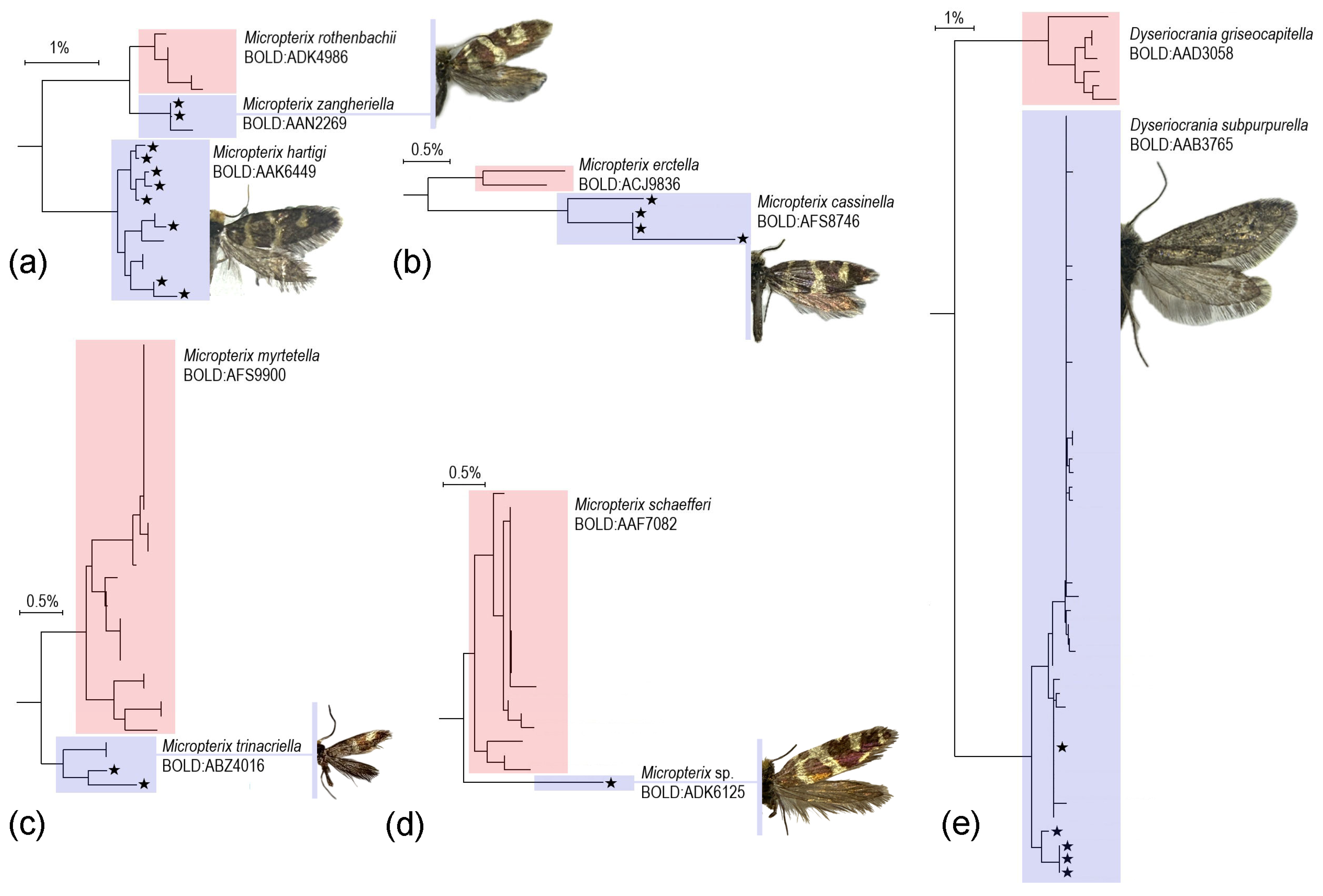
Micropterigidae and Eriocraniidae are poorly investigated in Southern Europe. Despite the richness of the Italian territory, studies devoted to investigating their molecular diversity are lacking. Furthermore, knowledge concerning the diversity and species distribution of these families in southern Italian regions is very poor. The aim of this paper is to contribute to filling the gaps in knowledge on the diversity of Micropterigidae and Eriocraniidae in southern Italian regions by analysing, through DNA barcoding, the samples collected in this geographic area by the authors in recent years. In total, 37 specimens were submitted to DNA barcoding analysis. The sequences were subsequently identified by comparing them with those available in the Barcoding of Life Data Systems. The results provided the first record and the first sequences of the Eriocraniidae family for southern Italy, the first record in continental Italy of a formerly Sicilian endemic species, the first sequences of an endemic species, and the first sequence belonging either to a previously described but unsequenced species or to an undescribed species. In conclusion, DNA barcoding of these families in southern Italy provided very interesting insights, improving their molecular libraries and the knowledge on the fauna of this territory. Daytime studies can further improve these results, but addressing the gaps concerning immature stages should be the major goal of future research.
Keywords: molecular identification; taxonomic impediment; faunistics; Calabria; forest ecosystems molecular identification; taxonomic impediment; faunistics; Calabria; forest ecosystems