Review

The Ural Owl as a Keystone Species in Interspecific Interactions Among Avian Predators—A Review

Institute of Systematics and Evolution of Animals, Polish Academy of Sciences, 31-016 Krakow, Poland
Diversity 2025, 17(2), 109; https://doi.org/10.3390/d17020109
Submission received: 6 January 2025 / Revised: 24 January 2025 / Accepted: 31 January 2025 / Published: 1 February 2025
(This article belongs to the Special Issue Birds in Temperate and Tropical Forests—2nd Edition)

Abstract

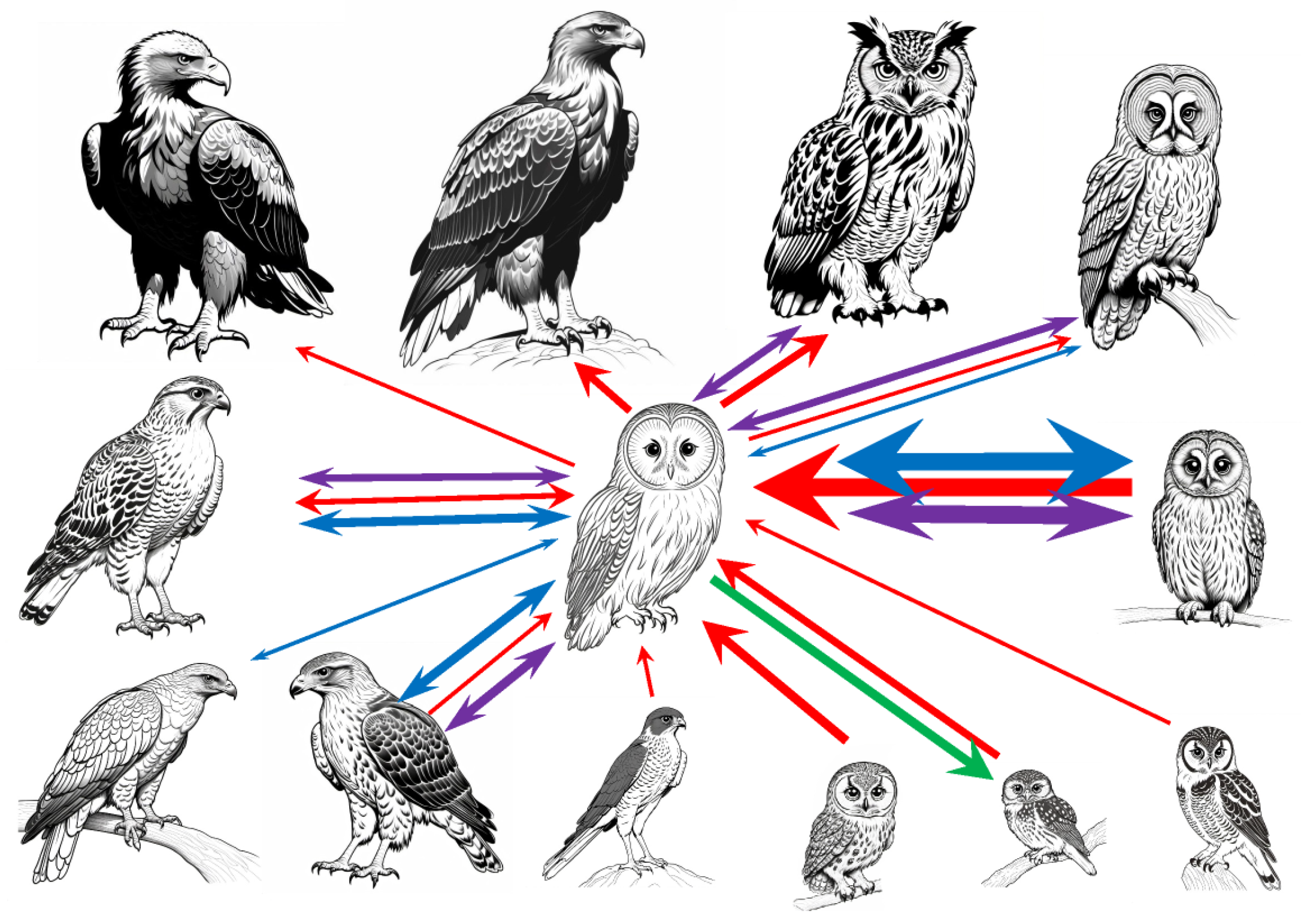
Ural owls are one of the largest owls in Europe, exhibiting known aggressive behaviour toward other raptors. They are known to interact with nearly all sympatric owls and many diurnal raptors. To summarise these interactions, a literature search was undertaken in the Web of Sciences and Scopus databases using the Preferred Reporting Items for Systematic Reviews and Meta-Analyses methodology as well principal books on owl biology. The search revealed 22 relevant publications that (along with the book data) described the Ural owl’s relations with seven owls and six diurnal raptor species. The Ural owl is subordinate only to the largest predators like golden eagles and eagles, although only its chicks are known to be killed. Contrary to that, the Ural owls shape the distribution of numerous other species, mostly by strong competition (e.g., forcing tawny owls to breed in suboptimal habitats) or by predation (killing smaller owls and diurnal raptors). Their occurrence could be also protective for some species like boreal owls thanks to the removal of intermediate predators. The relations of Ural owls with goshawks are interesting, which seem to live in some balance—temporal avoidance of activity with frequent co-occurrence. Thanks to their association with old-growth forests and their impact on other predators in their territories, Ural owls act as keystone species in mountainous and boreal forests in Europe. Considering this ecosystem service, Ural owls should be effectively protected e.g., by designing forest-management-free zones around their nesting sites.
Keywords: Strix uralensis; Strigidae; competition; predation–prey interactions; protective behaviour Strix uralensis; Strigidae; competition; predation–prey interactions; protective behaviour