Article

The First 3 Years: Movements of Reintroduced Plains Bison (Bison bison bison) in Banff National Park


Banff National Park, Box 900, Banff, AB T1L 1K2, Canada
*
Author to whom correspondence should be addressed.
Diversity 2022, 14(10), 883; https://doi.org/10.3390/d14100883
Submission received: 1 September 2022 / Revised: 9 October 2022 / Accepted: 16 October 2022 / Published: 19 October 2022
(This article belongs to the Special Issue Bison and Beyond: Achievements and Problems in Wildlife Conservation)

Abstract

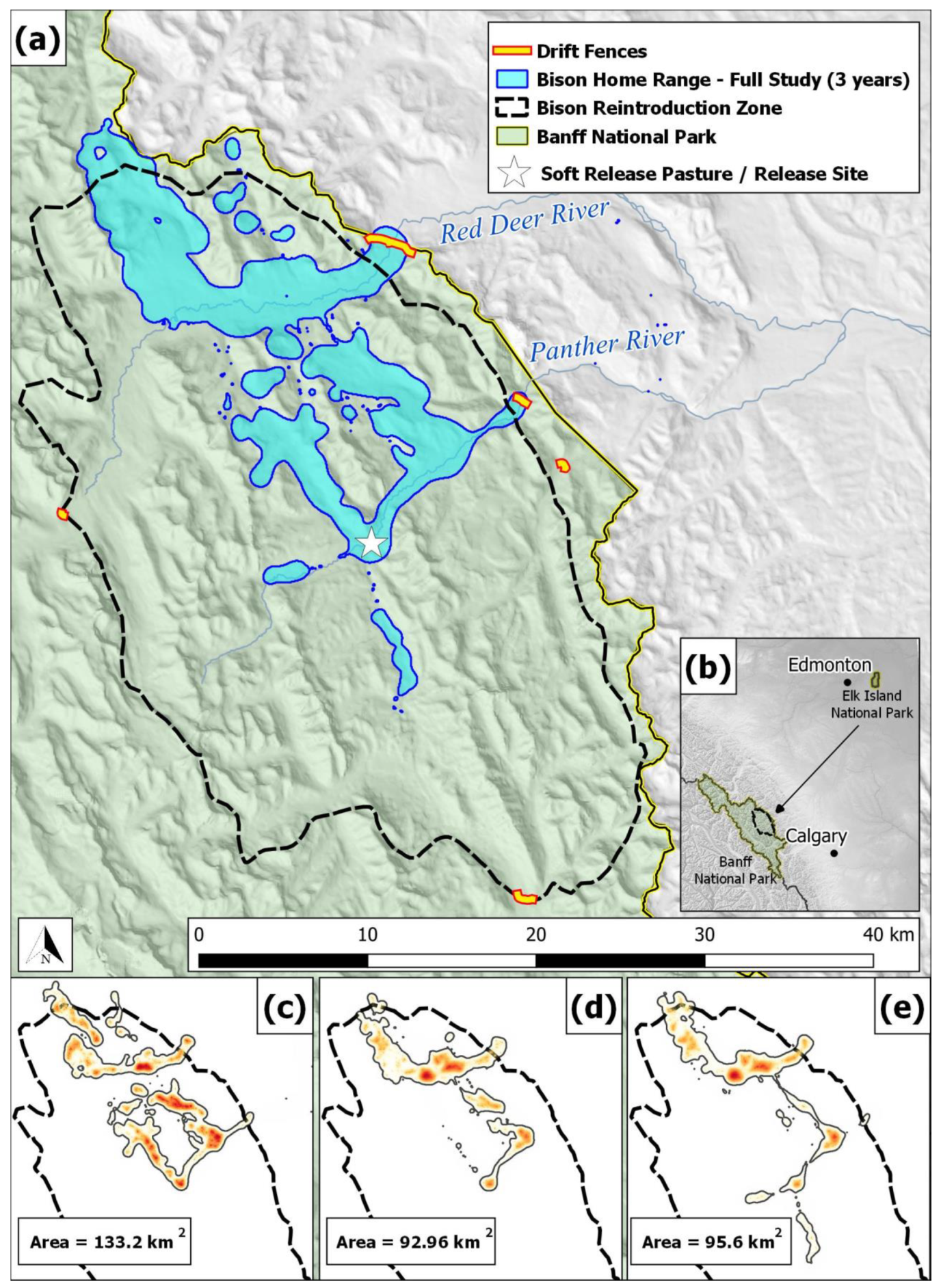
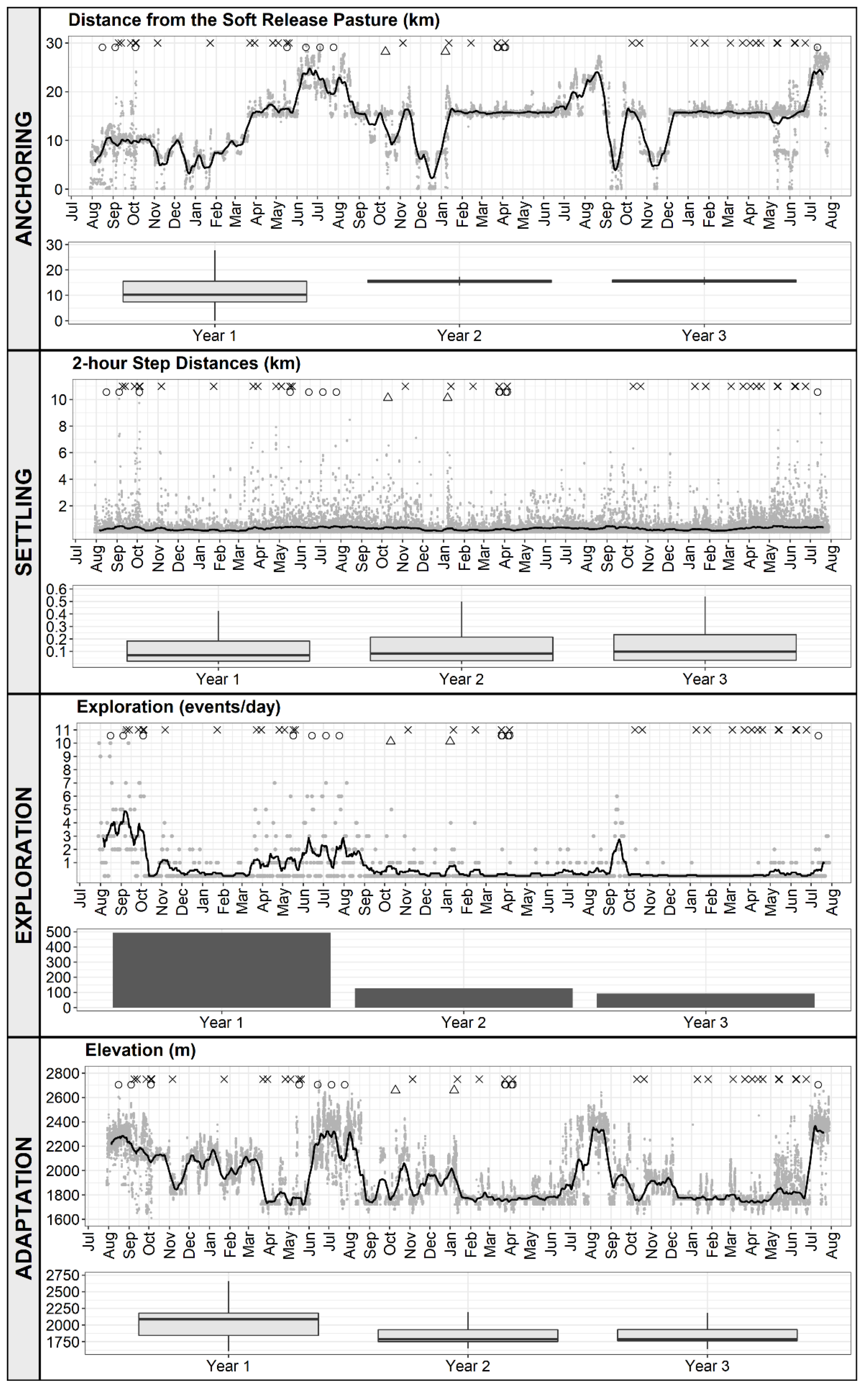
We assessed 3 years of post-release movements of a reintroduced plains bison (Bison bison bison) population for evidence of anchoring, settling, exploratory and adaptive behavior within a 1200 km2 target reintroduction zone in Banff National Park. We first held them in a soft-release pasture for 18 months, then partially constrained their movements with drift fences and hazing trials to discourage excursions from a 1200 km2 target reintroduction zone. Their post-release movements were within 13 km of the soft-release pasture for the first 3 months, but management interventions were needed to keep the animals within 29 km of the release site and inside the reintroduction zone for the remainder of the 3-year study period. Bison exploration was high in the first year but decreased thereafter, as did the size of their annual home range. Step lengths did not decrease but the frequency of “surge movements” (step lengths > 4 km in 2 h) did. Fence visits did not decrease over time but the need to herd/haze the bison from other, unfenced boundary areas did. The reintroduced bison seasonally selected for rugged, high-elevation habitat despite being translocated from a flat landscape. Our results suggest wild bison reintroductions to areas of just a few hundred square kilometres are possible without perimeter fencing, so long as good habitat and management interventions to discourage broad movements are in place. Trends suggest such interventions will need to continue in Banff until the bison range can be expanded and/or bison movements are constrained by other forces, such as regulated hunting outside the park.
Keywords: anchoring; Banff National Park; Bison sp.; conservation; dispersal; elevation; exploration; fidelity; plains bison; range establishment; range expansion; reintroduction; settling; soft-release; step-length; translocation anchoring; Banff National Park; Bison sp.; conservation; dispersal; elevation; exploration; fidelity; plains bison; range establishment; range expansion; reintroduction; settling; soft-release; step-length; translocation