
Article

Ecological Observations on Hybrid Populations of European Plethodontid Salamanders, Genus Speleomantes


1
Key Laboratory of the Zoological Systematics and Evolution, Institute of Zoology, Chinese Academy of Sciences, Beichen West Road 1, Beijing 100101, China
2
Museo di Storia Naturale dell’Università di Firenze, Museo “La Specola”, Via Romana 17, 50125 Firenze, Italy
3
Natural Oasis, Via di Galceti 141, 59100 Prato, Italy
4
Unione Speleologica Calenzano, Piazza della Stazione 1, Calenzano, 50041 Firenze, Italy
5
Istituto di Ricerca sugli Ecosistemi Terrestri (IRET), Consiglio Nazionale delle Ricerche (CNR), Sesto Fiorentino, 50019 Firenze, Italy
6
Speleo Club Firenze via Guardavia 8, 50143 Firenze, Italy
7
Department of Environmental Science and Policy, Universitòà degli Studi di Milano, Via Celoria, 26, 20133 Milan, Italy
8
Laboratorio di Biologia Sotterranea “Enrico Pezzoli”, Parco Regionale del Monte Barro, 23851 Galbiate, Italy
9
Université Grenoble Alpes, Université Savoie Mont Blanc, CNRS, LECA, Laboratoire d’Ecologie Alpine, F-38000 Grenoble, France
*
Authors to whom correspondence should be addressed.
Diversity 2021, 13(7), 285; https://doi.org/10.3390/d13070285
Submission received: 25 May 2021 / Revised: 11 June 2021 / Accepted: 17 June 2021 / Published: 23 June 2021
(This article belongs to the Special Issue The Ecological Role of Salamanders as Predators and Prey)

Abstract

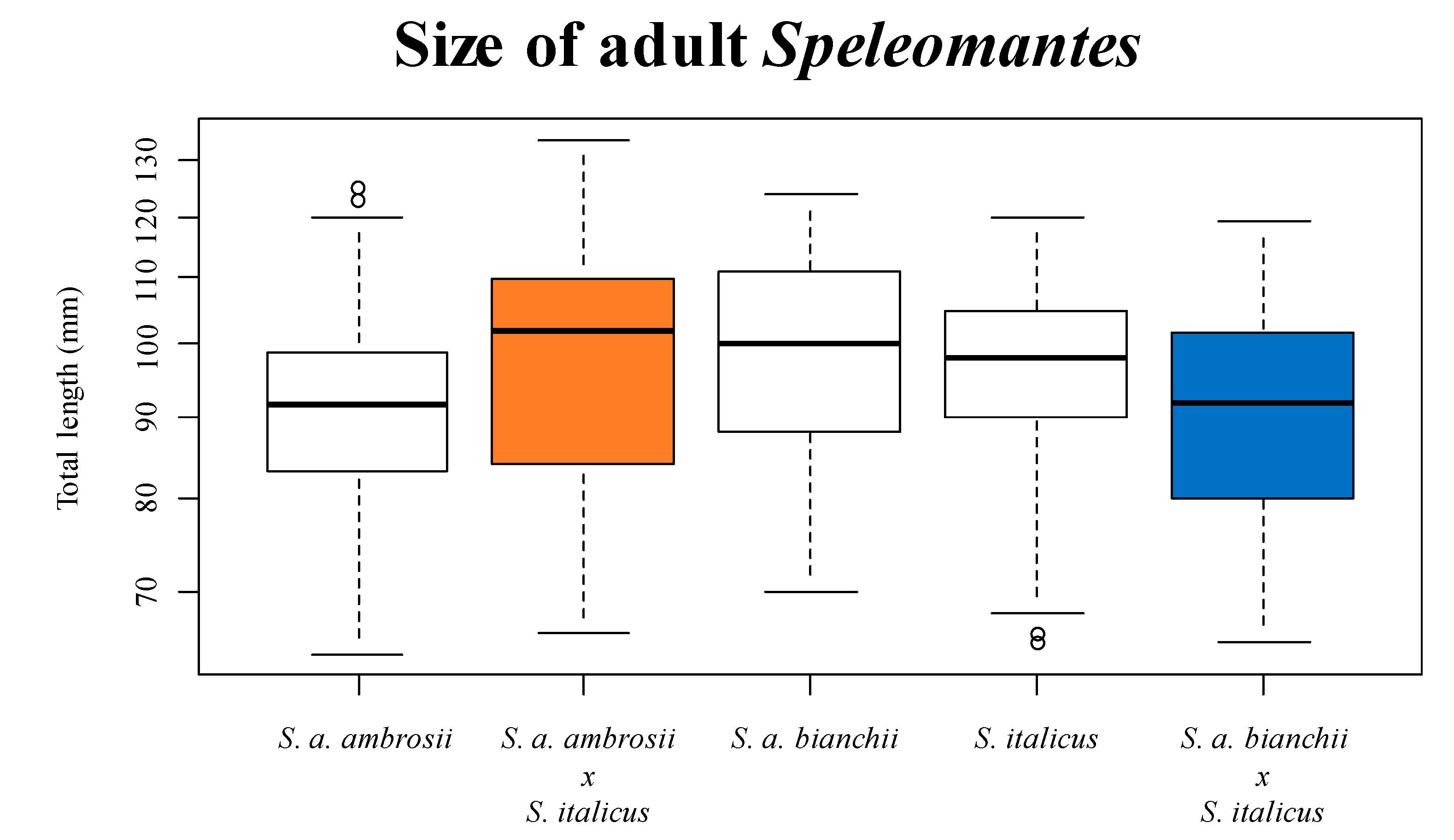
Speleomantes are the only plethodontid salamanders present in Europe. Multiple studies have been performed to investigate the trophic niche of the eight Speleomantes species, but none of these studies included hybrid populations. For the first time, we studied the trophic niche of five Speleomantes hybrid populations. Each population was surveyed twice in 2020, and stomach flushing was performed on each captured salamander; stomach flushing is a harmless technique that allows stomach contents to be inspected. We also assessed the potential divergence in size and body condition between natural and introduced hybrids, and their parental species. Previously collected data on Speleomantes were included to increase the robustness of these analyses. In only 33 out of 134 sampled hybrid Speleomantes we recognized 81 items belonging to 11 prey categories. The frequency of empty stomachs was higher in females and individuals from natural hybrid populations, whereas the largest number of prey was consumed by males. We compared the total length and body condition of 685 adult salamanders belonging to three types of hybrids and three parental (sub)species. Three group of salamanders (one hybrid and two parental species) showed significantly larger size, whereas no difference in body condition was observed. This study provided novel ecological information on Speleomantes hybrid populations. We also provided insights into the potential divergence between hybrids and parental species in terms of size and body condition. We discuss our findings, and formulate several hypotheses that should be tested in the future.
Keywords: Speleomantes; Hydromantes; trophic niche; body condition; cave biology; biospeleology; parental species; diet; size; capture-mark-recapture Speleomantes; Hydromantes; trophic niche; body condition; cave biology; biospeleology; parental species; diet; size; capture-mark-recapture