Article

Assessing the Diversity of the Form of Age-Specific Changes in Adult Mortality from Captive Mammalian Populations


by
Victor Ronget
1,*,
Jean-François Lemaître
2,
Morgane Tidière
3,4 and
Jean-Michel Gaillard
2
1
Unité Eco-anthropologie (EA), Muséum National d’Histoire Naturelle, CNRS, Université Paris Diderot, F-75016 Paris, France
2
Univ Lyon, Université Lyon 1, CNRS, Laboratoire de Biométrie et Biologie Évolutive UMR 5558, F-69622 Villeurbanne, France
3
Species360 Conservation Science Alliance, Bloomington, MN 55425, USA
4
Interdisciplinary Centre on Population Dynamics, Department of Biology, University of Southern Denmark, 5230 Odense, Denmark
*
Author to whom correspondence should be addressed.
Diversity 2020, 12(9), 354; https://doi.org/10.3390/d12090354
Submission received: 31 July 2020 / Revised: 11 September 2020 / Accepted: 13 September 2020 / Published: 15 September 2020
(This article belongs to the Special Issue Bayesian Survival Trajectory Analysis in Wildlife)

Abstract

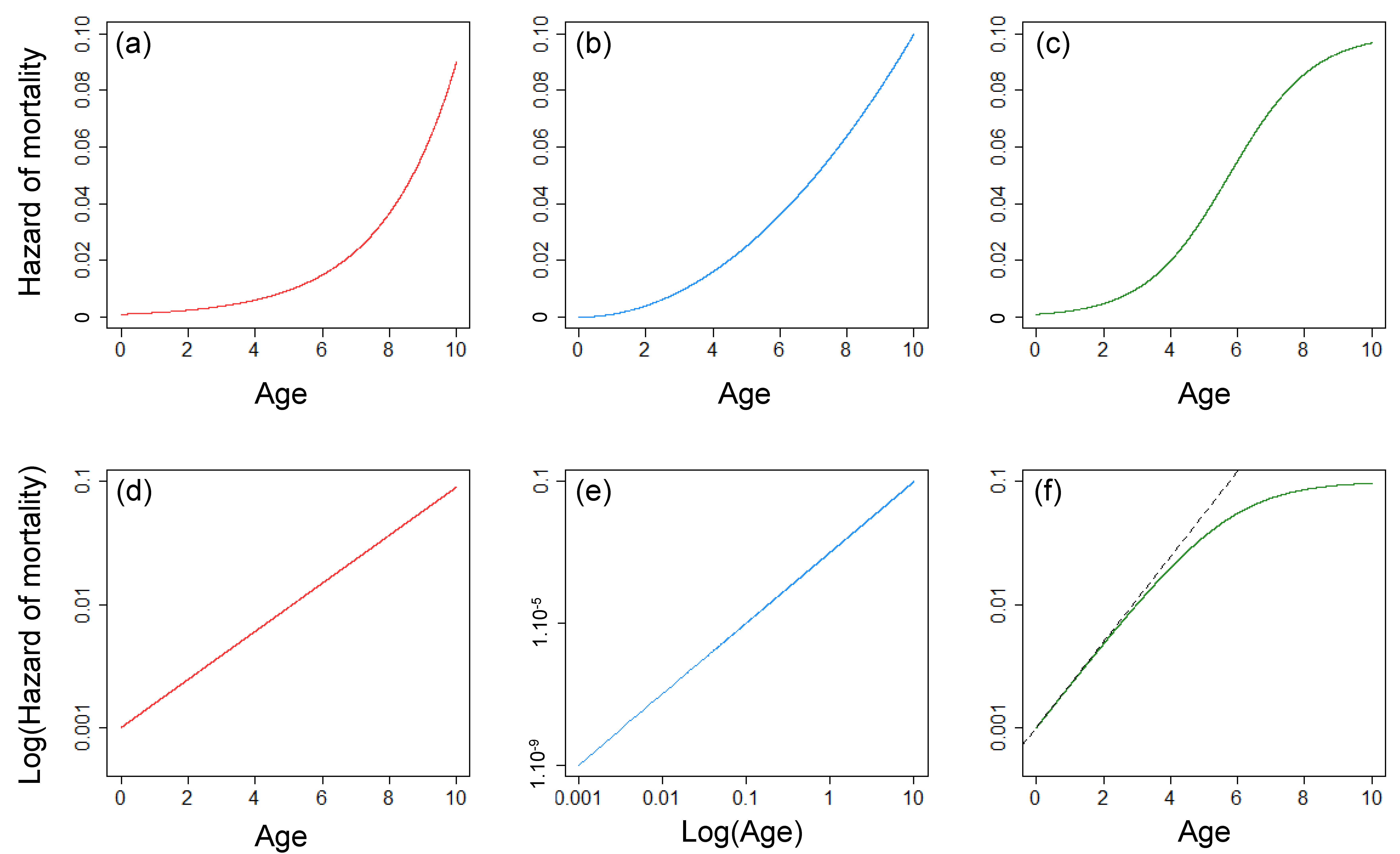
Actuarial senescence (i.e., the age-specific increase in mortality rate) is pervasive across mammalian species, but our current understanding of the diversity of forms that actuarial senescence displays across species remains limited. Although several mathematical models have been proposed to model actuarial senescence, there is still no consensus on which model to use, especially when comparing mortality patterns among species. To fill this knowledge gap, we fitted and compared different forms of increase using models commonly used in senescence studies (i.e., Gompertz, Weibull, and logistic) across 61 species of mammalian captive populations using the Bayesian Survival Trajectory Analysis (BaSTA) approach. For as much as 79% of the species, a Gompertz increase of mortality with age was the most parsimonious model that satisfactorily described the shape of age-specific mortality changes in adults. This highlights that the form of the increase in mortality is mostly consistent across mammalian species and follows the Gompertz rule with some rare exceptions. The implications of that result are twofold. First, the Gompertz rate of mortality increase should be used in cross-species comparative analyses of mammals, as already done in some studies. Second, although the Gompertz model accurately describes actuarial senescence in most mammals, there are notable exceptions, and the factors causing this deviation from an exponential mortality increase during the adult stage warrant further investigation.
Keywords: aging; senescence; demography; Bayesian analysis; population dynamics aging; senescence; demography; Bayesian analysis; population dynamics