


Abstract
The synthesis of methyl (E)-3-(2-amino-4-chloro-6-morpholinopyrimidin-5-yl)acrylate 3 was accomplished using a Schlosser-modified Wittig reaction. Complete 1H and 13C NMR signal assignments confirm the formation of E-alkene.
1. Introduction
The biological properties of pyrimidine derivatives are well known and widely documented [1,2,3,4,5,6]; research continues to be directed toward the synthesis of these systems with substituents and functional groups that allow for the expansion of their potential applications in different biological phenotypes and structural diversities [7,8,9,10]. Synthetic approaches include variations and substrate diversity in the classic Biginelli reaction [11,12,13], and the modification of available pyrimidine derivatives. The use of halo pyrimidine carbaldehyde derivatives as precursors provides several functionalizable sites to form C–C bonds through aldol and related reaction mechanisms, and C-N bonds through SNAr mechanisms, reactions related to ammonia derivatives [14,15,16,17], and the Wittig olefination reaction [14,18].
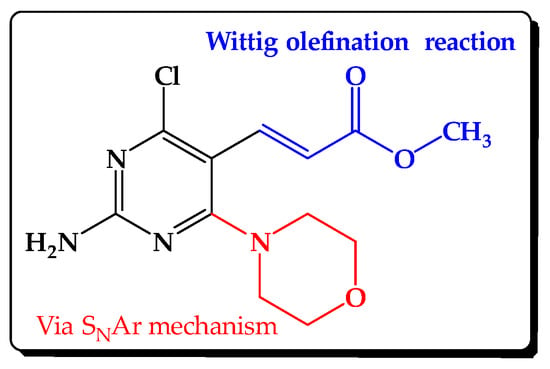
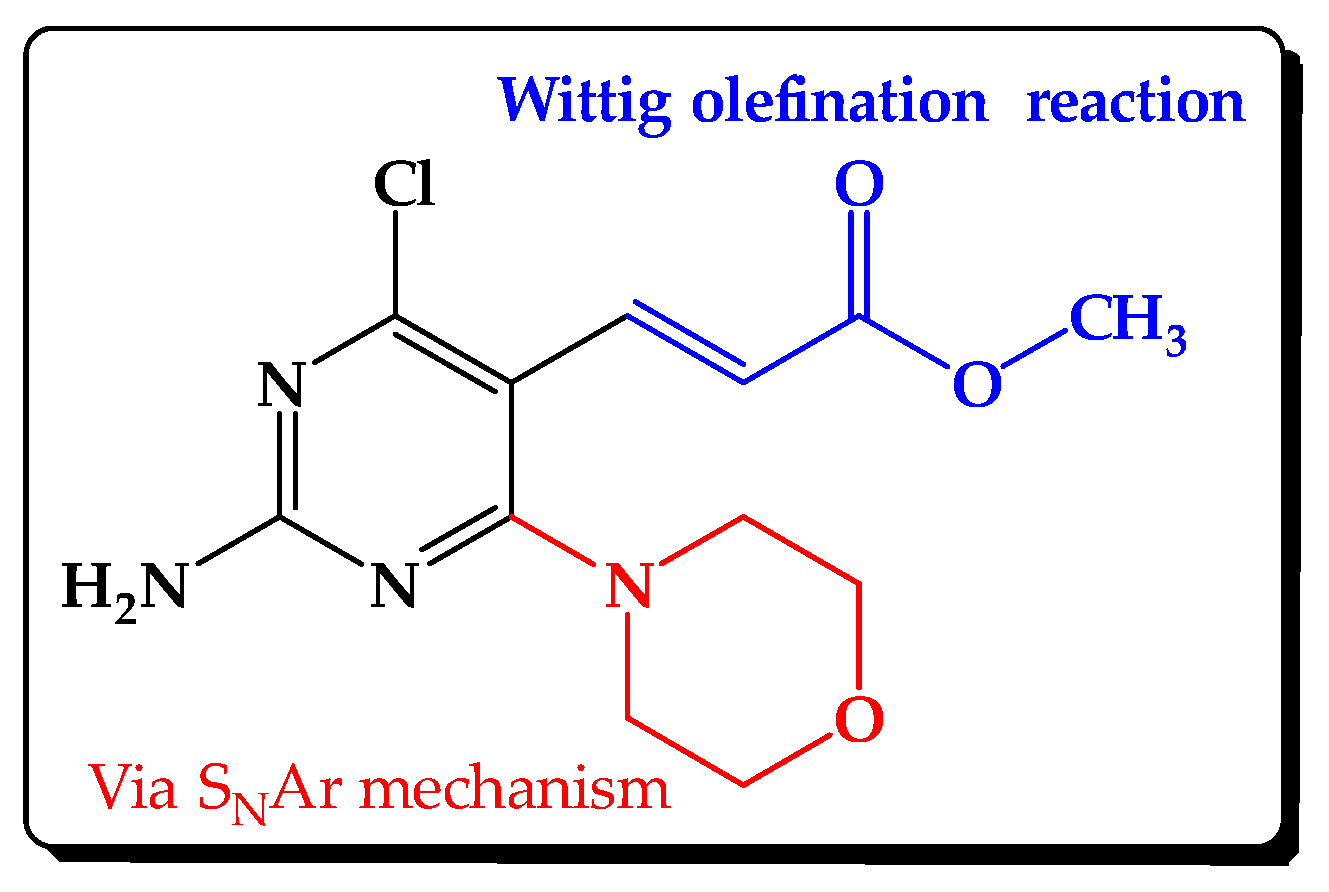
In this context, we continue to explore the scope and synthetic versatility of 2-Amino-4,6-dichloropyrimidine-5-carbaldehyde in Wittig olefination reactions combined with SNAr reactions (Figure 1).
Figure 1.
(E)-Methyl 3-(2-amino-4-chloro-6-morpholinopyrimidin-5-yl)acrylate.
2. Results and Discussion
2-Amino-4,6-dichloropyrimidine-5-carbaldehyde can be obtained via the Vilsmeier-Haack chloroformylation reaction of 2-amino-4,6-dihydroxypyrimidine, an inexpensive and commercially available compound [19]. The compound 2-Amino-4,6-dichloropyrimidine-5-carbaldehyde can be derived and modified through its four functionalizable sites: an amino substituent, two chloro substituents, and the aldehyde functionality. Using the SNAr mechanism, chloro has been replaced by amino groups through an efficient and stoichiometrically controlled procedure using different primary and secondary amines and anilines, thus generating C–N bonds [20,21]. In contrast, the aldehyde functionality opens up options for structural diversification via Claisen–Schmidt [21] and Knoevenagel [22] condensation reactions and Horner–Wadsworth–Emmons and Wittig olefination reactions [14,15,16].
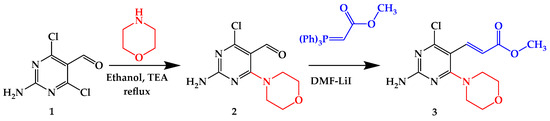
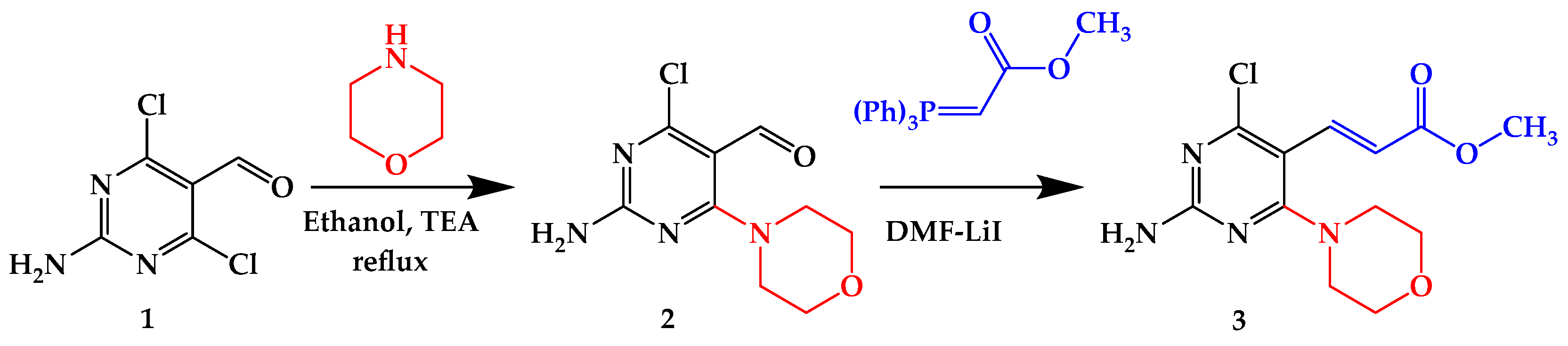
The Wittig reaction has been widely studied, and interest remains because of the new reaction conditions, catalytic variants, and mechanistic and computational analyses. Currently, the disadvantages of the classical reaction have been overcome, and strategies are available that allow the Wittig reaction to be combined with other synthetic applications, such as the formation of heterocyclic compounds by intermolecular or intramolecular aza-Wittig reactions, Wittig olefination with photo-assisted reactions, and SNAr–Wittig reactions. The extension of the reaction is mainly due to characteristics such as regiospecificity, stereoselectivity, mild reaction conditions, easily obtainable starting materials, and ylide and ylene tolerance to functional groups [23,24,25,26]. In this context, the Wittig olefination reaction was carried out from 2-amino-4-chloro-6-morpholinopyrimidine-5-carbaldehyde 2 and methyl (triphenylphosphoranylidene)acetate as a phosphoru-stabilized carbon nucleophilic for the preparation of methyl (E)-3-(2-amino-4-chloro-6-morpholinopyrimidin-5-yl)acrylate 3, with good yield 80% (Scheme 1).
Scheme 1.
Amination via the SNAr mechanism and Wittig olefination.
This reaction has several advantages, such as the use of methyl (triphenylphosphoranylide-ne)acetate as triphenylphosphonium ylides, which is commercially available, inexpensive, and stable and, together with the lithium salt, favors the formation of E-alkenes. This combination is known as the Schlosser modification of the Wittig reaction and allows for methyl (E)-3-(2-amino-4-chloro-6-morpholinopyrimidin-5-yl)acrylate 3 to be obtained in good yield, which is separated by simple filtration, because the reaction is carried out in DMF, which dissolves the phosphine oxide byproduct.
2-amino-4-chloro-6-morpholinopyrimidine-5-carbaldehyde 2 was prepared as previously described [20]. The use of phosphonium ylide enables the Wittig reaction to proceed without strong bases (BuLi, NaH, and KOtBu), diverging from the conventional conditions. In our hands, conducting this transformation under base-free conditions prevented substrate 2 from undergoing competitive nucleophilic processes, delivering product 3 in a high isolated yield (80%) while preserving reaction fidelity [25,26,27].
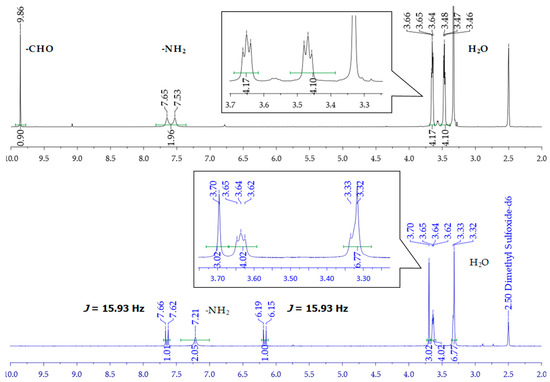
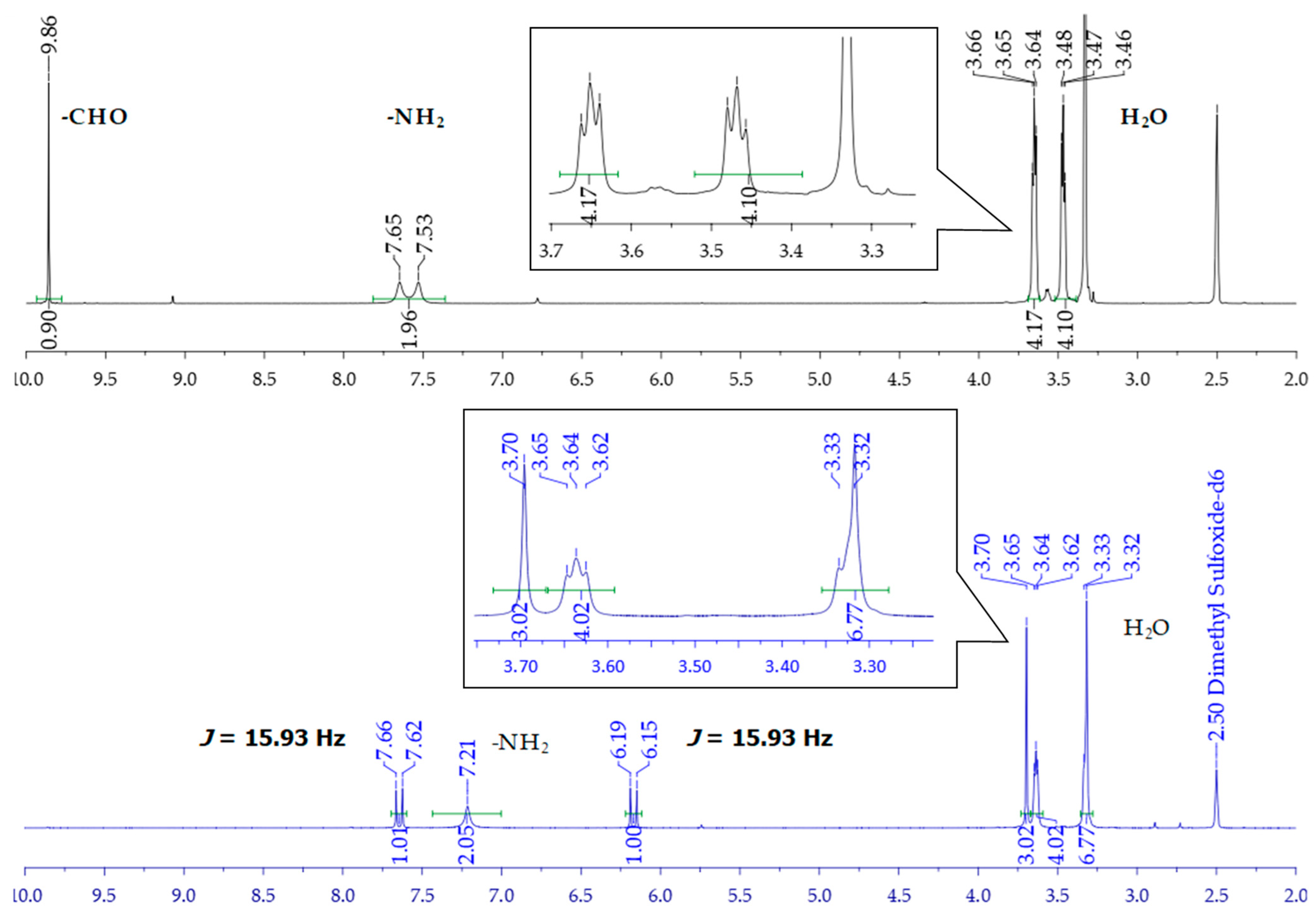
(E)-3-(2-amino-4-chloro-6-morpholinopyrimidin-5-yl)acrylate 3 was characterized by IR, 1H, 13C NMR, and HRMS (see spectra in the Supplementary Materials). Figure 2 shows the 1H NMR spectra of compound 2 (black) and 3 (blue). Comparative analysis confirmed the formation of E-alkene 3, as indicated by the large coupling constant of its olefinic protons (J = 15.93 Hz).
Figure 2.
1H NMR spectra of compounds 2 (black) and 3 (blue). Both spectra show an expansion of the aliphatic region.
The isolated and characterized (E)-3-(2-amino-4-chloro-6-morpholinopyrimidin-5-yl)acrylate 3, obtained in good yield (80%), does not rule out the partial reversibility of the oxaphosphetane intermediate, but suggests that the observed E-selectivity arises from the thermodynamically more stable trans-oxaphosphetane, which affords E-alkene upon phosphine oxide elimination.
3. Materials and Methods
3.1. General
Methyl (triphenylphosphoranylidene)acetate, lithium iodide, and all solvents were purchased from Sigma-Aldrich (St. Louis, MO, USA; Merck, Kenilworth, NJ, USA) and used without further purification. The melting point (uncorrected) was determined using a Thermo Scientific IA 9100/Capillary melting point apparatus (Electrothermal House, Essex, UK). 1H and 13C NMR spectra were recorded on a Bruker Avance 400 spectrometer (Bremen, Germany) operating at 400 and 100 MHz, respectively, using DMSO-d6 as the solvent and tetramethylsilane (δ 0.00 ppm) as the internal standard. Chemical shifts (δ) are reported in ppm and coupling constants (J) in hertz. High-resolution mass spectra (HRMS) were obtained using an Agilent Technologies QTOF 6520B spectrometer coupled to an Agilent 1200 HPLC system equipped with an Agilent Zorbax Extend C18 column (2.1 × 50 mm, 1.8 μm; PN 727700-902) using electrospray ionization (ESI) in the positive mode (Agilent, Santa Clara, CA, USA). The HPLC method employed a flow rate of 0.4 mL/min with a gradient from acetonitrile/water (10%, containing 0.1% formic acid) to acetonitrile (containing 0.1% of formic acid).
3.2. Synthesis of Methyl (E)-3-(2-amino-4-chloro-6-morpholinopyrimidin-5-yl)acrylate 3
Equimolar amounts (1.0 mmol) of the 2-amino-4-chloro-6-morpholinopyrimidine-5-carbaldehyde 2 and methyl (triphenylphosphoranylidene)acetate were mixed in 10 mL DMF, then lithium iodide (0.268 g, 2 mmol) was editioned and the mixture was refluxed for 5 h. The mixture was then allowed to cool to room temperature, and DMF was removed under reduced pressure. Crude product 3 was further purified by recrystallization from ethanol and isolated by filtration as a brown solid. m.p. 218–220 °C. 80%. 1H 400 MHz DMSO–d6 RT δ: 3.32 (bb, 4H, N–CH2), 3.64 (t, 4H, O–CH2), 3.70 (s, 3H, OCH3), 6.15 (d, 1H, Hα, J = 15.93 Hz), 7.21 (s, 2H, NH2), 7.62 (d, 1H, Hβ, J = 15.93 Hz). 13C 100 MHz DMSO-d6 RT δ: 48.9 (N–CH2), 51.4 (OCH3), 65.7 (O–CH2), 101.3 (C–5, pyirimidine), 116.3 (Cα), 137.8 (Cβ), 160.6 (C–4, pyirimidine), 160.9 (C–6, pyirimidine), 165.9 (C–2, pyirimidine), 167.1 (C=O). IR (KBr) cm−1 3295–3186 (NH2 st), 2968–2946 (C–H st), 1701 (C=O st) 1623 (C=C st), 1525 (C–N st), 1106 (C–O st), 1072 (C–O, st). HR-MS calc. For C12H15ClN4O3 298.0833 found 298.0824.
3.3. Synthesis of 2-Amino-4-chloro-6-morpholinopyrimidine-5-carbaldehyde 2
A solution of 2-amino-4,6-dichloro-5-formylpyrimidine (1 mmol), morpholine (1 mmol), and triethylamine (1 mmol) in ethanol (10.0 mL) was heated under reflux for 3 h. The reaction mixture was then allowed to cool to room temperature, and the product was collected by filtration, washed with ethanol, and air-dried. Yellow solid. m.p. 172–174 °C. 81%. 1H 400 MHz DMSO–d6 RT: 3.46 (t, 4H, CH2), 3.64 (t, 4H, CH2), 7.52 (broad s, 1H, NH2), 7.64 (broad s, 1H, NH2), 9.85 (s, 1H, CH O). 13C NMR 100 MHz DMSO–d6 RT δ: 48.9, 66.1, 103.4, 161.2, 162.8, 166.6, 183.4 (CH=O). IR (KBr) cm−1 3351–3200 (NH2 st), 1632 (C=O st), 1579 (C=N st), 1115 (C–O, st), 1034 (C–N, st). MS m/z (abundance %): 244 (M+2, 4), 242 (M+, 11), 225 (18), 129 (27), 94 (15), 69 (28), 55 (48), 43 (100). Anal. calc. for C9H11ClN4O2: C 44.55, H 4.57, N 23.09 found C 44.50, H 4.33, N 23.35.
4. Conclusions
Overall, the combination of a stabilized ylide under robust base-free conditions outperformed traditional basic protocols in terms of yield, functional group tolerance, and stereochemical control. Although the reaction requires a slightly longer time, its operational simplicity and enhanced selectivity make this strategy an appealing option for the synthesis of functionalized alkenes, in which stereochemical purity and substrate stability are critical.
Supplementary Materials
The following supporting information can be downloaded online, HRMS, 1H, and 13C NMR spectra for compound 3.
Author Contributions
Synthesis work and NMR interpretation. J.T.; writing—original draft preparation, J.T. and E.P.-C.; writing—review and editing J.Q. All authors have read and agreed to the published version of the manuscript.
Funding
This research received no external funding.
Data Availability Statement
The data are contained within this article and its Supplementary Materials.
Acknowledgments
The authors express their gratitude to the Universidad del Atlántico, the Universidad del Valle and the Universidad de Concepción.
Conflicts of Interest
The authors declare no conflicts of interest.
References
- Venugopala, K.N.; Kamat, V. Pyrimidines: A New Versatile Molecule in the Drug Development Field, Scope, and Future Aspects. Pharmaceuticals 2024, 17, 1258. [Google Scholar] [CrossRef]
- Kaur, N.; Kaur, M.; Sohal, H.S.; Han, H.; Bhowmik, P.K. A Review on Barbituric Acid and Its Derivatives: Synthesis, Reactions, and Bio-Applications. Organics 2024, 5, 298–345. [Google Scholar] [CrossRef]
- Kumar, A.; Singh, A.K.; Singh, H.; Vijayan, V.; Kumar, D.; Naik, J.; Thareja, S.; Yadav, J.P.; Pathak, P.; Grishina, M.; et al. Nitrogen Containing Heterocycles as Anticancer Agents: A Medicinal Chemistry Perspective. Pharmaceuticals 2023, 16, 299. [Google Scholar] [CrossRef] [PubMed]
- Utrera Martines, M.A.; Pereira Duarte, A.; ur Rashid, H.; Jorge, J.; Rasool, S.; Muhammad, R.; Ahmad, N.; Naveed Umar, M. Research developments in the syntheses, antiinflammatory activities and structure–activity relationships of pyrimidines. RSC Adv. 2021, 11, 606. [Google Scholar] [CrossRef]
- Ramalakshmi, N.; Helina, N.A.S.; Amuthalakshmi, A.S.; Arunkumar, S. Structure-Activity Relationships of Pyrimidine Derivatives and their Biological Activity—A Review. Med. Chem. 2023, 19, 10–30. [Google Scholar] [CrossRef]
- Zarenezhad, E.; Farjam, M.; Iraji, A. Synthesis and biological activity of pyrimidines-containing hybrids: Focusing on pharmacological application. J. Mol. Struct. 2021, 1230, 129833. [Google Scholar] [CrossRef]
- Díaz-Fernández, M.; Algarra, M.; Calvo-Losada, S.; Quirante, J.-J.; Sarabia, F.; Pino-González, M.-S. Diverse Methods with Stereoselective Induction in the Asymmetric Biginelli Reaction. Molecules 2024, 29, 3864. [Google Scholar] [CrossRef]
- Zhang, X.; Bi, W.; Cao, Z.; Shen, J.; Chen, B. Recent Developments in the Metal-Catalyzed Synthesis of Nitrogenous Heterocyclic Compounds. Molecules 2024, 29, 5458. [Google Scholar] [CrossRef]
- Aparna, E.P.; Devaky, K.S. Advances in the Solid-Phase Synthesis of Pyrimidine Derivatives. ACS Comb. Sci. 2019, 21, 35–68. [Google Scholar] [CrossRef]
- Patil, R.V.; Chavan, J.U.; Dalal, D.S.; Shinde, V.S.; Beldar, A.G. Biginelli Reaction: Polymer Supported Catalytic Approaches. ACS Comb. Sci. 2019, 21, 105–148. [Google Scholar] [CrossRef]
- Chandravarkar, A.; Aneeja, T.; Anilkumar, G. Advances in Biginelli reaction: A comprehensive review. J. Heterocycl. Chem. 2024, 61, 5–28. [Google Scholar] [CrossRef]
- Marinescu, M. Biginelli Reaction Mediated Synthesis of Antimicrobial Pyrimidine Derivatives and Their Therapeutic Properties. Molecules 2021, 26, 6022. [Google Scholar] [CrossRef] [PubMed]
- Mittersteiner, M.; Farias, F.F.S.; Bonacorso, H.G.; Martins, M.A.P.; Zanatta, N. Ultrasound-assisted synthesis of pyrimidines and their fused derivatives: A review. Ultrason. Sonochem. 2021, 79, 105683. [Google Scholar] [CrossRef] [PubMed]
- Udayasri, A.; Chandrasekhar, M.M.; Naga, B.M.V.; Varanasi, G.; Ramakrishna, D.S. Green chemical principles based regioselective functionalization of 2,4,6-trichloropyrimidine-5-carbaldehyde: Application in the synthesis of new pyrimidines and pyrrolopyrimidine. J. Serb. Chem. Soc. 2023, 1, 1–9. [Google Scholar] [CrossRef]
- Hofmann, P.E.; Meinecke, J.; Harms, K.; Koert, U. Synthesis and Functionalization of C6/C7 Substituted Pyrido [3,2-d]pyrimidines. Eur. J. Org. Chem. 2021, 46, 6263–6281. [Google Scholar] [CrossRef]
- Zinchenko, A.M.; Muzychka, L.V.; Kucher, O.V.; Sadkova, I.V.; Mykhailiuk, P.K.; Smolii, O.B. One-Pot Synthesis of 6-Aminopyrido [2,3-d]pyrimidin-7-ones. Eur. J. Org. Chem. 2018, 46, 6519–6523. [Google Scholar] [CrossRef]
- Silva, J.L.; Lima, C.G.S.; Rangel, L.P.; Ferretti, G.D.S.; Pauli, F.P.; Ribeiro, R.C.B.; da Silva, T.d.B.; da Silva, F.C.; Ferreira, V.F. Recent Synthetic Approaches towards Small Molecule Reactivators of p53. Biomolecules 2020, 10, 635. [Google Scholar] [CrossRef]
- Zhou, Q.; Li, K.; Li, L.-L.; Yu, K.-K.; Zhang, H.; Shi, L.; Chen, H.; Yu, X.-Q. Combining Wittig Olefination with Photoassisted Domino Reaction. To Distinguish 5-Formylcytosine from 5-Formyluracil Anal. Chem. 2019, 91, 9366−9370. [Google Scholar] [CrossRef]
- Seela, F.; Sterker, H. Synthesis of 2′-Deoxyribofuranosides of 8-Aza-7-deazaguanine and Related Pyrazolo [3,4-d]pyrimidines. Helv. Chim. Acta 1986, 69, 1602–1613. [Google Scholar] [CrossRef]
- Cobo, J.; Trilleras, J.; Quiroga, J.; Marchal, A.; Nogueras, M.; Low, J.N.; Glidewell, C. N6-Substituted 2-amino-4-chloro-5-formylpyrimidines: Puckered versus planar pyrimidine rings, and hydrogen-bonded aggregation in zero, one, two and three dimensions. Acta Cryst. 2008, B64, 596–609. [Google Scholar] [CrossRef]
- Trilleras, J.; Pérez-Gamboa, A.; Quiroga, J. SNAr Reactions on 2-Amino-4,6-dichloropyrimidine-5-carbaldehyde. Molbank 2022, 2022, M1426. [Google Scholar] [CrossRef]
- Trilleras, J.; Low, J.N.; Cobo, J.; Marchal, A.; Glidewell, C. Hydrogen-bonded ribbons in ethyl (E)-3-[2-amino-4,6-bis-(dimethylamino)pyrimidin-5-yl]-2-cyanoacrylate and 2-[(2-amino-4,6-di-1-piperidylpyrimidin-5-yl)methylene] malononitrile. Acta Cryst. 2008, C64, o145–o148. [Google Scholar] [CrossRef]
- Ilia, G.; Simulescu, V.; Plesu, N.; Chiriac, V.; Merghes, P. Wittig and Wittig–Horner Reactions under Sonication Conditions. Molecules 2023, 28, 1958. [Google Scholar] [CrossRef]
- Pedrood, K.; Montazer, M.N.; Larijani, B.; Mahdavi, M. Recent Advances in the Synthesis of Heterocycles by the Aza-Wittig Reaction. Synthesis 2021, 53, 2342−2366. [Google Scholar] [CrossRef]
- Shi, Y.; Pan, B.-W.; Yu, J.-S.; Zhou, Y.; Zhou, J. Recent Advances in Applying Carbonyl-stabilized Phosphorus Ylides for Catalysis. ChemCatChem 2021, 13, 129–139. [Google Scholar] [CrossRef]
- Schirmer, M.L.; Adomeit, S.; Werner, T. First Base-Free Catalytic Wittig Reaction. Org. Lett. 2015, 17, 3078−3081. [Google Scholar] [CrossRef]
- Byrne, P.A.; Gilheany, D.G. The modern interpretation of the Wittig reaction mechanism. Chem. Soc. Rev. 2013, 42, 6670–6696. [Google Scholar] [CrossRef]
Disclaimer/Publisher’s Note: The statements, opinions and data contained in all publications are solely those of the individual author(s) and contributor(s) and not of MDPI and/or the editor(s). MDPI and/or the editor(s) disclaim responsibility for any injury to people or property resulting from any ideas, methods, instructions or products referred to in the content. |
© 2026 by the authors. Licensee MDPI, Basel, Switzerland. This article is an open access article distributed under the terms and conditions of the Creative Commons Attribution (CC BY) license.