Short Note

(5R,5aR,8aR,9S)-9-(2-Bromo-3,4,5-trimethoxyphenyl)-8-oxo-5,5a,6,8,8a,9-hexahydrofuro[3′,4′:6,7]naphtho[2,3-d][1,3]dioxol-5-yl 3,4,5-trimethoxybenzoate


1
School of Pharmacy, Macau University of Science and Technology, Macau 999078, China
2
Department of Molecular and Translational Medicine, Università di Brescia, Viale Europa 11, 25123 Brescia, Italy
3
Faculty of Medicine, Macau University of Science and Technology, Macau 999078, China
4
State Key Laboratory of Quality Research in Chinese Medicine, Science and Technology Building, Macau University of Science and Technology, Avenida Wai Long, Taipa, Macau 999078, China
*
Authors to whom correspondence should be addressed.
Molbank 2026, 2026(1), M2140; https://doi.org/10.3390/M2140
Submission received: 15 January 2026 / Revised: 11 February 2026 / Accepted: 12 February 2026 / Published: 13 February 2026
(This article belongs to the Section Organic Synthesis and Biosynthesis)

Abstract

In this report, we describe the synthesis and full spectroscopic characterization of a previously unreported podophyllotoxin (PTOX) analogue bearing a second 3,4,5-trimethoxyphenyl (TMP) unit at the C-4 position through an ester linkage. This dual-TMP PTOX derivative is obtained from a brominated PTOX intermediate. In this precursor, the bromine atom is located on the TMP aromatic ring at the 2′-position. The new compound was fully characterized by proton (1H), carbon-13 (13C), heteronuclear single-quantum coherence (HSQC), and distortionless enhancement by polarization transfer (DEPT) NMR spectroscopy. Ultraviolet–visible (UV-Vis) spectroscopy, Fourier-transform infrared (FTIR) spectroscopy, mass spectrometry and elemental analysis were also performed to confirm the structure and purity of the synthesized ester derivative.

1. Introduction

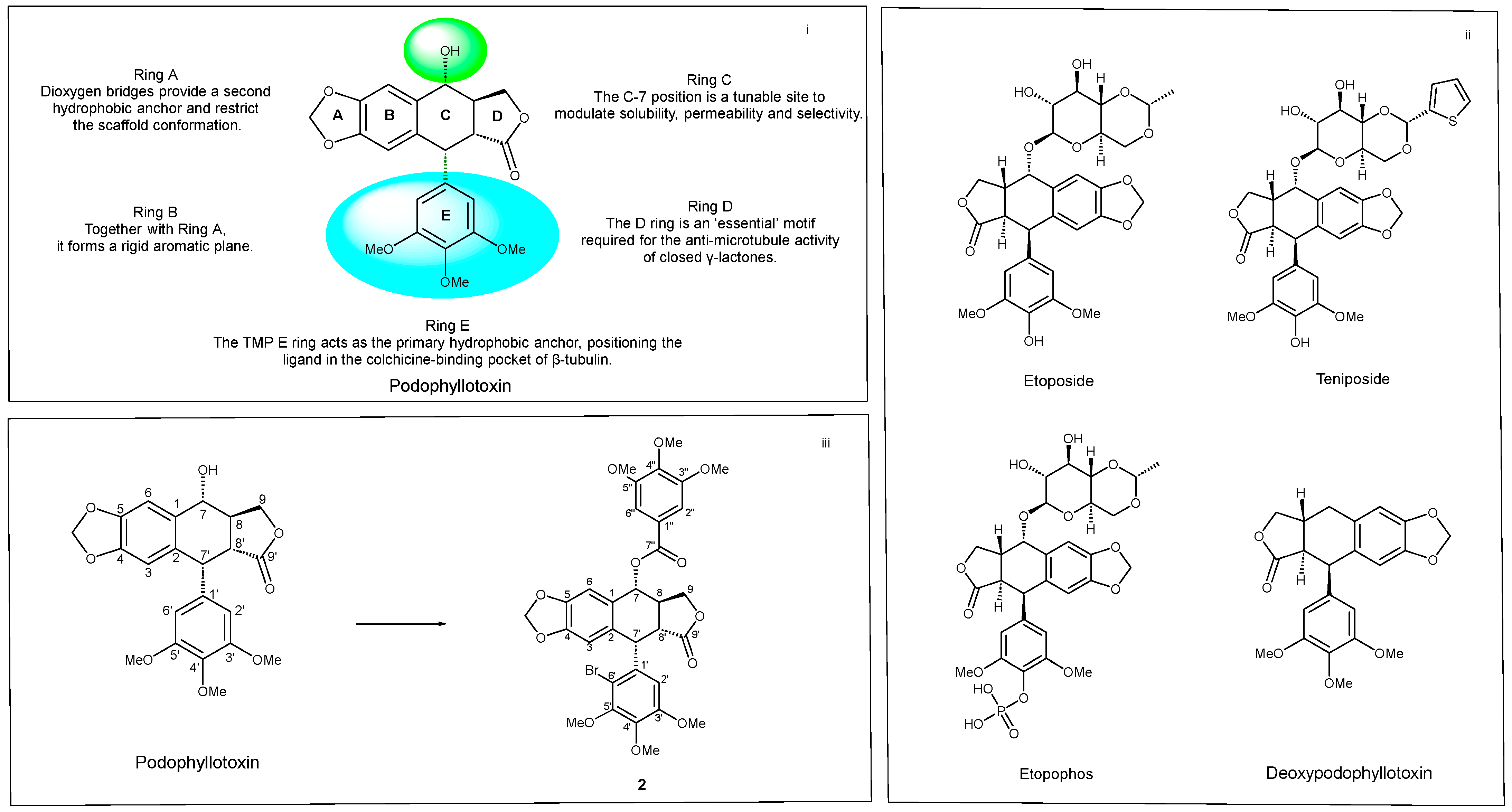
Podophyllotoxin (PTOX) is a typical cyclomethylated taxane analogue that occupies the colchicine-binding site (CBS) of β-tubulin, disrupting the dynamic equilibrium between microtubules and tubulin. As a natural product, it exhibits anticancer properties through its ability to inhibit cell division and induce apoptosis [1]. Consequently, microtubule polymerization and spindle formation are inhibited, leading to cell-cycle arrest at G2/M [2,3]. Representative semi-synthetic derivatives developed as anticancer agents include etoposide, teniposide, etopophos and deoxypodophyllotoxin (Figure 1). The primary mechanism of action for etoposide and teniposide does not involve microtubules, but rather the formation of complexes with DNA topoisomerase II. These compounds are widely employed in first-line or combination chemotherapy for tumours including small-cell lung cancer and testicular germ cell tumours. These derivatives primarily inhibit subsequent ligation, causing persistent double-strand breaks in DNA during replication/transcription rather than directly inhibiting topoisomerase activity [4,5]. This also leads to elevated reactive oxygen species (ROS) and activation of the p38 MAPK, CDK1/Cdc2, or PLK1 pathways [6,7,8]. Beyond proliferation inhibition, PTOX also exhibits a tendency to downregulate migration, invasion, and angiogenesis. Clinical applications primarily utilize PTOX derivatives, with etoposide combined with cisplatin for treating small-cell lung cancer (SCLC) [9]. PTOX itself is mainly administered as a 0.5% topical formulation for the treatment of genital warts [10,11]. However, the clinical application of PTOX is constrained by dose-limiting toxicities, primarily manifested as gastrointestinal reactions, hepatic injury, and bone marrow suppression. This may impact therapeutic efficacy, patient tolerance, and treatment progression, thus opening the field to the search for novel analogues.
From a structural point of view, the PTOX skeleton exhibits several chemically different moieties (Figure 1). Ring A, a 1,3-benzodioxole, imposes conformational constraints on the skeleton. Ring D, a γ-butyrolactone, is one of the key elements for microtubule-binding activity. Ring E comprises 3,4,5-trimethoxyphenyl (TMP), which provides hydrophobic docking to enhance ligand positioning and binding affinity. It also stabilizes the ortho substituent, strengthening π–π interactions [12]. Removal of the 4-OMe group or alteration of the ring substitution pattern frequently results in reduced activity. Similarly, the binding of the backbone of PTOX to CBS also relies on TMP. The TMP ring typically penetrates deep into the hydrophobic groove of β-tubulin, forming a tight hydrophobic fit with residues such as Cys241 and Leu248 to achieve its effect [13,14]. It should be noted that TMP is not the sole substituent responsible for the mechanism of CBS inhibition; nocodazole also binds to CBS to depolymerize microtubules even if its structure lacks TMP and instead features a benzimidazole–thiophene skeleton. This demonstrates that while TMP is an effective structural motif, it is not the only viable approach [15].
Over recent decades, esterification of the podophyllotoxin scaffold has become one of the main strategies to tune its biological and physicochemical properties. Previous medicinal chemistry efforts on PTOX have largely focused on derivatization at the C-4 position or on modifying the E-ring TMP motif with alternative acyloxy or heteroaromatic fragments [16,17,18]. Beyond the first-generation drugs, a large number of C-4 aliphatic, aromatic and heteroaromatic esters have been described as antimitotic or tubulin-targeting agents [19,20]. However, to the best of our knowledge, no PTOX analogue bearing a second TMP unit at C-4 in a brominated scaffold has been reported so far. In this paper, we describe a site-specific, selectively controllable synthetic pathway for the preparation of PTOX–TMP (2), generated by linking a brominated derivative of PTOX with 3,4,5-trimethoxybenzoic acid. This compound was fully characterized through NMR, IR, UV-Vis, mass spectrometry and elemental analysis to assess its identity.

2. Results and Discussion

As anticipated, PTOX is a classic tubulin inhibitor capable of arresting cell nuclei in metaphase during mitosis. The TMP moiety within its E-ring enhances CBS binding; therefore, based on the consensus that TMP serves as the anchoring group for this site, we introduced a second TMP moiety at a modifiable hydroxyl site on PTOX.
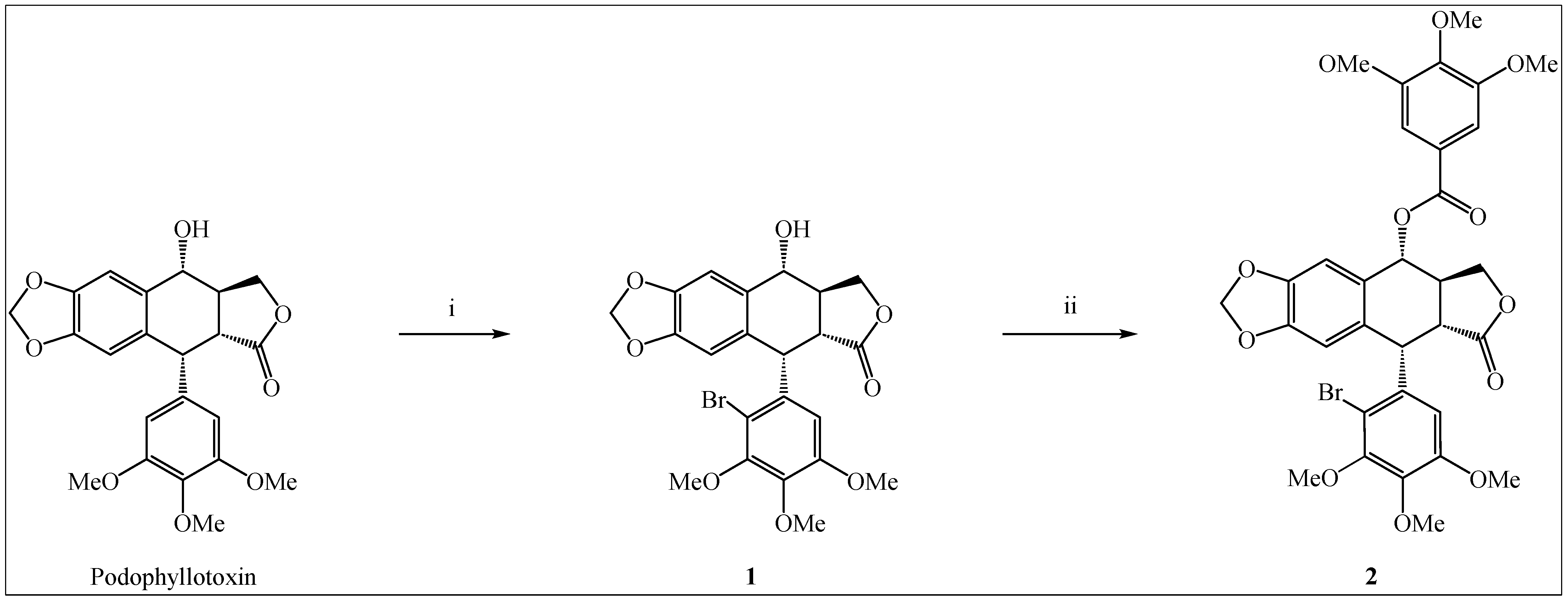
The synthetic routes for compounds 1 and 2 employ PTOX as the starting material (Scheme 1).
The synthetic scheme starts with the mild and selective bromination of the aromatic ring [21], followed by coupling with 3,4,5-trimethoxybenzoic acid under EDCI/DMAP conditions to yield the C-4 ester. From a chemical selectivity perspective, this synthetic route ensures that the core structure remains intact. PTOX exhibits heightened sensitivity towards the electrophilic bromination of N-bromobis(2-oxobutane)imide, yielding a single regionally selective adduct at ambient temperature. Concurrently, steric hindrance between the E ring (TMP) and the backbone suppresses over-bromination [22]. From a medicinal chemistry point of view, the incorporation of bromine may also reduce water solubility, enhance cLogP, and increase protein binding affinity, offering insights for subsequent prodrug design [23]. Then, compound 1 was coupled with 3,4,5-trimethoxybenzoic acid under EDCI/DMAP conditions to afford the C-4 ester derivative (compound 2) [24]. In this case, our primary rationale was to incorporate an additional TMP moiety as a second binding site group and as a new vector for further derivatization, rather than to dramatically improve basic physicochemical properties. Simulated physico-chemical/pharmacokinetic parameters calculated using SwissADME (swissadme.ch, accessed on 23 October 2025) indicate that compound 2 remains within the hydrophobic, poorly soluble property space typical of PTOX and related colchicine–site ligands, with limited gastrointestinal absorption; such limitations were already present in the original PTOX molecule rather than as an immediately improved drug candidate [25]. These issues should be addressed by further modifications of the compounds or by enrolling formulation and drug delivery technologies.
Finally, the chemical structure of 1 and 2 was confirmed by NMR, IR, UV, mass spectrometry and elemental analysis.
Complete 1H and 13C NMR assignments for compound 1 were obtained by combining 1D spectra with DEPT-135, HSQC, and COSY experiments. These data allowed us to unambiguously establish both the regioselective bromination pattern on the TMP ring and the integrity of the PTOX core. Compound 1 is a known derivative and its spectroscopic data are in agreement with those reported in the literature [26]. The IR spectrum of 1 revealed O-H stretching at 3437 cm−1, γ-lactone C=O stretching at 1774 cm−1, C-O-C stretching at 1184 cm−1, and aromatic stretching at 1627 cm−1 (Figure S8), while its UV spectrum exhibited an absorbance peak at 227.00 nm—an absorption attributable to the benzene ring (Figure S10).
For compound 2, the combination of DEPT-135, HSQC and COSY experiments enabled full assignment of all proton and carbon resonances and confirmed esterification at C-4 and preservation of the benzylic and lactone stereochemistry. The 1H-NMR spectrum of 2 displayed a peak at 3.85 ppm and 3.73 ppm, assigned to the three newly bonded methoxy groups. The two newly introduced hydrogen atoms on the benzene ring are located at 6.41 ppm (Figure S3). In the 13C-NMR spectrum of 2, 173.77 ppm and 174.64 ppm are assigned to the ester and lactone carbonyls, while the resonances in the δC 147–153 region correspond to aromatic C-O quaternary carbons of the TMP rings; methoxy methyl carbons appear at δC 60.87, 59.74, 56.40 and 56.22 (Figure S4). Also in this case, further structural assignments were supported by 2D NMR experiments. In the 1H-13C HSQC spectrum of 2, H-2′ (δH 7.26 ppm) in the 3,4,5-trimethoxy group below exhibits a single pair of related peaks with the aromatic carbon at δC 107.26 ppm. Again, no second hydrogen was observed in the HSQC spectrum, consistent with the 6′-position bromination (Figure S6). The equivalent aromatic hydrogen H-2″/H-6″ (δH 6.41 ppm) signals of the TMP ester moiety exhibit equal intensity correlation with δC 107.05 ppm, while the four methoxy signal values (δH 3.89, 3.85, 3.76 and 3.73 ppm) correlate in pairs with δC 60.87/59.74/56.40/56.22 ppm, thus further confirming successful synthesis. In the 1H-1H COSY spectrum of compound 2, no COSY cross-peak is expected between H-2″ and H-6″ because they are chemically equivalent (Figure S7). The IR spectrum of 2 shows methoxy C-H stretching at 2920 cm−1, aromatic ester C=O stretching at 1720 cm−1, and ester C–O stretching at 1261 cm−1 (Figure S8), while its UV spectrum exhibits an absorption maximum at 233 nm attributable to the aromatic chromophore (Figure S9). Overall, the multidimensional NMR data provide high-level structural information on this new PTOX scaffold and rule out alternative regioisomeric structures that could arise from bromination or acylation at different positions.

3. Materials and Methods

3.1. General Chemistry

Silica gel (FCP 230–400 mesh) was used for column chromatography. Thin-layer chromatography was carried out on Merck precoated silica gel 60 F254 plates (Merck, Darmstadt, Germany) and visualized with phosphomolybdic acid, iodine, or a UV–visible lamp. All chemicals were purchased from Bide Pharmatech. Ltd. (Shanghai, China). 1H-NMR and 13C-NMR spectra were collected in CDCl3 at 25 °C on a Bruker Ascend®-600 (Magnet System 600′54 Ascend LH, San Jose, CA, USA) NMR spectrometer (600 MHz for 1H and 150 MHz for 13C). All chemical shifts were reported in the standard δ notation of parts per million using the peak of the residual proton signals of CDCl3 as an internal reference (CDCl3, δC 77.2 ppm, δH 7.26 ppm). UV analysis was performed by a Shimadzu UV–2600 (Osaka, Japan) with a 1 cm quartz cell and a slit width of 2.0 nm. The analysis was carried out using wavelengths in the range of 200–700 nm. IR analysis (KBr) was performed on a Shimadzu IRAffinity-1S (Kyoto, Japan) with a frequency range of 4000–500 cm−1.

3.2. Synthesis of (5R,5aR,8aR,9S)-5-(2-Bromo-3,4,5-trimethoxyphenyl)-9-hydroxy-5,8,8a,9-tetrahydrofuro[3′,4′:6,7]naphtho[2,3-d][1,3]dioxol-6(5aH)-one 1

A solution of N-bromosuccinimide (NBS) (1.1 eq) in dry DMF (4 mL) was added dropwise to a solution of PTOX (200 mg) in dry DMF (4 mL) at 0 °C to room temperature for 24 h. When the reaction was complete, the reaction was checked using TLC analysis. The reaction mixture was diluted with water (15 mL), and then 200 mL saturated brine was added for extraction and then partitioned with ethyl acetate (20 mL × 3). Then, the organic phases were collected, dried over anhydrous Na2SO4 and evaporated, obtaining the crude product, which was purified by silica gel column chromatography with dichloromethane/methanol (99:1, v/v) as the eluent. The target compound was concentrated and produced a white solid compound (169 mg) with a yield of 84.5%. 1H-NMR (600 MHz, CDCl3) 7.09 (s, 1H), 6.34 (s, 1H), 6.22 (s, 1H), 5.91 (s, 2H), 5.25 (d, J = 6.0 Hz, 1H), 4.75 (d, J = 9.3 Hz, 1H), 4.61 (dd, J = 8.7, 6.5 Hz, 1H), 4.15–4.05 (m, 1H), 3.89 (s, 3H), 3.86 (s, 3H), 3.65 (s, 3H), 2.98 (qd, J = 8.3, 3.8 Hz, 1H), 2.95 (dd, J = 14.7, 6.2 Hz, 1H), 2.86 (s,1H). 13C-NMR (151 MHz, CDCl3) δ 171.93, 151.22, 149.92, 146.87, 146.57, 141.66, 134.57, 131.44, 130.56, 113.50, 109.57, 108.65, 104.57, 100.44, 70.84, 69.86, 60.00, 55.41, 43.06, 40.85, 40.73. UV-Vis (CH2Cl2) peaks 285.50, 247.12 and 227.00 nm. IR (FTIR) 3437, 3194, 2931, 1774, 1184 cm−1. Elemental analysis (%): C, 53.57; H, 4.29; Br, 16.20; O, 25.95. HRMS (ESI+) m/z: [M + H]+ calcd for C22H21BrO8+ 493.0493; found 493.0462 (Δ0.003 ppm).

3.3. Synthesis of (5R,5aR,8aR,9S)-9-(2-Bromo-3,4,5-trimethoxyphenyl)-8-oxo-5,5a,6,8,8a,9-hexahydrofuro[3′,4′:6,7]naphtho[2,3-d][1,3]dioxol-5-yl 3,4,5-trimethoxybenzoate 2

The mixture of compound 1 (150 mg), 3,4,5-trimethoxybenzoic acid (0.2 mmol), 1-ethyl-3-(3-dimethylaminopropyl)carbodiimide (EDCI; 0.4 mmol) and 4-(N,N-dimethylamino) pyridine (DMAP; 0.1 mmol) in DMF (10 mL) was stirred at room temperature for 4 h. When the reaction was complete according to TLC analysis, the mixture was filtered. The filtrate was collected and the mixture washed using ethyl acetate (20 mL × 3) and brine (25 mL). The organic phases were collected, dried over anhydrous Na2SO4, and then evaporated, obtaining the crude product, further purified by silica gel column chromatography with dichloromethane/methanol (99:1, v/v) as the eluent. The target compound was concentrated and produced a white solid compound (124 mg) with a yield of 82.7%. 1H-NMR (600 MHz, CDCl3) δ 7.26 (s, 1H, H-2′, overlapped with residual CHCl3), 6.81 (d, J = 0.7 Hz, 1H), 6.54 (s, 1H), 6.41 (s, 2H), 6.10 (d, J = 8.5 Hz, 1H), 5.97 (s, 1H), 5.93 (s, 1H),4.61 (d, J = 4.0 Hz, 1H), 4.41 (m, 1H), 4.26 (false triplet, J = 9.3,Hz, 1H), 3.88 (s, 3H), 3.85 (s, 6H), 3.76 (s, 3H), 3.73 (s, 6H), 2.97–2.94 (m, 2H). 13C-NMR (151 MHz, CDCl3) δ174.64, 173.77, 153.24, 152.75, 148.36, 147.90, 143.22, 137.37, 134.99, 132.52, 128.49, 124.19, 109.91, 108.37, 107.26, 107.05, 101.75, 74.37, 71.54, 60.87, 59.74, 56.40, 56.22, 45.75, 43.87, 38.89. UV-Vis (CH2Cl2) peaks 274.50, 247.12 and 233.00 nm. IR (FTIR) 2920,1788,1720, 1261 cm−1. Elemental Analysis (%): C, 55.91; H, 4.55; Br, 11.62; O, 27.93. HRMS (ESI+) m/z: [M + H]+ calcd for C32H31BrO12+ 688.1150; found 688.1160 (Δ0.001 ppm).

4. Conclusions

This study focused on PTOX, a classic cyclolignan and CBS-acting microtubule inhibitor, and established a chemoselective route to a previously unreported dual-TMP analogue. Targeting the C-4 position, we established a chemoselective EDCI/DMAP acylation to introduce an additional TMP unit in a brominated PTOX derivative, obtaining a PTOX-TMP derivative in which the Br atom and TMP moieties were rationally introduced as motivated above. The resulting PTOX-TMP ester was obtained without perturbing the lactone or benzylic stereochemistry and was fully characterized by UV-Vis, IR, and NMR. These findings provide detailed structural information on this new scaffold and demonstrate the feasibility of the TMP strategy in chemical research, providing an experimental foundation and design reference for the development of PTOX derivatives and novel anticancer candidates.

Supplementary Materials

The following supporting information is available online. Figure S1. 1H NMR spectrum (CDCl3, 600 MHz) of Podophyllotoxin (PTOX); Figure S2. 13C NMR spectrum (CDCl3, 150 MHz) of Podophyllotoxin (PTOX); Figure S3. 1H NMR spectrum (CDCl3, 600 MHz) of 2; Figure S4. 1H NMR spectrum (CDCl3, 600 MHz) of 2 (δ4.60–4.10 ppm); Figure S5. 13C NMR spectrum (CDCl3, 150 MHz) of 2; Figure S6. DEPT-135 spectrum (CDCl3, 600 MHz) of 2; Figure S7. HSQC spectrum (CDCl3, 600 MHz) of 2; Figure S8. COSY spectrum (CDCl3, 600 MHz) of 2; Table S1. 1H and 13C NMR chemical shifts and the structure of 2; Figure S9. IR spectrum of 2; Figure S10. UV spectrum of 2; Figure S11. MASS spectrum of 2.

Author Contributions

Conceptualization, P.C.; methodology, Y.X.; validation, A.G., G.R. and P.C.; formal analysis, Y.X. and I.K.; investigation, Y.X.; data curation, Y.X., A.G., I.K. and G.R.; writing—original draft preparation, Y.X.; writing and editing, A.G., G.R. and P.C.; supervision, P.C.; project administration, P.C.; funding acquisition, G.R. and P.C. All authors have read and agreed to the published version of the manuscript.

Funding

This research was funded by FDCT grants from Macao Science and Technology University to P.C. (Project Code: 0005-2023-RIA1) and the Università di Brescia (to A.G. and G.R.).

Data Availability Statement

The original contributions presented in this study are included in the article and Supplementary Materials. Further enquiries can be directed to the corresponding author.

Conflicts of Interest

The authors declare no conflicts of interest.

Abbreviations

PTOXPodophyllotoxin
TMP3,4,5-Trimethoxyphenyl
CBSColchicine-binding site
Cys241Cysteine-241
Leu248Leucine-248
HOBT1-Hydroxybenzotriazole
EDCI1-Ethyl-3-(3-dimethylaminopropyl)carbodiimide (hydrochloride)
p38 MAPKp38 mitogen-activated protein kinase
CDK1/Cdc2Cyclin-dependent kinase 1/cell division cycle protein 2
PLK1Polo-like kinase 1
SCLCSmall-cell lung cancer

References

  1. Coghi, P.; Ng, J.P.L.; Kadioglu, O.; Law, B.Y.K.; Qiu, A.C.; Saeed, M.E.M.; Chen, X.; Ip, C.K.; Efferth, T.; Liu, L.; et al. Synthesis, computational docking and biological evaluation of celastrol derivatives as dual inhibitors of SERCA and P-glycoprotein in cancer therapy. Eur. J. Med. Chem. 2021, 224, 113676. [Google Scholar] [CrossRef] [PubMed]
  2. Ravelli, R.B.; Gigant, B.; Curmi, P.A.; Jourdain, I.; Lachkar, S.; Sobel, A.; Knossow, M. Insight into tubulin regulation from a complex with colchicine and a stathmin-like domain. Nature 2004, 428, 198–202. [Google Scholar] [CrossRef]
  3. Xie, Y.; Khalifa, S.-A.-M.; El-Seedi, H.-R.; Coghi, P. Multi-Target Biological Activities of Podophyllotoxin-Derived Natural Products. Oncol. Res. 2025, 33, 2673–-2697. [Google Scholar] [CrossRef]
  4. Deweese, J.E.; Osheroff, N. The DNA cleavage reaction of topoisomerase II: Wolf in sheep’s clothing. Nucleic Acids Res. 2009, 37, 738–748. [Google Scholar] [CrossRef]
  5. Vanden Broeck, A.; Lotz, C.; Drillien, R.; Haas, L.; Bedez, C.; Lamour, V. Structural basis for allosteric regulation of Human Topoisomerase IIα. Nat. Commun. 2021, 12, 2962. [Google Scholar] [CrossRef]
  6. Bondarev, A.D.; Jonsson, J.; Chubarev, V.N.; Tarasov, V.V.; Lagunas-Rangel, F.A.; Schiöth, H.B. Recent developments of topoisomerase inhibitors: Clinical trials, emerging indications, novel molecules and global sales. Pharmacol. Res. 2024, 209, 107431. [Google Scholar] [CrossRef]
  7. Lee, S.O.; Joo, S.H.; Kwak, A.W.; Lee, M.H.; Seo, J.H.; Cho, S.S.; Yoon, G.; Chae, J.I.; Shim, J.H. Podophyllotoxin Induces ROS-Mediated Apoptosis and Cell Cycle Arrest in Human Colorectal Cancer Cells via p38 MAPK Signaling. Biomol. Ther. 2021, 29, 658–666. [Google Scholar] [CrossRef]
  8. Choi, J.Y.; Cho, H.-J.; Hwang, S.-G.; Kim, W.-J.; Kim, J.-I.; Um, H.-D.; Park, J.K. Podophyllotoxin acetate enhances γ-ionizing radiation-induced apoptotic cell death by stimulating the ROS/p38/caspase pathway. Biomed. Pharmacother. 2015, 70, 111–118. [Google Scholar] [CrossRef]
  9. Ganti, A.K.P.; Loo, B.W.; Bassetti, M.; Blakely, C.; Chiang, A.; D’Amico, T.A.; D’Avella, C.; Dowlati, A.; Downey, R.J.; Edelman, M.; et al. Small Cell Lung Cancer, Version 2.2022, NCCN Clinical Practice Guidelines in Oncology. J. Natl. Compr. Cancer Netw. 2021, 19, 1441–1464. [Google Scholar] [CrossRef] [PubMed]
  10. Bertolotti, A.; Ferdynus, C.; Milpied, B.; Dupin, N.; Huiart, L.; Derancourt, C. Local Management of Anogenital Warts in Non-Immunocompromised Adults: A Network Meta-Analysis of Randomized Controlled Trials. Dermatol. Ther. 2020, 10, 249–262. [Google Scholar] [CrossRef] [PubMed]
  11. Gilson, R.; Nugent, D.; Werner, R.N.; Ballesteros, J.; Ross, J. 2019 IUSTI-Europe guideline for the management of anogenital warts. J. Eur. Acad. Dermatol. Venereol. 2020, 34, 1644–1653. [Google Scholar] [CrossRef]
  12. Jin, L.; Song, Z.; Cai, F.; Ruan, L.; Jiang, R. Chemistry and Biological Activities of Naturally Occurring and Structurally Modified Podophyllotoxins. Molecules 2022, 28, 302. [Google Scholar] [CrossRef] [PubMed]
  13. Mooberry, S.L.; Weiderhold, K.N.; Dakshanamurthy, S.; Hamel, E.; Banner, E.J.; Kharlamova, A.; Hempel, J.; Gupton, J.T.; Brown, M.L. Identification and characterization of a new tubulin-binding tetrasubstituted brominated pyrrole. Mol. Pharmacol. 2007, 72, 132–140. [Google Scholar] [CrossRef]
  14. Tang, S.; Zhou, Z.; Jiang, Z.; Zhu, W.; Qiao, D. Indole-Based Tubulin Inhibitors: Binding Modes and SARs Investigations. Molecules 2022, 27, 1587. [Google Scholar] [CrossRef] [PubMed]
  15. Song, I.H.; Park, S.J.; Yeom, G.S.; Song, K.S.; Kim, T.; Nimse, S.B. Not all benzimidazole derivatives are microtubule destabilizing agents. Biomed. Pharmacother. 2023, 164, 114977. [Google Scholar] [CrossRef]
  16. Liu, Y.Q.; Tian, J.; Qian, K.; Zhao, X.B.; Morris-Natschke, S.L.; Yang, L.; Nan, X.; Tian, X.; Lee, K.H. Recent progress on C-4-modified podophyllotoxin analogs as potent antitumor agents. Med. Res. Rev. 2015, 35, 1–62. [Google Scholar] [CrossRef] [PubMed]
  17. Miranda-Vera, C.; Hernández, Á.P.; García-García, P.; Díez, D.; García, P.A.; Castro, M.Á. Podophyllotoxin: Recent Advances in the Development of Hybridization Strategies to Enhance Its Antitumoral Profile. Pharmaceutics 2023, 15, 2728. [Google Scholar] [CrossRef]
  18. Castro, M.A.; Miguel del Corral, J.M.; Gordaliza, M.; Gómez-Zurita, M.A.; de la Puente, M.L.; Betancur-Galvis, L.A.; Sierra, J.; San Feliciano, A. Synthesis, cytotoxicity and antiviral activity of podophyllotoxin analogues modified in the E-ring. Eur. J. Med. Chem. 2003, 38, 899–911. [Google Scholar] [CrossRef]
  19. Motyka, S.; Jafernik, K.; Ekiert, H.; Sharifi-Rad, J.; Calina, D.; Al-Omari, B.; Szopa, A.; Cho, W.C. Podophyllotoxin and its derivatives: Potential anticancer agents of natural origin in cancer chemotherapy. Biomed. Pharmacother. 2023, 158, 114145. [Google Scholar] [CrossRef]
  20. Shareef, M.A.; Duscharla, D.; Ramasatyaveni, G.; Dhoke, N.R.; Das, A.; Ummanni, R.; Srivastava, A.K. Investigation of podophyllotoxin esters as potential anticancer agents: Synthesis, biological studies and tubulin inhibition properties. Eur. J. Med. Chem. 2015, 89, 128–137. [Google Scholar] [CrossRef]
  21. Mitchell, R.H.; Lai, Y.-H.; Williams, R.V. N-Bromosuccinimide-dimethylformamide: A mild, selective nuclear monobromination reagent for reactive aromatic compounds. J. Org. Chem. 1979, 44, 4733–4735. [Google Scholar] [CrossRef]
  22. Che, Z.; Yu, X.; Fan, L.; Xu, H. Insight into dihalogenation of E-ring of podophyllotoxins, and their acyloxyation derivatives at the C4 position as insecticidal agents. Bioorg. Med. Chem. Lett. 2013, 23, 5592–5598. [Google Scholar] [CrossRef]
  23. Huo, T.; Zhao, X.; Cheng, Z.; Wei, J.; Zhu, M.; Dou, X.; Jiao, N. Late-stage modification of bioactive compounds: Improving druggability through efficient molecular editing. Acta Pharm. Sin. B 2024, 14, 1030–1076. [Google Scholar] [CrossRef] [PubMed]
  24. Zefirov, N.A.; Nurieva, E.V.; Mamaeva, A.V.; Vasilenko, D.A.; Sadovnikov, K.S.; Averina, E.B.; Kolchanova, A.Y.; Milaeva, E.R.; Zefirova, O.N. New podophyllotoxin and epipodophyllotoxin derivatives with substituted isoxazole fragments. Russ. Chem. Bull. 2023, 72, 1029–1035. [Google Scholar] [CrossRef]
  25. Daina, A.; Michielin, O.; Zoete, V. SwissADME: A free web tool to evaluate pharmacokinetics, drug-likeness and medicinal chemistry friendliness of small molecules. Sci. Rep. 2017, 7, 42717. [Google Scholar] [CrossRef] [PubMed]
  26. Che, Z.; Yu, X.; Zhi, X.; Fan, L.; Yao, X.; Xu, H. Synthesis of Novel 4α-(Acyloxy)-2′(2′,6′)-(di)halogenopodophyllotoxin Derivatives as Insecticidal Agents. J. Agric. Food Chem. 2013, 61, 8148–8155. [Google Scholar] [CrossRef]
Figure 1. (i) Functional groups and moieties of PTOX that are important for its biological activity; (ii) clinically approved PTOX derivatives; (iii) chemical structure of compound 2.
Molbank 2026 m2140 g001
Scheme 1. (i) Synthesis of 1: N-bromosuccinimide (NBS) (1.1 eq), PTOX (0.1 mmol), dry DMF (8 mL) at 0 °C to RT for 24 h. (ii) Synthesis of 2: Br-PTOX (0.1 mmol), 3,4,5-trimethoxybenzoic acid (0.2 mmol), EDCI (0.4 mmol), DMAP (0.1 mmol), DMF (10 mL) at RT for 4 h. Yields: step (i) 84.5%; step (ii) 82.7%.
Molbank 2026 m2140 sch001
Disclaimer/Publisher’s Note: The statements, opinions and data contained in all publications are solely those of the individual author(s) and contributor(s) and not of MDPI and/or the editor(s). MDPI and/or the editor(s) disclaim responsibility for any injury to people or property resulting from any ideas, methods, instructions or products referred to in the content.