

Short Note

4-(4-Chlorophenyl)-6-phenyl-2-(prop-2-yn-1-yloxy)nicotinonitrile
by
Diana Becerra
*,
Diana Hurtado-Rodríguez
and
Juan-Carlos Castillo
*
Escuela de Ciencias Químicas, Universidad Pedagógica y Tecnológica de Colombia, Avenida Central del Norte 39-115, Tunja 150003, Colombia
*
Authors to whom correspondence should be addressed.
Molbank 2026, 2026(1), M2119; https://doi.org/10.3390/M2119
Submission received: 5 December 2025 / Revised: 26 December 2025 / Accepted: 30 December 2025 / Published: 4 January 2026
(This article belongs to the Collection Heterocycle Reactions)

Abstract

We report an efficient and transition-metal-free protocol for the propargylation of 4-(4-chlorophenyl)-2-oxo-6-phenyl-1,2-dihydropyridine-3-carbonitrile using propargyl bromide in the presence of cesium carbonate in dimethylsulfoxide under mild conditions. This synthetic transformation proceeds with marked chemoselectivity, furnishing the O-propargylated pyridine and the N-propargylated 2-pyridone in 75% and 8% yields, respectively. Both products were fully characterized by IR and NMR spectroscopy, as well as high-resolution mass spectrometry, confirming their molecular structures.

1. Introduction

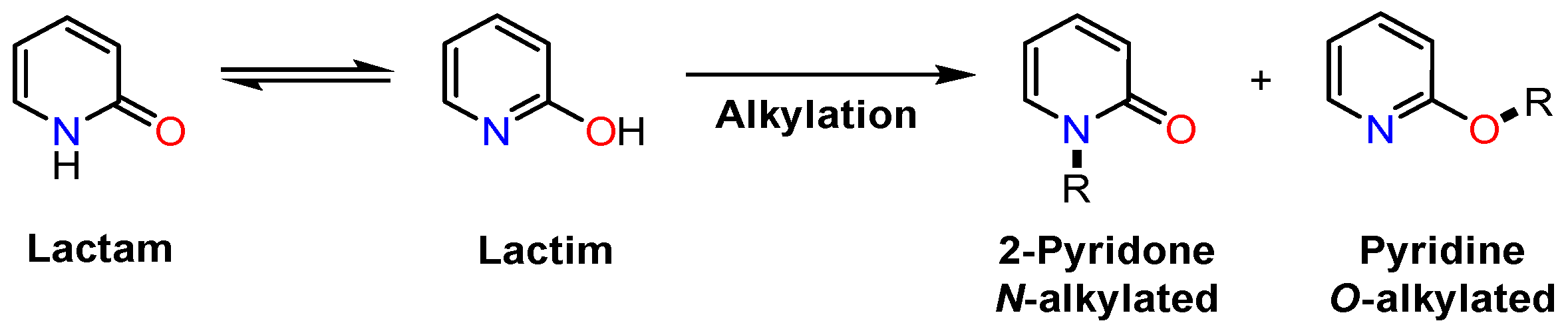
2(1H)-Pyridone is a N-heterocyclic framework bearing a carbonyl group adjacent to a NH moiety, a structural arrangement that enables lactam–lactim tautomerism (Figure 1) [1]. Under most conditions, particularly in the solid state and in polar protic solvents, the lactam tautomer predominates due to the thermodynamic stabilization provided by hydrogen-bonded dimer formation [2,3,4]. The equilibrium between dimeric and monomeric species is highly sensitive to the solvent environment, especially to its hydrogen-bond-accepting ability [5]. In strongly polar aprotic media such as dimethylsulfoxide, solvent coordination disrupts dimerization and shifts the equilibrium toward the monomeric form, highlighting the pronounced solvation-dependent behavior of this N-heterocycle [5].
2(1H)-Pyridone derivatives have attracted sustained interest owing to their broad relevance in medicinal chemistry and drug discovery, as they exhibit a wide range of biological activities, predominantly including anticancer, antibacterial, antifungal, and anti-inflammatory properties [6,7,8]. A central synthetic challenge associated with this scaffold arises from its ambident nucleophilicity, governed by the lactam–lactim tautomerism, which enables nucleophilic attack through either the nitrogen or the oxygen atom and consequently leads to competing N- and O-functionalization pathways.
Among the various transformations available for this N-heterocycle, alkylation remains one of the most fundamental strategies in medicinal chemistry, as the introduction of alkyl groups can significantly modulate lipophilicity, metabolic stability, target binding affinity, and overall pharmacokinetic properties. Consequently, N- and O-selectivity in the alkylation of 2(1H)-pyridone derivatives is highly sensitive to reaction parameters, including solvent polarity, base strength, temperature, catalytic environment, steric hindrance of the alkylating agents, and electronic effects exerted by substituents on the 2(1H)-pyridone core [9,10,11,12,13,14,15,16,17,18].
Beyond these macroscopic factors, chemoselectivity is also governed by intrinsic molecular determinants that fine-tune the relative nucleophilicities of nitrogen and oxygen. These include the acidity of the N–H bond and the resulting distribution between N- and O-centered anionic species, hard–soft complementarity between the 2-pyridone anion and the electrophile, stabilization of distinct resonance contributors by counterions or tight ion-pair formation, and transition-state organization under specific solvation regimes. Collectively, these interconnected factors rationalize the well-documented predisposition of 2(1H)-pyridones toward N-alkylation [9,10,11,12,13], whereas the development of selective and generalizable methodologies for O-alkylation remains comparatively limited and underexplored [14,15,16,17,18].
In our previous works, we demonstrated that substituents at the C–4 and C–6 positions of 3-cyano-2(1H)-pyridones exert a decisive influence on N- and O-selectivity under Cs2CO3-mediated alkylation in dimethylsulfoxide [13,18]. While 3-cyano-2(1H)-pyridones bearing alkyl substituents at both positions predominantly afforded N-alkylated products, their diaryl counterparts exhibited a pronounced shift toward O-alkylation. Despite these insights, the reactivity of this N-heterocycle toward propargyl bromide remained unexplored. This gap is noteworthy because the propargyl fragment is a highly valuable structural and synthetic motif in organic and medicinal chemistry, offering a versatile handle for downstream derivatization and appearing frequently within bioactive molecular architectures [19].
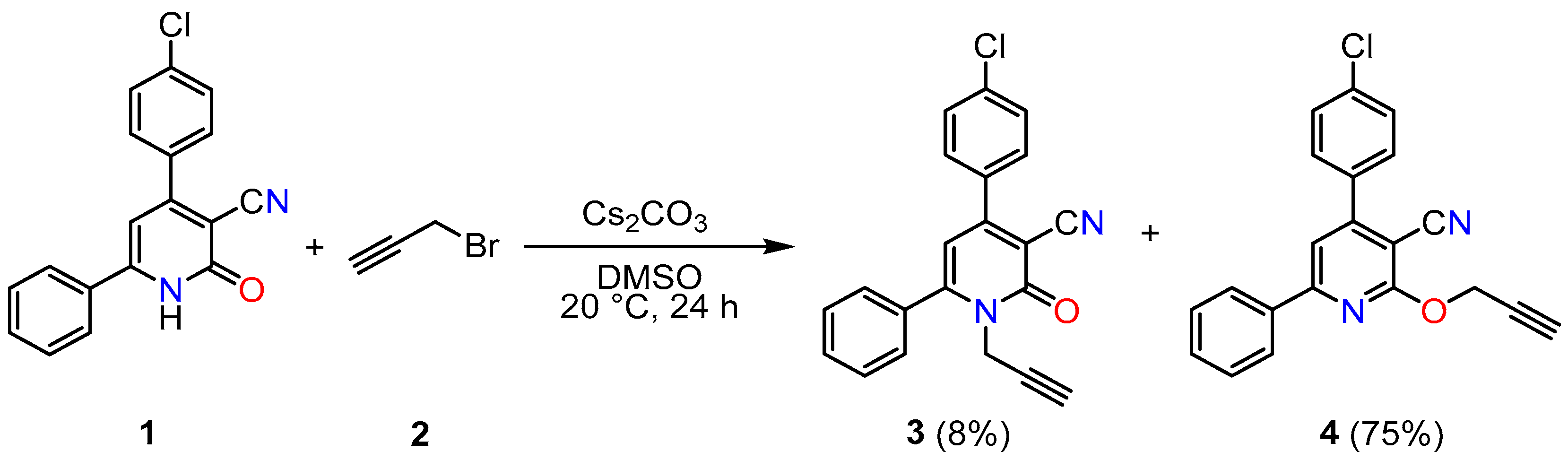
Motivated by this gap, the present study examines the propargylation of 4-(4-chlorophenyl)-2-oxo-6-phenyl-1,2-dihydropyridine-3-carbonitrile 1 using propargyl bromide 2 in the presence of cesium carbonate in dimethylsulfoxide, leading to the formation of N- and O-propargylated derivatives 3 and 4 in a chemoselective ratio of 10:90. Both products 3 and 4 were fully characterized by IR and NMR spectroscopy, and high-resolution mass spectrometry, confirming their molecular structures.

2. Results and Discussion

Building on our previous investigations on the synthesis and functionalization of 3-cyano-2(1H)-pyridones [13,18,20], we successfully obtained 4-(4-chlorophenyl)-2-oxo-6-phenyl-1,2-dihydropyridine-3-carbonitrile 1 in 90% yield using a microwave-assisted multicomponent protocol involving 4-chlorobenzaldehyde, acetophenone, ethyl cyanoacetate, and ammonium acetate in ethanol at 100 °C for 30 min, as previously reported by our group [20]. We then developed a simple and transition-metal-free propargylation of compound 1 with propargyl bromide 2 in the presence of cesium carbonate in dimethyl sulfoxide at 20 °C for 24 h (Scheme 1). Upon completion, the reaction mixture was filtered and washed with ethyl acetate. The filtrate was treated with 1.0 M NaOH and extracted four times with ethyl acetate. The combined organic layers were washed with brine, dried over anhydrous Na2SO4, filtered, and concentrated under reduced pressure to afford the crude product. Due to the lactam–lactim tautomerism of 3-cyano-2(1H)-pyridone 1, TLC analysis revealed two spots with markedly different polarities. 1H NMR analysis of the crude mixture indicated a strong preference for O- over N-propargylation, with a chemoselectivity ratio of 90:10 (Figure S9). Purification by column chromatography on silica gel using dichloromethane/n-hexane (1/1, v/v) afforded the O-propargylated pyridine 4 in 75% yield. Subsequent elution with dichloromethane allowed the isolation of the N-propargylated 2-pyridone 3 in 8% yield. The structures of both propargylated products 3 and 4 were confirmed by IR and NMR spectroscopy, as well as by high-resolution mass spectrometry (Figures S1–S8).
The IR spectra confirmed the incorporation of the propargyl substituent in compounds 3 and 4, as evidenced by the characteristic ≡C–H and C≡C stretching vibrations observed at 3270 and 2124 cm−1 for compound 3, and at 3298 and 2135 cm−1 for compound 4 (Figures S3 and S4). The presence of a strong C=O stretching vibration at 1647 cm−1 confirms the formation of the N-propargylated 2-pyridone 3, whereas its absence provides clear evidence for the formation of the O-propargylated pyridine 4. In addition, the C≡N and C–Cl stretching vibrations were consistently observed at 2220 and 767 cm−1, respectively, in both compounds.
The 1H NMR analysis in CDCl3 confirmed the incorporation of the propargyl substituent in both the N- and O-propargylated products 3 and 4 (Figures S5 and S7). The N-propargylated 2-pyridone 3 displayed a triplet at 2.36 ppm (4JHH = 2.5 Hz) corresponding to the acetylenic proton (≡C–H), together with a doublet at 4.63 ppm (4JHH = 2.5 Hz) assigned to the enantiotopic protons of the NCH2 group. In contrast, the O-propargylated pyridine 4 exhibited a triplet at 2.53 ppm (4JHH = 2.5 Hz) due to the acetylenic proton and a downfield-shifted doublet at 5.23 ppm (4JHH = 2.5 Hz) attributed to the enantiotopic protons of the OCH2 group, consistent with the stronger electron-withdrawing effect of oxygen relative to the nitrogen atom. Importantly, the H–5 proton of the 2-pyridone ring in 3 appears as a singlet at 6.29 ppm, consistent with its reduced aromatic character. In contrast, the corresponding H–5 proton of the π-deactivated pyridine ring in 4 appears significantly downfield at 7.53 ppm. Finally, the nine aromatic protons of the phenyl and 4-chlorophenyl rings in 3 and 4 appear in the ranges of 7.45–7.61 ppm and 7.49–8.13 ppm, respectively.
The 13C-NMR and DEPT-135 analyses of the N- and O-propargylated products 3 and 4 recorded in CDCl3 revealed one methylene carbon, seven methine carbons, and nine quaternary carbons (Figures S6 and S8). In compound 3, the CH and quaternary carbon of the acetylenic fragment were assigned at 73.3 and 77.8 ppm, respectively, while in compound 4 these signals appeared slightly downfield at 75.2 and 78.3 ppm. The NCH2 carbon of the N-propargylated 2-pyridone 3 was observed at 37.2 ppm, whereas the OCH2 carbon of the O-propargylated pyridine 4 appeared significantly downfield at 54.9 ppm, consistent with the greater electron-withdrawing effect of oxygen relative to the nitrogen atom. Additionally, the C–5 carbon of the 2-pyridone ring was assigned at 109.4 ppm, whereas the corresponding C–5 carbon in the π-deactivated pyridine ring appeared slightly downfield at 114.1 ppm.
The exact mass of the protonated molecular ion ([M + H]+, m/z 345.0789) for products 3 and 4, along with the corresponding elemental composition C21H1435ClN2O+, was confirmed by high-resolution mass spectrometry, affording mass errors of 4.64 and −1.16 ppm, respectively (Figures S1 and S2).

3. Materials and Methods

The progression of the reaction was monitored using thin-layer chromatography (TLC) under UV light at 254 or 365 nm. Flash column chromatography was performed using silica gel 60 (mesh 230–400; Alfa Aesar, Tewksbury, MA, USA). Infrared spectra were recorded at room temperature on a PerkinElmer FT–IR spectrometer (PerkinElmer, Inc., Waltham, MA, USA) equipped with an ATR accessory. NMR spectra were acquired in CDCl3 on a Bruker Advance 500 spectrophotometer (Bruker BioSpin GmbH, Rheinstetten, Germany). Chemical shifts (δ) are reported in ppm and coupling constants (J) in hertz. The 1H and 13C NMR spectra were referenced to the residual proton signal of CDCl3 (δ = 7.26 ppm) and the deuterated solvent carbon signal (δ = 77.16 ppm), respectively. High-resolution mass spectra (HRMS) were recorded on an Agilent 6520 Q-TOF mass spectrometer (Agilent Technologies Inc., Santa Clara, CA, USA) using electrospray ionization (ESI, 4000 V).

3.1. Synthesis of 4-(4-Chlorophenyl)-2-oxo-6-phenyl-1-(prop-2-yn-1-yl)-1,2-dihydropyridine-3-carbonitrile 3 and 4-(4-Chlorophenyl)-6-phenyl-2-(prop-2-yn-1-yloxy)nicotinonitrile 4

A mixture of cesium carbonate (0.50 mmol, 163 mg) and 4-(4-chlorophenyl)-2-oxo-6-phenyl-1,2-dihydropyridine-3-carbonitrile 1 (0.50 mmol, 153 mg) in dimethylsulfoxide (2.0 mL) was stirred at 20 °C for 30 min. Propargyl bromide (80% in toluene) 2 (0.50 mmol, 53 µL) was then added to the resulting white suspension, and the reaction mixture was stirred for 24 h. After completion, the mixture was filtered and washed with ethyl acetate (5.0 mL). The filtrate was treated with 1.0 M NaOH (2.0 mL) and extracted with ethyl acetate (4 × 5.0 mL). The combined organic layers were washed with brine (2 × 10.0 mL), dried over anhydrous Na2SO4, filtered, and concentrated under reduced pressure to give the crude product. 1H NMR analysis of the crude mixture prior to purification indicated the formation of products 3 and 4 in a chemoselective ratio of 10:90 ratio. The residue was purified by column chromatography on silica gel using dichloromethane/n-hexane (1/1, v/v), which afforded the O-propargylated pyridine 4 (high Rf). Subsequently, the eluent was switched to dichloromethane, allowing the isolation of the N-propargylated 2-pyridone 3 (low Rf).

3.2. 4-(4-Chlorophenyl)-2-oxo-6-phenyl-1-(prop-2-yn-1-yl)-1,2-dihydropyridine-3-carbonitrile 3

Yellow solid (14 mg, 8%). m.p. 135–136 °C (amorphous). Rf = 0.10 (dichloromethane/n-hexane (1/1, v/v). IR (ATR): νmax = 3270 (ν C≡H), 3066, 2924, 2850, 2220 (ν C≡N), 2124 (ν C≡C), 1647 (ν C=O), 1584 (ν C=C), 1573 (ν C=C), 1527, 1488, 1425, 1396, 1363, 1340, 1176, 1093, 1011, 977, 824, 767 (ν C–Cl), 699, 477 cm−1. 1H NMR (500 MHz, CDCl3): δ = 2.36 (t, J = 2.5 Hz, 1H), 4.63 (d, J = 2.5 Hz, 2H, NCH2), 6.29 (s, 1H, H–5), 7.47 (d, J = 8.5 Hz, 2H), 7.53–7.58 (m, 5H), 7.59 (d, J = 8.5 Hz, 2H) ppm. 13C{1H} NMR (125 MHz, CDCl3): δ = 37.2 (NCH2), 73.3 (CH), 77.8 (Cq), 101.1 (Cq, CN), 109.4 (CH, C–5), 115.5 (Cq), 128.4 (2CH), 129.3 (2CH), 129.5 (2CH), 129.6 (2CH), 130.9 (CH), 133.6 (Cq), 133.9 (Cq), 137.3 (Cq), 154.0 (Cq), 157.6 (Cq), 160.5 (Cq) ppm. HRMS (ESI+): calcd for C21H1435ClN2O+, 345.0789 [M + H]+; found, 345.0805 (mass error Δm = 4.64 ppm).

3.3. 4-(4-Chlorophenyl)-6-phenyl-2-(prop-2-yn-1-yloxy)nicotinonitrile 4

White solid (129 mg, 75%). m.p. 204–205 °C (amorphous). Rf = 0.53 (dichloromethane/n-hexane (1/1, v/v). IR (ATR): νmax = 3298 (ν C≡H), 3065, 2930, 2873, 2220 (ν C≡N), 2135 (ν C≡C), 1584 (ν C=C and ν C=N), 1538, 1493, 1392, 1328, 1244, 1141, 1090, 1005, 829, 767 (ν C–Cl), 682, 631, 494 cm−1. 1H NMR (500 MHz, CDCl3): δ = 2.53 (t, J = 2.5 Hz, 1H), 5.23 (d, J = 2.5 Hz, 2H, OCH2), 7.49–7.53 (m, 6H), 7.60 (d, J = 8.5 Hz, 2H), 8.09–8.12 (m, 2H) ppm. 13C{1H} NMR (125 MHz, CDCl3): δ = 54.9 (OCH2), 75.2 (CH), 78.3 (Cq), 93.4 (Cq, CN), 114.1 (CH, C–5), 115.0 (Cq), 127.6 (2CH), 129.1 (2CH), 129.5 (2CH), 129.9 (2CH), 130.9 (CH), 134.7 (Cq), 136.6 (Cq), 137.0 (Cq), 155.8 (Cq), 158.3 (Cq), 163.5 (Cq) ppm. HRMS (ESI+): calcd for C21H1435ClN2O+, 345.0789 [M + H]+; found, 345.0785 (mass error Δm = −1.16 ppm).

4. Conclusions

In summary, we have developed an efficient and transition-metal-free protocol for the propargylation of 4-(4-chlorophenyl)-2-oxo-6-phenyl-1,2-dihydropyridine-3-carbonitrile using propargyl bromide and cesium carbonate in dimethylsulfoxide under mild conditions. This synthetic transformation affords the O-propargylated pyridine and the N-propargylated 2-pyridone in 75% and 8% yields, respectively, demonstrating a marked preference for O- over N-alkylation, with a chemoselective ratio of 90:10. The structures of both products were unequivocally confirmed by IR and NMR spectroscopy, as well as high-resolution mass spectrometry. Overall, this metal-free and operationally simple methodology provides a valuable approach for the functionalization of the 3-cyano-2(1H)-pyridone scaffold, offering potential utility in N-heterocyclic synthesis and medicinal chemistry.

Supplementary Materials

The following are available online: Figure S1: HRMS spectrum of compound 3, Figure S2: HRMS spectrum of compound 4, Figure S3: FT–IR spectrum of compound 3 using the ATR technique, Figure S4: FT–IR spectrum of compound 4 using the ATR technique, Figure S5: 1H NMR spectrum of compound 3, Figure S6: 13C{1H} NMR and DEPT-135 spectra of compound 3, Figure S7: 1H NMR spectrum of compound 4, Figure S8: 13C{1H} NMR and DEPT-135 spectra of compound 4, Figure S9: 1H NMR spectrum of the crude reaction mixture before purification.

Author Contributions

Conceptualization, Data Curation, Writing—Original Draft Preparation, D.B.; Investigation, Data Curation, D.H.-R.; Investigation, Conceptualization, Data Curation, Writing—Original Draft Preparation, J.-C.C. All authors have read and agreed to the published version of the manuscript.

Funding

This research received no external funding.

Data Availability Statement

The data presented in this study are available in this article and supporting Supplementary Material.

Acknowledgments

The authors thank the financial support from the Universidad Pedagógica y Tecnológica de Colombia. Additionally, we also acknowledge Universidad de Alcalá for acquiring NMR spectra.

Conflicts of Interest

The authors declare no conflicts of interest.

References

  1. Baron, H.; Remfry, F.G.P.; Thorpe, J.F. The formation and reactions of imino-compounds. Part I. Condensation of ethyl cyanoacetate with its sodium derivative. J. Chem. Soc. Trans. 1904, 85, 1726–1761. [Google Scholar] [CrossRef]
  2. Frank, J.; Katritzky, A.R. Tautomeric pyridines. Part XV. Pyridone–hydroxypyridine equilibria in solvents of differing polarity. J. Chem. Soc. Perkin Trans. 2 1976, 12, 1428–1431. [Google Scholar] [CrossRef]
  3. Bensaude, O.; Chevrier, M.; Dubois, J.E. Lactim-lactam tautomeric equilibriums of 2-hydroxypyridines. 1. Cation binding, dimerization, and interconversion mechanism in aprotic solvents. A spectroscopic and temperature-jump kinetic study. J. Am. Chem. Soc. 1978, 100, 7055–7060. [Google Scholar] [CrossRef]
  4. Bensaude, O.; Chevrier, M.; Dubois, J.E. Lactim-lactam tautomeric interconversion mechanism in water-polar aprotic solvent water systems. II. Hydration of 2-hydroxypyridines. Evidence for a bifunctional water-catalyzed proton transfer. J. Am. Chem. Soc. 1979, 101, 2423–2429. [Google Scholar] [CrossRef]
  5. Hammes, G.G.; Lillford, P.J. Kinetic and equilibrium study of the hydrogen bond dimerization of 2-pyridone in hydrogen bonding solvents. J. Am. Chem. Soc. 1970, 92, 7578–7585. [Google Scholar] [CrossRef]
  6. Yadav, N.; Sangwan, S.; Kumar, R.; Chauhan, S.; Duhan, A.; Singh, A.; Arya, R.K. Comprehensive overview of progress in functionalization of 2-pyridone and 2,4-dihydroxy pyridine: Key constituents of vital natural products. ChemistrySelect 2021, 6, 11792–11821. [Google Scholar] [CrossRef]
  7. Sangwan, S.; Yadav, N.; Kumar, R.; Chauhan, S.; Dhanda, V.; Walia, P.; Duhan, A. A score years’ update in the synthesis and biological evaluation of medicinally important 2-pyridones. Eur. J. Med. Chem. 2022, 232, 114199. [Google Scholar] [CrossRef] [PubMed]
  8. Das, L.; Sengupta, T. An overview of synthesis and biological activities of 2-pyridone derivatives over the last decade. Discov. Appl. Sci. 2025, 7, 1069. [Google Scholar] [CrossRef]
  9. Hao, X.; Xu, Z.; Lu, H.; Dai, X.; Yang, T.; Lin, X.; Ren, F. Mild and regioselective N-alkylation of 2-pyridones in water. Org. Lett. 2015, 17, 3382–3385. [Google Scholar] [CrossRef]
  10. Feng, B.; Li, Y.; Li, H.; Zhang, X.; Xie, H.M.; Cao, H.G.; Yu, L.; Xu, Q. Specific N-alkylation of hydroxypyridines achieved by a catalyst- and base-free reaction with organohalides. J. Org. Chem. 2018, 83, 6769–6775. [Google Scholar] [CrossRef] [PubMed]
  11. Gurak, J.A.; Tran, V.T.; Sroda, M.M.; Engle, K.M. N-Alkylation of 2-pyridone derivatives via palladium(II)-catalyzed directed alkene hydroamination. Tetrahedron 2017, 73, 3636–3642. [Google Scholar] [CrossRef]
  12. Xu, G.; Chen, P.; Liu, P.; Tang, S.; Zhang, X.; Sun, J. Access to N-substituted 2-pyridones by catalytic intermolecular dearomatization and 1,4-acyl transfer. Angew. Chem. Int. Ed. 2019, 58, 1980–1984. [Google Scholar] [CrossRef] [PubMed]
  13. Salamanca-Perdigón, K.; Hurtado-Rodríguez, D.; Portilla, J.; Iriepa, I.; Rojas, H.; Becerra, D.; Castillo, J.-C. Cs2CO3-Promoted alkylation of 3-cyano-2(1H)-pyridones: Anticancer evaluation and molecular docking. ChemPlusChem 2024, 89, e202400172. [Google Scholar] [CrossRef] [PubMed]
  14. Zhou, Q.; Du, F.; Liang, X.; Liu, W.; Fang, T.; Chen, G. Zinc(II)-mediated selective O-benzylation of 2-oxo-1,2-dihydropyridines systems. Molecules 2018, 23, 1784. [Google Scholar] [CrossRef] [PubMed]
  15. Yang, J.; Wang, G.; Zhou, H.; Li, Z.; Ma, B.; Song, M.; Sun, R.; Huo, C. Visible-light-promoted selective O-alkylation of 2-pyridones with α-aryldiazoacetates. Org. Biomol. Chem. 2021, 19, 394–398. [Google Scholar] [CrossRef] [PubMed]
  16. Yan, Z.; He, H.; Yuan, D.; Yan, Q.; Wang, W.; Jiang, H.; Wang, H.; Chen, F. Regioselective O-alkylation of 2-pyridones by TfOH-catalyzed carbenoid insertion. Chem. Commun. 2023, 59, 106–109. [Google Scholar] [CrossRef] [PubMed]
  17. Biswas, S.; Duari, S.; Maity, S.; Roy, A.; Guchhait, S.; Elsharif, A.M.; Biswas, S. Solvent- and catalyst-controlled regioselective O- and N-alkylation of 2-pyridones by 2H-azirines. J. Org. Chem. 2024, 89, 15091–15102. [Google Scholar] [CrossRef] [PubMed]
  18. Salamanca-Perdigón, K.; Lozano, J.D.; Hurtado-Rodríguez, D.; Becerra, D.; Rojas, H.; Macías, M.A.; Castillo, J.-C. Cs2CO3-Mediated synthesis of 2-alkoxy-3-cyanopyridines: Integrated crystallographic, photophysical, and DFT analyses. New J. Chem. 2025, 49, 18369–18383. [Google Scholar] [CrossRef]
  19. Abonia, R.; Insuasty, D.; Laali, K.K. Recent advances in the synthesis of propargyl derivatives, and their application as synthetic intermediates and building blocks. Molecules 2023, 28, 3379. [Google Scholar] [CrossRef] [PubMed]
  20. Hurtado-Rodríguez, D.; Becerra, D.; Rojas, H.; Gómez Castaño, J.A.; Macías, M.A.; Castillo, J.-C. Crystal structure, spectroscopy, DFT, and thermal studies of 3-cyano-2(1H)-pyridones as potential anticancer agents. RSC Adv. 2024, 14, 24928–24941. [Google Scholar] [CrossRef] [PubMed]
Figure 1. Lactam–lactim tautomerism of 2(1H)-pyridone and its chemoselective N- and O-alkylation pathways.
Molbank 2026 m2119 g001
Scheme 1. Cs2CO3-mediated propargylation of 3-cyano-2(1H)-pyridone 1 with propargyl bromide 2.
Molbank 2026 m2119 sch001
Disclaimer/Publisher’s Note: The statements, opinions and data contained in all publications are solely those of the individual author(s) and contributor(s) and not of MDPI and/or the editor(s). MDPI and/or the editor(s) disclaim responsibility for any injury to people or property resulting from any ideas, methods, instructions or products referred to in the content.