Short Note

4’-Ethyl 1,2-dimethyl 1’,5-dibenzyl-4,4-dicyano-2’-oxo-5’-phenyl-1’,2’,4a,5-tetrahydro-4H-spiro[benzo[4,5]imidazo[1,2-a]pyridine-3,3’-pyrrole]-1,2,4’-tricarboxylate


Department of Chemistry, Perm State University, ul. Bukireva, 15, 614068 Perm, Russia
*
Author to whom correspondence should be addressed.
Molbank 2026, 2026(1), M2118; https://doi.org/10.3390/M2118
Submission received: 30 November 2025 / Revised: 29 December 2025 / Accepted: 30 December 2025 / Published: 4 January 2026
(This article belongs to the Collection Heterocycle Reactions)

Abstract

The 1,4-dipolar cycloaddition of the ylidene derivative of 1H-pyrrole-2,3-dione to a dipole generated in situ from 1-benzylbenzimidazole and dimethyl acetylenedicarboxylate proceeds via the exocyclic multiple bond of the ylidene derivative and affords a mixture of diastereomeric spiro[benzo[4,5]imidazo[1,2-a]pyridine-3,3’-pyrroles], which slowly epimerized in a solution.

1. Introduction

The utility of 1,4-dipolar cycloadditions for synthesizing cyclic compounds is well-documented. Zwitterionic 1,4-dipoles, which are readily accessible, have been widely employed for this purpose, providing efficient routes to various carbo- and heterocycles [1,2,3,4,5,6].
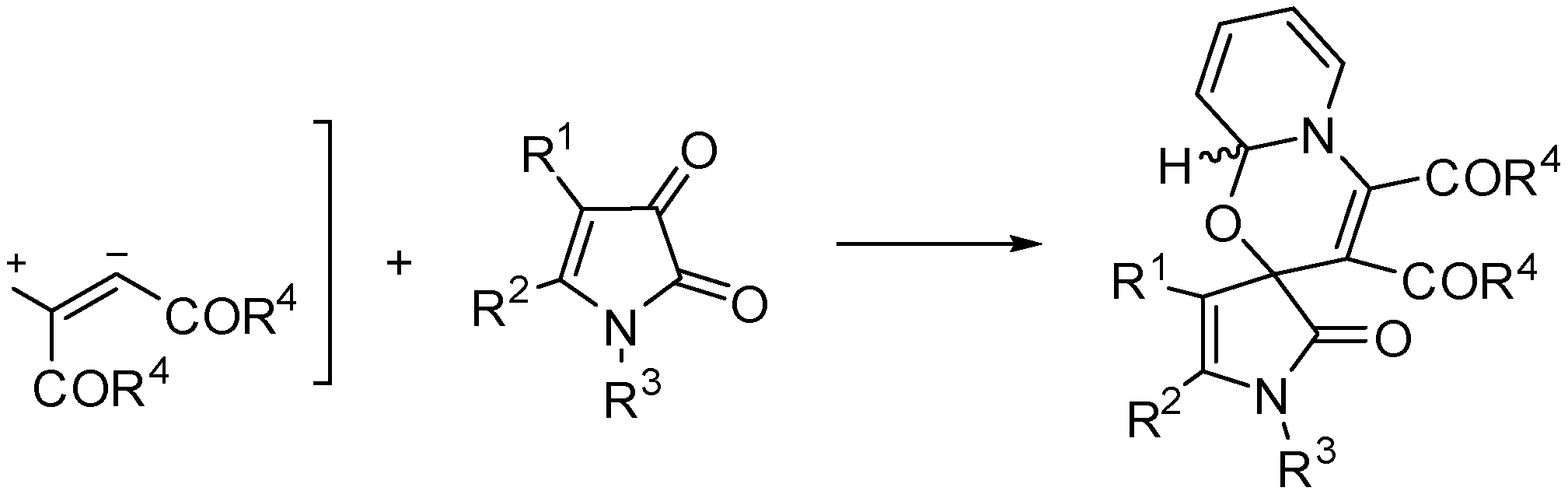
Our research has long focused on the chemistry of 1H-pyrrole-2,3-diones and their derivatives [7,8]. These compounds are highly reactive substrates, featuring at least three dipolarophilic sites that enable diverse reactivity in dipolar cycloadditions. For instance, 1H-pyrrole-2,3-diones react with 1,4-dipoles derived from activated acetylenes and pyridine to afford diastereomeric spiro[pyrido[2,1-b][1,3]oxazine-2,3’-pyrroles] (Scheme 1) [9], which exist in a rapid equilibrium in solution. This rapid epimerization is a characteristic feature of other similar spiropyrido[2,1-b][1,3]oxazines and related spirocyclic quinolizines [8]. To further explore the scope of this chemistry, we herein report the previously unknown reaction of an ylidene derivative of 1H-pyrrole-2,3-dione with a 1,4-dipole generated in situ from DMAD and 1-benzylbenzimidazole, including an evaluation of the epimerization tendency of the resulting product.

2. Results and Discussion

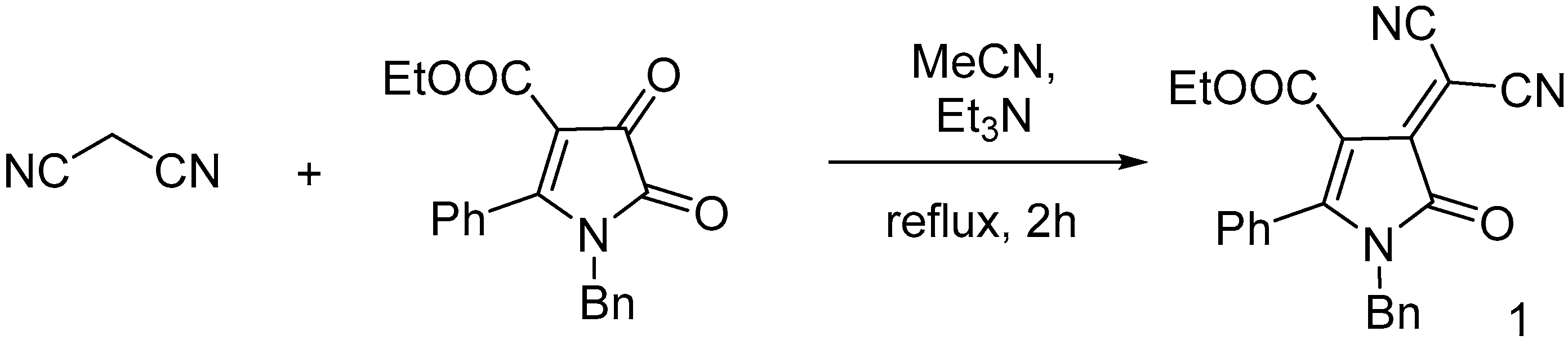
In this work, we employed the Knoevenagel condensation product of 1,5-diphenyl-4-ethoxycarbonyl-1H-pyrrole-2,3-dione with malononitrile, namely, 3-ylidenepyrrol-2-one 1, as a dipolarophile (Scheme 2). The 1,4-dipolar cycloadditions of this compound have not been previously studied.
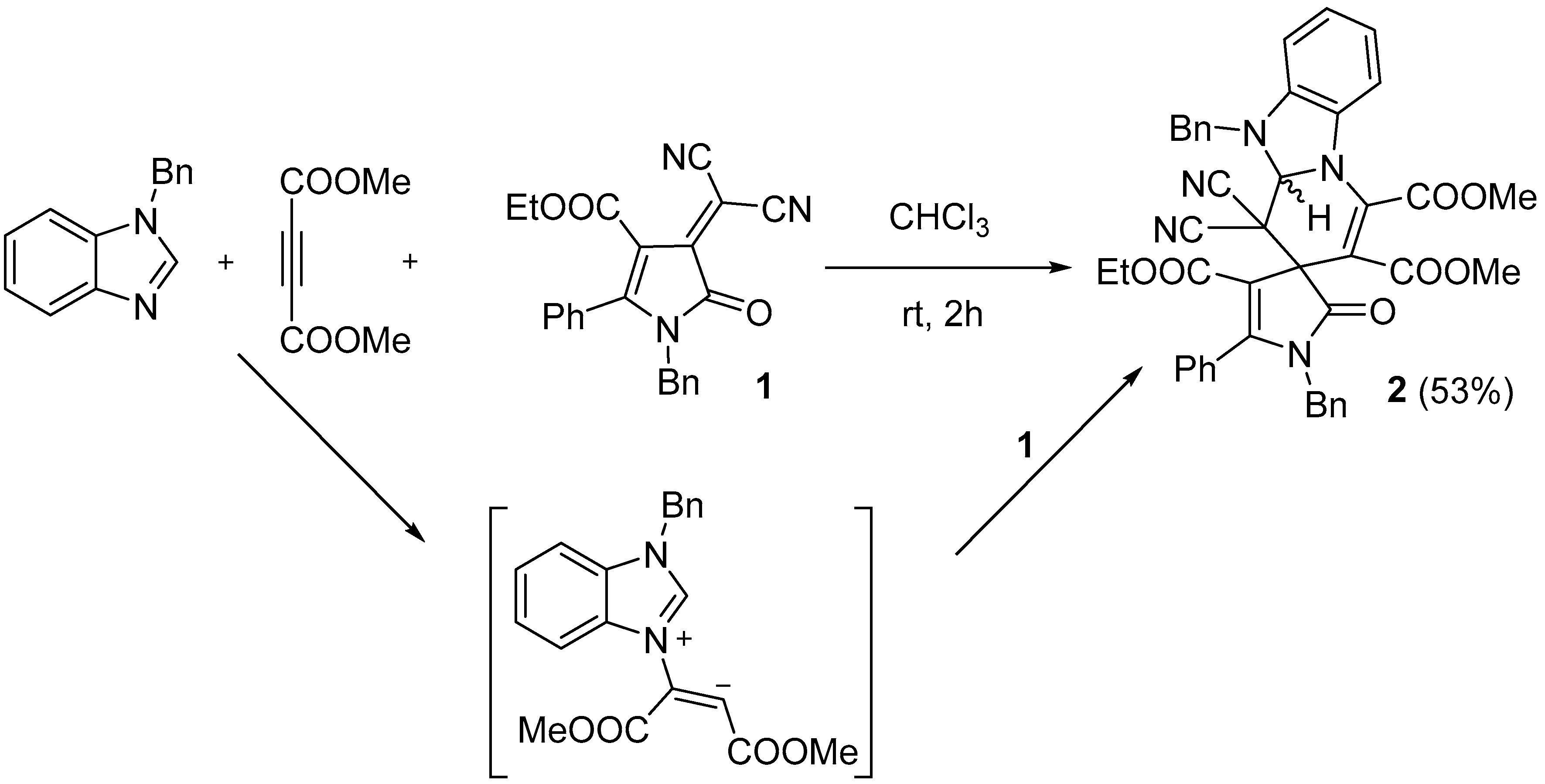
We carried out the three-component reaction of 3-ylidenepyrrole-2-one 1 with DMAD and 1-benzylbenzimidazole in CHCl3 at room temperature and isolated the spirocyclic [4+2] cycloadduct 2 as a diastereomeric mixture in 53% yield (Scheme 3). Notably, only cycloaddition product 2 at the exocyclic multiple bond was detected in the reaction mixture by LC-MS, while isomeric products were observed only in trace amounts.
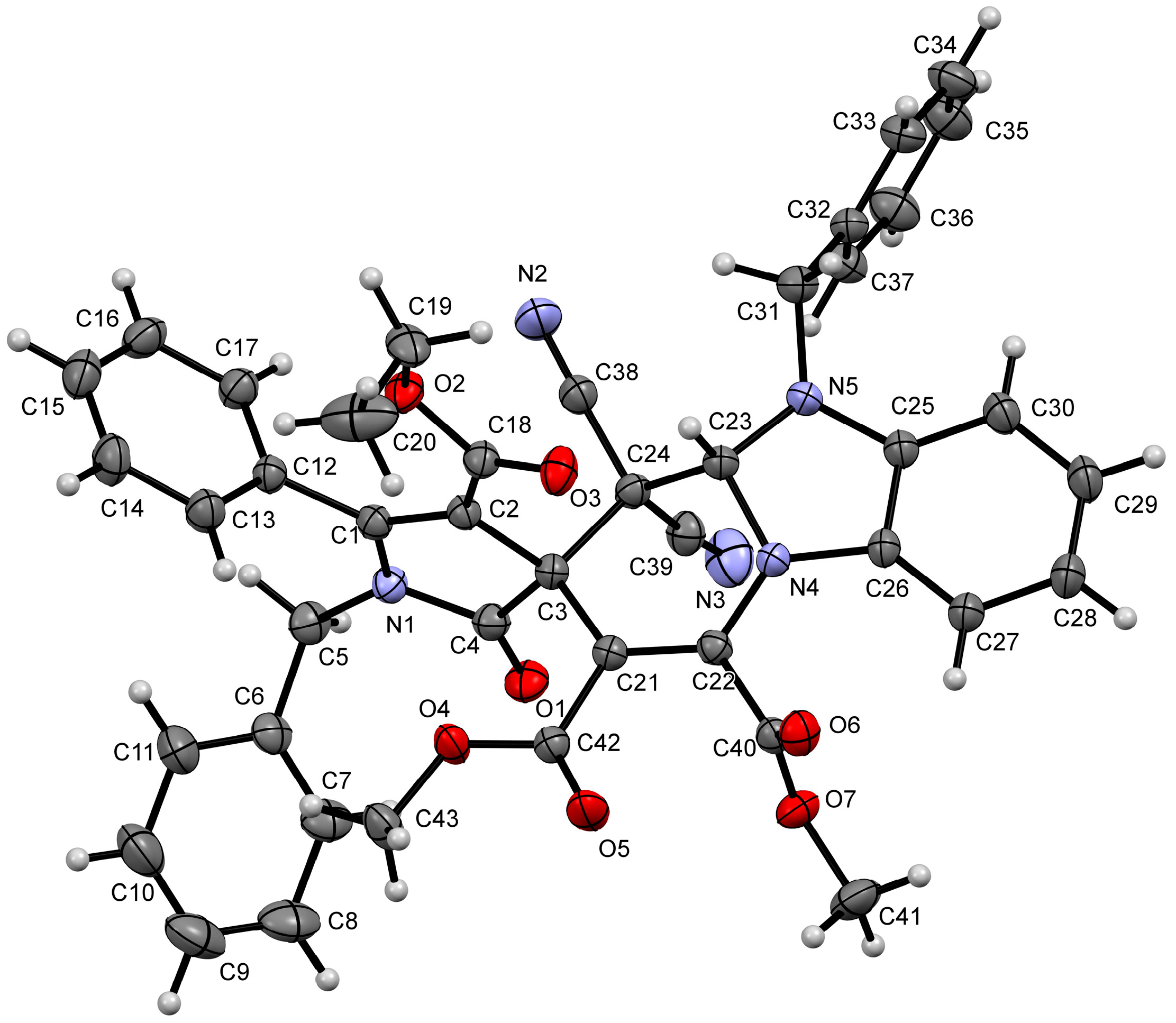
The structure of compound 2 was unambiguously confirmed by single-crystal X-ray diffraction analysis (CCDC 2512081) (Figure 1). The crystal exclusively contains the R,R-diastereomer as a racemate. Due to the potential for epimerization in solution [8], the relative configurations of the chiral centers are not assigned in the structural schemes despite being determined by X-ray diffraction. Both diastereomers coexist in the solution, but the equilibrium can shift toward the more stable R,R-form upon crystallization, consistent with the epimerization tendency of such compounds. One of the stabilizing factors may be the intramolecular hydrogen bond involving the ethoxycarbonyl group: C23–H23⋯O3 (d(H⋯O) = 2.288 Å, d(C⋯O) = 3.054 (3) Å, angle C–H–O = 134.4°). For the R,S-diastereomer, a weaker intramolecular hydrogen bond involving the lactam group (C23–H23⋯O1) is expected. Indeed, similar structures derived from isatylidenes, benzylbenzimidazole, and acetylenedicarboxylates crystallize as the opposite diastereomer, where analogous C–H⋯O (lactam) bonds are observed with less favorable geometric parameters (d(H⋯O) = 2.38–2.78 Å, angle 95–125°) [9].
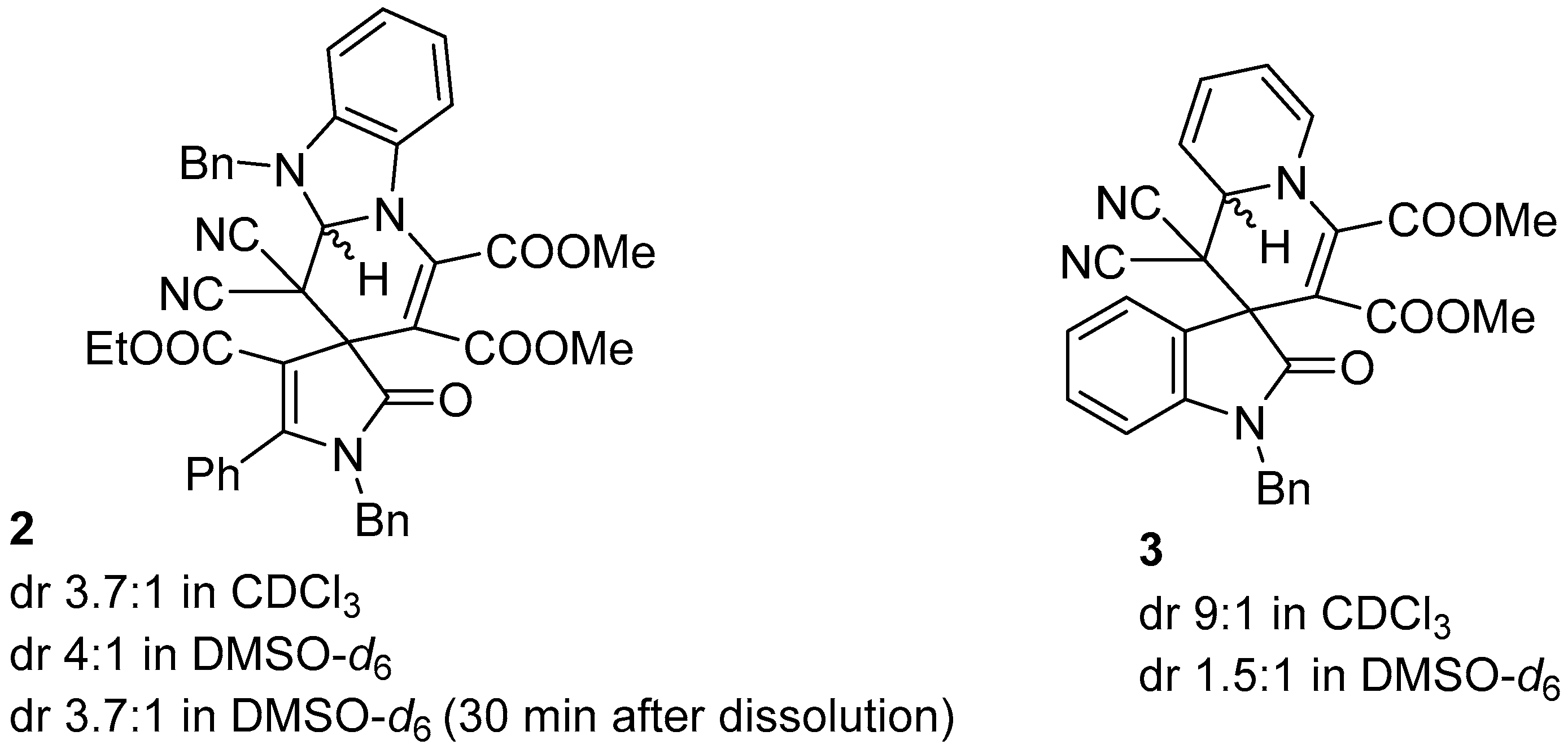
1H NMR analysis (in CDCl3) of isolated compound 2 showed a diastereomeric ratio (dr) of ~3.7:1 determined from the well-separated methyl groups of the ethoxycarbonyl substituent (Figure 2). We have previously shown that structurally related compound 3, obtained from isatylidene, pyridine, and DMAD, undergoes rapid epimerization in solution [8]. As a result, its apparent dr was dependent on the solvent used for NMR spectroscopy (dr ~9:1 in CDCl3 vs. ~1.5:1 in DMSO-d6). When the spectrum of compound 2 was recorded in DMSO-d6, the dr value remained approximately unchanged (~4:1). However, when the spectrum was recorded in DMSO-d6 30 min after sample dissolution, the dr changed slightly to 3.7:1. This indicates that epimerization in solution does occur but significantly more slowly than for compound 3, which is likely due to the replacement of the pyridine moiety with a benzimidazole.

3. Materials and Methods

3.1. General Information

1H and 13C NMR spectra (Supplementary Materials) were acquired on a Bruker Avance III 400 HD spectrometer (Faellanden, Switzerland) (at 400 and 100 MHz, respectively) in CDCl3 using the solvent residual signal (CDCl3: δH = 7.26 ppm, δC = 77.16 ppm) as an internal standard. IR spectra were recorded on a Perkin Elmer Spectrum Two Spectrometer (Shelton, CT, USA) as mulls in mineral oil. Melting points were measured on a Mettler Toledo MP70 Melting Point apparatus (Schwerzenbach, Switzerland). Elemental analysis was carried out on a Vario MICRO Cube analyzer (Langenselbold, Germany). TLC was performed on Silica gel 60 F254 (Merck, Darmstadt, Germany) plates; spots were visualized with UV light (254 nm). The single crystal X-ray analysis of compound 2 was performed on an Xcalibur Ruby diffractometer (Agilent Technologies, Wroclaw, Poland). The empirical absorption correction was introduced by multi-scan method using SCALE3 ABSPACK algorithm [10]. Using OLEX2 [11], the structure was solved with the SHELXS [12] program and refined by the full-matrix least-squares minimization in the anisotropic approximation for all non-hydrogen atoms with the SHELXL [13] program. Hydrogen atoms were positioned geometrically and refined using a riding model. The disordered ethyl group was modeled using SAME, DELU, and SIMU restraints. 3-Ylidenepyrrol-2-one was obtained according to the reported procedure [7]. All solvents and reagents were purchased from commercial vendors and used as received.

3.2. 4’-Ethyl 1,2-dimethyl (3S*,4aR*)-1’,5-dibenzyl-4,4-dicyano-2’-oxo-5’-phenyl-1’,2’,4a,5-tetrahydro-4H-spiro[benzo[4,5]imidazo[1,2-a]pyridine-3,3’-pyrrole]-1,2,4’-tricarboxylate 2

A glass flask was charged with 3-ylidenepyrrol-2-one 1 (383 mg, 1 mmol), DMAD (147 µL, 1.2 mmol), and anhydrous chloroform (10 mL). 1-Benzylbenzimidazole (249 mg, 1.2 mmol) was added to the resulted solution, and the reaction mixture was stirred at RT for 2 h in the closed flask. The solvent was evaporated under reduced pressure. The residue was purified by crystallization from EtOH to yield the title compound 2. Yield: 388 mg (53%); yellow solid; m.p. 179–180 °C (decomp.); IR (cm−1): 1743, 1711, 1679, 1652, 1613, and 1584; and 1H NMR (400 MHz, CDCl3), mixture of inseparable diastereomers, d.r. = ~4:1 (A:B):δ = 7.50–7.05 (m, A+B, Ar, 13H), 7.00–6.86 (m, A+B, Ar, 3H), 6.80–6.75 (m, A+B, Ar, 1H), 6.68–6.58 (m, A+B, Ar + C4aH, 2.2H), 6.52 (s, A, C4aH, 0.8H), 4.89 (d, J = 15.2 Hz, B, 0.2H), 4.86–4.80 (m, A+B, CH2Ph, 1H), 4.68–4.57 (m, A+B, CH2Ph, 2.6H), 4.27 (d, J = 15.2 Hz, B, CH2Ph, 0.2H), 4.10–4.01 (m, B, CH3CH2, 0.2H), [4.06 (s, B, OMe), 4.03 (s, A, OMe), ∑ 3H], 3.93 (dq, J = 10.8, 7.1 Hz, B, CH3CH2, 0.2H), 3.76 (dq, J = 10.8, 7.1 Hz, A, CH3CH2, 0.8H), 3.61 (dq, J = 10.8, 7.1 Hz, A, CH3CH2, 0.8H), [3.53 (s, A, OMe), 3.51 (s, B, OMe), ∑ 3H], and [1.09 (t, J = 7.1 Hz, B, CH3CH2), 0.67 (t, J = 7.1 Hz, A, CH3CH2), ∑ 3H]. 13C NMR (101 MHz, CDCl3): δ (A, major) = 174.40, 163.95, 163.14, 162.94, 160.99, 142.73, 142.36, 136.03, 135.70, 132.07, 130.05, 130.03, 129.15 (2C), 128.69 (2C), 128.51 (4C), 128.31 (2C, br.), 128.09, 128.00, 127.87 (2C), 124.87, 121.19, 111.69, 110.41, 110.38, 108.73, 107.64, 99.61, 81.13, 60.41, 54.72, 54.24, 53.44, 52.21, 45.88, 45.80, and 13.26. 13C NMR (101 MHz, CDCl3): δ (B, minor) = 175.41, 163.89, 163.44, 161.22, 157.72, 142.64, 140.14, 136.13, 135.73, 131.58, 130.30, 129.01, 128.48, 128.19, 128.15, 127.94, 127.71, 124.56, 121.31, 111.48, 110.69, 109.88, 109.62, 109.15, 100.28, 78.41, 60.71, 55.35, 55.02, 53.39, 51.89, 45.74, 43.17, and 13.51; three carbon signals were not separated/found; Anal. Calcd (%) for C43H35N5O7: C 70.39; H 4.81; and N 9.54. Found: C 70.75; H 4.79; and N 9.31.
1H NMR (400 MHz, DMSO-d6), mixture of inseparable diastereomers, d.r. = ~4:1 (A:B):δ = 7.57–7.43 (m, A+B, Ar, 3H), 7.43–7.20 (m, A+B, Ar, 8H), 7.20–7.13 (m, A+B, Ar, 2H), 7.03–6.77 (m, A+B, Ar, 5H), 6.65–6.58 (m, A+B, Ar + C4aH, 1.2H), 6.43 (s, A, C4aH, 0.8H), 5.06 (d, J = 16.5 Hz, A, CH2Ph, 0.8H), 4.90 (d, J = 16.5 Hz, B, 0.2H), 4.79 (d, J = 15.8 Hz, B, CH2Ph, 0.2H), 4.67 (d, J = 15.8 Hz, A, CH2Ph, 0.8H), 4.61–4.50 (m, A+B, CH2Ph, 1.8H), 4.38 (d, J = 15.7 Hz, B, CH2Ph, 0.2H), [4.02 (s, B, OMe), 4.01 (s, A, OMe), ∑ 3H], 3.91 (dq, J = 10.8, 7.1 Hz, B, CH3CH2, 0.2H), 3.82–3.56 (m, A+B, CH3CH2, 1.8H), [3.58 (s, A, OMe), 3.53 (s, B, OMe), ∑ 3H], and [0.96 (t, J = 7.1 Hz, B, CH3CH2), 0.64 (t, J = 7.1 Hz, A, CH3CH2), ∑ 3H].
Crystal data of compound 2. C43H35N5O7, M = 733.76, triclinic, space group P–1, a = 10.5783(13) Å, b = 11.5582(14) Å, c = 15.551(2) Å, α = 86.823(10)°, β = 75.467(11)°, γ = 84.391(10)°, V = 1830.8(4) Å3, T = 295(2) K, Z = 2, and µ(Mo Kα) = 0.092 mm−1. The final refinement parameters: R1 = 0.0663 (for observed 4284 reflections with I > 2σ(I)); wR2 = 0.1432 (for all independent 8521 reflections, Rint = 0.0663); and S = 1.008. CCDC 2512081 contains the supplementary crystallographic data for this paper. These data can be obtained free of charge via http://www.ccdc.cam.ac.uk/structures/ (accessed on 29 December 2025) (or from the CCDC, 12 Union Road, Cambridge CB2 1EZ, UK; Fax: +44 1223 336033; and E-mail: deposit@ccdc.cam.ac.uk).

4. Conclusions

In conclusion, we have developed a method for the synthesis of spiro[benzo[4,5]imidazo[1,2-a]pyridine-3,3’-pyrrole] 2 as a diastereomeric mixture in moderate yield via a three-component reaction of 3-ylidenepyrrol-2-one, DMAD, and 1-benzylbenzimidazole. The product 2 is less prone to epimerization in solution than its pyridine-based analog 3.

Supplementary Materials

Copies of the NMR spectra for the new compound can be downloaded online.

Author Contributions

Conceptualization, M.V.D. and A.N.M.; methodology M.V.D., A.N.M. and A.A.M.; validation, A.A.M., M.V.D. and A.N.M.; investigation, A.A.M. and M.V.D.; writing—original draft preparation M.V.D. and A.A.M.; writing—review and editing, A.A.M., M.V.D. and A.N.M.; visualization, M.V.D. and A.A.M.; supervision, M.V.D. and A.N.M.; project administration, M.V.D. and A.N.M.; funding acquisition, A.N.M. All authors have read and agreed to the published version of the manuscript.

Funding

This study was performed with financial support of the Ministry of Science and Higher Education of the Russian Federation (FSNF-2025-0013).

Data Availability Statement

The presented data are available in this article and supporting information.

Conflicts of Interest

The authors declare no conflicts of interest.

Abbreviations

The following abbreviations are used in this manuscript:
DMADDimethyl acetylenedicarboxylate

References

  1. De, N.; Yoo, E.J. Recent advances in the catalytic cycloaddition of 1,n-dipoles. ACS Catal. 2018, 8, 48–58. [Google Scholar] [CrossRef]
  2. Nair, V.; Deepthi, A.; Ashok, D.; Raveendran, A.E.; Paul, R.R. 1,4-Dipolar cycloadditions and related reactions. Tetrahedron 2014, 70, 3085–3105. [Google Scholar] [CrossRef]
  3. Trofimov, B.A.; Belyaeva, K.V. Zwitterionic adducts of N-heterocycles to electrophilic acetylenes as a master key to diversity and complexity of fundamental nitrogen heterocycles. Tetrahedron Lett. 2020, 61, 151991. [Google Scholar] [CrossRef]
  4. Wang, Y.; Jin, Z.; Zhou, L.; Lv, X. Recent advances in [4 + 4] annulation of conjugated heterodienes with 1,4-dipolar species for the synthesis of eight-membered heterocycles. Org. Biomol. Chem. 2024, 22, 252–268. [Google Scholar] [CrossRef] [PubMed]
  5. Chen, X.Y.; Zheng, H.; Han, Y.; Sun, J.; Yan, C.G. The unique reactivity of 5,6-unsubstituted 1,4-dihydropyridine in the Huisgen 1,4-diploar cycloaddition and formal [2 + 2] cycloaddition. Beilstein J. Org. Chem. 2023, 19, 982–990. [Google Scholar] [CrossRef] [PubMed]
  6. Al-Mahadeen, M.M.; Jaber, A.M.; Zahra, J.A.; El-Abadelah, M.M.; Alshaer, W.; Taha, M.O. Synthesis of novel benzothieno-[3,2’-f][1,3]oxazepines and their isomeric 2-oxo-2H-spiro[benzothiophene-3,3’-pyrrolines] via 1,4-dipolar cycloaddition reaction and their evaluation as cytotoxic anticancer leads. Med. Chem. Res. 2024, 33, 918–929. [Google Scholar] [CrossRef]
  7. Moroz, A.A.; Dmitriev, M.V.; Maslivets, A.N. Synthesis of Spiro[pyrrole–pyrrolizidines] by 1,3-Dipolar Cycloaddition of Azomethine Ylides to 3-Ylidenepyrrol-2-ones. Russ. J. Org. Chem. 2020, 56, 1166–1173. [Google Scholar] [CrossRef]
  8. Galeev, A.R.; Moroz, A.A.; Dmitriev, M.V.; Maslivets, A.N. Cycloaddition of Huisgen 1,4-dipoles: Synthesis and rapid epimerization of functionalized spiropyrido[2,1-b][1,3]oxazine-pyrroles and related products. RSC Adv. 2022, 12, 578–587. [Google Scholar] [CrossRef] [PubMed]
  9. Yang, F.; Zhang, L.J.; Yan, C.G. Four-component reaction of N-alkylimidazoles(N-alkylbenzimidazoles), dialkyl but-2-ynedioate, N-alkylisatins and malononitrile. RSC Adv. 2014, 4, 64466–64475. [Google Scholar] [CrossRef]
  10. CrysAlisPro, Version 1.171.37.33 (Release 27 March 2014 CrysAlis171 .NET), Agilent Technologies, Oxford Diffraction: Wroclaw, Poland, 2014. Available online: https://www.rigaku.com/products/crystallography/crysalis (accessed on 10 December 2023).
  11. Dolomanov, O.V.; Bourhis, L.J.; Gildea, R.J.; Howard, J.A.K.; Puschmann, H. OLEX2: A complete structure solution, refinement and analysis program. J. Appl. Cryst. 2009, 42, 339–341. [Google Scholar] [CrossRef]
  12. Sheldrick, G.M. A short history of SHELX. Acta Crystallogr. Sect. A Found. Crystallogr. 2008, 64, 112–122. [Google Scholar] [CrossRef] [PubMed]
  13. Sheldrick, G.M. Crystal structure refinement with SHELXL. Acta Crystallogr. Sect. C Struct. Chem. 2015, 71, 3–8. [Google Scholar] [CrossRef] [PubMed]
Scheme 1. Cycloaddition of 1H-pyrrole-2,3-diones with 1,4-dipoles.
Molbank 2026 m2118 sch001
Scheme 2. Synthesis of 3-ylidenepyrrol-2-one 1.
Molbank 2026 m2118 sch002
Scheme 3. Synthesis of cycloadduct 2.
Molbank 2026 m2118 sch003
Figure 1. Structure of compound 2, obtained by X-ray diffraction analysis.
Molbank 2026 m2118 g001
Figure 2. Diastereomeric ratios of cycloadducts 2 and 3 [8].
Molbank 2026 m2118 g002
Disclaimer/Publisher’s Note: The statements, opinions and data contained in all publications are solely those of the individual author(s) and contributor(s) and not of MDPI and/or the editor(s). MDPI and/or the editor(s) disclaim responsibility for any injury to people or property resulting from any ideas, methods, instructions or products referred to in the content.