Short Note

(Benzo[h]quinoline-κ2C,N)-[2,2′-bis(diphenylphosphino)-1,1′-binaphthalene-κ2P,P′]-platinum(II) Hexafluorophosphate

Shandong Provincial Engineering Research Center of Novel Pharmaceutical Excipients and Controlled Release Preparations, College of Pharmacy, Dezhou University, Dezhou 253023, China
*
Author to whom correspondence should be addressed.
These authors contributed equally to this work.
Molbank 2026, 2026(1), M2120; https://doi.org/10.3390/M2120
Submission received: 9 December 2025 / Revised: 29 December 2025 / Accepted: 30 December 2025 / Published: 5 January 2026
(This article belongs to the Section Structure Determination)

Abstract

A cyclometalated platinum(II) complex [Pt(bzq)(BINAP)]PF6 bearing a 2,2′-bis(diphenylphosphino)-1,1′-binaphthalene (BINAP) auxiliary ligand and a cyclometalated benzo[h]quinoline (bzq) ligand have been prepared. Structural characterization was achieved through X-ray crystallography, 1H, 13C and 31P NMR spectroscopy, ESI−MS, and elemental analysis.

1. Introduction

Transition metal complexes, with their rich structural diversity and tunable electronic properties, serve as versatile platforms in fields ranging from catalysis to biomedicine [1,2,3,4,5,6,7,8,9]. Among these, platinum(II) complexes stand out due to their distinctive square-planar geometry, which endows them with unique photophysical properties, propensity for supramolecular interactions, and renowned anticancer activity, as exemplified by cisplatin [10,11]. Cyclometalated Pt(II) systems bearing chelating ligands offer remarkable stability and unique luminescent properties, making them promising candidates for applications in organic light-emitting diodes (OLEDs), photocatalysis, and bioimaging [12,13,14]. Among the various ligand designs, phosphine-based auxiliary ligands, such as PˆP-type donors, have been employed to modulate the electronic and steric environments of the metal center, thereby influencing the complex’s photophysical and catalytic behaviors [15,16].
Herein, we report the synthesis and comprehensive characterization of a novel cyclometalated platinum(II) complex, [Pt(bzq)(BINAP)]PF6, which incorporates both a cyclometalated bzq ligand and the BINAP auxiliary ligand. This work highlights the novelty of utilizing BINAP as an auxiliary ligand in a cyclometalated Pt(II) framework—a combination that merges the strong field effects of bisphosphines with the photophysical advantages of cyclometalated architectures. The structural and electronic properties of the complex have been elucidated through X-ray crystallography, multinuclear NMR (1H, 13C and 31P) spectroscopy, ESI−MS, and elemental analysis. This study not only expands the library of phosphine-supported Pt(II) cyclometalates but also opens avenues for designing chiral or sterically tailored platinum complexes with tailored properties for advanced photonic and catalytic applications.

2. Results and Discussion

The target complex [Pt(bzq)(BINAP)]PF6 was synthesized in three steps (Figure 1). First, the μ-chloro-bridged platinum dimer [Pt(bzq)Cl]2 was prepared by reacting bzq with K2PtCl4 under reflux in a 2-ethoxyethanol/water mixed solvent system. The dimer was isolated as a yellow solid upon precipitation with water and used directly in the subsequent cleavage step. The intermediate Pt(bzq)(CH3CN)2 was then obtained by treating the dimer [Pt(bzq)Cl]2 with silver trifluoromethanesulfonate in CH3CN. Finally, the cationic platinum(II) complex [Pt(bzq)(BINAP)]PF6 was prepared in moderate yield by reacting [Pt(bzq)(CH3CN)2]CF3SO3 with an equimolar amount of BINAP. The complex was isolated as its hexafluorophosphate salt via anion metathesis using aqueous NH4PF6. The compound was fully characterized by 1H NMR spectrum (see Supplementary Materials, Figure S1), 13C NMR spectrum (see Supplementary Materials, Figure S2), 31P NMR spectrum (see Supplementary Materials, Figure S3), ESI-MS (see Supplementary Materials, Figure S4), and elemental analysis. The structure and coordination geometry around the platinum(II) center were further confirmed by X-ray diffraction analysis of the target complex (see Supplementary Materials, Tables S1 and S2).
In the DMSO-d6 solution, the target complex exhibited NMR signals exclusively in the aromatic region: the 1H NMR spectrum showed signals between δ 8.58 and 6.53 ppm, while the 13C NMR spectrum displayed signals between δ 159.93 and 121.59 ppm. These observations are characteristic of the aromatic protons and carbons present in the complex. The 31P NMR spectrum of the target complex displayed two singlets at δ 21.26 and 15.27 ppm, corresponding to the two distinct phosphorus nuclei of the BINAP ligand, while the hexafluorophosphate counterion showed a characteristic septet centered at δ −144.18 ppm (range: δ −135.39 to −152.96 ppm, 1JP–F 711.6 Hz). In the 31P NMR spectra of the complex, each singlet is accompanied by satellite peaks due to the direct scalar coupling between the bonded platinum and phosphorus atoms. Two distinct sets of satellites were observed, with corresponding coupling constants (1JPt–P) of 1970.5 and 3976.9 Hz, thus confirming the presence of two inequivalent phosphorus atoms.
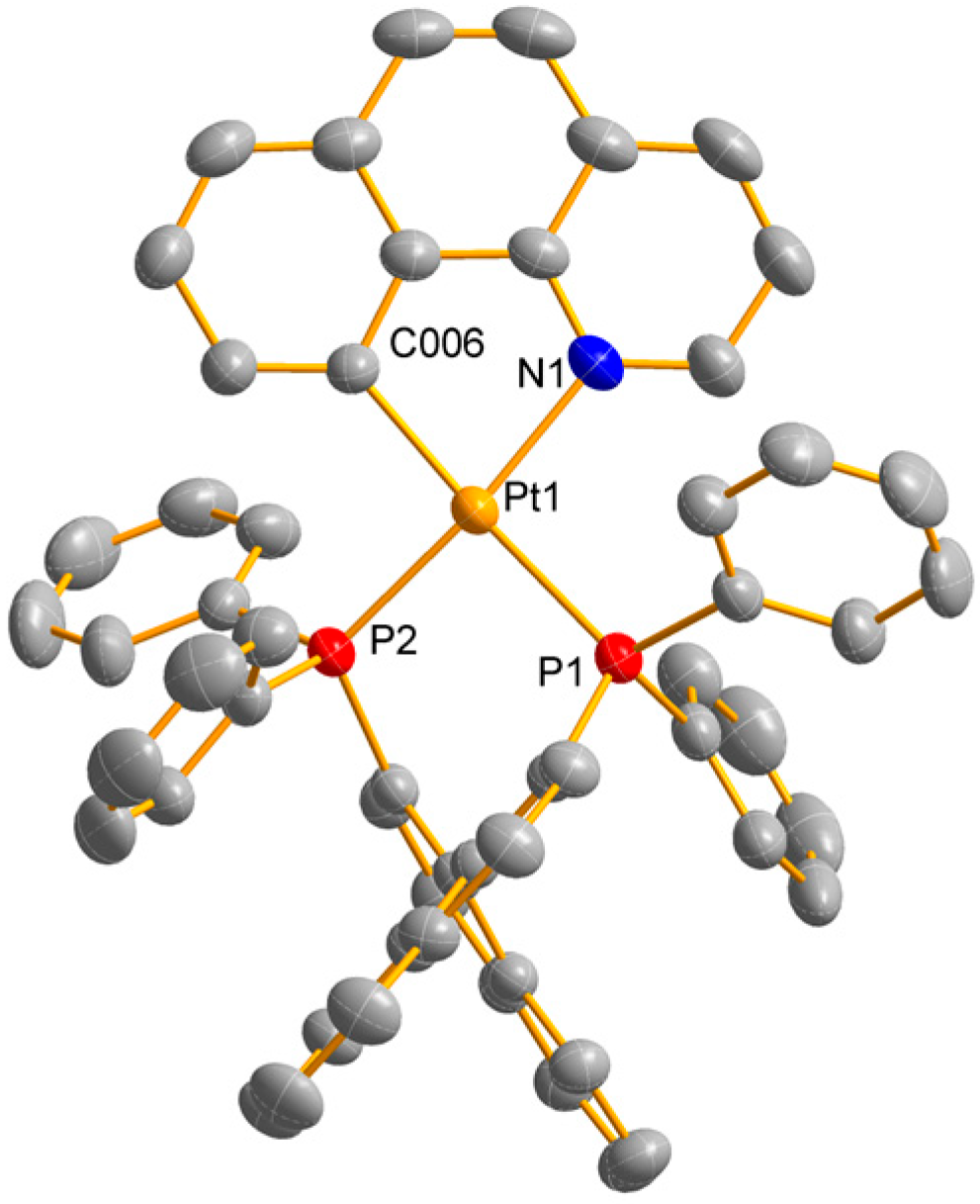
Single crystals of [Pt(bzq)(BINAP)]PF6 suitable for crystallographic analysis were obtained by slow diffusion of hexane into a dichloromethane solution. As shown in Figure 2, the molecular structure is represented by a thermal ellipsoid plot. The complex crystallizes in the triclinic system with the chiral space group P-1. Crystallographic parameters and selected bond lengths and angles are summarized in Tables S1 and S2, respectively. The Pt(II) center adopts a distorted square-planar geometry coordinated by two phosphorus atoms and a CˆN-chelating bzq ligand. The measured Pt–N and Pt–C bond lengths in our complex are 2.108(2) and 2.061(2) Å, respectively, which are comparable to those reported for the reference complex [Pt(ppy)(dppb)]+ (ppy = 2-phenylpyridine; dppb = 1,2-bis(diphenylphosphino)benzene; Pt–N 2.106(10) Å; Pt–C 2.071(12) Å) [15]. In contrast, the chelate angles exhibit a notable difference: the N–Pt–C and P–Pt–P angles in our complex are 80.15(9)° and 91.56(2)°, significantly larger than the corresponding values of 78.7(4)° and 83.75(12)° in [Pt(ppy)(dppb)]+. This discrepancy may be attributed to the larger seven-membered chelate macrocycle formed by the BINAP ligand with the Pt(II) center [17,18]. Notably, consistent with the NMR results, the two Pt–P bonds show a significant inequivalence (a difference exceeding 0.08 Å) due to the stronger trans influence of the aryl group: one bond is elongated to 2.3308(6) Å (trans to the Pt–C bond), while the other is markedly shorter at 2.2513(6) Å. As reported in the literature, Pt–P bond lengths (lPt–P) show a clear correlation with the corresponding 1JPt–P values [19]. In line with this correlation, the empirical relationship for cis-PtX2(PR3)2 complexes (lPt–P = 2.421 − 1JPt–P/24,255) was applied. These coupling constants predict bond lengths of 2.3398 Å and 2.2570 Å, respectively. The calculated values are remarkably close to the experimentally determined metrics (2.3308(6) and 2.2513(6) Å). This excellent agreement validates the inverse relationship between 1JPt–P and bond length in our system, where a larger coupling constant corresponds to a shorter, stronger Pt–P bond.

3. Materials and Instrumentation

3.1. General Methods and Physical Measurements

K2PtCl4 (Adamas, Shanghai, China), silver trifluoromethanesulfonate (Adamas), benzo[h]quinoline (Adamas), ammonium hexafluorophosphate (Adamas), 2,2′-Bis(diphenylphosphino)-1,1′-binaphthyl (Adamas), acetonitrile (Greagent, Shanghai, China), 2-methoxyethanol (Greagent), dichloromethane (Greagent) and methanol (Greagent) were used in this work. [Pt(bzq)Cl]2 [20,21] and [Pt(bzq)(CH3CN)2] [22] were synthesized according to literature methods. All chemicals and solvents were of analytical grade. Mass spectra were recorded on an Agilent Ultivo LC-MS instrument (Santa Clara, CA, USA). 1H, 13C and 31P NMR spectra were measured on a Bruker Avance IIIHD 600 MHz spectrometer (Bruker, Karlsruhe, Germany) using DMSO-d6 as solvents, and tetramethylsilane (TMS; δ = 0 ppm) was chosen as the internal reference. Microanalysis (C, H and N%) was carried out using a PerkinElmer 2400 analyzer (Elementar Analysensysteme GmbH, Langenselbold, Germany). X-ray diffraction measurements were performed at 291 K using a Bruker D8 venture diffractometer (Bruker, Karlsruhe, Germany) and graphite-monochromated MoKα radiation (λ = 0.71073 Å). The structures were solved by direct methods and refined through full-matrix least-squares on F2 using the SHELXL-2018/3 program package [23,24]. Initial models were obtained with SHELXS (TREF), and subsequent Fourier analysis revealed the positions of the remaining light atoms.

3.2. Synthesis of [Pt(bzq)(BINAP)]PF6

A mixture of [Pt(bzq)Cl]2 (120 mg, 0.147 mmol) and AgCF3SO3 (75 mg, 0.292 mmol) in acetonitrile (15–20 mL) was stirred at room temperature for 24 h under N2. After removal of the precipitated AgCl by filtration, 2,2′-bis(diphenylphosphino)-1,1′-binaphthyl (182.8 mg, 0.294 mmol) was introduced to the filtrate. The resulting mixture was then refluxed at 60 °C for 24 h under a nitrogen atmosphere. Subsequently, NH4PF6 (383 mg, 2.35 mmol) was added, and the reaction was stirred for an additional 2 h. The solution was concentrated to 1–2 mL by rotary evaporation, and the product was precipitated with ethyl ether. The resulting solid was collected by filtration, washed with water and ether, and dried at 55 °C to afford [Pt(bzq)(BINAP)]PF6 as an orange solid (201 mg, 60% yield). 1H NMR (600 MHz, DMSO-d6) δ 8.58 (d, J = 7.8 Hz, 1H), 8.52 (s, 1H), 8.32–7.83 (m, 6H), 7.85–7.59 (m, 7H), 7.59–7.30 (m, 9H), 7.27 (d, J = 7.8 Hz, 1H), 7.24–7.11 (m, 5H), 7.09 (s, 1H), 7.05–6.95 (m, 3H), 6.93 (t, J = 7.3 Hz, 1H), 6.74 (d, J = 8.6 Hz, 1H), 6.69–6.63 (m, 2H), 6.59 (d, J = 8.7 Hz, 1H), 6.53 (d, J = 6.7 Hz, 1H) ppm. 13C NMR (150 MHz, DMSO-d6) δ 159.93, 159.21, 155.30, 151.69, 142.30, 140.28, 139.28, 139.17, 137.52, 136.26, 134.18, 134.04, 133.95, 133.63, 132.83, 132.77, 132.70, 132.64, 132.44, 132.14, 131.17, 131.02, 130.31, 129.83, 129.76, 129.68, 129.42, 128.99, 128.61, 128.43, 128.09, 127.95 127.91, 127.72, 127.60, 127.42, 127.38, 127.04, 126.99, 124.49, 124.43, 123.20, 122.89, 122.00, 121.59 ppm. 31P NMR (243 MHz, DMSO-d6) δ 21.26 (1JPt–P = 1970.5 Hz), 15.27 (1JPt–P = 3976.9 Hz), δ −144.18 (septet, 1JP–F = 711.6 Hz) ppm. ESI-MS (ESI) (m/z), [M − PF6]+. Calcd for C57H40PtNP2: 995.2. Found: 995.2. Elemental analysis calcd (%) for C57H40PtNP3F6: C, 60.01; H, 3.53; N, 1.23; found: C, 60.14; H, 3.60; N,1.09.
Crystal Data for C57H40F6NP3Pt (M = 1140.90 g/mol): triclinic, space group P-1 (no. 2), a = 12.1977(8) Å, b = 14.3909(8) Å, c = 14.4261(9) Å, α = 83.262(2)°, β = 71.767(2)°, γ = 76.062(2)°, V = 2331.9(2) Å3, Z = 2, T = 291.0 K, μ (Mo Kα) = 3.177 mm−1, Dcalc = 1.625 g/cm3, 87686 reflections measured (3.936° ≤ 2Θ ≤ 54.992°), 10687 unique (Rint = 0.0565, Rsigma = 0.0275) which were used in all calculations. The final R1 was 0.0217 (I > 2σ(I)) and wR2 was 0.0573 (all data).

Supplementary Materials

The following are available online. Figure S1: 1H NMR spectrum of [Pt(bzq)(BINAP)]PF6 in DMSO-d6; Figure S2: 13C NMR spectrum of [Pt(bzq)(BINAP)]PF6 in DMSO-d6; Figure S3: 31P NMR spectrum of [Pt(bzq)(BINAP)]PF6 in DMSO-d6; Figure S4: ESI-MS diagram of [Pt(bzq)(BINAP)]PF6; Table S1: Crystal data and details of data collection for [Pt(bzq)(BINAP)]PF6; Table S2: Selected bond distances (Å) and angles (deg) of [Pt(bzq)(BINAP)]PF6. CCDC 2497151 also contains the supplementary crystallographic data for this paper.

Author Contributions

Y.Y. conceived and designed the experiments; H.W. and M.Z. performed the experiments; H.W., M.Z., J.W., J.Z., and X.M. analyzed the data; Y.Y. wrote the paper. All authors have read and agreed to the published version of the manuscript.

Funding

This research was supported by the Natural Science Foundation of Shandong Province (Grant No. ZR2024QB127) and the Innovation and Entrepreneurship Training Program for College Students of Dezhou University (Grant No. X2025104480022).

Data Availability Statement

The data supporting the findings of this study are available within the article and its Supplementary Materials.

Acknowledgments

We gratefully acknowledge the financial support from the Doctoral Scientific Research Start-up Fund of Dezhou University.

Conflicts of Interest

The authors declare no conflicts of interest.

Abbreviations

The following abbreviations are used in this manuscript:
BINAP2,2′-bis(diphenylphosphino)-1,1′-binaphthalene
bzqbenzo[h]quinoline
OLEDsorganic light-emitting diodes
dppb1,2-bis(diphenylphosphino)benzene
ppy2-phenylpyridine

References

  1. Mjos, K.D.; Orvig, C. Metallodrugs in medicinal inorganic chemistry. Chem. Rev. 2014, 114, 4540–4563. [Google Scholar] [CrossRef]
  2. Lee, L.C.-C.; Lo, K.K.-W. Shining new light on biological systems: Luminescent transition metal complexes for bioimaging and biosensing applications. Chem. Rev. 2024, 124, 8825–9014. [Google Scholar] [CrossRef]
  3. Pragti; Kundu, B.K.; Mukhopadhyay, S. Target based chemotherapeutic advancement of ruthenium complexes. Coord. Chem. Rev. 2021, 448, 214169. [Google Scholar] [CrossRef]
  4. Ndagi, U.; Mhlongo, N.; Soliman, M.E. Metal complexes in cancer therapy—An update from drug design perspective. Drug Des. Dev. Ther. 2017, 11, 599–616. [Google Scholar] [CrossRef]
  5. Leung, C.-H.; Zhong, H.-J.; Chan, D.S.-H.; Ma, D.-L. Bioactive iridium and rhodium complexes as therapeutic agents. Coord. Chem. Rev. 2013, 257, 1764–1776. [Google Scholar] [CrossRef]
  6. Abdolmaleki, S.; Aliabadi, A.; Khaksar, S. Bridging the gap between theory and treatment: Transition metal complexes as successful candidates in medicine. Coord. Chem. Rev. 2025, 531, 216477. [Google Scholar] [CrossRef]
  7. Sun, W.; Kong, W.; Du, Q.; Zhang, S.; Guo, L.; Liu, Z. 2,4-Bis[(2,6-diisopropylphenyl)imino]-3-methylpentan-3-ol. Molbank 2018, 2018, M995. [Google Scholar] [CrossRef]
  8. Gill, M.R.; Vallis, K.A. Transition metal compounds as cancer radiosensitizers. Chem. Soc. Rev. 2019, 48, 540–557. [Google Scholar] [CrossRef]
  9. Liu, B.; Lystrom, L.; Kilina, S.; Sun, W. Effects of varying the benzannulation site and π conjugation of the cyclometalating ligand on the photophysics and reverse saturable absorption of monocationic iridium(III) complexes. Inorg. Chem. 2018, 58, 476–488. [Google Scholar] [CrossRef]
  10. Anthony, E.J.; Bolitho, E.M.; Bridgewater, H.E.; Carter, O.W.L.; Donnelly, J.M.; Imberti, C.; Lant, E.C.; Lermyte, F.; Needham, R.J.; Palau, M.; et al. Metallodrugs are unique: Opportunities and challenges of discovery and development. Chem. Sci. 2020, 11, 12888–12917. [Google Scholar] [CrossRef]
  11. Haque, A.; Xu, L.L.; Al-Balushi, R.A.; Al-Suti, M.K.; Ilmi, R.; Guo, Z.L.; Khan, M.S.; Wong, W.-Y.; Raithby, P.R. Cyclometallated tridentate platinum(II) arylacetylide complexes: Old wine in new bottles. Chem. Soc. Rev. 2019, 48, 5547–5563. [Google Scholar] [CrossRef]
  12. Li, B.; Wang, Y.; Chan, M.H.-Y.; Pan, M.; Li, Y.; Yam, V.W.-W. Supramolecular assembly of organoplatinum(II) complexes for subcellular distribution and cell viability monitoring with differentiated imaging. Angew. Chem. Int. Ed. 2022, 134, e202210703. [Google Scholar] [CrossRef]
  13. Zhou, X.-Q.; Mytiliniou, M.; Hilgendorf, J.; Zeng, Y.; Papadopoulou, P.; Shao, Y.; Dominguez, M.P.; Zhang, L.; Hesselberth, M.B.S.; Bos, E.; et al. Intracellular dynamic assembly of deep-red emitting supramolecular nanostructures based on the Pt…Pt metallophilic interaction. Adv. Mater. 2021, 33, 2008613. [Google Scholar] [CrossRef]
  14. Carrara, S.; Aliprandi, A.; Hogan, C.F.; De Cola, L. Aggregation-induced electrochemiluminescence of platinum(II) complexes. J. Am. Chem. Soc. 2017, 139, 14605–14610. [Google Scholar] [CrossRef]
  15. Li, K.; Tong, G.S.M.; Yuan, J.; Ma, C.; Du, L.; Yang, C.; Kwok, W.-M.; Phillips, D.L.; Che, C.-M. Excitation-wavelength-dependent and auxiliary-ligand-tuned intersystem-crossing efficiency in cyclometalated platinum(II) complexes: Spectroscopic and theoretical studies. Inorg. Chem. 2020, 59, 14654–14665. [Google Scholar] [CrossRef]
  16. Li, J.; Tian, M.; Tian, Z.; Zhang, S.; Yan, C.; Shao, C.; Liu, Z. Half-sandwich iridium(III) and ruthenium(II) complexes containing PˆP-chelating ligands: A new class of potent anticancer agents with unusual redox features. Inorg. Chem. 2018, 57, 1705–1716. [Google Scholar] [CrossRef]
  17. Aghakhanpour, R.B.; Nabavizadeh, S.M.; Rashidi, M.; Kubicki, M. Luminescence properties of some monomeric and dimeric cycloplatinated(II) complexes containing biphosphine ligands. Dalton Trans. 2015, 44, 15829–15842. [Google Scholar] [CrossRef]
  18. Solomatina, A.I.; Su, S.-H.; Lukina, M.M.; Dudenkova, V.V.; Shcheslavskiy, V.I.; Wu, C.-H.; Chelushkin, P.S.; Chou, P.-T.; Koshevoy, I.O.; Tunik, S.P. Water-soluble cyclometalated platinum(II) and iridium(III) complexes: Synthesis, tuning of the photophysical properties, and in vitro and in vivo phosphorescence lifetime imaging. RSC Adv. 2018, 8, 17224–17236. [Google Scholar] [CrossRef]
  19. Waddell, P.G.; Slawin, A.M.Z.; Woollins, J.D. Correlating Pt–P bond lengths and Pt–P coupling constants. Dalton Trans. 2010, 39, 8620–8625. [Google Scholar] [CrossRef]
  20. Ghedini, M.; Pugliese, T.; La Deda, M.; Godbert, N.; Aiello, I.; Amati, M.; Belviso, S.; Lelj, F.; Accorsi, G.; Barigelletti, F. Spectroscopy and electrochemical properties of a homologous series of acetylacetonato and hexafluoroacetylacetonato cyclopalladated and cycloplatinated complexes. Dalton Trans. 2008, 32, 4303–4318. [Google Scholar] [CrossRef]
  21. Brooks, J.; Babayan, Y.; Lamansky, S.; Djurovich, P.I.; Tsyba, I.; Bau, R.; Thompson, M.E. Synthesis and characterization of phosphorescent cyclometalated platinum complexes. Inorg. Chem. 2002, 41, 3055–3066. [Google Scholar] [CrossRef] [PubMed]
  22. Tritto, E.; Chico, R.; Ortega, J.; Folcia, C.L.; Etxebarria, J.; Coco, S.; Espinet, P. Synergistic π–π and Pt–Pt interactions in luminescent hybrid inorganic/organic dual columnar liquid crystals. J. Mater. Chem. C 2015, 3, 9385–9392. [Google Scholar] [CrossRef]
  23. Sheldrick, G.M. Crystal structure refinement with SHELXL. Acta Crystallogr. C 2015, 71, 3–8. [Google Scholar] [CrossRef] [PubMed]
  24. McArdle, P. Oscail, a program package for small-molecule single-crystal crystallography with crystal morphology prediction and molecular modelling. J. Appl. Crystallogr. 2017, 50, 320–326. [Google Scholar] [CrossRef]
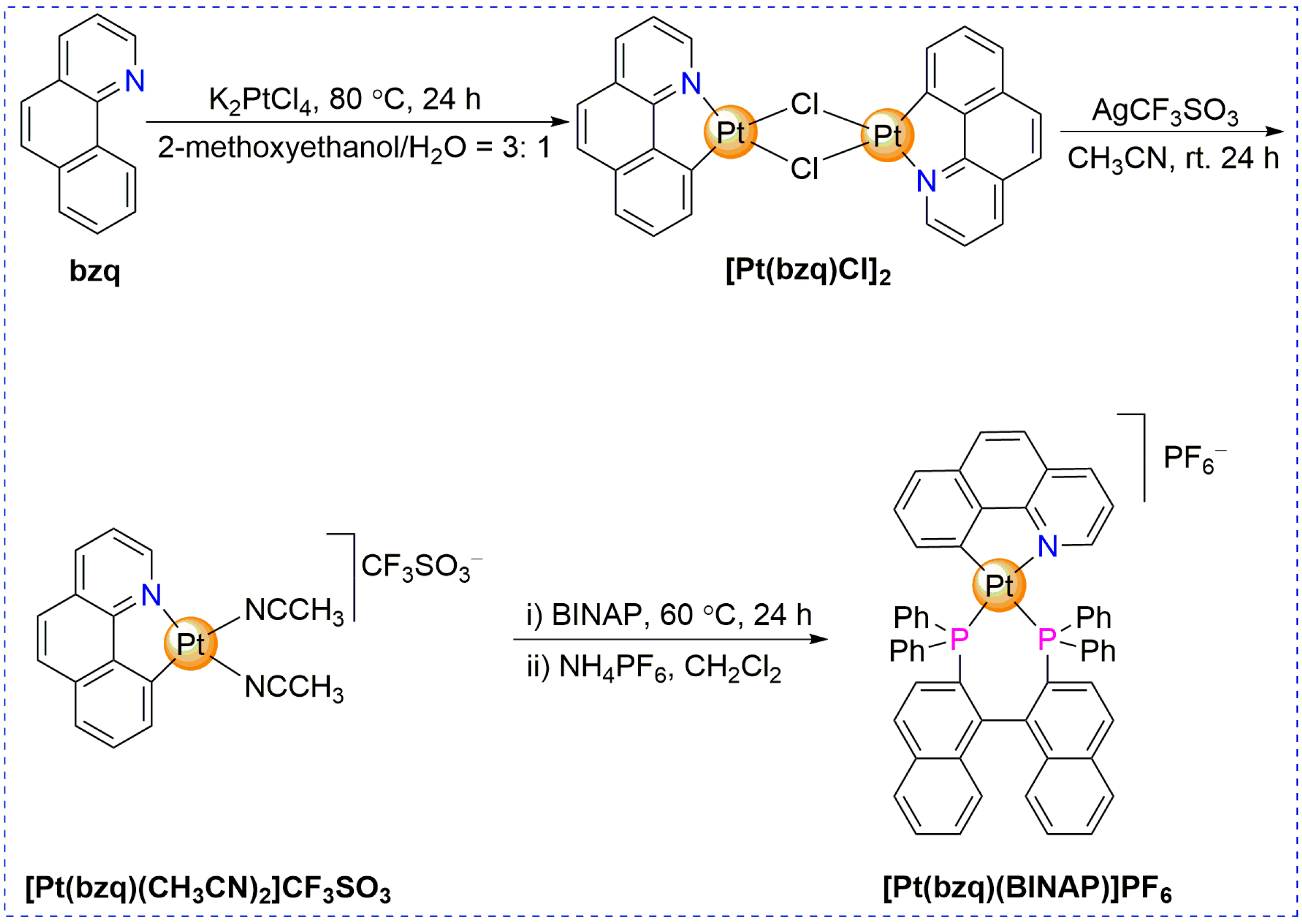
Figure 1. Reaction routes for synthesis of target platinum(II) complex [Pt(bzq)(BINAP)]PF6.
Molbank 2026 m2120 g001
Figure 2. Molecular structure of [Pt(bzq)(BINAP)]PF6 with thermal ellipsoids set at 50% probability. Hydrogen atoms and the PF6 anion have been omitted for clarity. (Pt1: orange; N1: blue; P1 and P2: red; C: gray).
Molbank 2026 m2120 g002
Disclaimer/Publisher’s Note: The statements, opinions and data contained in all publications are solely those of the individual author(s) and contributor(s) and not of MDPI and/or the editor(s). MDPI and/or the editor(s) disclaim responsibility for any injury to people or property resulting from any ideas, methods, instructions or products referred to in the content.