Reproductive Genetic Carrier Screening in Romania: A Couple-Based Study of Pathogenic Molecular Variants

 ,
,  , ,
, ,
Abstract
1. Introduction
2. Results
2.1. Indications for Genetic Screening
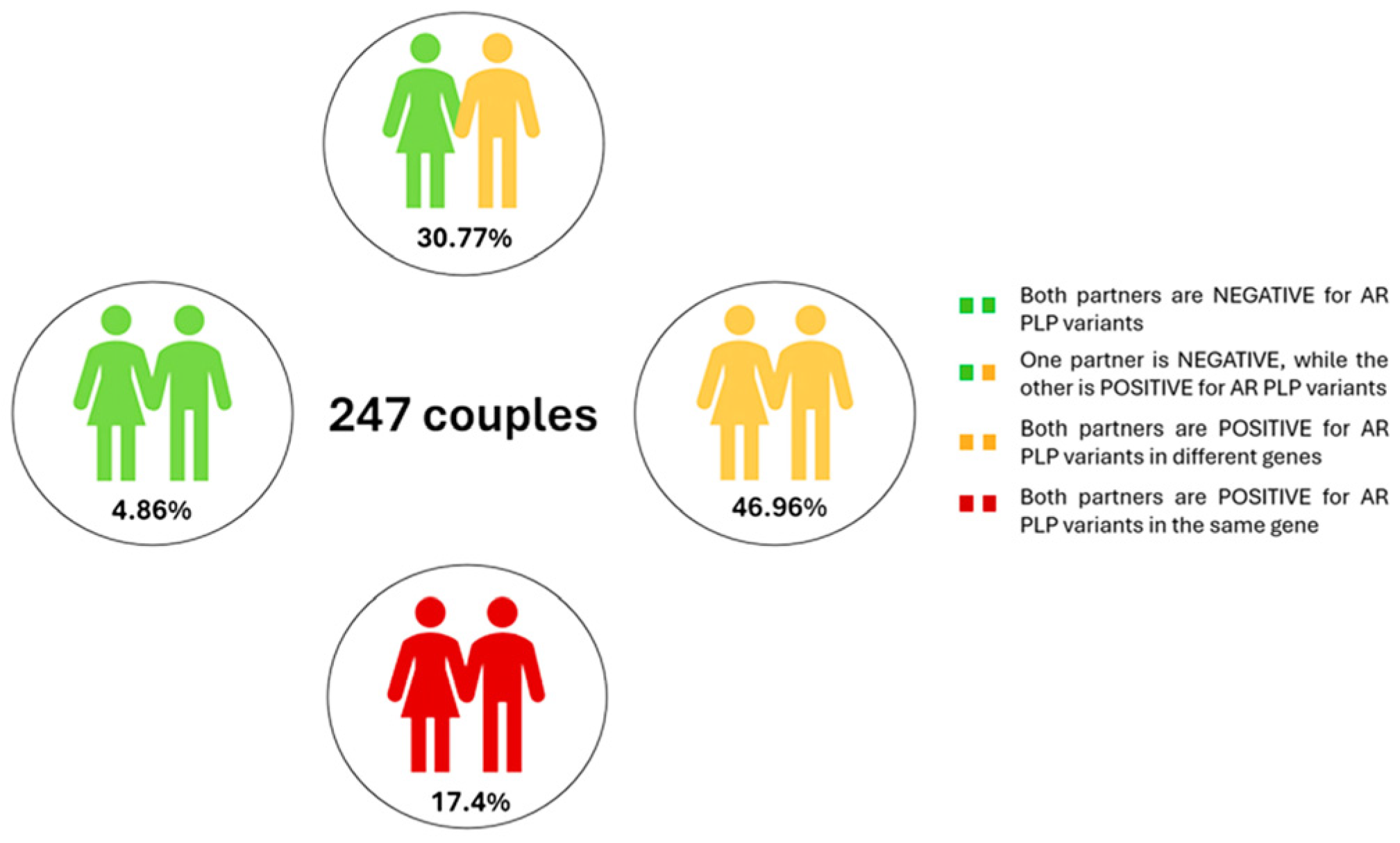
2.2. Classification of Couples According to the Presence of PLP Variants
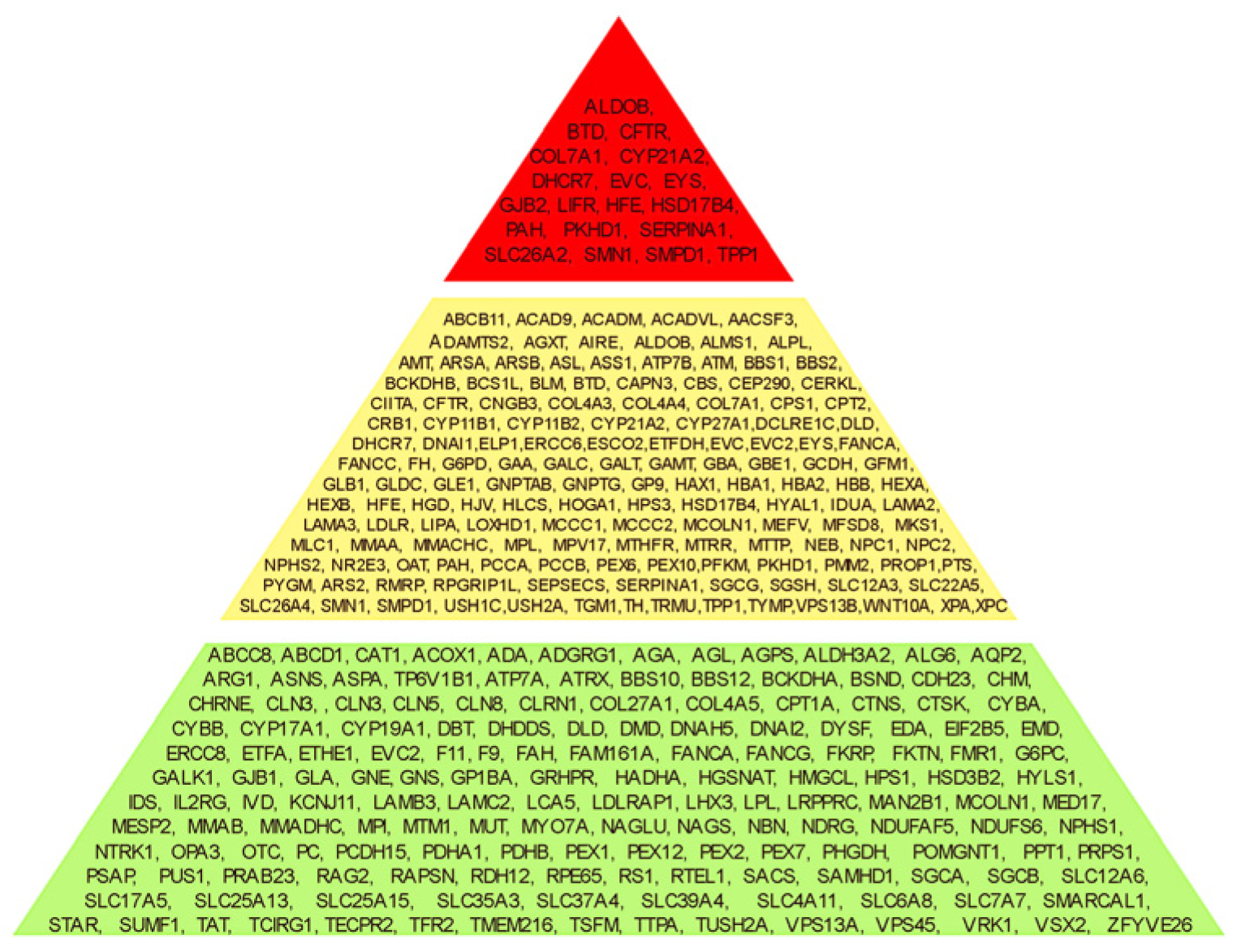
2.3. Classification of Genes According to Reproductive Risk
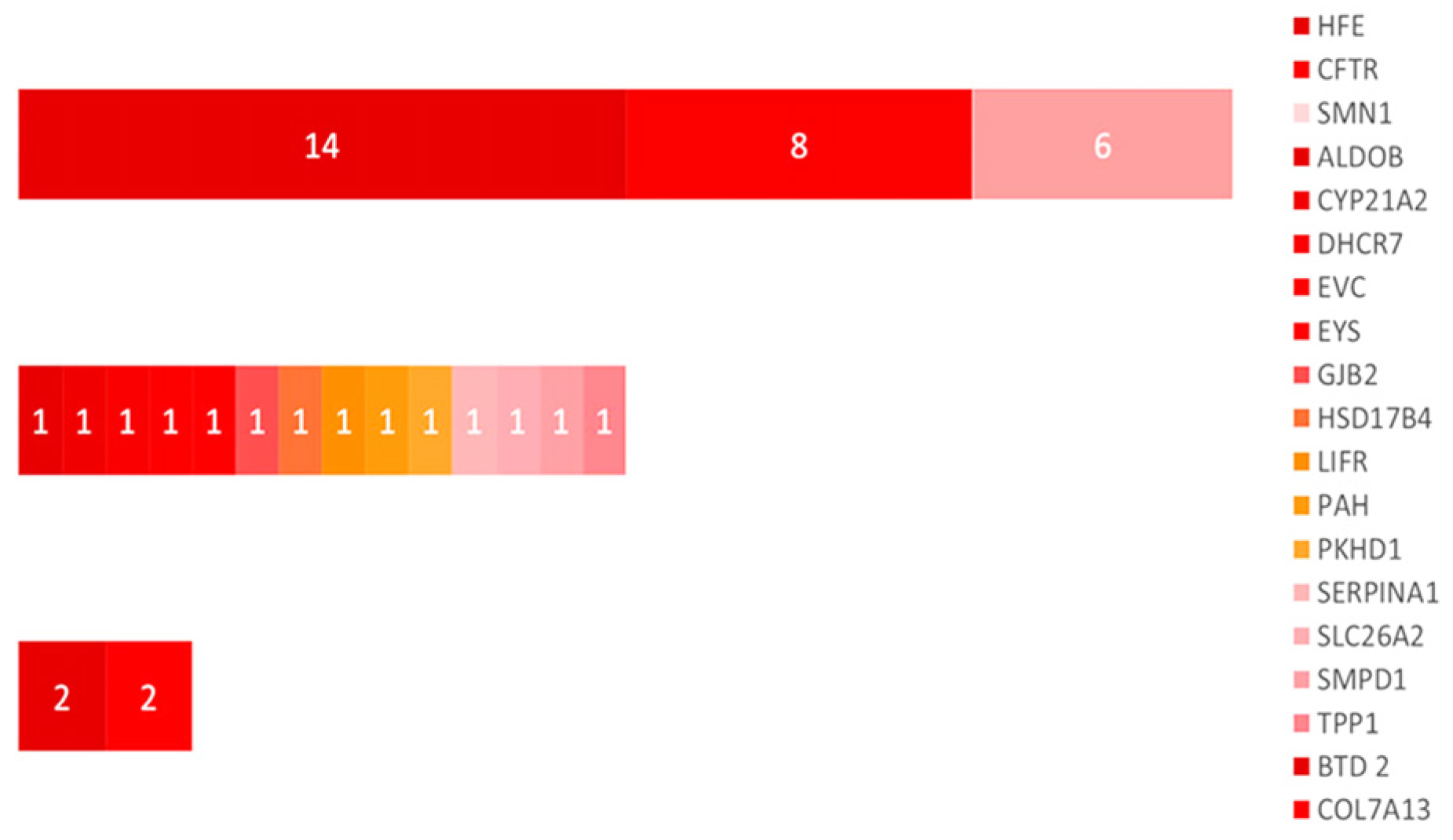
2.4. Couples with PLP Variants in Shared Genes
2.5. Gene Classification According to Disease Morbidity
2.6. Medically Actionable Conditions
2.7. Regional Origins of the Study Cohort Across Romania
3. Discussion
- (1)
- Natural conception followed by prenatal diagnosis, typically through amniocentesis. If the fetus is affected, parents may prepare for the birth of a child with the condition, or consider pregnancy termination, depending on legal regulations and personal beliefs.
- (2)
- IVF with preimplantation genetic testing for monogenic disorders (PGT-M) prior to embryo transfer, allowing the selection and implantation of unaffected embryos. Although this approach prevents the establishment of an affected pregnancy, it involves substantial costs, maternal hormonal treatment, and potential ethical considerations.
- (3)
- Use of donor gametes (sperm or oocytes) from donors genetically screened for carrier status, thereby eliminating the risk for the specific condition.
- (4)
- Adoption as a non-biological parenting option.
- (5)
- Choosing not to pursue biological parenthood, an option selected by some couples.
4. Materials and Methods
4.1. Participant Selection and Clinical Data
4.2. Genetic Counseling
4.3. Carrier Screening and Gene Panel
4.4. Assay Limitations
4.5. Statistical Analysis and Cohort Characteristics
5. Conclusions
Supplementary Materials
Author Contributions
Funding
Institutional Review Board Statement
Informed Consent Statement
Data Availability Statement
Acknowledgments
Conflicts of Interest
Abbreviations
| ACOG | American College of Obstetricians and Gynecologists |
| AD | Autosomal Dominant |
| AMP | Association for Molecular Pathology |
| AR | Autosomal Recessive |
| bp | Base pairs |
| CA | California |
| CF | Cystic fibrosis |
| CFTR modulator | Cystic Fibrosis Transmembrane Conductance Regulator modulator |
| CLN2 | Classic late-infantile neuronal ceroid lipofuscinosis |
| CNV | Copy Number Variant |
| COPD | Chronic Obstructive Pulmonary Disease |
| DNA | Deoxyribonucleic acid |
| ESHG | European Society of Human Genetics |
| ESHRE | European Society of Human Reproduction and Embryology |
| EURORDIS | Rare Diseases Europe |
| GRCh37 | Genome Reference Consortium Human build 37 |
| IVF | In Vitro Fertilization |
| NGS | Next-Generation Sequencing |
| PGT-M | Preimplantation genetic testing for monogenic disorders |
| PLP | Pathogenic or likely pathogenic |
| PCR | Polymerase Chain Reaction |
| RGCS | Reproductive genetic carrier screening |
| SMA | Spinal muscular atrophy |
| USA | United States of America |
| VUS | Variant of Uncertain Significance |
| WES | Whole-exome sequencing |
References
- Eurordis Rare Diseases Europe. What Is a Rare Disease? 2018. Available online: https://www.eurordis.org/information-support/what-is-a-rare-disease/ (accessed on 26 February 2026).
- Capalbo, A.; Fabiani, M.; Caroselli, S.; Poli, M.; Girardi, L.; Patassini, C.; Favero, F.; Cimadomo, D.; Vaiarelli, A.; Simon, C.; et al. Clinical validity and utility of preconception expanded carrier screening for the management of reproductive genetic risk in IVF and general population. Hum. Reprod. 2021, 36, 2050–2061. [Google Scholar] [CrossRef] [PubMed]
- Fidan, Ç.; Akdur, R.; Ünver, Ç.N.; Şahin, Ö.C.; Alper, A.B.; Ayhan, A. Carrier screening programs for rare diseases in developed countries and the case of Turkey: A systematic review. Intractable Rare Dis. Res. 2023, 12, 161–169. [Google Scholar] [CrossRef] [PubMed]
- Kaback, M.M. Screening and prevention in Tay-Sachs disease: Origins, update, and impact. Adv. Genet. 2001, 44, 253–265. [Google Scholar] [CrossRef] [PubMed]
- Punj, S.; Akkari, Y.; Huang, J.; Yang, F.; Creason, A.; Pak, C.; Potter, A.; Dorschner, M.O.; Nickerson, D.A.; Robertson, P.D.; et al. Preconception Carrier Screening by Genome Sequencing: Results from the Clinical Laboratory. Am. J. Hum. Genet. 2018, 102, 1078–1089. [Google Scholar] [CrossRef]
- Loukopoulos, D. Haemoglobinopathies in Greece: Prevention programme over the past 35 years. Indian J. Med. Res. 2011, 134, 572–576. [Google Scholar] [PubMed]
- Cowan, R.S. Moving up the slippery slope: Mandated genetic screening on Cyprus. Am. J. Med. Genet. C Semin. Med. Genet. 2009, 151, 95–103. [Google Scholar] [CrossRef]
- Rowe, C.A.; Wright, C.F. Expanded universal carrier screening and its implementation within a publicly funded healthcare service. J. Community Genet. 2020, 11, 21–38. [Google Scholar] [CrossRef]
- European Association for the Study of the Liver. EASL Clinical Practice Guidelines on haemochromatosis. J. Hepatol. 2022, 77, 479–502. [Google Scholar] [CrossRef]
- Bell, S.C.; Mall, M.A.; Gutierrez, H.; Macek, M.; Madge, S.; Davies, J.C.; Burgel, P.R.; Tullis, E.; Castaños, C.; Castellani, C.; et al. The future of cystic fibrosis care: A global perspective. Lancet Respir. Med. 2019, 7, e40, Erratum in Lancet Respir. Med. 2020, 8, 65–124. https://doi.org/10.1016/S2213-2600(19)30408-4. [Google Scholar] [CrossRef] [PubMed]
- Finkel, R.S.; Mercuri, E.; Darras, B.T.; Connolly, A.M.; Kuntz, N.L.; Kirschner, J.; Chiriboga, C.A.; Saito, K.; Servais, L.; Tizzano, E.; et al. Nusinersen versus Sham Control in Infantile-Onset Spinal Muscular Atrophy. N. Engl. J. Med. 2017, 377, 1723–1732. [Google Scholar] [CrossRef]
- Wolf, B. Biotinidase deficiency: “If you have to have an inherited metabolic disease, this is the one to have”. Genet. Med. 2012, 14, 565–575. [Google Scholar] [CrossRef]
- Pinheiro, F.C.; Sperb-Ludwig, F.; Schwartz, I.V.D. KHK inhibition for the treatment of hereditary fructose intolerance and nonalcoholic fatty liver disease: A double-edged sword. Cell. Mol. Life Sci. 2020, 77, 3465–3466. [Google Scholar] [CrossRef]
- van Wegberg, A.M.J.; MacDonald, A.; Ahring, K.; Bélanger-Quintana, A.; Blau, N.; Bosch, A.M.; Burlina, A.; Campistol, J.; Feillet, F.; Giżewska, M.; et al. The complete European guidelines on phenylketonuria: Diagnosis and treatment. Orphanet J. Rare Dis. 2017, 12, 162. [Google Scholar] [CrossRef]
- Speiser, P.W.; Arlt, W.; Auchus, R.J.; Baskin, L.S.; Conway, G.S.; Merke, D.P.; Meyer-Bahlburg, H.F.L.; Miller, W.L.; Murad, M.H.; Oberfield, S.E.; et al. Congenital Adrenal Hyperplasia Due to Steroid 21-Hydroxylase Deficiency: An Endocrine Society Clinical Practice Guideline. J. Clin. Endocrinol. Metab. 2018, 1, 4043–4088. [Google Scholar] [CrossRef]
- Holzinger, D.; Hofer, J.; Dall, M.; Fellinger, J. Multidimensional Family-Centred Early Intervention in Children with Hearing Loss: A Conceptual Model. J. Clin. Med. 2022, 11, 1548. [Google Scholar] [CrossRef] [PubMed]
- Miravitlles, M.; Dirksen, A.; Ferrarotti, I.; Koblizek, V.; Lange, P.; Mahadeva, R.; McElvaney, N.G.; Parr, D.; Piitulainen, E.; Roche, N.; et al. European Respiratory Society statement: Diagnosis and treatment of pulmonary disease in α1-antitrypsin deficiency. Eur. Respir. J. 2017, 50, 1700610. [Google Scholar] [CrossRef]
- Schulz, A.; Schwering, C.; Wibbeler, E.; Westermann, L.M.; Hagenah, L.; Lezius, S.; Jha, A.; Hunt, A.; Slasor, P.; Reisewitz, P.; et al. Real-world clinical outcomes of patients with CLN2 disease treated with cerliponase alfa. Front. Neurol. 2025, 16, 1516026. [Google Scholar] [CrossRef] [PubMed]
- Scarpa, M.; Diaz, G.A.; Giugliani, R.; Jones, S.A.; Mengel, E.; Guffon, N.; Witters, P.; Ganesh, J.; Armstrong, N.M.; Srivastava, S.; et al. Long-Term Safety and Clinical Outcomes with Olipudase Alfa Enzyme Replacement Therapy in Children and Adolescents with Acid Sphingomyelinase Deficiency. J. Inherit. Metab. Dis. 2025, 48, e70086. [Google Scholar] [CrossRef]
- Ognean, M.L.; Mutică, I.B.; Vișa, G.A.; Șofariu, C.R.; Matei, C.; Neamțu, B.; Cucerea, M.; Galiș, R.; Cocișiu, G.A.; Mătăcuță-Bogdan, I.O. D-Bifunctional Protein Deficiency Diagnosis—A Challenge in Low Resource Settings: Case Report and Review of the Literature. Int. J. Mol. Sci. 2024, 25, 4924. [Google Scholar] [CrossRef] [PubMed]
- Burgmaier, K.; Broekaert, I.J.; Liebau, M.C. Autosomal Recessive Polycystic Kidney Disease: Diagnosis, Prognosis, and Management. Adv. Kidney Dis. Health 2023, 30, 468–476. [Google Scholar] [CrossRef]
- Härkönen, H.; Loid, P.; Mäkitie, O. SLC26A2-Associated Diastrophic Dysplasia and rMED—Clinical Features in Affected Finnish Children and Review of the Literature. Genes 2021, 11, 714. [Google Scholar] [CrossRef]
- Villavisanis, D.F.; Perrault, D.P.; Kiani, S.N.; Cholok, D.; Fox, P.M. Current Treatment Landscape for Dystrophic Epidermolysis Bullosa: From Surgical Management to Emerging Gene Therapies and Novel Skin Grafts. J. Hand Surg. Am. 2024, 49, 472–480. [Google Scholar] [CrossRef] [PubMed]
- Kritzer, A.; Dutta, R.; Pramparo, T.; Terner-Rosenthal, J.; Vig, P.; Steiner, R.D. Smith-Lemli-Opitz syndrome: Clinical, biochemical, and genetic insights with emerging treatment opportunities. Genet. Med. 2025, 27, 101450. [Google Scholar] [CrossRef]
- Ruiz-Perez, V.L.; Goodship, J.A. Ellis–van Creveld syndrome and Weyers acrodental dysostosis are caused by cilia-mediated diminished response to hedgehog ligands. Am. J. Med. Genet. 2009, 151C, 341–351. [Google Scholar] [CrossRef]
- Hartong, D.T.; Berson, E.L.; Dryja, T.P. Retinitis pigmentosa. Lancet 2006, 368, 1795–1809. [Google Scholar] [CrossRef]
- McDermott, H.; Simmonds, J.; Thyagarajan, M.; Islam, L.; Naik, S.; Titheradge, H. Paediatric survivors beyond infancy with Stüve-Wiedemann syndrome—A case series from the West Midlands, UK. Eur. J. Med. Genet. 2023, 66, 104788. [Google Scholar] [CrossRef] [PubMed]
- Antonarakis, S.E. Carrier screening for recessive disorders. Nat. Rev. Genet. 2019, 20, 549–561. [Google Scholar] [CrossRef] [PubMed]
- Gug, M.; Andreescu, N.; Caba, L.; Popoiu, T.-A.; Mozos, I.; Gug, C. The Landscape of Genetic Variation and Disease Risk in Romania: A Single-Center Study of Autosomal Recessive Carrier Frequencies and Molecular Variants. Int. J. Mol. Sci. 2025, 26, 10912. [Google Scholar] [CrossRef]
- Jamieson, N.; Fitzgerald, D.; Singh-Grewal, D.; Hanson, C.S.; Craig, J.C.; Tong, A. Children’s experiences of cystic fibrosis: A systematic review. of qualitative studies. Pediatrics 2014, 133, e1683–e1697. [Google Scholar] [CrossRef]
- Wilfond, B.S.; Goddard, K.A. It’s complicated: Criteria for policy decisions for the clinical integration of genome-scale sequencing for reproductive decision making. Mol. Genet. Genom. Med. 2015, 3, 239–242. [Google Scholar] [CrossRef]
- Goudie, A.; Narcisse, M.R.; Hall, D.E.; Kuo, D.Z. Financial and psychological stressors associated with caring for children with disability. Fam. Syst. Health 2014, 32, 280–290. [Google Scholar] [CrossRef] [PubMed]
- Beauchamp, K.A.; Johansen Taber, K.A.; Muzzey, D. Clinical impact and cost-effectiveness of a 176-condition expanded carrier screen. Genet. Med. 2019, 21, 1948–1957. [Google Scholar] [CrossRef]
- Capalbo, A.; de Wert, G.; Henneman, L.; Kakourou, G.; Mcheik, S.; Peterlin, B.; van El, C.; Vassena, R.; Vermeulen, N.; Viville, S.; et al. An ESHG-ESHRE survey on the current practice of expanded carrier screening in medically assisted reproduction. Hum. Reprod. 2024, 39, 1844–1855. [Google Scholar] [CrossRef] [PubMed]
- Dive, L.; Newson, A.J. Reproductive carrier screening: Responding to the eugenics critique. J. Med. Ethics 2022, 48, 1060–1067. [Google Scholar] [CrossRef]
- Gug, C.; Mozos, I.; Ratiu, A.; Tudor, A.; Gorduza, E.V.; Caba, L.; Gug, M.; Cojocariu, C.; Furau, C.; Furau, G.; et al. Genetic Counseling and Management: The First Study to Report NIPT Findings in a Romanian Population. Medicina 2022, 58, 79. [Google Scholar] [CrossRef]
- Gug, M.; Rațiu, A.; Andreescu, N.; Farcas, S.; Laitin, S.; Gug, C. Approach and Management of Pregnancies with Risk Identified by Non-Invasive Prenatal Testing. J. Pers. Med. 2024, 14, 366. [Google Scholar] [CrossRef]
- Archibald, A.D.; McClaren, B.J.; Caruana, J.; Tutty, E.; King, E.A.; Halliday, J.L.; Best, S.; Kanga-Parabia, A.; Bennetts, B.H.; Cliffe, C.C.; et al. The Australian Reproductive Genetic Carrier Screening Project (Mackenzie’s Mission): Design and Implementation. J. Pers. Med. 2022, 12, 1781. [Google Scholar] [CrossRef]
- Freeman, L.; Archibald, A.D.; Dive, L.; Delatycki, M.B.; Kirk, E.P.; Laing, N.; Newson, A.J. Considering severity in the design of reproductive genetic carrier screening programs: Screening for severe conditions. Eur. J. Hum. Genet. 2024, 33, 194–198. [Google Scholar] [CrossRef]
- Robson, S.J.; Caramins, M.; Saad, M.; Suthers, G. Socioeconomic status and uptake of reproductive carrier screening in Australia. Aust. N. Z. J. Obstet. Gynaecol. 2020, 60, 976–979. [Google Scholar] [CrossRef]
- Available online: https://www.caleaeuropeana.ro/alexandru-rogobete-lansarea-registrului-national-de-screening-neonatal-deschide-calea-catre-digitalizarea-sanatatii-si-apropie-romania-de-standardele-europene/ (accessed on 28 February 2026).
- Cousens, N.E.; Gaff, C.L.; Metcalfe, S.A.; Delatycki, M.B. Carrier screening for beta-thalassaemia: A review of international practice. Eur. J. Hum. Genet. 2010, 18, 1077–1083. [Google Scholar] [CrossRef] [PubMed]
- Glotov, A.S.; Nasykhova, Y.A.; Lazareva, T.E.; Dvoynova, N.M.; Shabanova, E.S.; Danilova, M.M.; Osinovskaya, N.S.; Barbitoff, Y.A.; Maretina, M.A.; Gorodnicheva, E.E.; et al. Pilot Study of Preconception Carrier Screening in Russia: Initial Findings and Challenges. Genes 2025, 17, 3. [Google Scholar] [CrossRef]
- Sagaser, K.G.; Malinowski, J.; Westerfield, L.; Proffitt, J.; Hicks, M.A.; Toler, T.L.; Blakemore, K.J.; Stevens, B.K.; Oakes, L.M. Expanded carrier screening for reproductive risk assessment: An evidence-based practice guideline from the National Society of Genetic Counselors. J. Genet. Couns. 2023, 32, 540–557. [Google Scholar] [CrossRef]
- Lincoln, S.E.; Truty, R.; Lin, C.F.; Zook, J.M.; Paul, J.; Ramey, V.H.; Salit, M.; Rehm, H.L.; Nussbaum, R.L.; Lebo, M.S. A Rigorous Interlaboratory Examination of the Need to Confirm Next-Generation Sequencing-Detected Variants with an Orthogonal Method in Clinical Genetic Testing. J. Mol. Diagn. 2019, 21, 318–329. [Google Scholar] [CrossRef] [PubMed]



| Gene | Disease | Number of Affected Families | Number of Deceased Children |
|---|---|---|---|
| SMN1 | Spinal muscular atrophy (SMA) | 6 | 1 |
| CFTR | Cystic fibrosis (CF) | 4 | 0 |
| COL7A1 | Dystrophic epidermolysis bullosa | 2 | 1 |
| TPP1 | Neuronal ceroid lipofuscinosis type 2 | 1 | 1 |
| HSD17B4 | Peroxisomal metabolic conditions | 1 | 1 |
| SMPD1 | Niemann–Pick disease type A | 1 | 1 |
| LIFR | Stüve–Wiedemann syndrome | 1 | 1 |
| PKHD1 | AR polycystic kidney disease | 1 | 1 |
| PAH | Phenylketonuria | 1 | 0 |
| ALDOB | Hereditary fructose intolerance | 1 | 0 |
| Couple No. | Shared Genes | Gene PLP Variant |
|---|---|---|
| 1 | SMPD1 | c.[1268A>G];[?] (p.[His423Arg];[?]) |
| SMPD1 | c.[1685T>A];[?] (p.[Met562Lys];[?]) | |
| 2 | SMN1 | Heterozygous Deletion of Exons 7 + 8 |
| SMN1 | Heterozygous Deletion of Exons 7 + 8 | |
| 3 | LIFR | c.1789C>T (p.Arg597*1) |
| LIFR | c.1418del (p.Ser473Leufs*15) | |
| 4 | HFE | c.845G>A (p.Cys282Tyr) § 2 |
| HFE | c.187C>G (p.His63Asp) § | |
| 5 | CFTR | c.1210-34TG[11]T[5] § |
| CFTR | c.1210-34TG[11]T[5] § | |
| 6 | HFE | c.187C>G (p.His63Asp) § |
| HFE | c.187C>G (p.His63Asp) § | |
| 7 | SLC26A2 | c.1957T>A (p.Cys653Ser) |
| SLC26A2 | c.1724del (p.Lys575Serfs*10) | |
| 8 | HFE | c.187C>G (p.His63Asp) § |
| HFE | c.187C>G (p.His63Asp) § | |
| 9 | HFE | c.187C>G (p.His63Asp) § |
| HFE | c.187C>G (p.His63Asp) § | |
| 10 | HFE | c.845G>A (p.Cys282Tyr) § |
| HFE | c.187C>G (p.His63Asp) § | |
| 11 | GJB2 | c.35del (p.Gly12Valfs*2) |
| GJB2 | c.35del (p.Gly12Valfs*2) | |
| 12 | EYS | c.9036del (p.Leu3013Serfs*6) |
| EYS | c.9036del (p.Leu3013Serfs*6) | |
| 13 | HFE | c.187C>G (p.His63Asp) § |
| HFE | c.845G>A (p.Cys282Tyr) § | |
| 14 | EVC | c.919T>C (p.Ser307Pro) |
| EVC | c.919T>C (p.Ser307Pro) | |
| 15 | HFE | c.187C>G (p.His63Asp) § |
| HFE | c.187C>G (p.His63Asp) § homozygous | |
| 16 | CFTR and HFE | c.1210-34TG[11]T[5] (Intronic) § and c.187C>G (p.His63Asp) § |
| CFTR and HFE | c.1210-34TG[11]T[5] (Intronic) § and c.187C>G (p.His63Asp) § | |
| 17 | HFE | c.187C>G (p.His63Asp) § |
| HFE | c.187C>G (p.His63Asp) § | |
| 18 | DHCR7 | c.91C>T (p.Arg31Cys) |
| DHCR7 | c.452G>A (p.Trp151*) | |
| 19 | BTD | c.1330G>C (p.Asp444His) |
| BTD | c.1330G>C (p.Asp444His) | |
| 20 | CFTR | c.3909C>G (p.Asn1303Lys) |
| CFTR | c.1521_1523del (p.508del) | |
| 21 | HFE | c.187C>G (p.His63Asp) § |
| HFE | c.187C>G (p.His63Asp) § | |
| 22 | SMN1 | Heterozygous Deletion of Exons 7 + 8 |
| SMN1 | Heterozygous Deletion of Exons 7 + 8 | |
| 23 | CYP21A2 and HFE | c.955C>T (p.Gln319*) and c.187C>G (p.His63Asp) § |
| CYP21A2 and HFE | c.844G>T (p.Val282Leu) and c.187C>G (p.His63Asp) § | |
| 24 | HFE | c.187C>G (p.His63Asp) § |
| HFE | c.187C>G (p.His63Asp) § | |
| 25 | HFE | c.187C>G (p.His63Asp) § |
| HFE | c.187C>G (p.His63Asp) § | |
| 26 | HFE | c.187C>G (p.His63Asp) § |
| HFE | c.845G>A (p.Cys282Tyr) § | |
| 27 | BTD and SERPINA1 | c.1330G>C (p.Asp444His) and c.863A>T (p.Glu288Val) § |
| BTD and SERPINA1 | c.1595C>T (p.Thr532Met) and c.1177C>T (p.Pro393Ser) | |
| 28 | SMN1 | Heterozygous Deletion of Exons 7 + 8 |
| SMN1 | Heterozygous Deletion of Exons 7 + 8 | |
| 29 | CFTR | c.1521_1523del (p.508del) |
| CFTR | c.1521_1523del (p.508del) | |
| 30 | SMN1 | Heterozygous Deletion of Exons 7 + 8 in SMN1 and Duplication of SMN2 |
| SMN1 | Heterozygous Deletion of Exons 7 + 8 in SMN1 and Duplication of SMN2 | |
| 31 | HSD17B4 | c.788del p.(Pro263Glnfs*2) |
| HSD17B4 | c.788del p.(Pro263Glnfs*2) | |
| 32 | ALDOB | c.448G>C (p.Ala150Pro) |
| ALDOB | c.448G>C (p.Ala150Pro) | |
| 33 | CFTR | c.1521_1523del (p.508del) |
| CFTR | c.1521_1523del (p.508del) | |
| 34 | TPP1 | c.622C>T, p.(Arg208*) |
| TPP1 | c.1678_1679delCT | |
| 35 | CFTR | c.1521_1523del (p.508del) |
| CFTR | c.3472 C>G (Arg1158*) | |
| 36 | PAH | c.1066-11G>A |
| PAH | c.1222C>T p.Arg408Trp | |
| 37 | CFTR | c.1521_1523del (p.508del) |
| CFTR | 7T + 7T | |
| 38 | CFTR | c.1521_1523del (p.508del) |
| CFTR | c.3909C>G (p.Asn1303Lys) | |
| 39 | SMN1 | Heterozygous Deletion of Exons 7 + 8 |
| SMN1 | Heterozygous Deletion of Exons 7 + 8 | |
| 40 | SMN1 | Heterozygous Deletion of Exon 7 |
| SMN1 | Heterozygous Deletion of Exons 7 + 8 | |
| 41 | COL7A1 | c.425A>G (p.Lys142Arg) (Exon 3) |
| COL7A1 | c.2308_c.2314 + 1delAGGACTGG (Intron 17) | |
| 42 | COL7A1 | c.3140-2A>G |
| COL7A1 | c.3140-2A>G | |
| 43 | PKHD1 | Exon 3 (c.107C>T) p.Thr36Met |
| PKHD1 | Exon 64 (c.11439C>G) p.Phe3813Leu |
| Morbidity Level | Gene | Disease | Clinical Picture |
|---|---|---|---|
| High morbidity | CYP21A2 | Congenital adrenal hyperplasia due to 21-hydroxylase deficiency | Life-threatening adrenal crises in infancy if untreated (Classic salt-wasting type) |
| PKHD1 | AR polycystic kidney disease | Severe renal and hepatic involvement, pulmonary hypoplasia, and high neonatal mortality | |
| SMN1 | Spinal muscular atrophy | Severe neuromuscular disease | |
| COL7A1 | Dystrophic epidermolysis bullosa | Severe skin and mucosal involvement | |
| TPP1 | Neuronal ceroid lipofuscinosis type 2 | Fatal childhood neurodegenerative disease | |
| HSD17B4 | Peroxisomal disorder | Severe encephalopathy and liver failure | |
| DHCR7 | Smith–Lemli–Opitz syndrome | Multiple malformations and severe intellectual disability | |
| SMPD1 | Niemann–Pick disease type A/B | Lysosomal storage disorder (type A often lethal) | |
| EYS | Retinitis pigmentosa | Progressive retinal degeneration leading to blindness | |
| Moderate morbidity | CFTR | Cystic fibrosis | Affects lungs, pancreas, and reproductive system |
| PAH | Phenylketonuria | Cognitive impairment if untreated; diet-controlled | |
| EVC | Ellis–van Creveld syndrome | Chondrodysplastic dwarfism with possible cardiac defects | |
| ALDOB | Hereditary fructose intolerance | Potentially severe but reversible with diet | |
| SERPINA1 | Alpha-1 antitrypsin deficiency | Chronic condition affecting lungs and/or liver | |
| SLC26A2 | Skeletal dysplasias | Variable severity (from lethal to moderate forms) | |
| Low morbidity | HFE | Hereditary hemochromatosis | Low morbidity; manageable with phlebotomy and monitoring |
| BTD | Biotinidase deficiency | Completely reversible | |
| GJB2 | Nonsyndromic congenital hearing loss | Classically severe, but milder variants exist | |
| LIFR | Stüve–Wiedemann syndrome | Variable severity depending on mutation |
| Actionability | Gene | Disease | Actionable Measures |
|---|---|---|---|
| Medically actionable | HFE | Hereditary hemochromatosis | Preventable organ damage with phlebotomy and monitoring [9] |
| CFTR | Cystic fibrosis | Targeted therapies (CFTR modulators), early pulmonary & nutritional management [10] | |
| SMN1 | Spinal muscular atrophy | Disease-modifying therapies available (Nusinersen, Onasemnogene, Risdiplam) [11] | |
| BTD | Biotinidase deficiency | Completely preventable with biotin supplementation [12] | |
| ALDOB | Hereditary fructose intolerance | Disease prevented by dietary exclusion of fructose and KHK inhibition [13] | |
| PAH | Phenylketonuria | Diet ± pharmacologic therapy [14] | |
| CYP21A2 | Congenital adrenal hyperplasia due to 21-hydroxylase deficiency | Glucocorticoid and mineralocorticoid replacement immediately after birth and lifelong for prevention of adrenal crisis [15] | |
| GJB2 | Nonsyndromic congenital hearing loss | Early intervention (hearing aids, cochlear implants, speech therapy) [16] | |
| SERPINA1 | Alpha-1 antitrypsin deficiency | Intravenous alpha-1 antitrypsin, COPD 1 therapies, Liver transplant [17] | |
| TPP1 | CLN2 2 disease | Enzyme replacement therapy slows neurodegeneration (Cerliponase alfa) [18] | |
| Partially actionable | SMPD1 | Niemann–Pick disease A/B | Enzyme replacement for type B [19] but type A largely non-actionable |
| HSD17B4 | Peroxisomal disorders | Supportive management only (no curative therapy) [20] | |
| PKHD1 | AR polycystic kidney disease | Treatment of congenital hepatic fibrosis and portal hypertension, (dialysis) and kidney transplant [21] | |
| SLC26A2 | Skeletal dysplasia | Orthopedic and supportive interventions(no molecular cure) [22] | |
| COL7A1 | Dystrophic epidermolysis bullosa | Surgical pseudosyndactyly release, emerging gene therapies and novel skin grafts [23] | |
| Limited clinical actionability | DHCR7 | Smith–Lemli–Opitz syndrome | Management is Symptomatic/supportive [24,25,26,27] |
| EVC | Ellis–van Creveld syndrome | ||
| EYS | Retinitis pigmentosa | ||
| LIFR | Stüve–Wiedemann syndrome |
| Romanian County | Frequency | Percent | Valid Percent | Cumulative Percent |
|---|---|---|---|---|
| Arad | 27 | 5.47 | 5.47 | 5.47 |
| Bihor | 2 | 0.41 | 0.41 | 5.87 |
| Bistria-Nasaud | 2 | 0.41 | 0.41 | 6.28 |
| Caras-Severin | 19 | 3.85 | 3.85 | 10.12 |
| Dolj | 2 | 0.41 | 0.41 | 10.53 |
| Foreign | 4 | 0.81 | 0.81 | 11.34 |
| Gorj | 9 | 1.82 | 1.82 | 13.16 |
| Galati | 1 | 0.20 | 0.20 | 13.36 |
| Hunedoara | 13 | 2.63 | 2.63 | 15.99 |
| Ilfov | 2 | 0.41 | 0.41 | 16.40 |
| Iasi | 5 | 1.01 | 1.01 | 17.41 |
| Mehedinti | 4 | 0.81 | 0.81 | 18.22 |
| Maramures | 2 | 0.41 | 0.41 | 18.62 |
| Mures | 3 | 0.61 | 0.61 | 19.23 |
| Neamt | 2 | 0.41 | 0.41 | 19.64 |
| Not specified | 2 | 0.41 | 0.41 | 20.04 |
| Olt | 2 | 0.41 | 0.41 | 20.45 |
| Prahova | 4 | 0.81 | 0.81 | 21.26 |
| Sibiu | 2 | 0.41 | 0.41 | 21.66 |
| Satu Mare | 2 | 0.41 | 0.41 | 22.07 |
| Tulcea | 1 | 0.20 | 0.20 | 22.27 |
| Timis | 383 | 77.53 | 77.53 | 99.80 |
| Valcea | 1 | 0.20 | 0.20 | 100.00 |
| Missing | 0 | 0.00 | ||
| Total | 494 | 100.00 |
Disclaimer/Publisher’s Note: The statements, opinions and data contained in all publications are solely those of the individual author(s) and contributor(s) and not of MDPI and/or the editor(s). MDPI and/or the editor(s) disclaim responsibility for any injury to people or property resulting from any ideas, methods, instructions or products referred to in the content. |
© 2026 by the authors. Licensee MDPI, Basel, Switzerland. This article is an open access article distributed under the terms and conditions of the Creative Commons Attribution (CC BY) license.
Share and Cite
Gug, M.; Gug, C.; Jurca, A.A.; Popoiu, T.-A.; Patrascu, R.; Roman, P.A.; Olteanu, L.; Andreescu, N. Reproductive Genetic Carrier Screening in Romania: A Couple-Based Study of Pathogenic Molecular Variants. Int. J. Mol. Sci. 2026, 27, 3581. https://doi.org/10.3390/ijms27083581
Gug M, Gug C, Jurca AA, Popoiu T-A, Patrascu R, Roman PA, Olteanu L, Andreescu N. Reproductive Genetic Carrier Screening in Romania: A Couple-Based Study of Pathogenic Molecular Variants. International Journal of Molecular Sciences. 2026; 27(8):3581. https://doi.org/10.3390/ijms27083581
Chicago/Turabian StyleGug, Miruna, Cristina Gug, Aurora Alexandra Jurca, Tudor-Alexandru Popoiu, Raul Patrascu, Paula Andreea Roman, Larisa Olteanu, and Nicoleta Andreescu. 2026. "Reproductive Genetic Carrier Screening in Romania: A Couple-Based Study of Pathogenic Molecular Variants" International Journal of Molecular Sciences 27, no. 8: 3581. https://doi.org/10.3390/ijms27083581
APA StyleGug, M., Gug, C., Jurca, A. A., Popoiu, T.-A., Patrascu, R., Roman, P. A., Olteanu, L., & Andreescu, N. (2026). Reproductive Genetic Carrier Screening in Romania: A Couple-Based Study of Pathogenic Molecular Variants. International Journal of Molecular Sciences, 27(8), 3581. https://doi.org/10.3390/ijms27083581