Molecular Modeling of the Pathogenetic Mechanisms of Neuropsychiatric Disorders

 , , ,
, , ,
Abstract
1. Introduction
2. Molecular Dynamics Background
2.1. Classical Molecular Dynamics
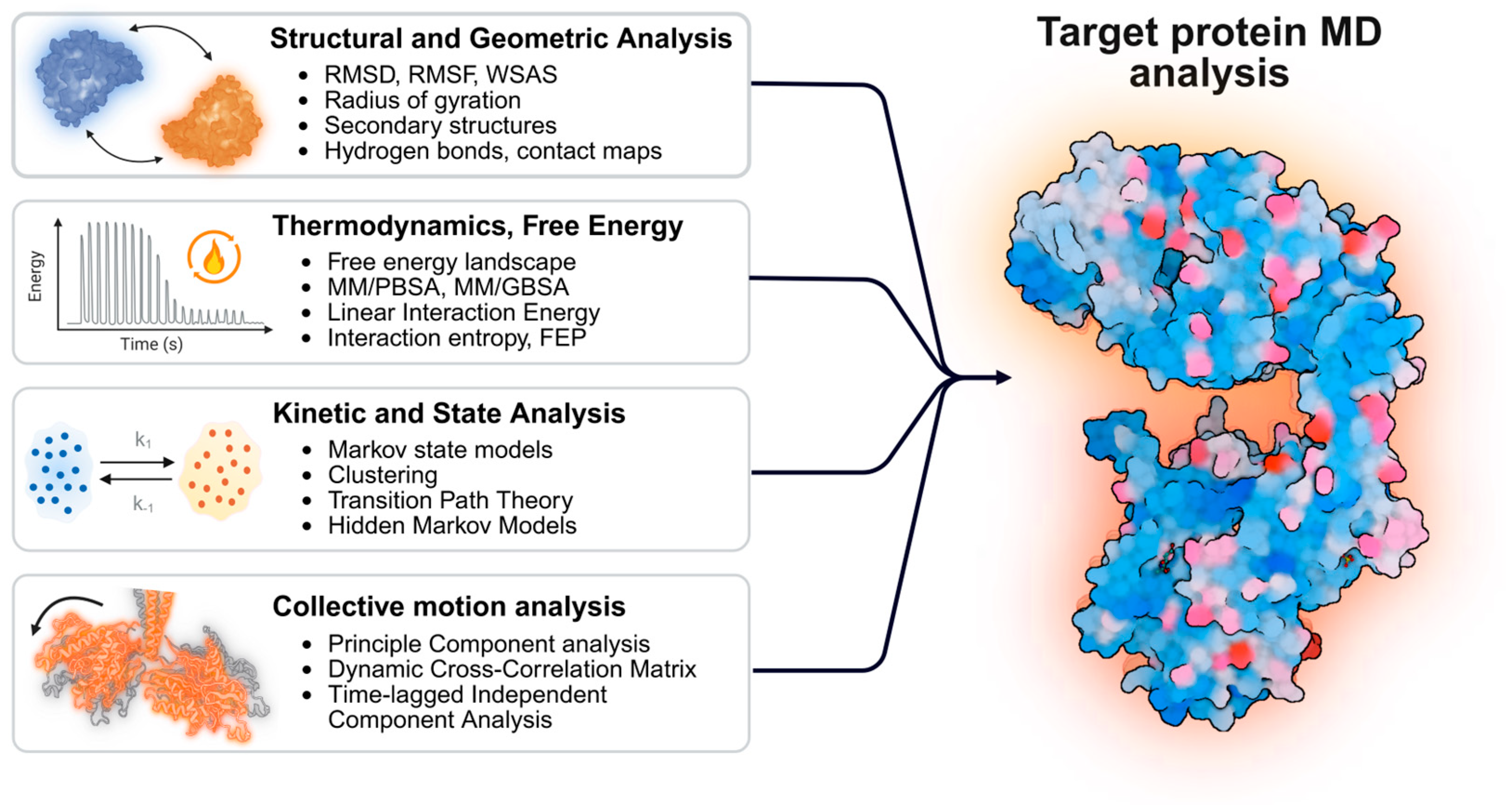
- In MD simulations, a key objective is to evaluate biomolecular stability and monitor structural changes over time. This is commonly done using RMSD, which quantifies how much a structure at each time point deviates from a reference structure [46]. Increasing RMSD generally indicates larger conformational rearrangements, whereas a plateau with small fluctuations suggests equilibration. Therefore, RMSD is widely used as a primary indicator of conformational stability and simulation quality.
- Local flexibility, in contrast, is characterized by RMSF, which complements stability metrics by quantifying the mobility of individual atoms or residues over the trajectory [47]. Regions with high RMSF typically correspond to flexible segments such as loops and termini, whereas low RMSF values indicate rigid, structurally stable parts of the protein, often including the core.
- 3.
- The radius of gyration (Rg) parameter reflects the degree of molecular compactness and allows monitoring whether the structure retains its integrity during the simulation or, conversely, undergoes expansion and unfolding. Rg and RMSF are often analyzed together to obtain a comprehensive assessment of a system’s dynamics. This approach allows for the simultaneous characterization of global disorder and changes in structural compactness via Rg, as well as the local mobility of individual atoms or amino acid residues via RMSF.
- 4.
- Principal component analysis (PCA) is used to capture the largest, functionally relevant collective motions in MD trajectories, such as open–closed transitions or domain rearrangements [49]. Typically, trajectories are first aligned to remove overall rotation/translation and a subset of atoms is selected to reduce computational cost and suppress high-frequency local noise, thereby emphasizing collective, functionally relevant motions. PCA then decomposes the covariance matrix of atomic fluctuations into eigenvectors (directions of motion) and eigenvalues (their amplitudes). The leading components (e.g., PC1/PC2) explain most of the variance and enable visualization and comparison of major conformational transitions.
- 5.
- MSMs simplify complex molecular motion by describing it as transitions between a finite set of stable conformational states and by estimating the probabilities and rates of these transitions, for example rearrangements between active and inactive GPCR states or β-sheet growth during amyloid aggregation [53,54,55,56]. This approach is useful for rare events that are hard to observe in conventional MD because they require crossing high energy barriers and occur on long timescales, such as metastable switching or slow structural rearrangements. To construct an MSM, structures from MD are grouped into clusters using structural similarity measures such as Cα RMSD or coordinates of a reaction center, which helps identify stable conformations and quantify their contribution to overall behavior. In practice, MSM conclusions are most defensible when they remain consistent after building the model from multiple independent trajectories and after checking that the inferred kinetics do not change substantially when the lag time or the state definition is varied, since these choices can otherwise create an illusion of well-defined long-time kinetics [57].
- 6.
- The MM/PBSA and MM/GBSA methods are employed to approximate binding energetics and estimate relative changes in binding free energy and affinity in ligand–protein and protein–protein systems, including inhibitor–target interactions and mutation-related shifts in binding [58,59,60]. Complementary hydrogen-bond analyses can add mechanistic context by localizing key contacts and assessing their persistence over time. However, MM/GBSA is an end-state approximation, so its numerical values are sensitive to modeling choices such as the force field and the implicit-solvent model, and it should be interpreted primarily as a comparative tool within a consistent setup rather than a definitive measure of affinity [61].
2.2. Enhanced Sampling and Biased MD Approaches
3. Analysis of Significant Mutations
4. Analysis of Post-Translational Modifications
5. Psychopharmacological Drug Development
6. Conclusions and Future Perspectives
Author Contributions
Funding
Institutional Review Board Statement
Informed Consent Statement
Data Availability Statement
Conflicts of Interest
References
- Cheng, Y. Single-Particle Cryo-EM—How Did It Get Here and Where Will It Go. Science 2018, 361, 876–880. [Google Scholar] [CrossRef]
- Kay, L.E. New Views of Functionally Dynamic Proteins by Solution NMR Spectroscopy. J. Mol. Biol. 2016, 428, 323–331. [Google Scholar] [CrossRef] [PubMed]
- McCammon, J.A.; Gelin, B.R.; Karplus, M. Dynamics of Folded Proteins. Nature 1977, 267, 585–590. [Google Scholar] [CrossRef]
- Obmolova, G.; Malia, T.J.; Teplyakov, A.; Sweet, R.W.; Gilliland, G.L. Protein Crystallization with Microseed Matrix Screening: Application to Human Germline Antibody Fabs. Acta Crystallogr. F Struct. Biol. Commun. 2014, 70, 1107–1115. [Google Scholar] [CrossRef]
- Shih, Y.; Kung, W.; Chen, J.; Yeh, C.; Wang, A.H.-J.; Wang, T. High-throughput Screening of Soluble Recombinant Proteins. Protein Sci. 2002, 11, 1714–1719. [Google Scholar] [CrossRef]
- Giri, N.; Chen, X.; Wang, L.; Cheng, J. A Labeled Dataset for AI-Based Cryo-EM Map Enhancement. Comput. Struct. Biotechnol. J. 2025, 27, 2843–2850. [Google Scholar] [CrossRef]
- Singh, T.; Neale, B.M.; Daly, M.J. Exome Sequencing Identifies Rare Coding Variants in 10 Genes Which Confer Substantial Risk for Schizophrenia. medRxiv 2020. [Google Scholar] [CrossRef]
- dbGaP Study. Available online: https://www.ncbi.nlm.nih.gov/projects/gap/cgi-bin/study.cgi?study_id=phs000298.v4.p3 (accessed on 23 September 2025).
- Buterez, D.; Janet, J.P.; Kiddle, S.J.; Liò, P. MF-PCBA: Multifidelity High-Throughput Screening Benchmarks for Drug Discovery and Machine Learning. J. Chem. Inf. Model. 2023, 63, 2667–2678. [Google Scholar] [CrossRef] [PubMed]
- Korlepara, D.B.; Vasavi, C.S.; Srivastava, R.; Pal, P.K.; Raza, S.H.; Kumar, V.; Pandit, S.; Nair, A.G.; Pandey, S.; Sharma, S.; et al. PLAS-20k: Extended Dataset of Protein-Ligand Affinities from MD Simulations for Machine Learning Applications. Sci. Data 2024, 11, 180. [Google Scholar] [CrossRef]
- Mirarchi, A.; Giorgino, T.; De Fabritiis, G. mdCATH: A Large-Scale MD Dataset for Data-Driven Computational Biophysics. Sci. Data 2024, 11, 1299. [Google Scholar] [CrossRef]
- Stevens, J.A.; Grünewald, F.; Van Tilburg, P.A.M.; König, M.; Gilbert, B.R.; Brier, T.A.; Thornburg, Z.R.; Luthey-Schulten, Z.; Marrink, S.J. Molecular Dynamics Simulation of an Entire Cell. Front. Chem. 2023, 11, 1106495. [Google Scholar] [CrossRef]
- Ponder, J.W.; Case, D.A. Force Fields for Protein Simulations. In Protein Simulations; Elsevier: Amsterdam, The Netherlands, 2003; pp. 27–85. [Google Scholar]
- Riniker, S. Fixed-Charge Atomistic Force Fields for Molecular Dynamics Simulations in the Condensed Phase: An Overview. J. Chem. Inf. Model. 2018, 58, 565–578. [Google Scholar] [CrossRef]
- Baker, C.M. Polarizable Force Fields for Molecular Dynamics Simulations of Biomolecules. WIREs Comput. Mol. Sci. 2015, 5, 241–254. [Google Scholar] [CrossRef]
- Ponder, J.W.; Wu, C.; Ren, P.; Pande, V.S.; Chodera, J.D.; Schnieders, M.J.; Haque, I.; Mobley, D.L.; Lambrecht, D.S.; DiStasio, R.A.; et al. Current Status of the AMOEBA Polarizable Force Field. J. Phys. Chem. B 2010, 114, 2549–2564. [Google Scholar] [CrossRef]
- Jing, Z.; Liu, C.; Qi, R.; Ren, P. Many-Body Effect Determines the Selectivity for Ca2+ and Mg2+ in Proteins. Proc. Natl. Acad. Sci. USA 2018, 115, E7495–E7501. [Google Scholar] [CrossRef]
- Antila, H.S.; Dixit, S.; Kav, B.; Madsen, J.J.; Miettinen, M.S.; Ollila, O.H.S. Evaluating Polarizable Biomembrane Simulations against Experiments. J. Chem. Theory Comput. 2024, 20, 4325–4337. [Google Scholar] [CrossRef] [PubMed]
- Chipot, C. Recent Advances in Simulation Software and Force Fields: Their Importance in Theoretical and Computational Chemistry and Biophysics. J. Phys. Chem. B 2024, 128, 12023–12026. [Google Scholar] [CrossRef] [PubMed]
- Jumper, J.; Evans, R.; Pritzel, A.; Green, T.; Figurnov, M.; Ronneberger, O.; Tunyasuvunakool, K.; Bates, R.; Žídek, A.; Potapenko, A.; et al. Highly Accurate Protein Structure Prediction with AlphaFold. Nature 2021, 596, 583–589. [Google Scholar] [CrossRef] [PubMed]
- Guo, H.-B.; Huntington, B.; Perminov, A.; Smith, K.; Hastings, N.; Dennis, P.; Kelley-Loughnane, N.; Berry, R. AlphaFold2 Modeling and Molecular Dynamics Simulations of an Intrinsically Disordered Protein. PLoS ONE 2024, 19, e0301866. [Google Scholar] [CrossRef]
- Yang, Z.; Zeng, X.; Zhao, Y.; Chen, R. AlphaFold2 and Its Applications in the Fields of Biology and Medicine. Signal Transduct. Target. Ther. 2023, 8, 115. [Google Scholar] [CrossRef]
- Ahdritz, G.; Bouatta, N.; Floristean, C.; Kadyan, S.; Xia, Q.; Gerecke, W.; O’donnell, T.J.; Berenberg, D.; Fisk, I.; Zanichelli, N.; et al. OpenFold: Retraining AlphaFold2 yields new insights into its learning mechanisms and capacity for generalization. Nat. Methods 2024, 21, 1514–1524. [Google Scholar] [CrossRef] [PubMed]
- Baek, M.; DiMaio, F.; Anishchenko, I.; Dauparas, J.; Ovchinnikov, S.; Lee, G.R.; Wang, J.; Cong, Q.; Kinch, L.N.; Schaeffer, R.D.; et al. Accurate prediction of protein structures and interactions using a three-track neural network. Science 2021, 373, 871–876. [Google Scholar] [CrossRef] [PubMed]
- Abramson, J.; Adler, J.; Dunger, J.; Evans, R.; Green, T.; Pritzel, A.; Ronneberger, O.; Willmore, L.; Ballard, A.J.; Bambrick, J.; et al. Accurate Structure Prediction of Biomolecular Interactions with AlphaFold 3. Nature 2024, 630, 493–500. [Google Scholar] [CrossRef]
- Wohlwend, J.; Corso, G.; Passaro, S.; Getz, N.; Reveiz, M.; Leidal, K.; Swiderski, W.; Atkinson, L.; Portnoi, T.; Chinn, I.; et al. Boltz-1: Democratizing biomolecular interaction modeling. bioRxiv 2024. [Google Scholar] [CrossRef]
- Alderson, T.R.; Pritišanac, I.; Kolarić, Đ.; Moses, A.M.; Forman-Kay, J.D. Systematic Identification of Conditionally Folded Intrinsically Disordered Regions by AlphaFold2. Proc. Natl. Acad. Sci. USA 2023, 120, e2304302120. [Google Scholar] [CrossRef]
- Yang, J.; Ji, W.; Cheng, W.X.; Wu, G.; Sheng, S.T.; Zhang, P.; Lin, J.; Chen, X.; Shi, Q. Expose Flexible Conformations for Intrinsically Disordered Protein. Curr. Res. Struct. Biol. 2025, 10, 100170. [Google Scholar] [CrossRef]
- Wróblewski, K.; Kmiecik, S. Integrating AlphaFold pLDDT Scores into CABS-Flex for Enhanced Protein Flexibility Simulations. Comput. Struct. Biotechnol. J. 2024, 23, 4350–4356. [Google Scholar] [CrossRef]
- Elfmann, C.; Stülke, J. PAE Viewer: A Webserver for the Interactive Visualization of the Predicted Aligned Error for Multimer Structure Predictions and Crosslinks. Nucleic Acids Res. 2023, 51, W404–W410. [Google Scholar] [CrossRef]
- AlphaFold2 Models Indicate That Protein Sequence Determines Both Structure and Dynamics|Scientific Reports. Available online: https://www.nature.com/articles/s41598-022-14382-9 (accessed on 21 March 2026).
- Understanding the Characteristic Behaviour of the Wild-Type and Mutant Structure of FLT3 Protein by Computational Methods—Computational and Structural Biotechnology Journal. Available online: https://www.csbj.org/article/S2001-0370(25)00424-6/fulltext (accessed on 21 March 2026).
- Jorgensen, W.L.; Chandrasekhar, J.; Madura, J.D.; Impey, R.W.; Klein, M.L. Comparison of Simple Potential Functions for Simulating Liquid Water. J. Chem. Phys. 1983, 79, 926–935. [Google Scholar] [CrossRef]
- Li, D.; Minkara, M.S. Comparative Assessment of Water Models in Protein–Glycan Interaction: Insights from Alchemical Free Energy Calculations and Molecular Dynamics Simulations. J. Chem. Inf. Model. 2024, 64, 9459–9473. [Google Scholar] [CrossRef] [PubMed]
- Fischer, A.-L.M.; Tichy, A.; Kokot, J.; Hoerschinger, V.J.; Wild, R.F.; Riccabona, J.R.; Loeffler, J.R.; Waibl, F.; Quoika, P.K.; Gschwandtner, P.; et al. The Role of Force Fields and Water Models in Protein Folding and Unfolding Dynamics. J. Chem. Theory Comput. 2024, 20, 2321–2333. [Google Scholar] [CrossRef] [PubMed]
- Berendsen, H.J.C.; Grigera, J.R.; Straatsma, T.P. The Missing Term in Effective Pair Potentials. J. Phys. Chem. 1987, 91, 6269–6271. [Google Scholar] [CrossRef]
- Horn, H.W.; Swope, W.C.; Pitera, J.W.; Madura, J.D.; Dick, T.J.; Hura, G.L.; Head-Gordon, T. Development of an Improved Four-Site Water Model for Biomolecular Simulations: TIP4P-Ew. J. Chem. Phys. 2004, 120, 9665–9678. [Google Scholar] [CrossRef]
- Abascal, J.L.F.; Vega, C. A General Purpose Model for the Condensed Phases of Water: TIP4P/2005. J. Chem. Phys. 2005, 123, 234505. [Google Scholar] [CrossRef] [PubMed]
- Sethi, A.; Agrawal, N.; Brezovsky, J. Impact of Water Models on the Structure and Dynamics of Enzyme Tunnels. Comput. Struct. Biotechnol. J. 2024, 23, 3946–3954. [Google Scholar] [CrossRef]
- Feng, S.; Park, S.; Choi, Y.K.; Im, W. CHARMM-GUI Membrane Builder: Past, current, and future developments and applications. J. Chem. Theory Comput. 2023, 19, 2161–2185. [Google Scholar] [CrossRef] [PubMed]
- Ash, W.L.; Zlomislic, M.R.; Oloo, E.O.; Tieleman, D.P. Computer simulations of membrane proteins. Biochim. Biophys. Acta Biomembr. 2004, 1666, 158–189. [Google Scholar] [CrossRef]
- Blumer, M.; Harris, S.; Li, M.; Martinez, L.; Untereiner, M.; Saeta, P.N.; Carpenter, T.S.; Ingólfsson, H.I.; Bennett, W.F.D. Simulations of asymmetric membranes illustrate cooperative leaflet coupling and lipid adaptability. Front. Cell Dev. Biol. 2020, 8, 575. [Google Scholar] [CrossRef]
- Neale, C.; Pomès, R. Sampling errors in free energy simulations of small molecules in lipid bilayers. Biochim. Biophys. Acta Biomembr. 2016, 1858, 2539–2548. [Google Scholar] [CrossRef]
- Hünenberger, P.H. Thermostat Algorithms for Molecular Dynamics Simulations. In Advanced Computer Simulation; Holm, C., Kremer, K., Eds.; Advances in Polymer Science; Springer: Berlin/Heidelberg, Germany, 2005; Volume 173, pp. 105–149. [Google Scholar]
- Ruiz-Franco, J.; Rovigatti, L.; Zaccarelli, E. On the Effect of the Thermostat in Non-Equilibrium Molecular Dynamics Simulations. Eur. Phys. J. E 2018, 41, 80. [Google Scholar] [CrossRef] [PubMed]
- Schreiner, W.; Karch, R.; Knapp, B.; Ilieva, N. Relaxation Estimation of RMSD in Molecular Dynamics Immunosimulations. Comput. Math. Methods Med. 2012, 2012, 173521. [Google Scholar] [CrossRef]
- Benson, N.C.; Daggett, V. A Comparison of Multiscale Methods for the Analysis of Molecular Dynamics Simulations. J. Phys. Chem. B 2012, 116, 8722–8731. [Google Scholar] [CrossRef]
- Flyvbjerg, H.; Petersen, H.G. Error Estimates on Averages of Correlated Data. J. Chem. Phys. 1989, 91, 461–466. [Google Scholar] [CrossRef]
- Amadei, A.; Linssen, A.B.M.; Berendsen, H.J.C. Essential Dynamics of Proteins. Proteins 1993, 17, 412–425. [Google Scholar] [CrossRef]
- David, C.C.; Jacobs, D.J. Principal Component Analysis: A Method for Determining the Essential Dynamics of Proteins. In Protein Dynamics; Humana Press: Totowa, NJ, USA, 2013; pp. 193–226. [Google Scholar]
- Hess, B. Similarities between Principal Components of Protein Dynamics and Random Diffusion. Phys. Rev. E 2000, 62, 8438–8448. [Google Scholar] [CrossRef] [PubMed]
- Kozlowski, N.; Grubmüller, H. Uncertainties in Markov State Models of Small Proteins. J. Chem. Theory Comput. 2023, 19, 5516–5524. [Google Scholar] [CrossRef]
- Konovalov, K.A.; Unarta, I.C.; Cao, S.; Goonetilleke, E.C.; Huang, X. Markov State Models to Study the Functional Dynamics of Proteins in the Wake of Machine Learning. JACS Au 2021, 1, 1330–1341. [Google Scholar] [CrossRef]
- Pande, V.S.; Beauchamp, K.; Bowman, G.R. Everything You Wanted to Know about Markov State Models but Were Afraid to Ask. Methods 2010, 52, 99–105. [Google Scholar] [CrossRef] [PubMed]
- Prinz, J.-H.; Wu, H.; Sarich, M.; Keller, B.; Senne, M.; Held, M.; Chodera, J.D.; Schütte, C.; Noé, F. Markov Models of Molecular Kinetics: Generation and Validation. J. Chem. Phys. 2011, 134, 174105. [Google Scholar] [CrossRef]
- Sengupta, U.; Carballo-Pacheco, M.; Strodel, B. Automated Markov State Models for Molecular Dynamics Simulations of Aggregation and Self-Assembly. J. Chem. Phys. 2019, 150, 115101. [Google Scholar] [CrossRef] [PubMed]
- Chodera, J.D.; Noé, F. Markov State Models of Biomolecular Conformational Dynamics. Curr. Opin. Struct. Biol. 2014, 25, 135–144. [Google Scholar] [CrossRef]
- Genheden, S.; Ryde, U. The MM/PBSA and MM/GBSA Methods to Estimate Ligand-Binding Affinities. Expert Opin. Drug Discov. 2015, 10, 449–461. [Google Scholar] [CrossRef]
- Wang, C.; Greene, D.; Xiao, L.; Qi, R.; Luo, R. Recent Developments and Applications of the MMPBSA Method. Front. Mol. Biosci. 2018, 4, 87. [Google Scholar] [CrossRef]
- Onufriev, A.; Bashford, D.; Case, D.A. Exploring Protein Native States and Large-scale Conformational Changes with a Modified Generalized Born Model. Proteins 2004, 55, 383–394. [Google Scholar] [CrossRef] [PubMed]
- Miller, B.R.; McGee, T.D.; Swails, J.M.; Homeyer, N.; Gohlke, H.; Roitberg, A.E. MMPBSA.Py: An Efficient Program for End-State Free Energy Calculations. J. Chem. Theory Comput. 2012, 8, 3314–3321. [Google Scholar] [CrossRef]
- Wang, J.; Hou, T. Develop and Test a Solvent Accessible Surface Area-Based Model in Conformational Entropy Calculations. J. Chem. Inf. Model. 2012, 52, 1199–1212. [Google Scholar] [CrossRef] [PubMed]
- Duan, L.; Liu, X.; Zhang, J.Z.H. Interaction Entropy: A New Paradigm for Highly Efficient and Reliable Computation of Protein–Ligand Binding Free Energy. J. Am. Chem. Soc. 2016, 138, 5722–5728. [Google Scholar] [CrossRef]
- Cournia, Z.; Allen, B.; Sherman, W. Relative binding free energy calculations in drug discovery: Recent advances and practical considerations. J. Chem. Inf. Model. 2017, 57, 2911–2937. [Google Scholar] [CrossRef] [PubMed]
- Gapsys, V.; Yildirim, A.; Aldeghi, M.; Khalak, Y.; van der Spoel, D.; de Groot, B.L. Accurate absolute free energies for ligand–protein binding based on non-equilibrium approaches. Commun. Chem. 2021, 4, 61. [Google Scholar] [CrossRef]
- La Serra, M.A.; Vidossich, P.; Acquistapace, I.; Ganesan, A.K.; De Vivo, M. Alchemical free energy calculations to investigate protein–protein interactions: The case of the CDC42/PAK1 complex. J. Chem. Inf. Model. 2022, 62, 2925–2938. [Google Scholar] [CrossRef]
- Klesse, G.; Rao, S.; Tucker, S.J.; Sansom, M.S.P. Induced Polarization in Molecular Dynamics Simulations of the 5-HT 3 Receptor Channel. J. Am. Chem. Soc. 2020, 147, 9415–9427. [Google Scholar] [CrossRef]
- Yang, Y.I.; Shao, Q.; Zhang, J.; Yang, L.; Gao, Y.Q. Enhanced Sampling in Molecular Dynamics. J. Chem. Phys. 2019, 151, 070902. [Google Scholar] [CrossRef] [PubMed]
- Hamelberg, D.; Mongan, J.; McCammon, J.A. Accelerated Molecular Dynamics: A Promising and Efficient Simulation Method for Biomolecules. J. Chem. Phys. 2004, 120, 11919–11929. [Google Scholar] [CrossRef]
- Torrie, G.M.; Valleau, J.P. Nonphysical Sampling Distributions in Monte Carlo Free-Energy Estimation: Umbrella Sampling. J. Comput. Phys. 1977, 23, 187–199. [Google Scholar] [CrossRef]
- Kumar, S.; Rosenberg, J.M.; Bouzida, D.; Swendsen, R.H.; Kollman, P.A. THE Weighted Histogram Analysis Method for Free-energy Calculations on Biomolecules. I. The Method. J. Comput. Chem. 1992, 13, 1011–1021. [Google Scholar] [CrossRef]
- Laio, A.; Parrinello, M. Escaping Free-Energy Minima. Proc. Natl. Acad. Sci. USA 2002, 99, 12562–12566. [Google Scholar] [CrossRef] [PubMed]
- Barducci, A.; Bussi, G.; Parrinello, M. Well-Tempered Metadynamics: A Smoothly Converging and Tunable Free-Energy Method. Phys. Rev. Lett. 2008, 100, 020603. [Google Scholar] [CrossRef] [PubMed]
- Cheng, X.; Wang, H.; Grant, B.; Sine, S.M.; McCammon, J.A. Targeted Molecular Dynamics Study of C-Loop Closure and Channel Gating in Nicotinic Receptors. PLoS Comput. Biol. 2006, 2, e134. [Google Scholar] [CrossRef]
- Dong, H.; Zhou, H.-X. Atomistic Mechanism for the Activation and Desensitization of an AMPA-Subtype Glutamate Receptor. Nat. Commun. 2011, 2, 354. [Google Scholar] [CrossRef][Green Version]
- Isralewitz, B.; Gao, M.; Schulten, K. Steered Molecular Dynamics and Mechanical Functions of Proteins. Curr. Opin. Struct. Biol. 2001, 11, 224–230. [Google Scholar] [CrossRef] [PubMed]
- Musgaard, M.; Biggin, P.C. Steered Molecular Dynamics Simulations Predict Conformational Stability of Glutamate Receptors. J. Chem. Inf. Model. 2016, 56, 1787–1797. [Google Scholar] [CrossRef]
- Skovstrup, S.; David, L.; Taboureau, O.; Jørgensen, F.S. A Steered Molecular Dynamics Study of Binding and Translocation Processes in the GABA Transporter. PLoS ONE 2012, 7, e39360. [Google Scholar] [CrossRef]
- Brünger, T.; Pérez-Palma, E.; Montanucci, L.; Nothnagel, M.; Møller, R.S.; Schorge, S.; Zuberi, S.; Symonds, J.; Lemke, J.R.; Brunklaus, A.; et al. Conserved Patterns across Ion Channels Correlate with Variant Pathogenicity and Clinical Phenotypes. Brain 2023, 146, 923–934. [Google Scholar] [CrossRef] [PubMed]
- Hebebrand, M.; Hüffmeier, U.; Trollmann, R.; Hehr, U.; Uebe, S.; Ekici, A.B.; Kraus, C.; Krumbiegel, M.; Reis, A.; Thiel, C.T.; et al. The Mutational and Phenotypic Spectrum of TUBA1A-Associated Tubulinopathy. Orphanet J. Rare Dis. 2019, 14, 38. [Google Scholar] [CrossRef] [PubMed]
- Rhoades, R.; Henry, B.; Prichett, D.; Fang, Y.; Teng, S. Computational Saturation Mutagenesis to Investigate the Effects of Neurexin-1 Mutations on AlphaFold Structure. Genes 2022, 13, 789. [Google Scholar] [CrossRef] [PubMed]
- Alemany, S.; Blok, E.; Jansen, P.R.; Muetzel, R.L.; White, T. Brain Morphology, Autistic Traits, and Polygenic Risk for Autism: A Population-Based Neuroimaging Study. Autism Res. 2021, 14, 2085–2099. [Google Scholar] [CrossRef]
- Zhang, Y.; Liao, J.; Li, Q.; Zhang, X.; Liu, L.; Yan, J.; Zhang, D.; Yan, H.; Yue, W. Altered Resting-State Brain Activity in Schizophrenia and Obsessive-Compulsive Disorder Compared With Non-Psychiatric Controls: Commonalities and Distinctions Across Disorders. Front. Psychiatry 2021, 12, 681701. [Google Scholar] [CrossRef]
- Zhong, Y.; An, L.; Wang, Y.; Yang, L.; Cao, Q. Functional Abnormality in the Sensorimotor System Attributed to NRXN1 Variants in Boys with Attention Deficit Hyperactivity Disorder. Brain Imaging Behav. 2022, 16, 967–976. [Google Scholar] [CrossRef]
- Andersen, S.L.; Sonntag, K.C. Juvenile Methylphenidate Reduces Prefrontal Cortex Plasticity via D3 Receptor and BDNF in Adulthood. Front. Synaptic Neurosci. 2014, 6, 1. [Google Scholar] [CrossRef] [PubMed]
- Autry, A.E.; Monteggia, L.M. Brain-Derived Neurotrophic Factor and Neuropsychiatric Disorders. Pharmacol. Rev. 2012, 64, 238–258. [Google Scholar] [CrossRef]
- Leman, J.K.; Weitzner, B.D.; Lewis, S.M.; Adolf-Bryfogle, J.; Alam, N.; Alford, R.F.; Aprahamian, M.; Baker, D.; Barlow, K.A.; Barth, P.; et al. Macromolecular Modeling and Design in Rosetta: Recent Methods and Frameworks. Nat. Methods 2020, 17, 665–680. [Google Scholar] [CrossRef] [PubMed]
- Abraham, M.J.; Murtola, T.; Schulz, R.; Páll, S.; Smith, J.C.; Hess, B.; Lindahl, E. GROMACS: High Performance Molecular Simulations through Multi-Level Parallelism from Laptops to Supercomputers. SoftwareX 2015, 1, 19–25. [Google Scholar] [CrossRef]
- Zeev, B.B.; Bebbington, A.; Ho, G.; Leonard, H.; De Klerk, N.; Gak, E.; Vecksler, M.; Christodoulou, J. The Common BDNF Polymorphism May Be a Modifier of Disease Severity in Rett Syndrome. Neurology 2009, 72, 1242–1247. [Google Scholar] [CrossRef]
- Schlitter, J.; Engels, M.; Krüger, P. Targeted Molecular Dynamics: A New Approach for Searching Pathways of Conformational Transitions. J. Mol. Graph. 1994, 12, 84–89. [Google Scholar] [CrossRef]
- Burnashev, N.; Szepetowski, P. NMDA Receptor Subunit Mutations in Neurodevelopmental Disorders. Curr. Opin. Pharmacol. 2015, 20, 73–82. [Google Scholar] [CrossRef]
- Lemke, J.R.; Geider, K.; Helbig, K.L.; Heyne, H.O.; Schütz, H.; Hentschel, J.; Courage, C.; Depienne, C.; Nava, C.; Heron, D.; et al. Delineating the GRIN1 Phenotypic Spectrum: A Distinct Genetic NMDA Receptor Encephalopathy. Neurology 2016, 86, 2171–2178. [Google Scholar] [CrossRef]
- Yuan, H.; Low, C.-M.; Moody, O.A.; Jenkins, A.; Traynelis, S.F. Ionotropic GABA and Glutamate Receptor Mutations and Human Neurologic Diseases. Mol. Pharmacol. 2015, 88, 203–217. [Google Scholar] [CrossRef]
- Iacobucci, G.J.; Liu, B.; Wen, H.; Sincox, B.; Zheng, W.; Popescu, G.K. Complex Functional Phenotypes of NMDA Receptor Disease Variants. Mol. Psychiatry 2022, 27, 5113–5123. [Google Scholar] [CrossRef]
- De Ligt, J.; Willemsen, M.H.; Van Bon, B.W.M.; Kleefstra, T.; Yntema, H.G.; Kroes, T.; Vulto-van Silfhout, A.T.; Koolen, D.A.; De Vries, P.; Gilissen, C.; et al. Diagnostic Exome Sequencing in Persons with Severe Intellectual Disability. N. Engl. J. Med. 2012, 367, 1921–1929. [Google Scholar] [CrossRef] [PubMed]
- Lesca, G.; Rudolf, G.; Bruneau, N.; Lozovaya, N.; Labalme, A.; Boutry-Kryza, N.; Salmi, M.; Tsintsadze, T.; Addis, L.; Motte, J.; et al. GRIN2A Mutations in Acquired Epileptic Aphasia and Related Childhood Focal Epilepsies and Encephalopathies with Speech and Language Dysfunction. Nat. Genet. 2013, 45, 1061–1066. [Google Scholar] [CrossRef] [PubMed]
- Marini, C.; Porro, A.; Rastetter, A.; Dalle, C.; Rivolta, I.; Bauer, D.; Oegema, R.; Nava, C.; Parrini, E.; Mei, D.; et al. HCN1 Mutation Spectrum: From Neonatal Epileptic Encephalopathy to Benign Generalized Epilepsy and Beyond. Brain 2018, 141, 3160–3178. [Google Scholar] [CrossRef]
- Bauer, D.; Haroutunian, V.; Meador-Woodruff, J.H.; McCullumsmith, R.E. Abnormal Glycosylation of EAAT1 and EAAT2 in Prefrontal Cortex of Elderly Patients with Schizophrenia. Schizophr. Res. 2010, 117, 92–98. [Google Scholar] [CrossRef]
- Kippe, J.M.; Mueller, T.M.; Haroutunian, V.; Meador-Woodruff, J.H. Abnormal N-Acetylglucosaminyltransferase Expression in Prefrontal Cortex in Schizophrenia. Schizophr. Res. 2015, 166, 219–224. [Google Scholar] [CrossRef]
- Tucholski, J.; Simmons, M.S.; Pinner, A.L.; Haroutunian, V.; McCullumsmith, R.E.; Meador-Woodruff, J.H. Abnormal N-Linked Glycosylation of Cortical AMPA Receptor Subunits in Schizophrenia. Schizophr. Res. 2013, 146, 177–183. [Google Scholar] [CrossRef]
- Wu, Y.; Zhang, Q.; Qi, Y.; Gao, J.; Li, W.; Lv, L.; Chen, G.; Zhang, Z.; Yue, X.; Peng, S. Enzymatic Activity of Palmitoyl-protein Thioesterase-1 in Serum from Schizophrenia Significantly Associates with Schizophrenia Diagnosis Scales. J. Cell. Mol. Med. 2019, 23, 6512–6518. [Google Scholar] [CrossRef]
- Alomair, L.; Mustafa, S.; Jafri, M.S.; Alharbi, W.; Aljouie, A.; Almsned, F.; Alawad, M.; Bokhari, Y.A.; Rashid, M. Molecular Dynamics Simulations to Decipher the Role of Phosphorylation of SARS-CoV-2 Nonstructural Proteins (Nsps) in Viral Replication. Viruses 2022, 14, 2436. [Google Scholar] [CrossRef] [PubMed]
- Weigle, A.T.; Feng, J.; Shukla, D. Thirty Years of Molecular Dynamics Simulations on Posttranslational Modifications of Proteins. Phys. Chem. Chem. Phys. 2022, 24, 26371–26397. [Google Scholar] [CrossRef] [PubMed]
- Bodakuntla, S.; Jijumon, A.S.; Villablanca, C.; Gonzalez-Billault, C.; Janke, C. Microtubule-Associated Proteins: Structuring the Cytoskeleton. Trends Cell Biol. 2019, 29, 804–819. [Google Scholar] [CrossRef] [PubMed]
- Xia, Y.; Prokop, S.; Giasson, B.I. “Don’t Phos Over Tau”: Recent Developments in Clinical Biomarkers and Therapies Targeting Tau Phosphorylation in Alzheimer’s Disease and Other Tauopathies. Mol. Neurodegener. 2021, 16, 37. [Google Scholar] [CrossRef]
- Man, V.H.; He, X.; Gao, J.; Wang, J. Phosphorylation of Tau R2 Repeat Destabilizes Its Binding to Microtubules: A Molecular Dynamics Simulation Study. ACS Chem. Neurosci. 2023, 14, 458–467. [Google Scholar] [CrossRef]
- Zippo, E.; Dormann, D.; Speck, T.; Stelzl, L.S. Molecular Simulations of Enzymatic Phosphorylation of Disordered Proteins and Their Condensates. Nat. Commun. 2025, 16, 4649. [Google Scholar] [CrossRef] [PubMed]
- Wilson, R.S.; Yu, L.; Trojanowski, J.Q.; Chen, E.-Y.; Boyle, P.A.; Bennett, D.A.; Schneider, J.A. TDP-43 Pathology, Cognitive Decline, and Dementia in Old Age. JAMA Neurol. 2013, 70, 1418. [Google Scholar] [CrossRef]
- Arai, T.; Mackenzie, I.R.A.; Hasegawa, M.; Nonoka, T.; Niizato, K.; Tsuchiya, K.; Iritani, S.; Onaya, M.; Akiyama, H. Phosphorylated TDP-43 in Alzheimer’s Disease and Dementia with Lewy Bodies. Acta Neuropathol. 2009, 117, 125–136. [Google Scholar] [CrossRef]
- Patwardhan, A.; Cheng, N.; Trejo, J. Post-Translational Modifications of G Protein–Coupled Receptors Control Cellular Signaling Dynamics in Space and Time. Pharmacol. Rev. 2021, 73, 120–151. [Google Scholar] [CrossRef]
- Goth, C.K.; Petäjä-Repo, U.E.; Rosenkilde, M.M. G Protein-Coupled Receptors in the Sweet Spot: Glycosylation and Other Post-Translational Modifications. ACS Pharmacol. Transl. Sci. 2020, 3, 237–245. [Google Scholar] [CrossRef]
- Quiroz, R.C.N.; Philot, E.A.; General, I.J.; Perahia, D.; Scott, A.L. Effect of Phosphorylation on the Structural Dynamics, Thermal Stability of Human Dopamine Transporter: A Simulation Study Using Normal Modes, Molecular Dynamics and Markov State Model. J. Mol. Graph. Model. 2023, 118, 108359. [Google Scholar] [CrossRef] [PubMed]
- Álvarez, D.; Sapia, J.; Vanni, S. Computational Modeling of Membrane Trafficking Processes: From Large Molecular Assemblies to Chemical Specificity. Curr. Opin. Cell Biol. 2023, 83, 102205. [Google Scholar] [CrossRef] [PubMed]
- Ou, A.H.; Rosenthal, S.B.; Adli, M.; Akiyama, K.; Akula, N.; Alda, M.; Amare, A.T.; Ardau, R.; Arias, B.; Aubry, J.-M.; et al. Lithium Response in Bipolar Disorder Is Associated with Focal Adhesion and PI3K-Akt Networks: A Multi-Omics Replication Study. Transl. Psychiatry 2024, 14, 109. [Google Scholar] [CrossRef]
- Potkin, S.G.; Kane, J.M.; Correll, C.U.; Lindenmayer, J.-P.; Agid, O.; Marder, S.R.; Olfson, M.; Howes, O.D. The Neurobiology of Treatment-Resistant Schizophrenia: Paths to Antipsychotic Resistance and a Roadmap for Future Research. npj Schizophr. 2020, 6, 1. [Google Scholar] [CrossRef]
- Hodgekins, J.; French, P.; Birchwood, M.; Mugford, M.; Christopher, R.; Marshall, M.; Everard, L.; Lester, H.; Jones, P.; Amos, T.; et al. Comparing Time Use in Individuals at Different Stages of Psychosis and a Non-Clinical Comparison Group. Schizophr. Res. 2015, 66, 188–193. [Google Scholar] [CrossRef]
- Leighton, S.P.; Upthegrove, R.; Krishnadas, R.; Benros, M.E.; Broome, M.R.; Gkoutos, G.V.; Liddle, P.F.; Singh, S.P.; Everard, L.; Jones, P.B.; et al. Development and Validation of Multivariable Prediction Models of Remission, Recovery, and Quality of Life Outcomes in People with First Episode Psychosis: A Machine Learning Approach. Lancet Digit. Health 2019, 1, e261–e270, Correction in Lancet Digit. Health 2019, 1, e334. [Google Scholar] [CrossRef]
- Sertkaya, A.; Beleche, T.; Jessup, A.; Sommers, B.D. Costs of Drug Development and Research and Development Intensity in the US, 2000-2018. JAMA Netw. Open 2024, 7, e2415445. [Google Scholar] [CrossRef]
- Xiang, M.; Cao, Y.; Fan, W.; Chen, L.; Mo, Y. Computer-Aided Drug Design: Lead Discovery and Optimization. Comb. Chem. High Throughput Screen. 2012, 15, 328–337. [Google Scholar] [CrossRef]
- Meng, X.-Y.; Zhang, H.-X.; Mezei, M.; Cui, M. Molecular Docking: A Powerful Approach for Structure-Based Drug Discovery. Curr. Comput. Aided-Drug Des. 2011, 7, 146–157. [Google Scholar] [CrossRef]
- Sahu, M.K.; Nayak, A.K.; Hailemeskel, B.; Eyupoglu, O.E. Exploring Recent Updates on Molecular Docking: Types, Method, Application, Limitation & Future Prospects. Int. J. Pharm. Res. Allied Sci. 2024, 13, 24–40. [Google Scholar] [CrossRef]
- Luttens, A.; Cabeza De Vaca, I.; Sparring, L.; Brea, J.; Martínez, A.L.; Kahlous, N.A.; Radchenko, D.S.; Moroz, Y.S.; Loza, M.I.; Norinder, U.; et al. Rapid Traversal of Vast Chemical Space Using Machine Learning-Guided Docking Screens. Nat. Comput. Sci. 2025, 5, 301–312. [Google Scholar] [CrossRef] [PubMed]
- Zhang, Y.; Yang, L.; Zhang, Q.; Li, C.; Mao, F.; Zhuo, C. The Molecular Mechanisms through Which Psilocybin Prevents Suicide: Evidence from Network Pharmacology and Molecular Docking Analyses. Transl. Psychiatry 2025, 15, 202. [Google Scholar] [CrossRef] [PubMed]
- Kim, Y.; Kim, S. Target Discovery Using Deep Learning-Based Molecular Docking and Predicted Protein Structures With AlphaFold for Novel Antipsychotics. Psychiatry Investig. 2023, 20, 504–514. [Google Scholar] [CrossRef]
- Spassov, D.S. Binding Affinity Determination in Drug Design: Insights from Lock and Key, Induced Fit, Conformational Selection, and Inhibitor Trapping Models. Int. J. Mol. Sci. 2024, 25, 7124. [Google Scholar] [CrossRef] [PubMed]
- Shannon, S.; Geller, J. MDMA for PTSD and beyond: A New Paradigm Brings Hope. Front. Hum. Neurosci. 2024, 18, 1475013. [Google Scholar] [CrossRef]
- Yazar-Klosinski, B.; Mithoefer, M. Potential Psychiatric Uses for MDMA. Clin. Pharma Ther. 2017, 101, 194–196. [Google Scholar] [CrossRef]
- Wolfson, P.E.; Andries, J.; Feduccia, A.A.; Jerome, L.; Wang, J.B.; Williams, E.; Carlin, S.C.; Sola, E.; Hamilton, S.; Yazar-Klosinski, B.; et al. MDMA-Assisted Psychotherapy for Treatment of Anxiety and Other Psychological Distress Related to Life-Threatening Illnesses: A Randomized Pilot Study. Sci. Rep. 2020, 10, 20442. [Google Scholar] [CrossRef]
- Albert, A.E.; Back, A.L. Psychoanalytically Informed MDMA-Assisted Therapy for Pathological Narcissism: A Novel Theoretical Approach. Front. Psychiatry 2025, 16, 1529427. [Google Scholar] [CrossRef]
- Chi, T.; Gold, J.A. A Review of Emerging Therapeutic Potential of Psychedelic Drugs in the Treatment of Psychiatric Illnesses. J. Neurol. Sci. 2020, 411, 116715. [Google Scholar] [CrossRef] [PubMed]
- Romeo, B.; Karila, L.; Martelli, C.; Benyamina, A. Efficacy of Psychedelic Treatments on Depressive Symptoms: A Meta-Analysis. J. Psychopharmacol. 2020, 34, 1079–1085. [Google Scholar] [CrossRef] [PubMed]
- Islas, Á.A.; Moreno, L.G.; Scior, T. Induced Fit, Ensemble Binding Space Docking and Monte Carlo Simulations of MDMA ‘Ecstasy’ and 3D Pharmacophore Design of MDMA Derivatives on the Human Serotonin Transporter (hSERT). Heliyon 2021, 7, e07784. [Google Scholar] [CrossRef] [PubMed]
- Autry, A.E.; Adachi, M.; Nosyreva, E.; Na, E.S.; Los, M.F.; Cheng, P.; Kavalali, E.T.; Monteggia, L.M. NMDA Receptor Blockade at Rest Triggers Rapid Behavioural Antidepressant Responses. Nature 2011, 475, 91–95. [Google Scholar] [CrossRef] [PubMed]
- Rantamäki, T.; Vesa, L.; Antila, H.; Di Lieto, A.; Tammela, P.; Schmitt, A.; Lesch, K.-P.; Rios, M.; Castrén, E. Antidepressant Drugs Transactivate TrkB Neurotrophin Receptors in the Adult Rodent Brain Independently of BDNF and Monoamine Transporter Blockade. PLoS ONE 2011, 6, e20567. [Google Scholar] [CrossRef]
- Casarotto, P.C.; Girych, M.; Fred, S.M.; Kovaleva, V.; Moliner, R.; Enkavi, G.; Biojone, C.; Cannarozzo, C.; Sahu, M.P.; Kaurinkoski, K.; et al. Antidepressant Drugs Act by Directly Binding to TRKB Neurotrophin Receptors. Cell 2021, 184, 1299–1313.e19. [Google Scholar] [CrossRef] [PubMed]
- Tulodziecka, K.; Diaz-Rohrer, B.B.; Farley, M.M.; Chan, R.B.; Di Paolo, G.; Levental, K.R.; Waxham, M.N.; Levental, I. Remodeling of the Postsynaptic Plasma Membrane during Neural Development. Mol. Biol. Cell. 2016, 22, 3480–3489. [Google Scholar] [CrossRef]
- Mavranezouli, I.; Megnin-Viggars, O.; Pedder, H.; Welton, N.J.; Dias, S.; Watkins, E.; Nixon, N.; Daly, C.H.; Keeney, E.; Eadon, H.; et al. A Systematic Review and Network Meta-Analysis of Psychological, Psychosocial, Pharmacological, Physical and Combined Treatments for Adults with a New Episode of Depression. eClinicalMedicine 2024, 75, 102780. [Google Scholar] [CrossRef]
- Voderholzer, U.; Barton, B.B.; Favreau, M.; Zisler, E.M.; Rief, W.; Wilhelm, M.; Schramm, E. Enduring Effects of Psychotherapy, Antidepressants and Their Combination for Depression: A Systematic Review and Meta-Analysis. Front. Psychiatry 2024, 15, 1415905. [Google Scholar] [CrossRef]
- Milosavljević, F.; Bukvić, N.; Pavlović, Z.; Miljević, Č.; Pešić, V.; Molden, E.; Ingelman-Sundberg, M.; Leucht, S.; Jukić, M.M. Association of CYP2C19 and CYP2D6 Poor and Intermediate Metabolizer Status With Antidepressant and Antipsychotic Exposure: A Systematic Review and Meta-Analysis. JAMA Psychiatry 2021, 78, 270–280. [Google Scholar] [CrossRef] [PubMed]
- Xin, J.; Yuan, M.; Peng, Y.; Wang, J. Analysis of the Deleterious Single-Nucleotide Polymorphisms Associated With Antidepressant Efficacy in Major Depressive Disorder. Front. Psychiatry 2020, 11, 151. [Google Scholar] [CrossRef]
- Zhou, H.; Arapoglou, T.; Li, X.; Li, Z.; Zheng, X.; Moore, J.; Asok, A.; Kumar, S.; Blue, E.E.; Buyske, S.; et al. FAVOR: Functional Annotation of Variants Online Resource and Annotator for Variation across the Human Genome. Nucleic Acids Res. 2022, 51, D1300–D1311. [Google Scholar] [CrossRef]
- Galindez, G.; Sadegh, S.; Baumbach, J.; Kacprowski, T.; List, M. Network-Based Approaches for Modeling Disease Regulation and Progression. Comput. Struct. Biotechnol. J. 2023, 21, 780–795. [Google Scholar] [CrossRef] [PubMed]
- Qiao, L.; Khalilimeybodi, A.; Linden-Santangeli, N.J.; Rangamani, P. The Evolution of Systems Biology and Systems Medicine: From Mechanistic Models to Uncertainty Quantification. Annu. Rev. Biomed. Eng. 2025, 27, 425–447. [Google Scholar] [CrossRef]
- Clark, F.; Robb, G.R.; Cole, D.J.; Michel, J. Automated Adaptive Absolute Binding Free Energy Calculations. J. Chem. Theory Comput. 2024, 20, 7806–7828. [Google Scholar] [CrossRef] [PubMed]
- Wong, F.; Krishnan, A.; Zheng, E.J.; Stärk, H.; Manson, A.L.; Earl, A.M.; Jaakkola, T.; Collins, J.J. Benchmarking AlphaFold-enabled Molecular Docking Predictions for Antibiotic Discovery. Mol. Syst. Biol. 2022, 18, MSB202211081. [Google Scholar] [CrossRef] [PubMed]
- Ngo, V.A.; Garcia, A.E. Millisecond Molecular Dynamics Simulations of KRas-Dimer Formation and Interfaces. Biophys. J. 2022, 121, 3730–3744. [Google Scholar] [CrossRef]
- Feig, M.; Harada, R.; Mori, T.; Yu, I.; Takahashi, K.; Sugita, Y. Complete Atomistic Model of a Bacterial Cytoplasm for Integrating Physics, Biochemistry, and Systems Biology. J. Mol. Graph. Model. 2015, 58, 1–9. [Google Scholar] [CrossRef]
- Marrink, S.J.; Risselada, H.J.; Yefimov, S.; Tieleman, D.P.; de Vries, A.H. The MARTINI Force Field: Coarse Grained Model for Biomolecular Simulations. J. Phys. Chem. B 2007, 111, 7812–7824. [Google Scholar] [CrossRef]
- Souza, P.C.; Alessandri, R.; Barnoud, J.; Thallmair, S.; Faustino, I.; Grünewald, F.; Patmanidis, I.; Abdizadeh, H.; Bruininks, B.M.; Wassenaar, T.A.; et al. Martini 3: A General Purpose Force Field for Coarse-Grained Molecular Dynamics. Nat. Methods 2021, 18, 382–388. [Google Scholar] [CrossRef]
- Periole, X.; Cavalli, M.; Marrink, S.-J.; Ceruso, M.A. Combining an Elastic Network With a Coarse-Grained Molecular Force Field: Structure, Dynamics, and Intermolecular Recognition. J. Chem. Theory Comput. 2009, 5, 2531–2543. [Google Scholar] [CrossRef]
- Majumder, A.; Straub, J.E. Addressing the Excessive Aggregation of Membrane Proteins in the MARTINI Model. J. Chem. Theory Comput. 2021, 17, 2513–2521. [Google Scholar] [CrossRef] [PubMed]
- Janson, G.; Valdes-Garcia, G.; Heo, L.; Feig, M. Direct Generation of Protein Conformational Ensembles via Machine Learning. Nat. Commun. 2023, 14, 774. [Google Scholar] [CrossRef]
- Herrington, N.B.; Stein, D.; Li, Y.C.; Pandey, G.; Schlessinger, A. Exploring the Druggable Conformational Space of Protein Kinases Using AI-Generated Structures. bioRxiv 2023. [Google Scholar] [CrossRef] [PubMed]
- Wang, J.; Wang, X.; Chu, Y.; Li, C.; Li, X.; Meng, X.; Fang, Y.; No, K.T.; Mao, J.; Zeng, X. Exploring the Conformational Space of Protein-Protein Complex with Transformer-Based Generative Model. bioRxiv 2024. Available online: https://www.biorxiv.org/content/10.1101/2024.02.24.581708v1 (accessed on 21 March 2026).
- Brownless, A.-L.R.; Yehorova, D.; Welsh, C.L.; Kamerlin, S.C.L. Generative AI Techniques for Conformational Diversity and Evolutionary Adaptation of Proteins. Curr. Opin. Struct. Biol. 2025, 94, 103135. [Google Scholar] [CrossRef] [PubMed]
- Sil, S.; Datta, I.; Basu, S. Use of AI-Methods over MD Simulations in the Sampling of Conformational Ensembles in IDPs. Front. Mol. Biosci. 2025, 12, 1542267. [Google Scholar] [CrossRef]


Disclaimer/Publisher’s Note: The statements, opinions and data contained in all publications are solely those of the individual author(s) and contributor(s) and not of MDPI and/or the editor(s). MDPI and/or the editor(s) disclaim responsibility for any injury to people or property resulting from any ideas, methods, instructions or products referred to in the content. |
© 2026 by the authors. Licensee MDPI, Basel, Switzerland. This article is an open access article distributed under the terms and conditions of the Creative Commons Attribution (CC BY) license.
Share and Cite
Abdurazakov, A.; Abashkin, D.A.; Semina, E.V.; Chaika, Y.A.; Golimbet, V.E. Molecular Modeling of the Pathogenetic Mechanisms of Neuropsychiatric Disorders. Int. J. Mol. Sci. 2026, 27, 3563. https://doi.org/10.3390/ijms27083563
Abdurazakov A, Abashkin DA, Semina EV, Chaika YA, Golimbet VE. Molecular Modeling of the Pathogenetic Mechanisms of Neuropsychiatric Disorders. International Journal of Molecular Sciences. 2026; 27(8):3563. https://doi.org/10.3390/ijms27083563
Chicago/Turabian StyleAbdurazakov, Amal, Dmitrii A. Abashkin, Ekaterina V. Semina, Yulia A. Chaika, and Vera E. Golimbet. 2026. "Molecular Modeling of the Pathogenetic Mechanisms of Neuropsychiatric Disorders" International Journal of Molecular Sciences 27, no. 8: 3563. https://doi.org/10.3390/ijms27083563
APA StyleAbdurazakov, A., Abashkin, D. A., Semina, E. V., Chaika, Y. A., & Golimbet, V. E. (2026). Molecular Modeling of the Pathogenetic Mechanisms of Neuropsychiatric Disorders. International Journal of Molecular Sciences, 27(8), 3563. https://doi.org/10.3390/ijms27083563