CRISPR Interference to Inhibit Oncogenes for Cancer Therapy


Abstract
1. Introduction
2. The Molecular Mechanisms of CRISPR Interference
2.1. The Dead Cas9 (dCas9) Core
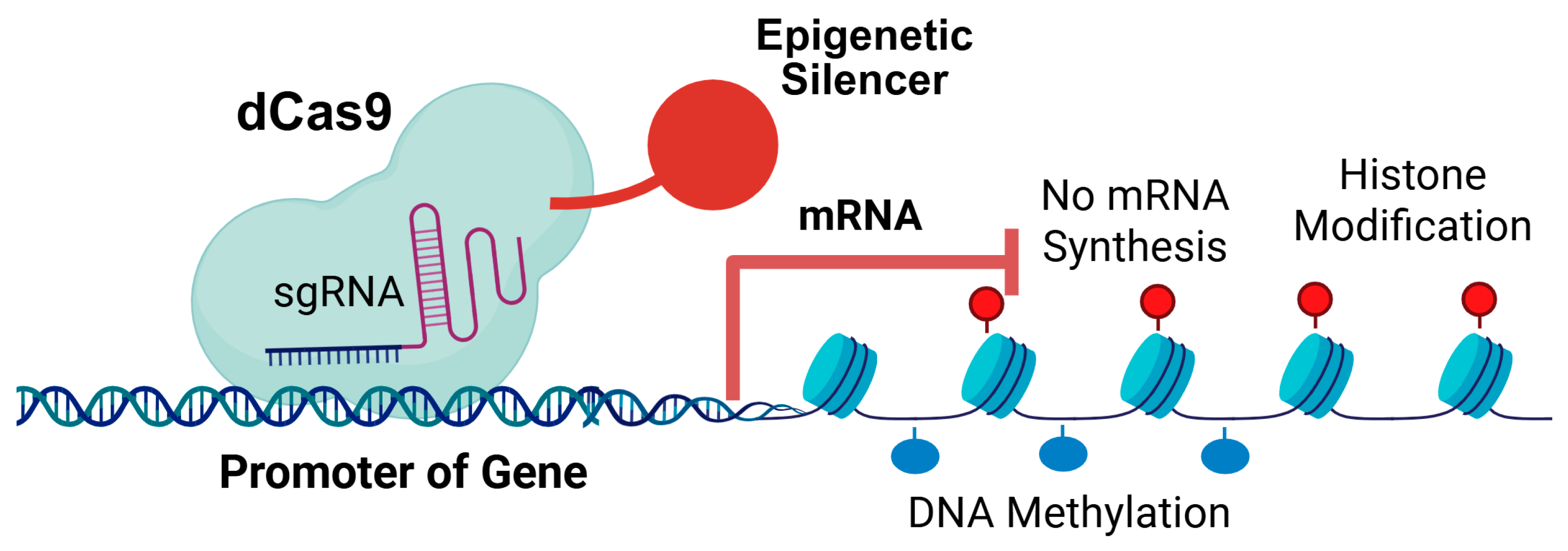
2.2. Transcriptional Repression via Effector Domains
3. Targeting the Oncogenic Drivers with CRISPRi
3.1. Silencing Master Transcription Factors: MYC and Beyond
3.2. Neutralizing Signaling Hubs: RAS and PI3K
3.3. Inhibition of Metastasis and Immunotherapy

| Gene Target | CRISPRi Format | Cancer Model | Delivery Strategy | Main Outcome | References |
|---|---|---|---|---|---|
| KRAS | dCas9-KRAB | Lung cancer | Adenovirus | Effective inhibition of tumor growth in xenograft model | [69] |
| KRAS | dCas9-HDAC1 | Colon and pancreatic cancers | Plasmid or recombinant protein | Inhibition of tumor growth in vitro | [56] |
| ΔNp63 | dCas9-KRAB | Squamous cell carcinomas (SCCs) | Adenovirus | Effective inhibition of tumor growth in xenograft model | [73] |
| MYC | dCas9-KRAB | Acute Myeloid Leukemia (AML) | Lentivirus | Inhibition of cancer cell viability in vitro | [74] |
| MYC | dCasX-KRAB | Bladder cancer | Adeno-associated Virus (AAV) | Effective inhibition of tumor growth in xenograft model | [62] |
| DPP4 | dCas9-KRAB | Colon cancer | Transfection | Effective inhibition of tumor growth and metastasis in vivo | [70] |
| XIST | dCas9-KRAB | Breast cancer | Transfection | Effective inhibition of tumor growth and metastasis in vivo | [71] |
4. Advantages of CRISPRi over Current Gene Silencing Technologies
4.1. Improved Specificity and Reduced Off-Target Effects
4.2. Stable and Long-Term Gene Repression
4.3. Targeting Non-Coding Oncogenic Elements
4.4. Reversible Knockdown
5. Delivery Systems for CRISPRi
5.1. Viral Delivery Systems
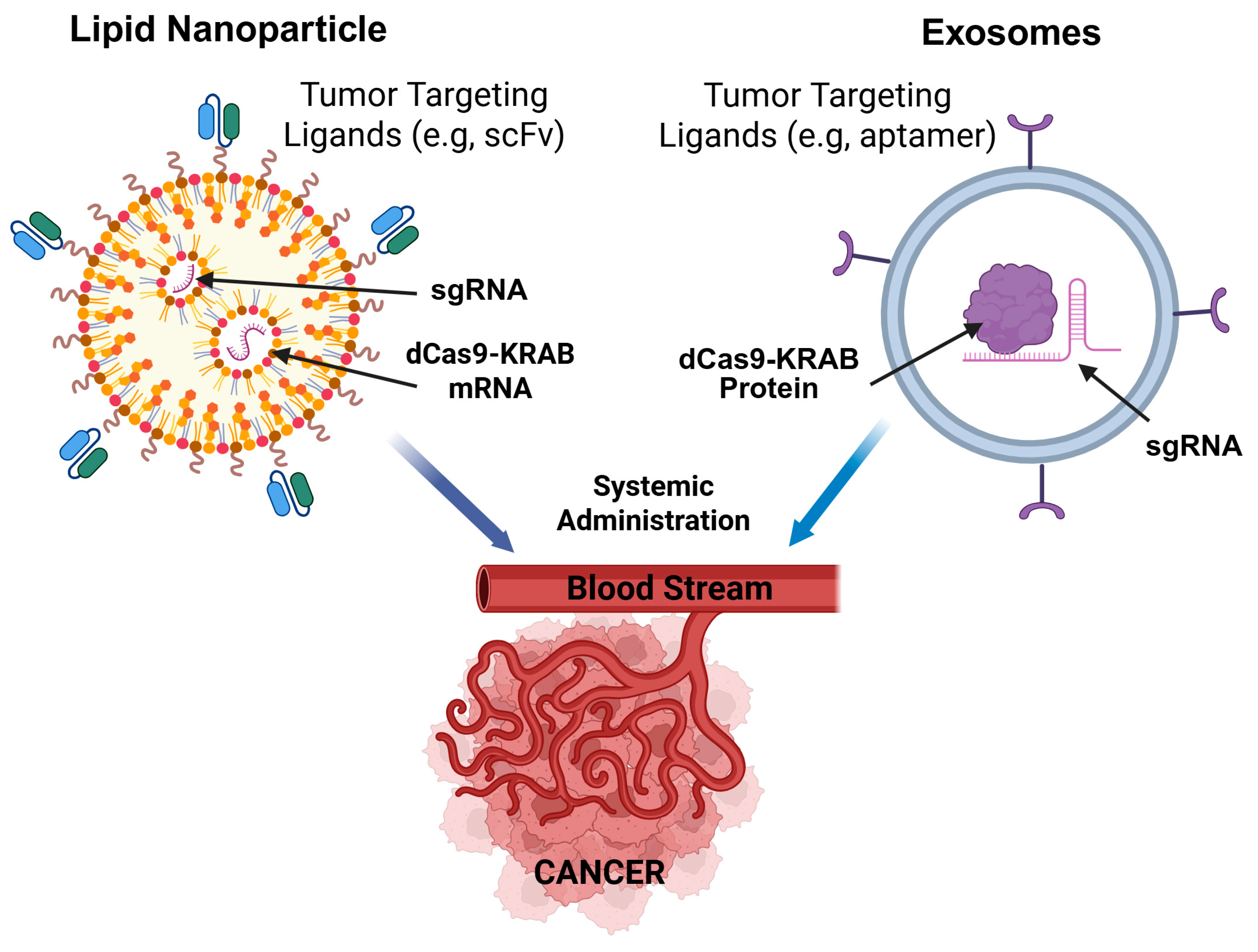
5.2. Non-Viral Delivery: LNPs and Exosomes
5.3. Advanced Tumor-Targeting and Triggered Release
6. Translational Challenges and Future Directions
6.1. The Delivery Bottleneck
6.2. Immunogenicity
6.3. Regulatory and Ethical Considerations
7. Conclusions
Funding
Institutional Review Board Statement
Informed Consent Statement
Data Availability Statement
Acknowledgments
Conflicts of Interest
Abbreviations
| CRISPRi | CRISPR interference |
| CRISPR | Clustered regularly interspaced palindromic repeats |
| RNAi | RNA interference |
| ASO | antisense oligonucleotides |
| KRAS | Kirsten rat sarcoma gene |
| EGFR | Epidermal Growth Factor Receptor |
| siRNA | small interfering RNA |
| shRNA | short hairpin RNA |
| miRNA | microRNA |
| dCas9 | catalytically dead Cas9 |
| RNP | Ribonucleoprotein |
| PAM | Protospacer Adjacent Motif |
| KRAB | Krüppel-associated box |
| HP1 | heterochromatin protein 1 |
| DNMT | DNA methyltransferase |
| HDAC1 | Histone Deacetylase 1 |
| EMT | epithelial–mesenchymal transition |
| PI3K | Phosphoinositide 3-kinase |
| PD-1 | Programmed Cell Death 1 |
| PD-L1 | Programmed death-ligand 1 |
| RISC | RNA-induced Silencing Complex |
| LNP | lipid nanoparticle |
| DSB | double-strand break |
| scFv | single-chain variable fragment |
| MMPs | Matrix Metalloproteinases |
| TME | tumor microenvironment |
| AAV | Adeno-associated virus |
References
- Weinberg, R.A. Cancer Biology and Therapy: The road ahead. Cancer Biol. Ther. 2002, 1, 3. [Google Scholar] [CrossRef] [PubMed]
- Dakal, T.C.; Dhabhai, B.; Pant, A.; Moar, K.; Chaudhary, K.; Yadav, V.; Ranga, V.; Sharma, N.K.; Kumar, A.; Maurya, P.K.; et al. Oncogenes and tumor suppressor genes: Functions and roles in cancers. MedComm 2024, 5, e582. [Google Scholar] [CrossRef] [PubMed]
- Lee, E.Y.; Muller, W.J. Oncogenes and tumor suppressor genes. Cold Spring Harb. Perspect. Biol. 2010, 2, a003236. [Google Scholar] [CrossRef]
- Haigis, K.M.; Kendall, K.R.; Wang, Y.; Cheung, A.; Haigis, M.C.; Glickman, J.N.; Niwa-Kawakita, M.; Sweet-Cordero, A.; Sebolt-Leopold, J.; Shannon, K.M.; et al. Differential effects of oncogenic K-Ras and N-Ras on proliferation, differentiation and tumor progression in the colon. Nat. Genet. 2008, 40, 600–608. [Google Scholar] [CrossRef]
- Karapetis, C.S.; Khambata-Ford, S.; Jonker, D.J.; O’Callaghan, C.J.; Tu, D.; Tebbutt, N.C.; Simes, R.J.; Chalchal, H.; Shapiro, J.D.; Robitaille, S.; et al. K-ras mutations and benefit from cetuximab in advanced colorectal cancer. N. Engl. J. Med. 2008, 359, 1757–1765. [Google Scholar] [CrossRef]
- Dong, Y.; Tu, R.; Liu, H.; Qing, G. Regulation of cancer cell metabolism: Oncogenic MYC in the driver’s seat. Signal Transduct. Target. Ther. 2020, 5, 124. [Google Scholar] [CrossRef]
- Hsieh, A.L.; Walton, Z.E.; Altman, B.J.; Stine, Z.E.; Dang, C.V. MYC and metabolism on the path to cancer. Semin. Cell Dev. Biol. 2015, 43, 11–21. [Google Scholar] [CrossRef]
- Whitfield, J.R.; Soucek, L. MYC in cancer: From undruggable target to clinical trials. Nat. Rev. Drug Discov. 2025, 24, 445–457. [Google Scholar] [CrossRef]
- Wang, H.; Guo, M.; Wei, H.; Chen, Y. Targeting p53 pathways: Mechanisms, structures, and advances in therapy. Signal Transduct. Target. Ther. 2023, 8, 92. [Google Scholar] [CrossRef]
- Dyson, N.J. RB1: A prototype tumor suppressor and an enigma. Genes. Dev. 2016, 30, 1492–1502. [Google Scholar] [CrossRef] [PubMed]
- Iqbal, N.; Iqbal, N. Imatinib: A breakthrough of targeted therapy in cancer. Chemother. Res. Pract. 2014, 357027, 9, Erratum in Chemother. Res. Pract. 2020, 1375374, 1. [Google Scholar] [CrossRef]
- Miranda-Galvis, M.; Wilson, J.; Reategui-Almonacid, Y.; Johnston, L.; Taylor, A.O.; Sadek, R.; Tjioe, K.; Cortes, J.E. Imatinib outcomes in chronic myeloid leukemia across diverse health care settings: A systematic review and meta-analysis. Blood Cancer J. 2026, 16, 38. [Google Scholar] [CrossRef]
- Tolaney, S.M.; Jiang, Z.; Zhang, Q.; Barroso-Sousa, R.; Park, Y.H.; Rimawi, M.F.; Saura, C.; Schneeweiss, A.; Toi, M.; Chae, Y.S.; et al. Trastuzumab Deruxtecan plus Pertuzumab for HER2-Positive Metastatic Breast Cancer. N. Engl. J. Med. 2026, 394, 551–562. [Google Scholar] [CrossRef]
- Swain, S.M.; Shastry, M.; Hamilton, E. Targeting HER2-positive breast cancer: Advances and future directions. Nat. Rev. Drug Discov. 2023, 22, 101–126. [Google Scholar] [CrossRef]
- Yun, C.H.; Mengwasser, K.E.; Toms, A.V.; Woo, M.S.; Greulich, H.; Wong, K.K.; Meyerson, M.; Eck, M.J. The T790M mutation in EGFR kinase causes drug resistance by increasing the affinity for ATP. Proc. Natl. Acad. Sci. USA 2008, 105, 2070–2075. [Google Scholar] [CrossRef]
- Altunel, E.; Aljamal, A.A.; Mantyh, J.; Deak, K.; Glover, W.; McCall, S.J.; Datto, M.; Strickler, J.; Hsu, D.S. Characterization of the Epidermal Growth Factor Receptor T790M Mutation in Colorectal Cancer. JCO Precis. Oncol. 2018, 2, 1–7. [Google Scholar] [CrossRef] [PubMed]
- Asimgil, H.; Ertetik, U.; Cevik, N.C.; Ekizce, M.; Dogruoz, A.; Gokalp, M.; Arik-Sever, E.; Istvanffy, R.; Friess, H.; Ceyhan, G.O.; et al. Targeting the undruggable oncogenic KRAS: The dawn of hope. JCI Insight 2022, 7, e153688. [Google Scholar] [CrossRef] [PubMed]
- Llombart, V.; Mansour, M.R. Therapeutic targeting of “undruggable” MYC. EBioMedicine 2022, 75, 103756. [Google Scholar] [CrossRef]
- Tiemann, K.; Rossi, J.J. RNAi-based therapeutics-current status, challenges and prospects. EMBO Mol. Med. 2009, 1, 142–151. [Google Scholar] [CrossRef] [PubMed]
- Tang, Q.; Khvorova, A. RNAi-based drug design: Considerations and future directions. Nat. Rev. Drug Discov. 2024, 23, 341–364. [Google Scholar] [CrossRef]
- Corydon, I.J.; Fabian-Jessing, B.K.; Jakobsen, T.S.; Jorgensen, A.C.; Jensen, E.G.; Askou, A.L.; Aagaard, L.; Corydon, T.J. 25 years of maturation: A systematic review of RNAi in the clinic. Mol. Ther. Nucleic Acids 2023, 33, 469–482. [Google Scholar] [CrossRef]
- DeFranciscis, V.; Amabile, G.; Kortylewski, M. Clinical applications of oligonucleotides for cancer therapy. Mol. Ther. 2025, 33, 2705–2718. [Google Scholar] [CrossRef]
- Dume, B.; Licarete, E.; Banciu, M. Advancing cancer treatments: The role of oligonucleotide-based therapies in driving progress. Mol. Ther. Nucleic Acids 2024, 35, 102256. [Google Scholar] [CrossRef]
- Zhang, Z.; Yu, M.; Hu, G.; Gan, Y. The new era of siRNA therapy: Advances in cancer treatment. Clin. Transl. Med. 2025, 15, e70363. [Google Scholar] [CrossRef]
- Singh, J.; Saeedan, A.S.; Kaithwas, G.; Ansari, M.N. Small interfering RNA: From designing to therapeutic in cancer. J. Genet. Eng. Biotechnol. 2025, 23, 100484. [Google Scholar] [CrossRef]
- Rao, D.D.; Vorhies, J.S.; Senzer, N.; Nemunaitis, J. siRNA vs. shRNA: Similarities and differences. Adv. Drug Deliv. Rev. 2009, 61, 746–759. [Google Scholar] [CrossRef] [PubMed]
- Moore, C.B.; Guthrie, E.H.; Huang, M.T.; Taxman, D.J. Short hairpin RNA (shRNA): Design, delivery, and assessment of gene knockdown. Methods Mol. Biol. 2010, 629, 141–158. [Google Scholar] [CrossRef]
- Zhang, J.; Chen, B.; Gan, C.; Sun, H.; Zhang, J.; Feng, L. A Comprehensive Review of Small Interfering RNAs (siRNAs): Mechanism, Therapeutic Targets, and Delivery Strategies for Cancer Therapy. Int. J. Nanomedicine 2023, 18, 7605–7635. [Google Scholar] [CrossRef] [PubMed]
- Xiao, B.; Wang, S.; Pan, Y.; Zhi, W.; Gu, C.; Guo, T.; Zhai, J.; Li, C.; Chen, Y.Q.; Wang, R. Development, opportunities, and challenges of siRNA nucleic acid drugs. Mol. Ther. Nucleic Acids 2025, 36, 102437. [Google Scholar] [CrossRef]
- O’Brien, J.; Hayder, H.; Zayed, Y.; Peng, C. Overview of MicroRNA Biogenesis, Mechanisms of Actions, and Circulation. Front. Endocrinol. 2018, 9, 402. [Google Scholar] [CrossRef] [PubMed]
- Bartel, D.P. MicroRNAs: Genomics, biogenesis, mechanism, and function. Cell 2004, 116, 281–297. [Google Scholar] [CrossRef] [PubMed]
- Janssen, H.L.; Reesink, H.W.; Lawitz, E.J.; Zeuzem, S.; Rodriguez-Torres, M.; Patel, K.; van der Meer, A.J.; Patick, A.K.; Chen, A.; Zhou, Y.; et al. Treatment of HCV infection by targeting microRNA. N. Engl. J. Med. 2013, 368, 1685–1694. [Google Scholar] [CrossRef] [PubMed]
- Crooke, S.T. Molecular Mechanisms of Antisense Oligonucleotides. Nucleic Acid. Ther. 2017, 27, 70–77. [Google Scholar] [CrossRef]
- Mercuri, E.; Darras, B.T.; Chiriboga, C.A.; Day, J.W.; Campbell, C.; Connolly, A.M.; Iannaccone, S.T.; Kirschner, J.; Kuntz, N.L.; Saito, K.; et al. Nusinersen versus Sham Control in Later-Onset Spinal Muscular Atrophy. N. Engl. J. Med. 2018, 378, 625–635. [Google Scholar] [CrossRef] [PubMed]
- Charleston, J.S.; Schnell, F.J.; Dworzak, J.; Donoghue, C.; Lewis, S.; Chen, L.; Young, G.D.; Milici, A.J.; Voss, J.; DeAlwis, U.; et al. Eteplirsen treatment for Duchenne muscular dystrophy: Exon skipping and dystrophin production. Neurology 2018, 90, e2146–e2154, Erratum in Neurology 2018, 91, 637. [Google Scholar] [CrossRef]
- Lauffer, M.C.; van Roon-Mom, W.; Aartsma-Rus, A.; Collaborative, N. Possibilities and limitations of antisense oligonucleotide therapies for the treatment of monogenic disorders. Commun. Med. 2024, 4, 6. [Google Scholar] [CrossRef]
- Mandegar, M.A.; Huebsch, N.; Frolov, E.B.; Shin, E.; Truong, A.; Olvera, M.P.; Chan, A.H.; Miyaoka, Y.; Holmes, K.; Spencer, C.I.; et al. CRISPR Interference Efficiently Induces Specific and Reversible Gene Silencing in Human iPSCs. Cell Stem Cell 2016, 18, 541–553. [Google Scholar] [CrossRef]
- Cong, L.; Ran, F.A.; Cox, D.; Lin, S.; Barretto, R.; Habib, N.; Hsu, P.D.; Wu, X.; Jiang, W.; Marraffini, L.A.; et al. Multiplex genome engineering using CRISPR/Cas systems. Science 2013, 339, 819–823. [Google Scholar] [CrossRef]
- Bendixen, L.; Jensen, T.I.; Bak, R.O. CRISPR-Cas-mediated transcriptional modulation: The therapeutic promises of CRISPRa and CRISPRi. Mol. Ther. 2023, 31, 1920–1937. [Google Scholar] [CrossRef]
- Pacesa, M.; Pelea, O.; Jinek, M. Past, present, and future of CRISPR genome editing technologies. Cell 2024, 187, 1076–1100. [Google Scholar] [CrossRef]
- Tadic, V.; Josipovic, G.; Zoldos, V.; Vojta, A. CRISPR/Cas9-based epigenome editing: An overview of dCas9-based tools with special emphasis on off-target activity. Methods 2019, 164–165, 109–119. [Google Scholar] [CrossRef]
- Mojica, F.J.M.; Diez-Villasenor, C.; Garcia-Martinez, J.; Almendros, C. Short motif sequences determine the targets of the prokaryotic CRISPR defence system. Microbiology 2009, 155, 733–740. [Google Scholar] [CrossRef] [PubMed]
- Bloomer, H.; Khirallah, J.; Li, Y.; Xu, Q. CRISPR/Cas9 ribonucleoprotein-mediated genome and epigenome editing in mammalian cells. Adv. Drug Deliv. Rev. 2022, 181, 114087. [Google Scholar] [CrossRef]
- Szczelkun, M.D.; Tikhomirova, M.S.; Sinkunas, T.; Gasiunas, G.; Karvelis, T.; Pschera, P.; Siksnys, V.; Seidel, R. Direct observation of R-loop formation by single RNA-guided Cas9 and Cascade effector complexes. Proc. Natl. Acad. Sci. USA 2014, 111, 9798–9803. [Google Scholar] [CrossRef]
- Qi, L.S.; Larson, M.H.; Gilbert, L.A.; Doudna, J.A.; Weissman, J.S.; Arkin, A.P.; Lim, W.A. Repurposing CRISPR as an RNA-guided platform for sequence-specific control of gene expression. Cell 2021, 184, 844, Erratum in Cell 2013, 152, 1173–1183. [Google Scholar] [CrossRef] [PubMed]
- Schep, R.; Brinkman, E.K.; Leemans, C.; Vergara, X.; van der Weide, R.H.; Morris, B.; van Schaik, T.; Manzo, S.G.; Peric-Hupkes, D.; van den Berg, J.; et al. Impact of chromatin context on Cas9-induced DNA double-strand break repair pathway balance. Mol. Cell 2021, 81, 2216–2230 e2210. [Google Scholar] [CrossRef]
- Nishiyama, A.; Nakanishi, M. Navigating the DNA methylation landscape of cancer. Trends Genet. 2021, 37, 1012–1027. [Google Scholar] [CrossRef] [PubMed]
- Fonfara, I.; Richter, H.; Bratovic, M.; Le Rhun, A.; Charpentier, E. The CRISPR-associated DNA-cleaving enzyme Cpf1 also processes precursor CRISPR RNA. Nature 2016, 532, 517–521. [Google Scholar] [CrossRef] [PubMed]
- Magnusson, J.P.; Rios, A.R.; Wu, L.; Qi, L.S. Enhanced Cas12a multi-gene regulation using a CRISPR array separator. Elife 2021, 10, e66406. [Google Scholar] [CrossRef]
- Alerasool, N.; Segal, D.; Lee, H.; Taipale, M. An efficient KRAB domain for CRISPRi applications in human cells. Nat. Methods 2020, 17, 1093–1096. [Google Scholar] [CrossRef]
- Ecco, G.; Imbeault, M.; Trono, D. KRAB zinc finger proteins. Development 2017, 144, 2719–2729. [Google Scholar] [CrossRef]
- Fritsch, L.; Robin, P.; Mathieu, J.R.; Souidi, M.; Hinaux, H.; Rougeulle, C.; Harel-Bellan, A.; Ameyar-Zazoua, M.; Ait-Si-Ali, S. A subset of the histone H3 lysine 9 methyltransferases Suv39h1, G9a, GLP, and SETDB1 participate in a multimeric complex. Mol. Cell 2010, 37, 46–56. [Google Scholar] [CrossRef]
- Lachner, M.; O’Carroll, D.; Rea, S.; Mechtler, K.; Jenuwein, T. Methylation of histone H3 lysine 9 creates a binding site for HP1 proteins. Nature 2001, 410, 116–120. [Google Scholar] [CrossRef]
- Park, H.; Shin, J.; Kim, Y.; Saito, T.; Saido, T.C.; Kim, J. CRISPR/dCas9-Dnmt3a-mediated targeted DNA methylation of APP rescues brain pathology in a mouse model of Alzheimer’s disease. Transl. Neurodegener. 2022, 11, 41. [Google Scholar] [CrossRef]
- Liu, X.S.; Wu, H.; Ji, X.; Stelzer, Y.; Wu, X.; Czauderna, S.; Shu, J.; Dadon, D.; Young, R.A.; Jaenisch, R. Editing DNA Methylation in the Mammalian Genome. Cell 2016, 167, 233–247 e217. [Google Scholar] [CrossRef]
- Liu, J.; Sun, M.; Cho, K.B.; Gao, X.; Guo, B. A CRISPR-Cas9 repressor for epigenetic silencing of KRAS. Pharmacol. Res. 2021, 164, 105304. [Google Scholar] [CrossRef] [PubMed]
- Gallinari, P.; Di Marco, S.; Jones, P.; Pallaoro, M.; Steinkuhler, C. HDACs, histone deacetylation and gene transcription: From molecular biology to cancer therapeutics. Cell Res. 2007, 17, 195–211. [Google Scholar] [CrossRef] [PubMed]
- Duffy, M.J.; O’Grady, S.; Tang, M.; Crown, J. MYC as a target for cancer treatment. Cancer Treat. Rev. 2021, 94, 102154. [Google Scholar] [CrossRef]
- Mulet-Lazaro, R.; Delwel, R. One for All and All for One: New Insights into Enhancers Driving MYC Dysregulation. Blood Cancer Discov. 2025, 6, 149–152. [Google Scholar] [CrossRef] [PubMed]
- Iyer, A.R.; Gurumurthy, A.; Chu, S.A.; Kodgule, R.; Aguilar, A.R.; Saari, T.; Ramzan, A.; Rosa, J.; Gupta, J.; Emmanuel, A.; et al. Selective Enhancer Dependencies in MYC-Intact and MYC-Rearranged Germinal Center B-cell Diffuse Large B-cell Lymphoma. Blood Cancer Discov. 2025, 6, 233–253. [Google Scholar] [CrossRef]
- Altinbay, M.; Wang, J.; Chen, J.; Schafer, D.; Sprang, M.; Blagojevic, B.; Wolfl, S.; Andrade-Navarro, M.A.; Dikic, I.; Knapp, S.; et al. Chem-CRISPR/dCas9FCPF: A platform for chemically induced epigenome editing. Nucleic Acids Res. 2024, 52, 11587–11601. [Google Scholar] [CrossRef] [PubMed]
- Cao, C.; Yao, L.; Li, A.; Zhang, Q.; Zhang, Z.; Wang, X.; Gan, Y.; Liu, Y.; Zhang, Q. A CRISPR/dCasX-mediated transcriptional programming system for inhibiting the progression of bladder cancer cells by repressing c-MYC or activating TP53. Clin. Transl. Med. 2021, 11, e537. [Google Scholar] [CrossRef]
- Li, R.; Xia, X.; Wang, X.; Sun, X.; Dai, Z.; Huo, D.; Zheng, H.; Xiong, H.; He, A.; Wu, X. Generation and validation of versatile inducible CRISPRi embryonic stem cell and mouse model. PLoS Biol. 2020, 18, e3000749. [Google Scholar] [CrossRef]
- Hossain, M.T.; Hossain, M.A. Targeting PI3K in cancer treatment: A comprehensive review with insights from clinical outcomes. Eur. J. Pharmacol. 2025, 996, 177432. [Google Scholar] [CrossRef] [PubMed]
- He, Y.; Sun, M.M.; Zhang, G.G.; Yang, J.; Chen, K.S.; Xu, W.W.; Li, B. Targeting PI3K/Akt signal transduction for cancer therapy. Signal Transduct. Target. Ther. 2021, 6, 425. [Google Scholar] [CrossRef]
- Riedl, J.M.; Matsubara, H.; McNeil, R.; Patel, P.S.; Fece de la Cruz, F.; Gulhan, D.C.; Corcoran, R.B. Emerging landscape of KRAS inhibitors in cancer treatment. Cancer Cell 2026, 44, 471–497. [Google Scholar] [CrossRef]
- Zhu, L.; Jia, X.; Xu, L.; Chen, L.; Fu, X.; Yan, H.; Ai, B.; Peng, S. Tumor suppressor genes and KRAS G12C inhibitor resistance in non-small cell lung cancer. iScience 2026, 29, 114429. [Google Scholar] [CrossRef]
- Isermann, T.; Sers, C.; Der, C.J.; Papke, B. KRAS inhibitors: Resistance drivers and combinatorial strategies. Trends Cancer 2025, 11, 91–116. [Google Scholar] [CrossRef]
- Gao, Q.; Ouyang, W.; Kang, B.; Han, X.; Xiong, Y.; Ding, R.; Li, Y.; Wang, F.; Huang, L.; Chen, L.; et al. Selective targeting of the oncogenic KRAS G12S mutant allele by CRISPR/Cas9 induces efficient tumor regression. Theranostics 2020, 10, 5137–5153. [Google Scholar] [CrossRef] [PubMed]
- Wang, L.; Wang, E.; Prado Balcazar, J.; Wu, Z.; Xiang, K.; Wang, Y.; Huang, Q.; Negrete, M.; Chen, K.Y.; Li, W.; et al. Chromatin Remodeling of Colorectal Cancer Liver Metastasis is Mediated by an HGF-PU.1-DPP4 Axis. Adv. Sci. 2021, 8, e2004673. [Google Scholar] [CrossRef]
- Cui, X.; Zhang, C.; Xu, Z.; Wang, S.; Li, X.; Stringer-Reasor, E.; Bae, S.; Zeng, L.; Zhao, D.; Liu, R.; et al. Dual CRISPR interference and activation for targeted reactivation of X-linked endogenous FOXP3 in human breast cancer cells. Mol. Cancer 2022, 21, 38. [Google Scholar] [CrossRef] [PubMed]
- Alsaab, H.O.; Sau, S.; Alzhrani, R.; Tatiparti, K.; Bhise, K.; Kashaw, S.K.; Iyer, A.K. PD-1 and PD-L1 Checkpoint Signaling Inhibition for Cancer Immunotherapy: Mechanism, Combinations, and Clinical Outcome. Front. Pharmacol. 2017, 8, 561. [Google Scholar] [CrossRef] [PubMed]
- Yoshida, M.; Yokota, E.; Sakuma, T.; Yamatsuji, T.; Takigawa, N.; Ushijima, T.; Yamamoto, T.; Fukazawa, T.; Naomoto, Y. Development of an integrated CRISPRi targeting DeltaNp63 for treatment of squamous cell carcinoma. Oncotarget 2018, 9, 29220–29232. [Google Scholar] [CrossRef]
- Call, S.G.; Duren, R.P.; Panigrahi, A.K.; Nguyen, L.; Freire, P.R.; Grimm, S.L.; Coarfa, C.; Conneely, O.M. Targeting Oncogenic Super Enhancers in MYC-Dependent AML Using a Small Molecule Activator of NR4A Nuclear Receptors. Sci. Rep. 2020, 10, 2851. [Google Scholar] [CrossRef]
- Cazares, T.; Higgs, R.E.; Wang, J.; Ozer, H.G. SeedMatchR: Identify off-target effects mediated by siRNA seed regions in RNA-seq experiments. Bioinformatics 2024, 40, btae011. [Google Scholar] [CrossRef] [PubMed]
- Jackson, A.L.; Burchard, J.; Schelter, J.; Chau, B.N.; Cleary, M.; Lim, L.; Linsley, P.S. Widespread siRNA “off-target” transcript silencing mediated by seed region sequence complementarity. RNA 2006, 12, 1179–1187. [Google Scholar] [CrossRef]
- Neumeier, J.; Meister, G. siRNA Specificity: RNAi Mechanisms and Strategies to Reduce Off-Target Effects. Front. Plant Sci. 2020, 11, 526455. [Google Scholar] [CrossRef]
- Khan, M.S.; Qureshi, N.; Khan, R.; Son, Y.O.; Maqbool, T. CRISPR/Cas9-Based therapeutics as a promising strategy for management of Alzheimer’s disease: Progress and prospects. Front. Cell Neurosci. 2025, 19, 1578138. [Google Scholar] [CrossRef]
- Bharti, A.; Mudge, J. Therapeutic applications of CRISPR-Cas9 gene editing. Front. Genome Ed. 2025, 7, 1724291. [Google Scholar] [CrossRef]
- Guo, C.; Ma, X.; Gao, F.; Guo, Y. Off-target effects in CRISPR/Cas9 gene editing. Front. Bioeng. Biotechnol. 2023, 11, 1143157. [Google Scholar] [CrossRef]
- Chen, J.S.; Dagdas, Y.S.; Kleinstiver, B.P.; Welch, M.M.; Sousa, A.A.; Harrington, L.B.; Sternberg, S.H.; Joung, J.K.; Yildiz, A.; Doudna, J.A. Enhanced proofreading governs CRISPR-Cas9 targeting accuracy. Nature 2017, 550, 407–410. [Google Scholar] [CrossRef]
- Muller, M.; Lee, C.M.; Gasiunas, G.; Davis, T.H.; Cradick, T.J.; Siksnys, V.; Bao, G.; Cathomen, T.; Mussolino, C. Streptococcus thermophilus CRISPR-Cas9 Systems Enable Specific Editing of the Human Genome. Mol. Ther. 2016, 24, 636–644. [Google Scholar] [CrossRef]
- Mansoor, T.; Rao, B.H.; Gupta, K.; Parikh, S.S.; Abramov, D.; Mehta, A.; Al Rifai, M.; Virani, S.S.; Nambi, V.; Minhas, A.M.K.; et al. Inclisiran as a siRNA Inhibitor of Proprotein Convertase Subtilisin/Kexin Type 9 (PCSK9); Past, Present, and Future. Am. J. Cardiovasc. Drugs 2025, 25, 293–306. [Google Scholar] [CrossRef] [PubMed]
- Tremblay, F.; Xiong, Q.; Shah, S.S.; Ko, C.W.; Kelly, K.; Morrison, M.S.; Giancarlo, C.; Ramirez, R.N.; Hildebrand, E.M.; Voytek, S.B.; et al. A potent epigenetic editor targeting human PCSK9 for durable reduction of low-density lipoprotein cholesterol levels. Nat. Med. 2025, 31, 1329–1338. [Google Scholar] [CrossRef] [PubMed]
- Khajanchi, N.; Patel, V.; Dua, R.; Kabra, M.; Pattnaik, B.R.; Saha, K. Controlling CRISPR-Cas9 genome editing in human cells using a molecular glue degrader. Mol. Ther. Nucleic Acids 2025, 36, 102640. [Google Scholar] [CrossRef] [PubMed]
- Sreekanth, V.; Zhou, Q.; Kokkonda, P.; Bermudez-Cabrera, H.C.; Lim, D.; Law, B.K.; Holmes, B.R.; Chaudhary, S.K.; Pergu, R.; Leger, B.S.; et al. Chemogenetic System Demonstrates That Cas9 Longevity Impacts Genome Editing Outcomes. ACS Cent. Sci. 2020, 6, 2228–2237. [Google Scholar] [CrossRef]
- Bulcha, J.T.; Wang, Y.; Ma, H.; Tai, P.W.L.; Gao, G. Viral vector platforms within the gene therapy landscape. Signal Transduct. Target. Ther. 2021, 6, 53. [Google Scholar] [CrossRef] [PubMed]
- Wang, J.H.; Gessler, D.J.; Zhan, W.; Gallagher, T.L.; Gao, G. Adeno-associated virus as a delivery vector for gene therapy of human diseases. Signal Transduct. Target. Ther. 2024, 9, 78. [Google Scholar] [CrossRef]
- Backstrom, J.R.; Sheng, J.; Wang, M.C.; Bernardo-Colon, A.; Rex, T.S. Optimization of S. aureus dCas9 and CRISPRi Elements for a Single Adeno-Associated Virus that Targets an Endogenous Gene. Mol. Ther. Methods Clin. Dev. 2020, 19, 139–148. [Google Scholar] [CrossRef]
- Laurette, P.; Cao, C.; Ramanujam, D.; Schwaderer, M.; Lueneburg, T.; Kuss, S.; Weiss, L.; Dilshat, R.; Furlong, E.E.M.; Rezende, F.; et al. In Vivo Silencing of Regulatory Elements Using a Single AAV-CRISPRi Vector. Circ. Res. 2024, 134, 223–225. [Google Scholar] [CrossRef]
- Hou, X.; Zaks, T.; Langer, R.; Dong, Y. Lipid nanoparticles for mRNA delivery. Nat. Rev. Mater. 2021, 6, 1078–1094, Correction in Nat. Rev. Mater. 2022, 7, 65. [Google Scholar] [CrossRef]
- Kazemian, P.; Yu, S.Y.; Thomson, S.B.; Birkenshaw, A.; Leavitt, B.R.; Ross, C.J.D. Lipid-Nanoparticle-Based Delivery of CRISPR/Cas9 Genome-Editing Components. Mol. Pharm. 2022, 19, 1669–1686. [Google Scholar] [CrossRef] [PubMed]
- Rithiga, B.S.; Dhar, R.; Devi, A. Exosomes-mediated CRISPR/Cas delivery: A cutting-edge frontier in cancer gene therapy. Gene 2025, 944, 149296. [Google Scholar] [CrossRef]
- Aslan, C.; Zolbanin, N.M.; Faraji, F.; Jafari, R. Exosomes for CRISPR-Cas9 Delivery: The Cutting Edge in Genome Editing. Mol. Biotechnol. 2024, 66, 3092–3116. [Google Scholar] [CrossRef] [PubMed]
- Pi, F.; Binzel, D.W.; Lee, T.J.; Li, Z.; Sun, M.; Rychahou, P.; Li, H.; Haque, F.; Wang, S.; Croce, C.M.; et al. Nanoparticle orientation to control RNA loading and ligand display on extracellular vesicles for cancer regression. Nat. Nanotechnol. 2018, 13, 82–89. [Google Scholar] [CrossRef]
- Dietmair, B.; Humphries, J.; Mercer, T.R.; Thurecht, K.J.; Howard, C.B.; Cheetham, S.W. Targeted mRNA delivery with bispecific antibodies that tether LNPs to cell surface markers. Mol. Ther. Nucleic Acids 2025, 36, 102520. [Google Scholar] [CrossRef] [PubMed]
- Kanamala, M.; Wilson, W.R.; Yang, M.; Palmer, B.D.; Wu, Z. Mechanisms and biomaterials in pH-responsive tumour targeted drug delivery: A review. Biomaterials 2016, 85, 152–167. [Google Scholar] [CrossRef]
- Zhang, C.; Jiang, G.; Gao, X. Matrix Metalloproteinase-Responsive Drug Delivery Systems. Bioconjug Chem. 2023, 34, 1349–1365. [Google Scholar] [CrossRef]
- Chatterjee, S.; Kon, E.; Sharma, P.; Peer, D. Endosomal escape: A bottleneck for LNP-mediated therapeutics. Proc. Natl. Acad. Sci. USA 2024, 121, e2307800120. [Google Scholar] [CrossRef]
- Zheng, Z.; Li, Z.; Xu, C.; Guo, B.; Guo, P. Folate-displaying exosome mediated cytosolic delivery of siRNA avoiding endosome trapping. J. Control Release 2019, 311–312, 43–49. [Google Scholar] [CrossRef]
- Ewaisha, R.; Anderson, K.S. Immunogenicity of CRISPR therapeutics-Critical considerations for clinical translation. Front. Bioeng. Biotechnol. 2023, 11, 1138596. [Google Scholar] [CrossRef] [PubMed]

Disclaimer/Publisher’s Note: The statements, opinions and data contained in all publications are solely those of the individual author(s) and contributor(s) and not of MDPI and/or the editor(s). MDPI and/or the editor(s) disclaim responsibility for any injury to people or property resulting from any ideas, methods, instructions or products referred to in the content. |
© 2026 by the author. Licensee MDPI, Basel, Switzerland. This article is an open access article distributed under the terms and conditions of the Creative Commons Attribution (CC BY) license.
Share and Cite
Guo, B. CRISPR Interference to Inhibit Oncogenes for Cancer Therapy. Int. J. Mol. Sci. 2026, 27, 3564. https://doi.org/10.3390/ijms27083564
Guo B. CRISPR Interference to Inhibit Oncogenes for Cancer Therapy. International Journal of Molecular Sciences. 2026; 27(8):3564. https://doi.org/10.3390/ijms27083564
Chicago/Turabian StyleGuo, Bin. 2026. "CRISPR Interference to Inhibit Oncogenes for Cancer Therapy" International Journal of Molecular Sciences 27, no. 8: 3564. https://doi.org/10.3390/ijms27083564
APA StyleGuo, B. (2026). CRISPR Interference to Inhibit Oncogenes for Cancer Therapy. International Journal of Molecular Sciences, 27(8), 3564. https://doi.org/10.3390/ijms27083564