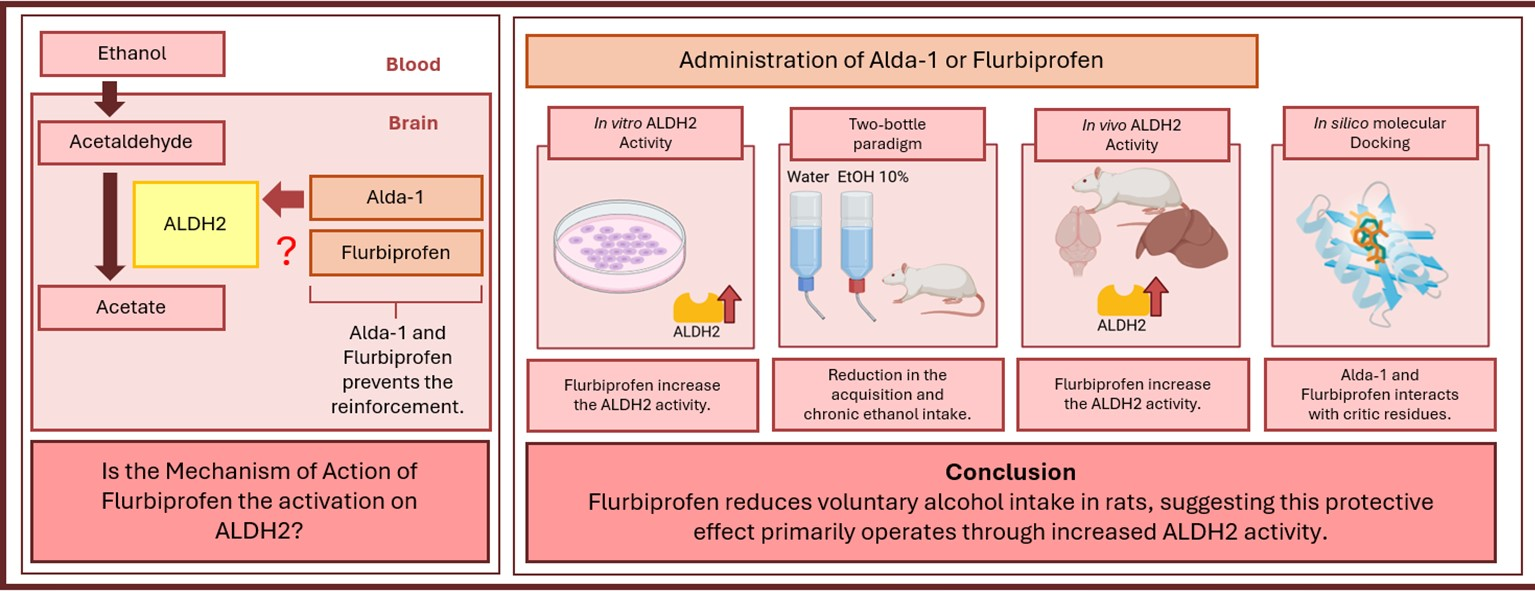
The Activation of Aldehyde Dehydrogenase 2 (ALDH2) by Alda-1 and Flurbiprofen as a Common Mechanism to Reduce Alcohol Intake in Rats

 ,
,  and
and
Abstract
1. Introduction
2. Results
3. Discussion
4. Materials and Methods
4.1. Animals
4.2. Drugs
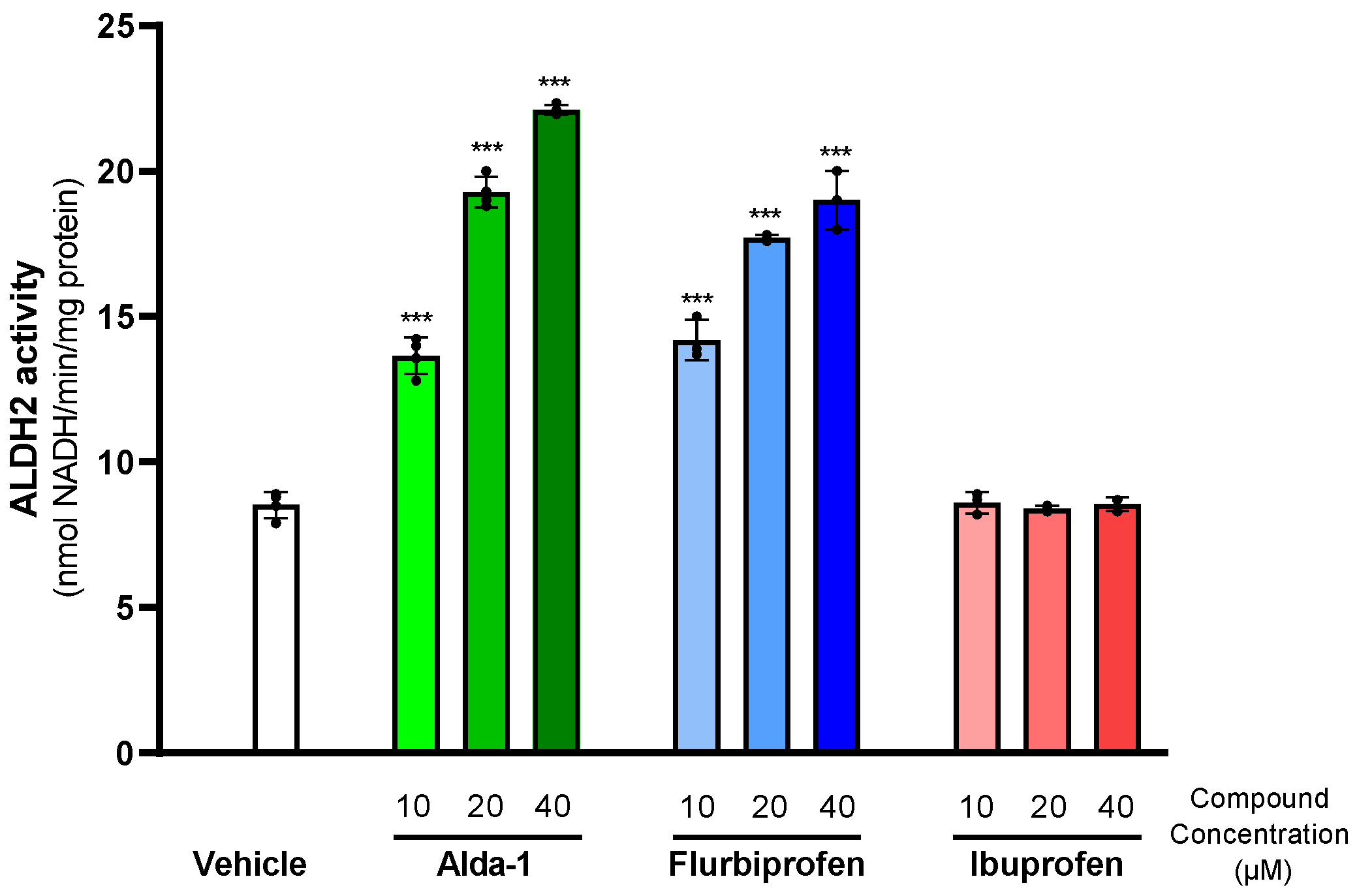
4.3. Exposure of PC-12 Cell Cultures to Drugs
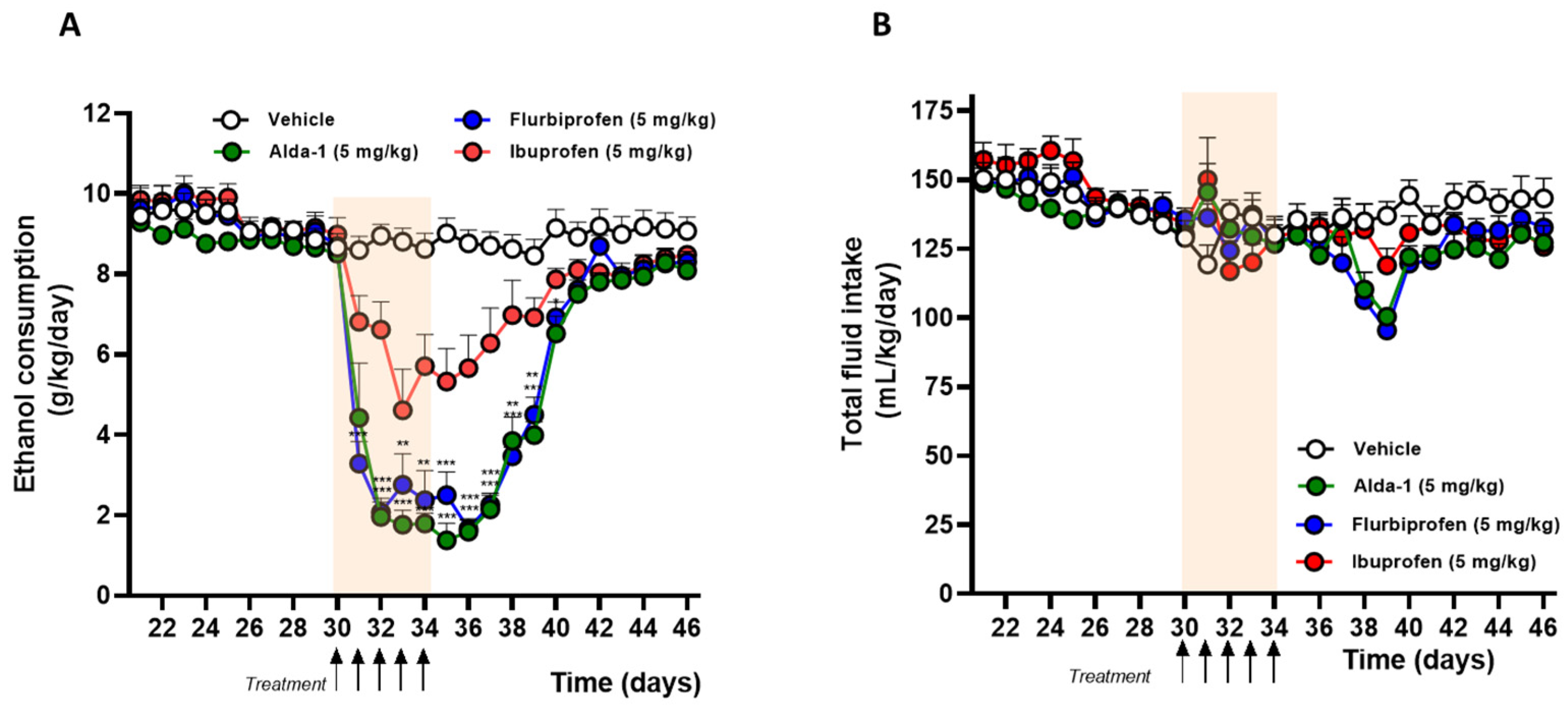
4.4. Effect of Flurbiprofen on Alcohol Drinking Acquisition by UChB Rats
4.5. Effect of Flurbiprofen, Alda-1, and Ibuprofen on Chronic Alcohol Intake of UChB Rats

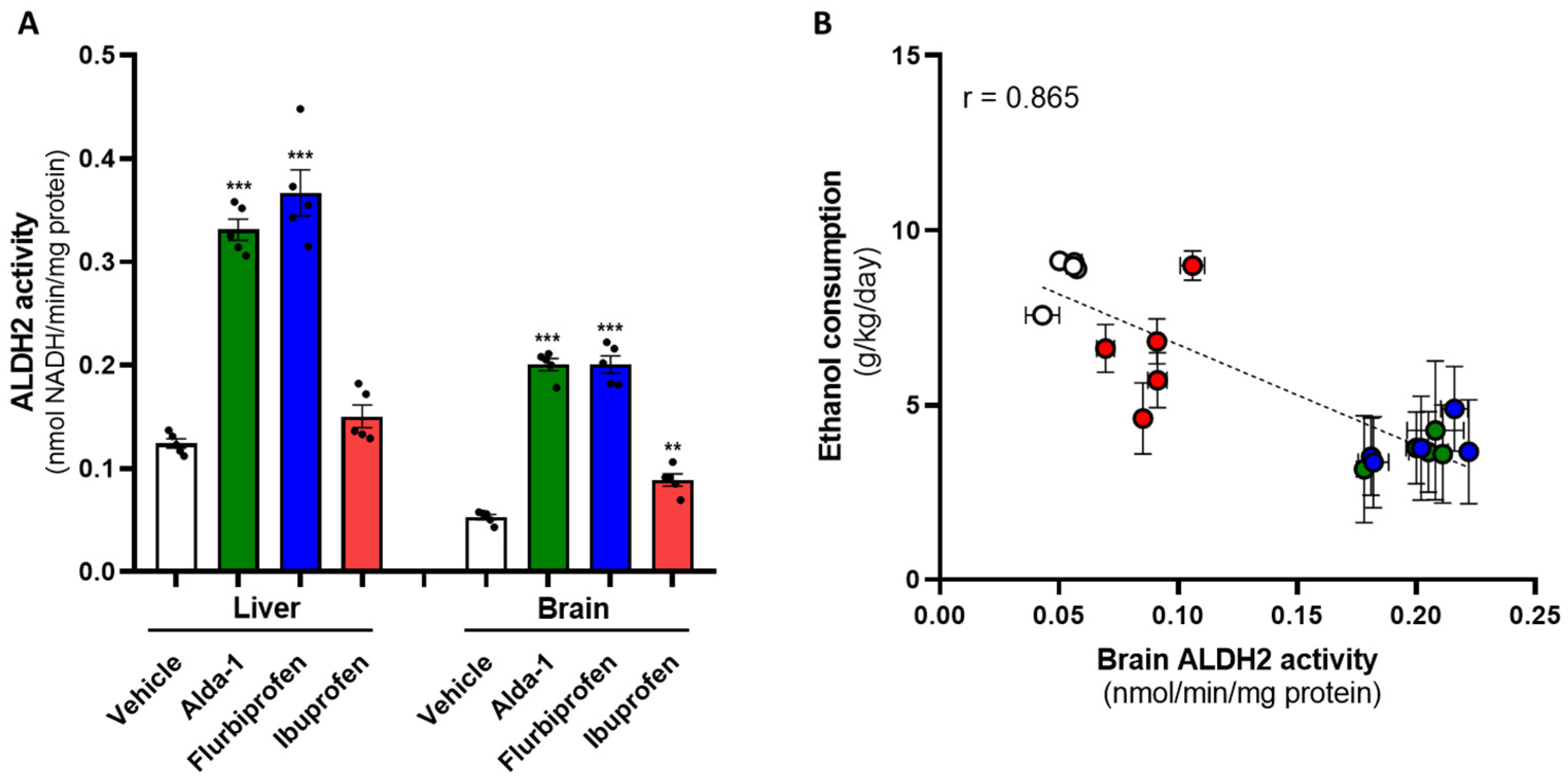
4.6. ALDH2 Activity Measurement
4.7. Effect of Alda-1 and Flurbiprofen on COX-1 and COX-2 Activity
4.8. In Silico Analysis
4.9. Statistical Analysis
Author Contributions
Funding
Institutional Review Board Statement
Data Availability Statement
Acknowledgments
Conflicts of Interest
References
- World Health Organization. Global Status Report on Alcohol and Health and Treatment of Substance Use Disorders; World Health Organization: Geneva, Switzerland, 2024.
- Zindel, L.R.; Kranzler, H.R. Pharmacotherapy of alcohol use disorders: Seventy-five years of progress. J. Stud. Alcohol. Drugs Suppl. 2014, 17, 79–88. [Google Scholar] [CrossRef] [Scilit] [PubMed]
- Agabio, R.; Lopez-Pelayo, H.; Bruguera, P.; Huang, S.Y.; Sardo, S.; Pecina, M.; Krupitsky, E.M.; Fitzmaurice, G.M.; Lin, Z. Efficacy of medications for the treatment of alcohol use disorder (AUD): A systematic review and meta-analysis considering baseline AUD severity. Pharmacol. Res. 2024, 209, 107454. [Google Scholar] [CrossRef] [Scilit]
- Quertemont, E. Genetic polymorphism in ethanol metabolism: Acetaldehyde contribution to alcohol abuse and alcoholism. Mol. Psychiatry 2004, 9, 570–581. [Google Scholar] [CrossRef] [Scilit]
- Deitrich, R.A.; Dunwiddie, T.V.; Harris, R.A.; Erwin, V.G. Mechanism of action of ethanol: Initial central nervous system actions. Pharmacol. Rev. 1989, 41, 489–537. [Google Scholar] [CrossRef] [Scilit]
- Zimatkin, S.M. Histochemical study of aldehyde dehydrogenase in the rat CNS. J. Neurochem. 1991, 56, 1–11. [Google Scholar] [CrossRef] [Scilit]
- Zimatkin, S.M.; Pronko, S.P.; Vasiliou, V.; Gonzalez, F.J.; Deitrich, R.A. Enzymatic mechanisms of ethanol oxidation in the brain. Alcohol. Clin. Exp. Res. 2006, 30, 1500–1505. [Google Scholar] [CrossRef] [Scilit]
- Israel, Y.; Quintanilla, M.E.; Karahanian, E.; Rivera-Meza, M.; Herrera-Marschitz, M. The “first hit” toward alcohol reinforcement: Role of ethanol metabolites. Alcohol. Clin. Exp. Res. 2015, 39, 776–786. [Google Scholar] [CrossRef] [Scilit] [PubMed]
- Rodd, Z.A.; Bell, R.L.; Zhang, Y.; Murphy, J.M.; Goldstein, A.; Zaffaroni, A.; Li, T.K.; McBride, W.J. Regional heterogeneity for the intracranial self-administration of ethanol and acetaldehyde within the ventral tegmental area of alcohol-preferring (P) rats: Involvement of dopamine and serotonin. Neuropsychopharmacology 2005, 30, 330–338. [Google Scholar] [CrossRef] [Scilit]
- Melis, M.; Enrico, P.; Peana, A.T.; Diana, M. Acetaldehyde mediates alcohol activation of the mesolimbic dopamine system. Eur. J. Neurosci. 2007, 26, 2824–2833. [Google Scholar] [CrossRef] [Scilit] [PubMed]
- Deehan, G.A., Jr.; Engleman, E.A.; Ding, Z.M.; McBride, W.J.; Rodd, Z.A. Microinjections of acetaldehyde or salsolinol into the posterior ventral tegmental area increase dopamine release in the nucleus accumbens shell. Alcohol. Clin. Exp. Res. 2013, 37, 722–729. [Google Scholar] [CrossRef] [Scilit]
- Mattalloni, M.S.; Albrecht, P.A.; Salinas-Luypaert, C.; Deza-Ponzio, R.; Quintanilla, M.E.; Herrera-Marschitz, M.; Cancela, L.M.; Rivera-Meza, M.; Virgolini, M.B. Silencing brain catalase expression reduces ethanol intake in developmentally-lead-exposed rats. Neurotoxicology 2019, 70, 180–186. [Google Scholar] [CrossRef] [Scilit]
- Karahanian, E.; Rivera-Meza, M.; Tampier, L.; Quintanilla, M.E.; Herrera-Marschitz, M.; Israel, Y. Long-term inhibition of ethanol intake by the administration of an aldehyde dehydrogenase-2 (ALDH2)-coding lentiviral vector into the ventral tegmental area of rats. Addict. Biol. 2015, 20, 336–344. [Google Scholar] [CrossRef] [Scilit]
- Perez-Miller, S.; Younus, H.; Vanam, R.; Chen, C.H.; Mochly-Rosen, D.; Hurley, T.D. Alda-1 is an agonist and chemical chaperone for the common human aldehyde dehydrogenase 2 variant. Nat. Struct. Mol. Biol. 2010, 17, 159–164. [Google Scholar] [CrossRef] [Scilit]
- Guo, J.M.; Liu, A.J.; Zang, P.; Dong, W.Z.; Ying, L.; Wang, W.; Xu, P.; Song, X.R.; Cai, J.; Zhang, S.Q.; et al. ALDH2 protects against stroke by clearing 4-HNE. Cell Res. 2013, 23, 915–930. [Google Scholar] [CrossRef] [Scilit]
- Cao, S.; Bian, Y.; Zhou, X.; Yuan, Q.; Wei, S.; Xue, L.; Yang, F.; Dong, Q.; Wang, W.; Zheng, B.; et al. A small-molecule activator of mitochondrial aldehyde dehydrogenase 2 reduces the severity of cerulein-induced acute pancreatitis. Biochem. Biophys. Res. Commun. 2020, 522, 518–524. [Google Scholar] [CrossRef] [Scilit] [PubMed]
- Hsieh, Y.W.; Lee, A.S.; Sung, K.T.; Chen, X.R.; Lai, H.H.; Chen, Y.F.; Chien, C.Y.; Yeh, H.I.; Chen, C.H.; Hung, C.L. ALDH2 Enzyme Deficiency in Diabetic Cardiomyopathy. Int. J. Mol. Sci. 2025, 26, 5516. [Google Scholar] [CrossRef] [Scilit] [PubMed]
- Rivera-Meza, M.; Vásquez, D.; Quintanilla, M.E.; Lagos, D.; Rojas, B.; Herrera-Marschitz, M.; Israel, Y. Activation of mitochondrial aldehyde dehydrogenase (ALDH2) by ALDA-1 reduces both the acquisition and maintenance of ethanol intake in rats: A dual mechanism? Neuropharmacology 2019, 146, 175–183. [Google Scholar] [CrossRef] [Scilit]
- Quilaqueo, M.E.; Adasme, S.; Solís-Egaña, F.; Quintanilla, M.E.; Vásquez, D.; Morales, P.; Herrera-Marschitz, M.; Rivera-Meza, M. The administration of Alda-1, an activator of ALDH2, inhibits relapse-like ethanol intake in female alcohol-preferring UChB rats. Life Sci. 2023, 328, 121876. [Google Scholar] [CrossRef] [Scilit]
- Hosoi, T.; Yamaguchi, R.; Noji, K.; Matsuo, S.; Baba, S.; Toyoda, K.; Suezawa, T.; Kayano, T.; Tanaka, S.; Ozawa, K. Flurbiprofen ameliorated obesity by attenuating leptin resistance induced by endoplasmic reticulum stress. EMBO Mol. Med. 2014, 6, 335–346. [Google Scholar] [CrossRef] [Scilit] [PubMed]
- Barron, S.E.; Perry, J.R.; Ferslew, K.E. The effect of ibuprofen on ethanol concentration and elimination rate. J. Forensic Sci. 1992, 37, 432–435. [Google Scholar] [CrossRef] [Scilit]
- Slattery, J.T.; Nelson, S.D.; Thummel, K.E. The complex interaction between ethanol and acetaminophen. Clin. Pharmacol. Ther. 1996, 60, 241–246. [Google Scholar] [CrossRef] [Scilit]
- Kim, M.; Lee, E.J.; Lim, K.M. Ibuprofen Increases the Hepatotoxicity of Ethanol through Potentiating Oxidative Stress. Biomol. Ther. 2020, 29, 205–210. [Google Scholar] [CrossRef] [Scilit]
- Warner, T.D.; Giuliano, F.; Vojnovic, I.; Bukasa, A.; Mitchell, J.A.; Vane, J.R. Nonsteroid drug selectivities for cyclo-oxygenase-1 rather than cyclo-oxygenase-2 are associated with human gastrointestinal toxicity: A full in vitro analysis. Proc. Natl. Acad. Sci. USA 1999, 96, 7563–7568. [Google Scholar] [CrossRef] [Scilit]
- Lv, W.; Wang, Z.; Zhang, C.; Yang, T.; Liu, T.; Li, J.; Fan, X.; Li, X. Detecting ALDH2 activity in live cells via conditional metabolic labeling. Chem. Sci. 2025, 16, 16780–16791. [Google Scholar] [CrossRef] [Scilit]
- Bishay, P.; Schmidt, H.; Marian, C.; Häussler, A.; Wijnvoord, N.; Ziebell, S.; Metzner, J.; Koch, M.; Myrczek, T.; Bechmann, I.; et al. R-flurbiprofen reduces neuropathic pain in rodents by restoring endogenous cannabinoids. PLoS ONE 2010, 5, e10628. [Google Scholar] [CrossRef] [Scilit] [PubMed]
- Choudhary, A.J.; Mahajan, S.S.; Majumdar, A.S. Nose to brain delivery of flurbiprofen from a solid lipid nanoparticles-based thermosensitive in-situ gel. Neurosci. Appl. 2024, 3, 104062. [Google Scholar] [CrossRef] [Scilit]
- Parepally, J.M.; Mandula, H.; Smith, Q.R. Brain uptake of nonsteroidal anti-inflammatory drugs: Ibuprofen, flurbiprofen, and indomethacin. Pharm. Res. 2006, 23, 873–881. [Google Scholar] [CrossRef] [Scilit] [PubMed]
- Fu, S.H.; Zhang, H.F.; Yang, Z.B.; Li, T.B.; Liu, B.; Lou, Z.; Ma, Q.L.; Luo, X.J.; Peng, J. Alda-1 reduces cerebral ischemia/reperfusion injury in rat through clearance of reactive aldehydes. Naunyn-Schmiedeberg’s Arch. Pharmacol. 2014, 387, 87–94. [Google Scholar] [CrossRef] [Scilit]
- Israel, Y.; Quintanilla, M.E.; Ezquer, F.; Morales, P.; Rivera-Meza, M.; Karahanian, E.; Ezquer, M.; Herrera-Marschitz, M. Gene and cell therapy on the acquisition and relapse-like binge drinking in a model of alcoholism: Translational options. Gene Ther. 2019, 26, 407–417. [Google Scholar] [CrossRef] [Scilit]
- Berríos-Cárcamo, P.; Quintanilla, M.E.; Herrera-Marschitz, M.; Vasiliou, V.; Zapata-Torres, G.; Rivera-Meza, M. Racemic Salsolinol and its Enantiomers Act as Agonists of the μ-Opioid Receptor by Activating the Gi Protein-Adenylate Cyclase Pathway. Front. Behav. Neurosci. 2017, 10, 253. [Google Scholar] [CrossRef] [Scilit]
- Israel, Y.; Quintanilla, M.E.; Ezquer, F.; Morales, P.; Santapau, D.; Berríos-Cárcamo, P.; Ezquer, M.; Olivares, B.; Herrera-Marschitz, M. Aspirin and N-acetylcysteine co-administration markedly inhibit chronic ethanol intake and block relapse binge drinking: Role of neuroinflammation-oxidative stress self-perpetuation. Addict. Biol. 2021, 26, e12853. [Google Scholar] [CrossRef] [Scilit]
- Deschamps, C.; Uyttersprot, F.; Debris, M.; Marié, C.; Fouquet, G.; Marcq, I.; Vilpoux, C.; Naassila, M.; Pierrefiche, O. Anti-inflammatory drugs prevent memory and hippocampal plasticity deficits following initial binge-like alcohol exposure in adolescent male rats. Psychopharmacology 2022, 239, 2245–2262. [Google Scholar] [CrossRef] [Scilit]
- Crews, F.T.; Vetreno, R.P. Mechanisms of neuroimmune gene induction in alcoholism. Psychopharmacology 2016, 233, 1543–1557. [Google Scholar] [CrossRef] [Scilit]
- Ye, J.-H.; Zuo, W.; Chaudhry, F.; Chinn, L. Neuroimmune Mechanisms in Alcohol Use Disorder: Microglial Modulation and Therapeutic Horizons. Psychoactives 2025, 4, 33. [Google Scholar] [CrossRef] [Scilit]
- Ramkissoon, A.; Wells, P.G. Human prostaglandin H synthase (hPHS)-1- and hPHS-2-dependent bioactivation, oxidative macromolecular damage, and cytotoxicity of dopamine, its precursor, and its metabolites. Free Radic. Biol. Med. 2011, 50, 295–304. [Google Scholar] [CrossRef] [Scilit]
- Carabaza, A.; Cabré, F.; Rotllan, E.; Gómez, M.; Gutiérrez, M.; García, M.L.; Mauleón, D. Stereoselective inhibition of inducible cyclooxygenase by chiral nonsteroidal antiinflammatory drugs. J. Clin. Pharmacol. 1996, 36, 505–512. [Google Scholar] [CrossRef] [Scilit]
- Hosseini-Sharifabad, A.; Alaei, Z.; Rabbani, M.; Seyedabadi, M. The Role of Cyclooxygenase 2 in the Cognitive Impairment Induced by Alcohol or Stress in Rats. Adv. Biomed. Res. 2021, 10, 44. [Google Scholar] [CrossRef] [Scilit]
- Moore, S.A.; Baker, H.M.; Blythe, T.J.; Kitson, K.E.; Kitson, T.M.; Baker, E.N. Sheep liver cytosolic aldehyde dehydrogenase: The structure reveals the basis for the retinal specificity of class 1 aldehyde dehydrogenases. Structure 1998, 6, 1541–1551. [Google Scholar] [CrossRef] [Scilit] [PubMed]
- Tian, W.; Sun, X.; Gao, X.; Wang, W.; Chen, Z.; Chen, X.; Zheng, C. Discovery of novel small-molecule aldehyde dehydrogenase 2 activators based on drug repurposing. J. Saudi Chem. Soc. 2023, 27, 101727. [Google Scholar] [CrossRef] [Scilit]
- Doorn, J.A.; Hurley, T.D.; Petersen, D.R. Inhibition of human mitochondrial aldehyde dehydrogenase by 4-hydroxynon-2-enal and 4-oxonon-2-enal. Chem. Res. Toxicol. 2006, 19, 102–110. [Google Scholar] [CrossRef] [Scilit] [PubMed]
- Vecchio, A.J.; Orlando, B.J.; Nandagiri, R.; Malkowski, M.G. Investigating substrate promiscuity in cyclooxygenase-2: The role of Arg-120 and residues lining the hydrophobic groove. J. Biol. Chem. 2012, 287, 24619–24630. [Google Scholar] [CrossRef] [Scilit]
- Wang, W.; Zhang, Y.; Liu, W. Bioinspired fabrication of high strength hydrogels from non-covalent interactions. Prog. Polym. Sci. 2017, 71, 1–25. [Google Scholar] [CrossRef] [Scilit]
- Davies, N.M. Clinical pharmacokinetics of flurbiprofen and its enantiomers. Clin. Pharmacokinet. 1995, 28, 100–114. [Google Scholar] [CrossRef] [Scilit]
- Alberifki, N.M.; Naser, A.S. The antidepressant efficacy of flurbiprofen in mice: Behavioral assessment. J. Adv. VetBio Sci. Tech. 2024, 9, 59–64. [Google Scholar] [CrossRef] [Scilit]
- Chen, Y.Q.; Ye, J.R.; Wang, S.S.; Peng, Y.; Zhou, R.; Yuan, R.L.; Wang, W.F.; Chu, S.F.; Zhang, Z.; Chen, N.H. Esflurbiprofen exerts a fast-onset antidepressant effect by blocking SERT-nNOS interaction. Acta Pharmacol. Sin. 2026, 47, 593–607. [Google Scholar] [CrossRef] [Scilit]
- Cornelius, J.R.; Salloum, I.M.; Ehler, J.G.; Jarrett, P.J.; Cornelius, M.D.; Perel, J.M.; Thase, M.E.; Black, A. Fluoxetine in depressed alcoholics. A double-blind, placebo-controlled trial. Arch. Gen. Psychiatry 1997, 54, 700–705. [Google Scholar] [CrossRef] [Scilit]
- Winslow, B.T.; Onysko, M.; Hebert, M. Medications for Alcohol Use Disorder. Am. Fam. Physician 2016, 93, 457–465. [Google Scholar] [PubMed]
- Tampier, L.; Quintanilla, M.E. UChA and UChB rats: An animal model for the study of alcoholism. Rev. Farmacol. Chile 2010, 3, 3–9. [Google Scholar]
- Quintanilla, M.E.; Perez, E.; Tampier, L. Baclofen reduces ethanol intake in high-alcohol-drinking University of Chile bibulous rats. Addict. Biol. 2008, 13, 326–336. [Google Scholar] [CrossRef] [Scilit]
- Sotomayor-Zárate, R.; Gysling, K.; Busto, U.E.; Cassels, B.K.; Tampier, L.; Quintanilla, M.E. Varenicline and cytisine: Two nicotinic acetylcholine receptor ligands reduce ethanol intake in University of Chile bibulous rats. Psychopharmacology 2013, 227, 287–298. [Google Scholar] [CrossRef] [Scilit] [PubMed]
- Dell, R.B.; Holleran, S.; Ramakrishnan, R. Sample size determination. ILAR J. 2002, 43, 207–213. [Google Scholar] [CrossRef] [Scilit] [PubMed]
- Solito, R.; Corti, F.; Chen, C.H.; Mochly-Rosen, D.; Giachetti, A.; Ziche, M.; Donnini, S. Mitochondrial aldehyde dehydrogenase-2 activation prevents β-amyloid-induced endothelial cell dysfunction and restores angiogenesis. J. Cell Sci. 2013, 126, 1952–1961. [Google Scholar] [CrossRef] [Scilit] [PubMed]
- Kilkenny, C.; Browne, W.J.; Cuthill, I.C.; Emerson, M.; Altman, D.G. Improving bioscience research reporting: The ARRIVE guidelines for reporting animal research. PLoS Biol. 2010, 8, e1000412. [Google Scholar] [CrossRef] [Scilit] [PubMed]



Disclaimer/Publisher’s Note: The statements, opinions and data contained in all publications are solely those of the individual author(s) and contributor(s) and not of MDPI and/or the editor(s). MDPI and/or the editor(s) disclaim responsibility for any injury to people or property resulting from any ideas, methods, instructions or products referred to in the content. |
© 2026 by the authors. Licensee MDPI, Basel, Switzerland. This article is an open access article distributed under the terms and conditions of the Creative Commons Attribution (CC BY) license.
Share and Cite
Torres, J.M.; Ponce, C.; Pérez, V.; Gutiérrez-Vega, I.; Quintanilla, M.E.; Vásquez, D.; Rivera-Meza, M. The Activation of Aldehyde Dehydrogenase 2 (ALDH2) by Alda-1 and Flurbiprofen as a Common Mechanism to Reduce Alcohol Intake in Rats. Int. J. Mol. Sci. 2026, 27, 3248. https://doi.org/10.3390/ijms27073248
Torres JM, Ponce C, Pérez V, Gutiérrez-Vega I, Quintanilla ME, Vásquez D, Rivera-Meza M. The Activation of Aldehyde Dehydrogenase 2 (ALDH2) by Alda-1 and Flurbiprofen as a Common Mechanism to Reduce Alcohol Intake in Rats. International Journal of Molecular Sciences. 2026; 27(7):3248. https://doi.org/10.3390/ijms27073248
Chicago/Turabian StyleTorres, Juan Manuel, Carolina Ponce, Vicente Pérez, Ignacio Gutiérrez-Vega, María Elena Quintanilla, David Vásquez, and Mario Rivera-Meza. 2026. "The Activation of Aldehyde Dehydrogenase 2 (ALDH2) by Alda-1 and Flurbiprofen as a Common Mechanism to Reduce Alcohol Intake in Rats" International Journal of Molecular Sciences 27, no. 7: 3248. https://doi.org/10.3390/ijms27073248
APA StyleTorres, J. M., Ponce, C., Pérez, V., Gutiérrez-Vega, I., Quintanilla, M. E., Vásquez, D., & Rivera-Meza, M. (2026). The Activation of Aldehyde Dehydrogenase 2 (ALDH2) by Alda-1 and Flurbiprofen as a Common Mechanism to Reduce Alcohol Intake in Rats. International Journal of Molecular Sciences, 27(7), 3248. https://doi.org/10.3390/ijms27073248