Article

Genome-Wide Identification of Sigma Factors in Brassica napus and Role of BnSIG5A in Response to Cold Stress

1
Ministry of Agriculture and Rural Affairs Key Laboratory of Spectroscopy Sensing, Institute of Crop Science, Zhejiang University, Hangzhou 310058, China
2
Department of Agricultural Engineering, Khwaja Fareed University of Engineering and Information Technology, Rahim Yar Khan 64200, Pakistan
3
Key Laboratory of Plant Secondary Metabolism and Regulation of Zhejiang Province, College of Life Sciences and Medicine, Zhejiang Sci-Tech University, Hangzhou 310018, China
*
Authors to whom correspondence should be addressed.
Int. J. Mol. Sci. 2026, 27(7), 3010; https://doi.org/10.3390/ijms27073010
Submission received: 19 February 2026 / Revised: 20 March 2026 / Accepted: 24 March 2026 / Published: 26 March 2026
(This article belongs to the Special Issue Molecular Research and Insights in Rapeseed Abiotic Stress)

Abstract

Sigma factors (SIGs) are nuclear-encoded regulators of chloroplast gene transcription. We conducted a genome-wide analysis in Brassica napus, identifying 23 SIG genes that were phylogenetically classified into six distinct subfamilies. Characterization of gene structure, conserved motifs, and chromosomal locations indicated family expansion primarily through segmental duplication under purifying selection. Promoter analysis identified cold-responsive elements enriched in BnSIG5A. Expression profiling showed that BnSIG5 subfamily members, particularly BnSIG5A, are strongly induced by cold stress. Analysis of Arabidopsis SIG5 mutants confirmed previously reported roles of AtSIG5 in cold tolerance. Heterologous expression in yeast, and the strong cold induction of BnSIG5A together with its chloroplast localization, suggest that BnSIG5A may play a conserved role, providing a foundation for future functional studies in B. napus. This work establishes a genomic framework for the SIG family in rapeseed and identifies BnSIG5A as a high-priority candidate for further investigation. Subcellular localization confirmed chloroplast targeting of BnSIG5A. Heterologous expression in yeast and analysis of Arabidopsis SIG5 mutants suggest conserved functions in cold tolerance, providing a foundation for future functional studies in B. napus. This work establishes a genomic framework for understanding SIG-mediated stress responses in rapeseed and identifies BnSIG5A as a promising candidate for further investigation.

1. Introduction

Brassica napus (oilseed rape) is a fundamental crop in global agriculture, serving as a primary source of vegetable oil and biofuel. As the leading oilseed crop in China, it accounts for roughly 20% of worldwide production, cultivated on over 7.5 million hectares [1]. The productivity of this vital crop, however, is consistently threatened by abiotic stresses [2]. Among these stressors, low temperature is a major environmental constraint that severely impairs growth, development, and yield, ultimately shaping its geographic distribution. Understanding the molecular mechanisms underlying cold adaptation in B. napus is crucial for ensuring agricultural stability.
Chloroplasts are central to a plant’s ability to perceive and respond to environmental challenges like cold stress. These organelles possess their own genome, transcribed by a plastid-encoded RNA polymerase (PEP). The PEP complex, a bacteria-like multi-subunit RNA polymerase, requires nuclear-encoded sigma factors (SIGs) for promoter recognition. Sigma factor genes, which were evolutionarily transferred to the nucleus, are essential components of retrograde signaling pathways that modulate nuclear gene expression in response to plastid status [3,4,5,6]. Structurally, plant SIGs belong to the sigma-70 family and are predicted to localize to chloroplasts [7,8,9]. They share conserved C-terminal domains (1.2, 2, 3, and 4) with their bacterial homologs, which are responsible for core promoter recognition and transcription initiation [10,11]. In contrast, their N-terminal regions are more variable, suggesting functional diversification in plants [11,12,13]. Through this mechanism, SIGs are indispensable for chloroplast development, chlorophyll biosynthesis, and the regulation of photosynthetic genes, thereby directly influencing plant productivity and stress resilience [14,15,16].
The functionality of chloroplasts is intimately linked to stress tolerance. Cold stress disrupts critical chloroplast processes, including photoprotection, thylakoid membrane integrity, and reactive oxygen species (ROS) homeostasis, ultimately increasing excitation pressure on photosystem II (PSII) [4,13,17,18]. This positions SIGs as critical regulators of the chloroplast’s response to environmental adversity. In angiosperms, six phylogenetically distinct SIG groups (SIG1SIG6) have been identified [19]. Evolutionary analyses, based on conserved intron positions, suggest that SIG2, SIG3, SIG4, and SIG6 originated from a common ancestor, while SIG1 and SIG5 have followed a more divergent evolutionary path [4,12].
In the model plant Arabidopsis thaliana, the six sigma factors (SIG1SIG6) regulate chloroplast transcription during both biogenesis and steady-state photosynthesis [17,20,21,22]. Notably, SIG5 has emerged as a key player in mediating chloroplast responses to diverse stimuli, including fluctuating light conditions, abiotic stresses, and circadian signals [23,24,25]. This makes SIG5 a particularly compelling candidate for investigating stress response pathways, especially cold stress [2]. Despite this knowledge, a comprehensive analysis of the SIG gene family in the complex allotetraploid genome of B. napus and its specific role in cold tolerance remains largely unexplored.
While the function of the SIG gene family has been well-characterized in Arabidopsis thaliana [2,20,23,24], including its role in integrating cold and circadian signals [2], the SIG genes in the economically vital crop B. napus remains unexplored. B. napus is an allotetraploid species (AACC genome) resulting from hybridization between B. rapa (AA) and B. oleracea (CC), with a genome approximately four times larger than Arabidopsis. This polyploidization event has led to gene duplication and potential functional diversification, making it impossible to simply extrapolate findings from diploid model species. Understanding how SIG genes, particularly SIG5 paralogs, function in this complex genomic context is essential for two reasons: (1) It reveals how essential regulatory networks evolve and partition functions following whole-genome duplication; and (2) it provides crop-specific knowledge required for genetic improvement of cold tolerance in B. napus, which is cultivated across diverse climatic zones.
This study aimed to fill this knowledge gap by conducting a genome-wide identification and characterization of the SIG gene family in B. napus. We analyzed the sequence features, phylogenetic relationships, and chromosomal distribution of BnSIG genes. By integrating transcriptome data, we systematically profiled their expression patterns under cold stress, which highlighted BnSIG5A as a strong cold-inducible candidate. To gain insight into potential SIG5 function, we examined the response of Arabidopsis T-DNA insertion mutants (sig5-3 and sig5-7) to cold stress, alongside heterologous expression of BnSIG5A in yeast. While these approaches cannot substitute for direct functional validation in B. napus, they provide suggestive evidence for conserved SIG5 function across species. Our findings provide a comprehensive genomic framework for the BnSIG family and identify BnSIG5A as a strong candidate for future functional studies aimed at the genetic improvement of cold tolerance in B. napus.

2. Results

2.1. Genome-Wide Identification and Evolutionary Characterization of the BnSIG Gene Family

A comprehensive genome-wide analysis identified 23 sigma factor (SIG) genes in B. napus. These genes were systematically characterized and named BnSIG1A to BnSIG6D based on their phylogenetic relationships. The analysis encompassed their physio-chemical properties, evolutionary history, and structural features, revealing insights into the family expansion and functional conservation.

2.1.1. Identification and Physio-Chemical Properties of BnSIG Proteins

The identified 23 SIG genes in the B. napus genome encoded proteins exhibiting considerable diversity in length (88–684 amino acids) and molecular weight (10.33–77.54 kDa). This substantial variation reflects evolutionary processes including domain gain/loss, insertion/deletion events, and N-/C-terminal variation [26]. Notably, the shorter variants (e.g., BnSIG1A at 88 aa) lack some conserved domains present in full-length family members (Supplementary Table S1), suggesting possible neo-functionalization or alternative regulatory roles. In contrast, full-length variants (e.g., BnSIG3A at 684 aa) retain all typical sigma factor domains required for core RNA polymerase binding and promoter recognition. This structural diversity within a single gene family enables functional specialization while maintaining core conserved functions under purifying selection [27,28]. Most BnSIG proteins (22 out of 23) were predicted to be basic (pI > 8), with only BnSIG2B being acidic (pI 6.47) (Supplementary Table S1). Hydropathicity analysis indicated that all BnSIGs are hydrophilic, with instability indices exceeding 40, classifying them as unstable proteins; BnSIG4D was the most unstable (index = 78.89) and BnSIG6A the least (index = 41.60) (Supplementary Table S1).
Subcellular localization predictions placed BnSIG proteins in multiple compartments, including the chloroplast, cytoplasm, and nucleus, though the chloroplast was the predominant predicted location, consistent with their functional role (Supplementary Table S2). Secondary structure analysis indicated that α-helices and random coils are the primary structural components of all BnSIG proteins, with no significant β-sheet or β-turn structures predicted (Supplementary Table S2).

2.1.2. Phylogenetic Relationships, Chromosomal Distribution, and Collinearity Analysis

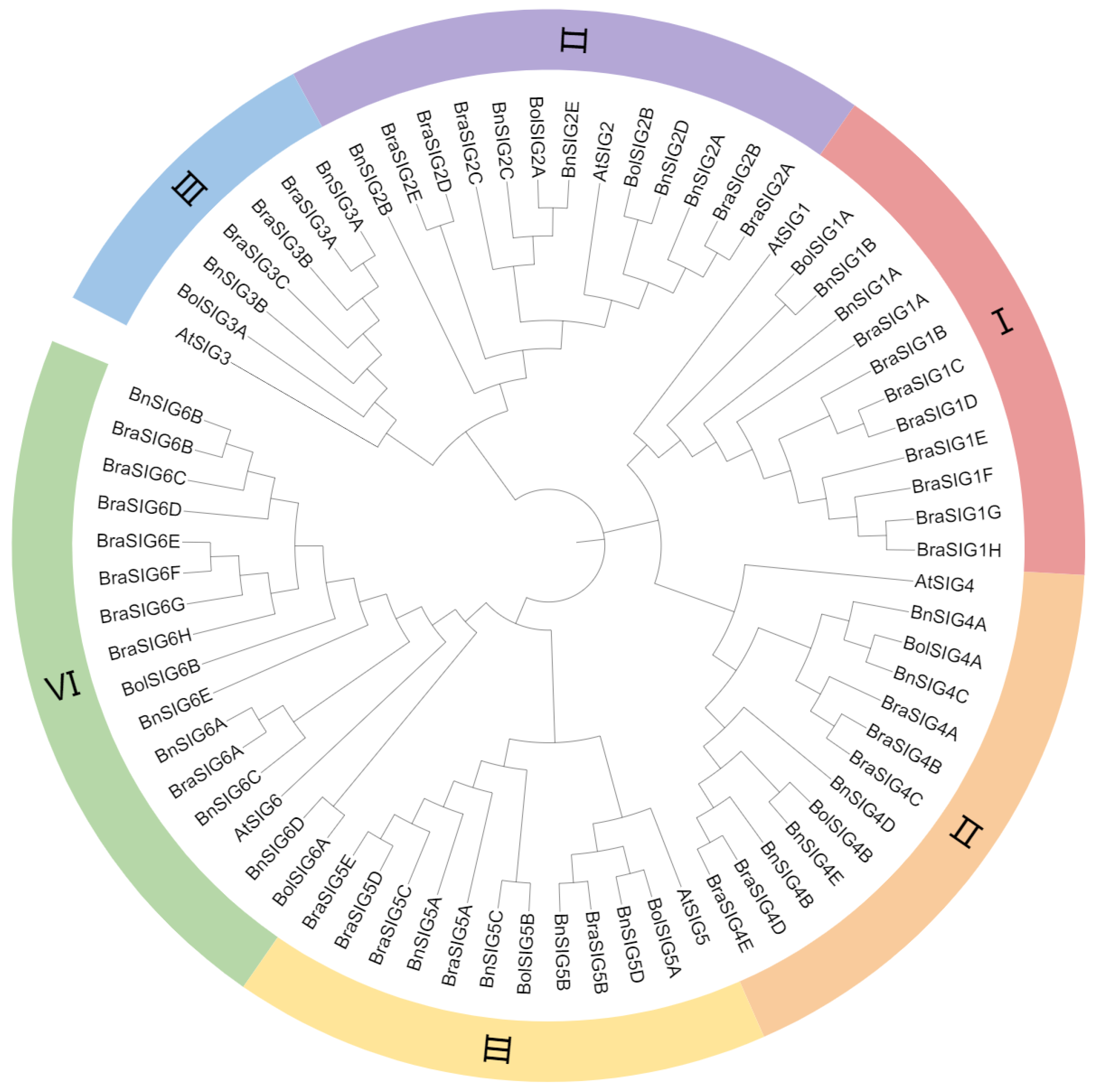
A maximum-likelihood phylogenetic tree was constructed using 73 SIG protein sequences from A. thaliana (6), B. rapa (34), B. oleracea (10), and B. napus (23). The analysis classified the SIG family into six well-supported clades (Groups I-VI) (Figure 1). Group VI was the largest, while Group III was the smallest, suggesting differential expansion and diversification of the family across these species.
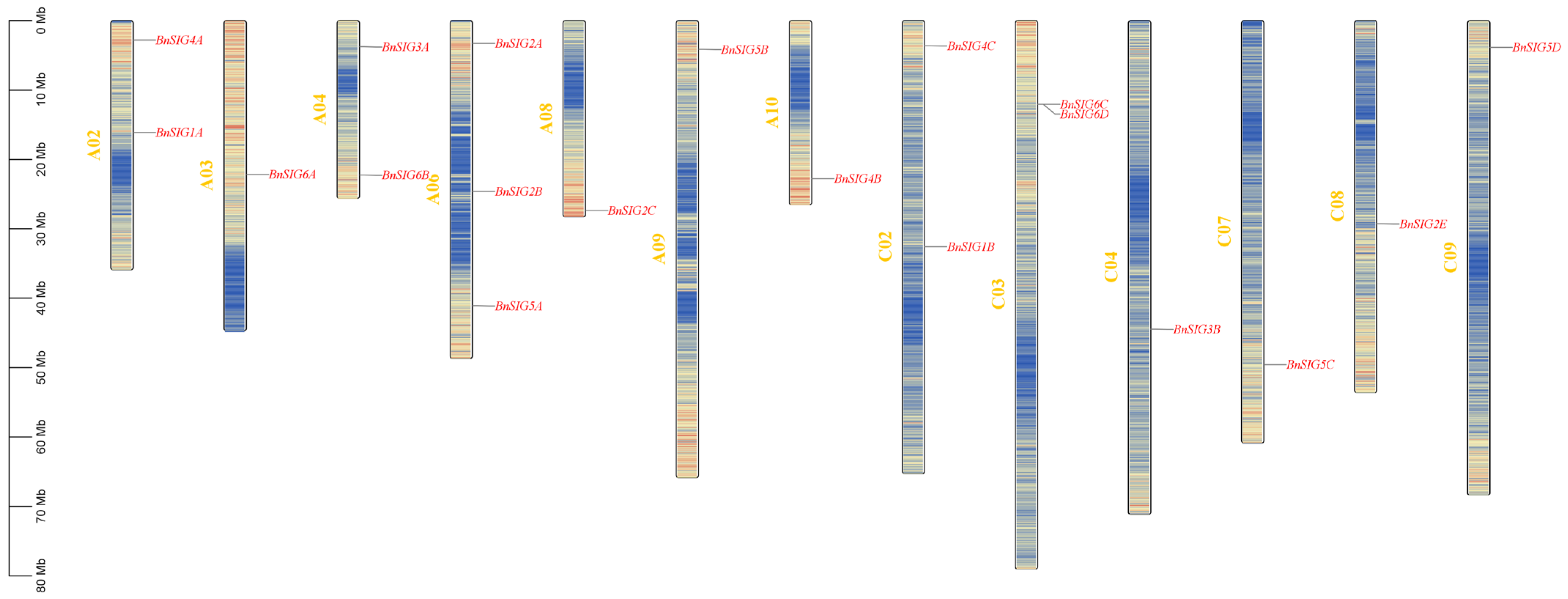
The 23 BnSIG genes were unevenly distributed across 13 of the 19 B. napus chromosomes (A02, A03, A04, A06, A08, A09, A10, C02, C03, C04, C07, C08, and C09) (Figure 2). Chromosome A06 harbored the most genes (three), while eight chromosomes contained only a single BnSIG gene. This irregular distribution implies that segmental duplication events contributed significantly to the family expansion.
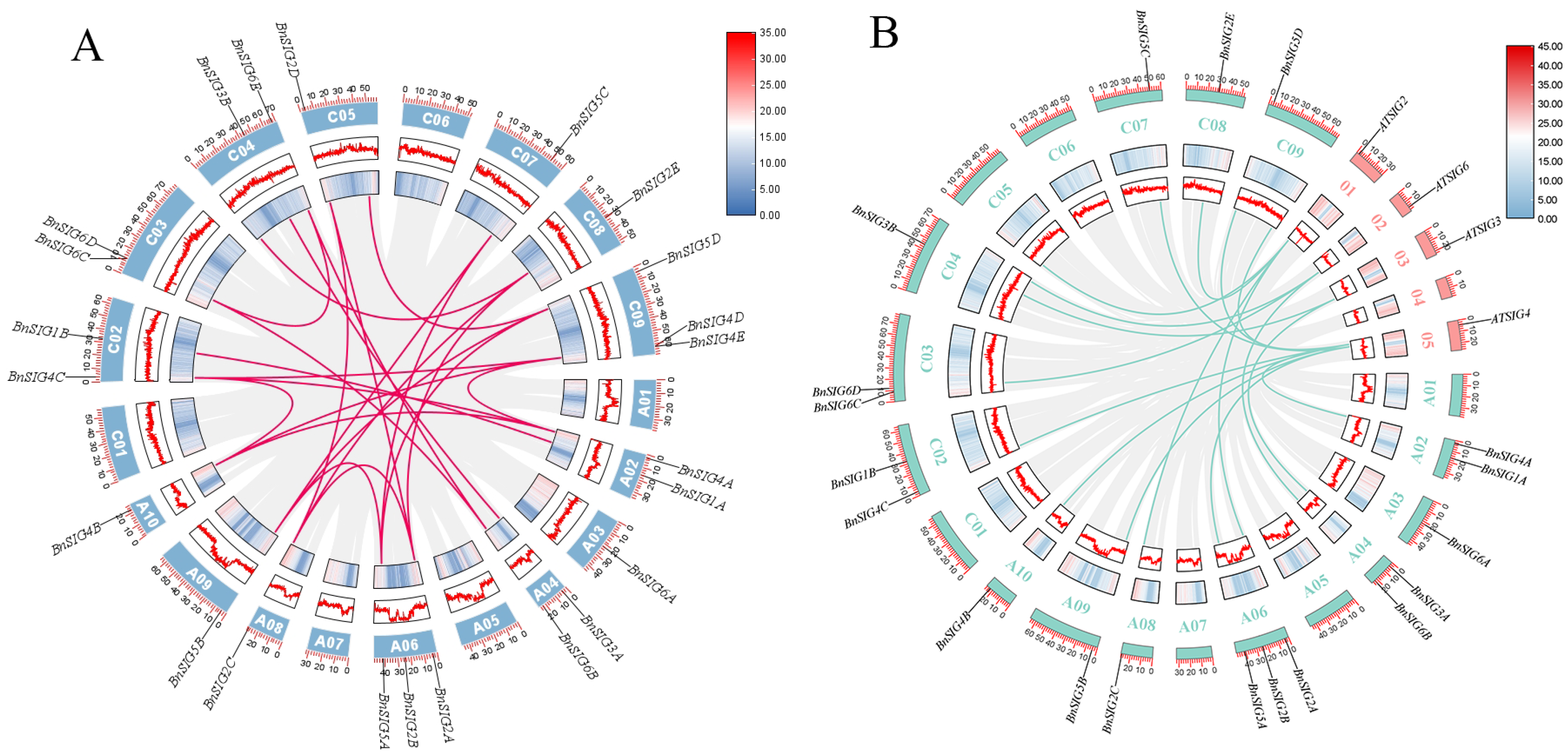
Collinearity analysis within the B. napus genome identified 17 duplicated gene pairs, underscoring the role of segmental duplication in the proliferation of the SIG family (Figure 3A). Key genes like BnSIG1A, BnSIG4A, BnSIG4B, and BnSIG6A were involved in multiple duplication events. Notably, BnSIG5C showed collinearity with both BnSIG5A and BnSIG5B, suggesting a potential triplication event. Analysis of non-synonymous (Ka) and synonymous (Ks) substitution rates for these pairs revealed Ka/Ks ratios all less than one, indicating the action of strong purifying selection (Supplementary Table S3). Further collinearity analysis between B. napus and A. thaliana identified 17 orthologous relationships involving 14 BnSIG and four AtSIG genes (e.g., AtSIG2 with BnSIG2A, BnSIG2C, and BnSIG2E), all of which belonged to the same phylogenetic subfamilies (Figure 3B). This highlights a high degree of evolutionary conservation following polyploidization.

2.1.3. Gene Structure and Conserved Motif Analysis of BnSIG Proteins

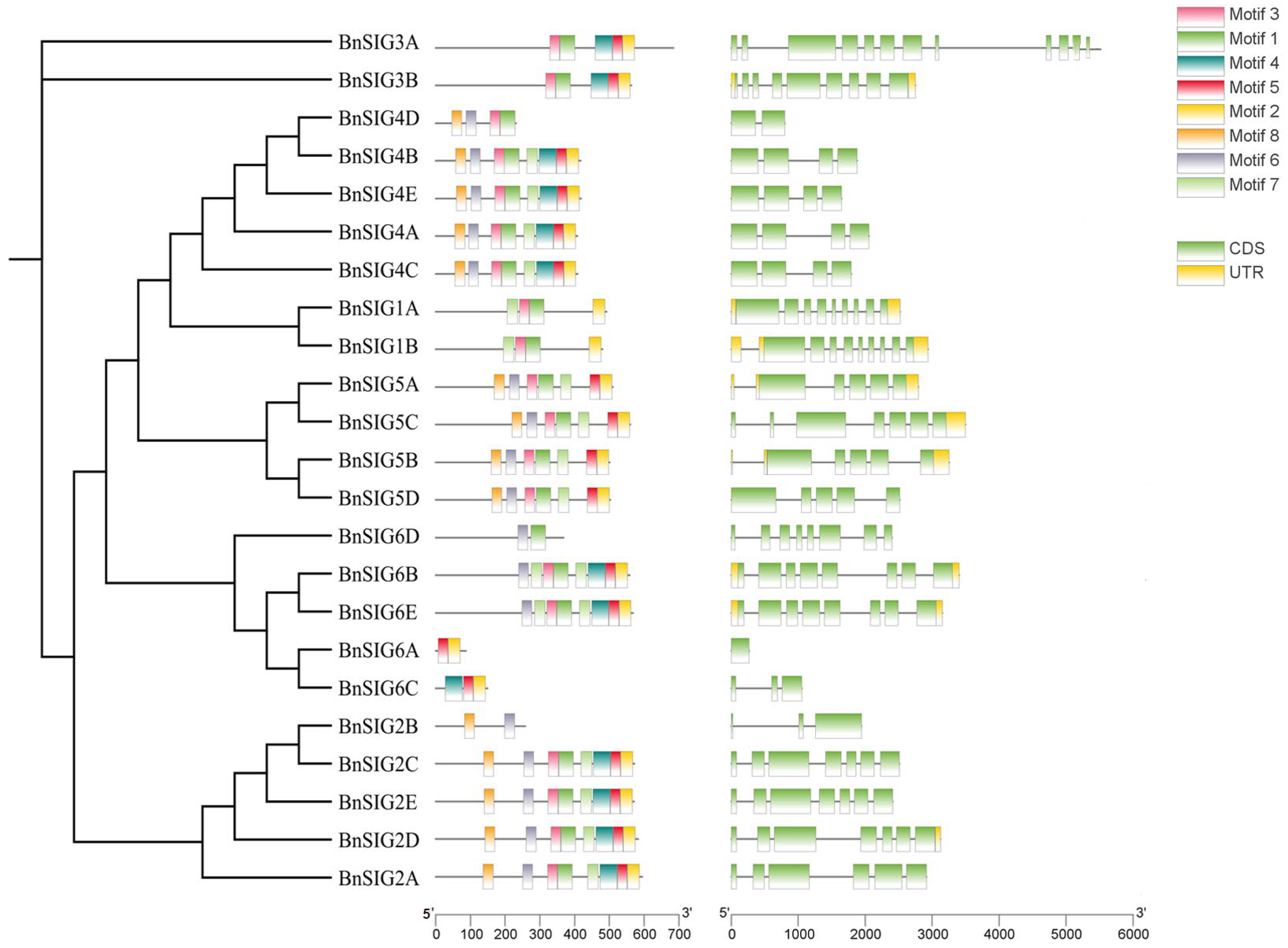
Analysis of gene structure revealed that most BnSIG genes contain a simple structure of one to three exons, though BnSIG3A was more complex with twelve exons (Figure 4). Most genes (14 out of 23) lacked predicted 5′ and 3′ UTRs in the current genome annotation, which likely reflects incomplete annotation of untranslated regions rather than true biological absence. Genes within the same phylogenetic clade generally shared similar exon-intron structures, supporting their evolutionary relatedness.
Conserved motif analysis identified ten motifs, with most BnSIG proteins sharing a common set, indicating structural conservation within the family (Figure 4). However, notable variation in motif composition was observed among specific members. For instance, BnSIG1A, BnSIG4C, and BnSIG5C retained only two of the ten motifs, while other family members retained most or all motifs. This variation in conserved motif content may reflect genuine structural differences, though it could also result from incomplete genome annotation or gene model prediction errors—a common limitation in analyses of recently sequenced polyploid genomes [28]. Determining whether such structural variation translates to functional differences will require experimental investigation.

2.2. Regulatory and Expression Characteristics of BnSIG Genes

To understand the regulatory potential and biological roles of the BnSIG family, we analyzed promoter cis-elements, expression patterns, and subcellular localization. These analyses highlighted the importance of specific members, particularly BnSIG5A, in stress and light responses.

2.2.1. Promoter Cis-Element Analysis

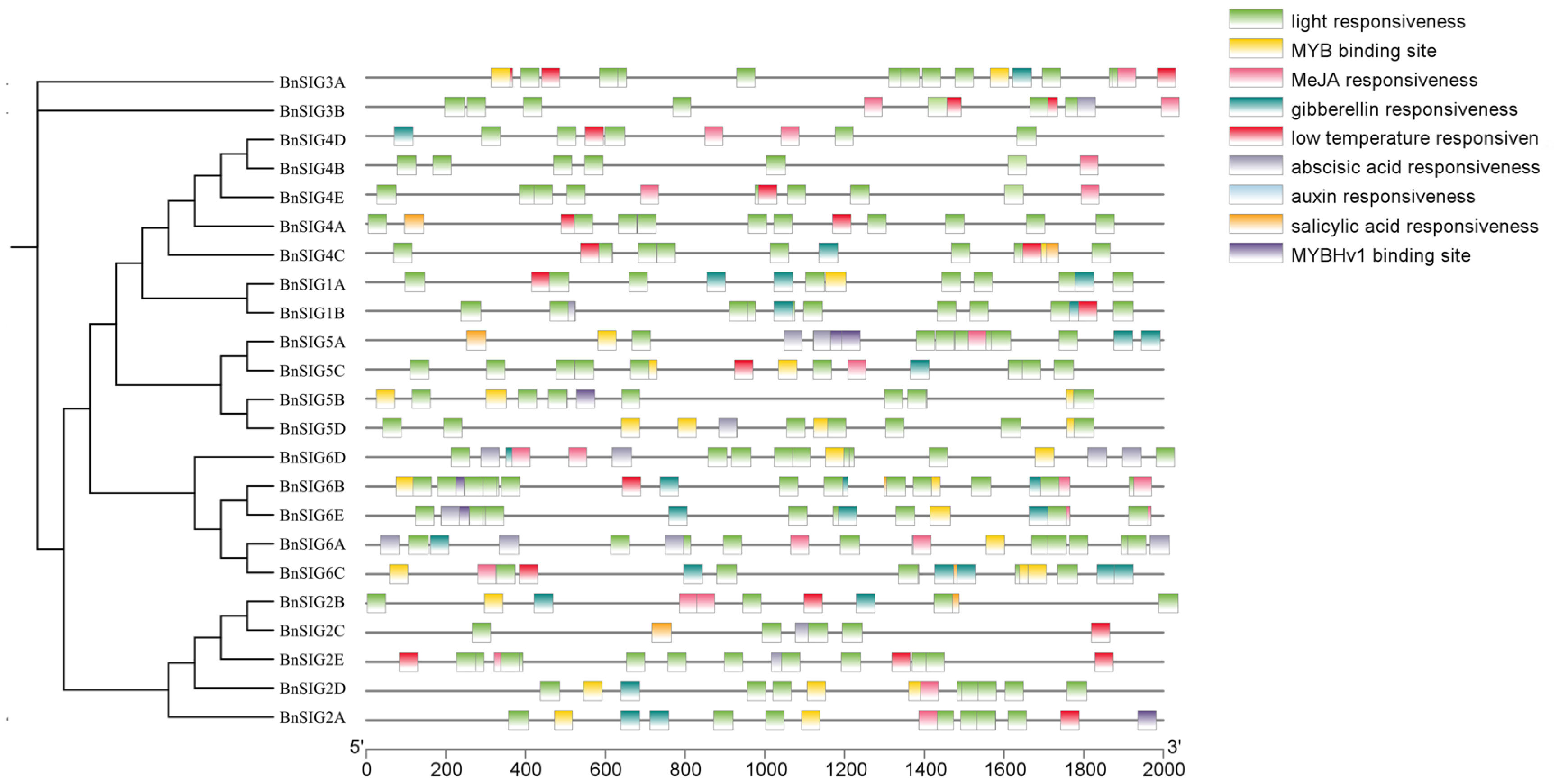
Analysis of the 2.0 kb promoter regions upstream of all BnSIG genes revealed the presence of multiple predicted cis-acting regulatory elements associated with stress and hormone responses (Figure 5). These predictions are based on sequence homology to known element motifs in the PlantCARE database and should be interpreted as suggestive rather than demonstrative of actual regulatory function. Notably, putative low-temperature-responsive elements (LTR) were identified in 16 promoters, and MYB binding site motifs—associated with drought and cold stress responses in other species—were also detected, with BnSIG5A containing four such motifs. Additionally, all BnSIG promoters contained predicted light-responsive elements, consistent with the established connection between sigma factors and photosynthetic gene regulation. These in silico predictions generate testable hypotheses regarding the regulation of BnSIG genes by light and cold stress, which require experimental validation through techniques such as promoter-reporter assays, electrophoretic mobility shift assays (EMSAs), or chromatin immunoprecipitation (ChIP).

2.2.2. Expression Profiling Across Tissues and Under Cold Stress

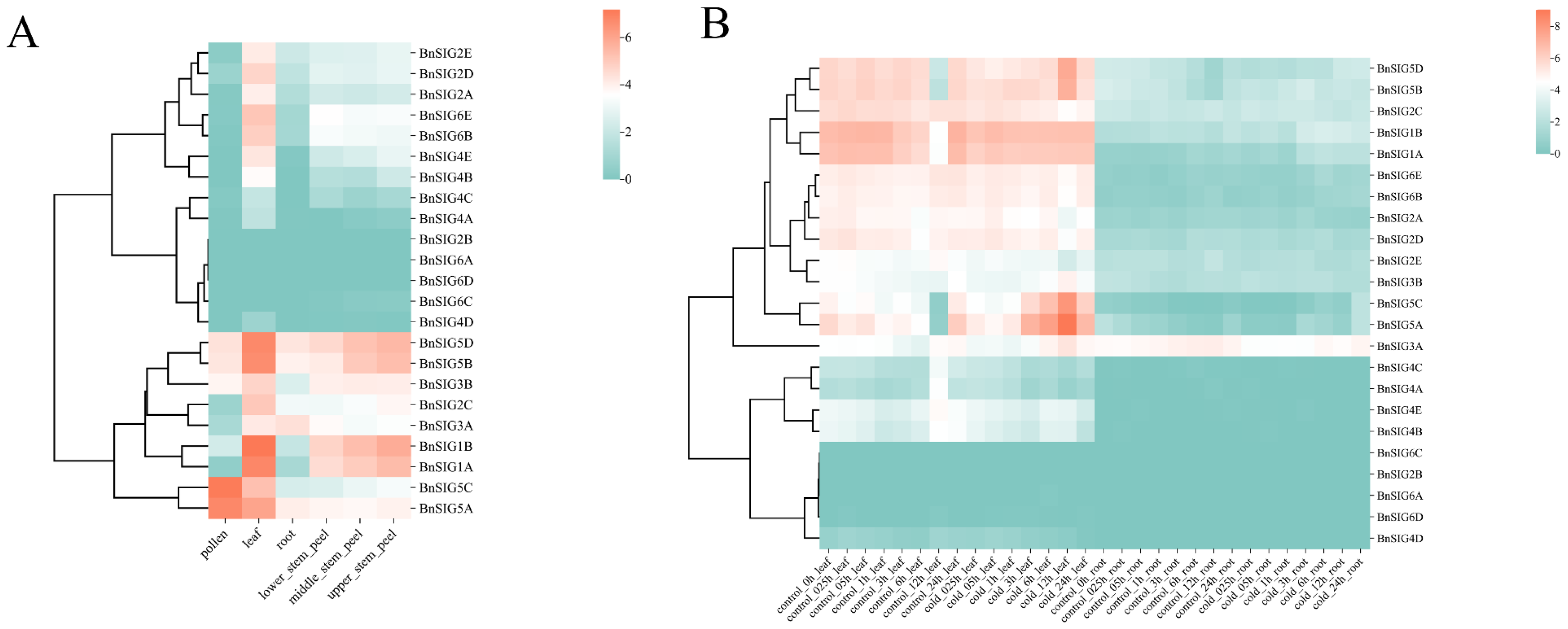
Transcriptomic data revealed that BnSIG genes exhibit distinct tissue-specific expression patterns (Figure 6A). Members of the BnSIG5 subfamily (BnSIG5A, BnSIG5B, BnSIG5D) were highly expressed across most tissues, including pollen and leaves. In contrast, genes like BnSIG2B and BnSIG6A showed low or undetectable expression. Under cold stress, a dynamic transcriptional response was observed in leaves (Figure 6B). BnSIG5A, BnSIG5B, and BnSIG5C were strongly induced. BnSIG5A exhibited a rapid response, with significant upregulation beginning at 1 h, peaking at 2 h, and remaining elevated until 12 h post-treatment, marking it as a key early responder to cold stress.

2.2.3. Subcellular Localization of BnSIG5A

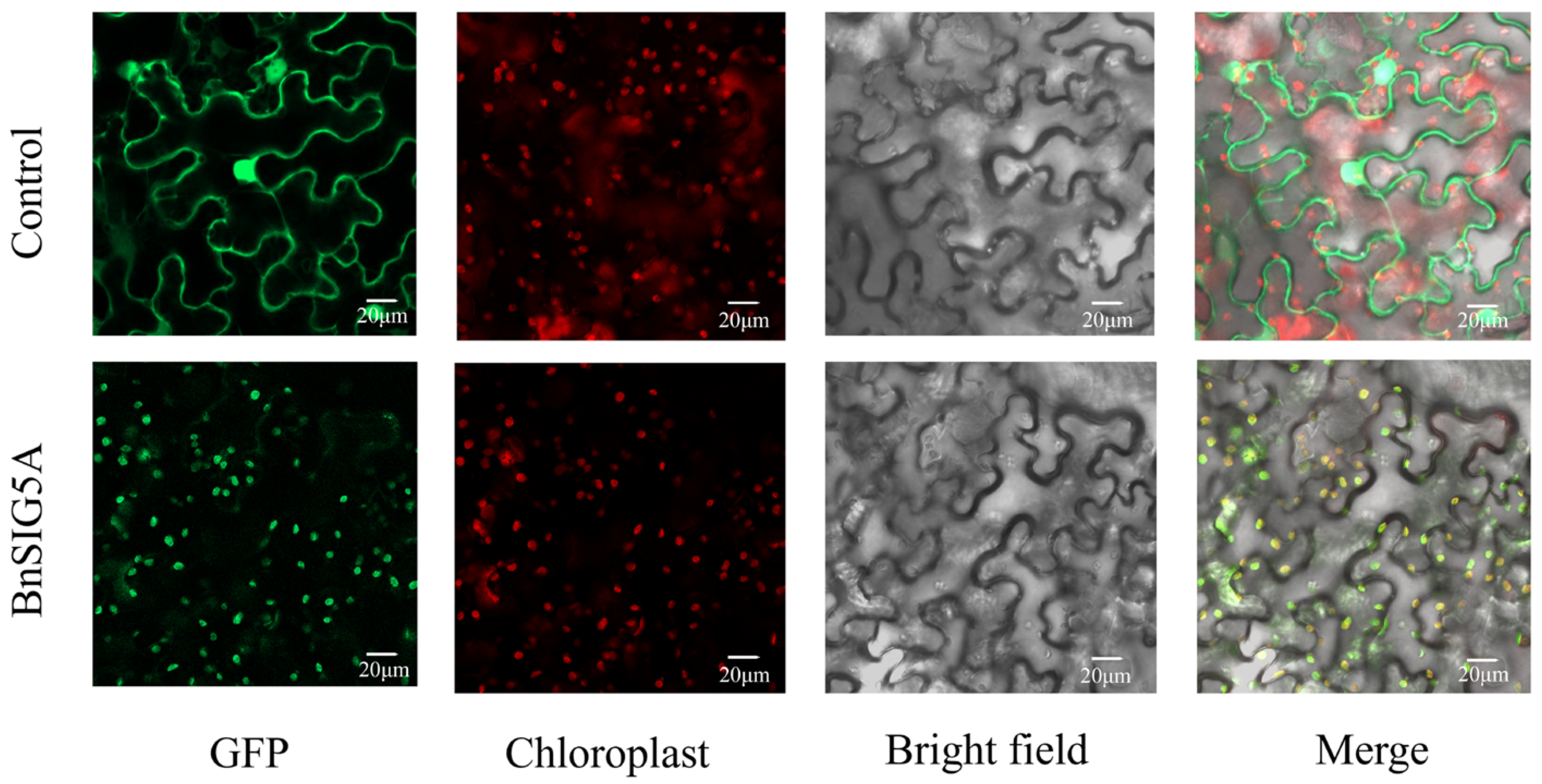
The subcellular localization of BnSIG5A was confirmed experimentally. Transient expression of a BnSIG5A-GFP fusion protein in Nicotiana benthamiana leaves resulted in a GFP signal that co-localized with chloroplasts, validating its plastid targeting and functional role in chloroplast transcription (Figure 7).

2.3. Expression Analysis of BnSIG Genes and Functional Insights from Arabidopsis SIG5 Mutants

To investigate the cold-responsive expression of BnSIG genes in B. napus, we performed qRT-PCR analysis on selected family members. To examine whether the Arabidopsis ortholog of BnSIG5A (AtSIG5) functions in cold tolerance, we analyzed A. thaliana SIG5 T-DNA insertion mutants. These experiments test the function of AtSIG5 and provide a reference point for hypotheses regarding potential conserved roles of BnSIG5A.

2.3.1. qRT-PCR Validation of Cold-Responsive BnSIG Genes

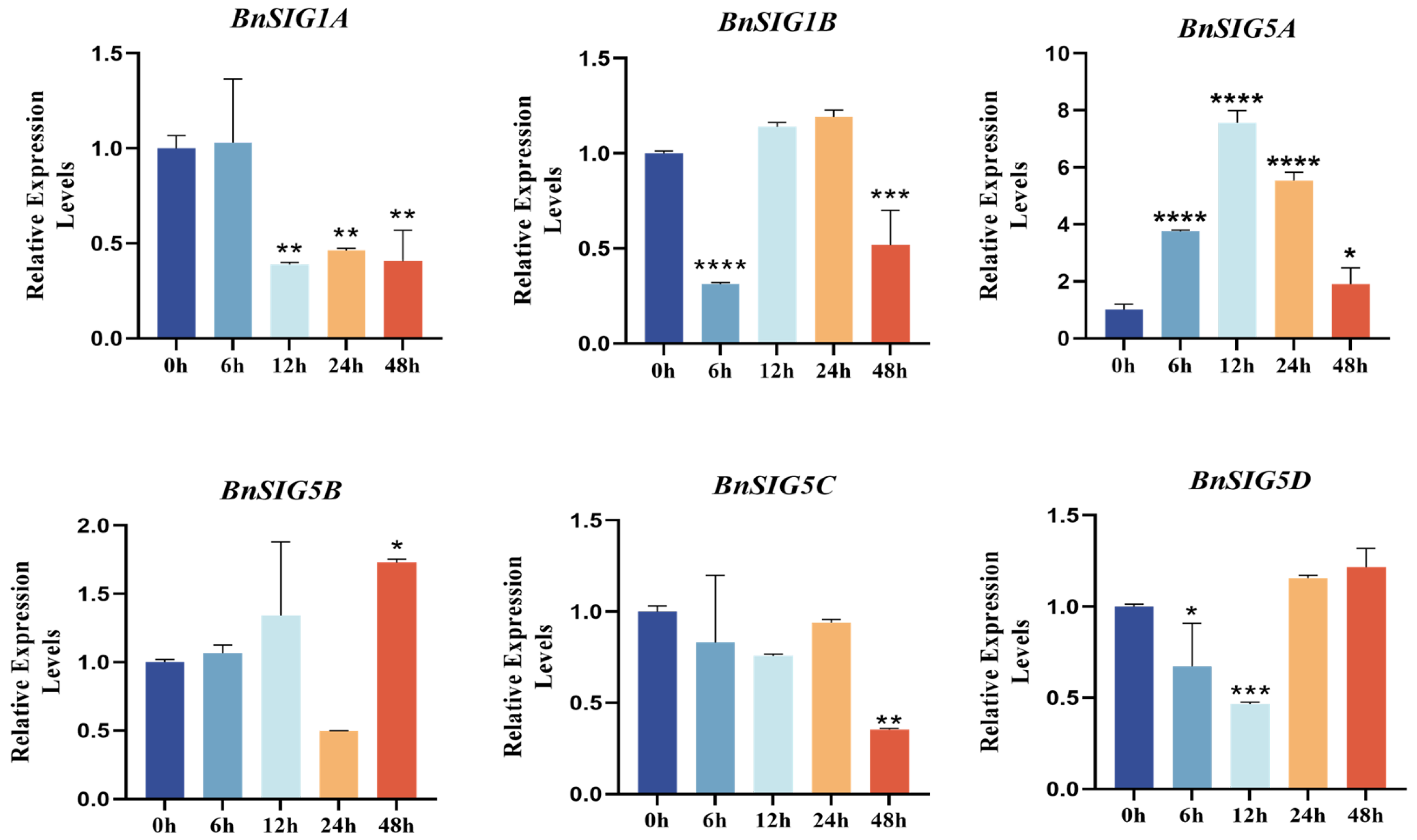
The qRT-PCR analysis of six selected BnSIG genes confirmed the RNA-seq expression trends (Figure 8). BnSIG5A expression peaked sharply at 12 h of cold treatment, while BnSIG5B, BnSIG5C, and BnSIG5D showed sustained induction up to 24 h. In contrast, BnSIG1A expression declined steadily, suggesting it is not a primary cold-responsive gene. These results identify the BnSIG5 subfamily, particularly BnSIG5A, as strong cold-inducible candidates in B. napus.

2.3.2. Low-Temperature-Tolerance Assays of Yeast Transformants

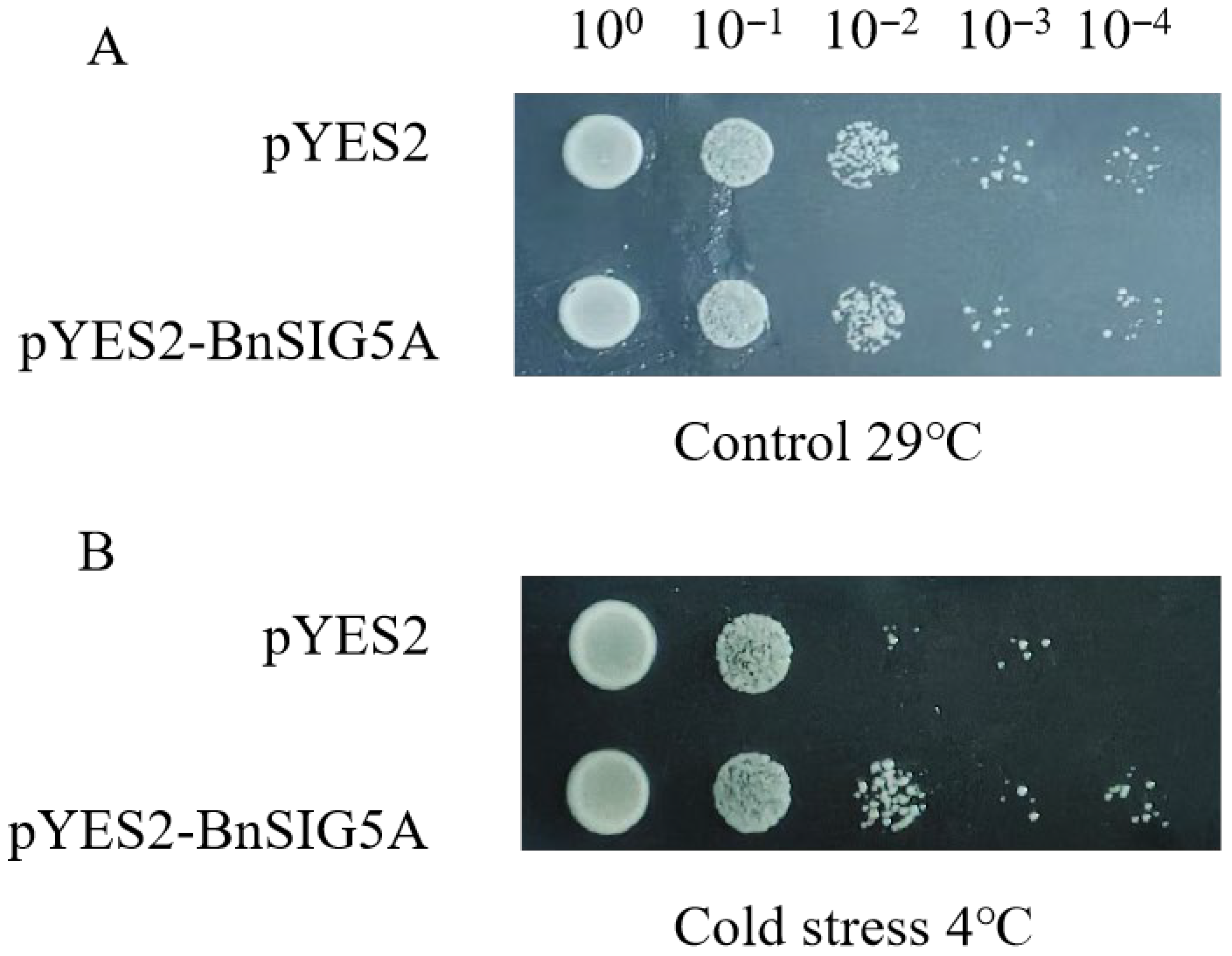
As a heterologous system to assess whether BnSIG5A protein expression could confer stress tolerance in a simple eukaryotic context, we transformed yeast (Saccharomyces cerevisiae strain BY4741) with either a pYES2-BnSIG5A vector or an empty vector control. Under optimal growth conditions (29 °C), both transformed strains showed comparable colony growth. However, when subjected to cold stress (4 °C for 48 h), the BnSIG5A-expressing yeast exhibited enhanced growth compared to the empty vector control (Figure 9). While yeast lacks plastids and cannot support sigma factor transcriptional function, this result suggests that BnSIG5A expression may confer cold tolerance through mechanisms independent of its native transcriptional role, such as enhanced protein stability or general stress protection, or may simply reflect successful heterologous protein production. This experiment provides complementary, albeit indirect, evidence that BnSIG5A can be functionally expressed in a eukaryotic system but does not demonstrate sigma factor-specific activity.

2.3.3. Phenotypic and Physiological Analysis of A. thaliana sig5 Mutants

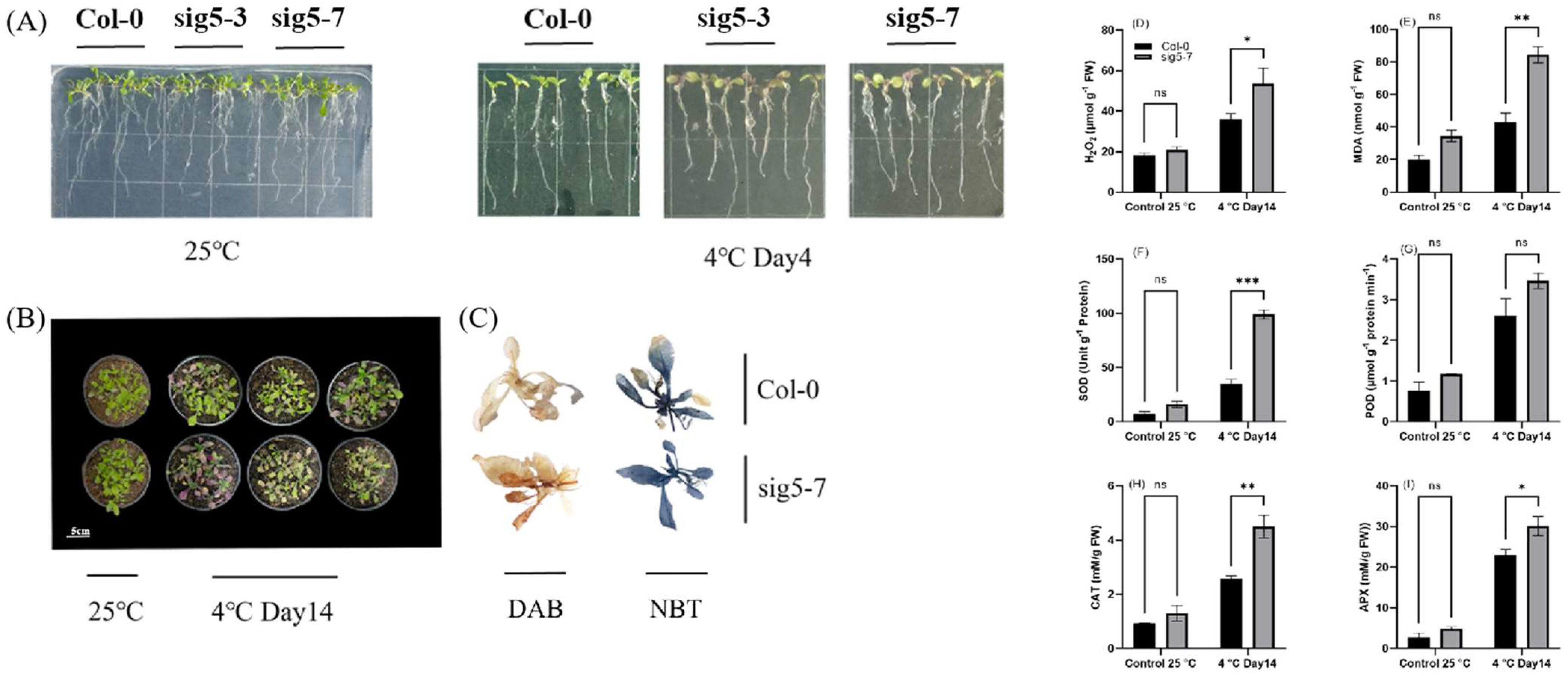
To further functionally characterize SIG5, we analyzed two A. thaliana T-DNA insertion mutants, sig5-3 and sig5-7. Under cold stress, both mutants exhibited a clear susceptible phenotype, including leaf browning, which was absent in the wild type (Col-0) (Figure 10A,B).
Physiological assessments revealed that the sig5-7 mutant accumulated significantly higher levels of hydrogen peroxide (H2O2) and malondialdehyde (MDA) under cold stress, indicating severe oxidative damage (Figure 10 D,E). This was visually confirmed by intense DAB and NBT staining (Figure 10C). Although the activities of antioxidant enzymes (SOD, POD, CAT and APX) were elevated in the mutant, this response was insufficient to prevent oxidative damage.
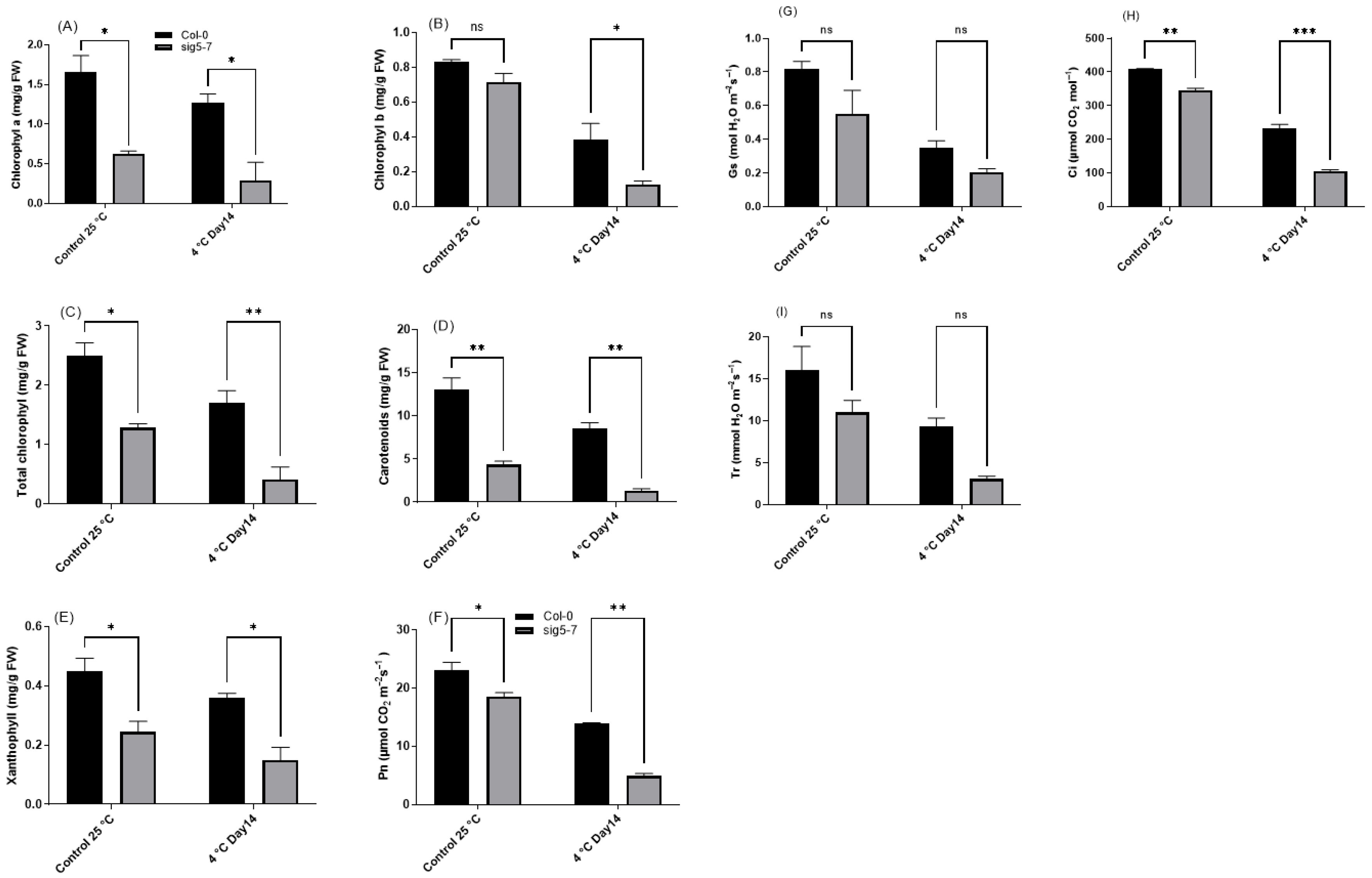
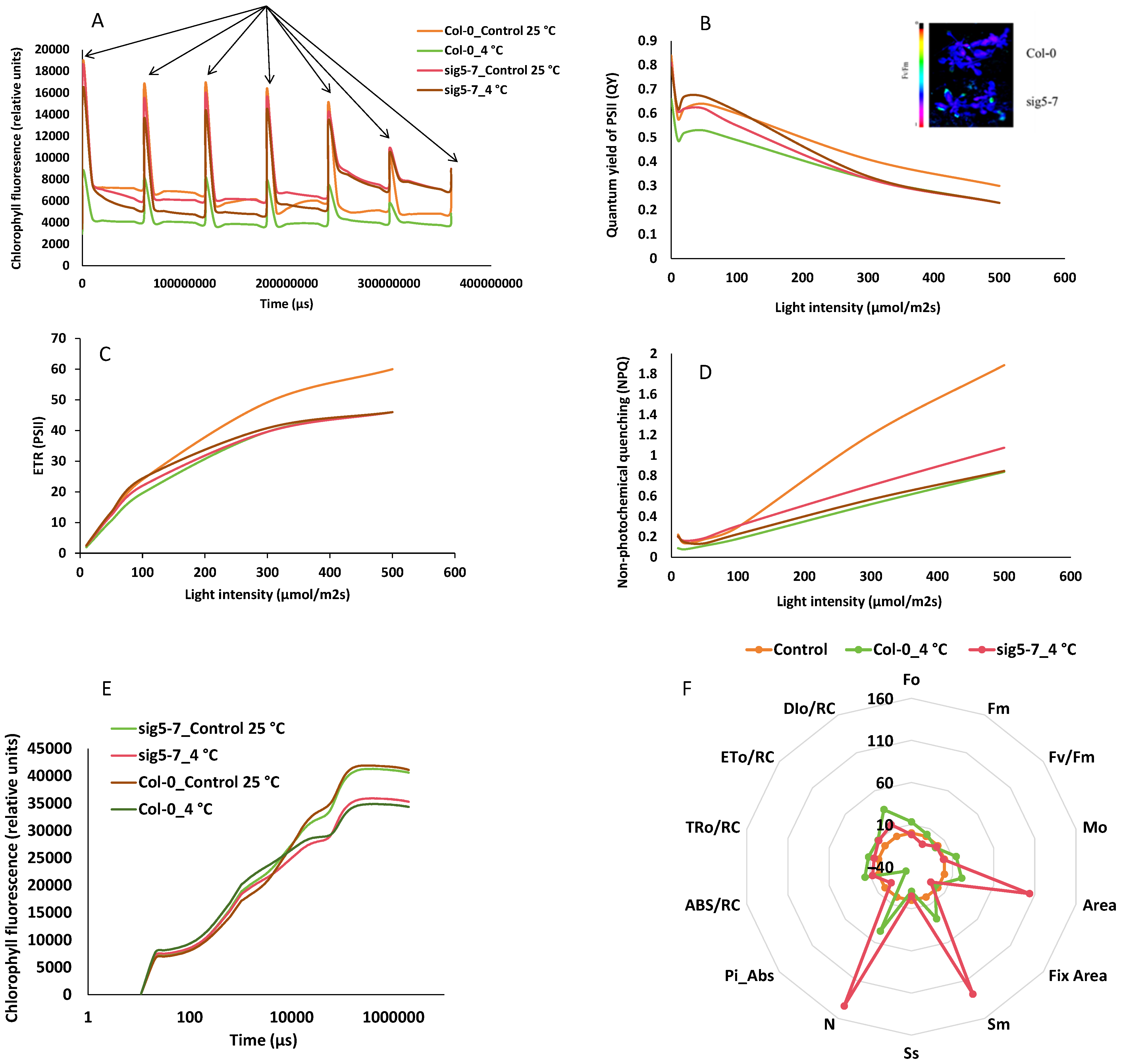
The mutants also displayed significantly reduced chlorophyll a, b, and total chlorophyll content, as well as impaired gas exchange parameters (Pn, Gs, Ci, Tr) compared to Col-0, both before and after cold stress (Figure 11). Chlorophyll fluorescence analysis showed that the maximum quantum efficiency of PSII (Fv/Fm) was lower in the mutant after prolonged cold treatment (Figure 12). However, the mutant showed an altered OJIP (the analysis of the fast chlorophyll fluorescence rise curve through its O, J, I, and P steps) curve and higher non-photochemical quenching (NPQ), suggesting a compensatory mechanism to manage excess excitation energy. Despite this, the overall data demonstrate that the loss of SIG5 function compromises PSII integrity and photosynthetic performance under cold stress. To assess the impact of the mutation on gene expression related to RuBP hydroxylase large subunit synthesis [29] and the psbI-psbK-psbD-psbC [17,30,31], we performed quantitative reverse transcription PCR (qRT-PCR) analysis. Compared with the wild type, the expression levels of these genes were consistently downregulated in the mutant, with the most pronounced reduction observed for psbD (Supplementary File S1). Collectively, these results confirm that SIG5 is essential for cold tolerance, playing a critical role in mitigating oxidative stress, preserving chlorophyll content, and maintaining photosynthetic efficiency.

3. Discussion

Plastid sigma factors (SIGs) serve as master regulators of chloroplast transcription, enabling the nucleus to dynamically control plastid function in response to developmental and environmental signals. Our study provides the first comprehensive genomic and functional characterization of the SIG gene family in the allotetraploid crop B. napus, with a specific focus on its role in cold stress adaptation. We demonstrate that the BnSIG family has expanded through polyploidization, that specific members are potent cold-stress responders, and that BnSIG5A is essential for maintaining photosynthetic integrity and oxidative homeostasis under low-temperature stress.

3.1. Genomic Expansion and Functional Diversification of the BnSIG Family

The identification of 23 SIG genes in B. napus reflects the genomic complexity of this allotetraploid species. Notably, while Arabidopsis contains a single SIG5 gene, B. napus possesses four SIG5 homologs (BnSIG5A-D). This expansion raises important questions about functional partitioning: do all four paralogs retain the same function, or have they undergone sub-functionalization or neo-functionalization following polyploidization? Our expression data show that all four BnSIG5 paralogs are cold-inducible, but with distinct temporal dynamics (Figure 8), suggesting possible divergence in regulatory control. This represents a key biological difference between the model system and the crop species, highlighting the necessity of species-specific studies.
The present work provides the foundational genomic resources needed to address such questions and ultimately enables targeted manipulation of individual paralogs for crop improvement. The observed protein length variation (88–684 aa) within the BnSIG family warrants discussion about its biological significance. This diversity is not random but reflects evolutionary processes shaping functional diversification following whole-genome duplication in B. napus [26]. Similar length variation has been documented in other plant gene families and is associated with sub-functionalization and neo-functionalization [27].
The shorter variants, such as BnSIG1A (88 aa) and BnSIG4C (147 aa), lack several conserved C-terminal domains (regions 2–4) typically required for core RNA polymerase binding and promoter recognition (Figure 4). These truncated forms may represent: (1) Pseudogenes undergoing decay, (2) alternative splice variants with regulatory functions, or (3) proteins that have acquired novel functions independent of canonical sigma factor activity. In contrast, full-length variants like BnSIG3A (684 aa) retain all conserved domains and likely function as canonical sigma factors in chloroplast transcription.
Notably, all four BnSIG5 paralogs are full-length proteins (541–568 aa), suggesting they retain canonical sigma factor function. This is consistent with their strong cold-inducible expression and predicted role in chloroplast gene regulation. The presence of multiple paralogs with full-length sequences in the SIG5 clade, compared to truncated forms in other clades, suggests that SIG5 function is under stronger purifying selection and that all four copies remain functionally important in B. napus.
This structural diversity within a single gene family exemplifies how polyploid genomes generate functional novelty through gene duplication and divergence, providing raw material for environmental adaptation. The length variation we observe likely contributes to the regulatory flexibility required for B. napus to cope with diverse environmental stresses, including cold.
The phylogenetic classification of BnSIG proteins into six conserved clades aligns with established groupings in A. thaliana and rice, indicating deep evolutionary conservation of the SIG family’s core structure in angiosperms [32,33,34,35]. Of the six Arabidopsis sigma subunits, each plays a distinct role in regulating chloroplast gene expression. SIG1 regulates the transcription of the photosystem reaction center genes psaA/B and psbA, with its phosphorylation being influenced by the redox status of the plastoquinone pool [36]. SIG2, on the other hand, is involved in the transcription of several chloroplast tRNA genes, including trnE, which encodes tRNA-Glu, and may link translation with pigment synthesis in chloroplasts [17]. SIG3, a nucleus-encoded plastid sigma factor, specifically transcribes the psbN gene in plastids, playing a crucial role in chloroplast gene expression [37]. In the unicellular red alga Cyanidioschyzon merolae, the nuclear-encoded sigma factor SIG4 directly activates the transcription of chloroplast genes psbA and ycf17, both of which are important for photosynthesis and plastid function. Research on AtSIG6, another plastid sigma factor from Arabidopsis, highlights how cpCK2 phosphorylation modulates its function in regulating chloroplast gene expression [11]. Finally, SIG5 is stress-induced and contributes to the repair of damaged photosystem II (PSII) by transcribing the psbD and psbC genes [17]. Together, these findings help to clarify the target genes and physiological roles of each sigma subunit in plant cells.
The uneven distribution of BnSIG genes across chromosomes and the prevalence of segmental duplication events strongly suggest that genome duplication has been a primary driver for the expansion of this gene family in B. napus. The finding that all duplicated BnSIG pairs have undergone purifying selection (Ka/Ks < 1) indicates strong functional constraints, preserving their essential roles in chloroplast biology despite genomic rearrangement [32]. Further evidence of this balance between conservation and diversification is found in the gene structure and motif composition. Members within the same phylogenetic clade share highly similar exon-intron structures and conserved motifs, suggesting functional redundancy. However, the selective loss of motifs in specific members, such as BnSIG2B, BnSIG6A, BnSIG6D, and BnSIG6C, points to potential sub- or neo-functionalization. This structural divergence may explain the specialized roles that different SIG paralogs have acquired in the complex regulatory networks of B. napus.

3.2. Expression Patterns and Potential Regulatory Roles Under Cold Stress

The expression of SIG genes is potentially influenced by cis-acting elements in their promoters. Our in silico promoter analysis identified abundant light-responsive element motifs in all BnSIG promoters (Figure 3A), which correlates with previous findings in maize and A. thaliana where SIG genes such as ZmSIG1 and AtSIG5 are light-inducible and involved in photomorphogenesis and high-light responses [38,39,40]. This correlation suggests a possible conserved relationship between sigma factors and light-regulated photosynthetic gene expression, though direct experimental validation is required to confirm that these predicted motifs are functionally active.
Importantly, our analysis also identified putative low-temperature responsive (LTR) and MYB cis-element motifs in multiple BnSIG promoters, with BnSIG5A showing a particularly high density of such elements (Figure 3A). These predictions align with the observed rapid and strong transcriptional upregulation of BnSIG5A under cold stress (Figure 6 and Figure 8), and are consistent with the cold-induction of AtSIG5 reported in Arabidopsis [2,20]. The convergence of light and cold stress-related element predictions on the SIG5 promoter across species raises the hypothesis that a conserved regulatory mechanism coordinates photosynthetic capacity with abiotic stress responses. However, definitive evidence for such regulation, such as demonstration of transcription factors binding to these elements, or functional validation through promoter-reporter assays remains to be established.
The subsequent confirmation of BnSIG5A chloroplast localization (Figure 7) supports its potential role in mediating nuclear-plastid communication under environmental stress, but does not itself demonstrate regulatory function. Together, these predictive and correlative findings generate specific, testable hypotheses regarding the regulation of BnSIG genes by light and cold stress, providing a foundation for future experimental validation studies.

3.3. Insights into BnSIG5A Function from Arabidopsis thaliana T-DNA Insertion Mutants

To explore the potential function of SIG5 in chloroplast resilience, we examined the cold stress response of Arabidopsis thaliana T-DNA insertion mutants (sig5-3 and sig5-7). Arabidopsis is a well-established model plant with mature genetic tools, and its SIG5 gene shares high homology with BnSIG5A, providing a reliable reference for investigating SIG5 function, following previously established study [2]. Consistent with recent reports documenting SIG5’s role in integrating cold and circadian signals [2], both mutant lines exhibited cold-sensitive phenotypes, including leaf browning, elevated ROS accumulation, and significant chlorophyll loss under low-temperature stress (Figure 5 and Figure 6). These observations align with the photoprotective role of SIG5 described in earlier studies [20] and confirm that SIG5 function in promoting chloroplast resilience is conserved in Arabidopsis. Based on the experimental results in Arabidopsis thaliana, we hypothesize that BnSIG5A may play a similar role in chloroplast resilience and cold tolerance. However, direct physiological evidence for BnSIG5A in B. napus was not obtained in this study, and these conclusions are derived from extrapolation of the Arabidopsis mutant data. The impaired PSII efficiency (reduced Fv/Fm) and altered chlorophyll fluorescence kinetics (OJIP parameters) in the sig5 mutant directly link the loss of SIG5 function to a failure in photoprotection. These findings are consistent with studies showing that proper SIG function is crucial for maintaining electron transport rates and preventing over-reduction in the photosynthetic electron transport chain under stress conditions [21]. In A. thaliana, AtSIG5 is known to directly activate the transcription of the psbD gene, which encodes the D2 protein of PSII, and this regulation is enhanced by cold stress via the HY5/HYH pathway [2,20]. The photosynthetic defects observed in sig5 mutants under cold stress are therefore consistent with disrupted psbD expression and impaired PSII repair.
The disruption in photosynthetic electron transport observed in sig5 mutants likely contributes to the ROS imbalance (Figure 5). Under cold stress, the impaired linear electron flow leads to enhanced leakage of electrons to O2, generating superoxide radicals primarily at PSI [35]. Our observation of increased superoxide accumulation in sig5 mutants (NBT staining, Figure 10C) aligns with this mechanism, and the subsequent conversion to H2O2 (DAB staining, Figure 10C) is consistent with cold-induced oxidative stress. Elevated MDA levels (Figure 10E) further indicate membrane lipid peroxidation resulting from this oxidative burst.
Notably, the enhanced activities of antioxidant enzymes (SOD, POD, CAT, and APX) in sig5 mutants suggest a compensatory mechanism to counter the cold-induced oxidative burst (Figure 10 F–I). This upregulation is consistent with studies showing that cold stress upregulates antioxidant systems as part of the acclimation response [41]. However, in sig5 mutants, this upregulation appears insufficient to prevent oxidative damage, suggesting that SIG5-mediated maintenance of photosynthetic electron flow is fundamental to ROS homeostasis. Previous research has established that efficient electron transport through PSII and PSI is crucial for minimizing ROS generation under stress conditions [42], and our results indicate that SIG5 is integral to this process in Arabidopsis.
The chlorophyll deficiency observed in sig5 mutants under cold stress (Figure 6A) may reflect both oxidative degradation and impaired synthesis of chlorophyll-binding proteins. ROS can directly damage chlorophyll molecules and inhibit chlorophyll biosynthesis enzymes [43], while proper assembly and stability of photosynthetic complexes depend on coordinated nuclear and plastid gene expression, which requires functional sigma factors [6]. The increased non-photochemical quenching (NPQ) capacity observed in sig5 mutants (Figure 12) likely represents an attempt to dissipate excess excitation energy. However, this mechanism alone cannot compensate for fundamental defects in photosynthetic complex maintenance in the absence of functional SIG5, consistent with reports that sustained NPQ under prolonged stress may be insufficient when not accompanied by adequate repair of the photosynthetic apparatus [44].
It is important to acknowledge that the functional evidence presented here does not demonstrate the role of BnSIG5A in B. napus cold tolerance. The Arabidopsis mutant analysis confirms previously reported functions of AtSIG5 [2,20], and together with the strong cold-induction of BnSIG5A and its chloroplast localization supports the hypothesis that BnSIG5A may play a similar role. However, direct validation in B. napus is essential for two key reasons.
First, the allotetraploid genome of B. napus contains four SIG5 homologs (BnSIG5A-D), whereas Arabidopsis has only one. Our expression profiling revealed that these paralogs exhibit distinct temporal dynamics under cold stress (Figure 6 and Figure 8), suggesting possible divergence in regulatory control or functional specialization. Whether these paralogs have redundant, overlapping, or distinct functions remains unknown and requires investigation through B. napus-specific approaches.
Second, as a major oilseed crop cultivated across diverse climatic zones, understanding the molecular basis of cold tolerance in B. napus has direct agricultural applications. Natural variation in BnSIG5 expression among cultivars may contribute to adaptation gradients.
Therefore, the current study should be viewed as a comprehensive genomic resource that identifies BnSIG5A as a high-priority candidate for future functional studies. Subsequent investigations should employ B. napus-specific approaches, including: (1) CRISPR/Cas9-mediated mutagenesis of individual BnSIG5 paralogs; (2) stable overexpression of BnSIG5A in B. napus; (3) complementation of Arabidopsis sig5 mutants with BnSIG5A; and (4) analysis of natural variation in BnSIG5A expression among cultivars with contrasting cold tolerance. The genomic resources provided here will facilitate such investigations.

4. Materials and Methods

4.1. Plant Materials and Treatments

Uniform and healthy seeds of the winter rapeseed cultivar ‘ZD622’ were used for this study. The seeds were cultured in a quarter-strength Hoagland’s nutrient solution in a box. After germination, the uniform-sized seedlings were shifted to half-strength Hoagland nutrient solution in plastic pots. After two weeks, the seedlings were used for cold treatment (4 °C). Following the treatments, leaf samples were taken at 0, 6, 12, 24 and 48 h and three biological replications of each treatment were included in the samples, which were thereafter instantly frozen in liquid nitrogen and then stored at −80 °C.
The Arabidopsis thaliana T-DNA insertion mutant lines sig5-3 (SALK_141383C) and sig5-7 (SALK_101921C) in the Col-0 background were originally obtained from the Arabidopsis Biological Resource Center (ABRC, Columbus, OH, USA; https://abrc.osu.edu/; accessed on 12 May 2025). Seeds were propagated and verified in our laboratory and subsequently made available through the material-sharing platform https://www.arashare.cn (accessed on 12 May 2025). For this study, seeds were obtained from this platform, and genotype confirmation was performed by PCR-based genotyping as described previously [2] (Supplementary Figure S1). Seeds were surface-sterilized and sown on half-strength Murashige and Skoog (MS) basal salts mixture (Duchefa Biochemie, Haarlem, The Netherlands) in 0.8% (w/v) agar at pH 5.8. Following stratification in darkness at 4 °C for 2 days, seedlings were transferred to Panasonic GXZ-450D plant growth chambers (Ningbo Jiangnan Instrument Factory, Ningbo, China). Wild type Col-0 was used as a control. Plants were cultivated under 12 h light/12 h dark cycles at 22 °C with a light intensity of 90 µmol m−2 s−1 (white light). Experimental treatments were initiated at one week and 20 days after germination. Then, seedlings were moved to an incubator at 4 °C, with all other conditions remaining unchanged.

4.2. Identification and Bioinformatics Analysis of BnSIG Genes

The detailed methodology for identification and bioinformatics analysis of BnSIG genes is provided in Supplementary File S1.

4.3. Phylogenetic Analysis and Chromosomal Locations

The SIG protein sequences from A. thaliana, B. rapa, B. oleracea, and B. napus were obtained from the TAIR (https://www.arabidopsis.org/) and BnIR (https://yanglab.hzau.edu.cn/) data bases. Multiple sequence alignments were carried out using MUSCLE implemented in MEGA, and the resulting files were saved in MEGA format. Phylogenetic analysis was performed in MEGA6 using the maximum likelihood (ML) method with 1000 bootstrap replicates. The phylogenetic tree was subsequently visualized and refined with Chiplot (https://www.chiplot.online/normalTree.html, accessed on 12 May 2025). Chromosomal positions of BnSIG genes were extracted from the GFF3 annotation file of the B. napus ZS11 genome and mapped using TBtools v2.450.

4.4. Gene Structure, Motif and Cis-Element Analysis

Cis-acting regulatory elements in promoter regions were predicted using the PlantCARE database (http://bioinformatics.psb.ugent.be/webtools/plantcare/html/, accessed on 12 May 2025). It is important to note that these predictions are based on sequence homology to known motif patterns and represent putative regulatory elements. Experimental validation (e.g., promoter-reporter assays, EMSA, ChIP) is required to confirm actual transcription factor binding and functional regulatory activity. The detailed methodology for gene structure, motif and cis-element analysis is provided in Supplementary File S1.

4.5. RNA Extraction and qRT-PCR Analysis

Arabidopsis wild type and mutant plants at 20 days after germination were subjected to low-temperature treatment for 14 days. After treatment, leaf samples were collected for subsequent analysis. After sample collection, they were immediately transferred into liquid nitrogen to ensure efficient freezing and grinding. Subsequently, reagent kits were utilized to conduct RNA extraction and reverse transcription (Supplementary File S1). For RT-qPCR testing, the obtained cDNA was diluted and utilized as a template (Supplementary File S1). Utilizing the 2−ΔΔCt method, gene expression levels were determined. The primers used in the investigation are listed in Supplementary Table S4.

4.6. RNA-Seq Data Acquisition and Expression Analysis

4.6.1. Tissue-Specific Expression Analysis

Genome-wide expression profiles for BnSIG genes across different tissues and developmental stages were retrieved from the Brassica napus Transcriptome Information Resource (BnTIR; http://yanglab.hzau.edu.cn/BnTIR, accessed on 12 May 2025) [45]. This database compiles RNA-seq data from multiple studies including root, stem, leaf, flower, silique, and seed tissues at various developmental stages. For our analysis, we extracted fragments per kilobase of transcript per million mapped reads (FPKM) values for all identified BnSIG genes from the following tissue samples: root, stem, leaf, flower bud, open flower, silique, and seed (at 10, 20, 30, and 40 days after pollination). Samples with three biological replicates were selected where available.

4.6.2. Cold Stress Expression Analysis

To examine BnSIG gene expression under low-temperature stress, we analyzed publicly available RNA-seq data from the NCBI Sequence Read Archive (SRA) under accession numbers SRR7764353, SRR7764354, and SRR7764358. These datasets correspond to a published study [2] examining B. napus (cultivar ‘ZS11’) response to cold stress. Experimental conditions were as follows: three-week-old seedlings grown under controlled conditions (22 °C, 16 h light/8 h photoperiod, 120 µmol m−2 s−1 light intensity) were transferred to 4 °C for cold treatment. Leaf samples were collected at 0 h (control), 1 h, 2 h, 6 h, 12 h, and 24 h after treatment initiation, with three biological replicates per time point.

4.6.3. Data Processing and Visualization

Raw RNA-seq reads were quality-filtered and aligned to the B. napus ‘ZS11’ reference genome using HISAT2. Gene expression levels were quantified as FPKM values using StringTie. For visualization, FPKM values were log2-transformed (log2 [FPKM + 1]) to normalize distribution. Heatmaps were generated using the R package pheatmap (version 1.0.12) with hierarchical clustering based on Euclidean distance. Genes with FPKM < 1 across all samples were considered not expressed and were filtered from visualization. All processed expression data used in this study are provided in Supplementary Table S5.

4.6.4. Statistical Criteria

For identification of differentially expressed genes under cold stress, we applied the following criteria: |log2 fold change| ≥ 1 and false discovery rate (FDR) ≤ 0.05, as calculated by DESeq2. Time points were compared against the 0 h control. Only genes meeting these criteria were considered significantly responsive to cold treatment.

4.7. Subcellular Localization Analysis of SIG5-GFP Protein

The BnSIG5A CDS without a stop codon was amplified and ligated with homologous arms for insertion into a pCAMBIA1300 transient expression vector. A GFP fluorescent label was present after the insertion site. Agrobacterium GV3101 was transformed with either the recombinant vector or the empty vector (pCAMBIA1300-sGFP) and injected into the leaves of 5-week-old tobacco plants. Laser scanning confocal microscopy (Zeiss LSM 880, Carl Zeiss AG, Oberkochen, Germany) was used to observe GFP signals after 48 h of incubation under low light.

4.8. Low-Temperature Tolerance Assay of Yeast Transformants

The BY4741 yeast strain, transformed with either the pYES2-BnSIG5A recombinant plasmid or the empty pYES2 vector (confirmed positive), was induced with galactose. Subsequently, the cultures were serially diluted (undiluted, 10−1, 10−2, 10−3, and 10−4), and 5 μL aliquots from each dilution were spotted onto SG-U solid medium containing 2% for 48 h. The growth differences between the two strains were assessed. Yeast cultures incubated at 29 °C for 48 h served as the control for normal growth conditions.

4.9. Chlorophyll Measurement and Gas Exchange Parameters

The detailed methodology for the chlorophyll analysis is provided in Supplementary File S1 [46,47,48].

4.10. Histochemical Analysis

The detailed methodology for the histochemical analysis is provided in Supplementary File S1 [49].

4.11. Analysis of ROS and Antioxidant Enzymes

The detailed methodology for the analysis of ROS and antioxidant enzymes is provided in Supplementary File S1 [50,51,52].

4.12. Statistical Analysis

Data analysis for this study was executed using GraphPad Prism 9, TBtools v2.019, and Excel 2016. Three biological replicates were used for each experiment, and the values listed in Section 2 represent the means of those replicates plus standard error (SE). To identify significant differences between the means of treatments, one- and two-way analysis of variance (ANOVA) was performed.

5. Conclusions

This study provides the first comprehensive genome-wide analysis of the sigma factor gene family in B. napus, identifying 23 BnSIG genes phylogenetically classified into six distinct groups. Our analyses reveal that the family expanded primarily through segmental duplication events and was under strong purifying selection, highlighting the evolutionary constraint on these essential regulatory proteins. Promoter cis-element analysis identified cold-responsive elements (LTR and MYB motifs) enriched in several BnSIG genes, particularly BnSIG5A. Expression profiling using RNA-seq and qRT-PCR validation demonstrated that BnSIG5 subfamily members, especially BnSIG5A, are strongly induced by cold stress, and subcellular localization confirmed chloroplast targeting of BnSIG5A. These results identify BnSIG5A as a strongly cold-responsive candidate gene in B. napus. Analysis of Arabidopsis SIG5 T-DNA insertion mutants confirmed previously reported functions of AtSIG5 in cold tolerance [2], including roles in maintaining photosynthetic integrity and mitigating oxidative stress. Based on the sequence homology, cold-inducible expression, and chloroplast localization of BnSIG5A, we hypothesize that BnSIG5A may play a conserved role in cold stress responses. However, direct validation in B. napus through approaches such as CRISPR/Cas9-mediated mutagenesis or stable overexpression is required to test this hypothesis definitively. This work establishes a valuable genomic framework for the SIG family in B. napus and provides a foundation for future functional studies aimed at understanding cold tolerance in this economically important crop species.

Supplementary Materials

The following supporting information can be downloaded at: https://www.mdpi.com/article/10.3390/ijms27073010/s1.

Author Contributions

Y.H.: Writing—original draft, Methodology, Validation, Formal analysis, Investigation, Data Curation; Y.Z.: Validation, Investigation, Formal analysis; I.B., W.L., Q.H. and B.A.: Investigation, Formal analysis; M.A.Y., K.Z. and J.M.: Data Curation, Validation and Investigation; A.A.: Conceptualization, Resources, Funding acquisition, Supervision, Writing—review and editing; W.Z.: Project administration, Conceptualization, Resources, Funding acquisition, Supervision, Writing—review and editing. All authors have read and agreed to the published version of the manuscript.

Funding

This work was supported by the Science and Technology Department of Zhejiang Province (2023C02002-3), and the Collaborative Innovation Center for Modern Crop Production co-sponsored by Province and Ministry (CIC-MCP).

Institutional Review Board Statement

Not applicable.

Informed Consent Statement

Not applicable.

Data Availability Statement

All data presented in this study are available in the article and Supplementary Materials.

Acknowledgments

We thank Deli Sun and Ping Yang from the Agricultural Experiment Station of Zhejiang University for their assistance.

Conflicts of Interest

The authors declare that they have no known competing financial interests or personal relationships that could have appeared to influence the work reported in this paper.

References

  1. Li, C.; Li, M.; Xiong, T.; Yang, H.; Peng, X.; Wang, Y.; Qin, H.; Li, H.; Tang, Y.; Fan, G. Strip tillage improves productivity of direct-seeded oilseed rape (Brassica napus) in rice–oilseed rape rotation systems. Agriculture 2024, 14, 1356. [Google Scholar] [CrossRef]
  2. Cano-Ramirez, D.L.; Panter, P.E.; Takemura, T.; De Fraine, T.S.; de Barros Dantas, L.L.; Dekeya, R.; Barros-Galvão, T.; Paajanen, P.; Bellandi, A.; Batstone, T.; et al. Low-temperature and circadian signals are integrated by the sigma factor SIG5. Nat. Plants 2023, 9, 661–672. [Google Scholar] [CrossRef] [PubMed]
  3. Allison, L.A. The role of sigma factors in plastid transcription. Biochimie 2000, 82, 537–548. [Google Scholar] [CrossRef] [PubMed]
  4. Shiina, T.; Ishizaki, Y.; Yagi, Y.; Nakahira, Y. Function and evolution of plastid sigma factors. Plant Biotechnol. 2009, 26, 57–66. [Google Scholar] [CrossRef]
  5. Börner, T.; Aleynikova, A.Y.; Zubo, Y.O.; Kusnetsov, V.V. Chloroplast RNA polymerases: Role in chloroplast biogenesis. Biochim. Biophys. Acta Bioenerg. 2015, 1847, 761–769. [Google Scholar] [CrossRef]
  6. Woodson, J.D.; Perez-Ruiz, J.M.; Schmitz, R.J.; Ecker, J.R.; Chory, J. Sigma factor-mediated plastid retrograde signals control nuclear gene expression. Plant J. 2013, 73, 1–13. [Google Scholar] [CrossRef]
  7. Paget, M.S.; Helmann, J.D. The σ70 family of sigma factors. Genome Biol. 2003, 4, 203. [Google Scholar] [CrossRef]
  8. Khan, M.S. Unraveling the complexities of plastid transcription in plants. Trends Biotechnol. 2005, 23, 535–538. [Google Scholar] [CrossRef]
  9. Lysenko, E. Analysis of the evolution of the family of the Sig genes encoding plant sigma factors. Russ. J. Plant Physiol. 2006, 53, 605–614. [Google Scholar] [CrossRef]
  10. Shiina, T.; Tsunoyama, Y.; Nakahira, Y.; Khan, M.S. Plastid RNA polymerases, promoters, and transcription regulators in higher plants. Int. Rev. Cytol. 2005, 244, 1–68. [Google Scholar] [CrossRef]
  11. Schweer, J.; Türkeri, H.; Kolpack, A.; Link, G. Role and regulation of plastid sigma factors and their functional interactors during chloroplast transcription: Lessons from Arabidopsis thaliana. Eur. J. Cell Biol. 2010, 89, 940–946. [Google Scholar] [CrossRef]
  12. Lysenko, E.A. Plant sigma factors and their role in plastid transcription. Plant Cell Rep. 2007, 26, 845–859. [Google Scholar] [CrossRef] [PubMed]
  13. Chi, W.; He, B.; Mao, J.; Jiang, J.; Zhang, L. Plastid sigma factors: Their individual functions and regulation in transcription. Biochim. Biophys. Acta Bioenerg. 2015, 1847, 770–778. [Google Scholar] [CrossRef]
  14. Crosatti, C.; Rizza, F.; Badeck, F.W.; Mazzucotelli, E.; Cattivelli, L. Harden the chloroplast to protect the plant. Physiol. Plant. 2013, 147, 55–63. [Google Scholar] [CrossRef]
  15. Moellering, E.R.; Muthan, B.; Benning, C. Freezing tolerance in plants requires lipid remodeling at the outer chloroplast membrane. Science 2010, 330, 226–228. [Google Scholar] [CrossRef]
  16. Zhang, J.; Yuan, H.; Yang, Y.; Fish, T.; Lyi, S.M.; Thannhauser, T.W.; Zhang, L.; Li, L. Plastid ribosomal protein S5 is involved in photosynthesis, plant development, and cold stress tolerance in Arabidopsis. J. Exp. Bot. 2016, 67, 2731–2744. [Google Scholar] [CrossRef]
  17. Kanamaru, K.; Tanaka, K. Roles of chloroplast RNA polymerase sigma factors in chloroplast development and stress response in higher plants. Biosci. Biotechnol. Biochem. 2004, 68, 2215–2223. [Google Scholar] [CrossRef]
  18. Lerbs-Mache, S. Function of plastid sigma factors in higher plants: Regulation of gene expression or just preservation of constitutive transcription? Plant Mol. Biol. 2011, 76, 235–247. [Google Scholar] [CrossRef] [PubMed]
  19. Zhang, J.; Ruhlman, T.A.; Sabir, J.; Blazier, J.C.; Jansen, R.K. Coordinated rates of evolution between interacting plastid and nuclear genes in Geraniaceae. Plant Cell 2015, 27, 563–573. [Google Scholar] [CrossRef]
  20. Nagashima, A.; Hanaoka, M.; Shikanai, T.; Fujiwara, M.; Kanamaru, K.; Takahashi, H.; Tanaka, K. The multiple-stress responsive plastid sigma factor SIG5 directs activation of the psbD blue light-responsive promoter (BLRP) in Arabidopsis thaliana. Plant Cell Physiol. 2004, 45, 357–368. [Google Scholar] [CrossRef] [PubMed]
  21. Ensminger, I.; Busch, F.; Huner, N.P. Photostasis and cold acclimation: Sensing low temperature through photosynthesis. Physiol. Plant. 2006, 126, 28–44. [Google Scholar] [CrossRef]
  22. Noordally, Z.B.; Ishii, K.; Atkins, K.A.; Wetherill, S.J.; Kusakina, J.; Walton, E.J.; Kato, M.; Azuma, M.; Tanaka, K.; Hanaoka, M.; et al. Circadian control of chloroplast transcription by a nuclear-encoded timing signal. Science 2013, 339, 1316–1319. [Google Scholar] [CrossRef]
  23. Onda, Y.; Yagi, Y.; Saito, Y.; Takenaka, N.; Toyoshima, Y. Light induction of Arabidopsis SIG1 and SIG5 transcripts in mature leaves: Differential roles of cryptochrome 1 and cryptochrome 2 and dual function of SIG5 in promoter recognition. Plant J. 2008, 55, 968–978. [Google Scholar] [CrossRef]
  24. Belbin, F.E.; Noordally, Z.B.; Wetherill, S.J.; Atkins, K.A.; Franklin, K.A.; Dodd, A.N. Integration of light and circadian signals that regulate chloroplast transcription by a nuclear-encoded sigma factor. New Phytol. 2017, 213, 727–738. [Google Scholar] [CrossRef]
  25. Zhao, P.; Cui, R.; Xu, P.; Wu, J.; Mao, J.L.; Chen, Y.; Zhou, C.Z.; Yu, L.H.; Xiang, C.B. ATHB17 enhances stress tolerance by coordinating photosynthesis-associated nuclear gene and ATSIG5 expression in response to abiotic stress. Sci. Rep. 2017, 7, 45492. [Google Scholar] [CrossRef]
  26. Wang, R.; Song, H.; Zhang, W.; Wang, N.; Zhang, S.; Shao, R.; Liu, C. Structural insights into the functions of Raf1 and Bsd2 in hexadecameric Rubisco assembly. Mol. Plant 2023, 16, 1927–1936. [Google Scholar] [CrossRef]
  27. Iwai, M.; Suzuki, T.; Kamiyama, A.; Sakurai, I.; Dohmae, N.; Inoue, Y.; Ikeuchi, M. The PsbK subunit is required for the stable assembly and stability of other small subunits in the PSII complex in the thermophilic cyanobacterium Thermosynechococcus elongatus BP-1. Plant Cell Physiol. 2010, 51, 554–560. [Google Scholar] [CrossRef]
  28. Schwenkert, S.; Umate, P.; Dal Bosco, C.; Volz, S.; Mlçochová, L.; Zoryan, M.; Eichacker, L.A.; Ohad, I.; Herrmann, R.G.; Meurer, J. PsbI affects the stability, function, and phosphorylation patterns of photosystem II assemblies in tobacco. J. Biol. Chem. 2006, 281, 34227–34238. [Google Scholar] [CrossRef]
  29. Mutt, E.; Mathew, O.K.; Sowdhamini, R. LenVarDB: Database of length-variant protein domains. Nucleic Acids Res. 2014, 42, D246–D250. [Google Scholar] [CrossRef] [PubMed][Green Version]
  30. Sehrish, S.; Sumbal, W.; Xie, M.; Zhao, C.; Zuo, R.; Gao, F.; Liu, S. Genome-Wide Identification and Characterization of SET Domain Family Genes in Brassica napus L. Int. J. Mol. Sci. 2022, 23, 1936. [Google Scholar] [CrossRef] [PubMed]
  31. Tørresen, O.K.; Star, B.; Mier, P.; Andrade-Navarro, M.A.; Bateman, A.; Jarnot, P.; Gruca, A.; Grynberg, M.; Kajava, A.V.; Promponas, V.J.; et al. Tandem repeats lead to sequence assembly errors and impose multi-level challenges for genome and protein databases. Nucleic Acids Res. 2019, 47, 10994–11006. [Google Scholar] [CrossRef] [PubMed]
  32. Fu, X.X.; Zhang, J.; Zhang, G.Q.; Liu, Z.J.; Chen, Z.D. Insights into the origin and evolution of plant sigma factors. J. Syst. Evol. 2021, 59, 326–340. [Google Scholar] [CrossRef]
  33. Kasai, K.; Kawagishi-Kobayashi, M.; Teraishi, M.; Ito, Y.; Ochi, K.; Wakasa, K.; Tozawa, Y. Differential expression of three plastidial sigma factors, OsSIG1, OsSIG2A, and OsSIG2B, during leaf development in rice. Biosci. Biotechnol. Biochem. 2004, 68, 973–977. [Google Scholar] [CrossRef][Green Version]
  34. Kubota, Y.; Miyao, A.; Hirochika, H.; Tozawa, Y.; Yasuda, H.; Tsunoyama, Y.; Niwa, Y.; Imamura, S.; Shirai, M.; Asayama, M. Two novel nuclear genes, OsSIG5 and OsSIG6, encoding potential plastid sigma factors of RNA polymerase in rice: Tissue-specific and light-responsive gene expression. Plant Cell Physiol. 2007, 48, 186–192. [Google Scholar] [CrossRef] [PubMed]
  35. Tozawa, Y.; Teraishi, M.; Sasaki, T.; Sonoike, K.; Nishiyama, Y.; Itaya, M.; Miyao, A.; Hirochika, H. The plastid sigma factor SIG1 maintains photosystem I activity via regulated expression of the psaA operon in rice chloroplasts. Plant J. 2007, 52, 124–132. [Google Scholar] [CrossRef] [PubMed]
  36. Shimizu, M.; Kato, H.; Ogawa, T.; Kurachi, A.; Nakagawa, Y.; Kobayashi, H. Sigma factor phosphorylation in the photosynthetic control of photosystem stoichiometry. Proc. Natl. Acad. Sci. USA 2010, 107, 10760–10764. [Google Scholar] [CrossRef] [PubMed]
  37. Zghidi, W.; Merendino, L.; Cottet, A.; Mache, R.; Lerbs-Mache, S. Nucleus-encoded plastid sigma factor SIG3 transcribes specifically the psbN gene in plastids. Nucleic Acids Res. 2007, 35, 455–464. [Google Scholar] [CrossRef]
  38. Tan, S.; Troxler, R.F. Characterization of two chloroplast RNA polymerase sigma factors from Zea mays: Photoregulation and differential expression. Proc. Natl. Acad. Sci. USA 1999, 96, 5316–5321. [Google Scholar] [CrossRef]
  39. Privat, I.; Hakimi, M.A.; Buhot, L.; Favory, J.J.; Mache-Lerbs, S. Characterization of Arabidopsis plastid sigma-like transcription factors SIG1, SIG2 and SIG3. Plant Mol. Biol. 2003, 51, 385–399. [Google Scholar] [CrossRef] [PubMed]
  40. Bychkov, I.A.; Kudryakova, N.V.; Kuznetsov, V.V.; Kusnetsov, V.V. Cold stress activates the expression of genes of the chloroplast transcription apparatus in Arabidopsis thaliana plants. Dokl. Biochem. Biophys. 2020, 494, 235–239. [Google Scholar] [CrossRef]
  41. Mu, J.; Fu, Y.; Liu, B.; Zhang, Y.; Wang, A.; Li, Y.; Zhu, J. SiFBA5, a cold-responsive factor from Saussurea involucrata promotes cold resilience and biomass increase in transgenic tomato plants under cold stress. BMC Plant Biol. 2021, 21, 75. [Google Scholar] [CrossRef]
  42. Foyer, C.H.; Shigeoka, S. Understanding oxidative stress and antioxidant functions to enhance photosynthesis. Plant Physiol. 2011, 155, 93–100. [Google Scholar] [CrossRef]
  43. Triantaphylidès, C.; Havaux, M. Singlet oxygen in plants: Production, detoxification and signaling. Trends Plant Sci. 2009, 14, 219–228. [Google Scholar] [CrossRef]
  44. Saccon, F.; Wilson, S.; Morey-Burrows, F.S.; Ruban, A.V. Quantifying the long-term interplay between photoprotection and repair mechanisms sustaining photosystem II activity. Biochem. J. 2022, 479, 701–717. [Google Scholar] [CrossRef] [PubMed]
  45. Liu, D.; Yu, L.; Wei, L.; Yu, P.; Wang, J.; Zhao, H.; Zhang, Y.; Zhang, S.; Yang, Z.; Chen, G.; et al. BnTIR: An online transcriptome platform for exploring RNA-seq libraries for oil crop Brassica napus. Plant Biotechnol. J. 2021, 19, 1895–1897. [Google Scholar] [CrossRef]
  46. Porra, R.J.; Thompson, W.A.; Kriedemann, P.E. Determination of accurate extinction coefficients and simultaneous equations for assaying chlorophylls a and b extracted with four different solvents: Verification of the concentration of chlorophyll standards by atomic absorption spectroscopy. BBA-Bioenerg. 1989, 975, 384–394. [Google Scholar] [CrossRef]
  47. Lichtenthaler, H.K.; Wellburn, A.R. Determinations of total carotenoids and chlorophylls a and b of leaf extracts in different solvents. Biochem. Soc. Trans. 1983, 11, 591–592. [Google Scholar] [CrossRef]
  48. Parsons, R.; Wevers, J.; Lawson, T.; Godber, L. Rapid and straightforward estimates of photosynthetic characteristics using a portable gas exchange system. Photosynthetica 1998, 34, 265–279. [Google Scholar] [CrossRef]
  49. Kuk, Y.I.; Shin, J.S.; Burgos, N.R.; Hwang, T.E.; Han, O.; Cho, B.H.; Jung, S.; Guh, J.O. Antioxidative enzymes offer protection from chilling damage in rice plants. Crop Sci. 2003, 43, 2109–2117. [Google Scholar] [CrossRef]
  50. Sergiev, I.; Alexieva, V.; Karanov, E. Effect of spermine, atrazine, and combination between them on some endogenous protective systems and stress markers in plants. Compt. Rend. Acad. Bulg. Sci. 1997, 51, 121–124. [Google Scholar]
  51. Nakano, Y.; Asada, K. Hydrogen peroxide is scavenged by ascorbate-specific peroxidase in spinach chloroplasts. Plant Cell Physiol. 1981, 22, 867–880. [Google Scholar] [CrossRef]
  52. Aebi, H. Catalase in vitro. In Methods in Enzymology; Elsevier: Amsterdam, The Netherlands, 1984; pp. 121–126. [Google Scholar]
Figure 1. Phylogenetic tree of SIG gene family members among B. rapa, B. napus, B. oleracea and A. thaliana.
Ijms 27 03010 g001
Figure 2. Chromosomal location of BnSIG gene family members in B. napus.
Ijms 27 03010 g002
Figure 3. (A) Collinearity relationship of SIG gene family members in B. napus; (B) homology analysis of SIG gene between B. napus and A. thaliana. The red rectangles indicate A. thaliana chromosomes, and the green rectangles signify B. napus chromosomes.
Ijms 27 03010 g003
Figure 4. Evolutionary relationship, gene structure and distribution of conserved motifs of SIG gene family members in B. napus.
Ijms 27 03010 g004
Figure 5. Cis-acting elements of B. napus SIG gene family. In silico prediction of cis-acting regulatory elements in the 2000 bp upstream promoter regions of BnSIG genes using the PlantCARE database. Elements were identified based on sequence homology to known motif patterns and categorized by predicted function. These predictions are computational and require experimental validation to confirm actual regulatory activity.
Ijms 27 03010 g005
Figure 6. (A) Tissue-specific expression pattern analysis of BnSIGs. Different color changes illustrate the log2-transformed FPKM + 1, where orange, white, and green colors present high to low levels of expression. (B) Analysis of the BnSIG genes’ expression under cold stress (4 °C). Different colors illustrate the log2-transformed FPKM + 1, where orange signifies greater levels of expression and green reflects low expression levels.
Ijms 27 03010 g006
Figure 7. The subcellular locations of BnSIG5A protein in Nicotiana benthamiana leaves.
Ijms 27 03010 g007
Figure 8. Expression analysis of BnSIGs under cold treatments by RT-qPCR. The 2−ΔΔCt method was employed to assess gene expression patterns relative to actin, based on three replicates. The results are presented as the mean ± standard deviation. Statistical significance was evaluated using Student’s t-test; 0 h serves as control, with significance levels indicated as follows: * = 0.05, ** = 0.01, *** = 0.001, **** = 0.0001.
Ijms 27 03010 g008
Figure 9. Overexpression of BnSIG5A enhances tolerance to cold stress in transformant yeast (BY4741). (A) Transformant yeast was grown in 29 °C, 48 h. (B) Transformant yeast was grown in 4 °C, 48 h.
Ijms 27 03010 g009
Figure 10. Comparative phenotype of A. thaliana T-DNA insertion mutant lines in leaves and roots under cold stress. (A) The left indicates one-week seedlings of Col-0, sig5-3, and sig5-7 under normal conditions; the right were subjected to cold treatment of 4 °C for 4 days. (B) The left indicates 20-day-old seedlings of Col-0 and sig5-7 under normal conditions; the right were subjected to cold treatment of 4 °C for 14 days. (C) Histochemical staining images show the ROS production (H2O2 and O2) in the leaves of both genotypes under cold treatment. DAB staining indicates the accumulation of H2O2, while NBT staining indicates the accumulation of O2. (D) hydrogen peroxide (H2O2), (E) malondialdehyde (MDA), antioxidant enzyme activities, (F) superoxide dismutase (SOD), (G) peroxidase (POD), (H) catalase (CAT), and (I) ascorbate peroxidase (APX), respectively. Different letters represent significance level as * = 0.05, ** = 0.01, *** = 0.001, and ns = non-significance.
Ijms 27 03010 g010
Figure 11. Photosynthetic pigments in sig5-7 mutant under cold stress as compared to Col-0. (A) Chlorophyll a, (B) chlorophyll b, (C) total chlorophyll, (D) carotenoids, and (E) xanthophyll, respectively. Gas exchange parameters in sig5-7 mutant under cold stress as compared to Col-0. (F) Net photosynthesis (Pn), (G) stomatal conductance (Gs), (H) carbon dioxide intake (Ci), and (I) transpiration rate (Tr), respectively. Different letters represent significance level as * = 0.05, ** = 0.01, *** = 0.001, and ns = non-significance.
Ijms 27 03010 g011
Figure 12. Relative values of chlorophyll fluorescence in sig5-7 mutant under cold stress as compared to Col-0 (A). (B) Quantum yield of PSII (QY), (C) electron transport rate (ETR), (D) non-photochemical quenching (NPQ), (E) OJIP test relative values, and (F) radar plot of computed values for OJIP test of PSI, respectively.
Ijms 27 03010 g012
Disclaimer/Publisher’s Note: The statements, opinions and data contained in all publications are solely those of the individual author(s) and contributor(s) and not of MDPI and/or the editor(s). MDPI and/or the editor(s) disclaim responsibility for any injury to people or property resulting from any ideas, methods, instructions or products referred to in the content.