2.1. CHIMA Microparticle Development Using the Oil Emulsion Method
Methacrylated chitosan, or CHIMA, was chosen as a material to prepare microparticles for the granular hydrogels due to the higher mechanical properties and lower degradation rate as compared to traditional GelMA-based granular hydrogels [
26,
27]. The fabrication of chitosan microparticles has already been described in the literature by emulsification methods [
28]. The oil emulsion methods provide a facile and fast process to produce particles at large scales, but are subject to multiple variables such as polymer concentration, oil-to-sample ratio, oil-to-surfactant ratio, stirring speed, crosslinking type, and concentration. In order to define the optimal microparticle preparation conditions, chitosan microparticles (CS), instead of CHIMA, were developed using the oil emulsion method followed by a crosslinking step with sodium citrate (NC) or tripolyphosphate (TPP). Chitosan concentrations of 1%, 2%, 5%, and 8% were tested to optimize the process. The primary objective was to establish a reliable method for preparing chitosan microparticles, which would subsequently inform the development of CHIMA microparticles under the optimized conditions. Various chitosan microparticle preparation parameters were systematically varied to determine their impact on microparticle formation, using sodium citrate (
Table S1) or TPP (
Table 1).
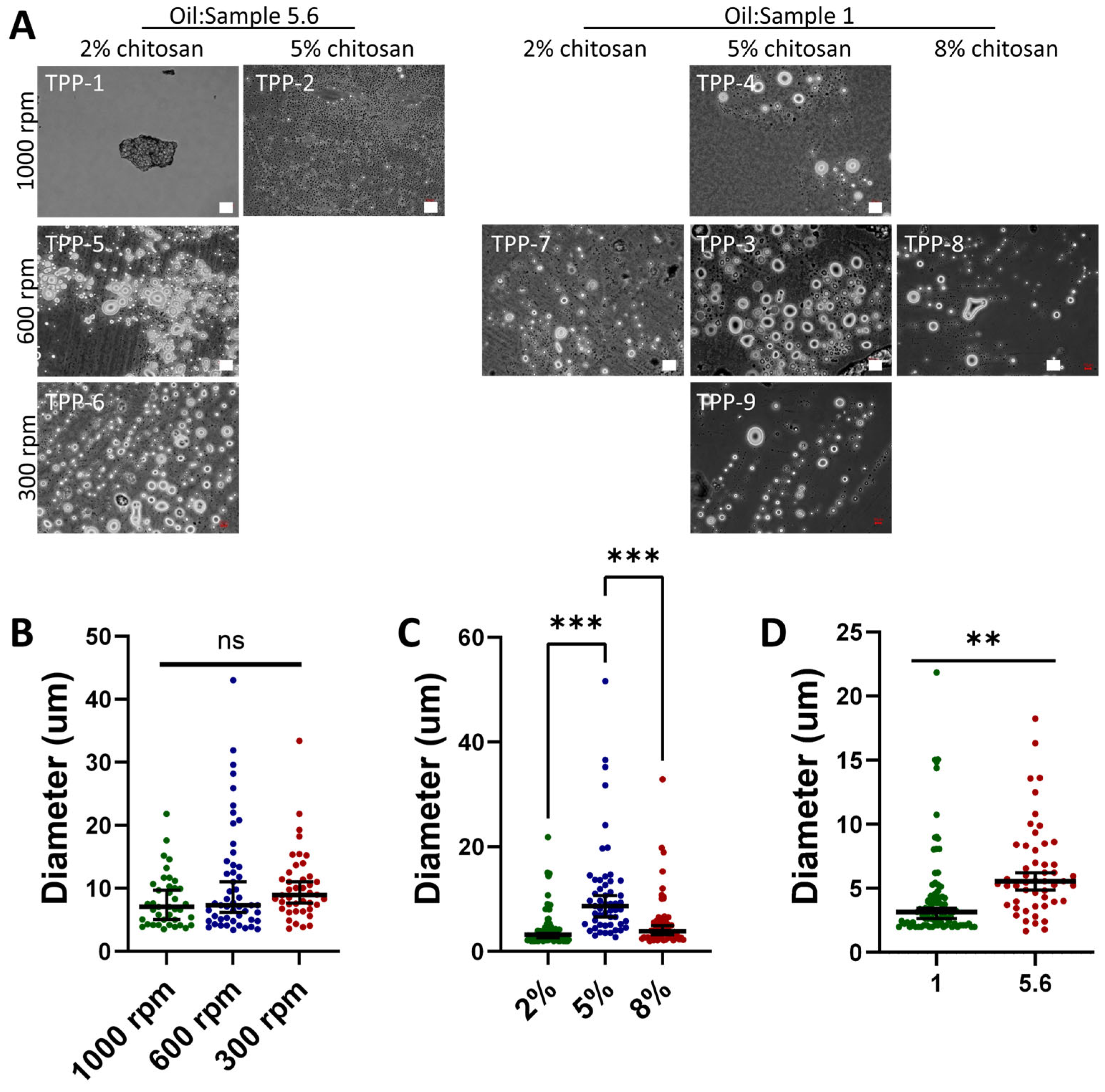
Microparticles were prepared and analyzed using optical microscopy to evaluate their size and morphology immediately after separation from the oil phase and subsequent redispersion in water to avoid potential aggregation upon freeze-drying (
Figure 1A and
Figure S1). As observed, the microparticles produced using sodium citrate as a crosslinker (NC1 to NC10) appeared to be agglomerated or forming flake-like structures and lacked a distinct shape, although they were freshly prepared. Attempts to improve microparticle formation by increasing polymer concentration (sample groups NC1–2 and NC3–5), varying the oil-to-sample ratio (NC7–9), oil-to-surfactant ratio (NC5–6), or crosslinker concentration (NC2–3) failed to result in a significant improvement. The resulting objects remained poorly structured and aggregated, and thus, further characterization was not conducted. Sodium citrate was used as the crosslinker in emulsification conditions NC1–10, which appeared to be ineffective in forming robust microparticles with well-defined shapes that would support the centrifugation and filtration steps without collapsing or losing their morphological integrity under our emulsification conditions. Nevertheless, this process has been reported to yield spherical microparticles [
28,
29] and, thus, we hypothesized that sodium citrate was ineffective in achieving sufficient ionic crosslinking regardless of the crosslinking time, perhaps due to a low diffusivity across emulsification media (oil) and through the chitosan itself under our specific set-up conditions. Additionally, the short emulsification and crosslinking times might have further contributed to the incomplete formation of microparticles despite being reported earlier by others [
28,
29].
To overcome these challenges, the crosslinker TPP was used in subsequent tests. Crosslinking with TPP provided a more controlled and efficient crosslinking process, as TPP is known for its ability to form strong ionic bonds with chitosan, resulting in enhanced microparticle stability and uniformity (samples TPP-1 to TPP-9). Optical microscopy images (
Figure 1A) revealed distinctly formed microparticles with minimal agglomeration and well-defined shapes for samples TPP-3 to TPP-9, indicating successful crosslinking. The improvement in microparticle formation and structural integrity is likely due to several key changes made to the protocol. Firstly, replacing sodium citrate with TPP as the crosslinker provided more effective ionic crosslinking. TPP interacts with the amino groups of chitosan, forming strong ionic bonds, which enhance the mechanical stability and robustness of the microparticles. Secondly, extending the emulsification time to overnight allowed for more uniform droplet formation in the oil phase, resulting in microparticles with consistent sizes. The longer emulsification period ensures that the chitosan droplets are stable and well-dispersed before crosslinking begins. Finally, increasing the crosslinking time to 7 h provided sufficient time for TPP to interact thoroughly with chitosan, ensuring complete crosslinking. This extended duration likely contributed to the improved particle shape and the prevention of agglomeration.
The process was optimized by studying the impact of polymer concentration (TPP-1 and TPP-2; TPP-3, TPP-7, and TPP-8), oil-to-sample ratio (TPP-2 and TPP-4; TPP-5 and TPP-7), and stirring speed (TPP-1, TPP-5, and TPP-6; TPP-3, TPP-4, and TPP-9) (
Figure 1). An increased agitation speed appeared to reduce the particle diameter, although not significantly, with agitations of 1000 rpm, 600 rpm and 300 rpm resulting on microparticles of 7.1 (5.1, 9.7) µm, 8.7 (6.6, 11.0) and 8.9 (7.7, 11.0) when samples were prepared from 5% chitosan solutions and an oil:sample ratio of 1 (
Figure 1B). Variation in the initial concentration of chitosan used to prepare the microparticles failed to show any clear trend, with median microparticle diameters of 3.2 (2.6, 3.5), 8.7 (6.6, 11.0), and 3.9 (3.2, 4.9) for polymer concentrations of 2%, 5%, and 8%, respectively (
Figure 1C). Variation in the oil-to-sample ratio had a clear impact on the capability to prepare well-defined microparticles. Sample conditions TPP-1 and TPP-2, with an oil-to-sample ratio of 5.6, a stirring speed of 1000 rpm, and a concentration of 2% and 5% chitosan, respectively, failed to yield microparticles. Comparison of samples TPP-2 and TPP-4, where only the oil-to-sample ratio was varied (agitation speed (1000 rpm) and polymer concentration (5%) constant) seem to indicate that for high agitation speeds, lower oil-to-sample ratios are needed to yield well-defined microparticles. Oil-to-sample ratios of 5.6, but lower agitation speeds of 600 rpm (TPP-5) and 300 rpm (TPP-6), enabled the formation of particles. A direct comparison of the effect of the oil-to-sample with conditions TPP-5 and TPP-7 using 5.6 and 1.0 oil-to-sample ratios, respectively, indicated that the higher the oil-to-sample ratio, the higher the microparticle diameter, yielding median microparticle diameters of 5.6 (4.9, 6.2) and 3.2 (2.6, 3.5), respectively (
Figure 1D).
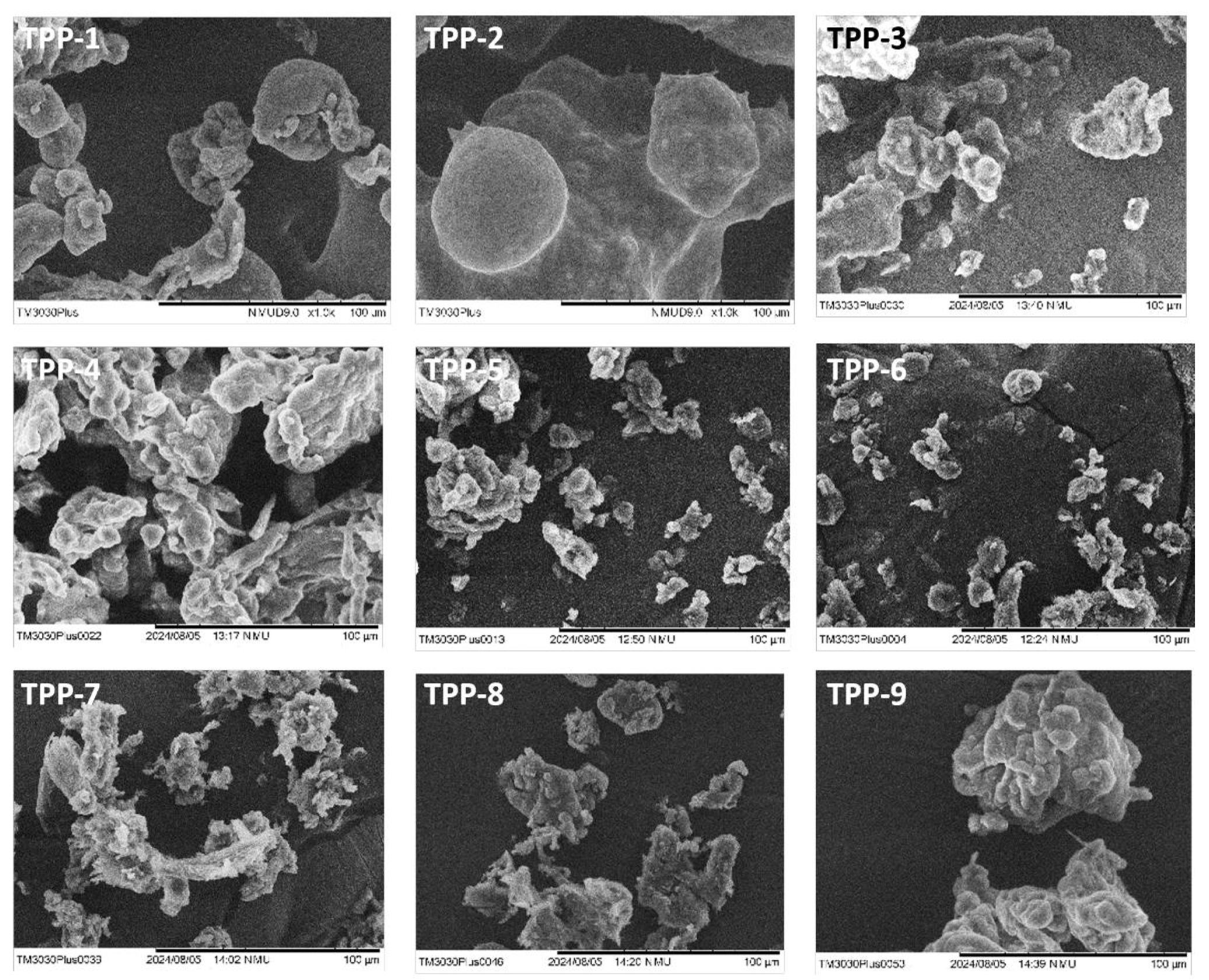
Scanning electron microscopy (SEM) was employed to further investigate the morphology and aggregation of the microparticles (
Figure 2). While optical images revealed distinct, well-formed, and individualized microparticles, sample freeze-drying for SEM resulted in significant agglomeration. In SEM imaging, the samples are typically dried to avoid distortion under the vacuum. However, the drying process can cause microparticle shrinkage or aggregation, especially if they are highly hydrophilic or sensitive to moisture loss. It is also possible that the drying process, particularly if it involved rapid drying, contributed to aggregation, causing the particles to collapse or bind together. To mitigate this issue, the complete drying of the microparticles was avoided in the subsequent steps. Instead, the microparticles were used in their hydrated form for further analysis to prevent aggregation and preserve their intended morphology.
2.2. Development of Chitosan/ALMA Granular Hydrogel
After optimization of the particle preparation process, the conditions from TPP-3 were selected for the development of chitosan-based and granular hydrogels, as these yield microparticles of the highest diameter, needed to fabricate cell-laden granular hydrogels. In this process, chitosan (CS) microparticles at concentrations of 5%, 10%, 20%, and 40% (
w/
v) were mixed with a 4% ALMA solution (
w/
v) to give rise to CS/ALMA hydrogels. Samples were prepared using a dual-crosslinking method based on ionic crosslinking, with CaCl
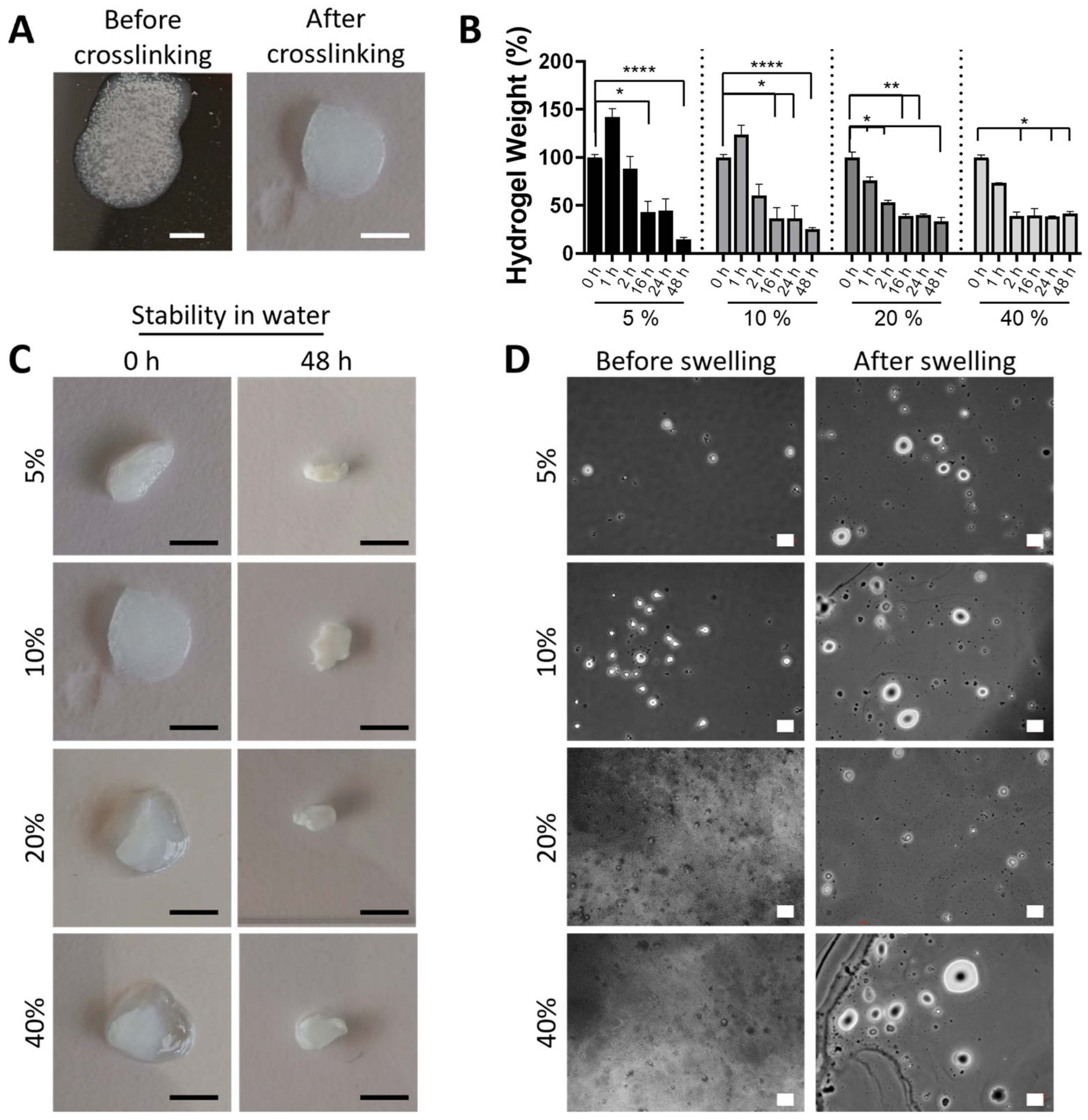
2, and covalent photo-crosslinking with UV light through the methacrylate groups of ALMA. The initial microparticle dispersions were clear and with a liquid consistency, but retained the shape immediately after crosslinking, changing to a whitish gel structure (
Figure 3A).
The stability of CS/ALMA granular hydrogels in water was evaluated over a period of 48 h (
Figure 3B,C). Granular hydrogels with the lowest microparticle concentrations of 5% and 10% suffered swelling in the first hour of incubation, reaching a weight increase of 142 ± 9% and 124 ± 10%, respectively. This can be ascribed to the higher concentration of ALMA in the hydrogels, driving the overall swelling of the hydrogel. Overall, granular hydrogels suffered a weight loss of 41–58%, depending on the sample composition, over the first 16 h, which remained stable upon further incubation in water only in hydrogels with the highest concentration of microparticles. Samples with the lowest concentration of microparticles suffered the highest weight loss, with a remaining weight of approximately 14.5% and 25.4% for samples containing 5% and 10% microparticles, respectively. Samples with the highest microparticle concentration showed a remaining weight of approximately 33.5% and 41.5% for samples bearing 20% and 40% microparticle concentration. This weight loss can be ascribed to the densification effect observed visually (
Figure 3C), by which the chitosan microparticles provided a structural reinforcement and improved network density. Chitosan is a polycation that can interact strongly with alginate, a polyanion, forming a polyelectrolyte complex that would increase the stability of the hydrogel [
30]. In this system, ALMA undergoes dual crosslinking through ionic bonds facilitated by CaCl
2 and covalent bonding induced by UV light. The CaCl
2 promotes ionic crosslinking by interacting with the carboxylate groups of the alginate, creating a network of ionic bridges that enhance the hydrogel’s mechanical strength and stability in an aqueous environment. Simultaneously, UV light initiates the polymerization of methacrylate groups in the ALMA, forming covalent crosslinks that further stabilize the hydrogel structure. Although chitosan itself is not methacrylated and does not participate directly in the covalent crosslinking, its presence plays a significant role in reinforcing the hydrogel via complexation with alginate. The chitosan microparticles serve as a physical scaffold within the hydrogel matrix, increasing the packing density and reducing the mobility of the polymer chains. This physical reinforcement complements the crosslinking mechanisms of ALMA, resulting in a more robust hydrogel network that resists degradation more effectively. In fact, optical observation of the granular hydrogels before and after immersion in water for 48 h revealed an initial segregation of the microparticles within the structure (observed as a white and dense area) that became homogeneous over time as the excess, non-crosslinked material was washed away (
Figure 3C). Upon incubation in water, chitosan microparticles also appeared to be swollen, with an increased diameter that could be observed by optical microscopy (
Figure 3D).
2.3. Development of CHIMA/ALMA and GelMA/ALMA Granular Hydrogels
To increase the stability of the developed granular hydrogels, chitosan was functionalized with methacrylate groups (CHIMA) that could polymerize with the bulk ALMA hydrogel (
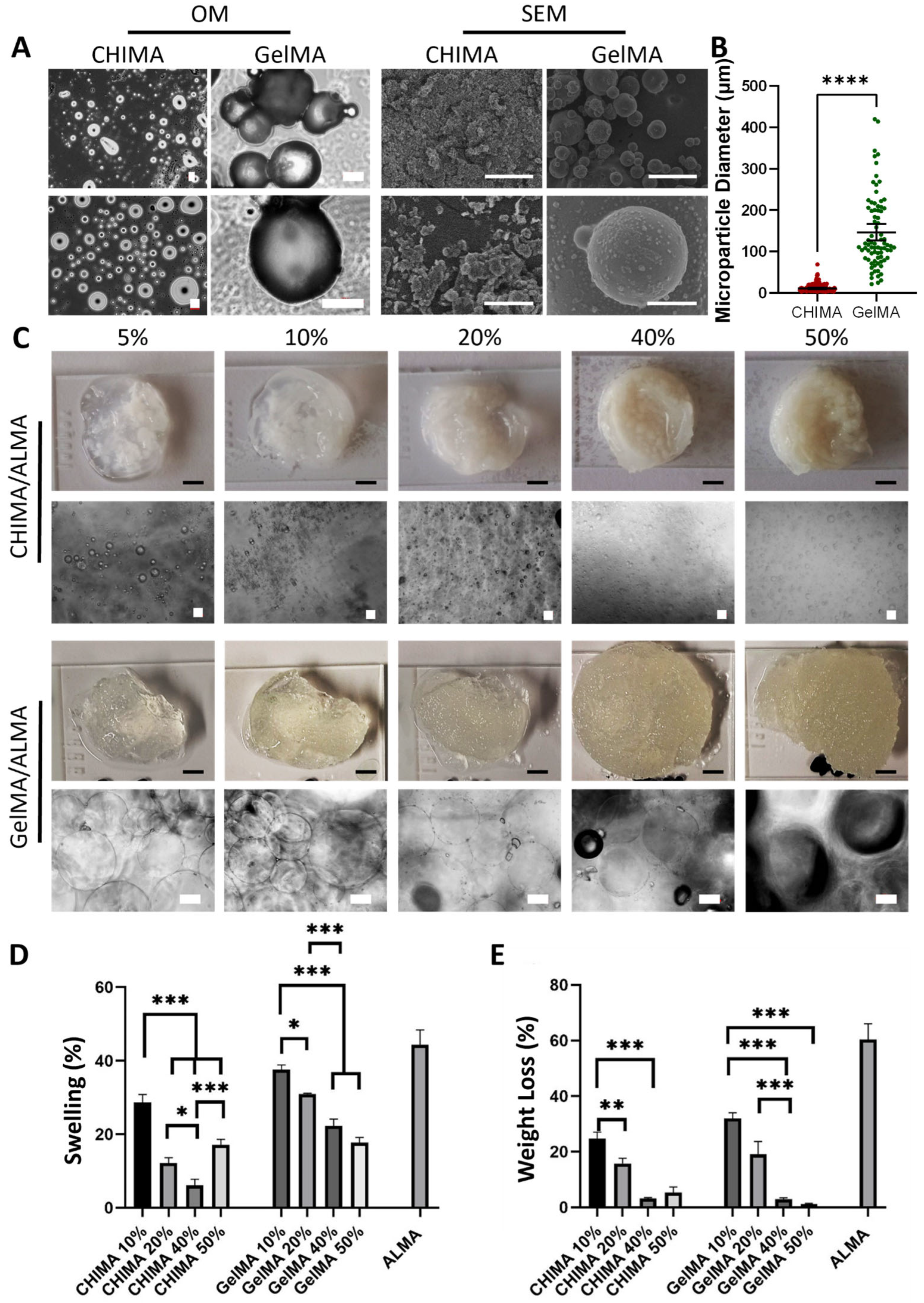
Figure S2). The inclusion of methacrylate moieties in the polymer is not expected to affect the size of the microparticles of the oil-emulsion process that remained unchanged for CHIMA microparticle production. Thus, CHIMA microparticles were obtained under the optimized conditions TPP-3 used for CS/ALMA hydrogels (
Figure 4A), yielding slightly larger particles with a median diameter of 10.8 µm (95% CI 9.2, 13.1) as measured by optical and scanning electron microscopies (
Figure 4B).
The development of granular hydrogels requires microparticles that are larger than 10 µm in diameter [
31]. However, the formation of jammed structures with sufficient space for multicellular infiltration, growth, and matrix deposition requires particle diameters of at least 50 µm [
31,
32]. Therefore, we decided to combine CHIMA particles with particles of a larger diameter and higher bioadhesivity, using a protocol developed earlier by us for methacrylated gelatin (GelMA) microparticles [
10]. The protocol makes use of a starting 30% (
w/
v) GelMA solution, and the obtained GelMA microparticles had a median diameter of 115.8 µm (95% CI 107.5, 137.6). A higher polymer concentration increases the viscosity of the aqueous phase, making it more resistant to shear forces during emulsification. As a result, it becomes more difficult to break the viscous polymer solution into smaller droplets within the oil phase, leading to the formation of larger microparticles. CHIMA microparticles were prepared using the oil emulsion method and then crosslinked with TPP after emulsification. The TPP crosslinking process stabilizes the droplets by chemically bonding the polymer chains, preventing further droplet coalescence or growth. This results in smaller, more uniform microparticles since the crosslinking locks the particle size at the point of emulsion formation. The ionic crosslinking with TPP ensures that the droplets are stabilized early in the process. In contrast, GelMA microparticles were created using a higher polymer concentration and then subjected to physical gelation in an ice bath. The higher concentration increases the viscosity of the emulsion, making it more difficult to break the polymer solution into smaller droplets. Additionally, since the gelation process is slower and dependent on temperature, the droplets tend to merge or grow before they are fully stabilized, leading to larger microparticles. The absence of chemical crosslinking during emulsification, combined with the higher concentration, allows for larger droplet formation that only begins to stabilize once the temperature drops in the ice bath.
Morphological characterization by SEM revealed GelMA microparticles with a distinct spherical shape and little aggregation (
Figure 4A). In contrast, CHIMA microparticles appear to be agglomerated. Given that CHIMA microparticles were smaller than GelMA, they have a larger surface area relative to their volume, which makes them more susceptible to inter-particle interactions. As a result, these smaller particles are more likely to stick together or agglomerate during the drying process.
Next, both CHIMA/ALMA and GelMA/ALMA granular hydrogels were prepared using CHIMA and GelMA microparticles mixed and crosslinked with ALMA gel (
Figure 4C). The goal was to enhance the crosslinking between the methacrylate groups of ALMA and the CHIMA or GelMA microparticles. In the case of GelMA/ALMA hydrogels, the microparticle formation involved physical crosslinking of the GelMA via chain entanglement, while chemical crosslinking was achieved through the methacrylate groups of GelMA and ALMA that strengthen the matrix, and using CaCl
2 to crosslink the ALMA. The use of CaCl
2, specifically for ALMA, promotes ionic crosslinking, contributing to the stability and integrity of the hydrogel network. For CHIMA/ALMA hydrogels, the process was similar to the GelMA-based system. However, in this case, the crosslinking primarily relied on ionic interactions between the chitosan in the CHIMA microparticles and TPP. Chitosan is a cationic polymer due to the presence of amino groups on its structure, which can form strong ionic bonds with negatively charged TPP molecules. Additionally, the methacrylate groups in both CHIMA and ALMA, as in the GelMA/ALMA system, undergo free radical polymerization upon UV exposure, creating a more robust, covalently bonded structure.
Different microparticle concentrations of 5%, 10%, 20%, 40%, and 50% were used to develop granular hydrogels (
Figure 4C). Hydrogels loaded with low, 5–10% microparticle concentration presented phase segregation, with ALMA-rich and microparticle-rich phases that could be distinguished visually. Particularly, ALMA hydrogels loaded with 5% microparticle concentration lack structural stability and were discarded from further analysis. An increasing concentration of microparticles resulted in more whitish and opaque hydrogels for both CHIMA/ALMA and GelMA/ALMA. The larger size of GelMA microparticles was still evident after embedding in the ALMA hydrogel, especially when compared to CHIMA microparticles. It should be noted that as the microparticle concentration increased, the opacity and density of the granular hydrogels also increased, which caused light scattering during image acquisition and the difficulty of obtaining sharp, well-defined images of the embedded microparticles.
The results show that increasing the concentration of CHIMA microparticles generally leads to a decrease in the water absorption capacity of the hydrogels. This is likely because a higher microparticle content increases the density of the hydrogel structure, reducing the free space available for water uptake. However, an interesting observation is that hydrogels containing 50% microparticles exhibit higher water absorption compared to those containing 40% and 20% microparticles. This behavior could be explained by the possibility that, at very high microparticle concentrations, the particles themselves may act as additional hydrophilic domains, promoting water retention. Alternatively, the organization or packing of microparticles at high concentrations might create microvoids or interconnected pores within the hydrogel, which could facilitate greater water uptake despite the overall denser structure. CHIMA microparticles are less hydrophilic than pure chitosan or pure alginate but still have some moderate hydrophilicity due to remaining hydroxyl groups and incomplete methacrylation. However, this increased water uptake at 50% microparticle concentration is likely not due to the intrinsic hydrophilicity of CHIMA, which is moderate compared to highly hydrophilic polymers such as alginate. Rather, at very high microparticle concentrations, the network structure may become less densely packed, leading to the formation of pores and interstitial spaces within the hydrogel. These structural voids can physically trap more water, resulting in an overall higher swelling capacity despite the relatively lower hydrophilicity of the CHIMA microparticles themselves.
The structural stability of granular hydrogels upon culture in liquid media was evaluated for both CHIMA/ALMA and GelMA/ALMA systems (
Figure 4D,E). Increasing the microparticle concentration within the hydrogels led to a reduction in water absorption. In fact, a correlation between water absorption density and a tighter network structure was created at higher microparticle loadings. As more microparticles are packed into the hydrogel matrix and crosslinked with the ALMA support polymer, fewer void spaces and interstitial gaps are available to accommodate water, thereby limiting the overall swelling capacity of the hydrogel. Interestingly, when the microparticle concentration was increased to 50%, the hydrogels exhibited a higher water absorption compared to the 40% and 20% microparticle formulations. This behavior could be due to the reduced packing efficiency at very high microparticle concentrations, which may create larger pores and a more heterogeneous network structure. These structural irregularities facilitate greater water penetration into the hydrogel matrix. Since the size of GelMA microparticles was approximately 10-fold that of CHIMA microparticles, a lower surface area and amount of methacrylic groups were available to bind ALMA; thus, the water absorption of GelMA/ALMA hydrogels was higher than that of CHIMA/ALMA hydrogels.
The weight loss of CHIMA/ALMA and GelMA/ALMA granular hydrogels after 72 h of incubation in water followed the same trend as for the water absorption (
Figure 4E). Specifically, an increase in microparticle concentration led to enhanced hydrogel stability and reduced weight loss. Simultaneously, the lower water uptake and lower weight loss in hydrogels with higher microparticle concentrations also confirm a lower water content in these samples.
2.4. Viscoelastic Properties of CHIMA/ALMA and GelMA/ALMA Granular Hydrogels
Hydrogels for cartilage regeneration have traditionally been of low mechanical properties. Thus, the typical storage modulus of alginate-based hydrogels is in the order of a few hundred Pa, depending on the molecular weight [
33]. These values are significantly lower than the reported storage modulus of human articular cartilage, which ranges from 32 to 43 MPa [
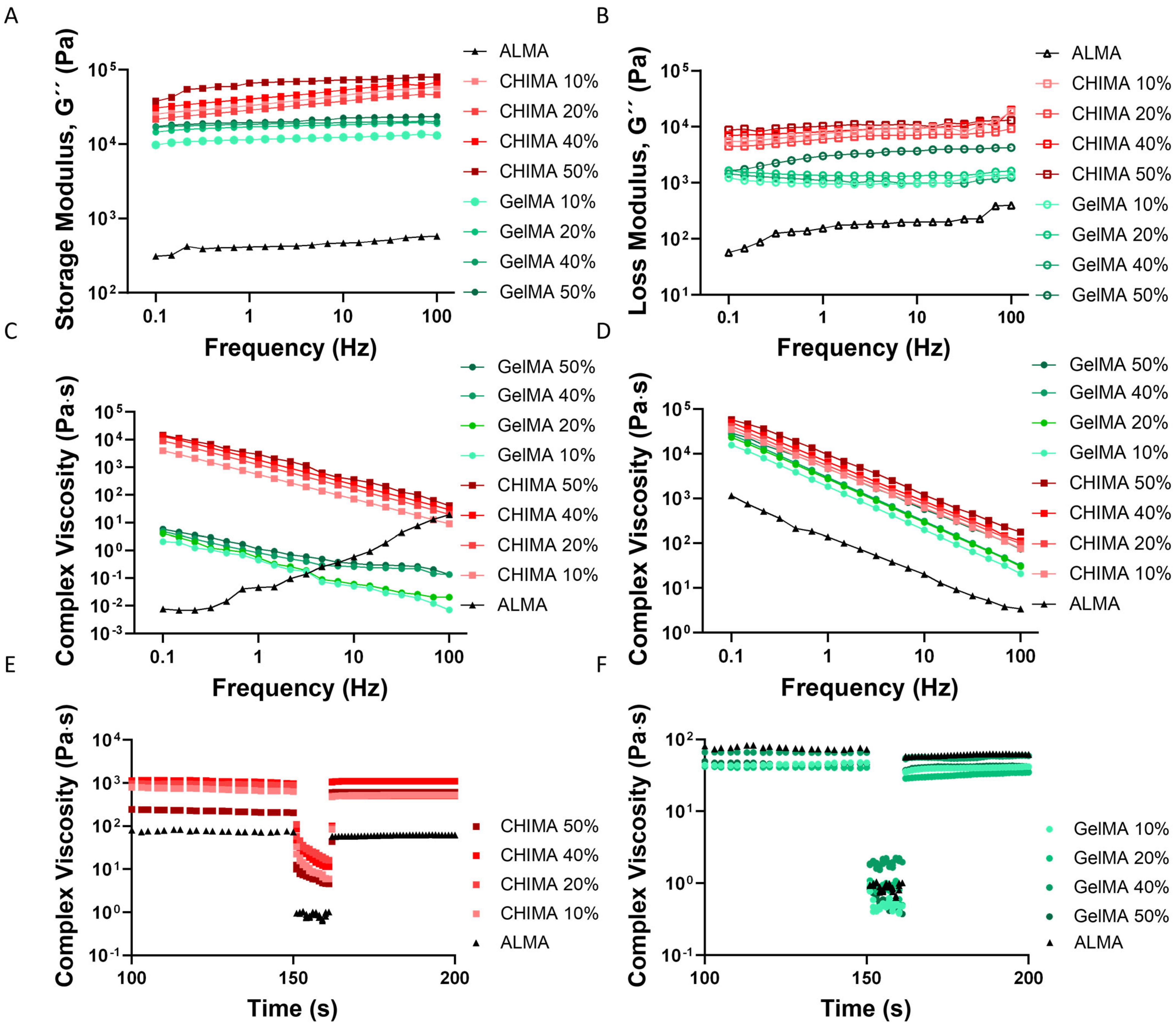
34]. The inclusion of microparticles to form granular hydrogels has been shown to increase the storage modulus of the supporting matrix. The viscoelastic properties of CHIMA/ALMA and CHIMA/GelMA granular hydrogels were analyzed using rheological characterization. First, the loss and storage moduli of these hydrogels were analyzed to assess their overall mechanical performance and the effect of microparticle concentration on these properties (
Figure 5A,B). The storage modulus (G′) reflects the elastic (solid-like) behavior of the hydrogel, representing its ability to store energy when deformed. In contrast, the loss modulus (G″) indicates the viscous (liquid-like) behavior, corresponding to the amount of energy dissipated during deformation. All granular hydrogels showed a significant increase in both storage and loss moduli as compared to ALMA hydrogels without any microparticles (
Table 2). Thus, GelMA and CHIMA microparticles act as reinforcing fillers within the ALMA hydrogel, improving their capability to resist deformation and increasing both the elastic and viscous components of the material response under stress. Increasing microparticle concentration in both CHIMA/ALMA and GelMA/ALMA hydrogels led to increased G′ and G″. A higher concentration of microparticles results in a denser and more interconnected network within the hydrogel matrix. The microparticles not only occupy space but also provide additional physical crosslinking points or act as mechanical anchors, which restrict the mobility of the polymer chains. As a result, the hydrogel becomes stiffer (higher G′) and more resistant to deformation, while also exhibiting a slight increase in energy dissipation capacity (higher G″) under applied stress. This reinforcement effect is particularly important for applications where mechanical strength, durability, and resilience are critical, such as in the regeneration of articular cartilage.
CHIMA/ALMA granular hydrogels exhibited significantly higher storage and loss moduli compared to GelMA/ALMA hydrogels (
Table 2 and
Figure 5A,B). Granular hydrogels with 50% microparticle loading showed storage and loss moduli of 66.4 and 10.1 kPa and 19.5 and 2.9 kPa for CHIMA/ALMA and GelMA/ALMA hydrogels, respectively. This represents an approximate three-fold increase in both the elastic and viscous responses in CHIMA/ALMA compared to GelMA/ALMA hydrogels. The higher moduli observed in CHIMA/ALMA hydrogels likely result from the intrinsic properties of chitosan-based microparticles, which are stiffer and form stronger physical and ionic crosslinks within the network. In contrast, GelMA, derived from gelatin, is softer and more flexible, leading to lower mechanical resistance. While the storage modulus of human articular cartilage is in the range of 32 to 43 MPa [
34], this is measured when a rich extracellular matrix is deposited by cells and further matures over time, acquiring the specific protein spatial organization observed in the tissue (e.g., collagen archades) and the stress-relaxation characteristic of water entrapping glycosaminoglycans. Thus, while the storage modulus reported here for granular hydrogels is not comparable to that of the native tissue, it might hinder the formation of the clasical hyperthophic tissue deposited in softer hydrogels.
The complex viscosity, a parameter derived from oscillatory rheology, reflects the resistance of a material to deformation under dynamic shear and encompasses both viscous and elastic contributions. It is particularly useful for evaluating the mechanical integrity of viscoelastic materials like hydrogels. The complex viscosity of the granular hydrogels before crosslinking showed a shear-thinning response in all compositions with an associated increase in viscosity with microparticle loading (
Figure 5C). This behavior suggests a denser and more interconnected microstructure within the hydrogel, which resists flow more effectively due to the presence of a greater number of physical and chemical interactions between microparticles and the surrounding matrix. Shear-thinning is a desirable property for injectable or printable biomaterials, as it allows the material to flow under stress but recover its structure at rest. This behavior arises from the alignment and disentanglement of polymer chains and microparticles under shear, which temporarily reduces internal resistance to flow. Interestingly, ALMA hydrogels without microparticles show an opposite trend prior to crosslinking, with viscosity increasing under higher shear. This behavior may stem from the relatively low molecular weight and concentration of ALMA, leading to weak intermolecular interactions that shortly reorganize under shear stress. However, upon addition of either CHIMA or GelMA microparticles, the hydrogel matrix gains a more entangled and heterogeneous structure, restoring a typical shear-thinning response.
Photo-crosslinking strengthens the hydrogel by forming covalent or ionic bonds that reduce molecular mobility, thus greatly increasing resistance to deformation. Crosslinking of granular hydrogels resulted in an increased complex viscosity of approximately three orders of magnitude for GelMA and of five-fold for CHIMA, an approximate 33-fold and 69-fold increase with respect to ALMA alone on 50% microparticle loaded hydrogels, respectively (
Figure 5D). This significant difference may be attributed to the inherent stiffness and positive charge density of chitosan-based particles, which interact more strongly with ALMA (negatively charged), leading to more effective stress distribution and reinforcement within the hydrogel network.
The physiological loading frequency of hyaline cartilage has been established to be in the range of 10
0–10
3 Hz, with the lowest frequencies of 10
0–10
1 Hz representing walking, up to 10
2 Hz running or jumping and landing, and the highest, of up to 10
3 Hz, representing a traumatic injury [
35]. Our experimental setup represented physiological conditions (up to 10
2 Hz). Recent studies of the rheological properties of bovine articular cartilage revealed clear differences between immature, mature, and pathological cartilage with storage moduli of approximately 2 MPa, 5 MPa, and 0.3 MPa, at 1 Hz, respectively, when a 5 N load was applied [
36]. When a constant frequency of 1 Hz was applied, bovine cartilage displayed a storage modulus of 1 MPa at 0.01% strain. Our samples displayed a maximum storage modulus of 66 kPa for CHIMA/ALMA hydrogels at 50% microparticle loading and of 19 kPa for GelMA/ALMA samples at 50% loading. Thus, despite having an over 150-fold increase in the storage moduli of CHIMA/ALMA at 50% loading as compared to ALMA alone, the overall rheological properties of the developed granular hydrogels are still 1 order of magnitude below those of bovine articular cartilage under similar test conditions.
Shear recovery tests are used to assess the self-healing or structural resilience of hydrogels under dynamic mechanical stress, which is particularly relevant for applications involving injection, 3D printing, or load-bearing environments such as those of articular cartilage. The test involves subjecting the hydrogel to a high shear strain to disrupt its internal network, followed by monitoring the recovery of complex viscosity over time once the stress is removed. Cartilage is subjected to daily strains of up to 30%, and thus, the shear recovery was calculated as the percentage recovery of the complex viscosity from the initial, after a shear strain of 30% was applied to the sample [
37]. The shape recovery capability of granular hydrogels increased with microparticle concentration for both CHIMA and GelMA hydrogels (
Table 2 and
Figure 5E,F). This improvement is likely due to the formation of a more physically entangled and densely packed network, where microparticles act as reversible physical crosslinkers or anchoring sites. These structures can temporarily deform under stress but reorganize quickly upon release, thus promoting recovery. Interestingly, hydrogels based on GelMA consistently exhibited slightly higher recovery percentages than their CHIMA counterparts at equivalent microparticle concentrations. For example, GelMA/ALMA hydrogels achieved a maximum recovery of 95.1%, compared to 91.6% and 90.2% for CHIMA/ALMA hydrogels with 40% and 50% microparticles, respectively. This difference may be attributed to the more flexible and hydrophilic nature of gelatin-derived particles, which facilitates faster chain reorganization and interaction with the ALMA matrix after shear. In contrast, CHIMA microparticles, derived from chitosan, are stiffer and more electrostatically interactive due to their cationic nature, potentially leading to a slightly slower or less efficient structural reformation. Moreover, the observation that CHIMA/ALMA with 50% microparticles had slightly lower recovery (90.2%) than the 40% group (91.6%) can be explained by the fact that at very high microparticle concentrations, the hydrogel may become excessively rigid or over-packed. This can reduce the mobility of polymer chains and limit the dynamic reformation of interactions required for full recovery, effectively compromising the reversibility of the internal network. Interestingly, even the ALMA hydrogel (0% microparticles) demonstrated a moderately high recovery capability, likely due to reversible physical interactions (e.g., hydrogen bonding or chain entanglements) within the polymer matrix.
Overall, the rheological analyses underscore the potential of granular hydrogels in applications such as bioprinting and cartilage tissue engineering, where mechanical performance is critical. The ability of these materials to exhibit shear-thinning behavior—where viscosity decreases under shear—enables smooth extrusion during printing processes, while their high storage modulus and rapid recovery after shear ensure that the printed structure retains its shape and mechanical integrity once deposited. These are essential features for building stable constructs with high fidelity and load-bearing capacity, particularly in the context of regenerating cartilage or other mechanically active tissues. Moreover, the composition and concentration of the microparticles embedded within the ALMA matrix play a pivotal role in determining the viscoelastic behavior of the resulting granular hydrogels. A higher microparticle content generally enhances viscosity, stiffness, and recovery, but overly high concentrations can reduce structural reorganization capacity. The type of microparticles also made a difference, with CHIMA-based hydrogels, due to the rigid, positively charged chitosan backbone, tend to form stiffer, more robust structures suitable for applications requiring higher mechanical strength (e.g., cartilage or bone interfaces) and GelMA-based hydrogels, with a higher elasticity and recovery upon shear, making them potentially more suitable for softer tissue engineering applications where compliance and cell-friendly properties are prioritized.
2.5. CHIMA/ALMA and GelMA/ALMA Granular Hydrogel Biocompatibility and Chondrogenic Differentiation Potential
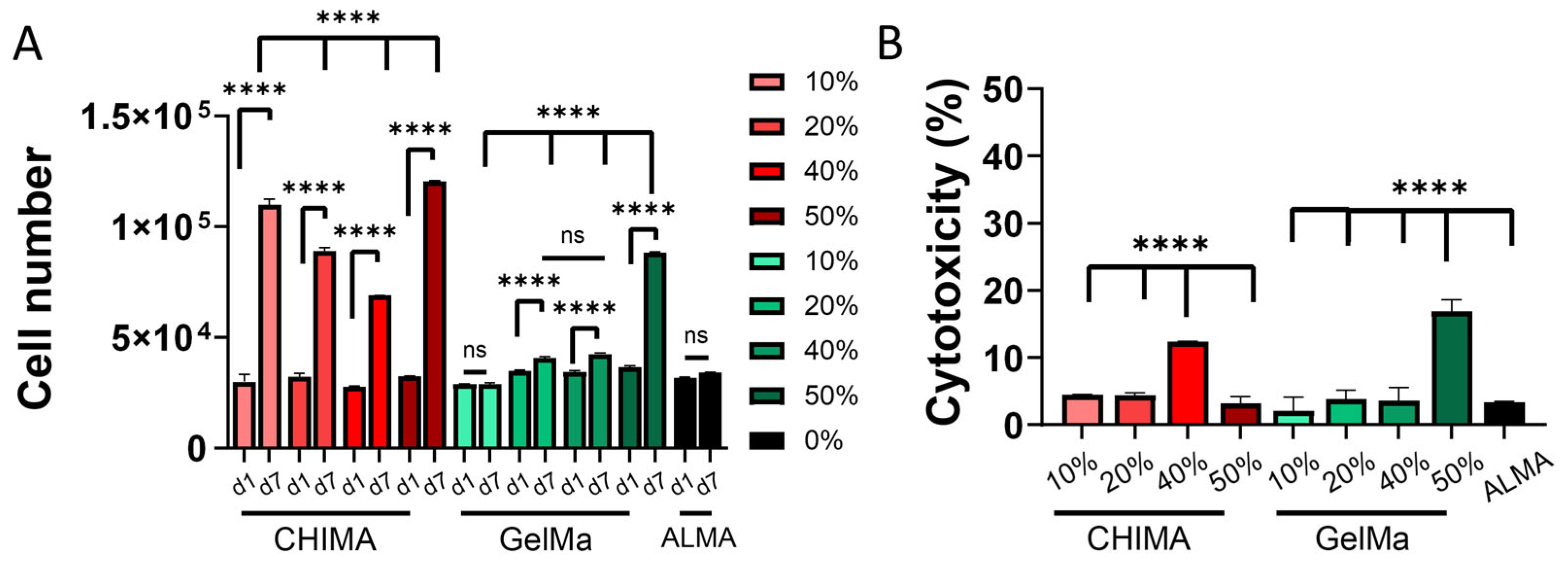
To investigate the applicability of the developed granular hydrogels for cartilage tissue regeneration, first, the capability of the gels to support mouse mesenchymal stem cell (MoMSC) viability and proliferation over time was investigated. Cell proliferation and cytotoxicity of CHIMA/ALMA and GelMA/ALMA granular hydrogels with varying microparticle concentrations were evaluated after 1 and 7 days of culture using DNA quantification and lactate dehydrogenase (LDH) assays (
Figure 6).
After 7 days of culture within granular and ALMA hydrogels, CHIMA/ALMA samples containing 10% and 50% microparticles demonstrated approximately three-fold increases in DNA content, indicating robust cell proliferation (
Figure 6A). Interestingly, the 40% CHIMA group exhibited the lowest increase in cell number, suggesting that microparticle concentration has a non-linear effect on cell growth potential due to differences in microstructure or porosity affecting nutrient diffusion or cell–material interactions. In fact, a correlation between water absorption capability or swelling and weight loss (
Figure 4D,E) with cell number appears evident. In all cases, there is a trend with increasing microparticle concentration from 10% to 40%, resulting in a lower swelling, lower weight loss, and lower cell proliferation. Moreover, this trend is disrupted at 50% CHIMA concentration, where swelling and cell proliferation values become higher than for 40% or 20% counterparts. This could be explained as a result of the packing density of the microparticles and the interactions with ALMA. As CHIMA microparticle concentration increases, the packing density becomes higher or more tortuous, and the porosity lower, hindering or at least making more difficult the diffusion of media and cells. At the highest microparticle concentration tested here (50%), the packing efficiency might decrease, leading to particle agglomeration, reducing tortuosity and, hence, facilitating the diffusion of media and cells. Despite this, the overall trend across all CHIMA-containing hydrogels was an increased DNA content from day 1 to day 7, indicating that CHIMA microparticles supported cell proliferation.
GelMA/ALMA hydrogels demonstrated the most substantial increase in DNA content (approximately twofold) in the 50% microparticle group. However, the extent of proliferation was generally lower in GelMA-based samples as compared to their CHIMA counterparts. In fact, CHIMA/ALMA hydrogels with 50% microparticles showed about 36% higher DNA content than GelMA/ALMA hydrogels at the same microparticle concentration by day 7. This could be attributed to differences in the mechanical and surface properties of CHIMA and GelMA microparticles, with CHIMA presenting a stiffer substrate for proliferation than GelMA.
These findings suggest that higher microparticle concentrations, particularly 50%, provide more surface area for cell attachment and spreading, thereby facilitating proliferation, as long as the overall structural environment remains permissive to cell infiltration and nutrient exchange. Moreover, the superior performance of CHIMA over GelMA in supporting proliferation may relate to its higher mechanical stiffness and potential for electrostatic interactions with cell membranes.
Cytotoxicity was calculated in all different hydrogel compositions after 7 days of culture and normalized to the cell number (
Figure 6B). The results demonstrate that while the majority of samples exhibited low cytotoxicity, hydrogels of CHIMA and GelMA at 40% and 50% microparticle loading, respectively, showed a significantly higher cytotoxicity of approximately 15%. The materials used here crosslink by exposure to light, and no small-molecule-based crosslinkers are used. Thus, no side-products should be left on the system. Degradation products at this time-point and physiological conditions can only be attributed to uncrosslinked ALMA, GelMA, or CHIMA, and these are non-cytotoxic. Thus, we hypothesized that the slight increase in cytotoxicity may be attributed to the denser packing and more compact internal structure of these hydrogels at higher microparticle concentrations. Such dense packing can cause cell stress during encapsulation or seeding. Nevertheless, according to the ISO 10993-5 standard, a material is considered non-cytotoxic if cell viability exceeds 70%, which corresponds to a maximum acceptable cytotoxicity of 30% (533). All tested groups remained well below this threshold, and thus, all hydrogel formulations can be classified as biocompatible.
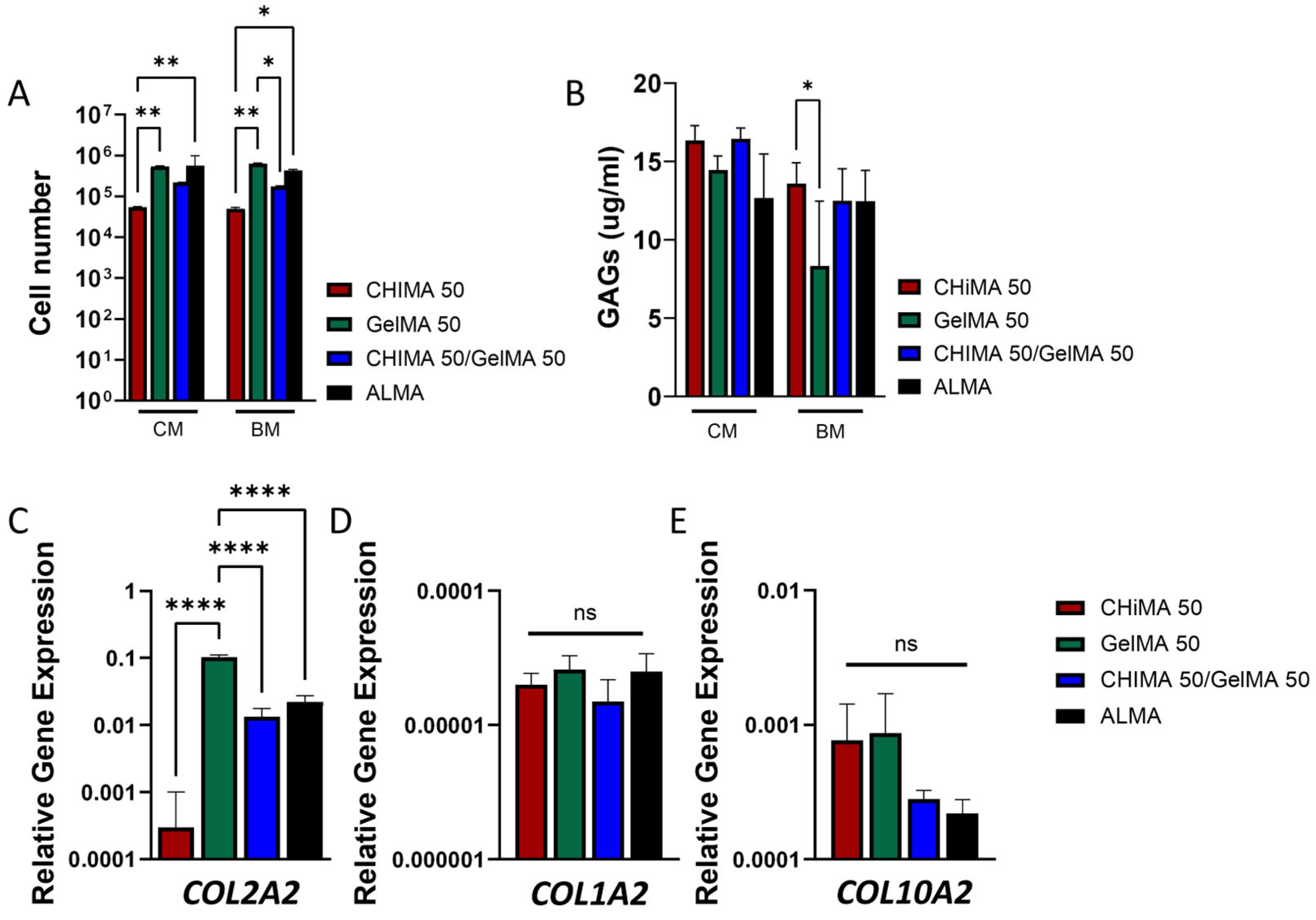
The ability of CHIMA/ALMA and GelMA/ALMA granular hydrogels to induce chondrogenic differentiation of MoMSCs was studied after 28 days of culture in chondrogenic and basal media conditions. To do so, we selected granular hydrogels composed of CHIMA/ALMA, GelMA/ALMA, and a composite hydrogel containing a 1:1 ratio of CHIMA and GelMA microparticles, under the assumption that the combination of both types of microparticles will provide cell adhesivity and high porosity (GelMA microparticles) while still increasing the overall rheological properties (CHIMA microparticles). Granular hydrogels with a 50% microparticle loading also presented the highest cell number after 7 days of culture, a swelling below the 20%, and the lowest weight loss or higher stability during culture periods of 72 h. Samples at 50% microparticles loading also displayed the highest storage module and shape recovery values over 90%. Thus, the total microparticle concentration was fixed at 50% for all CHIMA/ALMA, GelMA/ALMA, and 50:50 CHIMA:GelMA/ALMA hydrogels. Cell-laden hydrogels were cultured for 28 days under basal (BM) and chondrogenic (CM) media conditions (
Figure 7). Initially, 15.000 cells were seeded per hydrogel and, after 28 days of culture, a general increase in DNA content was observed across all groups of over 1–2 orders of magnitude. Among all formulations, GelMA/ALMA hydrogels supported the highest levels of DNA content at day 28 in both basal and chondrogenic media, with a two-order-of-magnitude increase in DNA content. This enhanced proliferative response may be attributed to the microstructural features of GelMA-based granular hydrogels, which tend to exhibit a less densely crosslinked and more compliant network and are likely more permissive to cell migration and proliferation compared to the denser CHIMA-based matrices. In contrast, cells within CHIMA/ALMA hydrogels showed an increase of one order of magnitude, lower than that of GelMA hydrogels, which could be attributed to the bioactive nature of CHIMA, a chemically modified chitosan derivative that may better mimic native cartilage extracellular matrix and thus favor early chondrogenic differentiation at the expense of proliferation. Comparison with early measurements of cell number and proliferation at only 7 days of culture in basal media conditions (
Figure 6) showed the opposite trend, with CHIMA/ALMA hydrogels presenting a higher cell number than GelMA/ALMA hydrogels. This effect can be ascribed to the stiffer nature of CHIMA microparticles that initially promote a faster proliferation, but at long term, the potentially less porous structure might hinder cell proliferation to the extent observed for GelMA hydrogels.
Glycosaminoglycans (GAGs) are essential components of the extracellular matrix (ECM) in cartilaginous tissues and are considered a marker of successful chondrogenic differentiation. These long, unbranched polysaccharides, such as chondroitin sulfate, keratan sulfate, and hyaluronic acid, play a crucial role in maintaining the structural integrity, hydration, and mechanical resilience of cartilage. They are secreted primarily by differentiated chondrocytes or mesenchymal stem cells undergoing chondrogenic differentiation and are typically embedded within a collagen type II-rich matrix. The sulfated nature of GAGs enables them to bind large amounts of water, which is vital for the compressive strength and viscoelastic behavior of cartilage. Additionally, GAGs interact with growth factors and cytokines in the microenvironment, helping regulate cell signaling, proliferation, and matrix assembly. The amount of GAGs produced in the granular hydrogels after 28 days of culture was overall higher in samples cultured in chondrogenic media, as expected (
Figure 7B). Within media conditions, GAG deposition was highest in CHIMA/ALMA and CHIMA/GelMA/ALMA hydrogels compared to GelMA/ALMA or ALMA alone. This elevated GAG production is consistent with the lower DNA content observed in CHIMA and CHIMA/GelMA containing samples, suggesting that the cells have transitioned from a proliferative to a differentiative state.
To further evaluate the chondrogenic potential of the granular hydrogels, the expression levels of key cartilage and bone-related genes were analyzed after 28 days of culture using RT-PCR. Specifically, we assessed the expression of Col2a1 (type II collagen), Col10a1 (type X collagen), and Col1a1 (type I collagen) in all groups cultured in either basal or chondrogenic media (
Figure 7C–E). Col2a1 is a widely recognized marker of hyaline cartilage and is indicative of early to mid-stage chondrogenic differentiation, as it is a major structural component of the cartilage extracellular matrix (ECM). Col10a1 is associated with hypertrophic chondrocytes and is often used to assess progression toward endochondral ossification or late-stage chondrogenesis. In contrast, Col1a1 is the primary collagen found in bone and fibrous tissue and serves here as a control to evaluate whether cells are diverting toward an undesired osteogenic or fibroblastic lineage.
The results revealed a substantial upregulation of Col2a1 expression in GelMA-containing hydrogels cultured in chondrogenic medium, suggesting a capacity to support chondrogenic differentiation. In contrast, Col2a1 expression was lower in CHIMA/ALMA hydrogels cultured under the same conditions. Hydrogels composed only of the supporting polymer ALMA also exhibited a relatively high level of Col2a1 expression, comparable to that of CHIMA/GelMA samples, suggesting that ALMA provides a permissive environment for chondrogenic differentiation of MoMSCs. The expression of Col1a1 was markedly lower across all hydrogel conditions when compared to Col2a1 and Col10a1 expression levels, indicating a limited activation of the osteogenic lineage and suggesting that the granular hydrogels support chondrogenic differentiation over osteogenesis. Nevertheless, while the expression level of Col1a1 was low for cells cultured in all hydrogel conditions, the expression levels of Col10a1 were lower (although not statistically significant) in samples of CHIMA/GelMA/ALMA and ALMA alone than in CHIMA/ALMA or GelMA/ALMA groups. Thus, the higher expression of Col10a1 in samples CHIMA/ALMA and GelMA/ALMA suggests that at longer culture periods, the initial onset of chondrogenesis observed as expression of Col2a1 and GAG deposition, could further evolve towards hypertrophic phenotypes with a higher expression and deposition of Col1a1 and Col10a1. This result suggests that the encapsulated MoMSCs predominantly remained in an early to mid-stage of chondrogenic differentiation, without progressing toward hypertrophy in the particular CHIMA/GelMA/ALMA hydrogels.
Maintaining a stable, non-hypertrophic chondrogenic phenotype is crucial for mimicking native articular cartilage and preventing ossification-related complications, which is a key goal. Thus, these findings are promising for cartilage tissue engineering, indicating the potential of CHIMA-containing microparticle hydrogels to support early chondrogenic differentiation for cartilage regeneration. Nevertheless, a deeper study of the cell phenotypic state and matrix deposition would be required to unravel the full potential of the developed granular hydrogels. Next steps would require assessing the impact of age, donor, and sex dependency on human cell differentiation and matrix deposition. Further in vivo studies would also be key to determining their applicability for the regeneration of cartilage.





 ,
,