Tracheal Regeneration: Recent Progress in the Application of Stem Cells in Tracheal Bioengineering


Abstract
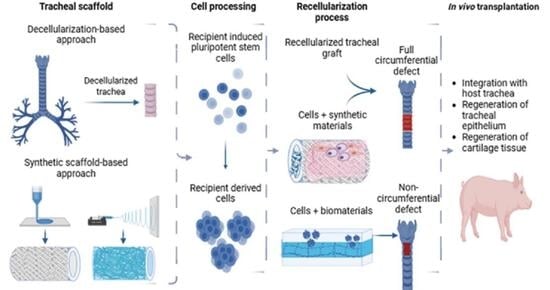
1. Introduction
2. Clinical Need and Current Approaches for Tracheal Repair and Replacement
3. Natural Biomaterials and Decellularized Tracheal Tissue Scaffolds for Bioengineered Grafts

| Scaffold/ Material | Graft Size | Cell Source | Experimental Details | Outcomes | Study |
|---|---|---|---|---|---|
| Acellular tracheal patch allografts | Patch 15 × 15 mm | No cells | Pigs (4w) were transplanted with acellular allogeneic tracheal grafts followed by bronchoscopic and histological evaluation at 11 weeks post-transplantation. | Acellular grafts showed some re-vascularization and re-epithelialization after implantation with regeneration of cartilage foci adjacent to the grafts. However, grafts failed due to stenosis and collapse. | [74,75] |
| Acellular and recell- ularized tracheal allografts | Long-segment circumferential graft 2–3 cm | Autologous mesenchymal stromal cells (MSCs) and tracheal epithelial cells | Porcine acellular and recellularized long-segment circumferential tracheal allografts heterotopically transplanted and followed by evaluation of in vitro and in vivo T cell proliferation and infiltration. | Acellular graft delayed leukocyte infiltration, but eventually cartilage degradation was observed due to the incomplete removal of MHC in the submucosal gland and CD4+ T cells induction. Recellularization induced immunological tolerance by the recruitment of CD4+CD25+Foxp3+ regulatory T cells. | [59] |
| Partially decellularized acellular trachea | Long-segment graft 3–4 mm | No cells | Heterotopic transplant of mice acellular trachea was evaluated at 28 days post-implantation. Restoration of the tracheal micro- vasculature was quantified by counting CD31+ cells within the submucosa. Graft patency was assessed in vivo with micro-computed tomography. | Implantation of partial acellular grafts resulted in the restoration of native tracheal rigidity, high chondrocyte viability, neo-epithelialization and endothelialization at endpoint. | [60] |
| Acellular tracheal allografts | Long-segment graft 5 × 5 mm | Canine tracheal epithelial cells and canine yolk sac endothelial progenitor cells (YS) | Recellularized canine trachea scaffolds fragments were implanted subcutaneously into the right and left medial dorsal thoracic region of nude mice. Control group received acellular scaffold. | Implanted tissue remained preserved and proliferative, and no fibrotic tissue process was observed in animals after 45 days. Differentiation ability was shown through the CK18 and β-tubulin expression in epithelial cells. | [22] |
| Combination of acellular tracheal and acellular hum- an dermis | Long-segment graft 5 cm | Human bronchial epithelial cells (HBECs) and lung fibroblasts | Tissue-engineered respiratory mucosa was generated via recellularization of human dermis (HBECs and lung fibroblasts) in air liquid interface (ALI) culture system and subsequently engrafted on pre-vascula-rized, acellularized trachea and hetero- topically implanted into immunosuppressed rabbits and nude mice. | Integration of graft with sign of re-vascularization was observed as well as infiltration of inflammatory cell. In vivo experiment demonstrated survival and retention of epithelial cells that expressed pan-keratin. | [61] |
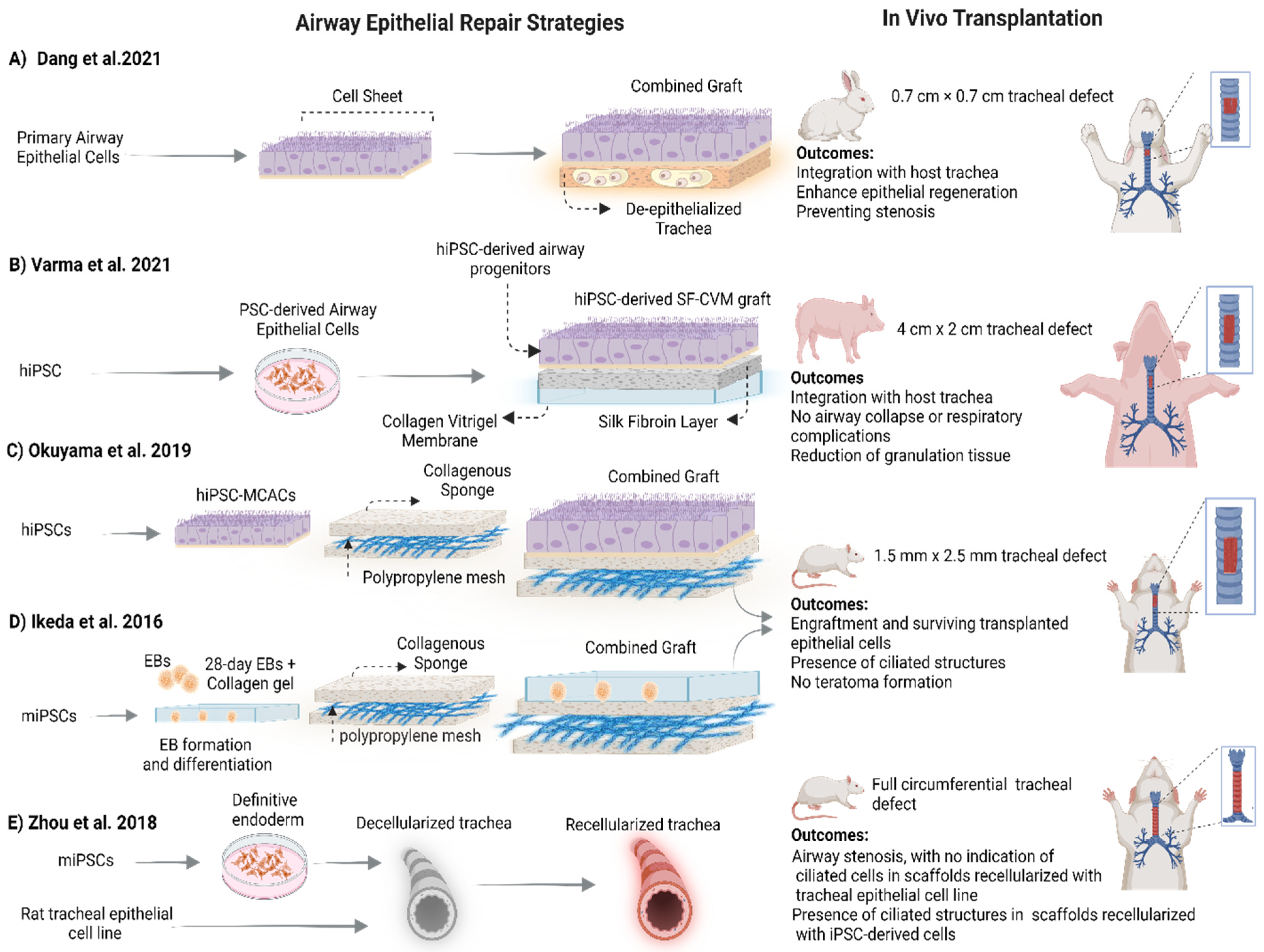
| Acellular tracheal graft | Fully circumferential graft 5–7 rings length | Mouse iPSC-derived definitive endoderm cells | Recellularized rat tracheal segments (7 rings) were orthotopically transplanted on nude rats. | Luminal surface of graft re-epithelialized with numerous ciliated epithelial cells. Animals died after 5 weeks due to airway stenosis. | [20] |
| Partially decellularized autograft | Patch 1 × 1 cm | Autologous nasal epithelial cell sheet | Cell sheets were prepared via seeding porous polyethylene terephthalate (PET) membranes. Defects were made via removal of epithelium in situ. Sheets were applied onto the luminal surface of the decellularized graft immediately re-transplanted into the original defect. Control group was transplanted with decellula-rized trachea without cell sheet application. | At two months post-operation, orthotopic transplantation of graft indicated integration of graft into the host trachea with healing of luminal surface. In control groups, epithelial hypertrophy, fibroproliferation and neovascularization in sub-epithelial layer was observed. | [11] |
| Partially decellularized tracheal scaff- old (porcine trachea) | Circumferential tracheal graft (~5 cm) | No cells | Partially decellularized tracheal segments were implanted in a porcine model and evaluated by bronchoscopy, imaging, and histology at day 28 and day 56 post- implantation to assess biointegration. | The scaffold showed progressive biointegration with neovascularization, fibroblast colonization of the scaffold, no infection or tissue necrosis and no significant graft rejection at day 28. However, cartilage regeneration remained limited and structural integrity was not fully restored at day 56 | [76] |
| Polypropylene mesh and collagen sponge | Patch 12 mm in diameter | Mouse iPSCs-derived epithelial cells | 5-day-old iPSCs-derived embryoid bodies (EBs) were cultured at ALI model for 28 days. EBs containing ciliated-like structures were loaded on collagen-coated artificial tracheal graft followed by orthotopic transplantation into nude rats. | Effective coverage of artificial material with differentiated epithelium with γ-tubulin expression on the basal sides of ciliated cells after 7 days. Only 50% of nude rats used for the experiment showed iPSCs-derived tissues. | [77] |
| Collagen, polypropylene mesh and collagen vitrigel membrane | Patch 12 mm in diameter | Human iPSC-derived multiciliated airway cells (MCACs) | 42-day-old proximal airway progenitor cells were cultured on collagen vitrigel membrane under ALI condition to create cell sheet. Internal side of an artificial trachea consisting of polypropylene mesh and collagen sponge was covered by hiPSC-MCACs sheet and transplanted into a nude rat trachea. | The survival of transplanted cells in the endotracheal epithelium of tracheal defect was observed at 1 and 2 weeks after transplantation and hiPSC—MCACs displayed motile cilia on collagen vitrigel membrane. | [24] |
| Silk fibroin and collagen vitrigel membrane (SF-CVM) | Patch 2.5 cm in diameter | Human iPSC-derived airway epithelial cells | Fabricated SF-CVM was glued onto trans-well inserts using fibrin glue, rehydrated and seeded with airway progenitors. Subsequent culture in ALI achieved functional mucociliary epithelia. hiPSC-derived SF-CVM grafts were evaluated in ex vivo and in porcine tracheal defects. | Differentiation of mucociliary epithelium was achieved on SF-CVM graft after 3 days. Integration with host tracheal tissue was observed as well as no airway collapse. SF-CVM graft was covered with hiPSC-derived p.seudostratified epithelium (~80%) on day 3 with reduction in granulation tissue formation. | [25] |
| Core–shell poly (L-lactic acid-co-Ɛ-caprolactone)/collagen scaffolds containing TGF-β3 | Patch 1 × 2 cm | Rabbit mesenchymal stromal cells (MSCs) | Electrospun PLCL–collagen membrane with a ratio of 75:25 containing TGF-β3 was spread on 6 3D-printed grooved PLCL molds (6 mm diameter) each seed-ed with cells. Molds were stacked and cultured for 7 days and then implanted into rabbit tracheal defects. | Sustained release of TGF-b3 scaffolds induced the differentiation of chondrogenic cells. Tracheal integrity was maintained for 2 months after restoration; meanwhile, the entire luminal surface of the engineered patch was re-epithelialized. | [78] |
| Porcine atelocoll- agen (I and III) sponge and poly propylene framework | Patch tracheal defect size (2 mm wide, over two cartilages) | Autologous adipose tissue-derived stem cells (ASCs) | Collagen sponge containing polypropylene mesh was prepared and used as tracheal graft. The collagen solution containing ASCs was stratified on the tracheal graft and then incubated for 1 h to form a collagen gel. Stratified trachea graft was transplanted into porcine tracheal defect. | ASC transplantation after 3 weeks promoted ciliogenesis with ciliary function comparable to the normal rat trachea. | [62] |
| Polycaprolactone (PCL) and hydrogel | Semi-circumferential 1.5 × 1.5 cm | Autologous nasal epithelial cells and chondrocyte cells | Artificial trachea (5 layers consisting of PCL, alginate with epithelial cells, PCL, alginate with chondrocytes and PCL). Grafts transplanted into rabbit tracheal defect for graft without cells used as a control. | Observation at 3, 6 and 12 months showed that artificial tracheas were effective in the regeneration of respiratory epithelium but not in cartilage regeneration. | [79] |
| 3D-printed polycaprolactone (PCL) backbone integrated with freeze-dried collagen–hyaluronic acid (CHyA) layer | Tubular scaffold Inner diameter: 9.6 mm Outer diameter: 12 mm | Calu-3 respiratory epithelial cells and Wi38 lung fibroblasts | Scaffolds were fabricated using a 3D-printed PCL framework reinforced with a CHyA layer. Hybrid scaffolds facilitated spatially targeted seeding of epithelial cells on the luminal surface and fibroblasts on the outer layer. | PCL reinforcement significantly improved scaffold mechanical stability. Targeted seeding enabled spatial cell organization, resulting in successful epithelial coverage and sustained fibroblast viability, demonstrating a promising platform for tracheal tissue engineering. | [80] |
4. Recellularization of Acellular Tracheal Grafts
| Cell Type | Tissue Source | Advantages | Limitations | Study |
|---|---|---|---|---|
| Chondrocytes | Auricular | Easily accessible | Limited purity and yield Limited expansion in culture Limited survival in vivo Difficult to harvest with limited yield and lower proliferation capacity | [86,109,110] |
| Nasal septum cartilage | Phenotypically and functionally similar to tracheal chondrocytes | [88,111,112,113] | ||
| Costal cartilage | [88] | |||
| Tracheal cartilage | Ideal biomimicry | [87,112] | ||
| Mesenchymal stromal cells | Bone marrow-derived MSCs (BMSCs) | Good capacity to differentiate into chondrogenic lineages | Decreased proliferative and multipotent capacity with increasing donor age Can be differentiated to hyaline cartilage-like tissue derived from MSC. Limited capacity to keep phenotype and function Tendency of MSC to differentiate toward hypertrophic cartilage instead of hyaline cartilage MSC-derived chondrocytes upregulate type II collagen, proteoglycans and upregulation hypertrophy markers, such as type X collagen, and alkaline phosphatase | [114] |
| Adipose-derived MSCs (AMSCs) | Easier to harvest and expand in vitro compared with BMSCs, and have multi-differentiation potential that is independent of age | [115] | ||
| Umbilical cord blood-derived MSCs (UCB-MSCs) | Good capacity to expand and differentiate | [96,116] | ||
| Amniotic fluid-derived MSCs (AFMSCs) | AFMSCs are able to differentiate into lineages of three germ layers and have no tumorigenicity in vivo unlike ES cells | [117,118] | ||
| Epithelial cells | Tracheal epithelial cells | Ideal biomimicry | Difficult to harvest in large numbers Limited proliferation and differentiation | [18,21,91] |
| SMG-associated myoepithelial cells | Capacity to differentiate and reconstitute tracheal epithelium | |||
| Nasal turbinate epithelial cells | Similarities to tracheal epithelium Can be expanded in culture | |||
| Skin epithelial cells | Have capacity to transdifferentiate into tracheal epithelial cells and chondrocytes Skin epithelial cells are easily accessible and can be expanded to large numbers | [119] | ||
| Epithelial stem cells | Endogenous stem/progenitor cells present in the respiratory tract, such as ductal cells, basal cells and variant club cells | Able to differentiate into different types of tracheal epithelial cells No risk of tumor formation | Challenging to isolate and culture | [120] |
| ESCs | Pluripotent ES cells derived from the inner cell mass of the blastocyst | ES cells could generate a fully differentiated airway epithelium composed of basal, ciliated, intermediate and club cells | Ethical issues with ESCs given their source Immune rejection resulting from ESCs Differentiated cells derived from ESCs and iPSCs are often heterogeneous and purity is variable Risks of tumor formation in vivo | [121,122,123] |
| iPSCs | Derived from somatic cells which can be patient specific | Capable of differentiation into a variety of cell lineages Non-immunogenic cells No ethical issues | [20,24,25,77,100,101,124,125] |
5. Recellularization Approaches for Cartilage Regeneration
6. Use of PSCs for Cartilage Regeneration
7. Recellularization Approaches for Epithelial Regeneration
8. Use of PSCs for Epithelial Regeneration
9. Challenges with iPSCs and Future Directions
10. Conclusions
Author Contributions
Funding
Institutional Review Board Statement
Informed Consent Statement
Data Availability Statement
Conflicts of Interest
References
- Brand-Saberi, B.E.M.; Schafer, T. Trachea: Anatomy and physiology. Thorac. Surg. Clin. 2014, 24, 1–5. [Google Scholar] [CrossRef] [PubMed]
- Soleas, J.P.; Paz, A.; Marcus, P.; McGuigan, A.; Waddell, T.K. Engineering airway epithelium. J. Biomed. Biotechnol. 2012, 2012, 982971. [Google Scholar] [CrossRef]
- Polverino, M.; Polverino, F.; Fasolino, M.; Ando, F.; Alfieri, A.; De Blasio, F. Anatomy and neuro-pathophysiology of the cough reflex arc. Multidiscip. Respir. Med. 2012, 7, 5. [Google Scholar] [CrossRef]
- Cooper, J.D. Tracheal Injuries Complicating Prolonged Intubation and Tracheostomy. Thorac. Surg. Clin. 2018, 28, 139–144. [Google Scholar] [CrossRef]
- Prokakis, C.; Koletsis, E.N.; Dedeilias, P.; Fligou, F.; Filos, K.; Dougenis, D. Airway trauma: A review on epidemiology, mechanisms of injury, diagnosis and treatment. J. Cardiothorac. Surg. 2014, 9, 117. [Google Scholar] [CrossRef]
- Kalathur, M.; Baiguera, S.; Macchiarini, P. Translating tissue-engineered tracheal replacement from bench to bedside. Cell Mol. Life Sci. 2010, 67, 4185–4196. [Google Scholar] [CrossRef]
- Kapat, K.; Gondane, P.; Kumbhakarn, S.; Takle, S.; Sable, R. Challenges and Opportunities in Developing Tracheal Substitutes for the Recovery of Long-Segment Defects. Macromol. Biosci. 2024, 24, e2400054. [Google Scholar] [CrossRef]
- Dos Santos, A.C.; Machado Holzlsauer, G.; Ruiz Lucio de Lima Parra, J.P.; Querino Candelaria, R.A.; Santos da Silva, T.; da Silva Nunes Barreto, R.; Miglino, M.A. Organic and Synthetic Substitutes in Tracheal Reconstruction: A Scoping Review (2015–2025). Bioengineering 2025, 12, 704. [Google Scholar] [CrossRef]
- Kojima, K.; Bonassar, L.J.; Roy, A.K.; Vacanti, C.A.; Cortiella, J. Autologous tissue-engineered trachea with sheep nasal chondrocytes. J. Thorac. Cardiovasc. Surg. 2002, 123, 1177–1184. [Google Scholar] [CrossRef] [PubMed]
- Grimmer, J.F.; Gunnlaugsson, C.B.; Alsberg, E.; Murphy, H.S.; Kong, H.J.; Mooney, D.J.; Weatherly, R.A. Tracheal reconstruction using tissue-engineered cartilage. Arch. Otolaryngol.–Head Neck Surg. 2004, 130, 1191–1196. [Google Scholar] [CrossRef] [PubMed][Green Version]
- Dang, L.H.; Hung, S.H.; Tseng, Y.; Quang, L.X.; Le, N.T.N.; Fang, C.L.; Tseng, H. Partial Decellularized Scaffold Combined with Autologous Nasal Epithelial Cell Sheet for Tracheal Tissue Engineering. Int. J. Mol. Sci. 2021, 22, 10322. [Google Scholar] [CrossRef]
- Vacanti, C.A.; Paige, K.T.; Kim, W.S.; Sakata, J.; Upton, J.; Vacanti, J.P. Experimental tracheal replacement using tissue-engineered cartilage. J. Pediatr. Surg. 1994, 29, 201–204; discussion 204–205. [Google Scholar] [CrossRef]
- Kojima, K.; Bonassar, L.J.; Roy, A.K.; Mizuno, H.; Cortiella, J.; Vacanti, C.A. A composite tissue-engineered trachea using sheep nasal chondrocyte and epithelial cells. FASEB J. 2003, 17, 823–828, Erratum in FASEB J. 2014, 28, 5022. [Google Scholar] [CrossRef]
- Walles, T.; Giere, B.; Hofmann, M.; Schanz, J.; Hofmann, F.; Mertsching, H.; Macchiarini, P. Experimental generation of a tissue-engineered functional and vascularized trachea. J. Thorac. Cardiovasc. Surg. 2004, 128, 900–906. [Google Scholar] [CrossRef][Green Version]
- Elliott, M.J.; De Coppi, P.; Speggiorin, S.; Roebuck, D.; Butler, C.R.; Samuel, E.; Crowley, C.; McLaren, C.; Fierens, A.; Vondrys, D.; et al. Stem-cell-based, tissue engineered tracheal replacement in a child: A 2-year follow-up study. Lancet 2012, 380, 994–1000. [Google Scholar] [CrossRef]
- He, X.; Fu, W.; Zheng, J. Cell sources for trachea tissue engineering: Past, present and future. Regen. Med. 2012, 7, 851–863. [Google Scholar] [CrossRef]
- Maughan, E.F.; Hynds, R.E.; Proctor, T.J.; Janes, S.M.; Elliott, M.; Birchall, M.A.; Lowdell, M.W.; De Coppi, P. Autologous Cell Seeding in Tracheal Tissue Engineering. Curr. Stem Cell Rep. 2017, 3, 279–289. [Google Scholar] [CrossRef] [PubMed]
- Pai, A.C.; Lynch, T.J.; Ahlers, B.A.; Ievlev, V.; Engelhardt, J.F.; Parekh, K.R. A Novel Bioreactor for Reconstitution of the Epithelium and Submucosal Glands in Decellularized Ferret Tracheas. Cells 2022, 11, 1027. [Google Scholar] [CrossRef] [PubMed]
- Lee, H.; Marin-Araujo, A.E.; Aoki, F.G.; Haykal, S.; Waddell, T.K.; Amon, C.H.; Romero, D.A.; Karoubi, G. Computational fluid dynamics for enhanced tracheal bioreactor design and long-segment graft recellularization. Sci. Rep. 2021, 11, 1187. [Google Scholar] [CrossRef] [PubMed]
- Zhou, Q.; Ye, X.; Ran, Q.; Kitahara, A.; Matsumoto, Y.; Moriyama, M.; Ajioka, Y.; Saijo, Y. Trachea Engineering Using a Centrifugation Method and Mouse-Induced Pluripotent Stem Cells. Tissue Eng. Part C Methods 2018, 24, 524–533. [Google Scholar] [CrossRef]
- Kanzaki, M.; Yamato, M.; Hatakeyama, H.; Kohno, C.; Yang, J.; Umemoto, T.; Kikuchi, A.; Okano, T.; Onuki, T. Tissue engineered epithelial cell sheets for the creation of a bioartificial trachea. Tissue Eng. 2006, 12, 1275–1283. [Google Scholar] [CrossRef] [PubMed]
- de Sa Schiavo Matias, G.; Carreira, A.C.O.; Batista, V.F.; de Carvalho, H.J.C.; Miglino, M.A.; Fratini, P. In vivo biocompatibility analysis of the recellularized canine tracheal scaffolds with canine epithelial and endothelial progenitor cells. Bioengineered 2022, 13, 3551–3565. [Google Scholar] [CrossRef]
- Koo, J.P.; Kim, C.H.; Lee, J.G.; Kim, K.S.; Yoon, J.H. Airway reconstruction with carrier-free cell sheets composed of autologous nasal squamous epithelium. Laryngoscope 2007, 117, 1750–1755. [Google Scholar] [CrossRef]
- Okuyama, H.; Ohnishi, H.; Nakamura, R.; Yamashita, M.; Kishimoto, Y.; Tateya, I.; Suehiro, A.; Gotoh, S.; Takezawa, T.; Nakamura, T.; et al. Transplantation of multiciliated airway cells derived from human iPS cells using an artificial tracheal patch into rat trachea. J. Tissue Eng. Regen. Med. 2019, 13, 1019–1030. [Google Scholar] [CrossRef]
- Varma, R.; Marin-Araujo, A.E.; Rostami, S.; Waddell, T.K.; Karoubi, G.; Haykal, S. Short-Term Preclinical Application of Functional Human Induced Pluripotent Stem Cell-Derived Airway Epithelial Patches. Adv. Healthc. Mater. 2021, 10, e2100957. [Google Scholar] [CrossRef]
- Rai, N.; Singh, A.K.; Singh, S.K.; Gaurishankar, B.; Kamble, S.C.; Mishra, P.; Kotiya, D.; Barik, S.; Atri, N.; Gautam, V. Recent technological advancements in stem cell research for targeted therapeutics. Drug Deliv. Transl. Res. 2020, 10, 1147–1169. [Google Scholar] [CrossRef]
- Halevy, T.; Urbach, A. Comparing ESC and iPSC-Based Models for Human Genetic Disorders. J. Clin. Med. 2014, 3, 1146–1162. [Google Scholar] [CrossRef]
- Kim, J.B.; Zaehres, H.; Wu, G.; Gentile, L.; Ko, K.; Sebastiano, V.; Arauzo-Bravo, M.J.; Ruau, D.; Han, D.W.; Zenke, M.; et al. Pluripotent stem cells induced from adult neural stem cells by reprogramming with two factors. Nature 2008, 454, 646–650. [Google Scholar] [CrossRef]
- Li, Y.; Zhao, H.; Lan, F.; Lee, A.; Chen, L.; Lin, C.; Yao, Y.; Li, L. Generation of human-induced pluripotent stem cells from gut mesentery-derived cells by ectopic expression of OCT4/SOX2/NANOG. Cell. Reprogram. 2010, 12, 237–247. [Google Scholar] [CrossRef] [PubMed]
- Tomioka, I.; Maeda, T.; Shimada, H.; Kawai, K.; Okada, Y.; Igarashi, H.; Oiwa, R.; Iwasaki, T.; Aoki, M.; Kimura, T.; et al. Generating induced pluripotent stem cells from common marmoset (Callithrix jacchus) fetal liver cells using defined factors, including Lin28. Genes. Cells 2010, 15, 959–969. [Google Scholar] [CrossRef] [PubMed]
- Takahashi, K.; Tanabe, K.; Ohnuki, M.; Narita, M.; Ichisaka, T.; Tomoda, K.; Yamanaka, S. Induction of pluripotent stem cells from adult human fibroblasts by defined factors. Cell 2007, 131, 861–872. [Google Scholar] [CrossRef]
- Singh, V.K.; Kalsan, M.; Kumar, N.; Saini, A.; Chandra, R. Induced pluripotent stem cells: Applications in regenerative medicine, disease modeling, and drug discovery. Front. Cell Dev. Biol. 2015, 3, 2. [Google Scholar] [CrossRef]
- Park, I.H.; Zhao, R.; West, J.A.; Yabuuchi, A.; Huo, H.; Ince, T.A.; Lerou, P.H.; Lensch, M.W.; Daley, G.Q. Reprogramming of human somatic cells to pluripotency with defined factors. Nature 2008, 451, 141–146. [Google Scholar] [CrossRef]
- Stadtfeld, M.; Nagaya, M.; Utikal, J.; Weir, G.; Hochedlinger, K. Induced pluripotent stem cells generated without viral integration. Science 2008, 322, 945–949. [Google Scholar] [CrossRef]
- Yu, J.; Hu, K.; Smuga-Otto, K.; Tian, S.; Stewart, R.; Slukvin, I.I.; Thomson, J.A. Human induced pluripotent stem cells free of vector and transgene sequences. Science 2009, 324, 797–801. [Google Scholar] [CrossRef] [PubMed]
- Firth, A.L.; Dargitz, C.T.; Qualls, S.J.; Menon, T.; Wright, R.; Singer, O.; Gage, F.H.; Khanna, A.; Verma, I.M. Generation of multiciliated cells in functional airway epithelia from human induced pluripotent stem cells. Proc. Natl. Acad. Sci. USA 2014, 111, E1723–E1730. [Google Scholar] [CrossRef]
- McCauley, K.B.; Hawkins, F.; Kotton, D.N. Derivation of Epithelial-Only Airway Organoids from Human Pluripotent Stem Cells. Curr. Protoc. Stem Cell Biol. 2018, 45, e51. [Google Scholar] [CrossRef]
- Suzuki, S.; Hawkins, F.J.; Barilla, C.; Beermann, M.L.; Kotton, D.N.; Davis, B.R. Differentiation of human pluripotent stem cells into functional airway basal stem cells. STAR Protoc. 2021, 2, 100683. [Google Scholar] [CrossRef]
- Wong, A.P.; Bear, C.E.; Chin, S.; Pasceri, P.; Thompson, T.O.; Huan, L.J.; Ratjen, F.; Ellis, J.; Rossant, J. Directed differentiation of human pluripotent stem cells into mature airway epithelia expressing functional CFTR protein. Nat. Biotechnol. 2012, 30, 876–882. [Google Scholar] [CrossRef] [PubMed]
- Ma, L.; Thapa, B.R.; Le Suer, J.A.; Tilston-Lunel, A.; Herriges, M.J.; Berical, A.; Beermann, M.L.; Wang, F.; Bawa, P.S.; Kohn, A.; et al. Airway stem cell reconstitution by the transplantation of primary or pluripotent stem cell-derived basal cells. Cell Stem Cell 2023, 30, 1199–1216.e1197. [Google Scholar] [CrossRef] [PubMed]
- Abo, K.M.; Sainz de Aja, J.; Lindstrom-Vautrin, J.; Alysandratos, K.D.; Richards, A.; Garcia-de-Alba, C.; Huang, J.; Hix, O.T.; Werder, R.B.; Bullitt, E.; et al. Air-liquid interface culture promotes maturation and allows environmental exposure of pluripotent stem cell-derived alveolar epithelium. JCI Insight 2022, 7, e155589. [Google Scholar] [CrossRef]
- Madariaga, M.L.L.; Gaissert, H.A. Overview of malignant tracheal tumors. Ann. Cardiothorac. Surg. 2018, 7, 244–254. [Google Scholar] [CrossRef]
- Urdaneta, A.I.; Yu, J.B.; Wilson, L.D. Population based cancer registry analysis of primary tracheal carcinoma. Am. J. Clin. Oncol. 2011, 34, 32–37. [Google Scholar] [CrossRef]
- Esteller-More, E.; Ibanez, J.; Matino, E.; Adema, J.M.; Nolla, M.; Quer, I.M. Prognostic factors in laryngotracheal injury following intubation and/or tracheotomy in ICU patients. Eur. Arch. Otorhinolaryngol. 2005, 262, 880–883. [Google Scholar] [CrossRef] [PubMed]
- Sarper, A.; Ayten, A.; Eser, I.; Ozbudak, O.; Demircan, A. Tracheal stenosis aftertracheostomy or intubation: Review with special regard to cause and management. Tex. Heart Inst. J. 2005, 32, 154–158. [Google Scholar] [PubMed]
- Mattioli, F.; Marchioni, A.; Andreani, A.; Cappiello, G.; Fermi, M.; Presutti, L. Post-intubation tracheal stenosis in COVID-19 patients. Eur. Arch. Otorhinolaryngol. 2021, 278, 847–848. [Google Scholar] [CrossRef]
- Grillo, H.C. Tracheal replacement: A critical review. Ann. Thorac. Surg. 2002, 73, 1995–2004. [Google Scholar] [CrossRef]
- Ren, J.; Xu, Y.; Zhiyi, G.; Ren, T.; Ren, J.; Wang, K.; Luo, Y.; Zhu, M.; Tan, Q. Reconstruction of the trachea and carina: Surgical reconstruction, autologous tissue transplantation, allograft transplantation, and bioengineering. Thorac. Cancer 2022, 13, 284–295. [Google Scholar] [CrossRef]
- Honings, J.; Gaissert, H.A.; van der Heijden, H.F.; Verhagen, A.F.; Kaanders, J.H.; Marres, H.A. Clinical aspects and treatment of primary tracheal malignancies. Acta Oto-Laryngol. 2010, 130, 763–772. [Google Scholar] [CrossRef] [PubMed]
- Luo, J.S.; Cui, P.C.; Gao, P.F.; Nan, H.; Liu, Z.; Sun, Y.Z. Reconstruction of tracheal wall defect with a mesh patch of nickel-titanium shape-memory alloy. Ann. Otol. Rhinol. Laryngol. 2011, 120, 198–203. [Google Scholar] [CrossRef]
- Elliott, M.J.; Butler, C.R.; Varanou-Jenkins, A.; Partington, L.; Carvalho, C.; Samuel, E.; Crowley, C.; Lange, P.; Hamilton, N.J.; Hynds, R.E.; et al. Tracheal Replacement Therapy with a Stem Cell-Seeded Graft: Lessons from Compassionate Use Application of a GMP-Compliant Tissue-Engineered Medicine. Stem Cells Transl. Med. 2017, 6, 1458–1464. [Google Scholar] [CrossRef]
- Delaere, P.; Van Raemdonck, D.; Vranckx, J. Tracheal transplantation. Intensive Care Med. 2019, 45, 391–393. [Google Scholar] [CrossRef] [PubMed]
- Delaere, P.; Vranckx, J.; Verleden, G.; De Leyn, P.; Van Raemdonck, D.; Leuven Tracheal Transplant, G. Tracheal allotransplantation after withdrawal of immunosuppressive therapy. N. Engl. J. Med. 2010, 362, 138–145. [Google Scholar] [CrossRef] [PubMed]
- Vranckx, J.J.; Delaere, P. The current status and outlook of trachea transplantation. Curr. Opin. Organ. Transplant. 2020, 25, 601–608. [Google Scholar] [CrossRef] [PubMed]
- Fabre, D.; Kolb, F.; Fadel, E.; Mercier, O.; Mussot, S.; Le Chevalier, T.; Dartevelle, P. Successful tracheal replacement in humans using autologous tissues: An 8-year experience. Ann. Thorac. Surg. 2013, 96, 1146–1155. [Google Scholar] [CrossRef]
- Greaney, A.M.; Niklason, L.E. The History of Engineered Tracheal Replacements: Interpreting the Past and Guiding the Future. Tissue Eng. Part B Rev. 2021, 27, 341–352. [Google Scholar] [CrossRef]
- Chiang, T.; Pepper, V.; Best, C.; Onwuka, E.; Breuer, C.K. Clinical Translation of Tissue Engineered Trachea Grafts. Ann. Otol. Rhinol. Laryngol. 2016, 125, 873–885. [Google Scholar] [CrossRef]
- Loos, E.; Meulemans, J.; Vranckx, J.; Poorten, V.V.; Delaere, P. Tracheal Autotransplantation for Functional Reconstruction of Extended Hemilaryngectomy Defects: A Single-Center Experience in 30 Patients. Ann. Surg. Oncol. 2016, 23, 1674–1683. [Google Scholar] [CrossRef]
- Haykal, S.; Zhou, Y.; Marcus, P.; Salna, M.; Machuca, T.; Hofer, S.O.; Waddell, T.K. The effect of decellularization of tracheal allografts on leukocyte infiltration and of recellularization on regulatory T cell recruitment. Biomaterials 2013, 34, 5821–5832. [Google Scholar] [CrossRef]
- Liu, L.; Dharmadhikari, S.; Shontz, K.M.; Tan, Z.H.; Spector, B.M.; Stephens, B.; Bergman, M.; Manning, A.; Zhao, K.; Reynolds, S.D.; et al. Regeneration of partially decellularized tracheal scaffolds in a mouse model of orthotopic tracheal replacement. J. Tissue Eng. 2021, 12, 20417314211017417. [Google Scholar] [CrossRef]
- Hamilton, N.J.I.; Lee, D.D.H.; Gowers, K.H.C.; Butler, C.R.; Maughan, E.F.; Jevans, B.; Orr, J.C.; McCann, C.J.; Burns, A.J.; MacNeil, S.; et al. Bioengineered airway epithelial grafts with mucociliary function based on collagen IV- and laminin-containing extracellular matrix scaffolds. Eur. Respir. J. 2020, 55, 1901200. [Google Scholar] [CrossRef]
- Nakamura, R.; Katsuno, T.; Tateya, I.; Omori, K. Evaluation of Cilia Function in Rat Trachea Reconstructed Using Collagen Sponge Scaffold Seeded with Adipose Tissue-Derived Stem Cells. Anat. Rec. 2020, 303, 471–477. [Google Scholar] [CrossRef]
- Catoira, M.C.; Fusaro, L.; Di Francesco, D.; Ramella, M.; Boccafoschi, F. Overview of natural hydrogels for regenerative medicine applications. J. Mater. Sci. Mater. Med. 2019, 30, 115. [Google Scholar] [CrossRef]
- Chen, Z.; Zhong, N.; Wen, J.; Jia, M.; Guo, Y.; Shao, Z.; Zhao, X. Porous Three-Dimensional Silk Fibroin Scaffolds for Tracheal Epithelial Regeneration in Vitro and in Vivo. ACS Biomater. Sci. Eng. 2018, 4, 2977–2985. [Google Scholar] [CrossRef]
- Gilbert, T.W.; Sellaro, T.L.; Badylak, S.F. Decellularization of tissues and organs. Biomaterials 2006, 27, 3675–3683. [Google Scholar] [CrossRef]
- Aoki, F.G.; Varma, R.; Marin-Araujo, A.E.; Lee, H.; Soleas, J.P.; Li, A.H.; Soon, K.; Romero, D.; Moriya, H.T.; Haykal, S.; et al. De-epithelialization of porcine tracheal allografts as an approach for tracheal tissue engineering. Sci. Rep. 2019, 9, 12034. [Google Scholar] [CrossRef] [PubMed]
- Liu, L.; Dharmadhikari, S.; Spector, B.M.; Tan, Z.H.; Van Curen, C.E.; Agarwal, R.; Nyirjesy, S.; Shontz, K.; Sperber, S.A.; Breuer, C.K.; et al. Tissue-engineered composite tracheal grafts create mechanically stable and biocompatible airway replacements. J. Tissue Eng. 2022, 13, 20417314221108791. [Google Scholar] [CrossRef] [PubMed]
- Hong, P.; Bezuhly, M.; Graham, M.E.; Gratzer, P.F. Efficient decellularization of rabbit trachea to generate a tissue engineering scaffold biomatrix. Int. J. Pediatr. Otorhinolaryngol. 2018, 112, 67–74. [Google Scholar] [CrossRef]
- Gomes, K.T.; Prasad, P.R.; Sandhu, J.S.; Kumar, A.; Kumar, N.A.N.; Shridhar, N.B.; Bisht, B.; Paul, M.K. Decellularization techniques: Unveiling the blueprint for tracheal tissue engineering. Front. Bioeng. Biotechnol. 2025, 13, 1518905. [Google Scholar] [CrossRef]
- Taylor, D.A.; Sampaio, L.C.; Ferdous, Z.; Gobin, A.S.; Taite, L.J. Decellularized matrices in regenerative medicine. Acta Biomater. 2018, 74, 74–89. [Google Scholar] [CrossRef] [PubMed]
- Parmaksiz, M.; Dogan, A.; Odabas, S.; Elcin, A.E.; Elcin, Y.M. Clinical applications of decellularized extracellular matrices for tissue engineering and regenerative medicine. Biomed. Mater. 2016, 11, 022003. [Google Scholar] [CrossRef]
- Haykal, S.; Soleas, J.P.; Salna, M.; Hofer, S.O.; Waddell, T.K. Evaluation of the structural integrity and extracellular matrix components of tracheal allografts following cyclical decellularization techniques: Comparison of three protocols. Tissue Eng. Part C Methods 2012, 18, 614–623. [Google Scholar] [CrossRef]
- Hamilton, N.; Bullock, A.J.; Macneil, S.; Janes, S.M.; Birchall, M. Tissue engineering airway mucosa: A systematic review. Laryngoscope 2014, 124, 961–968. [Google Scholar] [CrossRef]
- Ohno, M.; Fuchimoto, Y.; Hsu, H.C.; Higuchi, M.; Komura, M.; Yamaoka, T.; Umezawa, A.; Enosawa, S.; Kuroda, T. Airway reconstruction using decellularized tracheal allografts in a porcine model. Pediatr. Surg. Int. 2017, 33, 1065–1071. [Google Scholar] [CrossRef]
- Ohno, M.; Fuchimoto, Y.; Higuchi, M.; Yamaoka, T.; Komura, M.; Umezawa, A.; Hsu, H.C.; Enosawa, S.; Kuroda, T. Long-term observation of airway reconstruction using decellularized tracheal allografts in micro-miniature pigs at growing stage. Regen. Ther. 2020, 15, 64–69. [Google Scholar] [CrossRef]
- Vigouroux, A.; Bonnin, Y.; Gendron, N.; Kellouche, S.; Agniel, R.; Bruneval, P.; Balvay, D.; Allain, J.M.; Chhun, S.; Kempf, H.; et al. Biointegration of a partially decellularized tracheal scaffold in a porcine model—Preliminary results. Sci. Rep. 2026; in press. [Google Scholar] [CrossRef]
- Ikeda, M.; Imaizumi, M.; Yoshie, S.; Nakamura, R.; Otsuki, K.; Murono, S.; Omori, K. Implantation of Induced Pluripotent Stem Cell-Derived Tracheal Epithelial Cells. Ann. Otol. Rhinol. Laryngol. 2017, 126, 517–524. [Google Scholar] [CrossRef] [PubMed]
- Jing, H.; Gao, B.; Gao, M.; Yin, H.; Mo, X.; Zhang, X.; Luo, K.; Feng, B.; Fu, W.; Wang, J.; et al. Restoring tracheal defects in a rabbit model with tissue engineered patches based on TGF-beta3-encapsulating electrospun poly(l-lactic acid-co-epsilon-caprolactone)/collagen scaffolds. Artif. Cells Nanomed. Biotechnol. 2018, 46, 985–995. [Google Scholar] [CrossRef] [PubMed]
- Park, J.H.; Yoon, J.K.; Lee, J.B.; Shin, Y.M.; Lee, K.W.; Bae, S.W.; Lee, J.; Yu, J.; Jung, C.R.; Youn, Y.N.; et al. Experimental Tracheal Replacement Using 3-dimensional Bioprinted Artificial Trachea with Autologous Epithelial Cells and Chondrocytes. Sci. Rep. 2019, 9, 2103. [Google Scholar] [CrossRef] [PubMed]
- Soriano, L.; Lemoine, M.; Cavanagh, B.; Johnston, A.; Khalid, T.; O’Brien, F.J.; O’Leary, C.; Cryan, S.A. Method for Targeted Cellular Seeding of Tubular Tissue-Engineered Scaffolds for Tracheal Regeneration Approaches. ACS Biomater. Sci. Eng. 2025, 11, 5293–5305. [Google Scholar] [CrossRef] [PubMed]
- Mir, S.M.; Chen, J.; Pinezich, M.R.; O’Neill, J.D.; Huang, S.X.L.; Vunjak-Novakovic, G.; Kim, J. Imaging-guided bioreactor for de-epithelialization and long-term cultivation of ex vivo rat trachea. Lab. Chip 2022, 22, 1018–1031. [Google Scholar] [CrossRef]
- Haykal, S.; Salna, M.; Zhou, Y.; Marcus, P.; Fatehi, M.; Frost, G.; Machuca, T.; Hofer, S.O.; Waddell, T.K. Double-chamber rotating bioreactor for dynamic perfusion cell seeding of large-segment tracheal allografts: Comparison to conventional static methods. Tissue Eng. Part C Methods 2014, 20, 681–692. [Google Scholar] [CrossRef] [PubMed]
- Peng, T.; Morrisey, E.E. Development of the pulmonary vasculature: Current understanding and concepts for the future. Pulm. Circ. 2013, 3, 176–178. [Google Scholar] [CrossRef]
- Gebb, S.A.; Shannon, J.M. Tissue interactions mediate early events in pulmonary vasculogenesis. Dev. Dyn. 2000, 217, 159–169. [Google Scholar] [CrossRef]
- Huckle, J.; Dootson, G.; Medcalf, N.; McTaggart, S.; Wright, E.; Carter, A.; Schreiber, R.; Kirby, B.; Dunkelman, N.; Stevenson, S.; et al. Differentiated chondrocytes for cartilage tissue engineering. Novartis Found. Symp. 2003, 249, 103–112; discussion 112–117, 170–174, 239–241. [Google Scholar] [CrossRef] [PubMed]
- Komura, M.; Komura, H.; Kanamori, Y.; Tanaka, Y.; Suzuki, K.; Sugiyama, M.; Nakahara, S.; Kawashima, H.; Hatanaka, A.; Hoshi, K.; et al. An animal model study for tissue-engineered trachea fabricated from a biodegradable scaffold using chondrocytes to augment repair of tracheal stenosis. J. Pediatr. Surg. 2008, 43, 2141–2146. [Google Scholar] [CrossRef]
- Komura, M.; Komura, H.; Tanaka, Y.; Kanamori, Y.; Sugiyama, M.; Nakahara, S.; Kawashima, H.; Suzuki, K.; Hoshi, K.; Iwanaka, T. Human tracheal chondrocytes as a cell source for augmenting stenotic tracheal segments: The first feasibility study in an in vivo culture system. Pediatr. Surg. Int. 2008, 24, 1117–1121. [Google Scholar] [CrossRef]
- Isogai, N.; Kusuhara, H.; Ikada, Y.; Ohtani, H.; Jacquet, R.; Hillyer, J.; Lowder, E.; Landis, W.J. Comparison of different chondrocytes for use in tissue engineering of cartilage model structures. Tissue Eng. 2006, 12, 691–703. [Google Scholar] [CrossRef]
- Gao, B.; Jing, H.; Gao, M.; Wang, S.; Fu, W.; Zhang, X.; He, X.; Zheng, J. Long-segmental tracheal reconstruction in rabbits with pedicled Tissue-engineered trachea based on a 3D-printed scaffold. Acta Biomater. 2019, 97, 177–186. [Google Scholar] [CrossRef]
- Zeng, T.; Yuan, P.; Liang, L.; Zhang, X.; Zhang, H.; Wu, W. Cartilaginous Extracellular Matrix Enriched with Human Gingival Mesenchymal Stem Cells Derived “Matrix Bound Extracellular Vesicles” Enabled Functional Reconstruction of Tracheal Defect. Adv. Sci. 2022, 9, e2102735. [Google Scholar] [CrossRef] [PubMed]
- Nomoto, Y.; Suzuki, T.; Tada, Y.; Kobayashi, K.; Miyake, M.; Hazama, A.; Wada, I.; Kanemaru, S.; Nakamura, T.; Omori, K. Tissue engineering for regeneration of the tracheal epithelium. Ann. Otol. Rhinol. Laryngol. 2006, 115, 501–506. [Google Scholar] [CrossRef]
- Pfenninger, C.; Leinhase, I.; Endres, M.; Rotter, N.; Loch, A.; Ringe, J.; Sittinger, M. Tracheal remodeling: Comparison of different composite cultures consisting of human respiratory epithelial cells and human chondrocytes. In Vitro Cell Dev. Biol. Anim. 2007, 43, 28–36. [Google Scholar] [CrossRef]
- Goto, Y.; Noguchi, Y.; Nomura, A.; Sakamoto, T.; Ishii, Y.; Bitoh, S.; Picton, C.; Fujita, Y.; Watanabe, T.; Hasegawa, S.; et al. In vitro reconstitution of the tracheal epithelium. Am. J. Respir. Cell Mol. Biol. 1999, 20, 312–318. [Google Scholar] [CrossRef]
- Fuchs, J.R.; Hannouche, D.; Terada, S.; Vacanti, J.P.; Fauza, D.O. Fetal tracheal augmentation with cartilage engineered from bone marrow-derived mesenchymal progenitor cells. J. Pediatr. Surg. 2003, 38, 984–987. [Google Scholar] [CrossRef]
- Yoon, I.S.; Chung, C.W.; Sung, J.H.; Cho, H.J.; Kim, J.S.; Shim, W.S.; Shim, C.K.; Chung, S.J.; Kim, D.D. Proliferation and chondrogenic differentiation of human adipose-derived mesenchymal stem cells in porous hyaluronic acid scaffold. J. Biosci. Bioeng. 2011, 112, 402–408. [Google Scholar] [CrossRef]
- Choi, Y.S.; Im, M.W.; Kim, C.S.; Lee, M.H.; Noh, S.E.; Lim, S.M.; Kim, S.L.; Cho, C.G.; Kim, D.I. Chondrogenic differentiation of human umbilical cord blood-derived multilineage progenitor cells in atelocollagen. Cytotherapy 2008, 10, 165–173. [Google Scholar] [CrossRef]
- Kolambkar, Y.M.; Peister, A.; Soker, S.; Atala, A.; Guldberg, R.E. Chondrogenic differentiation of amniotic fluid-derived stem cells. J. Mol. Histol. 2007, 38, 405–413. [Google Scholar] [CrossRef]
- Kobayashi, K.; Suzuki, T.; Nomoto, Y.; Tada, Y.; Miyake, M.; Hazama, A.; Wada, I.; Nakamura, T.; Omori, K. A tissue-engineered trachea derived from a framed collagen scaffold, gingival fibroblasts and adipose-derived stem cells. Biomaterials 2010, 31, 4855–4863. [Google Scholar] [CrossRef]
- Liu, J.; Nie, H.; Xu, Z.; Niu, X.; Guo, S.; Yin, J.; Guo, F.; Li, G.; Wang, Y.; Zhang, C. The effect of 3D nanofibrous scaffolds on the chondrogenesis of induced pluripotent stem cells and their application in restoration of cartilage defects. PLoS ONE 2014, 9, e111566. [Google Scholar] [CrossRef] [PubMed]
- Imaizumi, M.; Nomoto, Y.; Sugino, T.; Miyake, M.; Wada, I.; Nakamura, T.; Omori, K. Potential of induced pluripotent stem cells for the regeneration of the tracheal wall. Ann. Otol. Rhinol. Laryngol. 2010, 119, 697–703. [Google Scholar] [CrossRef] [PubMed]
- Kim, I.G.; Park, S.A.; Lee, S.H.; Choi, J.S.; Cho, H.; Lee, S.J.; Kwon, Y.W.; Kwon, S.K. Transplantation of a 3D-printed tracheal graft combined with iPS cell-derived MSCs and chondrocytes. Sci. Rep. 2020, 10, 4326. [Google Scholar] [CrossRef] [PubMed]
- Yoshimatsu, M.; Ohnishi, H.; Zhao, C.; Hayashi, Y.; Kuwata, F.; Kaba, S.; Okuyama, H.; Kawai, Y.; Hiwatashi, N.; Kishimoto, Y.; et al. In vivo regeneration of rat laryngeal cartilage with mesenchymal stem cells derived from human induced pluripotent stem cells via neural crest cells. Stem Cell Res. 2021, 52, 102233. [Google Scholar] [CrossRef]
- Imaizumi, M.; Nomoto, Y.; Sugino, T.; Otsuki, K.; Omori, K. Implantation site-dependent differences for tracheal regeneration with induced pluripotent stem cells (iPS cells). Acta Oto-Laryngol. 2013, 133, 405–411. [Google Scholar] [CrossRef]
- Liu, G.; David, B.T.; Trawczynski, M.; Fessler, R.G. Advances in Pluripotent Stem Cells: History, Mechanisms, Technologies, and Applications. Stem Cell Rev. Rep. 2020, 16, 3–32. [Google Scholar] [CrossRef] [PubMed]
- Hawkins, F.J.; Suzuki, S.; Beermann, M.L.; Barilla, C.; Wang, R.; Villacorta-Martin, C.; Berical, A.; Jean, J.C.; Le Suer, J.; Matte, T.; et al. Derivation of Airway Basal Stem Cells from Human Pluripotent Stem Cells. Cell Stem Cell 2021, 28, 79–95.e78. [Google Scholar] [CrossRef] [PubMed]
- Huang, S.X.; Islam, M.N.; O’Neill, J.; Hu, Z.; Yang, Y.G.; Chen, Y.W.; Mumau, M.; Green, M.D.; Vunjak-Novakovic, G.; Bhattacharya, J.; et al. Efficient generation of lung and airway epithelial cells from human pluripotent stem cells. Nat. Biotechnol. 2014, 32, 84–91. [Google Scholar] [CrossRef] [PubMed]
- McCauley, K.B.; Hawkins, F.; Serra, M.; Thomas, D.C.; Jacob, A.; Kotton, D.N. Efficient Derivation of Functional Human Airway Epithelium from Pluripotent Stem Cells via Temporal Regulation of Wnt Signaling. Cell Stem Cell 2017, 20, 844–857.e846. [Google Scholar] [CrossRef]
- Wang, R.; Hume, A.J.; Beermann, M.L.; Simone-Roach, C.; Lindstrom-Vautrin, J.; Le Suer, J.; Huang, J.; Olejnik, J.; Villacorta-Martin, C.; Bullitt, E.; et al. Human airway lineages derived from pluripotent stem cells reveal the epithelial responses to SARS-CoV-2 infection. Am. J. Physiol. Lung Cell Mol. Physiol. 2022, 322, L462–L478. [Google Scholar] [CrossRef]
- Wu, W.; Cheng, X.; Zhao, Y.; Chen, F.; Feng, X.; Mao, T. Tissue engineering of trachea-like cartilage grafts by using chondrocyte macroaggregate: Experimental study in rabbits. Artif. Organs 2007, 31, 826–834. [Google Scholar] [CrossRef]
- Tani, G.; Usui, N.; Kamiyama, M.; Oue, T.; Fukuzawa, M. In vitro construction of scaffold-free cylindrical cartilage using cell sheet-based tissue engineering. Pediatr. Surg. Int. 2010, 26, 179–185. [Google Scholar] [CrossRef]
- Henderson, J.H.; Welter, J.F.; Mansour, J.M.; Niyibizi, C.; Caplan, A.I.; Dennis, J.E. Cartilage tissue engineering for laryngotracheal reconstruction: Comparison of chondrocytes from three anatomic locations in the rabbit. Tissue Eng. 2007, 13, 843–853. [Google Scholar] [CrossRef]
- Kojima, K.; Bonassar, L.J.; Ignotz, R.A.; Syed, K.; Cortiella, J.; Vacanti, C.A. Comparison of tracheal and nasal chondrocytes for tissue engineering of the trachea. Ann. Thorac. Surg. 2003, 76, 1884–1888. [Google Scholar] [CrossRef]
- Ruszymah, B.H.; Chua, K.; Latif, M.A.; Hussein, F.N.; Saim, A.B. Formation of in vivo tissue engineered human hyaline cartilage in the shape of a trachea with internal support. Int. J. Pediatr. Otorhinolaryngol. 2005, 69, 1489–1495. [Google Scholar] [CrossRef]
- Giovannini, S.; Diaz-Romero, J.; Aigner, T.; Heini, P.; Mainil-Varlet, P.; Nesic, D. Micromass co-culture of human articular chondrocytes and human bone marrow mesenchymal stem cells to investigate stable neocartilage tissue formation in vitro. Eur. Cell Mater. 2010, 20, 245–259. [Google Scholar] [CrossRef]
- Mehlhorn, A.T.; Niemeyer, P.; Kaschte, K.; Muller, L.; Finkenzeller, G.; Hartl, D.; Sudkamp, N.P.; Schmal, H. Differential effects of BMP-2 and TGF-beta1 on chondrogenic differentiation of adipose derived stem cells. Cell Prolif. 2007, 40, 809–823. [Google Scholar] [CrossRef] [PubMed]
- Fuchs, J.R.; Hannouche, D.; Terada, S.; Zand, S.; Vacanti, J.P.; Fauza, D.O. Cartilage engineering from ovine umbilical cord blood mesenchymal progenitor cells. Stem Cells 2005, 23, 958–964. [Google Scholar] [CrossRef] [PubMed]
- Kunisaki, S.M.; Freedman, D.A.; Fauza, D.O. Fetal tracheal reconstruction with cartilaginous grafts engineered from mesenchymal amniocytes. J. Pediatr. Surg. 2006, 41, 675–682; discussion 675–682. [Google Scholar] [CrossRef]
- Kunisaki, S.M.; Fuchs, J.R.; Steigman, S.A.; Fauza, D.O. A comparative analysis of cartilage engineered from different perinatal mesenchymal progenitor cells. Tissue Eng. 2007, 13, 2633–2644. [Google Scholar] [CrossRef]
- Kim, J.H.; Kong, W.H.; Kim, J.G.; Kim, H.J.; Seo, S.W. Possibility of skin epithelial cell transdifferentiation in tracheal reconstruction. Artif. Organs 2011, 35, 122–130. [Google Scholar] [CrossRef] [PubMed]
- Zhang, X.; Jing, H.; Luo, K.; Shi, B.; Luo, Q.; Zhu, Z.; He, X.; Zheng, J. Exosomes from 3T3-J2 promote expansion of tracheal basal cells to facilitate rapid epithelization of 3D-printed double-layer tissue engineered trachea. Mater. Sci. Eng. C Mater. Biol. Appl. 2021, 129, 112371. [Google Scholar] [CrossRef]
- Coraux, C.; Nawrocki-Raby, B.; Hinnrasky, J.; Kileztky, C.; Gaillard, D.; Dani, C.; Puchelle, E. Embryonic stem cells generate airway epithelial tissue. Am. J. Respir. Cell Mol. Biol. 2005, 32, 87–92. [Google Scholar] [CrossRef]
- Van Vranken, B.E.; Romanska, H.M.; Polak, J.M.; Rippon, H.J.; Shannon, J.M.; Bishop, A.E. Coculture of embryonic stem cells with pulmonary mesenchyme: A microenvironment that promotes differentiation of pulmonary epithelium. Tissue Eng. 2005, 11, 1177–1187. [Google Scholar] [CrossRef]
- Wang, Y.; Wong, L.B.; Mao, H. Induction of ciliated cells from avian embryonic stem cells using three-dimensional matrix. Tissue Eng. Part C Methods 2010, 16, 929–936. [Google Scholar] [CrossRef] [PubMed]
- Imaizumi, M.; Nomoto, Y.; Sato, Y.; Sugino, T.; Miyake, M.; Wada, I.; Nakamura, T.; Omori, K. Evaluation of the use of induced pluripotent stem cells (iPSCs) for the regeneration of tracheal cartilage. Cell Transplant. 2013, 22, 341–353. [Google Scholar] [CrossRef] [PubMed]
- Ikeda, M.; Imaizumi, M.; Yoshie, S.; Otsuki, K.; Miyake, M.; Hazama, A.; Wada, I.; Omori, K. Regeneration of tracheal epithelium using mouse induced pluripotent stem cells. Acta Oto-Laryngol. 2016, 136, 373–378. [Google Scholar] [CrossRef]
- Hyde, D.M.; Hamid, Q.; Irvin, C.G. Anatomy, pathology, and physiology of the tracheobronchial tree: Emphasis on the distal airways. J. Allergy Clin. Immunol. 2009, 124, S72–S77. [Google Scholar] [CrossRef]
- Ko, J.Y.; Kim, K.I.; Park, S.; Im, G.I. In vitro chondrogenesis and in vivo repair of osteochondral defect with human induced pluripotent stem cells. Biomaterials 2014, 35, 3571–3581. [Google Scholar] [CrossRef]
- Homicz, M.R.; Schumacher, B.L.; Sah, R.L.; Watson, D. Effects of serial expansion of septal chondrocytes on tissue-engineered neocartilage composition. Otolaryngol. Head Neck Surg. 2002, 127, 398–408. [Google Scholar] [CrossRef]
- Coutu, D.L.; Mahfouz, W.; Loutochin, O.; Galipeau, J.; Corcos, J. Tissue engineering of rat bladder using marrow-derived mesenchymal stem cells and bladder acellular matrix. PLoS ONE 2014, 9, e111966. [Google Scholar] [CrossRef]
- Gao, M.; Yao, H.; Dong, Q.; Zhang, H.; Yang, Z.; Yang, Y.; Zhu, J.; Xu, M.; Xu, R. Tumourigenicity and Immunogenicity of Induced Neural Stem Cell Grafts Versus Induced Pluripotent Stem Cell Grafts in Syngeneic Mouse Brain. Sci. Rep. 2016, 6, 29955. [Google Scholar] [CrossRef]
- Caplan, A.I. Mesenchymal Stem Cells: Time to Change the Name! Stem Cells Transl. Med. 2017, 6, 1445–1451. [Google Scholar] [CrossRef] [PubMed]
- Musial-Wysocka, A.; Kot, M.; Majka, M. The Pros and Cons of Mesenchymal Stem Cell-Based Therapies. Cell Transplant. 2019, 28, 801–812. [Google Scholar] [CrossRef]
- Zhou, T.; Yuan, Z.; Weng, J.; Pei, D.; Du, X.; He, C.; Lai, P. Challenges and advances in clinical applications of mesenchymal stromal cells. J. Hematol. Oncol. 2021, 14, 24. [Google Scholar] [CrossRef]
- Pevsner-Fischer, M.; Levin, S.; Zipori, D. The origins of mesenchymal stromal cell heterogeneity. Stem Cell Rev. Rep. 2011, 7, 560–568. [Google Scholar] [CrossRef]
- Maleki, M.; Ghanbarvand, F.; Reza Behvarz, M.; Ejtemaei, M.; Ghadirkhomi, E. Comparison of mesenchymal stem cell markers in multiple human adult stem cells. Int. J. Stem Cells 2014, 7, 118–126. [Google Scholar] [CrossRef]
- Pelttari, K.; Winter, A.; Steck, E.; Goetzke, K.; Hennig, T.; Ochs, B.G.; Aigner, T.; Richter, W. Premature induction of hypertrophy during in vitro chondrogenesis of human mesenchymal stem cells correlates with calcification and vascular invasion after ectopic transplantation in SCID mice. Arthritis Rheum. 2006, 54, 3254–3266. [Google Scholar] [CrossRef]
- Teramura, T.; Onodera, Y.; Mihara, T.; Hosoi, Y.; Hamanishi, C.; Fukuda, K. Induction of mesenchymal progenitor cells with chondrogenic property from mouse-induced pluripotent stem cells. Cell. Reprogram. 2010, 12, 249–261. [Google Scholar] [CrossRef]
- Guzzo, R.M.; Gibson, J.; Xu, R.H.; Lee, F.Y.; Drissi, H. Efficient differentiation of human iPSC-derived mesenchymal stem cells to chondroprogenitor cells. J. Cell Biochem. 2013, 114, 480–490. [Google Scholar] [CrossRef]
- Wang, C.H.; Tsai, C.H.; Lin, T.L.; Liu, S.P. The Effects of Tgfb1 and Csf3 on Chondrogenic Differentiation of iPS Cells in 2D and 3D Culture Environment. Int. J. Mol. Sci. 2021, 22, 2978. [Google Scholar] [CrossRef]
- Alber, A.B.; Marquez, H.A.; Ma, L.; Kwong, G.; Thapa, B.R.; Villacorta-Martin, C.; Lindstrom-Vautrin, J.; Bawa, P.; Wang, F.; Luo, Y.; et al. Directed differentiation of mouse pluripotent stem cells into functional lung-specific mesenchyme. Nat. Commun. 2023, 14, 3488. [Google Scholar] [CrossRef]
- Lach, M.S.; Wroblewska, J.; Kulcenty, K.; Richter, M.; Trzeciak, T.; Suchorska, W.M. Chondrogenic Differentiation of Pluripotent Stem Cells under Controllable Serum-Free Conditions. Int. J. Mol. Sci. 2019, 20, 2711. [Google Scholar] [CrossRef]
- Suchorska, W.M.; Augustyniak, E.; Richter, M.; Trzeciak, T. Comparison of Four Protocols to Generate Chondrocyte-Like Cells from Human Induced Pluripotent Stem Cells (hiPSCs). Stem Cell Rev. Rep. 2017, 13, 299–308. [Google Scholar] [CrossRef]
- Mizuno, K.; Ohnishi, H.; Kishimoto, Y.; Kojima, T.; Fujimura, S.; Kawai, Y.; Kitano, M.; Ikeya, M.; Omori, K. Rat Tracheal Cartilage Regeneration Using Mesenchymal Stem Cells Derived From Human iPS Cells. Tissue Eng. Part A 2024, 31, 398–408. [Google Scholar] [CrossRef]
- Chen, J.; Kataoka, O.; Tsuchiya, K.; Oishi, Y.; Takao, A.; Huang, Y.C.; Komura, H.; Akiyama, S.; Itou, R.; Inui, M.; et al. Automated xeno-free chondrogenic differentiation from human embryonic stem cells: Enhancing efficiency and ensuring high-quality mass production. Regen. Ther. 2024, 26, 889–900. [Google Scholar] [CrossRef] [PubMed]
- Lach, M.S.; Rosochowicz, M.A.; Richter, M.; Jagiello, I.; Suchorska, W.M.; Trzeciak, T. The Induced Pluripotent Stem Cells in Articular Cartilage Regeneration and Disease Modelling: Are We Ready for Their Clinical Use? Cells 2022, 11, 529. [Google Scholar] [CrossRef]
- Skoracka, J.; Bajewska, K.; Kulawik, M.; Suchorska, W.; Kulcenty, K. Advances in cartilage tissue regeneration: A review of stem cell therapies, tissue engineering, biomaterials, and clinical trials. EXCLI J. 2024, 23, 1170–1182. [Google Scholar] [CrossRef] [PubMed]
- Murphy, C.; Mobasheri, A.; Tancos, Z.; Kobolak, J.; Dinnyes, A. The Potency of Induced Pluripotent Stem Cells in Cartilage Regeneration and Osteoarthritis Treatment. Adv. Exp. Med. Biol. 2018, 1079, 55–68. [Google Scholar] [CrossRef]
- Inui, A.; Iwakura, T.; Reddi, A.H. Human stem cells and articular cartilage regeneration. Cells 2012, 1, 994–1009. [Google Scholar] [CrossRef]
- Batioglu-Karaaltin, A.; Karaaltin, M.V.; Ovali, E.; Yigit, O.; Kongur, M.; Inan, O.; Bozkurt, E.; Cansiz, H. In vivo tissue-engineered allogenic trachea transplantation in rabbits: A preliminary report. Stem Cell Rev. Rep. 2015, 11, 347–356. [Google Scholar] [CrossRef]
- Revell, C.M.; Athanasiou, K.A. Success rates and immunologic responses of autogenic, allogenic, and xenogenic treatments to repair articular cartilage defects. Tissue Eng. Part B Rev. 2009, 15, 1–15. [Google Scholar] [CrossRef]
- Fujihara, Y.; Takato, T.; Hoshi, K. Immunological response to tissue-engineered cartilage derived from auricular chondrocytes and a PLLA scaffold in transgenic mice. Biomaterials 2010, 31, 1227–1234. [Google Scholar] [CrossRef]
- Zepp, J.A.; Morrisey, E.E. Cellular crosstalk in the development and regeneration of the respiratory system. Nat. Rev. Mol. Cell Biol. 2019, 20, 551–566. [Google Scholar] [CrossRef]
- Hogan, B.; Tata, P.R. Cellular organization and biology of the respiratory system. Nat. Cell Biol. 2019. [Google Scholar] [CrossRef]
- Petit, L.M.G.; Belgacemi, R.; Ancel, J.; Saber Cherif, L.; Polette, M.; Perotin, J.M.; Spassky, N.; Pilette, C.; Al Alam, D.; Deslee, G.; et al. Airway ciliated cells in adult lung homeostasis and COPD. Eur. Respir. Rev. 2023, 32, 230106. [Google Scholar] [CrossRef]
- Rayner, R.E.; Makena, P.; Prasad, G.L.; Cormet-Boyaka, E. Optimization of Normal Human Bronchial Epithelial (NHBE) Cell 3D Cultures for in vitro Lung Model Studies. Sci. Rep. 2019, 9, 500. [Google Scholar] [CrossRef]
- Ghosh, M.; Ahmad, S.; Jian, A.; Li, B.; Smith, R.W.; Helm, K.M.; Seibold, M.A.; Groshong, S.D.; White, C.W.; Reynolds, S.D. Human tracheobronchial basal cells. Normal versus remodeling/repairing phenotypes in vivo and in vitro. Am. J. Respir. Cell Mol. Biol. 2013, 49, 1127–1134. [Google Scholar] [CrossRef]
- Van de Laar, E.; Clifford, M.; Hasenoeder, S.; Kim, B.R.; Wang, D.; Lee, S.; Paterson, J.; Vu, N.M.; Waddell, T.K.; Keshavjee, S.; et al. Cell surface marker profiling of human tracheal basal cells reveals distinct subpopulations, identifies MST1/MSP as a mitogenic signal, and identifies new biomarkers for lung squamous cell carcinomas. Respir. Res. 2014, 15, 160. [Google Scholar] [CrossRef][Green Version]
- Tada, T.; Ohnishi, H.; Yamamoto, N.; Kuwata, F.; Hayashi, Y.; Okuyama, H.; Morino, T.; Kasai, Y.; Kojima, H.; Omori, K. Transplantation of a human induced pluripotent stem cell-derived airway epithelial cell sheet into the middle ear of rats. Regen. Ther. 2022, 19, 77–87. [Google Scholar] [CrossRef]
- Rodrigues Toste de Carvalho, A.L.; Liu, H.Y.; Chen, Y.W.; Porotto, M.; Moscona, A.; Snoeck, H.W. The in vitro multilineage differentiation and maturation of lung and airway cells from human pluripotent stem cell-derived lung progenitors in 3D. Nat. Protoc. 2021, 16, 1802–1829. [Google Scholar] [CrossRef]
- Berical, A.C.; Kiyokawa, H.; Beermann, M.L.; Wallman, D.; Cherfane, G.; Dunphy, V.; Pan, J.; Tilston-Lunel, A.; Varelas, X.; Horani, A.; et al. Airway Disease Modeling with Gene-Edited Human Basal Cell Transplantation. Am. J. Respir. Crit. Care Med. 2025, 211, 131–134. [Google Scholar] [CrossRef]
- Demchenko, A.; Kondrateva, E.; Tabakov, V.; Efremova, A.; Salikhova, D.; Bukharova, T.; Goldshtein, D.; Balyasin, M.; Bulatenko, N.; Amelina, E.; et al. Airway and Lung Organoids from Human-Induced Pluripotent Stem Cells Can Be Used to Assess CFTR Conductance. Int. J. Mol. Sci. 2023, 24, 6293. [Google Scholar] [CrossRef]
- Varma, R.; Soleas, J.P.; Waddell, T.K.; Karoubi, G.; McGuigan, A.P. Current strategies and opportunities to manufacture cells for modeling human lungs. Adv. Drug Deliv. Rev. 2020, 161–162, 90–109. [Google Scholar] [CrossRef] [PubMed]
- Yoshie, S.; Ikeda, M.; Imaizumi, M.; Otsuki, K.; Nomoto, Y.; Wada, I.; Omori, K. Visualization of mouse induced pluripotent stem cells for evaluation of tracheal regeneration. Acta Oto-Laryngol. 2015, 135, 395–401. [Google Scholar] [CrossRef]
- Mizuno, K.; Ohnishi, H.; Kishimoto, Y.; Okuyama, H.; Kawai, Y.; Kitano, M.; Hayashi, Y.; Omori, K. Transplantation of Human Induced Pluripotent Stem Cell-Derived Airway Epithelia at Different Induction Stages into Nude Rat. Cell. Reprogram. 2024, 26, 156–163. [Google Scholar] [CrossRef] [PubMed]
- Kitano, M.; Hayashi, Y.; Ohnishi, H.; Okuyama, H.; Yoshimatsu, M.; Mizuno, K.; Kuwata, F.; Tada, T.; Kishimoto, Y.; Morita, S.; et al. Changes in the Proportion of Each Cell Type After hiPSC-Derived Airway Epithelia Transplantation. Cell Transplant. 2024, 33, 9636897241228026. [Google Scholar] [CrossRef] [PubMed]
- Hayashi, Y.; Ohnishi, H.; Kitano, M.; Kishimoto, Y.; Takezawa, T.; Okuyama, H.; Yoshimatsu, M.; Kuwata, F.; Tada, T.; Mizuno, K.; et al. Comparative Study of Immunodeficient Rat Strains in Engraftment of Human-Induced Pluripotent Stem Cell-Derived Airway Epithelia. Tissue Eng. Part A 2024, 30, 144–153. [Google Scholar] [CrossRef]
- Varma, R.; Aoki, F.G.; Soon, K.; Karoubi, G.; Waddell, T.K. Optimal biomaterials for tracheal epithelial grafts: An in vitro systematic comparative analysis. Acta Biomater. 2018, 81, 146–157. [Google Scholar] [CrossRef]
- Nomoto, Y.; Kobayashi, K.; Tada, Y.; Wada, I.; Nakamura, T.; Omori, K. Effect of fibroblasts on epithelial regeneration on the surface of a bioengineered trachea. Ann. Otol. Rhinol. Laryngol. 2008, 117, 59–64. [Google Scholar] [CrossRef]
- Sun, F.; Lu, Y.; Wang, Z.; Zhang, B.; Shen, Z.; Yuan, L.; Wu, C.; Wu, Q.; Yang, W.; Zhang, G.; et al. Directly construct microvascularization of tissue engineering trachea in orthotopic transplantation. Mater. Sci. Eng. C Mater. Biol. Appl. 2021, 128, 112201. [Google Scholar] [CrossRef]
- Harding, J.; Vintersten-Nagy, K.; Yang, H.; Tang, J.K.; Shutova, M.; Jong, E.D.; Lee, J.H.; Massumi, M.; Oussenko, T.; Izadifar, Z.; et al. Immune-privileged tissues formed from immunologically cloaked mouse embryonic stem cells survive long term in allogeneic hosts. Nat. Biomed. Eng. 2024, 8, 427–442. [Google Scholar] [CrossRef]
- Pavan, C.; Davidson, K.C.; Payne, N.; Frausin, S.; Hunt, C.P.J.; Moriarty, N.; Berrocal Rubio, M.A.; Elahi, Z.; Quattrocchi, A.T.; Abu-Bonsrah, K.D.; et al. A cloaked human stem-cell-derived neural graft capable of functional integration and immune evasion in rodent models. Cell Stem Cell 2025, 32, 710–726 e718. [Google Scholar] [CrossRef]
- Kim, J.; Nam, Y.; Jeon, D.; Choi, Y.; Choi, S.; Hong, C.P.; Kim, S.; Jung, H.; Park, N.; Sohn, Y.; et al. Generation of hypoimmunogenic universal iPS cells through HLA-type gene knockout. Exp. Mol. Med. 2025, 57, 686–699. [Google Scholar] [CrossRef]
- Hawkins, F.; Kotton, D.N. Embryonic and induced pluripotent stem cells for lung regeneration. Ann. Am. Thorac. Soc. 2015, 12, S50–S53. [Google Scholar] [CrossRef] [PubMed]
- Jacob, A.; Vedaie, M.; Roberts, D.A.; Thomas, D.C.; Villacorta-Martin, C.; Alysandratos, K.D.; Hawkins, F.; Kotton, D.N. Derivation of self-renewing lung alveolar epithelial type II cells from human pluripotent stem cells. Nat. Protoc. 2019, 14, 3303–3332. [Google Scholar] [CrossRef]
- Gadalla, D.; Kennedy, M.M.; Lott, D.G. Advances and Challenges in Tracheal Epithelium Regeneration: Insights into Tissue Engineering Approaches. Cells Tissues Organs 2026, 215, 56–80. [Google Scholar] [CrossRef]
- Liao, C.M.; Mukherjee, S.; Tiyaboonchai, A.; Maguire, J.A.; Cardenas-Diaz, F.L.; French, D.L.; Gadue, P. GATA6 suppression enhances lung specification from human pluripotent stem cells. J. Clin. Investig. 2018, 128, 2944–2950. [Google Scholar] [CrossRef]
- Mitchell, A.; Drinnan, C.T.; Jensen, T.; Finck, C. Production of high purity alveolar-like cells from iPSCs through depletion of uncommitted cells after AFE induction. Differentiation 2017, 96, 62–69. [Google Scholar] [CrossRef] [PubMed]
- Hawkins, F.; Kramer, P.; Jacob, A.; Driver, I.; Thomas, D.C.; McCauley, K.B.; Skvir, N.; Crane, A.M.; Kurmann, A.A.; Hollenberg, A.N.; et al. Prospective isolation of NKX2-1-expressing human lung progenitors derived from pluripotent stem cells. J. Clin. Investig. 2017, 127, 2277–2294. [Google Scholar] [CrossRef] [PubMed]
- Nomi, K.; Hayashi, R.; Ishikawa, Y.; Kobayashi, Y.; Katayama, T.; Quantock, A.J.; Nishida, K. Generation of functional conjunctival epithelium, including goblet cells, from human iPSCs. Cell Rep. 2021, 34, 108715. [Google Scholar] [CrossRef]
- Choi, B.; Kim, D.; Han, I.; Lee, S.H. Microenvironmental Regulation of Stem Cell Behavior Through Biochemical and Biophysical Stimulation. Adv. Exp. Med. Biol. 2018, 1064, 147–160. [Google Scholar] [CrossRef]
- Jain, I.; Berg, I.C.; Acharya, A.; Blaauw, M.; Gosstola, N.; Perez-Pinera, P.; Underhill, G.H. Delineating cooperative effects of Notch and biomechanical signals on patterned liver differentiation. Commun. Biol. 2022, 5, 1073. [Google Scholar] [CrossRef]
- Suzuki, D.; Pinto, F.; Senoo, M. Inhibition of TGF-beta signaling supports high proliferative potential of diverse p63(+) mouse epithelial progenitor cells in vitro. Sci. Rep. 2017, 7, 6089. [Google Scholar] [CrossRef]
- Dhaiban, S.; Chandran, S.; Noshi, M.; Sajini, A.A. Clinical translation of human iPSC technologies: Advances, safety concerns, and future directions. Front. Cell Dev. Biol. 2025, 13, 1627149. [Google Scholar] [CrossRef]
- Neofytou, E.; O’Brien, C.G.; Couture, L.A.; Wu, J.C. Hurdles to clinical translation of human induced pluripotent stem cells. J. Clin. Investig. 2015, 125, 2551–2557. [Google Scholar] [CrossRef] [PubMed]
- Zhong, C.; Liu, M.; Pan, X.; Zhu, H. Tumorigenicity risk of iPSCs in vivo: Nip it in the bud. Precis. Clin. Med. 2022, 5, pbac004. [Google Scholar] [CrossRef]
- Martin, R.M.; Fowler, J.L.; Cromer, M.K.; Lesch, B.J.; Ponce, E.; Uchida, N.; Nishimura, T.; Porteus, M.H.; Loh, K.M. Improving the safety of human pluripotent stem cell therapies using genome-edited orthogonal safeguards. Nat. Commun. 2020, 11, 2713. [Google Scholar] [CrossRef]
- Xia, L.; Qin, J.; Ye, S. Addressing the challenges of immunogenicity, heterogeneity and tumorigenicity in the clinical translation of human embryonic stem cells. Stem Cell Res. Ther. 2025, 16, 694. [Google Scholar] [CrossRef]
- Zeng, N.; Chen, Y.; Wu, Y.; Zang, M.; Largo, R.D.; Chang, E.I.; Schaverien, M.V.; Yu, P.; Zhang, Q. Pre-epithelialized cryopreserved tracheal allograft for neo-trachea flap engineering. Front. Bioeng. Biotechnol. 2023, 11, 1196521. [Google Scholar] [CrossRef] [PubMed]
- Asnaghi, M.A.; Jungebluth, P.; Raimondi, M.T.; Dickinson, S.C.; Rees, L.E.; Go, T.; Cogan, T.A.; Dodson, A.; Parnigotto, P.P.; Hollander, A.P.; et al. A double-chamber rotating bioreactor for the development of tissue-engineered hollow organs: From concept to clinical trial. Biomaterials 2009, 30, 5260–5269. [Google Scholar] [CrossRef]
- Nyirjesy, S.C.; Yu, J.; Dharmadhikari, S.; Liu, L.; Bergman, M.; Tan, Z.H.; VanKoevering, K.K.; Chiang, T. Successful Early Neovascularization in Composite Tracheal Grafts. Otolaryngol. Head Neck Surg. 2023, 169, 1035–1040. [Google Scholar] [CrossRef]
- Zhang, B.; Liu, J.; Lu, Y.; Sun, F.; Ye, J.; Wu, Q.; Zheng, Z.; Lu, S.; Zhu, X.; Hu, H.; et al. A novel bilayer composite artificial trachea with in situ vascularization function for tracheal defect reconstruction. Chem. Eng. J. 2026, 534, 174405. [Google Scholar] [CrossRef]
- Liu, Y.; Zheng, K.; Meng, Z.; Wang, L.; Liu, X.; Guo, B.; He, J.; Tang, X.; Liu, M.; Ma, N.; et al. A cell-free tissue-engineered tracheal substitute with sequential cytokine release maintained airway opening in a rabbit tracheal full circumferential defect model. Biomaterials 2023, 300, 122208. [Google Scholar] [CrossRef] [PubMed]
- Shen, Z.; Sun, F.; Shan, Y.; Lu, Y.; Wu, C.; Zhang, B.; Wu, Q.; Yuan, L.; Zhu, J.; Wang, Q.; et al. Construction of a novel cell-free tracheal scaffold promoting vascularization for repairing tracheal defects. Mater. Today Bio 2023, 23, 100841. [Google Scholar] [CrossRef] [PubMed]


Disclaimer/Publisher’s Note: The statements, opinions and data contained in all publications are solely those of the individual author(s) and contributor(s) and not of MDPI and/or the editor(s). MDPI and/or the editor(s) disclaim responsibility for any injury to people or property resulting from any ideas, methods, instructions or products referred to in the content. |
© 2026 by the authors. Licensee MDPI, Basel, Switzerland. This article is an open access article distributed under the terms and conditions of the Creative Commons Attribution (CC BY) license.
Share and Cite
Ganji, F.; Le Billan, F.; Haykal, S.; Karoubi, G. Tracheal Regeneration: Recent Progress in the Application of Stem Cells in Tracheal Bioengineering. Int. J. Mol. Sci. 2026, 27, 2891. https://doi.org/10.3390/ijms27062891
Ganji F, Le Billan F, Haykal S, Karoubi G. Tracheal Regeneration: Recent Progress in the Application of Stem Cells in Tracheal Bioengineering. International Journal of Molecular Sciences. 2026; 27(6):2891. https://doi.org/10.3390/ijms27062891
Chicago/Turabian StyleGanji, Fatemeh, Florian Le Billan, Siba Haykal, and Golnaz Karoubi. 2026. "Tracheal Regeneration: Recent Progress in the Application of Stem Cells in Tracheal Bioengineering" International Journal of Molecular Sciences 27, no. 6: 2891. https://doi.org/10.3390/ijms27062891
APA StyleGanji, F., Le Billan, F., Haykal, S., & Karoubi, G. (2026). Tracheal Regeneration: Recent Progress in the Application of Stem Cells in Tracheal Bioengineering. International Journal of Molecular Sciences, 27(6), 2891. https://doi.org/10.3390/ijms27062891