Myostatin in Obesity: A Molecular Link Between Metabolic Dysfunction and Musculotendinous Remodeling

 ,
,  , , , and
Abstract
1. Introduction

2. Materials and Methods
3. Myostatin in Obesity: Systemic Metabolic Roles
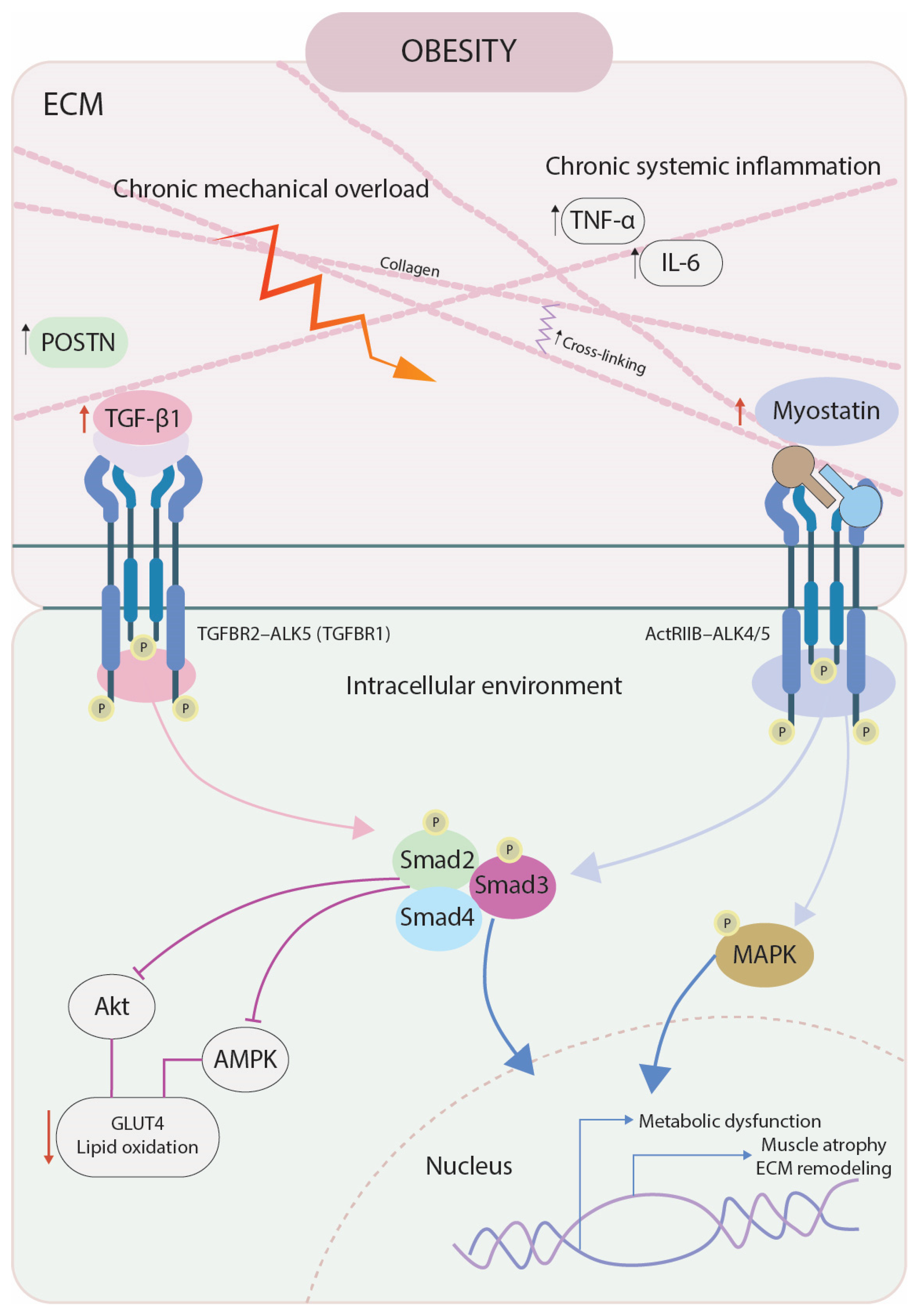
4. Myostatin as a Mediator of Obesity-Induced Musculotendinous Remodeling
5. Conclusions
Author Contributions
Funding
Data Availability Statement
Conflicts of Interest
Abbreviations
| ActRIIB | Activin receptor type IIB |
| Akt | Protein kinase B |
| AMPK | AMP-activated protein kinase |
| BAT | Brown adipose tissue |
| CRP | C-reactive protein |
| ECM | Extracellular matrix |
| GDF-8 | Growth differentiation factor 8 (myostatin) |
| GLUT4 | Glucose transporter type 4 |
| HFD | High-fat diet |
| IGF-1 | Insulin-like growth factor 1 |
| MAPK | Mitogen-activated protein kinase |
| mRNA | Messenger ribonucleic acid |
| mTOR | Mechanistic target of rapamycin |
| POSTN | Periostin |
| SMAD2/3 | Mothers against decapentaplegic homologs 2 and 3 |
| TGF-β | Transforming growth factor beta |
| TGF-β1 | Transforming growth factor beta 1 |
| TNF-α | Tumor necrosis factor alpha |
References
- Wearing, S.C.; Hennig, E.M.; Byrne, N.M.; Steele, J.R.; Hills, A.P. Musculoskeletal Disorders Associated with Obesity: A Biomechanical Perspective. Obes. Rev. 2006, 7, 239–250. [Google Scholar] [CrossRef] [Scilit]
- Tomlinson, D.J.; Erskine, R.M.; Morse, C.I.; Winwood, K.; Onambélé-Pearson, G. The Impact of Obesity on Skeletal Muscle Strength and Structure through Adolescence to Old Age. Biogerontology 2016, 17, 467–483. [Google Scholar] [CrossRef] [Scilit]
- Cesanelli, L.; Minderis, P.; Balnyte, I.; Ratkevicius, A.; Degens, H.; Satkunskiene, D. Obesity-Driven Musculotendinous Remodeling Impairs Tissue Resilience to Mechanical Damage. Cell Tissue Res. 2025, 400, 287–302. [Google Scholar] [CrossRef] [Scilit]
- Studentsova, V.; Mora, K.M.; Glasner, M.F.; Buckley, M.R.; Loiselle, A.E. Obesity/Type II Diabetes Promotes Function-Limiting Changes in Murine Tendons That Are Not Reversed by Restoring Normal Metabolic Function. Sci. Rep. 2018, 8, 9218. [Google Scholar] [CrossRef] [Scilit]
- Buras, E.D.; Converso-Baran, K.; Davis, C.S.; Akama, T.; Hikage, F.; Michele, D.E.; Brooks, S.V.; Chun, T.-H. Fibro-Adipogenic Remodeling of the Diaphragm in Obesity-Associated Respiratory Dysfunction. Diabetes 2019, 68, 45–56. [Google Scholar] [CrossRef] [Scilit] [PubMed]
- Messa, G.A.M.; Piasecki, M.; Hurst, J.; Hill, C.; Tallis, J.; Degens, H. The Impact of a High-Fat Diet in Mice Is Dependent on Duration and Age, and Differs between Muscles. J. Exp. Biol. 2020, 223, jeb217117. [Google Scholar] [CrossRef] [Scilit] [PubMed]
- Csapo, R.; Gumpenberger, M.; Wessner, B. Skeletal Muscle Extracellular Matrix—What Do We Know About Its Composition, Regulation, and Physiological Roles? A Narrative Review. Front. Physiol. 2020, 11, 253. [Google Scholar] [CrossRef] [Scilit] [PubMed]
- Kjaer, M. Role of Extracellular Matrix in Adaptation of Tendon and Skeletal Muscle to Mechanical Loading. Physiol. Rev. 2004, 84, 649–698. [Google Scholar] [CrossRef] [Scilit]
- Humphrey, J.D.; Dufresne, E.R.; Schwartz, M.A. Mechanotransduction and Extracellular Matrix Homeostasis. Nat. Rev. Mol. Cell Biol. 2014, 15, 802–812. [Google Scholar] [CrossRef] [Scilit]
- David, M.A.; Jones, K.H.; Inzana, J.A.; Zuscik, M.J.; Awad, H.A.; Mooney, R.A. Tendon Repair Is Compromised in a High Fat Diet-Induced Mouse Model of Obesity and Type 2 Diabetes. PLoS ONE 2014, 9, e91234. [Google Scholar] [CrossRef] [Scilit]
- Tallis, J.; Shelley, S.; Degens, H.; Hill, C. Age-Related Skeletal Muscle Dysfunction Is Aggravated by Obesity: An Investigation of Contractile Function, Implications and Treatment. Biomolecules 2021, 11, 372. [Google Scholar] [CrossRef] [Scilit]
- Mayorca-Guiliani, A.E.; Leeming, D.J.; Henriksen, K.; Mortensen, J.H.; Nielsen, S.H.; Anstee, Q.M.; Sanyal, A.J.; Karsdal, M.A.; Schuppan, D. ECM Formation and Degradation during Fibrosis, Repair, and Regeneration. NPJ Metab. Health Dis. 2025, 3, 25. [Google Scholar] [CrossRef] [Scilit]
- Gumucio, J.P.; Sugg, K.B.; Mendias, C.L. TGF-β Superfamily Signaling in Muscle and Tendon Adaptation to Resistance Exercise. Exerc. Sport. Sci. Rev. 2015, 43, 93–99. [Google Scholar] [CrossRef] [Scilit]
- Deng, Z.; Fan, T.; Xiao, C.; Tian, H.; Zheng, Y.; Li, C.; He, J. TGF-β Signaling in Health, Disease and Therapeutics. Signal Transduct. Target. Ther. 2024, 9, 61. [Google Scholar] [CrossRef] [Scilit]
- Subramanian, A.; Kanzaki, L.F.; Galloway, J.L.; Schilling, T.F. Mechanical Force Regulates Tendon Extracellular Matrix Organization and Tenocyte Morphogenesis through TGFbeta Signaling. eLife 2018, 7, e38069. [Google Scholar] [CrossRef] [Scilit]
- Hong, S.-H.; Kang, M.; Lee, K.-S.; Yu, K. High Fat Diet-Induced TGF-β/Gbb Signaling Provokes Insulin Resistance through the Tribbles Expression. Sci. Rep. 2016, 6, 30265. [Google Scholar] [CrossRef] [Scilit]
- Samad, F.; Yamamoto, K.; Pandey, M.; Loskutoff, D.J. Elevated Expression of Transforming Growth Factor-Beta in Adipose Tissue from Obese Mice. Mol. Med. 1997, 3, 37–48. [Google Scholar] [CrossRef] [Scilit]
- Yadav, H.; Quijano, C.; Kamaraju, A.K.; Gavrilova, O.; Malek, R.; Chen, W.; Zerfas, P.; Zhigang, D.; Wright, E.C.; Stuelten, C.; et al. Protection from Obesity and Diabetes by Blockade of TGF-β/Smad3 Signaling. Cell Metab. 2011, 14, 67–79. [Google Scholar] [CrossRef] [Scilit] [PubMed]
- Tan, C.K.; Leuenberger, N.; Tan, M.J.; Yan, Y.W.; Chen, Y.; Kambadur, R.; Wahli, W.; Tan, N.S. Smad3 Deficiency in Mice Protects against Insulin Resistance and Obesity Induced by a High-Fat Diet. Diabetes 2011, 60, 464–476. [Google Scholar] [CrossRef] [Scilit] [PubMed]
- Allen, D.L.; Hittel, D.S.; McPherron, A.C. Expression and Function of Myostatin in Obesity, Diabetes, and Exercise Adaptation. Med. Sci. Sports Exerc. 2011, 43, 1828–1835. [Google Scholar] [CrossRef] [Scilit] [PubMed]
- Allen, D.L.; Cleary, A.S.; Speaker, K.J.; Lindsay, S.F.; Uyenishi, J.; Reed, J.M.; Madden, M.C.; Mehan, R.S. Myostatin, Activin Receptor IIb, and Follistatin-like-3 Gene Expression Are Altered in Adipose Tissue and Skeletal Muscle of Obese Mice. Am. J. Physiol. Endocrinol. Metab. 2008, 294, E918–E927. [Google Scholar] [CrossRef] [Scilit]
- Baig, M.H.; Ahmad, K.; Moon, J.S.; Park, S.-Y.; Ho Lim, J.; Chun, H.J.; Qadri, A.F.; Hwang, Y.C.; Jan, A.T.; Ahmad, S.S.; et al. Myostatin and Its Regulation: A Comprehensive Review of Myostatin Inhibiting Strategies. Front. Physiol. 2022, 13, 876078. [Google Scholar] [CrossRef] [Scilit]
- Pervin, S.; Reddy, S.T.; Singh, R. Novel Roles of Follistatin/Myostatin in Transforming Growth Factor-β Signaling and Adipose Browning: Potential for Therapeutic Intervention in Obesity Related Metabolic Disorders. Front. Endocrinol. 2021, 12, 653179. [Google Scholar] [CrossRef] [Scilit]
- Esposito, P.; Picciotto, D.; Battaglia, Y.; Costigliolo, F.; Viazzi, F.; Verzola, D. Myostatin: Basic Biology to Clinical Application. Adv. Clin. Chem. 2022, 106, 181–234. [Google Scholar] [CrossRef] [Scilit]
- Rebbapragada, A.; Benchabane, H.; Wrana, J.L.; Celeste, A.J.; Attisano, L. Myostatin Signals through a Transforming Growth Factor Beta-like Signaling Pathway to Block Adipogenesis. Mol. Cell Biol. 2003, 23, 7230–7242. [Google Scholar] [CrossRef] [Scilit]
- McPherron, A.C.; Lawler, A.M.; Lee, S.J. Regulation of Skeletal Muscle Mass in Mice by a New TGF-Beta Superfamily Member. Nature 1997, 387, 83–90. [Google Scholar] [CrossRef] [Scilit]
- Hittel, D.S.; Berggren, J.R.; Shearer, J.; Boyle, K.; Houmard, J.A. Increased Secretion and Expression of Myostatin in Skeletal Muscle from Extremely Obese Women. Diabetes 2009, 58, 30–38. [Google Scholar] [CrossRef] [Scilit] [PubMed]
- Reisz-Porszasz, S.; Bhasin, S.; Artaza, J.N.; Shen, R.; Sinha-Hikim, I.; Hogue, A.; Fielder, T.J.; Gonzalez-Cadavid, N.F. Lower Skeletal Muscle Mass in Male Transgenic Mice with Muscle-Specific Overexpression of Myostatin. Am. J. Physiol. Endocrinol. Metab. 2003, 285, E876–E888. [Google Scholar] [CrossRef] [Scilit] [PubMed]
- Palsgaard, J.; Brøns, C.; Friedrichsen, M.; Dominguez, H.; Jensen, M.; Storgaard, H.; Spohr, C.; Torp-Pedersen, C.; Borup, R.; De Meyts, P.; et al. Gene Expression in Skeletal Muscle Biopsies from People with Type 2 Diabetes and Relatives: Differential Regulation of Insulin Signaling Pathways. PLoS ONE 2009, 4, e6575. [Google Scholar] [CrossRef] [Scilit] [PubMed]
- Kong, X.; Yao, T.; Zhou, P.; Kazak, L.; Tenen, D.; Lyubetskaya, A.; Dawes, B.A.; Tsai, L.; Kahn, B.B.; Spiegelman, B.M.; et al. Brown Adipose Tissue Controls Skeletal Muscle Function via the Secretion of Myostatin. Cell Metab. 2018, 28, 631–643.e3. [Google Scholar] [CrossRef] [Scilit] [PubMed]
- Mastaitis, J.W.; Gomez, D.; Raya, J.G.; Li, D.; Min, S.; Stec, M.; Kleiner, S.; McWilliams, T.; Altarejos, J.Y.; Murphy, A.J.; et al. GDF8 and Activin A Blockade Protects against GLP-1–Induced Muscle Loss While Enhancing Fat Loss in Obese Male Mice and Non-Human Primates. Nat. Commun. 2025, 16, 4377. [Google Scholar] [CrossRef] [Scilit]
- Minderis, P.; Kilikevicius, A.; Baltusnikas, J.; Alhindi, Y.; Venckunas, T.; Bunger, L.; Lionikas, A.; Ratkevicius, A. Myostatin Dysfunction Is Associated with Reduction in Overload Induced Hypertrophy of Soleus Muscle in Mice. Scand. J. Med. Sci. Sports 2016, 26, 894–901. [Google Scholar] [CrossRef] [Scilit]
- Satkunskiene, D.; Ratkevicius, A.; Kamandulis, S.; Venckunas, T. Effects of Myostatin on the Mechanical Properties of Muscles during Repeated Active Lengthening in the Mouse. Appl. Physiol. Nutr. Metab. = Physiol. Appl. Nutr. et Metab. 2019, 44, 381–388. [Google Scholar] [CrossRef] [Scilit]
- Amemiya, H.; Yamamoto, M.; Higa, K.; Watanabe, G.; Taniguchi, S.; Kitamura, K.; Jeong, J.; Yanagisawa, N.; Fukuda, K.-I.; Abe, S. Effects of Myostatin on Nuclear Morphology at the Myotendinous Junction. Int. J. Mol. Sci. 2023, 24, 6634. [Google Scholar] [CrossRef] [Scilit]
- Baltusnikas, J.; Kilikevicius, A.; Venckunas, T.; Fokin, A.; Bünger, L.; Lionikas, A.; Ratkevicius, A. Myostatin Dysfunction Impairs Force Generation in Extensor Digitorum Longus Muscle and Increases Exercise-Induced Protein Efflux from Extensor Digitorum Longus and Soleus Muscles. Appl. Physiol. Nutr. Metab. = Physiol. Appl. Nutr. et Metab. 2015, 40, 817–821. [Google Scholar] [CrossRef] [Scilit] [PubMed]
- Li, Z.B.; Kollias, H.D.; Wagner, K.R. Myostatin Directly Regulates Skeletal Muscle Fibrosis. J. Biol. Chem. 2008, 283, 19371–19378. [Google Scholar] [CrossRef] [Scilit] [PubMed]
- Bo Li, Z.; Zhang, J.; Wagner, K.R. Inhibition of Myostatin Reverses Muscle Fibrosis through Apoptosis. J. Cell Sci. 2012, 125, 3957–3965. [Google Scholar] [CrossRef] [Scilit]
- Cesanelli, L.; Ylaite, B.; Brazaitis, M.; Eimantas, N.; Ratkevicius, A.; Satkunskiene, D.; Minderis, P. Metabolic Stress and Muscle Mechanics: Acute Response of Isolated Soleus and EDL Muscles to Prolonged Fasting in Mice with Distinct Muscle Phenotypes. Biol. Open 2025, 14, bio.062245. [Google Scholar] [CrossRef] [Scilit] [PubMed]
- Mendias, C.L.; Bakhurin, K.I.; Faulkner, J.A. Tendons of Myostatin-Deficient Mice Are Small, Brittle, and Hypocellular. Proc. Natl. Acad. Sci. USA 2008, 105, 388–393. [Google Scholar] [CrossRef] [Scilit]
- Cesanelli, L.; Minderis, P.; Fokin, A.; Ratkevicius, A.; Satkunskiene, D.; Degens, H. Myostatin Deficiency Blunts Mechanical Adaptation of Soleus Muscle to Overload. J. Muscle Res. Cell Motil. 2025, 46, 439–449. [Google Scholar] [CrossRef] [Scilit]
- Dewi, N.M.; Meiliana, A.; Defi, I.R.; Amalia, R.; Sartika, C.R.; Wijaya, A.; Barliana, M.I. Targeted Therapy for Skeletal Muscle Fibrosis: Regulation of Myostatin, TGF-β, MMP, and TIMP to Maintain Extracellular Matrix Homeostasis. Biologics 2025, 19, 213–229. [Google Scholar] [CrossRef] [Scilit]
- Collao, N.; Farup, J.; De Lisio, M. Role of Metabolic Stress and Exercise in Regulating Fibro/Adipogenic Progenitors. Front. Cell Dev. Biol. 2020, 8, 9. [Google Scholar] [CrossRef] [Scilit]
- Consitt, L.A.; Clark, B.C. The Vicious Cycle of Myostatin Signaling in Sarcopenic Obesity: Myostatin Role in Skeletal Muscle Growth, Insulin Signaling and Implications for Clinical Trials. J. Frailty Aging 2018, 7, 21–27. [Google Scholar] [CrossRef] [Scilit]
- Hansen, M.; Grothen, J.E.R.; Karlsen, A.; Martinez, J.M.; Sidiropoulos, N.; Helge, J.W.; Pedersen, T.Å.; Dela, F. The Skeletal Muscle Response to High-Intensity Training Assessed by Single-Nucleus RNA-Sequencing Is Blunted in Individuals with Type 2 Diabetes. J. Physiol. 2025, 603, 3357–3377. [Google Scholar] [CrossRef] [Scilit]
- Cesanelli, L.; Balnyte, I.; Cesanelli, F.; Satkunskiene, D.; Degens, H. Periostin: A Candidate Mediator of Muscle–Tendon ECM Remodeling in Obesity. Biochim. et Biophys. Acta (BBA) Mol. Basis Dis. 2026, 1872, 168090. [Google Scholar] [CrossRef] [Scilit] [PubMed]
- Bhatt, S.P.; Nigam, P.; Misra, A.; Guleria, R.; Luthra, K.; Jain, S.K.; Qadar Pasha, M.A. Association of the Myostatin Gene with Obesity, Abdominal Obesity and Low Lean Body Mass and in Non-Diabetic Asian Indians in North India. PLoS ONE 2012, 7, e40977. [Google Scholar] [CrossRef] [Scilit]
- Pan, H.; Ping, X.-C.; Zhu, H.-J.; Gong, F.-Y.; Dong, C.-X.; Li, N.-S.; Wang, L.-J.; Yang, H.-B. Association of Myostatin Gene Polymorphisms with Obesity in Chinese North Han Human Subjects. Gene 2012, 494, 237–241. [Google Scholar] [CrossRef] [Scilit] [PubMed]
- Curiel-Cervantes, V.; Solís-Sáinz, J.C.; Costa-Urrutia, P.; Aguilar-Galarza, A.; Flores-Viveros, K.L.; García-Gasca, T.D.J.; Anaya-Loyola, M.A. The Myostatin Rs1805086 Variant Is Associated with Obesity in Mexican Adults, Independently of Metabolic Risk Factors. Biomarkers 2020, 25, 566–572. [Google Scholar] [CrossRef] [Scilit] [PubMed]
- Burgess, K.; Xu, T.; Brown, R.; Han, B.; Welle, S. Effect of Myostatin Depletion on Weight Gain, Hyperglycemia, and Hepatic Steatosis during Five Months of High-Fat Feeding in Mice. PLoS ONE 2011, 6, e17090. [Google Scholar] [CrossRef] [Scilit]
- Bueno, P.G.; Bassi, D.; Contrera, D.G.; Carnielli, H.M.; Silva, R.N.; Nonaka, K.O.; Selistre-de-Araújo, H.S.; Leal, A.M.O. Post-Exercise Changes in Myostatin and actRIIB Expression in Obese Insulin-Resistant Rats. Mol. Cell. Endocrinol. 2011, 339, 159–164. [Google Scholar] [CrossRef] [Scilit]
- Carvalho, L.P.; Basso-Vanelli, R.P.; Di Thommazo-Luporini, L.; Mendes, R.G.; Oliveira-Junior, M.C.; de Paula Vieira, R.; Bonjorno-Junior, J.C.; Oliveira, C.R.; Luporini, R.; Borghi-Silva, A. Myostatin and Adipokines: The Role of the Metabolically Unhealthy Obese Phenotype in Muscle Function and Aerobic Capacity in Young Adults. Cytokine 2018, 107, 118–124. [Google Scholar] [CrossRef] [Scilit]
- Amor, M.; Itariu, B.K.; Moreno-Viedma, V.; Keindl, M.; Jürets, A.; Prager, G.; Langer, F.; Grablowitz, V.; Zeyda, M.; Stulnig, T.M. Serum Myostatin Is Upregulated in Obesity and Correlates with Insulin Resistance in Humans. Exp. Clin. Endocrinol. Diabetes 2019, 127, 550–556. [Google Scholar] [CrossRef] [Scilit]
- Kern-Matschilles, S.; Gar, C.; Wanger, L.; Haschka, S.J.; Potzel, A.L.; Hesse, N.; Then, C.; Seissler, J.; Lechner, A. Association of Serum Myostatin with Body Weight, Visceral Fat Volume, and High Sensitivity C-Reactive Protein But Not with Muscle Mass and Physical Fitness in Premenopausal Women. Exp. Clin. Endocrinol. Diabetes 2022, 130, 393–399. [Google Scholar] [CrossRef] [Scilit] [PubMed]
- Ryan, A.S.; Li, G. Skeletal Muscle Myostatin Gene Expression and Sarcopenia in Overweight and Obese Middle-Aged and Older Adults. JCSM Clin. Rep. 2021, 6, 137–142. [Google Scholar] [CrossRef] [Scilit]
- Watts, R.; McAinch, A.J.; Dixon, J.B.; O’Brien, P.E.; Cameron-Smith, D. Increased Smad Signaling and Reduced MRF Expression in Skeletal Muscle from Obese Subjects. Obesity 2013, 21, 525–528. [Google Scholar] [CrossRef] [Scilit] [PubMed]
- Wilhelmsen, A.; Stephens, F.B.; Bennett, A.J.; Karagounis, L.G.; Jones, S.W.; Tsintzas, K. Skeletal Muscle Myostatin mRNA Expression Is Upregulated in Aged Human Adults with Excess Adiposity but Is Not Associated with Insulin Resistance and Ageing. Geroscience 2024, 46, 2033–2049. [Google Scholar] [CrossRef] [Scilit]
- Milan, G.; Dalla Nora, E.; Pilon, C.; Pagano, C.; Granzotto, M.; Manco, M.; Mingrone, G.; Vettor, R. Changes in Muscle Myostatin Expression in Obese Subjects after Weight Loss. J. Clin. Endocrinol. Metab. 2004, 89, 2724–2727. [Google Scholar] [CrossRef] [Scilit]
- Park, J.-J.; Berggren, J.R.; Hulver, M.W.; Houmard, J.A.; Hoffman, E.P. GRB14, GPD1, and GDF8 as Potential Network Collaborators in Weight Loss-Induced Improvements in Insulin Action in Human Skeletal Muscle. Physiol. Genom. 2006, 27, 114–121. [Google Scholar] [CrossRef] [Scilit] [PubMed]
- Bagheri, R.; Ashtary-Larky, D.; Elliott, B.T.; Willoughby, D.S.; Kargarfard, M.; Alipour, M.; Lamuchi-Deli, N.; Kooti, W.; Asbaghi, O.; Wong, A. The Effects of Gradual vs. Rapid Weight Loss on Serum Concentrations of Myokines and Body Composition in Overweight and Obese Females. Arch. Physiol. Biochem. 2023, 129, 821–828. [Google Scholar] [CrossRef] [Scilit]
- Perry, C.A.; Van Guilder, G.P.; Butterick, T.A. Decreased Myostatin in Response to a Controlled DASH Diet Is Associated with Improved Body Composition and Cardiometabolic Biomarkers in Older Adults: Results from a Controlled-Feeding Diet Intervention Study. BMC Nutr. 2022, 8, 24. [Google Scholar] [CrossRef] [Scilit]
- Goralska, J.; Razny, U.; Gruca, A.; Solnica, B.; Malczewska-Malec, M. Improvement in Insulin Sensitivity Following Weight Loss in Obese Patients Is Associated with Circulating Myostatin. J. Physiol. Pharmacol. 2025, 76. [Google Scholar] [CrossRef]
- McPherron, A.C.; Lee, S.-J. Suppression of Body Fat Accumulation in Myostatin-Deficient Mice. J. Clin. Investig. 2002, 109, 595–601. [Google Scholar] [CrossRef]
- Zhao, B.; Wall, R.J.; Yang, J. Transgenic Expression of Myostatin Propeptide Prevents Diet-Induced Obesity and Insulin Resistance. Biochem. Biophys. Res. Commun. 2005, 337, 248–255. [Google Scholar] [CrossRef] [Scilit]
- Yang, J.; Zhao, B. Postnatal Expression of Myostatin Propeptide cDNA Maintained High Muscle Growth and Normal Adipose Tissue Mass in Transgenic Mice Fed a High-Fat Diet. Mol. Reprod. Dev. 2006, 73, 462–469. [Google Scholar] [CrossRef] [Scilit]
- Akpan, I.; Goncalves, M.D.; Dhir, R.; Yin, X.; Pistilli, E.E.; Bogdanovich, S.; Khurana, T.S.; Ucran, J.; Lachey, J.; Ahima, R.S. The Effects of a Soluble Activin Type IIB Receptor on Obesity and Insulin Sensitivity. Int. J. Obes. (2005) 2009, 33, 1265–1273. [Google Scholar] [CrossRef] [Scilit] [PubMed]
- Guo, W.; Flanagan, J.; Jasuja, R.; Kirkland, J.; Jiang, L.; Bhasin, S. The Effects of Myostatin on Adipogenic Differentiation of Human Bone Marrow-Derived Mesenchymal Stem Cells Are Mediated through Cross-Communication between Smad3 and Wnt/β-Catenin Signaling Pathways. J. Biol. Chem. 2008, 283, 9136–9145. [Google Scholar] [CrossRef] [Scilit] [PubMed]
- Kim, H.S.; Liang, L.; Dean, R.G.; Hausman, D.B.; Hartzell, D.L.; Baile, C.A. Inhibition of Preadipocyte Differentiation by Myostatin Treatment in 3T3-L1 Cultures. Biochem. Biophys. Res. Commun. 2001, 281, 902–906. [Google Scholar] [CrossRef] [Scilit]
- Artaza, J.N.; Bhasin, S.; Magee, T.R.; Reisz-Porszasz, S.; Shen, R.; Groome, N.P.; Meerasahib, M.F.; Gonzalez-Cadavid, N.F. Myostatin Inhibits Myogenesis and Promotes Adipogenesis in C3H 10T(1/2) Mesenchymal Multipotent Cells. Endocrinology 2005, 146, 3547–3557. [Google Scholar] [CrossRef] [Scilit] [PubMed]
- Feldman, B.J.; Streeper, R.S.; Farese, R.V.; Yamamoto, K.R. Myostatin Modulates Adipogenesis to Generate Adipocytes with Favorable Metabolic Effects. Proc. Natl. Acad. Sci. USA 2006, 103, 15675–15680. [Google Scholar] [CrossRef] [Scilit]
- Guo, T.; Jou, W.; Chanturiya, T.; Portas, J.; Gavrilova, O.; McPherron, A.C. Myostatin Inhibition in Muscle, but Not Adipose Tissue, Decreases Fat Mass and Improves Insulin Sensitivity. PLoS ONE 2009, 4, e4937. [Google Scholar] [CrossRef] [Scilit]
- Bernardo, B.L.; Wachtmann, T.S.; Cosgrove, P.G.; Kuhn, M.; Opsahl, A.C.; Judkins, K.M.; Freeman, T.B.; Hadcock, J.R.; LeBrasseur, N.K. Postnatal PPARdelta Activation and Myostatin Inhibition Exert Distinct yet Complimentary Effects on the Metabolic Profile of Obese Insulin-Resistant Mice. PLoS ONE 2010, 5, e11307. [Google Scholar] [CrossRef] [Scilit]
- Stantzou, A.; Relizani, K.; Morales-Gonzalez, S.; Gallen, C.; Grassin, A.; Ferry, A.; Schuelke, M.; Amthor, H. Extracellular Matrix Remodelling Is Associated with Muscle Force Increase in Overloaded Mouse Plantaris Muscle. Neuropathol. Appl. Neurobiol. 2021, 47, 218–235. [Google Scholar] [CrossRef] [Scilit]
- Wu, L.; Coletta, D.K. Obesity and Type 2 Diabetes Mellitus: Insights from Skeletal Muscle Extracellular Matrix Remodeling. Am. J. Physiol. Cell Physiol. 2025, 328, C1752–C1763. [Google Scholar] [CrossRef] [Scilit]
- Ahmad, K.; Shaikh, S.; Chun, H.J.; Ali, S.; Lim, J.H.; Ahmad, S.S.; Lee, E.J.; Choi, I. Extracellular Matrix: The Critical Contributor to Skeletal Muscle Regeneration—A Comprehensive Review. Inflamm. Regen. 2023, 43, 58. [Google Scholar] [CrossRef] [Scilit]
- Allwood, M.A.; Foster, A.J.; Arkell, A.M.; Beaudoin, M.-S.; Snook, L.A.; Romanova, N.; Murrant, C.L.; Holloway, G.P.; Wright, D.C.; Simpson, J.A. Respiratory Muscle Weakness in the Zucker Diabetic Fatty Rat. Am. J. Physiology. Regul. Integr. Comp. Physiol. 2015, 309, R780–R787. [Google Scholar] [CrossRef] [Scilit]
- Ruan, J.; Zhang, Y.; Yuan, J.; Xin, L.; Xia, J.; Liu, N.; Mu, Y.; Chen, Y.; Yang, S.; Li, K. A Long-Term High-Fat, High-Sucrose Diet in Bama Minipigs Promotes Lipid Deposition and Amyotrophy by up-Regulating the Myostatin Pathway. Mol. Cell Endocrinol. 2016, 425, 123–132. [Google Scholar] [CrossRef] [Scilit]
- Rasool, S.; Geetha, T.; Broderick, T.L.; Babu, J.R. High Fat with High Sucrose Diet Leads to Obesity and Induces Myodegeneration. Front. Physiol. 2018, 9, 1054. [Google Scholar] [CrossRef] [Scilit] [PubMed]
- Barbero, A.; Astiz, S.; Ovilo, C.; Lopez-Bote, C.J.; Perez-Solana, M.L.; Ayuso, M.; Garcia-Real, I.; Gonzalez-Bulnes, A. Prenatal Programming of Obesity in a Swine Model of Leptin Resistance: Modulatory Effects of Controlled Postnatal Nutrition and Exercise. J. Dev. Orig. Health Dis. 2014, 5, 248–258. [Google Scholar] [CrossRef] [Scilit] [PubMed]
- Galt, N.J.; Froehlich, J.M.; Meyer, B.M.; Barrows, F.T.; Biga, P.R. High-Fat Diet Reduces Local Myostatin-1 Paralog Expression and Alters Skeletal Muscle Lipid Content in Rainbow Trout, Oncorhynchus Mykiss. Fish. Physiol. Biochem. 2014, 40, 875–886. [Google Scholar] [CrossRef] [Scilit]
- Tanaka, M.; Masuda, S.; Yamakage, H.; Inoue, T.; Ohue-Kitano, R.; Yokota, S.; Kusakabe, T.; Wada, H.; Sanada, K.; Ishii, K.; et al. Role of Serum Myostatin in the Association between Hyperinsulinemia and Muscle Atrophy in Japanese Obese Patients. Diabetes Res. Clin. Pract. 2018, 142, 195–202. [Google Scholar] [CrossRef] [Scilit] [PubMed]
- Li, N.; Yang, Q.; Walker, R.G.; Thompson, T.B.; Du, M.; Rodgers, B.D. Myostatin Attenuation In Vivo Reduces Adiposity, but Activates Adipogenesis. Endocrinology 2016, 157, 282–291. [Google Scholar] [CrossRef] [Scilit]
- Ishibashi, C.; Nakanishi, K.; Nishida, M.; Shinomiya, H.; Shinzawa, M.; Kanayama, D.; Yamamoto, R.; Kudo, T.; Nagatomo, I.; Yamauchi-Takihara, K. Myostatin as a Plausible Biomarker for Early Stage of Sarcopenic Obesity. Sci. Rep. 2024, 14, 28629. [Google Scholar] [CrossRef] [Scilit] [PubMed]
- Yan, X.; Niu, Q.; Gao, X.; Shen, S.; He, N.; Wang, H.; Fang, R.; Gao, Y.; Chang, H. Differential Protein Metabolism and Regeneration in Gastrocnemius Muscles in High-Fat Diet Fed Mice and Pre-Hibernation Daurian Ground Squirrels: A Comparison between Pathological and Healthy Obesity. Zool. Stud. 2021, 60, e6. [Google Scholar] [CrossRef] [Scilit] [PubMed]
- Burch, M.L.; Zheng, W.; Little, P.J. Smad Linker Region Phosphorylation in the Regulation of Extracellular Matrix Synthesis. Cell Mol. Life Sci. 2010, 68, 97–107. [Google Scholar] [CrossRef] [Scilit] [PubMed]
- Fan, C.; El Andaloussi, S.; Lehto, T.; Kong, K.W.; Seow, Y. Smad-Binding Decoy Reduces Extracellular Matrix Expression in Human Hypertrophic Scar Fibroblasts. Mol. Med. Rep. 2020, 22, 4589–4600. [Google Scholar] [CrossRef] [Scilit]
- Elashry, M.I.; Eldaey, A.; Glenske, K.; Matsakas, A.; Wenisch, S.; Arnhold, S.; Patel, K. The Effect of High-Fat Diet on the Morphological Properties of the Forelimb Musculature in Hypertrophic Myostatin Null Mice. J. Anat. 2019, 235, 825–835. [Google Scholar] [CrossRef] [Scilit]

| Evidence Context | Obesity Phenotype/Model | Systemic Myostatin (Circulating) | Muscle/Tendon Myostatin Signaling | Metabolic Consequences | Musculotendinous/ECM Consequences | Direction of Evidence |
|---|---|---|---|---|---|---|
| Human | Obesity without sarcopenia | ↑ or unchanged | ↑ (inferred from tissue markers) | Insulin resistance; metabolic dysfunction | Increased ECM remodeling; reduced tissue adaptability | Consistent |
| Human | Sarcopenic obesity | ↓ | ↓ (reflecting reduced muscle mass) | Muscle loss; impaired metabolic health | Compromised muscle–tendon integrity | Emerging |
| Animal | Diet-induced obesity | ↑ | ↑ | Weight gain; glucose intolerance | Increased collagen turnover; ECM remodeling | Consistent |
| Animal | Genetic myostatin deficiency | ↓ or normal | ↓ | Reduced adiposity via nutrient repartitioning | Altered ECM organization; preserved muscle mass | Consistent |
| Animal | Muscle-targeted myostatin inhibition | ↓ | ↓ (muscle-specific) | Improved glucose homeostasis; reduced fat mass | Limited or indirect ECM effects | Consistent |
| Animal | Combined anti-obesity pharmacotherapy + ActRII ligand blockade | ↓ | ↓ | Preserved lean mass; enhanced fat loss | Not yet fully characterized | Emerging |
Disclaimer/Publisher’s Note: The statements, opinions and data contained in all publications are solely those of the individual author(s) and contributor(s) and not of MDPI and/or the editor(s). MDPI and/or the editor(s) disclaim responsibility for any injury to people or property resulting from any ideas, methods, instructions or products referred to in the content. |
© 2026 by the authors. Licensee MDPI, Basel, Switzerland. This article is an open access article distributed under the terms and conditions of the Creative Commons Attribution (CC BY) license.
Share and Cite
Cesanelli, L.; Minderis, P.; Fokin, A.; Ratkevicius, A.; Satkunskiene, D.; Degens, H. Myostatin in Obesity: A Molecular Link Between Metabolic Dysfunction and Musculotendinous Remodeling. Int. J. Mol. Sci. 2026, 27, 967. https://doi.org/10.3390/ijms27020967
Cesanelli L, Minderis P, Fokin A, Ratkevicius A, Satkunskiene D, Degens H. Myostatin in Obesity: A Molecular Link Between Metabolic Dysfunction and Musculotendinous Remodeling. International Journal of Molecular Sciences. 2026; 27(2):967. https://doi.org/10.3390/ijms27020967
Chicago/Turabian StyleCesanelli, Leonardo, Petras Minderis, Andrej Fokin, Aivaras Ratkevicius, Danguole Satkunskiene, and Hans Degens. 2026. "Myostatin in Obesity: A Molecular Link Between Metabolic Dysfunction and Musculotendinous Remodeling" International Journal of Molecular Sciences 27, no. 2: 967. https://doi.org/10.3390/ijms27020967
APA StyleCesanelli, L., Minderis, P., Fokin, A., Ratkevicius, A., Satkunskiene, D., & Degens, H. (2026). Myostatin in Obesity: A Molecular Link Between Metabolic Dysfunction and Musculotendinous Remodeling. International Journal of Molecular Sciences, 27(2), 967. https://doi.org/10.3390/ijms27020967