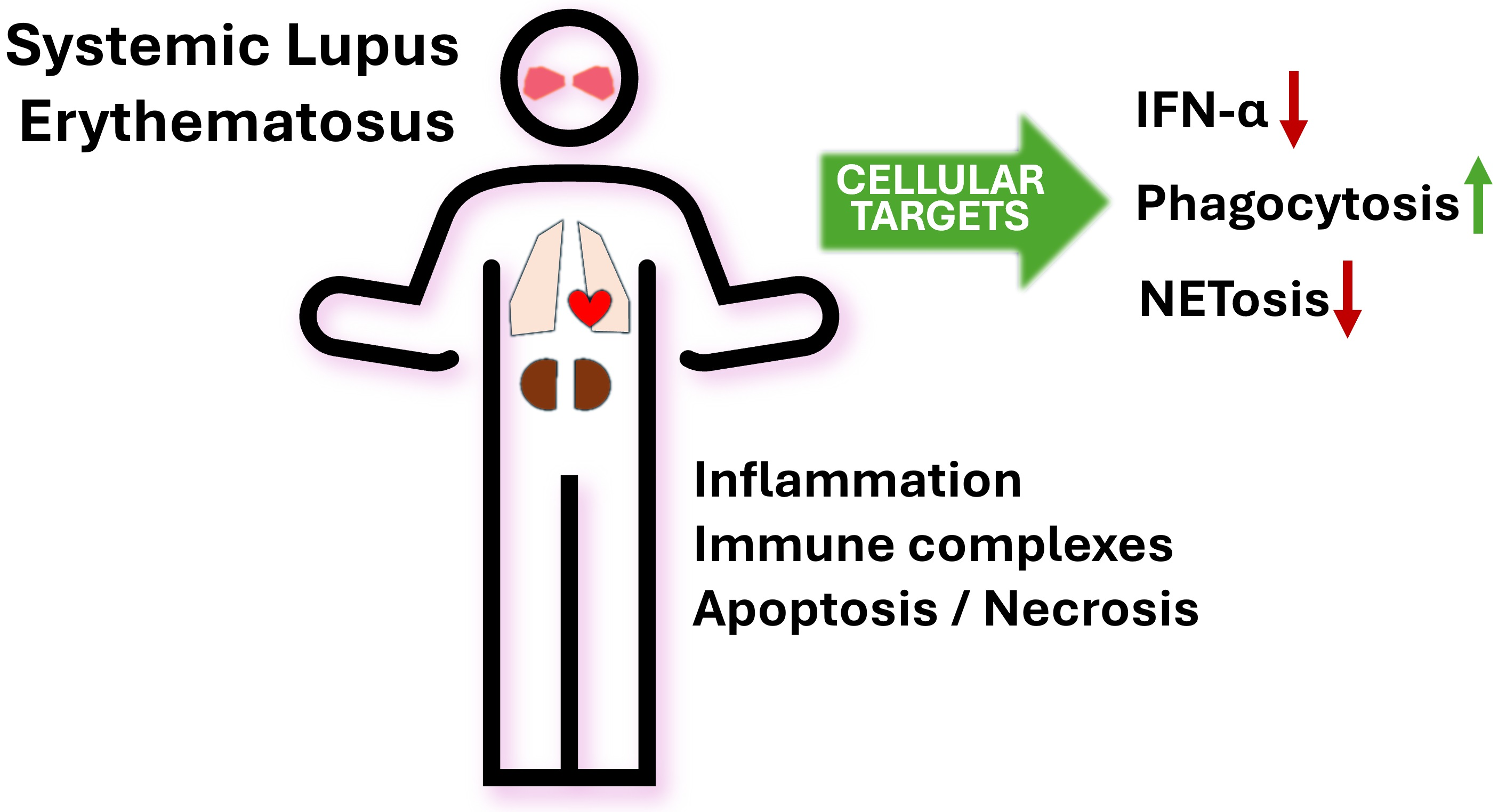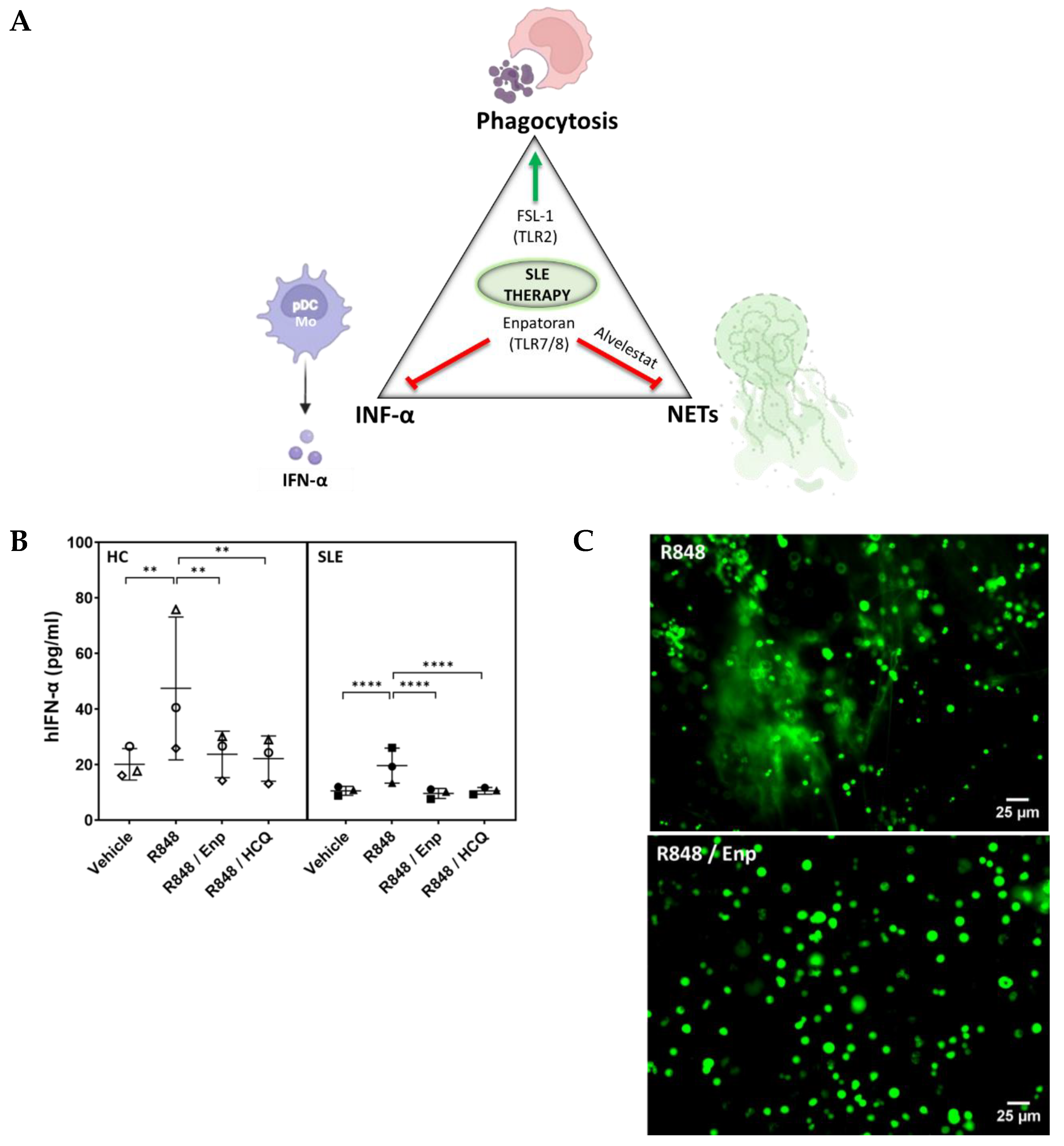
Can Phagocytosis, Neutrophil Extracellular Traps, and IFN-α Production in Systemic Lupus Erythematosus Be Simultaneously Modulated? A Pharmacological Perspective

 ,
,  , and
, and
Abstract
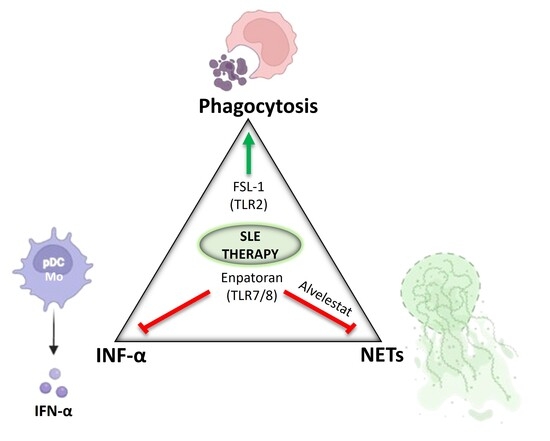
1. Introduction
2. Novel Approved Therapies Since the 2019 EULAR Guidelines

| (A) | ||||
| Drug/Therapy | Indication | Mechanism of Action | Dosage/Application | Clinical Notes/Adverse Effects |
| Hydroxychloroquine (HCQ) | All types of SLE, skin and joint involvement | TLR7/9 inhibition; cGAS activity inhibition [24] | Oral: 200–400 mg/day | Long-term therapy: risk of retinopathy, eye monitoring required |
| Glucocorticoids (GC) | Acute flares, crucial organ involvement | Genomic modulation: inhibition of inflammatory molecules transcription; rapid non-genomic pathway: blockage of phospholipase A2 activation, reduced lymphocyte activity, inhibition of ATP production [25] | Initial: 0.5–1 mg/kg/day orally for flares, then taper Maintenance: ≤2.5–5 mg/day IV pulse: Methylprednisolone 250–1000 mg/day × 1–3 days | Preferred short-term use; osteoporosis, diabetes, hypertension, glaucoma |
| Methotrexate (MTX) | Refractory skin/joint involvement, non-responsive to HCQ with or without GC, GC tapering not possible or higher dose of GC needed for skin involvement [26] | Di-hydropholate reductase inhibition; extracellular adenosine concentration increase [27] | Oral: 7.5–25 mg/week with 1–5 mg/day folate [27] | Bone marrow suppression, oral and gastrointestinal ulcers, alopecia, pulmonary toxicity, hepatic cytolysis [27] |
| Azathioprine (AZA) | Organ manifestations, non-responsive to HCQ with or without GC, GC tapering not possible, maintenance therapy in LN | Purine synthesis inhibition [28] | Oral: 2–3 mg/kg/day | Gastrointestinal disorders, mild infections, cytopenia [28] |
| Mycophenolate mofetil (MMF) | Skin and hematological manifestations, LN | Nucleic acid synthesis inhibition in T- and B-lymphocytes [28] | Oral: 2–3 g/day [29] | Leukopenia, diarrhea, nausea, infection risk [28,29] |
| Cyclophosphamide (CYC) | Severe LN, CNS involvement | DNA cross-link [28] | IV: 40–50 mg/kg over 2 to 5 days or 0.5–1 g/m2 monthly for 6 months (high-dose IV NIH regimen) [30] IV: 500 mg every 2 weeks for 3 months (EURO Lupus regimen) [31] Oral: 1.0–1.5 mg/kg/d (max 150 mg/d) for 2–6 months [31] | Infection risk, gonadal toxicity, neoplasms, amenorrhea [28] |
| Belimumab | Refractory SLE without severe organ involvement, additional to standard therapy in active LN | Anti-BLyS antibody [28] | SLE/LN: 10 mg/kg IV every 2 weeks (3 doses), then every 4 weeks SLE: 200 mg SC weekly LN: 400 mg SC weekly for 4 weeks, then 200 mg weekly [32] | Infection risk, hypersensitivity, nausea, headache, fatigue, psychiatric events [28] |
| Rituximab | Refractory severe cases, hematological involvement, CNS lupus, LN [33] | Anti-CD20 antibody [28] | IV: 375 mg/m2 weekly for 4 weeks or 1 g every 2 weeks (max 2 cycles/year) [28] | Off-label [34]; infusion reactions, infection risk [28] |
| Anifrolumab | Refractory severe cases with extensive skin disease involvement | IFNAR1/2 dimerization and internalization inhibition | IV: 300 mg every 4 weeks [35,36] | Infection risk, hypersensitivity, malignancy [37] |
| Calcineurin inhibitors (CNI; Tacrolimus, Cyclosporin, Voclosporin) | Skin disease, LN | NFAT dephosphorylation inhibition [28] | Tacrolimus: 0.1–0.3 mg/kg/day orally Cyclosporin: 2.5 mg/kg/day orally Voclosporin: 23.7 mg BID orally [38,39] | Nephrotoxicity, neurotoxicity, cardiometabolic complications, dermatological or GI complications [28,38] |
| (B) | ||||
| Drug Combination | Dosage/Application | Efficacy | Adverse Effects | |
| MMF + Tacrolimus + Prednisone/Methylprednisolone | I. MMF 0.91 ± 0.12 g/day, TAC 3.65 ± 0.48 mg/day, Prednisone 35.7 ± 8.6 mg/day [40] II. MMF 1 g/day + TAC 4 mg/day + Methylprednisolone 10 mg/d [41] III. MMF 0.5–0.75 g/day + TAC 2–3 mg/day + Prednisone 10 mg/day [42] | Complete remission, decreased SLE-DAI, negative rate dsDNA and ANA, decreased proteinuria levels, increased serum albumin, normalized C3 [40,42] Increased tolerability; lower GI, leucopenia, irregular menstruation and upper respiratory infection incidence [40,42] | Increased new-onset hypertension, pneumonia, diarrhea [40,41,42] | |
| Voclosporin + MMF + GC | Voclosporin 23.7 mg BID + MMF 2 g/d + GC (IV methylprednisolone on day 1–2, on day 3 oral prednisone 20–25 mg/d tapered to 2.5 mg/day by week 16) [43] | Complete remission, negative rate dsDNA [43,44] | GI and neurologic disorder, pneumonia and infection incidence; kidney dysfunction, hyperkalemia, diabetes and increase in blood pressure with CNI-class AE [43,45] | |
| Belimumab + SOC (MMF or CYC-AZA) | Belimumab 10 mg/kg IV + SOC [46] | Complete remission, negative rate dsDNA [40,43,44] | Pneumonia and infection incidence [46] | |
| Leflunomide + MMF/+ GC | Initial: Leflunomide 20 mg/day (3 months) + MMF 250 mg BID + prednisolone (0.8–1.0 mg/kg (6 weeks), 6–10 mg/day afterwards) Maintenance: Leflunomide 10 mg/day (6 months) + MMF 250 mg BID + prednisolone (0.8–1.0 mg/kg (6 weeks), 6–10 mg/day afterwards) [44] | Complete remission, negative rate dsDNA and ANA, decreased proteinuria levels Increased tolerability; lower GI, leucopoenia and irregular menstruation incidence [40,44] | Increased new-onset hypertension [40,44] | |
3. TLRs in Autoimmune Diseases and in SLE
4. Investigational Therapies
5. Defective Phagocytosis
6. High Interferon Levels
7. Neutrophil Extracellular Trap (NET) and Monocyte Extracellular Trap (MET) Production
8. Interplay Between Phagocytosis, NETosis, and IFN-α in SLE
9. A Multi-Target Therapeutic Approach and New Potential Drugs
10. Discussion and Future Directions
11. Conclusions
Author Contributions
Funding
Institutional Review Board Statement
Data Availability Statement
Conflicts of Interest
References
- Wener, M.H. Chapter 19—Immune Complexes in Systemic Lupus Erythematosus. In Systemic Lupus Erythematosus, 5th ed.; Lahita, R.G., Ed.; Academic Press: San Diego, CA, USA, 2011; pp. 321–338. [Google Scholar]
- Sherer, Y.; Gorstein, A.; Fritzler, M.J.; Shoenfeld, Y. Autoantibody explosion in systemic lupus erythematosus: More than 100 different antibodies found in SLE patients. Semin. Arthritis Rheum. 2004, 34, 501–537. [Google Scholar] [CrossRef]
- Boumpas, D.T.; Fessler, B.J.; Austin, H.A., 3rd; Balow, J.E.; Klippel, J.H.; Lockshin, M.D. Systemic lupus erythematosus: Emerging concepts, Part 2: Dermatologic and joint disease. the antiphospholipid antibody syndrome, pregnancy and hormonal therapy, morbidity and mortality, and pathogenesis. Ann. Intern. Med. 1995, 123, 42–53. [Google Scholar] [CrossRef]
- Boumpas, D.T.; Austin, H.A., 3rd; Fessler, B.J.; Balow, J.E.; Klippel, J.H.; Lockshin, M.D. Systemic lupus erythematosus: Emerging concepts, Part 1: Renal. neuropsychiatric, cardiovascular, pulmonary, and hematologic disease. Ann. Intern. Med. 1995, 122, 940–950. [Google Scholar] [CrossRef]
- Hejazi, E.Z.; Werth, V.P. Cutaneous Lupus Erythematosus: An Update on Pathogenesis, Diagnosis and Treatment. Am. J. Clin. Dermatol. 2016, 17, 135–146. [Google Scholar] [CrossRef]
- Pons-Estel, G.J.; Alarcon, G.S.; Scofield, L.; Reinlib, L.; Cooper, G.S. Understanding the epidemiology and progression of systemic lupus erythematosus. Semin. Arthritis Rheum. 2010, 39, 257–268. [Google Scholar] [CrossRef] [PubMed]
- Parks, C.G.; de Souza Espindola Santos, A.; Barbhaiya, M.; Costenbader, K.H. Understanding the role of environmental factors in the development of systemic lupus erythematosus. Best. Pract. Res. Clin. Rheumatol. 2017, 31, 306–320. [Google Scholar] [CrossRef]
- Katarzyna, P.B.; Wiktor, S.; Ewa, D.; Piotr, L. Current treatment of systemic lupus erythematosus: A clinician’s perspective. Rheumatol. Int. 2023, 43, 1395–1407. [Google Scholar] [CrossRef] [PubMed]
- Cugno, M.; Borghi, M.O.; Lonati, L.M.; Ghiadoni, L.; Gerosa, M.; Grossi, C.; De Angelis, V.; Magnaghi, G.; Tincani, A.; Mari, D.; et al. Patients with antiphospholipid syndrome display endothelial perturbation. J. Autoimmun. 2010, 34, 105–110. [Google Scholar] [CrossRef]
- Aringer, M. EULAR/ACR classification criteria for SLE. Semin. Arthritis Rheum. 2019, 49, S14–S17. [Google Scholar] [CrossRef] [PubMed]
- Wallace, D.J.; Stohl, W.; Furie, R.A.; Lisse, J.R.; McKay, J.D.; Merrill, J.T.; Petri, M.A.; Ginzler, E.M.; Chatham, W.W.; McCune, W.J.; et al. A phase II, randomized, double-blind, placebo-controlled, dose-ranging study of belimumab in patients with active systemic lupus erythematosus. Arthritis Rheum. 2009, 61, 1168–1178. [Google Scholar] [CrossRef]
- Gerber, J.M.; Dehdashtian, E.; Hu, G.; Gregoire, C.; Borie, D.; Bindal, P.; Cerny, J.; Geara, A.; Schett, G.; Caricchio, R. Successful autologous CD19 CAR T cell therapy following severe lupus flare during immunosuppressive washout in refractory lupus nephritis. Lupus Sci. Med. 2025, 12, e001742. [Google Scholar] [CrossRef]
- Doria, A.; Iaccarino, L.; Ghirardello, A.; Zampieri, S.; Arienti, S.; Sarzi-Puttini, P.; Atzeni, F.; Piccoli, A.; Todesco, S. Long-term prognosis and causes of death in systemic lupus erythematosus. Am. J. Med. 2006, 119, 700–706. [Google Scholar] [CrossRef]
- Elia, A.; Zucchi, D.; Silvagni, E.; Oliva, M.; Cascarano, G.; Cardelli, C.; Ciribe, B.; Bortoluzzi, A.; Tani, C. Systemic lupus erythematosus: One year in review 2025. Clin. Exp. Rheumatol. 2025, 43, 397–406. [Google Scholar] [CrossRef] [PubMed]
- Fanouriakis, A.; Kostopoulou, M.; Alunno, A.; Aringer, M.; Bajema, I.; Boletis, J.N.; Cervera, R.; Doria, A.; Gordon, C.; Govoni, M.; et al. 2019 update of the EULAR recommendations for the management of systemic lupus erythematosus. Ann. Rheum. Dis. 2019, 78, 736–745. [Google Scholar] [CrossRef]
- Himbert, M.; Jourde-Chiche, N.; Chapart, L.; Charles, N.; Baumstarck, K.; Daugas, E. Anti-dsDNA IgE: A potential non-invasive test for prediction of lupus nephritis relapse. RMD Open 2024, 10, e004255. [Google Scholar] [CrossRef]
- Krustev, E.; Hanly, J.G.; Chin, R.; Buhler, K.A.; Urowitz, M.B.; Gordon, C.; Bae, S.C.; Romero-Diaz, J.; Sanchez-Guerrero, J.; Bernatsky, S.; et al. Anti-KIF20B autoantibodies are associated with cranial neuropathy in systemic lupus erythematosus. Lupus Sci. Med. 2024, 11, e001139. [Google Scholar] [CrossRef] [PubMed]
- Askanase, A.; Khalili, L.; Tang, W.; Mertz, P.; Scherlinger, M.; Sebbag, E.; Chasset, F.; Felten, R.; Arnaud, L. New and future therapies: Changes in the therapeutic armamentarium for SLE. Best. Pract. Res. Clin. Rheumatol. 2023, 37, 101865. [Google Scholar] [CrossRef] [PubMed]
- Felten, R.; Scherlinger, M.; Mertz, P.; Chasset, F.; Arnaud, L. New biologics and targeted therapies in systemic lupus: From new molecular targets to new indications. A systematic review. Jt. Bone Spine 2023, 90, 105523. [Google Scholar] [CrossRef]
- Parodis, I.; Lindblom, J.; Tsoi, A.; Palazzo, L.; Blomkvist Sporre, K.; Enman, Y.; Nikolopoulos, D.; Beretta, L. Trajectories of disease evolution upon treatment initiation in systemic lupus erythematosus: Results from four clinical trials of belimumab. Rheumatology 2025, 64, 2697–2705. [Google Scholar] [CrossRef]
- Furie, R.; Morand, E.F.; Askanase, A.D.; Vital, E.M.; Merrill, J.T.; Kalyani, R.N.; Abreu, G.; Pineda, L.; Tummala, R. Anifrolumab reduces flare rates in patients with moderate to severe systemic lupus erythematosus. Lupus 2021, 30, 1254–1263. [Google Scholar] [CrossRef]
- Saxena, A.; Ginzler, E.M.; Gibson, K.; Satirapoj, B.; Santillan, A.E.Z.; Levchenko, O.; Navarra, S.; Atsumi, T.; Yasuda, S.; Chavez-Perez, N.N.; et al. Safety and Efficacy of Long-Term Voclosporin Treatment for Lupus Nephritis in the Phase 3 AURORA 2 Clinical Trial. Arthritis Rheumatol. 2024, 76, 59–67. [Google Scholar] [CrossRef]
- Fanouriakis, A.; Kostopoulou, M.; Andersen, J.; Aringer, M.; Arnaud, L.; Bae, S.C.; Boletis, J.; Bruce, I.N.; Cervera, R.; Doria, A.; et al. EULAR recommendations for the management of systemic lupus erythematosus: 2023 update. Ann. Rheum. Dis. 2024, 83, 15–29. [Google Scholar] [CrossRef]
- Dima, A.; Jurcut, C.; Chasset, F.; Felten, R.; Arnaud, L. Hydroxychloroquine in systemic lupus erythematosus: Overview of current knowledge. Ther. Adv. Musculoskelet. Dis. 2022, 14, 1759720X211073001. [Google Scholar] [CrossRef]
- Porta, S.; Danza, A.; Arias Saavedra, M.; Carlomagno, A.; Goizueta, M.C.; Vivero, F.; Ruiz-Irastorza, G. Glucocorticoids in Systemic Lupus Erythematosus. Ten Questions and Some Issues. J. Clin. Med. 2020, 9, 2709. [Google Scholar] [CrossRef]
- Athanassiou, P.; Athanassiou, L. Current Treatment Approach, Emerging Therapies and New Horizons in Systemic Lupus Erythematosus. Life 2023, 13, 1496. [Google Scholar] [CrossRef] [PubMed]
- Chan, E.S.; Cronstein, B.N. Molecular action of methotrexate in inflammatory diseases. Arthritis Res. 2002, 4, 266–273. [Google Scholar] [CrossRef] [PubMed]
- Alamilla-Sanchez, M.E.; Alcala-Salgado, M.A.; Alonso-Bello, C.D.; Fonseca-Gonzalez, G.T. Mechanism of Action and Efficacy of Immunosupressors in Lupus Nephritis. Int. J. Nephrol. Renovasc Dis. 2021, 14, 441–458. [Google Scholar] [CrossRef]
- Trevisonno, M.; Hall, A.; Rosengarten, S.; Ginzler, E.M. Mycophenolate Mofetil for Systemic Lupus Erythematosus: Our 20-Year Experience. Cureus 2023, 15, e34413. [Google Scholar] [CrossRef]
- Ogino, M.H.; Tadi, P. Cyclophosphamide; StatPearls: Treasure Island, FL, USA, 2025. [Google Scholar]
- Kidney Disease: Improving Global Outcomes Lupus Nephritis Work, G. KDIGO 2024 Clinical Practice Guideline for the management of LUPUS NEPHRITIS. Kidney Int. 2024, 105, S1–S69. [CrossRef] [PubMed]
- Medscape. Belimumab (Rx). 2025. Available online: https://reference.medscape.com/drug/benlysta-belimumab-999632#0 (accessed on 1 September 2025).
- Lan, L.; Han, F.; Chen, J.H. Efficacy and safety of rituximab therapy for systemic lupus erythematosus: A systematic review and meta-analysis. J. Zhejiang Univ. Sci. B 2012, 13, 731–744. [Google Scholar] [CrossRef]
- Gomez, V.J.; Carrion-Barbera, I.; Salman Monte, T.C.; Acosta, A.; Torrente-Segarra, V.; Monfort, J. Effectiveness and Safety of Rituximab in Systemic Lupus Erythematosus: A Case Series Describing the Experience of 2 Centers. Reumatol. Clin. (Engl. Ed.) 2020, 16, 391–395. [Google Scholar] [CrossRef]
- Borowy, P.; Kaminska, A.; Major, P.; Smyk, J.; Golojuch, K.; Batko, B. Anifrolumab in the treatment of recurrent systemic lupus erythematosus: The first post-trial case report. Cent. Eur. J. Immunol. 2025, 50, 105–108. [Google Scholar] [CrossRef]
- Abdelmalik, B.; Svoboda, S.; Gurnani, P.; Motaparthi, K. Successful treatment of recalcitrant cutaneous lupus erythematosus with anifrolumab in patients without systemic lupus erythematosus. JAAD Case Rep. 2025, 55, 57–61. [Google Scholar] [CrossRef] [PubMed]
- Furie, R.A.; Morand, E.F.; Bruce, I.N.; Manzi, S.; Kalunian, K.C.; Vital, E.M.; Lawrence Ford, T.; Gupta, R.; Hiepe, F.; Santiago, M.; et al. Type I interferon inhibitor anifrolumab in active systemic lupus erythematosus (TULIP-1): A randomised, controlled, phase 3 trial. Lancet Rheumatol. 2019, 1, e208–e219. [Google Scholar] [CrossRef] [PubMed]
- Ponticelli, C.; Reggiani, F.; Moroni, G. Old and New Calcineurin Inhibitors in Lupus Nephritis. J. Clin. Med. 2021, 10, 4832. [Google Scholar] [CrossRef]
- EMA. Lupkynis. 2025. Available online: https://www.ema.europa.eu/en/medicines/human/EPAR/lupkynis (accessed on 1 September 2025).
- Bao, H.; Liu, Z.H.; Xie, H.L.; Hu, W.X.; Zhang, H.T.; Li, L.S. Successful treatment of class V+IV lupus nephritis with multitarget therapy. J. Am. Soc. Nephrol. 2008, 19, 2001–2010. [Google Scholar] [CrossRef]
- Liu, Z.; Zhang, H.; Liu, Z.; Xing, C.; Fu, P.; Ni, Z.; Chen, J.; Lin, H.; Liu, F.; He, Y.; et al. Multitarget therapy for induction treatment of lupus nephritis: A randomized trial. Ann. Intern. Med. 2015, 162, 18–26. [Google Scholar] [CrossRef]
- Zhang, H.; Liu, Z.; Zhou, M.; Liu, Z.; Chen, J.; Xing, C.; Lin, H.; Ni, Z.; Fu, P.; Liu, F.; et al. Multitarget Therapy for Maintenance Treatment of Lupus Nephritis. J. Am. Soc. Nephrol. 2017, 28, 3671–3678. [Google Scholar] [CrossRef]
- Lee, Y.H.; Song, G.G. Multitarget therapy versus monotherapy as induction treatment for lupus nephritis: A meta-analysis of randomized controlled trials. Lupus 2022, 31, 1468–1476. [Google Scholar] [CrossRef] [PubMed]
- Zhou, J.; Tao, M.J.; Jin, L.R.; Sheng, J.; Li, Z.; Peng, H.; Xu, L.; Yuan, H. Effectiveness and safety of common therapeutic drugs for refractory lupus nephritis: A network meta-analysis. Exp. Ther. Med. 2020, 19, 665–671. [Google Scholar] [CrossRef]
- Menn-Josephy, H.; Hodge, L.S.; Birardi, V.; Leher, H. Efficacy of Voclosporin in Proliferative Lupus Nephritis with High Levels of Proteinuria. Clin. J. Am. Soc. Nephrol. 2024, 19, 309–318. [Google Scholar] [CrossRef]
- Furie, R.; Rovin, B.H.; Houssiau, F.; Malvar, A.; Teng, Y.K.O.; Contreras, G.; Amoura, Z.; Yu, X.; Mok, C.C.; Santiago, M.B.; et al. Two-Year, Randomized, Controlled Trial of Belimumab in Lupus Nephritis. N. Engl. J. Med. 2020, 383, 1117–1128. [Google Scholar] [CrossRef] [PubMed]
- Kang, N.; Liu, X.; Haneef, K.; Liu, W. Old and new damage-associated molecular patterns (DAMPs) in autoimmune diseases. Rheumatol. Autoimmun. 2022, 2, 185–197. [Google Scholar] [CrossRef]
- Fischer, M.; Ehlers, M. Toll-like receptors in autoimmunity. Ann. N. Y Acad. Sci. 2008, 1143, 21–34. [Google Scholar] [CrossRef] [PubMed]
- Nickerson, K.M.; Christensen, S.R.; Shupe, J.; Kashgarian, M.; Kim, D.; Elkon, K.; Shlomchik, M.J. TLR9 regulates TLR7- and MyD88-dependent autoantibody production and disease in a murine model of lupus. J. Immunol. 2010, 184, 1840–1848. [Google Scholar] [CrossRef]
- Christensen, S.R.; Shupe, J.; Nickerson, K.; Kashgarian, M.; Flavell, R.A.; Shlomchik, M.J. Toll-like receptor 7 and TLR9 dictate autoantibody specificity and have opposing inflammatory and regulatory roles in a murine model of lupus. Immunity 2006, 25, 417–428. [Google Scholar] [CrossRef]
- Barrat, F.J.; Meeker, T.; Gregorio, J.; Chan, J.H.; Uematsu, S.; Akira, S.; Chang, B.; Duramad, O.; Coffman, R.L. Nucleic acids of mammalian origin can act as endogenous ligands for Toll-like receptors and may promote systemic lupus erythematosus. J. Exp. Med. 2005, 202, 1131–1139. [Google Scholar] [CrossRef]
- Brown, G.J.; Canete, P.F.; Wang, H.; Medhavy, A.; Bones, J.; Roco, J.A.; He, Y.; Qin, Y.; Cappello, J.; Ellyard, J.I.; et al. TLR7 gain-of-function genetic variation causes human lupus. Nature 2022, 605, 349–356. [Google Scholar] [CrossRef] [PubMed]
- Souyris, M.; Cenac, C.; Azar, P.; Daviaud, D.; Canivet, A.; Grunenwald, S.; Pienkowski, C.; Chaumeil, J.; Mejia, J.E.; Guery, J.C. TLR7 escapes X chromosome inactivation in immune cells. Sci. Immunol. 2018, 3, eaap8855. [Google Scholar] [CrossRef]
- Deng, Y.; Zhao, J.; Sakurai, D.; Kaufman, K.M.; Edberg, J.C.; Kimberly, R.P.; Kamen, D.L.; Gilkeson, G.S.; Jacob, C.O.; Scofield, R.H.; et al. MicroRNA-3148 modulates allelic expression of toll-like receptor 7 variant associated with systemic lupus erythematosus. PLoS Genet. 2013, 9, e1003336. [Google Scholar] [CrossRef]
- Tay, S.H.; Zharkova, O.; Lee, H.Y.; Toh, M.M.X.; Libau, E.A.; Celhar, T.; Narayanan, S.; Ahl, P.J.; Ong, W.Y.; Joseph, C.; et al. Platelet TLR7 is essential for the formation of platelet-neutrophil complexes and low-density neutrophils in lupus nephritis. Rheumatology 2024, 63, 551–562. [Google Scholar] [CrossRef]
- Santos-Sierra, S. Targeting Toll-like Receptor (TLR) Pathways in Inflammatory Arthritis: Two Better Than One? Biomolecules 2021, 11, 1291. [Google Scholar] [CrossRef] [PubMed]
- Barrat, F.J.; Meeker, T.; Chan, J.H.; Guiducci, C.; Coffman, R.L. Treatment of lupus-prone mice with a dual inhibitor of TLR7 and TLR9 leads to reduction of autoantibody production and amelioration of disease symptoms. Eur. J. Immunol. 2007, 37, 3582–3586. [Google Scholar] [CrossRef]
- Tanaka, Y.; Kumanogoh, A.; Atsumi, T.; Ishii, T.; Tago, F.; Aoki, M.; Yamamuro, S.; Akira, S. Safety. pharmacokinetics, biomarker response and efficacy of E6742: A dual antagonist of Toll-like receptors 7 and 8, in a first in patient, randomised, double-blind, phase I/II study in systemic lupus erythematosus. RMD Open 2024, 10, e004701. [Google Scholar] [CrossRef] [PubMed]
- Merrill, J.T.; Tanaka, Y.; D’Cruz, D.; Vila-Rivera, K.; Siri, D.; Zeng, X.; Saxena, A.; Aringer, M.; D’Silva, K.M.; Cheng, L.; et al. Efficacy and Safety of Upadacitinib or Elsubrutinib Alone or in Combination for Patients With Systemic Lupus Erythematosus: A Phase 2 Randomized Controlled Trial. Arthritis Rheumatol. 2024, 76, 1518–1529. [Google Scholar] [CrossRef] [PubMed]
- Burge, D.J.; Werth, V.P.; Boackle, S.A.; Posada, J. Evaluation of RNase therapy in systemic lupus erythematosus: A randomised phase 2a clinical trial of RSLV-132. Lupus Sci. Med. 2024, 11, e001113. [Google Scholar] [CrossRef]
- Nagata, W.; Takayama, E.; Nakagawa, K.; Koizumi, A.; Ohsawa, Y.; Goto, H.; Yamashiro, A.; Ishinoda, Y.; Tanoue, K.; Kumagai, H.; et al. Treatment with lysophosphatidic acid improves glomerulonephritis through the suppression of macrophage activation in a murine model of systemic lupus erythematosus. Clin. Exp. Rheumatol. 2024, 42, 658–665. [Google Scholar] [CrossRef]
- Cohen, S.; Beebe, J.S.; Chindalore, V.; Guan, S.; Hassan-Zahraee, M.; Saxena, M.; Xi, L.; Hyde, C.; Koride, S.; Levin, R.; et al. A Phase 1, randomized, double-blind, placebo-controlled, single- and multiple-dose escalation study to evaluate the safety and pharmacokinetics/pharmacodynamics of PF-06835375, a C-X-C chemokine receptor type 5 directed antibody, in patients with systemic lupus erythematosus or rheumatoid arthritis. Arthritis Res. Ther. 2024, 26, 117. [Google Scholar]
- Davies, R.; Peng, S.L.; Lickliter, J.; McLendon, K.; Enstrom, A.; Chunyk, A.G.; Blanchfield, L.; Wang, N.; Blair, T.; Thomas, H.M.; et al. A first-in-human, randomized study of the safety, pharmacokinetics and pharmacodynamics of povetacicept, an enhanced dual BAFF/APRIL antagonist, in healthy adults. Clin. Transl. Sci. 2024, 17, e70055. [Google Scholar] [CrossRef]
- Mougiakakos, D.; Kronke, G.; Volkl, S.; Kretschmann, S.; Aigner, M.; Kharboutli, S.; Boltz, S.; Manger, B.; Mackensen, A.; Schett, G. CD19-Targeted CAR T Cells in Refractory Systemic Lupus Erythematosus. N. Engl. J. Med. 2021, 385, 567–569. [Google Scholar] [CrossRef]
- Herrmann, M.; Voll, R.E.; Zoller, O.M.; Hagenhofer, M.; Ponner, B.B.; Kalden, J.R. Impaired phagocytosis of apoptotic cell material by monocyte-derived macrophages from patients with systemic lupus erythematosus. Arthritis Rheum. 1998, 41, 1241–1250. [Google Scholar] [CrossRef]
- Brandt, L.; Hedberg, H. Impaired phagocytosis by peripheral blood granulocytes in systemic lupus erythematosus. Scand. J. Haematol. 1969, 6, 348–353. [Google Scholar] [CrossRef]
- Ma, C.; Xia, Y.; Yang, Q.; Zhao, Y. The contribution of macrophages to systemic lupus erythematosus. Clin. Immunol. 2019, 207, 1–9. [Google Scholar] [CrossRef] [PubMed]
- Erwig, L.P.; Henson, P.M. Clearance of apoptotic cells by phagocytes. Cell Death Differ. 2008, 15, 243–250. [Google Scholar] [CrossRef]
- Nagata, S.; Hanayama, R.; Kawane, K. Autoimmunity and the clearance of dead cells. Cell 2010, 140, 619–630. [Google Scholar] [CrossRef]
- Munoz, L.E.; Janko, C.; Chaurio, R.A.; Schett, G.; Gaipl, U.S.; Herrmann, M. IgG opsonized nuclear remnants from dead cells cause systemic inflammation in SLE. Autoimmunity 2010, 43, 232–235. [Google Scholar] [CrossRef]
- Verhoven, B.; Schlegel, R.A.; Williamson, P. Mechanisms of phosphatidylserine exposure, a phagocyte recognition signal, on apoptotic T lymphocytes. J. Exp. Med. 1995, 182, 1597–1601. [Google Scholar] [CrossRef]
- Bijl, M.; Reefman, E.; Horst, G.; Limburg, P.C.; Kallenberg, C.G. Reduced uptake of apoptotic cells by macrophages in systemic lupus erythematosus: Correlates with decreased serum levels of complement. Ann. Rheum. Dis. 2006, 65, 57–63. [Google Scholar] [CrossRef]
- Cook, H.T.; Botto, M. Mechanisms of Disease: The complement system and the pathogenesis of systemic lupus erythematosus. Nat. Clin. Pract. Rheumatol. 2006, 2, 330–337. [Google Scholar] [CrossRef] [PubMed]
- Monteith, A.J.; Kang, S.; Scott, E.; Hillman, K.; Rajfur, Z.; Jacobson, K.; Costello, M.J.; Vilen, B.J. Defects in lysosomal maturation facilitate the activation of innate sensors in systemic lupus erythematosus. Proc. Natl. Acad. Sci. USA 2016, 113, E2142–E2151. [Google Scholar] [CrossRef] [PubMed]
- Zervides, K.A.; Grenmyr, E.; Janelidze, S.; Linge, P.; Nystedt, J.; Nilsson, P.C.; Sundgren, P.C.; Hansson, O.; Bengtsson, A.A.; Jonsen, A. The impact of disease activity and interferon-alpha on the nervous system in systemic lupus erythematosus. Arthritis Res. Ther. 2025, 27, 60. [Google Scholar] [CrossRef]
- Liu, Z.; Bethunaickan, R.; Huang, W.; Lodhi, U.; Solano, I.; Madaio, M.P.; Davidson, A. Interferon-alpha accelerates murine systemic lupus erythematosus in a T cell-dependent manner. Arthritis Rheum. 2011, 63, 219–229. [Google Scholar] [CrossRef] [PubMed]
- Brinkmann, V.; Reichard, U.; Goosmann, C.; Fauler, B.; Uhlemann, Y.; Weiss, D.S.; Weinrauch, Y.; Zychlinsky, A. Neutrophil extracellular traps kill bacteria. Science 2004, 303, 1532–1535. [Google Scholar] [CrossRef]
- Hakkim, A.; Furnrohr, B.G.; Amann, K.; Laube, B.; Abed, U.A.; Brinkmann, V.; Herrmann, M.; Voll, R.E.; Zychlinsky, A. Impairment of neutrophil extracellular trap degradation is associated with lupus nephritis. Proc. Natl. Acad. Sci. USA 2010, 107, 9813–9818. [Google Scholar] [CrossRef] [PubMed]
- Lande, R.; Ganguly, D.; Facchinetti, V.; Frasca, L.; Conrad, C.; Gregorio, J.; Meller, S.; Chamilos, G.; Sebasigari, R.; Riccieri, V.; et al. Neutrophils activate plasmacytoid dendritic cells by releasing self-DNA-peptide complexes in systemic lupus erythematosus. Sci. Transl. Med. 2011, 3, 73ra19. [Google Scholar] [CrossRef]
- Gestermann, N.; Di Domizio, J.; Lande, R.; Demaria, O.; Frasca, L.; Feldmeyer, L.; Di Lucca, J.; Gilliet, M. Netting Neutrophils Activate Autoreactive B Cells in Lupus. J. Immunol. 2018, 200, 3364–3371. [Google Scholar] [CrossRef] [PubMed]
- Bettermann, K.; Vucur, M.; Haybaeck, J.; Koppe, C.; Janssen, J.; Heymann, F.; Weber, A.; Weiskirchen, R.; Liedtke, C.; Gassler, N.; et al. TAK1 suppresses a NEMO-dependent but NF-kappaB-independent pathway to liver cancer. Cancer Cell 2010, 17, 481–496. [Google Scholar] [CrossRef]
- Gonzalez-Tajuelo, R.; Silvan, J.; Perez-Frias, A.; de la Fuente-Fernandez, M.; Tejedor, R.; Espartero-Santos, M.; Vicente-Rabaneda, E.; Juarranz, A.; Munoz-Calleja, C.; Castaneda, S.; et al. P-Selectin preserves immune tolerance in mice and is reduced in human cutaneous lupus. Sci. Rep. 2017, 7, 41841. [Google Scholar] [CrossRef]
- Munoz-Callejas, A.; Gonzalez-Sanchez, E.; Silvan, J.; San Antonio, E.; Gonzalez-Tajuelo, R.; Ramos-Manzano, A.; Sanchez-Abad, I.; Gonzalez-Alvaro, I.; Garcia-Perez, J.; Tomero, E.G.; et al. Low P-Selectin Glycoprotein Ligand-1 Expression in Neutrophils Associates with Disease Activity and Deregulated NET Formation in Systemic Lupus Erythematosus. Int. J. Mol. Sci. 2023, 24, 6144. [Google Scholar] [CrossRef]
- Munoz-Callejas, A.; Sanchez-Abad, I.; Ramos-Manzano, A.; San Antonio, E.; Gonzalez-Sanchez, E.; Silvan, J.; Gonzalez-Tajuelo, R.; Gonzalez-Alvaro, I.; Garcia-Perez, J.; Tomero, E.G.; et al. Regulation of monocyte apoptosis and DNA extrusion in monocyte extracellular traps by PSGL-1: Relevance in systemic lupus erythematosus. Transl. Res. 2024, 274, 10–20. [Google Scholar] [CrossRef]
- Bouts, Y.M.; Wolthuis, D.F.; Dirkx, M.F.; Pieterse, E.; Simons, E.M.; van Boekel, A.M.; Dieker, J.W.; van der Vlag, J. Apoptosis and NET formation in the pathogenesis of SLE. Autoimmunity 2012, 45, 597–601. [Google Scholar] [CrossRef]
- Baumann, I.; Kolowos, W.; Voll, R.E.; Manger, B.; Gaipl, U.; Neuhuber, W.L.; Kirchner, T.; Kalden, J.R.; Herrmann, M. Impaired uptake of apoptotic cells into tingible body macrophages in germinal centers of patients with systemic lupus erythematosus. Arthritis Rheum. 2002, 46, 191–201. [Google Scholar] [CrossRef]
- Garcia-Romo, G.S.; Caielli, S.; Vega, B.; Connolly, J.; Allantaz, F.; Xu, Z.; Punaro, M.; Baisch, J.; Guiducci, C.; Coffman, R.L.; et al. Netting neutrophils are major inducers of type I IFN production in pediatric systemic lupus erythematosus. Sci. Transl. Med. 2011, 3, 73ra20. [Google Scholar] [CrossRef]
- Kolesnik, M.; Becker, E.; Reinhold, D.; Ambach, A.; Heim, M.U.; Gollnick, H.; Bonnekoh, B. Treatment of severe autoimmune blistering skin diseases with combination of protein A immunoadsorption and rituximab: A protocol without initial high dose or pulse steroid medication. J. Eur. Acad. Dermatol. Venereol. 2014, 28, 771–780. [Google Scholar] [CrossRef]
- Kan, H.J.; Song, X.; Johnson, B.H.; Bechtel, B.; O’Sullivan, D.; Molta, C.T. Healthcare utilization and costs of systemic lupus erythematosus in Medicaid. Biomed. Res. Int. 2013, 2013, 808391. [Google Scholar] [CrossRef]
- Duguet, F.; Ortega-Ferreira, C.; Fould, B.; Darville, H.; Berger, S.; Chomel, A.; Leclerc, G.; Kisand, K.; Haljasmagi, L.; Hayday, A.C.; et al. S95021, a novel selective and pan-neutralizing anti interferon alpha (IFN-alpha) monoclonal antibody as a candidate treatment for selected autoimmune rheumatic diseases. J. Transl. Autoimmun. 2021, 4, 100093. [Google Scholar] [CrossRef] [PubMed]
- Kalunian, K.C.; Merrill, J.T.; Maciuca, R.; McBride, J.M.; Townsend, M.J.; Wei, X.; Davis, J.C., Jr.; Kennedy, W.P. A Phase II study of the efficacy and safety of rontalizumab (rhuMAb interferon-alpha) in patients with systemic lupus erythematosus (ROSE). Ann. Rheum. Dis. 2016, 75, 196–202. [Google Scholar] [CrossRef] [PubMed]
- Furie, R.A.; van Vollenhoven, R.F.; Kalunian, K.; Navarra, S.; Romero-Diaz, J.; Werth, V.; Huang, X.; Carroll, H.; Meyers, A.; Musselli, C.; et al. Part A of the LILAC study of litifilimab for systemic lupus erythematosus: A plain language summary. Immunotherapy 2025, 17, 147–159. [Google Scholar] [CrossRef] [PubMed]
- Murimi-Worstell, I.B.; Lin, D.H.; Kan, H.; Tierce, J.; Wang, X.; Nab, H.; Desta, B.; Alexander, G.C.; Hammond, E.R. Healthcare Utilization and Costs of Systemic Lupus Erythematosus by Disease Severity in the United States. J. Rheumatol. 2021, 48, 385–393. [Google Scholar] [CrossRef]
- Sacre, K.; Criswell, L.A.; McCune, J.M. Hydroxychloroquine is associated with impaired interferon-alpha and tumor necrosis factor-alpha production by plasmacytoid dendritic cells in systemic lupus erythematosus. Arthritis Res. Ther. 2012, 14, R155. [Google Scholar] [CrossRef]
- Mavrikakis, M.; Papazoglou, S.; Sfikakis, P.P.; Vaiopoulos, G.; Rougas, K. Retinal toxicity in long term hydroxychloroquine treatment. Ann. Rheum. Dis. 1996, 55, 187–189. [Google Scholar] [CrossRef]
- Ding, H.J.; Denniston, A.K.; Rao, V.K.; Gordon, C. Hydroxychloroquine-related retinal toxicity. Rheumatology 2016, 55, 957–967. [Google Scholar] [CrossRef]
- Kabadi, S.; Yeaw, J.; Bacani, A.K.; Tafesse, E.; Bos, K.; Karkare, S.; DeKoven, M.; Vina, E.R. Healthcare resource utilization and costs associated with long-term corticosteroid exposure in patients with systemic lupus erythematosus. Lupus 2018, 27, 1799–1809. [Google Scholar] [CrossRef]
- Vlach, J.; Bender, A.T.; Przetak, M.; Pereira, A.; Deshpande, A.; Johnson, T.L.; Reissig, S.; Tzvetkov, E.; Musil, D.; Morse, N.T.; et al. Discovery of M5049: A Novel Selective Toll-Like Receptor 7/8 Inhibitor for Treatment of Autoimmunity. J. Pharmacol. Exp. Ther. 2021, 376, 397–409. [Google Scholar] [CrossRef]
- Zhao, Q.; Dyckman, A.; Schieven, G.; Qiu, H.; Zhang, R.; Cvijic, M.E.; Harrison, M.; Chiney, M.; Shevell, D.; Girgis, I.; et al. POS1129 In Vitro Evidence Demonstrates that Afimetoran (BMS-986256), an Equipotent TLR7/8 Dual Antagonist, has Steroid-Sparing Potential in the Clinic. Ann. Rheum. Dis. 2023, 82, 892. [Google Scholar] [CrossRef]
- Hawtin, S.; Andre, C.; Collignon-Zipfel, G.; Appenzeller, S.; Bannert, B.; Baumgartner, L.; Beck, D.; Betschart, C.; Boulay, T.; Brunner, H.I.; et al. Preclinical characterization of the Toll-like receptor 7/8 antagonist MHV370 for lupus therapy. Cell Rep. Med. 2023, 4, 101036. [Google Scholar] [CrossRef]
- Ishizaka, S.T.; Hawkins, L.; Chen, Q.; Tago, F.; Yagi, T.; Sakaniwa, K.; Zhang, Z.; Shimizu, T.; Shirato, M. A novel Toll-like receptor 7/8-specific antagonist E6742 ameliorates clinically relevant disease parameters in murine models of lupus. Eur. J. Pharmacol. 2023, 957, 175962. [Google Scholar] [CrossRef] [PubMed]
- Winkler, A.; Sun, W.; De, S.; Jiao, A.; Sharif, M.N.; Symanowicz, P.T.; Athale, S.; Shin, J.H.; Wang, J.; Jacobson, B.A.; et al. The Interleukin-1 Receptor-Associated Kinase 4 Inhibitor PF-06650833 Blocks Inflammation in Preclinical Models of Rheumatic Disease and in Humans Enrolled in a Randomized Clinical Trial. Arthritis Rheumatol. 2021, 73, 2206–2218. [Google Scholar] [CrossRef] [PubMed]
- Lamagna, C.; Chan, M.; Bagos, A.; Tai, E.; Young, C.; Chen, Y.; Chou, L.; Park, G.; Masuda, E.; Taylor, V. OP0046 Targeting IRAK1 and 4 Signaling with R835, a Novel Oral Small Molecule Inhibitor: A Potential New Treatment for Systemic Lupus Erythematosus. Ann. Rheum. Dis. 2020, 79, 30. [Google Scholar] [CrossRef]
- Ammann, S.E.; Cottell, J.J.; Wright, N.E.; Warr, M.R.; Snyder, C.A.; Bacon, E.M.; Brizgys, G.; Chin, E.; Chou, C.; Conway, A.; et al. Discovery of Edecesertib (GS-5718): A Potent, Selective Inhibitor of IRAK4. J. Med. Chem. 2025, 68, 10619–10630. [Google Scholar] [CrossRef] [PubMed]
- Study of Edecesertib in Participants With Cutaneous Lupus Erythematosus (CLE). Available online: https://clinicaltrials.gov/study/NCT05629208?term=edecesertib&rank=1 (accessed on 1 September 2025).
- Lewis, H.D.; Liddle, J.; Coote, J.E.; Atkinson, S.J.; Barker, M.D.; Bax, B.D.; Bicker, K.L.; Bingham, R.P.; Campbell, M.; Chen, Y.H.; et al. Inhibition of PAD4 activity is sufficient to disrupt mouse and human NET formation. Nat. Chem. Biol. 2015, 11, 189–191. [Google Scholar] [CrossRef]
- Knight, J.S.; Subramanian, V.; O’Dell, A.A.; Yalavarthi, S.; Zhao, W.; Smith, C.K.; Hodgin, J.B.; Thompson, P.R.; Kaplan, M.J. Peptidylarginine deiminase inhibition disrupts NET formation and protects against kidney, skin and vascular disease in lupus-prone MRL/lpr mice. Ann. Rheum. Dis. 2015, 74, 2199–2206. [Google Scholar] [CrossRef] [PubMed]
- Zheng, W.; Warner, R.; Ruggeri, R.; Su, C.; Cortes, C.; Skoura, A.; Ward, J.; Ahn, K.; Kalgutkar, A.; Sun, D.; et al. PF-1355, a mechanism-based myeloperoxidase inhibitor, prevents immune complex vasculitis and anti-glomerular basement membrane glomerulonephritis. J. Pharmacol. Exp. Ther. 2015, 353, 288–298. [Google Scholar] [CrossRef]
- Stockley, R.; De Soyza, A.; Gunawardena, K.; Perrett, J.; Forsman-Semb, K.; Entwistle, N.; Snell, N. Phase II study of a neutrophil elastase inhibitor (AZD9668) in patients with bronchiectasis. Respir. Med. 2013, 107, 524–533. [Google Scholar] [CrossRef]
- Hasni, S.A.; Gupta, S.; Davis, M.; Poncio, E.; Temesgen-Oyelakin, Y.; Carlucci, P.M.; Wang, X.; Naqi, M.; Playford, M.P.; Goel, R.R.; et al. Phase 1 double-blind randomized safety trial of the Janus kinase inhibitor tofacitinib in systemic lupus erythematosus. Nat. Commun. 2021, 12, 3391. [Google Scholar] [CrossRef]
- Romankevych, I.; Singer, N.; Huggins, J.; Marathe, K.; Merritt, A.; Chen, C.; Stockert, L.; Pelletier, K.; Wang, X.; Shi, H.; et al. Pharmacokinetics, effectiveness, tolerability and effect on quality of life of open-label tofacitinib for the treatment of moderately active mucocutaneous manifestations of SLE: Results of a 76-week phase II study. Lupus Sci. Med. 2025, 12, e001689. [Google Scholar] [CrossRef]
- Hair, P.S.; Enos, A.I.; Krishna, N.K.; Cunnion, K.M. Inhibition of Immune Complex Complement Activation and Neutrophil Extracellular Trap Formation by Peptide Inhibitor of Complement C1. Front. Immunol. 2018, 9, 558. [Google Scholar] [CrossRef] [PubMed]
- Ivey, A.D.; Matthew Fagan, B.; Murthy, P.; Lotze, M.T.; Zeh, H.J.; Hazlehurst, L.A.; Geldenhuys, W.J.; Boone, B.A. Chloroquine reduces neutrophil extracellular trap (NET) formation through inhibition of peptidyl arginine deiminase 4 (PAD4). Clin. Exp. Immunol. 2023, 211, 239–247. [Google Scholar] [CrossRef]
- Ackermann, M.; Anders, H.J.; Bilyy, R.; Bowlin, G.L.; Daniel, C.; De Lorenzo, R.; Egeblad, M.; Henneck, T.; Hidalgo, A.; Hoffmann, M.; et al. Patients with COVID-19: In the dark-NETs of neutrophils. Cell Death Differ. 2021, 28, 3125–3139. [Google Scholar] [CrossRef] [PubMed]
- Doyle, S.E.; O’Connell, R.M.; Miranda, G.A.; Vaidya, S.A.; Chow, E.K.; Liu, P.T.; Suzuki, S.; Suzuki, N.; Modlin, R.L.; Yeh, W.C.; et al. Toll-like receptors induce a phagocytic gene program through p38. J. Exp. Med. 2004, 199, 81–90. [Google Scholar] [CrossRef]
- Ma, F.; Zhang, J.; Zhang, J.; Zhang, C. The TLR7 agonists imiquimod and gardiquimod improve DC-based immunotherapy for melanoma in mice. Cell. Mol. Immunol. 2010, 7, 381–388. [Google Scholar] [CrossRef]
- Lood, C.; Arve, S.; Ledbetter, J.; Elkon, K.B. TLR7/8 activation in neutrophils impairs immune complex phagocytosis through shedding of FcgRIIA. J. Exp. Med. 2017, 214, 2103–2119. [Google Scholar] [CrossRef]
- Coss, S.L.; Zhou, D.; Chua, G.T.; Aziz, R.A.; Hoffman, R.P.; Wu, Y.L.; Ardoin, S.P.; Atkinson, J.P.; Yu, C.Y. The complement system and human autoimmune diseases. J. Autoimmun. 2023, 137, 102979. [Google Scholar] [CrossRef]
- Hron, J.D.; Peng, S.L. Type I IFN protects against murine lupus. J. Immunol. 2004, 173, 2134–2142. [Google Scholar] [CrossRef]
- Khamashta, M.; Merrill, J.T.; Werth, V.P.; Furie, R.; Kalunian, K.; Illei, G.G.; Drappa, J.; Wang, L.; Greth, W. Sifalimumab, an anti-interferon-alpha monoclonal antibody, in moderate to severe systemic lupus erythematosus: A randomised, double-blind, placebo-controlled study. Ann. Rheum. Dis. 2016, 75, 1909–1916. [Google Scholar] [CrossRef]
- Chan, J.; Walters, G.D.; Puri, P.; Jiang, S.H. Safety and efficacy of biological agents in the treatment of Systemic Lupus Erythematosus (SLE). BMC Rheumatol. 2023, 7, 37. [Google Scholar] [CrossRef]
- Port, A.; Shaw, J.V.; Klopp-Schulze, L.; Bytyqi, A.; Vetter, C.; Hussey, E.; Mammasse, N.; Ona, V.; Bachmann, A.; Strugala, D.; et al. Phase 1 study in healthy participants of the safety, pharmacokinetics, and pharmacodynamics of enpatoran (M5049), a dual antagonist of toll-like receptors 7 and 8. Pharmacol. Res. Perspect. 2021, 9, e00842. [Google Scholar] [CrossRef] [PubMed]
- Witte, T.; Fernandez Ruiz, R.; Abramova, N.; Weinelt, D.; Moreau, F.; Klopp-Schulze, L.; Shaw, J.R.; Denis, D.; Wenzel, J. Safety, Pharmacokinetics, Clinical Efficacy and Exploratory Biomarker Results from a Randomized, Double-Blind, Placebo-Controlled Phase 1b Study of Enpatoran in Active Systemic and Cutaneous Lupus Erythematosus (SLE/CLE). In ACR Convergence 2024; WILEY: New York, NY, USA, 2024; Arthritis Rheumatol. [Google Scholar]
- Pearson, D.; Morand, E.; Wenzel, J.; Furie, R.; Dall’Era, M.; Sanchez-Guerrero, J.; Roy, S.; Goodson, S.; Gühring, H.; Moreau, F.; et al. Randomized, Placebo-Controlled Phase II Study of Enpatoran, a Small Molecule Toll-Like Receptor 7/8 Inhibitor, in Cutaneous Lupus Erythematosus: Results from Cohort A. J. Rheumatol. 2025, 52, 11. [Google Scholar] [CrossRef]
- Gunawardena, K.A.; Gullstrand, H.; Perrett, J. Pharmacokinetics and safety of AZD9668, an oral neutrophil elastase inhibitor, in healthy volunteers and patients with COPD. Int. J. Clin. Pharmacol. Ther. 2013, 51, 288–304. [Google Scholar] [CrossRef] [PubMed]
- Wells, J.M.; Titlestad, I.L.; Tanash, H.; Turner, A.M.; Chapman, K.R.; Hatipoglu, U.S.; Goldklang, M.P.; D’Armiento, J.M.; Pirozzi, C.S.; Drummond, M.B.; et al. Two randomized controlled Phase 2 studies of the oral neutrophil elastase inhibitor alvelestat in alpha-1 antitrypsin deficiency. Eur. Respir. J. 2025, 66, 2501019. [Google Scholar] [CrossRef]
- Murgueitio, M.S.; Ebner, S.; Hortnagl, P.; Rakers, C.; Bruckner, R.; Henneke, P.; Wolber, G.; Santos-Sierra, S. Enhanced immunostimulatory activity of in silico discovered agonists of Toll-like receptor 2 (TLR2). Biochim. Biophys. Acta Gen. Subj. 2017, 1861, 2680–2689. [Google Scholar] [CrossRef] [PubMed]
- Morin, M.D.; Wang, Y.; Jones, B.T.; Mifune, Y.; Su, L.; Shi, H.; Moresco, E.M.Y.; Zhang, H.; Beutler, B.; Boger, D.L. Diprovocims: A New and Exceptionally Potent Class of Toll-like Receptor Agonists. J. Am. Chem. Soc. 2018, 140, 14440–14454. [Google Scholar] [CrossRef] [PubMed]
- Brickey, W.J.; Caudell, D.L.; Macintyre, A.N.; Olson, J.D.; Dai, Y.; Li, S.; Dugan, G.O.; Bourland, J.D.; O’Donnell, L.M.; Tooze, J.A.; et al. The TLR2/TLR6 ligand FSL-1 mitigates radiation-induced hematopoietic injury in mice and nonhuman primates. Proc. Natl. Acad. Sci. USA 2023, 120, e2122178120. [Google Scholar] [CrossRef] [PubMed]

Disclaimer/Publisher’s Note: The statements, opinions and data contained in all publications are solely those of the individual author(s) and contributor(s) and not of MDPI and/or the editor(s). MDPI and/or the editor(s) disclaim responsibility for any injury to people or property resulting from any ideas, methods, instructions or products referred to in the content. |
© 2026 by the authors. Licensee MDPI, Basel, Switzerland. This article is an open access article distributed under the terms and conditions of the Creative Commons Attribution (CC BY) license.
Share and Cite
Seidlberger, S.; Huti, S.; Castañeda, S.; Schirmer, M.; Fenkart, J.; Wietzorrek, G.; Santos-Sierra, S. Can Phagocytosis, Neutrophil Extracellular Traps, and IFN-α Production in Systemic Lupus Erythematosus Be Simultaneously Modulated? A Pharmacological Perspective. Int. J. Mol. Sci. 2026, 27, 956. https://doi.org/10.3390/ijms27020956
Seidlberger S, Huti S, Castañeda S, Schirmer M, Fenkart J, Wietzorrek G, Santos-Sierra S. Can Phagocytosis, Neutrophil Extracellular Traps, and IFN-α Production in Systemic Lupus Erythematosus Be Simultaneously Modulated? A Pharmacological Perspective. International Journal of Molecular Sciences. 2026; 27(2):956. https://doi.org/10.3390/ijms27020956
Chicago/Turabian StyleSeidlberger, Stephanie, Sindi Huti, Santos Castañeda, Michael Schirmer, Julian Fenkart, Georg Wietzorrek, and Sandra Santos-Sierra. 2026. "Can Phagocytosis, Neutrophil Extracellular Traps, and IFN-α Production in Systemic Lupus Erythematosus Be Simultaneously Modulated? A Pharmacological Perspective" International Journal of Molecular Sciences 27, no. 2: 956. https://doi.org/10.3390/ijms27020956
APA StyleSeidlberger, S., Huti, S., Castañeda, S., Schirmer, M., Fenkart, J., Wietzorrek, G., & Santos-Sierra, S. (2026). Can Phagocytosis, Neutrophil Extracellular Traps, and IFN-α Production in Systemic Lupus Erythematosus Be Simultaneously Modulated? A Pharmacological Perspective. International Journal of Molecular Sciences, 27(2), 956. https://doi.org/10.3390/ijms27020956