Article

Identification of Potential Roles of Bestrophin 3 in the Growth Performance of Ortiental River Prawn Macrobrachium nipponense by RNA Interference


1
Key Laboratory of Freshwater Fisheries and Germplasm Resources Utilization, Ministry of Agriculture and Rural Affairs, Freshwater Fisheries Research Center, Chinese Academy of Fishery Sciences, Wuxi 214081, China
2
Wuxi Fisheries College, Nanjing Agricultural University, Wuxi 214081, China
*
Authors to whom correspondence should be addressed.
Int. J. Mol. Sci. 2026, 27(12), 5338; https://doi.org/10.3390/ijms27125338 (registering DOI)
Submission received: 22 May 2026 / Revised: 11 June 2026 / Accepted: 11 June 2026 / Published: 13 June 2026
(This article belongs to the Special Issue Molecular Genetics and Genomics of Aquatic Crustaceans)

Abstract

Macrobrachium nipponense is an economically important freshwater prawn species in China, where larger individuals have higher commercial value than smaller ones. Previous studies indicated that bestrophin 3 (BEST3) may play a regulatory role in the growth performance of this species. Therefore, the present study investigated the potential functions of the BEST3 gene in the growth of M. nipponense by using quantitative real-time PCR (qPCR) and RNA interference (RNAi), and also searched for growth-related single-nucleotide polymorphisms (SNPs) within this gene. qPCR results revealed that Mn-BEST3 expression was widely detected across all tested tissues, suggesting that this gene may serve multiple functions in M. nipponense. Notably, its highest expression was observed in muscle tissue, which was significantly greater than that in all other tested tissues (p < 0.05), implicating a potential role for this gene in growth regulation. Further qPCR analysis confirmed that the synthesized dsBEST3 effectively reduced Mn-BEST3 expression. The body mass gain percentage in the dsBEST3-injected group was significantly lower than that in the dsGFP-injected control group, with differences becoming significant from Day 12 onward in both males and females (p < 0.05). These findings indicate that Mn-BEST3 plays a positive role in regulating growth in M. nipponense. Finally, three SNPs were identified in the coding region of this gene. The associations of these three SNPs with growth performance, including body weight and total length, were further validated using 50 male and 50 female prawns derived from a full-sib family at approximately 5 months post-hatching. Among them, one SNP (S31_23192836) was found to be associated with growth performance in both male prawns and female prawns. Overall, this study confirmed the positive regulatory role of BEST3 in the growth of M. nipponense and identified growth-related SNPs within this gene. These results improve our understanding of the molecular mechanisms underlying growth regulation and support the production of populations with superior growth traits through marker-assisted selection.

1. Introduction

The oriental river prawn, Macrobrachium nipponense, is a commercially important freshwater species widely found across China, Japan, Korea, Vietnam, Myanmar, and Iran [1,2,3,4,5]. It mainly lives in freshwater environments such as rivers, lakes, reservoirs, and ponds, but also tolerates low-salinity conditions well, so it is commonly seen in estuarine areas as well. Because of its fast growth, high reproductive capacity, and good adaptability to different farming conditions, M. nipponense has become one of the most economically valuable freshwater prawn species in China. In 2024, the annual production of this species reached about 230,000 metric tons, ranking fourth among freshwater commercial prawn species in China. This highlights its important role in the economic performance of the aquaculture industry [6].
Growth performance is a key commercial trait affecting the economic value of aquatic animals, given that larger individuals are typically worth more than smaller ones [7]. For this reason, producing populations with improved growth traits through genetic selection has long been a major goal in aquaculture. In M. nipponense, growth performance is known to be influenced by multiple factors, including stocking density [8,9,10], nutrition [11,12,13], molting [14], and environmental conditions [15,16]. As an important economical trait, growth is also influenced by genetic factors. To identify growth-related genes in this species, a genome-wide association study combined with transcriptome analysis was carried out [17]. In addition, transcriptome analysis revealed that an actin-like gene was upregulated in fast-growing individuals, suggesting that this gene may be involved in the regulation of growth in M. nipponense [16]. Subsequent qPCR and RNAi analysis demonstrated that this gene positively regulates growth in M. nipponense, confirming the accuracy of Reference 16 in screening growth-related genes in this species [18].
Previous transcriptome profiling analysis showed that bestrophin 3 (BEST3) is markedly up-regulated in fast-growing individuals of M. nipponense, suggesting a regulatory role for this gene in growth regulation [17]. Bestrophins (Best) are a family of transmembrane proteins that act as Ca2+-activated Cl channels in the plasma membranes of epithelial and non-epithelial cells [19]. The BEST3 gene encodes bestrophin 3, one of the bestrophin anion channels. This protein is a transmembrane protein containing a region of homology that is rich in aromatic amino acid residues and includes an invariant R-F-P (arginine-phenylalanine-proline) motif [20]. In mammals, BEST3 can function as a Ca2+-activated Cl channel in cardiac [21] and smooth muscle tissues [22]. Ca2+-activated Cl channels (CaCC) are abundantly present in arterial smooth muscle cells (ASMCs). They are key ion channels that function in maintaining the membrane polarization state of ASMCs and regulating the contractility of both these cells and arteries [23]. In addition, BEST3 has been proposed as a candidate gene for mandibular prognathism, a condition marked by excessive endochondral growth of the mandibular condyle [24].
Over the past few decades, a number of certified improved varieties of aquatic species have been developed through conventional breeding programs, with growth performance serving as the main selection trait. These varieties have been officially certified by the Ministry of Agriculture of China, and their promotion and use have greatly contributed to the sustainable development of aquaculture [25]. Traditional breeding strategies include mass selection, family selection, and hybridization. These approaches rely on phenotypic and pedigree information at the individual or family level, but they are often constrained by high labor costs and long generation intervals [26,27]. By contrast, marker-assisted selection (MAS) offers advantages over conventional methods. It allows for more efficient identification of candidate accessions for phenotypic evaluation, while also reducing the resources needed for seedling maintenance, including both cost and space [28]. Thus, there is an urgent need to identify molecular markers associated with growth in M. nipponense to support selective breeding of strains with better growth performance.
In this study, we used quantitative real-time PCR (qPCR) and RNA interference (RNAi) to explore whether BEST3 plays a role in regulating growth performance in M. nipponense. We also screened for growth-related single-nucleotide polymorphisms (SNPs) within this gene by PCR amplification and Sanger sequencing. Our findings help clarify the molecular mechanisms underlying the growth in M. nipponense and may support the use of MAS to breed populations with better growth traits in this species.

2. Results

2.1. Sequence Analysis

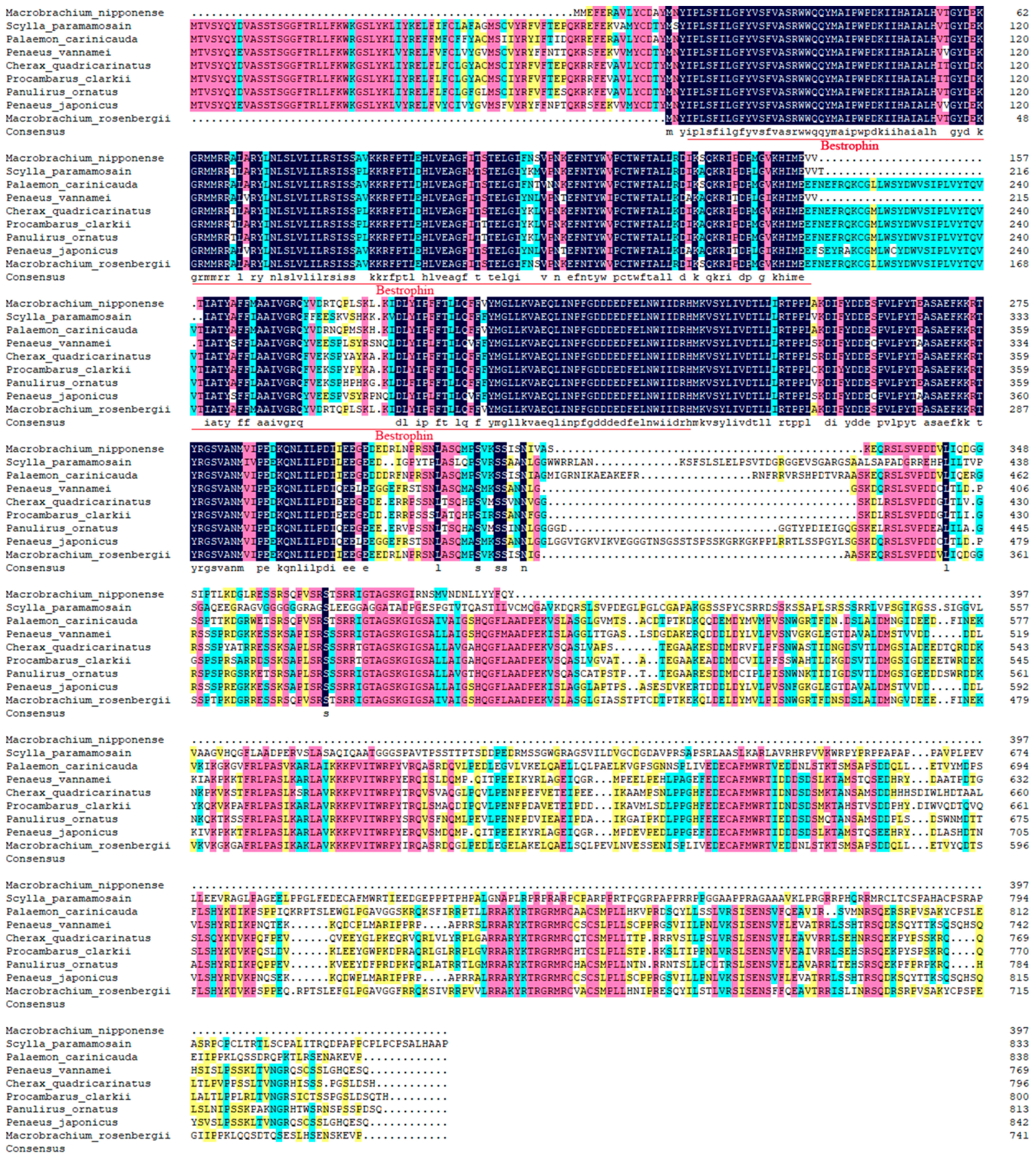
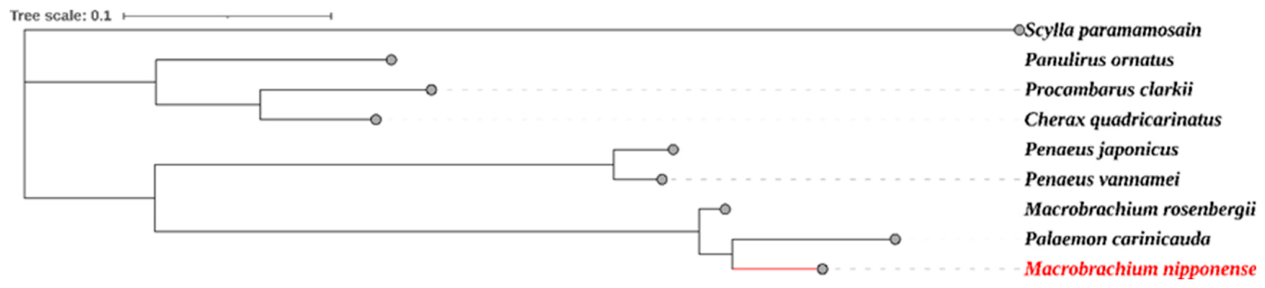
The coding region of Mn-BEST3 was 1194 bp in length, encoding a protein of 397 amino acids (Figure 1). The predicted molecular weight and isoelectric point of the encoded protein were 45.61 kDa and 6.561, respectively. The genomic sequence of this gene spaned 43,543 bp and was located on Chromosome 31, between positions 23,166,703 bp and 23,210,245 bp. The gene consisted of 10 exons and 9 introns (Figure 2; Table 1). Within the deduced protein, a conserved bestrophin functional domain was predicted, spanning amino acid residues from 15 to 231 (Figure 3). Furthermore, Blastx analysis against the NCBI database indicated that the Mn-BEST3 amino acid sequence shareed high identity with orthologs from other shrimp species. It exhibits the highest identity with Macrobrachium rosenbergii (90.75%), followed by Scylla paramamosain (83.69%), Palaemon carinicauda (82.77%) and Penaeus vannamei (80.31%). Maximum likelihood phylogenetic analysis revealed that Mn-BEST3 is most closely related to the ortholog from P. carinicauda, forming a clade with M. rosenbergii (Figure 4).

2.2. qPCR Analysis

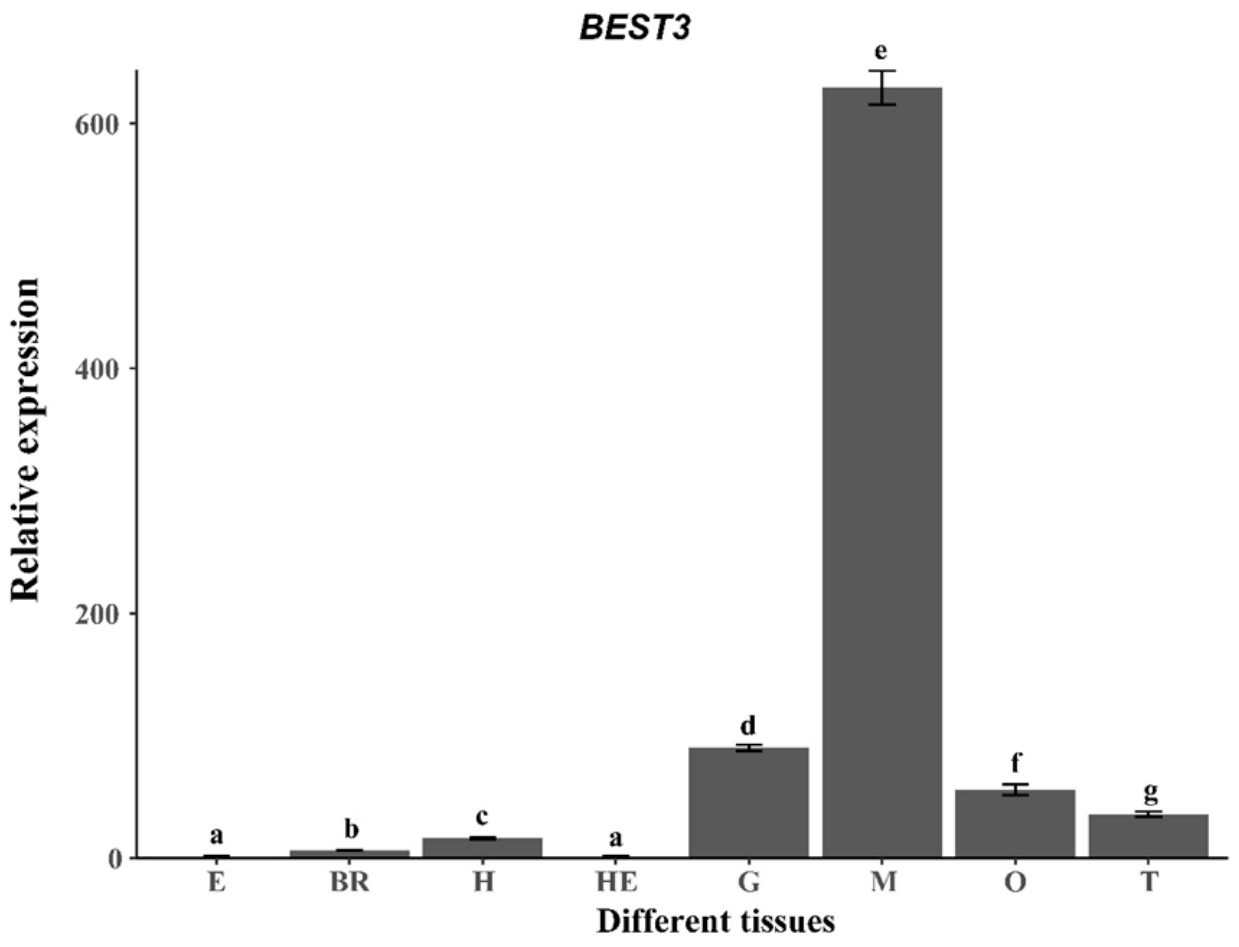
qPCR analysis was performed to examine the mRNA expression levels of Mn-BEST3 in various tissues (Figure 5). Among the tested tissues, muscle exhibited the highest expression of Mn-BEST3, which was significantly higher than that in all other tissues (p < 0.05), whereas the hepatopancreas showed the lowest expression. Moderate expression levels were observed in the gill, ovary, and testis. Specifically, the mRNA expression levels in muscle, gill, ovary, and testis were 617.2-fold, 64.3-fold, 45.3-fold, and 33.6-fold higher, respectively, than that in the hepatopancreas.

2.3. RNAi Analysis

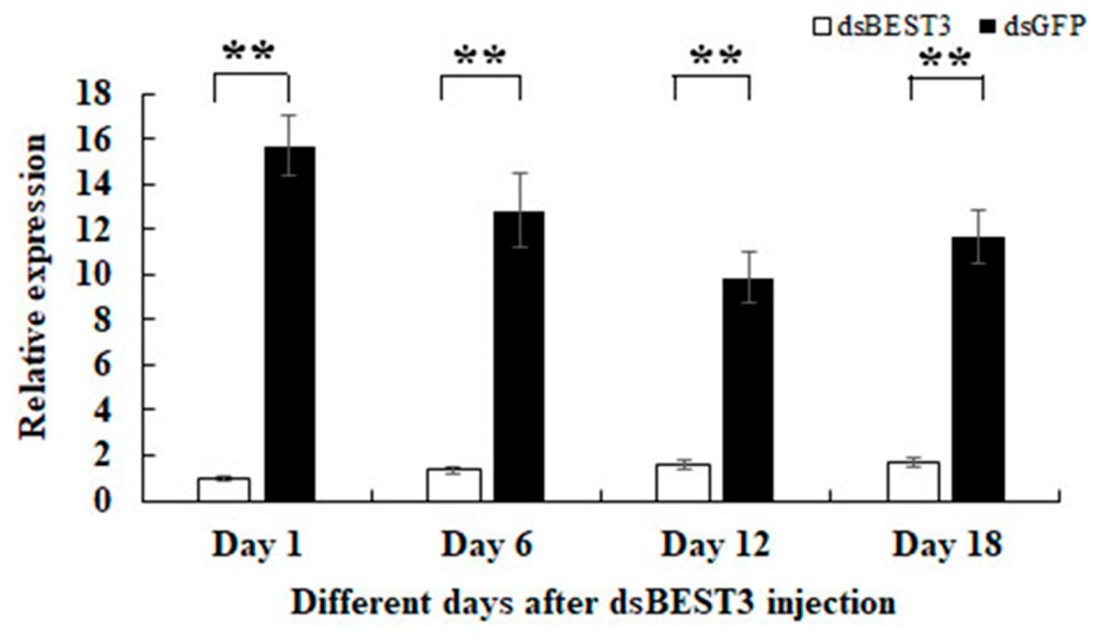
RNAi was employed to investigate the potential role of Mn-BEST3 in the growth performance of M. nipponense. The mRNA expression levels of Mn-BEST3 following injection of dsBEST3 or dsGFP (control) were assessed using qPCR. Compared to the dsGFP-injected group on the corresponding days, qPCR analysis revealed that Mn-BEST3 mRNA expression in the dsBEST3-injected prawns was significantly reduced to 93.64%, 89.35%, 84.40%, and 85.57% at days 1, 6, 12, and 18 post-injection, respectively (p < 0.05) (Figure 6).
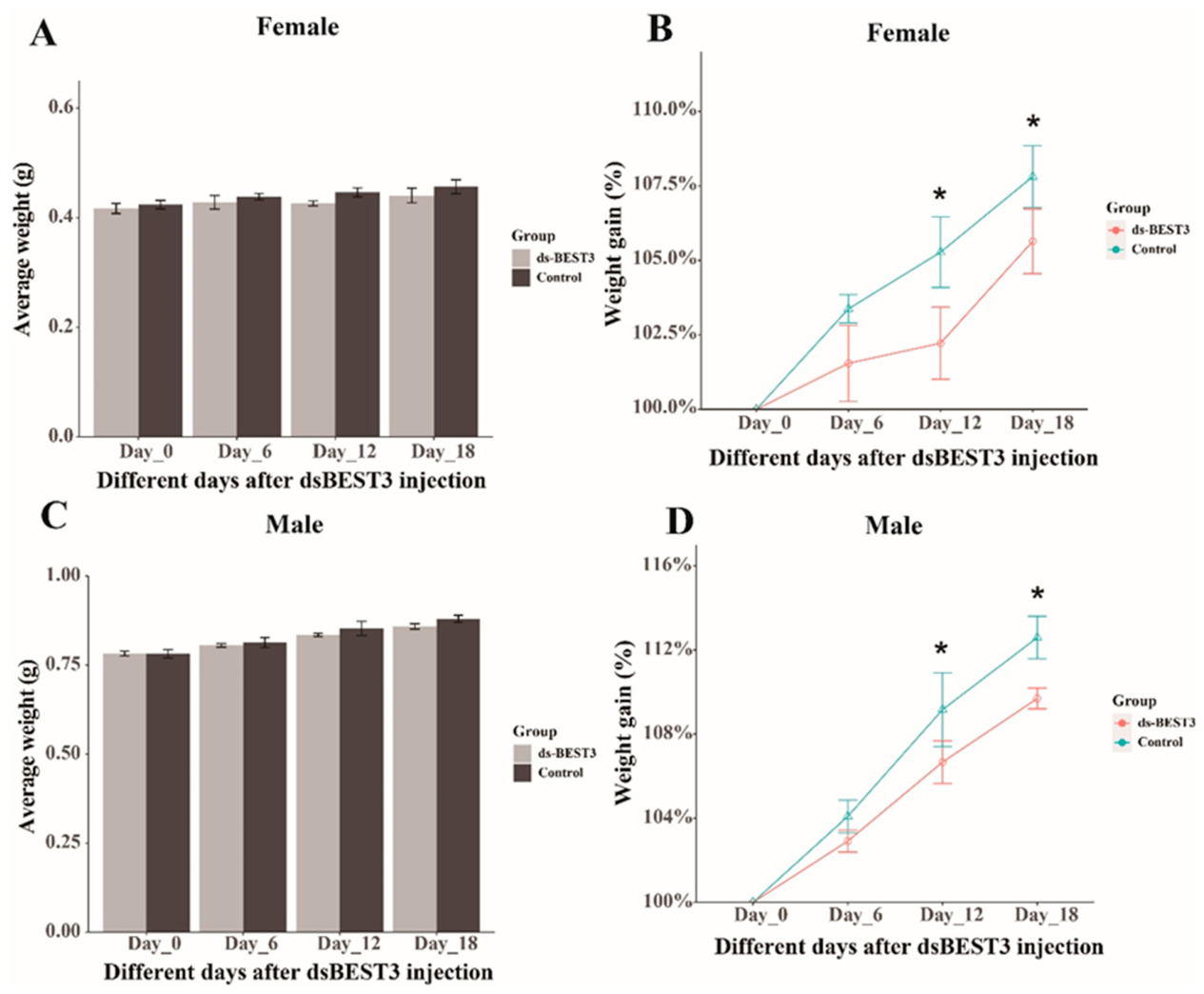
On Day 0, the initial body weights of female M. nipponense in the dsBEST3-injected group and the dsGFP-injected control group were 0.417 ± 0.03 g and 0.424 ± 0.05 g, respectively. In the dsGFP-injected control group, the body weights increased to 0.438 ± 0.06 g, 0.446 ± 0.06 g, and 0.457 ± 0.06 g at Day 6, Day 12, and Day 18, respectively. At the same time points, the body weights in the dsBEST3-injected group were 0.423 ± 0.04 g, 0.426 ± 0.04 g, and 0.440 ± 0.05 g, respectively (Figure 7A). When expressed as the percentage increase in mass relative to Day 0, female prawns in the dsGFP-injected control group exhibited gains of 3.30%, 5.19%, and 7.78% on Days 6, 12, and 18, respectively. In contrast, the dsBEST3-injected group showed mass increases of 1.44%, 2.16%, and 5.51% at the corresponding time points. The percentage mass increase differed significantly between the dsGFP-injected control group and the dsBEST3-injected group starting from 12 days post-injection (p < 0.05) (Figure 7B).
A similar trend in weight gain was observed in male prawns. The initial body weights of male M. nipponense in the dsBEST3-injected group and the dsGFP-injected control group were 0.780 ± 0.10 g and 0.781 ± 0.11 g, respectively. Subsequently, at Day 6, Day 12, and Day 18, the body weights in the dsGFP-injected control reached 0.814 ± 0.12 g, 0.855 ± 0.11 g, and 0.881 ± 0.13 g, respectively, while those in the dsBEST3-injected group were 0.805 ± 0.11 g, 0.834 ± 0.13 g, and 0.858 ± 0.13 g at the corresponding time points (Figure 7C). The percentage increases in mass relative to Day 0 in the dsGFP-injected control group were 4.23%, 9.48%, and 12.80% at Days 6, 12, and 18, respectively. Over the same period, the dsBEST3-injected group exhibited corresponding mass increases of 3.21%, 6.92%, and 10.00%. A statistically significant difference in the percentage mass increase between the dsGFP-injected control group and the dsBEST3-injected group was observed from 12 days post-injection onward (p < 0.05) (Figure 7D).
In female prawns, the daily weight gain at Day 18 post-injection was 3.179 ± 0.919‰ in the dsBEST3-injected group and 4.293 ± 1.831‰ in the dsGFP-injected control group, and this difference was statistically significant (p < 0.05). Similarly, in male prawns, the daily weight gain at Day 18 post-injection was 5.384 ± 0.274‰ in the dsBEST3-injected group and 6.993 ± 0.563‰ in the dsGFP-injected control group, which also showed a significant difference (p < 0.05) (Table 2).

2.4. Identification of Growth-Related SNPs Within BEST3

A total of 3 SNPs were identified within the coding regions of Mn-BEST3. Their observed heterozygosity ranged from 0.311 to 0.396, expected heterozygosity ranged from 0.292 to 0.393, and the polymorphism information content ranged from 0.247 to 0.316. All of these loci were synonymous mutation sites (Table 3).
Among these three SNPs, S31_23192836 (located at the 196th amino acid of this gene) was identified to regulate growth in both male and female prawns (Table 4). A total of 46 female individuals were successfully sequenced, including 22 with the TT genotype, 14 with the TG genotype, and 10 with the GG genotype. The average body weight and full length of the TT genotype were 1.117 g ± 0.504 and 46.237 mm ± 6.100, respectively, which were significantly greater than those of the TG genotype (0.897 g ± 0.429 for body weight and 43.692 mm ± 6.350 for full length) and the GG genotype (0.500g ± 0.190 for body weight and 38.057 mm ± 5.155 for full length) (p < 0.05). In male prawns, sequencing was successfully performed on 45 individuals, among which 25 carried the TT genotype, 13 carried the TG genotype, and 7 carried the GG genotype. The TT genotype exhibited significantly higher average body weight (2.500 g ± 0.682) and full length (59.532 mm ± 5.635), compared to the TG genotype (1.699 g ± 0.910 for body weight; 52.919 mm ± 8.475 for full length) and the GG genotype (1.057 g ± 0.142 for body weight; 47.097 mm ± 1.539 for full length), with all differences being statistically significant (p < 0.05).

3. Discussion

In mammals, BEST3 functions as a Ca2+-activated Cl channel and plays an essential role in maintaining the membrane polarization state of ASMCs, as well as in regulating the contractility of both ASMCs and arteries [23]. Growth is the primary commercial trait targeted during genetic improvement programs in aquatic animals. Previous transcriptome profiling has suggested that BEST3 may also be involved in regulating the growth of M. nipponense [17]. Therefore, the present study aimed to investigate the potential functions of BEST3 in the growth regulation of this species, and to identify growth-related SNPs within this gene, thereby facilitating the production of populations with superior growth traits through marker-assisted selection.
The expression of BEST3 has been characterized in several mammalian species. In human tissues, BEST3 is strongly expressed in skeletal muscle, with weaker expression detected in bone marrow, testis, and retina [20]. Its expression has also been observed in human cartilage [29]. Immunofluorescence staining revealed BEST3 expression in the plasma membrane, nuclei, and intracellular compartments of rat kidney cortex sections [22]. Furthermore, a muscle transcriptome profiling analysis showed that BEST3 expression levels are higher in the larger-bodied cattle species (Bos frontalis) than in the common domestic cattle (Bos taurus), suggesting that this gene may be involved in growth regulation in cattle [30]. However, to the best of our knowledge, the expression of this gene has not been investigated in any aquatic animal species. The present study revealed that BEST3 exhibits the highest expression level in muscle tissue. Genes expressed in muscle tissue influence the growth performance of aquatic animals through various molecular and physiological mechanisms. For example, Insulin-like growth factor-1 (IGF-1) and IGF-2, along with their receptors and binding proteins, are expressed in muscle and promote protein synthesis while inhibiting protein degradation, thereby facilitating muscle hypertrophy and hyperplasia [31,32]. Additionally, the myogenic regulatory factor family genes directly control the proliferation, differentiation, and fusion of muscle stem cells into myofibers [33,34]. The expression levels of these genes are closely associated with myofiber number and diameter, ultimately determining individual body size and growth rate. A previous study identified that an actin-like gene was highly expressed in muscle tissue and exerted positive regulatory effects on the growth of M. nipponense [18]. Similarly, the high expression of the BEST3 gene in muscle tissue suggests that this gene may also be involved in regulating growth traits in M. nipponense.
RNAi functions as a conserved cellular defense and regulatory mechanism. It utilizes small RNA molecules as guides to specifically recognize and degrade complementary messenger RNA (mRNA) transcripts, thereby silencing gene expression at the post-transcriptional level. RNAi has since been identified across diverse eukaryotic lineages, including crustaceans, where it plays critical roles in antiviral immunity, transposable element suppression, developmental regulation, and physiological adaptation [35,36,37]. Knockdown of BEST3 led to a reduction in cell number as a consequence of cell death in rat kidney proximal tubule cells under conditions of endoplasmic reticulum stress [22]. However, to the best of our knowledge, the potential functions of this gene have not yet been analyzed in any aquatic animal species using RNAi. The RNAi technique has been well established in M. nipponense [38], and the functional roles of numerous genes have been successfully investigated through RNAi analysis in this species [39,40,41,42,43,44]. In the present study, the synthesized dsBEST3 efficiently knocked down Mn-BEST3 expression, with a significant reduction of 81–95% relative to the dsGFP-injected controls (p < 0.05). In both sexes, injection of dsBEST3 led to impaired growth performance in M. nipponense, with a notable decrease in body weight gain observed from Day 12 post-injection. Taken together, these findings demonstrate that this gene positively regulates growth performance in this species. Interestingly, Mn-BEST3 expression in the dsGFP group did not show a progressive increase with increasing individual body weight. Transcriptomic analysis revealed that this gene is highly expressed in larger individuals, indicating its high expression in fast-growing M. nipponense. However, this observation does not imply that Mn-BEST3 expression gradually rises as body weight increases. Additionally, Mn-BEST3 expression is likely regulated by both endogenous biological rhythms and exogenous environmental cues [18].
SNPs are widely distributed across the genomes of diverse organisms. Mutations occurring in coding regions are known to alter protein structure and function [45,46]. Associations between SNPs and key traits have been documented in M. nipponense, regarding hypoxia resistance [47], sexual maturation [48], and growth-related traits [18]. In the present study, three SNP loci were identified within the coding region of the BEST3 gene in M. nipponense, among which S31_23192836 was identified to be associated with growth performance. In both male and female prawns, individuals carrying the T allele demonstrated significantly greater average body weight and total length relative to those with other genotypes. These findings suggest that the T allele significantly promotes growth performance in this species.

4. Materials and Methods

4.1. Tissue Collection

All prawns were collected from the Dapu Breeding Base in Wuxi, China (120°13′44″ E, 31°28′22″ N), consisting of 286 healthy individuals for functional analysis of Mn-BEST3 and 100 full-sibs (50 males and 50 females) for SNP selection within the Mn-BEST3 (Table 5). All prawns were reared in a pond under conditions suitable for the growth of M. nipponense, with water temperature ranging from 25 °C to 30 °C and dissolved oxygen concentration kept above 6.0 mg/L [25]. During the rearing period, feeding was conducted twice daily. The prawns used for sequence verification, qPCR analysis, and SNP screening were collected at approximately 5 months post-hatching, as opposed to those used for RNAi analysis, which were collected at approximately 2 months post-hatching. All prawns were acclimatized for three days under controlled laboratory conditions prior to the experiments. During this period, the water temperature was kept at 26.0 ± 1.2 °C, and the dissolved oxygen concentration remained above 6.0 mg/L.
To verify the ORF sequence of Mn-BEST3, muscle tissue was dissected from ten randomly selected individuals. A total of 36 M. nipponense individuals, consisting of 18 males and 18 females, were collected for qPCR analysis. The mature tissues examined included eyestalk, brain, heart, hepatopancreas, gill, muscle, testis, and ovary. One biological replicate for testis and ovary was generated by pooling samples from three individuals of the respective sex. For the remaining tissues, samples were taken separately from three male and three female individuals, and then pooled to form one biological replicate. Six such replicates were prepared for each tissue. For the RNAi experiment, a total of 240 prawns (120 males and 120 females) were used. Following injection with either double-stranded GFP (dsGFP) or double-stranded BEST3 (dsBEST3), muscle tissue was dissected and collected for qPCR analysis. Additionally, full-sibling individuals were subjected to body weight and length measurements, and their muscle tissue was collected for SNP identification. To prevent RNA degradation, all collected samples were immediately flash-frozen in liquid nitrogen and subsequently stored at −80 °C.

4.2. Annotation and Comparison of Mn-BEST3

The full-length cDNA sequence of Mn-BEST3 was obtained by integrating data from the M. nipponense genome database (accession number: GCA_015104395.2) and muscle transcriptome datasets (accession numbers: SRX25177010–SRX25177021).
To confirm the sequence, RNAiso Plus reagent (TaKaRa, Dalian, China) was used to extract the total RNA from each muscle sample. RNA concentrations were determined with a spectrophotometer (Eppendorf, Hamburg, Germany), while RNA integrity was assessed via agarose gel electrophoresis. First-strand cDNA was synthesized from approximately 1 µg of total RNA per sample by reverse transcription with the iScript™ cDNA Synthesis Kit (Bio-Rad, Hercules, CA, USA). To ensure sequence accuracy, the obtained sequence was experimentally validated using three specific primer pairs (Table 6) by PCR amplification, with the synthesized cDNA serving as templates. PCR was carried out in a 25 μL reaction mixture containing 0.5 μL each of forward and reverse primers (10 μM), 1 μL cDNA template, 19.9 μL DEPC-treated water, 2.5 μL 10× PCR supermix, 0.5 μL dNTP mix (10 mM), and 0.1 μL Taq DNA polymerase. The thermal cycling program was as follows: initial denaturation at 95 °C for 3 min; 35 cycles of 95 °C for 30 s, 62 °C for 60 s, and 72 °C for 30 s; followed by a final extension at 72 °C for 10 min. The resulting PCR products were then sequenced by Shanghai Shenggong Bioengineering Technology Service Co., Ltd. (Shanghai, China) on an ABI 3730 automated DNA sequencer (Invitrogen Biotechnology Co., Ltd., Carlsbad, CA, USA).
The ORF of Mn-BEST3 was identified using the online tool ORF-FINDER [49]. The corresponding cDNA sequence was then translated into an amino acid sequence, and the result was visualized with DNAman software (version 6.0) [50]. Multiple sequence alignment of BEST3 protein sequences from different species was performed using ClustalW (version 2.0) [51]. Based on the aligned sequences, a phylogenetic tree was subsequently reconstructed with MEGA software (version 11) [52] using the maximum likelihood method. Nodal support was assessed by 1000 bootstrap replicates, and the resulting bootstrap values are displayed at the respective nodes.

4.3. qPCR Analysis

In the present study, the mRNA expression levels of Mn-BEST3 were quantified in various mature tissues using qPCR. The procedures for RNA extraction and cDNA synthesis were as described in detail in Section 4.2.
QPCR was carried out on a Bio-Rad iCycler iQ5 system using SYBR Green fluorescence detection. The experimental procedure followed the protocols described in previous studies [53]. QPCR analyses were carried out in a 25 μL reaction mixture consisted of 12.5 μL of 2× Ultra SYBR Mix (CWBIO), 0.5 μL each of the forward and reverse primers (10 μM; see Table 4), 1 μL of cDNA template, and 10.5 μL of nuclease-free water. The thermal cycling conditions were set as follows: initial denaturation at 95 °C for 10 min, then 40 cycles of 95 °C for 15 s and 60 °C for 1 min. All qPCR assays were conducted in triplicate for each tissue sample.
The specific BEST3 primer for qPCR analysis is listed in Table 6. The elongation factor gene (EIF) has been demonstrated to exhibit stable expression across various tissues and experimental conditions, and was therefore employed as an internal reference gene [54]. The amplification efficiencies of Mn-BEST3 and EIF were confirmed to be approximately comparable, thereby allowing the application of the 2−ΔΔCt method for the calculation of relative gene expression levels [55].

4.4. RNAi Analysis

To explore the potential regulatory function of Mn-BEST3 in the growth performance of M. nipponense, an RNAi experiment was conducted. A total of 240 prawns were randomly divided into the control group (injected with dsGFP) and the experimental group (injected with dsBEST3). Each group comprised 60 males and 60 females. The dsGFP treatment served as a negative control to monitor non-specific effects [56]. The initial mean body weights were as follows: in the dsGFP-injected control group, males weighed 0.781 ± 0.11 g and females weighed 0.424 ± 0.05 g; in the dsBEST3-injected group, males weighed 0.780 ± 0.10 g and females weighed 0.417 ± 0.03 g.
Using the Snap Dragon tool (https://www.flyrnai.org/cgi-bin/RNAi_find_primers.pl, accessed on 7 June 2024), we designed RNAi primers that were specific to BEST3 and flanked by T7 promoter sequences (listed in Table 6). For both the Mn-BEST3 gene and the GFP control, double-stranded RNA (dsRNA) was produced in vitro with the Transcript Aid™ T7 High Yield Transcription Kit (Fermentas, Inc., Rockville, MD, USA), strictly adhering to the manufacturer’s instructions. Following a previously reported protocol [38], each prawn in the experimental cohort was microinjected with dsBEST3 through cavum pericardial, whereas those in the control cohort were injected with dsGFP. The dsRNA solutions were adjusted to 4 µg/µL in an isotonic vehicle, and a dose of 4 µg per gram of body weight was administered to each animal. This dosing regimen meant that the injection volume in microliters for any given prawn was equal to its body weight expressed in grams. Both the experimental cohort and the control cohort received injections of dsBEST3 and dsGFP once every 6 days, for a total of 3 injections. To monitor the effectiveness of RNAi, we measured Mn-BEST3 transcript levels in muscle tissue via qPCR at four time points after injection: days 1, 6, 12, and 18 (with at least five individuals per time point). The procedures for RNA extraction, cDNA synthesis, and qPCR analysis were as described in detail in Section 4.2 and Section 4.3. On the same sampling days, body weight measurements were also taken for each prawn.

4.5. Identification of Growth-Related SNPs Within BEST3

Total RNA was first extracted from the muscle tissue of each experimental individual, from which cDNA templates were subsequently generated by reverse transcription, following the protocol detailed in Section 4.2. Using the resulting cDNA as templates, three pairs of primers (Table 3) were employed to amplify the target regions via PCR. The PCR amplification and sequencing procedures were performed identically to those described in Section 4.2. The obtained sequences were then assembled and aligned with MEGA version 11.0 [52], allowing for the identification of SNP loci within the BEST3 gene according to the criteria of previous reports [18]. Observed heterozygosity (Ho), and expected heterozygosity (He), were calculated using Popgene32 software (version 1.32) [57]. Polymorphic information content (PIC) was calculated using PIC_CALC [58]. SPSS Statistics 23.0 was used to examine the p-value of each SNP locus, as well as the relationship between each SNP locus and two growth traits (body weight and total length). A one-way ANOVA was carried out, followed by post hoc comparisons using the least significant difference (LSD) and Duncan’s multiple range test. Before performing the ANOVA, the normality of the data was assessed using the Shapiro–Wilk test, and the homogeneity of variances was checked with Levene’s test. Body weight and total length were entered as dependent variables in the statistical models. A probability value of less than 0.05 was considered statistically significant.

4.6. Statistical Analysis

All statistical analyses in this study were performed with SPSS Statistics 23.0 [18]. To determine significant differences between groups (different mature tissues, dsBEST3 silencing efficiency validation, and comparisons of mass percentage increase between dsBEST3- and dsGFP-injected prawns), a one-way analysis of variance (ANOVA) was applied, followed by multiple comparisons using both LSD and Duncan’s post hoc tests. Quantitative measurements are presented as mean values with their corresponding standard deviations (±SD). A probability value below 0.05 was considered statistically significant.

5. Conclusions

Collectively, based on the results of qPCR analysis in various mature tissues and RNAi analysis, BEST3 was identified as a positive regulator of growth performance in both sexes of M. nipponense. Notably, a SNP locus (S31_23192836) within the coding region of BEST3 was also identified to be associated with growth performance. Specifically, in both male and female prawns, individuals carrying the T allele had significantly higher average body weight and total length compared to those with other genotypes. Taken together, these findings establish the regulatory role of BEST3 in growth performance and underscore the utility of its growth-associated SNP for marker-assisted selection in M. nipponense breeding. In the present study, the growth-related SNP locus was validated only within a single full-sib family, which limits its general applicability. In future studies, the association between this SNP locus and growth will be examined across multiple populations of this species.

Author Contributions

S.J. (Shubo Jin): conceptualization, software, writing—review and editing. Z.G.: data curation, formal analysis. H.F.: investigation, validation. Y.X.: formal analysis, resources. H.Q.: software, data curation. W.Z.: validation, writing—review and editing, supervision. S.J. (Sufei Jiang): validation, writing—review and editing, supervision, funding acquisition. All authors have read and agreed to the published version of the manuscript.

Funding

This research was supported by grants from the Central Public-interest Scientific Institution Basal Research Fund CAFS (2026XT0702, 2023TD39) and the earmarked fund for China Agriculture Research System (CARS-48-07).

Institutional Review Board Statement

Permissions for the experiments involved in the present study were obtained from the Institutional Animal Care and Use Ethics Committee of the Fresh-water Fisheries Research Center, Chinese Academy of Fishery Sciences (Wuxi, China) (Authorization NO. 20240517003, 7 May 2024). MS-222 anesthesia was used to sedate the prawns prior to tissue dissection. At the end of the experiment, all experimental prawns were humanely euthanized by hypothermic shock in ice-cold water, followed by decapitation to confirm death. The carcasses were subsequently stored at −20 °C and disposed of as biological waste in accordance with institutional biosafety protocols.

Informed Consent Statement

Not applicable.

Data Availability Statement

The original contributions presented in this study are included in the article. Further inquiries can be directed to the corresponding authors.

Acknowledgments

Thanks to the Jiangsu Province Platform for the Conservation and Utilization of Agricultural Germplasm.

Conflicts of Interest

The authors declare no conflicts of interest.

References

  1. Afanasyev, D.; Zhivoglyadova, L.; Nebesikhina, N.; Magomedov, M.; Mutallieva, Y.K.; Velibekova, B.; Mirzoyan, A. Finding of oriental river prawn Macrobrachium nipponense (De Haan, 1849) in the lower Terek River (Caspian Sea Basin). Russ. J. Biol. Invasions 2020, 11, 191–197. [Google Scholar] [CrossRef]
  2. Marques, H.L.; New, M.B.; Boock, M.V.; Barros, H.P.; Mallasen, M.; Valenti, W.C. Integrated freshwater prawn farming: State-of-the-art and future potential. Rev. Fish. Sci. Aquac. 2016, 24, 264–293. [Google Scholar] [CrossRef]
  3. New, M.B. Freshwater prawn farming: Global status, recent research and a glance at the future. Aquac. Res. 2005, 36, 210–230. [Google Scholar] [CrossRef]
  4. New, M.B.; Nair, C.M. Global scale of freshwater prawn farming. Aquac. Res. 2012, 43, 960–969. [Google Scholar] [CrossRef]
  5. Luo, P.; Jin, Y.; Zhao, T.; Bian, C.; Lv, Z.; Zhou, N.; Qin, J.; Sun, S. Population structure and mitogenomic analyses reveal dispersal routes of Macrobrachium nipponense in China. BMC Genom. 2025, 26, 497. [Google Scholar] [CrossRef] [PubMed]
  6. Fisheries Economic Statistics. In China Fishery Yearbook; China Agricultural Press: Beijing, China, 2025; p. 24.
  7. Tsikliras, A.C.; Stergiou, K.I. Fish market prices drive overfishing of the ‘big ones’. PeerJ 2014, 2, e638. [Google Scholar] [CrossRef]
  8. Sun, S.M.; Fu, H.T.; Gu, Z.M.; Zhu, J. Effects of stocking density on the individual growth and differentiation of the oriental river prawn Macrobrachium nipponense (de haan, 1849) (caridea: Palaemonidae). J. Crustac. Biol. 2016, 36, 769–775. [Google Scholar] [CrossRef]
  9. Ettefaghdoost, M.; Babakhani, A. Effects of stocking density on the oriental river prawn (Macrobrachium nipponense): A comprehensive evaluation of growth, hematological, physio-immunological, and antioxidant responses. Aquacult. Int. 2025, 6, 608. [Google Scholar] [CrossRef]
  10. Xu, M.; Xiong, Y.W.; Xiao, Z.Q.; Zhang, W.Y.; Fu, H.T.; Qiao, H.; Jiang, S.F. Stocking density effects on growth performance, water quality, immune indexes, and economic benefits of oriental river prawns (Macrobrachium nipponense) reared in earthen ponds. Aquacult. Rep. 2026, 48, 103536, Correction in Aquacult. Rep. 2026, 48, 103627. [Google Scholar] [CrossRef]
  11. Dong, Y.Z.; Wei, L.Y.; Liu, W.B.; Liu, B.; Sun, C.X.; Li, X.F. Optimal dietary pyridoxine requirement of oriental river prawn (Macrobrachium nipponense): Insights from growth, feed utilization, and protein metabolism. Anim. Feed Sci. Technol. 2026, 338, 116769. [Google Scholar] [CrossRef]
  12. Ettefaghdoost, M.; Haghighi, H.; Babakhani, A. Curcumin as a functional feed additive enhances growth, immunity, antioxidant defense, gut microbiota, muscle quality, and disease resistance in the oriental river prawn (Macrobrachium nipponense). Appl. Food Res. 2026, 6, 101714. [Google Scholar] [CrossRef]
  13. Ettefaghdoost, M.; Haghdoost, A. Functional role of dietary bixin as a natural carotenoid: Integrative modulation of growth, metabolism, antioxidant defense, and disease resistance in the oriental river prawn (Macrobrachium nipponense). Aquaculture 2026, 617, 743770. [Google Scholar] [CrossRef]
  14. Wang, W.N.; Wang, A.L.; Nu, D.H.; Liu, Y.C.; Sun, R.Y. Effects of molting on the growth of primary cultured muscle cells from Macrobrachium nipponense and Penaeus vannamei. Isr. J. Aquacult.-Bamid. 2005, 57, 264–270. [Google Scholar]
  15. Ding, Z.L.; Kong, Y.Q.; Shao, X.P.; Zhang, Y.X.; Ren, C.C.; Zhao, X.M.; Yu, W.S.; Jiang, T.Q.; Ye, J.Y. Growth, antioxidant capacity, intestinal morphology, and metabolomic responses of juvenile Oriental river prawn (Macrobrachium nipponense) to chronic lead exposure. Chemosphere 2019, 217, 289–297. [Google Scholar] [CrossRef]
  16. Li, Y.M.; Du, X.L.; Jiang, Q.C.; Huang, Y.Y.; Zhao, Y.L. Effects of nanoplastic exposure on the growth performance and molecular characterization of growth-associated genes in juvenile Macrobrachium nipponense. Comp. Biochem. Phys. C 2022, 254, 109278. [Google Scholar] [CrossRef]
  17. Gao, Z.J.; Zhang, W.Y.; Jiang, S.F.; Qiao, H.; Xiong, Y.W.; Jin, S.B.; Fu, H.T. Genome-wide association and transcriptomic analysis and the identification of growth-related genes in Macrobrachium nipponense. BMC Genom. 2024, 25, 1182. [Google Scholar] [CrossRef]
  18. Jin, S.B.; Lin, J.Y.; Fu, H.T.; Xiong, Y.W.; Qiao, H.; Zhang, W.Y.; Jiang, S.F. RNAi Identified the potential functions of actin-like protein in the growth performance of Macrobrachium nipponense. Int. J. Mol. Sci. 2026, 27, 893. [Google Scholar] [CrossRef] [PubMed]
  19. Hartzell, H.C.; Qu, Z.; Yu, K.; Xiao, Q.; Chien, L.T. Molecular physiology of bestrophins: Multifunctional membrane proteins linked to best disease and other retinopathies. Physiol. Rev. 2008, 88, 639–672. [Google Scholar] [CrossRef]
  20. Stöhr, H.; Marquardt, A.; Nanda, I.; Schmid, M.; Weber, B. Three novel human VMD2-like genes are members of the evolutionary highly conserved RFP-TM family. Eur. J. Hum. Genet. 2002, 10, 281–284. [Google Scholar] [CrossRef]
  21. O’Driscoll, K.E.; Hatton, W.J.; Burkin, H.R.; Leblanc, N.; Britton, F.C. Expression, localization, and functional properties of Bestrophin 3 channel isolated from mouse heart. Am. J. Physiol. Cell Physiol. 2008, 295, C1610–C1624. [Google Scholar] [CrossRef] [PubMed]
  22. Matchkov, V.V.; Larsen, P.; Bouzinova, E.V.; Rojek, A.; Boedtkjer, D.M.; Golubinskaya, V.; Pedersen, F.S.; Aalkjaer, C.; Nilsson, H. Bestrophin-3 (vitelliform macular dystrophy 2-like 3 protein) is essential for the cGMP-dependent calcium-activated chloride conductance in vascular smooth muscle cells. Circ. Res. 2008, 103, 864–872. [Google Scholar] [CrossRef]
  23. Tykocki, N.R.; Boerman, E.M.; Jackson, W.F. Smooth muscle ion channels and regulation of vascular tone in resistance arteries and arterioles. Compr. Physiol. 2017, 7, 485–581. [Google Scholar] [CrossRef] [PubMed]
  24. Kajii, T.S.; Oka, A.; Saito, F.; Mitsui, J.; Iida, J. Whole-exome sequencing in a Japanese pedigree implicates a rare non-synonymous single-nucleotide variant in BEST3 as a candidate for mandibular prognathism. Bone 2019, 122, 193–198. [Google Scholar] [CrossRef] [PubMed]
  25. Gui, J.F.; Tang, Q.S.; Li, Z.J.; Liu, J.S.; De Silva, S.S. Aquaculture in China: Success Stories and Modern Trends; John Wiley & Sons: Hoboken, NJ, USA, 2018. [Google Scholar]
  26. Gjedrem, T. Genetic improvement of cold-water fish species. Aquac. Res. 2000, 31, 25–33. [Google Scholar] [CrossRef]
  27. Rhode, C.; Jackson, T.K.; le Cordeur, N.S.; Jenkins, S.F.; Sampson, J.E.; Vervalle, J. Performance, heritability, and candidate genes for growth in dusky kob (Argyrosomus japonicus): Implications for genetic improvement during early phase domestication. Aquaculture 2023, 577, 739971. [Google Scholar] [CrossRef]
  28. Moose, S.P.; Mumm, R.H. Molecular Plant Breeding as the Foundation for 21st Century Crop Improvement. Plant Physiol. 2008, 147, 969–977. [Google Scholar] [CrossRef]
  29. Kumagai, K.; Toyoda, F.; Staunton, C.A.; Maeda, T.; Okumura, N.; Matsuura, H.; Matsusue, Y.; Imai, S.; Barrett-Jolley, R. Activation of a chondrocyte volume-sensitive Cl− conductance prior to macroscopic cartilage lesion formation in the rabbit knee anterior cruciate ligament transection osteoarthritis model. Osteoarthr. Cartil. 2016, 24, 1786–1794. [Google Scholar] [CrossRef]
  30. Mukherjee, S.; Mukherjee, A.; Jasrotia, R.S.; Jaiswal, S.; Iquebal, M.A.; Longkumer, I.; Mech, M.; Vüpru, K.; Khate, K.; Rajkhowa, C.; et al. Muscle transcriptome signature and gene regulatory network analysis in two divergent lines of a hilly bovine species Mithun (Bos frontalis). Genomics 2020, 112, 252–262. [Google Scholar] [CrossRef]
  31. Blum, W.F.; Alherbish, A.; Alsagheir, A.; El Awwa, A.; Kaplan, W.; Koledova, E.; Savage, M.O. The growth hormone-insulin-like growth factor-I axis in the diagnosis and treatment of growth disorders. Endocr. Connect. 2018, 7, R212–R222. [Google Scholar] [CrossRef]
  32. Werner, H. The IGF1 signaling pathway: From basic concepts to therapeutic opportunities. Int. J. Mol. Sci. 2023, 24, 14882. [Google Scholar] [CrossRef]
  33. Asfour, H.A.; Allouh, M.Z.; Said, R.S. Myogenic regulatory factors: The orchestrators of myogenesis after 30 years of discovery. Exp. Biol. Med. 2018, 243, 118–128. [Google Scholar] [CrossRef] [PubMed]
  34. Hernández-Hernández, J.M.; García-González, E.G.; Brun, C.E.; Rudnicki, M.A. The myogenic regulatory factors, determinants of muscle development, cell identity and regeneration. Semin. Cell Dev. Biol. 2017, 72, 10–18. [Google Scholar] [CrossRef]
  35. Hannon, G.J. RNA interference. Nature 2002, 418, 244–251. [Google Scholar] [CrossRef]
  36. Huvenne, H.; Smagghe, G. Mechanisms of dsRNA uptake in insects and potential of RNAi for pest control: A review. J. Insect Physiol. 2010, 56, 227–235. [Google Scholar] [CrossRef]
  37. Zhu, K.Y.; Palli, S.R. Mechanisms, applications, and challenges of insect RNA interference. Annu. Rev. Entomol. 2020, 65, 293–311. [Google Scholar] [CrossRef]
  38. Jiang, F.W.; Fu, H.T.; Qiao, H.; Zhang, W.Y.; Jiang, S.F.; Xiong, Y.W.; Sun, S.M.; Gong, Y.S.; Jin, S.B. The RNA interference regularity of transformer-2 gene of oriental river prawn Macrobrachium nipponense. Chin. Agric. Sci. Bull. 2014, 30, 32–37. [Google Scholar]
  39. Cui, W.; Liu, X.; Zhang, S.; Li, X.; Wang, Z.; Li, Y.; Zhang, M.; Wang, L.; Yu, M.; Qiao, Z.; et al. Identification and ovarian developmental regulation of ribosomal protein S6 kinase in Macrobrachium nipponense. Int. J. Biol. Macromol. 2025, 328, 147666. [Google Scholar] [CrossRef]
  40. Jiang, H.; Liu, X.; Li, Y.; Zhang, R.; Liu, H.; Ma, X.; Wu, L.; Qiao, Z.; Li, X. Identification of ribosomal protein L24 (RPL24) from the oriental river prawn, Macrobrachium nipponense, and its roles in ovarian development. Comp. Biochem. Physiol. Part A 2022, 266, 111154. [Google Scholar] [CrossRef]
  41. Li, F.J.; Zhang, S.Y.; Fu, C.P.; Wang, A.L.; Zhang, D. Comparative transcriptional analysis and RNA interference reveal immunoregulatory pathways involved in growth of the oriental river prawn Macrobrachium nipponense. Comp. Biochem. Physiol. Part D 2019, 29, 24–31. [Google Scholar] [CrossRef] [PubMed]
  42. Sun, B.; Luo, H.; Zhao, S.; Yu, J.L.; Lv, X.T.; Yi, C.; Wang, H. Characterization and expression analysis of a gC1qR gene from Macrobrachium nipponense under ammonia-N stress. Aquaculture 2019, 513, 734426. [Google Scholar] [CrossRef]
  43. Li, M.Y.; Qin, N.; Yuan, B.W.; Guo, M.H.; Yang, L.K.; Tang, T.; Li, F.C.; Liu, F.S. Involvement of nerve cord-expressed SVWC2 in pathogen recognition and defense in Macrobrachium nipponense. Fish Shellfish Immun. 2025, 162, 110329. [Google Scholar] [CrossRef]
  44. Ren, Q.; Huang, Y.; Liu, B.X. Function of two newly identified Spätzle genes in innate immune response of Macrobrachium nipponense against WSSV infection. Fish Shellfish Immun. 2025, 161, 110296. [Google Scholar] [CrossRef]
  45. Slate, J.; Pemberton, J.M. Admixture and patterns of linkage disequilibrium in a free-living vertebrate population. J. Evol. Biol. 2010, 20, 1415–1427. [Google Scholar] [CrossRef] [PubMed]
  46. Montalban, G.; Bonache, S.; Moles-Fernández, A.; Gisbert-Beamud, A.; Tenés, A.; Bach, V.; Carrasco, E.; López-Fernández, A.; Stjepanovic, N.; Balmaña, J.; et al. Screening of BRCA1/2 deep intronic regions by targeted gene sequencing identifies the first germline BRCA1 variant causing pseudoexon activation in a patient with breast/ovarian cancer. J. Med. Genet. 2019, 56, 63–74. [Google Scholar] [CrossRef]
  47. Gao, X.; Gao, Z.; Zhang, M.; Qiao, H.; Jiang, S.; Zhang, W.; Xiong, Y.; Jin, S.; Fu, H. Identifying relationships between glutathione S-transferase-2 single nucleotide polymorphisms and hypoxia tolerance and growth traits in Macrobrachium nipponense. Animals 2024, 14, 666. [Google Scholar] [CrossRef]
  48. Jiang, S.; Xie, Y.; Gao, Z.; Niu, Y.; Ma, C.; Zhang, W.; Xiong, Y.; Qiao, H.; Fu, H. Studies on the relationships between growth and gonad development during first sexual maturation of Macrobrachium nipponense and associated SNPs screening. Int. J. Mol. Sci. 2024, 25, 7071. [Google Scholar] [CrossRef]
  49. Rombel, I.T.; Sykes, K.F.; Rayner, S.; Johnston, S.A. ORF-FINDER: A vector for high-throughput gene identification. Gene 2002, 282, 33–41. [Google Scholar] [CrossRef]
  50. Wang, W. The Molecular Detection of Corynespora Cassiicola on Cucumber by PCR Assay Using DNAman Software and NCBI. In Computer and Computing Technologies in Agriculture IX; Li, D., Li, Z., Eds.; CCTA IFIP Advances in Information and Communication Technology; Springer: Cham, Switzerland, 2016; Volume 479, Erratum in IFIP Adv. Inf. Commun. Technol. 2017, 479. [Google Scholar] [CrossRef]
  51. Larkin, M.A.; Blackshields, G.; Brown, N.P.; Chenna, R.; McGettigan, P.A.; McWilliam, H.; Valentin, F.; Wallace, I.M.; Wilm, A.; Lopez, R.; et al. Clustal W and Clustal X version 2.0. Bioinformatics 2007, 23, 2947–2948. [Google Scholar] [CrossRef]
  52. Tamura, K.; Stecher, G.; Kumar, S. MEGA11: Molecular evolutionary genetics analysis version 11. Mol. Biol. Evol. 2021, 38, 3022–3027. [Google Scholar] [CrossRef] [PubMed]
  53. Jin, S.B.; Jiang, S.F.; Xiong, Y.W.; Qiao, H.; Sun, S.M.; Zhang, W.Y.; Li, F.J.; Gong, Y.S.; Fu, H.T. Molecular cloning of two tropomyosin family genes and expression analysis during development in oriental river prawn, Macrobrachium nipponense. Gene 2014, 546, 390–397. [Google Scholar] [CrossRef] [PubMed]
  54. Hu, Y.N.; Fu, H.T.; Qiao, H.; Sun, S.M.; Zhang, W.Y.; Jin, S.B.; Jiang, S.F.; Gong, Y.S.; Xiong, Y.W.; Wu, Y. Validation and evaluation of reference genes for quantitative real-time PCR in Macrobrachium nipponense. Int. J. Mol. Sci. 2018, 19, 2258. [Google Scholar] [CrossRef] [PubMed]
  55. Livak, K.J.; Schmittgen, T.D. Analysis of relative gene expression data using real-time quantitative PCR and the 2−ΔΔCt method. Methods 2001, 25, 402–408. [Google Scholar] [CrossRef] [PubMed]
  56. Zhang, S.B.; Jiang, P.; Wang, Z.Q.; Long, S.R.; Liu, R.D.; Zhang, X.; Yang, W.; Ren, H.J.; Cui, J. Dsrna-mediated silencing of nudix hydrolase in Trichinella spiralis inhibits the larval invasion and survival in mice. Exp. Parasitol. 2016, 162, 35–42. [Google Scholar] [CrossRef] [PubMed]
  57. Kuo, C.H.; Janzen, F.J. Genetic effects of a persistent bottleneck on a natural population of ornate box turtles (Terrapene ornata). Conserv. Genet. 2004, 5, 425–437. [Google Scholar] [CrossRef]
  58. Nagy, S.; Poczai, P.; Cernák, I.; Gorji, A.M.; Hegedűs, G.; Taller, J. PICcalc: An online program to calculate polymorphic information content for molecular genetic studies. Biochem. Genet. 2012, 50, 670–672. [Google Scholar] [CrossRef]
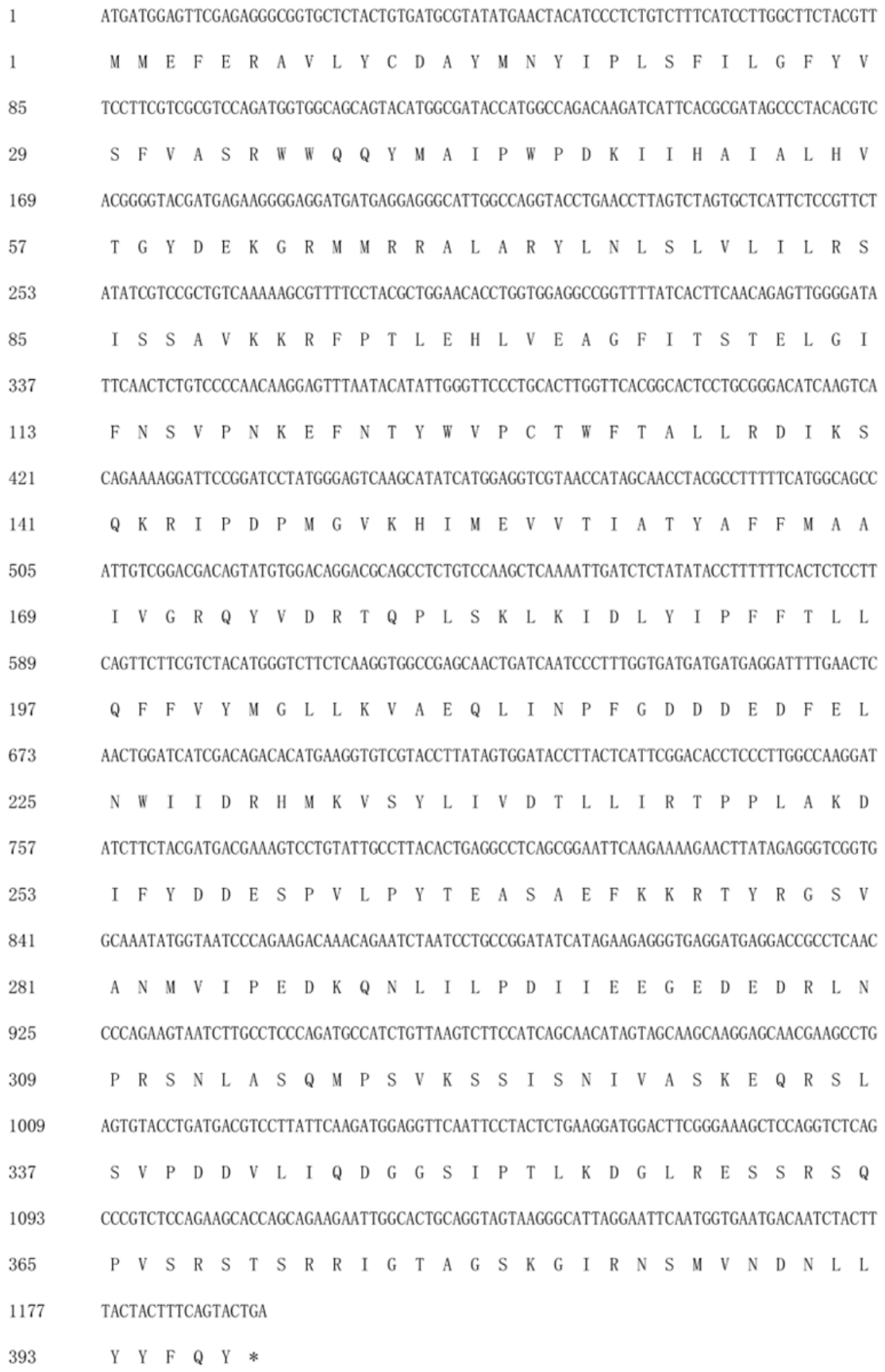
Figure 1. The open reading frame (ORF) sequence of the Mn-BEST3 gene is shown, with both the nucleotide sequence and the deduced amino acid sequence presented in the 5′→3′ direction. In the deduced amino acid sequence, each amino acid is represented by its single-letter uppercase code. The start codon (ATG) and the stop codon (TAA, marked by an asterisk) are clearly indicated.
Ijms 27 05338 g001
Figure 2. The genome structure of Mn-BEST3. The blue boxes indicated the exons.
Ijms 27 05338 g002
Figure 3. Sequence alignment and structural information of the BEST3 protein from M. nipponense. Red line indicated the conserved bestrophin domain within the BEST3 protein. Black, pink, blue, and yellow indicated 100%, ≥75%, ≥50%, and ≥33% identity between species, respectively.
Ijms 27 05338 g003
Figure 4. Phylogenetic tree analysis of BEST3 protein in crustaceans. Macrobrachium rosenbergii (XP_066944196.1); Scylla paramamosain (KAK8379233.1); Palaemon carinicauda (XP_068205836.1); Penaeus vannamei (XP_069969864.1); Cherax quadricarinatus (XP_069940637.1); Procambarus clarkii (XP_045599924.1); Panulirus ornatus (XP_071545299.1); Penaeus japonicus (XP_042887574.1).
Ijms 27 05338 g004
Figure 5. qPCR analysis was used to measure the relative expression levels of the BEST3 gene across various mature tissues of M. nipponense. The EIF gene served as an internal control for data normalization. All data are shown as mean ± standard deviation (SD, n = 6). Different lowercase letters indicated statistically significant differences in BEST3 expression among tissues (p < 0.05). E, eyestalk; BR, brain; H, heart; HE, hepatopancreas; G, gill; M, muscle; O, ovary; T, testis.
Ijms 27 05338 g005
Figure 6. The time-course interference efficiency of dsBEST3 was assessed using qPCR. Gene expression levels were normalized to the reference gene EIF and presented as mean ± SD (n = 3). Double asterisks (**) indicate a highly significant difference (p < 0.01) between the dsBEST3-treated group and the dsGFP control group at matching time points.
Ijms 27 05338 g006
Figure 7. Effect of dsBEST3 injection on weight gain in M. nipponense. Body weight changes were recorded over time after dsBEST3 or dsGFP (control) injection. At identical time points, significant differences between groups are denoted by * (p < 0.05). (A) Female weight gain. (B) Female percent body mass increase. (C) Male weight gain. (D) Male percent body mass increase.
Ijms 27 05338 g007
Table 1. The positions of exons of Mn-BEST3.
ExonStartStopLength
123,166,70323,166,7075
223,170,01823,170,152135
323,175,99423,176,160167
423,178,89423,179,051158
523,192,71423,192,866153
623,193,63123,193,71181
723,194,23223,194,383152
823,199,01523,199,145131
923,206,83223,206,991160
1023,210,19423,210,24552
Table 2. Daily weight and length gain of M. nipponense after knockdown of BEST3.
GenderGroupWeight Gain Rate (‰)
FemaledsBEST33.179 ± 0.919 *
Control4.293 ± 1.831
MaledsBEST5.384 ± 0.274 *
Control6.993 ± 0.563
* indicated the significant difference between the dsBEST3 and control group (p < 0.05).
Table 3. Identification of SNPs within the coding region of Mn-BEST3.
SNPGenotype1Genotype2Genotype3HoHePICp-ValueVariation Type
S31_23176129C:26T:30Y:360.379 0.393 0.316 0.262 Synonymous
S31_23192836G:17T:47K:270.311 0.292 0.247 0.022 Synonymous
S31_23206944A:25C:31M:360.396 0.358 0.294 0.114 Synonymous
Table 4. Identification of growth-associated SNPs within the coding region of Mn-BEST3.
SNP IDGenderGenotype (Number)Weight (g)Full Length (mm)
S31_23192836FemaleTT:221.117 ± 0.504 b 46.237 ± 6.100 b
TG:140.897 ± 0.429 ab43.692 ± 6.350 ab
GG:100.500 ± 0.190 a38.057 ± 5.155 a
MaleTT:252.500 ± 0.682 b 59.532 ± 5.635 b
TG:131.699 ± 0.910 ab52.919 ± 8.475 ab
GG:71.057 ± 0.142 a47.097 ± 1.539 a
Letters indicated the significant difference between different genotypes (p < 0.05).
Table 5. Specimens used in this study.
Sampling DataAnimalsTissuePurposeBody Weight
2023.07.04–07.0710 specimensMuscleORF verification2.93–3.82 g
2023.07.04–07.0718 male specimens and 18 female specimensEyestalk, Brain, Heart, Hepatopancreas, Gill, Muscle, Ovary, TestisqPCR analysis2.68–3.85 g for male prawns;
1.74–2.25 g for female prawns
2024.06.15–07.06240 specimens (120 males and 120 females)MuscleRNAi analysis0.76–0.82 g for male prawns;
0.41–0.44 g for female prawns
2024.09.12100 speimens (50 males and 50 females) from a full-sib familyMuscleSNP identification0.86–3.89 g for male prawns;
0.36–1.58 g for female prawns
Table 6. Primers used in the present study.
PrimerSequenceProduct LengthPurpose
F1CGGTGCTCTACTGTGATGCG481 bpPrimers for PCR verification and SNP identification
R1GCCATGAAAAAGGCGTAGGT
F2CACTCCTGCGGGACATCAAG538 bp
R2TTACTTCTGGGGTTGAGGCG
F3TGGTAATCCCAGAAGACAAACAGA303 bp
R3TCCTAATGCCCTTACTACCTGC
RT-F1GATAGCCCTACACGTCACGG125 bpPrimer for qPCR
RT-F2AACGCTTTTTGACAGCGGAC
EIF-F1CATGGATGTACCTGTGGTGAAAC179 bpPrimer for reference gene
EIF-R1CTGTCAGCAGAAGGTCCTCATTA
RNAi-F1TAATACGACTCACTATAGGGGGCCGGTTTTATCACTTCAA443 bpPrimer for RNAi
RNAi-R1TAATACGACTCACTATAGGGGGGAGGTGTCCGAATGAGTA
Disclaimer/Publisher’s Note: The statements, opinions and data contained in all publications are solely those of the individual author(s) and contributor(s) and not of MDPI and/or the editor(s). MDPI and/or the editor(s) disclaim responsibility for any injury to people or property resulting from any ideas, methods, instructions or products referred to in the content.