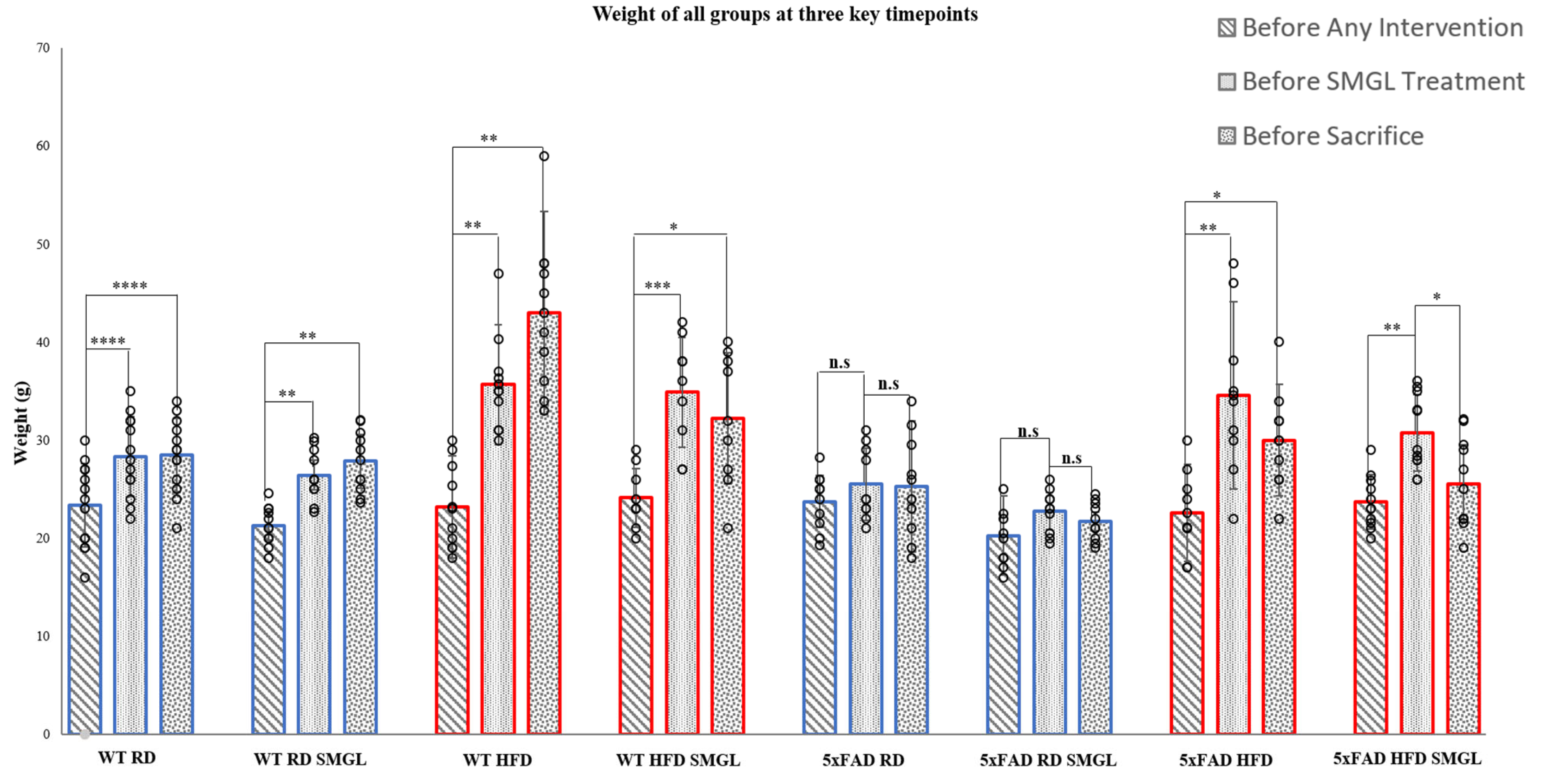
Figure 1.
Body weight changes in WT and 5xFAD mice on RD/HFD with/without SMGL treatment. WT RD mice showed a significant increase in their weight after a duration of 5 months, which was stable to the end of the experimental phase. Similarly, WT RD mice treated with SMGL exhibited an increased body weight at 5 months, which remained the same at the endpoint. WT HFD untreated mice showed a significant increase at 5 months, which increased further at the endpoint. The significantly increased weight of the WT HFD SMGL-treated mice at 5 months showed a declining tendency at the endpoint; however, this difference was not significant. Both 5xFAD RD groups, before or after treatment, demonstrated no changes in weight at any stage. 5xFAD HFD mice exhibited a significantly increased body weight at 5 months; however, at the endpoint, their weight was slightly reduced, but not significantly. Finally, the 5xFAD HFD SMGL-treated group showed a significantly increased weight at 5 months. After SMGL administration, their weight was significantly reduced, restoring it to baseline levels [F (2, 85.67) = 71.41]. (WT RD; n = 13, WT RD SMGL; n = 11, WT HFD; n = 11, WT HFD SMGL; n = 9, 5xFAD RD; n = 10, 5xFAD RD SMGL; n = 10, 5xFAD HFD; n = 10, 5xFAD HFD SMGL; n = 11). Mean ± SD. All groups met the normality assumptions (Shapiro–Wilk test; all p > 0.05), justifying the use of parametric two-way ANOVA. Two-way ANOVA and Tukey’s post hoc test. * p ≤ 0.05, ** p ≤ 0.01, *** p ≤ 0.001 and **** p ≤ 0.0001, n.s = not significant. Circles indicate individual values.
Figure 1.
Body weight changes in WT and 5xFAD mice on RD/HFD with/without SMGL treatment. WT RD mice showed a significant increase in their weight after a duration of 5 months, which was stable to the end of the experimental phase. Similarly, WT RD mice treated with SMGL exhibited an increased body weight at 5 months, which remained the same at the endpoint. WT HFD untreated mice showed a significant increase at 5 months, which increased further at the endpoint. The significantly increased weight of the WT HFD SMGL-treated mice at 5 months showed a declining tendency at the endpoint; however, this difference was not significant. Both 5xFAD RD groups, before or after treatment, demonstrated no changes in weight at any stage. 5xFAD HFD mice exhibited a significantly increased body weight at 5 months; however, at the endpoint, their weight was slightly reduced, but not significantly. Finally, the 5xFAD HFD SMGL-treated group showed a significantly increased weight at 5 months. After SMGL administration, their weight was significantly reduced, restoring it to baseline levels [F (2, 85.67) = 71.41]. (WT RD; n = 13, WT RD SMGL; n = 11, WT HFD; n = 11, WT HFD SMGL; n = 9, 5xFAD RD; n = 10, 5xFAD RD SMGL; n = 10, 5xFAD HFD; n = 10, 5xFAD HFD SMGL; n = 11). Mean ± SD. All groups met the normality assumptions (Shapiro–Wilk test; all p > 0.05), justifying the use of parametric two-way ANOVA. Two-way ANOVA and Tukey’s post hoc test. * p ≤ 0.05, ** p ≤ 0.01, *** p ≤ 0.001 and **** p ≤ 0.0001, n.s = not significant. Circles indicate individual values.

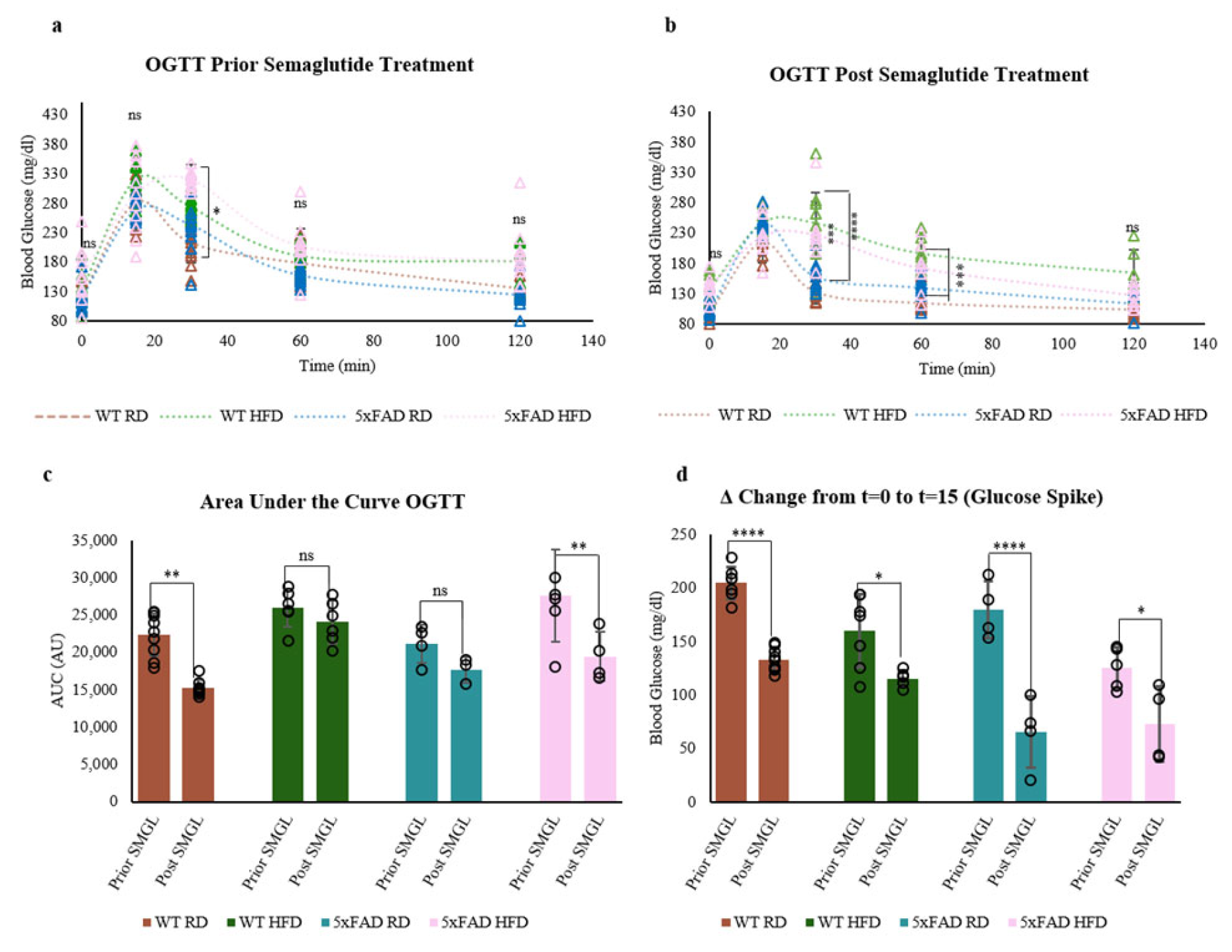
Figure 2.
OGTT performed in HFD-fed and RD-fed mice before and after the commencement of SMGL treatment. Glucose levels during OGTT. Fasting glucose levels were measured at 15, 30, 60, and 120 min after oral glucose administration before (a) and after (b) SMGL treatment. (a) 5xFAD HFD showed a significant increase at 30 min [F (3, 100) = 7.987]. (WT RD; n = 11, WT HFD; n = 11, 5xFAD RD; n = 11, 5xFAD HFD; n = 11). (b) After treatment, the entire glucose curve was significantly reduced [F (3, 90) = 27.72]. (WT RD; n = 8, WT HFD; n = 8, 5xFAD RD; n = 8, 5xFAD HFD; n = 8). (c) The glucose area under the curve (AUC) during OGTT was significantly reduced after SMGL administration in WT RD and 5xFAD HFD. However, no significant changes were observed in the other groups. (d) The delta change in the initial spike in blood glucose 15 min after oral glucose administration was significantly reduced after SMGL administration in all groups. Mean ± SD. All groups met the normality assumptions (Shapiro–Wilk test; all p > 0.05). One-way ANOVA and Tukey’s post hoc test. * p ≤ 0.05, ** p ≤ 0.01, *** p ≤ 0.001 and **** p ≤ 0.0001, ns = not significant. Circles indicate individual values.
Figure 2.
OGTT performed in HFD-fed and RD-fed mice before and after the commencement of SMGL treatment. Glucose levels during OGTT. Fasting glucose levels were measured at 15, 30, 60, and 120 min after oral glucose administration before (a) and after (b) SMGL treatment. (a) 5xFAD HFD showed a significant increase at 30 min [F (3, 100) = 7.987]. (WT RD; n = 11, WT HFD; n = 11, 5xFAD RD; n = 11, 5xFAD HFD; n = 11). (b) After treatment, the entire glucose curve was significantly reduced [F (3, 90) = 27.72]. (WT RD; n = 8, WT HFD; n = 8, 5xFAD RD; n = 8, 5xFAD HFD; n = 8). (c) The glucose area under the curve (AUC) during OGTT was significantly reduced after SMGL administration in WT RD and 5xFAD HFD. However, no significant changes were observed in the other groups. (d) The delta change in the initial spike in blood glucose 15 min after oral glucose administration was significantly reduced after SMGL administration in all groups. Mean ± SD. All groups met the normality assumptions (Shapiro–Wilk test; all p > 0.05). One-way ANOVA and Tukey’s post hoc test. * p ≤ 0.05, ** p ≤ 0.01, *** p ≤ 0.001 and **** p ≤ 0.0001, ns = not significant. Circles indicate individual values.

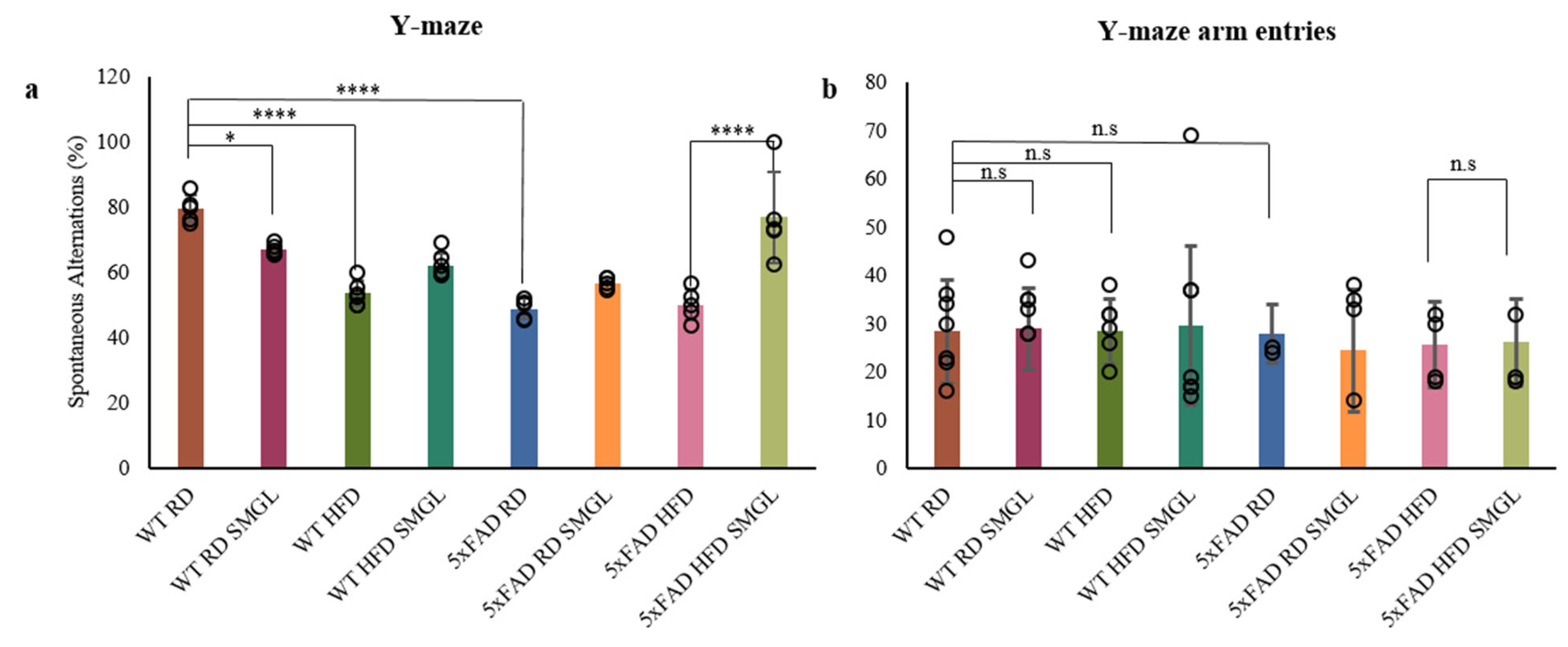
Figure 3.
Cognitive impairment assessment using the Y-maze spontaneous alternation test. All groups of mice underwent spontaneous alternation behavioral testing using a Y-maze. (a) WT HFD and 5xFAD RD showed a significant reduction in cognitive function compared to WT RD. 5xFAD HFD mice after SMGL administration exhibited increased cognitive function compared to 5xFAD HFD [F (7, 30) = 16.14]. (WT RD; n = 5, WT RD SMGL; n = 5, WT HFD; n = 6, WT HFD SMGL; n = 7, 5xFAD RD; n = 5, 5xFAD RD SMGL; n = 5, 5xFAD HFD; n = 5, 5xFAD HFD SMGL; n = 5). (b) Graphical representation of the number of mouse entries in the Y-maze arms. The number of Y-maze entries did not change significantly in any group, either with or without drug administration. This ensured proper motor function and indicated that all animals performed correctly within the given time, irrespective of the outcome [F (7, 55) = 0.2091]. WT RD, n = 14; WT RD OZ, n = 13; WT HFD, n = 10; WT HFD SMGL, n = 10; 5xFAD RD, n = 5; 5xFAD RD SMGL, n = 5; 5xFAD HFD, n = 7; 5xFAD HFD SMGL. All groups met the normality assumptions (Shapiro–Wilk test; all p > 0.05), justifying the use of parametric one-way ANOVA. Mean ± SD. One-way ANOVA and Tukey’s post hoc test. * p ≤ 0.05, **** p ≤ 0.0001 and n.s = not significant.
Figure 3.
Cognitive impairment assessment using the Y-maze spontaneous alternation test. All groups of mice underwent spontaneous alternation behavioral testing using a Y-maze. (a) WT HFD and 5xFAD RD showed a significant reduction in cognitive function compared to WT RD. 5xFAD HFD mice after SMGL administration exhibited increased cognitive function compared to 5xFAD HFD [F (7, 30) = 16.14]. (WT RD; n = 5, WT RD SMGL; n = 5, WT HFD; n = 6, WT HFD SMGL; n = 7, 5xFAD RD; n = 5, 5xFAD RD SMGL; n = 5, 5xFAD HFD; n = 5, 5xFAD HFD SMGL; n = 5). (b) Graphical representation of the number of mouse entries in the Y-maze arms. The number of Y-maze entries did not change significantly in any group, either with or without drug administration. This ensured proper motor function and indicated that all animals performed correctly within the given time, irrespective of the outcome [F (7, 55) = 0.2091]. WT RD, n = 14; WT RD OZ, n = 13; WT HFD, n = 10; WT HFD SMGL, n = 10; 5xFAD RD, n = 5; 5xFAD RD SMGL, n = 5; 5xFAD HFD, n = 7; 5xFAD HFD SMGL. All groups met the normality assumptions (Shapiro–Wilk test; all p > 0.05), justifying the use of parametric one-way ANOVA. Mean ± SD. One-way ANOVA and Tukey’s post hoc test. * p ≤ 0.05, **** p ≤ 0.0001 and n.s = not significant.

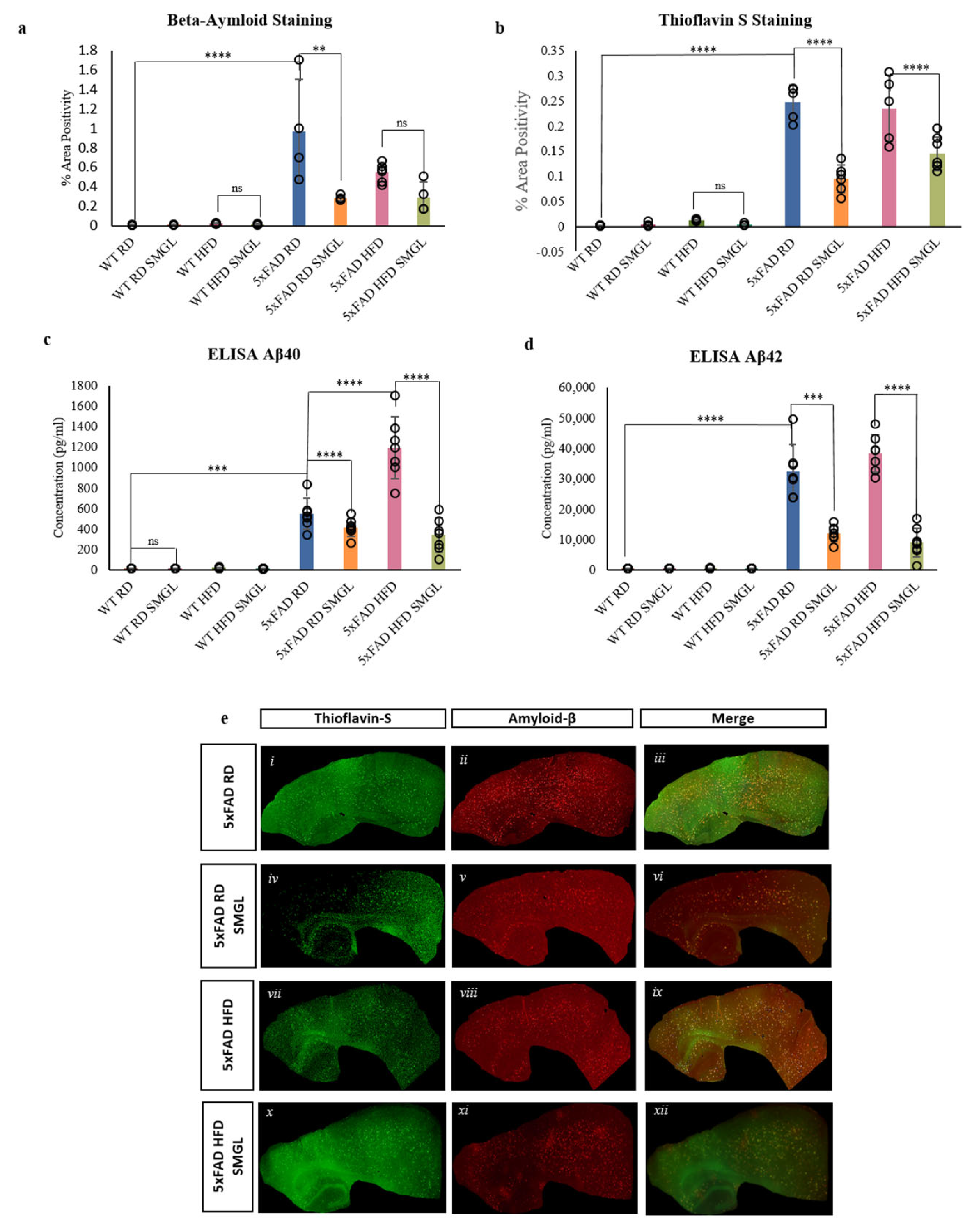
Figure 4.
Amyloid load decrease and cognitive impairment amelioration in SMGL-treated animals. Sagittal brain sections from WT RD, WT HFD, 5xFAD RD, and 5xFAD HFD mice, either untreated or treated with SMGL, were co-stained with thioflavin-S (green; excitation λ: 430, emission λ: 550) and an anti-amyloid-β antibody (red; excitation λ: 555, emission λ: 580). (a) β-amyloid staining revealed increased expression in 5xFAD RD mice compared to WT controls. After SMGL treatment, β-amyloid levels were significantly reduced. 5xFAD HFD mice also exhibited increased levels of β-amyloid, but no changes were observed after treatment [F (7, 26) = 13.44]. (WT RD; n = 7, WT RD SMGL; n = 4, WT HFD; n = 4, WT HFD SMGL; n = 4, 5xFAD RD; n = 4, 5xFAD RD SMGL; n = 4, 5xFAD HFD; n = 6, 5xFAD HFD SMGL; n = 4). (b) Similarly, thioflavin-S staining showed substantial plaque deposition in 5xFAD RD when compared to WT RD, which was significantly reduced after treatment. 5xFAD HFD mice also exhibited increased levels of thioflavin-S-positive plaques that were reduced after treatment [F (7, 32) = 49.96]. (WT RD; n = 5, WT RD SMGL; n = 5, WT HFD; n = 5, WT HFD SMGL; n = 4, 5xFAD RD; n = 5, 5xFAD RD SMGL; n = 6, 5xFAD HFD; n = 5, 5xFAD HFD SMGL; n = 7). (c,d) Enzyme-linked immunosorbent assay of the two most prominent amyloidogenic species in AD, namely, Aβ40 and Aβ42, respectively. In both cases, the 5xFAD RD and 5xFAD HFD groups demonstrated significantly higher levels of β-amyloid, which were reduced after SMGL treatment: Aβ40—[F (7, 36) = 37.91]; Aβ42—[F (7, 48) = 55.68]. (WT RD; n = 8, WT RD SMGL; n = 8, WT HFD; n = 5, WT HFD SMGL; n = 8, 5xFAD RD; n = 7, 5xFAD RD SMGL; n = 7, 5xFAD HFD; n = 7, 5xFAD HFD SMGL; n = 7). All groups met the normality assumptions (Shapiro–Wilk test; all p > 0.05), justifying the use of parametric one-way ANOVA. Mean ± SD. One-way ANOVA and Tukey’s post hoc test. ** p ≤ 0.01, *** p ≤ 0.001 and **** p ≤ 0.0001, ns = not significant. (e) Representative sections of the 5xFAD-treated and untreated groups indicating thioflavin-S and β-amyloid staining in the cortex and hippocampus (composite figures from 50× images). Thioflavin-S staining in 5xFAD-treated groups (iv,x) showed significantly reduced amounts of plaques compared to untreated groups (i,vii). Similarly, amyloid-b staining in 5xFAD-treated groups (v,xi) showed significantly reduced amounts of plaques compared to untreated groups (ii,viii). (iii,vi,ix,xii) Co-staining of thioflavin-S and beta-amyloid staining in 5xFAD animals.
Figure 4.
Amyloid load decrease and cognitive impairment amelioration in SMGL-treated animals. Sagittal brain sections from WT RD, WT HFD, 5xFAD RD, and 5xFAD HFD mice, either untreated or treated with SMGL, were co-stained with thioflavin-S (green; excitation λ: 430, emission λ: 550) and an anti-amyloid-β antibody (red; excitation λ: 555, emission λ: 580). (a) β-amyloid staining revealed increased expression in 5xFAD RD mice compared to WT controls. After SMGL treatment, β-amyloid levels were significantly reduced. 5xFAD HFD mice also exhibited increased levels of β-amyloid, but no changes were observed after treatment [F (7, 26) = 13.44]. (WT RD; n = 7, WT RD SMGL; n = 4, WT HFD; n = 4, WT HFD SMGL; n = 4, 5xFAD RD; n = 4, 5xFAD RD SMGL; n = 4, 5xFAD HFD; n = 6, 5xFAD HFD SMGL; n = 4). (b) Similarly, thioflavin-S staining showed substantial plaque deposition in 5xFAD RD when compared to WT RD, which was significantly reduced after treatment. 5xFAD HFD mice also exhibited increased levels of thioflavin-S-positive plaques that were reduced after treatment [F (7, 32) = 49.96]. (WT RD; n = 5, WT RD SMGL; n = 5, WT HFD; n = 5, WT HFD SMGL; n = 4, 5xFAD RD; n = 5, 5xFAD RD SMGL; n = 6, 5xFAD HFD; n = 5, 5xFAD HFD SMGL; n = 7). (c,d) Enzyme-linked immunosorbent assay of the two most prominent amyloidogenic species in AD, namely, Aβ40 and Aβ42, respectively. In both cases, the 5xFAD RD and 5xFAD HFD groups demonstrated significantly higher levels of β-amyloid, which were reduced after SMGL treatment: Aβ40—[F (7, 36) = 37.91]; Aβ42—[F (7, 48) = 55.68]. (WT RD; n = 8, WT RD SMGL; n = 8, WT HFD; n = 5, WT HFD SMGL; n = 8, 5xFAD RD; n = 7, 5xFAD RD SMGL; n = 7, 5xFAD HFD; n = 7, 5xFAD HFD SMGL; n = 7). All groups met the normality assumptions (Shapiro–Wilk test; all p > 0.05), justifying the use of parametric one-way ANOVA. Mean ± SD. One-way ANOVA and Tukey’s post hoc test. ** p ≤ 0.01, *** p ≤ 0.001 and **** p ≤ 0.0001, ns = not significant. (e) Representative sections of the 5xFAD-treated and untreated groups indicating thioflavin-S and β-amyloid staining in the cortex and hippocampus (composite figures from 50× images). Thioflavin-S staining in 5xFAD-treated groups (iv,x) showed significantly reduced amounts of plaques compared to untreated groups (i,vii). Similarly, amyloid-b staining in 5xFAD-treated groups (v,xi) showed significantly reduced amounts of plaques compared to untreated groups (ii,viii). (iii,vi,ix,xii) Co-staining of thioflavin-S and beta-amyloid staining in 5xFAD animals.

Figure 5.
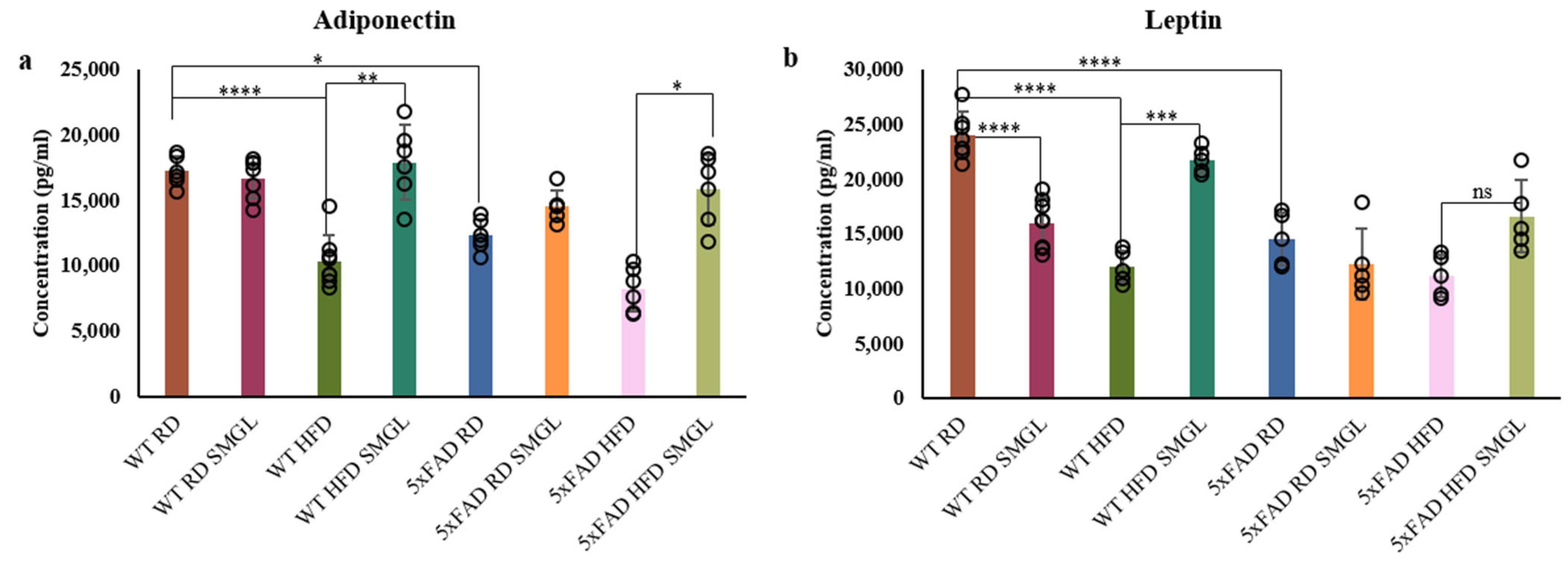
Brain immunoassays of adipokines. Enzyme-linked immunosorbent assay of brain adiponectin (a) and leptin (b) levels. (a) WT HFD, 5xFAD RD, and 5xFAD HFD groups showed significantly reduced levels of adiponectin when compared to the WT RD group. After treatment, adiponectin levels significantly increased, restoring them to WT levels [F (7, 30) = 14.32]. (WT RD; n = 6, WT RD SMGL; n = 7, WT HFD; n = 8, WT HFD SMGL; n = 6, 5xFAD RD; n = 6, 5xFAD RD SMGL; n = 6, 5xFAD HFD; n = 6, 5xFAD HFD SMGL; n = 6). (b) Leptin levels in WT-HFD mice were significantly decreased compared to WT RD. The reduced levels of WT HFD were significantly increased after treatment. On the contrary, no significant changes were observed after treatment to the reduced levels of 5xFAD RD and 5xFAD HFD [F (7, 31) = 17.95]. (WT RD; n = 7, WT RD SMGL; n = 8, WT HFD; n = 5, WT HFD SMGL; n = 5, 5xFAD RD; n = 5, 5xFAD RD SMGL; n = 5, 5xFAD HFD; n = 5, 5xFAD HFD SMGL; n = 5). All groups met normality assumptions (Shapiro–Wilk test; all p > 0.05), justifying the use of parametric one-way ANOVA. Mean ± SD. One-way ANOVA and Tukey’s post hoc test. * p ≤ 0.05, ** p ≤ 0.01, *** p ≤ 0.001 and **** p ≤ 0.0001, ns = not significant. Circles indicate individual values.
Figure 5.
Brain immunoassays of adipokines. Enzyme-linked immunosorbent assay of brain adiponectin (a) and leptin (b) levels. (a) WT HFD, 5xFAD RD, and 5xFAD HFD groups showed significantly reduced levels of adiponectin when compared to the WT RD group. After treatment, adiponectin levels significantly increased, restoring them to WT levels [F (7, 30) = 14.32]. (WT RD; n = 6, WT RD SMGL; n = 7, WT HFD; n = 8, WT HFD SMGL; n = 6, 5xFAD RD; n = 6, 5xFAD RD SMGL; n = 6, 5xFAD HFD; n = 6, 5xFAD HFD SMGL; n = 6). (b) Leptin levels in WT-HFD mice were significantly decreased compared to WT RD. The reduced levels of WT HFD were significantly increased after treatment. On the contrary, no significant changes were observed after treatment to the reduced levels of 5xFAD RD and 5xFAD HFD [F (7, 31) = 17.95]. (WT RD; n = 7, WT RD SMGL; n = 8, WT HFD; n = 5, WT HFD SMGL; n = 5, 5xFAD RD; n = 5, 5xFAD RD SMGL; n = 5, 5xFAD HFD; n = 5, 5xFAD HFD SMGL; n = 5). All groups met normality assumptions (Shapiro–Wilk test; all p > 0.05), justifying the use of parametric one-way ANOVA. Mean ± SD. One-way ANOVA and Tukey’s post hoc test. * p ≤ 0.05, ** p ≤ 0.01, *** p ≤ 0.001 and **** p ≤ 0.0001, ns = not significant. Circles indicate individual values.

Figure 6.
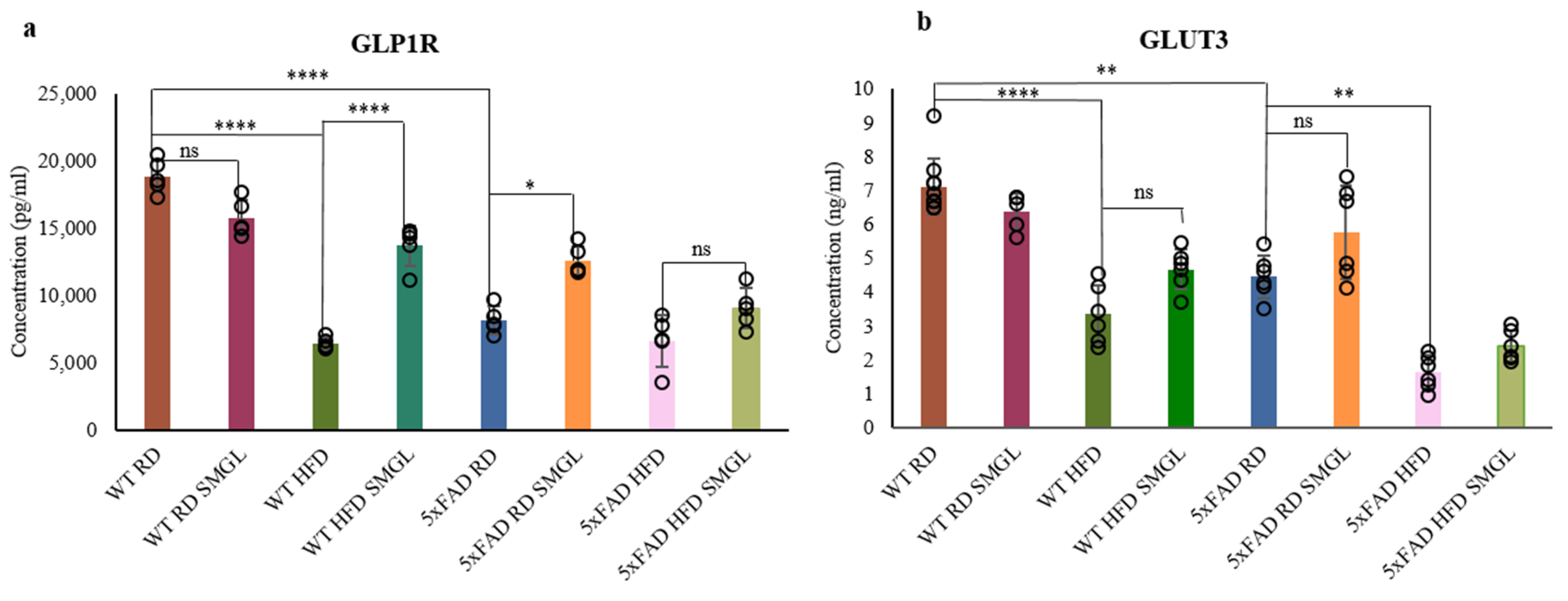
Brain immunoassays of receptors. Enzyme-linked immunosorbent assay (ELISA) of GLP1R (a) and GLUT3 (b) receptor levels in the brain. (a) The expression levels of GLP1R remained unaffected in the WT RD group after treatment. However, the reduced levels in WT HFD and 5xFAD RD were significantly increased after treatment [F (7, 23) = 37.08]. (WT RD; n = 5, WT RD SMGL; n = 5, WT HFD; n = 5, WT HFD SMGL; n = 5, 5xFAD RD; n = 5, 5xFAD RD SMGL; n = 5, 5xFAD HFD; n = 5, 5xFAD HFD SMGL; n = 5). (b) GLUT3 levels were significantly reduced in WT HFD and 5xFAD RD when compared to WT RD. Additionally, 5xFAD HFD exhibited further reduced levels when compared to the 5xFAD RD, and SMGL treatment did not significantly alter the expression of GLUT3 in any WT or 5xFAD groups [F (7, 28) = 29.71]. (WT RD; n = 10, WT RD SMGL; n = 5, WT HFD; n = 6, WT HFD SMGL; n = 6, 5xFAD RD; n = 6, 5xFAD RD SMGL; n = 6, 5xFAD HFD; n = 6, 5xFAD HFD SMGL; n = 6). All groups met normality assumptions (Shapiro–Wilk test; all p > 0.05), justifying the use of parametric one-way ANOVA. Mean ± SD. One-way ANOVA and Tukey’s post hoc test. * p ≤ 0.05, ** p ≤ 0.01, and **** p ≤ 0.0001, ns = not significant. Circles indicate individual values.
Figure 6.
Brain immunoassays of receptors. Enzyme-linked immunosorbent assay (ELISA) of GLP1R (a) and GLUT3 (b) receptor levels in the brain. (a) The expression levels of GLP1R remained unaffected in the WT RD group after treatment. However, the reduced levels in WT HFD and 5xFAD RD were significantly increased after treatment [F (7, 23) = 37.08]. (WT RD; n = 5, WT RD SMGL; n = 5, WT HFD; n = 5, WT HFD SMGL; n = 5, 5xFAD RD; n = 5, 5xFAD RD SMGL; n = 5, 5xFAD HFD; n = 5, 5xFAD HFD SMGL; n = 5). (b) GLUT3 levels were significantly reduced in WT HFD and 5xFAD RD when compared to WT RD. Additionally, 5xFAD HFD exhibited further reduced levels when compared to the 5xFAD RD, and SMGL treatment did not significantly alter the expression of GLUT3 in any WT or 5xFAD groups [F (7, 28) = 29.71]. (WT RD; n = 10, WT RD SMGL; n = 5, WT HFD; n = 6, WT HFD SMGL; n = 6, 5xFAD RD; n = 6, 5xFAD RD SMGL; n = 6, 5xFAD HFD; n = 6, 5xFAD HFD SMGL; n = 6). All groups met normality assumptions (Shapiro–Wilk test; all p > 0.05), justifying the use of parametric one-way ANOVA. Mean ± SD. One-way ANOVA and Tukey’s post hoc test. * p ≤ 0.05, ** p ≤ 0.01, and **** p ≤ 0.0001, ns = not significant. Circles indicate individual values.

Figure 7.
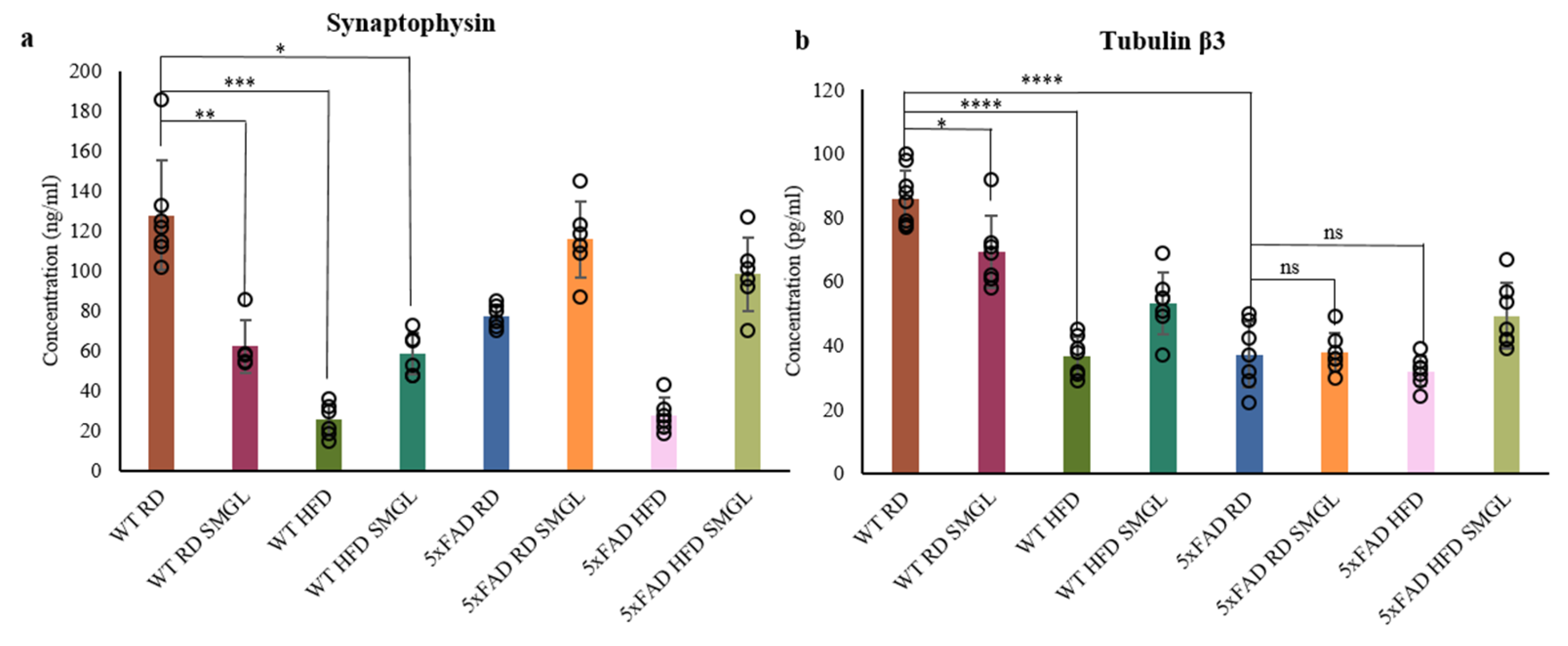
Brain immunoassays of neural markers. Expression levels of enzyme-linked immunosorbent assay of brain synaptophysin [F (7, 21) = 11.33] (a) and tubulin-β3 [F (7, 36) = 25.72] (b). A significant reduction in synaptophysin and tubulin-β3 was observed in all groups when compared with the WT RD group. (WT RD; n = 7, WT RD SMGL; n = 5, WT HFD; n = 6, WT HFD SMGL; n = 6, 5xFAD RD; n = 6, 5xFAD RD SMGL; n = 6, 5xFAD HFD; n = 6, 5xFAD HFD SMGL; n = 6). All groups met the normality assumptions (Shapiro–Wilk test; all p > 0.05), justifying the use of parametric one-way ANOVA. Mean ± SD. One-way ANOVA and Tukey’s post hoc test. * p ≤ 0.05, ** p ≤ 0.01, *** p ≤ 0.001 and **** p ≤ 0.0001, ns = not significant.
Figure 7.
Brain immunoassays of neural markers. Expression levels of enzyme-linked immunosorbent assay of brain synaptophysin [F (7, 21) = 11.33] (a) and tubulin-β3 [F (7, 36) = 25.72] (b). A significant reduction in synaptophysin and tubulin-β3 was observed in all groups when compared with the WT RD group. (WT RD; n = 7, WT RD SMGL; n = 5, WT HFD; n = 6, WT HFD SMGL; n = 6, 5xFAD RD; n = 6, 5xFAD RD SMGL; n = 6, 5xFAD HFD; n = 6, 5xFAD HFD SMGL; n = 6). All groups met the normality assumptions (Shapiro–Wilk test; all p > 0.05), justifying the use of parametric one-way ANOVA. Mean ± SD. One-way ANOVA and Tukey’s post hoc test. * p ≤ 0.05, ** p ≤ 0.01, *** p ≤ 0.001 and **** p ≤ 0.0001, ns = not significant.
Figure 8.
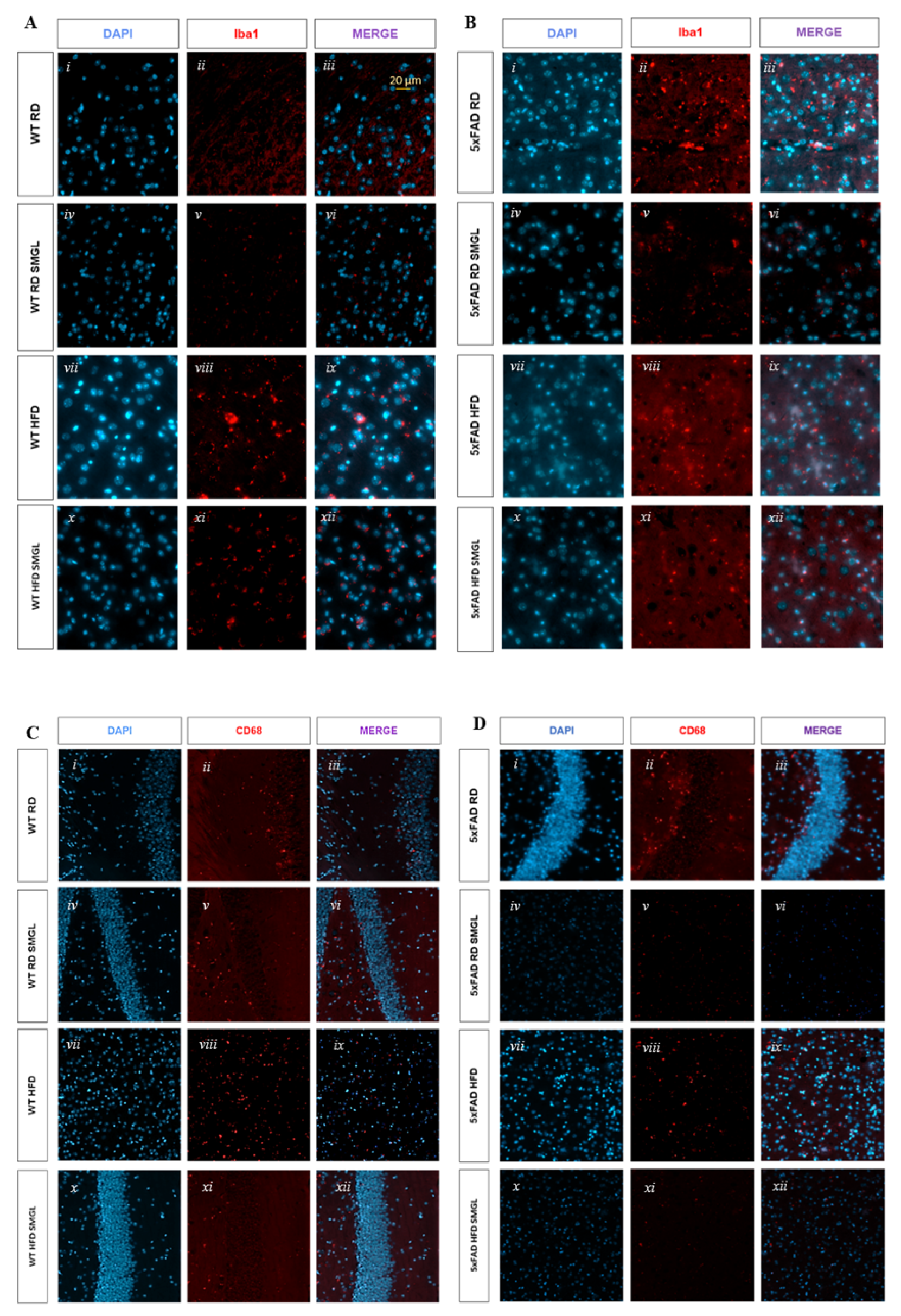
Microglial activation and phagocytosis assessed by Iba1 and CD68 immunofluorescence in WT and 5xFAD brain tissue. Representative cortical images of WT (A,C) and 5xFAD (B,D) mice maintained on an RD or HFD, with or without SMGL treatment. Panels (A,B) show DAPI (blue), Iba1 (red), and merged images. Panels (C,D) show DAPI (blue), CD68 (red), and merged images. (A) WT RD control mice: (i) DAPI, (ii) Iba1, and (iii) merged image; WT RD+SMGL mice: (iv) DAPI, (v) Iba1, and (vi) merged image; WT HFD mice: (vii) DAPI, (viii) Iba1, and (ix) merged image; WT HFD+SMGL mice: (x) DAPI, (xi) Iba1, and (xii) merged image. WT RD mice exhibited minimal Iba1 immunoreactivity, whereas increased staining was observed in WT HFD mice and appeared reduced following SMGL Treatment. (B) 5xFAD RD mice: (i) DAPI, (ii) Iba1, and (iii) merged image; 5xFAD RD+SMGL mice: (iv) DAPI, (v) Iba1, and (vi) merged image; 5xFAD HFD mice: (vii) DAPI, (viii) Iba1, and (ix) merged image; 5xFAD HFD+SMGL mice: (x) DAPI, (xi) Iba1, and (xii) merged image. Increased Iba1 immunoreactivity was observed in 5xFAD mice and appeared reduced following SMGL treatment under both dietary conditions. (C) WT RD control mice: (i) DAPI, (ii) CD68, and (iii) merged image; WT RD+SMGL mice: (iv) DAPI, (v) CD68, and (vi) merged image; WT HFD mice: (vii) DAPI, (viii) CD68, and (ix) merged image; WT HFD+SMGL mice: (x) DAPI, (xi) CD68, and (xii) merged image. CD68 immunoreactivity was minimal in WT RD mice but increased in WT HFD mice and appeared reduced following SMGL treatment. (D) 5xFAD RD control mice: (i) DAPI, (ii) CD68, and (iii) merged image; 5xFAD RD+SMGL mice: (iv) DAPI, (v) CD68, and (vi) merged image; 5xFAD HFD mice: (vii) DAPI, (viii) CD68, and (ix) merged image; 5xFAD HFD+SMGL mice: (x) DAPI, (xi) CD68, and (xii) merged image. Increased CD68 immunoreactivity was observed in 5xFAD mice and appeared reduced following SMGL treatment under both dietary conditions.
Figure 8.
Microglial activation and phagocytosis assessed by Iba1 and CD68 immunofluorescence in WT and 5xFAD brain tissue. Representative cortical images of WT (A,C) and 5xFAD (B,D) mice maintained on an RD or HFD, with or without SMGL treatment. Panels (A,B) show DAPI (blue), Iba1 (red), and merged images. Panels (C,D) show DAPI (blue), CD68 (red), and merged images. (A) WT RD control mice: (i) DAPI, (ii) Iba1, and (iii) merged image; WT RD+SMGL mice: (iv) DAPI, (v) Iba1, and (vi) merged image; WT HFD mice: (vii) DAPI, (viii) Iba1, and (ix) merged image; WT HFD+SMGL mice: (x) DAPI, (xi) Iba1, and (xii) merged image. WT RD mice exhibited minimal Iba1 immunoreactivity, whereas increased staining was observed in WT HFD mice and appeared reduced following SMGL Treatment. (B) 5xFAD RD mice: (i) DAPI, (ii) Iba1, and (iii) merged image; 5xFAD RD+SMGL mice: (iv) DAPI, (v) Iba1, and (vi) merged image; 5xFAD HFD mice: (vii) DAPI, (viii) Iba1, and (ix) merged image; 5xFAD HFD+SMGL mice: (x) DAPI, (xi) Iba1, and (xii) merged image. Increased Iba1 immunoreactivity was observed in 5xFAD mice and appeared reduced following SMGL treatment under both dietary conditions. (C) WT RD control mice: (i) DAPI, (ii) CD68, and (iii) merged image; WT RD+SMGL mice: (iv) DAPI, (v) CD68, and (vi) merged image; WT HFD mice: (vii) DAPI, (viii) CD68, and (ix) merged image; WT HFD+SMGL mice: (x) DAPI, (xi) CD68, and (xii) merged image. CD68 immunoreactivity was minimal in WT RD mice but increased in WT HFD mice and appeared reduced following SMGL treatment. (D) 5xFAD RD control mice: (i) DAPI, (ii) CD68, and (iii) merged image; 5xFAD RD+SMGL mice: (iv) DAPI, (v) CD68, and (vi) merged image; 5xFAD HFD mice: (vii) DAPI, (viii) CD68, and (ix) merged image; 5xFAD HFD+SMGL mice: (x) DAPI, (xi) CD68, and (xii) merged image. Increased CD68 immunoreactivity was observed in 5xFAD mice and appeared reduced following SMGL treatment under both dietary conditions.

Figure 9.
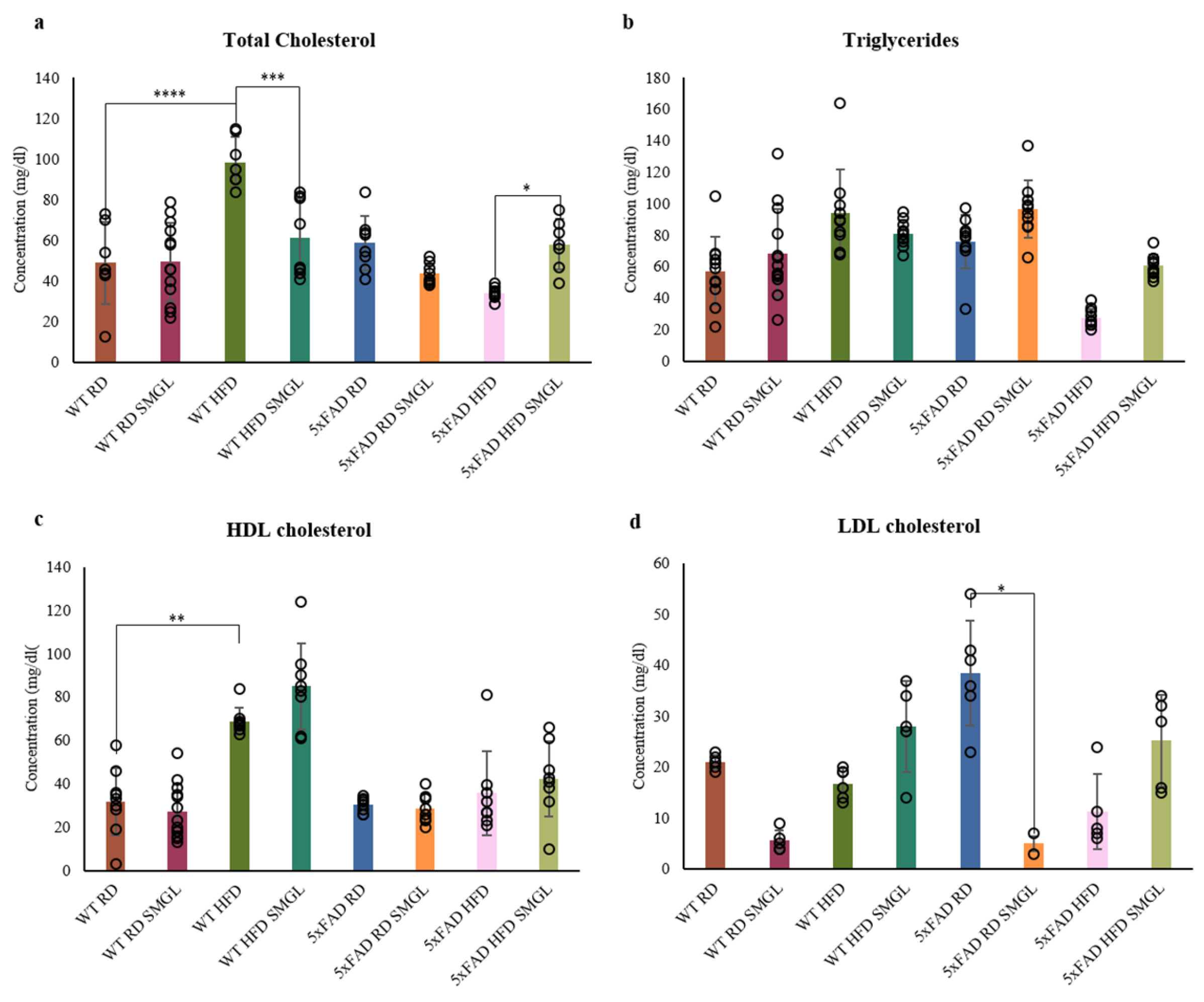
Lipid metabolism assessed by cholesterol, triglycerides, HDL and LDL in SMGL-treated WT and 5xFAD mice. (a) Serum samples revealed increased levels of total cholesterol in the WT HFD group compared to the WT RD group. After SMGL treatment, the total cholesterol levels in WT HFD mice were significantly reduced. By contrast, the reduced levels in the 5xFAD group were significantly increased, restoring them to normal levels [F (7, 47) = 9.3]. (WT RD; n = 7, WT RD SMGL; n = 13, WT HFD; n = 7, WT HFD SMGL; n = 8, 5xFAD RD; n = 8, 5xFAD RD SMGL; n = 8, 5xFAD HFD; n = 7, 5xFAD HFD SMGL; n = 7). (b) No significant changes were observed in the triglyceride levels between the groups [F (7, 43) = 4.386]. (WT RD; n = 11, WT RD SMGL; n = 13, WT HFD; n = 10, WT HFD SMGL; n = 10, 5xFAD RD; n = 10, 5xFAD RD SMGL; n = 10, 5xFAD HFD; n = 10, 5xFAD HFD SMGL; n = 10). (c) HDL levels in the WT HFD group were significantly elevated compared to those in the WT RD group. After treatment, an even greater tendency was observed [F (7, 40) = 8.937]. (WT RD; n = 9, WT RD SMGL; n = 13, WT HFD; n = 9, WT HFD SMGL; n = 8, 5xFAD RD; n = 8, 5xFAD RD SMGL; n = 8, 5xFAD HFD; n = 8, 5xFAD HFD SMGL; n = 8). (d) The LDL cholesterol levels in the 5xFAD RD group were higher than in those of their WT RD littermates. After treatment, the LDL levels were significantly reduced [F (7, 22) = 6.283]. (WT RD; n = 6, WT RD SMGL; n = 5, WT HFD; n = 6, WT HFD SMGL; n = 5, 5xFAD RD; n = 6, 5xFAD RD SMGL; n = 6, 5xFAD HFD; n = 5, 5xFAD HFD SMGL; n = 5). All groups met the normality assumptions (Shapiro–Wilk test; all p > 0.05), justifying the use of parametric one-way ANOVA. Mean ± SD. One-way ANOVA and Tukey’s post hoc test. * p ≤ 0.05, ** p ≤ 0.01, *** p ≤ 0.001 and **** p ≤ 0.0001.
Figure 9.
Lipid metabolism assessed by cholesterol, triglycerides, HDL and LDL in SMGL-treated WT and 5xFAD mice. (a) Serum samples revealed increased levels of total cholesterol in the WT HFD group compared to the WT RD group. After SMGL treatment, the total cholesterol levels in WT HFD mice were significantly reduced. By contrast, the reduced levels in the 5xFAD group were significantly increased, restoring them to normal levels [F (7, 47) = 9.3]. (WT RD; n = 7, WT RD SMGL; n = 13, WT HFD; n = 7, WT HFD SMGL; n = 8, 5xFAD RD; n = 8, 5xFAD RD SMGL; n = 8, 5xFAD HFD; n = 7, 5xFAD HFD SMGL; n = 7). (b) No significant changes were observed in the triglyceride levels between the groups [F (7, 43) = 4.386]. (WT RD; n = 11, WT RD SMGL; n = 13, WT HFD; n = 10, WT HFD SMGL; n = 10, 5xFAD RD; n = 10, 5xFAD RD SMGL; n = 10, 5xFAD HFD; n = 10, 5xFAD HFD SMGL; n = 10). (c) HDL levels in the WT HFD group were significantly elevated compared to those in the WT RD group. After treatment, an even greater tendency was observed [F (7, 40) = 8.937]. (WT RD; n = 9, WT RD SMGL; n = 13, WT HFD; n = 9, WT HFD SMGL; n = 8, 5xFAD RD; n = 8, 5xFAD RD SMGL; n = 8, 5xFAD HFD; n = 8, 5xFAD HFD SMGL; n = 8). (d) The LDL cholesterol levels in the 5xFAD RD group were higher than in those of their WT RD littermates. After treatment, the LDL levels were significantly reduced [F (7, 22) = 6.283]. (WT RD; n = 6, WT RD SMGL; n = 5, WT HFD; n = 6, WT HFD SMGL; n = 5, 5xFAD RD; n = 6, 5xFAD RD SMGL; n = 6, 5xFAD HFD; n = 5, 5xFAD HFD SMGL; n = 5). All groups met the normality assumptions (Shapiro–Wilk test; all p > 0.05), justifying the use of parametric one-way ANOVA. Mean ± SD. One-way ANOVA and Tukey’s post hoc test. * p ≤ 0.05, ** p ≤ 0.01, *** p ≤ 0.001 and **** p ≤ 0.0001.

Figure 10.
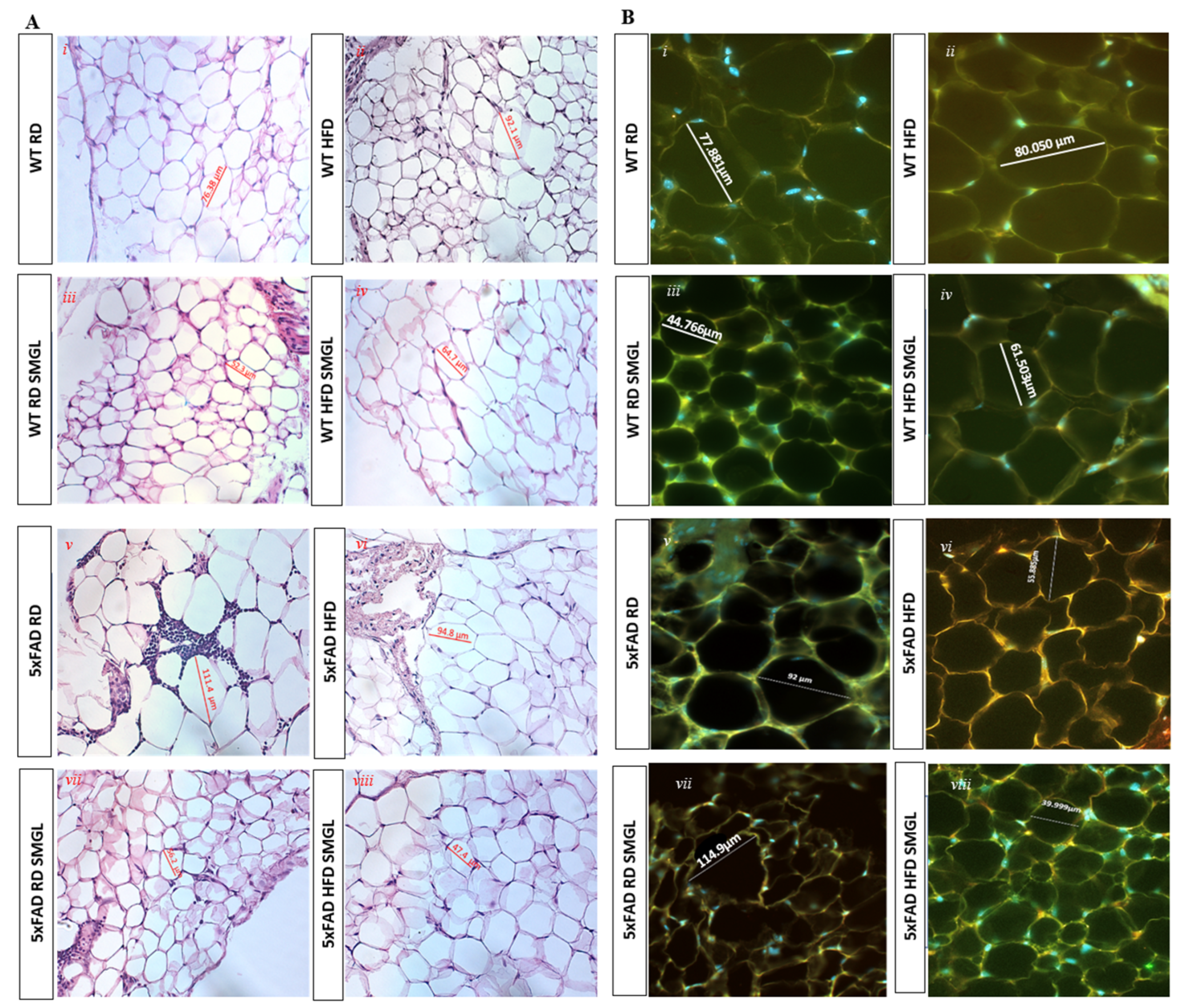
Morphological and inflammatory profiling of VAT using H&E and CD36/F4/80 staining with adipocyte diameter measurements. (A) Hematoxylin and eosin staining of visceral adipose tissue at 200× magnification. Representative sections from all groups are shown, with the distance between individual adipocytes indicated. (A(i)) WT RD showed an organized morphology with respect to both size and arrangement. No significant changes were observed after SMGL administration (A(iii)). (A(ii)) WT HFD VAT-cells were observed to be bigger in size when compared to the WT RD cells. (A(iv)) After treatment, we observed a more uniform arrangement. (A(v)) 5xFAD RD cells were larger in size with an uneven arrangement, and a significant infiltration of macrophages that formed crown-like structures was observed. (A(vii)) Post-SMGL administration, the number of macrophages was significantly reduced, and the cell size and proper arrangement were restored. (A(vi)) Finally, the 5xFAD HFD group showed no macrophages but larger cells in diameter, which were restored after SMGL administration (A(viii)). (B) CD36 (red) and F4/80 (green) co-staining of visceral adipose tissue at 400× magnification. Representative sections for all groups with the distance between individual adipocytes indicated. (B(i)) WT RD showed optimal adipocyte arrangement. After SMGL administration, the cells were observed to be smaller in diameter and retain their arrangement (B(iii)). (B(ii)) WT HFD adipocytes were observed to be bigger in size when compared to the WT RD cells. (B(iv)) After treatment, we observed a more uniform arrangement and smaller size. (B(v)) 5xFAD RD cells were larger in size with an uneven arrangement. (B(vii)) Post-SMGL administration, the cell size was larger in diameter and even more irregularly arranged. (B(vi)) Finally, the 5xFAD HFD adipocytes with a larger diameter were restored after SMGL administration. There was also a more prominent signal of the co-staining, indicating the presence of macrophages. However, in (B(viii)), the arrangement deteriorated.
Figure 10.
Morphological and inflammatory profiling of VAT using H&E and CD36/F4/80 staining with adipocyte diameter measurements. (A) Hematoxylin and eosin staining of visceral adipose tissue at 200× magnification. Representative sections from all groups are shown, with the distance between individual adipocytes indicated. (A(i)) WT RD showed an organized morphology with respect to both size and arrangement. No significant changes were observed after SMGL administration (A(iii)). (A(ii)) WT HFD VAT-cells were observed to be bigger in size when compared to the WT RD cells. (A(iv)) After treatment, we observed a more uniform arrangement. (A(v)) 5xFAD RD cells were larger in size with an uneven arrangement, and a significant infiltration of macrophages that formed crown-like structures was observed. (A(vii)) Post-SMGL administration, the number of macrophages was significantly reduced, and the cell size and proper arrangement were restored. (A(vi)) Finally, the 5xFAD HFD group showed no macrophages but larger cells in diameter, which were restored after SMGL administration (A(viii)). (B) CD36 (red) and F4/80 (green) co-staining of visceral adipose tissue at 400× magnification. Representative sections for all groups with the distance between individual adipocytes indicated. (B(i)) WT RD showed optimal adipocyte arrangement. After SMGL administration, the cells were observed to be smaller in diameter and retain their arrangement (B(iii)). (B(ii)) WT HFD adipocytes were observed to be bigger in size when compared to the WT RD cells. (B(iv)) After treatment, we observed a more uniform arrangement and smaller size. (B(v)) 5xFAD RD cells were larger in size with an uneven arrangement. (B(vii)) Post-SMGL administration, the cell size was larger in diameter and even more irregularly arranged. (B(vi)) Finally, the 5xFAD HFD adipocytes with a larger diameter were restored after SMGL administration. There was also a more prominent signal of the co-staining, indicating the presence of macrophages. However, in (B(viii)), the arrangement deteriorated.

Table 1.
Experimental design. H = high-fat diet (HFD); SM = semaglutide; S = sacrifice.
Table 1.
Experimental design. H = high-fat diet (HFD); SM = semaglutide; S = sacrifice.
| Treatment | Number of Mice | Months of Age |
|---|
| 1 | 2 | 3 | 4 | 5 | 6 | 7 | 8 | 9 |
|---|
| 1. H2O | WT (14: 7 ♂, 7♀) | | | | | | | | | S |
| 2. H2O-SMGL | WT (13: 6♂, 7♀) | | | | | SM | SM | SM | SM | S |
| 3. HFD | WT (10: 5♂, 5 ♀) | | | H | H | H | H | H | H | S |
| 4. HFD-SMGL | WT (11: 6♂, 5 ♀) | | | H | H | H, SM | H, SM | H, SM | H, SM | S |
| 5. H2O | 5xFAD (7: 4♂, 3 ♀) | | | | | | | | | S |
| 6. H2O-SMGL | 5xFAD (7: 4♂, 3 ♀) | | | | | SM | SM | SM | SM | S |
| 7. HFD | 5xFAD (7: 4♂, 3 ♀) | | | H | H | H | H | H | H | S |
| 8. HFD-SMGL | 5xFAD (8: 4♂, 4 ♀) | | | H | H | H, SM | H, SM | H, SM | H, SM | S |



 ,
,