Taurine as an Early-Phase Disease-Modifying Candidate for Alzheimer’s Disease

Abstract
1. Introduction
2. Early Phase Neuroprotective vs. Curative Approach in AD Treatment
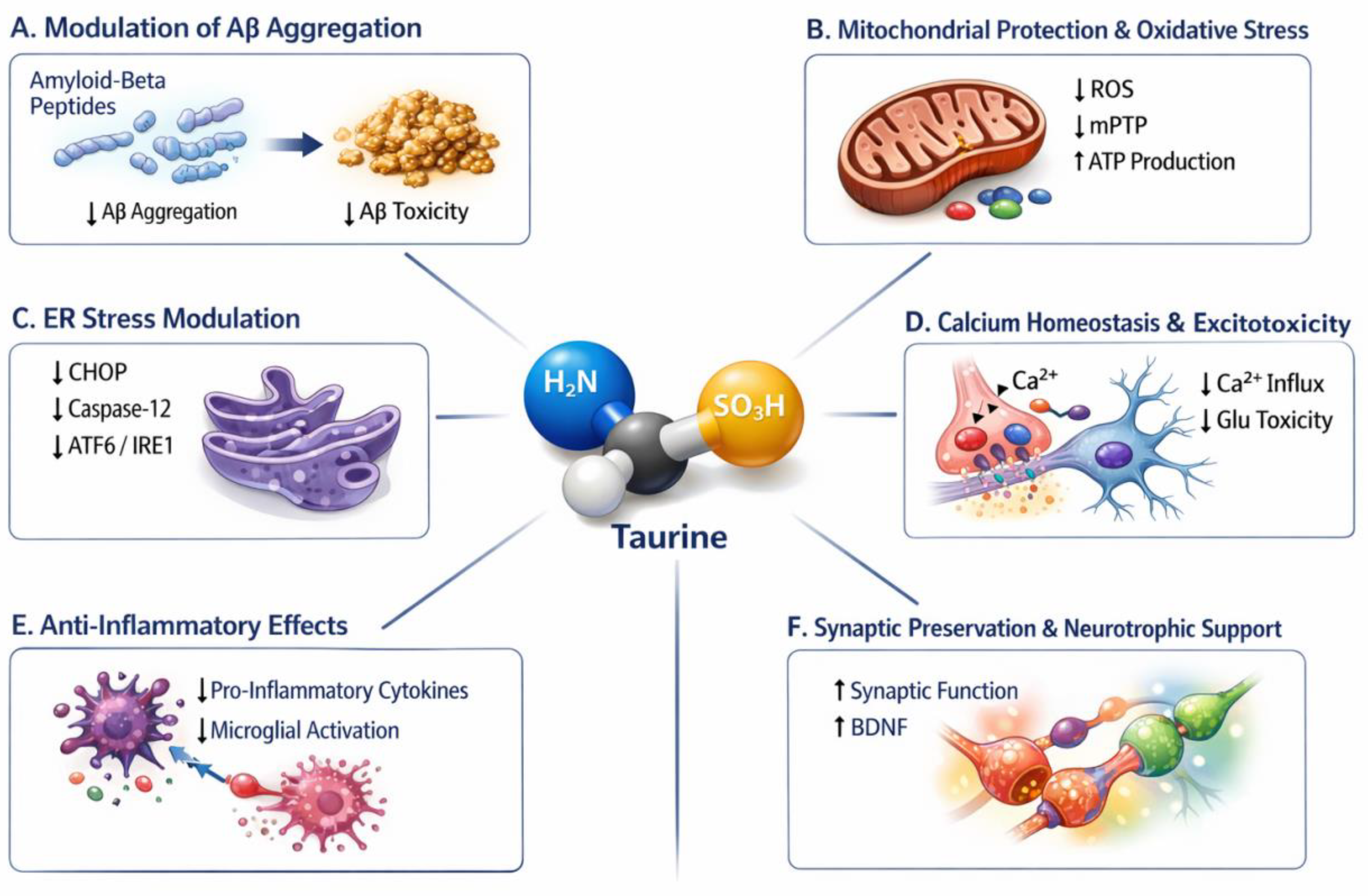
3. Mechanistic Rationale for Taurine in AD
3.1. Modulation of Aβ Aggregation
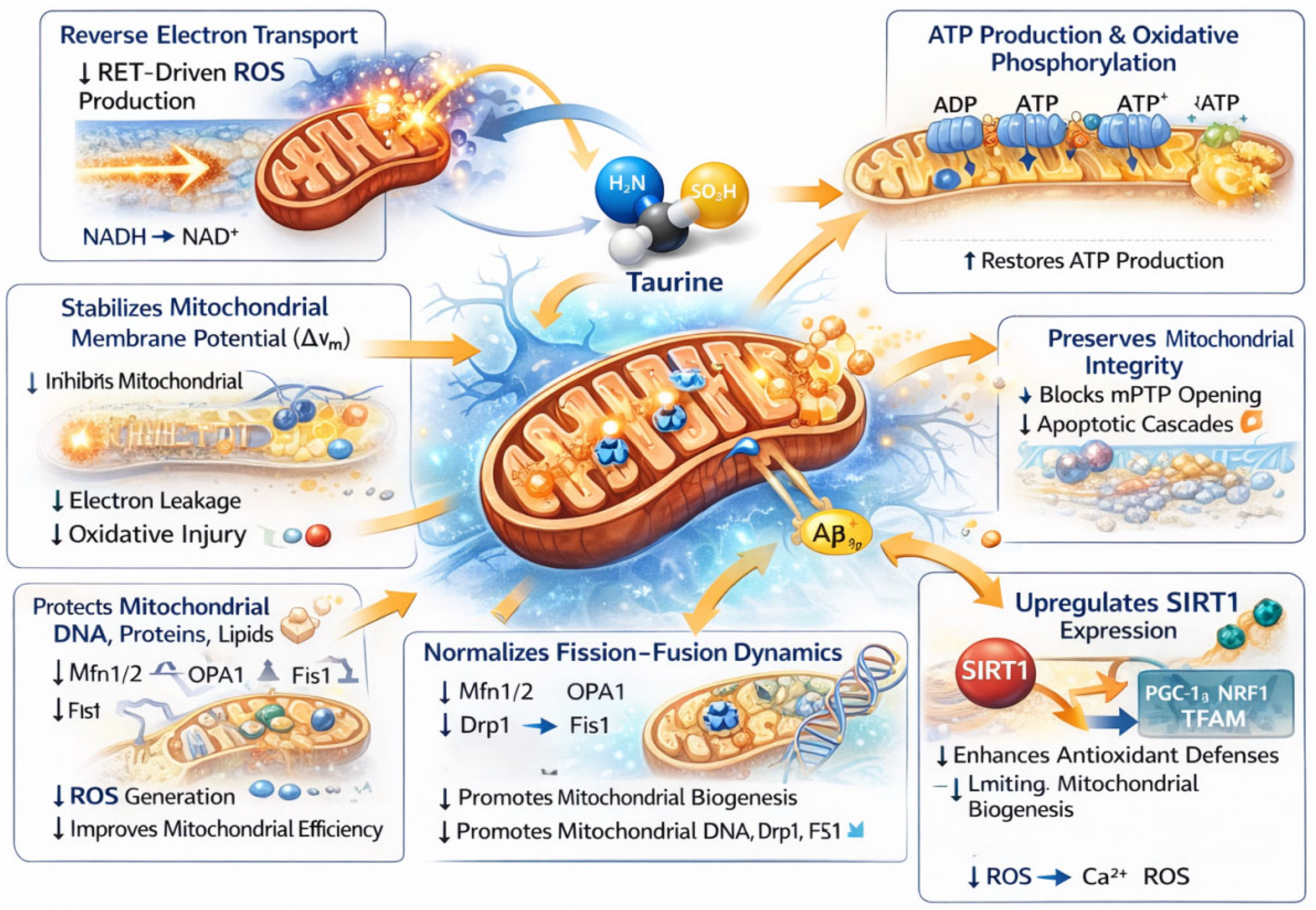
3.2. Mitochondrial Protection and Reduction in Oxidative Stress
3.3. ER Stress Modulation
3.4. Ca2+ Homeostasis and Network-Level Control of Excitotoxicity
3.5. Anti-Inflammatory Effects
3.6. Synaptic Preservation and Neurotrophic Support
4. Taurine-Mediated Neuroprotection: Evidence from Preclinical Study
5. Current Research Gaps and Future Directions
6. Conclusions
Author Contributions
Funding
Data Availability Statement
Acknowledgments
Conflicts of Interest
References
- Rajmohan, R.; Reddy, P.H. Amyloid-beta and phosphorylated tau accumulations cause abnormalities at synapses of Alzheimer’s disease neurons. J. Alzheimer’s Dis. 2017, 57, 975–999. [Google Scholar] [CrossRef] [PubMed]
- Ju, Y.; Tam, K.Y. Pathological mechanisms and therapeutic strategies for Alzheimer’s disease. Neural Regen. Res. 2022, 17, 543–549. [Google Scholar] [CrossRef] [PubMed]
- Congdon, E.E.; Ji, C.; Tetlow, A.M.; Jiang, Y.; Sigurdsson, E.M. Tau-targeting therapies for Alzheimer disease: Current status and future directions. Nat. Rev. Neurol. 2023, 19, 715–736. [Google Scholar] [CrossRef] [PubMed]
- De la Torre, J.C. Alzheimer’s disease is incurable but preventable. J. Alzheimer’s Dis. 2010, 20, 861–870. [Google Scholar] [CrossRef]
- Abbas, K.; Mustafa, M.; Alam, M.; Habib, S.; Ahmad, W.; Adnan, M.; Hassan, M.I.; Usmani, N. Multi-target approach to Alzheimer’s disease prevention and treatment: Antioxidant, anti-inflammatory, and amyloid-modulating mechanisms. Neurogenetics 2025, 26, 39. [Google Scholar] [CrossRef]
- Chen, S.-Y.; Gao, Y.; Sun, J.-Y.; Meng, X.-L.; Yang, D.; Fan, L.-H.; Xiang, L.; Wang, P. Traditional Chinese medicine: Role in reducing β-amyloid, apoptosis, autophagy, neuroinflammation, oxidative stress, and mitochondrial dysfunction of Alzheimer’s disease. Front. Pharmacol. 2020, 11, 497. [Google Scholar] [CrossRef]
- Hossain, M.K.; Chae, H.J. Calcium balance through mutual orchestrated inter-organelle communication: A pleiotropic target for combating Alzheimer’s disease. Neurochem. Int. 2025, 182, 105905. [Google Scholar] [CrossRef]
- Plascencia-Villa, G.; Perry, G.; Signaling, R. Preventive and therapeutic strategies in Alzheimer’s disease: Focus on oxidative stress, redox metals, and ferroptosis. Antioxidants 2021, 34, 591–610. [Google Scholar] [CrossRef]
- Zhang, J.; Kong, G.; Yang, J.; Pang, L.; Li, X. Pathological mechanisms and treatment progression of Alzheimer’s disease. Eur. J. Med. Res. 2025, 30, 625. [Google Scholar] [CrossRef]
- Kumari, N.; Prentice, H.; Wu, J.-Y. Taurine and its neuroprotective role. In Taurine 8; Springer: New York, NY, USA, 2013; Volume 775, pp. 19–27. [Google Scholar]
- Jangra, A.; Gola, P.; Singh, J.; Gond, P.; Ghosh, S.; Rachamalla, M.; Dey, A.; Iqbal, D.; Kamal, M.; Sachdeva, P. Emergence of taurine as a therapeutic agent for neurological disorders. Neural Regen. Res. 2024, 19, 62–68. [Google Scholar] [CrossRef]
- Lee, H.; Hossain, M.K.; Lee, H.-Y.; Kumar, V.; Shin, S.J.; Kim, B.-H.; Park, H.H.; Son, J.G.; Moon, M.; Kim, H.-R. Taurine suppresses Aβ aggregation and attenuates Alzheimer’s disease pathologies in 5XFAD mice and patient-derived cerebral organoids. Biomed. Pharmacother. 2025, 191, 118527. [Google Scholar] [CrossRef]
- Gorgani, S.; Jahanshahi, M.; Elyasi, L. Taurine prevents passive avoidance memory impairment, accumulation of amyloid-β plaques, and neuronal loss in the hippocampus of scopolamine-treated rats. Neurophysiology 2019, 51, 171–179. [Google Scholar] [CrossRef]
- Peng, Y.; Jin, H.; Xue, Y.-H.; Chen, Q.; Yao, S.-Y.; Du, M.-Q.; Liu, S. Current and future therapeutic strategies for Alzheimer’s disease: An overview of drug development bottlenecks. Front. Aging Neurosci. 2023, 15, 1206572. [Google Scholar] [CrossRef]
- Rujeedawa, T.; Carrillo Félez, E.; Clare, I.C.; Fortea, J.; Strydom, A.; Rebillat, A.-S.; Coppus, A.; Levin, J.; Zaman, S.H. The clinical and neuropathological features of sporadic (Late-onset) and genetic forms of alzheimer’s disease. J. Clin. Med. 2021, 10, 4582. [Google Scholar] [CrossRef]
- She, X. Targeting the Synergistic Interaction of Pathologies in Alzheimer’s Disease: Rationale and Prospects for Combination Therapy. arXiv 2025. [Google Scholar] [CrossRef]
- Loeffler, D.A. Antibody-mediated clearance of brain amyloid-β: Mechanisms of action, effects of natural and monoclonal anti-Aβ antibodies, and downstream effects. J. Alzheimer’s Dis. Rep. 2023, 7, 873–899. [Google Scholar] [CrossRef] [PubMed]
- Guo, Y.; Li, S.; Zeng, L.-H.; Tan, J. Tau-targeting therapy in Alzheimer’s disease: Critical advances and future opportunities. Ageing Neurodegener. Dis. 2022, 2, 11. [Google Scholar] [CrossRef]
- Jurcău, M.C.; Andronie-Cioara, F.L.; Jurcău, A.; Marcu, F.; Ţiț, D.M.; Pașcalău, N.; Nistor-Cseppentö, D.C. The link between oxidative stress, mitochondrial dysfunction and neuroinflammation in the pathophysiology of Alzheimer’s disease: Therapeutic implications and future perspectives. Antioxidants 2022, 11, 2167. [Google Scholar] [CrossRef]
- Rojas-Gutierrez, E.; Muñoz-Arenas, G.; Treviño, S.; Espinosa, B.; Chavez, R.; Rojas, K.; Flores, G.; Díaz, A.; Guevara, J. Alzheimer’s disease and metabolic syndrome: A link from oxidative stress and inflammation to neurodegeneration. Synapse 2017, 71, e21990. [Google Scholar] [CrossRef]
- Sharma, C.; Kim, S.; Nam, Y.; Jung, U.J.; Kim, S.R. Mitochondrial dysfunction as a driver of cognitive impairment in Alzheimer’s disease. Int. J. Mol. Sci. 2021, 22, 4850. [Google Scholar] [CrossRef]
- Frautschy, S.A.; Cole, G.M. Why pleiotropic interventions are needed for Alzheimer’s disease. Mol. Neurobiol. 2010, 41, 392–409. [Google Scholar] [CrossRef]
- Frisoni, G.B.; Boccardi, M.; Barkhof, F.; Blennow, K.; Cappa, S.; Chiotis, K.; Démonet, J.-F.; Garibotto, V.; Giannakopoulos, P.; Gietl, A. Strategic roadmap for an early diagnosis of Alzheimer’s disease based on biomarkers. Lancet Neurol. 2017, 16, 661–676. [Google Scholar] [CrossRef] [PubMed]
- Lee, J.C.; Kim, S.J.; Hong, S.; Kim, Y. Diagnosis of Alzheimer’s disease utilizing amyloid and tau as fluid biomarkers. Exp. Mol. Med. 2019, 51, 1–10. [Google Scholar] [CrossRef] [PubMed]
- Risacher, S.L.; Saykin, A.J. Neuroimaging and other biomarkers for Alzheimer’s disease: The changing landscape of early detection. Ann. Rev. Clin. Psych. 2013, 9, 621–648. [Google Scholar] [CrossRef] [PubMed]
- Segobin, S.; La Joie, R.; Ritz, L.; Beaunieux, H.; Desgranges, B.; Chételat, G.; Pitel, A.L.; Eustache, F. FDG-PET contributions to the pathophysiology of memory impairment. Neuropsychol. Rev. 2015, 25, 326–355. [Google Scholar] [CrossRef]
- Prajapati, S.K.; Pathak, A.; Samaiya, P.K. Alzheimer’s disease: From early pathogenesis to novel therapeutic approaches. Metab. Brain Dis. 2024, 39, 1231–1254. [Google Scholar] [CrossRef]
- Balazs, N.; Bereczki, D.; Kovács, T. Cholinesterase inhibitors and memantine for the treatment of Alzheimer and non-Alzheimer dementias. Clin. Neurosci. 2021, 74, 379. [Google Scholar] [CrossRef]
- Cummings, J. Anti-amyloid monoclonal antibodies are transformative treatments that redefine Alzheimer’s disease therapeutics. Drugs 2023, 83, 569–576. [Google Scholar] [CrossRef]
- Cummings, J.L. Maximizing the benefit and managing the risk of anti-amyloid monoclonal antibody therapy for Alzheimer’s disease: Strategies and research directions. Neurotherapeutics 2025, 22, e00570. [Google Scholar] [CrossRef]
- Bhat, M.A.; Ahmad, K.; Khan, M.S.A.; Bhat, M.A.; Almatroudi, A.; Rahman, S.; Jan, A.T. Expedition into taurine biology: Structural insights and therapeutic perspective of taurine in neurodegenerative diseases. Biomolecules 2020, 10, 863. [Google Scholar] [CrossRef]
- Menzie, J.; Pan, C.; Prentice, H.; Wu, J.-Y. Taurine and central nervous system disorders. Amino Acids 2014, 46, 31–46. [Google Scholar] [CrossRef]
- Siddu, A.; Natale, S.; Wong, C.H.; Shaye, H.; Südhof, T.C. Aggregation shifts amyloid-β peptides from synaptogenic to synaptotoxic. J. Clin. Investig. 2025, 135, e193407. [Google Scholar] [CrossRef] [PubMed]
- Sun, Q.; Hu, H.; Wang, W.; Jin, H.; Feng, G.; Jia, N. Taurine attenuates amyloid β 1–42-induced mitochondrial dysfunction by activating of SIRT1 in SK-N-SH cells. Biochem. Biophys. Res. Commun. 2014, 447, 485–489. [Google Scholar] [CrossRef] [PubMed]
- Jang, H.; Lee, S.; Choi, S.L.; Kim, H.Y.; Baek, S.; Kim, Y. Taurine directly binds to oligomeric amyloid-β and recovers cognitive deficits in Alzheimer model mice. In Taurine 10; Springer: Berlin/Heidelberg, Germany, 2017; pp. 233–241. [Google Scholar]
- Oh, S.J.; Lee, H.-J.; Jeong, Y.J.; Nam, K.R.; Kang, K.J.; Han, S.J.; Lee, K.C.; Lee, Y.J.; Choi, J.Y. Evaluation of the neuroprotective effect of taurine in Alzheimer’s disease using functional molecular imaging. Sci. Rep. 2020, 10, 15551. [Google Scholar] [CrossRef] [PubMed]
- Gomes-da-Silva, N.C.; Soares, M.A.G.; Ricci-Junior, E.; do Nascimento Amorim, M.d.S.; Alencar, L.M.R.; Bhattarai, P.; Zhu, L.; Follmer, C.; Santos-Oliveira, R. Nanomicelles of taurine inhibit the fibrillation and toxicity of amyloid β1-42 peptide. J. Drug Deliv. Sci. Technol. 2023, 86, 104721. [Google Scholar] [CrossRef]
- Ballantyne, J.; Chamberlin, M. Regulation of cellular amino acid levels. In Cellular and Molecular Physiology of Cell Volume Regulation; CRC Press: Boca Raton, FL, USA, 2020; pp. 111–122. [Google Scholar]
- Gao, M.; Winter, R. The effects of lipid membranes, crowding and osmolytes on the aggregation, and fibrillation propensity of human IAPP. J. Diabetes Res. 2015, 2015, 849017. [Google Scholar] [CrossRef]
- Tobore, T.O. On the central role of mitochondria dysfunction and oxidative stress in Alzheimer’s disease. Neurol. Sci. 2019, 40, 1527–1540. [Google Scholar] [CrossRef]
- Bhat, A.H.; Dar, K.B.; Anees, S.; Zargar, M.A.; Masood, A.; Sofi, M.A.; Ganie, S.A. Oxidative stress, mitochondrial dysfunction and neurodegenerative diseases; a mechanistic insight. Biomed. Pharmacother. 2015, 74, 101–110. [Google Scholar] [CrossRef]
- Misrani, A.; Tabassum, S.; Yang, L. Mitochondrial dysfunction and oxidative stress in Alzheimer’s disease. Front. Aging Neurosci. 2021, 13, 617588. [Google Scholar] [CrossRef]
- Yao, P.J.; Eren, E.; Goetzl, E.J.; Kapogiannis, D. Mitochondrial electron transport chain protein abnormalities detected in plasma extracellular vesicles in Alzheimer’s disease. Biomedicines 2021, 9, 1587. [Google Scholar] [CrossRef]
- Rimal, S.; Li, W.; Khaket, T.P.; Li, Y.; Tantray, I.; Li, Y.; Bhurtel, S.; Grinberg, L.T.; Spina, S.; Sillero, M.I.C. Deregulation of mitochondrial reverse electron transport alters the metabolism of reactive oxygen species and NAD+/NADH and presents a therapeutic target in Alzheimer’s disease. Ageing Neurodegener. Dis. 2024, 4, 4. [Google Scholar] [CrossRef]
- Sharma, S.; Sahoo, B.M.; Banik, B.K. Biological effects and mechanisms of taurine in various therapeutics. Curr. Drug Disc. Technol. 2023, 20, 60–78. [Google Scholar] [CrossRef] [PubMed]
- Hansen, S.H.; Andersen, M.L.; Cornett, C.; Gradinaru, R.; Grunnet, N. A role for taurine in mitochondrial function. J. Biomed. Sci. 2010, 17, S23. [Google Scholar] [CrossRef] [PubMed]
- Ohsawa, Y.; Hagiwara, H.; Nishimatsu, S.-i.; Hirakawa, A.; Kamimura, N.; Ohtsubo, H.; Fukai, Y.; Murakami, T.; Koga, Y.; Goto, Y.-i. Taurine supplementation for prevention of stroke-like episodes in MELAS: A multicentre, open-label, 52-week phase III trial. J. Neurol. Neurosurg. Psychiatry 2019, 90, 529–536. [Google Scholar] [CrossRef]
- Zhang, R.; Wang, X.; Gao, Q.; Jiang, H.; Zhang, S.; Lu, M.; Liu, F.; Xue, X. Taurine supplementation reverses diabetes-induced podocytes injury via modulation of the CSE/TRPC6 axis and improvement of mitochondrial function. Nephron 2020, 144, 84–95. [Google Scholar] [CrossRef]
- Jamshidzadeh, A.; Heidari, R.; Abasvali, M.; Zarei, M.; Ommati, M.M.; Abdoli, N.; Khodaei, F.; Yeganeh, Y.; Jafari, F.; Zarei, A. Taurine treatment preserves brain and liver mitochondrial function in a rat model of fulminant hepatic failure and hyperammonemia. Biomed. Pharmacother. 2017, 86, 514–520. [Google Scholar] [CrossRef]
- Aruoma, O.; Halliwell, B.; Hoey, B.M.; Butler, J. The antioxidant action of taurine, hypotaurine and their metabolic precursors. Biochem. J. 1988, 256, 251–255. [Google Scholar] [CrossRef]
- Jong, C.J.; Sandal, P.; Schaffer, S.W. The role of taurine in mitochondria health: More than just an antioxidant. Molecules 2021, 26, 4913. [Google Scholar] [CrossRef]
- Rezaei, H.; Wang, H.W.; Tian, W.; Zhao, J.; Najibi, A.; Retana-Márquez, S.; Rafiei, E.; Rowhanirad, A.; Sabouri, S.; Kiafar, M. Long-term taurine supplementation regulates brain mitochondrial dynamics in mice. Basic Clin. Pharmacol. Toxicol. 2025, 136, e14101. [Google Scholar] [CrossRef]
- Ajoolabady, A.; Lindholm, D.; Ren, J.; Pratico, D. ER stress and UPR in Alzheimer’s disease: Mechanisms, pathogenesis, treatments. Cell Death Dis. 2022, 13, 706. [Google Scholar] [CrossRef]
- Uddin, M.S.; Tewari, D.; Sharma, G.; Kabir, M.T.; Barreto, G.E.; Bin-Jumah, M.N.; Perveen, A.; Abdel-Daim, M.M.; Ashraf, G.M. Molecular Mechanisms of ER Stress and UPR in the Pathogenesis of Alzheimer’s Disease. Mol. Neurobiol. 2020, 57, 2902–2919. [Google Scholar] [CrossRef] [PubMed]
- Fewell, S.W.; Travers, K.J.; Weissman, J.S.; Brodsky, J.L. The action of molecular chaperones in the early secretory pathway. Annu. Rev. Genet. 2001, 35, 149–191. [Google Scholar] [CrossRef] [PubMed]
- Ellgaard, L.; Molinari, M.; Helenius, A. Setting the standards: Quality control in the secretory pathway. Science 1999, 286, 1882–1888. [Google Scholar] [CrossRef] [PubMed]
- Liu, C.Y.; Kaufman, R.J. The unfolded protein response. J. Cell Sci. 2003, 116, 1861–1862. [Google Scholar] [CrossRef]
- Schröder, M.; Kaufman, R.J. The mammalian unfolded protein response. Annu. Rev. Biochem. 2005, 74, 739–789. [Google Scholar] [CrossRef]
- Nishitsuji, K.; Tomiyama, T.; Ishibashi, K.; Ito, K.; Teraoka, R.; Lambert, M.P.; Klein, W.L.; Mori, H. The E693Δ mutation in amyloid precursor protein increases intracellular accumulation of amyloid β oligomers and causes endoplasmic reticulum stress-induced apoptosis in cultured cells. Am. J. Pathol. 2009, 174, 957–969. [Google Scholar] [CrossRef]
- Soejima, N.; Ohyagi, Y.; Nakamura, N.; Himeno, E.; Iinuma, K.M.; Sakae, N.; Yamasaki, R.; Tabira, T.; Murakami, K.; Irie, K. Intracellular accumulation of toxic turn amyloid-β is associated with endoplasmic reticulum stress in Alzheimer’s disease. Curr. Alzheimer Res. 2013, 10, 11–20. [Google Scholar]
- Rozpędek-Kamińska, W.; Siwecka, N.; Wawrzynkiewicz, A.; Wojtczak, R.; Pytel, D.; Diehl, J.A.; Majsterek, I. The PERK-dependent molecular mechanisms as a novel therapeutic target for neurodegenerative diseases. Int. J. Mol. Sci. 2020, 21, 2108. [Google Scholar] [CrossRef]
- Stacchiotti, A.; Favero, G.; Lavazza, A.; Monsalve, M.; Rodella, L.F.; Rezzani, R. Taurine supplementation alleviates puromycin aminonucleoside damage by modulating endoplasmic reticulum stress and mitochondrial-related apoptosis in rat kidney. Nutrients 2018, 10, 689. [Google Scholar] [CrossRef]
- Jong, C.J. Mechanism Underlying Taurine Depletion-Mediated Cell Death. Ph.D. Thesis, University of South Alabama, Mobile, AL, USA, 2014. [Google Scholar]
- Zhang, Y.; Li, D.; Li, H.; Hou, D.; Hou, J. Taurine pretreatment prevents isoflurane-induced cognitive impairment by inhibiting ER stress-mediated activation of apoptosis pathways in the hippocampus in aged rats. Neurochem. Res. 2016, 41, 2517–2525. [Google Scholar] [CrossRef]
- Pan, C.; Prentice, H.; Price, A.L.; Wu, J.-Y. Beneficial effect of taurine on hypoxia-and glutamate-induced endoplasmic reticulum stress pathways in primary neuronal culture. Amino Acids 2012, 43, 845–855. [Google Scholar] [CrossRef]
- El Idrissi, A. Taurine increases mitochondrial buffering of calcium: Role in neuroprotection. Amino Acids 2008, 34, 321–328. [Google Scholar] [CrossRef]
- Ma, B.; Zhang, L.; Li, J.; Xing, T.; Jiang, Y.; Gao, F. Dietary taurine supplementation ameliorates muscle loss in chronic heat stressed broilers via suppressing the perk signaling and reversing endoplasmic reticulum-stress-induced apoptosis. J. Sci. Food Agric. 2021, 101, 2125–2134. [Google Scholar] [CrossRef] [PubMed]
- McDaid, J.; Mustaly-Kalimi, S.; Stutzmann, G.E. Ca2+ dyshomeostasis disrupts neuronal and synaptic function in Alzheimer’s disease. Cells 2020, 9, 2655. [Google Scholar] [CrossRef] [PubMed]
- Mira, R.G.; Cerpa, W. Building a bridge between NMDAR-mediated excitotoxicity and mitochondrial dysfunction in chronic and acute diseases. Cell. Mol. Neurobiol. 2021, 41, 1413–1430. [Google Scholar] [CrossRef] [PubMed]
- El Idrissi, A.; Trenkner, E. Growth factors and taurine protect against excitotoxicity by stabilizing calcium homeostasis and energy metabolism. J. Neurosci. 1999, 19, 9459–9468. [Google Scholar] [CrossRef]
- Ramírez-Guerrero, S.; Guardo-Maya, S.; Medina-Rincón, G.J.; Orrego-González, E.E.; Cabezas-Pérez, R.; González-Reyes, R.E. Taurine and astrocytes: A homeostatic and neuroprotective relationship. Front. Mol. Neurosci. 2022, 15, 937789. [Google Scholar] [CrossRef]
- Pasantes-Morales, H. Taurine homeostasis and volume control. Glial Amino Acid Transp. 2017, 33–53. [Google Scholar]
- Huxtable, R.J.; Della Corte, L.; Huxtable, R.J.; Sgaragli, G.; Tipton, K.F. Taurine 4: Taurine and Excitable Tissues; Springer Science & Business Media: Berlin/Heidelberg, Germany, 2002. [Google Scholar]
- Chen, W.; Jin, H.; Nguyen, M.; Carr, J.; Lee, Y.; Hsu, C.; Faiman, M.; Schloss, J.; Wu, J. Role of taurine in regulation of intracellular calcium level and neuroprotective function in cultured neurons. J. Neurosci. Res. 2001, 66, 612–619. [Google Scholar] [CrossRef]
- El Idrissi, A.; Trenkner, E. Taurine as a modulator of excitatory and inhibitory neurotransmission. Neurochem. Res. 2004, 29, 189–197. [Google Scholar] [CrossRef]
- Sava, B.A.; Chen, R.; Sun, H.; Luhmann, H.J.; Kilb, W. Taurine activates GABAergic networks in the neocortex of immature mice. Front. Cell. Neurosci. 2014, 8, 26. [Google Scholar] [CrossRef]
- Miles, A.R.; Hawrysh, P.J.; Hossein-Javaheri, N.; Buck, L.T. Taurine activates glycine and GABAA receptor currents in anoxia-tolerant painted turtle pyramidal neurons. J. Exp. Biol. 2018, 221, jeb181529. [Google Scholar] [CrossRef] [PubMed]
- Simpson, D.S.; Oliver, P.L. ROS generation in microglia: Understanding oxidative stress and inflammation in neurodegenerative disease. Antioxidants 2020, 9, 743. [Google Scholar] [CrossRef] [PubMed]
- Kaur, D.; Sharma, V.; Deshmukh, R. Activation of microglia and astrocytes: A roadway to neuroinflammation and Alzheimer’s disease. Inflammopharmacology 2019, 27, 663–677. [Google Scholar] [CrossRef] [PubMed]
- Singh, D. Astrocytic and microglial cells as the modulators of neuroinflammation in Alzheimer’s disease. J. Neuroinflamm. 2022, 19, 206. [Google Scholar] [CrossRef]
- Haage, V.; De Jager, P.L. Neuroimmune contributions to Alzheimer’s disease: A focus on human data. Mol. Psychiatry 2022, 27, 3164–3181. [Google Scholar] [CrossRef]
- Nott, A.; Holtman, I.R. Genetic insights into immune mechanisms of Alzheimer’s and Parkinson’s disease. Front. Immunol. 2023, 14, 1168539. [Google Scholar] [CrossRef]
- Gao, C.; Shen, X.; Tan, Y.; Chen, S. Pathogenesis, therapeutic strategies and biomarker development based on “omics” analysis related to microglia in Alzheimer’s disease. J. Neuroinflamm. 2022, 19, 215. [Google Scholar] [CrossRef]
- Rosenthal, S.B.; Wang, H.; Shi, D.; Liu, C.; Abagyan, R.; McEvoy, L.K.; Chen, C.-H. Mapping the gene network landscape of Alzheimer’s disease through integrating genomics and transcriptomics. PLoS Comp. Biol. 2022, 18, e1009903. [Google Scholar] [CrossRef]
- Fontana, B.D.; Cleal, M.; Parker, M.O. Female adult zebrafish (Danio rerio) show higher levels of anxiety-like behavior than males, but do not differ in learning and memory capacity. Eur. J. Neurosci. 2020, 52, 2604–2613. [Google Scholar] [CrossRef]
- Su, Y.; Fan, W.; Ma, Z.; Wen, X.; Wang, W.; Wu, Q.; Huang, H. Taurine improves functional and histological outcomes and reduces inflammation in traumatic brain injury. Neuroscience 2014, 266, 56–65. [Google Scholar] [CrossRef] [PubMed]
- Surai, P.F.; Earle-Payne, K.; Kidd, M.T. Taurine as a natural antioxidant: From direct antioxidant effects to protective action in various toxicological models. Antioxidants 2021, 10, 1876. [Google Scholar] [CrossRef] [PubMed]
- Kim, C.; Cha, Y.-N. Taurine chloramine produced from taurine under inflammation provides anti-inflammatory and cytoprotective effects. Amino Acids 2014, 46, 89–100. [Google Scholar] [CrossRef] [PubMed]
- Soininen, H.; West, C.; Robbins, J.; Niculescu, L. Long-term efficacy and safety of celecoxib in Alzheimer’s disease. Dement. Geriatr. Cogn. Disord. 2006, 23, 8–21. [Google Scholar] [CrossRef]
- Green, K.N.; Billings, L.M.; Roozendaal, B.; McGaugh, J.L.; LaFerla, F.M. Glucocorticoids increase amyloid-β and tau pathology in a mouse model of Alzheimer’s disease. J. Neurosci. 2006, 26, 9047–9056. [Google Scholar] [CrossRef]
- Zhang, Z.; Li, D.; He, S.; Xu, W.; Lv, Q.; Wang, Y.; Xu, J.; Yu, Z.; Liu, S.; Ge, Y. Taurine Attenuates M1 Macrophage Polarization and IL-1β Production by Suppressing the JAK1/2-STAT1 Pathway via Metabolic Reprogramming. Biology 2025, 14, 1751. [Google Scholar] [CrossRef]
- Ebrahimi, R.; Golzari, Z.; Heidari-Foroozan, M.; Khosravi, A.; Ghaheri Sharghi, S.; Saleh, M.; Salarvandian, S.; Esmaeilpour, K. Impaired Synaptic Plasticity Mechanisms in Alzheimer’s Disease. Metab. Brain Dis. 2025, 40, 277. [Google Scholar] [CrossRef]
- Benarroch, E.E. Glutamatergic synaptic plasticity and dysfunction in Alzheimer disease: Emerging mechanisms. Neurology 2018, 91, 125–132. [Google Scholar] [CrossRef]
- Zhang, H.; Jiang, X.; Ma, L.; Wei, W.; Li, Z.; Chang, S.; Wen, J.; Sun, J.; Li, H. Role of Aβ in Alzheimer’s-related synaptic dysfunction. Front. Cell Dev. Biol. 2022, 10, 964075. [Google Scholar] [CrossRef]
- Wu, M.; Zhang, M.; Yin, X.; Chen, K.; Hu, Z.; Zhou, Q.; Cao, X.; Chen, Z.; Liu, D. The role of pathological tau in synaptic dysfunction in Alzheimer’s diseases. Transl. Neurodegener. 2021, 10, 45. [Google Scholar] [CrossRef]
- Shivaraj, M.C.; Marcy, G.; Low, G.; Ryu, J.R.; Zhao, X.; Rosales, F.J.; Goh, E.L. Taurine induces proliferation of neural stem cells and synapse development in the developing mouse brain. PLoS ONE 2012, 7, e42935. [Google Scholar] [CrossRef] [PubMed]
- Mersman, B.; Zaidi, W.; Syed, N.I.; Xu, F. Taurine promotes neurite outgrowth and synapse development of both vertebrate and invertebrate central neurons. Front. Synaptic Neurosci. 2020, 12, 29. [Google Scholar] [CrossRef] [PubMed]
- Fang, Q.; Liu, J.; Chen, L.; Chen, Q.; Ke, J.; Zhang, J.; Liu, Y.; Fu, W. Taurine improves the differentiation of neural stem cells in fetal rats with intrauterine growth restriction via activation of the PKA-CREB-BDNF signaling pathway. Metab. Brain Dis. 2021, 36, 969–981. [Google Scholar] [CrossRef]
- Iio, W.; Matsukawa, N.; Tsukahara, T.; Toyoda, A. The effects of oral taurine administration on behavior and hippocampal signal transduction in rats. Amino Acids 2012, 43, 2037–2046. [Google Scholar] [CrossRef] [PubMed]
- Toyoda, A.; Iio, W. Antidepressant-like effect of chronic taurine administration and its hippocampal signal transduction in rats. In Taurine 8: Volume 1: The Nervous System, Immune System, Diabetes and the Cardiovascular System; Springer: Berlin/Heidelberg, Germany, 2013; pp. 29–43. [Google Scholar]
- Gupta, A.K.; Gupta, S.; Mehan, S.; Khan, Z.; Das Gupta, G.; Narula, A.S. Exploring the Connection Between BDNF/TrkB and AC/cAMP/PKA/CREB Signaling Pathways: Potential for Neuroprotection and Therapeutic Targets for Neurological Disorders. Mol. Neurobiol. 2025, 62, 14627–14659. [Google Scholar] [CrossRef]
- Gawryluk, A.; Cybulska-Klosowicz, A.; Charzynska, A.; Zakrzewska, R.; Sobolewska, A.; Kossut, M.; Liguz-Lecznar, M. Mitigation of aging-related plasticity decline through taurine supplementation and environmental enrichment. Sci. Rep. 2024, 14, 19546. [Google Scholar] [CrossRef]
- Chepkova, A.N.; Sergeeva, O.A.; Haas, H.L. Taurine rescues hippocampal long-term potentiation from ammonia-induced impairment. Neurobiol. Dis. 2006, 23, 512–521. [Google Scholar] [CrossRef]
- Del Olmo, N.; Handler, A.; Alvarez, L.; Bustamante, J.; Del Río, R.M.; Solis, J. Taurine-induced synaptic potentiation and the late phase of long-term potentiation are related mechanistically. Neuropharmacology 2003, 44, 26–39. [Google Scholar] [CrossRef]
- Zhu, D.-M.; Wang, M.; She, J.-Q.; Yu, K.; Ruan, D.-Y. Protection by a taurine supplemented diet from lead-induced deficits of long-term potentiation/depotentiation in dentate gyrus of rats in vivo. Neuroscience 2005, 134, 215–224. [Google Scholar] [CrossRef]
- Jia, F.; Yue, M.; Chandra, D.; Keramidas, A.; Goldstein, P.A.; Homanics, G.E.; Harrison, N.L. Taurine is a potent activator of extrasynaptic GABAA receptors in the thalamus. J. Neurosci. 2008, 28, 106–115. [Google Scholar] [CrossRef]
- Ahmed, S.; Ma, N.; Kawanokuchi, J.; Matsuoka, K.; Oikawa, S.; Kobayashi, H.; Hiraku, Y.; Murata, M. Taurine reduces microglia activation in the brain of aged senescence-accelerated mice by increasing the level of TREM2. Sci. Rep. 2024, 14, 7427. [Google Scholar] [CrossRef] [PubMed]
- Huf, F.; Gutierres, J.M.; da Silva, G.N.; Zago, A.M.; Koenig, L.F.C.; Fernandes, M.C. Neuroprotection elicited by taurine in sporadic Alzheimer-like disease: Benefits on memory and control of neuroinflammation in the hippocampus of rats. Mol. Cell. Biochem. 2024, 479, 2663–2678. [Google Scholar] [CrossRef] [PubMed]
- Kim, H.Y.; Kim, H.V.; Yoon, J.H.; Kang, B.R.; Cho, S.M.; Lee, S.; Kim, J.Y.; Kim, J.W.; Cho, Y.; Woo, J. Taurine in drinking water recovers learning and memory in the adult APP/PS1 mouse model of Alzheimer’s disease. Sci. Rep. 2014, 4, 7467. [Google Scholar] [CrossRef] [PubMed]
- Moon, S.M.; Kim, J.; Seol, J.; Yang, S.; Jung, D.; Kim, C.Y.; Kim, C.S.; Chung, K.W.; Jung, Y.-S.; Chang, S.-C. Neuroprotective effects of taurine in a rodent model of parkinson’s disease involve modulating astrocyte-mediated inflammation. Arch. Pharmacal Res. 2025, 48, 814–829. [Google Scholar] [CrossRef]
- Bhattacharjee, A.; Prajapati, S.K.; Krishnamurthy, S. Supplementation of taurine improves ionic homeostasis and mitochondrial function in the rats exhibiting post-traumatic stress disorder-like symptoms. Eur. J. Pharmacol. 2021, 908, 174361. [Google Scholar] [CrossRef]
- Lee, D.-S.; Cheong, S.H. Taurine have neuroprotective activity against oxidative damage-induced HT22 cell death through heme oxygenase-1 pathway. In Taurine 10; Springer: Berlin/Heidelberg, Germany, 2017; pp. 159–171. [Google Scholar]
- Zhang, N.; Borné, Y.; Hagberg, E.; Palmqvist, S.; Glans, I.; Ottosson, F.; Samuelsson, J.; Nägga, K.; Hansson, O.; Duarte, J.M. Taurine Intake, Plasma Taurine Concentration, and Dementia Risk: Findings From the Malmö Diet and Cancer Study. J. Neurochem. 2025, 169, e70298. [Google Scholar] [CrossRef]
- Schaffer, S.W.; Ito, T.; Azuma, J. Clinical significance of taurine. Amino Acids 2014, 46, 1–5. [Google Scholar] [CrossRef]
- Cao, Q.; Nie, Z.; Liu, Y.; Xu, J.; Chen, L.; Han, S. Effects of taurine supplementation on cognitive function: A systematic review and meta-analysis of randomised controlled trials. Int. J. Food Sci. Nutr. 2025, 76, 370–380. [Google Scholar] [CrossRef]
- Gavriel, Y.; Voinsky, I.; Klin, H.; Squassina, A.; Gurwitz, D. Reduced Taurine Transporter Expression in Lymphoblastoid Cell Lines From Alzheimer’s Disease Patients Compared With Age-Matched Controls: Therapeutic Implications? Drug Dev. Res. 2025, 86, e70124. [Google Scholar] [CrossRef]



| Mechanistic Category | Possible Actions of Taurine | Proposed Functional Consequences in AD | Ref. |
|---|---|---|---|
| Selective modulation of the unfolded protein response (UPR) |
| Restores ER proteostasis and limits transition to neuronal apoptosis | [62,65] |
| Inhibition of PERK–eIF2α–CHOP-mediated apoptosis |
| Prevents synaptic vulnerability and neuronal loss | [67] |
| Suppression of ER stress sensors and downstream UPR pathways |
| Reduces maladaptive ER-stress signaling cascades | [65] |
| Reduction in ER stress-induced caspase activation |
| Limits ER-stress-driven neuronal apoptosis | [64] |
| Stabilization of Bcl-2/Bax ratio and mitochondrial integrity |
| Protects against mitochondria-mediated apoptosis linked to ER stress | [64] |
| Attenuation of toxic Aβ-induced ER stress |
| Mitigates early ER proteostasis disruption in AD pathology | [59,64] |
| Recalibration of ER–mitochondria crosstalk (MAM regulation) |
| Constrains feed-forward ER–mitochondrial injury loops | [66] |
| Protection under hypoxic and excitotoxic stress conditions |
| Enhances neuronal survival under stress relevant to AD | [65] |
| Systems-level proteostasis modulation |
| Acts as network-level proteostasis modulator | [66] |
Disclaimer/Publisher’s Note: The statements, opinions and data contained in all publications are solely those of the individual author(s) and contributor(s) and not of MDPI and/or the editor(s). MDPI and/or the editor(s) disclaim responsibility for any injury to people or property resulting from any ideas, methods, instructions or products referred to in the content. |
© 2026 by the authors. Licensee MDPI, Basel, Switzerland. This article is an open access article distributed under the terms and conditions of the Creative Commons Attribution (CC BY) license.
Share and Cite
Hossain, M.K.; Kim, H.-R. Taurine as an Early-Phase Disease-Modifying Candidate for Alzheimer’s Disease. Int. J. Mol. Sci. 2026, 27, 1871. https://doi.org/10.3390/ijms27041871
Hossain MK, Kim H-R. Taurine as an Early-Phase Disease-Modifying Candidate for Alzheimer’s Disease. International Journal of Molecular Sciences. 2026; 27(4):1871. https://doi.org/10.3390/ijms27041871
Chicago/Turabian StyleHossain, Muhammad Kamal, and Hyung-Ryong Kim. 2026. "Taurine as an Early-Phase Disease-Modifying Candidate for Alzheimer’s Disease" International Journal of Molecular Sciences 27, no. 4: 1871. https://doi.org/10.3390/ijms27041871
APA StyleHossain, M. K., & Kim, H.-R. (2026). Taurine as an Early-Phase Disease-Modifying Candidate for Alzheimer’s Disease. International Journal of Molecular Sciences, 27(4), 1871. https://doi.org/10.3390/ijms27041871