Fibro-Adipogenic Progenitor Cell Alterations in Skeletal Muscle: Pathological Dysfunction or Adaptive Reprogramming?


Abstract
1. Introduction
2. Alterations in FAPs Derived from Disuse- and Diseased Skeletal Muscle
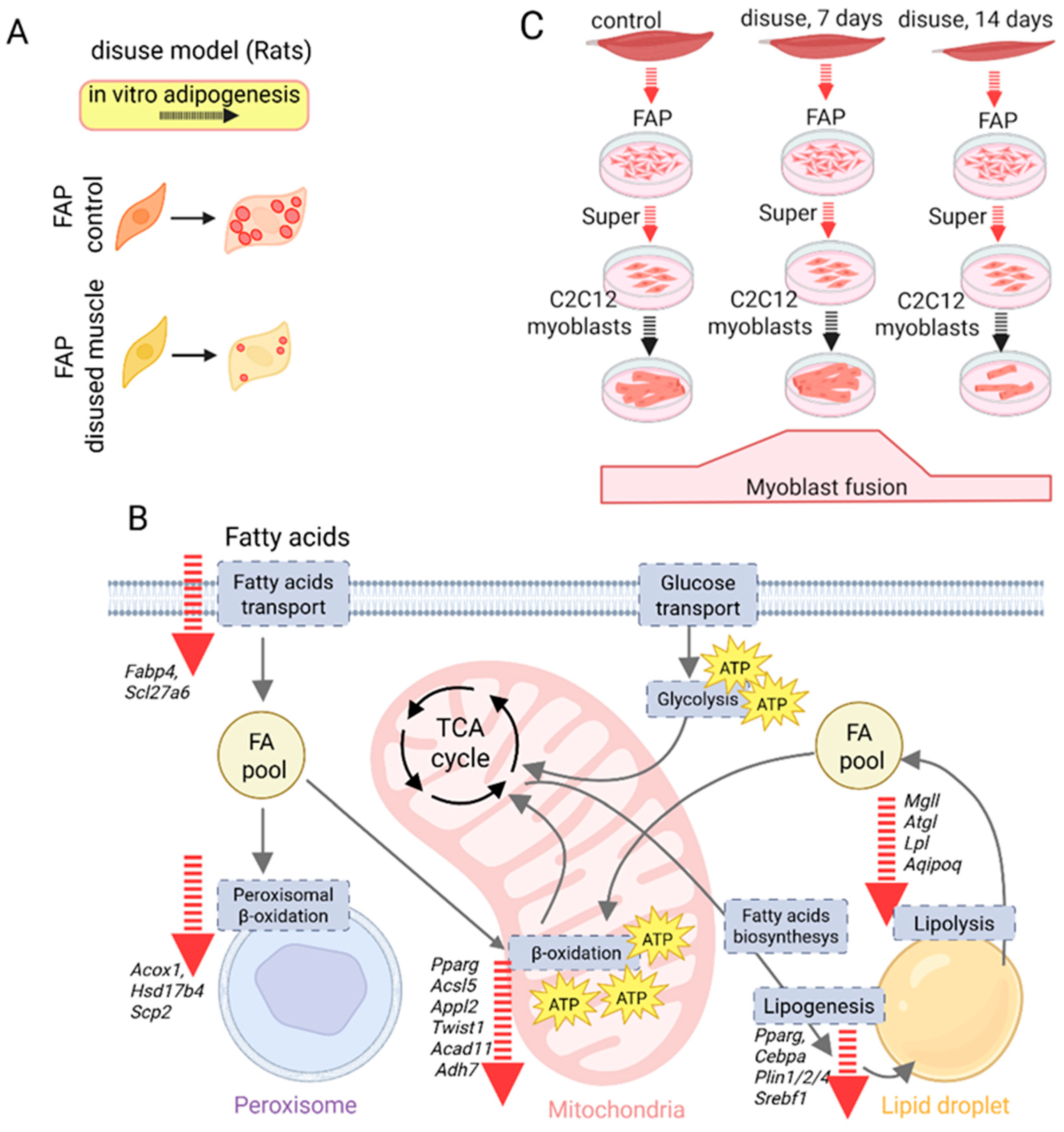
2.1. FAPs in Muscle Atrophy Induced by Functional Unloading
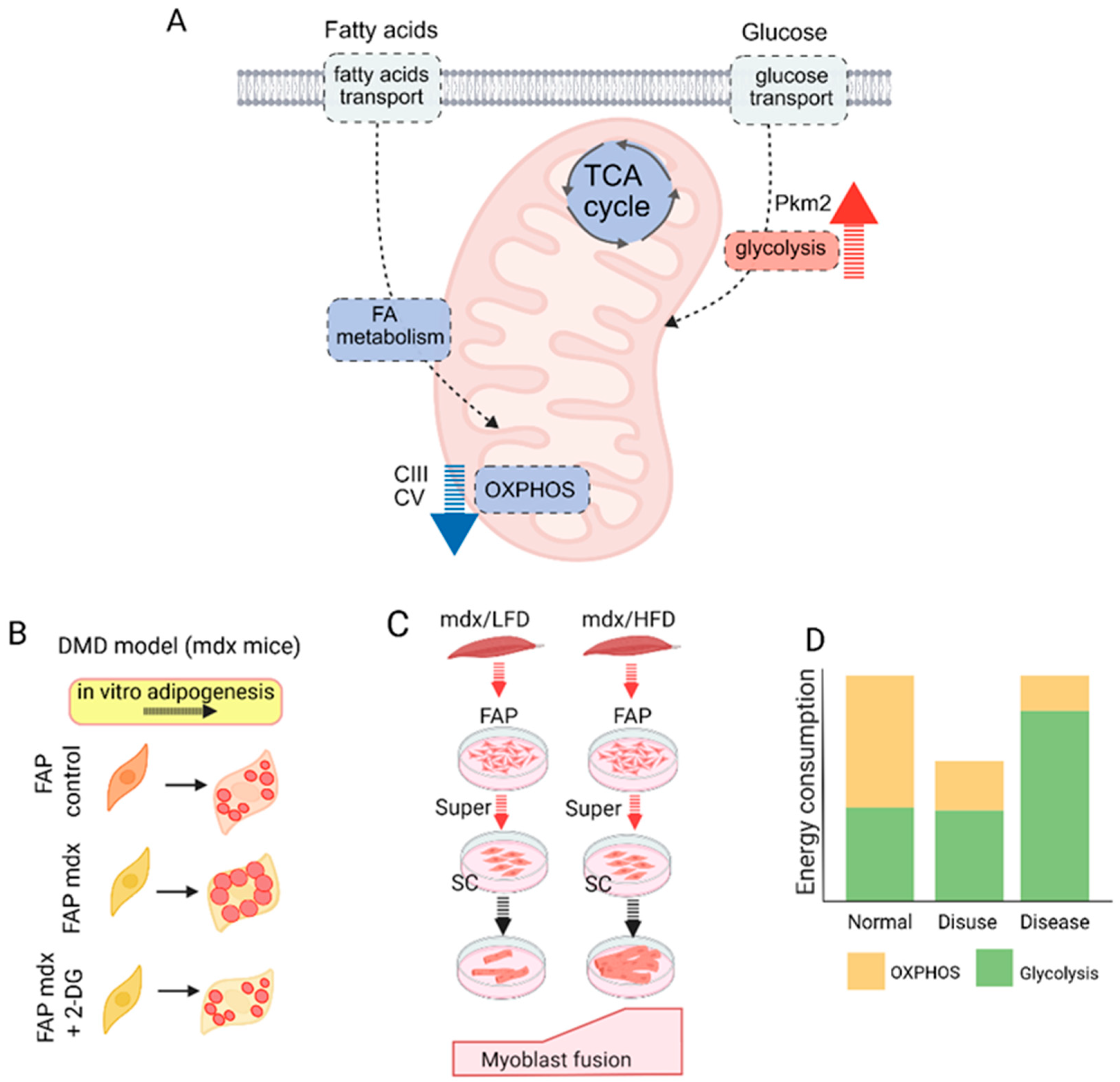
2.2. FAPs in Duchenne Muscular Dystrophy (DMD)
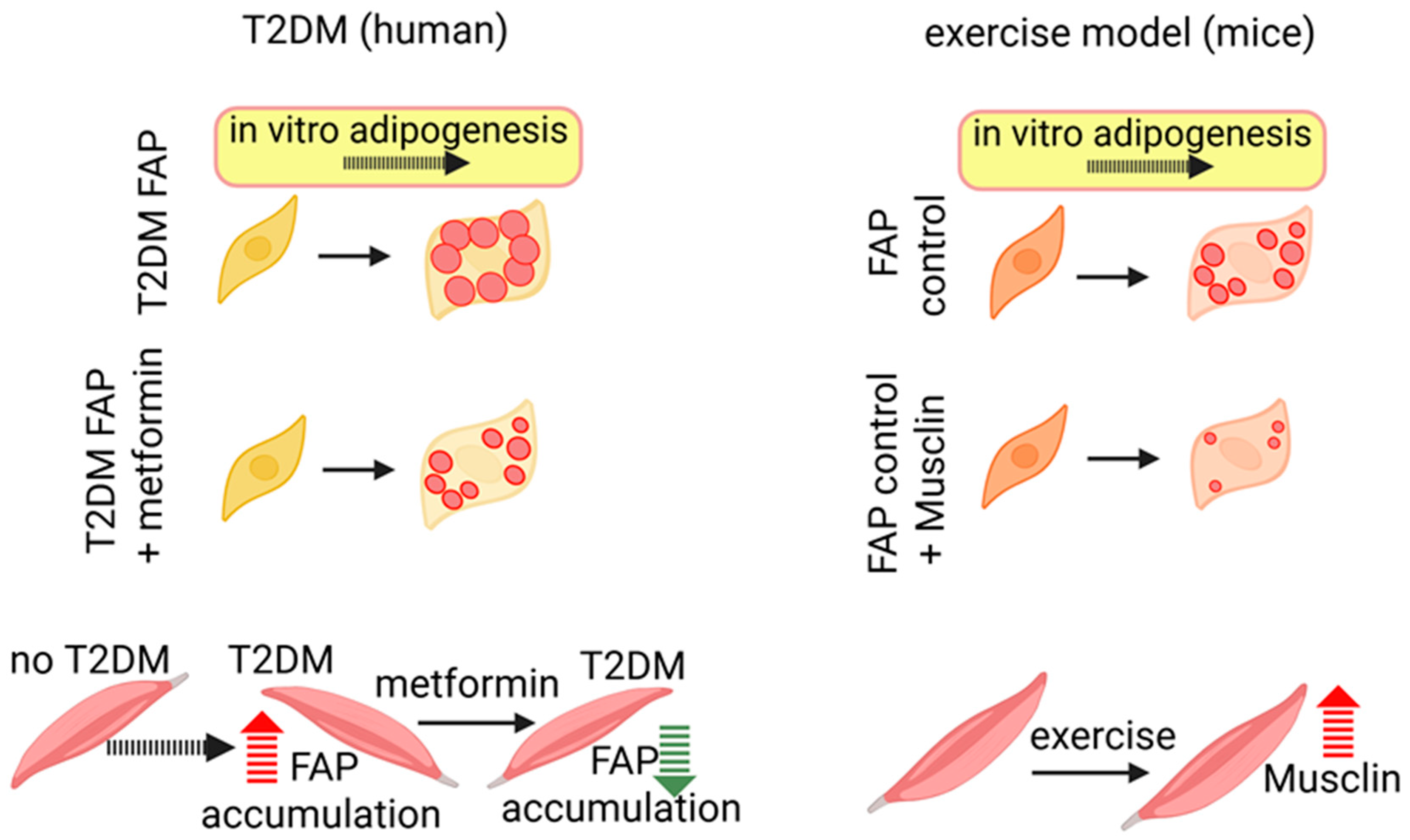
2.3. FAPs in T2DM
3. Could the Therapeutic Target Be Found Within Mechanisms That Control the Skeletal Muscle Interstitial Cells’ Functionality and Metabolism?
3.1. Metformin
3.2. Exercise and Muscline
4. Future Prospective
Author Contributions
Funding
Data Availability Statement
Conflicts of Interest
References
- Goodpaster, B.H.; Sparks, L.M. Metabolic Flexibility in Health and Disease. Cell Metab. 2017, 25, 1027–1036. [Google Scholar] [CrossRef]
- Pala, F.; Di Girolamo, D.; Mella, S.; Yennek, S.; Chatre, L.; Ricchetti, M.; Tajbakhsh, S. Distinct Metabolic States Govern Skeletal Muscle Stem Cell Fates during Prenatal and Postnatal Myogenesis. J. Cell Sci. 2018, 131, jcs212977. [Google Scholar] [CrossRef] [PubMed]
- Reggio, A.; Rosina, M.; Krahmer, N.; Palma, A.; Petrilli, L.L.; Maiolatesi, G.; Massacci, G.; Salvatori, I.; Valle, C.; Testa, S.; et al. Metabolic Reprogramming of Fibro/Adipogenic Progenitors Facilitates Muscle Regeneration. Life Sci. Alliance 2020, 3, e202000646. [Google Scholar] [CrossRef] [PubMed]
- Jin, J.B.; Robinson, A.; Soukup, T.; Black, E.; Abit, A.; Hammer, S.M.; Han, A.; Lucas, E.; Kim, Y.; Bae, J. Metabolic and Molecular Regulation in Skeletal Muscle Dysfunction and Regeneration. Front. Cell Dev. Biol. 2025, 13, 1651553. [Google Scholar] [CrossRef] [PubMed]
- Fu, X.; Zhuang, C.-l.; Hu, P. Regulation of Muscle Stem Cell Fate. Cell Regen. 2022, 11, 40. [Google Scholar] [CrossRef] [PubMed]
- Egan, B.; Zierath, J.R. Exercise Metabolism and the Molecular Regulation of Skeletal Muscle Adaptation. Cell Metab. 2013, 17, 162–184. [Google Scholar] [CrossRef]
- Le Grand, F.; Rudnicki, M.A. Skeletal Muscle Satellite Cells and Adult Myogenesis. Curr. Opin. Cell Biol. 2007, 19, 628–633. [Google Scholar] [CrossRef]
- Collao, N.; Farup, J.; De Lisio, M. Role of Metabolic Stress and Exercise in Regulating Fibro/Adipogenic Progenitors. Front. Cell Dev. Biol. 2020, 8, 9. [Google Scholar] [CrossRef]
- Evano, B.; Tajbakhsh, S. Skeletal Muscle Stem Cells in Comfort and Stress. npj Regen. Med. 2018, 3, 24. [Google Scholar] [CrossRef]
- García-Prat, L.; Martínez-Vicente, M.; Perdiguero, E.; Ortet, L.; Rodríguez-Ubreva, J.; Rebollo, E.; Ruiz-Bonilla, V.; Gutarra, S.; Ballestar, E.; Serrano, A.L.; et al. Autophagy Maintains Stemness by Preventing Senescence. Nature 2016, 529, 37–42. [Google Scholar] [CrossRef]
- Bjornson, C.R.R.; Cheung, T.H.; Liu, L.; Tripathi, P.V.; Steeper, K.M.; Rando, T.A. Notch Signaling Is Necessary to Maintain Quiescence in Adult Muscle Stem Cells. Stem Cells 2012, 30, 232–242. [Google Scholar] [CrossRef] [PubMed]
- Heredia, J.E.; Mukundan, L.; Chen, F.M.; Mueller, A.A.; Deo, R.C.; Locksley, R.M.; Rando, T.A.; Chawla, A. Type 2 Innate Signals Stimulate Fibro/Adipogenic Progenitors to Facilitate Muscle Regeneration. Cell 2013, 153, 376–388. [Google Scholar] [CrossRef] [PubMed]
- Joe, A.W.B.; Yi, L.; Natarajan, A.; Le Grand, F.; So, L.; Wang, J.; Rudnicki, M.A.; Rossi, F.M.V. Muscle Injury Activates Resi-dent Fibro/Adipogenic Progenitors That Facilitate Myogenesis. Nat. Cell Biol. 2010, 12, 153–163. [Google Scholar] [CrossRef]
- Uezumi, A.; Fukada, S.I.; Yamamoto, N.; Takeda, S.; Tsuchida, K. Mesenchymal Progenitors Distinct from Satellite Cells Contribute to Ectopic Fat Cell Formation in Skeletal Muscle. Nat. Cell Biol. 2010, 12, 143–152. [Google Scholar] [CrossRef]
- Wosczyna, M.N.; Rando, T.A. A Muscle Stem Cell Support Group: Coordinated Cellular Responses in Muscle Regeneration. Dev. Cell 2018, 46, 135–143. [Google Scholar] [CrossRef]
- Lemos, D.R.; Babaeijandaghi, F.; Low, M.; Chang, C.K.; Lee, S.T.; Fiore, D.; Zhang, R.H.; Natarajan, A.; Nedospasov, S.A.; Rossi, F.M.V. Nilotinib Reduces Muscle Fibrosis in Chronic Muscle Injury by Promoting TNF-Mediated Apoptosis of Fi-bro/Adipogenic Progenitors. Nat. Med. 2015, 21, 786–794. [Google Scholar] [CrossRef]
- Wosczyna, M.N.; Konishi, C.T.; Perez Carbajal, E.E.; Wang, T.T.; Walsh, R.A.; Gan, Q.; Wagner, M.W.; Rando, T.A. Mesen-chymal Stromal Cells Are Required for Regeneration and Homeostatic Maintenance of Skeletal Muscle. Cell Rep. 2019, 27, 2029–2035.e5. [Google Scholar] [CrossRef]
- Fiore, D.; Judson, R.N.; Low, M.; Lee, S.; Zhang, E.; Hopkins, C.; Xu, P.; Lenzi, A.; Rossi, F.M.V.; Lemos, D.R. Pharmacolog-ical Blockage of Fibro/Adipogenic Progenitor Expansion and Suppression of Regenerative Fibrogenesis Is Associated with Im-paired Skeletal Muscle Regeneration. Stem Cell Res. 2016, 17, 161–169. [Google Scholar] [CrossRef]
- Uezumi, A.; Fukada, S.; Yamamoto, N.; Ikemoto-Uezumi, M.; Nakatani, M.; Morita, M.; Yamaguchi, A.; Yamada, H.; Ni-shino, I.; Hamada, Y.; et al. Identification and Characterization of PDGFRα+ Mesenchymal Progenitors in Human Skeletal Muscle. Cell Death Dis. 2014, 5, e1186. [Google Scholar] [CrossRef]
- Powers, S.K. Can Antioxidants Protect Against Disuse Muscle Atrophy? Sports Med. 2014, 44, 155–165. [Google Scholar] [CrossRef] [PubMed]
- Vainzof, M.; Ayub-Guerrieri, D.; Onofre, P.C.G.; Martins, P.C.M.; Lopes, V.F.; Zilberztajn, D.; Maia, L.S.; Sell, K.; Yamamoto, L.U. Animal Models for Genetic Neuromuscular Diseases. J. Mol. Neurosci. 2008, 34, 241–248. [Google Scholar] [CrossRef]
- Farup, J.; Just, J.; de Paoli, F.; Lin, L.; Jensen, J.B.; Billeskov, T.; Roman, I.S.; Cömert, C.; Møller, A.B.; Madaro, L.; et al. Hu-man Skeletal Muscle CD90+ Fibro-Adipogenic Progenitors Are Associated with Muscle Degeneration in Type 2 Diabetic Patients. Cell Metab. 2021, 33, 2201–2214.e11. [Google Scholar] [CrossRef] [PubMed]
- Fernández-Simón, E.; Piñol-Jurado, P.; Gokul-Nath, R.; Unsworth, A.; Alonso-Pérez, J.; Schiava, M.; Nascimento, A.; Tasca, G.; Queen, R.; Cox, D.; et al. Single Cell RNA Sequencing of Human FAPs Reveals Different Functional Stages in Duchenne Mus-cular Dystrophy. Front. Cell Dev. Biol. 2024, 12, 1399319. [Google Scholar] [CrossRef]
- Dirks, M.L.; Wall, B.T.; Van De Valk, B.; Holloway, T.M.; Holloway, G.P.; Chabowski, A.; Goossens, G.H.; van Loon, L.J. One week of bed rest leads to substantial muscle atrophy and induces whole-body insulin resistance in the absence of skeletal muscle lipid accumulation. Diabetes 2016, 65, 2862–2875. [Google Scholar] [CrossRef]
- Wall, B.T.; Dirks, M.L.; Snijders, T.; Stephens, F.B.; Senden, J.M.; Verscheijden, M.L.; van Loon, L.J. Short-term muscle dis-use atrophy is not associated with increased intramuscular lipid deposition or a decline in the maximal activity of key mito-chondrial enzymes in young and older males. Exp. Gerontol. 2015, 61, 76–83. [Google Scholar] [CrossRef]
- Yeo, D. Muscle Disuse Atrophy. In The Skeletal Muscle: Plasticity, Degeneration and Epigenetics; Springer: Cham, Switzerland, 2025; pp. 157–183. [Google Scholar] [CrossRef]
- Parker, E.; Hamrick, M.W. Role of fibro-adipogenic progenitor cells in muscle atrophy and musculoskeletal diseases. Curr. Opin. Pharmacol. 2021, 58, 1–7. [Google Scholar] [CrossRef]
- Sorokina, M.; Bobkov, D.; Khromova, N.; Vilchinskaya, N.; Shenkman, B.; Kostareva, A.; Dmitrieva, R. Fibro-Adipogenic Progenitor Cells in Skeletal Muscle Unloading: Metabolic and Functional Impairments. Skelet. Muscle 2024, 14, 31. [Google Scholar] [CrossRef] [PubMed]
- Campanario, S.; Grima-Terrén, M.; Rommelfanger, M.; Dell’Orso, S.; Feng, X.; Cisneros, A.; Ramírez-Pardo, I.; Calls-Cobos, A.; Yang, B.A.; Ko, K.D.; et al. A skeletal muscle atlas shows neuromuscular junction adaptations to growth and atrophy. Dev. Cell 2026, 61, 1028–1043.e9. [Google Scholar] [CrossRef]
- Zhang, G.; Hu, F.; Huang, T.; Ma, X.; Cheng, Y.; Liu, X.; Jiang, W.; Dong, B.; Fu, C. The recent development, application, and future prospects of muscle atrophy animal models. MedComm–Future Med. 2024, 3, e70008. [Google Scholar] [CrossRef]
- Hornberger, T.A.; Hunter, R.B.; Kandarian, S.C.; Esser, K.A. Regulation of translation factors during hindlimb unloading and denervation of skeletal muscle in rats. Am. J. Physiol.-Cell Physiol. 2001, 281, C179–C187. [Google Scholar] [CrossRef] [PubMed]
- Lukjanenko, L.; Karaz, S.; Stuelsatz, P.; Gurriaran-Rodriguez, U.; Michaud, J.; Dammone, G.; Sizzano, F.; Mashinchian, O.; Ancel, S.; Migliavacca, E.; et al. Aging disrupts muscle stem cell function by impairing matricellular WISP1 secretion from fibro-adipogenic progenitors. Cell Stem Cell 2019, 24, 433–446. [Google Scholar] [CrossRef]
- Zhang, X.; Habiballa, L.; Aversa, Z.; Ng, Y.E.; Sakamoto, A.E.; Englund, D.A.; Pearsall, V.M.; White, T.A.; Robinson, M.M.; Rivas, D.A.; et al. Characterization of cellular senescence in aging skeletal muscle. Nat. Aging 2022, 2, 601–615. [Google Scholar] [CrossRef]
- Moiseeva, V.; Cisneros, A.; Sica, V.; Deryagin, O.; Lai, Y.; Jung, S.; Andrés, E.; An, J.; Segalés, J.; Ortet, L.; et al. Senescence atlas reveals an aged-like inflamed niche that blunts muscle regeneration. Nature 2023, 613, 169–178, Erratum in Nature 2023, 614, E45. [Google Scholar] [CrossRef] [PubMed]
- Kang, X.; Gao, Y.; Fukada, S.I.; Miao, H. FAP senescence: A critical event in muscle regeneration. Signal Transduct. Target. Ther. 2023, 8, 195. [Google Scholar] [CrossRef] [PubMed]
- Chiche, A.; Le Roux, I.; von Joest, M.; Sakai, H.; Aguín, S.B.; Cazin, C.; Salam, R.; Fiette, L.; Alegria, O.; Flamant, P.; et al. Injury-induced senescence enables in vivo reprogramming in skeletal muscle. Cell Stem Cell 2017, 20, 407–414. [Google Scholar] [CrossRef] [PubMed]
- Saito, Y.; Chikenji, T.S.; Matsumura, T.; Nakano, M.; Fujimiya, M. Exercise enhances skeletal muscle regeneration by promoting senescence in fibro-adipogenic progenitors. Nat. Commun. 2020, 11, 889. [Google Scholar] [CrossRef]
- Liu, L.; Yue, X.; Sun, Z.; Hambright, W.S.; Wei, J.; Li, Y.; Matre, P.; Cui, Y.; Wang, Z.; Rodney, G.; et al. Reduction of senescent fibro-adipogenic progenitors in progeria-aged muscle by senolytics rescues the function of muscle stem cells. J. Cachexia Sarcopenia Muscle 2022, 13, 3137–3148. [Google Scholar] [CrossRef]
- Zeng, Q.; Gong, Y.; Zhu, N.; Shi, Y.; Zhang, C.; Qin, L. Lipids and lipid metabolism in cellular senescence: Emerging targets for age-related diseases. Ageing Res. Rev. 2024, 97, 102294. [Google Scholar] [CrossRef]
- Pagano, A.F.; Arc-Chagnaud, C.; Brioche, T.; Chopard, A.; Py, G. Muscle Resting and TGF-β Inhibitor Treatment Prevent Fatty Infiltration Following Skeletal Muscle Injury. Cell. Physiol. Biochem. 2019, 53, 62–75. [Google Scholar] [CrossRef]
- Li, Y.; Wang, H. Cellular Senescence in Skeletal Muscle Aging. Endocrinol. Metab. 2026, 41, 191. [Google Scholar] [CrossRef]
- Mankodi, A.; Bishop, C.A.; Auh, S.; Newbould, R.D.; Fischbeck, K.H.; Janiczek, R.L. Quantifying Disease Activity in Fat-ty-Infiltrated Skeletal Muscle by IDEAL-CPMG in Duchenne Muscular Dystrophy. Neuromuscul. Disord. 2016, 26, 650–658. [Google Scholar] [CrossRef]
- Desguerre, I.; Mayer, M.; Leturcq, F.; Barbet, J.-P.; Gherardi, R.K.; Christov, C. Endomysial Fibrosis in Duchenne Muscular Dystrophy: A Marker of Poor Outcome Associated With Macrophage Alternative Activation. J. Neuropathol. Exp. Neurol. 2009, 68, 762–773. [Google Scholar] [CrossRef] [PubMed]
- Malecova, B.; Gatto, S.; Etxaniz, U.; Passafaro, M.; Cortez, A.; Nicoletti, C.; Giordani, L.; Torcinaro, A.; De Bardi, M.; Bicciato, S.; et al. Dynamics of Cellular States of Fibro-Adipogenic Progenitors during Myogenesis and Muscular Dystrophy. Nat. Commun. 2018, 9, 3670. [Google Scholar] [CrossRef]
- Uezumi, A.; Ito, T.; Morikawa, D.; Shimizu, N.; Yoneda, T.; Segawa, M.; Yamaguchi, M.; Ogawa, R.; Matev, M.M.; Miyagoe-Suzuki, Y.; et al. Fibrosis and Adipogenesis Originate from a Common Mesenchymal Progenitor in Skeletal Muscle. J. Cell Sci. 2011, 124, 3654–3664. [Google Scholar] [CrossRef]
- Goodpaster, B.H.; Thaete, F.L.; Kelley, D.E. Thigh Adipose Tissue Distribution Is Associated with Insulin Resistance in Obesity and in Type 2 Diabetes Mellitus. Am. J. Clin. Nutr. 2000, 71, 885–892. [Google Scholar] [CrossRef]
- Moore, C.W.; Allen, M.D.; Kimpinski, K.; Doherty, T.J.; Rice, C.L. Reduced Skeletal Muscle Quantity and Quality in Patients with Diabetic Polyneuropathy Assessed by Magnetic Resonance Imaging. Muscle Nerve 2016, 53, 726–732. [Google Scholar] [CrossRef] [PubMed]
- Richardson, D.K.; Kashyap, S.; Bajaj, M.; Cusi, K.; Mandarino, S.J.; Finlayson, J.; DeFronzo, R.A.; Jenkinson, C.P.; Mandarino, L.J. Lipid Infusion Decreases the Expression of Nuclear Encoded Mitochondrial Genes and Increases the Expression of Extracellu-lar Matrix Genes in Human Skeletal Muscle. J. Biol. Chem. 2005, 280, 10290–10297. [Google Scholar] [CrossRef] [PubMed]
- Zhou, G.; Myers, R.; Li, Y.; Chen, Y.; Shen, X.; Fenyk-Melody, J.; Wu, M.; Ventre, J.; Doebber, T.; Fujii, N.; et al. Role of AMP-Activated Protein Kinase in Mechanism of Metformin Action. J. Clin. Investig. 2001, 108, 1167–1174. [Google Scholar] [CrossRef]
- Mogi, M.; Kohara, K.; Nakaoka, H.; Kan-no, H.; Tsukuda, K.; Wang, X.-L.; Chisaka, T.; Bai, H.-Y.; Shan, B.-S.; Kukida, M.; et al. Diabetic Mice Exhibited a Peculiar Alteration in Body Composition with Exaggerated Ectopic Fat Deposition after Muscle Injury Due to Anomalous Cell Differentiation. J. Cachexia Sarcopenia Muscle 2016, 7, 213–224. [Google Scholar] [CrossRef]
- Giuliani, G.; Rosina, M.; Reggio, A. Signaling Pathways Regulating the Fate of Fibro/Adipogenic Progenitors (FAPs) in Skeletal Muscle Regeneration and Disease. FEBS J. 2022, 289, 6484–6517. [Google Scholar] [CrossRef]
- Kang, X.; Qian, J.; Shi, Y.X.; Bian, X.T.; Zhang, L.D.; Li, G.M.; Wang, L.T.; Zhao, J.; Dong, Z.Y.; Yang, M.M.; et al. Exercise-Induced Musclin Determines the Fate of Fibro-Adipogenic Progenitors to Control Muscle Homeostasis. Cell Stem Cell 2024, 31, 212–226.e7. [Google Scholar] [CrossRef] [PubMed]
- Bourbeau, M.P.; Bartberger, M.D. Recent Advances in the Development of Acetyl-CoA Carboxylase (ACC) Inhibitors for the Treatment of Metabolic Disease. J. Med. Chem. 2015, 58, 525–536. [Google Scholar] [CrossRef]
- Eldor, R.; DeFronzo, R.A.; Abdul-Ghani, M. In Vivo Actions of Peroxisome Proliferator–Activated Receptors. Diabetes Care 2013, 36, S162–S174. [Google Scholar] [CrossRef]
- Dong, X.; Hui, T.; Chen, J.; Yu, Z.; Ren, D.; Zou, S.; Wang, S.; Fei, E.; Jiao, H.; Lai, X. Metformin Increases Sarcolemma Integ-rity and Ameliorates Neuromuscular Deficits in a Murine Model of Duchenne Muscular Dystrophy. Front. Physiol. 2021, 12, 642908. [Google Scholar] [CrossRef]
- Hafner, P.; Bonati, U.; Klein, A.; Rubino, D.; Gocheva, V.; Schmidt, S.; Schroeder, J.; Bernert, G.; Laugel, V.; Steinlin, M.; et al. Effect of Combination L-Citrulline and Metformin Treatment on Motor Function in Patients with Duchenne Muscular Dystrophy: A Randomized Clinical Trial. JAMA Netw. Open 2019, 2, e1914171. [Google Scholar] [CrossRef]
- Hafner, P.; Bonati, U.; Erne, B.; Schmid, M.; Rubino, D.; Pohlman, U.; Peters, T.; Rutz, E.; Frank, S.; Neuhaus, C.; et al. Im-proved Muscle Function in Duchenne Muscular Dystrophy through L-Arginine and Metformin: An Investigator-Initiated, Open-Label, Single-Center, Proof-of-Concept-Study. PLoS ONE 2016, 11, e0147634. [Google Scholar] [CrossRef]
- Pavlidou, T.; Rosina, M.; Fuoco, C.; Gerini, G.; Gargioli, C.; Castagnoli, L.; Cesareni, G. Regulation of Myoblast Differenti-ation by Metabolic Perturbations Induced by Metformin. PLoS ONE 2017, 12, e0182475. [Google Scholar] [CrossRef]
- Pavlidou, T.; Marinkovic, M.; Rosina, M.; Fuoco, C.; Vumbaca, S.; Gargioli, C.; Castagnoli, L.; Cesareni, G. Metformin De-lays Satellite Cell Activation and Maintains Quiescence. Stem Cells Int. 2019, 2019, 5980465. [Google Scholar] [CrossRef]
- Choi, S.W.; Oh, H.; Park, S.Y.; Cho, W.; Abd El-Aty, A.M.; Hacimuftuoglu, A.; Jeong, J.H.; Jung, T.W. Myokine Musclin Al-leviates Lipid Accumulation in 3T3-L1 Adipocytes through PKA/P38-Mediated Upregulation of Lipolysis and Suppression of Lipogenesis. Biochem. Biophys. Res. Commun. 2023, 642, 113–117. [Google Scholar] [CrossRef] [PubMed]
- Kita, S.; Nishizawa, H.; Okuno, Y.; Tanaka, M.; Yasui, A.; Matsuda, M.; Yamada, Y.; Shimomura, I. Competitive Binding of Musclin to Natriuretic Peptide Receptor 3 with Atrial Natriuretic Peptide. J. Endocrinol. 2009, 201, 287–295. [Google Scholar] [CrossRef] [PubMed]
- Sarzani, R.; Allevi, M.; Di Pentima, C.; Schiavi, P.; Spannella, F.; Giulietti, F. Role of Cardiac Natriuretic Peptides in Heart Structure and Function. Int. J. Mol. Sci. 2022, 23, 14415. [Google Scholar] [CrossRef]
- Subbotina, E.; Sierra, A.; Zhu, Z.; Gao, Z.; Koganti, S.R.K.; Reyes, S.; Stepniak, E.; Walsh, S.A.; Acevedo, M.R.; Perez-Terzic, C.M.; et al. Musclin Is an Activity-Stimulated Myokine That Enhances Physical Endurance. Proc. Natl. Acad. Sci. USA 2015, 112, 16042–16047. [Google Scholar] [CrossRef]
- Nam, J.S.; Cho, E.-S.; Kwon, Y.R.; Park, J.S.; Kim, Y. Dynamic Response of Musclin, a Myokine, to Aerobic Exercise and Its Interplay With Natriuretic Peptides and Receptor C. J. Clin. Endocrinol. Metab. 2025, 110, 1305–1314. [Google Scholar] [CrossRef]
- Saw, E.L.; Werner, L.D.; Cooper, H.L.; Pimental, D.R.; Zamani, P.; Chirinos, J.A.; Valero-Muñoz, M.; Sam, F. Musclin Coun-teracts Skeletal Muscle Dysfunction and Exercise Intolerance in Heart Failure With Preserved Ejection Fraction. Circ. Heart Fail. 2025, 18, e012350. [Google Scholar] [CrossRef]
- Wen, R.; Yang, Y.; Wang, H.; Teng, Y.; Zhao, B.; Zhu, H.; Wang, S. The Myokine Musclin in Metabolic Syndrome: Patholog-ical Links and Exercise Interventions. iScience 2026, 29, 114367. [Google Scholar] [CrossRef]
- Cao, T.; Warren, C.R. From 2D myotube cultures to 3D engineered skeletal muscle constructs: A comprehensive review of in vitro skeletal muscle models and disease modeling applications. Cells 2025, 14, 882. [Google Scholar] [CrossRef]
- Ivanova, O.A.; Predeus, A.V.; Sorokina, M.Y.; Ignatieva, E.V.; Bobkov, D.E.; Sukhareva, K.S.; Kostareva, A.A.; Dmitrieva, R.I. LMNA R482L Mutation Causes Impairments in C2C12 Myoblasts Subpopulations, Alterations in Metabolic Reprogramming during Differentiation, and Oxidative Stress. Sci. Rep. 2025, 15, 5358. [Google Scholar] [CrossRef] [PubMed]
- Smolina, N.; Khudiakov, A.; Knyazeva, A.; Zlotina, A.; Sukhareva, K.; Kondratov, K.; Gogvadze, V.; Zhivotovsky, B.; Sejersen, T.; Kostareva, A. Desmin mutations result in mitochondrial dysfunction regardless of their aggregation properties. Biochim. Et. Biophys. Acta (BBA) -Mol. Basis Dis. 2020, 1866, 165745. [Google Scholar] [CrossRef]
- Ignatieva, E.; Smolina, N.; Kostareva, A.; Dmitrieva, R. Skeletal muscle mitochondria dysfunction in genetic neuromuscular disorders with cardiac phenotype. Int. J. Mol. Sci. 2021, 22, 7349. [Google Scholar] [CrossRef] [PubMed]
- Sonavane, M.; Alqallaf, A.; Mitchell, R.D.; Almeida, J.R.; Gilabadi, S.; Richards, N.J.; Adeyemi, S.; Williams, J.; Ritvos, O.; Vaiyapuri, S.; et al. Soluble Activin Receptor Type IIB Improves Muscle Regeneration Following Crotalus atrox Ven-om-Induced Damage. Toxins 2025, 17, 59. [Google Scholar] [CrossRef] [PubMed]
- Adeyemi, S.O.; Richards, N.J.; Alqallaf, A.; Haidar, H.B.; Al-Asady, M.J.J.; Williams, J.; Almeida, J.R.; Patel, K. Compro-mised regeneration, damage to blood vessels and the endomysium underpin permanent muscle damage induced by puff adder (Bitis arietans) venom. Toxins 2025, 17, 496. [Google Scholar] [CrossRef]


Disclaimer/Publisher’s Note: The statements, opinions and data contained in all publications are solely those of the individual author(s) and contributor(s) and not of MDPI and/or the editor(s). MDPI and/or the editor(s) disclaim responsibility for any injury to people or property resulting from any ideas, methods, instructions or products referred to in the content. |
© 2026 by the authors. Licensee MDPI, Basel, Switzerland. This article is an open access article distributed under the terms and conditions of the Creative Commons Attribution (CC BY) license.
Share and Cite
Sorokina, M.Y.; Ivanova, O.A.; Kostareva, A.A.; Dmitrieva, R.I. Fibro-Adipogenic Progenitor Cell Alterations in Skeletal Muscle: Pathological Dysfunction or Adaptive Reprogramming? Int. J. Mol. Sci. 2026, 27, 5016. https://doi.org/10.3390/ijms27115016
Sorokina MY, Ivanova OA, Kostareva AA, Dmitrieva RI. Fibro-Adipogenic Progenitor Cell Alterations in Skeletal Muscle: Pathological Dysfunction or Adaptive Reprogramming? International Journal of Molecular Sciences. 2026; 27(11):5016. https://doi.org/10.3390/ijms27115016
Chicago/Turabian StyleSorokina, Margarita Y., Oksana A. Ivanova, Anna A. Kostareva, and Renata I. Dmitrieva. 2026. "Fibro-Adipogenic Progenitor Cell Alterations in Skeletal Muscle: Pathological Dysfunction or Adaptive Reprogramming?" International Journal of Molecular Sciences 27, no. 11: 5016. https://doi.org/10.3390/ijms27115016
APA StyleSorokina, M. Y., Ivanova, O. A., Kostareva, A. A., & Dmitrieva, R. I. (2026). Fibro-Adipogenic Progenitor Cell Alterations in Skeletal Muscle: Pathological Dysfunction or Adaptive Reprogramming? International Journal of Molecular Sciences, 27(11), 5016. https://doi.org/10.3390/ijms27115016