Correlation Between Dysbiosis and Atrial Fibrillation: What’s New?
 , , , ,
  ,
,  and
and 
Abstract
1. Introduction
2. Methods
- -
- -
- -
- One [19] was an observational, cross-sectional, and in vivo study;
- -
- One [4] was an observational cross-sectional and short-term longitudinal study;
- -
- -
- One [21] was a prospective observational cohort study;
- -
- -
- One [24] was a prospective observational study;
- -
- One [25] was an observational cross-sectional study combined with in vitro and in vivo experiments.
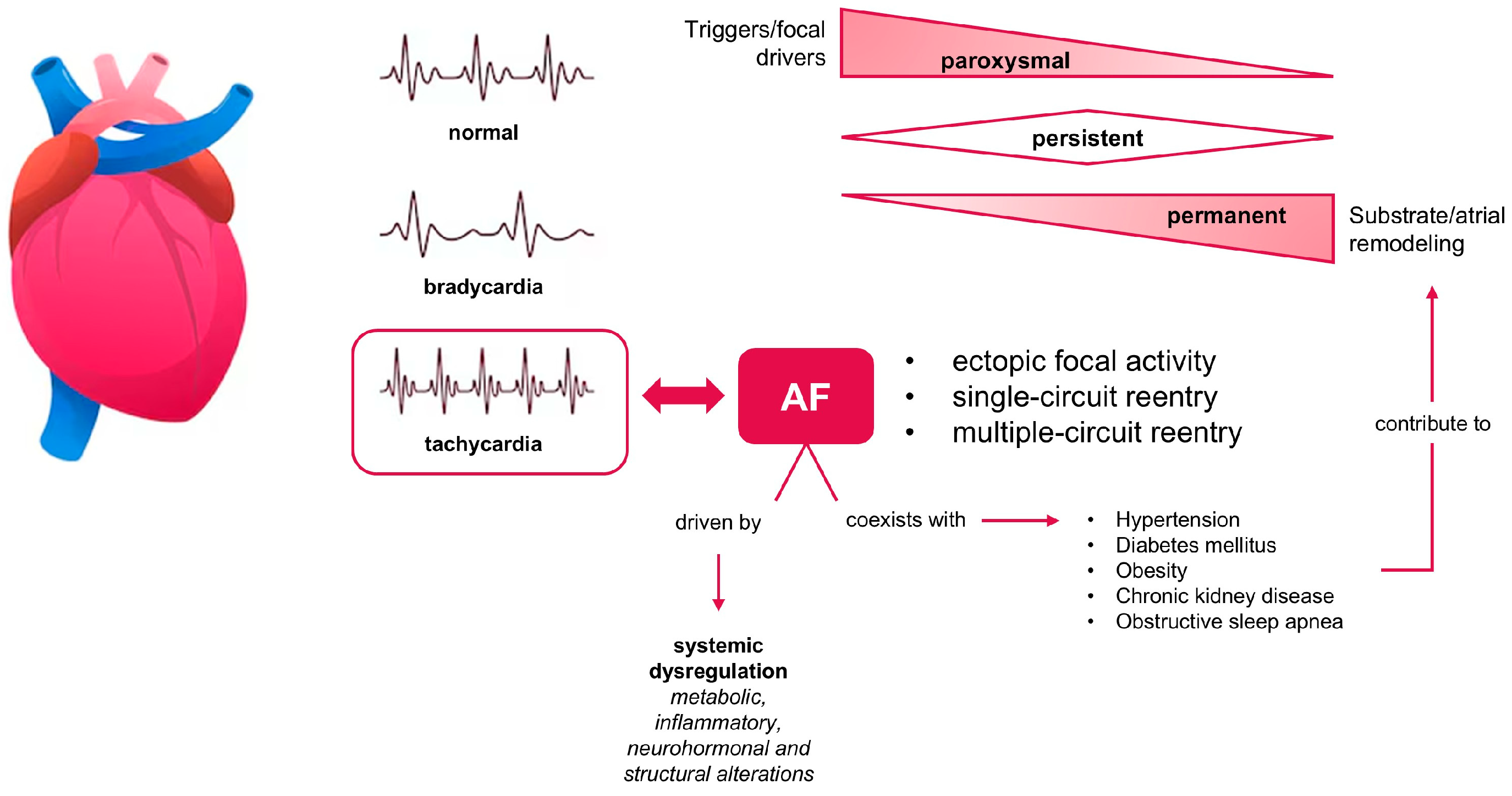
3. Pathophysiology of Atrial Fibrillation
4. Gut Microbiota Dysbiosis
5. Discussion
5.1. Evidence on Association Between Gut Dysbiosis and Atrial Fibrillation
5.2. Limitations of the Studies
6. Conclusions and Future Perspectives
Author Contributions
Funding
Data Availability Statement
Acknowledgments
Conflicts of Interest
References
- Bidaoui, G.; Assaf, A.; Marrouche, N. Atrial Fibrillation in Heart Failure: Novel Insights, Challenges, and Treatment Opportunities. Curr. Heart Fail. Rep. 2025, 22, 3. [Google Scholar] [CrossRef]
- Chen, J.; Wang, Y.; Wang, K.; Mei, Z.; Wang, L. Exploring the Axis of Gut Microbiota-Inflammatory Cytokine-Atrial Fibrillation in the Pathogenesis of Atrial Fibrillation. J. Cell. Mol. Med. 2025, 29, e70379. [Google Scholar] [CrossRef]
- Dai, H.; Hou, T.; Wang, Q.; Hou, Y.; Zhu, Z.; Zhu, Y.; Zhao, Z.; Li, M.; Lin, H.; Wang, S.; et al. Roles of Gut Microbiota in Atrial Fibrillation: Insights from Mendelian Randomization Analysis and Genetic Data from Over 430,000 Cohort Study Participants. Cardiovasc. Diabetol. 2023, 22, 306. [Google Scholar] [CrossRef]
- Huang, K.; Wang, Y.; Bai, Y.; Luo, Q.; Lin, X.; Yang, Q.; Wang, S.; Xin, H. Gut Microbiota and Metabolites in Atrial Fibrillation Patients and Their Changes after Catheter Ablation. Microbiol. Spectr. 2022, 10, e0107721. [Google Scholar] [CrossRef]
- Gawałko, M.; Agbaedeng, T.A.; Saljic, A.; Müller, D.N.; Wilck, N.; Schnabel, R.; Penders, J.; Rienstra, M.; van Gelder, I.; Jespersen, T.; et al. Gut Microbiota, Dysbiosis and Atrial Fibrillation. Arrhythmogenic Mechanisms and Potential Clinical Implications. Cardiovasc. Res. 2022, 118, 2415–2427. [Google Scholar] [CrossRef]
- Gawałko, M.; Kociemba, W.; Sanders, P.; Linz, D. Gut Microbiome and Atrial Fibrillation: Mechanistic Insights Metabolites and Comorbidities. Systematic Review. Gut Microbes 2025, 17, 2570423. [Google Scholar] [CrossRef]
- Nenna, A.; Laudisio, A.; Taffon, C.; Fogolari, M.; Spadaccio, C.; Ferrisi, C.; Loreni, F.; Giacinto, O.; Mastroianni, C.; Barbato, R.; et al. Intestinal Microbiota and Derived Metabolites in Myocardial Fibrosis and Postoperative Atrial Fibrillation. Int. J. Mol. Sci. 2024, 25, 6037. [Google Scholar] [CrossRef] [PubMed]
- Zuo, K.; Li, J.; Wang, P.; Liu, Y.; Liu, Z.; Yin, X.; Liu, X.; Yang, X. Duration of Persistent Atrial Fibrillation Is Associated with Alterations in Human Gut Microbiota and Metabolic Phenotypes. mSystems 2019, 4, e00422-19. [Google Scholar] [CrossRef]
- Fang, C.; Zuo, K.; Jiao, K.; Zhu, X.; Fu, Y.; Zhong, J.; Xu, L.; Yang, X. PAGln, an Atrial Fibrillation-Linked Gut Microbial Metabolite, Acts as a Promoter of Atrial Myocyte Injury. Biomolecules 2022, 12, 1120. [Google Scholar] [CrossRef] [PubMed]
- Zuo, K.; Li, J.; Li, K.; Hu, C.; Gao, Y.; Chen, M.; Hu, R.; Liu, Y.; Chi, H.; Wang, H.; et al. Disordered Gut Microbiota and Alterations in Metabolic Patterns Are Associated with Atrial Fibrillation. Gigascience 2019, 8, giz058. [Google Scholar] [CrossRef] [PubMed]
- Chen, L.; Chen, J.; Huang, Y.; Wu, Y.; Li, J.; Ni, W.; Lu, Y.; Li, Z.; Zhao, C.; Kong, S.; et al. Changes of the Gut Microbiota Composition and Short Chain Fatty Acid in Patients with Atrial Fibrillation. PeerJ 2023, 11, e16228. [Google Scholar] [CrossRef] [PubMed]
- Fang, C.; Zuo, K.; Zhang, W.; Zhong, J.; Li, J.; Xu, L.; Yang, X. Association Between Gut Microbiota Dysbiosis and the CHA2DS2-VASc Score in Atrial Fibrillation Patients. Int. J. Clin. Pract. 2022, 2022, 7942605. [Google Scholar] [CrossRef] [PubMed]
- Zuo, K.; Fang, C.; Gao, Y.; Fu, Y.; Wang, H.; Li, J.; Zhong, J.; Yang, X.; Xu, L. Suppression of the Gut Microbiota–Bile Acid–FGF19 Axis in Patients with Atrial Fibrillation. Cell Prolif. 2023, 56, e13488. [Google Scholar] [CrossRef]
- Xu, F.; Fu, Y.; Sun, T.; Jiang, Z.; Miao, Z.; Shuai, M.; Gou, W.; Ling, C.; Yang, J.; Wang, J.; et al. The Interplay Between Host Genetics and the Gut Microbiome Reveals Common and Distinct Microbiome Features for Complex Human Diseases. Microbiome 2020, 8, 145. [Google Scholar] [CrossRef]
- Zuo, K.; Liu, X.; Wang, P.; Jiao, J.; Han, C.; Liu, Z.; Yin, X.; Li, J.; Yang, X. Metagenomic Data-Mining Reveals Enrichment of Trimethylamine-N-Oxide Synthesis in Gut Microbiome in Atrial Fibrillation Patients. BMC Genom. 2020, 21, 526. [Google Scholar] [CrossRef]
- Chen, S.; Tu, M.; Shi, J.; Hu, X. Changes of Intestinal Flora in Patients with Atrial Fibrillation and Its Correlation with Cardiovascular Risk Factors. Rev. Cardiovasc. Med. 2023, 24, 110. [Google Scholar] [CrossRef] [PubMed]
- Zuo, K.; Yin, X.; Li, K.; Zhang, J.; Wang, P.; Jiao, J.; Liu, Z.; Liu, X.; Liu, J.; Li, J.; et al. Different Types of Atrial Fibrillation Share Patterns of Gut Microbiota Dysbiosis. mSphere 2020, 5, e00071-20. [Google Scholar] [CrossRef]
- Fang, C.; Zuo, K.; Fu, Y.; Zhu, X.; Li, J.; Zhong, J.; Xu, L.; Yang, X. Aggravated Gut Microbiota and Metabolomic Imbalances Are Associated with Hypertension Patients Comorbid with Atrial Fibrillation. Biomolecules 2022, 12, 1445. [Google Scholar] [CrossRef]
- Zhang, Y.; Zhang, S.; Li, B.; Luo, Y.; Gong, Y.; Jin, X.; Zhang, J.; Zhou, Y.; Zhuo, X.; Wang, Z.; et al. Gut Microbiota Dysbiosis Promotes Age-Related Atrial Fibrillation by Lipopolysaccharide and Glucose-Induced Activation of NLRP3-Inflammasome. Cardiovasc. Res. 2022, 118, 785–797. [Google Scholar] [CrossRef]
- Li, J.; Zuo, K.; Zhang, J.; Hu, C.; Wang, P.; Jiao, J.; Liu, Z.; Yin, X.; Liu, X.; Li, K.; et al. Shifts in Gut Microbiome and Metabolome Are Associated with Risk of Recurrent Atrial Fibrillation. J. Cell. Mol. Med. 2020, 24, 13356–13369. [Google Scholar] [CrossRef]
- Palmu, J.; Börschel, C.S.; Ortega-Alonso, A.; Markó, L.; Inouye, M.; Jousilahti, P.; Salido, R.A.; Sanders, K.; Brennan, C.; Humphrey, G.C.; et al. Gut Microbiome and Atrial Fibrillation—Results from a Large Population-Based Study. eBioMedicine 2023, 91, 104583. [Google Scholar] [CrossRef] [PubMed]
- Shi, L.; Duan, Y.; Fang, N.; Zhang, N.; Yan, S.; Wang, K.; Hou, T.; Wang, Z.; Jiang, X.; Gao, Q.; et al. Lactobacillus Gasseri Prevents Ibrutinib-Associated Atrial Fibrillation Through Butyrate. Europace 2025, 27, euaf018. [Google Scholar] [CrossRef]
- Yu, L.; Meng, G.; Huang, B.; Zhou, X.; Stavrakis, S.; Wang, M.; Li, X.; Zhou, L.; Wang, Y.; Wang, M.; et al. A Potential Relationship Between Gut Microbes and Atrial Fibrillation: Trimethylamine N-Oxide, a Gut Microbe-Derived Metabolite, Facilitates the Progression of Atrial Fibrillation. Int. J. Cardiol. 2018, 255, 92–98. [Google Scholar] [CrossRef] [PubMed]
- Tabata, T.; Yamashita, T.; Hosomi, K.; Park, J.; Hayashi, T.; Yoshida, N.; Saito, Y.; Fukuzawa, K.; Konishi, K.; Murakami, H.; et al. Gut Microbial Composition in Patients with Atrial Fibrillation: Effects of Diet and Drugs. Heart Vessels 2021, 36, 105–114. [Google Scholar] [CrossRef]
- Zuo, K.; Fang, C.; Liu, Z.; Fu, Y.; Liu, Y.; Liu, L.; Wang, Y.; Yin, X.; Liu, X.; Li, J.; et al. Commensal Microbe-Derived SCFA Alleviates Atrial Fibrillation via GPR43/NLRP3 Signaling. Int. J. Biol. Sci. 2022, 18, 4219–4232. [Google Scholar] [CrossRef]
- Nagpal, A.K.; Pundkar, A.; Singh, A.; Gadkari, C. Cardiac Arrhythmias and Their Management: An In-Depth Review of Current Practices and Emerging Therapies. Cureus 2024, 16, e66549. [Google Scholar] [CrossRef]
- Iwasaki, Y.; Nishida, K.; Kato, T.; Nattel, S. Atrial Fibrillation Pathophysiology: Implications for Management. Circulation 2011, 124, 2264–2274. [Google Scholar] [CrossRef]
- Nattel, S.; Burstein, B.; Dobrev, D. Atrial Remodeling and Atrial Fibrillation: Mechanisms and Implications. Circ. Arrhythmia Electrophysiol. 2008, 1, 62–73. [Google Scholar] [CrossRef]
- de Groot, N.M.S.; Houben, R.P.M.; Smeets, J.L.; Boersma, E.; Schotten, U.; Schalij, M.J.; Crijns, H.; Allessie, M.A. Electropathological Substrate of Longstanding Persistent Atrial Fibrillation in Patients with Structural Heart Disease. Circulation 2010, 122, 1674–1682. [Google Scholar] [CrossRef]
- Gould, P.A.; Yii, M.; Mclean, C.; Finch, S.; Marshall, T.; Lambert, G.W.; Kaye, D.M. Evidence for Increased Atrial Sympathetic Innervation in Persistent Human Atrial Fibrillation. Pacing Clin. Electrophysiol. 2006, 29, 821–829. [Google Scholar] [CrossRef] [PubMed]
- Svennberg, E.; Freedman, B.; Andrade, J.G.; Anselmino, M.; Biton, Y.; Boriani, G.; Brandes, A.; Buckley, C.M.; Cameron, A.; Clua-Espuny, J.L.; et al. Recent-Onset Atrial Fibrillation: Challenges and Opportunities. Eur. Heart J. 2025, ehaf478. [Google Scholar] [CrossRef] [PubMed]
- Băghină, R.-M.; Crișan, S.; Luca, S.; Pătru, O.; Lazăr, M.-A.; Văcărescu, C.; Negru, A.G.; Luca, C.-T.; Gaiță, D. Association Between Inflammation and New-Onset Atrial Fibrillation in Acute Coronary Syndromes. J. Clin. Med. 2024, 13, 5088. [Google Scholar] [CrossRef]
- DeLeon, O.; Chang, E.B. Assessing the Health of the Gut Microbial Organ: Why and How? J. Clin. Investig. 2025, 135, e184313. [Google Scholar] [CrossRef]
- Baquero, F.; Nombela, C. The Microbiome as a Human Organ. Clin. Microbiol. Infect. 2012, 18, 2–4. [Google Scholar] [CrossRef]
- Milani, C.; Duranti, S.; Bottacini, F.; Casey, E.; Turroni, F.; Mahony, J.; Belzer, C.; Delgado Palacio, S.; Arboleya Montes, S.; Mancabelli, L.; et al. The First Microbial Colonizers of the Human Gut: Composition, Activities, and Health Implications of the Infant Gut Microbiota. Microbiol. Mol. Biol. Rev. 2017, 81, e00036-17. [Google Scholar] [CrossRef] [PubMed]
- Fishbein, S.R.S.; Mahmud, B.; Dantas, G. Antibiotic Perturbations to the Gut Microbiome. Nat. Rev. Microbiol. 2023, 21, 772–788. [Google Scholar] [CrossRef]
- Dudek-Wicher, R.K.; Junka, A.; Bartoszewicz, M. The Influence of Antibiotics and Dietary Components on Gut Microbiota. Gastroenterol. Rev. 2018, 13, 85–92. [Google Scholar] [CrossRef]
- Spor, A.; Koren, O.; Ley, R. Unravelling the Effects of the Environment and Host Genotype on the Gut Microbiome. Nat. Rev. Microbiol. 2011, 9, 279–290. [Google Scholar] [CrossRef]
- Shen, Y.; Fan, N.; Ma, S.; Cheng, X.; Yang, X.; Wang, G. Gut Microbiota Dysbiosis: Pathogenesis, Diseases, Prevention, and Therapy. MedComm 2025, 6, e70168. [Google Scholar] [CrossRef]
- Li, X.; Liu, L.; Cao, Z.; Li, W.; Li, H.; Lu, C.; Yang, X.; Liu, Y. Gut Microbiota as an “Invisible Organ” That Modulates the Function of Drugs. Biomed. Pharmacother. 2020, 121, 109653. [Google Scholar] [CrossRef] [PubMed]
- Turroni, F.; Milani, C.; Duranti, S.; Lugli, G.A.; Bernasconi, S.; Margolles, A.; Di Pierro, F.; van Sinderen, D.; Ventura, M. The Infant Gut Microbiome as a Microbial Organ Influencing Host Well-Being. Ital. J. Pediatr. 2020, 46, 16. [Google Scholar] [CrossRef]
- Marchesi, J.R.; Adams, D.H.; Fava, F.; Hermes, G.D.A.; Hirschfield, G.M.; Hold, G.; Quraishi, M.N.; Kinross, J.; Smidt, H.; Tuohy, K.M.; et al. The Gut Microbiota and Host Health: A New Clinical Frontier. Gut 2016, 65, 330–339. [Google Scholar] [CrossRef] [PubMed]
- Carías Domínguez, A.M.; de Jesús Rosa Salazar, D.; Stefanolo, J.P.; Cruz Serrano, M.C.; Casas, I.C.; Zuluaga Peña, J.R. Intestinal Dysbiosis: Exploring Definition, Associated Symptoms, and Perspectives for a Comprehensive Understanding—A Scoping Review. Probiot. Antimicrob. Proteins 2025, 17, 440–449. [Google Scholar] [CrossRef]
- Wolters, M.; Ahrens, J.; Romaní-Pérez, M.; Watkins, C.; Sanz, Y.; Benítez-Páez, A.; Stanton, C.; Günther, K. Dietary Fat, the Gut Microbiota, and Metabolic Health—A Systematic Review Conducted Within the MyNewGut Project. Clin. Nutr. 2019, 38, 2504–2520. [Google Scholar] [CrossRef]
- Vinelli, V.; Biscotti, P.; Martini, D.; Del Bo’, C.; Marino, M.; Meroño, T.; Nikoloudaki, O.; Calabrese, F.M.; Turroni, S.; Taverniti, V.; et al. Effects of Dietary Fibers on Short-Chain Fatty Acids and Gut Microbiota Composition in Healthy Adults: A Systematic Review. Nutrients 2022, 14, 2559. [Google Scholar] [CrossRef]
- Weiss, G.A.; Hennet, T. Mechanisms and Consequences of Intestinal Dysbiosis. Cell. Mol. Life Sci. 2017, 74, 2959–2977. [Google Scholar] [CrossRef] [PubMed]
- Hasan, N.; Yang, H. Factors Affecting the Composition of the Gut Microbiota, and Its Modulation. PeerJ 2019, 7, e7502. [Google Scholar] [CrossRef]
- Liu, Y.; Wang, J.; Wu, C. Modulation of Gut Microbiota and Immune System by Probiotics, Pre-Biotics, and Post-Biotics. Front. Nutr. 2022, 8, 634897. [Google Scholar] [CrossRef] [PubMed]
- Grande, R.; Celia, C.; Mincione, G.; Stringaro, A.; Di Marzio, L.; Colone, M.; Di Marcantonio, M.C.; Savino, L.; Puca, V.; Santoliquido, R.; et al. Detection and Physicochemical Characterization of Membrane Vesicles (MVs) of Lactobacillus reuteri DSM 17938. Front. Microbiol. 2017, 8, 1040. [Google Scholar] [CrossRef]
- Vitale, I.; Spano, M.; Puca, V.; Carradori, S.; Cesa, S.; Marinacci, B.; Sisto, F.; Roos, S.; Grompone, G.; Grande, R. Antibiofilm Activity and NMR-Based Metabolomic Characterization of Cell-Free Supernatant of Limosilactobacillus reuteri DSM 17938. Front. Microbiol. 2023, 14, 1128275. [Google Scholar] [CrossRef]
- Marinacci, B.; D’Ambrosio, C.; Vitale, I.; Di Sotto, A.; Cairone, F.; Spano, M.; Carradori, S.; Scaloni, A.; Gullì, M.; Puca, V.; et al. Biochemical and Functional Properties of Vesicles from Planktonic and Biofilm Phenotypes of Limosilactobacillus reuteri DSM 17938. Sci. Rep. 2025, 15, 18889. [Google Scholar] [CrossRef]
- Panda, S.; El Khader, I.; Casellas, F.; López Vivancos, J.; García Cors, M.; Santiago, A.; Cuenca, S.; Guarner, F.; Manichanh, C. Short-Term Effect of Antibiotics on Human Gut Microbiota. PLoS ONE 2014, 9, e95476. [Google Scholar] [CrossRef]
- Ramirez, J.; Guarner, F.; Bustos Fernandez, L.; Maruy, A.; Sdepanian, V.L.; Cohen, H. Antibiotics as Major Disruptors of Gut Microbiota. Front. Cell. Infect. Microbiol. 2020, 10, 572912. [Google Scholar] [CrossRef] [PubMed]
- Cusumano, G.; Flores, G.A.; Venanzoni, R.; Angelini, P. The Impact of Antibiotic Therapy on Intestinal Microbiota: Dysbiosis, Antibiotic Resistance, and Restoration Strategies. Antibiotics 2025, 14, 371. [Google Scholar] [CrossRef] [PubMed]
- Wilson, I.D.; Nicholson, J.K. Gut Microbiome Interactions with Drug Metabolism, Efficacy, and Toxicity. Transl. Res. 2017, 179, 204–222. [Google Scholar] [CrossRef] [PubMed]
- Flowers, S.A.; Bhat, S.; Lee, J.C. Potential Implications of Gut Microbiota in Drug Pharmacokinetics and Bioavailability. Pharmacother. J. Hum. Pharmacol. Drug Ther. 2020, 40, 704–712. [Google Scholar] [CrossRef]
- Doestzada, M.; Vila, A.V.; Zhernakova, A.; Koonen, D.P.Y.; Weersma, R.K.; Touw, D.J.; Kuipers, F.; Wijmenga, C.; Fu, J. Pharmacomicrobiomics: A Novel Route Towards Personalized Medicine? Protein Cell 2018, 9, 432–445. [Google Scholar] [CrossRef]
- Yoo, J.Y.; Groer, M.; Dutra, S.V.O.; Sarkar, A.; McSkimming, D.I. Gut Microbiota and Immune System Interactions. Microorganisms 2020, 8, 1587, Erratum in Microorganisms 2020, 8, 2046. https://doi.org/10.3390/microorganisms8122046. [Google Scholar] [CrossRef]
- Pabst, O.; Slack, E. IgA and the Intestinal Microbiota: The Importance of Being Specific. Mucosal Immunol. 2020, 13, 12–21. [Google Scholar] [CrossRef]
- An, J.; Liu, Y.; Wang, Y.; Fan, R.; Hu, X.; Zhang, F.; Yang, J.; Chen, J. The Role of Intestinal Mucosal Barrier in Autoimmune Disease: A Potential Target. Front. Immunol. 2022, 13, 871713. [Google Scholar] [CrossRef]
- Mostafavi Abdolmaleky, H.; Zhou, J.-R. Gut Microbiota Dysbiosis, Oxidative Stress, Inflammation, and Epigenetic Alterations in Metabolic Diseases. Antioxidants 2024, 13, 985. [Google Scholar] [CrossRef]
- van der Meulen, T.; Harmsen, H.; Bootsma, H.; Spijkervet, F.; Kroese, F.; Vissink, A. The Microbiome–Systemic Diseases Connection. Oral Dis. 2016, 22, 719–734. [Google Scholar] [CrossRef]
- Morrison, D.J.; Preston, T. Formation of Short Chain Fatty Acids by the Gut Microbiota and Their Impact on Human Metabolism. Gut Microbes 2016, 7, 189–200. [Google Scholar] [CrossRef]
- Wei, L.; Singh, R.; Ro, S.; Ghoshal, U.C. Gut Microbiota Dysbiosis in Functional Gastrointestinal Disorders: Underpinning the Symptoms and Pathophysiology. JGH Open 2021, 5, 976–987. [Google Scholar] [CrossRef]
- Jiang, J.-Y.; Zhang, Q.-P.; Ren, H.; Yao, Q.-Y.; Liu, G.-Q.; Lu, P.-R. Trimethylamine N-Oxide Aggravates Vascular Permeability and Endothelial Cell Dysfunction Under Diabetic Condition: In Vitro and in Vivo Study. Int. J. Ophthalmol. 2024, 17, 25–33. [Google Scholar] [CrossRef]
- Canyelles, M.; Borràs, C.; Rotllan, N.; Tondo, M.; Escolà-Gil, J.C.; Blanco-Vaca, F. Gut Microbiota-Derived TMAO: A Causal Factor Promoting Atherosclerotic Cardiovascular Disease? Int. J. Mol. Sci. 2023, 24, 1940. [Google Scholar] [CrossRef] [PubMed]
- Lau, K.; Srivatsav, V.; Rizwan, A.; Nashed, A.; Liu, R.; Shen, R.; Akhtar, M. Bridging the Gap between Gut Microbial Dysbiosis and Cardiovascular Diseases. Nutrients 2017, 9, 859. [Google Scholar] [CrossRef] [PubMed]
- Xu, H.; Wang, X.; Feng, W.; Liu, Q.; Zhou, S.; Liu, Q.; Cai, L. The Gut Microbiota and Its Interactions with Cardiovascular Disease. Microb. Biotechnol. 2020, 13, 637–656. [Google Scholar] [CrossRef]
- Nesci, A.; Carnuccio, C.; Ruggieri, V.; D’Alessandro, A.; Di Giorgio, A.; Santoro, L.; Gasbarrini, A.; Santoliquido, A.; Ponziani, F.R. Gut Microbiota and Cardiovascular Disease: Evidence on the Metabolic and Inflammatory Background of a Complex Relationship. Int. J. Mol. Sci. 2023, 24, 9087. [Google Scholar] [CrossRef] [PubMed]
- Belli, M.; Barone, L.; Longo, S.; Prandi, F.R.; Lecis, D.; Mollace, R.; Margonato, D.; Muscoli, S.; Sergi, D.; Federici, M.; et al. Gut Microbiota Composition and Cardiovascular Disease: A Potential New Therapeutic Target? Int. J. Mol. Sci. 2023, 24, 11971. [Google Scholar] [CrossRef]
- Al-Kaisey, A.M.; Figgett, W.; Hawson, J.; Mackay, F.; Joseph, S.A.; Kalman, J.M. Gut Microbiota and Atrial Fibrillation: Pathogenesis, Mechanisms and Therapies. Arrhythmia Electrophysiol. Rev. 2023, 12, e14. [Google Scholar] [CrossRef]
- Sun, T.; Song, B.; Li, B. Gut Microbiota and Atrial Cardiomyopathy. Front. Cardiovasc. Med. 2025, 12, 121541278. [Google Scholar] [CrossRef]
- Matusheski, N.V.; Caffrey, A.; Christensen, L.; Mezgec, S.; Surendran, S.; Hjorth, M.F.; McNulty, H.; Pentieva, K.; Roager, H.M.; Seljak, B.K.; et al. Diets, Nutrients, Genes and the Microbiome: Recent Advances in Personalised Nutrition. Br. J. Nutr. 2021, 126, 1489–1497. [Google Scholar] [CrossRef]
- Abouelela, M.E.; Helmy, Y.A. Next-Generation Probiotics as Novel Therapeutics for Improving Human Health: Current Trends and Future Perspectives. Microorganisms 2024, 12, 430. [Google Scholar] [CrossRef]
- Nazir, A.; Hussain, F.H.N.; Raza, A. Advancing Microbiota Therapeutics: The Role of Synthetic Biology in Engineering Microbial Communities for Precision Medicine. Front. Bioeng. Biotechnol. 2024, 12, 1511149. [Google Scholar] [CrossRef]
- Malnick, S.D.H.; Fisher, D.; Somin, M.; Neuman, M.G. Treating the Metabolic Syndrome by Fecal Transplantation—Current Status. Biology 2021, 10, 447. [Google Scholar] [CrossRef]
- Halaweish, H.F.; Boatman, S.; Staley, C. Encapsulated Fecal Microbiota Transplantation: Development, Efficacy, and Clinical Application. Front. Cell. Infect. Microbiol. 2022, 12, 826114. [Google Scholar] [CrossRef] [PubMed]
- Mandrioli, J.; Amedei, A.; Cammarota, G.; Niccolai, E.; Zucchi, E.; D’Amico, R.; Ricci, F.; Quaranta, G.; Spanu, T.; Masucci, L. FETR-ALS Study Protocol: A Randomized Clinical Trial of Fecal Microbiota Transplantation in Amyotrophic Lateral Sclerosis. Front. Neurol. 2019, 10, 1021. [Google Scholar] [CrossRef] [PubMed]
- Shukla, V.; Singh, S.; Verma, S.; Verma, S.; Rizvi, A.A.; Abbas, M. Targeting the Microbiome to Improve Human Health with the Approach of Personalized Medicine: Latest Aspects and Current Updates. Clin. Nutr. ESPEN 2024, 63, 813–820. [Google Scholar] [CrossRef]
- O’Hara, A.M.; Shanahan, F. The Gut Flora as a Forgotten Organ. EMBO Rep. 2006, 7, 688–693. [Google Scholar] [CrossRef] [PubMed]
- Donald, K.; Finlay, B.B. Early-Life Interactions Between the Microbiota and Immune System: Impact on Immune System Development and Atopic Disease. Nat. Rev. Immunol. 2023, 23, 735–748. [Google Scholar] [CrossRef]
- Cryan, J.F.; O’Riordan, K.J.; Cowan, C.S.M.; Sandhu, K.V.; Bastiaanssen, T.F.S.; Boehme, M.; Codagnone, M.G.; Cussotto, S.; Fulling, C.; Golubeva, A.V.; et al. The Microbiota-Gut-Brain Axis. Physiol. Rev. 2019, 99, 1877–2013. [Google Scholar] [CrossRef] [PubMed]
- Boem, F.; Lamminpää, I.; Amedei, A. Updating the Discontinuity Theory to the Extended Immunity: The Symmunobiome Concept. Eur. J. Immunol. 2025, 55, e202451528. [Google Scholar] [CrossRef] [PubMed]
- Cheraghi, M.; Nazari, A.; Souri, F. Gut Microbiota and Cardiac Arrhythmogenesis: Unveiling the Gut–Heart Axis. Pathol. Res. Pract. 2025, 273, 156125. [Google Scholar] [CrossRef]
- Bui, T.V.A.; Hwangbo, H.; Lai, Y.; Hong, S.B.; Choi, Y.-J.; Park, H.-J.; Ban, K. The Gut-Heart Axis: Updated Review for The Roles of Microbiome in Cardiovascular Health. Korean Circ. J. 2023, 53, 499. [Google Scholar] [CrossRef]
- Wexler, H.M. Bacteroides: The Good, the Bad, and the Nitty-Gritty. Clin. Microbiol. Rev. 2007, 20, 593–621. [Google Scholar] [CrossRef]
- Xu, M.; Lan, R.; Qiao, L.; Lin, X.; Hu, D.; Zhang, S.; Yang, J.; Zhou, J.; Ren, Z.; Li, X.; et al. Bacteroides vulgatus Ameliorates Lipid Metabolic Disorders and Modulates Gut Microbial Composition in Hyperlipidemic Rats. Microbiol. Spectr. 2023, 11, e0251722. [Google Scholar] [CrossRef]
- Qu, D.; Sun, F.; Feng, S.; Yu, L.; Tian, F.; Zhang, H.; Chen, W.; Zhai, Q. Protective Effects of Bacteroides Fragilis Against Lipopolysaccharide-Induced Systemic Inflammation and Their Potential Functional Genes. Food Funct. 2022, 13, 1015–1025. [Google Scholar] [CrossRef]
- Chandra, H.; Sharma, K.K.; Tuovinen, O.H.; Sun, X.; Shukla, P. Pathobionts: Mechanisms of Survival, Expansion, and Interaction with Host with a Focus on Clostridioides difficile. Gut Microbes 2021, 13, 1979882. [Google Scholar] [CrossRef]
- Hall, A.B.; Yassour, M.; Sauk, J.; Garner, A.; Jiang, X.; Arthur, T.; Lagoudas, G.K.; Vatanen, T.; Fornelos, N.; Wilson, R.; et al. A Novel Ruminococcus Gnavus Clade Enriched in Inflammatory Bowel Disease Patients. Genome Med. 2017, 9, 103. [Google Scholar] [CrossRef] [PubMed]
- Henke, M.T.; Kenny, D.J.; Cassilly, C.D.; Vlamakis, H.; Xavier, R.J.; Clardy, J. Ruminococcus gnavus, a Member of the Human Gut Microbiome Associated with Crohn’s Disease, Produces an Inflammatory Polysaccharide. Proc. Natl. Acad. Sci. USA 2019, 116, 12672–12677. [Google Scholar] [CrossRef]
- Miquel, S.; Martín, R.; Rossi, O.; Bermúdez-Humarán, L.; Chatel, J.; Sokol, H.; Thomas, M.; Wells, J.; Langella, P. Faecalibacterium Prausnitzii and Human Intestinal Health. Curr. Opin. Microbiol. 2013, 16, 255–261. [Google Scholar] [CrossRef]
- Ferreira-Halder, C.V.; Faria, A.V.d.S.; Andrade, S.S. Action and Function of Faecalibacterium prausnitzii in Health and Disease. Best Pract. Res. Clin. Gastroenterol. 2017, 31, 643–648. [Google Scholar] [CrossRef] [PubMed]
- Sokol, H.; Pigneur, B.; Watterlot, L.; Lakhdari, O.; Bermúdez-Humarán, L.G.; Gratadoux, J.-J.; Blugeon, S.; Bridonneau, C.; Furet, J.-P.; Corthier, G.; et al. Faecalibacterium prausnitzii Is an Anti-Inflammatory Commensal Bacterium Identified by Gut Microbiota Analysis of Crohn Disease Patients. Proc. Natl. Acad. Sci. USA 2008, 105, 16731–16736. [Google Scholar] [CrossRef]
- Tett, A.; Pasolli, E.; Masetti, G.; Ercolini, D.; Segata, N. Prevotella Diversity, Niches and Interactions with the Human Host. Nat. Rev. Microbiol. 2021, 19, 585–599. [Google Scholar] [CrossRef] [PubMed]
- Iljazovic, A.; Amend, L.; Galvez, E.J.C.; de Oliveira, R.; Strowig, T. Modulation of Inflammatory Responses by Gastrointestinal Prevotella Spp.—From Associations to Functional Studies. Int. J. Med. Microbiol. 2021, 311, 151472. [Google Scholar] [CrossRef]
- Zhang, Y.; Wang, Y.; Ke, B.; Du, J. TMAO: How Gut Microbiota Contributes to Heart Failure. Transl. Res. 2021, 228, 109–125. [Google Scholar] [CrossRef]
- Hernández-Ruiz, P.; Escalona Montaño, A.R.; Amezcua-Guerra, L.M.; González-Pacheco, H.; Niccolai, E.; Amedei, A.; Aguirre-García, M.M. Potential Association of the Oral Microbiome with Trimethylamine N-Oxide Quantification in Mexican Patients with Myocardial Infarction. Mediat. Inflamm. 2024, 2024, 3985731. [Google Scholar] [CrossRef] [PubMed]
- Dobrev, D.; Heijman, J.; Hiram, R.; Li, N.; Nattel, S. Inflammatory Signalling in Atrial Cardiomyocytes: A Novel Unifying Principle in Atrial Fibrillation Pathophysiology. Nat. Rev. Cardiol. 2023, 20, 145–167. [Google Scholar] [CrossRef]
- Jaworska, K.; Kopacz, W.; Koper, M.; Ufnal, M. Microbiome-Derived Trimethylamine N-Oxide (TMAO) as a Multifaceted Biomarker in Cardiovascular Disease: Challenges and Opportunities. Int. J. Mol. Sci. 2024, 25, 12511. [Google Scholar] [CrossRef]
- Lu, D.; Zou, X.; Zhang, H. The Relationship Between Atrial Fibrillation and Intestinal Flora with Its Metabolites. Front. Cardiovasc. Med. 2022, 9, 948755. [Google Scholar] [CrossRef] [PubMed]
- Suzuki, K.; Susaki, E.A.; Nagaoka, I. Lipopolysaccharides and Cellular Senescence: Involvement in Atherosclerosis. Int. J. Mol. Sci. 2022, 23, 11148. [Google Scholar] [CrossRef]
- Ma, X.; Liu, J.; Jiang, L.; Gao, Z.; Shi, Z.; Zhang, N.; Wang, Z.; Li, S.; Zhang, R.; Xu, S. Dynamic Changes in the Gut Microbiota Play a Critical Role in Age-Associated Cognitive Dysfunction via SCFAs and LPS Synthesis Metabolic Pathways During Brain Aging. Int. J. Biol. Macromol. 2025, 304, 140945. [Google Scholar] [CrossRef]
- Wang, X.; Li, Z.; Zang, M.; Yao, T.; Mao, J.; Pu, J. Circulating Primary Bile Acid Is Correlated with Structural Remodeling in Atrial Fibrillation. J. Interv. Card. Electrophysiol. 2020, 57, 371–377. [Google Scholar] [CrossRef]
- Yang, J.; Liu, S.; Zhao, Q.; Li, X.; Jiang, K. Gut Microbiota-Related Metabolite Alpha-Linolenic Acid Mitigates Intestinal Inflammation Induced by Oral Infection with Toxoplasma gondii. Microbiome 2023, 11, 273. [Google Scholar] [CrossRef] [PubMed]
- Constantino-Jonapa, L.A.; Aguilar-Villegas, O.R.; Hernández-Ruiz, P.; Escalona-Montaño, A.R.; Pallecchi, M.; González-Pacheco, H.; Bartolucci, G.; Baldi, S.; Amezcua-Guerra, L.M.; Amedei, A.; et al. The Link Between Inflammatory/SCFA Profiles and Oral/Gut Microbiome: An Observational Study in Patients with ST-Segment Elevation Myocardial Infarction. Curr. Res. Microb. Sci. 2025, 9, 100423. [Google Scholar] [CrossRef] [PubMed]


| Ref. | Study Type | Population | Gut Microbiota Alterations | Key Microbial Genes and Metabolites Identified | Proposed Mechanism | Clinical Implications |
|---|---|---|---|---|---|---|
| [8] | Observational case–control study |
|
|
|
|
|
| [17] | Observational cross-sectional comparative study |
|
|
|
| Targeting dysbiosis and its metabolic pathways could be an effective strategy for AF prevention and/or treatment |
| [20] | Observational cohort study with Mendelian randomization analysis |
|
|
|
| Based on the gut microbiota profiling of RAF, non-RAF, and control samples, a Taxonomic Score can be introduced, which may represent a predictive strategy for recurrent AF |
| [9] | Observational cross-sectional study |
| ND |
|
|
|
| [10] | Observational cross-sectional study |
|
|
|
|
|
| [3] | Observational cohort study with Mendelian randomization analysis |
|
| ND |
| Characterization of the gut microbiota could become a valuable tool for risk stratification or part of predictive models integrating genetic and clinical factors related to AF |
| [11] | Observational cross-sectional study |
|
|
|
|
|
| [2] | Observational cohort study with Mendelian randomization analysis |
|
|
|
|
|
| [12] | Observational cross-sectional study |
|
| 84 KEGG Orthologs were differentially enriched between the two groups:
|
| Gut microbiota profiling could have the potential to become an additional marker of thromboembolic risk in patients with AF |
| [19] | Observational cross-sectional and in vivo study |
|
|
|
| The gut microbiota is a potential therapeutic target for age-related AF |
| [18] | Observational cross-sectional comparative study |
|
| 56 KEGG metabolic pathways were significantly different between the two groups, all related to metabolism.
| Intestinal dysbiosis and an alteration in related metabolites may contribute to the development of AF in hypertensive patients | Microbial and metabolic profiles may represent predictive tools for the screening of patients at higher risk of developing AF |
| [4] | Observational cross-sectional and short-term longitudinal study |
|
|
|
| Gut microbiota profiling and analysis of metabolites may be used as potential biomarkers in AF |
| [21] | Prospective observational cohort study | People aged between 25 and 74 from six geographical regions are invited to participate in the FINRISK 2002 study:
|
| ND | In AF patients, there is a shift in the microbiota composition that is close to that in hypertension and heart failure: this suggests that there could be a similar pathophysiology | Gut microbiota may potentially have a predictive role in the risk of developing AF |
| [13] | Observational cross-sectional study |
| ↓ bacteria involved in the biotransformation of bile acids: Faecalibacterium, Roseburia, Dialister, Butyricicoccus, Prevotella, Eubacterium, and Blautia. | In patients with AF ↓, enzymes encoded by the bai operon are involved in the transformation of bile acids (7α-HSDH; 7β-HSDH; baiA, baiA2, baiH, baiCD, and baiN) | Intestinal dysbiosis leads to impaired conversion of primary bile acids to secondary bile acids and decreased plasma FGF19, resulting in increased lipid accumulation and atrial cardiomyocyte dysfunction | The microbiota-bile acids-FGF19 axis is a hypothetical biomarker of AF risk |
| [14] | Observational cross-sectional study |
|
| ND | Host genetics may influence gut microbiota composition, inducing a shift similar to that of AF patients |
|
| [22] | Preclinical experimental study |
|
|
|
| Supplementation of butyrate and L. gasseri could help restore the gut microbiota for the prevention and management of ibrutinib-associated AF |
| [23] | Preclinical experimental study |
| ND | ND |
| Targeting TMAO or its downstream signaling pathways could provide novel therapeutic approaches for AF prevention or treatment |
| [15] | Observational cross-sectional study |
| ↑ Escherichia, Klebsiella, Kluyvera, and Citrobacter (associated with TMAO production) in AF patients | ↑ Genes encoding TMA-synthesis enzymes (CutC, CntA, GrdH, TorA) in AF patients compared with controls |
| Targeting TMA-synthesis pathways and gut dysbiosis could serve as therapeutic strategies for AF |
| [24] | Prospective observational study |
|
| ND | Enrichment of Streptococcus, Lachnoclostridium, Parabacteroides, Alistipes, and Dorea could be related to increased TMAO and LPS levels that may be the trigger for oxidative stress and atrial electrophysiology instability, leading to increased risk of AF |
|
| [25] | Observational cross-sectional study combined with in vitro and in vivo experiments |
|
Low-fiber diet:
|
|
|
|
| [16] | Observational cross-sectional study |
|
| ND |
|
|
Disclaimer/Publisher’s Note: The statements, opinions and data contained in all publications are solely those of the individual author(s) and contributor(s) and not of MDPI and/or the editor(s). MDPI and/or the editor(s) disclaim responsibility for any injury to people or property resulting from any ideas, methods, instructions or products referred to in the content. |
© 2025 by the authors. Licensee MDPI, Basel, Switzerland. This article is an open access article distributed under the terms and conditions of the Creative Commons Attribution (CC BY) license.
Share and Cite
Marinacci, B.; Mencarelli, N.; Stornelli, G.; Pellegrini, B.; Amedei, A.; Gallorini, M.; Grande, R. Correlation Between Dysbiosis and Atrial Fibrillation: What’s New? Int. J. Mol. Sci. 2026, 27, 73. https://doi.org/10.3390/ijms27010073
Marinacci B, Mencarelli N, Stornelli G, Pellegrini B, Amedei A, Gallorini M, Grande R. Correlation Between Dysbiosis and Atrial Fibrillation: What’s New? International Journal of Molecular Sciences. 2026; 27(1):73. https://doi.org/10.3390/ijms27010073
Chicago/Turabian StyleMarinacci, Beatrice, Noemi Mencarelli, Giorgia Stornelli, Benedetta Pellegrini, Amedeo Amedei, Marialucia Gallorini, and Rossella Grande. 2026. "Correlation Between Dysbiosis and Atrial Fibrillation: What’s New?" International Journal of Molecular Sciences 27, no. 1: 73. https://doi.org/10.3390/ijms27010073
APA StyleMarinacci, B., Mencarelli, N., Stornelli, G., Pellegrini, B., Amedei, A., Gallorini, M., & Grande, R. (2026). Correlation Between Dysbiosis and Atrial Fibrillation: What’s New? International Journal of Molecular Sciences, 27(1), 73. https://doi.org/10.3390/ijms27010073