The Etiology of IgE-Mediated Food Allergy: Potential Therapeutics and Challenges

 ,
,  ,
,
Abstract
1. Introduction
2. Epidemiology
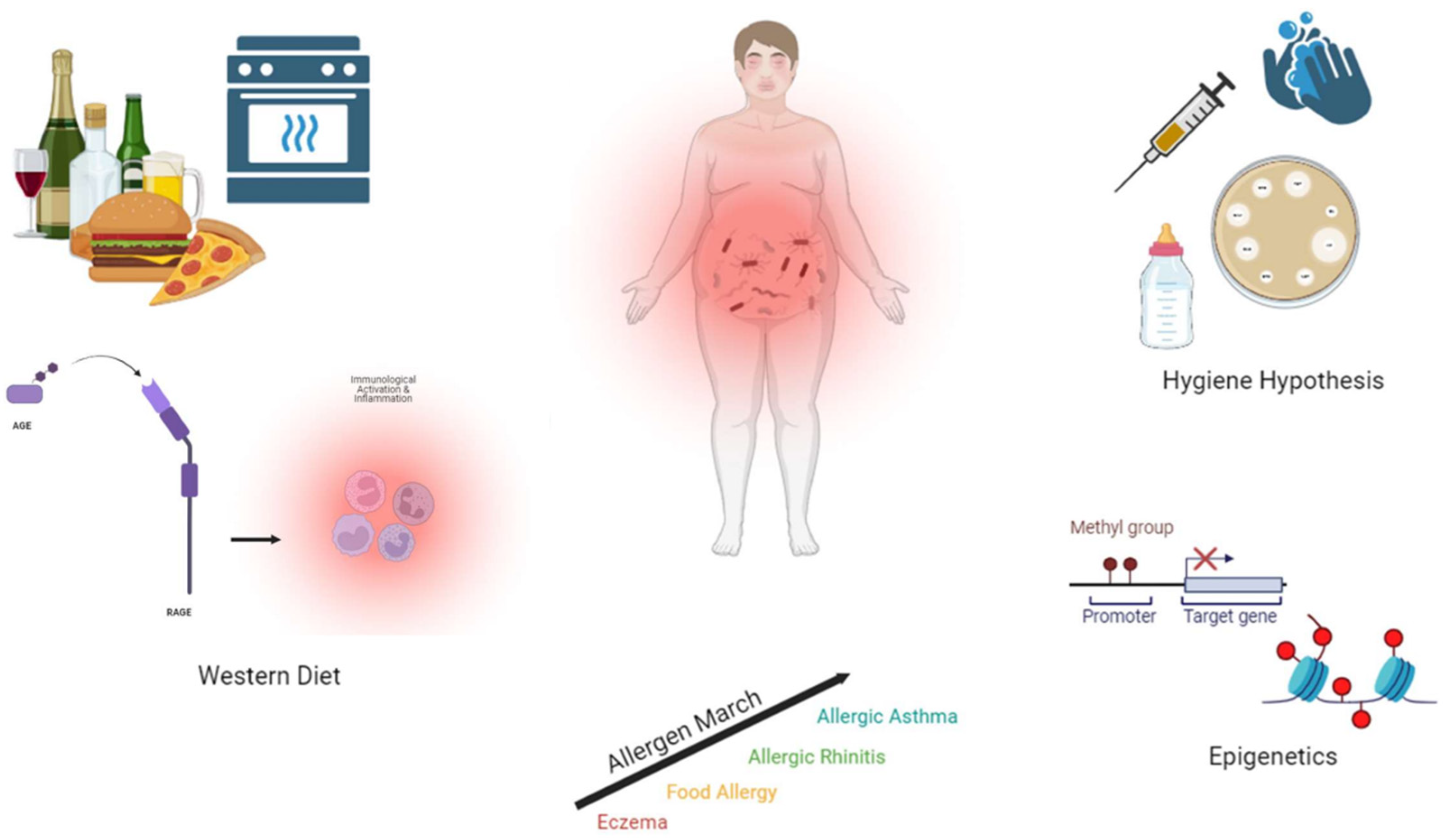
2.1. Western Diet
2.2. The Hygiene Hypothesis
2.3. Epigenetics
2.4. The Allergen March
3. Etiology
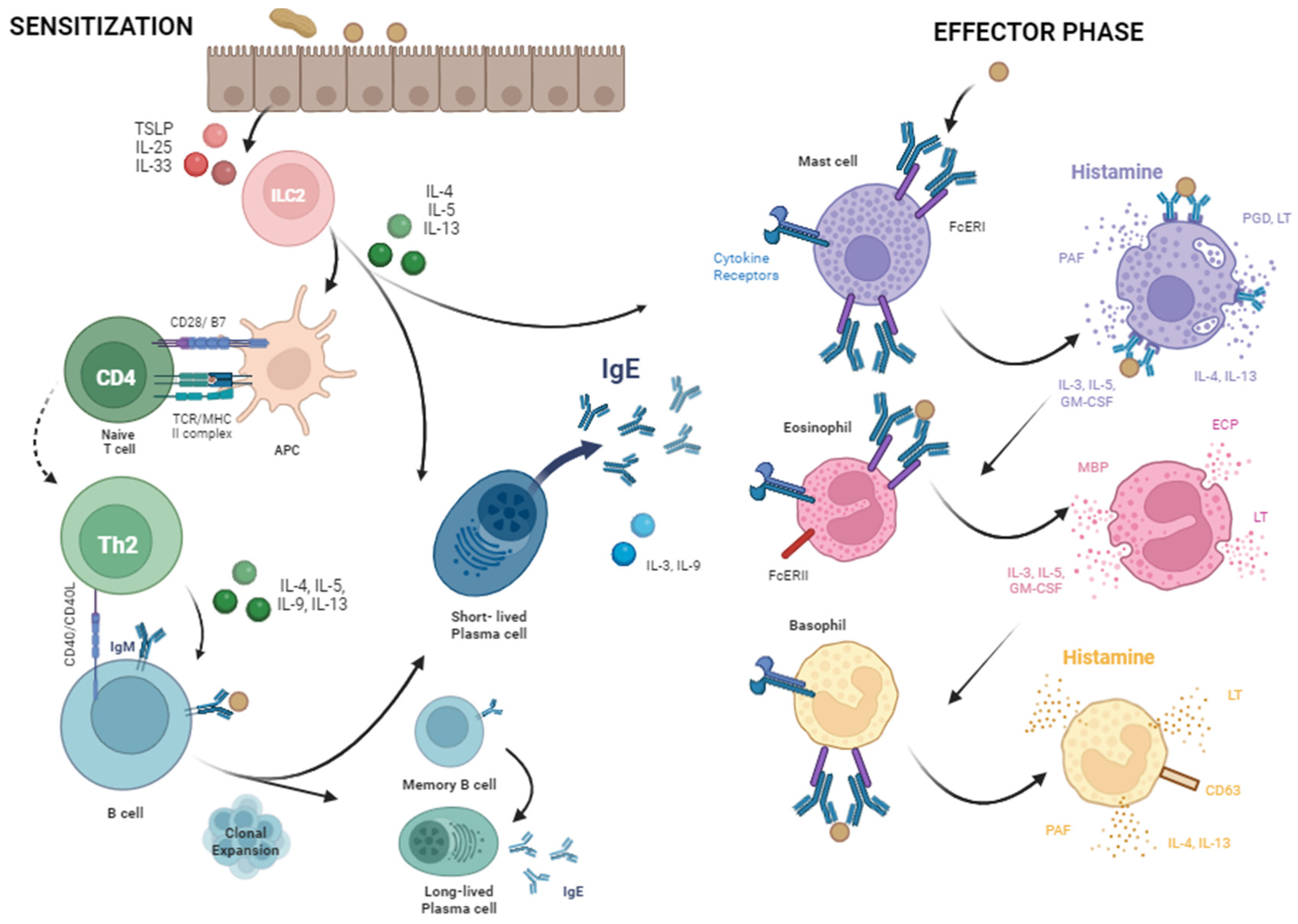
3.1. Sensitization
3.2. Effector Phase
3.3. Immunological Memory
4. Diagnosis
4.1. Symptoms
4.2. Diagnostic Testing
4.3. Natural Course
5. Therapeutics and Challenges
5.1. Immunotherapy
5.2. Biologics
5.2.1. Anti-IgE Therapeutics
5.2.2. Cytokine- and Receptor-Targeted Therapeutics
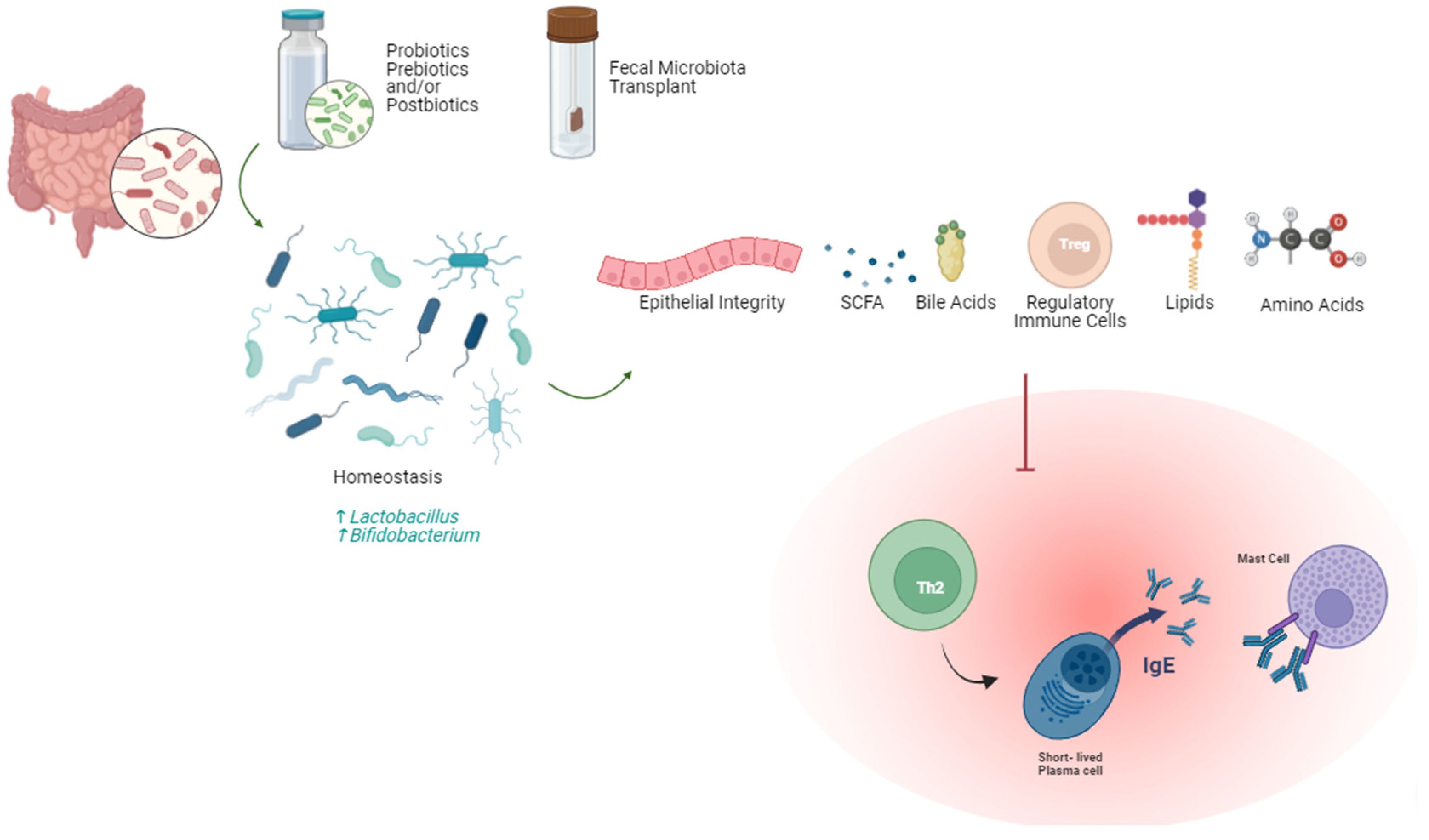
5.3. Probiotics
5.4. Natural Products
6. Conclusions
Author Contributions
Funding
Conflicts of Interest
References
- United States Department of Agriculture. Food Allergies: The “Big 9”. Available online: https://www.fsis.usda.gov/food-safety/safe-food-handling-and-preparation/food-safety-basics/food-allergies-big-9 (accessed on 7 September 2024).
- Allergy & Asthma Network. A Complete Guide to Allergies. Available online: https://allergyasthmanetwork.org/allergies/ (accessed on 6 September 2024).
- Lopez, C.M.; Yarrarapu, S.N.S.; Mendez, M.D. Food Allergies. In StatPearls [Internet]; StatPearls Publishing: Treasure Island, FL, USA, 2023. [Google Scholar]
- Lee, E.C.K.; Trogen, B.; Brady, K.; Ford, L.S.; Wang, J. The Natural History and Risk Factors for the Development of Food Allergies in Children and Adults. Curr. Allergy Asthma Rep. 2024, 24, 121–131. [Google Scholar] [CrossRef] [Scilit] [PubMed]
- Skripak, J.; Matsui, E.C.; Mudd, K.; Wood, R.A. The natural history of IgE-mediated cow’s milk allergy. J. Allergy Clin. Immunol. 2007, 120, 1172–1177. [Google Scholar] [CrossRef] [Scilit] [PubMed]
- Peters, R.L.; Krawiec, M.; Koplin, J.J.; Santos, A.F. Update on food allergy. Pediatr. Allergy Immunol. 2021, 32, 647–657. [Google Scholar] [CrossRef] [Scilit] [PubMed]
- Untersmayr, E.; Jensen-Jarolim, E. Mechanisms of type I food allergy. Pharmacol. Ther. 2006, 112, 787–798. [Google Scholar] [CrossRef] [Scilit]
- Frontela-Saseta, C.; Gonzalez-Bermudez, C.A.; Garcia-Marcos, L. Diet: A Specific Part of the Western Lifestyle Pack in the Asthma Epidemic. J. Clin. Med. 2020, 9, 2063. [Google Scholar] [CrossRef] [Scilit]
- Zhang, P. The Role of Diet and Nutrition in Allergic Diseases. Nutrients 2023, 15, 3683. [Google Scholar] [CrossRef] [Scilit]
- Gu, Y.; Guo, X.; Sun, S.; Che, H. High-Fat Diet-Induced Obesity Aggravates Food Allergy by Intestinal Barrier Destruction and Inflammation. Int. Arch. Allergy Immunol. 2022, 183, 80–92. [Google Scholar] [CrossRef] [Scilit]
- Siracusa, F.; Schaltenberg, N.; Villablanca, E.J.; Huber, S.; Gagliani, N. Dietary Habits and Intestinal Immunity: From Food Intake to CD4+ TH Cells. Front. Immunol. 2019, 9, 3177. [Google Scholar] [CrossRef] [Scilit]
- Clemente-Suárez, V.J.; Beltrán-Velasco, A.I.; Redondo-Flórez, L.; Martín-Rodríguez, A.; Tornero-Aguilera, J.F. Global Impacts of Western Diet and Its Effects on Metabolism and Health: A Narrative Review. Nutrients 2023, 15, 2749. [Google Scholar] [CrossRef] [Scilit]
- Smith, P.K.; Masilamani, M.; Li, X.-M.; Sampson, H. The false alarm hypothesis: Food allergy is associated with high dietary advanced glycation end-products and proglycating dietary sugars that mimic alarmins. J. Allergy Clin. Immunol. 2017, 139, 429–437. [Google Scholar] [CrossRef] [Scilit]
- Paparo, L.; Coppola, S.; Nocerino, R.; Pisapia, L.; Picariello, G.; Cortese, M.; Voto, L.; Maglio, M.; Miele, E.; Carucci, L.; et al. How dietary advanced glycation end products could facilitate the occurrence of food allergy. J. Allergy Clin. Immunol. 2024, 153, 742–758. [Google Scholar] [CrossRef] [Scilit] [PubMed]
- U.S. Food and Drug Administration. Asthma: The Hygiene Hypothesis. Available online: https://www.fda.gov/vaccines-blood-biologics/consumers-biologics/asthma-hygiene-hypothesis (accessed on 10 September 2024).
- Liu, A.H. Revisiting the hygiene hypothesis for allergy and asthma. J. Allergy Clin. Immunol. 2015, 136, 860–865. [Google Scholar] [CrossRef] [Scilit] [PubMed]
- Alexandre-Silva, G.M.; Brito-Souza, P.A.; Oliveira, A.C.; Cerni, F.A.; Zottich, U.; Pucca, M.A. The hygiene hypothesis at a glance: Early exposures, immune mechanism and novel therapies. Acta Trop. 2018, 188, 16–26. [Google Scholar] [CrossRef] [Scilit] [PubMed]
- Du Toit, G.; Roberts, G.; Sayre, P.H.; Bahnson, H.; Radulovic, S.; Santos, A.F.; Brough, H.A.; Phippard, D.; Basting, M.; Feeney, M.; et al. Randomized trial of peanut consumption in infants at risk for peanut allergy. N. Engl. J. Med. 2015, 372, 803–813. [Google Scholar] [CrossRef] [Scilit] [PubMed]
- Fleischer, D.M.; Sicherer, S.; Greenhawt, M.; Campbell, D.; Chan, E.; Muraro, A.; Halken, S.; Katz, Y.; Ebisawa, M.; Eichenfield, L.; et al. Consensus communication on early peanut introduction and the prevention of peanut allergy in high-risk infants. Ann. Allergy Asthma Immunol. 2015, 115, 87–90. [Google Scholar] [CrossRef] [Scilit]
- Azad, M.B.; Konya, T.; Maughan, H.; Guttman, D.S.; Field, C.J.; Sears, M.R.; Becker, A.B.; Scott, J.A.; Kozyrskyj, A.L.; CHILD Study Investigators. Infant gut microbiota and the hygiene hypothesis of allergic disease: Impact of household pets and siblings on microbiota composition and diversity. Allergy Asthma Clin. Immunol. 2013, 9, 15. [Google Scholar] [CrossRef] [Scilit]
- Calvani, M.; Anania, C.; Caffarelli, C.; Martelli, A.; Miraglia del Giudice, M.; Cravidi, C.; Duse, M.; Manti, S.; Tosca, M.A.; Cardinale, F.; et al. Food allergy: An updated review on pathogenesis, diagnosis, prevention and management. Acta Biomed. 2020, 91, e2020012. [Google Scholar] [CrossRef] [Scilit]
- Palmer, M.T.; Lee, Y.K.; Maynard, C.L.; Oliver, J.R.; Bikle, D.D.; Jetten, A.M.; Weaver, C.T. Lineage-specific Effects of 1,25-Dihydroxyvitamin D3 on the Development of Effector CD4 T Cells. J. Biol. Chem. 2010, 286, 997–1004. [Google Scholar] [CrossRef] [Scilit]
- Thysen, A.H.; Rasmussen, M.A.; Kreiner-Moller, E.; Larsen, J.M.; Folsgaard, N.V.; Bonnelykke, K.; Stokholm, J.; Bisgaard, H.; Brix, S. Season of birth shapes neonatal immune function. J. Allergy Clin. Immunol. 2016, 137, 1238–1246. [Google Scholar] [CrossRef] [Scilit]
- Di Costanzo, M.; De Paulis, N.; Capra, M.E.; Biasucci, M. Nutrition during Pregnancy and Lactation: Epigenetic Effects on Infants’ Immune System in Food Allergy. Nutrients 2022, 14, 1766. [Google Scholar] [CrossRef] [Scilit]
- Canani, R.B.; Paparo, L.; Nocerino, R.; Cosenza, L.; Pezzella, V.; Di Costanzo, M.; Capasso, M.; Del Monaco, V.; D’Argenio, V.; Greco, L.; et al. Differences in DNA methylation profile of Th1 and Th2 cytokine genes are associated with tolerance acquisition in children with IgE-mediated cow’s milk allergy. Clin. Epigenet. 2015, 7, 38. [Google Scholar] [CrossRef] [Scilit] [PubMed]
- Wang, J.; Zhou, Y.; Zhang, H.; Hu, L.; Liu, J.; Wang, L.; Wang, T.; Zhang, H.; Cong, L.; Wang, Q. Pathogenesis of allergic diseases and implications for therapeutic interventions. Signal Transduct. Target. Ther. 2023, 8, 138. [Google Scholar] [CrossRef] [Scilit]
- Petrus, N.C.M.; Henneman, P.; Venema, A.; Mul, A.; van Sinderen, F.; Haagmans, M.; Mook, O.; Hennekam, R.C.; Sprikkelman, A.B.; Mannens, M. Cow’s milk allergy in Dutch children: An epigenetic pilot survey. Clin. Transl. Allergy 2016, 6, 16. [Google Scholar] [CrossRef] [Scilit]
- Martino, D.; Joo, J.E.; Sexton-Oates, A.; Dang, T.; Allen, K.; Saffery, R.; Prescott, S. Epigenome-wide association study reveals longitudinally stable DNA methylation differences in CD4+ T cells from children with IgE-mediated food allergy. Epigenetics 2014, 9, 998–1006. [Google Scholar] [CrossRef] [Scilit]
- Martino, D.; Neeland, M.; Dang, T.; Cobb, J.; Ellis, J.; Barnett, A.; Tang, M.; Vuillermin, P.; Allen, K.; Saffery, R. Epigenetic dysregulation of naive CD4+ T-cell activation genes in childhood food allergy. Nat. Commun. 2018, 9, 3308. [Google Scholar] [CrossRef] [Scilit]
- Hong, X.; Tsai, H.-J.; Wang, X. Genetics of Food allergy. Curr. Opin. Pediatr. 2010, 21, 770–776. [Google Scholar] [CrossRef] [Scilit]
- Allergy & Asthma Network. What Is the Allergic March? Available online: https://allergyasthmanetwork.org/health-a-z/allergic-march/ (accessed on 3 October 2024).
- Asthma and Allergy Foundation of America. The Allergic or Atopic March. Available online: https://aafa.org/allergies/prevent-allergies/allergic-march/ (accessed on 15 December 2024).
- Gupta, R.S.; Singh, A.M.; Walkner, M.; Caruso, D.; Bryce, P.J.; Wang, X.; Pongracic, J.A.; Smith, B.M. Hygiene factors associated with childhood food allergy and asthma. Allergy Asthma Proc. 2016, 37, e140–e146. [Google Scholar] [CrossRef] [Scilit]
- Togias, A.; Cooper, S.F.; Acebal, M.L.; As’aad, A.; Baker, J.R.; Beck, L.A.; Block, J.; Byrd-Bredbenner, C.; Chan, E.S.; Eichenfield, L.; et al. Addendum Guidelines for the Prevention of Peanut Allergy in the United States: Report of the National Institute of Allergy and Infectious Diseases–sponsored expert panel. J. Allergy Clin. Immunol. 2018, 139, 29–44. [Google Scholar] [CrossRef] [Scilit]
- Hadis, U.; Wahl, B.; Schulz, O.; Hardtke-Wolenski, M.; Schippers, A.; Wagner, N.; Muller, W.; Sparwasser, T.; Forster, R.; Pabst, O. Intestinal tolerance requires gut homing and expansion of FoxP3+ regulatory T cells in the lamina propria. Immunity 2011, 34, 237–246. [Google Scholar] [CrossRef] [Scilit]
- Barni, S.; Liccioli, G.; Sarti, L.; Giovannini, M.; Novembre, E.; Mori, F. Immunoglobulin E (IgE)-Mediated Food Allergy in Children: Epidemiology, Pathogenesis, Diagnosis, Prevention, and Management. Medicina 2020, 56, 111. [Google Scholar] [CrossRef] [Scilit]
- Gocki, J.; Bartuzi, Z. Role of immunoglobulin G antibodies in diagnosis of food allergy. Postep. Dermatol. Alergol. 2016, 33, 253–256. [Google Scholar] [CrossRef] [Scilit] [PubMed]
- De Martinis, M.; Sirufo, M.M.; Suppa, M.; Ginaldi, L. New Perspectives in Food Allergy. Int. J. Mol. Sci. 2020, 21, 1474. [Google Scholar] [CrossRef] [Scilit] [PubMed]
- Voehringer, D. Protective and pathological roles of mast cells and basophils. Nat. Rev. Immunol. 2013, 13, 362–375. [Google Scholar] [CrossRef] [Scilit]
- Halim, T.Y.; Hwang, Y.Y.; Scanlon, S.T.; Zaghouani, H.; Garbi, N.; Fallon, P.G.; McKenzie, A.N. Group 2 innate lymphoid cells license dendritic cells to potentiate memory T helper 2 cell responses. Nat. Immunol. 2015, 17, 57–64. [Google Scholar] [CrossRef] [Scilit]
- Rivas, M.N.; Burton, O.T.; Oettgen, H.; Chatila, T. IL-4 production by group 2 innate lymphoid cells promotes food allergy by blocking regulatory T-cell function. J. Allergy Clin. Immunol. 2016, 138, 801–811. [Google Scholar] [CrossRef] [Scilit]
- Saenz, S.A.; Siracusa, M.C.; Monticelli, L.A.; Zieger, C.G.K.; Kim, B.S.; Brestoff, J.R.; Peterson, L.W.; Wherry, E.J.; Goldrath, A.W.; Bhandoola, A.; et al. IL-25 simultaneously elicits distinct populations of innate lymphoid cells and multipotent progenitor type 2 (MPPtype2) cells. J. Exp. Med. 2013, 210, 1823–1837. [Google Scholar] [CrossRef] [Scilit]
- Mjosberg, J.; Bernink, J.; Golebski, K.; Karrich, J.J.; Peters, C.P.; Blom, B.; te Velde, A.A.; Fokkens, W.J.; van Drunen, C.M.; Spits, H. The transcription factor GATA3 is essential for the function of human type 2 innate lymphoid cells. Immunity 2012, 37, 649–659. [Google Scholar] [CrossRef] [Scilit]
- Berin, M.C. Targeting type 2 immunity and the future of food allergy treatment. J. Exp. Med. 2023, 220, e20221104. [Google Scholar] [CrossRef] [Scilit]
- Udemgba, C.; Lin, A. B cells and food allergy. Curr. Opin. Pediatr. 2021, 33, 625–632. [Google Scholar] [CrossRef] [Scilit]
- Vecchione, A.; Devlin, J.C.; Tasker, C.; Ramnarayan, V.R.; Haase, C.; Conde, E.; Srivastava, D.; Atwal, G.S.; Bruhns, P.; Murphy, A.J.; et al. IgE plasma cells are transcriptionally and functionally distinct from other isotypes. Sci. Immunol. 2024, 9, eadm8964. [Google Scholar] [CrossRef] [Scilit]
- Saito, Y.; Harada, A.; Ushijima, M.; Tanaka, K.; Higuchi, R.; Baba, A.; Murakami, D.; Nutt, S.L.; Nakagawa, T.; Ohkawa, Y.; et al. Plasma cell differentiation is regulated by the expression of histone variant H3.3. Nat. Commun. 2024, 15, 5004. [Google Scholar] [CrossRef] [Scilit] [PubMed]
- Iwakoshi, N.N.; Lee, A.; Vallabhajosyula, P.; Otipoby, K.L.; Rajewsky, K.; Glimcher, L.H. Plasma cell differentiation and the unfolded protein response intersect at the transcription factor XBP-1. Nat. Immunol. 2003, 4, 321–329. [Google Scholar] [CrossRef] [Scilit] [PubMed]
- Kallies, A.; Hasbold, J.; Fairfax, K.C.; Pridans, C.; Emslie, D.; McKenzie, B.S.; Lew, A.M.; Corcoran, L.M.; Hodgkin, P.D.; Tarlinton, D.M.; et al. Initiation of plasma-cell differentiation is independent of the transcription factor Blimp-1. Immunity 2007, 26, 555–566. [Google Scholar] [CrossRef] [Scilit]
- Nera, K.; Kohonen, P.; Narvi, E.; Peippo, A.; Mustonen, L.; Terho, P.; Koskela, K.; Buerstedde, J.; Lassila, O. Loss of Pax5 promotes plasma cell differentiation. Immunity 2006, 24, 283–293. [Google Scholar] [CrossRef] [Scilit] [PubMed]
- Tunyaplin, C.; Shaffer, A.L.; Angelin-Duclos, C.D.; Yu, X.; Staudt, L.M.; Calame, K.L. Direct repression of prdm1 by Bcl-6 inhibits plasmacytic differentiation. J. Immunol. 2004, 173, 1158–1165. [Google Scholar] [CrossRef] [Scilit]
- Reimold, A.M.; Iwakoshi, N.N.; Manis, J.; Vallabhajosyula, P.; Szomolanyi-Tsuda, E.; Gravallese, E.M.; Friend, D.; Grusby, M.J.; Alt, F.; Glimcher, L.H. Plasma cell differentiation requires the transcription factor XBP-1. Nature 2001, 412, 300–307. [Google Scholar] [CrossRef] [Scilit]
- Klein, U.; Casola, S.; Cattoretti, G.; Shen, Q.; Lia, M.; Mo, T.; Ludwig, T.; Rajewsky, K.; Dalla-Favera, R. Transcription factor IRF4 controls plasma cell differentiation and class-switch recombination. Nat. Immunol. 2006, 7, 773–782. [Google Scholar] [CrossRef] [Scilit]
- Rigoni, A.; Colombo, M.; Pucillo, C. Mast cells, basophils and eosinophils: From allergy to cancer. Semin. Immunol. 2018, 35, 29–34. [Google Scholar] [CrossRef] [Scilit]
- Cox, A.; Eigenmann, P.; Sicherer, S. Clinical Relevance of Cross-Reactivity in Food Allergy. J. Allergy Clin. Immunol. Pract. 2021, 9, 82–99. [Google Scholar] [CrossRef] [Scilit]
- Krystel-Whittemore, M.; Dileepan, K.N.; Wood, J.G. Mast Cell: A Multi-Functional Master Cell. Front. Immunol. 2016, 6, 620. [Google Scholar] [CrossRef] [Scilit]
- Miyake, K.; Shibata, S.; Yoshikawa, S.; Karasuyama, H. Basophils and their effector molecules in allergic disorders. Allergy 2020, 76, 1693–1706. [Google Scholar] [CrossRef] [Scilit] [PubMed]
- Koenig, J.F.; Bruton, K.; Phelps, A.; Grydziuszko, E.; Jimenez-Saiz, R.; Jordana, M. Memory Generation and Re-Activation in Food Allergy. ImmunoTargets Ther. 2021, 10, 171–184. [Google Scholar] [CrossRef] [Scilit] [PubMed]
- Saunders, S.P.; Ma, E.G.; Aranda, C.J.; Curotto de Lafaille, M.A. Non-classical B Cell Memory of Allergic IgE Responses. Front. Immunol. 2019, 10, 715. [Google Scholar] [CrossRef] [Scilit]
- Jimenez-Saiz, R.; Chu, D.K.; Mandur, T.S.; Walker, T.D.; Gordon, M.E.; Chaudhary, R.; Koenig, J.; Saliba, S.; Galipeau, H.J.; Utley, A.; et al. Lifelong Memory Responses Perpetuate Humoral Th2 Immunity and Anaphylaxis in Food Allergy. J. Allergy Clin. Immunol. 2017, 140, 1604–1615. [Google Scholar] [CrossRef] [Scilit]
- Winter, O.; Dame, C.; Jundt, F.; Hiepe, F. Pathogenic Long-Lived Plasma Cells and Their Survival Niches in Autoimmunity, Malignancy, and Allergy. J. Immunol. 2012, 189, 5105–5111. [Google Scholar] [CrossRef] [Scilit]
- Mayo Clinic. Food Allergy. Available online: https://www.mayoclinic.org/diseases-conditions/food-allergy/symptoms-causes/syc-20355095 (accessed on 8 October 2024).
- Gupta, R.S.; Warren, C.M.; Smith, B.M.; Blumenstock, J.A.; Jiang, J.; Davis, M.M.; Nadeau, K.C. The Public Health Impact of Parent-Reported Childhood Food Allergies in the United States. Pediatrics 2018, 142, e20181235. [Google Scholar] [CrossRef] [Scilit]
- Food Allergy Research & Education. Facts and Statistics. Available online: https://www.foodallergy.org/resources/facts-and-statistics (accessed on 9 November 2024).
- Sampson, H. Comparative study of commercial food antigen extracts for the diagnosis of food hypersensitivity. J. Allergy Clin. Immunol. 1988, 82, 718–726. [Google Scholar] [CrossRef] [Scilit]
- Sampson, H. Utility of food-specific IgE concentrations in predicting symptomatic food allergy. J. Allergy Clin. Immunol. 2001, 107, 891–896. [Google Scholar] [CrossRef] [Scilit]
- Dang, T.D.; Tang, M.; Choo, S.; Licciardi, P.V.; Koplin, J.J.; Martin, P.E.; Tan, T.; Gurrin, L.C.; Ponsonby, A.L.; Tey, D.; et al. Increasing the accuracy of peanut allergy diagnosis by using Ara h 2. J. Allergy Clin. Immunol. 2012, 129, 1056–1063. [Google Scholar] [CrossRef] [Scilit]
- Klemans, R.B.; Otte, D.; Knol, M.; Knol, E.; Meijer, Y.; Gmelig-Meyling, F.H.J.; Bruijnzeel-Koomen, C.; Knulst, A.; Pasmans, S.G. The diagnostic value of specific IgE to Ara h 2 to predict peanut allergy in children is comparable to a validated and updated diagnostic prediction model. J. Allergy Clin. Immunol. 2013, 131, 157–163. [Google Scholar] [CrossRef] [Scilit]
- Valenta, R.; Hockhwallner, H.; Linhart, B.; Pahr, S. Food allergies: The basics. Gastroenterology 2015, 148, 1120–1131. [Google Scholar] [CrossRef] [Scilit] [PubMed]
- Nowak-Wegrzyn, A.; Assa’ad, A.; Bahna, S.L.; Bock, S.A.; Sicherer, S.; Teuber, S.S. Work Group report: Oral food challenge testing. J. Allergy Clin. Immunol. 2009, 123, S365–S383. [Google Scholar] [CrossRef] [Scilit] [PubMed]
- Suprun, M.; Kearney, P.; Hayward, C.; Butler, H.; Getts, R.; Sicherer, S.; Turner, P.J.; Campbell, D.E.; Sampson, H. Predicting probability of tolerating discrete amounts of peanut protein in allergic children using epitope-specific IgE antibody profiling. Allergy 2022, 77, 3061–3069. [Google Scholar] [CrossRef] [Scilit]
- Calamelli, E.; Liotti, L.; Beghetti, I.; Piccinno, V.; Serra, L.; Bottau, P. Component-Resolved Diagnosis in Food Allergies. Medicina 2019, 55, 498. [Google Scholar] [CrossRef] [Scilit]
- Song, Y.; Wang, J.; Leung, N.; Wang, L.X.; Lisann, L.; Sicherer, S.H.; Scurlock, A.M.; Pesek, R.; Perry, T.T.; Jones, S.M.; et al. Correlations between basophil activation, allergen-specific IgE with outcome and severity of oral food challenges. Ann. Allergy Asthma Immunol. 2015, 114, 319–326. [Google Scholar] [CrossRef] [Scilit]
- Hoffman, H.J.; Santos, A.F.; Mayorga, C.; Nopp, A.; Eberlein, B.; Ferrer, M.; Rouzaire, P.; Ebo, D.G.; Sabato, V.; Sanz, M.L.; et al. The clinical utility of basophil activation testing in diagnosis and monitoring of allergic disease. Allergy 2015, 70, 1393–1405. [Google Scholar] [CrossRef] [Scilit]
- Santos, A.F.; Lack, G. Basophil activation test: Food challenge in a test tube or specialist research tool? Clin. Transl. Allergy 2016, 6, 10. [Google Scholar] [CrossRef] [Scilit]
- Santos, A.F.; Douiri, A.; Becares, N.; Wu, S.-Y.; Stephens, A.; Radulovic, S.; Chan, S.; Fox, A.; Du Toit, G.; Turcanu, V.; et al. Basophil activation test discriminates between allergy and tolerance in peanut-sensitized children. J. Allergy Clin. Immunol. 2014, 134, 645–652. [Google Scholar] [CrossRef] [Scilit]
- Savage, J.; Johns, C.B. Food Allergy: Epidemiology and Natural History. Immunol. Allergy Clin. N. Am. 2016, 35, 45–59. [Google Scholar] [CrossRef] [Scilit]
- U.S. Food and Drug Administration. Food Allergen Labeling and Consumer Protection Act of 2004 21 USC 301. Public Law 108-282, Title II 2004. Available online: https://www.fda.gov/food/food-allergensgluten-free-guidance-documents-regulatory-information/food-allergen-labeling-and-consumer-protection-act-2004-falcpa (accessed on 15 October 2024).
- Clark, S.; Espinola, J.; Rudders, S.A.; Banerji, A.; Camargo, C.A. Frequency of US emergency department visits for food-related acute allergic reactions. J. Allergy Clin. Immunol. 2011, 127, 682–683. [Google Scholar] [CrossRef] [Scilit]
- Turner, P.J.; Jerschow, E.; Umasunthar, T.; Lin, R.; Campbell, D.E.; Boyle, R.J. Fatal Anaphylaxis: Mortality Rate and Risk Factors. J. Allergy Clin. Immunol. Pract. 2017, 5, 1169–1178. [Google Scholar] [CrossRef] [Scilit] [PubMed]
- Chooniedass, R.; Temple, B.; Martin, D.; Becker, A. A qualitative study exploring parents’ experiences with epinephrine use for their child’s anaphylactic reaction. Clin. Transl. Allergy 2018, 8, 43. [Google Scholar] [CrossRef] [Scilit] [PubMed]
- Christie, L.; Hine, R.J.; Parker, J.G.; Burks, W. Food allergies in children affect nutrient intake and growth. J. Am. Diet. Assoc. 2002, 102, 1648–1651. [Google Scholar] [CrossRef] [Scilit] [PubMed]
- Polloni, L.; DunnGalvin, A.; Ferruzza, E.; Bonaguro, R.; Lazzarotto, F.; Toniolo, A.; Celegato, N.; Muraro, A. Coping strategies, alexithymia and anxiety in young patients with food allergy. Allergy 2016, 72, 1054–1060. [Google Scholar] [CrossRef] [Scilit]
- Patel, N.; Herbert, L.; Green, T.D. The emotional, social, and financial burden of food allergies on children and their families. Allergy Asthma Proc. 2017, 38, 88–91. [Google Scholar] [CrossRef] [Scilit]
- Reinwald, S.; Rolland, J.M.; O’Hehir, R.E.; van Zelm, M.C. Peanut oral immunotherapy: Current trends in clinical trials. Immunother. Adv. 2022, 2, ltac004. [Google Scholar] [CrossRef] [Scilit]
- Lazizi, S.; Labrosse, R.; Graham, F. Transitioning peanut oral immunotherapy to clinical practice. Front. Allergy 2022, 3, 974250. [Google Scholar] [CrossRef] [Scilit]
- Bird, J.A.; Spergel, J.; Jones, S.; Rachid, R.; Assa’ad, A.; Wang, J.; Leonard, S.A.; Laubach, S.; Kim, E.H.; Vickery, B.; et al. Efficacy and Safety of AR101 in Oral Immunotherapy for Peanut Allergy: Results of ARC001, a Randomized, Double-Blind, Placebo-Controlled Phase 2 Clinical Trial. J. Allergy Clin. Immunol. Pract. 2018, 6, 476–485. [Google Scholar] [CrossRef] [Scilit]
- Nowak-Wegrzyn, A.; Sato, S.; Fiocchi, A.; Ebisawa, M. Oral and sublingual immunotherapy for food allergy. Curr. Opin. Allergy Clin. Immunol. 2019, 19, 606–613. [Google Scholar] [CrossRef] [Scilit]
- Jones, S.M.; Burks, A.W.; Keet, C.; Vickery, B.P.; Scurlock, A.M.; Wood, R.A.; Liu, A.H.; Sicherer, S.; Henning, A.K.; Lindblad, R.W.; et al. Long-term treatment with egg oral immunotherapy enhances sustained unresponsiveness that persists after cessation of therapy. J. Allergy Clin. Immunol. 2016, 137, 1117–1127. [Google Scholar] [CrossRef] [Scilit]
- Varshney, P.; Steele, P.; Vickery, B.; Bird, J.A.; Thyagarajan, A.; Scurlock, A.M.; Perry, T.T.; Jones, S.M.; Burks, A.W. Adverse Reactions During Peanut Oral Immunotherapy Home Dosing. J. Allergy Clin. Immunol. 2010, 124, 1351–1352. [Google Scholar] [CrossRef] [Scilit] [PubMed]
- Vazquez-Ortiz, M.; Turner, P.J. Improving the safety of oral immunotherapy for food allergy. Pediatr. Allergy Immunol. 2016, 27, 117–125. [Google Scholar] [CrossRef] [Scilit] [PubMed]
- Virkud, Y.V.; Burks, A.W.; Steele, P.; Edwards, L.J.; Berglund, J.P.; Jones, S.M.; Scurlock, A.M.; Perry, T.T.; Pesek, R.D.; Vickery, B.P. Novel baseline predictors of adverse events during oral immunotherapy in children with peanut allergy. J. Allergy Clin. Immunol. 2017, 139, 882–888. [Google Scholar] [CrossRef] [Scilit] [PubMed]
- Cildag, S.; Senturk, T. The effect of omalizumab treatment on IgE and other immunoglobulin levels in patients with chronic spontaneous urticaria and its association with treatment response. Postep. Dermatol. Alergol. 2018, 35, 516–519. [Google Scholar] [CrossRef] [Scilit]
- Gonul, M.; Bittaci, A.O.; Ergin, C. Omalizumab-induced triphasic anaphylaxis in a patient with chronic spontaneous urticaria. J. Eur. Acad. Dermatol. Venereol. 2016, 30, e135–e136. [Google Scholar] [CrossRef] [Scilit]
- Narisety, S.; Frischmeyer-Guerrerio, P.A.; Keet, C.; Gorelik, M.; Schroeder, J.T.; Hamilton, R.G.; Wood, R. A Randomized, Double-Blind, Placebo-Controlled Pilot Study of Sublingual versus Oral Immunotherapy for the Treatment of Peanut Allergy. J. Allergy Clin. Immunol. 2016, 135, 1275–1282. [Google Scholar] [CrossRef] [Scilit]
- Sampson, H.; Shreffler, W.; Yang, W.H.; Sussman, G.; Brown-Whitehorn, T.; Nadeau, K.; Cheema, A.S.; Leonard, S.A.; Pongracic, J.; Sauvage-Delebarre, C.; et al. Effect of Varying Doses of Epicutaneous Immunotherapy vs Placebo on Reaction to Peanut Protein Exposure Among Patients with Peanut Sensitivity. JAMA 2017, 318, 1798–1809. [Google Scholar] [CrossRef] [Scilit]
- Jones, S.M.; Sicherer, S.H.; Burks, A.W.; Leung, D.Y.; Lindblad, R.W.; Dawson, P.; Henning, A.K.; Berin, M.C.; Chiang, D.; Vickery, B.P.; et al. Epicutaneous immunotherapy for the treatment of peanut allergy in children and young adults. J. Allergy Clin. Immunol. 2017, 139, 1242–1252. [Google Scholar] [CrossRef] [Scilit]
- Sicherer, S.H.; Warren, C.M.; Dant, C.; Gupta, R.S.; Nadeau, K.C. Food Allergy from Infancy through Adulthood. J. Allergy Clin. Immunol. Pract. 2020, 8, 1854–1864. [Google Scholar] [CrossRef] [Scilit]
- Vickery, B.P.; Scurlock, A.M.; Kulis, M.; Steele, P.H.; Kamilaris, J.; Berglund, J.P.; Burk, C.; Hiegel, A.; Carlisle, S.; Christie, L.; et al. Sustained unresponsiveness to peanut in subjects who have completed peanut oral immunotherapy. J. Allergy Clin. Immunol. 2013, 133, 468–475. [Google Scholar] [CrossRef] [Scilit]
- Burks, A.W.; Wood, R.A.; Jones, S.M.; Sicherer, S.; Fleischer, D.M.; Scurlock, A.M.; Vickery, B.; Liu, A.H.; Henning, A.K.; Lindblad, R.; et al. Sublingual immunotherapy for peanut allergy: Long-term follow-up of a randomized multicenter trial. J. Allergy Clin. Immunol. 2015, 135, 1240–1248. [Google Scholar] [CrossRef] [Scilit] [PubMed]
- Chinthrajah, R.S.; Purington, N.; Andorf, S.; Long, A.; O’Laughlin, K.L.; Lyu, S.C.; Manohar, M.; Boyd, S.D.; Tibshirani, R.; Maecker, H.; et al. Sustained outcomes in oral immunotherapy for peanut allergy (POISED study): A large, randomised, double-blind, placebo-controlled, phase 2 study. Lancet 2019, 394, 1437–1449. [Google Scholar] [CrossRef] [Scilit] [PubMed]
- Syed, A.; Garcia, M.A.; Lyu, S.-C.; Bucayu, R.; Kohli, A.; Ishida, S.; Berglund, J.P.; Tsai, M.; Maecker, H.; O’Riordan, G.; et al. Peanut oral immunotherapy results in increased antigen-induced regulatory T-cell function and hypomethylation of forkhead box protein 3 (FOXP3). J. Allergy Clin. Immunol. 2015, 133, 500–510. [Google Scholar] [CrossRef] [Scilit]
- Gernez, Y.; Nowak-Wegrzyn, A. Immunotherapy for Food Allergy: Are We There Yet? J. Allergy Clin. Immunol. Pract. 2017, 5, 250–272. [Google Scholar] [CrossRef] [Scilit]
- Liu, Y.; Sun, Y.; Chang, L.-J.; Li, N.; Li, H.; Yu, Y.; Bryce, P.J.; Grammer, L.C.; Schleimer, R.P.; Zhu, D. Blockade of peanut allergy with a novel Ara h 2–Fcg fusion protein in mice. J. Allergy Clin. Immunol. 2013, 131, 213–221. [Google Scholar] [CrossRef] [Scilit]
- Wood, R.A.; Sicherer, S.; Burks, A.W.; Grishin, A.; Henning, A.K.; Lindblad, R.; Stablein, D.; Sampson, H. A phase 1 study of heat/phenol-killed, E. coli-encapsulated, recombinant modified peanut proteins Ara h 1, Ara h 2, and Ara h 3 (EMP-123) for the treatment of peanut allergy. Allergy 2013, 68, 803–808. [Google Scholar] [CrossRef] [Scilit]
- Li, X.-M.; Srivastava, K.; Huleatt, J.W.; Bottomly, K.; Burks, A.W.; Sampson, H. Engineered recombinant peanut protein and heat-killed Listeria monocytogenes coadministration protects against peanut-induced anaphylaxis in a murine model. J. Immunol. 2003, 170, 3289–3295. [Google Scholar] [CrossRef] [Scilit]
- Srivastava, K.D.; Siefert, A.; Fahmy, T.M.; Caplan, M.J.; Li, X.-M.; Sampson, H.A. Investigation of peanut oral immunotherapy with CpG/peanut nanoparticles in a murine model of peanut allergy. J. Allergy Clin. Immunol. 2016, 138, 536–543. [Google Scholar] [CrossRef] [Scilit]
- Zhang, T.; Shi, Y.; Zhao, Y.; Tang, G.; Niu, B.; Chen, Q. Boiling and roasting treatment affecting the peanut allergenicity. Ann. Transl. Med. 2018, 6, 357. [Google Scholar] [CrossRef] [Scilit]
- Grzeskowiak, L.E.; Tao, B.; Aliakbari, K.; Chegeni, N.; Morris, S.; Chataway, T. Oral immunotherapy using boiled peanuts for treating peanut allergy: An open-label, single-arm trial. Clin. Exp. Allergy 2023, 53, 327–336. [Google Scholar] [CrossRef] [Scilit]
- Nowak-Wegrzyn, A.; Lawson, K.; Masilamani, M.; Kattan, J.K.; Bahnson, H.; Sampson, H. Increased Tolerance to Less Extensively Heat-Denatured (Baked) Milk Products in Milk-Allergic Children. J. Allergy Clin. Immunol. Pract. 2018, 6, 486–495. [Google Scholar] [CrossRef] [Scilit] [PubMed]
- Upton, J.; Nowak-Wegrzyn, A. The Impact of Baked Egg and Baked Milk Diets on IgE- and Non-IgE-Mediated Allergy. Clin. Rev. Allergy Immunol. 2018, 55, 118–138. [Google Scholar] [CrossRef] [Scilit]
- Haidar, E.; Lakkis, J.; Karam, M.; Koubaa, M.; Louka, N.; Debs, E. Peanut Allergenicity: An Insight into Its Mitigation Using Thermomechanical Processing. Foods 2023, 12, 1253. [Google Scholar] [CrossRef] [Scilit] [PubMed]
- Voskamp, A.L.; Khosa, S.; Phan, T.; DeBerg, H.A.; Bingham, J.; Hew, M.; Smith, W.; Abramovitch, J.; Rolland, J.M.; Moyle, M.; et al. Phase 1 trial supports safety and mechanism of action of peptide immunotherapy for peanut allergy. Allergy 2024, 79, 485–498. [Google Scholar] [CrossRef] [Scilit] [PubMed]
- Sindher, S.B.; Barshow, S.; Tirumalasetty, J.; Arasi, S.; Atkins, D.; Bauer, M.; Begin, P.; Collins, M.H.; Deschildre, A.; Doyle, A.D.; et al. The role of biologics in pediatric food allergy and eosinophilic gastrointestinal disorders. J. Allergy Clin. Immunol. 2024, 151, 595–606. [Google Scholar] [CrossRef] [Scilit]
- U.S. Food and Drug Administration. FDA Approves First Medication to Help Reduce Allergic Reactions to Multiple Foods After Accidental Exposure. 2024. Available online: https://www.fda.gov/news-events/press-announcements/fda-approves-first-medication-help-reduce-allergic-reactions-multiple-foods-after-accidental (accessed on 14 October 2024).
- Schneider, L.C.; Rachid, R.; LeBovidge, J.; Blood, E.; Mittal, M.; Umetsu, D.T. A pilot study of omalizumab to facilitate rapid oral desensitization in high-risk peanut-allergic patients. J. Allergy Clin. Immunol. 2013, 132, 1368–1374. [Google Scholar] [CrossRef] [Scilit]
- Costa, C.; Coimbra, A.; Vitor, A.; Aguiar, R.; Ferreira, A.L.; Todo-Bom, A. Food allergy—From food avoidance to active treatment. Scand. J. Immunol. 2019, 91, e12824. [Google Scholar] [CrossRef] [Scilit]
- Wood, R.A.; Kim, J.S.; Lindblad, R.; Nadeau, K.; Henning, A.K.; Dawson, P.; Plaut, M.; Sampson, H. A randomized, double-blind, placebo-controlled study of omalizumab combined with oral immunotherapy for the treatment of cow’s milk allergy. J. Allergy Clin. Immunol. 2016, 137, 1103–1110. [Google Scholar] [CrossRef]
- Begin, P.; Dominguez, T.; Wilson, S.P.; Bacal, L.; Mehrotra, A.; Kausch, B.; Trela, A.; Tavassoli, M.; Hoyte, E.; O’Riordan, G.; et al. Phase 1 results of safety and tolerability in a rush oral immunotherapy protocol to multiple foods using Omalizumab. Allergy Asthma Clin. Immunol. 2014, 10, 7. [Google Scholar] [CrossRef] [Scilit]
- Lafuente, I.; Mazon, A.; Nieto, M.; Uixera, S.; Pina, R.; Nieto, A. Possible recurrence of symptoms after discontinuation of omalizumab in anti-IgE-assisted desensitization to egg. Pediatr. Allergy Immunol. 2014, 25, 717–719. [Google Scholar] [CrossRef] [Scilit]
- Maurer, M.; Ensina, L.F.; Gimenez-Arnau, A.M.; Sussman, G.; Hide, M.; Saini, S.; Grattan, C.; Fomina, D.; Rigopoulos, D.; Berard, F.; et al. Efficacy and safety of ligelizumab in adults and adolescents with chronic spontaneous urticaria: Results of two phase 3 randomised controlled trials. Lancet 2024, 403, 147–159. [Google Scholar] [CrossRef] [Scilit] [PubMed]
- Sindher, S.B.; Hillier, C.; Anderson, B.; Long, A.; Chinthrajah, R.S. Treatment of food allergy. Ann. Allergy Asthma Immunol. 2023, 131, 29–36. [Google Scholar] [CrossRef] [Scilit]
- Gomez, G. Current Strategies to Inhibit High Affinity FcεRI-Mediated Signaling for the Treatment of Allergic Disease. Front. Immunol. 2019, 10, 175. [Google Scholar] [CrossRef] [Scilit] [PubMed]
- Dispenza, M.C.; Bochner, B.S.; MacGlashan, D.W. Targeting the FcεRI Pathway as a Potential Strategy to Prevent Food-Induced Anaphylaxis. Front. Immunol. 2020, 11, 614402. [Google Scholar] [CrossRef] [Scilit] [PubMed]
- Kanagaratham, C.; El Ansari, Y.S.; Lewis, O.L.; Oettgen, H.C. IgE and IgG Antibodies as Regulators of Mast Cell and Basophil Functions in Food Allergy. Front. Immunol. 2020, 11, 603050. [Google Scholar] [CrossRef] [Scilit]
- Dispenza, M.C.; Metcalfe, D.D.; Olivera, A. Research advances in mast cell biology and their translation into novel therapies for anaphylaxis. J. Allergy Clin. Immunol. 2024, 11, 2032–2042. [Google Scholar] [CrossRef] [Scilit]
- Strait, R.T.; Morris, S.C.; Finkelman, F.D. IgG-blocking antibodies inhibit IgE-mediated anaphylaxis in vivo through both antigen interception and Fc gamma RIIb cross-linking. J. Clin. Investig. 2006, 116, 833–841. [Google Scholar] [CrossRef] [Scilit]
- Croote, D.; Wong, J.J.W.; Creeks, P.; Aruva, V.; Grossman, J.; Ferrini, R.; Lowman, H.B.; Landers, J.J.; O’Konek, J.J.; Thomas, R. IGNX001 Abrogates Peanut-Mediated Mast Cell Degranulation and Murine Anaphylaxis. J. Allergy Clin. Immunol. 2024, 153, AB125. [Google Scholar] [CrossRef] [Scilit]
- Shankar, A.; McAlees, J.W.; Lewkowich, I.P. Modulation of IL-4/IL-13 cytokine signaling in the context of allergic disease. J. Allergy Clin. Immunol. 2023, 150, 266–276. [Google Scholar] [CrossRef] [Scilit]
- Spekhorst, L.S.; van der Rijst, L.P.; de Graaf, M.; van Megen, M.; Zuithoff, N.P.A.; Knulst, A.; de Bruin-Weller, M.; Le, T.M. Dupilumab has a profound effect on specific-IgE levels of several food allergens in atopic dermatitis patients. Allergy 2022, 78, 875–878. [Google Scholar] [CrossRef] [Scilit]
- Sastre, J.; Davila, I. Dupilumab: A New Paradigm for the Treatment of Allergic Diseases. J. Investig. Allergol. Clin. Immunol. 2018, 28, 139–150. [Google Scholar] [CrossRef] [Scilit]
- Sernicola, A.; Amore, E.; Rizzuto, G.; Rallo, A.; Greco, M.E.; Battilotti, C.; Svara, F.; Azzella, G.; Nistico, S.P.; Dattola, A.; et al. Dupilumab as Therapeutic Option in Polysensitized Atopic Dermatitis Patients Suffering from Food Allergy. Nutrients 2024, 16, 2797. [Google Scholar] [CrossRef] [Scilit] [PubMed]
- Caldwell, J.; Ballaban, A.; Li, J.; Maddux, R.; Harris, S.; Rothenberg, M.E. Anti–IL-13 (cendakimab) administration improves esophageal gene expression in eosinophilic esophagitis. J. Allergy Clin. Immunol. 2023, 151, AB215. [Google Scholar] [CrossRef] [Scilit]
- Chen, M.; Zhang, W.; Lee, L.; Saxena, J.; Sindher, S.; Chinthrajah, R.S.; Dant, C.; Nadeau, K. Biologic therapy for food allergy. J. Food Allergy 2020, 2, 86–90. [Google Scholar] [CrossRef] [Scilit] [PubMed]
- Wollenberg, A.; Boguniewicz, M.; Travers, J.; Thyssen, J.; Goldblum, O.; Ball, S.; Sun, L.; Chen, S.; Silverberg, J. Efficacy of Baricitinib in Patients with Atopic Dermatitis and Atopic Comorbidities: Results of Pooled Data from 2 Phase 3 Monotherapy Randomized, Double-Blind, Placebo-Controlled 16-week Trials (BREEZE-AD1 and BREEZE-AD2). J. Allergy Clin. Immunol. 2020, 145, AB190. [Google Scholar] [CrossRef] [Scilit]
- Ramsey, N.; Kazmi, W.; Phelan, M.; Lozano-Ojalvo, D.; Berin, M.C. JAK1 inhibition with abrocitinib decreases allergen-specific basophil and T-cell activation in pediatric peanut allergy. J. Allergy Clin. Immunol. 2023, 2, 100103. [Google Scholar] [CrossRef] [Scilit]
- Albrecht, M. Turning off the alarm—Targeting alarmins and other epithelial mediators of allergic inflammation with biologics. Allergol. Sel. 2021, 5, 82–88. [Google Scholar] [CrossRef] [Scilit]
- Sindher, S.; Chinthrajah, R.S.; Cao, S.; Londei, M.; Nadeau, K. A randomized study assessing safety and efficacy of etokimab monotherapy in peanut allergic participants. World Allergy Organ. J. 2020, 13, 100419. [Google Scholar] [CrossRef] [Scilit]
- Khodoun, M.V.; Tomar, S.; Tocker, J.E.; Wang, Y.H.; Finkelman, F.D. Prevention of food allergy development and suppression of established food allergy by neutralization of thymic stromal lymphopoietin, IL-25, and IL-33. J. Allergy Clin. Immunol. 2018, 141, 171–179.e1. [Google Scholar] [CrossRef] [Scilit]
- Sitek, A.N.; Li, J.T.; Pongdee, T. Risks and safety of biologics: A practical guide for allergists. World Allergy Organ. J. 2023, 16, 100737. [Google Scholar] [CrossRef] [Scilit]
- Zarif, A. Advances in Food Allergy Treatment. Yale J. Biol. Med. 2020, 93, 749–758. [Google Scholar]
- Lynch, S.V. Gut Microbiota and Allergic Disease. New Insights. Ann. Am. Thorac. Soc. 2016, 13, S51–S54. [Google Scholar] [CrossRef] [Scilit] [PubMed]
- Ramsey, N.; Berin, M.C. Pathogenesis of IgE-mediated food allergy and implications for future immunotherapeutics. Pediatr. Allergy Immunol. 2022, 32, 1416–1425. [Google Scholar] [CrossRef] [Scilit]
- Goldberg, M.R.; Mor, H.; Neriya, D.M.; Magzal, F.; Muller, E.; Appel, M.Y.; Nachshon, L.; Borenstein, E.; Tamir, S.; Louzoun, Y.; et al. Microbial signature in IgE-mediated food allergies. Genome Med. 2020, 12, 92. [Google Scholar] [CrossRef] [Scilit] [PubMed]
- De Filippis, F.; Paparo, L.; Nocerino, R.; Gatta, G.D.; Carucci, L.; Russo, R.; Pasolli, E.; Ercolini, D.; Canani, R.B. Specific gut microbiome signatures and the associated pro-inflamatory functions are linked to pediatric allergy and acquisition of immune tolerance. Nat. Commun. 2021, 12, 92. [Google Scholar] [CrossRef] [Scilit] [PubMed]
- Feehley, T.; Plunkett, C.H.; Bao, R.; Hong, S.M.C.; Culleen, E.; Belda-Ferre, P.; Campbell, E.; Aitoro, R.; Nocerino, R.; Paparo, L.; et al. Healthy infants harbor intestinal bacteria that protect against food allergy. Nat. Med. 2019, 25, 448–453. [Google Scholar] [CrossRef] [Scilit]
- Stefka, A.T.; Feehley, T.; Tripathi, P.; Qiu, J.; McCoy, K.; Mazmanian, S.K.; Tjota, M.Y.; Seo, G.-Y.; Cao, S.; Theriault, B.R.; et al. Commensal bacteria protect against food allergen sensitization. Proc. Natl. Acad. Sci. USA 2014, 111, 13145–13150. [Google Scholar] [CrossRef] [Scilit]
- Tang, M.L.K.; Ponsonby, A.L.; Orsini, F.; Tey, D.; Robinson, M.; Su, E.L.; Licciardi, P.; Burks, A.W.; Donath, S. Administration of a probiotic with peanut oral immunotherapy: A randomized trial. J. Allergy Clin. Immunol. 2015, 135, 737–744. [Google Scholar] [CrossRef] [Scilit]
- Hsiao, C.-K.; Ponsonby, A.L.; Axelrad, C.; Pitkin, S.; Tang, M.L.K. Long-term clinical and immunological effects of probiotic and peanut oral immunotherapy after treatment cessation: 4-Year follow-up of a randomised, double-blind, placebo-controlled trial. Lancet 2017, 1, 97–105. [Google Scholar] [CrossRef] [Scilit]
- Jensen, C.; Antonsen, M.F.; Lied, G.A. Gut Microbiota and Fecal Microbiota Transplantation in Patients with Food Allergies: A Systematic Review. Microorganisms 2022, 10, 1904. [Google Scholar] [CrossRef] [Scilit]
- Huang, Y.-Y.; Liang, Y.-T.; Wu, J.-M.; Wu, W.-T.; Liu, X.-T.; Ye, T.-T.; Chen, X.-R.; Zeng, X.-A.; Manzoor, M.F.; Wang, L.-H. Advances in the Study of Probiotics for Immunomodulation and Intervention in Food Allergy. Molecules 2023, 28, 1242. [Google Scholar] [CrossRef] [Scilit] [PubMed]
- Schiavi, E.; Barletta, B.; Butteroni, C.; Corinti, S.; Boirivant, M.; Di Felice, G. Oral therapeutic administration of a probiotic mixture suppresses established Th2 responses and systemic anaphylaxis in a murine model of food allergy. Allergy 2011, 66, 499–508. [Google Scholar] [CrossRef] [Scilit] [PubMed]
- Kim, J.; Jeun, E.; Hong, C.; Kim, S.; Jang, M.S.; Lee, E.; Moon, S.J.; Yun, C.H.; Im, S.; Jeong, S.; et al. Extracellular vesicle-derived protein from Bifidobacterium longum alleviates food allergy through mast cell suppression. J. Allergy Clin. Immunol. 2016, 137, 507–516. [Google Scholar] [CrossRef] [Scilit] [PubMed]
- Liu, M.; Yang, Z.; Dai, W.; Huang, J.; Li, Y.; Zhang, J.; Qiu, C.; Wei, C.; Zhou, Q.; Sun, X.; et al. Protective effect of Bifidobacterium infantis CGMCC313-2 on ovalbumin-induced airway asthma and β-lactoglobulin-induced intestinal food allergy mouse models. World J. Gastroenterol. 2017, 23, 2149–2158. [Google Scholar] [CrossRef] [Scilit]
- Fu, G.; Zhao, K.; Chen, H.; Wang, Y.; Nie, L.; Wei, H.; Wan, C. Effect of 3 lactobacilli on immunoregulation and intestinal microbiota in a β-lactoglobulin-induced allergic mouse model. J. Dairy Sci. 2019, 102, 1943–1958. [Google Scholar] [CrossRef] [Scilit]
- Ribiero, J.F.; Pedrosa, C. Probiotics, prebiotics and food allergy: A review. Eur. Ann. Allergy Clin. Immunol. 2024, 56, 99–110. [Google Scholar] [CrossRef] [Scilit]
- Pohjavuori, E.; Viljanen, M.; Korpela, R.; Kuitunen, M.; Tiittanen, M.; Vaarala, O.; Savilahti, E. Lactobacillus GG effect in increasing IFN-gamma production in infants with cow’s milk allergy. J. Allergy Clin. Immunol. 2004, 114, 131–136. [Google Scholar] [CrossRef] [Scilit]
- Lee, J.; Bang, J.; Woo, H. Effect of orally administered Lactobacillus brevis HY7401 in a food allergy mouse model. J. Microbiol. Biotechnol. 2013, 23, 1636–1640. [Google Scholar] [CrossRef] [Scilit]
- Melli, L.C.F.L.; do Carmo-Rodrigues, M.S.; Araujo-Filho, H.B.; Sole, D.; de Morais, M.B. Intestinal microbiota and allergic diseases: A systematic review. Allergol. Immunopathol. 2016, 44, 177–188. [Google Scholar] [CrossRef] [Scilit]
- Chernikova, D.A.; Zhao, M.Y.; Jacobs, J.P. Microbiome Therapeutics for Food Allergy. Nutrients 2022, 14, 5155. [Google Scholar] [CrossRef] [Scilit]
- Sestito, S.; D’Auria, E.; Baldassarre, M.E.; Salvatore, S.; Tallarico, V.; Stefanelli, E.; Tarsitano, F.; Concolino, D.; Pensabene, L. The Role of Prebiotics and Probiotics in Prevention of Allergic Diseases in Infants. Front. Pediatr. 2020, 8, 583946. [Google Scholar] [CrossRef] [Scilit] [PubMed]
- Santos, S.S.; Miranda, V.C.; Trindade, L.M.; Cardoso, V.N.; Reis, D.C.; Cassali, G.D.; Nicoli, J.R.; Cara, D.C.; Martins, F.S. Bifidobacterium longum subsp. longum 51A Attenuates Signs of Inflammation in a Murine Model of Food Allergy. Probiot. Antimicrob. Proteins 2023, 15, 63–73. [Google Scholar] [CrossRef] [Scilit]
- Australian New Zealand Clinical Trials Registry. Oral Peanut Immunotherapy with a Modified Dietary Starch Adjuvant for Treatment of Peanut Allergy in Children Aged 10–16 Years. 2017. Available online: https://anzctr.org.au/Trial/Registration/TrialReview.aspx?ACTRN=12617000914369 (accessed on 15 October 2024).
- Pratap, K.; Taki, A.C.; Johnston, E.B.; Lopata, A.L.; Kamath, S.D. A Comprehensive Review on Natural Bioactive Compounds and Probiotics as Potential Therapeutics in Food Allergy Treatment. Front. Immunol. 2020, 11, 996. [Google Scholar] [CrossRef] [Scilit] [PubMed]
- Srivastava, K.D.; Kattan, J.D.; Zou, Z.M.; Li, J.H.; Zhang, L.; Wallenstein, S.; Goldfarb, J.; Sampson, H.; Li, X.-M. The Chinese herbal medicine formula FAHF-2 completely blocks anaphylactic reactions in a murine model of peanut allergy. J. Allergy Clin. Immunol. 2005, 115, 171–178. [Google Scholar] [CrossRef] [Scilit]
- Srivastava, K.D.; Qu, C.; Zhang, T.; Goldfarb, J.; Sampson, H.; Li, X.-M. Food Allergy Herbal Formula-2 silences peanut-induced anaphylaxis for a prolonged posttreatment period via IFN-gamma-producing CD8+ T cells. J. Allergy Clin. Immunol. 2009, 123, 443–451. [Google Scholar] [CrossRef] [Scilit]
- Song, Y.; Qu, C.; Srivastava, K.D.; Yang, N.; Busse, P.; Zhao, W.; Li, X.-M. Food Allergy Herbal Formula -2 protection against peanut anaphylactic reaction is via inhibition of mast cells and basophils. J. Allergy Clin. Immunol. 2011, 126, 1208–1217. [Google Scholar] [CrossRef] [Scilit]
- Srivastava, K.D.; Bardina, L.; Sampson, H.; Li, X.-M. Efficacy and immunological actions of FAHF-2 in a murine model of multiple food allergies. Ann. Allergy Asthma Immunol. 2012, 108, 351–358. [Google Scholar] [CrossRef] [Scilit]
- Wang, J.; Patil, S.P.; Yang, N.; Ko, J.; Lee, J.; Noone, S.; Sampson, H.; Li, X.-M. Safety, tolerability, and immunologic effects of a food allergy herbal formula in food allergic individuals: A randomized, double-blinded, placebo-controlled, dose escalation, phase 1 study. Ann. Allergy Asthma Immunol. 2010, 105, 75–84. [Google Scholar] [CrossRef] [Scilit]
- Patil, S.; Wang, J.; Song, Y.; Noone, S.; Yang, N.; Wallenstein, S.; Sampson, H.; Li, X.-M. Clinical safety of Food Allergy Herbal Formula-2 (FAHF-2) and inhibitory effect on basophils from patients with food allergy: Extended phase I study. J. Allergy Clin. Immunol. 2011, 128, 1259–1265. [Google Scholar] [CrossRef] [Scilit]
- Wang, J.; Jones, S.M.; Pongracic, J.; Song, Y.; Yang, N.; Sicherer, S.H.; Makhija, M.M.; Robison, R.G.; Moshier, E.; Godbold, J.; et al. Safety, clinical, and immunologic efficacy of a Chinese herbal medicine (Food Allergy Herbal Formula-2) for food allergy. J. Allergy Clin. Immunol. 2015, 136, 962–970. [Google Scholar] [CrossRef] [Scilit]
- Yang, N.; Maskey, A.R.; Srivastava, K.D.; Kim, M.; Wang, Z.; Musa, I.; Shi, Y.; Gong, Y.; Fidan, O.; Wang, J.; et al. Inhibition of pathologic immunoglobulin E in food allergy by EBF-2 and active compound berberine associated with immunometabolism regulation. Front. Immunol. 2023, 14, 1081121. [Google Scholar] [CrossRef] [Scilit] [PubMed]
- Wang, Z.; Kim, M.; Marghani, Y.; Zambrano, L.; Srivastava, K.D.; Yang, N.; Yu, X.; Neshiwat, J.; Krenz, M.; Chen, Y.; et al. Effect of E-B-FAHF-2 and 7,4′-Dihydroxiflavone (DHF) on TNF-α and IL-8 Production, Inflammatory Markers of a non-IgE-mediated food hypersensitivity. J. Allergy Clin. Immunol. 2020, 145, AB52. [Google Scholar] [CrossRef] [Scilit]
- Wang, J.; Wood, R.A.; Raymond, S.; Suárez-Fariñas, M.; Yang, N.; Sicherer, S.; Sampson, H.; Li, X.-M. Double-blind, placebo-controlled study of E-B-FAHF-2 in combination with omalizumab-facilitated multi-allergen oral immunotherapy. J. Allergy Clin. Immunol. 2023, 11, 2208–2216. [Google Scholar] [CrossRef] [Scilit]
- Yang, N.; Wang, J.; Liu, C.; Song, Y.; Zhang, S.; Zi, J.; Zhan, J.; Masilamani, M.; Cox, A.; Nowak-Wegrzyn, A.; et al. Berberine and limonin suppress IgE production by human B cells and peripheral blood mononuclear cells from food-allergic patients. Ann. Allergy Asthma Immunol. 2014, 113, 556–564. [Google Scholar] [CrossRef] [Scilit] [PubMed]
- Okada, Y.; Oh-oka, K.; Nakamura, Y.; Ishimaru, K.; Matsuoka, S.; Okumura, K.; Ogawa, H.; Hisamoto, M.; Okuda, T.; Nakao, A. Dietary Resveratrol Prevents the Development of Food Allergy in Mice. PLoS ONE 2012, 7, e44338. [Google Scholar] [CrossRef] [Scilit]
- Shin, H.S.; See, H.J.; Jung, S.Y.; Choi, D.W.; Kwon, D.A.; Bae, M.J.; Sung, K.; Shon, D.H. Turmeric (Curcuma longa) attenuates food allergy symptoms by regulating type 1/type 2 helper T cells (Th1/Th2) balance in a mouse model of food allergy. J. Enthropharmacol. 2015, 175, 21–29. [Google Scholar] [CrossRef] [Scilit]
- Sumiyoshi, M.; Sakanaka, M.; Kimura, Y. Effects of Red Ginseng extract on allergic reactions to food in Balb/c mice. J. Ethnopharmacol. 2010, 132, 206–212. [Google Scholar] [CrossRef] [Scilit]
- Zuercher, A.W.; Holvoet, S.; Weiss, M.; Mercenier, A. Polyphenol-enriched apple extract attenuates food allergy in mice. Clin. Exp. Allergy 2010, 40, 942–950. [Google Scholar] [CrossRef] [Scilit]

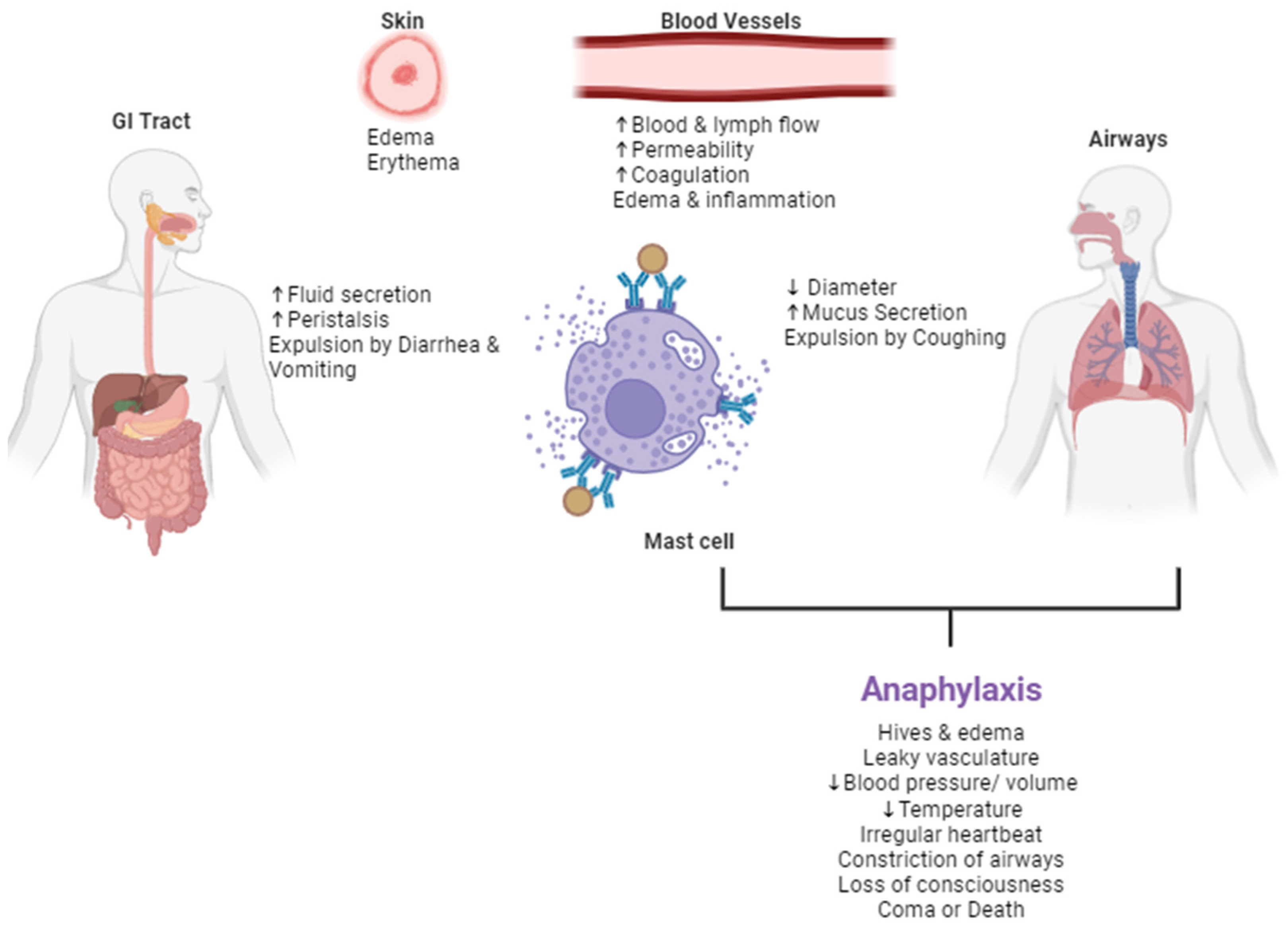
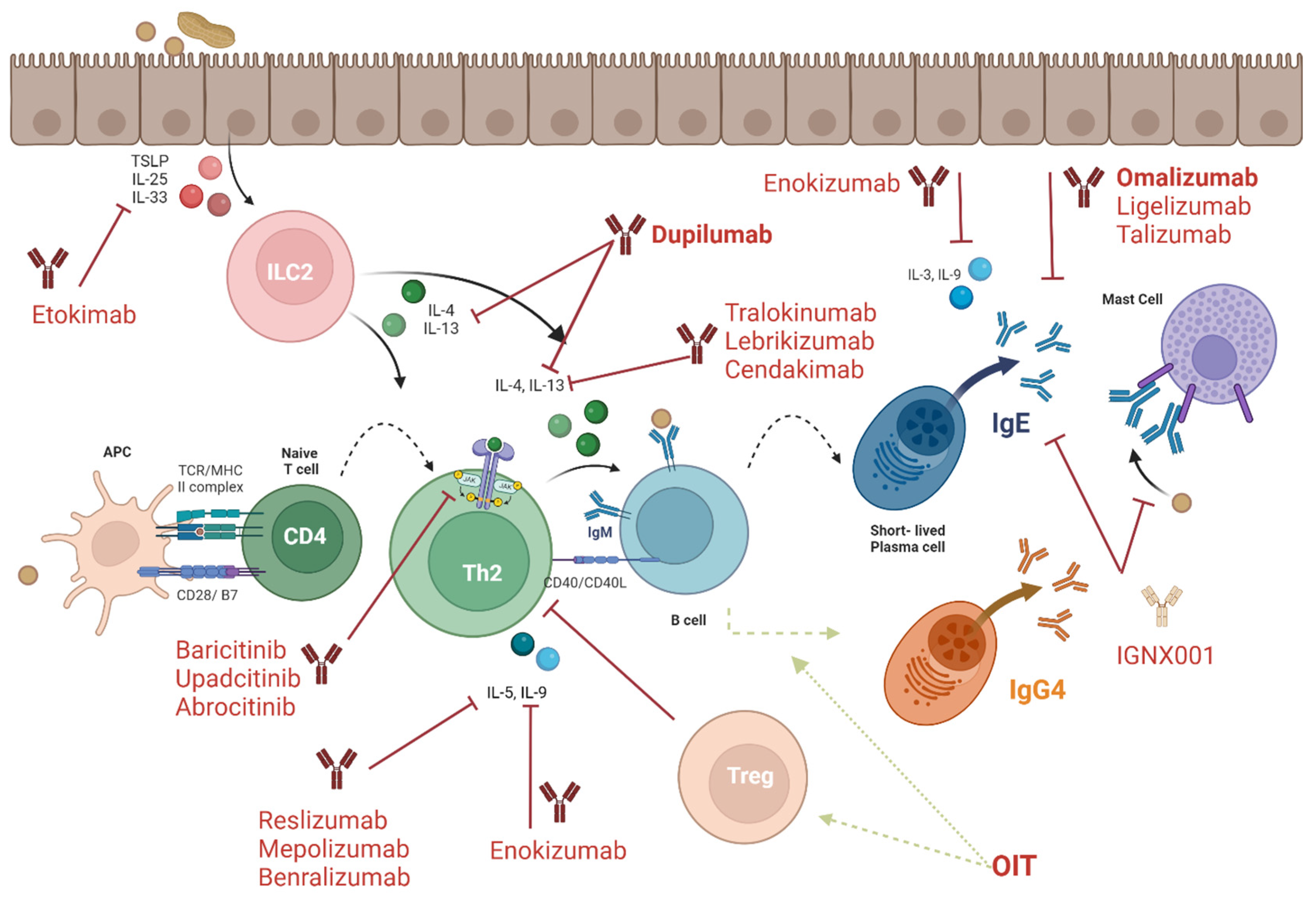

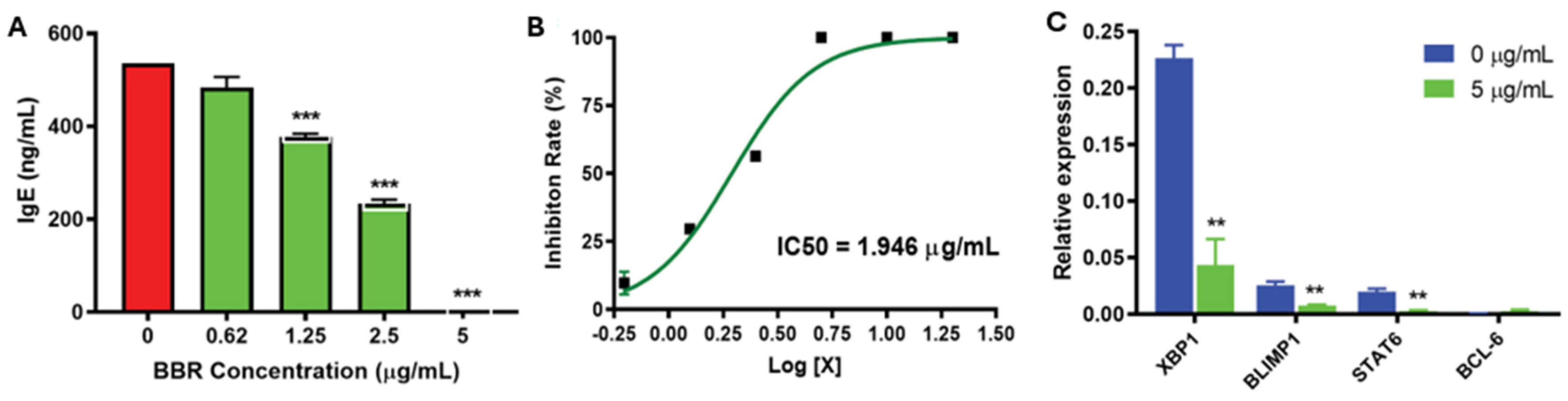

| Number | Treatment | Condition | Status |
|---|---|---|---|
| Biologics | |||
| NCT02643862 | Omalizumab | Multi-food allergy | Completed |
| NCT01157117 | Omalizumab + OIT | Cow milk allergy | Completed |
| NCT02920021 | Etokamib | Peanut allergy | Completed |
| NCT03881696 NCT01510626 | Omalizumab + OIT | Multi-food allergy | Active, not recruiting |
| NCT03682770 | Dupilumab + OIT | Peanut allergy | Completed |
| NCT04148352 | Dupilumab + OIT | Cow milk allergy | Recruiting |
| NCT00932282 | Omalizumab + OIT | Peanut allergy | Completed |
| NCT04943744 | Omalizumab + Dupilumab + OIT | Multi-food allergy | Enrolling by invitation |
| Immunotherapy | |||
| NCT00932828 NCT04222491 NCT00597675 NCT01814241 NCT03907397 NCT01867671 NCT00815035 NCT01324401 NCT02203799 NCT01750879 NCT03736447 NCT01891136 NCT03251508 NCT04603300 NCT02635776 NCT01274429 NCT01074840 NCT02993107 NCT01987817 NCT03292484 NCT03352726 NCT02198664 NCT03126227 NCT03337542 | OIT | Peanut allergy | Completed |
| NCT05621317 | OIT | Peanut allergy | Recruiting |
| NCT04090203 | OIT | Peanut allergy | Active, not recruiting |
| NCT00461097 NCT04056299 NCT01846208 | OIT | Egg allergy | Completed |
| NCT00429429 NCT00597727 NCT01373242 NCT00580606 NCT02304991 NCT02991885 | SIT | Peanut allergy | Completed |
| NCT05440642 | SIT | Peanut allergy | Recruiting |
| NCT02350660 | OIT | Peanut and mammalian meat allergy | Completed |
| NCT04856865 NCT01490177 | OIT | Multi-food allergy | Completed |
| NCT03504774 | OIT | Shrimp and cashew allergy | Terminated |
| NCT03181009 | Multi-OIT | Multi-food allergy | Completed |
| NCT01904604 NCT01170286 NCT01675882 NCT02636699 NCT01955109 | EIT | Peanut allergy | Completed |
| NCT05741476 | EIT | Peanut allergy | Recruiting |
| NCT05424731 | EIT | Peanut allergy | Available |
| NCT03211247 | EIT | Peanut allergy | Active, not recruiting |
| NCT03859700 | EIT | Peanut allergy | Recruiting by invitation |
| NCT02223182 NCT02579876 | EIT | Milk allergy | Completed |
| NCT00732654 | OIT + SIT | Milk allergy | Completed |
| NCT01162473 NCT00465569 NCT03462030 | OIT | Milk allergy | Completed |
| NCT01084174 | OIT + SIT | Peanut allergy | Completed |
| NCT01980992 | OIT | Wheat allergy | Completed |
| NCT0546753 | OIT | Tree nut allergy | Completed |
| Natural Products | |||
| NCT00602160 | FAHF-2TM | Multi-food allergy | Unknown |
| NCT02879006 | EB-FAHF-2, Multi-OIT and Omalizumab | Multi-food allergy | Unknown |
| Probiotics | |||
| NCT05138757 | Prebiotic + OIT | Peanut allergy | Recruiting |
| NCT03936998 | Postbioitc + Antibiotic + OIT | Peanut allergy | Recruiting |
| NCT00664768 | Prebiotic + Probiotic | Milk allergy | Completed |
| NCT02960074 | Fecal microbiota transplant | Peanut allergy | Completed |
Disclaimer/Publisher’s Note: The statements, opinions and data contained in all publications are solely those of the individual author(s) and contributor(s) and not of MDPI and/or the editor(s). MDPI and/or the editor(s) disclaim responsibility for any injury to people or property resulting from any ideas, methods, instructions or products referred to in the content. |
© 2025 by the authors. Licensee MDPI, Basel, Switzerland. This article is an open access article distributed under the terms and conditions of the Creative Commons Attribution (CC BY) license (https://creativecommons.org/licenses/by/4.0/).
Share and Cite
Carnazza, M.; Werner, R.; Tiwari, R.K.; Geliebter, J.; Li, X.-M.; Yang, N. The Etiology of IgE-Mediated Food Allergy: Potential Therapeutics and Challenges. Int. J. Mol. Sci. 2025, 26, 1563. https://doi.org/10.3390/ijms26041563
Carnazza M, Werner R, Tiwari RK, Geliebter J, Li X-M, Yang N. The Etiology of IgE-Mediated Food Allergy: Potential Therapeutics and Challenges. International Journal of Molecular Sciences. 2025; 26(4):1563. https://doi.org/10.3390/ijms26041563
Chicago/Turabian StyleCarnazza, Michelle, Robert Werner, Raj K. Tiwari, Jan Geliebter, Xiu-Min Li, and Nan Yang. 2025. "The Etiology of IgE-Mediated Food Allergy: Potential Therapeutics and Challenges" International Journal of Molecular Sciences 26, no. 4: 1563. https://doi.org/10.3390/ijms26041563
APA StyleCarnazza, M., Werner, R., Tiwari, R. K., Geliebter, J., Li, X.-M., & Yang, N. (2025). The Etiology of IgE-Mediated Food Allergy: Potential Therapeutics and Challenges. International Journal of Molecular Sciences, 26(4), 1563. https://doi.org/10.3390/ijms26041563