Distribution Analysis of the Lifespan Trait in Drosophila
 , and
, and
Abstract
1. Introduction
‘I think it may fairly be assumed, in the light of what we now know, that no other measure will, statistically speaking, furnish so delicate and precise a measure of the general constitutional fitness of individuals as will their duration of life.’Raymond Pearl, 1923
2. Results
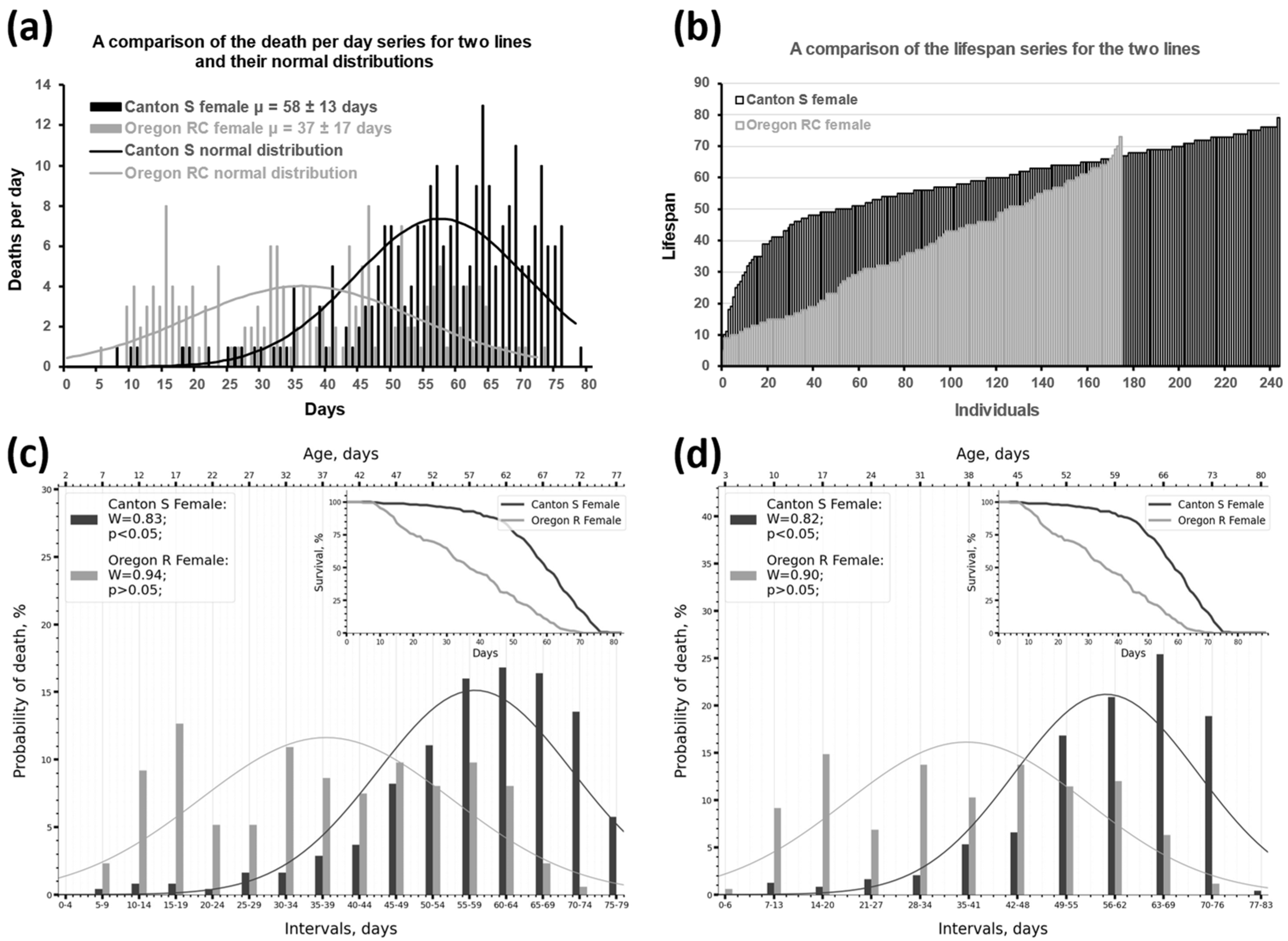
2.1. Dividing Survival Data into Intervals Enables an Effective Assessment of Phenotype Frequencies by Lifespan Within the Sample
2.2. Using Kolmogorov–Smirnov and Shapiro–Wilk Normality Tests to Describe the Parameters of the Lifespan Distribution
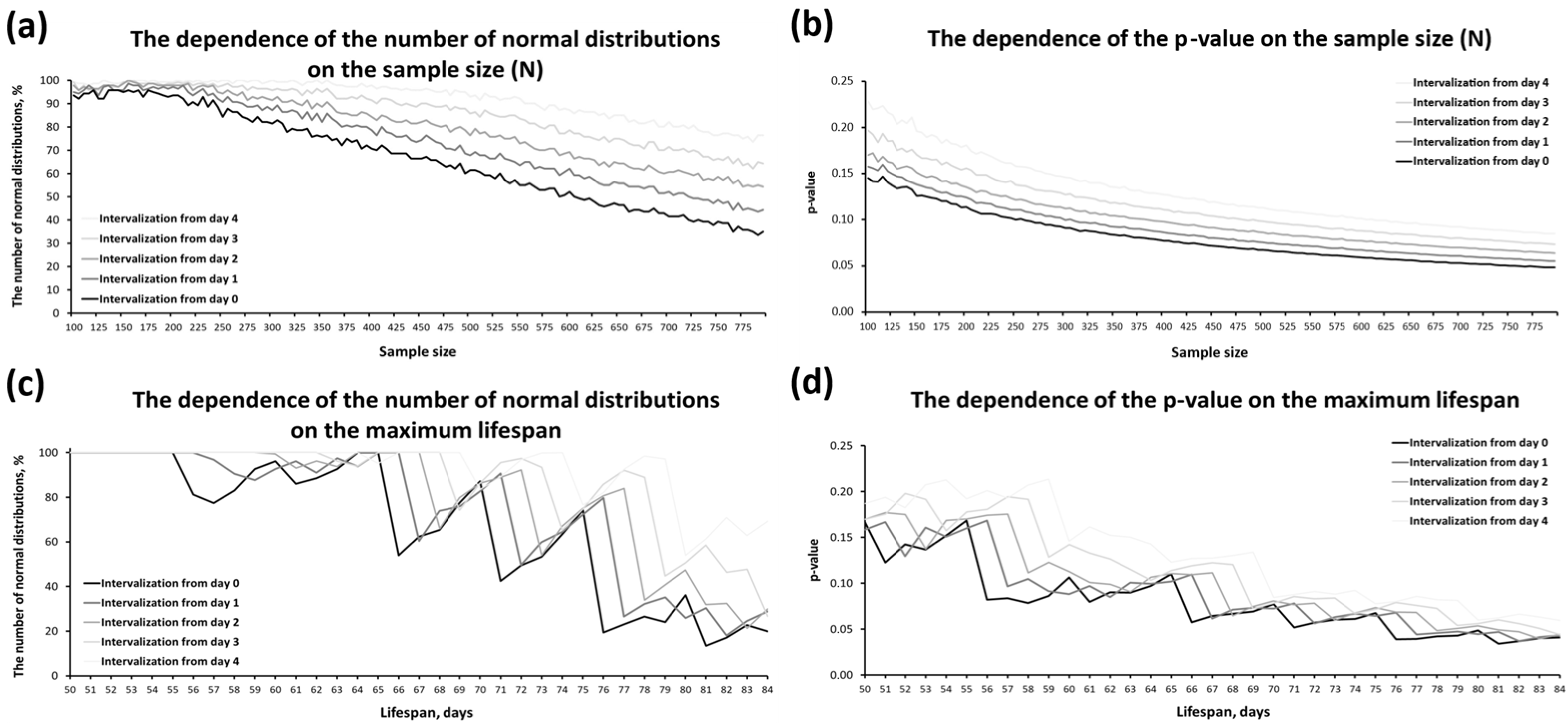
2.3. Peculiarities of SW Test Functioning Under Different Intervalization Conditions and on Samples of Various Types
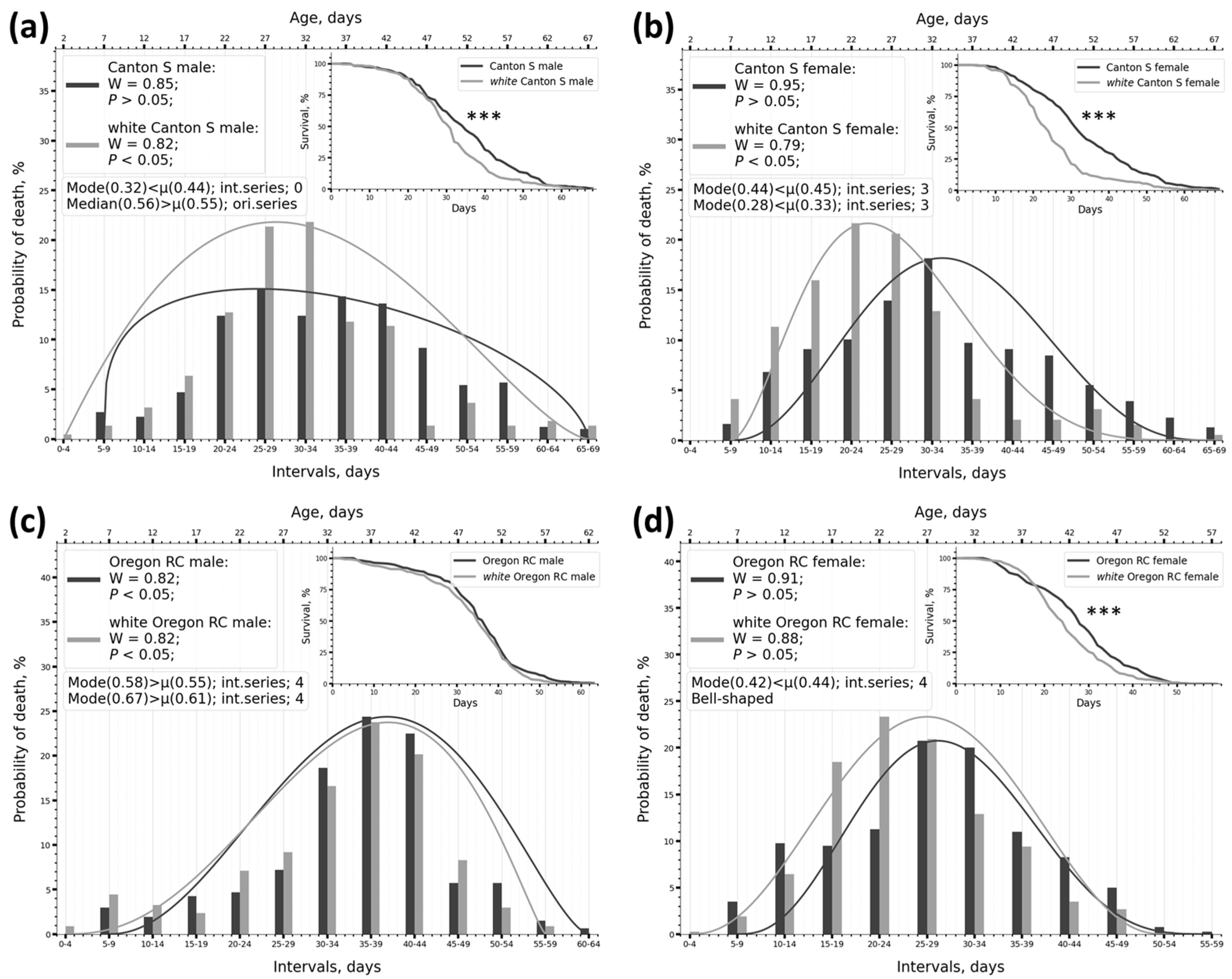
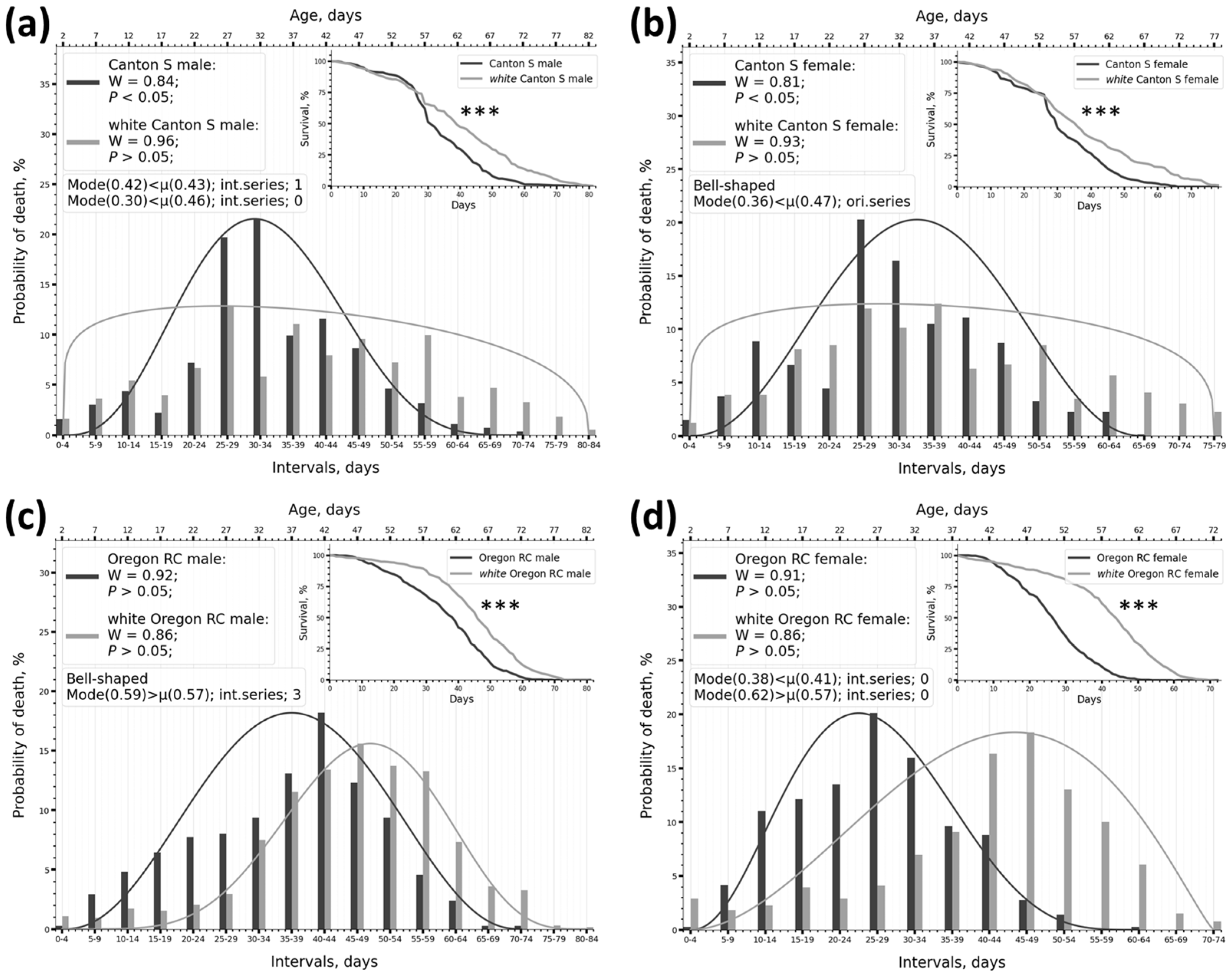
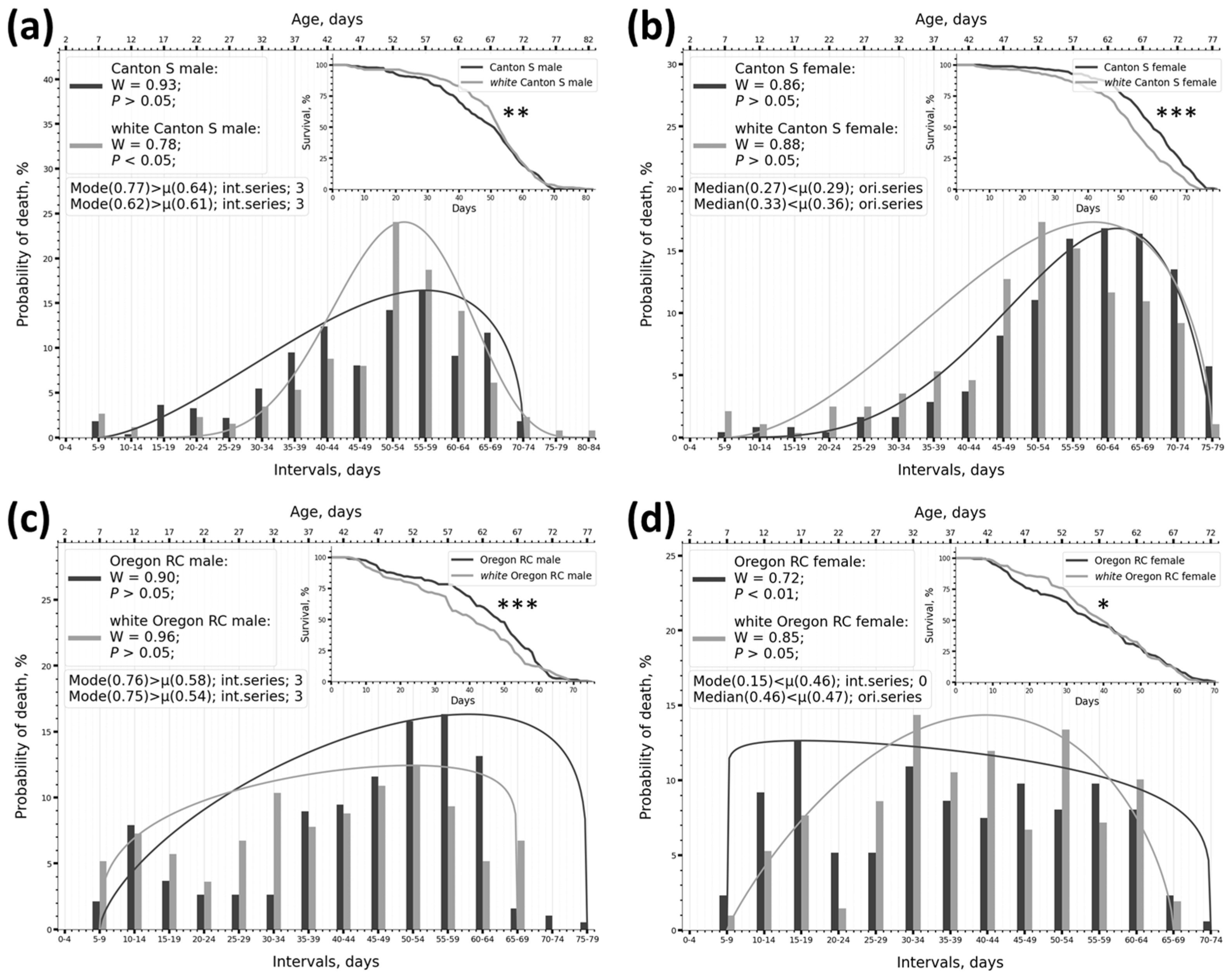
2.4. The Normality Criteria, the Beta Function, and the Normal Distribution Function Can Be Used to Describe the Effect of Genetic Interventions on the Distribution of Lifespan
3. Discussion
3.1. The Situation with the Study of Lifespan Distributions in General
3.2. The Destabilisation of Ontogenesis and Changes in Lifespan Distribution Under Genetic Interventions
3.3. Selection of Tests for Analysing Lifespan Data to Determine Normality
4. Materials and Methods
4.1. Drosophila Lines and Survival Data for Analysis
4.2. Partitioning Survival Data into Intervals (Obtaining Frequency/Probability Series of Lifespan)
4.3. Formal Description of Frequency/Probability Series of Phenotypes by Lifespan and Mortality Series Using the Normal Distribution Function
4.4. Kolmogorov–Smirnov Test Calculation for Single Samples
4.5. Calculation of the Two Sample Kolmogorov–Smirnov Test
4.6. Shapiro-Wilk Test Calculation for Single Samples
4.7. Calculating the β-Distribution of Lifespan
5. Conclusions
Supplementary Materials
Author Contributions
Funding
Institutional Review Board Statement
Informed Consent Statement
Data Availability Statement
Acknowledgments
Conflicts of Interest
References
- Falconer, D.S.; Mackay, T.F.C. Introduction to Quantitative Genetics; Longman: London, UK, 1996. [Google Scholar]
- Bylino, O.V.; Ogienko, A.A.; Batin, M.A.; Georgiev, P.G.; Omelina, E.S. Genetic, Environmental, and Stochastic Components of Lifespan Variability: The Drosophila Paradigm. Int. J. Mol. Sci. 2024, 25, 4482. [Google Scholar] [CrossRef]
- Olshansky, S.J.; Willcox, B.J.; Demetrius, L.; Beltrán-Sánchez, H. Implausibility of Radical Life Extension in Humans in the Twenty-First Century. Nat. Aging 2024, 4, 1635–1642. [Google Scholar] [CrossRef]
- Linford, N.J.; Bilgir, C.; Ro, J.; Pletcher, S.D. Measurement of Lifespan in Drosophila melanogaster. J. Vis. Exp. 2013, e50068. [Google Scholar] [CrossRef] [PubMed]
- He, Y.; Jasper, H. Studying Aging in Drosophila. Methods 2014, 68, 129–133. [Google Scholar] [CrossRef] [PubMed]
- Piper, M.D.W.; Partridge, L. Protocols to Study Aging in Drosophila. Methods Mol. Biol. 2016, 1478, 291–302. [Google Scholar] [CrossRef] [PubMed]
- Piper, M.D.W.; Partridge, L. Drosophila as a Model for Ageing. Biochim. Biophys. Acta (BBA)—Mol. Basis Dis. 2018, 1864, 2707–2717. [Google Scholar] [CrossRef] [PubMed]
- Ogienko, A.A.; Omelina, E.S.; Bylino, O.V.; Batin, M.A.; Georgiev, P.G.; Pindyurin, A.V. Drosophila as a Model Organism to Study Basic Mechanisms of Longevity. Int. J. Mol. Sci. 2022, 23, 11244. [Google Scholar] [CrossRef]
- Louka, X.P.; Gumeni, S.; Trougakos, I.P. Studying Cellular Senescence Using the Model Organism Drosophila melanogaster. Methods Mol. Biol. 2025, 2906, 281–299. [Google Scholar] [CrossRef]
- Na, H.-J.; Park, J.-S. Measuring Anti-Aging Effects in Drosophila. Bio Protoc. 2025, 15, e5305. [Google Scholar] [CrossRef]
- Pontillo, N.; Lyu, Y. Perception and Longevity Control in Invertebrate Model Organisms—A Mini-Review of Recent Advances. Biomolecules 2025, 15, 187. [Google Scholar] [CrossRef]
- Pearl, R.; Parker, S. Experimental Studies on the Duration of Life. V. A Comparison of the Laws of Mortality in Drosophila. Am. Nat. 1922, 56, 398–405. [Google Scholar] [CrossRef]
- Pearl, R. Duration of Life as an Index of Constitutional Fitness. Poult. Sci. 1923, 3, 1–10. [Google Scholar] [CrossRef]
- Pfenninger, M. The Effect of Offspring Number on the Adaptation Speed of a Polygenic Trait. bioRxiv 2017. [Google Scholar] [CrossRef]
- Krohs, U. Darwin’s Empirical Claim and the Janiform Character of Fitness Proxies. Biol. Philos. 2022, 37, 15. [Google Scholar] [CrossRef]
- Viblanc, V.A.; Saraux, C.; Tamian, A.; Criscuolo, F.; Coltman, D.W.; Raveh, S.; Murie, J.O.; Dobson, F.S. Measuring Fitness and Inferring Natural Selection from Long-Term Field Studies: Different Measures Lead to Nuanced Conclusions. Behav. Ecol. Sociobiol. 2022, 76, 79. [Google Scholar] [CrossRef]
- Orr, H.A. Fitness and Its Role in Evolutionary Genetics. Nat. Rev. Genet. 2009, 10, 531–539. [Google Scholar] [CrossRef] [PubMed]
- Flatt, T. Life-History Evolution and the Genetics of Fitness Components in Drosophila melanogaster. Genetics 2020, 214, 3–48. [Google Scholar] [CrossRef]
- Flatt, T.; Partridge, L. Horizons in the Evolution of Aging. BMC Biol. 2018, 16, 93. [Google Scholar] [CrossRef] [PubMed]
- Kaplan, E.L.; Meier, P. Nonparametric Estimation from Incomplete Observations. J. Am. Stat. Assoc. 1958, 53, 457–481. [Google Scholar] [CrossRef]
- Stalpers, L.J.A.; Kaplan, E.L.; Edward, L. Kaplan and the Kaplan-Meier Survival Curve. BSHM Bull. J. Br. Soc. Hist. Math. 2018, 33, 109–135. [Google Scholar] [CrossRef]
- Fleming, T.R.; O’Fallon, J.R.; O’Brien, P.C.; Harrington, D.P. Modified Kolmogorov-Smirnov Test Procedures with Application to Arbitrarily Right-Censored Data. Biometrics 1980, 36, 607–625. [Google Scholar] [CrossRef]
- Mantel, N. Evaluation of Survival Data and Two New Rank Order Statistics Arising in Its Consideration. Cancer Chemother. Rep. 1966, 50, 163–170. [Google Scholar] [PubMed]
- Bland, J.M.; Altman, D.G. The Logrank Test. BMJ 2004, 328, 1073. [Google Scholar] [CrossRef]
- Gehan, E.A. A Generalized Wilcoxon Test for Comparing Arbitrarily Singly-Censored Samples. Biometrika 1965, 52, 203–223. [Google Scholar] [CrossRef]
- Gehan, E.A. A Generalized Two-Sample Wilcoxon Test for Doubly Censored Data. Biometrika 1965, 52, 650–653. [Google Scholar] [CrossRef]
- Breslow, N. A Generalized Kruskal-Wallis Test for Comparing K Samples Subject to Unequal Patterns of Censorship. Biometrika 1970, 57, 579–594. [Google Scholar] [CrossRef]
- Martinez, R.L.M.C.; Naranjo, J.D. A Pretest for Choosing Between Logrank and Wilcoxon Tests in the Two-Sample Problem. METRON 2010, 68, 111–125. [Google Scholar] [CrossRef]
- Wang, C.; Li, Q.; Redden, D.T.; Weindruch, R.; Allison, D.B. Statistical Methods for Testing Effects on “Maximum Lifespan”. Mech. Ageing Dev. 2004, 125, 629–632. [Google Scholar] [CrossRef]
- Mehrotra, D.V.; Chan, I.S.F.; Berger, R.L. A Cautionary Note on Exact Unconditional Inference for a Difference Between Two Independent Binomial Proportions. Biometrics 2003, 59, 441–450. [Google Scholar] [CrossRef] [PubMed]
- Moskalev, A.; Shaposhnikov, M. Pharmacological Inhibition of NF-κB Prolongs Lifespan of Drosophila melanogaster. Aging 2011, 3, 391–394. [Google Scholar] [CrossRef]
- McHugh, M.L. The Chi-Square Test of Independence. Biochem. Med. 2013, 23, 143–149. [Google Scholar] [CrossRef]
- Cox, D.R. Regression Models and Life-Tables. J. R. Stat. Soc. Ser. B (Methodol.) 1972, 34, 187–202. [Google Scholar] [CrossRef]
- Katz, M.H.; Hauck, W.W. Proportional Hazards (Cox) Regression. J. Gen. Intern. Med. 1993, 8, 702–711. [Google Scholar] [CrossRef]
- Abd ElHafeez, S.; D’Arrigo, G.; Leonardis, D.; Fusaro, M.; Tripepi, G.; Roumeliotis, S. Methods to Analyze Time-to-Event Data: The Cox Regression Analysis. Oxid. Med. Cell. Longev. 2021, 2021, 1302811. [Google Scholar] [CrossRef]
- Deo, S.V.; Deo, V.; Sundaram, V. Survival Analysis—Part 2: Cox Proportional Hazards Model. Indian J. Thorac. Cardiovasc. Surg. 2021, 37, 229–233. [Google Scholar] [CrossRef]
- Kalbfleisch, J.D.; Schaubel, D.E. Fifty Years of the Cox Model. Annu. Rev. Stat. Its Appl. 2023, 10, 1–23. [Google Scholar] [CrossRef]
- Gregson, J.; Sharples, L.; Stone, G.W.; Burman, C.-F.; Öhrn, F.; Pocock, S. Nonproportional Hazards for Time-to-Event Outcomes in Clinical Trials. JACC 2019, 74, 2102–2112. [Google Scholar] [CrossRef] [PubMed]
- Crowther, M.J.; Royston, P.; Clements, M. A Flexible Parametric Accelerated Failure Time Model and the Extension to Time-Dependent Acceleration Factors. Biostatistics 2022, 24, 811–831. [Google Scholar] [CrossRef]
- Kirkwood, T.B.L. Deciphering Death: A Commentary on Gompertz (1825) ‘On the Nature of the Function Expressive of the Law of Human Mortality, and on a New Mode of Determining the Value of Life Contingencies’. Philos. Trans. R. Soc. Lond. B Biol. Sci. 2015, 370, 20140379. [Google Scholar] [CrossRef]
- Lucanic, M.; Plummer, W.T.; Chen, E.; Harke, J.; Foulger, A.C.; Onken, B.; Coleman-Hulbert, A.L.; Dumas, K.J.; Guo, S.; Johnson, E.; et al. Impact of Genetic Background and Experimental Reproducibility on Identifying Chemical Compounds with Robust Longevity Effects. Nat. Commun. 2017, 8, 14256. [Google Scholar] [CrossRef]
- Banse, S.A.; Lucanic, M.; Sedore, C.A.; Coleman-Hulbert, A.L.; Plummer, W.T.; Chen, E.; Kish, J.L.; Hall, D.; Onken, B.; Presley, M.P.; et al. Automated Lifespan Determination Across Caenorhabditis Strains and Species Reveals Assay-Specific Effects of Chemical Interventions. GeroScience 2019, 41, 945–960. [Google Scholar] [CrossRef]
- Woodruff, G.C.; Johnson, E.; Phillips, P.C. A Large Close Relative of C. elegans Is Slow-Developing but Not Long-Lived. BMC Evol. Biol. 2019, 19, 74. [Google Scholar] [CrossRef]
- Phelps, G.B.; Morin, J.; Pinto, C.; Schoenfeldt, L.; Guilmot, S.; Ocampo, A.; Perez, K. Comprehensive Evaluation of Lifespan-extending Molecules in C. elegans. Aging Cell 2025, 24, e14424. [Google Scholar] [CrossRef]
- Swindell, W.R. Accelerated Failure Time Models Provide a Useful Statistical Framework for Aging Research. Exp. Gerontol. 2009, 44, 190–200. [Google Scholar] [CrossRef]
- Stroustrup, N.; Anthony, W.E.; Nash, Z.M.; Gowda, V.; Gomez, A.; López-Moyado, I.F.; Apfeld, J.; Fontana, W. The Temporal Scaling of Caenorhabditis elegans Ageing. Nature 2016, 530, 103–107. [Google Scholar] [CrossRef]
- Sturges, H.A. The Choice of a Class Interval. J. Am. Stat. Assoc. 1926, 21, 65–66. [Google Scholar] [CrossRef]
- Morgan, T.H. Sex Limited Inheritance in Drosophila. Science 1910, 32, 120–122. [Google Scholar] [CrossRef]
- Green, M.M. 2010: A Century of Drosophila Genetics Through the Prism of the White Gene. Genetics 2010, 184, 3–7. [Google Scholar] [CrossRef]
- Myers, J.; Porter, M.; Narwold, K.; Bhat, K.; Dauwalder, B.; Roman, G. Mutants of the White ABCG Transporter in Drosophila melanogaster Have Deficient Olfactory Learning and Cholesterol Homeostasis. Int. J. Mol. Sci. 2021, 22, 12967. [Google Scholar] [CrossRef]
- Sasaki, A.; Nishimura, T.; Takano, T.; Naito, S.; Yoo, S.K. White Regulates Proliferative Homeostasis of Intestinal Stem Cells During Ageing in Drosophila. Nat. Metab. 2021, 3, 546–557. [Google Scholar] [CrossRef]
- Xiao, C.; Qiu, S. Frequency-Specific Modification of Locomotor Components by the White Gene in Drosophila melanogaster Adult Flies. Genes. Brain Behav. 2021, 20, e12703. [Google Scholar] [CrossRef]
- Mendoza-Grimau, V.; Pérez-Gálvez, A.; Busturia, A.; Fontecha, J. Lipidomic Profiling of Drosophila Strains Canton-S and White1118 Reveals Intraspecific Lipid Variations in Basal Metabolic Rate. Prostaglandins Leukot. Essent. Fat. Acids 2024, 201, 102618. [Google Scholar] [CrossRef]
- Rickle, A.; Sudhakar, K.; Booms, A.; Stirtz, E.; Lempradl, A. More than Meets the Eye: Mutation of the white Gene in Drosophila Has Broad Phenotypic and Transcriptomic Effects. Genetics 2025, 230, iyaf097. [Google Scholar] [CrossRef]
- Robertson, H.T.; Allison, D.B. A Novel Generalized Normal Distribution for Human Longevity and Other Negatively Skewed Data. PLoS ONE 2012, 7, e37025, Erratum in PLoS ONE 2016, 11, e0151123. [Google Scholar] [CrossRef]
- Skulachev, V.P.; Shilovsky, G.A.; Putyatina, T.S.; Popov, N.A.; Markov, A.V.; Skulachev, M.V.; Sadovnichii, V.A. Perspectives of Homo Sapiens Lifespan Extension: Focus on External or Internal Resources? Aging 2020, 12, 5566–5584. [Google Scholar] [CrossRef]
- O’Neill, D.G.; Church, D.B.; McGreevy, P.D.; Thomson, P.C.; Brodbelt, D.C. Longevity and Mortality of Owned Dogs in England. Vet. J. 2013, 198, 638–643. [Google Scholar] [CrossRef]
- O’Neill, D.G.; Church, D.B.; McGreevy, P.D.; Thomson, P.C.; Brodbelt, D.C. Longevity and Mortality of Cats Attending Primary Care Veterinary Practices in England. J. Feline Med. Surg. 2015, 17, 125–133. [Google Scholar] [CrossRef]
- Adams, V.J.; Evans, K.M.; Sampson, J.; Wood, J.L.N. Methods and Mortality Results of a Health Survey of Purebred Dogs in the UK. J. Small Anim. Pract. 2010, 51, 512–524. [Google Scholar] [CrossRef]
- Ezcurra, M.; Benedetto, A.; Sornda, T.; Gilliat, A.F.; Au, C.; Zhang, Q.; van Schelt, S.; Petrache, A.L.; Wang, H.; de la Guardia, Y.; et al. C. elegans Eats Its Own Intestine to Make Yolk Leading to Multiple Senescent Pathologies. Curr. Biol. 2018, 28, 2544–2556. [Google Scholar] [CrossRef]
- Kern, C.C.; Srivastava, S.; Ezcurra, M.; Hsiung, K.C.; Hui, N.; Townsend, S.; Maczik, D.; Zhang, B.; Tse, V.; Konstantellos, V.; et al. C. elegans Ageing Is Accelerated by a Self-Destructive Reproductive Programme. Nat. Commun. 2023, 14, 4381. [Google Scholar] [CrossRef]
- Chen, J.; Senturk, D.; Wang, J.-L.; Muller, H.-G.; Carey, J.R.; Caswell, H.; Caswell-Chen, E.P. A Demographic Analysis of the Fitness Cost of Extended Longevity in Caenorhabditis elegans. J. Gerontol. Ser. A Biol. Sci. Med. Sci. 2007, 62, 126–135. [Google Scholar] [CrossRef] [PubMed]
- Clancy, D.; Chtarbanova, S.; Broughton, S. Editorial: Model Organisms in Aging Research: Drosophila melanogaster. Front. Aging 2023, 3, 1118299. [Google Scholar] [CrossRef]
- Izmaĭlov, D.M.; Obukhova, L.K. Analysis of the life span distribution mode in 128 successive generations of D. melanogaster. Adv. Gerontol. 2004, 15, 30–35. [Google Scholar]
- Azzalini, A. The Skew-Normal Distribution and Related Multivariate Families. Scand. J. Stat. 2005, 32, 159–188. [Google Scholar] [CrossRef]
- Arnastauskaitė, J.; Ruzgas, T.; Bražėnas, M. An Exhaustive Power Comparison of Normality Tests. Mathematics 2021, 9, 788. [Google Scholar] [CrossRef]
- Facchinetti, S. A Procedure to Find Exact Critical Values of Kolmogorov-Smirnov Test. Stat. Appl.—Ital. J. Appl. Stat. 2009, 21, 337–359. [Google Scholar]
- Simard, R.; L’Ecuyer, P. Computing the Two-Sided Kolmogorov-Smirnov Distribution. J. Stat. Softw. 2011, 39, 1–18. [Google Scholar] [CrossRef]
- Royston, P. A Toolkit for Testing for Non-Normality in Complete and Censored Samples. J. R. Stat. Soc. Ser. D (Stat.) 1993, 42, 37–43. [Google Scholar] [CrossRef]
- Mara, U.T. Power Comparisons of Shapiro-Wilk, Kolmogorov-Smirnov, Lilliefors and Anderson-Darling Tests. J. Stat. Model. Anal. 2011, 2, 21–33. [Google Scholar]
- Kolmogoroff, A. Sulla Determinazione Empirica Di Una Legge Di Distribuzione. G. Dell’ Ist. Ital. Degli Attuari 1933, 4, 83–91. [Google Scholar]
- Feller, W. On the Kolmogorov-Smirnov Limit Theorems for Empirical Distributions. Ann. Math. Stat. 1948, 19, 177–189, Correction in Ann. Math. Stat. 1950, 21, 301–302. [Google Scholar] [CrossRef]
- Smirnov, N. On the Estimation of the Discrepancy Between Critical Curves of Distribution of Two Independent Samples. Bull. Math. Univ. Moscou 1939, 2, 3–26. [Google Scholar]
- Marsaglia, G.; Tsang, W.W.; Wang, J. Evaluating Kolmogorov’s Distribution. J. Stat. Softw. 2003, 8, 1–4. [Google Scholar] [CrossRef]
- Lilliefors, H.W. On the Kolmogorov-Smirnov Test for Normality with Mean and Variance Unknown. J. Am. Stat. Assoc. 1967, 62, 399–402. [Google Scholar] [CrossRef]
- Johnson, N.L. Systems of Frequency Curves Generated by Methods of Translation. Biometrika 1949, 36, 149–176. [Google Scholar] [CrossRef]
- Shapiro, S.S.; Wilk, M.B. An Analysis of Variance Test for Normality (Complete Samples). Biometrika 1965, 52, 591–611. [Google Scholar] [CrossRef]
- Chakraborty, T.S.; Gendron, C.M.; Lyu, Y.; Munneke, A.S.; DeMarco, M.N.; Hoisington, Z.W.; Pletcher, S.D. Sensory Perception of Dead Conspecifics Induces Aversive Cues and Modulates Lifespan Through Serotonin in Drosophila. Nat. Commun. 2019, 10, 2365. [Google Scholar] [CrossRef]
- Lin, Y.-C.; Zhang, M.; Wang, S.-H.; Chieh, C.-W.; Shen, P.-Y.; Chen, Y.-L.; Chang, Y.-C.; Kuo, T.-H. The Deleterious Effects of Old Social Partners on Drosophila Lifespan and Stress Resistance. npj Aging 2022, 8, 1. [Google Scholar] [CrossRef]
- Bushey, D.; Hughes, K.A.; Tononi, G.; Cirelli, C. Sleep, Aging, and Lifespan in Drosophila. BMC Neurosci. 2010, 11, 56. [Google Scholar] [CrossRef] [PubMed]
- Smirnov, N. Table for Estimating the Goodness of Fit of Empirical Distributions. Ann. Math. Stat. 1948, 19, 279–281. [Google Scholar] [CrossRef]
- Miller, L.H. Table of Percentage Points of Kolmogorov Statistics. J. Am. Stat. Assoc. 1956, 51, 111–121. [Google Scholar] [CrossRef]
- Massey, F.J. The Kolmogorov-Smirnov Test for Goodness of Fit. J. Am. Stat. Assoc. 1951, 46, 68–78. [Google Scholar] [CrossRef]
- Hodges, J.L. The Significance Probability of the Smirnov Two-Sample Test. Ark. Mat. 1958, 3, 469–486. [Google Scholar] [CrossRef]
- Warne, R.T. Statistics for the Social Sciences: A General Linear Model Approach, 2nd ed.; Cambridge University Press: Cambridge, UK, 2017. [Google Scholar]
- Royston, P. Remark AS R94: A Remark on Algorithm AS 181: The W-Test for Normality. J. R. Stat. Soc. Ser. C (Appl. Stat.) 1995, 44, 547–551. [Google Scholar] [CrossRef]
- Cramer, H. Mathematical Methods of Statistics; Princeton University Press: Princeton, NJ, USA, 1957; Volume 7. [Google Scholar]



| 1 | 2 | 3 | 4 | 5 | 6 | 7 | 8 | 9 | 10 | 11 | 12 | 13 | 14 | 15 |
|---|---|---|---|---|---|---|---|---|---|---|---|---|---|---|
| Genotype | Sex | µ, Days | σ, Days | SW Test w/o Intervals | SW Test Intervals | KS Test w/o Intervals | KS Test Intervals | Two Sample KS Test (WT vs. Mut.) | Number of Intervals | Sample Size | ||||
| W | p-Value * | W | p-Value | Dn | p-Value | Dn | p-Value | N | ||||||
| Canton S | M | 34.8 | ± 12.7 | 0.99 | 0.036 not norm. | 0.89 | 0.091 norm. | 0.05 | 0.285 norm. | 0.20 | 0.646 norm. | – | 13 | 404 |
| F | 33.1 | ± 13.5 | 0.98 | 0.001 not norm | 0.94 | 0.478 norm. | 0.07 | 0.091 norm. | 0.15 | 0.917 norm. | 13 | 308 | ||
| w1118 Canton S | M | 31.6 | ± 11.2 | 0.97 | <0.0001 not norm. | 0.80 | 0.005 not norm. | 0.10 | 0.018 not norm. | 0.26 | 0.307 not norm ** | p < 0.001 *** | 14 | 220 |
| F | 25.2 | ± 10.7 | 0.92 | <0.0001 not norm. | 0.84 | 0.019 not norm. | 0.12 | 0.011 not norm. | 0.30 | 0.197 not norm ** | p < 0.001 | 13 | 194 | |
| Oregon RC | M | 35.2 | ± 10.4 | 0.96 | <0.0001 not norm. | 0.78 | 0.005 not norm. | 0.10 | <0.0001 not norm. | 0.31 | 0.212 not norm ** | – | 12 | 472 |
| F | 27.9 | ± 10.6 | 0.98 | 0.0001 not norm. | 0.92 | 0.324 norm. | 0.06 | 0.115 norm. | 0.19 | 0.834 norm. | 11 | 400 | ||
| w1118 Oregon RC | M | 33.7 | ± 10.9 | 0.95 | <0.0001 not norm. | 0.85 | 0.034 not norm. | 0.11 | 0.001 not norm. | 0.20 | 0.702 norm. | p > 0.05 | 12 | 337 |
| F | 25.1 | ± 8.7 | 0.98 | 0.0004 not norm. | 0.88 | 0.106 norm. | 0.08 | 0.019 not norm. | 0.21 | 0.725 norm. | p < 0.001 | 11 | 373 | |
| 1 | 2 | 3 | 4 | 5 | 6 | 7 | 8 | 9 | 10 | 11 | 12 | 13 | 14 | 15 |
|---|---|---|---|---|---|---|---|---|---|---|---|---|---|---|
| Genotype | Sex | µ, Days | σ, Days | SW test w/o Intervals | SW Test Intervals | KS Test w/o Intervals | KS Test Intervals | Two Sample KS Test (WT vs. Mut.) | Number of Intervals | Sample Size | ||||
| W | p-Value * | W | p-Value | Dn | p-Value | Dn | p-Value | N | ||||||
| Canton S | M | 33.3 | ± 12.7 | 0.98 | <0.0001 not norm. | 0.83 | 0.010 not norm. | 0.09 | <0.0001 not norm. | 0.22 | 0.443 norm. | – | 15 | 817 |
| F | 31.2 | ± 13.3 | 0.99 | <0.0001 not norm. | 0.90 | 0.123 norm. | 0.11 | <0.0001 not norm. | 0.18 | 0.740 norm. | 14 | 676 | ||
| w67c23 Canton S | M | 39.7 | ± 18.2 | 0.99 | 0.0001 not norm. | 0.97 | 0.756 norm. | 0.06 | 0.020 not norm. | 0.12 | 0.960 not norm. ** | p < 0.0001 *** | 17 | 552 |
| F | 37.5 | ± 18.0 | 0.98 | <0.0001 not norm. | 0.94 | 0.408 norm. | 0.07 | 0.012 not norm. | 0.18 | 0.654 norm. | p < 0.0001 | 16 | 493 | |
| Oregon RC | M | 36.4 | ± 13.7 | 0.98 | <0.0001 not norm. | 0.94 | 0.417 norm. | 0.08 | 0.013 not norm. | 0.11 | 0.994 norm. | – | 15 | 374 |
| F | 26.7 | ± 10.5 | 0.99 | 0.0075 not norm. | 0.92 | 0.232 norm. | 0.05 | 0.254 norm. | 0.17 | 0.839 norm. | 13 | 363 | ||
| w67c23 Oregon RC | M | 45.6 | ± 14.2 | 0.97 | <0.0001 not norm. | 0.84 | 0.008 not norm. | 0.06 | 0.019 not norm. | 0.25 | 0.222 not norm ** | p < 0.0001 | 17 | 641 |
| F | 41.7 | ± 14.9 | 0.94 | <0.0001 not norm. | 0.87 | 0.039 not norm. | 0.12 | <0.0001 not norm. | 0.22 | 0.479 not norm ** | p < 0.0001 | 15 | 660 | |
| 1 | 2 | 3 | 4 | 5 | 6 | 7 | 8 | 9 | 10 | 11 | 12 | 13 | 14 | 15 |
|---|---|---|---|---|---|---|---|---|---|---|---|---|---|---|
| Genotype | Sex | µ, Days | σ, Days | SW test w/o Intervals | SW Test Intervals | KS Test w/o Intervals | KS Test Intervals | Two Sample KS Test (WT vs. Mut.) | Number of Intervals | Sample Size | ||||
| W | p-Value * | W | p-Value * | Dn | p-Value * | Dn | p-Value * | N | ||||||
| Canton S | M | 47.9 | ± 14.9 | 0.95 | <0.0001 not norm. | 0.92 | 0.251 norm. | 0.11 | 0.003 not norm. | 0.19 | 0.720 norm. | – | 14 | 274 |
| F | 58.3 | ± 13.2 | 0.92 | <0.0001 not norm. | 0.83 | 0.010 not norm. | 0.09 | 0.046 not norm. | 0.22 | 0.473 norm. | 15 | 244 | ||
| w67c23 Canton S | M | 50.7 | ± 13.8 | 0.92 | <0.0001 not norm. | 0.80 | 0.003 not norm. | 0.15 | <0.0001 not norm. | 0.22 | 0.406 not norm. ** | p = 0.005 *** | 16 | 262 |
| F | 52.2 | ± 14.7 | 0.93 | <0.0001 not norm. | 0.89 | 0.063 norm. | 0.12 | 0.001 not norm. | 0.20 | 0.594 norm. | p < 0.0001 | 15 | 283 | |
| Oregon RC | M | 44.6 | ± 16.5 | 0.92 | <0.0001 not norm. | 0.87 | 0.036 not norm. | 0.13 | 0.003 not norm. | 0.24 | 0.332 not norm. ** | – | 15 | 190 |
| F | 37.2 | ± 17.4 | 0.96 | <0.0001 not norm. | 0.94 | 0.407 norm. | 0.09 | 0.098 norm. | 0.18 | 0.773 norm. | 14 | 175 | ||
| w67c23 Oregon RC | M | 39.4 | ± 17.4 | 0.96 | <0.0001 not norm. | 0.98 | 0.946 norm. | 0.10 | 0.043 not norm. | 0.11 | 0.996 norm. | p < 0.001 | 13 | 193 |
| F | 39.5 | ± 15.3 | 0.97 | 0.0002 not norm. | 0.95 | 0.587 norm. | 0.08 | 0.127 norm. | 0.14 | 0.951 norm. | p = 0.040 | 14 | 209 | |
| 1 | 2 | 3 | 4 | 5 | 6 | 7 | 8 | 9 | 11 | 12 | 13 | 14 | 15 | 16 | 17 | 18 | 19 |
|---|---|---|---|---|---|---|---|---|---|---|---|---|---|---|---|---|---|
| Genotype | Sex | µ, Days | Internalization * from | ||||||||||||||
| Day 0 | Day 1 | Day 2 | Day 3 | Day 4 | |||||||||||||
| W | p- Value ** | Number of Intervals | W | p-Value | Number of Intervals | W | p-Value | Number of Intervals | W | p-Value | Number of Intervals | W | p- Value | Number of Intervals | |||
| w1118 (2024) | |||||||||||||||||
| Canton S | M | 34.8 | 0.89 | 0.091 | 13 | 0.91 | 0.153 | 14 | 0.87 | 0.038 | 14 | 0.91 | 0.146 | 14 | 0.92 | 0.271 | 13 |
| F | 33.1 | 0.94 | 0.478 | 13 | 0.93 | 0.262 | 14 | 0.94 | 0.457 | 14 | 0.92 | 0.242 | 14 | 0.93 | 0.282 | 14 | |
| w1118 Canton S | M | 31.6 | 0.80 | 0.005 | 14 | 0.82 | 0.008 | 14 | 0.81 | 0.006 | 14 | 0.78 | 0.004 | 13 | 0.81 | 0.008 | 13 |
| F | 25.2 | 0.84 | 0.019 | 13 | 0.83 | 0.017 | 13 | 0.81 | 0.009 | 13 | 0.80 | 0.006 | 13 | 0.79 | 0.005 | 13 | |
| Oregon RC | M | 35.2 | 0.78 | 0.005 | 12 | 0.81 | 0.014 | 12 | 0.81 | 0.009 | 13 | 0.80 | 0.007 | 13 | 0.76 | 0.003 | 12 |
| F | 27.9 | 0.92 | 0.324 | 11 | 0.93 | 0.400 | 11 | 0.95 | 0.654 | 11 | 0.92 | 0.294 | 12 | 0.92 | 0.289 | 12 | |
| w1118 Oregon RC | M | 33.7 | 0.85 | 0.034 | 12 | 0.85 | 0.034 | 12 | 0.83 | 0.023 | 12 | 0.81 | 0.017 | 11 | 0.82 | 0.020 | 11 |
| F | 25.1 | 0.88 | 0.106 | 11 | 0.90 | 0.239 | 10 | 0.88 | 0.135 | 10 | 0.86 | 0.086 | 10 | 0.89 | 0.176 | 10 | |
| w67c23 (2024) | |||||||||||||||||
| Canton S | M | 33.3 | 0.83 | 0.010 | 15 | 0.77 | 0.002 | 15 | 0.80 | 0.004 | 15 | 0.87 | 0.029 | 15 | 0.87 | 0.039 | 14 |
| F | 31.2 | 0.90 | 0.123 | 14 | 0.77 | 0.003 | 13 | 0.74 | 0.001 | 13 | 0.93 | 0.305 | 13 | 0.90 | 0.157 | 13 | |
| w67c23 Canton S | M | 39.7 | 0.97 | 0.756 | 17 | 0.95 | 0.456 | 17 | 0.93 | 0.254 | 16 | 0.92 | 0.158 | 16 | 0.95 | 0.521 | 16 |
| F | 37.5 | 0.94 | 0.408 | 16 | 0.96 | 0.699 | 16 | 0.98 | 0.965 | 16 | 0.95 | 0.433 | 16 | 0.96 | 0.713 | 15 | |
| Oregon RC | M | 36.4 | 0.94 | 0.417 | 15 | 0.93 | 0.314 | 14 | 0.93 | 0.298 | 14 | 0.94 | 0.381 | 14 | 0.96 | 0.650 | 14 |
| F | 26.7 | 0.92 | 0.232 | 13 | 0.91 | 0.222 | 12 | 0.93 | 0.393 | 12 | 0.90 | 0.161 | 12 | 0.92 | 0.267 | 12 | |
| w67c23 Oregon RC | M | 45.6 | 0.84 | 0.008 | 17 | 0.87 | 0.019 | 17 | 0.87 | 0.029 | 16 | 0.87 | 0.028 | 16 | 0.87 | 0.030 | 16 |
| F | 41.7 | 0.87 | 0.039 | 15 | 0.87 | 0.035 | 15 | 0.88 | 0.055 | 15 | 0.86 | 0.027 | 14 | 0.89 | 0.088 | 14 | |
| w67c23 (2012) | |||||||||||||||||
| Canton S | M | 47.9 | 0.92 | 0.251 | 14 | 0.91 | 0.117 | 15 | 0.92 | 0.200 | 15 | 0.93 | 0.253 | 15 | 0.91 | 0.117 | 15 |
| F | 58.3 | 0.83 | 0.010 | 15 | 0.82 | 0.007 | 15 | 0.80 | 0.004 | 15 | 0.83 | 0.009 | 15 | 0.81 | 0.004 | 16 | |
| w67c23 Canton S | M | 50.7 | 0.80 | 0.003 | 16 | 0.81 | 0.003 | 17 | 0.82 | 0.004 | 17 | 0.81 | 0.004 | 16 | 0.82 | 0.005 | 16 |
| F | 52.2 | 0.89 | 0.063 | 15 | 0.89 | 0.067 | 15 | 0.84 | 0.010 | 16 | 0.84 | 0.008 | 16 | 0.87 | 0.032 | 15 | |
| Oregon RC | M | 44.6 | 0.87 | 0.036 | 15 | 0.87 | 0.031 | 15 | 0.89 | 0.063 | 15 | 0.89 | 0.072 | 15 | 0.89 | 0.066 | 15 |
| F | 37.2 | 0.94 | 0.457 | 14 | 0.94 | 0.438 | 14 | 0.97 | 0.906 | 14 | 0.95 | 0.637 | 14 | 0.91 | 0.143 | 14 | |
| w67c23 Oregon RC | M | 39.4 | 0.98 | 0.946 | 13 | 0.91 | 0.204 | 13 | 0.93 | 0.274 | 14 | 0.92 | 0.220 | 14 | 0.91 | 0.155 | 14 |
| F | 39.5 | 0.95 | 0.587 | 13 | 0.92 | 0.290 | 13 | 0.95 | 0.608 | 13 | 0.96 | 0.772 | 12 | 0.92 | 0.287 | 13 | |
| 1 | 2 | 3 | 4 | 5 | 6 | 7 | 8 | 9 | 10 | 11 |
|---|---|---|---|---|---|---|---|---|---|---|
| Genotype | Sex | µ, Days | Intervalization According to Sturges’s Rule | Intervalization Using a Five-Day Interval | ||||||
| W | p-Value * | Number of Intervals | Interval Length | W | p-Value | Number of Intervals | Interval Length | |||
| w1118 (2024) | ||||||||||
| Canton S | M | 34.8 | 0.85 | 0.079 | 9 | 7.17 | 0.89 | 0.091 | 13 | 5 |
| F | 33.1 | 0.95 | 0.791 | 9 | 7.44 | 0.94 | 0.478 | 13 | 5 | |
| w1118 Canton S | M | 31.6 | 0.82 | 0.038 | 9 | 7.29 | 0.80 | 0.005 | 14 | 5 |
| F | 25.2 | 0.79 | 0.021 | 9 | 6.98 | 0.84 | 0.019 | 13 | 5 | |
| Oregon RC | M | 35.2 | 0.82 | 0.030 | 10 | 6.07 | 0.78 | 0.005 | 12 | 5 |
| F | 27.9 | 0.91 | 0.287 | 10 | 5.45 | 0.92 | 0.324 | 11 | 5 | |
| w1118 Oregon RC | M | 33.7 | 0.82 | 0.032 | 10 | 5.85 | 0.85 | 0.034 | 12 | 5 |
| F | 25.1 | 0.88 | 0.148 | 10 | 5.03 | 0.88 | 0.106 | 11 | 5 | |
| w67c23 (2024) | ||||||||||
| Canton S | M | 33.3 | 0.84 | 0.032 | 11 | 7.12 | 0.83 | 0.010 | 15 | 5 |
| F | 31.2 | 0.81 | 0.022 | 10 | 6.44 | 0.90 | 0.123 | 14 | 5 | |
| w67c23 Canton S | M | 39.7 | 0.96 | 0.772 | 11 | 7.91 | 0.97 | 0.756 | 17 | 5 |
| F | 37.5 | 0.93 | 0.445 | 10 | 7.74 | 0.94 | 0.408 | 16 | 5 | |
| Oregon RC | M | 36.4 | 0.92 | 0.372 | 10 | 7.02 | 0.94 | 0.417 | 15 | 5 |
| F | 26.7 | 0.91 | 0.261 | 10 | 5.89 | 0.92 | 0.232 | 13 | 5 | |
| w67c23 Oregon RC | M | 45.6 | 0.86 | 0.087 | 10 | 8.38 | 0.84 | 0.008 | 17 | 5 |
| F | 41.7 | 0.86 | 0.086 | 10 | 7.47 | 0.87 | 0.039 | 15 | 5 | |
| w67c23 (2012) | ||||||||||
| Canton S | M | 47.9 | 0.93 | 0.427 | 10 | 7.64 | 0.92 | 0.251 | 14 | 5 |
| F | 58.3 | 0.86 | 0.109 | 9 | 7.95 | 0.83 | 0.010 | 15 | 5 | |
| w67c23 Canton S | M | 50.7 | 0.78 | 0.011 | 10 | 8.52 | 0.80 | 0.003 | 16 | 5 |
| F | 52.2 | 0.88 | 0.184 | 9 | 8.06 | 0.89 | 0.063 | 15 | 5 | |
| Oregon RC | M | 44.6 | 0.90 | 0.235 | 9 | 8.17 | 0.87 | 0.036 | 15 | 5 |
| F | 37.2 | 0.72 | 0.005 | 9 | 7.70 | 0.94 | 0.457 | 14 | 5 | |
| w67c23 Oregon RC | M | 39.4 | 0.96 | 0.878 | 9 | 7.35 | 0.98 | 0.946 | 13 | 5 |
| F | 39.5 | 0.85 | 0.080 | 9 | 6.99 | 0.95 | 0.587 | 13 | 5 | |
Disclaimer/Publisher’s Note: The statements, opinions and data contained in all publications are solely those of the individual author(s) and contributor(s) and not of MDPI and/or the editor(s). MDPI and/or the editor(s) disclaim responsibility for any injury to people or property resulting from any ideas, methods, instructions or products referred to in the content. |
© 2025 by the authors. Licensee MDPI, Basel, Switzerland. This article is an open access article distributed under the terms and conditions of the Creative Commons Attribution (CC BY) license (https://creativecommons.org/licenses/by/4.0/).
Share and Cite
Yumuhova, C.A.; Konopatov, A.V.; Shtil, A.A.; Bylino, O.V. Distribution Analysis of the Lifespan Trait in Drosophila. Int. J. Mol. Sci. 2025, 26, 11987. https://doi.org/10.3390/ijms262411987
Yumuhova CA, Konopatov AV, Shtil AA, Bylino OV. Distribution Analysis of the Lifespan Trait in Drosophila. International Journal of Molecular Sciences. 2025; 26(24):11987. https://doi.org/10.3390/ijms262411987
Chicago/Turabian StyleYumuhova, Camila A., Alexander V. Konopatov, Alexander A. Shtil, and Oleg V. Bylino. 2025. "Distribution Analysis of the Lifespan Trait in Drosophila" International Journal of Molecular Sciences 26, no. 24: 11987. https://doi.org/10.3390/ijms262411987
APA StyleYumuhova, C. A., Konopatov, A. V., Shtil, A. A., & Bylino, O. V. (2025). Distribution Analysis of the Lifespan Trait in Drosophila. International Journal of Molecular Sciences, 26(24), 11987. https://doi.org/10.3390/ijms262411987