GFAP, CHI3L1 and GCIPL Thickness as Baseline Predictors of Early Disability Progression in MS

 , , , ,
  and
and
Abstract
1. Introduction
2. Results
2.1. Patient Characteristics
2.2. Biomarker Analysis
2.3. Binary Regression Analysis
3. Discussion
4. Materials and Methods
4.1. Study Protocol
4.2. Fluid Biomarker Analysis Protocol
4.3. OCT Imaging Protocol
4.4. Statistical Analysis
5. Conclusions
Supplementary Materials
Author Contributions
Funding
Institutional Review Board Statement
Informed Consent Statement
Data Availability Statement
Acknowledgments
Conflicts of Interest
Abbreviations
| Abbreviation | Definition |
| 1yCDP | One-year confirmed disability progression |
| AUC | Area under the curve |
| ANCOVA | Analysis of covariance |
| BMI | Body mass index |
| CDP | Confirmed disability progression |
| CHI3L1 | Chitinase-3-like protein 1 |
| CI | Confidence interval |
| CNS | Central nervous system |
| CSF | Cerebrospinal fluid |
| DMT | Disease-modifying therapy |
| EDSS | Expanded Disability Status Scale |
| GCIPL | Ganglion cell inner plexiform layer |
| GFAP | Glial fibrillary acidic protein |
| IQR | Interquartile range |
| MRI | Magnetic resonance imaging |
| MS | Multiple sclerosis |
| NfL | Neurofilament light chain |
| OCT | Optical coherence tomography |
| ON | Optic neuritis |
| OR | Odds ratio |
| PIRA | Progression independent of relapse activity |
| pwMS | Patient with multiple sclerosis |
| RNFL | Retinal nerve fiber layer |
| ROC | Receiver operating characteristic |
| SD | Standard deviation |
| SIMOA | Single-molecule array |
| sCHI3L1 | Serum chitinase-3-like protein 1 |
| sGFAP | Serum glial fibrillary acidic protein |
| sNfL | Serum neurofilament light chain |
| SPSS | Statistical Package for the Social Sciences |
| T25FWT | Timed 25-Foot Walk Test |
| 9HPT | Nine-Hole Peg Test |
References
- Lublin, F.D.; Häring, D.A.; Ganjgahi, H.; Ocampo, A.; Hatami, F.; Čuklina, J.; Aarden, P.; Dahlke, F.; Arnold, D.L.; Wiendl, H.; et al. How patients with multiple sclerosis acquire disability. Brain 2022, 145, 3147–3161. [Google Scholar] [CrossRef]
- Guerra, T.; Iaffaldano, P. A window into new insights on progression independent of relapse activity in multiple sclerosis: Role of therapies and current perspective. Int. J. Mol. Sci. 2025, 26, 884. [Google Scholar] [CrossRef] [PubMed]
- Kappos, L.; Wolinsky, J.S.; Giovannoni, G.; Arnold, D.L.; Wang, Q.; Bernasconi, C.; Model, F.; Koendgen, H.; Manfrini, M.; Belachew, S.; et al. Contribution of relapse-independent progression vs. relapse-associated worsening to overall confirmed disability accumulation in typical relapsing multiple sclerosis in a pooled analysis of 2 randomized clinical trials. JAMA Neurol. 2020, 77, 1132–1140. [Google Scholar] [CrossRef]
- Ontaneda, D.; Thompson, A.J.; Fox, R.J.; Cohen, J.A. Progressive multiple sclerosis: Prospects for disease therapy, repair, and restoration of function. Lancet 2017, 389, 1357–1366. [Google Scholar] [CrossRef] [PubMed]
- Chitnis, T.; Magliozzi, R.; Abdelhak, A.; Kuhle, J.; Leppert, D.; Bielekova, B. Blood and CSF biomarkers for multiple sclerosis: Emerging clinical applications. Lancet Neurol. 2025, 24, 1066–1078. [Google Scholar] [CrossRef]
- Freedman, M.S.; Abdelhak, A.; Bhutani, M.K.; Freeman, J.; Gnanapavan, S.; Hussain, S.; Madiraju, S.; Paul, F. The role of serum neurofilament light (sNfL) as a biomarker in multiple sclerosis: Insights from a systematic review. J. Neurol. 2025, 272, 400. [Google Scholar] [CrossRef] [PubMed]
- Barro, C.; Healy, B.C.; Liu, Y.; Saxena, S.; Paul, A.; Polgar-Turcsanyi, M.; Guttmann, C.R.; Bakshi, R.; Kropshofer, H.; Weiner, H.L.; et al. Serum GFAP and NfL levels differentiate subsequent progression and disease activity in patients with progressive multiple sclerosis. Neurol. Neuroimmunol. Neuroinflamm. 2023, 10, e200052. [Google Scholar] [CrossRef]
- Floro, S.; Carandini, T.; Pietroboni, A.M.; De Riz, M.A.; Scarpini, E.; Galimberti, D. Role of chitinase 3-like 1 as a biomarker in multiple sclerosis: A systematic review and meta-analysis. Neurol. Neuroimmunol. Neuroinflamm. 2022, 9, e1164. [Google Scholar] [CrossRef]
- Scalfari, A.; Traboulsee, A.; Oh, J.; Airas, L.; Bittner, S.; Calabrese, M.; Dominguez, J.M.G.; Granziera, C.; Greenberg, B.; Hellwig, K.; et al. Smouldering-associated worsening in multiple sclerosis: An international consensus statement on definition, biology, clinical implications, and future directions. Ann. Neurol. 2024, 96, 826–845. [Google Scholar] [CrossRef]
- Madill, E.; Healy, B.C.; Molazadeh, N.; Polgar-Turcsanyi, M.; Glanz, B.I.; Weiner, H.L.; Chitnis, T. Serum glial fibrillary acidic protein predicts disease progression in multiple sclerosis. Ann. Clin. Transl. Neurol. 2024, 11, 2719–2730. [Google Scholar] [CrossRef]
- Benkert, P.; Maleska Maceski, A.; Schaedelin, S.; Oechtering, J.; Zadic, A.; Vilchez Gomez, J.F.; Melie-Garcia, L.; Cagol, A.; Galbusera, R.; Subramaniam, S.; et al. Serum Glial Fibrillary Acidic Protein and Neurofilament Light Chain Levels Reflect Different Mechanisms of Disease Progression Under B—Cell Depleting Treatment in Multiple Sclerosis. Ann. Neurol. 2025, 97, 104–115. [Google Scholar] [CrossRef] [PubMed]
- Comabella, M.; Clarke, M.A.; Schaedelin, S.; Tintoré, M.; Pareto, D.; Fissolo, N.; Pinteac, R.; Granziera, C.; Sastre-Garriga, J.; Benkert, P.; et al. CSF chitinase 3-like 1 is associated with iron rims in patients with a first demyelinating event. Mult. Scler. J. 2022, 28, 71–81. [Google Scholar] [CrossRef]
- Thouvenot, E.; Hinsinger, G.; Demattei, C.; Uygunoglu, U.; Castelnovo, G.; Pittion-Vouyovitch, S.; Okuda, D.; Kantarci, O.; Pelletier, D.; Lehmann, S.; et al. Cerebrospinal fluid chitinase-3-like protein 1 level is not an independent predictive factor for the risk of clinical conversion in radiologically isolated syndrome. Mult. Scler. J. 2019, 25, 669–677. [Google Scholar] [CrossRef]
- Paul, F.; Calabresi, P.A.; Barkhof, F.; Green, A.J.; Kardon, R.; Sastre-Garriga, J.; Schippling, S.; Vermersch, P.; Saidha, S.; Gerendas, B.S.; et al. Optical coherence tomography in multiple sclerosis: A 3-year prospective multicenter study. Ann. Clin. Transl. Neurol. 2021, 8, 2235–2251. [Google Scholar] [CrossRef]
- Saidha, S.; Green, A.J.; Leocani, L.; Vidal-Jordana, A.; Kenney, R.C.; Bsteh, G.; Outteryck, O.; Thompson, A.; Montalban, X.; Coetzee, T.; et al. The use of optical coherence tomography and visual evoked potentials in the 2024 McDonald diagnostic criteria for multiple sclerosis. Lancet Neurol. 2025, 24, 880–892, Erratum in Lancet Neurol. 2025, 24, e13. [Google Scholar] [CrossRef]
- Meier, S.; Willemse, E.A.J.; Schaedelin, S.; Oechtering, J.; Lorscheider, J.; Melie-Garcia, L.; Cagol, A.; Barakovic, M.; Galbusera, R.; Subramaniam, S.; et al. Serum glial fibrillary acidic protein compared with neurofilament light chain as a biomarker for disease progression in multiple sclerosis. JAMA Neurol. 2023, 80, 287–296. [Google Scholar] [CrossRef]
- Jatczak-Pawlik, I.; Jurewicz, A.; Domowicz, M.; Ewiak-Paszyńska, A.; Stasiołek, M. CHI3L1 in multiple sclerosis—From bench to clinic. Cells 2024, 13, 2086. [Google Scholar] [CrossRef]
- Schneider, R.; Bellenberg, B.; Gisevius, B.; Hirschberg, S.; Sankowski, R.; Prinz, M.; Gold, R.; Lukas, C.; Haghikia, A. Chitinase 3-like 1 and neurofilament light chain in CSF and CNS atrophy in MS. Neurol. Neuroimmunol. Neuroinflamm. 2021, 8, e906. [Google Scholar] [CrossRef]
- Tiu, V.E.; Popescu, B.O.; Enache, I.I.; Tiu, C.; Cherecheanu, A.P.; Panea, C.A. Serum neurofilaments and OCT metrics predict EDSS-plus score progression in early relapse-remitting multiple sclerosis. Biomedicines 2023, 11, 606. [Google Scholar] [CrossRef] [PubMed]
- El Ayoubi, N.K.; Ismail, A.; Fahd, F.; Younes, L.; Chakra, N.A.; Khoury, S.J. Retinal optical coherence tomography measures in multiple sclerosis: A systematic review and meta-analysis. Ann. Clin. Transl. Neurol. 2024, 11, 2236–2253. [Google Scholar] [CrossRef] [PubMed]
- Benkert, P.; Meier, S.; Schaedelin, S.; Manouchehrinia, A.; Yaldizli, Ö.; Maceski, A.; Oechtering, J.; Achtnichts, L.; Conen, D.; Derfuss, T.; et al. Serum neurofilament light chain for individual prognostication of disease activity in people with multiple sclerosis: A retrospective modelling and validation study. Lancet Neurol. 2022, 21, 246–257. [Google Scholar] [CrossRef] [PubMed]
- Thompson, A.J.; Banwell, B.L.; Barkhof, F.; Carroll, W.M.; Coetzee, T.; Comi, G.; Correale, J.; Fazekas, F.; Filippi, M.; Freedman, M.S.; et al. Diagnosis of multiple sclerosis: 2017 revisions of the McDonald criteria. Lancet Neurol. 2018, 17, 162–173. [Google Scholar] [CrossRef] [PubMed]



| Variable | Total RRMS Patients (N = 72) | Non-1yCDP (N = 55) | 1yCDP (N = 17) | p-Value |
|---|---|---|---|---|
| Age, years (median, IQR) | 29 (23–35) | 26 (21–33) | 35 (29–43) | 0.003 * |
| Gender, % (female) | 75% | 72.7% | 82.3% | 0.533 |
| Smoking status, % (active) | 29.2% | 28.6% | 31.3% | 0.901 |
| Duration from first symptom onset, years (median, minimum and maximum) | 1 (0, 12) | 1 (0, 12) | 0 (0, 7) | 0.225 |
| Type of treatment during first year, N | ||||
| No treatment | 1 (1.4%) | 1 (1.8%) | 0 (0%) | |
| Moderate efficacy | 56 (77.8%) | 41 (74.6%) | 15 (88.2%) | 0.399 |
| High efficacy | 15 (20.8%) | 13 (23.6%) | 2 (11.8%) | |
| Number of relapses in the first year, N | ||||
| No relapse | 49 (68%) | 40 (72.7%) | 9 (52.9%) | |
| 1 relapse | 21 (29.2%) | 13 (23.6%) | 8 (47.1%) | 0.173 |
| 2 relapses | 2 (2.8%) | 2 (3.7%) | 0 (0%) | |
| EDSS at baseline (median, IQR) | 1.5 (1.5–2.0) | 1.5 (1.5–2.0) | 2.0 (1.5–3.5) | 0.049 * |
| EDSS at 1-year follow-up (median, IQR) | 1.5 (1.0–2.0) | 1.5 (1.0–2.0) | 3.0 (1.5–4.5) | <0.001 * |
| Mean EDSS change (mean, SD) | −0.04 ± 0.88 | −0.25 ± 0.65 | 0.61 ± 1.2 | 0.001 * |
| EDSS at 2-year follow-up (median, IQR) | 1.5 (1.5–2.5) | 1.5 (1.5–2.0) | 3.0 (1.5–5.0) | <0.001 * |
| T25FWT at baseline, seconds (median, IQR) | 6.17 (5.37–7.08) | 6.18 (5.67–7.09) | 5.75 (4.49–7.08) | 0.208 |
| T25FWT at 1-year follow-up, seconds (median, IQR) | 5.5 (5.15–5.85) | 5.4 (5.0–5.7) | 5.8 (5.48–6.98) | 0.002 * |
| Mean change in T25FWT, seconds (mean, SD) | −0.5 ± 2.29 | −1.15 ± 1.4 | 1.61 ± 3.23 | <0.001 * |
| 9HPT dominant hand at baseline, seconds (median, IQR) | 19.7 (17.6–22.1) | 19.73 (17.8–22.1) | 18.5 (17.6–22.3) | 0.937 |
| 9HPT dominant hand at 1-year follow-up, seconds (median, IQR) | 17.8 (16.8–18.9) | 17.6 (16.6–18.4) | 18.8 (17.1–21.8) | 0.027 * |
| 9HPT non-dominant hand at baseline, seconds (median, IQR) | 21.25 (19.15–23.9) | 21.3 (19.7–23.8) | 20.4 (18.7–25.1) | 0.776 |
| 9HPT non-dominant hand at 1-year follow-up, seconds (median, IQR) | 19.4 (18.0–23.4) | 19.1 (18.0–21.7) | 20.5 (18.9–25.4) | 0.071 |
| Mean change in 9HPT dominant hand, seconds (mean, SD) | −1.61 ± 3.4 | −2.27 ± 2.74 | 0.5 ± 4.4 | 0.003 * |
| Mean change in 9HPT non-dominant hand, seconds (mean, SD) | −1.68 ± 4.58 | −2.24 ± 4.56 | 0.16 ± 4.21 | 0.058 |
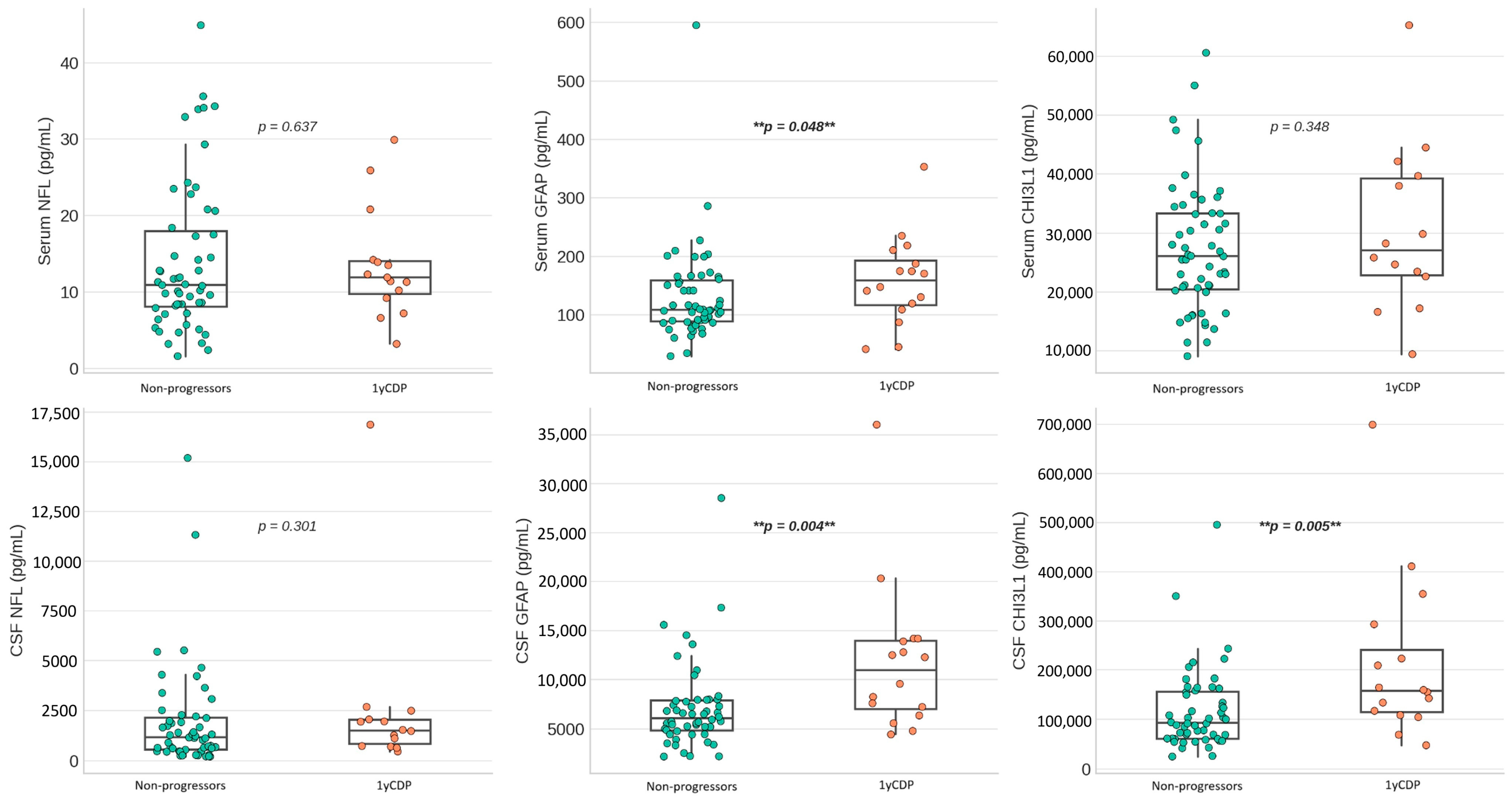
| Biomarker | Non-1yCDP | 1yCDP | Unadjusted p-Value | Adjusted p-Value (ANCOVA) * |
|---|---|---|---|---|
| sNFL, pg/mL (median, IQR) | 10.9 (7.9–18.4) | 11.9 (9.2–14.2) | 0.637 | 0.758 |
| sNFL z-score (median, IQR) | 2.1 (0.92–2.65) | 1.77 (0.81–2.46) | 0.678 | - |
| CSF NFL, pg/mL (median, IQR) | 1151 (507–2156) | 1498 (718–2156) | 0.301 | 0.657 |
| sGFAP, pg/mL (median, IQR) | 109.24 (88.0–161.2) | 159.2 (111.8–205.1) | 0.048 † | 0.496 |
| CSF GFAP, pg/mL (median, IQR) | 6085.3 (4811–7930) | 10,932 (6578–14,105) | 0.004 † | 0.007 † |
| sCHI3L1, pg/mL (median, IQR) | 26,064 (20,235–33,378) | 27,030 (21,280–40,312) | 0.348 | 0.036 † |
| CSF CHI3L1, pg/mL (median, IQR) | 93,019 (61,483–157,635) | 157,682 (110,797–275,447) | 0.005 † | 0.007 † |
| RNFL, µm (median, IQR) | 95 (87.5–102) | 92 (82–97.5) | 0.103 | 0.103 |
| GCIPL, µm (median, IQR) | 82 (75.5–86) | 76 (67.8–79.5) | 0.003 † | 0.009 † |
| Univariate | Multivariate (Best Model) | |||
|---|---|---|---|---|
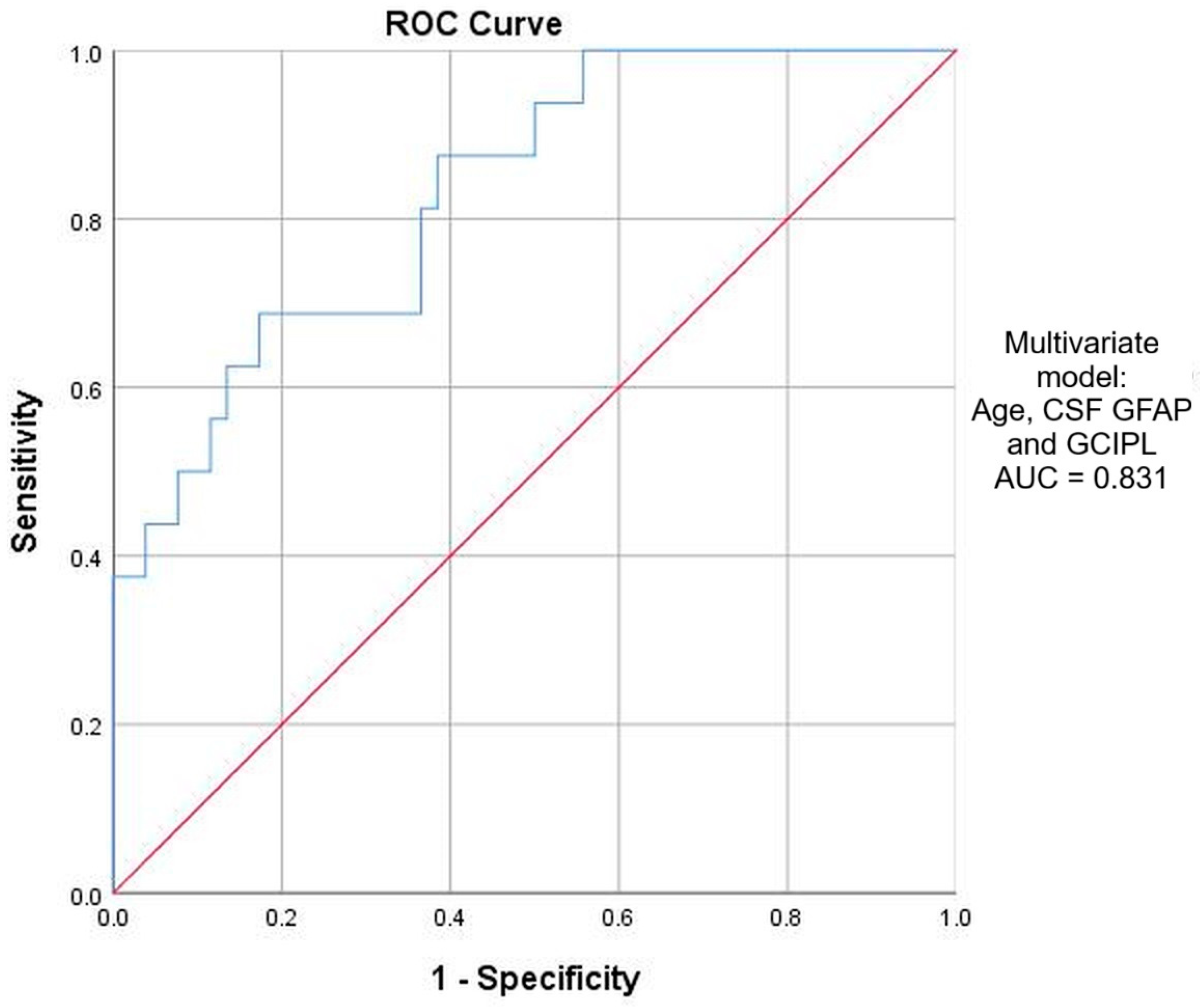
| Variable | OR (95% CI) | p-Value | OR (95% CI) | p-Value |
| Age | 1.1 (1.03–1.18) | 0.005 * | 1.08 (1.0–1.17) | 0.037 * |
| Baseline EDSS | 1.75 (1.05–2.9) | 0.03 * | - | - |
| Serum CHI3L1 (ln-transformed) | 1.68 (0.40–7.02) | 0.477 | - | - |
| CSF GFAP (ln-transformed) | 5.79 (1.72–19.45) | 0.005 * | 4.48 (1.26–15.9) | 0.021 * |
| CSF CHI3L1 (ln-transformed) | 4.14 (1.49–11.49) | 0.006 * | - | - |
| GCIPL | 0.9 (0.84–0.97) | 0.006 * | 0.91 (0.83–1.0) | 0.038 * |
Disclaimer/Publisher’s Note: The statements, opinions and data contained in all publications are solely those of the individual author(s) and contributor(s) and not of MDPI and/or the editor(s). MDPI and/or the editor(s) disclaim responsibility for any injury to people or property resulting from any ideas, methods, instructions or products referred to in the content. |
© 2025 by the authors. Licensee MDPI, Basel, Switzerland. This article is an open access article distributed under the terms and conditions of the Creative Commons Attribution (CC BY) license (https://creativecommons.org/licenses/by/4.0/).
Share and Cite
Enache, I.I.; Tiu, V.E.; Anghel, C.A.; Tiu, C.; Popa-Cherecheanu, A.; Bostan, M.; Scippa, S.; Balestrieri, A.; Smaldone, G.; Soricelli, A. GFAP, CHI3L1 and GCIPL Thickness as Baseline Predictors of Early Disability Progression in MS. Int. J. Mol. Sci. 2025, 26, 11774. https://doi.org/10.3390/ijms262411774
Enache II, Tiu VE, Anghel CA, Tiu C, Popa-Cherecheanu A, Bostan M, Scippa S, Balestrieri A, Smaldone G, Soricelli A. GFAP, CHI3L1 and GCIPL Thickness as Baseline Predictors of Early Disability Progression in MS. International Journal of Molecular Sciences. 2025; 26(24):11774. https://doi.org/10.3390/ijms262411774
Chicago/Turabian StyleEnache, Ion Iulian, Vlad Eugen Tiu, Cătălina Andreea Anghel, Cristina Tiu, Alina Popa-Cherecheanu, Mihai Bostan, Sonia Scippa, Alessia Balestrieri, Giovanni Smaldone, and Andrea Soricelli. 2025. "GFAP, CHI3L1 and GCIPL Thickness as Baseline Predictors of Early Disability Progression in MS" International Journal of Molecular Sciences 26, no. 24: 11774. https://doi.org/10.3390/ijms262411774
APA StyleEnache, I. I., Tiu, V. E., Anghel, C. A., Tiu, C., Popa-Cherecheanu, A., Bostan, M., Scippa, S., Balestrieri, A., Smaldone, G., & Soricelli, A. (2025). GFAP, CHI3L1 and GCIPL Thickness as Baseline Predictors of Early Disability Progression in MS. International Journal of Molecular Sciences, 26(24), 11774. https://doi.org/10.3390/ijms262411774