Secretory Leukocyte Protease Inhibitor: A Pleiotropic Molecule for the Potential Diagnosis of and Therapy for Acute Kidney Injury

 , and
, and
Abstract
1. Introduction
2. Molecular Structure and Classical Functions of SLPI
3. Regulation of SLPI Expression
4. SLPI as a Potential Biomarker in Acute and Chronic Kidney Diseases
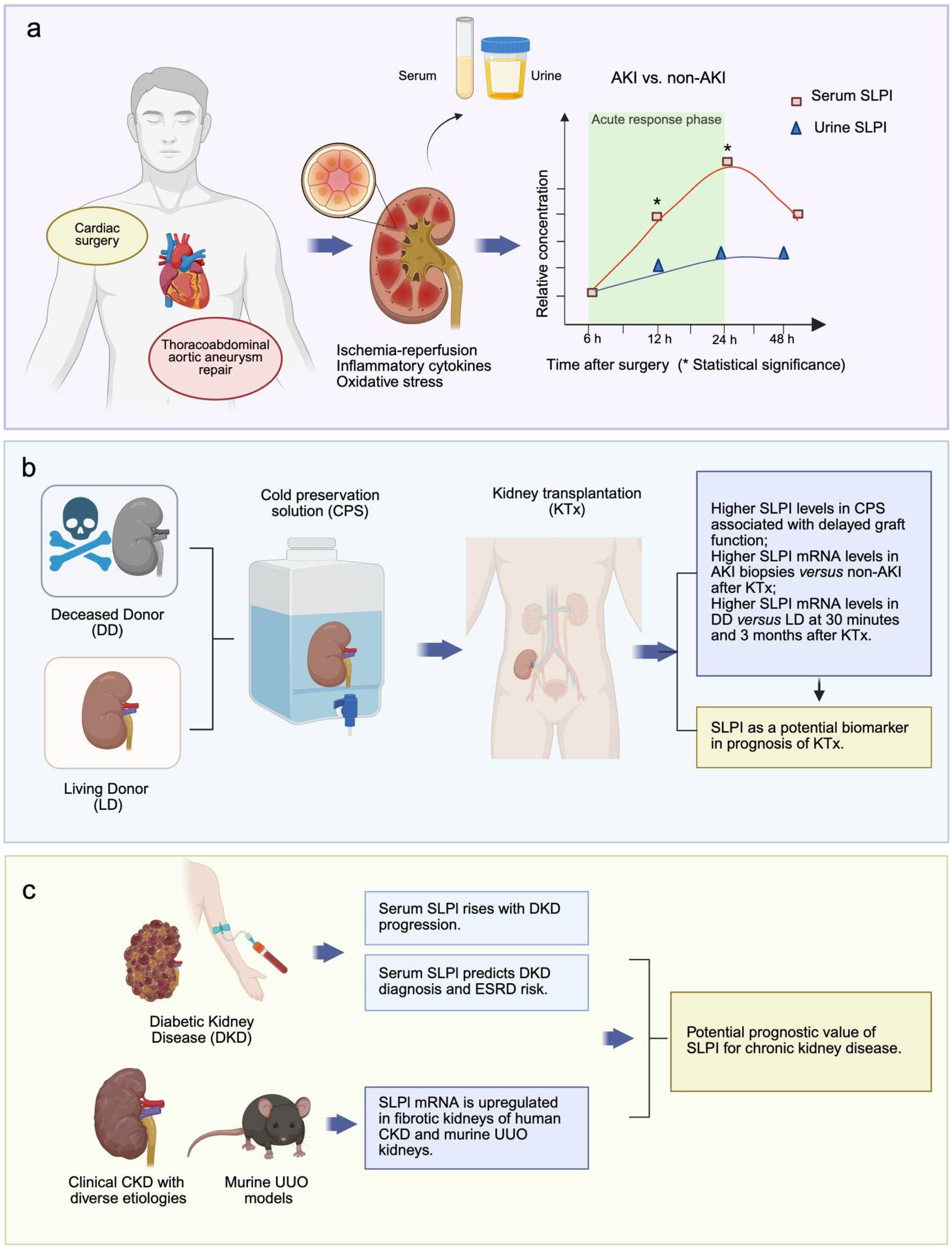
4.1. SLPI as a Promising Early Diagnostic Biomarker for AKI Post-Cardiovascular Surgery
4.2. SLPI Predicts Graft Outcomes Post-Kidney Transplantation
4.3. SLPI in Chronic Kidney Disease Progression
4.4. Challenges and Specificity
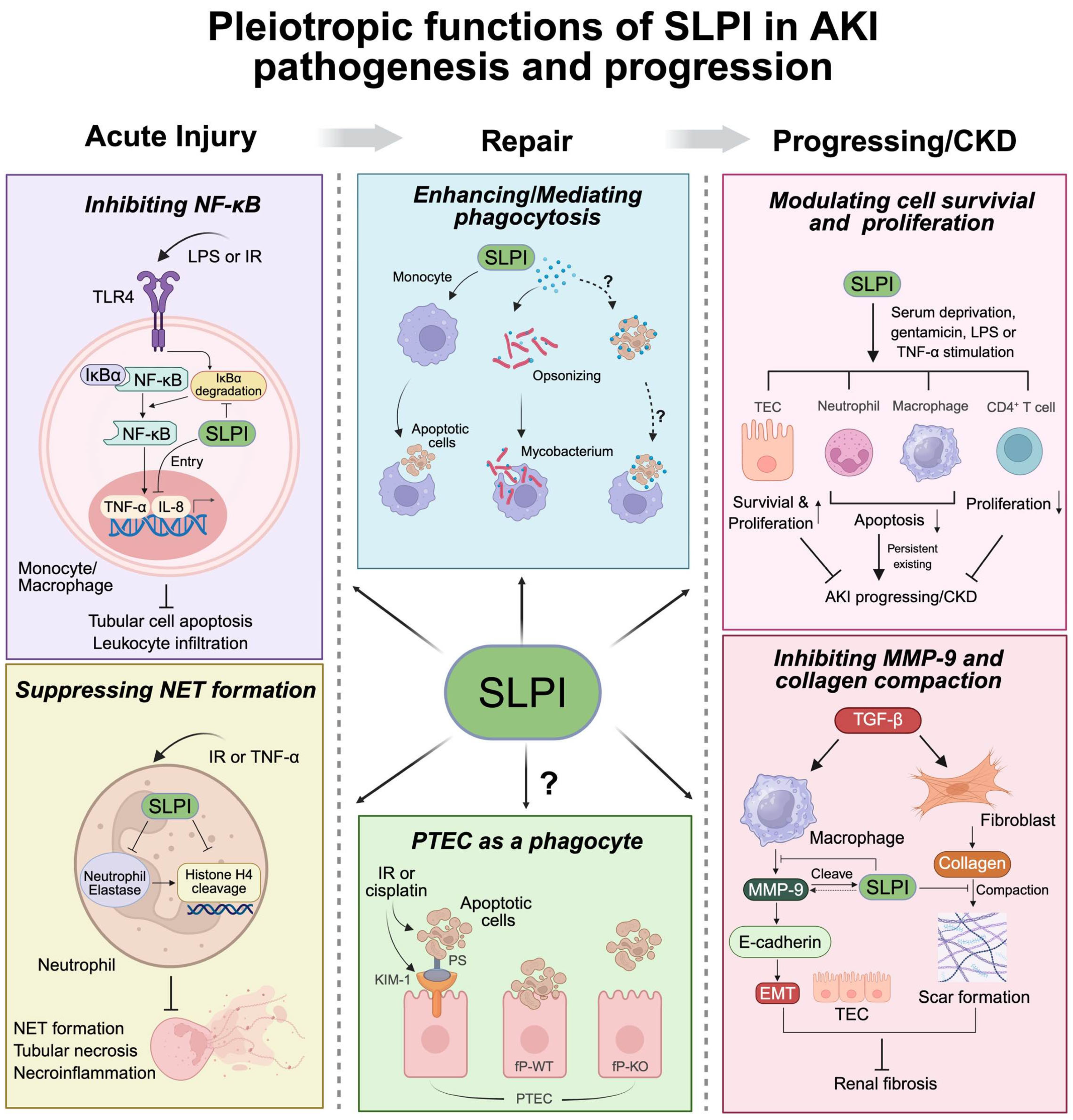
5. SLPI Involvements in Multiple Biological Events Related to AKI
5.1. SLPI and Immune Regulation
5.2. SLPI and Phagocytosis
5.3. SLPI and Cell Apoptosis, Proliferation, and Differentiation
5.4. SLPI and Fibrosis
6. Therapeutic Potential of SLPI in AKI
6.1. SLPI Alleviates Kidney Damage in Experimental AKI Models
6.2. Safety Considerations and Challenges for Clinical Translation
7. Conclusions and Perspectives
Author Contributions
Funding
Data Availability Statement
Conflicts of Interest
References
- Ostermann, M.; Lumlertgul, N.; Jeong, R.; See, E.; Joannidis, M.; James, M. Acute kidney injury. Lancet 2025, 405, 241–256. [Google Scholar] [CrossRef]
- See, E.J.; Jayasinghe, K.; Glassford, N.; Bailey, M.; Johnson, D.W.; Polkinghorne, K.R.; Toussaint, N.D.; Bellomo, R. Long-term risk of adverse outcomes after acute kidney injury: A systematic review and meta-analysis of cohort studies using consensus definitions of exposure. Kidney Int. 2019, 95, 160–172. [Google Scholar] [CrossRef]
- Coca, S.G.; Singanamala, S.; Parikh, C.R. Chronic kidney disease after acute kidney injury: A systematic review and meta-analysis. Kidney Int. 2012, 81, 442–448. [Google Scholar] [CrossRef]
- Khwaja, A. KDIGO clinical practice guidelines for acute kidney injury. Nephron Clin. Pract. 2012, 120, c179–c184. [Google Scholar] [CrossRef]
- Bailly, V.; Zhang, Z.; Meier, W.; Cate, R.; Sanicola, M.; Bonventre, J.V. Shedding of kidney injury molecule-1, a putative adhesion protein involved in renal regeneration. J. Biol. Chem. 2002, 277, 39739–39748. [Google Scholar] [CrossRef] [PubMed]
- Vaidya, V.S.; Ozer, J.S.; Dieterle, F.; Collings, F.B.; Ramirez, V.; Troth, S.; Muniappa, N.; Thudium, D.; Gerhold, D.; Holder, D.J.; et al. Kidney injury molecule-1 outperforms traditional biomarkers of kidney injury in preclinical biomarker qualification studies. Nat. Biotechnol. 2010, 28, 478–485. [Google Scholar] [CrossRef] [PubMed]
- Mishra, J.; Ma, Q.; Prada, A.; Mitsnefes, M.; Zahedi, K.; Yang, J.; Barasch, J.; Devarajan, P. Identification of neutrophil gelatinase-associated lipocalin as a novel early urinary biomarker for ischemic renal injury. J. Am. Soc. Nephrol. 2003, 14, 2534–2543. [Google Scholar] [CrossRef]
- Ferguson, M.A.; Vaidya, V.S.; Waikar, S.S.; Collings, F.B.; Sunderland, K.E.; Gioules, C.J.; Bonventre, J.V. Urinary liver-type fatty acid-binding protein predicts adverse outcomes in acute kidney injury. Kidney Int. 2010, 77, 708–714. [Google Scholar] [CrossRef]
- Endre, Z.H.; Pickering, J.W.; Walker, R.J.; Devarajan, P.; Edelstein, C.L.; Bonventre, J.V.; Frampton, C.M.; Bennett, M.R.; Ma, Q.; Sabbisetti, V.S.; et al. Improved performance of urinary biomarkers of acute kidney injury in the critically ill by stratification for injury duration and baseline renal function. Kidney Int. 2011, 79, 1119–1130. [Google Scholar] [CrossRef]
- Osuna-Gómez, R.; Mulet, M.; Barril, S.; Cantó, E.; Millan-Billi, P.; Pardessus, A.; de la Rosa-Carrillo, D.; Castillo, D.; Vidal, S. Levels of Lysozyme and SLPI in Bronchoalveolar Lavage: Exploring Their Role in Interstitial Lung Disease. Int. J. Mol. Sci. 2024, 25, 4297. [Google Scholar] [CrossRef]
- Si-Tahar, M.; Merlin, D.; Sitaraman, S.; Madara, J.L. Constitutive and regulated secretion of secretory leukocyte proteinase inhibitor by human intestinal epithelial cells. Gastroenterology 2000, 118, 1061–1071. [Google Scholar] [CrossRef]
- King, A.E.; Critchley, H.O.; Kelly, R.W. Presence of secretory leukocyte protease inhibitor in human endometrium and first trimester decidua suggests an antibacterial protective role. Mol. Hum. Reprod. 2000, 6, 191–196. [Google Scholar] [CrossRef]
- Odaka, C.; Mizuochi, T.; Yang, J.; Ding, A. Murine macrophages produce secretory leukocyte protease inhibitor during clearance of apoptotic cells: Implications for resolution of the inflammatory response. J. Immunol. 2003, 171, 1507–1514. [Google Scholar] [CrossRef]
- Sallenave, J.M.; Si Tahar, M.; Cox, G.; Chignard, M.; Gauldie, J. Secretory leukocyte proteinase inhibitor is a major leukocyte elastase inhibitor in human neutrophils. J. Leukoc. Biol. 1997, 61, 695–702. [Google Scholar] [CrossRef]
- Averdunk, L.; Fitzner, C.; Levkovich, T.; Leaf, D.E.; Sobotta, M.; Vieten, J.; Ochi, A.; Moeckel, G.; Marx, G.; Stoppe, C. Secretory Leukocyte Protease Inhibitor (SLPI)—A Novel Predictive Biomarker of Acute Kidney Injury after Cardiac Surgery: A Prospective Observational Study. J. Clin. Med. 2019, 8, 1931. [Google Scholar] [CrossRef] [PubMed]
- Yang, B.; Sylvius, N.; Luo, J.; Yang, C.; Da, Z.; Crotty, C.; Nicholson, M.L. Identifying Biomarkers from Transcriptomic Signatures in Renal Allograft Biopsies Using Deceased and Living Donors. Front. Immunol. 2021, 12, 657860. [Google Scholar] [CrossRef] [PubMed]
- Doumas, S.; Kolokotronis, A.; Stefanopoulos, P. Anti-inflammatory and antimicrobial roles of secretory leukocyte protease inhibitor. Infect. Immun. 2005, 73, 1271–1274. [Google Scholar] [CrossRef] [PubMed]
- Guerrieri, D.; Ambrosi, N.G.; Romeo, H.; Salaberry, J.; Toniolo, M.F.; Remolins, C.; Incardona, C.; Casadei, D.; Chuluyan, E. Secretory Leukocyte Proteinase Inhibitor Protects Acute Kidney Injury Through Immune and Non-Immune Pathways. Shock 2021, 56, 1019–1027. [Google Scholar] [CrossRef]
- Jian, J.; Yu-Qing, L.; Rang-Yue, H.; Xia, Z.; Ke-Huan, X.; Ying, Y.; Li, W.; Rui-Zhi, T. Isorhamnetin ameliorates cisplatin-induced acute kidney injury in mice by activating SLPI-mediated anti-inflammatory effect in macrophage. Immunopharmacol. Immunotoxicol. 2024, 46, 319–329. [Google Scholar] [CrossRef]
- Thompson, R.C.; Ohlsson, K. Isolation, properties, and complete amino acid sequence of human secretory leukocyte protease inhibitor, a potent inhibitor of leukocyte elastase. Proc. Natl. Acad. Sci. USA 1986, 83, 6692–6696. [Google Scholar] [CrossRef]
- Bouchard, D.; Morisset, D.; Bourbonnais, Y.; Tremblay, G.M. Proteins with whey-acidic-protein motifs and cancer. Lancet Oncol. 2006, 7, 167–174. [Google Scholar] [CrossRef]
- Abe, T.; Tominaga, Y.; Kikuchi, T.; Watanabe, A.; Satoh, K.; Watanabe, Y.; Nukiwa, T. Bacterial pneumonia causes augmented expression of the secretory leukoprotease inhibitor gene in the murine lung. Am. J. Respir. Crit. Care Med. 1997, 156, 1235–1240. [Google Scholar] [CrossRef][Green Version]
- Kramps, J.A.; van Twisk, C.; Appelhans, H.; Meckelein, B.; Nikiforov, T.; Dijkman, J.H. Proteinase inhibitory activities of antileukoprotease are represented by its second COOH-terminal domain. Biochim. Biophys. Acta 1990, 1038, 178–185. [Google Scholar] [CrossRef] [PubMed]
- Hiemstra, P.S.; Maassen, R.J.; Stolk, J.; Heinzel-Wieland, R.; Steffens, G.J.; Dijkman, J.H. Antibacterial activity of antileukoprotease. Infect. Immun. 1996, 64, 4520–4524. [Google Scholar] [CrossRef] [PubMed]
- Nishimura, J.; Saiga, H.; Sato, S.; Okuyama, M.; Kayama, H.; Kuwata, H.; Matsumoto, S.; Nishida, T.; Sawa, Y.; Akira, S.; et al. Potent antimycobacterial activity of mouse secretory leukocyte protease inhibitor. J. Immunol. 2008, 180, 4032–4039. [Google Scholar] [CrossRef]
- Miller, K.W.; Evans, R.J.; Eisenberg, S.P.; Thompson, R.C. Secretory leukocyte protease inhibitor binding to mRNA and DNA as a possible cause of toxicity to Escherichia coli. J. Bacteriol. 1989, 171, 2166–2172. [Google Scholar] [CrossRef] [PubMed]
- Ma, G.; Greenwell-Wild, T.; Lei, K.; Jin, W.; Swisher, J.; Hardegen, N.; Wild, C.T.; Wahl, S.M. Secretory leukocyte protease inhibitor binds to annexin II, a cofactor for macrophage HIV-1 infection. J. Exp. Med. 2004, 200, 1337–1346. [Google Scholar] [CrossRef]
- Callahan, M.K.; Popernack, P.M.; Tsutsui, S.; Truong, L.; Schlegel, R.A.; Henderson, A.J. Phosphatidylserine on HIV envelope is a cofactor for infection of monocytic cells. J. Immunol. 2003, 170, 4840–4845. [Google Scholar] [CrossRef]
- Py, B.; Basmaciogullari, S.; Bouchet, J.; Zarka, M.; Moura, I.C.; Benhamou, M.; Monteiro, R.C.; Hocini, H.; Madrid, R.; Benichou, S. The phospholipid scramblases 1 and 4 are cellular receptors for the secretory leukocyte protease inhibitor and interact with CD4 at the plasma membrane. PLoS ONE 2009, 4, e5006, Erratum in PLoS ONE 2009, 4. https://doi.org/10.1371/annotation/657cd713-aaac-4ebb-80ad-3ec8dfb12b42. [Google Scholar] [CrossRef]
- Jin, J.; Liu, X.M.; Shao, W.; Meng, X.M. Nucleic acid and protein methylation modification in renal diseases. Acta Pharmacol. Sin. 2024, 45, 661–673. [Google Scholar] [CrossRef]
- Nikitina, T.; Shi, X.; Ghosh, R.P.; Horowitz-Scherer, R.A.; Hansen, J.C.; Woodcock, C.L. Multiple modes of interaction between the methylated DNA binding protein MeCP2 and chromatin. Mol. Cell Biol. 2007, 27, 864–877. [Google Scholar] [CrossRef] [PubMed]
- Liu, C.; Wang, J.; Wei, Y.; Zhang, W.; Geng, M.; Yuan, Y.; Chen, Y.; Sun, Y.; Chen, H.; Zhang, Y.; et al. Fat-Specific Knockout of Mecp2 Upregulates Slpi to Reduce Obesity by Enhancing Browning. Diabetes 2020, 69, 35–47. [Google Scholar] [CrossRef] [PubMed]
- Abbinante-Nissen, J.M.; Simpson, L.G.; Leikauf, G.D. Neutrophil elastase increases secretory leukocyte protease inhibitor transcript levels in airway epithelial cells. Am. J. Physiol. 1993, 265, L286–L292. [Google Scholar] [CrossRef]
- Sullivan, A.L.; Dafforn, T.; Hiemstra, P.S.; Stockley, R.A. Neutrophil elastase reduces secretion of secretory leukoproteinase inhibitor (SLPI) by lung epithelial cells: Role of charge of the proteinase-inhibitor complex. Respir. Res. 2008, 9, 60. [Google Scholar] [CrossRef] [PubMed]
- Nukiwa, T.; Suzuki, T.; Fukuhara, T.; Kikuchi, T. Secretory leukocyte peptidase inhibitor and lung cancer. Cancer Sci. 2008, 99, 849–855. [Google Scholar] [CrossRef]
- Klimenkova, O.; Ellerbeck, W.; Klimiankou, M.; Ünalan, M.; Kandabarau, S.; Gigina, A.; Hussein, K.; Zeidler, C.; Welte, K.; Skokowa, J. A lack of secretory leukocyte protease inhibitor (SLPI) causes defects in granulocytic differentiation. Blood 2014, 123, 1239–1249. [Google Scholar] [CrossRef]
- Vandooren, J.; Goeminne, P.; Boon, L.; Ugarte-Berzal, E.; Rybakin, V.; Proost, P.; Abu El-Asrar, A.M.; Opdenakker, G. Neutrophils and Activated Macrophages Control Mucosal Immunity by Proteolytic Cleavage of Antileukoproteinase. Front. Immunol. 2018, 9, 1154. [Google Scholar] [CrossRef]
- van Wetering, S.; van der Linden, A.C.; van Sterkenburg, M.A.; de Boer, W.I.; Kuijpers, A.L.; Schalkwijk, J.; Hiemstra, P.S. Regulation of SLPI and elafin release from bronchial epithelial cells by neutrophil defensins. Am. J. Physiol. Lung Cell Mol. Physiol. 2000, 278, L51–L58. [Google Scholar] [CrossRef]
- Jana, N.K.; Gray, L.R.; Shugars, D.C. Human immunodeficiency virus type 1 stimulates the expression and production of secretory leukocyte protease inhibitor (SLPI) in oral epithelial cells: A role for SLPI in innate mucosal immunity. J. Virol. 2005, 79, 6432–6440. [Google Scholar] [CrossRef]
- Ding, A.; Yu, H.; Yang, J.; Shi, S.; Ehrt, S. Induction of macrophage-derived SLPI by Mycobacterium tuberculosis depends on TLR2 but not MyD88. Immunology 2005, 116, 381–389. [Google Scholar] [CrossRef]
- Wang, Y.; Bellomo, R. Cardiac surgery-associated acute kidney injury: Risk factors, pathophysiology and treatment. Nat. Rev. Nephrol. 2017, 13, 697–711. [Google Scholar] [CrossRef]
- Chatterjee, S.; LeMaire, S.A.; Amarasekara, H.S.; Green, S.Y.; Price, M.D.; Yanoff, M.S.; Zhang, Q.; Raghavan, R.; Preventza, O.; de la Cruz, K.I.; et al. Early-Stage Acute Kidney Injury Adversely Affects Thoracoabdominal Aortic Aneurysm Repair Outcomes. Ann. Thorac. Surg. 2019, 107, 1720–1726. [Google Scholar] [CrossRef]
- Averdunk, L.; Rückbeil, M.V.; Zarbock, A.; Martin, L.; Marx, G.; Jalaie, H.; Jacobs, M.J.; Stoppe, C.; Gombert, A. SLPI—A Biomarker of Acute Kidney Injury after Open and Endovascular Thoracoabdominal Aortic Aneurysm (TAAA) Repair. Sci. Rep. 2020, 10, 3453. [Google Scholar] [CrossRef] [PubMed]
- Lasorsa, F.; Rutigliano, M.; Milella, M.; d’Amati, A.; Crocetto, F.; Pandolfo, S.D.; Barone, B.; Ferro, M.; Spilotros, M.; Battaglia, M.; et al. Ischemia-Reperfusion Injury in Kidney Transplantation: Mechanisms and Potential Therapeutic Targets. Int. J. Mol. Sci. 2024, 25, 4332. [Google Scholar] [CrossRef] [PubMed]
- Ambrosi, N.G.; Caro, F.Y.; Osella, F.; Alvarez, L.D.; Sánchez, F.; Toniolo, F.; Guerrieri, D.; Incardona, C.; Casadei, D.; Chuluyan, E. SLPI in the perfusion solution helps to identify graft quality in kidney transplants. Biomark. Med. 2019, 13, 895–906. [Google Scholar] [CrossRef]
- Wilflingseder, J.; Sunzenauer, J.; Toronyi, E.; Heinzel, A.; Kainz, A.; Mayer, B.; Perco, P.; Telkes, G.; Langer, R.M.; Oberbauer, R. Molecular pathogenesis of post-transplant acute kidney injury: Assessment of whole-genome mRNA and miRNA profiles. PLoS ONE 2014, 9, e104164. [Google Scholar] [CrossRef] [PubMed]
- Schold, J.D.; Segev, D.L. Increasing the pool of deceased donor organs for kidney transplantation. Nat. Rev. Nephrol. 2012, 8, 325–331. [Google Scholar] [CrossRef]
- Hariharan, S.; Israni, A.K.; Danovitch, G. Long-Term Survival after Kidney Transplantation. N. Engl. J. Med. 2021, 385, 729–743. [Google Scholar] [CrossRef]
- Sun, W.; Yang, H.; Zhang, J.; Wei, S.; Wu, Q.; Yang, J.; Cao, C.; Cui, Z.; Zheng, H.; Wang, Y. Secretory leukocyte protease inhibitor as a novel predictive biomarker in patients with diabetic kidney disease. Front. Endocrinol. 2024, 15, 1334418. [Google Scholar] [CrossRef]
- Dong, Z.; Chen, F.; Peng, S.; Liu, X.; Guo, L.; Wang, E.; Chen, X. Identification of the key immune-related genes and immune cell infiltration changes in renal interstitial fibrosis. Front. Endocrinol. 2023, 14, 1207444. [Google Scholar] [CrossRef]
- Ohlsson, S.; Ljungkrantz, I.; Ohlsson, K.; Segelmark, M.; Wieslander, J. Novel distribution of the secretory leucocyte proteinase inhibitor in kidney. Mediat. Inflamm. 2001, 10, 347–350. [Google Scholar] [CrossRef]
- Ochi, A.; Chen, D.; Schulte, W.; Leng, L.; Moeckel, N.; Piecychna, M.; Averdunk, L.; Stoppe, C.; Bucala, R.; Moeckel, G. MIF-2/D-DT enhances proximal tubular cell regeneration through SLPI- and ATF4-dependent mechanisms. Am. J. Physiol. Renal Physiol. 2017, 313, F767–F780. [Google Scholar] [CrossRef]
- Menckeberg, C.L.; Hol, J.; Simons-Oosterhuis, Y.; Raatgeep, H.R.; de Ruiter, L.F.; Lindenbergh-Kortleve, D.J.; Korteland-van Male, A.M.; El Aidy, S.; van Lierop, P.P.; Kleerebezem, M.; et al. Human buccal epithelium acquires microbial hyporesponsiveness at birth, a role for secretory leukocyte protease inhibitor. Gut 2015, 64, 884–893. [Google Scholar] [CrossRef]
- Antoniades, C.G.; Khamri, W.; Abeles, R.D.; Taams, L.S.; Triantafyllou, E.; Possamai, L.A.; Bernsmeier, C.; Mitry, R.R.; O’Brien, A.; Gilroy, D.; et al. Secretory leukocyte protease inhibitor: A pivotal mediator of anti-inflammatory responses in acetaminophen-induced acute liver failure. Hepatology 2014, 59, 1564–1576. [Google Scholar] [CrossRef] [PubMed]
- Hannila, S.S. Secretory Leukocyte Protease Inhibitor (SLPI): Emerging Roles in CNS Trauma and Repair. Neuroscientist 2015, 21, 630–636. [Google Scholar] [CrossRef] [PubMed]
- Han, H.; Gao, Y.; Chen, B.; Xu, H.; Shi, C.; Wang, X.; Liang, Y.; Wu, Z.; Wang, Z.; Bai, Y.; et al. Nrf2 inhibits M1 macrophage polarization to ameliorate renal ischemia-reperfusion injury through antagonizing NF-κB signaling. Int. Immunopharmacol. 2024, 143, 113310. [Google Scholar] [CrossRef] [PubMed]
- Dong, L.; Xie, Y.L.; Zhang, R.T.; Hu, Q.Y. Models of sepsis-induced acute kidney injury. Life Sci. 2024, 352, 122873. [Google Scholar] [CrossRef]
- Huang, J.; Meng, P.; Liang, Y.; Li, X.; Zhou, S.; Li, J.; Wang, X.; Miao, J.; Shen, W.; Zhou, L. Tubular CD44 plays a key role in aggravating AKI through NF-κB p65-mediated mitochondrial dysfunction. Cell Death Dis. 2025, 16, 119. [Google Scholar] [CrossRef]
- Li, S.; Zhang, Y.; Lu, R.; Lv, X.; Lei, Q.; Tang, D.; Dai, Q.; Deng, Z.; Liao, X.; Tu, S.; et al. Peroxiredoxin 1 aggravates acute kidney injury by promoting inflammation through Mincle/Syk/NF-κB signaling. Kidney Int. 2023, 104, 305–323. [Google Scholar] [CrossRef]
- Matsuba, S.; Yabe-Wada, T.; Takeda, K.; Sato, T.; Suyama, M.; Takai, T.; Kikuchi, T.; Nukiwa, T.; Nakamura, A. Identification of Secretory Leukoprotease Inhibitor As an Endogenous Negative Regulator in Allergic Effector Cells. Front. Immunol. 2017, 8, 1538. [Google Scholar] [CrossRef]
- Taggart, C.C.; Greene, C.M.; McElvaney, N.G.; O’Neill, S. Secretory leucoprotease inhibitor prevents lipopolysaccharide-induced IkappaBalpha degradation without affecting phosphorylation or ubiquitination. J. Biol. Chem. 2002, 277, 33648–33653. [Google Scholar] [CrossRef]
- Ramadas, R.A.; Wu, L.; LeVine, A.M. Surfactant protein A enhances production of secretory leukoprotease inhibitor and protects it from cleavage by matrix metalloproteinases. J. Immunol. 2009, 182, 1560–1567. [Google Scholar] [CrossRef]
- Taggart, C.C.; Cryan, S.A.; Weldon, S.; Gibbons, A.; Greene, C.M.; Kelly, E.; Low, T.B.; O’neill, S.J.; McElvaney, N.G. Secretory leucoprotease inhibitor binds to NF-kappaB binding sites in monocytes and inhibits p65 binding. J. Exp. Med. 2005, 202, 1659–1668. [Google Scholar] [CrossRef] [PubMed]
- Mulligan, M.S.; Lentsch, A.B.; Huber-Lang, M.; Guo, R.F.; Sarma, V.; Wright, C.D.; Ulich, T.R.; Ward, P.A. Anti-inflammatory effects of mutant forms of secretory leukocyte protease inhibitor. Am. J. Pathol. 2000, 156, 1033–1039. [Google Scholar] [CrossRef] [PubMed]
- Greene, C.M.; McElvaney, N.G.; O’Neill, S.J.; Taggart, C.C. Secretory leucoprotease inhibitor impairs Toll-like receptor 2- and 4-mediated responses in monocytic cells. Infect. Immun. 2004, 72, 3684–3687. [Google Scholar] [CrossRef] [PubMed]
- Nakamura, A.; Mori, Y.; Hagiwara, K.; Suzuki, T.; Sakakibara, T.; Kikuchi, T.; Igarashi, T.; Ebina, M.; Abe, T.; Miyazaki, J.; et al. Increased susceptibility to LPS-induced endotoxin shock in secretory leukoprotease inhibitor (SLPI)-deficient mice. J. Exp. Med. 2003, 197, 669–674. [Google Scholar] [CrossRef]
- Nakazawa, D.; Marschner, J.A.; Platen, L.; Anders, H.J. Extracellular traps in kidney disease. Kidney Int. 2018, 94, 1087–1098. [Google Scholar] [CrossRef]
- Nakazawa, D.; Kumar, S.V.; Marschner, J.; Desai, J.; Holderied, A.; Rath, L.; Kraft, F.; Lei, Y.; Fukasawa, Y.; Moeckel, G.W.; et al. Histones and Neutrophil Extracellular Traps Enhance Tubular Necrosis and Remote Organ Injury in Ischemic AKI. J. Am. Soc. Nephrol. 2017, 28, 1753–1768. [Google Scholar] [CrossRef]
- Zabieglo, K.; Majewski, P.; Majchrzak-Gorecka, M.; Wlodarczyk, A.; Grygier, B.; Zegar, A.; Kapinska-Mrowiecka, M.; Naskalska, A.; Pyrc, K.; Dubin, A.; et al. The inhibitory effect of secretory leukocyte protease inhibitor (SLPI) on formation of neutrophil extracellular traps. J. Leukoc. Biol. 2015, 98, 99–106. [Google Scholar] [CrossRef]
- Majewski, P.; Majchrzak-Gorecka, M.; Grygier, B.; Skrzeczynska-Moncznik, J.; Osiecka, O.; Cichy, J. Inhibitors of Serine Proteases in Regulating the Production and Function of Neutrophil Extracellular Traps. Front. Immunol. 2016, 7, 261. [Google Scholar] [CrossRef]
- Papayannopoulos, V.; Metzler, K.D.; Hakkim, A.; Zychlinsky, A. Neutrophil elastase and myeloperoxidase regulate the formation of neutrophil extracellular traps. J. Cell Biol. 2010, 191, 677–691. [Google Scholar] [CrossRef]
- Park, S.Y.; Kim, I.S. Engulfment signals and the phagocytic machinery for apoptotic cell clearance. Exp. Mol. Med. 2017, 49, e331. [Google Scholar] [CrossRef]
- Medina, C.B.; Ravichandran, K.S. Do not let death do us part: ‘find-me’ signals in communication between dying cells and the phagocytes. Cell Death Differ. 2016, 23, 979–989. [Google Scholar] [CrossRef]
- Yang, L.; Brooks, C.R.; Xiao, S.; Sabbisetti, V.; Yeung, M.Y.; Hsiao, L.L.; Ichimura, T.; Kuchroo, V.; Bonventre, J.V. KIM-1-mediated phagocytosis reduces acute injury to the kidney. J. Clin. Investig. 2015, 125, 1620–1636. [Google Scholar] [CrossRef]
- Tutunea-Fatan, E.; Arumugarajah, S.; Suri, R.S.; Edgar, C.R.; Hon, I.; Dikeakos, J.D.; Gunaratnam, L. Sensing Dying Cells in Health and Disease: The Importance of Kidney Injury Molecule-1. J. Am. Soc. Nephrol. 2024, 35, 795–808. [Google Scholar] [CrossRef] [PubMed]
- Kemper, C.; Mitchell, L.M.; Zhang, L.; Hourcade, D.E. The complement protein properdin binds apoptotic T cells and promotes complement activation and phagocytosis. Proc. Natl. Acad. Sci. USA 2008, 105, 9023–9028. [Google Scholar] [CrossRef] [PubMed]
- Wu, Y.; Zwaini, Z.D.; Brunskill, N.J.; Zhang, X.; Wang, H.; Chana, R.; Stover, C.M.; Yang, B. Properdin Deficiency Impairs Phagocytosis and Enhances Injury at Kidney Repair Phase Post Ischemia-Reperfusion. Front. Immunol. 2021, 12, 697760. [Google Scholar] [CrossRef] [PubMed]
- Gomez, S.A.; Argüelles, C.L.; Guerrieri, D.; Tateosian, N.L.; Amiano, N.O.; Slimovich, R.; Maffia, P.C.; Abbate, E.; Musella, R.M.; Garcia, V.E.; et al. Secretory leukocyte protease inhibitor: A secreted pattern recognition receptor for mycobacteria. Am. J. Respir. Crit. Care Med. 2009, 179, 247–253. [Google Scholar] [CrossRef]
- Daigo, K.; Inforzato, A.; Barajon, I.; Garlanda, C.; Bottazzi, B.; Meri, S.; Mantovani, A. Pentraxins in the activation and regulation of innate immunity. Immunol. Rev. 2016, 274, 202–217. [Google Scholar] [CrossRef]
- Rovere, P.; Peri, G.; Fazzini, F.; Bottazzi, B.; Doni, A.; Bondanza, A.; Zimmermann, V.S.; Garlanda, C.; Fascio, U.; Sabbadini, M.G.; et al. The long pentraxin PTX3 binds to apoptotic cells and regulates their clearance by antigen-presenting dendritic cells. Blood 2000, 96, 4300–4306. [Google Scholar] [CrossRef]
- Murugaiah, V.; Tsolaki, A.G.; Kishore, U. Collectins: Innate Immune Pattern Recognition Molecules. Adv. Exp. Med. Biol. 2020, 1204, 75–127. [Google Scholar] [CrossRef]
- Triantafyllou, E.; Pop, O.T.; Possamai, L.A.; Wilhelm, A.; Liaskou, E.; Singanayagam, A.; Bernsmeier, C.; Khamri, W.; Petts, G.; Dargue, R.; et al. MerTK expressing hepatic macrophages promote the resolution of inflammation in acute liver failure. Gut 2018, 67, 333–347. [Google Scholar] [CrossRef] [PubMed]
- Morimoto, A.; Kikuta, J.; Nishikawa, K.; Sudo, T.; Uenaka, M.; Furuya, M.; Hasegawa, T.; Hashimoto, K.; Tsukazaki, H.; Seno, S.; et al. SLPI is a critical mediator that controls PTH-induced bone formation. Nat. Commun. 2021, 12, 2136. [Google Scholar] [CrossRef]
- Mueller, A.M.; Pedré, X.; Stempfl, T.; Kleiter, I.; Couillard-Despres, S.; Aigner, L.; Giegerich, G.; Steinbrecher, A. Novel role for SLPI in MOG-induced EAE revealed by spinal cord expression analysis. J. Neuroinflamm. 2008, 5, 20. [Google Scholar] [CrossRef] [PubMed]
- Zhang, D.; Simmen, R.C.; Michel, F.J.; Zhao, G.; Vale-Cruz, D.; Simmen, F.A. Secretory leukocyte protease inhibitor mediates proliferation of human endometrial epithelial cells by positive and negative regulation of growth-associated genes. J. Biol. Chem. 2002, 277, 29999–30009. [Google Scholar] [CrossRef] [PubMed]
- Tang, P.M.; Nikolic-Paterson, D.J.; Lan, H.Y. Macrophages: Versatile players in renal inflammation and fibrosis. Nat. Rev. Nephrol. 2019, 15, 144–158. [Google Scholar] [CrossRef]
- McGarry, N.; Greene, C.M.; McElvaney, N.G.; Weldon, S.; Taggart, C.C. The Ability of Secretory Leukocyte Protease Inhibitor to Inhibit Apoptosis in Monocytes Is Independent of Its Antiprotease Activity. J. Immunol. Res. 2015, 2015, 507315. [Google Scholar] [CrossRef]
- Subramaniyam, D.; Hollander, C.; Westin, U.; Erjefält, J.; Stevens, T.; Janciauskiene, S. Secretory leukocyte protease inhibitor inhibits neutrophil apoptosis. Respirology 2011, 16, 300–307. [Google Scholar] [CrossRef]
- Jang, H.R.; Gandolfo, M.T.; Ko, G.J.; Satpute, S.R.; Racusen, L.; Rabb, H. B cells limit repair after ischemic acute kidney injury. J. Am. Soc. Nephrol. 2010, 21, 654–665. [Google Scholar] [CrossRef]
- Han, H.; Zhu, J.; Wang, Y.; Zhu, Z.; Chen, Y.; Lu, L.; Jin, W.; Yan, X.; Zhang, R. Renal recruitment of B lymphocytes exacerbates tubulointerstitial fibrosis by promoting monocyte mobilization and infiltration after unilateral ureteral obstruction. J. Pathol. 2017, 241, 80–90. [Google Scholar] [CrossRef]
- Ascon, M.; Ascon, D.B.; Liu, M.; Cheadle, C.; Sarkar, C.; Racusen, L.; Hassoun, H.T.; Rabb, H. Renal ischemia-reperfusion leads to long term infiltration of activated and effector-memory T lymphocytes. Kidney Int. 2009, 75, 526–535. [Google Scholar] [CrossRef] [PubMed]
- Burne-Taney, M.J.; Liu, M.; Ascon, D.; Molls, R.R.; Racusen, L.; Rabb, H. Transfer of lymphocytes from mice with renal ischemia can induce albuminuria in naive mice: A possible mechanism linking early injury and progressive renal disease? Am. J. Physiol. Renal Physiol. 2006, 291, F981–F986. [Google Scholar] [CrossRef] [PubMed]
- Guerrieri, D.; Tateosian, N.L.; Maffía, P.C.; Reiteri, R.M.; Amiano, N.O.; Costa, M.J.; Villalonga, X.; Sanchez, M.L.; Estein, S.M.; Garcia, V.E.; et al. Serine leucocyte proteinase inhibitor-treated monocyte inhibits human CD4(+) lymphocyte proliferation. Immunology 2011, 133, 434–441. [Google Scholar] [CrossRef] [PubMed]
- Zhang, T.; Widdop, R.E.; Ricardo, S.D. Transition from acute kidney injury to chronic kidney disease: Mechanisms, models, and biomarkers. Am. J. Physiol. Renal Physiol. 2024, 327, F788–F805. [Google Scholar] [CrossRef]
- Henderson, N.C.; Rieder, F.; Wynn, T.A. Fibrosis: From mechanisms to medicines. Nature 2020, 587, 555–566. [Google Scholar] [CrossRef]
- Zakiyanov, O.; Kalousová, M.; Zima, T.; Tesař, V. Matrix metalloproteinases and tissue inhibitors of matrix metalloproteinases in kidney disease. Adv. Clin. Chem. 2021, 105, 141–212. [Google Scholar] [CrossRef]
- La Russa, A.; Serra, R.; Faga, T.; Crugliano, G.; Bonelli, A.; Coppolino, G.; Bolignano, D.; Battaglia, Y.; Ielapi, N.; Costa, D.; et al. Kidney Fibrosis and Matrix Metalloproteinases (MMPs). Front. Biosci. 2024, 29, 192. [Google Scholar] [CrossRef]
- Zheng, G.; Lyons, J.G.; Tan, T.K.; Wang, Y.; Hsu, T.T.; Min, D.; Succar, L.; Rangan, G.K.; Hu, M.; Henderson, B.R.; et al. Disruption of E-cadherin by matrix metalloproteinase directly mediates epithelial-mesenchymal transition downstream of transforming growth factor-beta1 in renal tubular epithelial cells. Am. J. Pathol. 2009, 175, 580–591. [Google Scholar] [CrossRef]
- Zhang, Y.; DeWitt, D.L.; McNeely, T.B.; Wahl, S.M.; Wahl, L.M. Secretory leukocyte protease inhibitor suppresses the production of monocyte prostaglandin H synthase-2, prostaglandin E2, and matrix metalloproteinases. J. Clin. Investig. 1997, 99, 894–900. [Google Scholar] [CrossRef]
- Påhlman, L.I.; Jögi, A.; Gram, M.; Mori, M.; Egesten, A. Hypoxia down-regulates expression of secretory leukocyte protease inhibitor in bronchial epithelial cells via TGF-β1. BMC Pulm. Med. 2015, 15, 19. [Google Scholar] [CrossRef]
- Treiber, N.; Peters, T.; Sindrilaru, A.; Huber, R.; Kohn, M.; Menke, A.; Briviba, K.; Kreppel, F.; Basu, A.; Maity, P.; et al. Overexpression of manganese superoxide dismutase in human dermal fibroblasts enhances the contraction of free floating collagen lattice: Implications for ageing and hyperplastic scar formation. Arch. Dermatol. Res. 2009, 301, 273–287. [Google Scholar] [CrossRef]
- Zhang, Q.; Wang, P.; Fang, X.; Lin, F.; Fang, J.; Xiong, C. Collagen gel contraction assays: From modelling wound healing to quantifying cellular interactions with three-dimensional extracellular matrices. Eur. J. Cell Biol. 2022, 101, 151253. [Google Scholar] [CrossRef]
- Sumi, Y.; Muramatsu, H.; Hata, K.; Ueda, M.; Muramatsu, T. Secretory leukocyte protease inhibitor is a novel inhibitor of fibroblast-mediated collagen gel contraction. Exp. Cell Res. 2000, 256, 203–212. [Google Scholar] [CrossRef]
- Wu, Y.; Chen, W.; Zhang, Y.; Liu, A.; Yang, C.; Wang, H.; Zhu, T.; Fan, Y.; Yang, B. Potent Therapy and Transcriptional Profile of Combined Erythropoietin-Derived Peptide Cyclic Helix B Surface Peptide and Caspase-3 siRNA against Kidney Ischemia/Reperfusion Injury in Mice. J. Pharmacol. Exp. Ther. 2020, 375, 92–103. [Google Scholar] [CrossRef]
- Nugteren, S.; Samsom, J.N. Secretory Leukocyte Protease Inhibitor (SLPI) in mucosal tissues: Protects against inflammation, but promotes cancer. Cytokine Growth Factor Rev. 2021, 59, 22–35. [Google Scholar] [CrossRef]



| Animal/Cell Models | Intervention | Readout | Outcomes | References |
|---|---|---|---|---|
| Male Wistar rats, bilateral kidney ischemia 40 min, reperfusion 24 h | SLPI 250 μg/kg, i.p., given at one dose on the time of reperfusion or three doses at 24 h pre-ischemia, during the ischemia, and 6 h post-ischemia | Reduction in SCr, BUN, acute tubular necrosis, MPO activity, mRNA expression of CD86, CD68, CD14, CCL2, TNF-α, IL-10, and C3αR | SLPI preserved kidney function and structure, ameliorated inflammation | [18] |
| Male Wistar rats, gentamicin-induced AKI | Gentamicin 60 mg/kg/day or plus SLPI 250 μg/kg, i.p., once daily for 4 days | Reduction in SCr, BUN | SLPI preserved kidney function | |
| Human proximal tubule cell line HK-2, serum starvation, treatment with immunosuppressant FK506, or overexpression of SLPI | Serum deprivation, or plus SLPI 0.4 μg/mL for 24 h; FK506 10 μM or plus SLPI 0.4 or 4 μg/mL for 24 h; overexpression of SLPI by transfection of plasmid vectors, controlled by empty plasmids | Reduction of cell apoptosis and necrosis; increased cell counting; increased cell-covered area in wound-healing scratch assay; increased Cyclin D1 and Ki67 staining | SLPI improved cell survival and proliferation | [18,52] |
| Adult male C57BL/6 mice, cisplatin-induced AKI | Cisplatin 20 mg/kg, i.p., single injection, or plus isorhamnetin 50 mg/kg, i.p., once daily for 3 days | Cisplatin reduced SLPI expression; isorhamnetin increased SLPI and reduced SCr, BUN, and tubular damage | SLPI mediated renoprotection of cisplatin-induced AKI by inhibiting Mincle/Syk/NF-κB-related inflammation in macrophages | [19] |
| LPS-stimulated macrophage cell line RAW264.7 | LPS 300 ng/mL, isorhamnetin 20 μM, or plus SLPI siRNA transfection | Knockdown of SLPI increased expression of Mincle, P-syk, P-P65, iNOS, TNF-α and IL-1β proteins, and IL-1β and IL-6 mRNAs |
Disclaimer/Publisher’s Note: The statements, opinions and data contained in all publications are solely those of the individual author(s) and contributor(s) and not of MDPI and/or the editor(s). MDPI and/or the editor(s) disclaim responsibility for any injury to people or property resulting from any ideas, methods, instructions or products referred to in the content. |
© 2025 by the authors. Licensee MDPI, Basel, Switzerland. This article is an open access article distributed under the terms and conditions of the Creative Commons Attribution (CC BY) license (https://creativecommons.org/licenses/by/4.0/).
Share and Cite
Chen, R.; Gu, S.; Xiong, F.; Ji, L.; Zhang, Z.-J.; Yang, B.; Wu, Y. Secretory Leukocyte Protease Inhibitor: A Pleiotropic Molecule for the Potential Diagnosis of and Therapy for Acute Kidney Injury. Int. J. Mol. Sci. 2025, 26, 11631. https://doi.org/10.3390/ijms262311631
Chen R, Gu S, Xiong F, Ji L, Zhang Z-J, Yang B, Wu Y. Secretory Leukocyte Protease Inhibitor: A Pleiotropic Molecule for the Potential Diagnosis of and Therapy for Acute Kidney Injury. International Journal of Molecular Sciences. 2025; 26(23):11631. https://doi.org/10.3390/ijms262311631
Chicago/Turabian StyleChen, Rui, Shiyun Gu, Fenfen Xiong, Lili Ji, Zhi-Jun Zhang, Bin Yang, and Yuanyuan Wu. 2025. "Secretory Leukocyte Protease Inhibitor: A Pleiotropic Molecule for the Potential Diagnosis of and Therapy for Acute Kidney Injury" International Journal of Molecular Sciences 26, no. 23: 11631. https://doi.org/10.3390/ijms262311631
APA StyleChen, R., Gu, S., Xiong, F., Ji, L., Zhang, Z.-J., Yang, B., & Wu, Y. (2025). Secretory Leukocyte Protease Inhibitor: A Pleiotropic Molecule for the Potential Diagnosis of and Therapy for Acute Kidney Injury. International Journal of Molecular Sciences, 26(23), 11631. https://doi.org/10.3390/ijms262311631