Article

Gene Polymorphisms Determining Sex Hormone-Binding Globulin Levels and Endometriosis Risk

1
Department of Medical Biological Disciplines, Belgorod State National Research University, 308015 Belgorod, Russia
2
Department of Obstetrics and Gynecology, Belgorod State National Research University, 308015 Belgorod, Russia
3
Obstetric Department, Belgorod Regional Clinical Hospital of St. Joasaph, 308007 Belgorod, Russia
4
Gynecological Department, Belgorod Regional Clinical Hospital of St. Joasaph, 308007 Belgorod, Russia
*
Author to whom correspondence should be addressed.
Int. J. Mol. Sci. 2025, 26(23), 11630; https://doi.org/10.3390/ijms262311630
Submission received: 1 October 2025 / Revised: 12 November 2025 / Accepted: 28 November 2025 / Published: 30 November 2025
(This article belongs to the Special Issue Genes and Human Diseases: 3rd Edition)

Abstract

Endometriosis is a hormone-dependent disease, in the pathophysiology of which sex hormones (androgens, estrogens, etc.) are involved. The level of bioactive androgens/estrogens (in the free state) in the organism largely depends on sex hormone-binding globulin (SHBG), which binds/transports a significant portion of the androgens/estrogens of the body and, due to this, changes the amount of these hormones in a free state (bioactive), which may be important in the development of endometriosis. The study was devoted to identifying the link between the genetic determinants (single nucleotide polymorphisms [SNPs]) of SHBG (according to predating genome-wide associative studies [GWAS]) and the risk of endometriosis in the Caucasian women of Russia. The study was accomplished on a total sample of 1368 women (395 endometriosis; 973 endometriosis free [controls]). Nine loci with an impact on SHBG level in predating GWAS have been examined. The search for associations of these loci with endometriosis was carried out: both their independent effects and interlocus interactions with an in silico interpretation of the functionality/pathways in which endometriosis-related loci and strongly linked SNPs were involved have been evaluated. Polymorphic locus rs440837 (A > G) ZBTB10 correlated with endometriosis development (recessive genetic model): the SHBG-raising genotype GG rs440837 (A > G) ZBTB10 serves as a risk factor for the disease formation; its presence in the genotype almost doubles the risk of endometriosis (OR = 1.91; 95%CI = 1.13–2.98; pperm = 0.024; power = 81.13%). The SHBG-impacts of 7 SNPs from 9 analyzed loci such as rs17496332 (A > G) PRMT6, rs780093 (C > T) GCKR, rs10454142 (T > C) PPP1R21, rs3779195 (T > A) BAIAP2L1, rs440837 (A > G) ZBTB10, rs7910927 (G > T) JMJD1C, and rs8023580 (T > C) NR2F2 interacting with each other have been endometriosis-associated. Endometriosis-causal SNP rs440837 (A > G) ZBTB10 and 5 proxy SNPs determine the DNA interaction in the region of 3 genes (RP11-48B3.3, RP11-48B3.4, ZBTB10) with 22 transcription factors and, due to this, affect the processes of development of the endocrine system, gene transcription regulation, TGF-beta signaling pathway, regulation of cell proliferation/differentiation, etc. In conclusion, the results of this study showed the endometriosis risk effect of the SHBG-impact polymorphic variants.

1. Introduction

Endometriosis, characterized by the appearance/proliferation of endometrial-like tissue outside the endometrium of the uterus (as a rule, the ovaries and other pelvic organs are affected), occurs in every tenth woman of reproductive age, as well as in every 2–3 women suffering from infertility [1,2,3]. The total number of women in the world diagnosed with endometriosis is as much as 176–179 million people [1]. A distinctive feature of endometriosis is a significant delay in its diagnosis, which on average is 7 years (since the appearance of the first symptoms of the disease) and requires surgical diagnostic interventions [4]. The presence of endometriosis in a woman has a significant impact on her quality of life and is associated with clinical manifestations of the disease such as dysmenorrhea, dyspareunia, chronic pelvic pain, infertility, and others [1,3,5]. Endometriosis is of extremely important socio-economic importance [4,5,6]. Thus, each woman with endometriosis, due to reduced labor productivity, loses an average of 10.8 h of work per week, which leads to significant economic costs (4 US dollars in Nigeria to 456 US dollars in Italy per woman per week) [4]. The financial costs of treating patients with endometriosis in European countries (which vary from country to country in the range of 0.8–12.5 billion Euros per year) are comparable to the cost of treating most common diseases (such as diabetes mellitus) [6].
The considerable role (up to about 50%) of hereditary factors in the formation/course (clinical manifestations) of endometriosis has been convincingly proven in previous studies performed using twin samples [7,8]. The SNP-based heritability index for endometriosis is 26% [9]. More than twenty-five GWAS have been performed for endometriosis, and even in the latest GWAS, which include very numerous patient/control samples, only a small part of the variability in endometriosis (about 5%) is described on the basis of established GWAS-impact loci [10,11,12,13,14,15,16,17,18,19,20,21,22,23,24,25,26,27,28,29,30,31,32,33,34,35,36]. For example, Sapkota and co-authors, having studied more than 200,000 DNA samples (7045 endometriosis and 191,596 controls; meta-analysis of 11 GWAS was performed) in 2017 and identified 19 GWAS-endometriosis-significant loci, explained only 5.19% of the variability in endometriosis using these loci [16]. After six years of Rahmioglu and co-authors’ work in 2023, more than 750,000 DNA samples (60,674 endometriosis and 701,926 controls; a meta-analysis of 24 GWAS was made) were studied and 42 GWAS-endometriosis-significant loci were identified that explain the same 5.01% variance of the disease [30]. Thus, despite active GWAS studies of endometriosis based on very numerous, constantly increasing samples, obtaining information about the association of the disease with an increasing number of SNPs, there was no greater clarity in understanding the genetic nature of the disease (currently known endometriosis-causal SNPs describe only about 1/20 part of its total variability and only 1/10 part of its genetic variability [16,30]), which determines the relevance of our endometriosis-oriented genetic study.
As proven in numerous clinical/experimental/review studies, endometriosis is a hormone-dependent female reproductive sphere disorder, in the pathophysiology of which various sex hormones (androgens, estrogens, etc.) are largely “involved” [37,38,39,40,41,42,43,44,45]. The level of bioactive androgens/estrogens (in a free state) in the organism (they account for only 1–2% of the hormones in the body) largely depends on SHBG [46,47,48,49]. This is due to the fact that it is SHBG that binds/transports the meaningful part (65% testosterone [50] and 38% estradiol [47]) of organism androgens/estrogens, and due to this, by changing the amount of androgens/estrogens associated with it, it can also change the amount of these hormones in a free state (bioactive) [46,47,48,49]. Such SHBG-mediated effects will directly determine the severity of the biological influences of androgens/estrogens in the organism, including those significant for endometriosis biology [37,38,39,40,41,42]. At the same time, on this topic today, the following can be stated: firstly, many GWAS data on genetic variants determining the organism SHBG level have been published [51,52,53,54,55,56,57]. Secondly, with the unquestionable pathophysiological justification for the participation of SHBG (level/expression) in the “appearance” of endometriosis, the results of specific clinical/experimental studies on this issue are ambiguous/contradictory: there are works that show the connection of SHBG with the risk of endometriosis [37,38,39], and there are works in which such correlations were not found [58]. Thirdly, the results of genetic research on this topic are few and equally ambiguous [59,60,61]. For example, in the work of Golovchenko et al., the relationship of GWAS-impact loci for the circulation level of SHBG (rs1641549 TP53 [54], rs727428 SHBG [52]) was shown only in their intergenic interactions (pronounced endometriosis-significant main effects of these loci were not detected) [60]; in the work of Garitazelaia et al. (the Mendelian randomization (MR) method was used in data analysis), it was not possible to identify causal relationships between sex hormones (including SHBG) and endometriosis [61]. The above indicates the presence in the available scientific data of an obvious significant lack of experimental materials confirming (or, conversely, refuting) the relationship between the genetic determinants of SHBG and the risk of endometriosis.
The present study was devoted to identifying the link between the GWAS-validated genetic determinants of SHBG and the risk of endometriosis in Caucasian women of Russia.

2. Results

The clinical and anamnestic “description” of endometriosis/endometriosis free women is presented in Table 1 (these data were obtained/presented by us earlier [60]). A comparative analysis of the clinical and anamnestic indicators of “endometriosis vs. control” revealed differences in parameters such as menstrual cycle duration, parity, the anamnesis presence of medical abortions (as well as their number), infertility, surgical procedures (laparoscopy; laparotomy) on the pelvic organs, and burdened heredity (Table 1), which was the basis for “accounting” these characteristics, as well as the age of women (as confounders) in genetic assessments of “endometriosis–SNP” associations [60].
In both endometriosis/non-endometriosis subjects, the observed/expected SHBG-linked SNP genotype distribution fully meets the Hardy–Weinberg Equilibrium (HWE) standard (PHWE > 0.05): in the endometriosis group, the PHWE for the studied loci was in the range of 0.085 [rs440837 (A > G) ZBTB10]—0.763 [rs4149056 (T > C) SLCO1B1], and in the control group, PHWE—0.052 [rs3779195 (T > A) BAIAP2L1]—0.891 [rs780093 (C > T) GCKR] (Table S1).
We have identified the involvement of the polymorphic locus rs440837 (A > G) ZBTB10 in endometriosis development (a recessive genetic model; data are shown in Table 2): the genotype GG rs440837 (A > G) ZBTB10 serves as a risk factor for the disease formation, and its presence in the genotype almost doubles the endometriosis risk (OR = 1.91; 95%CI = 1.13–2.98; p = 0.023; pperm = 0.024; statistical power is 81.13%).
In order to identify non-additive genetic effects that determine the risk of endometriosis, antagonistic/synergistic SNP-SNP interactions (SNP-SNPinter) of the studied SHBG-significant SNPs were analyzed. Four multi-level models of SNP-SNPinter most valuable for disease risk were identified (Table 3): two (the significance level of the selected model was p = 1.25 × 10⁻³ [pperm = 0.008] with a threshold value [taking into account the Bonferroni correction] equal to pthreshold = 1.39 × 10⁻³), three (p = 8.33 × 10⁻⁶; pperm = 0.001; pthreshold = 5.95 × 10⁻⁴), four (p = 9.65 × 10⁻⁸; pperm = 0.001; pthreshold = 3.97 × 10⁻⁴), and five (p = 1.95 × 10⁻¹¹; pperm = 0.001; pthreshold = 3.97 × 10⁻⁴) locus interactions. For almost all models at all levels (with the exception of the two-locus model), the real values of the significance level of the models significantly (by several orders of magnitude) exceeded the threshold values determined by us, taking into account the possible number of SNP-SNPinter of different levels, which indicates the “reliability” of the obtained results.
Endometriosis-associated SNP-SNPinter models include 7 SNPs from 9 analyzed loci, such as rs17496332 (A > G) PRMT6, rs780093 (C > T) GCKR, rs10454142 (T > C) PPP1R21, rs3779195 (T > A) BAIAP2L1, rs440837 (A > G) ZBTB10, rs7910927 (G > T) JMJD1C, and rs8023580 (T > C) NR2F2 (Table 3). At the same time, two genetic markers—rs440837 (A > G) ZBTB10 (it is an independent risk factor for endometriosis) and rs3779195 (T > A) BAIAP2L1, have been involved in the formation of the largest number of SNP-SNPinter models—4 and 3 models, respectively. Attention is drawn to the fact that the five-locus model [rs8023580 NR2F2-rs7910927 JMJD1C-rs440837 ZBTB10-rs3779195 BAIAP2L1-rs780093 GCKR] has the most expressed effect on the occurrence of endometriosis (the risky combinations of this model were characterized by the maximum value of the Wald parameter, which was 45.02) (Table 3).
Modeling of 15 different endometriosis-associated combinations of SNP-SNPinter genotypes was performed (Table S2), among which the vast majority of SNP-SNPinter genotypes (12/15, 80%) were risky and only 20% (3/15) had a protective effect in the event of endometriosis. The greatest statistical significance among the identified 15 SNP-SNPinter genotypes was in those such as rs440837-AG ZBTB10-rs3779195-TT BAIAP2L1 (β = −0.513; p = 0.001), rs8023580-TC NR2F2-rs7910927-GT JMJD1C-rs440837-AG ZBTB10-rs3779195-TA BAIAP2L1-rs780093-CT GCKR (β = 1.698; p = 0.006), and rs8023580-TT NR2F2-rs7910927-GG JMJD1C-rs440837-AG ZBTB10-rs3779195-TA BAIAP2L1-rs780093-CT GCKR (β = 2.887; p = 0.008).
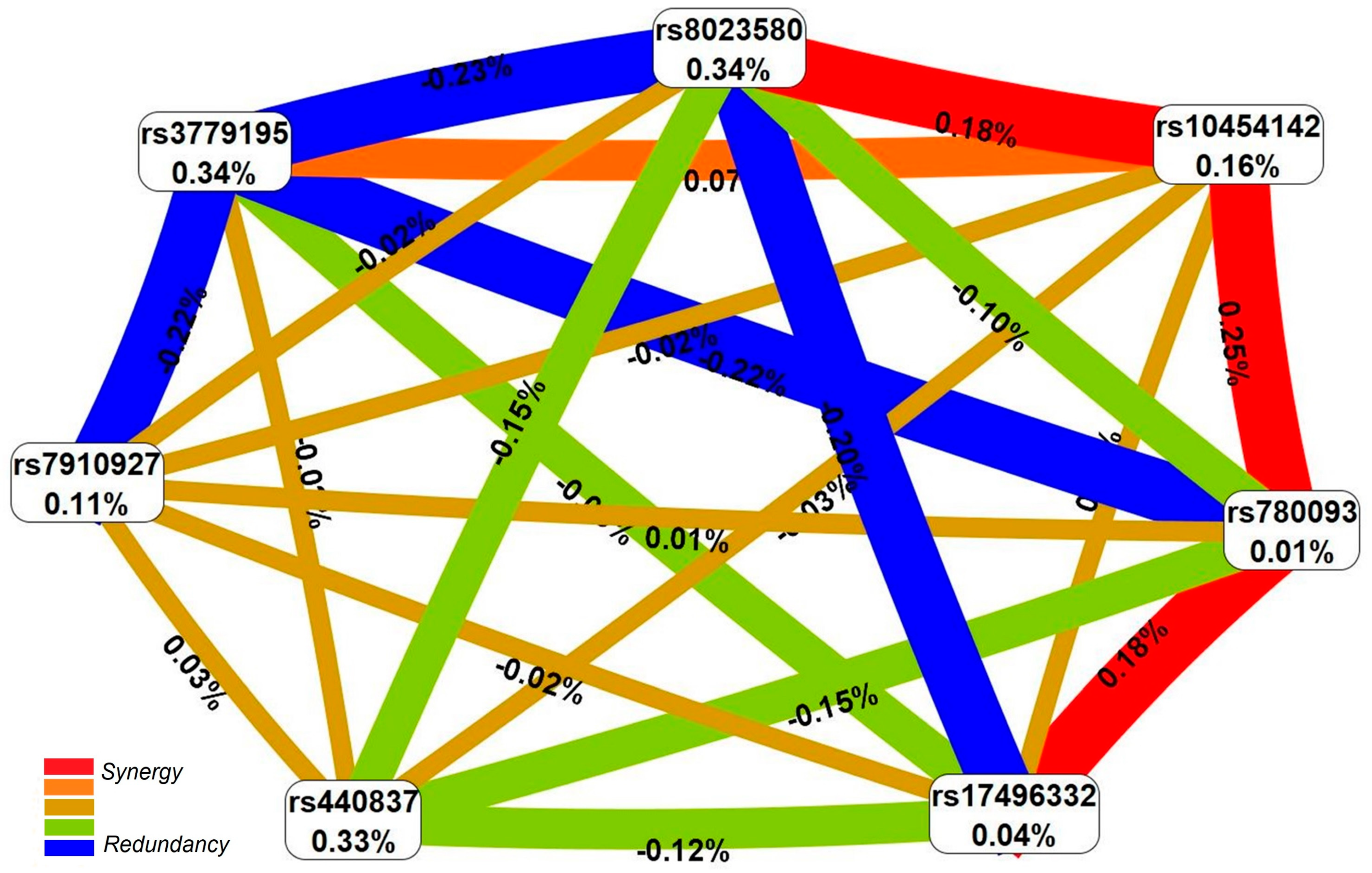
Paired antagonistic interactions with a contribution to trait entropy (endometriosis risk) from −0.15% to −0.23% were recorded when visualizing and evaluating the strength of the influence of the most significant endometriosis-associated five-locus SNP-SNPinter model, rs8023580 NR2F2-rs7910927 JMJD1C-rs440837 ZBTB10-rs3779195 BAIAP2L1-rs780093 GCKR (Figure 1). For the SNP-SNPinter of 7 SNPs determining susceptibility to endometriosis in all 4 models, interactions of both antagonistic (between 5 SNPs, deposit to entropy from −0.20 to −0.23%) and synergistic (between 4 SNPs, contribution to entropy from 0.18 to 0.25%) orientation were revealed (Figure 2). Three polymorphisms such as rs3779195 (T > A) BAIAP2L1, rs8023580 (T > C) NR2F2, and rs780093 (C > T) GCKR were involved in the largest number of the very impact-paired (with the greatest deposit to entropy) SNP-SNPinter (three each).

2.1. Forecasted Functionality of Endometriosis-Associated Polymorphisms

At this stage of our work, firstly, we performed functional annotation of the rs440837 (A > G) ZBTB10 locus, independently associated with endometriosis (genotype GG serves as a risk factor for the development of the disease, OR = 1.91) and 5 SNPs linked with it (r2 ≥ 0.80); secondly, we executed functional annotation of all seven endometriosis-associated SHBG-correlated polymorphic loci, and 115 SNPs strongly linked to them (r2 ≥ 0.80).

2.1.1. Functional Annotation of the Endometriosis-Causal SNP rs440837 (A > G) ZBTB10

As shown by the obtained results (Table S3), the rs440837 (A > G) ZBTB10 was localized in the region of DNA motifs serving as binding sites with 3 transcription factors (TF): Hlx1, Hoxa9, and Smad3. The endometriosis risk allele G rs440837 reduces affinity for the TF Hoxa9 (the difference in the “LODscores” parameter of the G and A alleles was −1.7) and increases sensitivity to TFs Hlx1 and Smad3 (differences in the “LODscores” of the G and A alleles are 1.5 and 7.5, respectively). This polymorphic locus was functionally active (located at the sites of potential promoters/enhancers, active promoters/enhancers) in the liver (the organ where SHBG is synthesized). Among the 5 polymorphisms strongly linked to rs440837 (A > G) ZBTB10, one locus, rs7013042, also exhibits pronounced functionality in the liver (located at the sites of promoters/enhancers, active promoters/enhancers), and all five proxy loci affect the DNA interaction with 19 TFs:rs58126885 (DMRT3, DMRT4, Pou1f1, Pou3f2), rs3893826 (CDP, CTCF, Gfi1), rs10957982 (Bbx, Mrg1::Hoxa9, Mrg, Nkx2, Sox, Tgif1), rs200988859 (DMRT5, Mef2, TCF11::MafG), rs7013042 (LXR, Myc, Sp4) (Table S4). So, rs440837 (A > G) ZBTB10 and 5 LD loci affect the interaction of DNA with 22 TFs (DMRT3, DMRT4, DMRT5, Pou1f1, Pou3f2, CDP, Gfi1, Bbx, Mrg1::Hoxa9, Mrg, Nkx2, Sox, Mef2, Tgif1, CTCF, TCF11::MafG, LXR, Myc, Sp4, Hlx1, Hoxa9, Smad3) in the region of three adjacent genes (RP11-48B3.3, RP11-48B3.4, ZBTB10).
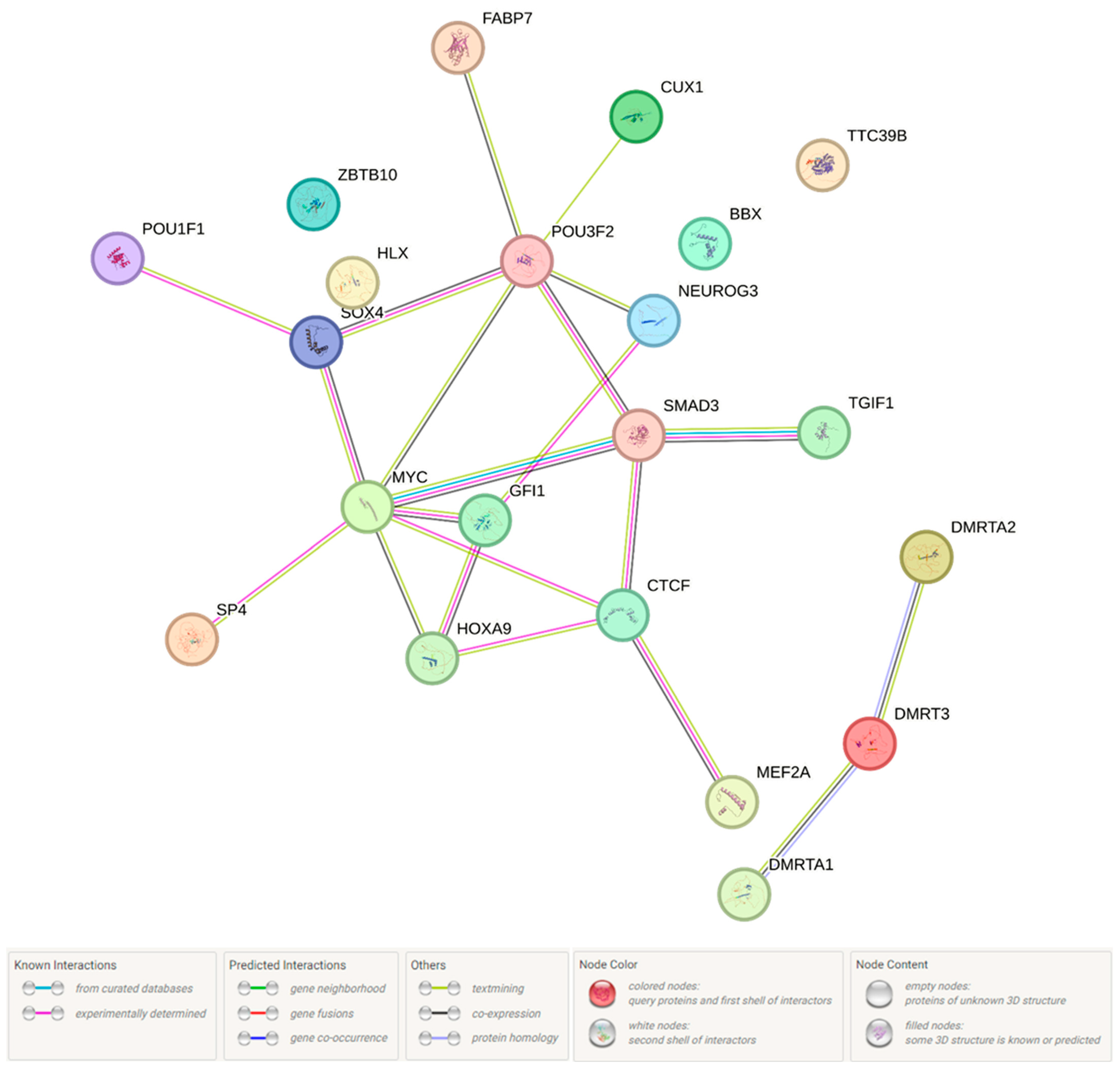
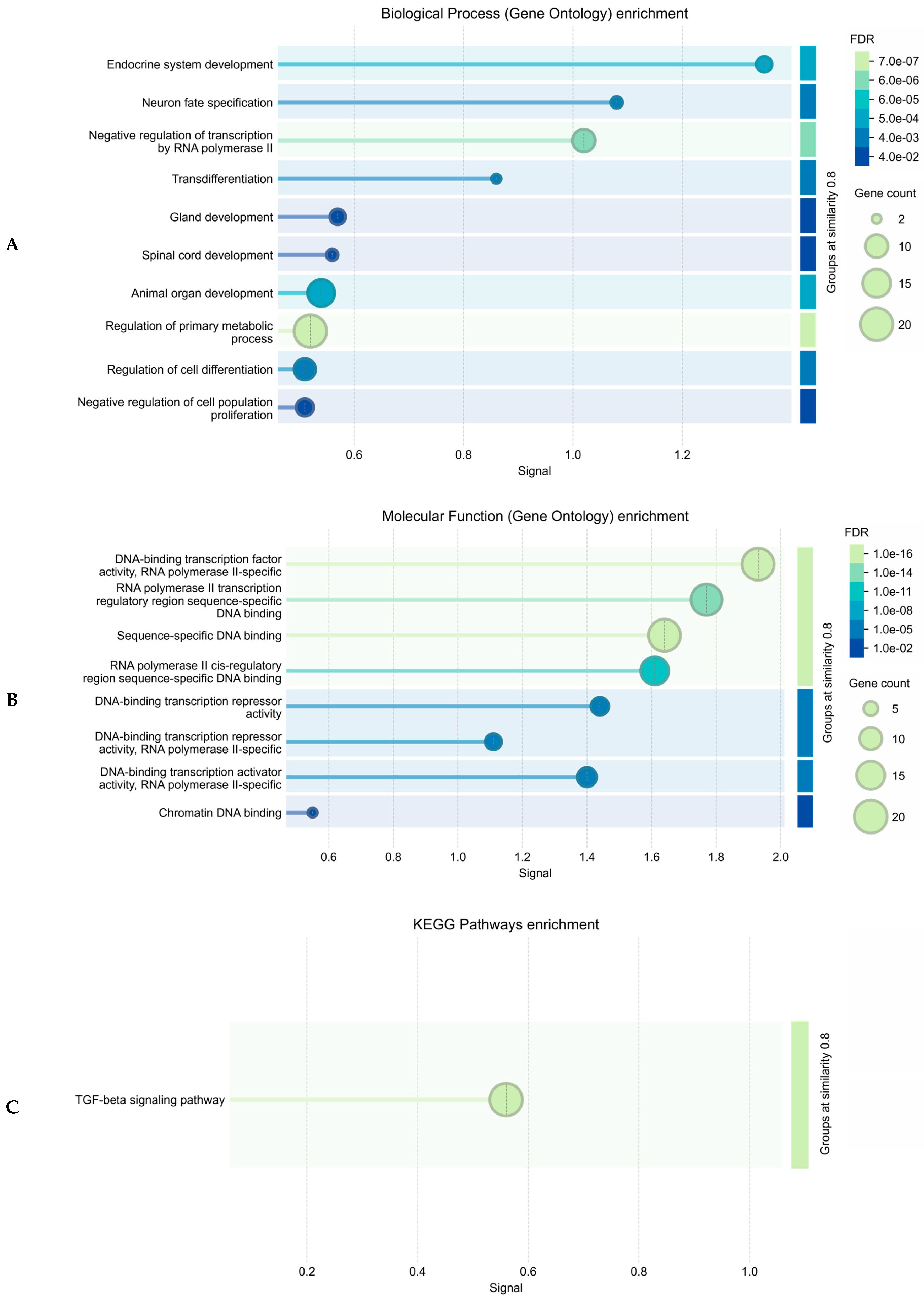
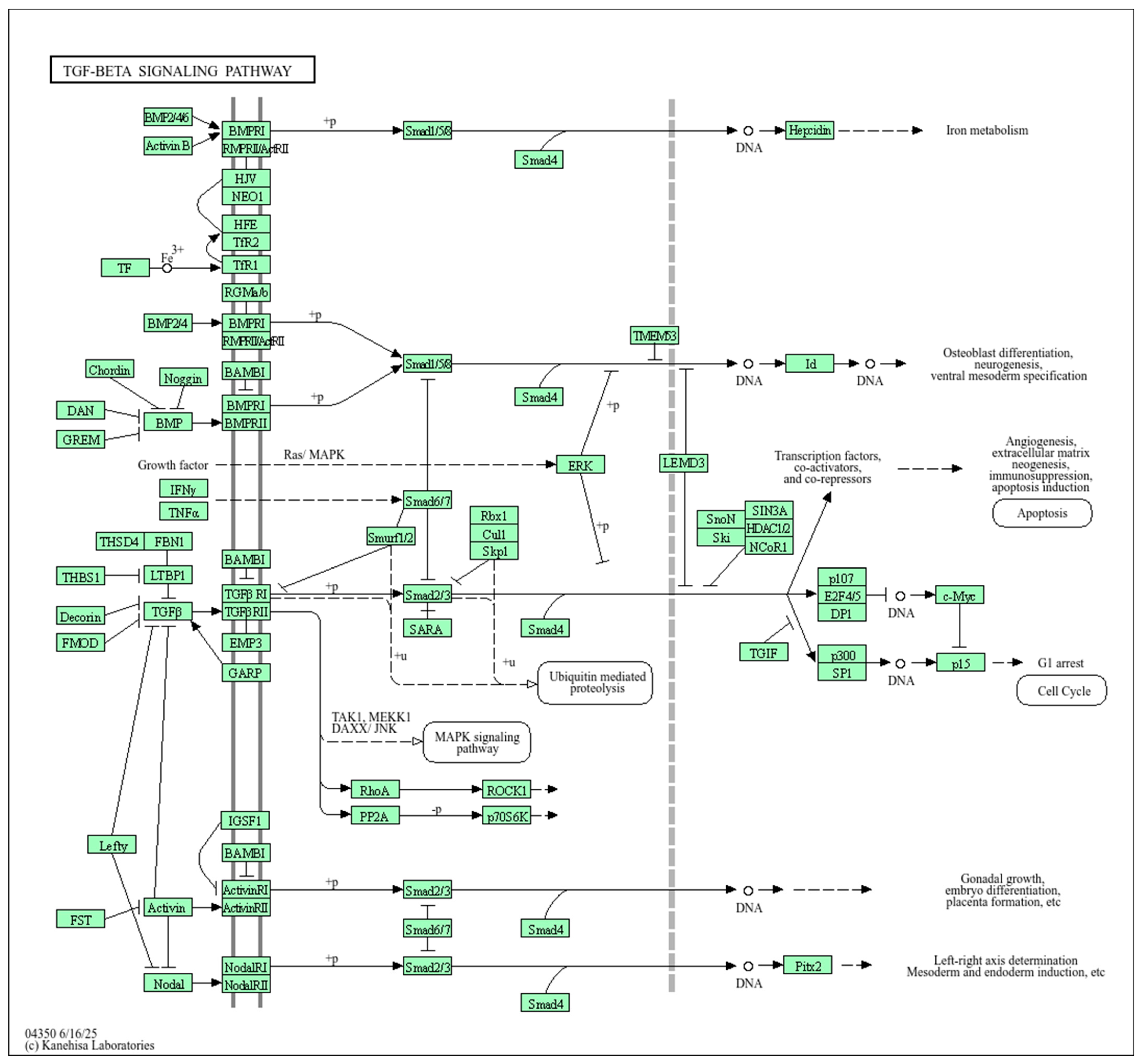
Next, we studied the biological pathways in which these 22 TFs and protein products, determined by 3 genes in the region which contain rs440837 (A > G) ZBTB10 and 5 proxy SNPs, have been involved (Figure 3). According to Figure 3 (it is a network of paired interactions that form TFs and proteins functionally related to rs440837 (A > G) ZBTB10 and 5 proxy SNPs), the following TF paired interactions demonstrate the greatest contribution to endometriosis susceptibility: SMAD3-MYC (coefficient [score] of the protein interaction −0.993), TGIF1-SMAD3 (0.974), MYC-CTCF (0.763), SOX4-MYC (0.722) and CTCF-SMAD3 (0.702). The role of “hubs” in these endometriosis-significant interactions was performed by proteins such as MYC (participates in 7 pair interactions), POU3F2 (6 pair interactions) and CTCF (4 pair interactions). Endometriosis-significant protein interactions were involved in more than 15 different biological pathways—mainly in the development of the endocrine system ([GO:0035270, pFRD = 0.00024] (NEUROG3, SOX4, POU3F2, SMAD3, POU1F1)) (Figure 4A), the regulation of gene transcription processes due to modulation (activation/repression) of RNA polymerase II binding to the corresponding sections of the genome, etc., ([GO:0000981, pFRD = 1.01 × 10⁻¹⁶; GO:0043565, pFRD = 1.34 × 10⁻¹⁵; etc.] (almost all considered 22 TFs)) (Figure 4A,B), the regulation of primary metabolic processes ([GO:0080090, pFRD = 7.37 × 10⁻⁷] (DMRT3, SP4, NEUROG3, SOX4, GFI1, DMRTA1, BBX, TGIF1, POU3F2, SMAD3, POU1F1, HOXA9, CUX1, HLX, CTCF, DMRTA2, ZBTB10, TTC39B, MYC, MEF2A) (Figure 4A), the TGF-beta signaling pathway (Figure 4C), and the regulation of cell proliferation/differentiation ([GO:0042127, pFRD = 0.0109/GO:0045595, pFRD = 0.0076] (NEUROG3, SOX4, POU3F2, SMAD3, HOXA9, CUX1, HLX, DMRTA2, MYC)) (Figure 4A), etc. Interestingly, the TGF-beta signaling pathway, which is important in realizing the phenotypic effects of rs440837 (A > G) ZBTB10 and 5 proxy SNPs (Figure 4C), is involved in endometriosis-significant mechanisms such as apoptosis, angiogenesis, extracellular matrix neogenesis, immunosuppression, cell cycle, gonadal growth, etc. (KEGG program data) (Figure 5).
Thus, the results obtained indicate the important role of endometriosis-significant protein interactions of 22 TFs and protein products of 3 genes “dependent” on the rs440837 (A > G) ZBTB10 and 5 LD SNPs, mainly in the development of the endocrine system, regulation of gene transcription processes, the TGF-beta signaling pathway, regulation of cell proliferation/differentiation, etc.

2.1.2. Functional Annotation of the Endometriosis-Associated Variants

It was found that out of 122 endometriosis-significant genetic markers (7 endometriosis-associated loci and 115 proxy variants), 118 SNPs (96.72%) have alleged regulatory influences on 13 genes in the region in in which they are located (ZBTB10, RP11-48B3.4, RP11-327J17.3, RP11-327J17.2, PPP1R21, NR2F2, KLRAQ1, JMJD1C, GCKR, FOXN2, BRI3, PRMT6, BAIAP2L1) (Table S4). These 118 SNPs have been localized in DNA regions considered evolutionarily conservative (5 SNPs, 4.10%), functionally active regions of the genome (promoters (10 SNPs, 8.19%) and enhancers (28 SNPs, 22.95%)), areas of hypersensitivity to the action of DNase (26 SNPs, 21.31%), and binding sites with regulatory proteins (17 SNPs, 13.93%), as well as the region of regulatory DNA motifs (110 SNPs, 90.16%) (Table S4).
We found that six endometriosis-associated loci (Table S5) and 110 LD SNPs (Table S6) were linked with the expression of 39 genes (JMJD1C-AS1, JMJD1C, ZNF512, BRI3, TRIM54, TECPR1, STON1-GTF2A1L, STON1, SLC5A6, PPP1R21, RP11-307C18.1, SNX17, RP11-460M2.1, RPL7AP50, RP11-327J17.2, RP11-191L17.1, REEP3, PRMT6, PPM1G, NRBP1, NRBF2, MSH6, MRPL35P2, LMTK2, LHCGR, KRTCAP3, IFT172, AC074117.10, GTF2A1L, GPN1, GCKR, FSHR, FOXN2, FNDC4, C2orf16, BAIAP2L1, ATRAID, AC004967.7, ASNS) including endometriosis-significant organs/tissues such as pituitary [4 genes] (FOXN2, GTF2A1L, MRPL35P2, RP11-307C18.1), adipose [13 genes] (ATRAID, BRI3, GTF2A1L, KRTCAP3, MRPL35P2, NRBP1, PPM1G, PPP1R21, PRMT6, REEP3, RP11-307C18.1, STON1-GTF2A1L), thyroid [21 genes] (AC074117.10, ATRAID, BAIAP2L1, C2orf16, FNDC4, GCKR, GTF2A1L, IFT172, JMJD1C-AS1, KRTCAP3, LMTK2, MRPL35P2, PPM1G, PPP1R21, PRMT6, REEP3, RP11-307C18.1, RPL7AP50, STON1, TECPR1, ZNF512), adrenal glands [6 genes] (FOXN2, GTF2A1L, KRTCAP3, MRPL35P2, PRMT6, RP11-307C18.1), and blood [5 genes] (KRTCAP3, NRBP1, PRMT6, RP11-307C18.1, TECPR1) (Tables S5 and S6).
We also found that three endometriosis-associated variants (Table S7) and 31 proxy loci (Table S8) have been involved in the alternative splicing regulation of 13 genes (KRTCAP3, IFT172, TRIM54, STON1-GTF2A1L, BRI3, STON1, SNX17, PPP1R21, GTF2A1L, GPN1, GCKR, FNDC4, BAIAP2L1) with an impact on endometriosis biology organs/tissues such as pituitary [3 genes] (FNDC4, IFT172, PPP1R21), adipose [9 genes] (BRI3, FNDC4, GPN1, GTF2A1L, IFT172, PPP1R21, SNX17, STON1, STON1-GTF2A1L), thyroid [4 genes] (BRI3, IFT172, KRTCAP3, PPP1R21), and adrenal glands [3 genes] (FNDC4, GCKR, IFT172).
Summarizing the results of the performed functional annotation of the SHBG-correlated endometriosis-associated 7 polymorphic loci and 115 LD SNPs, it can be concluded that these polymorphisms, due to their epigenetic [13 genes], eQTL [39 genes], and sQTL [13 genes] effects, can exhibit functionality with respect to 43 genes (ZNF512, ZBTB10, TRIM54, TECPR1, STON1-GTF2A1L, STON1, SNX17, SLC5A6, RPL7AP50, RP11-48B3.4, RP11-460M2.1, RP11-327J17.3, RP11-327J17.2, RP11-307C18.1, RP11-191L17.1, REEP3, PRMT6, PPP1R21, PPM1G, NRBP1, NR2F2, MSH6, MRPL35P2, LMTK2, LHCGR, KRTCAP3, KLRAQ1, JMJD1C-AS1, BAIAP2L1, JMJD1C, GCKR, IFT172, GTF2A1L, GPN1, FSHR, FOXN2, FNDC4, C2orf16, AC074117.10, BRI3, ATRAID, ASNS, AC004967.7).
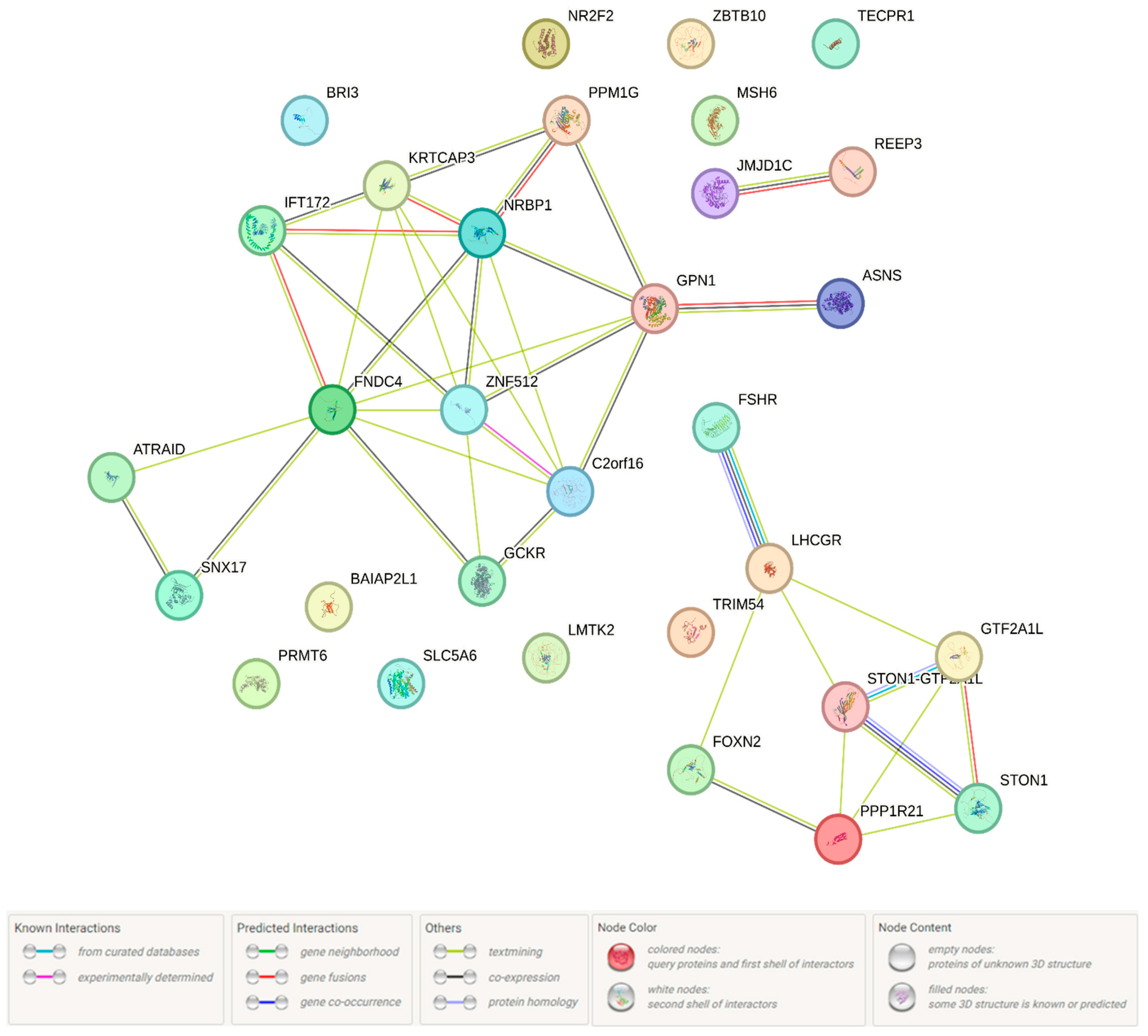
Next, we performed an analysis of protein interactions linked with the above 43 genes (the STRING program was used) (Figure 6). The greatest contribution to the susceptibility to endometriosis (Figure 6; it is a network of paired interactions that form proteins functionally related to 7 endometriosis-associated loci and 115 proxy variants) came from such paired protein interactions as GTF2A1L-STON1 (coefficient [score] of the protein interaction—0.992), JMJD1C-REEP3 [0.901], C2orf16-ZNF512 [0.777], FSHR-LHCGR [0.698], KRTCAP3-NRBP1 [0.626], PPP1R21-STON1 [0.610], C2orf16-GPN1 [0.610], and KRTCAP3-ZNF512 [0.604)]. A number of paired protein interactions were characterized by impact co-expression: ATRAID-SNX17 (coefficient [score] of the protein co-expression-0.151), GPN1-PPM1G [0.146], GPN1-NRBP1 [0.138], FNDC4-GCKR [0.127], and LHCGR-FSHR [0.124]. The role of “hubs” in these endometriosis-significant interactions was performed by proteins such as FNDC4 (participates in 9 pair interactions), NRBP1 and ZNF512 (7 pair interactions each), C2orf16, GPN1, and KRTCAP3 (6 pair interactions each). These protein interactions have been performed with the participation (STRING data) of transcription factor IIA, alpha/beta subunits [CL:27093; pFRD = 0.00025] (STON1-GTF2A1L; GTF2A1L; STON1), domain of unknown function DUF4515, and GPCR family 2 [CL:25526; pFRD = 0.00025] (FNDC4; ZNF512; C2orf16).

3. Discussion

This report demonstrates the endometriosis-risk effect in Caucasian women of Russia of the SHBG-raising genotype GG rs440837 (A > G) ZBTB10 (OR = 1.91) and shows the association of the disease with GWAS-substantial intergenic interactions for the level of SHBG and 7 functionally bulky polymorphisms within the framework of 4 multi-level models (from two to five loci) that determine (due to their assumed pronounced functionality) involvement in the endometriosis biology of many genes and TFs that affect the processes of the endocrine system development, gene transcription regulation, the TGF-beta signaling pathway, regulation of cell proliferation/differentiation, etc.
In two independent predating studies that conducted GWAS, SNP rs440837 (A > G) ZBTB10 showed a relationship with the SHBG level [53,57]. In GWAS, Coviello et al. (all subjects were of European origin), both in the sample as a whole (21,791 individuals [meta-analysis] and 7046 individuals [validation]) and separately in the cohort of women (9390 individuals [meta-analysis] and 4509 individuals [validation]), a correlation of SNP rs440837 (A > G) ZBTB10 with the level of SHBG was demonstrated, and at the same time, the allele A of this polymorphism marked a low level of SHBG with a more pronounced effect in women: β = −0.030 (p = 3 × 10⁻⁹) and β = −0.042 (p = 7 × 10⁻⁸), respectively [53]. GWAS by Harrison et al. on a sample of Europeans (British ancestry) also confirmed rs440837 (A > G) ZBTB10 to be associated with comparable SHBG levels as in men (p = 8 × 10⁻⁹; 148,248 men); similarly, in postmenopausal women (p = 1 × 10⁻¹²; 104,632 women) and with high levels of SHBG in both studied groups (men and women), the allele G rs440837 (A > G) ZBTB10 was associated as β = 0.57 and β = 1.43, respectively; it should be emphasized that based on the values of the indicator “β”, the phenotypic effect in women was more than 2.5 times higher than in men [57]. So, the data from two predating conducted GWAS, by Coviello et al. [53] and Harrison et al. [57], are completely consistent with each other and indicate that the high-level marker of SHBG was the minor allele G, and the low-level marker of SHBG is the major allele A of the rs440837 (A > G) ZBTB10. So, this gives us reason to conclude that the SHBG-higher genotype GG rs440837 (A > G) ZBTB10 (GWAS data, Coviello et al. [53] and Harrison et al. [57]) correlates with a high risk of endometriosis (OR = 1.91, our data). Importantly, our previous study revealed an association of rs440837 (A > G) ZBTB10 with uterine fibroids: the genotype GG increased the risk of uterine fibroids by almost 2 times (OR = 1.93) among women of the same population (Europeans in Russia) [62], which is fully consistent with the data of this study (the risk value of rs440837 (A > G) ZBTB10 in the formation of both endometriosis and uterine fibroids) and allows us to consider rs440837 (A > G) ZBTB10 as one of the potentially possible syntropic polymorphisms/genes in the development of benign proliferative diseases of the uterus. It should be noted that our assumption about the potentially possible syntropic effects of rs440837 (A > G) ZBTB10 in the formation of uterine hyperplastic diseases (endometriosis and uterine fibroids) requires additional research and confirmation in other experimental genetic (associative/functional) studies.
It is extremely interesting that the genome region where, established by us, the endometriosis-causal SHBG-significant locus rs440837 (A > G) ZBTB10 was located—8q21.13 (chromosome position [hg38]: 80,535,356–80,561,600)—has a very significant role in regulating the SHBG concentration in the organism: in addition to the SNP rs440837 (A > G) ZBTB10 considered by us, according to the materials of two GWAS, four other loci were associated with the SHBG level (these loci were proxy variants of rs440837) such as rs72688090 (β = 0.038; p = 2 × 10⁻¹⁷ [63]; r2 = 0.33, D’ = 0.85), rs388922 (β = 0.47; p = 3 × 10⁻⁸ [57]; r2 = 0.53, D’ = 0.96), rs575452 (β = 1.31; p = 2 × 10⁻¹² [57]; r2 = 0.28, D’ = 0.71), and rs117921873 (β = 1.74; p = 5 × 10⁻¹⁰ [57]; r2 = 0.26, D’ = 1.00). Along with this, strongly coupled with rs440837 (A > G) ZBTB10 polymorphism—rs444915 (r2 = 0.43, D’ = 0.80), was GWAS associated with body mass index (BMI) (β = 0.011; p = 4 × 10⁻⁹ [64]). Importantly, on the one hand, BMI has inverse correlations with endometriosis (low BMI is a risk factor for the disease [65,66,67,68]), and there are works in the literature that show the association of BMI-related polymorphisms/genes (GHRH, GRB14, LHCGR, KIFAP3, WNT4, CAB39L, etc.) with endometriosis [69]; on the other hand, BMI also has inverse correlations with the SHBG level in the organism [70,71,72].
We have obtained in silico data on the serious functionality of the endometriosis-causal SNP rs440837 (A > G) ZBTB10 and 5 proxy loci: they were localized in sites of potential promoters/enhancers, active promoters/enhancers in the DNA region of three genes such as RP11-48B3.3, RP11-48B3.4, ZBTB10, and affect this genome region interaction with 22 TFs. Importantly, endometriosis-causal SNP rs440837 (A > G) ZBTB10 itself and the strongly linked variant rs7013042 manifest functional activity in the liver, which is the organ of SHBG formation [48,73]. This may be one of the pathophysiological mechanisms of the rs440837 (A > G) ZBTB10 (with rs7013042) communicating with the SHBG level and their involvement in endometriosis pathogenesis due to this. Interestingly, the protein-product of the ZBTB10 gene (the zinc finger and BTB domain containing 10) exhibits its effects in the nucleoplasm, and it is assumed that it participates in the regulation of transcription using RNA polymerase II (by activating its binding to a DNA sequence specific to it) [74]. There are literature data on the association of the ZBTB10 gene with SHBG- and sex hormone-dependent tumors such as breast and ovarian cancers [74,75,76,77,78]. It is indicated that ZBTB10 inhibits the production of vascular endothelial growth factor (VEGF), its receptors of the first and second types (VEGFR1/VEGFR2), and survivin, and decreases mRNA/protein expression of specificity protein (Sp) TFs such as Sp1, Sp3, Sp4, which are responsible for the processes of tumor angiogenesis/growth/metastasis [75,76], and these biological pathways are also important for the biology of endometriosis [79]. Interestingly enough, according to our in silico data, rs7013042, strongly linked to the endometriosis-causal SNP rs440837 (A > G) ZBTB10, affects the “DNA-Sp4” interaction. The participation of Sp (Sp1-Sp4) in the activity regulation of the thousands genes involved in the cell proliferation/migration/survival/invasion processes has been shown [80].
The materials presented in the literature show a pronounced determination (56–58%) of the concentration of circulating SHBG by hereditary factors [46,81]. Nine polymorphisms studied in our work have a significant effect on the content of SHBG in the female organism (they account for 8.4% of the variability in the SHBG level) [53], seven of which (according to our results) determine the predisposition to endometriosis in Caucasian women of Russia. Interestingly, previously we showed an association with breast cancer risk in 8 out of 9 SNPs and the identical loci panel in the same population [78], what may indicate the “universal” role of GWAS-important genetic determinants of SHBG in the development of female reproductive sphere hormone-dependent diseases (endometriosis, breast cancer) in the population of Europeans in Russia. Similarly, the association of loci from the list of SNPs examined by us with breast cancer was demonstrated in the study by Dimou et al. (the Mendelian randomization method was used and postmenopausal women were considered) [82].
The literature materials about the link of SHBG level/expression with endometriosis are very contradictory [37,38,39,58]. There are studies where such a connection has not been found [58]; however, there are studies that show a direct correlation between the concentration/expression of SHBG and the risk of disease [37]. For example, the work of Panidis et al. revealed a higher level of SHBG in patients with endometriosis (compared with the control) and its decrease in the treatment of patients with danazol (the SHBG level in patients after treatment did not differ from those of healthy women) [37]. A decrease in the SHBG level (and an increase in free testosterone content) in endometriosis patients during treatment with danazol has been shown in other studies [83]. The Misao et al. study revealed an increased expression of SHBG mRNA in endometrioid tissue samples (pelvic endometriosis was studied) than in normal endometrium [38]. The authors point out that intercellular SHBG, which is excessively formed in endometrioid tissue, “protects” related estrogens from metabolic inactivation in the liver and makes them more accessible to endometrial cells, thereby causing an increased risk of endometriosis [38]. A later study by the same team of authors showed the dominant expression of a certain variant of SHBG mRNA associated with the peculiarities of exon VII splicing in ovarian endometriosis [39]. In accordance with the above experimental data, it can be noted that the risk value of SHBG-increasing genotype GG rs440837 (A > G) ZBTB10 (OR = 1.91) identified in our study for endometriosis may be mediated by local (in endometrioid tissue) effects of higher levels of SHBG, which binds to estrogens and “protects” them from metabolic inactivation and thus makes them more accessible to endometrial cells (local hyperestrogenism is formed), thereby increasing the risk of endometriosis.
SHBG is a glycoprotein (the main place of SHBG formation is the liver), which has two analogous peptide chains containing specific sites for binding steroid hormones [48,73]. Its purpose in the organism is to bind/transport steroids (testosterone, estradiol, etc.) in plasma (due to the presence of specific sites) and thus regulate the biological activity of steroids (only steroids that are in the plasma in a free [unbound] state are biologically active) [48]. Based on the above, there is an obvious inverse relationship between, on the one hand, the SHBG level in plasma and, on the other hand, the content of free (bioactive) testosterone (primarily) and estrogens (secondly) in the female [48,73]. This is determined by the following circumstance: SHBG has a greater “sensitivity” to testosterone and a lesser “sensitivity” to estrogens, and as a result, a greater amount of testosterone compared to estradiol will be associated with SHBG (65% and 38%, respectively) [47,50]. If we take into account, at the same time, an approximately equal percentage in the amount of free (bioactive) forms of testosterone and estradiol in plasma (1–2% for testosterone and 2% for estradiol) [47,50], then we can make an assumption about a more pronounced effect of SHBG on the content/effects of testosterone in the organism compared to estradiol. So, an increase in the plasma SHBG content (including genetically determined) it will cause its more pronounced binding to testosterone than to estrogens, which will lead to a more significant decrease in free (bioactive) testosterone concentration (to a lesser extent estrogens) and eventually will have more serious phenotypically significant “consequences” in the female organism. The reverse-oriented “SHBG-bioactive testosterone” genetic relationship in women has been shown in a number of studies [46,49]: the indicators of “SHBG-bioactive testosterone” genetic correlations calculated in these works were very impressive and amounted to pG = −0.60 [46] and rg = −0.75 [49]. So, taking into account the above-mentioned results of the work, we can note that free (bioactive) testosterone-related effects may be at the heart of the established association of GWAS-important loci for SHBG with endometriosis.
Well, we found that SHBG-raising genotype GG rs440837 (A > G) ZBTB10 causes an almost twofold increase in the endometriosis risk (OR = 1.91). An increase in the SHBG concentration, in turn, will determine a significant decrease in free testosterone in a woman [46,49], and this will eventually increase the risk of endometriosis, which we found in our study. Our results, to the fullest extent, correspond to the testosterone-driven concept of endometriosis development proposed in the review papers by Densdale & Crespi [40,41,42]. Densdale & Crespi postulate a hypothesis about the causal effect of low prenatal testosterone levels (persisting in the postnatal period) on an increased risk of developing endometriosis during a woman’s lifetime [40,41,42]. The works of these scientists indicate a pronounced effect on the hypothalamic-pituitary-gonadal system of the female fetus (in the prenatal period of its development) of low testosterone levels, which leads to its “reprogramming” and the formation of a certain endometriosis-predisposing pattern of the hormonal profile of these fetuses (reduced LH compared with FSH, increased SHBG, reduced systemic/ovarian testosterone, etc.) [40,41,42]. In their subsequent review article, Crespi et al. provided reasoned justifications for the positive correlation in a woman’s adult life of lower testosterone levels with the main endometriosis-related symptoms such as pelvic pain (several days a month) and increased pain sensitivity [84]. The authors note that the pathophysiological justification for the above correlations may be a link between low testosterone levels (on the one hand) and increased levels of the proinflammatory cytokine IL-1β, as well as reduced levels of β-endorphin (on the other hand) [84]. Crespi et al. point out that the low level of systemic/ovarian testosterone, formed in the prenatal period and maintained in the postnatal period, may be the basis for the formation of endometriosis and endometriosis-related symptoms (pain and sensitivity to it) [84]. The fundamental (genetic) basis of the prenatal/postnatal occurrence of low systemic/ovarian testosterone in a woman may be gene polymorphisms, which were established, among other things, in our present work.
A causal relationship between the genetic determination of low testosterone (both total and bioavailable) levels and endometriosis was found by McGrath I.M. et al., (UK Biobank data were used, the polygenic risk score was calculated, and Mendelian randomization was used) [45]. Conversely, Garitazelaia et al.’s work did not establish causal relationships between sex hormones (including SHBG) and endometriosis (GWAS from a Twins UK study [sex hormones] [54] and the FinnGen cohort [endometriosis] and MR were used) [61]. Our results fully correlate with the data obtained in the work of McGrath I.M. et al. [45] and differ from the results of Garitazelaia et al. [61]. The differences between our results (the association of the SHBG-raising genotype GG rs440837 (A > G) ZBTB10 with an increased risk of endometriosis was revealed) and the data of Garitazelaia et al. (the MR method did not establish a link between the GWAS determinants of sex hormones and endometriosis [61]) may be due to the following points.
Firstly, Garitazelaia et al. analyzed a different list of polymorphisms associated with the level of sex hormones (8 SNPs were considered, which, according to GWAS data from Ruth et al. [54], were associated with such sex hormones (their indexes) as oestradiol [rs117585797 ANO2], dehydroepiandrosterone sulfate [rs148982377 ZNF789], follicle-stimulating hormone [rs11031005 FSHB], luteinizing hormone [rs11031002 FSHB], progesterone [rs112295236 SLC22A10, rs34670419 ZKSCAN5], SHBG [rs1641549 TP53]), and free androgen index [rs117145500 CHD9] compared to our work, which studied GWAS-significance for the level of nine SHBG polymorphisms [rs17496332 (A > G) PRMT6, rs780093 (C > T) GCKR, rs10454142 (T > C) PPP1R21, rs3779195 (T > A) BAIAP2L1, rs440837 (A > G) ZBTB10, rs7910927 (G > T) JMJD1C, rs8023580 (T > C) NR2F2, rs12150660 (G > T) SHBG, and rs4149056 (T > C) SLCO1B1]. Herewith, Garitazelaia et al. studied only one polymorphism associated with the SHBG level (rs1641549 TP53), whereas in our study, this SNP was not considered. Accordingly, different results can be expected for different panels of polymorphisms linked with different sex hormones under study.
Secondly, in the work of Garitazelaia et al., in which MR analysis did not demonstrate statistically significant causal relationships between the GWAS-impact determinant of the sex hormone levels and endometriosis, pleiotropic genetic associations of two loci (rs11031002; rs11031005) of the FSHB gene with endometriosis and sex hormone contents were registered (and this, as the authors themselves note, came as a surprise to them!). Also, two SNPs (rs11031005; rs11031006) in this region of FSHB demonstrated statistically substantial pleiotropic associations mediating endometriosis and related features (age of menarche and menopause, and duration of the menstrual cycle) [61]. Thus, even within the framework of a single large-scale MR analysis of GWAS data, there is a serious discrepancy in the study results: the absence of associations for the totality of the analyzed 8 SNPs and the presence of associations for two separate loci! This data may indicate that the effects of individual polymorphisms may not “coincide” with the total effects of a group of polymorphisms, and further experimental genetic studies in the field of endometriosis are needed with a detailed analysis of both the effects of individual loci and an assessment of the total effect of a group of polymorphisms (causal relationships) in the development of the disease.
Quite importantly, in our earlier study by Golovchenko et al. [60], devoted to the relationship of GWAS-impact SNP of sex hormones (this panel of 8 loci taken from a GWAS by Ruth et al. [54]) with endometriosis, we studied (the work was performed on the same sample of patients): first, the disorder-protective value of total/free testosterone-boosting genetic variant C rs11031005 FSHB; and secondly, involvement in predisposition to the disease (as part of intergenic interactions) of polymorphisms, GWAS-impact on the circulation level of SHBG (rs1641549 TP53 [54], rs727428 SHBG [52]), free [bioavailable] testosterone (rs112295236 SLC22A10 [55], rs727428 SHBG [55]), DHEAS (rs34670419 ZKSCAN5 [85]) [60]. The correlation of testosterone levels in patients with endometriosis with polymorphisms rs148982377 ZNF789 and rs34670419 ZKSCAN5 was shown [86].
It should be noted that despite large-scale genetic studies of endometriosis (numerous associative studies and more than 25 GWAS [10,11,12,13,14,15,16,17,18,19,20,21,22,23,24,25,26,27,28,29,30,31,32,33,34,35,36]), data on specific genetic factors are currently known for only a small part (approximately 5%) of the variability of the disease [16,30]. This suggests that the genetic basis of endometriosis remains largely unclear, since the currently known SNPs/genes associated with endometriosis (involved in the production of sex (steroid) hormones (SYNE1, FN1, FSHB, ESR1, CCDC170, etc.) [16,60], pain sensitivity (MLLT10, BMF/SRP14, NGF, GDAP1, BSN, etc.) [30], fat distribution (KIFAP3, CAB39L, WNT4, GRB14, etc.) [69], affecting the structure of chromatin (TRA2A, GREB1, VEZT, BMF, SRP14, etc.) [30], inflammatory reactions, uterine development, oncogenesis, etc. [30], explain only about one twentieth of the total variability and one tenth of the genetic variability of the disease. This fact underscores the need to continue further active research on endometriosis in order to identify other genetic factors that determine the development of the disease, which currently, despite the serious efforts made by the scientific community in this direction, remain unknown.
This work has a number of limitations, among which the following can be noted. Firstly, our results were obtained for one ethnic group (the Europeans of Central Russia) and can only be used as a guideline for other ethnic groups. Further research in this area is needed to confirm the patterns identified in this work in other ethnic groups. Secondly, due to the small number of women in the control group with infertility, we were unable to conduct a representative comparative analysis of the genetic characteristics of patients and controls with infertility according to the considered SHBG-significant polymorphisms.

4. Materials and Methods

4.1. Study Subjects

When planning/conducting this study, the requirements/recommendations of the “Ethics Committee” of the Belgorod State National Research University were taken into account: the procedure for implementing each stage of the study (collection of clinical/anamnestic/biological data, laboratory [genetic] testing, etc.) was considered in detail/approved at meetings of this committee; all participants in our study confirmed their consent in writing to their involvement in it. The study was conducted on a total sample of 1368 women (395 endometriosis; 973 endometriosis free [controls]). The sample was ethnically/geographically “homogeneous” and included only Caucasian (Russian) women who were born/lived in Central Russia [87,88,89]. Individuals with oncological pathology of the female reproductive system (pelvic organs, mammary gland), and severe disorder of the vital organs and autoimmune system, were excluded from the study (both endometriosis and controls) [60].
The diagnosis of endometriosis was carried out on the basis of rASRM criteria [90] by certified doctors of the gynecology and assisted reproductive technologies departments at the Perinatal Center, and included mandatory morphological verification of the endometrioid tissue detected during laparotomy/laparoscopy. Among patients (n = 395), stage I of the disorder was detected in 35.90%, stage II in 53.98%, and stage III/IV in 10.12%. The absence of well-known clinical symptoms of endometriosis in women (infertility, chronic pelvic pain, and others), as well as the reproductive system (pelvic organ) disorders, allowed them to be included in the control group (endometriosis-free).

4.2. Experimental Analysis of the DNA (Selection and Genotyping of SNP)

DNA samples (concentrations ranging from 10 to 20 ng/mL with a sufficient level of purity [parameter “260 nm/280 nm” was in the range from 1.7 to 2.0] [91] according to the results of testing on NanoDrop 2000 (Thermo Fisher Scientific Inc., Waltham, MA, USA)) were genotyped on a CFX96 amplifier [92,93]. The polymorphisms panel for genotyping included 9 SNPs that were GWAS-validated for SHBG [51,53,55,56,57,94] (Table S9) and had forecasted functionality (Table S3). So, loci such as rs17496332 (A > G) PRMT6, rs780093 (C > T) GCKR, rs10454142 (T > C) PPP1R21, rs3779195 (T > A) BAIAP2L1, rs440837 (A > G) ZBTB10, rs7910927 (G > T) JMJD1C, rs8023580 (T > C) NR2F2, rs12150660 (G > T) SHBG, and rs4149056 (T > C) SLCO1B1 were detected in our work (previously, this panel of loci was “tested” and showed its “effectiveness” in the genetic study of breast cancer, endometrial hyperplasia, and uterine fibroid [62,78,95,96,97,98,99]).
The “call rate” indicator was used to control the quality of experimentally obtained genetic data: DNA samples and SNPs with a “call rate” of >90% were considered to have “completed” quality control and were included in the study. All the DNA samples studied and the SNPs considered had a “call rate” > 90% (for the studied SNPs, the “call rate” in the endometriosis group was 92.41% [rs440837 (A > G) ZBTB10]—99.24% [rs17496332 (A > G) PRMT6], and in the control group, 90.85% [rs4149056 (T > C) SLCO1B1]—96.40% [rs12150660 (G > T) SHBG] (Table S1); the total genotyping rate in the studied case/control individuals was 94.76%). The “blind re-genotyping” method (for this purpose, repeated studies were conducted for ≈5% of the studied DNA samples), which we additionally used to control the quality of the obtained genetic data [100], showed complete coincidence in the results obtained (certain genotypes) for 99% of the “blind re-genotyped” samples, which indicates the acceptable quality of the genetic analysis performed.

4.3. Statistical Analysis of Experimental Genetic Data (SNP and Multi-SNPs Association Analysis)

A mandatory “preparatory” stage before evaluating “endometriosis–SNP” associations was a comparison of the observed and expected (when performing the Hardy–Weinberg equilibrium [HWE]) genotype frequencies for each examined polymorphism for both endometriosis and endometriosis-free, and when these frequencies corresponded, the locus was considered “suitable” for inclusion in the associative analysis.
To assess the “endometriosis–SNP” relationship (calculation of relationship indicators such as the odds ratio [OR] and its 95% confidence interval [95% CI] was performed [101])), the method of logistic regression was employed, and four “basic” models of the reference/alternative allele interactions at the studied polymorphisms (additive//recessive//dominant//allelic [102]) were considered. All calculations were performed in the PLINK (Java-compatible version) software product, which is most widely utilized for solution goals like this [103], when adjusted for confounders (as mentioned above [Table 1], the confounders were menstrual cycle duration, parity, the anamnesis presence of medical abortions (as well as their number), infertility, surgical procedures (laparoscopy; laparotomy) on pelvic organs, and burdened heredity), with multiple comparisons (an adaptive permutation test was used, as a result of which the pperm value was assessed [104]) and mandatory determination of the power of the identified associative relationships (the Quanto program was utilized [105]). A value of pperm less than 0.05 with a power of at least 80% was the basis for the identification of statistically significant/justified “endometriosis–SNP” associations [106].
To study the contribution of multi-SNPs (non-allelic variant interlocus interactions) of SHBG-impact genes to susceptibility to endometriosis, the MB-MDR method [107] and the software of the same name for the R package were exchanged. When evaluating associations, the necessary confounders were taken into account (menstrual cycle duration, parity, the anamnesis presence of medical abortions (as well as their number), infertility, surgical procedures (laparoscopy and laparotomy) on pelvic organs, burdened heredity) and permutation testing was performed (the number of permutations performed was 1000). For permutation validation, one of the most significant “endometriosis-multi-SNP” models was selected (they have the highest values of both Wald statistics and the level of statistical significance [p]) of each considered level. At the same time, this procedure (permutation validation) included only those models that exceeded a certain “threshold level” in terms of statistical significance, calculated by us taking into account the Bonferroni correction (the generally accepted statistically significant parameter “p” equal to 0.05 was adjusted for the number of all possible combinations of the nine studied loci with their different-level combinations) and which made up the following values: two (pthreshold = 1.39 × 10⁻³ [0.05/36]), three (pthreshold = 5.95 × 10⁻⁴ [0.05/84]), four (pthreshold = 3.97 × 10⁻⁴ [0.05/126]) and five (pthreshold = 3.97 × 10⁻⁴ [0.05/126]) locus interactions. In the end, pperm values not exceeding 0.01/0.001 for two-locus/three-and-higher locus models, respectively, were considered reliable. To visualize the endometriosis-significant effects of SHBG-impact loci (orientation and percentage of contribution (entropy) to the disease), the MDR software package was used [108].

4.4. Analysis of Forecasted Functionality at Endometriosis-Associated Polymorphisms (In Silico Study)

An essential final part of our work was the assessment of the potential functionality of endometriosis-associated loci and their LD SNPs (these loci were distinguished at the value of the r2 parameter from 0.80 to 1.00) [109,110] based on materials presented in such well-reputed bioinformatic/experimental genetic databases [111,112] as HaploReg (v.4.2, accessed 11 October 2024) [113]; GTExportal (accessed 1 October 2024) [114]; STRING (accessed 16 October 2024) [115].

5. Conclusions

SHBG-raising genotype GG rs440837 (A > G) ZBTB10 and GWAS-substantial intergenic interactions affect the level of seven SHBG SNPs and increase the risk of endometriosis in Caucasian women of Russia.

Supplementary Materials

The following supporting information can be downloaded at: https://www.mdpi.com/article/10.3390/ijms262311630/s1.

Author Contributions

Conceptualization, T.P. and M.C. (Maria Churnosova); data curation, O.A. and I.P.; formal analysis, E.R. and I.A.; project administration, M.C. (Mikhail Churnosov); writing—original draft, T.P.; writing—review and editing, M.C. (Mikhail Churnosov), E.R., I.A. and I.P. All authors have read and agreed to the published version of the manuscript.

Funding

This research received no external funding.

Institutional Review Board Statement

This study was conducted according to the guidelines of the Declaration of Helsinki, and approved by the Local Ethical Committee of the Belgorod State University (21 March 2017, No. 3).

Informed Consent Statement

Informed consent was obtained from all subjects involved in this study.

Data Availability Statement

The authors declare that the data supporting the findings of this study are available within the paper and its Supplementary Tables. The raw data used in this study can be obtained from the corresponding author upon reasonable request.

Conflicts of Interest

The authors declare no conflicts of interest.

Abbreviations

The following abbreviations are used in this manuscript:
SHBGSex hormone-binding globulin
SHBGlevelSex hormone-binding globulin level
SNPSingle-nucleotide polymorphism
GWASGenome-wide association studies
BMIBody mass index
DNADeoxyribonucleic acid
LDLinkage disequilibrium
TFsTranscription factors

References

  1. Zondervan, K.T.; Becker, C.M.; Missmer, S.A. Endometriosis. N. Engl. J. Med. 2020, 382, 1244–1256. [Google Scholar] [CrossRef] [PubMed]
  2. Taylor, H.S.; Kotlyar, A.M.; Flores, V.A. Endometriosis is a chronic systemic disease: Clinical challenges and novel innovations. Lancet 2021, 397, 839–852. [Google Scholar] [CrossRef] [PubMed]
  3. Cano-Herrera, G.; Salmun Nehmad, S.; Ruiz de Chávez Gascón, J.; Méndez Vionet, A.; van Tienhoven, X.A.; Osorio Martínez, M.F.; Muleiro Alvarez, M.; Vasco Rivero, M.X.; López Torres, M.F.; Barroso Valverde, M.J.; et al. Endometriosis: A Comprehensive Analysis of the Pathophysiology, Treatment, and Nutritional Aspects, and Its Repercussions on the Quality of Life of Patients. Biomedicines 2024, 12, 1476. [Google Scholar] [CrossRef] [PubMed]
  4. Nnoaham, K.E.; Hummelshoj, L.; Webster, P.; d’Hooghe, T.; de Cicco Nardone, F.; de Cicco Nardone, C.; Jenkinson, C.; Kennedy, S.H.; Zondervan, K.T.; World Endometriosis Research Foundation Global Study of Women’s Health Consortium. Impact of endometriosis on quality of life and work productivity: A multicenter study across ten countries. Fertil. Steril. 2011, 96, 366–373.e8. [Google Scholar] [CrossRef]
  5. Smolarz, B.; Szyłło, K.; Romanowicz, H. Endometriosis: Epidemiology, classification, pathogenesis, treatment and genetics (Review of literature). Int. J. Mol. Sci. 2021, 22, 10554. [Google Scholar] [CrossRef]
  6. Simoens, S.; Dunselman, G.; Dirksen, C.; Hummelshoj, L.; Bokor, A.; Brandes, I.; Brodszky, V.; Canis, M.; Colombo, G.L.; DeLeire, T.; et al. The burden of endometriosis: Costs and quality of life of women with endometriosis and treated in referral centres. Hum. Reprod. 2012, 27, 1292–1299. [Google Scholar] [CrossRef]
  7. Saha, R.; Pettersson, H.J.; Svedberg, P.; Olovsson, M.; Bergqvist, A.; Marions, L.; Tornvall, P.; Kuja-Halkola, R. Heritability of endometriosis. Fertil. Steril. 2015, 104, 947–952. [Google Scholar] [CrossRef]
  8. Treloar, S.A.; O’Connor, D.T.; O’Connor, V.M.; Martin, N.G. Genetic influences on endometriosis in an Australian twin sample. Fertil. Steril. 1999, 71, 701–710. [Google Scholar] [CrossRef] [PubMed]
  9. Lee, S.H.; Harold, D.; Nyholt, D.R.; ANZGene Consortium; International Endogene Consortium; Genetic and Environmental Risk for Alzheimer’s disease Consortium; Goddard, M.E.; Zondervan, K.T.; Williams, J.; Montgomery, G.W.; et al. Estimation and partitioning of polygenic variation captured by common SNPs for Alzheimer’s disease, multiple sclerosis and endometriosis. Hum. Mol. Genet. 2012, 4, 832–841. [Google Scholar] [CrossRef]
  10. Adachi, S.; Tajima, A.; Quan, J.; Haino, K.; Yoshihara, K.; Masuzaki, H.; Katabuchi, H.; Ikuma, K.; Suginami, H.; Nishida, N.; et al. Meta-analysis of genome-wide association scans for genetic susceptibility to endometriosis in Japanese population. J. Hum. Genet. 2010, 55, 816–821. [Google Scholar] [CrossRef]
  11. Uno, S.; Zembutsu, H.; Hirasawa, A.; Takahashi, A.; Kubo, M.; Akahane, T.; Aoki, D.; Kamatani, N.; Hirata, K.; Nakamura, Y. A genome-wide association study identifies genetic variants in the CDKN2BAS locus associated with endometriosis in Japanese. Nat. Genet. 2010, 42, 707–710. [Google Scholar] [CrossRef] [PubMed]
  12. Painter, J.N.; Anderson, C.A.; Nyholt, D.R.; Macgregor, S.; Lin, J.; Lee, S.H.; Lambert, A.; Zhao, Z.Z.; Roseman, F.; Guo, Q.; et al. Genome-wide association study identifies a locus at 7p15.2 associated with endometriosis. Nat. Genet. 2011, 43, 51–54. [Google Scholar] [CrossRef] [PubMed]
  13. Nyholt, D.R.; Low, S.K.; Anderson, C.A.; Painter, J.N.; Uno, S.; Morris, A.P.; MacGregor, S.; Gordon, S.D.; Henders, A.K.; Martin, N.G.; et al. Genome-wide association meta-analysis identifies new endometriosis risk loci. Nat. Genet. 2012, 44, 1355–1359. [Google Scholar] [CrossRef]
  14. Albertsen, H.M.; Chettier, R.; Farrington, P.; Ward, K. Genome-wide association study link novel loci to endometriosis. PLoS ONE 2013, 8, e58257. [Google Scholar] [CrossRef] [PubMed]
  15. Borghese, B.; Tost, J.; de Surville, M.; Busato, F.; Letourneur, F.; Mondon, F.; Vaiman, D.; Chapron, C. Identification of susceptibility genes for peritoneal, ovarian, and deep infiltrating endometriosis using a pooled sample-based genome-wide association study. Biomed. Res. Int. 2015, 2015, 461024. [Google Scholar] [CrossRef]
  16. Sapkota, Y.; Steinthorsdottir, V.; Morris, A.P.; Fassbender, A.; Rahmioglu, N.; De Vivo, I.; Buring, J.E.; Zhang, F.; Edwards, T.L.; Jones, S.O.D.; et al. Meta-analysis identifies five novel loci associated with endometriosis highlighting key genes involved in hormone metabolism. Nat. Commun. 2017, 8, 15539. [Google Scholar] [CrossRef]
  17. Sobalska-Kwapis, M.; Smolarz, B.; Słomka, M.; Szaflik, T.; Kępka, E.; Kulig, B.; Siewierska-Górska, A.; Polak, G.; Romanowicz, H.; Strapagiel, D.; et al. New variants near RHOJ and C2, HLA-DRA region and susceptibility to endometriosis in the Polish population-The genome-wide association study. Eur. J. Obstet. Gynecol. Reprod. Biol. 2017, 217, 106–112. [Google Scholar] [CrossRef]
  18. Wang, W.; Li, Y.; Li, S.; Wu, Z.; Yuan, M.; Wang, T.; Wang, S. Pooling-Based Genome-Wide Association Study Identifies Risk Loci in the Pathogenesis of Ovarian Endometrioma in Chinese Han Women. Reprod. Sci. 2017, 24, 400–406. [Google Scholar] [CrossRef]
  19. Uimari, O.; Rahmioglu, N.; Nyholt, D.R.; Vincent, K.; Missmer, S.A.; Becker, C.; Morris, A.P.; Montgomery, G.W.; Zondervan, K.T. Genome-wide genetic analyses highlight mitogen-activated protein kinase (MAPK) signaling in the pathogenesis of endometriosis. Hum. Reprod. 2017, 32, 780–793. [Google Scholar] [CrossRef]
  20. Painter, J.N.; O’Mara, T.A.; Morris, A.P.; Cheng, T.H.T.; Gorman, M.; Martin, L.; Hodson, S.; Jones, A.; Martin, N.G.; Gordon, S.; et al. Genetic overlap between endometriosis and endometrial cancer: Evidence from cross-disease genetic correlation and GWAS meta-analyses. Cancer Med. 2018, 7, 1978–1987. [Google Scholar] [CrossRef]
  21. Zhou, W.; Nielsen, J.B.; Fritsche, L.G.; Dey, R.; Gabrielsen, M.E.; Wolford, B.N.; LeFaive, J.; VandeHaar, P.; Gagliano, S.A.; Gifford, A.; et al. Efficiently controlling for case-control imbalance and sample relatedness in large-scale genetic association studies. Nat. Genet. 2018, 50, 1335–1341. [Google Scholar] [CrossRef]
  22. Ishigaki, K.; Akiyama, M.; Kanai, M.; Takahashi, A.; Kawakami, E.; Sugishita, H.; Sakaue, S.; Matoba, N.; Low, S.K.; Okada, Y.; et al. Large-scale genome-wide association study in a Japanese population identifies novel susceptibility loci across different diseases. Nat. Genet. 2020, 52, 669–679. [Google Scholar] [CrossRef] [PubMed]
  23. Masuda, T.; Low, S.K.; Akiyama, M.; Hirata, M.; Ueda, Y.; Matsuda, K.; Kimura, T.; Murakami, Y.; Kubo, M.; Kamatani, Y.; et al. GWAS of five gynecologic diseases and cross-trait analysis in Japanese. Eur. J. Hum. Genet. 2020, 28, 95–107. [Google Scholar] [CrossRef] [PubMed]
  24. Adewuyi, E.O.; Mehta, D.; Sapkota, Y.; International Endogene Consortium; 23andMe Research Team; Auta, A.; Yoshihara, K.; Nyegaard, M.; Griffiths, L.R.; Montgomery, G.W.; et al. Genetic analysis of endometriosis and depression identifies shared loci and implicates causal links with gastric mucosa abnormality. Hum. Genet. 2021, 140, 529–552. [Google Scholar] [CrossRef]
  25. Backman, J.D.; Li, A.H.; Marcketta, A.; Sun, D.; Mbatchou, J.; Kessler, M.D.; Benner, C.; Liu, D.; Locke, A.E.; Balasubramanian, S.; et al. Exome sequencing and analysis of 454,787 UK Biobank participants. Nature 2021, 599, 628–634. [Google Scholar] [CrossRef]
  26. Chou, Y.C.; Chen, M.J.; Chen, P.H.; Chang, C.W.; Yu, M.H.; Chen, Y.J.; Tsai, E.M.; Tsai, S.F.; Kuo, W.S.; Tzeng, C.R. Integration of genome-wide association study and expression quantitative trait locus mapping for identification of endometriosis-associated genes. Sci. Rep. 2021, 11, 478. [Google Scholar] [CrossRef]
  27. Jiang, L.; Zheng, Z.; Fang, H.; Yang, J. A generalized linear mixed model association tool for biobank-scale data. Nat. Genet. 2021, 53, 1616–1621. [Google Scholar] [CrossRef]
  28. Sakaue, S.; Kanai, M.; Tanigawa, Y.; Karjalainen, J.; Kurki, M.; Koshiba, S.; Narita, A.; Konuma, T.; Yamamoto, K.; Akiyama, M.; et al. A cross-population atlas of genetic associations for 220 human phenotypes. Nat. Genet. 2021, 53, 1415–1424. [Google Scholar] [CrossRef]
  29. McGrath, I.M.; International Endometriosis Genetics Consortium; Montgomery, G.W.; Mortlock, S. Genomic characterisation of the overlap of endometriosis with 76 comorbidities identifies pleiotropic and causal mechanisms underlying disease risk. Hum. Genet. 2023, 142, 1345–1360. [Google Scholar] [CrossRef]
  30. Rahmioglu, N.; Mortlock, S.; Ghiasi, M.; Møller, P.L.; Stefansdottir, L.; Galarneau, G.; Turman, C.; Danning, R.; Law, M.H.; Sapkota, Y.; et al. The genetic basis of endometriosis and comorbidity with other pain and inflammatory conditions. Nat. Genet. 2023, 55, 423–436. [Google Scholar] [CrossRef]
  31. Walters, R.G.; Millwood, I.Y.; Lin, K.; Schmidt Valle, D.; McDonnell, P.; Hacker, A.; Avery, D.; Edris, A.; Fry, H.; Cai, N.; et al. Genotyping and population characteristics of the China Kadoorie Biobank. Cell Genom. 2023, 3, 100361. [Google Scholar] [CrossRef] [PubMed]
  32. Auwerx, C.; Jõeloo, M.; Sadler, M.C.; Tesio, N.; Ojavee, S.; Clark, C.J.; Mägi, R.; Estonian Biobank Research Team; Reymond, A.; Kutalik, Z. Rare copy-number variants as modulators of common disease susceptibility. Genome Med. 2024, 16, 5. [Google Scholar] [CrossRef] [PubMed]
  33. Verma, A.; Huffman, J.E.; Rodriguez, A.; Conery, M.; Liu, M.; Ho, Y.L.; Kim, Y.; Heise, D.A.; Guare, L.; Panickan, V.A.; et al. Diversity and scale: Genetic architecture of 2068 traits in the VA Million Veteran Program. Science 2024, 385, eadj1182. [Google Scholar] [CrossRef] [PubMed]
  34. Liu, T.Y.; Lu, H.F.; Chen, Y.C.; Liao, C.C.; Lin, Y.J.; Yang, J.S.; Liao, W.L.; Lin, W.D.; Chen, S.Y.; Huang, Y.C.; et al. Diversity and longitudinal records: Genetic architecture of disease associations and polygenic risk in the Taiwanese Han population. Sci. Adv. 2025, 11, eadt0539. [Google Scholar] [CrossRef]
  35. Pujol Gualdo, N.; Džigurski, J.; Rukins, V.; Pajuste, F.D.; Wolford, B.N.; Võsa, M.; Golob, M.; Haug, L.; Alver, M.; Läll, K.; et al. Atlas of genetic and phenotypic associations across 42 female reproductive health diagnoses. Nat. Med. 2025, 31, 1626–1634. [Google Scholar] [CrossRef]
  36. Shigesi, N.; Harris, H.R.; Fang, H.; Ndungu, A.; Lincoln, M.R.; International Endometriosis Genome Consortium; 23andMe Research Team; Cotsapas, C.; Knight, J.; Missmer, S.A.; et al. The phenotypic and genetic association between endometriosis and immunological diseases. Hum. Reprod. 2025, 40, 1195–1209. [Google Scholar] [CrossRef]
  37. Panidis, D.; Kokkinos, T.; Vavilis, D.; Rousso, D.; Tantanassis, T.; Kalogeropoulos, A. SHBG-Serumspiegel bein Frauen mit Endometriose vor, während und nach Danazol-Langzeittherapie [SHBG serum level in women with endometriosis before, during and after long-term danazol therapy]. Geburtshilfe Frauenheilkd. 1993, 53, 121–124. [Google Scholar] [CrossRef]
  38. Misao, R.; Hori, M.; Ichigo, S.; Fujimoto, J.; Tamaya, T. Levels of sex hormone-binding globulin (SHBG) and corticosteroid-binding globulin (CBG) messenger ribonucleic acid (mRNAs) in ovarian endometriosis. Reprod. Nutr. Dev. 1995, 35, 155–165. [Google Scholar] [CrossRef]
  39. Misao, R.; Nakanishi, Y.; Fujimoto, J.; Tamaya, T. Expression of sex hormone-binding globulin exon VII splicing variant messenger ribonucleic acid in human ovarian endometriosis. Fertil. Steril. 1998, 69, 324–328. [Google Scholar] [CrossRef]
  40. Crespi, B. Variation among human populations in endometriosis and PCOS A test of the inverse comorbidity model. Evol. Med. Public Health 2021, 9, 95–310. [Google Scholar] [CrossRef]
  41. Dinsdale, N.; Nepomnaschy, P.; Crespi, B. The evolutionary biology of endometriosis. Evol. Med. Public Health 2021, 9, 74–191. [Google Scholar] [CrossRef]
  42. Dinsdale, N.L.; Crespi, B.J. Endometriosis and polycystic ovary syndrome are diametric disorders. Evol. Appl. 2021, 14, 1693–1715. [Google Scholar] [CrossRef]
  43. Foster, W.G.; Leonardi, M. Endometriosis—Novel approaches and controversies debated. Reprod Fertil. 2021, 2, C39–C41. [Google Scholar] [CrossRef] [PubMed]
  44. Saunders, P.T.K. Insights from genomic studies on the role of sex steroids in the aetiology of endometriosis. Reprod. Fertil. 2022, 3, R51–R65. [Google Scholar] [CrossRef] [PubMed]
  45. McGrath, I.M.; International Endometriosis Genetics Consortium; Montgomery, G.W.; Mortlock, S. Polygenic risk score phenome-wide association study reveals an association between endometriosis and testosterone. BMC Med. 2023, 21, 482. [Google Scholar] [CrossRef]
  46. Coviello, A.D.; Zhuang, W.V.; Lunetta, K.L.; Bhasin, S.; Ulloor, J.; Zhang, A.; Karasik, D.; Kiel, D.P.; Vasan, R.S.; Murabito, J.M. Circulating testosterone and SHBG concentrations are heritable in women: The Framingham Heart Study. J. Clin. Endocrinol. Metab. 2011, 96, E1491–E1495. [Google Scholar] [CrossRef] [PubMed]
  47. Balogh, A.; Karpati, E.; Schneider, A.E.; Hetey, S.; Szilagyi, A.; Juhasz, K.; Laszlo, G.; Hupuczi, P.; Zavodszky, P.; Papp, Z.; et al. Sex hormone-binding globulin provides a novel entry pathway for estradiol and influences subsequent signaling in lymphocytes via membrane receptor. Sci. Rep. 2019, 9, 4. [Google Scholar] [CrossRef]
  48. Hammond, G.L. Plasma steroid-binding proteins: Primary gatekeepers of steroid hormone action. J. Endocrinol. 2016, 230, R13–R25. [Google Scholar] [CrossRef]
  49. Sinnott-Armstrong, N.; Naqvi, S.; Rivas, M.; Pritchard, J.K. GWAS of three molecular traits highlights core genes and pathways alongside a highly polygenic background. Elife 2021, 10, e58615. [Google Scholar] [CrossRef]
  50. Dunn, J.F.; Nisula, B.C.; Rodbard, D. Transport of steroid hormones: Binding of 21 endogenous steroids to both testosterone-binding globulin and corticosteroid-binding globulin in human plasma. J. Clin. Endocrinol. Metab. 1981, 53, 58–68. [Google Scholar] [CrossRef]
  51. Ohlsson, C.; Wallaschofski, H.; Lunetta, K.L.; Stolk, L.; Perry, J.R.; Koster, A.; Petersen, A.K.; Eriksson, J.; Lehtimäki, T.; Huhtaniemi, I.T.; et al. Genetic determinants of serum testosterone concentrations in men. PLoS Genet. 2011, 7, e1002313. [Google Scholar] [CrossRef] [PubMed]
  52. Prescott, J.; Thompson, D.J.; Kraft, P.; Chanock, S.J.; Audley, T.; Brown, J.; Leyland, J.; Folkerd, E.; Doody, D.; Hankinson, S.E.; et al. Genome-wide association study of circulating estradiol, testosterone, and sex hormone-binding globulin in postmenopausal women. PLoS ONE 2012, 7, e37815. [Google Scholar] [CrossRef] [PubMed]
  53. Coviello, A.D.; Haring, R.; Wellons, M.; Vaidya, D.; Lehtimäki, T.; Keildson, S.; Lunetta, K.L.; He, C.; Fornage, M.; Lagou, V.; et al. A genome-wide association meta-analysis of circulating sex hormone-binding globulin reveals multiple Loci implicated in sex steroid hormone regulation. PLoS Genet. 2012, 8, e1002805. [Google Scholar] [CrossRef] [PubMed]
  54. Ruth, K.S.; Campbell, P.J.; Chew, S.; Lim, E.M.; Hadlow, N.; Stuckey, B.G.; Brown, S.J.; Feenstra, B.; Joseph, J.; Surdulescu, G.L.; et al. Genome-wide association study with 1000 genomes imputation identifies signals for nine sex hormone-related phenotypes. Eur. J. Hum. Genet. 2016, 24, 284–290. [Google Scholar] [CrossRef] [PubMed]
  55. Ruth, K.S.; Day, F.R.; Tyrrell, J.; Thompson, D.J.; Wood, A.R.; Mahajan, A.; Beaumont, R.N.; Wittemans, L.; Martin, S.; Busch, A.S.; et al. Using human genetics to understand the disease impacts of testosterone in men and women. Nat. Med. 2020, 26, 252–258. [Google Scholar] [CrossRef]
  56. Haas, C.B.; Hsu, L.; Lampe, J.W.; Wernli, K.J.; Lindström, S. Cross-ancestry Genome-wide Association Studies of Sex Hormone Concentrations in Pre- and Postmenopausal Women. Endocrinology 2022, 163, bqac020. [Google Scholar] [CrossRef]
  57. Harrison, S.; Davies, N.M.; Howe, L.D.; Hughes, A. Testosterone and socioeconomic position: Mendelian randomization in 306,248 men and women in UK Biobank. Sci. Adv. 2021, 7, eabf8257. [Google Scholar] [CrossRef]
  58. Shafrir, A.L.; Mu, F.; Eliassen, A.H.; Thombre Kulkarni, M.; Terry, K.L.; Hankinson, S.E.; Missmer, S.A. Endogenous Steroid Hormone Concentrations and Risk of Endometriosis in Nurses’ Health Study II. Am. J. Epidemiol. 2023, 192, 573–586. [Google Scholar] [CrossRef]
  59. van der Vaart, J.F.; Merki-Feld, G.S. Sex hormone-related polymorphisms in endometriosis and migraine: A narrative review. Womens Health 2022, 18, 17455057221111315. [Google Scholar] [CrossRef]
  60. Golovchenko, I.; Aizikovich, B.; Golovchenko, O.; Reshetnikov, E.; Churnosova, M.; Aristova, I.; Ponomarenko, I.; Churnosov, M. Sex Hormone Candidate Gene Polymorphisms Are Associated with Endometriosis. Int. J. Mol. Sci. 2022, 23, 13691. [Google Scholar] [CrossRef]
  61. Garitazelaia, A.; Rueda-Martínez, A.; Arauzo, R.; de Miguel, J.; Cilleros-Portet, A.; Marí, S.; Bilbao, J.R.; Fernandez-Jimenez, N.; García-Santisteban, I. A Systematic two-sample Mendelian randomization analysis identifies shared genetic origin of endometriosis and associated phenotypes. Life 2021, 11, 24. [Google Scholar] [CrossRef] [PubMed]
  62. Ponomarenko, M.; Reshetnikov, E.; Churnosova, M.; Aristova, I.; Abramova, M.; Novakov, V.; Churnosov, V.; Polonikov, A.; Plotnikov, D.; Churnosov, M.; et al. Genetic Variants Linked with the Concentration of Sex Hormone-Binding Globulin Correlate with Uterine Fibroid Risk. Life 2025, 15, 1150. [Google Scholar] [CrossRef] [PubMed]
  63. Sinnott-Armstrong, N.; Tanigawa, Y.; Amar, D.; Mars, N.; Benner, C.; Aguirre, M.; Venkataraman, G.R.; Wainberg, M.; Ollila, H.M.; Kiiskinen, T.; et al. Genetics of 35 blood and urine biomarkers in the UK Biobank. Nat. Genet. 2021, 53, 185–194, Erratum in Nat Genet. 2021, 53, 1622. https://doi.org/10.1038/s41588-021-00956-2. [Google Scholar] [CrossRef] [PubMed]
  64. Huang, J.; Huffman, J.E.; Huang, Y.; Do Valle, Í.; Assimes, T.L.; Raghavan, S.; Voight, B.F.; Liu, C.; Barabási, A.L.; Huang, R.D.L.; et al. Genomics and phenomics of body mass index reveals a complex disease network. Nat. Commun. 2022, 13, 7973. [Google Scholar] [CrossRef]
  65. Backonja, U.; Buck Louis, G.M.; Lauver, D.R. Overall Adiposity, Adipose Tissue Distribution, and Endometriosis: A Systematic Review. Nurs. Res. 2016, 65, 151–166. [Google Scholar] [CrossRef]
  66. Yong, L.; Weiyuan, Z. Association between body mass index and endometriosis risk: A meta-analysis. Oncotarget 2017, 8, 46928–46936. [Google Scholar] [CrossRef]
  67. Shafrir, A.L.; Farland, L.V.; Shah, D.K.; Harris, H.R.; Kvaskoff, M.; Zondervan, K.; Missmer, S.A. Risk for and consequences of endometriosis: A critical epidemiologic review. Best. Pract. Res. Clin. Obstet. Gynaecol. 2018, 51, 1–15. [Google Scholar] [CrossRef]
  68. Byun, J.; Peterson, C.M.; Backonja, U.; Taylor, R.N.; Stanford, J.B.; Allen-Brady, K.L.; Smith, K.R.; Louis, G.M.B.; Schliep, K.C. Adiposity and endometriosis severity and typology. J. Minim. Invasive Gynecol. 2020, 27, 1516–1523. [Google Scholar] [CrossRef]
  69. Rahmioglu, N.; Macgregor, S.; Drong, A.W.; Hedman, Å.K.; Harris, H.R.; Randall, J.C.; Prokopenko, I.; International Endogene Consortium (IEC); The GIANT Consortium; Nyholt, D.R.; et al. Genome-wide enrichment analysis between endometriosis and obesity-related traits reveals novel susceptibility loci. Hum. Mol. Genet. 2015, 24, 1185–1199. [Google Scholar] [CrossRef]
  70. Baglietto, L.; English, D.R.; Hopper, J.L.; MacInnis, R.J.; Morris, H.A.; Tilley, W.D.; Krishnan, K.; Giles, G.G. Circulating steroid hormone concentrations in postmenopausal women in relation to body size and composition. Breast Cancer Res. Treat. 2009, 115, 171–179. [Google Scholar] [CrossRef]
  71. Liedtke, S.; Schmidt, M.E.; Vrieling, A.; Lukanova, A.; Becker, S.; Kaaks, R.; Zaineddin, A.K.; Buck, K.; Benner, A.; Chang-Claude, J.; et al. Postmenopausal sex hormones in relation to body fat distribution. Obesity 2012, 20, 1088–1095. [Google Scholar] [CrossRef] [PubMed]
  72. Chen, Y.W.; Hang, D.; Kværner, A.S.; Giovannucci, E.; Song, M. Associations between body shape across the life course and adulthood concentrations of sex hormones in men and pre- and postmenopausal women: A multicohort study. Br. J. Nutr. 2022, 127, 1000–1009. [Google Scholar] [CrossRef] [PubMed]
  73. Hammond, G.L. Diverse roles for sex hormone-binding globulin in reproduction. Biol. Reprod. 2011, 85, 431–441. [Google Scholar] [CrossRef] [PubMed]
  74. Giordano, C.; Accattatis, F.M.; Gelsomino, L.; Del Console, P.; Győrffy, B.; Giuliano, M.; Veneziani, B.M.; Arpino, G.; De Angelis, C.; De Placido, P.; et al. miRNAs in the Box: Potential Diagnostic Role for Extracellular Vesicle-Packaged miRNA-27a and miRNA-128 in Breast Cancer. Int. J. Mol. Sci. 2023, 24, 15695. [Google Scholar] [CrossRef]
  75. Li, X.; Mertens-Talcott, S.U.; Zhang, S.; Kim, K.; Ball, J.; Safe, S. MicroRNA-27a Indirectly Regulates Estrogen Receptor α Expression and Hormone Responsiveness in MCF-7 Breast Cancer Cells. Endocrinology 2010, 151, 2462–2473. [Google Scholar] [CrossRef]
  76. Tang, W.; Zhu, J.; Su, S.; Wu, W.; Liu, Q.; Su, F.; Yu, F. MiR-27 as a prognostic marker for breast cancer progression and patient survival. PLoS ONE 2012, 7, e51702. [Google Scholar] [CrossRef]
  77. Lai, Y.; Zhang, X.; Zhang, Z.; Shu, Y.; Luo, X.; Yang, Y.; Wang, X.; Yang, G.; Li, L.; Feng, Y. The microRNA-27a: ZBTB10-specificity protein pathway is involved in follicle stimulating hormone-induced VEGF, Cox2 and survivin expression in ovarian epithelial cancer cells. Int. J. Oncol. 2013, 42, 776–784. [Google Scholar] [CrossRef]
  78. Ponomarenko, I.; Pasenov, K.; Churnosova, M.; Sorokina, I.; Aristova, I.; Churnosov, V.; Ponomarenko, M.; Reshetnikov, E.; Churnosov, M. Sex-Hormone-Binding Globulin Gene Polymorphisms and Breast Cancer Risk in Caucasian Women of Russia. Int. J. Mol. Sci. 2024, 25, 2182. [Google Scholar] [CrossRef]
  79. Benagiano, G.; Brosens, I.; Habiba, M. Structural and molecular features of the endomyometrium in endometriosis and adenomyosis. Hum. Reprod. Update 2014, 20, 386–402. [Google Scholar] [CrossRef]
  80. Hedrick, E.; Cheng, Y.; Jin, U.-H.; Kim, K.; Safe, S. Specificity protein (Sp) transcription factors Sp1, Sp3 and Sp4 are non-oncogene addiction genes in cancer cells. Oncotarget 2016, 7, 22245–22256. [Google Scholar] [CrossRef]
  81. Varghese, J.S.; Smith, P.L.; Folkerd, E.; Brown, J.; Leyland, J.; Audley, T.; Warren, R.M.; Dowsett, M.; Easton, D.F.; Thompson, D.J. The heritability of mammographic breast density and circulating sex-hormone levels: Two independent breast cancer risk factors. Cancer Epidemiol. Biomarkers Prev. 2012, 21, 2167–2175. [Google Scholar] [CrossRef]
  82. Dimou, N.L.; Papadimitriou, N.; Gill, D.; Christakoudi, S.; Murphy, N.; Gunter, M.J.; Travis, R.C.; Key, T.J.; Fortner, R.T.; Haycock, P.C.; et al. Sex hormone binding globulin and risk of breast cancer: A Mendelian randomization study. Int. J. Epidemiol. 2019, 48, 807–816. [Google Scholar] [CrossRef] [PubMed]
  83. Asai, M.; Ohsawa, M.; Ichikawa, Y.; Wu, M.C.; Masahashi, T.; Narita, O.; Matsui, N.; Kashiwamata, S. Changes in % free testosterone and sex-hormone binding globulin during danazol administration. Nihon Sanka Fujinka Gakkai Zasshi 1985, 37, 1001–1006. (In Japanese) [Google Scholar] [PubMed]
  84. Crespi, B.J.; Evans, S.F. Prenatal Origins of Endometriosis Pathology and Pain: Reviewing the Evidence of a Role for Low Testosterone. J. Pain. Res. 2023, 16, 307–316. [Google Scholar] [CrossRef] [PubMed]
  85. Wood, A.R.; Perry, J.R.; Tanaka, T.; Hernandez, D.G.; Zheng, H.F.; Melzer, D.; Gibbs, J.R.; Nalls, M.A.; Weedon, M.N.; Spector, T.D.; et al. Imputation of variants from the 1000 Genomes Project modestly improves known associations and can identify low-frequency variant-phenotype associations undetected by HapMap based imputation. PLoS ONE 2013, 8, e64343. [Google Scholar] [CrossRef]
  86. Golovchenko, I.O. Genetic determinants of sex hormone levels in endometriosis patients. Res. Results Biomed. 2023, 9, 5–21. (In Russian) [Google Scholar] [CrossRef]
  87. Abramova, M.; Churnosova, M.; Efremova, O.; Aristova, I.; Reshetnikov, E.; Polonikov, A.; Churnosov, M.; Ponomarenko, I. Effects of pre-pregnancy over-weight/obesity on the pattern of association of hypertension susceptibility genes with preeclampsia. Life 2022, 12, 2018. [Google Scholar] [CrossRef]
  88. Churnosov, M.; Abramova, M.; Reshetnikov, E.; Lyashenko, I.V.; Efremova, O.; Churnosova, M.; Ponomarenko, I. Polymorphisms of hypertension susceptibility genes as a risk factors of preeclampsia in the Caucasian population of central Russia. Placenta 2022, 129, 51–61. [Google Scholar] [CrossRef]
  89. Sergeeva, K.N.; Sorokina, I.N. Assessment of the relationship between marriage and migration characteristics of the population of the Belgorod region in dynamics over 130 years. Res. Results Biomed. 2024, 10, 374–388. (In Russian) [Google Scholar] [CrossRef]
  90. American Society for Reproductive Medicine. Revised American Society for Reproductive Medicine classification of endometriosis: 1996. Fertil. Steril. 1997, 5, 817–821. [Google Scholar] [CrossRef]
  91. Novakov, V.; Novakova, O.; Churnosova, M.; Sorokina, I.; Aristova, I.; Polonikov, A.; Reshetnikov, E.; Churnosov, M. Intergenic Interactions of SBNO1, NFAT5 and GLT8D1 Determine the Susceptibility to Knee Osteoarthritis among Europeans of Russia. Life 2023, 13, 405. [Google Scholar] [CrossRef]
  92. Reshetnikov, E.; Ponomarenko, I.; Golovchenko, O.; Sorokina, I.; Batlutskaya, I.; Yakunchenko, T.; Dvornyk, V.; Polonikov, A.; Churnosov, M. The VNTR polymorphism of the endothelial nitric oxide synthase gene and blood pressure in women at the end of pregnancy. Taiwan. J. Obstet. Gynecol. 2019, 58, 390–395. [Google Scholar] [CrossRef]
  93. Eliseeva, N.; Ponomarenko, I.; Reshetnikov, E.; Dvornyk, V.; Churnosov, M. LOXL1 gene polymorphism candidates for exfoliation glaucoma are also associated with a risk for primary open-angle glaucoma in a Caucasian population from central Russia. Mol. Vis. 2021, 27, 262–269. [Google Scholar]
  94. Fantus, R.J.; Na, R.; Wei, J.; Shi, Z.; Resurreccion, W.K.; Halpern, J.A.; Franco, O.; Hayward, S.W.; Isaacs, W.B.; Zheng, S.L.; et al. Genetic Susceptibility for Low Testosterone in Men and Its Implications in Biology and Screening: Data from the UK Biobank. Eur. Urol. Open Sci. 2021, 29, 36–46. [Google Scholar] [CrossRef]
  95. Ponomarenko, I.; Pasenov, K.; Churnosova, M.; Sorokina, I.; Aristova, I.; Churnosov, V.; Ponomarenko, M.; Reshetnikova, Y.; Reshetnikov, E.; Churnosov, M. Obesity-Dependent Association of the rs10454142 PPP1R21 with Breast Cancer. Biomedicines 2024, 12, 818. [Google Scholar] [CrossRef]
  96. Churnosov, V.I. Associations of polymorphic loci of candidate genes with the level of sex hormones in patients with endometrial hyperplasia. Res. Results Biomed. 2025, 11, 243–262. (In Russian) [Google Scholar] [CrossRef]
  97. Ponomarenko, M.; Reshetnikov, E.; Churnosova, M.; Aristova, I.; Abramova, M.; Novakov, V.; Churnosov, V.; Polonikov, A.; Churnosov, M.; Ponomarenko, I. Obesity/Overweight as a Meaningful Modifier of Associations Between Gene Polymorphisms Affecting the Sex Hormone-Binding Globulin Content and Uterine Myoma. Life 2025, 15, 1459. [Google Scholar] [CrossRef] [PubMed]
  98. Pasenov, K.N. Features of associations of SHBG-related genes with breast cancer in women, depending on the presence of hereditary burden and mutations in the BRCA1/CHEK2 genes. Res. Results Biomed. 2024, 10, 69–88. (In Russian) [Google Scholar] [CrossRef]
  99. Ponomarenko, M.S. The relationship between the genetic determinants of SHBG and the hormonal profile of patients with uterine fibroids. Res. Results Biomed. 2025, 11, 628–642. (In Russian) [Google Scholar] [CrossRef]
  100. Pavlova, N.; Demin, S.; Churnosov, M.; Reshetnikov, E.; Aristova, I.; Churnosova, M.; Ponomarenko, I. The Modifying Effect of Obesity on the Association of Matrix Metalloproteinase Gene Polymorphisms with Breast Cancer Risk. Biomedicines 2022, 10, 2617. [Google Scholar] [CrossRef]
  101. Ivanova, T.; Churnosova, M.; Abramova, M.; Plotnikov, D.; Ponomarenko, I.; Reshetnikov, E.; Aristova, I.; Sorokina, I.; Churnosov, M. Sex-Specific Features of the Correlation between GWAS-Noticeable Polymorphisms and Hypertension in Europeans of Russia. Int. J. Mol. Sci. 2023, 24, 7799. [Google Scholar] [CrossRef]
  102. Novakov, V.; Novakova, O.; Churnosova, M.; Aristova, I.; Ponomarenko, M.; Reshetnikova, Y.; Churnosov, V.; Sorokina, I.; Ponomarenko, I.; Efremova, O.; et al. Polymorphism rs143384 GDF5 reduces the risk of knee osteoarthritis development in obese individuals and increases the disease risk in non-obese population. Arthroplasty 2024, 6, 12. [Google Scholar] [CrossRef] [PubMed]
  103. Purcell, S.; Neale, B.; Todd-Brown, K.; Thomas, L.; Ferreira, M.A.; Bender, D.; Maller, J.; Sklar, P.; de Bakker, P.I.; Daly, M.J.; et al. PLINK: A tool set for whole-genome association and population-based linkage analyses. Am. J. Hum. Genet. 2007, 81, 559–575. [Google Scholar] [CrossRef]
  104. Che, R.; Jack, J.R.; Motsinger-Reif, A.A.; Brown, C.C. An adaptive permutation approach for genome-wide association study: Evaluation and recommendations for use. BioData Min. 2014, 7, 9. [Google Scholar] [CrossRef] [PubMed]
  105. Gauderman, A.; Gauderman, W.; Morrison, J.M.; Gauderman, W.J.; Morrison, J.M.; Morrison, W.G.J. QUANTO 1.1: A Computer Program for Power and Sample Size Calculations Genetic–Epidemiology Studies. 2006. Available online: https://www.scienceopen.com/document?vid=2944f68a-3b3d-4e86-90a3-3d3c1fab3ffa (accessed on 10 June 2025).
  106. Ivanova, T.; Churnosova, M.; Abramova, M.; Ponomarenko, I.; Reshetnikov, E.; Aristova, I.; Sorokina, I.; Churnosov, M. Risk Effects of rs1799945 Polymorphism of the HFE Gene and Intergenic Interactions of GWAS-Significant Loci for Arterial Hypertension in the Caucasian Population of Central Russia. Int. J. Mol. Sci. 2023, 24, 8309. [Google Scholar] [CrossRef]
  107. Calle, M.L.; Urrea, V.; Malats, N.; Van Steen, K. Mbmdr: An R package for exploring gene-gene interactions associated with binary or quantitative traits. Bioinformatics 2010, 26, 2198–2199. [Google Scholar] [CrossRef]
  108. Moore, J.H.; Gilbert, J.C.; Tsai, C.T.; Chiang, F.T.; Holden, T.; Barney, N.; White, B.C. A flexible computational framework for detecting, characterizing, and interpreting statistical patterns of epistasis in genetic studies of human disease susceptibility. J. Theor. Biol. 2006, 241, 252–261. [Google Scholar] [CrossRef]
  109. Reshetnikova, Y.; Churnosova, M.; Stepanov, V.; Bocharova, A.; Serebrova, V.; Trifonova, E.; Ponomarenko, I.; Sorokina, I.; Efremova, O.; Orlova, V.; et al. Maternal Age at Menarche Gene Polymorphisms Are Associated with Offspring Birth Weight. Life 2023, 13, 1525. [Google Scholar] [CrossRef]
  110. Minyaylo, O.; Ponomarenko, I.; Reshetnikov, E.; Dvornyk, V.; Churnosov, M. Functionally significant polymorphisms of the MMP-9 gene are associated with peptic ulcer disease in the Caucasian population of Central Russia. Sci. Rep. 2021, 11, 13515. [Google Scholar] [CrossRef]
  111. Pavlova, N.; Demin, S.; Churnosov, M.; Reshetnikov, E.; Aristova, I.; Churnosova, M.; Ponomarenko, I. Matrix Metalloproteinase Gene Polymorphisms Are Associated with Breast Cancer in the Caucasian Women of Russia. Int. J. Mol. Sci. 2022, 23, 12638. [Google Scholar] [CrossRef]
  112. Reshetnikov, E.; Churnosova, M.; Reshetnikova, Y.; Stepanov, V.; Bocharova, A.; Serebrova, V.; Trifonova, E.; Ponomarenko, I.; Sorokina, I.; Efremova, O.; et al. Maternal Age at Menarche Genes Determines Fetal Growth Restriction Risk. Int. J. Mol. Sci. 2024, 25, 2647. [Google Scholar] [CrossRef]
  113. Ward, L.D.; Kellis, M. HaploReg v4: Systematic mining of putative causal variants, cell types, regulators and target genes for human complex traits and disease. Nucleic. Acids Res. 2016, 44, D877–D881. [Google Scholar] [CrossRef]
  114. GTEx Consortium. The GTEx Consortium atlas of genetic regulatory effects across human tissues. Science 2020, 369, 1318–1330. [Google Scholar] [CrossRef]
  115. Szklarczyk, D.; Kirsch, R.; Koutrouli, M.; Nastou, K.; Mehryary, F.; Hachilif, R.; Gable, A.L.; Fang, T.; Doncheva, N.T.; Pyysalo, S.; et al. The STRING database in 2023: Protein-protein association networks and functional enrichment analyses for any sequenced genome of interest. Nucleic Acids Res. 2023, 51, D638–D646. [Google Scholar] [CrossRef]
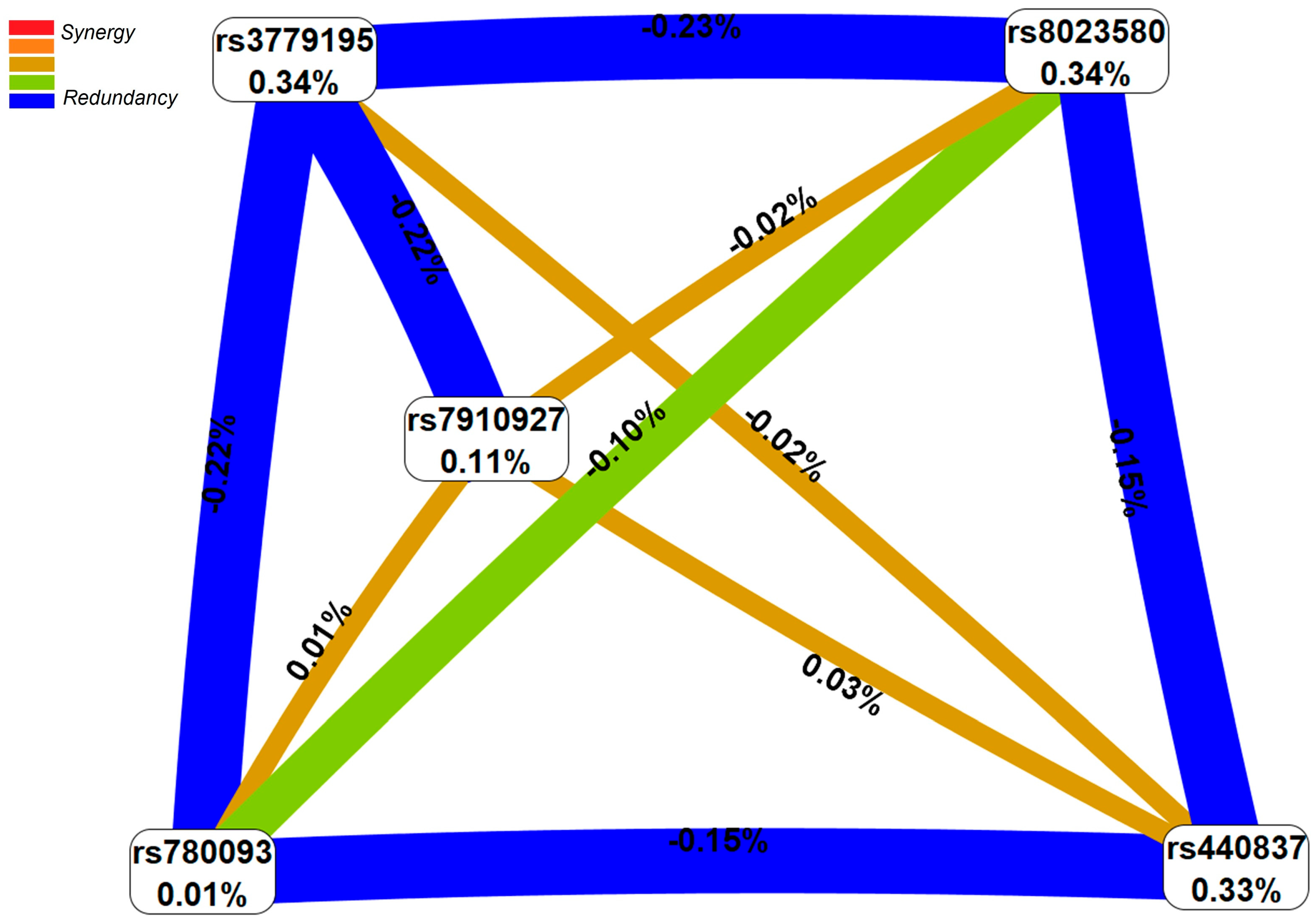
Figure 1. The entropy graph of the endometriosis-associated five loci model of SNP × SNP interactions (based on the MDR analysis, Wald st. = 45.02, p = 1.95 × 10⁻¹¹, pperm = 0.001). Positive values of entropy indicate synergistic interactions while negative values indicate redundancy. Red and orange colors denote strong and moderate synergism, respectively; brown color denotes the independent effect; green and blue colors denote moderate and strong antagonism.
Ijms 26 11630 g001
Figure 2. The entropy graph of the endometriosis-associated SNP × SNP interactions (based on the MDR analysis). Positive values of entropy indicate synergistic interactions while negative values indicate redundancy. Red and orange colors denote strong and moderate synergism, respectively; brown color denotes the independent effect; green and blue colors denote moderate and strong antagonism.
Ijms 26 11630 g002
Figure 3. Interactions of transcription factors and proteins of the RP11-48B3.3, RP11-48B3.4, and ZBTB10 genes linked with the endometriosis-causal SNP rs440837 (A > G) ZBTB10 and 5 proxy SNPs (STRING program data).
Ijms 26 11630 g003
Figure 4. The main biological pathways linked with the endometriosis-causal SNP rs440837 (A > G) ZBTB10 and 5 proxy SNPs: (A) Biological Process enrichment (Gene Ontology); (B) Molecular Function enrichment (Gene Ontology); (C) KEGG Pathway enrichment (STRING program data).
Ijms 26 11630 g004
Figure 5. TGF-beta signaling pathway linked with the endometriosis-causal SNP rs440837 (A > G) ZBTB10 and 5 proxy SNPs (KEGG program data, https://www.kegg.jp/kegg-bin/show_pathway?hsa04350# (accessed on 26 October 2025)).
Ijms 26 11630 g005
Figure 6. Endometriosis-associated protein interactions (the network is built in the STRING program).
Ijms 26 11630 g006
Table 1. Characteristics of participants from the case and control groups.
ParametersCases
(n = 395)
X ¯ ± SD/% (n)
Controls
(n = 973)
X ¯ ± SD/% (n)
p
Age, years39.75 ± 9.0140.71 ± 8.60>0.05
Height, m1.65 ± 0.061.65 ± 0.06>0.05
Weight, kg72.65 ± 14.3872.47 ± 13.36>0.05
BMI, kg/m226.63 ± 5.3126.65 ± 4.60>0.05
Proportion of the participants by relative BMI, % (n):
Underweight (<18.50)4.30 (17)1.13 (11)
Normal weight (18.50–24.99)37.72 (149)42.55 (414)>0.05
Overweight (25.00–29.99)31.65 (125)30.32 (295)
Obese (>30.00)26.33 (104)26.00 (253)
Family history of endometriosis (yes)6.07 (24)1.95 (19)<0.001
Married82.53 (326)85.82 (835)>0.05
Smoking (yes)18.22 (72)17.47 (170)>0.05
Drinking alcohol (≥7 drinks per week)4.05 (16)3.08 (30)>0.05
History of pelvic surgery (laparoscopy and/or laparotomy)15.19 (60)9.76 (95)<0.01
Oral contraceptive use8.10 (32)9.76 (95)>0.05
Age at menarche and menstrual cycle
Age at menarche, years13.29 ± 1.2713.26 ± 1.25>0.05
Proportion of the participants by relative age at menarche, % (n)
Early (<12 years)6.36 (25)6.47 (63)
Average (12–14 years)81.17 (319)80.16 (780)>0.05
Late (>14 years)12.47 (49)13.36 (130)
Duration of bleeding menstrual (mean, days)5.13 ± 1.564.95 ± 0.93>0.05
Menstrual cycle length (mean, days)27.66 ± 2.2828.16 ± 2.25<0.001
Reproductive characteristic
Age at first birth (mean. years)21.25 ± 3.0421.70 ± 3.48>0.05
Gravidity (mean)2.60 ± 2.312.46 ± 1.56>0.05
No. of births (mean)1.07 ± 0.971.51 ± 0.67<0.001
No. of spontaneous abortions (mean)0.21 ± 0.610.24 ± 0.51>0.05
No. of induced abortions (mean)1.25 ± 1.610.67 ± 0.99<0.001
No. of induced abortions:
046.58 (184)58.99 (574)
117.22 (68)23.54 (229)
219.24 (76)10.48 (102)
38.61 (34)5.45 (53)<0.001
≥48.35 (33)1.54 (15)
History of infertility32.42 (132)5.24 (51)<0.001
Gynecological pathologies
Uterine leiomyoma52.40 (207)--
Endometrial hyperplasia46.33 (183)--
Adenomyosis43.04 (170)--
p values < 0.05 are shown in bold.
Table 2. Associations of the SHBG-significant gene polymorphisms with endometriosis.
SNPGeneMinor AllelenAllelic ModelAdditive ModelDominant ModelRecessive Model
OR95%CIpOR95%CIpOR95%CIPOR95%CIp
L95U95L95U95L95U95L95U95
rs17496332PRMT6G12921.010.841.200.9411.030.861.230.7611.010.781.300.9591.010.771.570.598
rs780093GCKRT13100.980.831.170.8280.970.811.160.7270.970.751.260.8360.930.661.330.699
rs10454142PPP1R21C12910.870.721.050.1530.910.741.100.3210.840.651.080.1701.030.671.580.907
rs3779195BAIAP2L1A12901.020.821.270.8701.020.811.290.8601.120.861.470.4050.490.201.150.100
rs440837ZBTB10G12821.010.831.240.9151.020.821.260.8680.910.701.180.4741.911.132.980.023
rs7910927JMJD1CT13110.890.751.050.1640.890.751.070.2080.800.611.070.1280.930.691.250.610
rs4149056SLCO1B1C12640.930.761.140.4900.940.761.170.6010.910.701.180.4721.060.601.870.852
rs8023580NR2F2C13040.990.821.190.9051.030.851.260.7631.130.871.450.3550.780.471.270.316
rs12150660SHBGT13230.910.741.100.3270.880.721.090.2430.920.711.180.4950.640.361.120.120
All results were obtained after adjustment for covariates; OR, odds ratio; 95% CI, 95% confidence interval; p values < 0.05 are shown in bold; the additive genetic model evaluates how the phenotypic effect will change with an increase in the “dose” of the recessive allele in the genotype (all genotypes are compared; for example, TT vs. TC vs. CC, where C is the minor allele); the dominant model assumes that the minor allele exhibits a dominant effect, and the major allele is recessive (CC/TC vs. TT, where C is the minor allele); the recessive model assumes that the minor allele has a recessive effect, and the major allele is dominant (CC vs. TC/TT, where C is the minor allele); the allele model assumes a comparison of genotypes having the recessive allele/alleles with the genotype without these alleles (has the dominant allele) (C vs. T, where C is the minor allele).
Table 3. SNP × SNP interactions of SHBG-significant genes associated with endometriosis.
NSNP × SNP Interaction ModelsNHbetaHWHNLbetaLWLpperm
Two-order interaction models (p = 1.25 × 10⁻³)
1rs440837 ZBTB10-rs3779195 BAIAP2L110.4124.07 1−0.51310.410.008
Three-order interaction models (p = 8.33 × 10⁻⁶)
2rs8023580 NR2F2-rs440837 ZBTB10-rs3779195 BAIAP2L150.61219.86 2−0.4959.200.001
Four-order interaction models (p = 9.65 × 10⁻⁸)
3rs440837 ZBTB10-rs10454142 PPP1R21-rs780093 GCKR-rs17496332 PRMT6 71.19328.44 2−1.118 6.810.001
Five-order interaction models (p = 1.95 × 10⁻¹¹)
4rs8023580 NR2F2-rs7910927 JMJD1C-rs440837 ZBTB10-rs3779195 BAIAP2L1- rs780093 GCKR91.55045.02 1−1.3844.670.001
The results were obtained using the MB-MDR method with adjustment for covariates; NH, number of significant high risk genotypes in the interaction; betaH, regression coefficient for high risk exposition in the step2 analysis; WH, Wald statistic for high risk category; NL, number of significant low risk genotypes in the interaction; betaL, regression coefficient for low risk exposition in the step2 analysis; WL, Wald statistic for low risk category; pperm, permutation p-value for the interaction model (1.000 permutations).
Disclaimer/Publisher’s Note: The statements, opinions and data contained in all publications are solely those of the individual author(s) and contributor(s) and not of MDPI and/or the editor(s). MDPI and/or the editor(s) disclaim responsibility for any injury to people or property resulting from any ideas, methods, instructions or products referred to in the content.