Serum YKL-40, but Not Relaxin-2, Shows Diagnostic Utility as an Adjunct Biomarker in Colorectal Cancer
 , ,
, ,  and
and 
Abstract
1. Introduction
2. Results
3. Discussion
4. Materials and Methods
4.1. Patients
4.2. Biochemical Analyses
4.3. Statistical Analysis
5. Conclusions
Supplementary Materials
Author Contributions
Funding
Institutional Review Board Statement
Informed Consent Statement
Data Availability Statement
Acknowledgments
Conflicts of Interest
References
- Li, M.; Cao, S.; Xu, R.H. Global trends and epidemiological shifts in gastrointestinal cancers: Insights from the past four decades. Cancer Commun. 2025, 45, 774–788. [Google Scholar] [CrossRef] [PubMed] [PubMed Central]
- Sun, K.X.; Liang, X.; Zhu, Q.; Wu, H.L.; Zhang, G.Y.; Yao, Y.F.; Li, X.; Zheng, R.S.; Zuo, J.; Wei, W.Q. Global patterns and trends in cancer-related premature death and their impact on life expectancy across 185 countries: A population-based analysis. Mil. Med. Res. 2025, 12, 56. [Google Scholar] [CrossRef] [PubMed] [PubMed Central]
- Nair, V.B.; Samuel, C.S.; Separovic, F.; Hossain, M.A.; Wade, J.D. Human relaxin-2: Historical perspectives and role in cancer biology. Amino Acids. 2012, 43, 1131–1140. [Google Scholar] [CrossRef] [PubMed]
- Eppel, W.; Kucera, E.; Bieglmayer, C. Relationship of serum levels of endogenous relaxin to cervical size in the second trimester and to cervical ripening at term. Br. J. Obstet. Gynaecol. 1999, 106, 917–923. [Google Scholar] [CrossRef] [PubMed][Green Version]
- Weiss, G. Relaxin in the male. Biol. Reprod. 1989, 40, 197–200. [Google Scholar] [CrossRef] [PubMed]
- Unemori, E.N.; Amento, E.P. Relaxin modulates synthesis and secretion of procollagenase and collagen by human dermal fibroblasts. J. Biol. Chem. 1990, 265, 10681–10685. [Google Scholar] [CrossRef] [PubMed]
- Conrad, K.P.; Novak, J. Emerging role of relaxin in renal and cardiovascular function. Am. J. Physiol.-Regul. Integr. Comp. Physiol. 2004, 287, R250–R261. [Google Scholar] [CrossRef] [PubMed]
- Teerlink, J.R.; Metra, M.; Felker, G.M.; Ponikowski, P.; Voors, A.A.; Weatherley, B.D.; Marmor, A.; Katz, A.; Grzybowski, J.; Unemori, E.; et al. Relaxin for the treatment of patients with acute heart failure (Pre-RELAX-AHF): A multicentre, randomised, placebo-controlled, parallel-group, dose-finding phase IIb study. Lancet 2009, 373, 1429–1439. [Google Scholar] [CrossRef] [PubMed]
- Silvertown, J.D.; Geddes, B.J.; Summerlee, A.J. Adenovirus-mediated expression of human prorelaxin promotes the invasive potential of canine mammary cancer cells. Endocrinology 2003, 144, 3683–3691. [Google Scholar] [CrossRef] [PubMed]
- Jadeski, L.C.; Hum, K.O.; Chakraborty, C.; Lala, P.K. Nitric oxide promotes murine mammary tumour growth and metastasis by stimulating tumour cell migration, invasiveness and angiogenesis. Int. J. Cancer 2000, 86, 30–39. [Google Scholar] [CrossRef] [PubMed]
- Barrett-Connor, E.; Garland, C.; McPhillips, J.B.; Khaw, K.T.; Wingard, D.L. A prospective, population-based study of androstenedione, estrogens, and prostatic cancer. Cancer Res. 1990, 50, 169–173. [Google Scholar] [PubMed]
- Kamat, A.A.; Feng, S.; Agoulnik, I.U.; Kheradmand, F.; Bogatcheva, N.V.; Coffey, D.; Sood, A.K.; Agoulnik, A.I. The role of relaxin in endometrial cancer. Cancer Biol. Ther. 2006, 5, 71–77. [Google Scholar] [CrossRef] [PubMed]
- Hombach-Klonisch, S.; Bialek, J.; Trojanowicz, B.; Weber, E.; Holzhausen, H.J.; Silvertown, J.D.; Summerlee, A.J.; Dralle, H.; Hoang-Vu, C.; Klonisch, T. Relaxin enhances the oncogenic potential of human thyroid carcinoma cells. Am. J. Pathol. 2006, 169, 617–632. [Google Scholar] [CrossRef] [PubMed] [PubMed Central]
- Binder, C.; Simon, A.; Binder, L.; Hagemann, T.; Schulz, M.; Emons, G.; Trümper, L.; Einspanier, A. Elevated concentrations of serum relaxin are associated with metastatic disease in breast cancer patients. Breast Cancer Res. Treat. 2004, 87, 157–166. [Google Scholar] [CrossRef] [PubMed]
- Feng, S.; Agoulnik, I.U.; Bogatcheva, N.V.; Kamat, A.A.; Kwabi-Addo, B.; Li, R.; Ayala, G.; Ittmann, M.M.; Agoulnik, A.I. Relaxin promotes prostate cancer progression. Clin. Cancer Res. 2007, 13, 1695–1702. [Google Scholar] [CrossRef] [PubMed]
- Kwantwi, L.B. The dual and multifaceted role of relaxin-2 in cancer. Clin. Transl. Oncol. 2023, 25, 2763–2771. [Google Scholar] [CrossRef] [PubMed]
- Sheng, Y.; Peng, W.; Huang, Y.; Cheng, L.; Meng, Y.; Kwantwi, L.; Yang, J.; Xu, J.; Xiao, H.; Kzhyshkowska, J.; et al. Tumor-activated Neutrophils Promote Metastasis in Breast Cancer via the G-CSF-RLN2-MMP-9 Axis. J. Leukoc. Biol. 2022, 113, 383–399. [Google Scholar] [CrossRef]
- Willcox, J.; Summerlee, A. RLN2 and its role in cancer. Atlas Genet. Cytogenet. Oncol. Haematol. 2010, 14, 609–626. Available online: http://atlasgeneticsoncology.org/deep-insight/20079/rln2-and-its-role-in-cancer (accessed on 14 August 2025). [CrossRef]
- Tevž, G.; McGrath, S.; Demeter, R.; Magrini, V.; Jeet, V.; Rockstroh, A.; McPherson, S.; Lai, J.; Bartonicek, N.; An, J.; et al. Identification of a novel fusion transcript between human relaxin-1 (RLN1) and human relaxin-2 (RLN2) in prostate cancer. Mol. Cell. Endocrinol. 2016, 420, 159–168. [Google Scholar] [CrossRef]
- Ogawa, H.; Ekawa, T.; Mizote, Y.; Akazawa, T.; Tahara, H. Relaxin-2-secreting CAR-T cells exhibit enhanced efficacy in stromal-rich xenograft tumors. Front. Immunol. 2025, 16, 1506204. [Google Scholar] [CrossRef]
- Hu, M.; Zhou, X.; Wang, Y.; Guan, K.; Huang, L. Relaxin-FOLFOX-IL-12 triple combination therapy engages memory response and achieves long-term survival in colorectal cancer liver metastasis. J. Control. Release 2019, 319, 213–221. [Google Scholar] [CrossRef]
- Blazevic, N.; Rogic, D.; Pelajic, S.; Miler, M.; Glavcic, G.; Ratkajec, V.; Vrkljan, N.; Bakula, D.; Hrabar, D.; Pavic, T. YKL-40 as a biomarker in various inflammatory diseases: A review. Biochem. Med. 2024, 34, 010502. [Google Scholar] [CrossRef] [PubMed] [PubMed Central]
- Muszyński, P.; Groblewska, M.; Kulczyńska-Przybik, A.; Kułakowska, A.; Mroczko, B. YKL-40 as a Potential Biomarker and a Possible Target in Therapeutic Strategies of Alzheimer’s Disease. Curr. Neuropharmacol. 2017, 15, 906–917. [Google Scholar] [CrossRef] [PubMed] [PubMed Central]
- Libreros, S.; Iragavarapu-Charyulu, V. YKL-40/CHI3L1 drives inflammation on the road of tumor progression. J. Leukoc. Biol. 2015, 98, 931–936. [Google Scholar] [CrossRef] [PubMed] [PubMed Central]
- Otsuka, K.; Matsumoto, H.; Niimi, A.; Muro, S.; Ito, I.; Takeda, T.; Terada, K.; Yamaguchi, M.; Matsuoka, H.; Jinnai, M.; et al. Sputum YKL-40 levels and pathophysiology of asthma and chronic obstructive pulmonary disease. Respiration 2012, 83, 507–519. [Google Scholar] [CrossRef] [PubMed]
- Lee, J.H.; Park, K.H.; Park, J.W.; Hong, C.S. YKL-40 in induced sputum after allergen bronchial provocation in atopic asthma. J. Investig. Allergol. Clin. Immunol. 2012, 22, 501–507. [Google Scholar] [PubMed]
- Karalilova, R.; Kazakova, M.; Batalov, A.; Sarafian, V. Correlation between protein YKL-40 and ultrasonographic findings in active knee osteoarthritis. Med. Ultrason. 2018, 1, 57–63. [Google Scholar] [CrossRef] [PubMed]
- Albeltagy, E.S.; Abdul-Mohymen, A.M.; Taha, D.R.A. Early diagnosis of acute kidney injury by urinary YKL-40 in critically ill patients in ICU: A pilot study. Int. Urol. Nephrol. 2020, 52, 351–361. [Google Scholar] [CrossRef] [PubMed]
- Buisson, A.; Vazeille, E.; Minet-Quinard, R.; Goutte, M.; Bouvier, D.; Goutorbe, F.; Pereira, B.; Barnich, N.; Bommelaer, G. Faecal chitinase 3-like 1 is a reliable marker as accurate as faecal calprotectin in detecting endoscopic activity in adult patients with inflammatory bowel diseases. Aliment. Pharmacol. Ther. 2016, 43, 1069–1079. [Google Scholar] [CrossRef] [PubMed]
- Roslind, A.; Palle, C.; Johansen, J.S.; Christensen, I.J.; Nielsen, H.J.; Mosgaard, B.J. Prognostic utility of serum YKL-40 in patients with cervical cancer. Scand. J. Clin. Lab. Investig. 2020, 80, 687–693. [Google Scholar] [CrossRef] [PubMed]
- Qin, R.; Liao, M.; Qin, W.; Wang, J.; Zheng, F.; Ma, N.; Zhao, Y.; Qin, A. The diagnostic value of serum YKL-40 in endometrial cancer: A meta-analysis. Biomarkers 2022, 27, 215–221. [Google Scholar] [CrossRef] [PubMed]
- Huang, R.; Yao, J.; Ding, X.; Liu, J.; Fan, C.; Duan, H.; Ye, H. Plasma YKL-40: A Potential Biomarker for Tumor Invasion in Esophageal Cancer. Clin. Lab. 2020, 66, 261. [Google Scholar] [CrossRef] [PubMed]
- Li, C.; Wang, Y.; Ren, X.; Li, Y. Chitinase-3 like-protein-1 (YKL-40) Promotes Anorectal Mucosal Melanoma Progression via the PI3K-AKT Signaling Pathway. Altern. Ther. Health Med. 2023, 11, 1–7. [Google Scholar]
- Suzuki, H.; Boki, H.; Kamijo, H.; Nakajima, R.; Oka, T.; Shishido-Takahashi, N.; Suga, H.; Sugaya, M.; Sato, S.; Miyagaki, T. YKL-40 promotes proliferation of CTCL tumor cells through extracellular signal-regulated kinase pathways. J. Investig. Dermatol. 2020, 140, 860–868. [Google Scholar] [CrossRef] [PubMed]
- Chen, H.; Zhou, Z.; Luo, Y.; Luo, Q.; Fan, J. Knockdown of YKL-40 inhibits angiogenesis through regulation of VEGF/VEGFR2 and ERK1/2 signaling in endometrial cancer. Cell Biol. Int. 2021, 45, 2557–2566. [Google Scholar] [CrossRef]
- De Robertis, M.; Greco, M.R.; Cardone, R.A.; Mazza, T.; Marzano, F.; Mehterov, N.; Kazakova, M.; Belev, N.; Tullo, A.; Pesole, G.; et al. Upregulation of YKL-40 Promotes Metastatic Phenotype and Correlates with Poor Prognosis and Therapy Response in Patients with Colorectal Cancer. Cells 2022, 11, 3568. [Google Scholar] [CrossRef]
- Xu, Y.; Yu, Q.; Liu, Y. Serum relaxin-2 as a novel biomarker for prostate cancer. Br. J. Biomed. Sci. 2018, 75, 145–148. [Google Scholar] [CrossRef] [PubMed]
- Ma, J.; Niu, M.; Yang, W.; Zang, L.; Xi, Y. Role of relaxin-2 in human primary osteosarcoma. Cancer Cell Int. 2013, 13, 59. [Google Scholar] [CrossRef] [PubMed] [PubMed Central]
- Ren, P.; Yu, Z.; Xiu, L.; Wang, M.; Liu, H. Elevated serum levels of human relaxin-2 in patients with esophageal squamous cell carcinoma. World J. Gastroenterol. 2013, 19, 2412–2418. [Google Scholar] [CrossRef]
- Cintin, C.; Johansen, J.S.; Christensen, I.J.; Price, P.A.; Sørensen, S.; Nielsen, H.J. Serum YKL-40 and colorectal cancer. Br. J. Cancer 1999, 79, 1494–1499. [Google Scholar] [CrossRef] [PubMed] [PubMed Central]
- Vocka, M.; Langer, D.; Fryba, V.; Petrtyl, J.; Hanus, T.; Kalousova, M.; Zima, T.; Petruzelka, L. Novel serum markers HSP60, CHI3L1, and IGFBP-2 in metastatic colorectal cancer. Oncol. Lett. 2019, 18, 6284–6292. [Google Scholar] [CrossRef] [PubMed] [PubMed Central]
- Tarpgaard, L.S.; Guren, T.K.; Glimelius, B.; Christensen, I.J.; Pfeiffer, P.; Kure, E.H.; Sorbye, H.; Ikdahl, T.; Yilmaz, M.; Johansen, J.S.; et al. Plasma YKL-40 in patients with metastatic colorectal cancer treated with first line oxaliplatin-based regimen with or without cetuximab: RESULTS from the NORDIC VII Study. PLoS ONE 2014, 9, e87746, Erratum in PLoS ONE 2014, 9, e98836. [Google Scholar] [CrossRef] [PubMed] [PubMed Central]
- Fuksiewicz, M.; Kotowicz, B.; Rutkowski, A.; Achinger-Kawecka, J.; Wagrodzki, M.; Kowalska, M.M. The Assessment of Clinical Usage and Prognostic Value of YKL-40 Serum Levels in Patients With Rectal Cancer Without Distant Metastasis. Technol Cancer Res Treat. 2018, 17, 1533033818765209. [Google Scholar] [CrossRef] [PubMed] [PubMed Central]
- Eldaly, M.N.; Metwally, F.M.; Shousha, W.G.; El-Saiid, A.S.; Ramadan, S.S. Clinical Potentials of miR-576-3p, miR-613, NDRG2 and YKL40 in Colorectal Cancer Patients. Asian Pac. J. Cancer Prev. 2020, 21, 1689–1695. [Google Scholar] [CrossRef] [PubMed] [PubMed Central]
- Liu, X.; Zhang, Y.; Zhu, Z.; Ha, M.; Wang, Y. Elevated pretreatment serum concentration of YKL-40: An independent prognostic biomarker for poor survival in patients with colorectal cancer. Med. Oncol. 2014, 31, 85. [Google Scholar] [CrossRef] [PubMed]
- Ye, H.M.; Lu, Y.Z.; Liang, X.M.; Lin, Y.Z.; Li, Y.; Zhang, Z.Y.; Tzeng, C.M. Clinical significance of combined testing of YKL-40 with CEA in Chinese colorectal cancer patients. Clin. Lab. 2014, 60, 397–405. [Google Scholar] [CrossRef] [PubMed]
- Johansen, J.S.; Christensen, I.J.; Jørgensen, L.N.; Olsen, J.; Rahr, H.B.; Nielsen, K.T.; Laurberg, S.; Brünner, N.; Nielsen, H.J. Serum YKL-40 in risk assessment for colorectal cancer: A prospective study of 4496 subjects at risk of colorectal cancer. Cancer Epidemiol. Biomark. Prev. 2015, 24, 621–626. [Google Scholar] [CrossRef] [PubMed]
- Wang, J.; Qi, S.; Zhu, Y.B.; Ding, L. Prognostic value of YKL-40 in colorectal carcinoma patients: A meta-analysis. World J. Clin. Cases 2022, 10, 2184–2193. [Google Scholar] [CrossRef] [PubMed] [PubMed Central]
- Hermunen, K.; Soveri, L.M.; Boisen, M.K.; Mustonen, H.K.; Dehlendorff, C.; Haglund, C.H.; Johansen, J.S.; Osterlund, P. Postoperative serum CA19-9, YKL-40, CRP and IL-6 in combination with CEA as prognostic markers for recurrence and survival in colorectal cancer. Acta Oncol. 2020, 59, 1416–1423. [Google Scholar] [CrossRef] [PubMed]
- Lehtomäki, K.; Heervä, E.; Kellokumpu-Lehtinen, P.L.; Mustonen, H.; Salminen, T.; Joensuu, H.; Hermunen, K.; Boisen, M.K.; Johansen, J.S.; Haglund, C.; et al. Transient Changes in Serum CEA, CA19-9, CRP, YKL-40, and IL-6 during Adjuvant Chemotherapy and Survival of Patients with Colorectal Cancer. Int. J. Mol. Sci. 2023, 24, 6753. [Google Scholar] [CrossRef] [PubMed] [PubMed Central]
- Oh, I.H.; Pyo, J.S.; Son, B.K. Prognostic Impact of YKL-40 Immunohistochemical Expression in Patients with Colorectal Cancer. Curr. Oncol. 2021, 28, 3139–3149. [Google Scholar] [CrossRef] [PubMed] [PubMed Central]



| Parameter | Colorectal Cancer | Control Group | p * | |
|---|---|---|---|---|
| RLN2 [pg/mL] | Median value | 81.35 | 61.75 | 0.103 |
| Minimum–Maximum | 6.09–522.20 | 6.09–902.35 | ||
| Q1–Q3 | 46.93–130.68 | 49.68–80.51 | ||
| YKL-40 [pg/mL] | Median value | 47,695.45 | 31,274.02 | <0.001 |
| Minimum–Maximum | 6085.85–828,508.00 | 3287.52–95,870.72 | ||
| Q1–Q3 | 26,726.20–73,836.90 | 19,160.50–39,215.77 | ||
| CEA [ng/mL] | Median value | 2.82 | 0.50 | <0.001 |
| Minimum–Maximum | 0.50–1844.00 | 0.50–7.82 | ||
| Q1–Q3 | 1.73–11.02 | 0.50–1.73 | ||
| CA 19-9 [U/mL] | Median value | 4.91 | 3.31 | 0.018 |
| Minimum–Maximum | 2.00–1357.00 | 2.00–39.29 | ||
| Q1–Q3 | 2.42–11.91 | 2.09–4.78 |
| Parameter | RLN2 | YKL-40 | CEA | CA 19-9 | |
|---|---|---|---|---|---|
| Kruskal–Wallis p-value | 0.031 | 0.002 | <0.001 | 0.008 | |
| Post-hoc p-value | Control vs. I + II | 1.000 | 0.003 | <0.001 | 0.936 |
| Control vs. III + IV | 0.043 | 0.010 | <0.001 | 0.007 | |
| I + II vs. III + IV | 0.115 | 1.000 | <0.001 | 0.122 | |
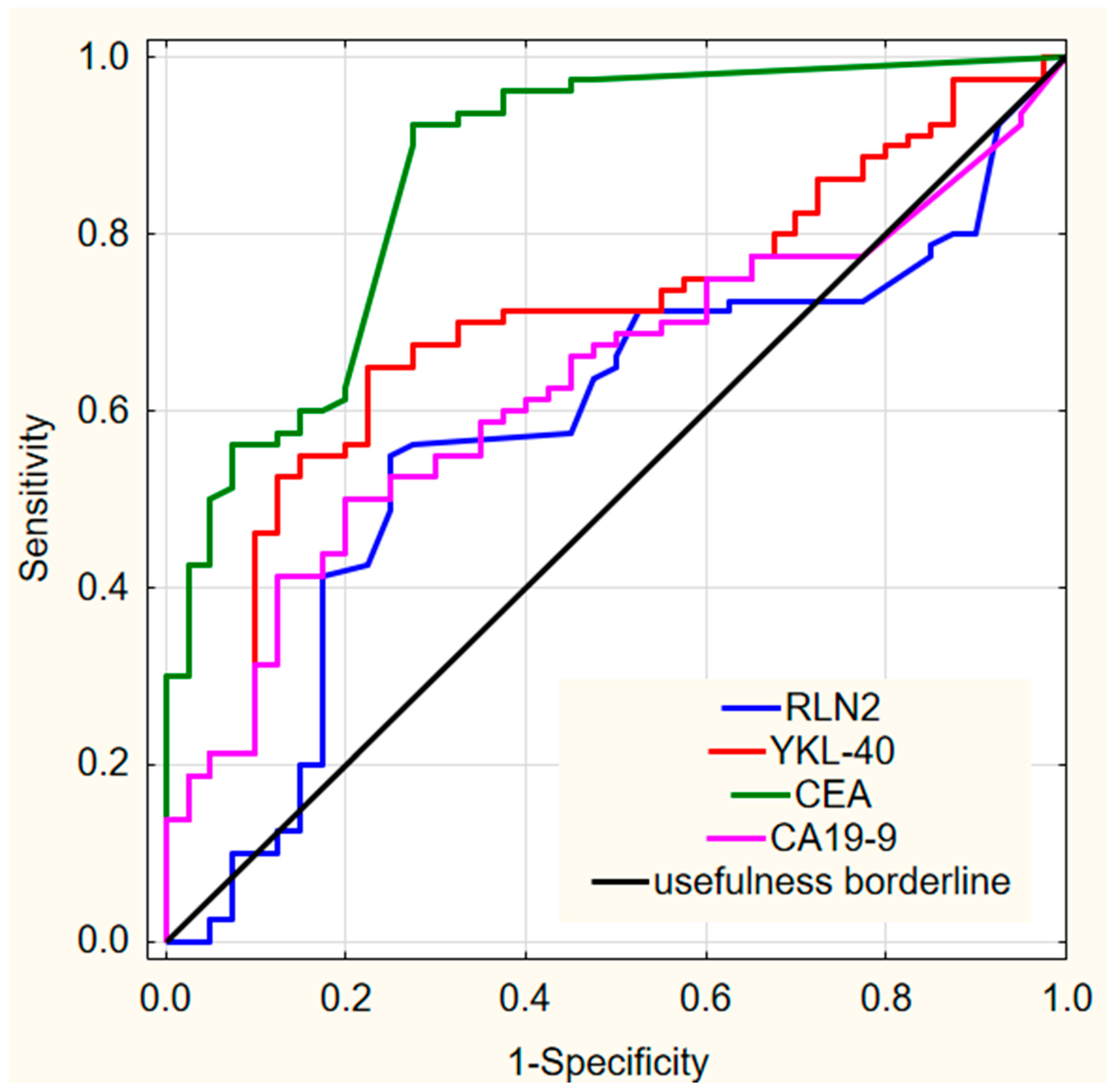
| Parameters | Diagnostic Criteria | CRC |
|---|---|---|
| RLN2 | SE | 55.00% |
| SP | 76.90% | |
| ACC | 62.20% | |
| PPV | 83.00% | |
| NPV | 45.50% | |
| AUC | 0.593 (p = 0.090) | |
| YKL-40 | SE | 65.00% |
| SP | 77.50% | |
| ACC | 69.20% | |
| PPV | 85.20% | |
| NPV | 52.50% | |
| AUC | 0.702 (p < 0.001) | |
| CEA | SE | 92.50% |
| SP | 72.50% | |
| ACC | 85.80% | |
| PPV | 87.10% | |
| NPV | 82.90% | |
| AUC | 0.869 (p < 0.001) | |
| CA 19-9 | SE | 50.00% |
| SP | 80.00% | |
| ACC | 60.00% | |
| PPV | 83.30% | |
| NPV | 44.40% | |
| AUC | 0.632 (p = 0.009) |
| Group Studied | Patient Characteristics | Number of Patients |
|---|---|---|
| Colorectal Cancer | 80 | |
| Gender: | ||
| Female | 28 | |
| Male | 52 | |
| Type: | ||
| Colon Cancer | 33 | |
| Rectal Cancer | 47 | |
| Histological subtype: | ||
| Adenocarcinoma | 71 | |
| Mucinous adenocarcinoma | 8 | |
| Squamous cell carcinoma | 1 | |
| TNM Stage: | ||
| I | 20 | |
| II | 20 | |
| III | 20 | |
| IV | 20 | |
| Depth of tumor invasion: | ||
| T1 | 4 | |
| T2 | 19 | |
| T3 | 45 | |
| T4 | 12 | |
| Nodal involvement: | ||
| N0 | 45 | |
| N1 | 23 | |
| N2 | 12 | |
| Distant metastasis: | ||
| M0 | 60 | |
| M1 | 20 | |
| Histological grade: | ||
| G1 | 6 | |
| G2 | 65 | |
| G3 | 9 | |
| Preoperative therapy: | ||
| Yes | 27 | |
| No | 53 | |
| Age: | 32–89 | |
| Control Group | 40 | |
| Gender: | ||
| Female | 22 | |
| Male | 18 | |
| Age: | 22–75 |
Disclaimer/Publisher’s Note: The statements, opinions and data contained in all publications are solely those of the individual author(s) and contributor(s) and not of MDPI and/or the editor(s). MDPI and/or the editor(s) disclaim responsibility for any injury to people or property resulting from any ideas, methods, instructions or products referred to in the content. |
© 2025 by the authors. Licensee MDPI, Basel, Switzerland. This article is an open access article distributed under the terms and conditions of the Creative Commons Attribution (CC BY) license (https://creativecommons.org/licenses/by/4.0/).
Share and Cite
Safiejko, K.; Juchimiuk, M.; Doroszkiewicz, J.; Mroczko, B.; Zajkowska, M. Serum YKL-40, but Not Relaxin-2, Shows Diagnostic Utility as an Adjunct Biomarker in Colorectal Cancer. Int. J. Mol. Sci. 2025, 26, 11601. https://doi.org/10.3390/ijms262311601
Safiejko K, Juchimiuk M, Doroszkiewicz J, Mroczko B, Zajkowska M. Serum YKL-40, but Not Relaxin-2, Shows Diagnostic Utility as an Adjunct Biomarker in Colorectal Cancer. International Journal of Molecular Sciences. 2025; 26(23):11601. https://doi.org/10.3390/ijms262311601
Chicago/Turabian StyleSafiejko, Kamil, Marcin Juchimiuk, Julia Doroszkiewicz, Barbara Mroczko, and Monika Zajkowska. 2025. "Serum YKL-40, but Not Relaxin-2, Shows Diagnostic Utility as an Adjunct Biomarker in Colorectal Cancer" International Journal of Molecular Sciences 26, no. 23: 11601. https://doi.org/10.3390/ijms262311601
APA StyleSafiejko, K., Juchimiuk, M., Doroszkiewicz, J., Mroczko, B., & Zajkowska, M. (2025). Serum YKL-40, but Not Relaxin-2, Shows Diagnostic Utility as an Adjunct Biomarker in Colorectal Cancer. International Journal of Molecular Sciences, 26(23), 11601. https://doi.org/10.3390/ijms262311601