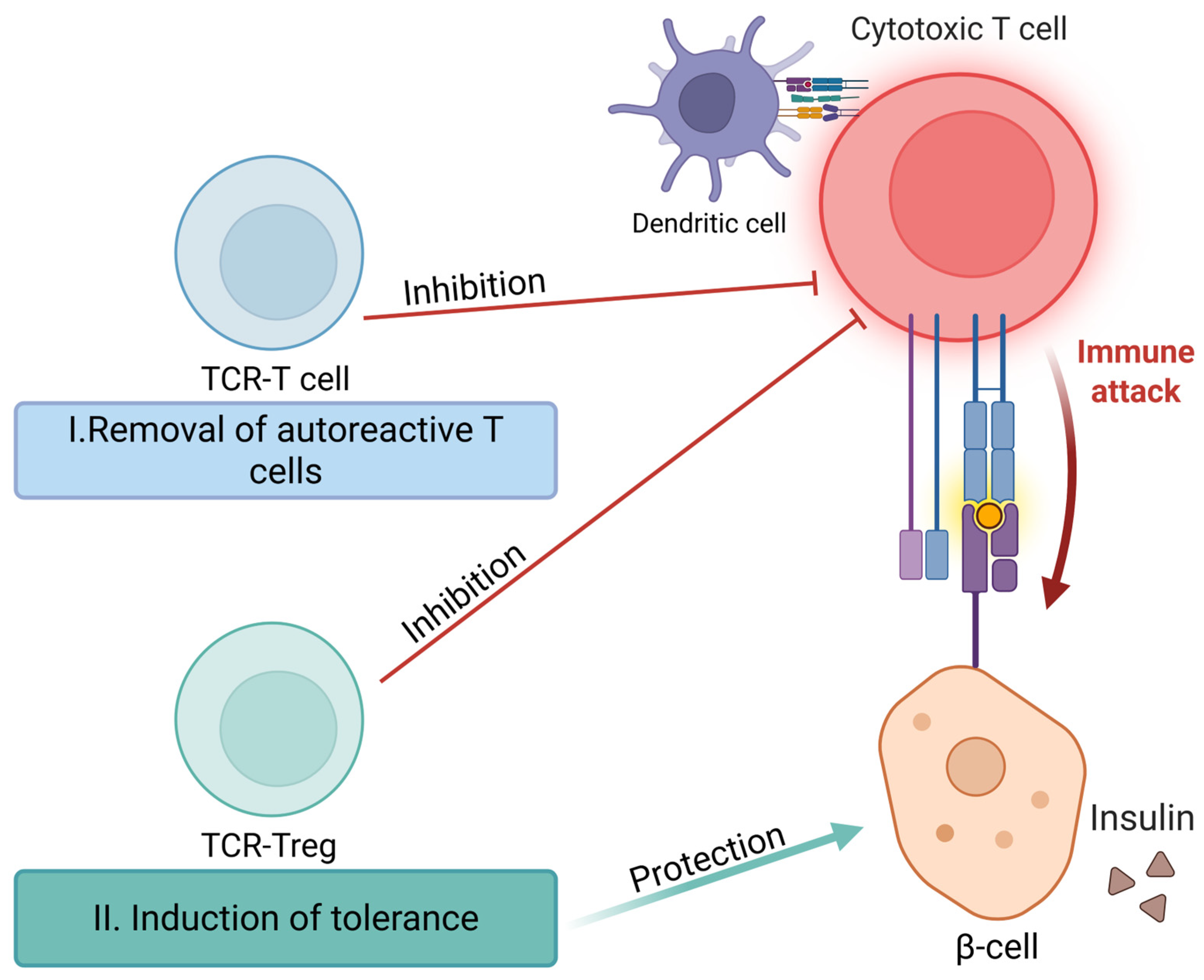
TCR-Based Antigen-Specific Therapy for Type 1 Diabetes Mellitus: From Editing Autoreactive Clones to Tolerance Induction

Abstract
1. Introduction
2. Key Autoantigens in T1DM and Pathogenic TCR Detection

| Autoantigen | Representative Key Epitope(s) | HLA Restriction | Role in Pathogenesis/Predictive Value | References and Comments |
|---|---|---|---|---|
| Insulin (INS) | InsB:9–23 (SHLVEALYLVCGERG); PPI15–24 (ALWGPDPAAA) | DQ8/DQ2; A*02:01 | Earliest and primary target; post-translational modifications critical | [16,17]; Skowera et al. seminal but small cohort; findings widely reproduced |
| GAD65 | GAD555–567 | DR4 | Strong Th1 CD4+response; autoantibodies stable marker | [18,19]; consistent T cell data across cohorts |
| IA-2 (PTPRN) | IA-2 752–775 (overlapping B/T epitopes) | Variable | Late-appearing autoantibodies; rapid progression marker | [20,21]; epitope overlap confirmed by multiple methods |
| ZnT8 (SLC30A8) | ZnT8 318–331 (VAANIVLTVVAEFLR | Multiple | Polymorphism-driven immunogenicity; adds diagnostic value | [22]; discovery robustly validated in large international cohorts |
3. Modulating Autoreactive T Cell Clones and Their Role in T1DM Pathogenesis
4. TCR-Based Tolerance Induction
5. CD8+Tregs
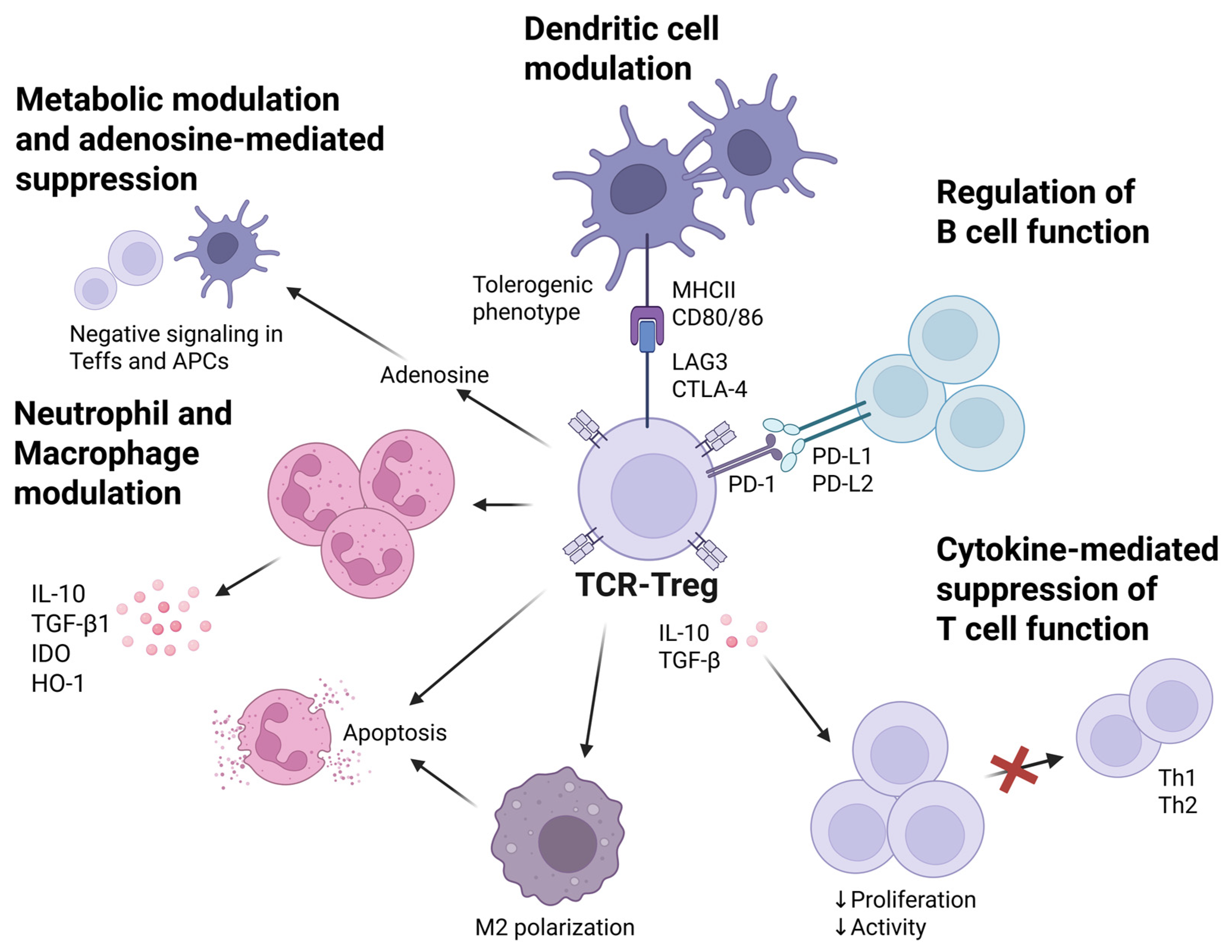
6. Impact of TCR-Treg Therapy on Other Cells of the Immune System
7. Future Perspectives
8. Literature Search Strategy
9. Limitations of the Review
Author Contributions
Funding
Institutional Review Board Statement
Informed Consent Statement
Data Availability Statement
Conflicts of Interest
References
- Ogle, G.D.; Wang, F.; Haynes, A.; Gregory, G.A.; King, T.W.; Deng, K.; Dabelea, D.; James, S.; Jenkins, A.J.; Li, X.; et al. Global Type 1 Diabetes Prevalence, Incidence, and Mortality Estimates 2025: Results from the International Diabetes Federation Atlas, 11th Edition, and the T1D Index Version 3.0. Diabetes Res. Clin. Pract. 2025, 225, 112277. [Google Scholar] [CrossRef] [PubMed]
- Ruiz, P.L.D.; Chen, L.; Morton, J.I.; Salim, A.; Carstensen, B.; Gregg, E.W.; Pavkov, M.E.; Mata-Cases, M.; Mauricio, D.; Nichols, G.A.; et al. Mortality Trends in Type 1 Diabetes: A Multicountry Analysis of Six Population-Based Cohorts. Diabetologia 2022, 65, 964–972. [Google Scholar] [CrossRef] [PubMed]
- Lampasona, V.; Liberati, D. Islet Autoantibodies. Curr. Diabetes Rep. 2016, 16, 53. [Google Scholar] [CrossRef]
- DiMeglio, L.A.; Evans-Molina, C.; Oram, R.A. Type 1 Diabetes. Lancet 2018, 391, 2449–2462. [Google Scholar] [CrossRef]
- Burrack, A.L.; Martinov, T.; Fife, B.T. T Cell-Mediated Beta Cell Destruction: Autoimmunity and Alloimmunity in the Context of Type 1 Diabetes. Front. Endocrinol. 2017, 8, 343. [Google Scholar] [CrossRef]
- Roep, B.O.; Arden, S.D.; de Vries, R.R.; Hutton, J.C. T-Cell Clones from a Type-1 Diabetes Patient Respond to Insulin Secretory Granule Proteins. Nature 1990, 345, 632–634. [Google Scholar] [CrossRef]
- Ziegler, A.G.; Cengiz, E.; Kay, T.W.H. The Future of Type 1 Diabetes Therapy. Lancet 2025, 406, 1520–1534, Erratum in Lancet 2025, 406, 2220. [Google Scholar] [CrossRef]
- American Diabetes Association Professional Practice Committee. 2. Diagnosis and Classification of Diabetes: Standards of Care in Diabetes—2025. Diabetes Care 2025, 48 (Suppl. 1), S27–S49. [Google Scholar] [CrossRef]
- Herold, K.C.; Bundy, B.N.; Long, S.A.; Bluestone, J.A.; DiMeglio, L.A.; Dufort, M.J.; Gitelman, S.E.; Gottlieb, P.A.; Krischer, J.P.; Linsley, P.S.; et al. An Anti-CD3 Antibody, Teplizumab, in Relatives at Risk for Type 1 Diabetes. N. Engl. J. Med. 2019, 381, 603–613. [Google Scholar] [CrossRef]
- Herold, K.C.; Gitelman, S.E.; Gottlieb, P.A.; Knecht, L.A.; Raymond, R.; Ramos, E.L. Teplizumab: A Disease-Modifying Therapy for Type 1 Diabetes That Preserves β-Cell Function. Diabetes Care 2023, 46, 1848–1856. [Google Scholar] [CrossRef] [PubMed]
- Rodriguez-Calvo, T.; Johnson, J.D.; Overbergh, L.; Dunne, J.L. Neoepitopes in Type 1 Diabetes: Etiological Insights, Biomarkers and Therapeutic Targets. Front. Immunol. 2021, 12, 667989. [Google Scholar] [CrossRef]
- Hering, B.J.; Clarke, W.R.; Bridges, N.D.; Eggerman, T.L.; Alejandro, R.; Bellin, M.D.; Chaloner, K.; Czarniecki, C.W.; Goldstein, J.S.; Hunsicker, L.G.; et al. Phase 3 Trial of Transplantation of Human Islets in Type 1 Diabetes Complicated by Severe Hypoglycemia. Diabetes Care 2016, 39, 1230–1240. [Google Scholar] [CrossRef]
- Reichman, T.W.; Markmann, J.F.; Odorico, J.; Witkowski, P.; Fung, J.J.; Wijkstrom, M.; Kandeel, F.; de Koning, E.J.P.; Peters, A.L.; Mathieu, C.; et al. Stem Cell-Derived, Fully Differentiated Islets for Type 1 Diabetes. N. Engl. J. Med. 2025, 393, 858–868. [Google Scholar] [CrossRef]
- DiLorenzo, T.P. Multiple Antigens Versus Single Major Antigen in Type 1 Diabetes: Arguing for Multiple Antigens. Diabetes Metab. Res. Rev. 2011, 27, 778–783. [Google Scholar] [CrossRef] [PubMed]
- Nakayama, M.; Abiru, N.; Moriyama, H.; Babaya, N.; Liu, E.; Miao, D.; Yu, L.; Wegmann, D.R.; Hutton, J.C.; Elliott, J.F.; et al. Prime Role for an Insulin Epitope in the Development of Type 1 Diabetes in NOD Mice. Nature 2005, 435, 220–223. [Google Scholar] [CrossRef]
- Delong, T.; Wiles, T.A.; Baker, R.L.; Bradley, B.; Barbour, G.; Reisdorph, R.; Armstrong, M.; Powell, R.L.; Reisdorph, N.; Kumar, N.; et al. Pathogenic CD4 T Cells in Type 1 Diabetes Recognize Epitopes Formed by Peptide Fusion. Science 2016, 351, 711–714. [Google Scholar] [CrossRef]
- Skowera, A.; Ellis, R.J.; Varela-Calviño, R.; Arif, S.; Huang, G.C.; Van-Krinks, C.; Zaremba, A.; Rackham, C.; Allen, J.S.; Tree, T.I.; et al. CTLs Are Targeted to Kill β Cells in Patients with Type 1 Diabetes through Recognition of a Glucose-Regulated Preproinsulin Epitope. J. Clin. Investig. 2008, 118, 3390–3402. [Google Scholar] [CrossRef] [PubMed]
- Yang, J.; Chow, I.T.; Sosinowski, T.; Torres-Chinn, N.; Greenbaum, C.J.; James, E.A.; Kappler, J.W.; Davidson, H.W.; Kwok, W.W. Autoreactive T Cells Specific for Insulin B:11–23 Recognize a Low-Affinity Peptide Register in Human Subjects with Autoimmune Diabetes. Proc. Natl. Acad. Sci. USA 2014, 111, 14840–14845. [Google Scholar] [CrossRef] [PubMed]
- Ziegler, A.G.; Rewers, M.; Simell, O.; Simell, T.; Lempainen, J.; Steck, A.; Winkler, C.; Ilonen, J.; Veijola, R.; Knip, M.; et al. Seroconversion to Multiple Islet Autoantibodies and Risk of Progression to Diabetes in Children. JAMA 2013, 309, 2473–2479. [Google Scholar] [CrossRef]
- Dromey, J.A.; Weenink, S.M.; Peters, G.H.; Endl, J.; Tighe, P.J.; Todd, I.; Christie, M.R. Mapping of Epitopes for Autoantibodies to the Type 1 Diabetes Autoantigen IA-2 by Peptide Phage Display and Molecular Modeling: Overlap of Antibody and T Cell Determinants. J. Immunol. 2004, 172, 4084–4090. [Google Scholar] [CrossRef]
- Achenbach, P.; Warncke, K.; Reiter, J.; Naserke, H.E.; Williams, A.J.; Bingley, P.J.; Bonifacio, E.; Ziegler, A.G. Stratification of Type 1 Diabetes Risk on the Basis of Islet Autoantibody Characteristics. Diabetes 2004, 53, 384–392. [Google Scholar] [CrossRef] [PubMed]
- Wenzlau, J.M.; Juhl, K.; Yu, L.; Moua, O.; Sarkar, S.A.; Gottlieb, P.; Rewers, M.; Eisenbarth, G.; Jensen, J.; Davidson, H.; et al. The Cation Efflux Transporter ZnT8 (Slc30A8) Is a Major Autoantigen in Human Type 1 Diabetes. Proc. Natl. Acad. Sci. USA 2007, 104, 17040–17045. [Google Scholar] [CrossRef]
- Baker, R.L.; Rihanek, M.; Hohenstein, A.C.; Nakayama, M.; Michels, A.; Gottlieb, P.A.; Haskins, K.; Delong, T. Hybrid Insulin Peptides Are Autoantigens in Type 1 Diabetes. Diabetes 2019, 68, 1830–1840. [Google Scholar] [CrossRef] [PubMed]
- Hohenstein, A.C.; Gallegos, J.B.; Dang, M.; Groegler, J.; Broncucia, H.; Tensun, F.A.; Waugh, K.; Dong, F.; James, E.A.; Speake, C.; et al. Novel T-Cell Reactivities to Hybrid Insulin Peptides in Islet Autoantibody–Positive At-Risk Individuals. Diabetes 2025, 74, 933–942. [Google Scholar] [CrossRef] [PubMed]
- Wenzlau, J.M.; Gu, Y.; Michels, A.; Rewers, M.; Haskins, K.; Yu, L. Identification of Autoantibodies to a Hybrid Insulin Peptide in Type 1 Diabetes. Diagnostics 2023, 13, 2859. [Google Scholar] [CrossRef]
- Kracht, M.J.; van Lummel, M.; Nikolic, T.; Joosten, A.M.; Laban, S.; van der Slik, A.R.; van Veelen, P.A.; Carlotti, F.; de Koning, E.J.; Hoeben, R.C.; et al. Autoimmunity against a Defective Ribosomal Insulin Gene Product in Type 1 Diabetes. Nat. Med. 2017, 23, 501–507. [Google Scholar] [CrossRef]
- Malviya, M.; Saoudi, A.; Bauer, J.; Fillatreau, S.; Liblau, R. Treatment of Experimental Autoimmune Encephalomyelitis with Engineered Bi-Specific Foxp3+ Regulatory CD4+ T Cells. J. Autoimmun. 2020, 108, 102401. [Google Scholar] [CrossRef]
- Yeh, W.I.; Seay, H.R.; Newby, B.; Posgai, A.L.; Moniz, F.B.; Michels, A.; Mathews, C.E.; Bluestone, J.A.; Brusko, T.M. Avidity and Bystander Suppressive Capacity of Human Regulatory T Cell Expressing De Novo Autoreactive T-Cell Receptors in Type 1 Diabetes. Front. Immunol. 2017, 8, 1313. [Google Scholar] [CrossRef]
- Hull, C.M.; Nickolay, L.E.; Estorninho, M.; Richardson, M.W.; Riley, J.L.; Peakman, M.; Maher, J.; Tree, T.I.M. Generation of Human Islet-Specific Regulatory T Cells by TCR Gene Transfer. J. Autoimmun. 2017, 79, 63–73. [Google Scholar] [CrossRef]
- Kim, Y.C.; Zhang, A.H.; Su, Y.; Rieder, S.A.; Rossi, R.J.; Ettinger, R.A.; Pratt, K.P.; Shevach, E.M.; Scott, D.W. Engineered Antigen-Specific Human Regulatory T Cells: Immunosuppression of FVIII-Specific T- and B-Cell Responses. Blood 2015, 125, 1107–1115. [Google Scholar] [CrossRef]
- Eggenhuizen, P.J.; Cheong, R.M.Y.; Lo, C.; Chang, J.; Ng, B.H.; Ting, Y.T.; Monk, J.A.; Loh, K.L.; Broury, A.; Tay, E.S.V.; et al. Smith-Specific Regulatory T Cells Halt the Progression of Lupus Nephritis. Nat. Commun. 2024, 15, 899. [Google Scholar] [CrossRef] [PubMed]
- Uenishi, G.I.; Repic, M.; Yam, J.Y.; Landuyt, A.; Saikumar-Lakshmi, P.; Guo, T.; Zarin, P.; Sassone-Corsi, M.; Chicoine, A.; Kellogg, H.; et al. GNTI-122: An Autologous Antigen-Specific Engineered Treg Cell Therapy for Type 1 Diabetes. JCI Insight 2024, 9, e171844. [Google Scholar] [CrossRef] [PubMed]
- Nakayama, M.; Michels, A.W. Using the T Cell Receptor as a Biomarker in Type 1 Diabetes. Front. Immunol. 2021, 12, 777788. [Google Scholar] [CrossRef]
- Lampeter, E.F.; McCann, S.R.; Kolb, H. Transfer of Diabetes Type 1 by Bone-Marrow Transplantation. Lancet 1998, 351, 568–569. [Google Scholar] [CrossRef]
- Martin, S.; Wolf-Eichbaum, D.; Duinkerken, G.; Scherbaum, W.A.; Kolb, H.; Noordzij, J.G.; Roep, B.O. Development of Type 1 Diabetes Despite Severe Hereditary B-Cell Deficiency. N. Engl. J. Med. 2001, 345, 1036–1040. [Google Scholar] [CrossRef] [PubMed]
- Barzaghi, F.; Passerini, L.; Bacchetta, R. Immune Dysregulation, Polyendocrinopathy, Enteropathy, X-Linked Syndrome: A Paradigm of Immunodeficiency with Autoimmunity. Front. Immunol. 2012, 3, 211. [Google Scholar] [CrossRef]
- Battaglia, M. Experiments by Nature: Lessons on Type 1 Diabetes. Tissue Antigens 2014, 83, 1–9. [Google Scholar] [CrossRef]
- Babon, J.A.; DeNicola, M.E.; Blodgett, D.M.; Crèvecoeur, I.; Buttrick, T.S.; Maehr, R.; Bottino, R.; Naji, A.; Kaddis, J.; Elyaman, W.; et al. Analysis of Self-Antigen Specificity of Islet-Infiltrating T Cells from Human Donors with Type 1 Diabetes. Nat. Med. 2016, 22, 1482–1487. [Google Scholar] [CrossRef]
- Michels, A.W.; Landry, L.G.; McDaniel, K.A.; Yu, L.; Campbell-Thompson, M.; Kwok, W.W.; Jones, K.L.; Gottlieb, P.A.; Kappler, J.W.; Tang, Q.; et al. Islet-Derived CD4 T Cells Targeting Proinsulin in Human Autoimmune Diabetes. Diabetes 2017, 66, 722–734. [Google Scholar] [CrossRef]
- Campbell-Thompson, M.L.; Atkinson, M.A.; Butler, A.E.; Chapman, N.M.; Frisk, G.; Gianani, R.; Giepmans, B.N.; von Herrath, M.G.; Hyöty, H.; Kay, T.W.; et al. The Diagnosis of Insulitis in Human Type 1 Diabetes. Diabetologia 2013, 56, 2541–2543. [Google Scholar] [CrossRef]
- Leete, P.; Willcox, A.; Krogvold, L.; Dahl-Jørgensen, K.; Foulis, A.K.; Richardson, S.J.; Morgan, N.G. Differential Insulitic Profiles Determine the Extent of β-Cell Destruction and the Age at Onset of Type 1 Diabetes. Diabetes 2016, 65, 1362–1369. [Google Scholar] [CrossRef]
- Campbell-Thompson, M. Organ Donor Specimens: What Can They Tell Us About Type 1 Diabetes? Pediatr. Diabetes 2015, 16, 320–330. [Google Scholar] [CrossRef]
- Wong, F.S.; Karttunen, J.; Dumont, C.; Wen, L.; Visintin, I.; Pilip, I.M.; Shastri, N.; Pamer, E.G.; Janeway, C.A. Identification of an MHC Class I-Restricted Autoantigen in Type 1 Diabetes by Screening an Organ-Specific cDNA Library. Nat. Med. 1999, 5, 1026–1031. [Google Scholar] [CrossRef]
- Roep, B.O.; Solvason, N.; Gottlieb, P.A.; Abreu, J.R.F.; Harrison, L.C.; Eisenbarth, G.S.; Yu, L.; Leviten, M.; Hagopian, W.A.; Buse, J.B.; et al. Plasmid-Encoded Proinsulin Preserves C-Peptide While Specifically Reducing Proinsulin-Specific CD8(+) T Cells in Type 1 Diabetes. Sci. Transl. Med. 2013, 5, 191ra82. [Google Scholar] [CrossRef] [PubMed]
- McKinney, E.F.; Lee, J.C.; Jayne, D.R.W.; Lyons, P.A.; Smith, K.G.C. T Cell Exhaustion, Co-Stimulation and Clinical Outcome in Autoimmunity. Nature 2015, 523, 612–616. [Google Scholar] [CrossRef] [PubMed]
- Britanova, O.V.; Lupyr, K.R.; Staroverov, D.B.; Shagina, I.A.; Aleksandrov, A.A.; Ustyugov, Y.Y.; Somov, D.V.; Klimenko, A.; Shostak, N.A.; Zvyagin, I.V.; et al. Targeted Depletion of TRBV9+ T Cells as Immunotherapy in a Patient with Ankylosing Spondylitis. Nat. Med. 2023, 29, 2731–2736. [Google Scholar] [CrossRef]
- Peakman, M.; Santamaria, P. Autoantigen-Specific Immunotherapies for the Prevention and Treatment of Type 1 Diabetes. Cold Spring Harb Perspect Med. 2025, 15, a041598. [Google Scholar] [CrossRef] [PubMed]
- Trzonkowski, P.; Bieniaszewska, M.; Juścińska, J.; Dobyszuk, A.; Krzystyniak, A.; Marek, N.; Myśliwska, J.; Hellmann, A. First-in-man clinical results of the treatment of patients with graft versus host disease with human ex vivo expanded CD4 + CD25 + CD127- T regulatory cells. Clin. Immunol. 2009, 133, 22–26. [Google Scholar] [CrossRef]
- Marek-Trzonkowska, N.; Mysliwiec, M.; Dobyszuk, A.; Grabowska, M.; Techmanska, I.; Juscinska, J.; Wujtewicz, M.A.; Witkowski, P.; Mlynarski, W.; Balcerska, A.; et al. Administration of CD4 + CD25highCD127- regulatory T cells preserves β-cell function in type 1 diabetes in children. Diabetes Care 2012, 35, 1817–1820. [Google Scholar] [CrossRef]
- Fisher, M.S.; Sennikov, S.V. T-Regulatory Cells for the Treatment of Autoimmune Diseases. Front. Immunol. 2025, 16, 1511671. [Google Scholar] [CrossRef]
- Legut, M.; Dolton, G.; Mian, A.A.; Ottmann, O.G.; Sewell, A.K. CRISPR-Mediated TCR Replacement Generates Superior Anticancer Transgenic T Cells. Blood 2018, 131, 311–322. [Google Scholar] [CrossRef]
- Hong, D.S.; Van Tine, B.A.; Biswas, S.; McAlpine, C.; Johnson, M.L.; Olszanski, A.J.; Clarke, J.M.; Araujo, D.; Blumenschein, G.R., Jr.; Kebriaei, P.; et al. Autologous T Cell Therapy for MAGE-A4+ Solid Cancers in HLA-A*02+ Patients: A Phase 1 Trial. Nat. Med. 2023, 29, 104–114. [Google Scholar] [CrossRef] [PubMed]
- Barnett, K.K.; Johnson, A.R.; Das, A.; Lee, C.J.; Wang, C.; Wang, X.; Cho, E.S.; Kluetz, P.G.; Fashoyin-Aje, L.A. FDA Approval Summary: Afamitresgene Autoleucel for Adults with HLA-Restricted, MAGE-A4-Positive Unresectable or Metastatic Synovial Sarcoma after Prior Chemotherapy. Clin. Cancer Res. 2025, 31, 3112–3117. [Google Scholar] [CrossRef]
- Jadlowsky, J.K.; Hexner, E.O.; Marshall, A.; Grupp, S.A.; Frey, N.V.; Riley, J.L.; Veloso, E.; McConville, H.; Rogal, W.; Czuczman, C.; et al. Long-Term Safety of Lentiviral or Gammaretroviral Gene-Modified T Cell Therapies. Nat. Med. 2025, 31, 1134–1144. [Google Scholar] [CrossRef]
- Milone, M.C.; O’Doherty, U. Clinical Use of Lentiviral Vectors. Leukemia 2018, 32, 1529–1541. [Google Scholar] [CrossRef]
- Yarza, R.; Bover, M.; Herrera-Juarez, M.; Rey-Cardenas, M.; Paz-Ares, L.; Lopez-Martin, J.A.; Haanen, J. Efficacy of T-Cell Receptor-Based Adoptive Cell Therapy in Cutaneous Melanoma: A Meta-Analysis. Oncologist 2023, 28, e406–e415. [Google Scholar] [CrossRef]
- Zhang, P.; Zhang, G.; Wan, X. Challenges and New Technologies in Adoptive Cell Therapy. J. Hematol. Oncol. 2023, 16, 97. [Google Scholar] [CrossRef]
- Amberger, M.; Ivics, Z. Latest Advances for the Sleeping Beauty Transposon System: Refinement and Recent Innovations Enabling Novel, Nonviral Genetic Engineering Applications. Bioessays 2020, 42, e2000136. [Google Scholar] [CrossRef]
- Deniger, D.C.; Pasetto, A.; Tran, E.; Parkhurst, M.R.; Cohen, C.J.; Robbins, P.F.; Cooper, L.J.; Rosenberg, S.A. Stable, Nonviral Expression of Mutated Tumor Neoantigen-Specific T-Cell Receptors Using the Sleeping Beauty Transposon/Transposase System. Mol. Ther. 2016, 24, 1078–1089. [Google Scholar] [CrossRef] [PubMed]
- Stadtmauer, E.A.; Fraietta, J.A.; Davis, M.M.; Cohen, A.D.; Weber, K.L.; Lancaster, E.; Mangan, P.A.; Kulikovskaya, I.; Gupta, M.; Chen, F.; et al. CRISPR-Engineered T Cells in Patients with Refractory Cancer. Science 2020, 367, eaba7365. [Google Scholar] [CrossRef] [PubMed]
- Chen, X.; Zhong, S.; Zhan, Y.; Zhang, X. CRISPR-Cas9 Applications in T Cells and Adoptive T Cell Therapies. Cell Mol. Biol. Lett. 2024, 29, 52. [Google Scholar] [CrossRef]
- Dimitri, A.; Herbst, F.; Fraietta, J.A. Engineering the Next Generation of CAR T-Cells with CRISPR-Cas9 Gene Editing. Mol. Cancer 2022, 21, 78. [Google Scholar] [CrossRef]
- Yang, S.J.; Singh, A.K.; Drow, T.; Tappen, T.; Honaker, Y.; Barahmand-Pour-Whitman, F.; Linsley, P.S.; Cerosaletti, K.; Mauk, K.; Xiang, Y.; et al. Pancreatic Islet-Specific Engineered Tregs Exhibit Robust Antigen-Specific and Bystander Immune Suppression in Type 1 Diabetes Models. Sci. Transl. Med. 2022, 14, 1–18. [Google Scholar] [CrossRef]
- Nakayama, M.; McDaniel, K.; Fitzgerald-Miller, L.; Kiekhaefer, C.; Snell-Bergeon, J.K.; Davidson, H.W.; Rewers, M.; Yu, L.; Gottlieb, P.; Kappler, J.W.; et al. Regulatory vs. Inflammatory Cytokine T-Cell Responses to Mutated Preproinsulin in Type 1 Diabetes. Diabetes 2015, 64, 2035–2044. [Google Scholar] [CrossRef]
- Wiles, T.A.; Delong, T.; Baker, R.L.; Bradley, B.; Barbour, G.; Powell, R.L.; Reisdorph, N.; Haskins, K. An Insulin-IAPP Hybrid Peptide Is an Endogenous Antigen for CD4 T Cells in the Non-Obese Diabetic Mouse. J. Autoimmun. 2017, 78, 11–18. [Google Scholar] [CrossRef]
- Baker, R.L.; Jamison, B.L.; Wiles, T.A.; Lindsay, R.S.; Barbour, G.; Bradley, B.; Delong, T.; Friedman, R.S.; Nakayama, M.; Haskins, K. CD4 T Cells Reactive to Hybrid Insulin Peptides Are Indicators of Disease Activity in the NOD Mouse. Diabetes 2018, 67, 1836–1846. [Google Scholar] [CrossRef] [PubMed]
- Spence, A.; Purtha, W.; Tam, J.; Dong, S.; Kim, Y.; Ju, C.H.; Sterling, T.; Nakayama, M.; Robinson, W.H.; Bluestone, J.A.; et al. Revealing the Specificity of Regulatory T Cells in Murine Autoimmune Diabetes. Proc. Natl. Acad. Sci. USA 2018, 115, 5265–5270. [Google Scholar] [CrossRef] [PubMed]
- Esensten, J.H.; Muller, Y.D.; Bluestone, J.A.; Tang, Q. Regulatory T-Cell Therapy for Autoimmune and Autoinflammatory Diseases: The Next Frontier. J. Allergy Clin. Immunol. 2018, 142, 1710–1718. [Google Scholar] [CrossRef] [PubMed]
- Wright, G.P.; Notley, C.A.; Xue, S.A.; Bendle, G.M.; Holler, A.; Schumacher, T.N.; Ehrenstein, M.R.; Stauss, H.J. Adoptive Therapy with Redirected Primary Regulatory T Cells Results in Antigen-Specific Suppression of Arthritis. Proc. Natl. Acad. Sci. USA 2009, 106, 19078–19083. [Google Scholar] [CrossRef]
- Sprouse, M.L.; Shevchenko, I.; Scavuzzo, M.A.; Joseph, F.; Lee, T.; Blum, S.; Borowiak, M.; Bettini, M.L.; Bettini, M. Cutting Edge: Low-Affinity TCRs Support Regulatory T Cell Function in Autoimmunity. J. Immunol. 2018, 200, 909–914. [Google Scholar] [CrossRef]
- Wyss, L.; Stadinski, B.D.; King, C.G.; Schallenberg, S.; McCarthy, N.I.; Lee, J.Y.; Kretschmer, K.; Terracciano, L.M.; Anderson, G.; Surh, C.D.; et al. Affinity for Self Antigen Selects Treg Cells with Distinct Functional Properties. Nat. Immunol. 2016, 17, 1093–1101. [Google Scholar] [CrossRef]
- Hull, C.M.; Peakman, M.; Tree, T.I.M. Regulatory T cell dysfunction in type 1 diabetes: What’s broken and how can we fix it? Diabetologia 2017, 60, 1839–1850. [Google Scholar] [CrossRef] [PubMed]
- Wardell, C.M.; Fung, V.C.W.; Chen, E.; Haque, M.; Tan, D.F.H.; Leca, M.; Gillies, J.; Spanier, J.A.; Mojibian, M.; Fife, B.T.; et al. CAR Treg Cells Mediate Linked Suppression and Infectious Tolerance in Islet Transplantation in Mice. Sci. Transl. Med. 2025, 17, eadp6519. [Google Scholar] [CrossRef] [PubMed]
- Jiang, H.; Chess, L. The Specific Regulation of Immune Responses by CD8+ T Cells Restricted by the MHC Class Ib Molecule Qa-1. Annu. Rev. Immunol. 2000, 18, 185–216. [Google Scholar] [CrossRef] [PubMed]
- Filaci, G.; Fenoglio, D.; Indiveri, F. CD8+ T Regulatory/Suppressor Cells and Their Relationships with Autoreactivity and Autoimmunity. Autoimmunity 2011, 44, 51–57. [Google Scholar] [CrossRef] [PubMed]
- Niederlova, V.; Tsyklauri, O.; Chadimova, T.; Stepanek, O. CD8(+) Tregs Revisited: A Heterogeneous Population with Different Phenotypes and Properties. Eur. J. Immunol. 2021, 51, 512–530. [Google Scholar] [CrossRef]
- Mahic, M.; Henjum, K.; Yaqub, S.; Bjørnbeth, B.A.; Torgersen, K.M.; Taskén, K.; Aandahl, E.M. Generation of Highly Suppressive Adaptive CD8(+)CD25(+)FOXP3(+) Regulatory T Cells by Continuous Antigen Stimulation. Eur. J. Immunol. 2008, 38, 640–646. [Google Scholar] [CrossRef]
- Filaci, G.; Fravega, M.; Negrini, S.; Procopio, F.; Fenoglio, D.; Rizzi, M.; Brenci, S.; Contini, P.; Olive, D.; Ghio, M.; et al. Nonantigen Specific CD8+ T Suppressor Lymphocytes Originate from CD8+CD28- T Cells and Inhibit Both T-Cell Proliferation and CTL Function. Hum. Immunol. 2004, 65, 142–156. [Google Scholar] [CrossRef]
- Poggi, A.; Zocchi, M.R. Role of Bone Marrow Stromal Cells in the Generation of Human CD8+ Regulatory T Cells. Hum. Immunol. 2008, 69, 755–759. [Google Scholar] [CrossRef]
- Kim, H.J.; Verbinnen, B.; Tang, X.; Lu, L.; Cantor, H. Inhibition of Follicular T-Helper Cells by CD8+ Regulatory T Cells Is Essential for Self Tolerance. Nature 2010, 467, 328–332. [Google Scholar] [CrossRef] [PubMed]
- Clement, M.; Guedj, K.; Andreata, F.; Morvan, M.; Bey, L.; Khallou-Laschet, J.; Gaston, A.T.; Delbosc, S.; Alsac, J.M.; Bruneval, P.; et al. Control of the T Follicular Helper–Germinal Center B-Cell Axis by CD8+ Regulatory T Cells Limits Atherosclerosis and Tertiary Lymphoid Organ Development. Circulation 2015, 131, 560–570. [Google Scholar] [CrossRef] [PubMed]
- Shimokawa, C.; Kato, T.; Takeuchi, T.; Ohshima, N.; Furuki, T.; Ohtsu, Y.; Suzue, K.; Imai, T.; Obi, S.; Olia, A.; et al. CD8+ Regulatory T Cells Are Critical in Prevention of Autoimmune-Mediated Diabetes. Nat. Commun. 2020, 11, 1922. [Google Scholar] [CrossRef] [PubMed]
- Dasgupta, S.; Erturk-Hasdemir, D.; Ochoa-Reparaz, J.; Reinecker, H.C.; Kasper, D.L. Plasmacytoid dendritic cells mediate anti-inflammatory responses to a gut commensal molecule via both innate and adaptive mechanisms. Cell Host Microbe 2014, 15, 413–423. [Google Scholar] [CrossRef]
- Ramakrishna, C.; Kujawski, M.; Chu, H.; Li, L.; Mazmanian, S.K.; Cantin, E.M. Bacteroides fragilis polysaccharide A induces IL-10 secreting B and T cells that prevent viral encephalitis. Nat. Commun. 2019, 10, 2153. [Google Scholar] [CrossRef] [PubMed]
- Park, J.; Kim, M.; Kang, S.G.; Jannasch, A.H.; Cooper, B.; Patterson, J.; Kim, C.H. Short-chain fatty acids induce both effector and regulatory T cells by suppression of histone deacetylases and regulation of the mTOR-S6K pathway. Mucosal. Immunol. 2015, 8, 80–93. [Google Scholar] [CrossRef]
- Read, S.; Malmström, V.; Powrie, F. Cytotoxic T Lymphocyte–Associated Antigen 4 Plays an Essential Role in the Function of CD25+ CD4+ Regulatory Cells That Control Intestinal Inflammation. J. Exp. Med. 2000, 192, 295–302. [Google Scholar] [CrossRef]
- Gorelik, L.; Constant, S.; Flavell, R.A. Mechanism of Transforming Growth Factor Beta-Induced Inhibition of T Helper Type 1 Differentiation. J. Exp. Med. 2002, 195, 1499–1505. [Google Scholar] [CrossRef]
- Collison, L.W.; Workman, C.J.; Kuo, T.T.; Boyd, K.; Wang, Y.; Vignali, K.M.; Cross, R.; Sehy, D.; Blumberg, R.S.; Vignali, D.A. The Inhibitory Cytokine IL-35 Contributes to Regulatory T-Cell Function. Nature 2007, 450, 566–569. [Google Scholar] [CrossRef]
- Schmidt, A.; Oberle, N.; Krammer, P.H. Molecular Mechanisms of Treg-Mediated T Cell Suppression. Front. Immunol. 2012, 3, 51. [Google Scholar] [CrossRef]
- Sidwell, T.; Liao, Y.; Garnham, A.L.; Vasanthakumar, A.; Gloury, R.; Blume, J.; Teh, P.P.; Chisanga, D.; Thelemann, C.; de Labastida Rivera, F.; et al. Attenuation of TCR-Induced Transcription by Bach2 Controls Regulatory T Cell Differentiation and Homeostasis. Nat. Commun. 2020, 11, 252. [Google Scholar] [CrossRef]
- Vahl, J.C.; Drees, C.; Heger, K.; Heink, S.; Fischer, J.C.; Nedjic, J.; Ohkura, N.; Morikawa, H.; Poeck, H.; Schallenberg, S.; et al. Continuous T Cell Receptor Signals Maintain a Functional Regulatory T Cell Pool. Immunity 2014, 41, 722–736. [Google Scholar] [CrossRef]
- Fallarino, F.; Grohmann, U.; Hwang, K.W.; Orabona, C.; Vacca, C.; Bianchi, R.; Belladonna, M.L.; Fioretti, M.C.; Alegre, M.L.; Puccetti, P. Modulation of Tryptophan Catabolism by Regulatory T Cells. Nat. Immunol. 2003, 4, 1206–1212. [Google Scholar] [CrossRef]
- Mellor, A.L.; Munn, D.H. IDO Expression by Dendritic Cells: Tolerance and Tryptophan Catabolism. Nat. Rev. Immunol. 2004, 4, 762–774. [Google Scholar] [CrossRef] [PubMed]
- Josefowicz, S.Z.; Lu, L.F.; Rudensky, A.Y. Regulatory T Cells: Mechanisms of Differentiation and Function. Annu. Rev. Immunol. 2012, 30, 531–564. [Google Scholar] [CrossRef] [PubMed]
- Wing, K.; Sakaguchi, S. Regulatory T Cells Exert Checks and Balances on Self Tolerance and Autoimmunity. Nat. Immunol. 2010, 11, 7–13. [Google Scholar] [CrossRef]
- Deaglio, S.; Dwyer, K.M.; Gao, W.; Friedman, D.; Usheva, A.; Erat, A.; Chen, J.F.; Enjyoji, K.; Linden, J.; Oukka, M.; et al. Adenosine Generation Catalyzed by CD39 and CD73 Expressed on Regulatory T Cells Mediates Immune Suppression. J. Exp. Med. 2007, 204, 1257–1265. [Google Scholar] [CrossRef]
- Onishi, Y.; Fehervari, Z.; Yamaguchi, T.; Sakaguchi, S. Foxp3+ Natural Regulatory T Cells Preferentially Form Aggregates on Dendritic Cells in Vitro and Actively Inhibit Their Maturation. Proc. Natl. Acad. Sci. USA 2008, 105, 10113–10118. [Google Scholar] [CrossRef]
- Misra, N.; Bayry, J.; Lacroix-Desmazes, S.; Kazatchkine, M.D.; Kaveri, S.V. Cutting Edge: Human CD4 + CD25 + T Cells Restrain the Maturation and Antigen-Presenting Function of Dendritic Cells. J. Immunol. 2004, 172, 4676–4680. [Google Scholar] [CrossRef]
- Selck, C.; Dominguez-Villar, M. Antigen-Specific Regulatory T Cell Therapy in Autoimmune Diseases and Transplantation. Front. Immunol. 2021, 12, 661875. [Google Scholar] [CrossRef]
- Akkaya, B.; Oya, Y.; Akkaya, M.; Al Souz, J.; Holstein, A.H.; Kamenyeva, O.; Kabat, J.; Matsumura, R.; Dorward, D.W.; Glass, D.D.; et al. Regulatory T Cells Mediate Specific Suppression by Depleting Peptide-MHC Class II from Dendritic Cells. Nat. Immunol. 2019, 20, 218–231. [Google Scholar] [CrossRef]
- Liang, B.; Workman, C.; Lee, J.; Chew, C.; Dale, B.M.; Colonna, L.; Flores, M.; Li, N.; Schweighoffer, E.; Greenberg, S.; et al. Regulatory T Cells Inhibit Dendritic Cells by Lymphocyte Activation Gene-3 Engagement of MHC Class II. J. Immunol. 2008, 180, 5916–5926. [Google Scholar] [CrossRef]
- Eggenhuizen, P.J.; Ng, B.H.; Lo, C.; Chang, J.; Snelgrove, S.L.; Cheong, R.M.Y.; Shen, C.; Lim, S.; Zhong, Y.; Gan, P.Y.; et al. Engineered Antigen-Specific T Regulatory Cells Suppress Autoreactivity to the Anti–Glomerular Basement Membrane Disease Antigen. Kidney Int. 2025, 107, 751–756. [Google Scholar] [CrossRef]
- Lapp, M.M.; Lin, G.; Komin, A.; Andrews, L.; Knudson, M.; Mossman, L.; Raimondi, G.; Arciero, J.C. Modeling the Potential of Treg-Based Therapies for Transplant Rejection: Effect of Dose, Timing, and Accumulation Site. Transplant. Int. 2022, 35, 10297. [Google Scholar] [CrossRef]
- Leite Dantas, R.; Masemann, D.; Schied, T.; Bergmeier, V.; Vogl, T.; Loser, K.; Brachvogel, B.; Varga, G.; Ludwig, S.; Wixler, V. Macrophage-Mediated Psoriasis Can Be Suppressed by Regulatory T Lymphocytes. J. Pathol. 2016, 240, 366–377. [Google Scholar] [CrossRef]
- Umeshappa, C.S.; Solé, P.; Surewaard, B.G.J.; Yamanouchi, J.; Mohapatra, S.; Uddin, M.M.; Clarke, R.; Ortega, M.; Singha, S.; Mondal, D.; et al. Liver-Specific T Regulatory Type-1 Cells Program Local Neutrophils to Suppress Hepatic Autoimmunity via CRAMP. Cell Rep. 2021, 34, 108919. [Google Scholar] [CrossRef]
- Tao, M.; He, Y.; Li, L.; Li, Y.; Liao, W.; Nie, H.; Gao, P. Identification and Validation of Immune-Associated NETosis Subtypes and Biomarkers in Anti-Neutrophil Cytoplasmic Antibody Associated Glomerulonephritis. Front. Immunol. 2023, 14, 1177968. [Google Scholar] [CrossRef]
- Gotot, J.; Gottschalk, C.; Leopold, S.; Knolle, P.A.; Yagita, H.; Kurts, C.; Ludwig-Portugall, I. Regulatory T Cells Use Programmed Death 1 Ligands to Directly Suppress Autoreactive B Cells In Vivo. Proc. Natl. Acad. Sci. USA 2012, 109, 10468–10473. [Google Scholar] [CrossRef]
- Lu, L.F.; Lind, E.F.; Gondek, D.C.; Bennett, K.A.; Gleeson, M.W.; Pino-Lagos, K.; Scott, Z.A.; Coyle, A.J.; Reed, J.L.; Van Snick, J.; et al. Mast Cells Are Essential Intermediaries in Regulatory T-Cell Tolerance. Nature 2006, 442, 997–1002. [Google Scholar] [CrossRef] [PubMed]
- Dolton, G.; Zervoudi, E.; Rius, C.; Wall, A.; Thomas, H.L.; Fuller, A.; Yeo, L.; Legut, M.; Wheeler, S.; Attaf, M.; et al. Optimized Peptide-MHC Multimer Protocols for Detection and Isolation of Autoimmune T-Cells. Front. Immunol. 2018, 9, 1378. [Google Scholar] [CrossRef]
- Tippalagama, R.; Chihab, L.Y.; Kearns, K.; Lewis, S.; Panda, S.; Willemsen, L.; Burel, J.G.; Lindestam Arlehamn, C.S. Antigen-Specificity Measurements are the Key to Understanding T Cell Responses. Front. Immunol. 2023, 14, 1127470. [Google Scholar] [CrossRef]
- Dolton, G.; Rius, C.; Wall, A.; Szomolay, B.; Bianchi, V.; Galloway, S.A.E.; Hasan, M.S.; Morin, T.; Caillaud, M.E.; Thomas, H.L.; et al. Targeting of Multiple Tumor-Associated Antigens by Individual T Cell Receptors During Successful Cancer Immunotherapy. Cell 2023, 186, 3333–3349.e27. [Google Scholar] [CrossRef] [PubMed]

| Neoantigen Type/Approach | Specific Example | Formation Mechanism/Concept | Key Observations and Limitations | References |
|---|---|---|---|---|
| Hybrid Insulin Peptides (HIP) | 2.5HIP; 6.9HIP (Ins C-peptide + IAPP) | Peptide-bond fusion in β-cell granules | Enriched in NOD islets; T cell reactivity in human blood and islets precedes clinical onset | [16,23,24,25] |
| Defective Ribosomal Products (DRiPs) | Defective insulin-derived peptides | Translational errors under stress | Autoreactive CD8+ T cells in patients; limited human data so far | [26] |
| Post-translational Modifications | Deamidated InsB:9–23 (Q→E at multiple positions); deamidated GAD65 | Tissue transglutaminase, inflammation | Dramatically increased binding/immunogenicity; reproducible across cohorts | [16] |
| Therapy Type/Approach | Principle of Action | Advantages | Limitations/Considerations |
|---|---|---|---|
| TCR-Tregs targeting classical autoantigens | TCRs specific for INS, GAD65, IA-2, ZnT8 epitopes. | Well-studied epitopes; known HLA restrictions. | Single-epitope targeting may be insufficient. |
| TCR-Tregs targeting neoantigens (HIPs, DRiPs, deamidated epitopes) | TCRs recognizing modified/hybrid autoantigens. | High specificity; potentially stronger suppression. | Incomplete neoantigen mapping; immunogenicity risks. |
| Dual transduction: FOXP3 + TCR | Reprogramming Teff into stable Tregs by FOXP3 + antigen-specific TCR. | Enhanced stability; resistance to inflammation. | Complex engineering; may need IL-2 support. |
| Cross-reactive/multi-specific TCR-Tregs | TCRs recognizing multiple related autoantigens. | Broader suppression; suitable for multi-antigen diseases. | Off-target risks; complex validation. |
| CAR-Tregs | CAR-mediated antigen recognition independent of HLA. | HLA-independent; tunable signaling. | Non-physiologic signaling; limited surface targets. |
| pMHCII nanoparticles | Activation/expansion of antigen-specific Tr1/Tregs without gene editing. | Non-genetic; safe; personalized. | Lower potency; requires repeat dosing. |
| CD8+ Treg-based therapies | Utilization or engineering of CD8+regulatory subsets. | Strong suppression; modulates T and B cells. | Phenotypic instability; limited clinical data. |
Disclaimer/Publisher’s Note: The statements, opinions and data contained in all publications are solely those of the individual author(s) and contributor(s) and not of MDPI and/or the editor(s). MDPI and/or the editor(s) disclaim responsibility for any injury to people or property resulting from any ideas, methods, instructions or products referred to in the content. |
© 2025 by the authors. Licensee MDPI, Basel, Switzerland. This article is an open access article distributed under the terms and conditions of the Creative Commons Attribution (CC BY) license (https://creativecommons.org/licenses/by/4.0/).
Share and Cite
Fisher, M.; Philippova, J.; Kurilin, V.; Sennikov, S. TCR-Based Antigen-Specific Therapy for Type 1 Diabetes Mellitus: From Editing Autoreactive Clones to Tolerance Induction. Int. J. Mol. Sci. 2025, 26, 11563. https://doi.org/10.3390/ijms262311563
Fisher M, Philippova J, Kurilin V, Sennikov S. TCR-Based Antigen-Specific Therapy for Type 1 Diabetes Mellitus: From Editing Autoreactive Clones to Tolerance Induction. International Journal of Molecular Sciences. 2025; 26(23):11563. https://doi.org/10.3390/ijms262311563
Chicago/Turabian StyleFisher, Marina, Julia Philippova, Vasily Kurilin, and Sergey Sennikov. 2025. "TCR-Based Antigen-Specific Therapy for Type 1 Diabetes Mellitus: From Editing Autoreactive Clones to Tolerance Induction" International Journal of Molecular Sciences 26, no. 23: 11563. https://doi.org/10.3390/ijms262311563
APA StyleFisher, M., Philippova, J., Kurilin, V., & Sennikov, S. (2025). TCR-Based Antigen-Specific Therapy for Type 1 Diabetes Mellitus: From Editing Autoreactive Clones to Tolerance Induction. International Journal of Molecular Sciences, 26(23), 11563. https://doi.org/10.3390/ijms262311563