


Abstract
Avocado (Persea americana Mill.) is cultivated in a wide range of environments, from tropical and semitropical to subtropical regions. Its fruit, of high nutritional value, is increasingly demanded worldwide. Spain is the main European producer, but avocado cultivation in certain areas, such as the Canary Islands, requires the genetic identification of West-Indian rootstocks because they often show tolerance to low-quality water and soil salinization. In the present study, eight novel Retrotransposon-Based Insertion Polymorphism assays, derived from previously characterized inter-Primer Binding Site markers, have been developed and evaluated by multiplex PCR across 58 P. americana cultivars. The results showed 100% specificity and sensitivity in detecting the West-Indian genomic component, both in pure and hybrid avocado cultivars. This cost-effective and fast molecular tool provides a valuable resource for characterization and selection programs of avocado cultivars genetically related to the West-Indian horticultural race.
1. Introduction
Avocado (Persea americana) is considered one of the most agronomically important species worldwide. It is predicted to be the world’s second-best-selling tropical fruit by 2030 [1]. Since 2019, European avocado imports have grown by approximately 10–20% annually, thus highlighting the importance of developing new agricultural production strategies within Europe. Spain is currently the leading European avocado producer, with the crop having been established in the Canary Islands, Málaga, and the Granada coast, and continually expanding into new areas such as the Valencian Community, Cádiz, Huelva, and the Cantabrian coast, replacing less profitable crops in some cases.
Avocado crops in the Canary Islands reached 2472 hectares in 2023, a 25.8% increase compared with 2020 [2]. The establishment of new plantations in this region requires the use of rootstocks from authorized nurseries to ensure plant health and certain agronomic properties. Currently, most plant nurseries produce rootstocks from seeds collected in fields of avocado mother-plants, which are classified at the race level based primarily on their morphological characteristics. However, these phenotypes are often difficult to distinguish, even for experienced specialists, particularly when dealing with hybrid individuals. This situation leads to orchards with low uniformity and generally low yields, averaging about 12 t/ha [3]. In this context, it is known that the genetic origin of the mother plant influences the resulting rootstocks’ tolerance to specific diseases, climatic conditions, and soil characteristics like salinity. Some of these traits are typically associated with one of the three main avocado horticultural races: West-Indian, Guatemalan, or Mexican [4,5].
The Canary Islands have agricultural soils with a high degree of degradation due to salinization, affecting about 57% of the cultivated land [6], mainly caused by irrigation with saline water extracted from volcanic groundwater, but also by sea spray or fertilizer accumulation. Comparable conditions occur in Mediterranean agricultural regions, which are also affected by salinity and water scarcity, with these areas being where most of the European avocado production is concentrated [7]. Unfortunately, avocado is one of the most salt-sensitive crops [8], and it is noteworthy that the physiological response of ‘Hass’ avocado to salinity is influenced by the rootstock [8,9,10]. Since the West-Indian rootstocks are more salt tolerant than Guatemalan or Mexican ones [11,12,13] and are also more resistant to the Phytophthora cinnamomi (Rands, 1922) pathogen [14], the regional government of the Canary Islands requires the use of rootstocks from this horticultural race to be explored [15]. Therefore, the development of molecular tools that allow for easy identification of West-Indian rootstocks, and their possible hybridization with Guatemalan and/or Mexican cultivars (i.e., non-West-Indian plants), is of great interest.
Single Sequence Repeats [16] and Single Nucleotide Polymorphisms [17] have been exploited to generate avocado race-specific markers, but with varying success rates and sometimes with controversial results [18]. Alternatively, the inter-Primer Binding Site (iPBS) strategy, which takes advantage of the conserved Primer Binding Site (PBS) sequence within retrotransposons with Long Terminal Repeat (LTR) to generate DNA fingerprints [19], has provided a good delimitation of avocado horticultural races, especially when focused on West-Indian cultivars [20]. Moreover, one advantage of iPBS is its ability to identify potential LTR sequences, which could then be used in combination with locus-specific primers to design Retrotransposon-Based Insertional Polymorphism (RBIP) molecular markers. These RBIP markers are a well-established tool [21], which can be used for the characterization of avocado horticultural races through low-cost, high-throughput standard PCR amplification.
In the present work, iPBS markers and LTRs previously characterized in P. americana [20] were used to design a set of RBIP primers. These tools were validated in a multiplex PCR assay and tested with a set of 58 avocado cultivars. The primers allow for the inexpensive and fast identification of avocado West-Indian cultivars and the detection of their hybrids.
2. Results
2.1. Suitability of RBIP Molecular Markers for Avocado Horticulture Race Identification
To develop new RBIP markers for P. americana horticultural race detection, eight different primer pairs were designed. This was performed using available LTRs along with the corresponding locus-specific sequences, which were previously described through iPBS analysis (Table 1).
Table 1.
Primers designed for race-specific RBIP analysis in P. americana.
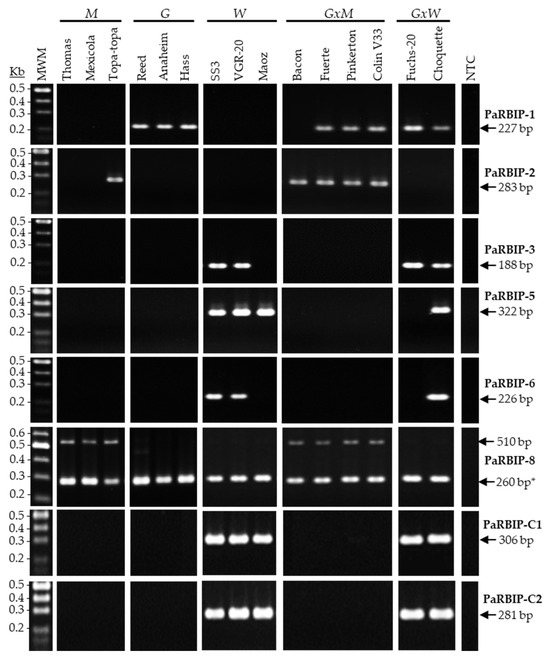
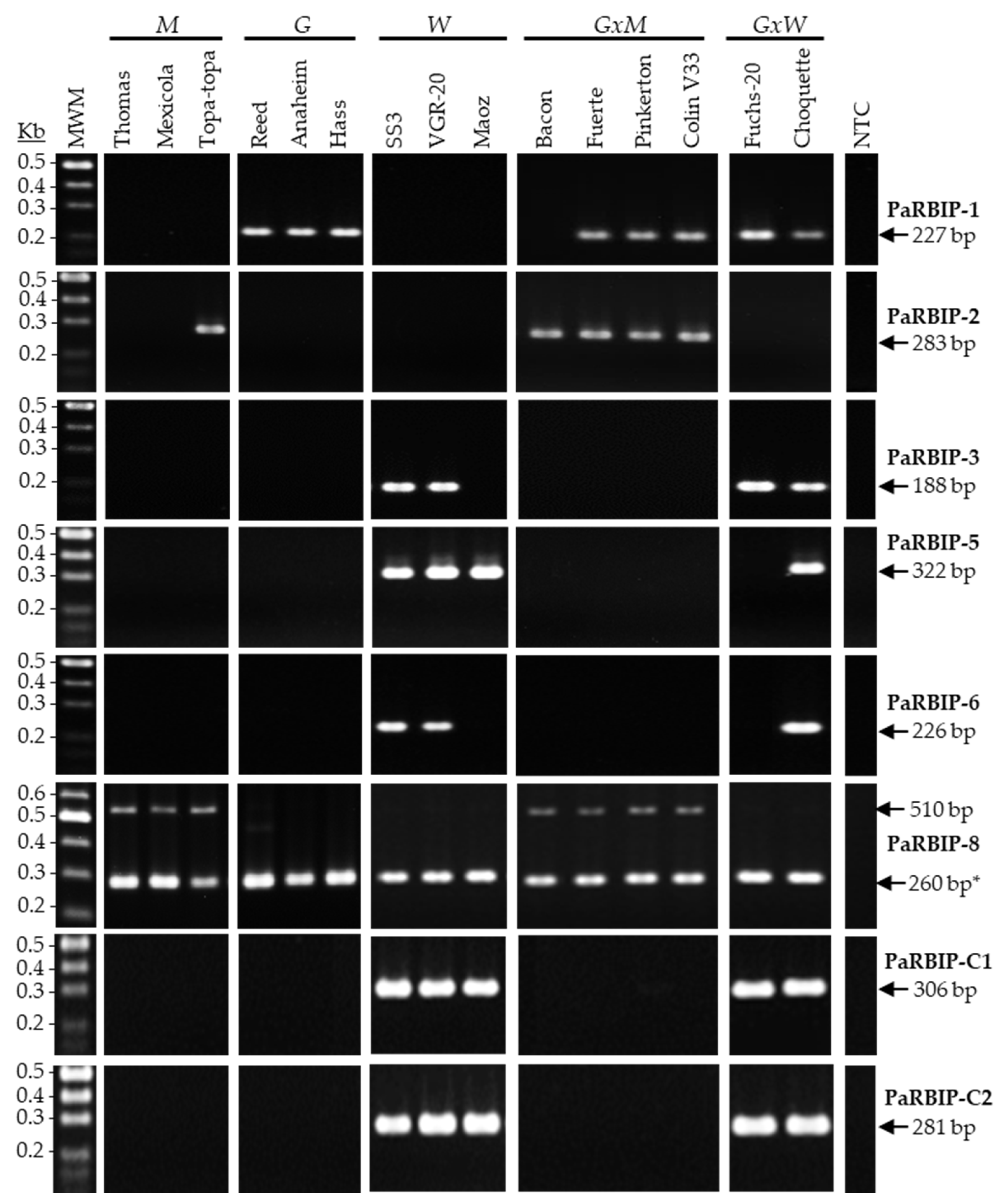
The eight PaRBIP assays were assessed independently using genomic DNA samples from a selection of 15 avocado cultivars, including three representatives of the Mexican (M), Guatemalan (G), and West-Indian (W) pure races, as well as four Guatemalan x Mexican (GxM), and two Guatemalan x West-Indian (GxW) hybrids. Overall, the eight markers yielded discrete bands with the expected amplicon lengths (Table 1), showing 100% of specificity for the different avocado races, judging by the results obtained with the cultivars used as references (Figure 1), although with different levels of sensitivity.
Figure 1.
Singleplex RBIP analysis of P. americana cultivars, representatives of the three pure horticultural races and some hybrids. A set of 15 different P. americana cultivars were analyzed, with the PaRBIP primer pairs indicated at the right side. M (Mexican); G (Guatemalan); W (West-Indian); GxM (Guatemalan x Mexican hybrid); GxW (Guatemalan x West-Indian hybrid); Kb (Kilobases); MWM (Molecular weight marker); NTC (Non-template control); * Positive control for PCR.
PaRBIP-1 emerged as a potential G-specific marker, since the expected amplicon (227 bp) was observed in nearly all cultivars with a G genetic background, but not in the pure M or W cultivars (Figure 1). In contrast, PaRBIP-2 and PaRBIP-8 seem to be M-specific markers. On one hand, the expected PCR product for the PaRBIP-2 marker (283 bp) was detected in one pure M cultivar (Topa–topa) and in all GxM hybrids (Figure 1). On the other hand, the expected band for the PaRBIP-8 marker (510 pb) was found in all cultivars with a M genomic component. PaRBIP-1, PaRBIP-2, and PaRBIP-8 were treated as non-West-Indian (non-W) markers in this work. Surprisingly, PaRBIP-8 primers also produced an extra band (260 bp) that was amplified in all samples (Figure 1). Therefore, PaRBIP-8 was also used as a positive control to verify the suitability of the DNA for PCR amplification. Finally, results for markers PaRBIP-3, -5, -6, -C1, and -C2 indicate they are all specific to the W horticultural race. These five markers failed to amplify in pure M and G cultivars, and in GxM hybrids, but were frequently detected in pure W cultivars and GxW hybrids (Figure 1).
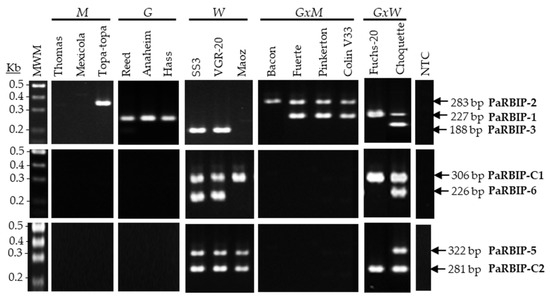
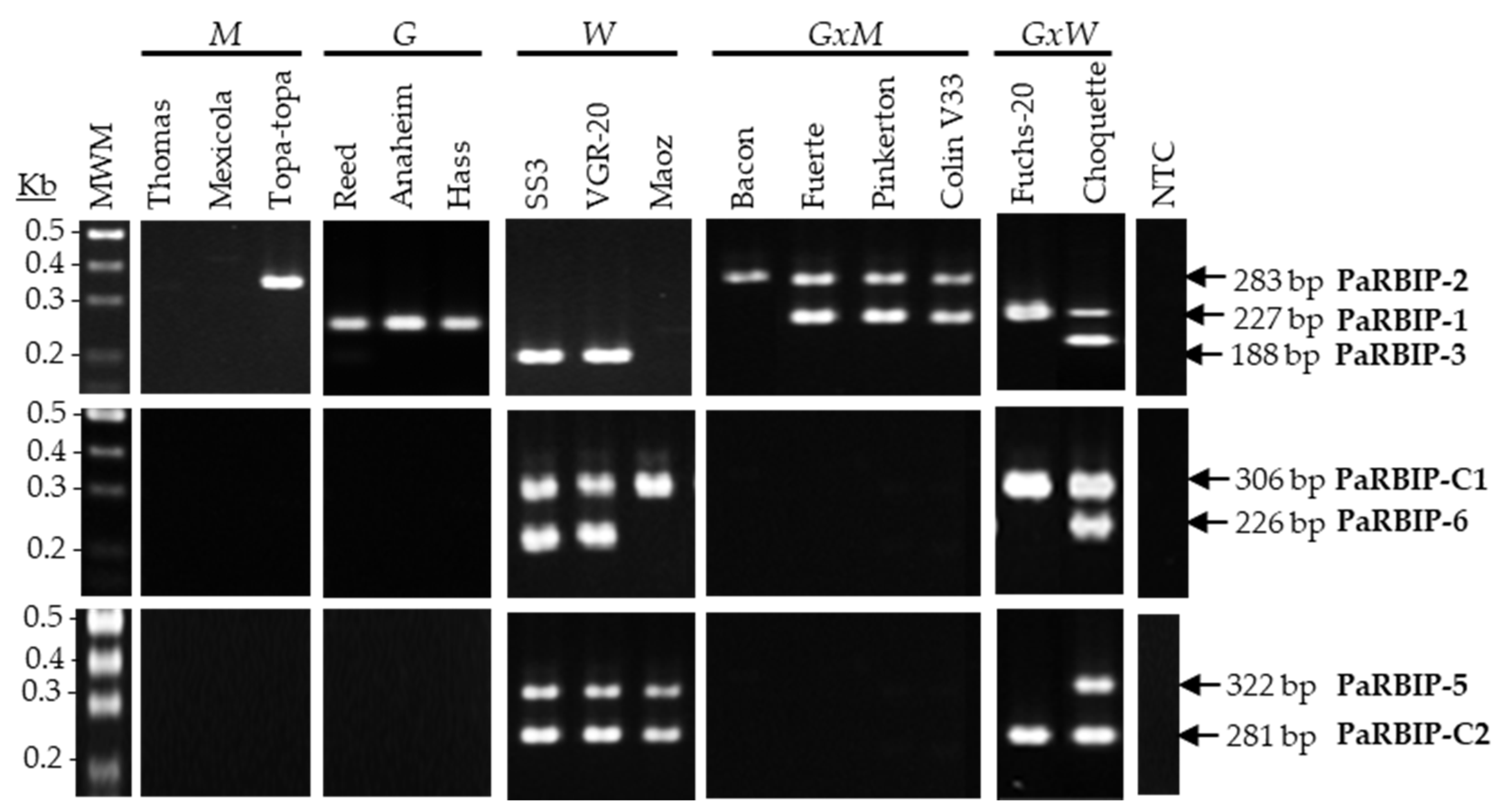
Considering the compatibility between the eight primer pairs and the ability to resolve the different amplicons by electrophoresis in agarose gels, seven RBIP markers were grouped into three multiplex PCRs, for which adjustments in the concentration of certain primer pairs were necessary (Table 1). Markers PaRBIP-1, -2 and -3 were assayed together, as were PaRBIP-5 with -C2, and PaRBIP-6 with -C1, whereas PaRBIP-8 remained as a singleplex PCR assay (Table 1). The results obtained with the three multiplex assays and the same set of 15 selected cultivars were consistent with previous findings (Figure 2).
Figure 2.
Multiplex RBIP analysis of P. americana cultivars, representatives of the three different pure horticultural races and some hybrids. A set of 15 different P. americana cultivars were analyzed, with the combination of PaRBIP primer pairs indicated at the right side of the figure. M (Mexican); G (Guatemalan); W (West-Indian); GxM (Guatemalan x Mexican hybrid); GxW (Guatemalan x West-Indian hybrid); Kb (Kilobases); MWM (Molecular weight marker); NTC (Non-template control).
2.2. Sensitivity of PaRBIP Markers in Detecting the West-Indian Genomic Component
The analysis of PaRBIP markers was expanded to a total of 58 avocado cultivars (Table 2) to test the sensitivity of the RBIP strategy in detecting detect both the W and the non-W (i.e., G or M) genomic components. A clear horticultural race assignation was found in the consulted literature for 37 of these cultivars. However, for the remaining cultivars, contradictory data was encountered (nine cases) or was not available (12 cases) (Table 2). Among the 46 cultivars with available race information, 38 showed a non-W genomic component (G, M, GxM, or GxW). The non-W component was detected in all of cultivars using the PaRBIP-1, -2 and/or -8 markers. This resulted in a 100% sensitivity level in detecting the non-W genomic component when this three-marker combination was used. Conversely, according to the literature, ten cultivars had a W genomic background (pure W cultivars or GxW hybrids). All these were successfully detected using the set of PaRBIP-3, -5, -6, -C1, and -C2 markers, achieving a 100% sensitivity for the detection of the W component when this five-marker combination was implemented (Table 2).
Table 2.
Results of the analysis of 58 avocado cultivars with PaRBIP markers.
Furthermore, the results showed no detection of non-W component in Maoz, SS3, and VGR20/32/38 cultivars, which aligns with their previous classification as pure W cultivars [37,38]. However, cultivars Taro H25 and Taro H27, which were traditionally considered pure W cultivars [38], were found to have a non-W genomic component (Table 2). For Choquette and Fuchs-20, which are commonly identified as GxW hybrids [23,25,27,30,32], both the W and non-W components were detected by the corresponding PaRBIP marker set (Table 2). The same results were obtained for the Lula cultivar, which has been inconsistently classified as a GxM [27] and GxW hybrid [25,36].
Interestingly, the RBIP strategy revealed novel information about G.A.-13 and Lonjas, both previously classified as M cultivars [33,35]. While the existence of a non-W genomic component was confirmed, a W component was detected in both cultivars for the first time. This finding is consistent with the observation that G.A.-13 exhibits a high tolerance to salinity, similar to that of W rootstocks [33].
Finally, this study tested 11 cultivars for which no horticultural race information was found in the literature, but are classified as W cultivars by the agronomist who supplied us with the samples. Among these, A3, BA2, De La Verruga, Gallo 4, M1, T23, and V1 showed only the W genomic component. The remaining four cultivars—Gallo 2, Gallo 3, Julian, and Taro—showed both W and non-W components, revealing their hybridization with G and/or M cultivars.
3. Discussion
In this study, a set of eight novel RBIP markers was developed, using the iPBS markers previously described in P. americana [20] as a starting point. These tools represent a significant step forward for avocado rootstock production by facilitating the transition from phenotype-based identification to a more precise approach based on molecular markers. The main objective of our work was to identify pure W cultivars and their hybrids. However, it should be noted that the number of markers is not high enough to completely rule out all the G and/or M genomic components, but they still represent a powerful tool for the fast detection of W cultivars. The accurate identification of W rootstocks is critical for the long-term sustainability of avocado cultivation, particularly in regions with high soil salinity, such as the Canary Islands and Mediterranean regions. By enabling the accurate identification of W rootstocks, known for their chloride ion-excluding properties, our PaRBIP marker set provides a direct tool for growers to proactively select varieties genetically predisposed to tolerate high salt levels. Similarly, these markers could contribute to controlling the devastating root rot caused by Phytophthora cinnamomi. This selection of resilient varieties leads to healthier avocado trees, sustained yields, predictable outcomes in the field, and significant economic savings by helping to prevent losses caused by salt stress or this fungal pathogen.
Our research has shown that traditional classification of avocado rootstocks is often inaccurate due to widespread and unrecorded hybridization. Many cultivars previously considered “pure” are, in fact, hybrids, such as the cultivar G.A.-13. As stated by our results, the G.A.-13 is a complex hybrid with the three racial components. Moreover, the fact that G.A.-13, known for its salinity tolerance, has a W genetic component provides an explanation for this valuable trait. Our PaRBIP markers also have clarified the genetic makeup of some cultivars. For example, the cultivar Lula has been contradictorily classified as GxM [27] and GxW [25,36], but the PaRBIP markers have revealed that this cultivar possesses both M and W genomic components. The analysis of cultivars with complex pedigrees highlighted the ability of the PaRBIP markers to detect genetic introgression. For instance, Taro H25 and H27, which have been traditionally managed as pure W cultivars, showed a non-West-Indian genomic component, which indicates that these cultivars are hybrids. In these cases, a W-positive result confirms the presence of the marker-related W genome component but does not quantify the proportion of the W genome which is present in a hybrid cultivar. In complex multi-generational hybrids, a cultivar might retain a specific marker (i.e., W-positive), while losing other traits that confer the racial phenotypes (i.e., the salinity tolerance of the W race). Therefore, while these markers are robust for excluding material containing a non-West-Indian genomic component, the positive result for W-specific markers in complex hybrids should be interpreted with caution, since it could be the result of genetic introgression.
It should be noted that the fact that the PaRBIP-1 marker is not detected in the cultivar Lula does not mean that it lacks a G genetic component. A higher number of race-specific genetic markers are required to rule out the existence of a significative race-specific genetic component in the analyzed individual. In this sense, the PaRBIP markers presented in this work are dominant because they only detect the allelic variant that presents an LTR of a retrotransposon next to a specific genomic locus [21]. Therefore, despite the fact that the method does not allow for the quantification of the heterozygosity levels within hybrid individuals, the five W-specific markers used together are highly effective for certifying the presence of the West-Indian genomic component. Considering that the focus of this study is the development of a method for a fast and cost-effective screening of West-Indian rootstocks in commercial nurseries, we consider that it provides enough resolution to support downstream breeding decisions, especially when combined with traditional morphological screening. Our research group is currently working to identify the alternative allele (i.e., without the inserted retrotransposon) of PaRBIP markers and develop codominant ones, with the hope that these new alleles will be specific to the alternative race(s). In fact, this task has become much easier after the publication of the first haplotype-resolved genome of Hass [39]. This would increase the ability to detect race-specific genomic components.
The validation of the PaRBIP markers was conducted using germplasm collections maintained in Spain (the Canary Islands and Málaga). Therefore, for extending the applicability of our assays, it could be necessary to perform a validation with samples maintained in germplasms from Central and South America, due to the high genetic diversity found in these regions [40]. Additionally, regarding functional traits, our markers identify the presence of the West-Indian genomic component, and this race is widely documented to possess superior salinity tolerance and resistance to P. cinnamomi. However, it cannot be stated that PaRBIP markers are linked to loci involved in salinity tolerance or resistance to this pathogen.
Previous studies have developed race-specific codominant markers for avocado cultivars. Gross-German and Viruel [16] have reported 15 polymorphic simple sequence repeat (SSR) loci, with one or two alleles per marker being race-specific (seven GxM, two M, and six W markers). In addition, Ge et al. [17] have described eight single nucleotide polymorphisms (SNPs), with one variant in each locus being race-specific (four G, three M, and one W markers), and they have proposed the genotyping of these loci using real-time PCR and fluorescently labeled oligonucleotides. The advantages of the described procedure for the analysis of our set of PaRBIP markers include the fact that it does not require specialized instrumentation, such as a real-time PCR platform or a system for capillary electrophoresis, and avoids the use of expensive fluorescent labels. Furthermore, our PaRBIP markers have been validated for multiplex PCR, making genetic screening highly cost-effective, scalable, and practical for nurseries managing large volumes of seedlings. The initial cost of this testing is a minor investment compared to the multi-year losses that can result from a poorly performing orchard.
4. Materials and Methods
4.1. P. Americana Cultivars and Genomic DNA Purification
Leaf samples of 58 Persea americana cultivars were retrieved from Instituto Canario de Investigaciones Agrarias (ICIA. La Laguna, Canary Islands, Spain), Instituto de Hortofruticultura Subtropical y Mediterránea La Mayora (Málaga, Andalucía, Spain), and Agro-Rincón S.L (Los Realejos, Canary Islands, Spain) (Table 2).
Young leaves were collected from adult trees, without symptoms of disease, chlorosis, or wounds, and genomic DNA was purified as explained elsewhere [20]. Each DNA sample was diluted to a final concentration of 10 ng/µL in 10 mM Tris-HCl pH 8.0, and stored at −20 °C. From these stocks, working dilutions at 0.4 ng/µL were prepared in the same buffer, for PCR amplification.
4.2. Design of Oligonucleotides for PaRBIP Markers and PCR Amplification
From the LTR sequences of P. americana and associated locus-specific sequences identified by González-Carracedo et al. [20], eight primer pairs were designed for PCR amplification of each locus (Table 1), including one LTR-binding primer and one locus-specific primer. Evaluation of secondary structure and Tm calculations were carried out with the GeneRunner v6.5.52 software [22].
Singleplex PCRs were performed in a final volume of 20 μL containing 2 ng of genomic DNA template (H2O for negative controls), 1X Key Buffer (VWR, Radnor, PA, USA), 0.5 µg/µL BSA, extra MgCl2 (0.5 mM), 0.2 mM of each dNTP, 0.2 µM of each PaRBIP primer, and 0.5 U of Taq DNA polymerase (VWR). Reactions were incubated in a ProFlex PCR System (ThermoFisher, Waltham, MA, USA) with the following thermal profile: one initial denaturation step at 95 °C for 2 min; 35 amplification cycles with denaturation at 95 °C for 10 s, primer annealing at 60 °C for 10 s, and primer extension at 72 °C for 20 s (40 s in the case of PaRBIP-8 marker), with a final extension step carried out at 72 °C for 1 min. For multiplex PCR, the concentration of certain primers pairs was adjusted (Table 1).
Five microliters of each PCR were analyzed by electrophoresis in agarose gels (2%) prepared in 1X TBE buffer. Gels were run at 5 V/cm for 90 min and then stained in a 3X GelRed solution (Biotium, Fremont, CA, USA) for 30 min. Results were visualized under UV light using a ChemiDoc XR+ System (BioRad, Hercules, CA, USA).
5. Patents
In this paper, we refer to the methodology described in the Spanish patent application ES2957491A1, which details a diagnostic kit and method for identifying Persea americana horticultural races.
Author Contributions
Conceptualization: M.G.C., S.B.A. and J.A.P.P. Methodology: S.B.A. and J.A.P.P. Validation: M.G.C., D.J.A. and J.A.P.P. Formal analysis: M.G.C. and J.A.P.P. Investigation: M.G.C., A.R.L., D.J.A., A.E.E. and J.A.P.P. Resources: A.R.L., D.J.A. and J.A.P.P. Data curation, M.G.C. and J.A.P.P. Writing—original draft preparation: M.G.C. Writing—review and editing: M.G.C., S.B.A., A.R.L., D.J.A., A.E.E. and J.A.P.P. Supervision: D.J.A. and J.A.P.P. Project administration: J.A.P.P. Funding acquisition: D.J.A. and J.A.P.P. All authors have read and agreed to the published version of the manuscript.
Funding
This work was partially supported by Gobierno de Canarias 2025 CAIA 2024-002-04-S2.
Institutional Review Board Statement
Not applicable.
Informed Consent Statement
Not applicable.
Data Availability Statement
The original contributions presented in this study are included in the article. Further inquiries can be directed to the corresponding authors.
Acknowledgments
During the preparation of this manuscript/study, the author(s) used Google Gemini V2.5-flash to check the text and search for information. The authors have reviewed and edited the output and take full responsibility for the content of this publication. We would like to warmly thank Esperanza Hernández (Agro-Rincón) for her invaluable support, as well as the late ICIA researcher Pedro Modesto, whose dedication and generosity in assisting with the avocado leaves from the ICIA collection made this work possible. His passion and commitment will always be remembered. May he rest in peace.
Conflicts of Interest
The authors declare no conflicts of interest.
References
- OECD; Food and Agriculture Organization of the United Nations. OECD-FAO Agricultural Outlook 2021–2030; OECD-FAO Agricultural Outlook; OECD: Paris, France, 2021; ISBN 978-92-64-43607-7. [Google Scholar]
- Instituto Canario de Estadística (ISTAC). Estadística Anual de Superficies y Producciones de Cultivos. Available online: https://www.gobiernodecanarias.org/istac (accessed on 25 July 2025).
- Rodríguez Sosa, L.; Cáceres Hernández, J.J. Servicio Técnico de Agricultura y Desarrollo Rural; Rentabilidad del cultivo del aguacate en Canarias, Ed.; Área de Aguas, Agricultura, Ganadería y Pesca del Cabildo Insular de Tenerife: Santa Cruz de Tenerife, Spain, 2014; pp. 1–68. ISBN 978-84-15012-03-0. [Google Scholar]
- Ashworth, V.; Chen, H.; Clegg, M. Persea. In Wild Crop Relatives: Genomic and Breeding Resources. Tropical and Subtropical Fruits; Springer Science & Business Media: Berlin/Heidelberg, Germany, 2011; Chapter 8; pp. 173–189. ISBN 978-3-642-20446-3. [Google Scholar]
- Lahav, E.; Lavi, U. Avocado Genetics and Breeding. In Breeding Plantation Tree Crops: Tropical Species; Springer New York: New York City, NY, USA, 2009; pp. 247–285. ISBN 978-0-387-71199-7. [Google Scholar]
- Hernandez-Moreno, J.; Tejedor, M.; Jiménez, C. Effects of Land Use on Soil Degradation and Restoration in the Canary Islands. In Soils of Volcanic Regions in Europe; Springer: Berlin, Heidelberg, 2007; pp. 565–579. ISBN 978-3-540-48710-4. [Google Scholar]
- Nektarios, N.K.; Zoi, D. Water Management and Salinity Adaptation Approaches of Avocado Trees: A Review for Hot-Summer Mediterranean Climate. Agric. Water Manag. 2021, 252, 106923. [Google Scholar] [CrossRef] [Scilit]
- Celis, N.; Suarez, D.L.; Wu, L.; Li, R.; Arpaia, M.L.; Mauk, P. Salt Tolerance and Growth of 13 Avocado Rootstocks Related Best to Chloride Uptake. HortScience 2018, 53, 1737–1745. [Google Scholar] [CrossRef] [Scilit]
- Acosta-Rangel, A.M.; Li, R.; Celis, N.; Suarez, D.L.; Santiago, L.S.; Arpaia, M.L.; Mauk, P.A. The Physiological Response of ‘Hass’ Avocado to Salinity as Influenced by Rootstock. Sci. Hortic. 2019, 256, 108629. [Google Scholar] [CrossRef] [Scilit]
- Lazare, S.; Cohen, Y.; Goldshtein, E.; Yermiyahu, U.; Ben-Gal, A.; Dag, A. Rootstock-Dependent Response of Hass Avocado to Salt Stress. Plants 2021, 10, 1672. [Google Scholar] [CrossRef] [Scilit]
- Embleton, T.W.; Matsumura, M.; Storey, W.B.; Garber, M.J. Chlorine and Other Elements in Avocado Leaves Influenced by Rootstock. J. Am. Soc. Hort. Sci. 1955, 80, 230–236. [Google Scholar]
- Kadman, A. The Uptake and Accumulation of Sodium in Avocado Seedlings. J. Am. Soc. Hort. Sci. 1960, 85, 179–182. [Google Scholar]
- Downton, W.J.S. Growth and Flowering in Salt-Stressed Avocado Trees. Austral. J. Agric. Res. 1978, 29, 523–534. [Google Scholar] [CrossRef] [Scilit]
- Gallo Llobet, L.; Siverio de la Rosa, F.; Rodríguez Pérez, A.; Domínguez Correa, P.; Pérez Zárate, S.; Díaz Hernández, S. Evaluación en Campo de Patrones Clonales de Aguacate de Raza Mexicana y Antillana Tolerante-Resistentes a Phytophthora cinnamomi Rands. In Proceedings of the V World Avocado Congress, Granada–Malaga, Spain, 19–24 October 2003; pp. 573–578. [Google Scholar]
- Anonymous. Normas Técnicas Específicas de Producción Integrada del Aguacate, Mango, Papaya y Piña Tropical en Canarias. Boletín Canar. 2012, 125, 12044–12088. [Google Scholar]
- Gross-German, E.; Viruel, M.A. Molecular Characterization of Avocado Germplasm with a New Set of SSR and EST-SSR Markers: Genetic Diversity, Population Structure, and Identification of Race-Specific Markers in a Group of Cultivated Genotypes. Tree Genet. Genomes 2013, 9, 539–555. [Google Scholar] [CrossRef] [Scilit]
- Ge, Y.; Zhang, T.; Wu, B.; Tan, L.; Ma, F.; Zou, M.; Chen, H.; Pei, J.; Liu, Y.; Chen, Z.; et al. Genome-Wide Assessment of Avocado Germplasm Determined from Specific Length Amplified Fragment Sequencing and Transcriptomes: Population Structure, Genetic Diversity, Identification, and Application of Race-Specific Markers. Genes 2019, 10, 215. [Google Scholar] [CrossRef] [Scilit]
- Chen, H.; Morrell, P.L.; Ashworth, V.E.T.M.; de la Cruz, M.; Clegg, M.T. Tracing the Geographic Origins of Major Avocado Cultivars. J. Hered. 2008, 100, 56–65. [Google Scholar] [CrossRef] [Scilit]
- Kalendar, R.; Antonius, K.; Smýkal, P.; Schulman, A.H. iPBS: A Universal Method for DNA Fingerprinting and Retrotransposon Isolation. Theor. Appl. Genet. 2010, 121, 1419–1430. [Google Scholar] [CrossRef] [Scilit]
- González Carracedo, M.; Bello Alonso, S.; Brito Cabrera, R.S.; Jiménez-Arias, D.; Pérez Pérez, J.A. Development of Retrotransposon-Based Molecular Markers for Characterization of Persea americana (Avocado) Cultivars and Horticultural Races. Agronomy 2022, 12, 1510. [Google Scholar] [CrossRef] [Scilit]
- Flavell, A.J.; Knox, M.R.; Pearce, S.R.; Ellis, T.H.N. Retrotransposon-Based Insertion Polymorphisms (RBIP) for High Throughput Marker Analysis. Plant J. 1998, 16, 643–650. [Google Scholar] [CrossRef] [Scilit]
- Buquicchio, F.; Spruyt, M. Gene Runner, v6.5.52; Hastings Software Inc.: New York, NY, USA, 2019.
- Lahav, E.; Gazit, S. World Listing of Avocado Cultivars According to Flowering Type. Fruits 1994, 49, 299–313. [Google Scholar]
- Lahav, E.; Lavi, U.; Degani, C.; Zamet, D.; Gazit, S. ‘Adi’, a New Avocado Cultivar. HortScience 1992, 27, 1237. [Google Scholar] [CrossRef] [Scilit]
- Schnell, R.J.; Brown, J.S.; Olano, C.T.; Power, E.J.; Krol, C.A.; Kuhn, D.N.; Motamayor, J.C. Evaluation of Avocado Germplasm Using Microsatellite Markers. J. Am. Soc. Hort. Sci. 2003, 128, 881–889. [Google Scholar] [CrossRef] [Scilit]
- Lavi, U.; Hillel, J.; Vainstein, A.; Lahav, E.; Sharon, D. Application of DNA Fingerprints for Identification and Genetic Analysis of Avocado. J. Amer. Soc. Hort. Sci. 1991, 116, 1078–1081. [Google Scholar] [CrossRef] [Scilit]
- University of California Riverside. Avocado Variety Database. Available online: https://avocado.ucr.edu/avocado-variety-database (accessed on 24 July 2025).
- Solares, E.; Morales-Cruz, A.; Balderas, R.F.; Focht, E.; Ashworth, V.E.T.M.; Wyant, S.; Minio, A.; Cantu, D.; Arpaia, M.L.; Gaut, B.S. Insights into the domestication of avocado and potential genetic contributors to heterodichogamy. G3 2023, 13, jkac323. [Google Scholar] [CrossRef] [Scilit] [PubMed]
- Ashworth, V.E.T.M.; Clegg, M.T. Microsatellite Markers in Avocado (Persea americana Mill.): Genealogical Relationships Among Cultivated Avocado Genotypes. J. Hered. 2003, 94, 407–415. [Google Scholar] [CrossRef] [Scilit] [PubMed]
- Boza, E.J.; Tondo, C.L.; Ledesma, N.; Campbell, R.J.; Bost, J.; Schnell, R.J.; Gutiérrez, O.A. Genetic Differentiation, Races and Interracial Admixture in Avocado (Persea americana Mill.), and Persea spp. Evaluated Using SSR Markers. Genet. Resour. Crop Evol. 2018, 65, 1195–1215. [Google Scholar] [CrossRef] [Scilit]
- Lavi, U.; Sharon, D.; Kaufman, D.; Saada, D.; Chapnik, A.; Zamet, D.; Degani, C.; Lahav, E.; Gazit, S. ’Eden’—A New Avocado Cultivar. HortScience 1997, 32, 151. [Google Scholar] [CrossRef] [Scilit]
- Kadman, A.; Ben-Ya’acov, A. ‘Fuchs-20’ Avocado Rootstock. HortScience 1981, 16, 351. [Google Scholar] [CrossRef] [Scilit]
- Kadman, A.; Ben-Ya’acov, A. G.A.-13 Avocado Rootstock Selection. HortScience 1980, 15, 206. [Google Scholar] [CrossRef] [Scilit]
- Lahav, E.; Lavi, U.; Zamet, D.; Degani, C.; Gazit, S. Iriet—A New Avocado Cultivar. HortScience 1989, 24, 865–866. [Google Scholar] [CrossRef] [Scilit]
- López-López, L.; Barrientos-Priego, A.; Ben-Ya’acov, A. Study of Avocado Genetic Resources and Related Kinds Species at the Fundacion Salvador Sanchez Colin Cictamex S.C; Memoria Fundación Salvador Sánchez Colin CICTAMEX S.C.: Harinas, Mexico, 1998–2001, 2002; pp. 188–201. [Google Scholar]
- Ben-Ya’acov, A.; Zilberstaine, M.; Goren, M.; Tomer, E. The Israeli Avocado Germplasm Bank: Where and Why the Items Had Been Collected. In Proceedings of the V World Avocado Congress, Granada–Malaga, Spain, 19–24 October 2003; pp. 13–19. [Google Scholar]
- Kadman, A.; Ben-Ya’acov, A. Maoz Avocado Rootstock Selection. HortScience 1980, 15, 207. [Google Scholar] [CrossRef] [Scilit]
- Gallo Llobet, L.; Rodríguez Pérez, A.; Siverio de la Rosa, F.; Díaz Hernández, S.; Domínguez Correa, P. Uso Potencial de la raza Antillana Como Fuente de Resistencia a la Podredumbre Radicular del Aguacate. In Proceedings of the V World Avocado Congress, Granada–Malaga, Spain, 19–24 October 2003; pp. 61–67. [Google Scholar]
- Nath, O.; Fletcher, S.J.; Hayward, A.; Shaw, L.M.; Masouleh, A.K.; Furtado, A.; Henry, R.J.; Mitter, N. A haplotype resolved chromosomal level avocado genome allows analysis of novel avocado genes. Hortic Res. 2022, 30, uhac157. [Google Scholar] [CrossRef] [Scilit] [PubMed]
- Berdugo-Cely, J.A.; Cortés, A.J.; López-Hernández, F.; Delgadillo-Durán, P.; Cerón-Souza, I.; Reyes-Herrera, P.H.; Navas-Arboleda, A.A.; Yockteng, R. Pleistocene-dated genomic divergence of avocado trees supports cryptic diversity in the Colombian germplasm. Tree Genet. Genomes 2023, 19, 42. [Google Scholar] [CrossRef] [Scilit]

Disclaimer/Publisher’s Note: The statements, opinions and data contained in all publications are solely those of the individual author(s) and contributor(s) and not of MDPI and/or the editor(s). MDPI and/or the editor(s) disclaim responsibility for any injury to people or property resulting from any ideas, methods, instructions or products referred to in the content. |
© 2025 by the authors. Licensee MDPI, Basel, Switzerland. This article is an open access article distributed under the terms and conditions of the Creative Commons Attribution (CC BY) license (https://creativecommons.org/licenses/by/4.0/).