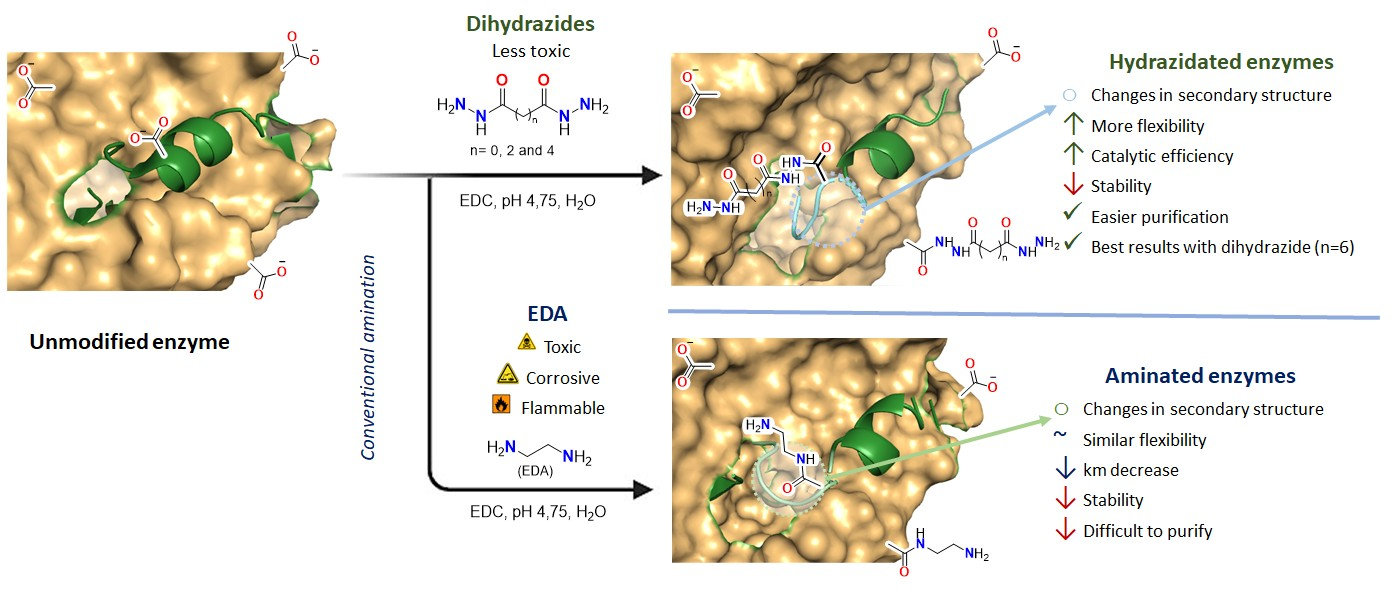
Article

Chemical Modification of Thermomyces lanuginosus Lipase and Myceliophthora thermophila Laccase Using Dihydrazides: Biochemical Characterization and In Silico Studies


by
Juan S. Pardo-Tamayo
1,*,
Maria Camila Muñoz-Vega
1,
Oscar L. Alférez
1,
Evelyn L. Guerrero-Tobar
1,
Chonny Herrera-Acevedo
2,
Ericsson Coy-Barrera
3 and
César A. Godoy
1,*
1
Laboratorio de Investigación en Biocatálisis y Biotransformaciones (LIBB), Grupo de Investigación en Ingeniería de los Procesos Agroalimentarios y Biotecnológicos (GIPAB), Department of Chemistry, Universidad del Valle, Cali 760001, Colombia
2
Department of Chemical Engineering, Universidad ECCI, Bogotá 111311, Colombia
3
Bioorganic Chemistry Laboratory, Facultad de Ciencias Básicas y Aplicadas, Universidad Militar Nueva Granada, Cajicá 250247, Colombia
*
Authors to whom correspondence should be addressed.
Int. J. Mol. Sci. 2025, 26(22), 11094; https://doi.org/10.3390/ijms262211094
Submission received: 8 October 2025 / Revised: 8 November 2025 / Accepted: 12 November 2025 / Published: 16 November 2025
(This article belongs to the Special Issue Advanced Research on Enzymes in Biocatalysis)

Abstract

Chemical modification is a valuable strategy for tuning enzyme functionality by introducing new reactive groups without disrupting the overall fold. Conventional amination using ethylenediamine (EDA) is effective, but the resulting modified proteins show limited reactivity for conjugation at neutral pH, and the modifier itself poses safety concerns due to its volatility and corrosive nature. Dihydrazides, in contrast, offer a safer and more versatile alternative: they operate through the same carboxyl-activation mechanism while enabling systematic investigation of chain-length effects. In this study, Thermomyces lanuginosus lipase (TLL) and Myceliophthora thermophila laccase (MTL) were modified using dihydrazides with different alkyl chain lengths (carbonyl (CZ), oxalyl (OX), succinyl (SC), and adipic (AA)), and compared to EDA-modified and unmodified enzymes to evaluate their effects on catalytic performance. Hydrazide-modified variants exhibited enhanced catalytic performance, reaching up to 2.5-fold (TLL-CZ) and 4.2-fold (MTL-AA and MTL-OX) higher efficiencies than unmodified and EDA-modified enzymes. Notably, AA provided the most consistent improvement across both enzymes (1.3-fold in TLL and the best in MTL). Molecular dynamics and docking analyses supported these findings, linking increased flexibility (higher RoG and RMSF) with higher kcat, and changes in substrate binding with lower km. Overall, hydrazide-based modification broadens the spectrum of enzyme variants attainable through amination, while offering safer procedures, thus representing an alternative that overcomes the limitations of using EDA as a conventional aminating agent.

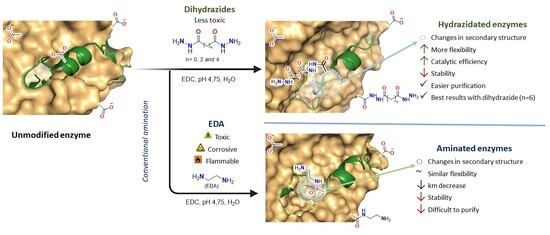
Graphical Abstract

1. Introduction

Biocatalysis has gained importance in industry due to its high specificity, mild operating conditions, and lower environmental impact compared to conventional catalysts, aligning with green chemistry principles [1]. Lipases and laccases are among the enzymes of biotechnology interest, valued for their versatility and broad substrate specificity. Lipases catalyze the hydrolysis of triglycerides and are applied in various sectors, including food, detergents, biofuels, and fine chemicals [2,3]. Laccases, on the other hand, oxidize phenolic substrates using molecular oxygen and are employed in textiles, paper, cosmetics, and environmental remediation [4,5,6]. Nonetheless, improving enzyme stability and activity remains a significant challenge for industrial applications. Strategies to address this issue encompass genetic methods such as directed evolution [7] and physicochemical modifications [8,9], have been developed. Notably, physicochemical modifications are becoming increasingly efficient and controllable [6,8,9], allowing for improved biocatalytic parameters and enhanced stability under specific conditions, such as variations in pH, temperature, and solvent presence [9]. These strategies can be combined to develop advanced enzyme systems, including plurienzymes with multiple active sites [10,11] or immobilized enzyme derivatives, which often exhibit superior activity and stability [6,9,12].
Surface amination of proteins using ethylenediamine (EDA) and carbodiimide reagents (commonly EDC) is among the most widely applied chemical modifications. The incorporation of primary amino groups introduces positive charges, often improving enzyme stability under varying pH, temperature, and solvent conditions [6,9]. On the other hand, EDA serves as a bifunctional linker that enables further derivatization [12], stabilization via methods such as cross-linked enzyme aggregates (CLEAs) [13], and covalent immobilization on electrophilic supports like glyoxyl- or epoxide-agarose [3,14,15]. EDA-modified enzymes have demonstrated improved activity (e.g., in Horseradish peroxidase HRP [16]) and enhanced reactivity toward aldehydes and epoxides, facilitating covalent bioconjugation between different proteins [16].
However, EDA poses several challenges since it is volatile, irritating, corrosive, and susceptible to oxidation in solution, which limits its safe handling and application [17]. Dihydrazides are safer alternatives, offering similar reactivity toward electrophiles, improved stability of the bond formed (hydrazones), and neutral nucleophilic character at physiological pH [9]. These groups have been used in peptide synthesis via native chemical ligation [18], in enzymatic modifications [8,9], and in studies of post-translational modifications. Adipic acid dihydrazide (AA), in particular, has been applied in protein–protein bioconjugation and HRP modification for improved hormone detection [16,19]. Despite their promising reactivity and safer profile, to our knowledge, the impact of dihydrazide-based modifications, particularly regarding the influence of alkyl chain length, on enzyme catalytic behavior and structure has not been thoroughly explored.
In this context, molecular dynamics (MD) simulations offer an approach to explore these effects at the atomic level. By modeling the physical movements of atoms and molecules over time, MD enables the analysis of structural, dynamic, and thermodynamic properties of biomolecules [20]. This includes insights into how proteins respond to external stimuli or covalent modifications, revealing conformational changes, alterations in flexibility, and shifts in folding or stability. Previous studies have demonstrated the utility of MD in evaluating chemical modifications on enzyme surfaces [20], although its routine application in biocatalyst design remains limited.
In this study, we hypothesized that chemical modification of enzymes using dihydrazides of different chain lengths could modulate their catalytic behavior and alter their structural stability by changing the microenvironment around the modified Glu and Asp residues. This strategy aimed to extend the applicability of conventional EDC-mediated modification—typically employing EDA-based amination—by introducing tunable, non-charged linkers suitable for future bioconjugation [19], while replacing EDA with a modifier that is less corrosive, odorless, and safer to handle.
To test this hypothesis, two model enzymes—Thermomyces lanuginosus lipase (TLL) and Myceliophthora thermophila laccase (MTL)—were systematically modified with dihydrazides of different chain lengths (carbonyl, oxalic, succinic, and adipic) and characterized through a combined experimental–computational approach. The modified enzymes were kinetically analyzed using the Michaelis–Menten model and evaluated for their stability in organic solvents and at elevated temperatures. Complementary molecular dynamics (MD) simulations were performed on in silico-modified structures to correlate it with the experimental results. Finally, the modified enzymes were evaluated in biotechnologically relevant reactions—fatty ester synthesis (a key component of biodiesel) for TLL and indigo carmine biodegradation for MTL—as model applications to explore their functional viability.

2. Results and Discussion

2.1. Enzyme Chemical Modification

Enzymatic modifications were initially conducted using a solid-phase modification with EDA and adipic acid dihydrazide (AA), based on a previously reported protocol employing 0.5 M modifier and 10 mM EDC [3,12,21]. Enzymes were immobilized on Lewatit® VPOC1600, Q-Sepharose®, and PEI-agarose supports (Table S1). TLL showed ~20% recovery in terms of activity and protein on the hydrophobic support Lewatit®, likely due to favorable interactions with its binding domain [22,23], and the poor interference of these types of interactions in the modification. MTL could not be immobilized on this support. In contrast, immobilization on ion-exchange supports resulted in poor recovery (<12% in activity and <6%) and no desorption in the case of PEI-agarose, possibly due to covalent interactions promoted by EDC [24,25]. This outcome is consistent with the intrinsic reactivity of EDC-activated carboxyl groups (from Asp and Glu residues) toward nucleophilic nitrogen-based moieties on the support (Scheme 1, top). That could be expected due the same versatility was exploited here to attach two different types of modifiers—EDA or dihydrazides—through analogous coupling chemistry but yielding distinct terminal groups (Scheme 1, bottom).
Due to these constraints, a liquid-phase modification strategy was adopted [6]. Preliminary assays varying EDC concentration showed that the extent of modification increased with EDC levels (Table S2), consistent with the mechanism of carbodiimide-mediated coupling, where the rate-limiting step involves coupling between EDC and protein carboxyl groups to form the O-acylisourea intermediate (Scheme 1) [27]. However, enzymatic activity remained low (<23%), likely due to modification of catalytic residues or active site obstruction, effects that are typically prevented when using hydrophobic supports [21]. In contrast, protein recovery was improved to ~39% for EDA and ~72% for AA, indicating that AA-modified versions were easier to purify than aminated ones, possibly due to the reduction in surface charge when dihydrazides were used (Scheme 1). This represents an operational advantage, along with the procedural simplification and improved safety of using hydrazides instead of EDA, as hydrazides facilitate pH adjustment and do not release gases [17,28].
To mitigate the loss of activity observed during modification, CTAB was added to the reaction medium. This cationic surfactant is known to stabilize the open, active form of lipases by reducing intermolecular aggregation and shielding catalytic residues from undesired modification [24,29,30,31]. Although this conformational effect was not directly validated in this work, its functional consequence was clearly evidenced by the marked increase in recovered activity and modification yield. At low CTAB concentrations (0.00–0.01%), activity recovery rose moderately, in the best case for TLL-AA, from 21.9% to 59.8%, while at 0.10% CTAB it exceeded 100% in some cases, with modification yields reaching ≈66%, compared to <23% and ≈40% in its absence (Table S3). This improvement is consistent with the stabilization of the open conformation, which prevents irreversible inactivation and modification of catalytic residues. The response plateaued at higher CTAB levels, likely near the CMC [29], indicating an optimal balance between reactive site exposure and preservation of catalytic activity.
Once the best tested modification conditions were established, both TLL and MTL were chemically modified using four dihydrazides of varying alkyl chain lengths: carbonyl dihydrazide (CZ), oxalic dihydrazide (OX), succinic dihydrazide (SC), and adipic dihydrazide (AA). Although AA had been previously reported for enzyme modification [16,19], the effect of dihydrazide chain length on the same enzyme had not been systematically evaluated and compared across different enzyme types. Ethylenediamine (EDA) modifier was included as a reference modifier due to its established role in enhancing enzyme reactivity and enabling further functionalization [32]. Table 1 summarizes the percentage of surface modification, protein and activity recovery, and specific activity (IU/mg) obtained for each derivative under standardized conditions.
It is important to highlight that most modifications positively affected enzymatic activity, with the exceptions being TLL modified with EDA and OX, and MTL modified with CZ. Remarkably, TLL-AA showed nearly a twofold activity increase, while MTL-AA exhibited an approximately sixfold increase. Overall, the modification percentages ranged between 45–66% for TLL and 40–54% for MTL (excluding MTL-CZ). SDS-PAGE analysis (Supplementary Table S4, Figures S1 and S2) revealed that EDA-modified enzymes did not show multimeric forms, likely because the surface charges introduced hinder intermolecular crosslinking. In contrast, several TLL variants modified with hydrazides formed dimeric and trimeric species, probably covalent, which may partly account for their reduced activity in some cases.

2.2. Biocatalytic Characterization of Modified Enzymes

2.2.1. TLL Surfactant Activation Studies: Impact of Chemical Modifications

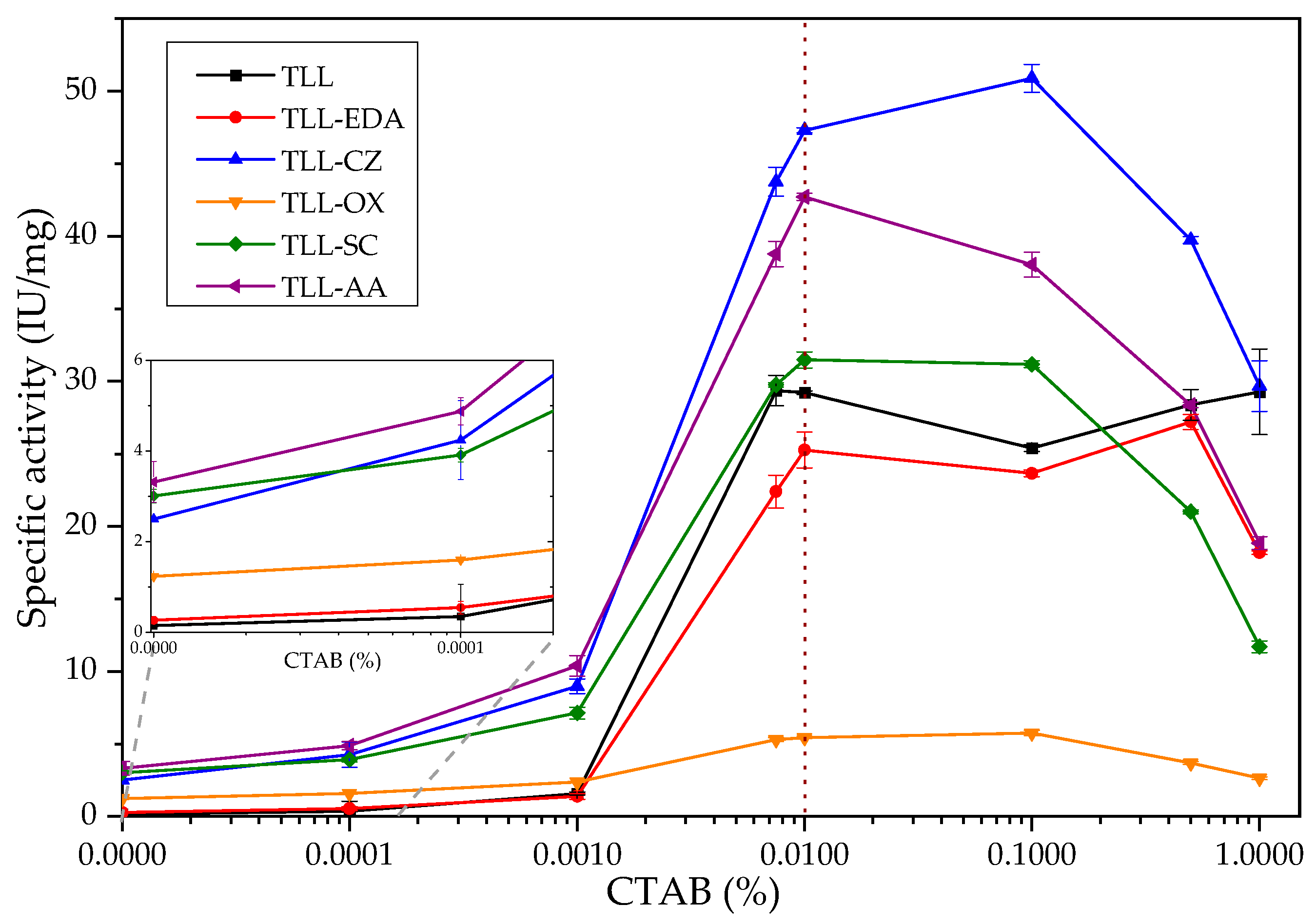
Certain lipases, TLL included, possess a lid domain that controls access to the active site, transitioning from inactive (closed or multimeric) to active conformation upon contact with hydrophobic interfaces (like an oil droplet or micelle), a phenomenon known as interfacial activation [33]. Surfactants such as CTAB can mimic this effect, as was mentioned in Section 2.1, stabilizing the active monomeric conformation [2,29,34], a property that underlies their widespread use in biotechnological formulations. This feature was exploited here to evaluate whether the chemical modifications altered the enzyme’s responsiveness to interfacial activation and, consequently, the equilibrium between open and closed forms. For that purpose, activation curves (Figure 1) were generated by measuring the specific hydrolytic activity (IU/mg) across increasing CTAB concentrations (w/v%).
All TLL variants, including those modified with EDA and the four dihydrazides (CZ, OX, SC, and AA), exhibited similar CTAB-induced activation patterns, indicating that their conformational equilibrium remained responsive to surfactant-mediated activation. This preservation of the activation behavior suggests that the chemical modifications did not disrupt the natural lid-controlled mechanism of TLL but rather modulated its amplitude or intensity between variants. Maximal activity was observed near the CMC (~0.01%), declining at higher concentrations, consistent with the typical inhibition caused by micelle formation [29,35,36]. Among the variants, TLL-CZ reached the highest activity (~50 IU/mg at 0.10% CTAB), nearly doubling that of the unmodified enzyme (TLL) and TLL-EDA (25–29 IU/mg), suggesting a favorable effect of CZ on lid dynamics and catalytic performance.
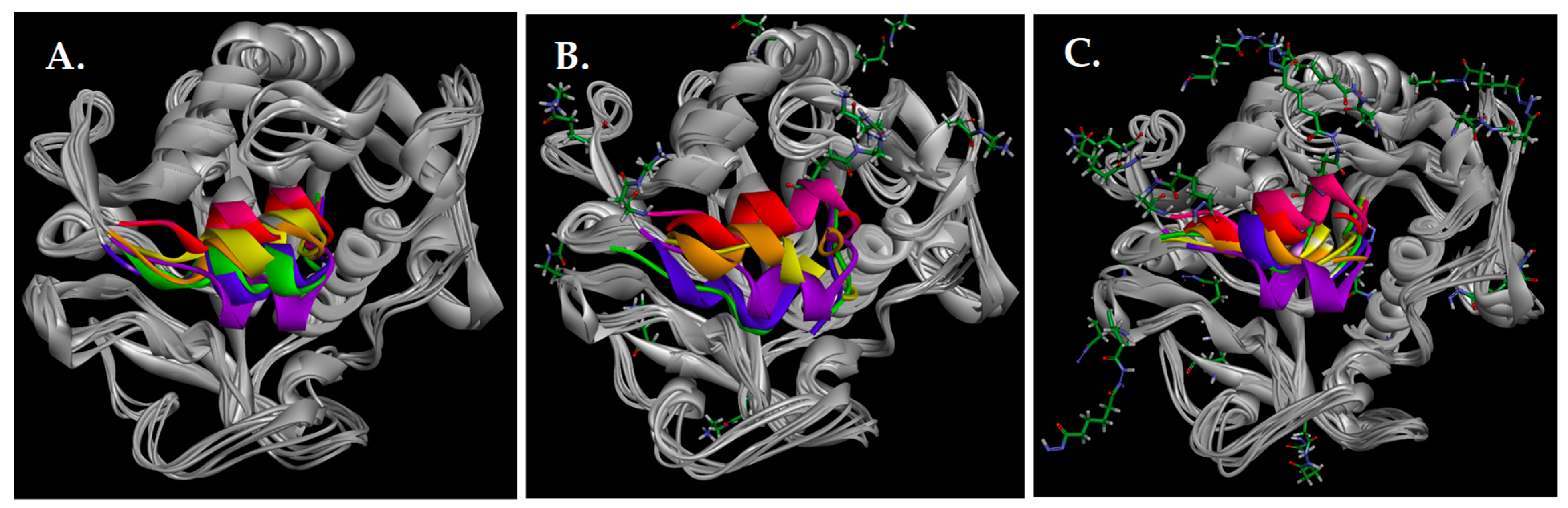
Molecular dynamics (MD) simulations (100 ns) were conducted on models of open-state TLL modified with either hydrazide or EDA (models were obtained using the methodology detailed in Section 3.12) to further examine the impact of chemical alterations on TLL conformational behavior (Figure 2 and Figure S3). The spontaneous closure observed in the MD simulations of the unmodified enzyme aligns with the natural open–closed equilibrium of lipases, which surfactants such as CTAB are known to shift toward the open, more catalytically active state [2]. Snapshots revealed that unmodified TLL underwent a gradual lid closure, reaching a near-closed conformation by 92 ns (Figure 2A). This transition occurred rapidly (43 ns) and was more pronounced in TLL-EDA (Figure 2B), aligning with its reduced response to CTAB. In contrast, dihydrazide-modified variants—particularly TLL-AA (Figure 2C)—exhibited reduced lid movement, consistent with a stabilization of the open, catalytically active form inferred from the activation curves. This aligns with the higher activity observed for TLL-AA at low CTAB concentrations (see inset in Figure 1). The lower activity of TLL-OX may be attributed to its higher proportion of inactive dimers (34%, Table S4), which are known to hinder substrate access to the catalytic site [37].
When analyzing the effect of chain length on lid mobility and on the stabilization of the enzyme’s active conformation, it was observed that the chemically modified variants showing the highest specific activities upon CTAB addition—CZ, AA, and SC (with carbon chain lengths of 1, 6, and 4, respectively)—did not follow a clear trend with respect to chain length (Figure 1). Nonetheless, an inspection of the MD trajectories focused on the lid region (Figure 2) indicated that variants bearing bulkier substituents tended to display smaller displacements from the fully open starting state within the 100-ns window. This behavior is consistent with a partial stabilization of open or semi-open conformations, which would preserve catalytic accessibility (Figure 2, Figures S3 and S4). Conversely, variants with shorter substituents—particularly EDA and OX—showed faster (after approximately 18 ns) progression toward more closed-like arrangements (Figure 2B), suggesting that linkers with two carbons of length may facilitate lid compaction. Interestingly, the CZ variant behaved differently: although its RMSD increased rapidly from the initial open conformation, the final structure at 100 ns (Figure S3A, blue trace) did not correspond to the closed state observed for the other variants. Consistent with the experimental data (Figure 1, blue line), this alternative conformation appears to be more catalytically active. A more comprehensive analysis of chain-length effects on global flexibility and catalytic performance, including RMSD/RMSF correlation with kinetic parameters, is presented in Section 2.2.2.

2.2.2. Kinetic Studies for TLL and Its Variants

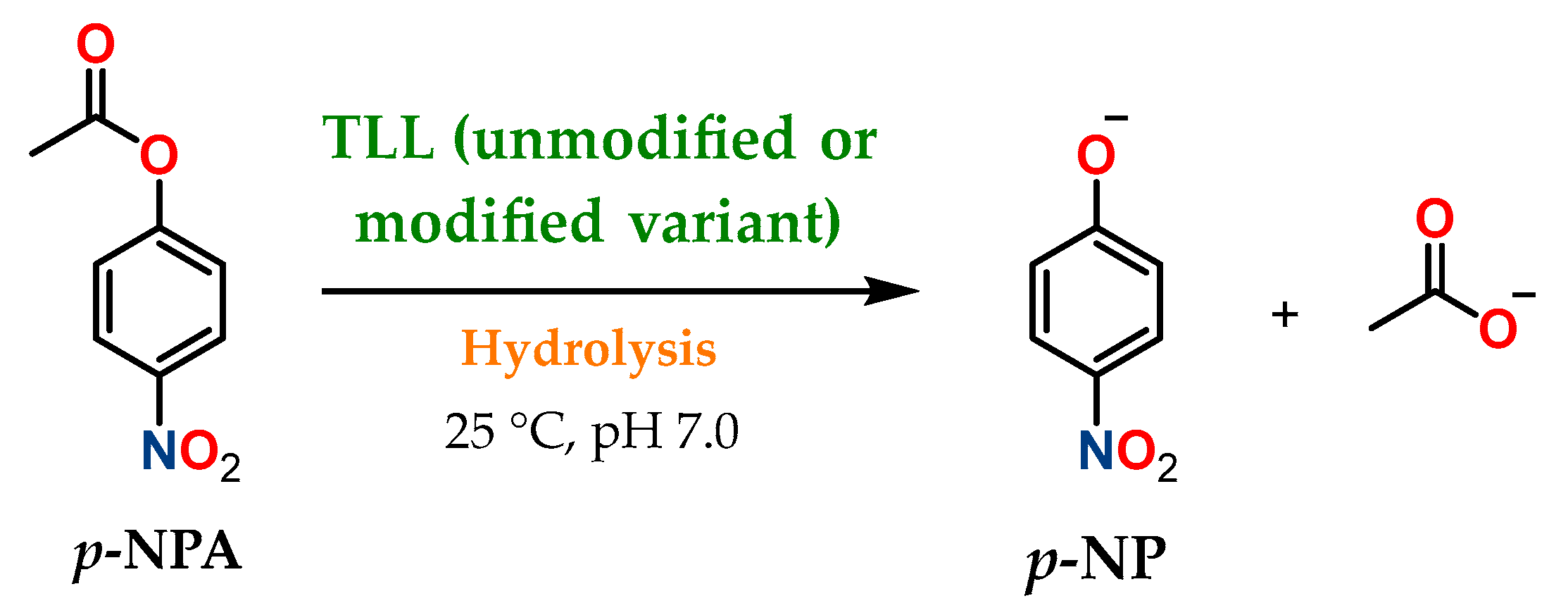
Although TLL is a widely used biocatalyst, including applications beyond lipid substrates, surprisingly few kinetic studies have employed p-NPA (Scheme 2). This gap makes the present results particularly valuable for benchmarking and for exploring TLL’s potential in small-molecule transformations, such as the synthesis of pharmaceutical building blocks [2]. Michaelis–Menten kinetic parameters were determined for unmodified and modified TLL variants using p-NPA hydrolysis at 25 °C and pH 7.0 with 0.01% CTAB (Scheme 2) (Section 3.9). Results are shown in Table 2 and Figure S5.
The unmodified enzyme exhibited a kcat of 70.1 s−1 and a km of 1.3 mM, resulting in a catalytic efficiency of 55.6 mM−1 s−1. Among the modified enzymes, TLL-CZ showed the greatest improvement in both parameters, with kcat = 98.0 s−1, km = 0.7 mM. Although the individual changes in kcat and km were relatively modest, their combined effect yielded a marked increase in catalytic efficiency (kcat/km = 138.0 mM−1 s−1). TLL-SC and TLL-AA also displayed enhanced performance, with efficiencies (kcat/km) of 90.5 and 75.0 mM−1 s−1, respectively. In contrast, TLL-EDA and especially TLL-OX showed reduced turnover (kcat) and efficiency (kcat/km), suggesting detrimental effects from these modifiers. The results underscore that hydrazide-based modifications—specifically CZ, SC, and AA—can improve TLL catalytic efficiency, while EDA and OX may detrimentally influence activity; this would presumably be attributable to lid dynamics or aggregation-related factors, as discussed in the previous section.
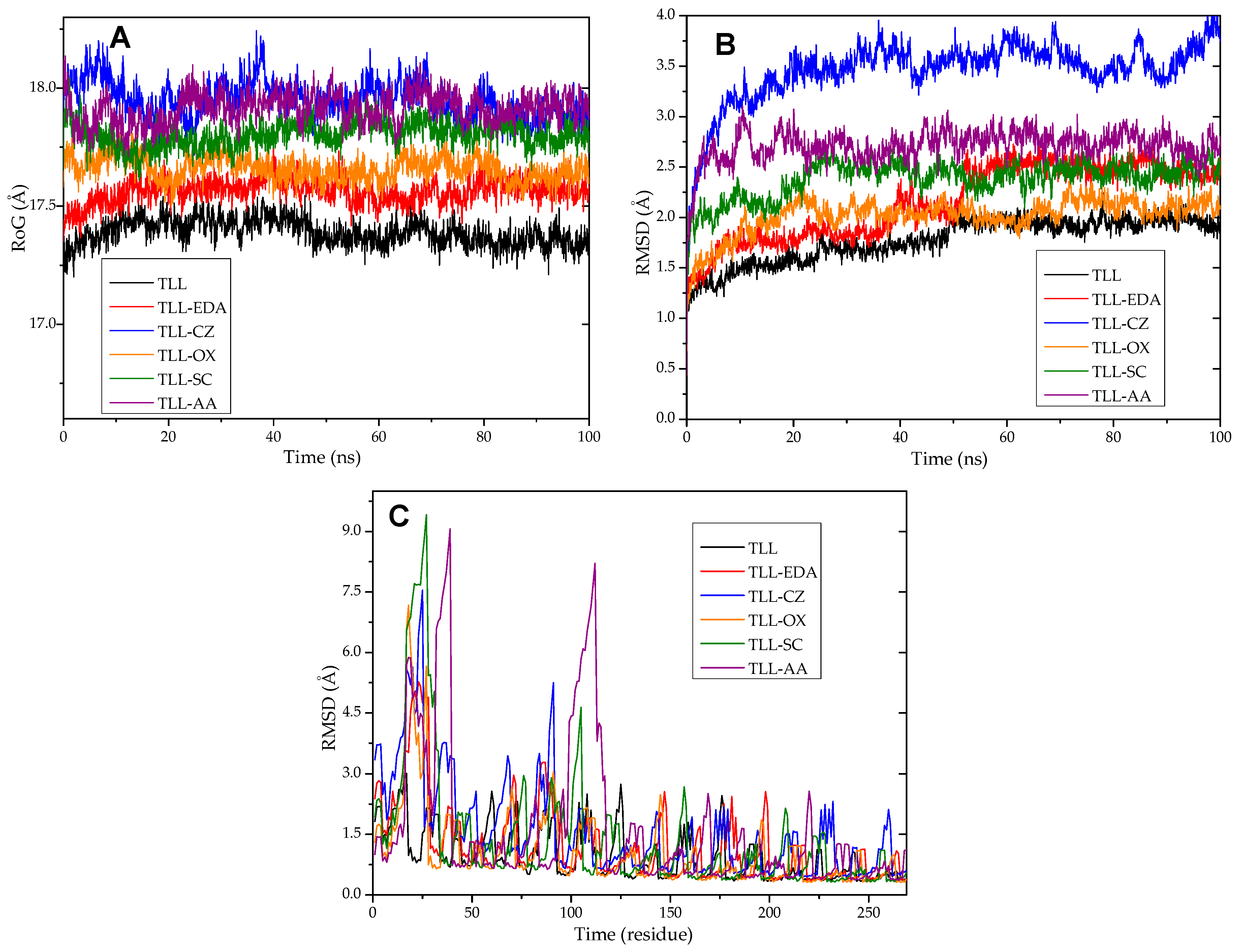
To further understand how chemical modifications affect TLL structure and function, 100 ns molecular dynamics simulations were performed using open-state models. The MD 100 ns simulations showed that all modified enzymes exhibited increased structural flexibility compared to unmodified TLL, as reflected by higher radius of gyration (RoG) and root mean square deviation (RMSD) values (Figure 3A,B).
The increase in RoG values suggests a less compact globular structure (Figure 3A), while RMSD (Figure 3B) provides an extent of the structural deviation from the initial conformation, reflecting the overall stability and flexibility of the enzyme during the simulation. Among the variants, TLL-CZ exhibited the highest RoG (~18.2 Å) and RMSD values (~3.5–4.0 Å), both of which increased steadily throughout the simulation, without reaching a plateau (Figure 3A,B), suggesting significant conformational mobility and incomplete structural stabilization within the 100-ns window. TLL-AA and TLL-SC also displayed increased RoG and intermediate RMSD values, indicating reduced compactness and greater conformational mobility—possibly likely sufficient to affect catalytic properties without compromising stability. In contrast, TLL-OX and TLL-EDA maintained values closer to those of the unmodified enzyme (~17.4–17.8 Å RoG and ~2.0–2.5 Å RMSD), indicating milder effects (Figure S6, Supporting Materials). However, excessive expansion—as observed in TLL-CZ—could also compromise stability if not carefully controlled.
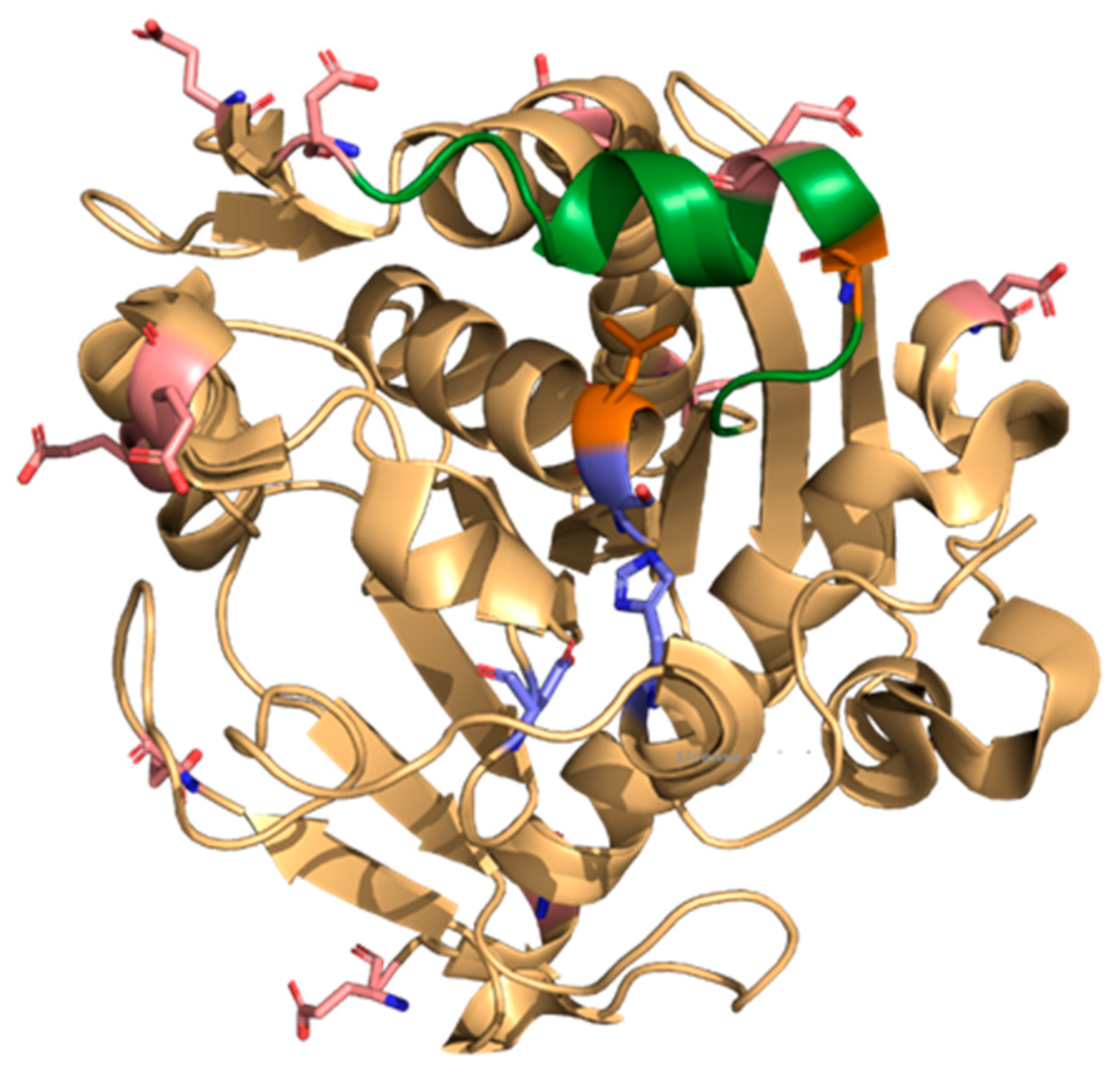
Root means square fluctuation (RMSF) analysis (Figure 3C) revealed localized flexibility increases in key catalytic regions: R81–I100 and V140–D165, including the lid (R91–D96), oxyanion hole (S83, L147), and catalytic serine (S146), mainly in hydrazide-modified variants (Figure 4). Particularly, longer-chain hydrazide modifiers induced lower lid mobility in the open form (Figure 2 and Figure S3), consistent with the RMSF profile (Figure 3C). Hence, the lid region (R91–D96) of TLL displayed progressive increases in conformational fluctuations as the modifier size decreased (AA: ~1.2 Å; SC: ~2.9 Å; OX: ~3.0 Å; CZ: ~4.7 Å). These results indicate that the lid remains relatively rigid in the AA-modified enzyme, whereas in the CZ-modified form it exhibits nearly fourfold greater fluctuations, correlating with the observed enhancement in catalytic efficiency. The longer, more flexible chains likely facilitate polar contacts through specific H-bond interactions (particularly between AA-hydrazide96 (AAH96) and R108, and between AAH96 and AAH99) that limit lid movement (Figure S7), thereby stabilizing the open, catalytically active conformation and facilitating substrate access. These enhanced fluctuations may correlate with improved substrate access and turnover, suggesting a mechanistic link between increased local flexibility and catalytic efficiency. This structural plasticity—induced by chemical modification—supports the adoption of more catalytically competent conformations compared with those adopted by unmodified versions, as previously suggested by Han et al. [39].
Previous work has demonstrated that replacing negatively charged residues (Asp, Glu) with neutral or basic ones (e.g., Phe, Lys) can disrupt salt bridges and increase flexibility, thereby enhancing catalytic performance [39,40,41]. In line with this, converting surface β- or γ-carboxylates into neutral hydrazide groups in our study may increase conformational flexibility and contribute to the observed improved activity of TLL variants CZ, SC and AA (Table 2).
The observed kinetic trends correlate with molecular docking data found (Table 3), where more efficient variants exhibited lower binding energy scores in their enzyme–substrate complexes with p-NPA, supporting improved substrate recognition or accessibility.

2.2.3. Kinetic Studies of MTL and Its Variants

The kinetic parameters for the unmodified MTL and its chemically modified variants reveal significant differences in catalytic behavior during the oxidation of ABTS at 25 °C and pH 5.0 (Table 4; Scheme 3, Supporting Materials Figure S14). As observed with TLL, the chemical modification of MTL also led to improved catalytic performance for most variants (Table 4), similar to what was found with TLL, without a clear correlation to the chain length of the dihydrazides. The unmodified enzyme displayed moderate catalytic parameters (kcat = 6.5 s−1, km = 12.2 μM), while the variants MTL-OX and MTL-AA reached catalytic efficiencies of 2.1 μM−1 s−1—four times better than that of the unmodified enzyme. These improvements were primarily due to increased turnover (e.g., MTL-OX, kcat = 22.7 s−1) and/or enhanced substrate affinity (e.g., MTL-EDA, km = 4.5 μM). In contrast to what is shown for TLL, MTL-CZ exhibited reduced turnover and comparable affinity, resulting in no significant improvement.
Docking results (Table 5) partially supported these trends. While most modified variants exhibited lower ligand-receptor interaction energies (more favorable binding), no direct correlation between docking scores and km values was observed. This discrepancy may arise from the presence of an oxidized histidine (O-His98) in the crystallographic structure used (PDB:6F5K), which can alter the binding cavity conformation and substrate accessibility (Supporting Materials Figures S15–S20), as previously reported [42,43].
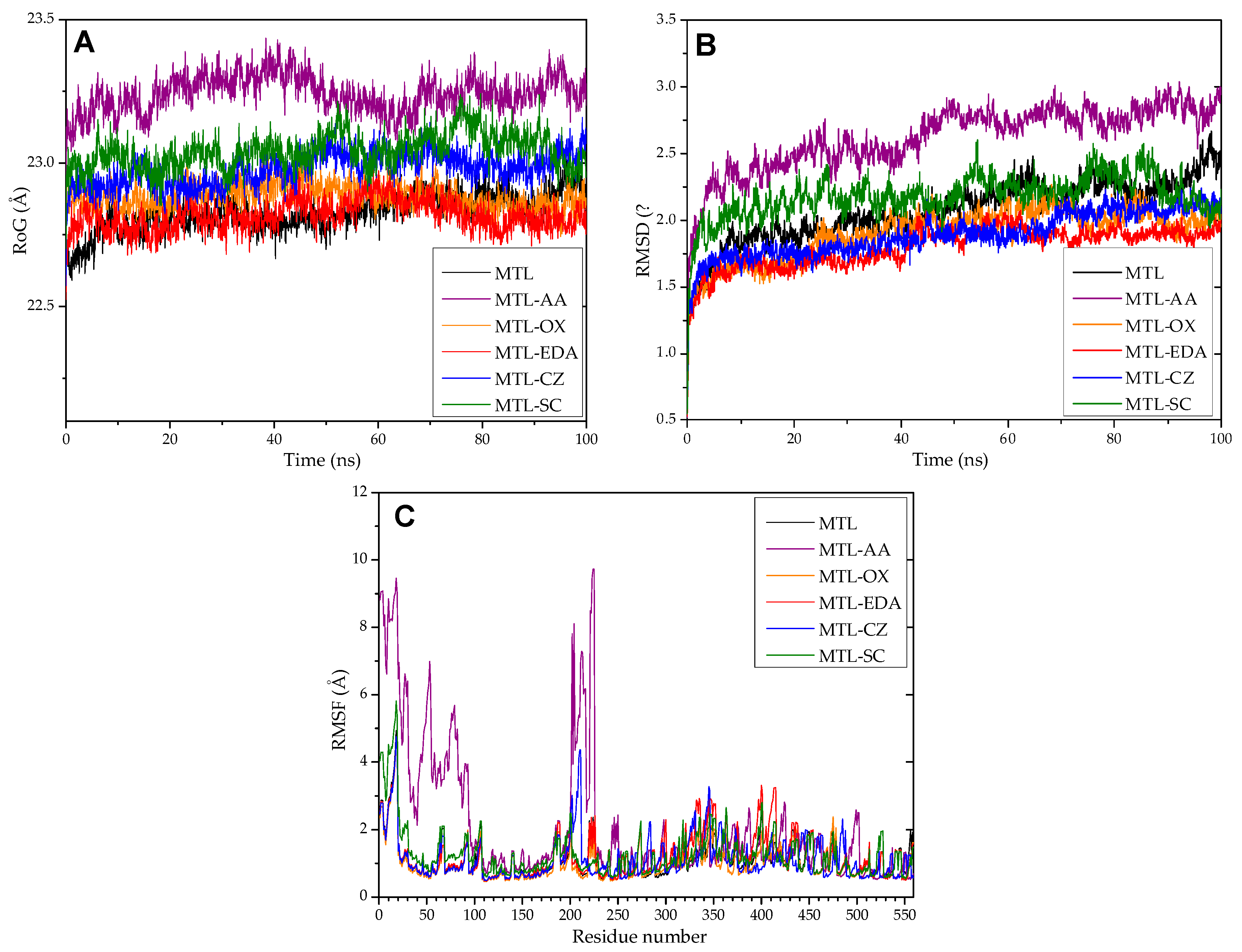
The MD simulations for MTL (Figure 5) revealed structural behaviors analogous to TLL (Section 2.2.2). All MTL-modified variants exhibited initial equilibration followed by stabilization in their RMSD profiles, suggesting that a dynamic conformational equilibrium was reached. The unmodified MTL (black line) maintained the lowest and most stable RoG (~22.7 Å), indicating a compact and consistent structure, similar to MTL-EDA (red line) and MTL-OX (orange line), which showed only slight increases (~22.7–22.9 Å), suggesting minor conformational changes. In contrast, MTL-AA (purple line) exhibited the highest RoG values (~23.1–23.4 Å), indicating structural expansion likely due to increased surface flexibility or disrupted internal packing. MTL-SC (green) and MTL-CZ (blue) also displayed elevated RoG values (~23.0–23.2 Å), representing moderate relaxation. Interestingly, as also observed for TLL, the effect tended to increase with longer chain modifiers, with EDA and OX (comparable in length) showing similar RoG values (Figure S6, Supporting Materials). In contrast, CZ again deviated from this trend, producing disproportionately higher conformational changes not seemingly explained by steric effects alone.
Consistent with this, RMSD (Figure 5B) trajectories showed that all systems initially equilibrated during the first 20–30 ns before stabilizing. MTL-AA showed the highest structural fluctuations, with RMSD values > 2.7 Å, indicating significant conformational changes. In comparison, MTL-CZ, MTL-EDA, and MTL-OX maintained low RMSD values (~2.0–2.1 Å), which reflect improved structural stability, while the unmodified enzyme remained within a moderate range (~2.0–2.5 Å). MTL-SC demonstrated intermediate behavior, characterized by a gradual increase followed by a plateau, indicating greater flexibility without compromising overall integrity. These results suggest that while structural relaxation can enhance catalytic dynamics, excessive expansion—such as in MTL-AA—must be carefully balanced to prevent destabilization, as discussed in Section 2.3.
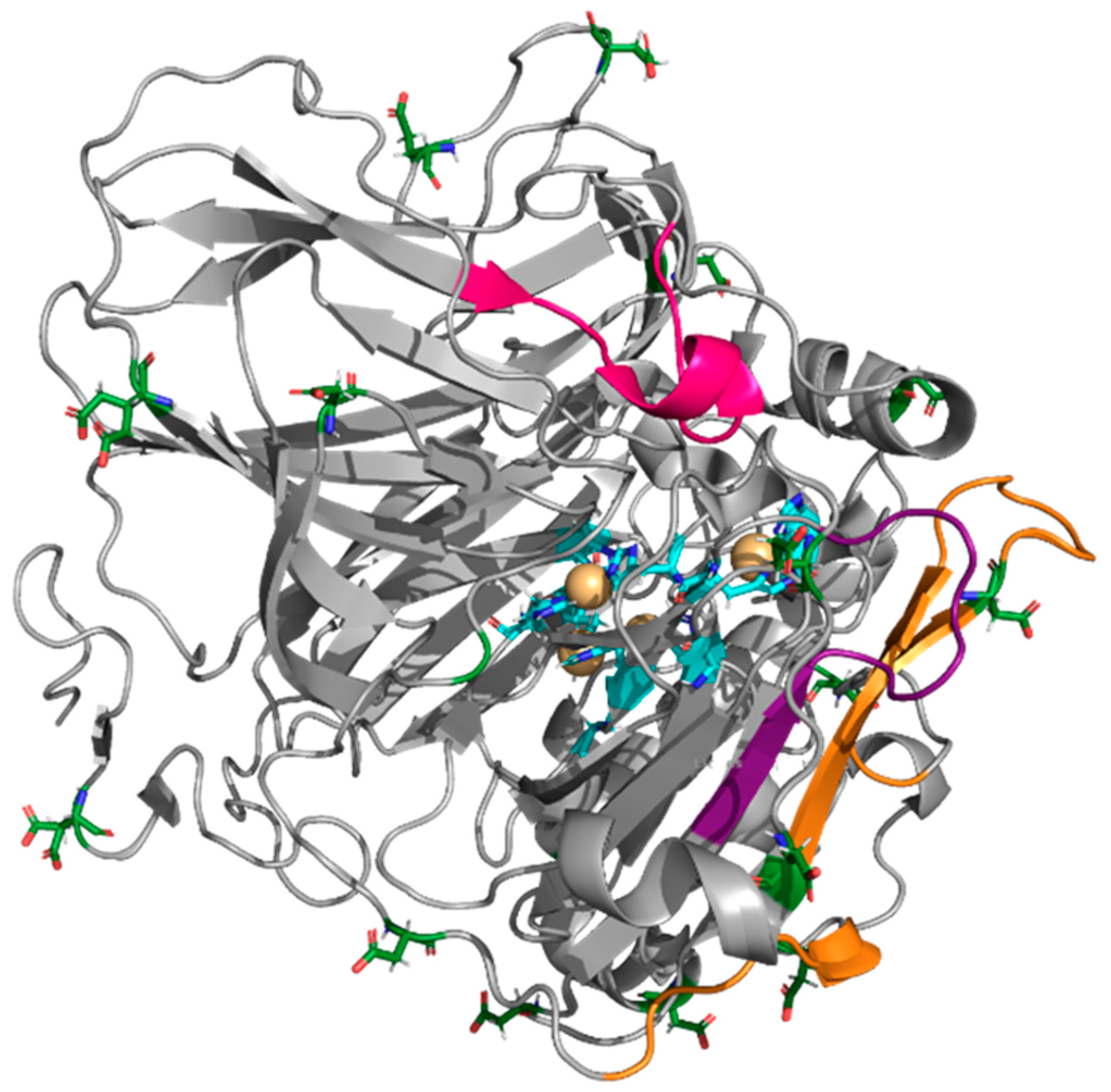
The RMSF analysis (Figure 5C) further showed localized increases in mobility across all variants. The most notable fluctuations occurred in distal loops; however, significant conformational shifts near the T1 copper center were exclusive to MTL-OX (G350–N376) and MTL-AA (V290–S301, G350–P401, and L418–T428) (Figure 6). These flexible regions likely modulate substrate access or redox activity and may explain the enhanced catalytic turnover observed for these variants [6,42].
In this sense, as was shown with TLL, chemical modifications induced overall and localized flexibility changes in MTL, thereby affecting substrate binding and turnover. These findings align with the study by Pinheiro et al. [6], which demonstrated that amination enhances MTL activity by inducing conformational changes, including a reduction in α-helices. However, at higher modification levels, this effect can become detrimental due to excessive structural disruption [6,44,45,46,47,48]. The above could explain why the EDA-modified enzyme in the present study showed a lower kcat compared to the unmodified enzyme, especially considering that the applied methodology yielded a 44.6 ± 1.9% of modification. In contrast, despite a similar degree of modification observed for OX, SC, and AA, these variants exhibited higher catalytic turnover. This suggests that the structural and functional responses depend not only on the extent of modification but also on the physicochemical properties of the modifiers employed.
It should also be noted that EDC-mediated activation can target not only carboxyl groups for hydrazide or amine coupling but may also react with cysteine and tyrosine residues [6]. These additional reactions, in combination with the intended modification, may contribute to the effects observed in the modified enzymes (TLL or MTL) compared to the unmodified ones. Nevertheless, since all enzymes underwent the same activation protocol, the differential responses can be attributed primarily to the nature of the hydrazide used.

2.3. Thermal and Organic Solvent Stability of Modified Enzymes

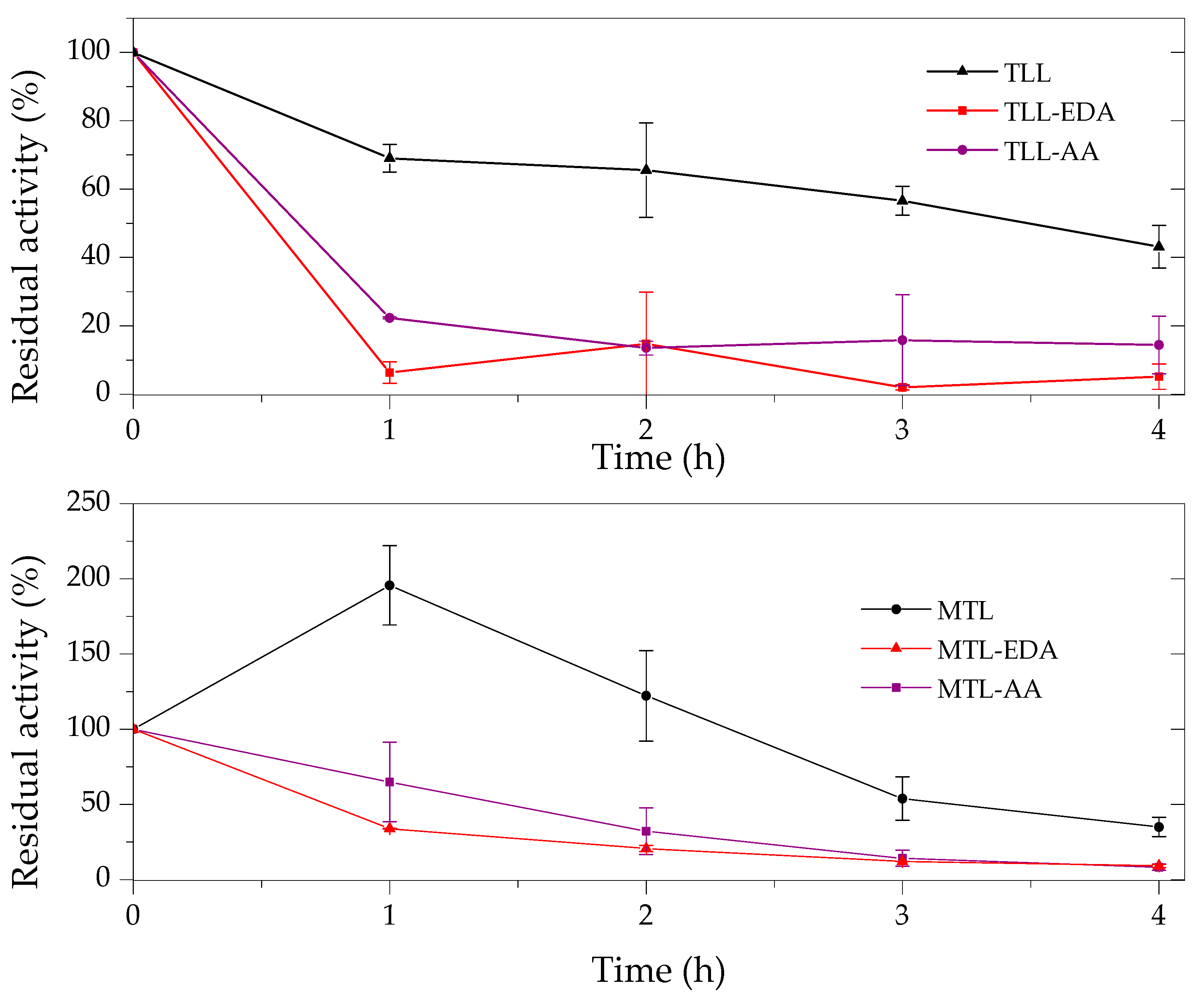
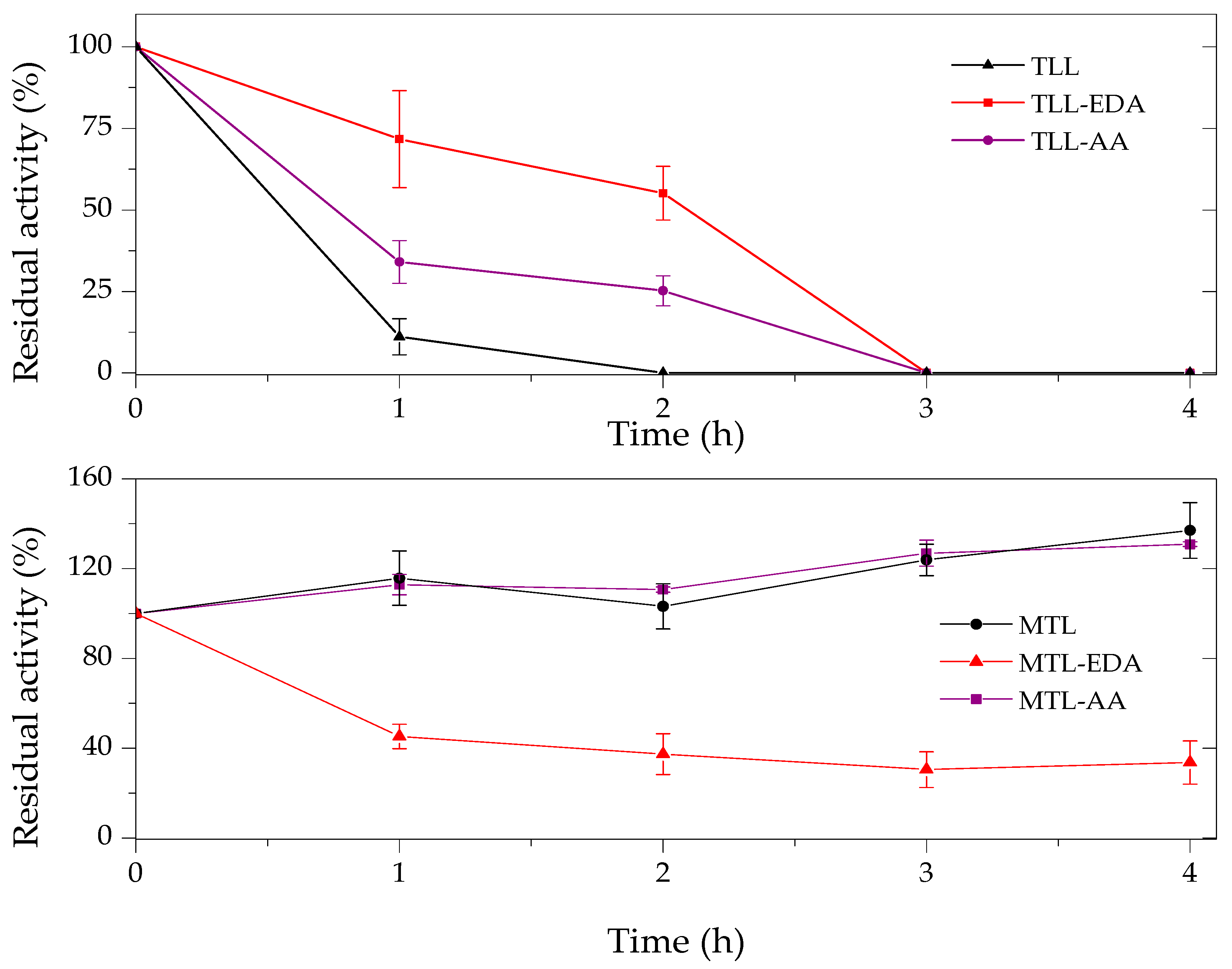
Enzyme functionality under harsh conditions, such as high temperatures or the presence of organic solvents, is crucial for industrial applications. Based on their consistent superior catalytic performance (Section 2.2), AA-modified enzymes (TLL-AA and MTL-AA) were selected for thermal and solvent stability assays at 70 °C and in 50% (v/v) THF (25 °C), which is an emerging low-toxicity solvent relevant to biomass processing [49]. For comparison, unmodified and EDA-modified versions were also evaluated (Figure 7).
At 70 °C, both modified versions of TLL (EDA and AA) exhibited a faster decline in activity compared to the unmodified enzyme. This agrees with MD simulations at 70 °C (Supporting Materials, Figure S21, A.I and B.I), where both modified forms displayed higher RoG values and RMSD profiles with greater fluctuations, indicating increased conformational expansion and reduced compactness. Nevertheless, their trajectories plateaued after ~50 ns (Figure S21, B.I), implying that they eventually adopted energetically stable, albeit less or not active (Figure 7, top), conformations. Complementarily, RMSF profiles further suggested that thermal-induced flexibility was distributed across the protein structure, with each variant showing a distinct conformational structure (Supporting Materials, Figure S21, C.I).
For unmodified MTL at 70 °C, two-step behavior was observed: a transient rise in activity followed by progressive deactivation (Figure 7, bottom). MD simulations support this finding, showing an initial increase in flexibility (RoG and RMSD, Supporting Materials, Figure S21, A.II and B.II) without stabilization over the simulation timeframe. These findings indicate that the initial activity rise may stem from thermally induced flexibility that briefly enhances substrate access; however, prolonged exposure likely causes globularity loss and less active conformations. In contrast, MTL-AA and MTL-EDA reached structural stabilization earlier, mirroring TLL behavior. However, as with TLL, that stabilization did not translate to higher residual activity, highlighting that while chemical modifications can accelerate transitions toward energetically favorable states, these states are not catalytically unfavorable. Altogether, these findings underscore the trade-off between flexibility and stability under thermal stress and reinforce the need to balance both aspects when designing robust biocatalysts [39,40,41,44,45,46,47,48].
In the presence of solvent (50% THF (v/v) at 25 °C), the chemically modified enzymes exhibited distinct behaviors in comparison to their native forms. For TLL (Figure 8, top), the EDA-modified variant retained activity for longer periods than both the unmodified and AA-modified forms. This improved stability aligns with MD simulations (Supporting Materials, Figure S22), where TLL-EDA displayed higher RoG and RMSD values than the native enzyme, indicative of greater conformational mobility. However, unlike the thermal simulations, the native TLL rapidly adopted a stable structure in THF, but this conformation seems catalytically inactive, suggesting that structural stability alone does not guarantee functional persistence. In contrast, the conformational plasticity of TLL-EDA may facilitate the maintenance of active conformers under solvent stress, thus explaining its superior performance.
In the MTL case (Figure 8, bottom), the EDA-modified form showed a marked loss of stability, while both the native enzyme and MTL-AA maintained comparable activity levels throughout the incubation period. This loss in MTL-EDA may be due to high amination levels, previously associated with decreased laccase stability [6,45,47]. By contrast, neutral or negatively charged groups have been reported to maintain or even enhance stability [44,46,48], consistent with the observed stability of MTL-AA. MD simulations in THF for MTL showed structural differences among the variants (Supporting Materials, Figure S22). Notably, the P320–L370 region in MTL-EDA showed increased flexibility, as indicated by RMSF data, which could disrupt the nearby copper catalytic. Meanwhile, in MTL-AA, the F200–R226 segment—remote from the active site—exhibited significant flexibility under both thermal and solvent stress, indicating that this region may function as a structural modulator, aiding in the accessibility or orientation of catalytic domains (Supporting Materials, Figure S22, C.II).

2.4. Preliminary Assessment of Biotechnological Applications Using Enzyme Variants

The use of enzyme-based technologies, as opposed to conventional chemical processes, is often associated with reduced greenhouse gas emissions, lower energy consumption, and, in some cases, reduced operational costs. For example, industrial biodiesel production using lipases has been reported to decrease these parameters by up to 37%, 79%, and 87%, respectively [50]. Moreover, laccases have been linked to progress toward net-zero carbon emission targets, as they enable more efficient biomass valorization and bioremediation than conventional chemical approaches [51]. Accordingly, two model reactions were employed to assess the biotechnological potential of the modified enzyme variants.
In a one-step, solvent-free transesterification assay for biodiesel synthesis [38], neither unmodified nor modified TLL (EDA or AA) produced detectable ethyl esters, confirming their sensitivity to ethanol-induced inactivation [38,52] (Supporting Materials, Table S5). Thus, the chemical modifications applied here did not prevent enzyme deactivation under these conditions, aligning with the results found in solvent stability for TLL.
In contrast, enzymatic dye decolorization assays using 25 ppm indigo carmine revealed modest improvements for modified MTL. After 6 h, MTL-EDA and MTL-AA achieved bleaching yields of 24.1 ± 2.5% and 22.8 ± 2.8%, respectively, compared to 16.0 ± 1.8% for the unmodified enzyme (Figure S23). Docking analyses (Supporting Materials, Figures S24–S26) supported these experimental observations by indicating comparable or slightly improved substrate accommodation for the modified variants.
Achieving industrial viability for enzymes is most likely when chemical modification is combined with complementary stabilization strategies. As demonstrated, our approach—tailoring the size of the modifying agent (e.g., employing dihydrazides instead of ethylenediamine)—does not inherently confer enhanced stability. Rather, it should be regarded as a versatile tool primarily for improving catalytic activity, which can be further potentiated when integrated with stabilization techniques [3,10,15].

3. Materials and Methods

3.1. Materials

Thermomyces lanuginosus lipase, Myceliophthora thermophila laccase, Q-Sepharose®, p-nitrophenyl acetate (p-NPA), 2,2′-azino-bis(3-ethylbenzothiazoline-6-sulfonic acid) (ABTS) Cetyltrimethylammonium bromide (CTAB), sodium dodecyl sulfate, ethylenediaminetetraacetic acid (EDTA), bicinchoninic Acid Kit (BCA), bovine serum albumin (BSA), ethanol (96%), 1-ethyl-3-(3-dimethylaminopropyl)carbodiimide (EDC), ethylenediamine, carbohydrazide, oxalyl dihydrazide, succinyl dihydrazide, adipic acid dihydrazide, Sephadex G-100, Sephadex G-50, and salts for buffering solutions were purchased from Sigma Chem. Co. (St. Louis, MO, USA). PEI-agarose support was prepared according to Guisán [53]. Palm olein was purchased from a local market. Unrefined palm oil and used cooking oil were generously donated by Biocombustibles Sostenibles del Caribe S.A. (Santa Marta, Colombia). All other reagents and solvents were of analytical or HPLC grade. The Lewatit® VP OC 1600 (LW) support, based on polymethacrylate/divinylbenzene copolymer, was kindly donated by Lanxess® (Cologne, Germany).

3.2. Esterase and Oxidative Activity Determination

Esterase activity of TLL toward p-nitrophenyl acetate hydrolysis (p-NPA, 0.4 mM) was determined at pH 7.0 (25 mM sodium phosphate buffer, 25 °C) as previously described [29,38], with the addition of 0.001% CTAB and 0.01% Triton X-100. When testing variable surfactant concentrations, these were adjusted accordingly. The oxidative activity of MTL was measured via ABTS oxidation (180 µM) at pH 5.0 (40 mM sodium acetate buffer, 25 °C), following standard procedures [6,54]. The formation of ABTS•+ was monitored at 420 nm (ε420 = 3.6 × 10⁴ M−1 cm−1). One international unit (IU) corresponds to the amount of enzyme that converts 1 μmol of substrate per minute under the specified conditions.

3.3. Protein Determination

Protein content was measured using either the Bradford reagent or the Pierce® BCA (manufactured by Thermo Fisher Scientific, Waltham, MA, USA), with BSA as the standard protein [55].

3.4. Solid-Phase Enzyme Modification

Solid-phase modifications were performed following established procedures [3,21]. TLL was immobilized on Lewatit® VPOC1600 or Q-Sepharose® and MTL were immobilized on the last one support or PEI-agarose under mild conditions (pH 7.0, 35 °C) until ≥99% of the activity was bound, yielding derivatives with 32 mg/g (TLL) and 14 mg/g (MTL). The immobilized enzymes were subsequently modified with 0.5 M ethylenediamine (EDA) or adipic acid dihydrazide (AA) in the presence of 10 mM EDC at pH 4.75 and 35 °C for 3 h. Reactions were stopped by adjusting the pH to 7.0. Desorption was carried out with buffered solutions containing surfactants (CTAB for TLL, Triton X-100 and NaCl for MTL) as previously described [3,53].

3.5. Liquid-Phase Enzyme Modification

Soluble enzymes (MTL or TLL, 4 mg/mL) were modified in the liquid phase using the modifiers EDA, carbohydrazide (CZ), oxalyl dihydrazide (OX), succinyl dihydrazide (SC), and AA, with 10–70 mM EDC and 0.5 M modifier, following the same procedure described in Section 3.4. The modified enzymes were purified as described in Section 3.6.

3.6. Purification of Modified Enzymes

Excess modifiers were removed by size-exclusion chromatography using Sephadex® G-50 (TLL) or G-100 (MTL), as described previously [56]. Protein recovery was assessed by the Bradford assay (Section 3.3), and active fractions were concentrated using centrifugal ultrafiltration tubes (10 kDa cutoff for TLL, 50 kDa for MTL). Final enzyme solutions were stored at 4 °C. Unmodified enzymes were processed in parallel as controls.

3.7. Determination of Enzyme Surface Modification

The yield of surface modification was determined using the 2,4,6-trinitrobenzene sulfonic acid (TNBS) assay, which quantifies free amines or hydrazides [57,58]. Enzyme samples in sodium borate buffer (pH 8.5) were incubated with 0.008% (w/v) TNBS at 30 °C and 800 rpm for 40 min. The reaction was quenched with a sodium carbonate buffer (pH 10.8), and the absorbance was measured at 420 nm for EDA derivatives and 500 nm for hydrazide-modified enzymes. Standard curves were generated using BSA (lysine equivalents) and octanoic hydrazide. The extent of modification was calculated by comparing modified and unmodified samples and normalized to the number of accessible carboxyl groups (32 for TLL, 42 for MTL). Full details and the calculation formula are available in the Supporting Information (Table S6, Figures S27 and S28 and Equation (S1)).

3.8. SDS-PAGE Analysis

SDS-PAGE was conducted using 5% stacking and 12% resolving polyacrylamide gels. Samples (0.25–0.3 mg/mL) were prepared with 8% SDS and 10% β-mercaptoethanol and denatured by boiling. Protein bands were visualized using Coomassie Brilliant Blue. Molecular weights were estimated using a Bio-Rad LMW-SDS marker (10–250 kDa) [59]. Densitometric analysis was performed using ImageJ software (version 1.54d) as previously described [60]. Full analysis details are provided in the Supporting Information.

3.9. Michaelis–Menten Kinetics

Kinetic parameters were determined using 1 ng/mL enzyme and substrate concentrations: 0–4 mM p-NPA (TLL) [61,62] or 0–180 μM ABTS (MTL) [63,64], as described in Section 3.2. The resulting Michaelis–Menten curves were fitted using OriginPro 9.0 and the Levenberg–Marquardt algorithm [65]. The kcat values (derived from Vmax) were calculated assuming that all measured protein content corresponded to the target active enzyme after performing the procedure described in Section 3.6.

3.10. Solvent and Thermal Stability Assays

Residual enzyme activity was expressed as the percentage of the initial activity (t0) remaining over time under deactivating conditions [66,67]. The inactivation course of the enzymes at 70 °C in 50 mM sodium phosphate (pH 7.0) or 50:50 (v/v) THF:H2O (pH 7.0 and 25 °C) was conducted as previously described [66,67].

3.11. Preliminary Assessment of the Obtained Enzymes in Biotechnological Applications

3.11.1. One-Step Solvent-Free Fatty Acid Ethyl Ester Synthesis (FAEs)

A one-step transesterification reaction was performed by adding lipase (1.3 mg) to palm olein (0.7 g) and absolute ethanol (~120 mg), using a 3.1:1 ethanol: oil molar ratio, without solvents or additives. The yield was analyzed using FT-IR with a PCA method, following previously reported methods [29,38].

3.11.2. Indigo Carmine Decolorization

For dye decolorization, laccase (1.2 mg) was added to 1 mL of a 25 ppm indigo carmine solution in a 2 mL vial. The mixture was incubated at 25 °C and 170 rpm for the desired time. Decolorization rate was assessed by measuring the absorbance decrease at 611 nm, and expressed as a decolorization percentage relative to the control with the enzyme inhibited with sodium azide [68].

3.12. Molecular Dynamics and Molecular Docking Studies of Modified Enzymes

Crystal structures of T. lanuginosus lipase (TLL, PDB:1DTE) and M. thermophila laccase (MTL, PDB:6F5K) were retrieved from the Protein Data Bank [42,69]. Residues were selected for in silico modification based on experimental modification percentages, applying dihydrazide moieties proportionally to the exposed residues, and distributed homogeneously across the enzyme surface using PyMOL v.4.6.0 and AVOGADRO2 v1.97.0. Structures were exported in .pdb format and refined through 2-ns molecular dynamics (MD) simulations in YASARA Structure v.19.12.14, using the AMBER14 force field and the Berendsen thermostat and manometer barostat [70,71]. Molecular dynamics (MD) simulations were carried out on a 48-core server using periodic boundary conditions. The protein–ligand complex was positioned at the center of a cubic box (20 Å beyond the protein surface), solvated with the simple point charge (SPC) water model, and neutralized by randomly replacing water molecules with Na+ and Cl ions to achieve a 0.9% NaCl concentration. System relaxation was performed in multiple stages: initially, the protein was fixed, and solvent molecules were optimized by steepest descent and local steepest descent algorithms to remove steric clashes. The protein backbone was then restrained, and the solvent was further relaxed with the same procedure. After releasing restraints, a short 10-ps dynamics run was performed to equilibrate the system. Long-range van der Waals interactions were treated using a spherical cut-off of 0.8 nm. Production simulations were then performed under NPT conditions (1 bar, 298 K), pH 7.4, and a density of 0.997 g/mL, with a time step of 2.5 fs and snapshots recorded every 100 ps. The best-refined structure (quality score ≥ 0.3) was selected and simulated for 100 ps [72]. To assess environmental effects, additional simulations were conducted at elevated temperature (343 K) and in a mixed-solvent system containing 50% THF. Trajectory visualization and analyses were performed using YASARA and PyMOL.

4. Conclusions

Eight novel biocatalysts were generated by chemically modifying two distinct enzymes, TLL and MTL, with dihydrazides (CZ, OX, SC, AA), using a liquid-phase methodology adapted for this study. The modified enzymes were compared with their EDA-modified counterparts. Notably, the hydrazide-based protocol yielded modification percentages comparable to amination under the same aqueous-phase methodology, while offering easier pH adjustment and easier purification, regardless of the length of the dihydrazide used. Additionally, no perceptible vapors were generated during handling, unlike EDA-modifications, an important safety and environmental advantage despite the higher reagent cost. This aqueous-phase approach proved to be widely applicable to two different types of enzymes and enabled the generation of variants with significantly improved catalytic efficiency (up to 2.5 times for TLL-CZ and 4.2 times for MTL-OX and MTL-AA), improving the surfactant activation effect, outperforming their unmodified and EDA-modified counterparts. AA-modification was consistently the best-performing across both enzymes in catalytic terms, whereas CZ and OX conferred benefits specific to TLL of MTL, respectively.
Molecular dynamics simulations revealed that the catalytic improvements observed after chemical modification were associated with moderate increases in RoG and region-specific RMSF increments near the catalytic sites, reflecting greater local flexibility, likely arising from the disruption of stabilizing interactions. Furthermore, docking analyses yielded complementary insights by predicting variations in substrate-binding modes that were consistent with the experimentally determined catalytic efficiencies. These simulations provided mechanistic support and structural insights, linking dihydrazide-induced flexibility to improved catalysis and highlighting their potential for rational enzyme functionalization.
Despite these advances, the modified enzymes showed no improvement in preliminary applications such as biodiesel synthesis or dye degradation, indicating that catalytic enhancement with model substrates under standard conditions does not necessarily translate to improved performance under real operational conditions. Therefore, to unlock its full biotechnological potential, future strategies should explore the integration of chemical modification with enzyme immobilization or other stabilization approaches that preserve activity while improving operational performance.

Supplementary Materials

The supporting information can be downloaded at: https://www.mdpi.com/article/10.3390/ijms262211094/s1.

Author Contributions

Conceptualization, C.A.G. and J.S.P.-T.; formal analysis, J.S.P.-T. and C.A.G.; funding acquisition, C.A.G. and J.S.P.-T.; investigation, J.S.P.-T., M.C.M.-V., O.L.A. and E.L.G.-T.; methodology, J.S.P.-T., M.C.M.-V., E.C.-B., C.H.-A. and C.A.G.; supervision, C.A.G.; writing—original draft, J.S.P.-T.; writing—review and editing, J.S.P.-T., O.L.A., E.C.-B., C.H.-A. and C.A.G. All authors have read and agreed to the published version of the manuscript.

Funding

This research was funded by Universidad del Valle (Colombia), Grant Number CI 71400. The APC was funded by Universidad del Valle (Colombia).

Institutional Review Board Statement

Not applicable.

Informed Consent Statement

Not applicable.

Data Availability Statement

The original contributions presented in this study are included in the article/Supplementary Materials. Further inquiries can be directed to the corresponding author(s).

Conflicts of Interest

The authors declare no conflicts of interest.

Abbreviations

The following abbreviations are used in this manuscript:
AAAdipic acid dihydrazide
ABTS2,2′-Azino-bis(3-ethylbenzothiazoline-6-sulfonic acid)
CZCarbohydrazide
EDAEthylenediamine
MDMolecular dynamics
MTLMyceliophthora thermophila laccase
OXOxalyl dihydrazide
PDBProtein Data Bank
RoGRadius of gyration
RMSDRoot mean square deviation
RMSFRoot mean square fluctuation
SCSuccinyl dihydrazide
T1Type 1 copper center
THFTetrahydrofuran
TLLThermomyces lanuginosus lipase

References

  1. Sheldon, R.A. Green Chemistry and Biocatalysis: Engineering a Sustainable Future. Catal. Today 2024, 431, 114571. [Google Scholar] [CrossRef]
  2. Godoy, C.A.; Pardo-Tamayo, J.S.; Barbosa, O. Microbial Lipases and Their Potential in the Production of Pharmaceutical Building Blocks. Int. J. Mol. Sci. 2022, 23, 9933. [Google Scholar] [CrossRef] [PubMed]
  3. Godoy, C.A. New Strategy for the Immobilization of Lipases on Glyoxyl–Agarose Supports: Production of Robust Biocatalysts for Natural Oil Transformation. Int. J. Mol. Sci. 2017, 18, 2130. [Google Scholar] [CrossRef]
  4. Mayolo-Deloisa, K.; González-González, M.; Rito-Palomares, M. Laccases in Food Industry: Bioprocessing, Potential Industrial and Biotechnological Applications. Front. Bioeng. Biotechnol. 2020, 8, 222. [Google Scholar] [CrossRef] [PubMed]
  5. Aghaee, M.; Salehipour, M.; Rezaei, S.; Mogharabi-Manzari, M. Bioremediation of Organic Pollutants by Laccase-Metal–Organic Framework Composites: A Review of Current Knowledge and Future Perspective. Bioresour. Technol. 2024, 406, 131072. [Google Scholar] [CrossRef]
  6. Pinheiro, B.B.; Rios, N.S.; Zanatta, G.; Pessela, B.C.; Gonçalves, L.R.B. Aminated Laccases Can Improve and Expand the Immobilization Protocol on Agarose-Based Supports by Ion Exchange. Process Biochem. 2023, 133, 292–302. [Google Scholar] [CrossRef]
  7. Sellés Vidal, L.; Isalan, M.; Heap, J.T.; Ledesma-Amaro, R. A Primer to Directed Evolution: Current Methodologies and Future Directions. RSC Chem. Biol. 2023, 4, 271–291. [Google Scholar] [CrossRef]
  8. Pagar, A.D.; Patil, M.D.; Flood, D.T.; Yoo, T.H.; Dawson, P.E.; Yun, H. Recent Advances in Biocatalysis with Chemical Modification and Expanded Amino Acid Alphabet. Chem. Rev. 2021, 121, 6173–6245. [Google Scholar] [CrossRef]
  9. Giri, P.; Pagar, A.D.; Patil, M.D.; Yun, H. Chemical Modification of Enzymes to Improve Biocatalytic Performance. Biotechnol. Adv. 2021, 53, 107868. [Google Scholar] [CrossRef]
  10. Roda, S.; Fernandez-Lopez, L.; Benedens, M.; Bollinger, A.; Thies, S.; Schumacher, J.; Coscolín, C.; Kazemi, M.; Santiago, G.; Gertzen, C.G.W.; et al. A Plurizyme with Transaminase and Hydrolase Activity Catalyzes Cascade Reactions. Angew. Chem. Int. Ed. 2022, 61, e202207344. [Google Scholar] [CrossRef]
  11. Alonso, S.; Santiago, G.; Cea-Rama, I.; Fernandez-Lopez, L.; Coscolín, C.; Modregger, J.; Ressmann, A.K.; Martínez-Martínez, M.; Marrero, H.; Bargiela, R.; et al. Genetically Engineered Proteins with Two Active Sites for Enhanced Biocatalysis and Synergistic Chemo- and Biocatalysis. Nat. Catal. 2020, 3, 319–328. [Google Scholar] [CrossRef]
  12. Abellanas-Perez, P.; Carballares, D.; Fernandez-Lafuente, R.; Rocha-Martin, J. Glutaraldehyde Modification of Lipases Immobilized on Octyl Agarose Beads: Roles of the Support Enzyme Loading and Chemical Amination of the Enzyme on the Final Enzyme Features. Int. J. Biol. Macromol. 2023, 248, 125853. [Google Scholar] [CrossRef] [PubMed]
  13. Blanco-Llamero, C.; García-García, P.; Señoráns, F.J. Cross-Linked Enzyme Aggregates and Their Application in Enzymatic Pretreatment of Microalgae: Comparison Between CLEAs and Combi-CLEAs. Front. Bioeng. Biotechnol. 2021, 9, 794672. [Google Scholar] [CrossRef]
  14. Arana-Peña, S.; Carballares, D.; Morellon-Sterling, R.; Rocha-Martin, J.; Fernandez-Lafuente, R. The Combination of Covalent and Ionic Exchange Immobilizations Enables the Coimmobilization on Vinyl Sulfone Activated Supports and the Reuse of the Most Stable Immobilized Enzyme. Int. J. Biol. Macromol. 2022, 199, 51–60. [Google Scholar] [CrossRef]
  15. Orrego, A.H.; Romero-Fernández, M.; Millán-Linares, M.D.C.; Yust, M.D.M.; Guisán, J.M.; Rocha-Martin, J. Stabilization of Enzymes by Multipoint Covalent Attachment on Aldehyde-Supports: 2-Picoline Borane as an Alternative Reducing Agent. Catalysts 2018, 8, 333. [Google Scholar] [CrossRef]
  16. Hermanson, G.T. Chapter 22—Enzyme Modification and Conjugation. In Bioconjugate Techniques, 3rd ed.; Hermanson, G.T., Ed.; Academic Press: Boston, MA, USA, 2013; pp. 951–957. ISBN 978-0-12-382239-0. [Google Scholar]
  17. Piapan, L.; Belloni Fortina, A.; Giulioni, E.; Larese Filon, F. Sensitization to Ethylenediamine Dihydrochloride in Patients with Contact Dermatitis in Northeastern Italy from 1996 to 2021. Contact Dermat. 2024, 90, 253–261. [Google Scholar] [CrossRef]
  18. Farnung, J.; Tolmachova, K.A.; Bode, J.W. Installation of Electrophiles onto the C-Terminus of Recombinant Ubiquitin and Ubiquitin-like Proteins. Chem. Sci. 2023, 14, 121–129. [Google Scholar] [CrossRef]
  19. Kölmel, D.K.; Kool, E.T. Oximes and Hydrazones in Bioconjugation: Mechanism and Catalysis. Chem. Rev. 2017, 117, 10358–10376. [Google Scholar] [CrossRef]
  20. Huang, Z.; Ni, D.; Chen, Z.; Zhu, Y.; Zhang, W.; Mu, W. Application of Molecular Dynamics Simulation in the Field of Food Enzymes: Improving the Thermal-Stability and Catalytic Ability. Crit. Rev. Food Sci. Nutr. 2024, 64, 11396–11408. [Google Scholar] [CrossRef]
  21. Rueda, N.; dos Santos, J.C.S.; Ortiz, C.; Barbosa, O.; Fernandez-Lafuente, R.; Torres, R. Chemical Amination of Lipases Improves Their Immobilization on Octyl-Glyoxyl Agarose Beads. Catal. Today 2016, 259 Pt 1, 107–118. [Google Scholar] [CrossRef]
  22. Rodrigues, R.C.; Virgen-Ortíz, J.J.; dos Santos, J.C.S.; Berenguer-Murcia, Á.; Alcantara, A.R.; Barbosa, O.; Ortiz, C.; Fernandez-Lafuente, R. Immobilization of Lipases on Hydrophobic Supports: Immobilization Mechanism, Advantages, Problems, and Solutions. Biotechnol. Adv. 2019, 37, 746–770. [Google Scholar] [CrossRef]
  23. Abreu Silveira, E.; Moreno-Perez, S.; Basso, A.; Serban, S.; Pestana-Mamede, R.; Tardioli, P.W.; Sanchez-Farinas, C.; Castejon, N.; Fernandez-Lorente, G.; Rocha-Martin, J.; et al. Biocatalyst Engineering of Thermomyces lanuginosus Lipase Adsorbed on Hydrophobic Supports: Modulation of Enzyme Properties for Ethanolysis of Oil in Solvent-Free Systems. J. Biotechnol. 2019, 289, 126–134. [Google Scholar] [CrossRef]
  24. Virgen-Ortíz, J.J.; Pedrero, S.G.; Fernandez-Lopez, L.; Lopez-Carrobles, N.; Gorines, B.C.; Otero, C.; Fernandez-Lafuente, R. Desorption of Lipases Immobilized on Octyl-Agarose Beads and Coated with Ionic Polymers after Thermal Inactivation. Stronger Adsorption of Polymers/Unfolded Protein Composites. Molecules 2017, 22, 91. [Google Scholar] [CrossRef]
  25. Arana-Peña, S.; Rios, N.S.; Mendez-Sanchez, C.; Lokha, Y.; Gonçalves, L.R.B.; Fernández-Lafuente, R. Use of Polyethylenimine to Produce Immobilized Lipase Multilayers Biocatalysts with Very High Volumetric Activity Using Octyl-Agarose Beads: Avoiding Enzyme Release during Multilayer Production. Enzym. Microb. Technol. 2020, 137, 109535. [Google Scholar] [CrossRef]
  26. Zhang, M.; Nilsson, L.; Lee, S.; Choi, J. Modification of EDC Method for Increased Labeling Efficiency and Characterization of Low-Content Protein in Gum Acacia Using Asymmetrical Flow Field-Flow Fractionation Coupled with Multiple Detectors. Anal. Bioanal. Chem. 2021, 413, 6313–6320. [Google Scholar] [CrossRef]
  27. Christ, H.-A.; Bourgat, Y.; Menzel, H. Optimization of Critical Parameters for Carbodiimide Mediated Production of Highly Modified Chitosan. Polymers 2021, 13, 2702. [Google Scholar] [CrossRef] [PubMed]
  28. EFSA Panel on Food Contact Materials, Enzymes, Flavourings and Processing Aids (CEF). Scientific Opinion on the Safety Assessment of the Substance Adipic Acid Dihydrazide, CAS No 1071-93-8, for Use in Food Contact Materials. EFSA J. 2015, 13, 3961. [Google Scholar] [CrossRef][Green Version]
  29. Pardo-Tamayo, J.S.; Arteaga-Collazos, S.; Domínguez-Hoyos, L.C.; Godoy, C.A. Biocatalysts Based on Immobilized Lipases for the Production of Fatty Acid Ethyl Esters: Enhancement of Activity through Ionic Additives and Ion Exchange Supports. BioTech 2023, 12, 67. [Google Scholar] [CrossRef]
  30. Mateos-Diaz, E.; Amara, S.; Roussel, A.; Longhi, S.; Cambillau, C.; Carrière, F. Probing Conformational Changes and Interfacial Recognition Site of Lipases with Surfactants and Inhibitors. Methods Enzymol. 2017, 583, 279–307. [Google Scholar] [CrossRef]
  31. Fernandez-Lafuente, R. Lipase from Thermomyces lanuginosus: Uses and Prospects as an Industrial Biocatalyst. J. Mol. Catal. B Enzym. 2010, 62, 197–212. [Google Scholar] [CrossRef]
  32. Rodrigues, R.C.; Barbosa, O.; Ortiz, C.; Berenguer-Murcia, Á.; Torres, R.; Fernandez-Lafuente, R. Amination of Enzymes to Improve Biocatalyst Performance: Coupling Genetic Modification and Physicochemical Tools. RSC Adv. 2014, 4, 38350–38374. [Google Scholar] [CrossRef]
  33. Zhang, J.; Wang, Z.; Zhuang, W.; Rabiee, H.; Zhu, C.; Deng, J.; Ge, L.; Ying, H. Amphiphilic Nanointerface: Inducing the Interfacial Activation for Lipase. ACS Appl. Mater. Interfaces 2022, 14, 39622–39636. [Google Scholar] [CrossRef]
  34. Safdar, A.; Ismail, F.; Imran, M. Characterization of Detergent-Compatible Lipases from Candida Albicans and Acremonium Sclerotigenum under Solid-State Fermentation. ACS Omega 2023, 8, 32740–32751. [Google Scholar] [CrossRef] [PubMed]
  35. Quilles, J.C.J.; Brito, R.R.; Borges, J.P.; Aragon, C.C.; Fernandez-Lorente, G.; Bocchini-Martins, D.A.; Gomes, E.; da Silva, R.; Boscolo, M.; Guisan, J.M. Modulation of the Activity and Selectivity of the Immobilized Lipases by Surfactants and Solvents. Biochem. Eng. J. 2015, 93, 274–280. [Google Scholar] [CrossRef]
  36. Moreno-Perez, S.; Ghattas, N.; Filice, M.; Guisan, J.M.; Fernandez-Lorente, G. Dramatic Hyperactivation of Lipase of Thermomyces lanuginosa by a Cationic Surfactant: Fixation of the Hyperactivated Form by Adsorption on Sulfopropyl-Sepharose. J. Mol. Catal. B Enzym. 2015, 122, 199–203. [Google Scholar] [CrossRef]
  37. Hayne, C.K.; Yumerefendi, H.; Cao, L.; Gauer, J.W.; Lafferty, M.J.; Kuhlman, B.; Erie, D.A.; Neher, S.B. We FRET So You Don’t Have To: New Models of the Lipoprotein Lipase Dimer. Biochemistry 2018, 57, 241–254. [Google Scholar] [CrossRef]
  38. Toro, E.C.; Rodríguez, D.F.; Morales, N.; García, L.M.; Godoy, C.A. Novel Combi-Lipase Systems for Fatty Acid Ethyl Esters Production. Catalysts 2019, 9, 546. [Google Scholar] [CrossRef]
  39. Han, N.; Tang, M.; Wan, S.; Jiang, Z.; Yue, Y.; Zhao, X.; Yang, J.; Huang, Z. Surface Charge Engineering of Thermomyces lanuginosus Lipase Improves Enzymatic Activity and Biodiesel Synthesis. Biotechnol. Lett. 2021, 43, 1403–1411. [Google Scholar] [CrossRef]
  40. Xiang, X.; Zhu, E.; Xiong, D.; Wen, Y.; Xing, Y.; Yue, L.; He, S.; Han, N.; Huang, Z. Improving the Thermostability of Thermomyces lanuginosus Lipase by Restricting the Flexibility of N-Terminus and C-Terminus Simultaneously via the 25-Loop Substitutions. Int. J. Mol. Sci. 2023, 24, 16562. [Google Scholar] [CrossRef]
  41. Zhu, E.; Xiang, X.; Wan, S.; Miao, H.; Han, N.; Huang, Z. Discovery of the Key Mutation Site Influencing the Thermostability of Thermomyces lanuginosus Lipase by Rosetta Design Programs. Int. J. Mol. Sci. 2022, 23, 8963. [Google Scholar] [CrossRef]
  42. Ernst, H.A.; Jørgensen, L.J.; Bukh, C.; Piontek, K.; Plattner, D.A.; Østergaard, L.H.; Larsen, S.; Bjerrum, M.J. A Comparative Structural Analysis of the Surface Properties of Asco-Laccases. PLoS ONE 2018, 13, e0206589. [Google Scholar] [CrossRef]
  43. Hakulinen, N.; Andberg, M.; Kallio, J.; Koivula, A.; Kruus, K.; Rouvinen, J. A near Atomic Resolution Structure of a Melanocarpus albomyces Laccase. J. Struct. Biol. 2008, 162, 29–39. [Google Scholar] [CrossRef] [PubMed]
  44. Forde, J.; Tully, E.; Vakurov, A.; Gibson, T.D.; Millner, P.; Ó’Fágáin, C. Chemical Modification and Immobilisation of Laccase from Trametes hirsuta and from Myceliophthora thermophila. Enzym. Microb. Technol. 2010, 46, 430–437, Corrigendum in Enzym. Microb. Technol. 2010, 47, 241. [Google Scholar] [CrossRef]
  45. Othman, A.M.; Sanromán, Á.; Moldes, D. Laccase Multi-Point Covalent Immobilization: Characterization, Kinetics, and Its Hydrophobicity Applications. Appl. Microbiol. Biotechnol. 2023, 107, 719–733. [Google Scholar] [CrossRef]
  46. Danait-Nabar, S.; Singhal, R.S. Chemical Modification of Laccase Using Phthalic and 2-Octenyl Succinic Anhydrides: Enzyme Characterization, Stability, and Its Potential for Clarification of Cashew Apple Juice. Process Biochem. 2022, 122, 181–195. [Google Scholar] [CrossRef]
  47. Stevens, J.C.; Shi, J. Modifying Surface Charges of a Thermophilic Laccase Toward Improving Activity and Stability in Ionic Liquid. Front. Bioeng. Biotechnol. 2022, 10, 880795. [Google Scholar] [CrossRef]
  48. Nwagu, T.N.; Okolo, B.; Aoyagi, H.; Yoshida, S. Chemical Modification with Phthalic Anhydride and Chitosan: Viable Options for the Stabilization of Raw Starch Digesting Amylase from Aspergillus carbonarius. Int. J. Biol. Macromol. 2017, 99, 641–647. [Google Scholar] [CrossRef]
  49. Li, J.; Zhang, W.; Xu, S.; Hu, C. The Roles of H2O/Tetrahydrofuran System in Lignocellulose Valorization. Front. Chem. 2020, 8, 70. [Google Scholar] [CrossRef] [PubMed]
  50. Kamal Pasha, M.; Rahim, M.; Dai, L.; Liu, D.; Du, W.; Guo, M. Comparative Study of a Two-Step Enzymatic Process and Conventional Chemical Methods for Biodiesel Production: Economic and Environmental Perspectives. Chem. Eng. J. 2024, 489, 151254. [Google Scholar] [CrossRef]
  51. Batool, S.; Haider, W.; Abbas, M.; Liaqat, I.; Mumtaz, A.; Saba, I.; Farooq, M.; Safi, S.Z.; Syed-Hassan, S.S.A.; Arshad, M. Role of Laccases to Achieve Net Zero Carbon Emissions. In Enzymes in Textile Processing: A Climate Changes Mitigation Approach: Textile Industry, Enzymes, and SDGs; Arshad, M., Ed.; Springer Nature: Singapore, 2025; pp. 191–222. ISBN 978-981-97-8058-7. [Google Scholar]
  52. Remonatto, D.; de Oliveira, J.V.; Guisan, J.M.; de Oliveira, D.; Ninow, J.; Fernandez-Lorente, G. Production of FAME and FAEE via Alcoholysis of Sunflower Oil by Eversa Lipases Immobilized on Hydrophobic Supports. Appl. Biochem. Biotechnol. 2018, 185, 705–716. [Google Scholar] [CrossRef] [PubMed]
  53. Rodrigues, R.C.; Godoy, C.A.; Volpato, G.; Ayub, M.A.Z.; Fernandez-Lafuente, R.; Guisan, J.M. Immobilization–Stabilization of the Lipase from Thermomyces lanuginosus: Critical Role of Chemical Amination. Process Biochem. 2009, 44, 963–968. [Google Scholar] [CrossRef]
  54. Wang, Z.; Ren, D.; Jiang, S.; Yu, H.; Cheng, Y.; Zhang, S.; Zhang, X.; Chen, W. The Study of Laccase Immobilization Optimization and Stability Improvement on CTAB-KOH Modified Biochar. BMC Biotechnol. 2021, 21, 47. [Google Scholar] [CrossRef] [PubMed]
  55. Ernst, O.; Zor, T. Linearization of the Bradford Protein Assay. J. Vis. Exp. JoVE 2010, 1918. [Google Scholar] [CrossRef]
  56. Burgess, R.R. A Brief Practical Review of Size Exclusion Chromatography: Rules of Thumb, Limitations, and Troubleshooting. Protein Expr. Purif. 2018, 150, 81–85. [Google Scholar] [CrossRef]
  57. Fields, R. [38] The Rapid Determination of Amino Groups with TNBS. In Methods in Enzymology; Enzyme Structure, Part B; Academic Press: Cambridge, MA, USA, 1972; Volume 25, pp. 464–468. [Google Scholar]
  58. Spellman, D.; McEvoy, E.; O’Cuinn, G.; FitzGerald, R.J. Proteinase and Exopeptidase Hydrolysis of Whey Protein: Comparison of the TNBS, OPA and pH Stat Methods for Quantification of Degree of Hydrolysis. Int. Dairy J. 2003, 13, 447–453. [Google Scholar] [CrossRef]
  59. Laemmli, U.K. Cleavage of Structural Proteins during the Assembly of the Head of Bacteriophage T4. Nature 1970, 227, 680–685. [Google Scholar] [CrossRef]
  60. Schroeder, A.B.; Dobson, E.T.A.; Rueden, C.T.; Tomancak, P.; Jug, F.; Eliceiri, K.W. The ImageJ Ecosystem: Open-source Software for Image Visualization, Processing, and Analysis. Protein Sci. Publ. Protein Soc. 2021, 30, 234–249. [Google Scholar] [CrossRef]
  61. Nini, L.; Sarda, L.; Comeau, L.C.; Boitard, E.; Dubès, J.P.; Chahinian, H. Lipase-Catalysed Hydrolysis of Short-Chain Substrates in Solution and in Emulsion: A Kinetic Study. Biochim. Biophys. Acta 2001, 1534, 34–44. [Google Scholar] [CrossRef]
  62. Choi, B.; Rempala, G.A.; Kim, J.K. Beyond the Michaelis-Menten Equation: Accurate and Efficient Estimation of Enzyme Kinetic Parameters. Sci. Rep. 2017, 7, 17018. [Google Scholar] [CrossRef]
  63. Singhal, A.; Choudhary, G.; Thakur, I.S. Characterization of Laccase Activity Produced by Cryptococcus Albidus. Prep. Biochem. Biotechnol. 2012, 42, 113–124. [Google Scholar] [CrossRef]
  64. Kelbert, M.; Pereira, C.S.; Daronch, N.A.; Cesca, K.; Michels, C.; de Oliveira, D.; Soares, H.M. Laccase as an Efficacious Approach to Remove Anticancer Drugs: A Study of Doxorubicin Degradation, Kinetic Parameters, and Toxicity Assessment. J. Hazard. Mater. 2021, 409, 124520. [Google Scholar] [CrossRef]
  65. Nesakumar, N.; Sethuraman, S.; Krishnan, U.M.; Rayappan, J.B.B. Non-Linearization of Modified Michaelis-Menten Kinetics. J. Comput. Theor. Nanosci. 2014, 11, 2596–2602. [Google Scholar] [CrossRef]
  66. Fernandez-Lorente, G.; Godoy, C.A.; Mendes, A.A.; Lopez-Gallego, F.; Grazu, V.; Rivas, B.d.L.; Palomo, J.M.; Hermoso, J.; Fernandez-Lafuente, R.; Guisan, J.M. Solid-Phase Chemical Amination of a Lipase from Bacillus thermocatenulatus to Improve Its Stabilization via Covalent Immobilization on Highly Activated Glyoxyl-Agarose. Biomacromolecules 2008, 9, 2553–2561. [Google Scholar] [CrossRef] [PubMed]
  67. Godoy, C.A.; de las Rivas, B.; Guisán, J.M. Site-Directing an Intense Multipoint Covalent Attachment (MCA) of Mutants of the Geobacillus thermocatenulatus Lipase 2 (BTL2): Genetic and Chemical Amination plus Immobilization on a Tailor-Made Support. Process Biochem. 2014, 49, 1324–1331. [Google Scholar] [CrossRef]
  68. Wang, C.; Wang, S.; Zhang, J.; Jiang, S.; Cui, D.; Sun, H.; Liu, C.; Li, L.; Zhao, M. The Biodegradation of Indigo Carmine by Bacillus Safensis HL3 Spore and Toxicity Analysis of the Degradation Products. Molecules 2022, 27, 8539. [Google Scholar] [CrossRef] [PubMed]
  69. Brzozowski, A.M.; Savage, H.; Verma, C.S.; Turkenburg, J.P.; Lawson, D.M.; Svendsen, A.; Patkar, S. Structural Origins of the Interfacial Activation in Thermomyces (Humicola) lanuginosa Lipase. Biochemistry 2000, 39, 15071–15082. [Google Scholar] [CrossRef] [PubMed]
  70. Land, H.; Humble, M.S. YASARA: A Tool to Obtain Structural Guidance in Biocatalytic Investigations. In Protein Engineering: Methods and Protocols; Bornscheuer, U.T., Höhne, M., Eds.; Springer: New York, NY, USA, 2018; pp. 43–67. ISBN 978-1-4939-7366-8. [Google Scholar]
  71. Datta Darshan, V.M.; Arumugam, N.; Almansour, A.I.; Sivaramakrishnan, V.; Kanchi, S. In Silico Energetic and Molecular Dynamic Simulations Studies Demonstrate Potential Effect of the Point Mutations with Implications for Protein Engineering in BDNF. Int. J. Biol. Macromol. 2024, 271, 132247. [Google Scholar] [CrossRef]
  72. Herrera-Acevedo, C.; Flores-Gaspar, A.; Scotti, L.; Mendonça-Junior, F.J.B.; Scotti, M.T.; Coy-Barrera, E. Identification of Kaurane-Type Diterpenes as Inhibitors of Leishmania Pteridine Reductase I. Molecules 2021, 26, 3076. [Google Scholar] [CrossRef]
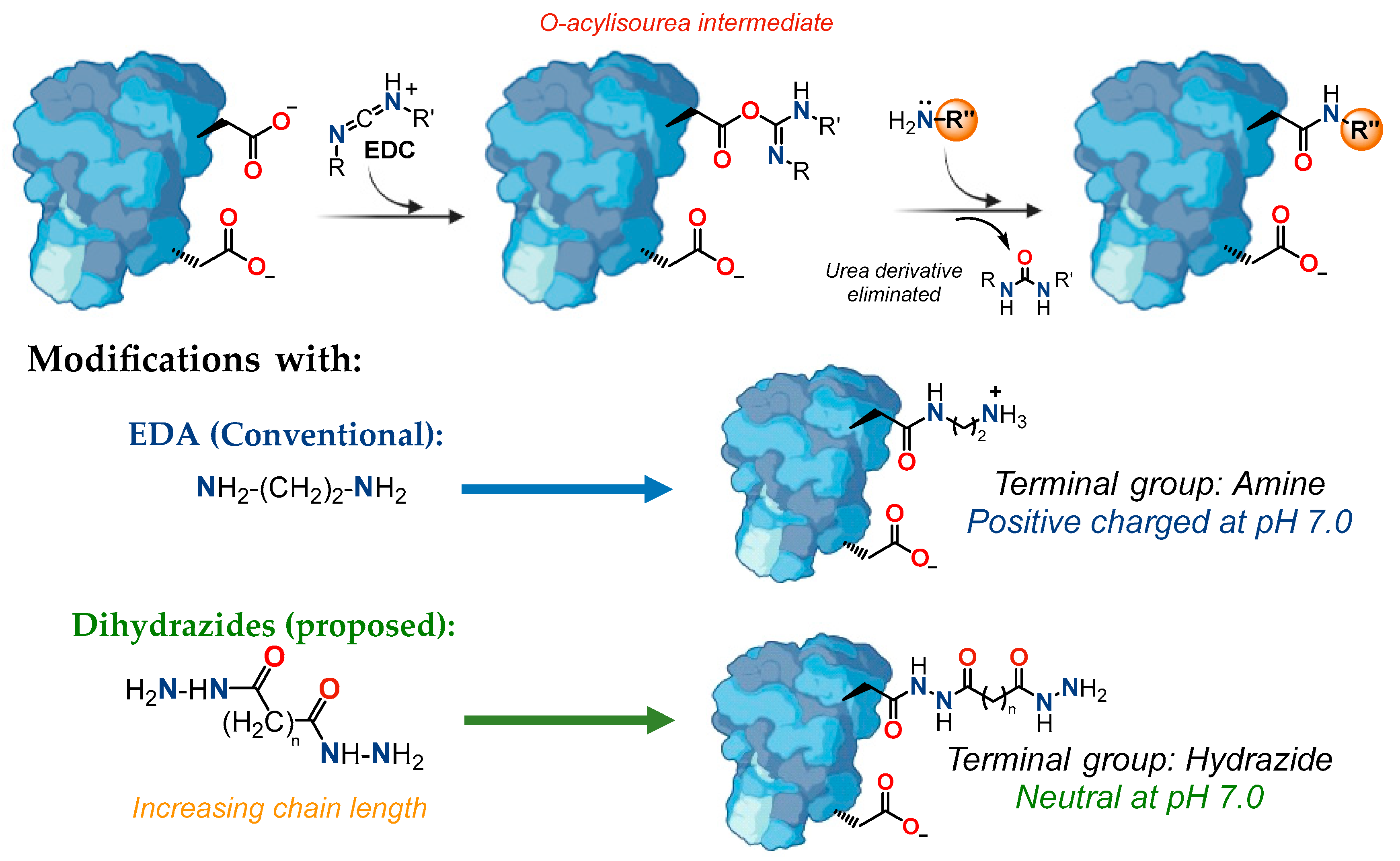
Scheme 1. Overview of the EDC-mediated coupling between enzyme carboxyl groups and different modifiers [9,26]. The scheme highlights the formation of the O-acylisourea intermediate (top) and the resulting enzyme–modifier conjugates for the conventional cationic reagent EDA (positively charged at pH 7.0) and for neutral dihydrazides of different chain lengths (uncharged at pH 7.0) (bottom). Image created with BioRender.com.
Ijms 26 11094 sch001
Figure 1. Activation curves showing specific hydrolytic activity (IU/mg) versus CTAB concentration (w/v%) for unmodified TLL (black), TLL-EDA (red), TLL-CZ (blue), TLL-OX (orange), TLL-SC (green), and TLL-AA (purple). CMC is shown as a vertical dashed line at 0.0100%.
Ijms 26 11094 g001
Figure 2. Lid flexibility of TLL (A), TLL-EDA (B), and TLL-AA (C) was assessed via 100-ns MD simulations starting from the open-state conformation. Snapshots at key time points—red (0 ns), orange (18 ns), yellow (43 ns), blue (92 ns), green (100 ns)—were superimposed onto the crystal structures of TLL in its open (pink, PDB:1DTE) and closed (purple, PDB:1DT5) conformations to illustrate the progression toward closure.
Ijms 26 11094 g002
Scheme 2. Hydrolysis of p-nitrophenyl acetate (p-NPA) catalyzed by TLL and its chemically modified variants. The release of p-nitrophenol (p-NP) as is described in Section 3.2 [29,38].
Ijms 26 11094 sch002
Figure 3. (A) Radius of gyration (RoG), (B) Root mean square deviation (RMSD), and (C) root mean square fluctuation (RMSF) plots of the open-state TLL and modified versions produced after 100-ns molecular dynamics simulations. TLL (black line, PDB:1DTE); TLL-AA (purple line); TLL-OX (orange line); TLL-EDA (red line); TLL-CZ (blue line), and TLL-SC (green line).
Ijms 26 11094 g003
Figure 4. Structural model of TLL highlighting key regions related to catalytic function. The lid region (R81–F94) is shown in green, oxyanion hole (S85 and L147) is shown in orange, and catalytic residues S146, D201, and H258 in blue. Of the 32 possible carboxylate groups, 31 were found to be exposed to modification. The groups modified in silico, based on the average modification percentage for TLL, are highlighted in pink.
Ijms 26 11094 g004
Scheme 3. Oxidation of ABTS catalyzed by native and chemically modified MTL variants. The formation of the ABTS•+ radical cation (λ = 420 nm) was monitored spectrophotometrically, as described in Section 3.2.
Ijms 26 11094 sch003
Figure 5. (A) radius of gyration (RoG), (B) Root mean square deviation (RMSD), and (C) root mean square fluctuation (RMSF) plots of the MTL and modified versions produced after 100-ns molecular dynamics simulations. MTL (black line, PDB:6F5K); MTL-AA (purple line); MTL-OX (orange line); MTL-EDA (red line); MTL-CZ (blue line), and MTL-SC (green line).
Ijms 26 11094 g005
Figure 6. Structural model highlighting regions with notable conformational shifts observed exclusively in MTL-OX (G350–N376 in orange) and MTL-AA (V290–S301 in pink, G350–P401, L418–T428 in purple). These regions are located near the T1 copper site and may influence the catalytic performance. Of the 65 possible carboxylate groups, only 42 were found to be modifiable. The groups modified in silico, based on the average modification percentage for MTL, are highlighted in green.
Ijms 26 11094 g006
Figure 7. Residual activity (%) over time at 70 °C for TLL (top: native [black], TLL-EDA [red], TLL-AA [purple]) and MTL (bottom: MTL-EDA [red], MTL-AA [purple]). Residual activity was calculated as 100 × ([X]s/[X]0), where [X]s is activity at time t and [X]0 is initial activity (t = 0 h).
Ijms 26 11094 g007
Figure 8. Residual activity over time for TLL (top) and MTL (bottom) variants—unmodified (black), EDA-modified (red), and AA-modified (purple)—in 50% (v/v) THF at 25 °C. Residual activity was calculated as 100% × ([X]s/[X]0).
Ijms 26 11094 g008
Table 1. Summary of TLL and MTL modifications with EDA and dihydrazides (CZ, OX, SC, AA), including modification percentage, protein and activity recovery, and specific activity (IU/mg).
EnzymeModifierAbbr.Modification (%)Recover Protein (%)Recover Activity (%)Specific Activity (IU/mg)
Thermomyces lanuginosus lipase (TLL)-TLL a-87.3 ± 0.290.0 ± 0.49.4 ± 0.2
Ethylenediamine (EDA)TLL-EDA47.1 ± 0.248.4 ± 1.029.4 ±3.45.9 ± 0.5
Carbohydrazide (CZ)TLL-CZ57.1 ± 1.285.0 ± 1.4128.6 ± 5.714.7 ± 0.4
Oxalyl hydrazide (OX)TLL-OX53.2 ± 3.668.5 ± 2.12.1 ± 0.30.3 ± 0.1
Succinic dihydrazide (SC)TLL-SC45.7 ± 0.998.1 ± 3.1123.5 ± 2.812.2 ± 0.3
Adipic acid dihydrazide (AA)TLL-AA66.0 ± 0.383.7 ± 1.7159.8 ± 3.818.6 ± 0.6
Myceliophthora thermophila laccase (MTL)-MTL a-69.4 ± 0.495.2 ± 4.91.5 ± 0.3
Ethylenediamine (EDA)MTL-EDA44.6 ± 1.966.4 ± 0.6186.3 ± 6.34.4 ± 0.2
Carbohydrazide (CZ)MTL-CZ16.2 ± 0.895.1 ± 1.523.2 ± 2.80.4 ± 0.1
Oxalyl hydrazide (OX)MTL-OX54.2 ± 3.185.7 ± 0.2122.4 ± 5.72.4 ± 0.2
Succinic dihydrazide (SC)MTL-SC41.9 ± 0.764.6 ± 0.4231 ± 6.15.6 ± 0.2
Adipic acid dihydrazide (AA)MTL-AA40.6 ± 1.271.0 ± 1.0389 ± 2.98.6 ± 0.2
a Control of the unmodified enzyme after purification. The activity and protein content were measured using the procedures described in Section 3.2 and Section 3.3. The activity and recovered protein were calculated using a modification target [X]0 and the values obtained after modification and desorption [X]m, using the equation 100% ([X]m/[X]0). The modification percentage was calculated using TNBS method, as described in Section 3.7.
Table 2. Kinetic parameters of unmodified and modified TLL in the hydrolysis of p-NPA (25 °C, pH 7.0, CTAB 0.01%) (Scheme 2). Reported values include turnover frequency (kcat), Michaelis–Menten constant (km), and catalytic efficiency (kcat/km).
Enzymekcat (s−1)km (mM)kcat/km (mM−1 s−1)
TLL70.1 ± 7.51.3 ± 0.255.6 ± 8.2
TLL-EDA42.4 ± 2.61.0 ± 0.244.6 ± 3.2
TLL-CZ98.0 ± 8.40.7 ± 0.3138.0 ± 9.1
TLL-OX8.9 ± 0.91.2 ± 0.27.3 ± 1.7
TLL-SC100.4 ± 9.41.1 ± 0.290.5 ± 7.1
TLL-AA78.0 ± 5.21.0 ± 0.175.0 ± 6.3
Table 3. Docking scores (kJ/mol) of TLL and modified variants using the complex with CTAB as a receptor [29] and p-NPA as substrate (see Supporting Materials Figures S8–S13).
EnzymeDocking Scores (kJ/mol)—Enzyme with CTABStandard Deviation (SD)
TLL−60.11.0
TLL-EDA−51.80.2
TLL-CZ−76.91.0
TLL-OX−76.90.7
TLL-SC−71.00.5
TLL-AA−67.70.8
Table 4. Kinetic parameters of MTL and MTL modified in the oxidation of ABTS (25 °C, pH 5.0) (Scheme 3). Reported values include turnover frequency (kcat), Michaelis–Menten constant (km), and catalytic efficiency (kcat/km).
Enzymekcat (s−1)km (μM)kcat/km (μM−1 s−1)
MTL6.5 ± 0.512.2 ± 0.30.5 ± 0.2
MTL-EDA6.1 ± 0.34.5 ± 0.21.4 ± 0.1
MTL-CZ4.1 ± 1.18.7 ± 0.20.5 ± 0.2
MTL-OX22.7 ± 9.111.1 ± 0.72.1 ± 0.8
MTL-SC6.7 ± 0.68.5 ± 0.40.8 ± 0.2
MTL-AA13.1 ± 0.46.2 ± 0.42.1 ± 0.2
Table 5. Summary of docking result of MTL and modified as a receptor and ABTS as ligand (see Supporting Materials Figures S15–S20).
EnzymeScore Ligand-Receptor (kJ/mol)Standard Deviation (SD)
MTL−110.61.0
MTL-EDA−141.35.4
MTL-CZ−103.00.6
MTL-OX−120.60.9
MTL-SC−132.60.4
MTL-AA−173.52.2
Disclaimer/Publisher’s Note: The statements, opinions and data contained in all publications are solely those of the individual author(s) and contributor(s) and not of MDPI and/or the editor(s). MDPI and/or the editor(s) disclaim responsibility for any injury to people or property resulting from any ideas, methods, instructions or products referred to in the content.