

Review

Expanding Horizons in Cholangiocarcinoma: Emerging Targets Beyond FGFR2 and IDH1

1
Department of Chemistry and Biochemistry, University of Notre Dame, Notre Dame, IN 46617, USA
2
Department of Surgery, Indiana University School of Medicine, South Bend, IN 46617, USA
3
Harper Cancer Research Institute, University of Notre Dame, Notre Dame, IN 46617, USA
4
Goshen Center for Cancer Care, Goshen, IN 46526, USA
5
School of Medicine, University of Basel, CH-4056 Basel, Switzerland
*
Author to whom correspondence should be addressed.
Int. J. Mol. Sci. 2025, 26(21), 10755; https://doi.org/10.3390/ijms262110755
Submission received: 17 September 2025 / Revised: 23 October 2025 / Accepted: 27 October 2025 / Published: 5 November 2025
(This article belongs to the Collection Latest Review Papers in Molecular Oncology)

Abstract

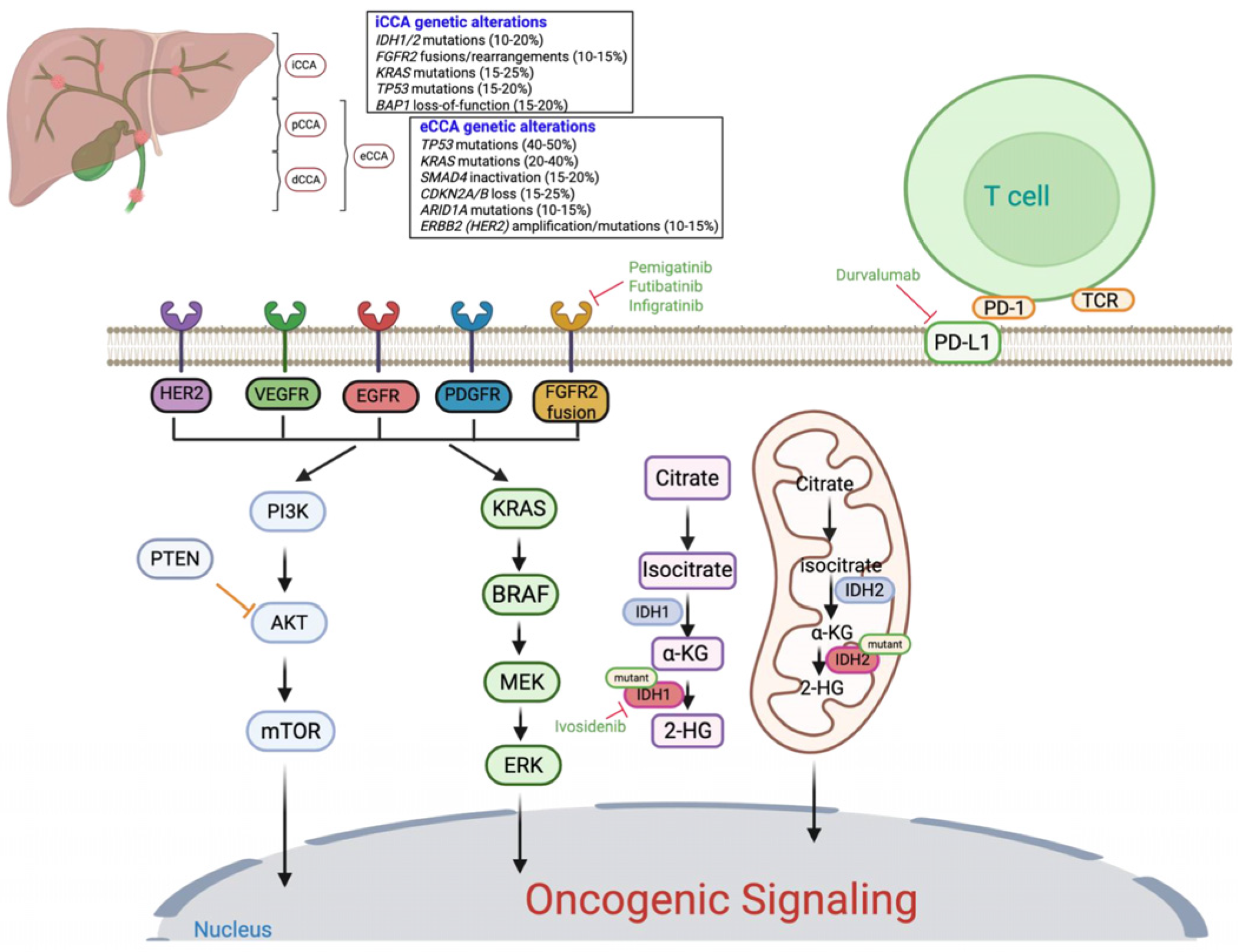
Cholangiocarcinoma (CCA) is a biliary tract cancer that accounts for approximately 3% of all gastrointestinal cancers. CCA is a “silent” disease that remains undetected for a long period of time, often presenting at an advanced stage with minimal treatment options and a poor prognosis. Advanced CCA remains largely inoperable, and combination gemcitabine plus cisplatin (GemCis) chemotherapy remains the standard treatment for patients affected by this disease. There is a desperate need for new therapeutic alternatives, and extensive research is ongoing to address this gap. Targeted therapies represent a rapidly expanding area of cancer treatment and are currently under active investigation in CCA. The FDA has approved the targeted therapies ivosidenib, pemigatinib, infigratinib, and futibatinib, as well as the immunotherapy durvalumab, for patients with CCA in recent years. Several other therapeutic strategies are still under investigation, targeting molecular pathways including p53/MDM2, JAK/STAT, KRAS, HER2, VEGFR, PDGFR, MET, ALK, MAPK, PI3K/AKT, BRAF, and DNA damage repair signaling. While several promising advancements have been made, further research is required to improve outcomes for patients with CCA. This review provides an up-to-date, comprehensive overview of currently approved targeted therapies in CCA, as well as those under investigation.
Keywords: cholangiocarcinoma; KRAS; targeted therapies; FGFR; IDH cholangiocarcinoma; KRAS; targeted therapies; FGFR; IDH


