1. Introduction
Salicylic acid (SA) is a central phytohormone orchestrating plant immune responses and stress signaling. SA is a widely distributed phenolic compound derived from the shikimate/phenylpropanoid pathway, and it plays diverse regulatory roles in plant physiology beyond immunity [
1]. In addition to its biotic defense functions, SA has been increasingly recognized as a mitigator of abiotic stresses (drought, salinity, temperature extremes, heavy metal toxicity) by modulating major metabolic processes for stress tolerance [
2]. For instance, under heavy metal stress, SA can limit metal uptake, boost antioxidant defenses, and protect membrane integrity, thereby alleviating metal-induced damage [
3].
SA’s role in plant stress responses is ancient, dating back to early land plant evolution. Evolutionary analyses suggest that the SA signaling pathway evolved in pieces—for example, SA receptors (NPR proteins) appear only in land plants, whereas the transcriptional activators they cooperate with (TGA factors) exist even in algae, and a full isochorismate-based SA biosynthetic pathway was assembled with the emergence of terrestrial plants [
4]. Notably, SA is involved not only in plant–pathogen defense but also in beneficial plant–microbe symbioses; SA levels are actively modulated during interactions with endophytes, mycorrhizal fungi, and rhizobia to balance growth and defense [
5].
In particular, SA accumulation triggers local defenses and systemic acquired resistance (SAR) against pathogens. Because SA levels and signaling are highly dynamic in time and space, mapping SA activity in planta is crucial for understanding how plant immunity is coordinated. In practical terms, reporter lines (e.g., PR1::LUC/YFP) visualize where SAR is primed and how it spreads: reporter activity first appears near the inoculation site and then expands to distal leaves over ~1–2 days, consistent with systemic signaling dynamics [
1]. Complementarily, microbial biosensors quantify early SA availability at infection fronts, while chemical probes resolve cell-scale SA hotspots, linking SAR priming to SA distribution at multiple scales [
2,
6,
7,
8,
9]. Emerging evidence shows that SA signaling is remarkably complex, involving multiple receptors and the formation of dynamic signaling complexes in cells. This complexity highlights the need for in vivo reporters to capture the spatial and temporal nuances of SA action [
10]. For example, Betsuyaku et al. visualized SA’s spatial dynamics via time-lapse imaging: around an infection site, SA forms a steep concentration gradient that activates defense genes (like PR1) only in cells immediately adjacent to the hypersensitive response (HR) lesion, whereas jasmonic acid (JA) signaling is activated in a surrounding ring of cells [
1,
11,
12]. This spatial separation allows SA- and JA-mediated defenses to operate simultaneously during effector-triggered immunity. These insights are reporter-dependent case studies. PR1-driven reporters revealed steep SA halos confined to cells bordering HR lesions, while JA reporters marked a concentric ring beyond, resolving domain-level crosstalk during infection [
11,
13]. Acinetobacter ADP1 lux biosensors captured early, minute-scale apoplastic SA pulses during resistance responses in tobacco, preceding visible symptoms [
2]. Recently, autoluminescent lines enabled continuous whole-plant imaging and multi-day tracking of SA-responsive waves, with tens-of-fold induction ranges upon infection in
Arabidopsis/
Nicotiana [
3,
5,
14].
Given SA’s central role in immunity, synthetic analogs have been developed to activate this pathway in crops. Decades of work on SA pathway activators (e.g., the commercial inducer BTH) attest to the importance of SA signaling—these compounds mimic SA to prime broad-spectrum disease resistance and are now used in crop protection [
15]. Fundamentally, SA is indispensable for mounting effective immune responses: exogenous SA or SA analogs induce pathogenesis-related (PR) genes, and plants deficient in SA biosynthesis or perception cannot establish robust local or systemic resistance [
16]. Accordingly, the key immune regulator NPR1 is required to transduce SA signals and activate downstream defense genes [
6].
Interestingly, the efficacy of SA-induced immunity can depend on the time of day, suggesting coordination between defense signaling and the plant’s internal clock. Recent studies indeed demonstrate a tight circadian control of SA responses: SA signaling can alter circadian rhythms via NPR1, and conversely the clock (notably the CCA1 gene) gates SA-induced defense gene expression and disease resistance, peaking at the biologically optimal time [
7].
However, applying SA directly can sometimes impair growth, pointing to the need for balanced delivery and hormonal crosstalk management. Notably, encapsulated SA formulations have been shown to bolster plant stress tolerance more effectively than free SA by avoiding excessive SA accumulation and auxin disruption—encapsulated-SA-treated plants maintained normal auxin reporter (DR5) activity under stress, unlike those given free SA [
8]. At the molecular level, SA triggers a broad transcriptional cascade that amplifies defense responses. Many transcription factors are induced by SA, enhancing immune signaling. For example, the mulberry gene MiWRKY53—a WRKY transcription factor—is highly SA-inducible (showing ~6–7-fold higher expression with SA treatment) and plays a positive role in defense, as its overexpression elevates PR1 levels and confers enhanced resistance to bacterial infection [
9].
Traditional methods like HPLC can measure SA concentrations from harvested tissue, but such chemical assays are destructive and lack spatial information. This limitation has driven the development of non-destructive SA reporters—tools that translate SA presence or signaling into visible signals in living plants [
17]. Because SA also orchestrates tolerance to abiotic stresses, SA reporters will be valuable for studying stress hormone crosstalk and resilience in crops [
18]. For example, SA has been identified as a key mediator of salt stress tolerance, helping plants maintain ionic balance and activate antioxidant defenses under high salinity [
19]. Spatially resolved reporters are especially needed, as hormone pathways often act in distinct domains within tissues. In Arabidopsis, PR1 (SA-responsive) reporters reveal an SA-rich “halo” around infection sites, while VSP1 (JA-responsive) marks a concentric JA zone—a pattern that confirms how these pathways compartmentalize during immune responses [
13].
Global transcript profiling further underscores the differences between SA and JA signaling. In soybean, for instance, transcriptome analysis identified over 3100 genes rapidly upregulated by SA (versus ~1450 by JA); SA promptly activated SAR-related genes (e.g., NIMIN1, WRKY40), whereas JA induced later waves of wound-response genes [
20]. These distinct gene signatures provide molecular tools for dissecting stress responses and highlight the value of reporters to monitor each pathway. In recent years, interest in visualizing SA in vivo has grown, as live imaging of hormone dynamics can reveal interactions (such as SA–JA crosstalk) and uncover novel defense mechanisms. Beyond its defense roles, SA also profoundly affects plant growth and morphology—high endogenous SA often leads to stunted growth, whereas SA-deficient plants tend to grow larger, and optimal low levels of SA can even promote growth under certain conditions [
21]. SA’s interactions with other hormones can be complex: for example, SA and ethylene coordinately promote leaf senescence, with SA-induced chlorophyll loss enhanced by ethylene and requiring the ethylene-regulated transcription factor EIN3 [
22].
New reporter technologies with improved sensitivity and resolution have recently become available, expanding the toolkit for plant biologists [
23]. Mapping where and when SA accumulates in both model and crop plants may inform strategies for breeding or engineering disease-resistant varieties. Indeed, maintaining appropriate SA levels is crucial to avoid fitness costs: plants with chronically high SA can suffer dwarfism or premature senescence, so SA levels must be finely tuned [
24]. Emerging studies have identified new molecular regulators of SA accumulation and revealed roles for SA in processes like leaf aging and nutrient signaling, underscoring that SA’s impact goes far beyond immunity [
25]. For example, SA can even modulate secondary metabolism—recent work in Cannabis sativa showed that SA treatment dramatically (≈100–fold) increases expression of key cannabinoid biosynthetic genes (CsPT1 and CsPT4) via specific SA-responsive cis-elements in their promoters [
26].
To ensure comprehensive coverage of SA reporter systems in plants, we performed an extensive literature search across multiple scientific databases (including Google Scholar, PubMed, and Elsevier’s ScienceDirect). We used a broad set of keywords and their variants related to salicylic acid and reporter technologies. For example, search terms included combinations like “salicylic acid reporter”, “SA sensor”, “SA-inducible promoter”, “autoluminescent sensor”, “self–luminescent reporter”, “SA biosensor”, “fluorescent SA sensor”, “SA luciferase reporter”, etc. The search covered publications from early foundational reports to recent studies (up to 2025), and initially yielded hundreds of results.
Our inclusion criteria focused on studies involving plant systems: articles dealing exclusively with non-plant organisms or purely in vitro assays were excluded. Both genetically encoded luminescent reporters (including autoluminescent constructs) and fluorescent reporter systems were considered if used to detect or visualize SA in plants. We also noted related in vivo SA sensing approaches applied in planta (e.g., microbial biosensors or chemical probes) for context. After filtering titles and abstracts, the remaining papers were examined in full to extract information on reporter designs, performance, and applications. This process yielded a curated set of key publications on SA reporters in plants, ensuring that the review reflects the current state of available tools (while acknowledging that some relevant studies might be missed if not indexed in the selected databases or if they employed uncommon terminology).
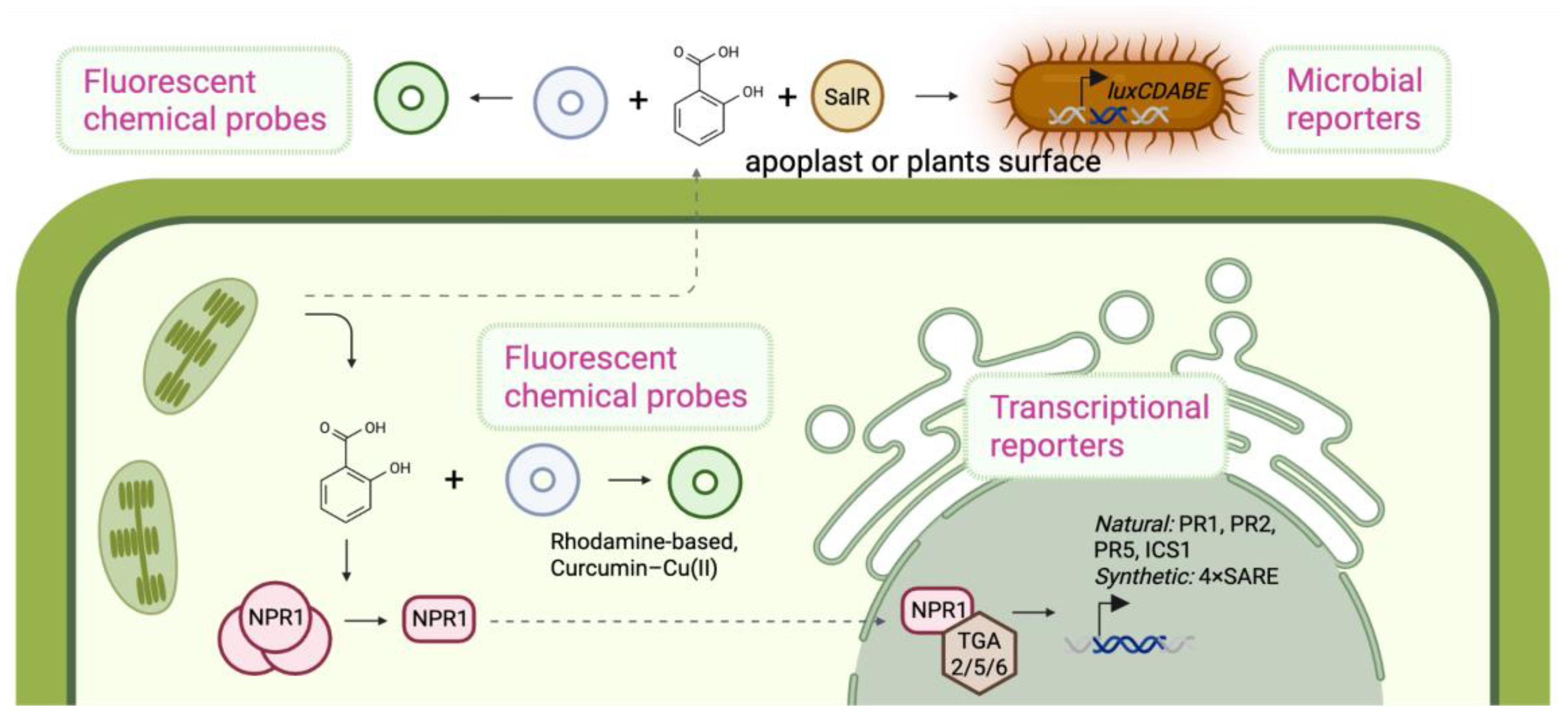
Multiple types of SA reporter systems have been developed in plant research. These include (
Table 1,
Figure 1):
Transcriptional reporters: Transgenic plants with a native or synthetic SA-inducible promoter driving a reporter gene (such as GUS, GFP, or luciferase). Autoluminescent reporter lines constitute a special subset: the luciferase enzyme and its substrate–biosynthesis pathway are integrated under SA-inducible control, causing the plant to emit light when SA signaling is active [
1,
3,
4,
5,
10].
Microbial biosensors: Engineered bacteria that produce a detectable signal in the presence of SA [
2,
11].
Fluorescent chemical probes: Small molecules that fluoresce or change color upon binding to SA [
27].
Emerging genetic sensors: New concepts like protein-based or FRET sensors for SA. Genetically encoded SA biosensors remain unrealized in plants largely due to the lack of validated SA-binding scaffolds with suitable affinity/specificity and targeting issues. Developing these sensors is urgent because they would permit single-cell, ratiometric readouts, multiplexing with other hormone reporters, and seamless integration with CRISPR pipelines for high-throughput perturbation screens and precision breeding.
Each type has unique advantages and limitations.
Table 1 provides a brief overview of the main classes of SA reporters in plants, highlighting what each measures along with key pros and cons.
To navigate this array of SA reporter systems effectively, this review examines the major classes of plant SA reporters in detail and compares their underlying detection mechanisms and overall performance. It further outlines practical recommendations for selecting appropriate reporter tools and applying them in plant biotechnology and in efforts to enhance stress resilience in crops.
Typical performance ranges (from representative reports): Chemical probes—seconds-to-minutes response; limit of detection (LOD) commonly in the nM range; local, high-resolution readout [
11,
12,
13,
14]. Microbial lux biosensors—minutes to respond; nM-level sensitivity for free SA; suitable for rapid quantification on intact tissues or extracts [
2,
10]. Transcriptional reporters—hours to reach detectable expression; high signal amplification and in vivo context, but indirect and limited for fast transients [
1,
5,
7,
8].
2. Transcriptional Reporters of Salicylic Acid
Transcriptional reporters are genetically encoded sensors that indicate SA signaling by leveraging the plant’s own SA-responsive gene promoters. In these reporters, an
SA-inducible promoter (either a native plant promoter from a known SA-responsive gene, or a synthetic promoter engineered to respond to SA) is fused to a reporter gene encoding a visible enzyme or protein. Common reporters include GUS (β-glucuronidase, yielding a blue stain when substrate is applied), GFP/YFP (green/yellow fluorescent protein), or luciferases (e.g., firefly luciferase, producing luminescence in the presence of luciferin). When SA levels rise in the plant, the chosen promoter is activated through the plant’s signaling network, leading to transcription of the reporter gene and a measurable signal in those cells [
1].
2.1. Mechanism of SA Detection by Transcriptional Reporters
These reporters do not bind SA directly; instead, they monitor the plant’s transcriptional response to SA. At the molecular level, SA accumulation triggers a signaling cascade inside the plant cell. A key player is the NPR1 protein, which acts as a master regulator of SA-mediated gene expression. In the presence of SA, NPR1 undergoes a conformational change and moves to the nucleus, where it interacts with TGA transcription factors to activate pathogenesis-related (PR) gene promoters [
13]. Promoters of SA-responsive genes (such as PR1, PR2, PR5, or ICS1) contain specific DNA motifs (e.g., the TGACG motif, also called an “as-1” or TGA-element) that are recognized by these transcription factors. NPR1 serves as a co-activator, recruiting the transcriptional machinery to induce these genes [
13]. In a transgenic reporter line, the same promoter (for example, the PR1 promoter) is placed upstream of a reporter gene. Thus, when SA causes NPR1 and other factors to activate the PR1 promoter, the reporter gene is expressed instead of the native PR1 gene, producing a detectable signal. This chain of events means the reporter’s output is an indirect proxy for SA—it reports that “SA signaling is active” (i.e., downstream defense genes are being turned on), rather than measuring SA molecules themselves [
1,
13].
Why transcriptional reporters are temporally slower. Transcriptional systems are inherently multistep: SA accumulation must (1) activate NPR1 and associated TFs, (2) trigger promoter occupancy, (3) drive transcription and mRNA processing, (4) translate reporter protein, and (5) (for some readouts) allow reporter maturation or substrate application. This cascade typically yields detectable signals on the order of hours, whereas microbial biosensors respond within minutes (direct SA sensing by a bacterial regulator driving lux output) and fluorescent chemical probes can switch within seconds due to immediate binding/chemical reaction with SA [
2,
10,
11,
12,
13,
14]. Functionally, transcriptional reporters measure pathway activation, while microbial/probe systems measure SA itself, explaining the gap in temporal resolution.
2.2. Natural Promoter Reporters of SA
The simplest and most widely used transcriptional reporters use native SA-responsive promoters from plants. For instance, the promoter of the
PR1 gene (a classic SA-inducible defense gene in Arabidopsis) is frequently used. In a
PR1::GUS line, blue staining indicates where the PR1 promoter is active, which in turn reflects where SA signaling has occurred. These natural promoter fusions have several strengths. Because they are actual promoters from SA-responsive genes, they provide a biologically contextual readout of the plant’s immune response. The reporter expression will occur in the same cells where an SA-responsive defense gene would normally turn on, giving a spatially accurate picture of hormone signaling. Indeed, promoter reporter lines have shown high spatial resolution—from specific cell layers up to whole-organ patterns—of SA-driven gene activation. Another benefit is signal amplification: a strong promoter like
PR1 can drive high levels of the reporter enzyme/protein when induced, resulting in a robust signal (for example, bright fluorescence or luminescence). Transcriptional reporters are well-established in model plants such as
Arabidopsis thaliana and
Nicotiana benthamiana, and have been used to visualize spatiotemporal patterns of SA signaling during pathogen infection. For example, transgenic Arabidopsis carrying a
PR1::YFP reporter shows defined halos of fluorescence around infection sites, corresponding to the zone of elevated SA signaling in those tissues. Likewise,
PR1::LUC (luciferase) lines have been used to track the spread of SA-induced gene expression over time: when a leaf is infected, over the next 1–2 days, luciferase activity spreads to neighboring leaves as the SA signal (and SAR induction) propagates. These kinds of experiments demonstrate how natural promoter reporters can map the dynamics of SA-mediated defense activation in vivo [
1].
Despite their usefulness, natural promoter reporters have important limitations. First, they measure SA signaling indirectly. There is an inherent time lag: SA must accumulate and trigger the signaling network, transcription factors must activate the promoter, the reporter mRNA and protein must be produced, and (for some reporters) a substrate must be applied before a signal is seen. This process typically takes hours, so transcriptional reporters cannot capture sudden changes in SA levels in real time. Additionally, because they rely on a plant gene promoter, the readout can be influenced by crosstalk with other signals. Many SA-inducible promoters also respond to other defense hormones or stress conditions. For instance, the
PR1 promoter, while largely SA-responsive, can be modestly induced by certain forms of stress or by high levels of related signals like jasmonates or ET, especially in mutants or particular contexts. This means a reporter signal might not strictly indicate “SA present” but rather “SA pathway active,” which could sometimes be triggered by SA-independent pathways. Careful controls are needed to interpret results (e.g., confirming that the reporter is not induced in mutants that cannot accumulate SA). Another drawback is the need to generate transgenic plants. Introducing a promoter reporter construct into the plant genome requires transformation and breeding, which can be laborious, especially in crop species. Moreover, some reporter assays are invasive or end-point: for example, GUS staining requires sacrificing the tissue and cannot be observed in the same sample over time, while luciferase imaging needs addition of the luciferin substrate to the plant, which can be cumbersome for long-term or high-throughput experiments [
1].
Autoluminescent SA reporters are an innovative variant of the transcriptional reporter approach that address some of the above limitations. In these systems, instead of a single reporter enzyme, an entire bioluminescence pathway is engineered into the plant under control of an SA-responsive promoter. Recent examples use a fungal luciferin biosynthesis pathway (from
Neonothopanus mushrooms) integrated into plants. For instance, researchers have placed a fungal luciferase enzyme gene and the genes for its substrate synthesis under the
WRKY70 promoter in Arabidopsis and tobacco [
4]. When SA signaling activates the promoter, the plant begins producing the luciferase, while luciferin is produced constitutively. This causes the plant to emit visible light without any external substrate. This is essentially a self-contained luciferase reporter. The major advantage of autoluminescent lines is that they enable continuous, non-invasive monitoring of SA-responsive gene activity in real time. The plants literally glow when and where SA signaling is active, allowing researchers to track hormone waves or oscillations over long periods (days to weeks) with minimal disturbance. The background is essentially zero (plants do not naturally luminesce), and induction can produce tens-of-fold increases in light output; in one demonstration, SA-inducible autoluminescent plants showed up to ~50-fold higher luminescence after infection, easily captured by standard cameras. Entire seedlings or canopies have been imaged to watch SA signaling spread during immune responses. Autoluminescent reporters thus combine the specificity of a transcriptional reporter with the convenience of a substrate-free luminescence readout, making them a powerful new tool.
Recent advances in luminescence-based salicylic acid imaging include the development of a ratiometric dual-color reporter based on a fungal bioluminescence system [
5]. One color reports the activity of the SA-responsive promoter, while the second is driven by a constitutive reference promoter. Because metabolic fluctuations affect both channels similarly, the intensity ratio provides a normalized, quantitative ratiometric readout. This makes the technology the first non-invasive quantitative luminescence-based approach enabling tissue and whole-plant imaging of salicylic activity in planta.
The drawbacks, however, include the complex engineering required (introducing multiple genes and pathways into the plant) and the fact that the luminescence, while visible, is relatively dim compared to traditional luciferase assays with an added substrate. Sensitive cameras and dark imaging conditions are usually required to detect the glow. Additionally, like other promoter fusion reporters, autoluminescent systems still report on SA signaling rather than measuring SA directly. Nonetheless, as the technology matures, these reporters are poised to become valuable for whole-plant, long-term imaging of defense hormone dynamics.
2.3. Synthetic Promoter Reporters of SA
Another branch of transcriptional reporters uses synthetic promoters that are artificially designed to respond to SA. These constructs typically multimerize known SA-responsive cis-elements (DNA motifs) and combine them with a minimal promoter to drive a reporter gene. For example, researchers have created synthetic promoters containing repeated copies of the SARE (salicylic acid responsive element) sequence or the as-1 element, which are DNA motifs recognized by the SA pathway transcription factors (such as TGA factors). By placing, for example, four tandem SARE copies upstream of a minimal promoter and a luciferase gene (4×
SARE::LUC), one can create a module that is highly sensitive to SA signaling. The mechanism is fundamentally the same as with natural promoters—the synthetic promoter is activated by NPR1-dependent transcription factors in the presence of SA—but the response can be quantitatively different. Advantages of synthetic promoters include enhanced sensitivity and customizable specificity [
15]. With multiple high-affinity binding sites for SA-activated transcription factors, the synthetic promoter can amplify the transcriptional response, leading to stronger reporter expression than a single native promoter might produce. This can be very useful if the native promoter is weak or if one needs to detect faint signals. Synthetic constructs can also be engineered to reduce cross-reactivity; for instance, one can omit undesired regulatory elements or combine elements to respond predominantly to SA and not to other stimuli. Moreover, synthetic promoters are modular—they can be transferred into different plant species or tuned by mutating binding sites. There are examples of hybrid promoters built to function as SA sensors in crops like potato, achieved by adjusting the sequence context so that the plant’s transcription factors recognize them optimally.
On the downside, synthetic promoter reporters share some limitations with natural promoter fusions and introduce a few of their own. They are still an indirect measure of SA: like any transcriptional reporter, they report the activation of a signaling pathway, not the actual concentration of SA. If SA signaling is blocked or altered, the synthetic promoter will not light up even if SA is present (and conversely could potentially be triggered by pathway crosstalk if not perfectly specific). Additionally, a synthetic promoter may not perfectly reproduce the nuanced expression pattern of a native promoter. Real gene promoters often have complex regulation (chromatin context, multiple enhancers, tissue-specific repressors, etc.) that a simplified synthetic construct might not capture. Thus, a synthetic reporter might show SA responsiveness, but perhaps not only in the exact cells or conditions that a native promoter would—it could be “leaky” or miss some spatial control. Each new promoter design also requires validation in planta: one must test that it truly responds to SA and not to other signals in the target plant, which can be time-consuming. Finally, creating an optimized synthetic promoter often involves trial-and-error and iteration of designs. Despite these caveats, synthetic promoters are extremely useful when native options are lacking or when one needs extra sensitivity. They provide a way to boost signal output or adapt SA reporters to non-model species where the standard Arabidopsis PR1 promoter might not work efficiently.
2.4. Strengths of Transcriptional Reporters
A major strength is biological context: a PR1 or similar SA-inducible promoter will activate the reporter in the same cells where endogenous defense genes turn on, yielding a highly spatially resolved map of SA signaling. Strong promoters can amplify the signal, producing bright fluorescence or luminescence upon induction. Synthetic promoter fusions (for example, multimerized SA-responsive cis-elements) can further boost sensitivity and reduce background, enabling detection of very low SA levels. Autoluminescent variants integrate a full bioluminescent pathway under SA control, so the plant emits light without added substrate: these plants literally “glow” in SA-rich tissues with minimal background and large fold-changes upon defense activation. In sum, transcriptional reporters provide in vivo, high-resolution, non-destructive readouts of SA activity with strong signal amplification, making them well suited for mapping hormone dynamics in model plants.
2.5. Limitations of Transcriptional Reporters
Despite their description in
Section 2.4., transcriptional reporters have intrinsic limitations. First, they report SA signaling rather than SA itself, so there is a significant time lag: hormone accumulation must activate NPR1 and transcription factors, drive transcription and translation, and (for luciferases with undeciphered luciferin biosynthesis pathway) require substrate application. This multistep process typically takes hours to generate a detectable signal, precluding real-time monitoring of rapid SA fluctuations. Second, promoter crosstalk can reduce specificity: many “SA-inducible” promoters are also weakly responsive to other stresses or hormones (e.g., jasmonate, ethylene), so a reporter may indicate “pathogen response on” even if SA levels are unchanged. Third, these reporters require transgenic plants and often invasive assays. Generating stable lines is laborious in non-model species, and some readouts are destructive or endpoint (for example, GUS staining kills tissue; conventional luciferase imaging requires exogenous luciferin). Even autoluminescent systems, while substrate-free, demand complex multi-gene engineering and very sensitive cameras (luminescence is relatively dim). Thus, although powerful for qualitative and spatially resolved mapping, transcriptional reporters are comparatively slow and indirect, and they do not easily provide absolute SA concentrations.
In summary, transcriptional SA reporters offer biologically contextual, high-spatial-resolution readouts of pathway activation, leveraging native or synthetic SA-responsive promoters to amplify signal and enable whole-plant imaging (including substrate-independent autoluminescent variants and ratiometric designs that improve normalization); however, they are inherently indirect and temporally delayed (requiring NPR1/TGA activation, transcription/translation, and sometimes reporter maturation), susceptible to promoter crosstalk and chromatin/context effects, and often demand transgenesis and species-specific validation, while some formats remain substrate-dependent and generally less suited for absolute quantification or rapid, transient SA fluctuations.
6. Discussion and Recommendations
No single SA reporter is perfect for all purposes—each has trade-offs in sensitivity, specificity, invasiveness, and practicality. The optimal choice depends on the experimental question and plant system. Classical promoter reporter lines (for example, Arabidopsis plants carrying a PR1::GUS or PR1::LUC transgene) remain popular for visualizing where SA-responsive genes are activated in planta. These reporters reflect authentic downstream responses to SA and have been indispensable for mapping spatial patterns of SA signaling over time [
28]. However, because they indicate SA signaling (gene expression) rather than free SA, their readout can be influenced by other factors—for instance, other defense pathways that also induce PR gene expression. In practice, researchers often use promoter fusion lines to observe how SA responses spread during infections; a PR1::LUC transgenic will luminesce in the infected leaf and neighboring tissues, revealing the progression of SA-mediated defense from an initial infection site into surrounding areas over days. It is worth noting that very high levels of SA can directly interfere with some reporters—SA treatment is known to quench GFP fluorescence in vivo, so fluorescence-based reporters must be interpreted with caution or paired with SA-insensitive variants like RFP.
By contrast, chemical probes and microbial biosensors offer more direct measurements of SA itself. A well-known example is the
Acinetobacter ADP1 lux biosensor, which has been used to quantitatively map SA accumulation in tobacco leaves after pathogen attack, revealing transient SA pulses in the leaf apoplast even before visible symptoms and capturing early dynamics of hormone release [
2]. Similarly, synthetic fluorogenic probes can pinpoint SA “hotspots” with high sensitivity and spatial resolution. For example, a curcumin-based fluorescent probe visualized SA inside living
Arabidopsis leaf tissues and roots [
7]. Such tools are excellent for short-term, ultra-sensitive detection of SA (down to picomole levels) [
9] and for confirming SA accumulation in specific cells or compartments. Their invasive application and one-time-use nature make them less suitable for continuous monitoring, but they are ideal for snapshot experiments or for validating SA distribution at particular moments.
The newest generation of SA reporters is the autoluminescent transgenic plant lines, which are especially powerful for long-term and whole-plant monitoring. By integrating a fungal bioluminescence pathway under an SA-inducible promoter, researchers have created plants that literally glow when SA signaling is active [
4]. In recent demonstrations, SA-inducible autoluminescent Arabidopsis and tobacco lines showed over 50-fold increases in luminescence upon pathogen infection, allowing entire plants to be imaged in real time with standard cameras [
5]. This non-invasive approach enables tracking of SA signaling waves (for example, during development of SAR or even across day–night cycles) over days to weeks. The complexity of generating these lines (multi-gene engineering) is a consideration, but once established, they provide a unique window into hormone dynamics at the whole-plant scale.
We believe that autoluminescent lines outperform GUS for longitudinal imaging. GUS histochemistry is endpoint and invasive (tissue sacrifice, substrate incubation), precluding time-series in the same organ; by contrast, autoluminescent systems are substrate-independent and non-destructive, enabling continuous imaging over days or weeks with near-zero background. In infection assays, SA-inducible autoluminescent plants showed >10- to ~50-fold increases in photon output, supporting canopy-scale visualization of signal propagation and circadian gating without perturbation [
3,
5,
10]. Ratiometric dual-color designs further normalize metabolic drift, improving quantitative comparability across tissues and time points [
5]. Together, these features explain superior performance in long-term, whole-plant studies compared with GUS.
Given the diverse toolkit available, investigators should choose the SA reporter system best suited to their needs—and often multiple approaches can be combined to gain complementary insights. For instance, one might use an autoluminescent reporter line to monitor overall SA responses in a plant, and simultaneously apply a fluorescent probe or a microbial sensor to quantify actual SA levels in specific tissues.
In summary, each reporter type has its niche, and using them appropriately can greatly enhance our understanding of SA biology. Some practical guidelines are summarized in
Table 2.
7. Conclusions
As of 2025, autonomous luminescent transgenic plants have emerged as arguably the most powerful and versatile SA reporters for live imaging. These autoluminescent, ratiometric systems overcome many limitations of earlier reporters—requiring no external substrates and causing minimal perturbation to the plant—making them a new gold standard for observing hormone activity in vivo [
5]. Incorporating a full luciferin biosynthesis pathway (fungal bioluminescence, FBP) under an SA-inducible promoter eliminates the need for exogenous luciferin and allows flexible promoter swapping to program hormone-dependent glow patterns across organs, enabling low-cost, long-duration imaging of SA signaling [
10]. For example, Khakhar et al. (2020) demonstrated a synthetic SA-responsive luciferase system that renders plants self-luminous during immune responses [
10].
At the same time, no single reporter is “best” in all contexts. The optimal choice depends on the experimental goal. For instance, a simple bacterial biosensor or a fluorescent probe might be ideal for a quick measurement of SA in a leaf extract, whereas luminescent reporter lines excel at monitoring dynamic defense responses inside an intact plant. In practice, using multiple complementary reporters in parallel can provide the most complete picture of SA biology [
27]. By combining approaches—for example, employing an autoluminescent line to track whole-plant SA signaling and a microscopy-compatible fluorescent probe to visualize cellular-level SA accumulation—researchers can cross-validate results and overcome the limitations of any single method [
29].
Looking ahead, a truly direct, genetically encoded SA biosensor (for example, a FRET-based protein that changes its fluorescence upon binding SA) remains a major goal for the field. Recent reviews emphasize both the promise and the current gaps: notably, plant biosensor technologies still lack a direct SA sensor, even as advances like autoluminescent reporters and multi-gene expression strategies (e.g., 2A peptide-linked reporters) are moving the field forward [
18,
19]. Success in developing such a sensor would enable precise real-time quantification of SA in specific cells and subcellular compartments, further enhancing our ability to monitor this crucial hormone. Ongoing progress in synthetic biology and protein engineering may eventually yield a true genetically encoded SA sensor [
30]. In the meantime, plant scientists now have an expanding and impressive toolkit of SA reporters at their disposal. Thoughtfully choosing and combining these tools will continue to illuminate how salicylic acid orchestrates plant defense, and will aid efforts to translate that knowledge into improved crop resilience [
1,
31,
32,
33,
34,
35]. Beyond research applications, SA also underpins aspects of post-harvest physiology: exogenous SA treatments can improve product quality and disease resistance, highlighting the translational value of SA monitoring for crop storage and protection [
20,
21,
36].