Scaffold Hopping from Dehydrozingerone: Design, Synthesis, and Antifungal Activity of Phenoxyltrifluoromethylpyridines



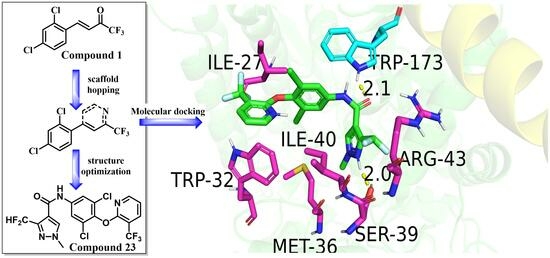
Abstract
Share and Cite
Nan, X.; Wang, K.; Sun, X.; Hu, Z.; Sun, R. Scaffold Hopping from Dehydrozingerone: Design, Synthesis, and Antifungal Activity of Phenoxyltrifluoromethylpyridines. Int. J. Mol. Sci. 2025, 26, 5345. https://doi.org/10.3390/ijms26115345
Nan X, Wang K, Sun X, Hu Z, Sun R. Scaffold Hopping from Dehydrozingerone: Design, Synthesis, and Antifungal Activity of Phenoxyltrifluoromethylpyridines. International Journal of Molecular Sciences. 2025; 26(11):5345. https://doi.org/10.3390/ijms26115345
Chicago/Turabian StyleNan, Xiaohui, Kaifeng Wang, Xinru Sun, Zhan Hu, and Ranfeng Sun. 2025. "Scaffold Hopping from Dehydrozingerone: Design, Synthesis, and Antifungal Activity of Phenoxyltrifluoromethylpyridines" International Journal of Molecular Sciences 26, no. 11: 5345. https://doi.org/10.3390/ijms26115345
APA StyleNan, X., Wang, K., Sun, X., Hu, Z., & Sun, R. (2025). Scaffold Hopping from Dehydrozingerone: Design, Synthesis, and Antifungal Activity of Phenoxyltrifluoromethylpyridines. International Journal of Molecular Sciences, 26(11), 5345. https://doi.org/10.3390/ijms26115345