Next Article in Journal
Dickkopf-1 Acts as a Profibrotic Mediator in Progressive Chronic Kidney Disease
Next Article in Special Issue
Biomarkers for Pregnancy Latency Prediction after Preterm Premature Rupture of Membranes–A Systematic Review
Previous Article in Journal
The ACE rs1799752 Variant Is Associated with COVID-19 Severity but Is Independent of Serum ACE Activity in Hospitalized and Recovered Patients
Previous Article in Special Issue
Kisspeptin Suppresses Inflammasome-NLRP3 Activation and Pyroptosis Caused by Hypothyroidism at the Maternal-Fetal Interface of Rats
 
 
Journal Notice: The Editorial Office has been made aware of an issue the validity of one peer-review report during the peer review process of this article, overseen by the Academic Editor. According to MDPI’s Publication Ethics and Editorial Process policies (https://www.mdpi.com/ethics#_bookmark29; https://www.mdpi.com/editorial_process), the Editorial Office and Editorial Board have decided to initiate a post-publication peer review to ensure that the publication fully complies with this policy. Once the process is completed, the Editorial Office will provide an additional update. MDPI regrets that this action has become necessary and wishes to emphasize that the authors were unaware of the compromised review report and, therefore, are not responsible for this additional retrospective evaluation.
Review

Biochemical Screening for Fetal Trisomy 21: Pathophysiology of Maternal Serum Markers and Involvement of the Placenta


by
Jean Guibourdenche
1,2,3,*,
Marie-Clémence Leguy
1,
Guillaume Pidoux
4,
Marylise Hebert-Schuster
2,
Christelle Laguillier
1,2,5,
Olivia Anselem
3,6,
Gilles Grangé
3,6,
Fidéline Bonnet
1,2 and
Vassilis Tsatsaris
2,3,6
1
Hormonologie CHU Cochin AP-HP, 75014 Paris, France
2
Faculté de Santé, Université Paris Cité, 75014 Paris, France
3
FHU Préma, 75014 Paris, France
4
INSERM UMR-S1180, 75014 Paris, France
5
UMR-S1139, 75014 Paris, France
6
Maternité Port Royal CHU Cochin AP-HP, 75014 Paris, France
*
Author to whom correspondence should be addressed.
Int. J. Mol. Sci. 2023, 24(8), 7669; https://doi.org/10.3390/ijms24087669
Submission received: 27 March 2023 / Revised: 19 April 2023 / Accepted: 20 April 2023 / Published: 21 April 2023
(This article belongs to the Special Issue Placental Related Disorders of Pregnancy 2.0.)

Abstract

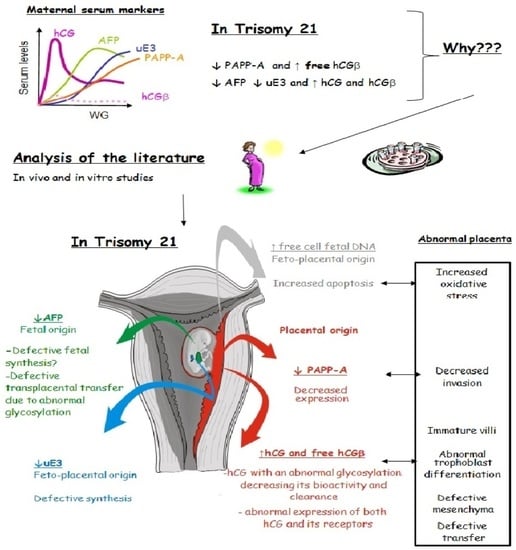
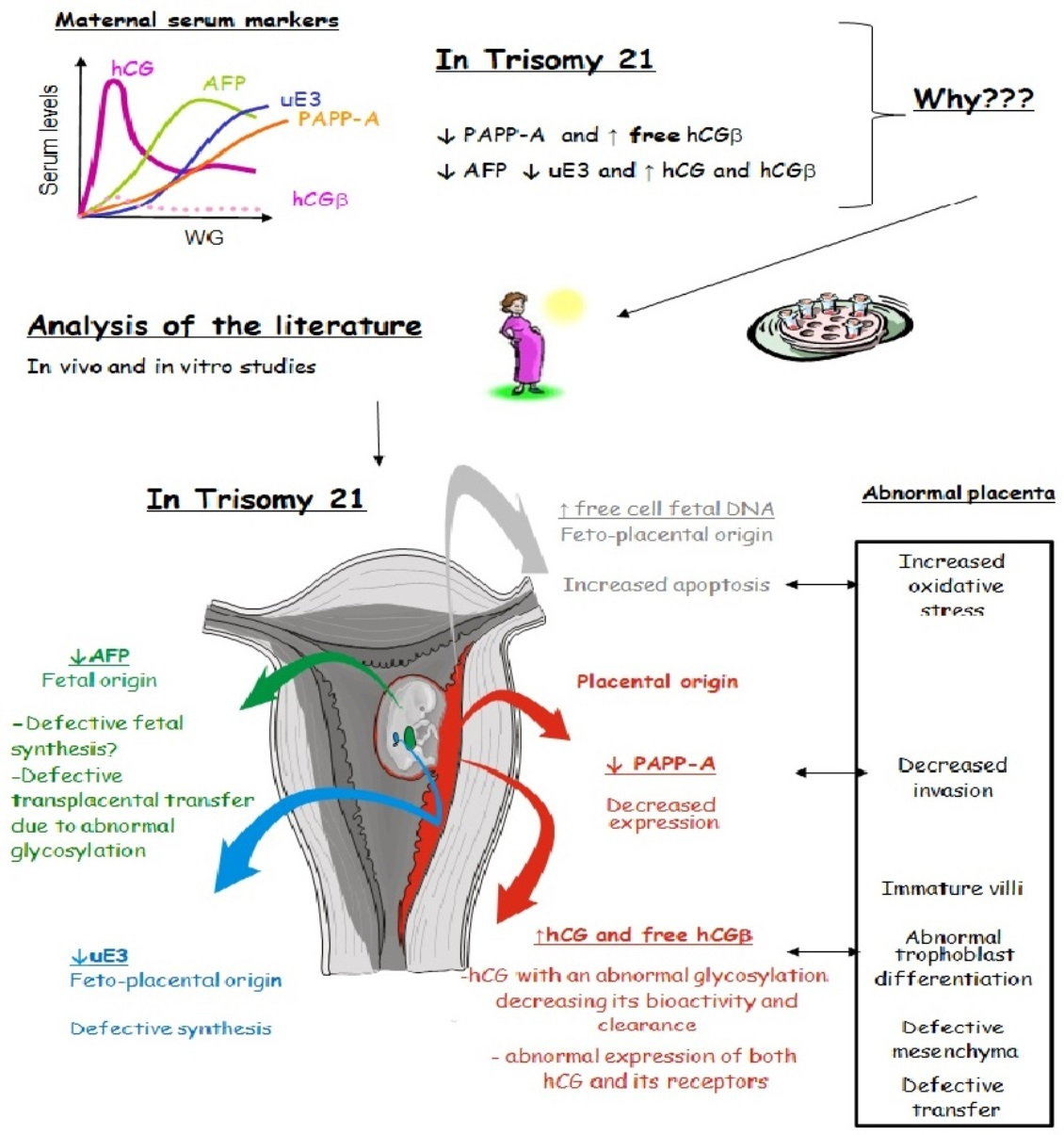
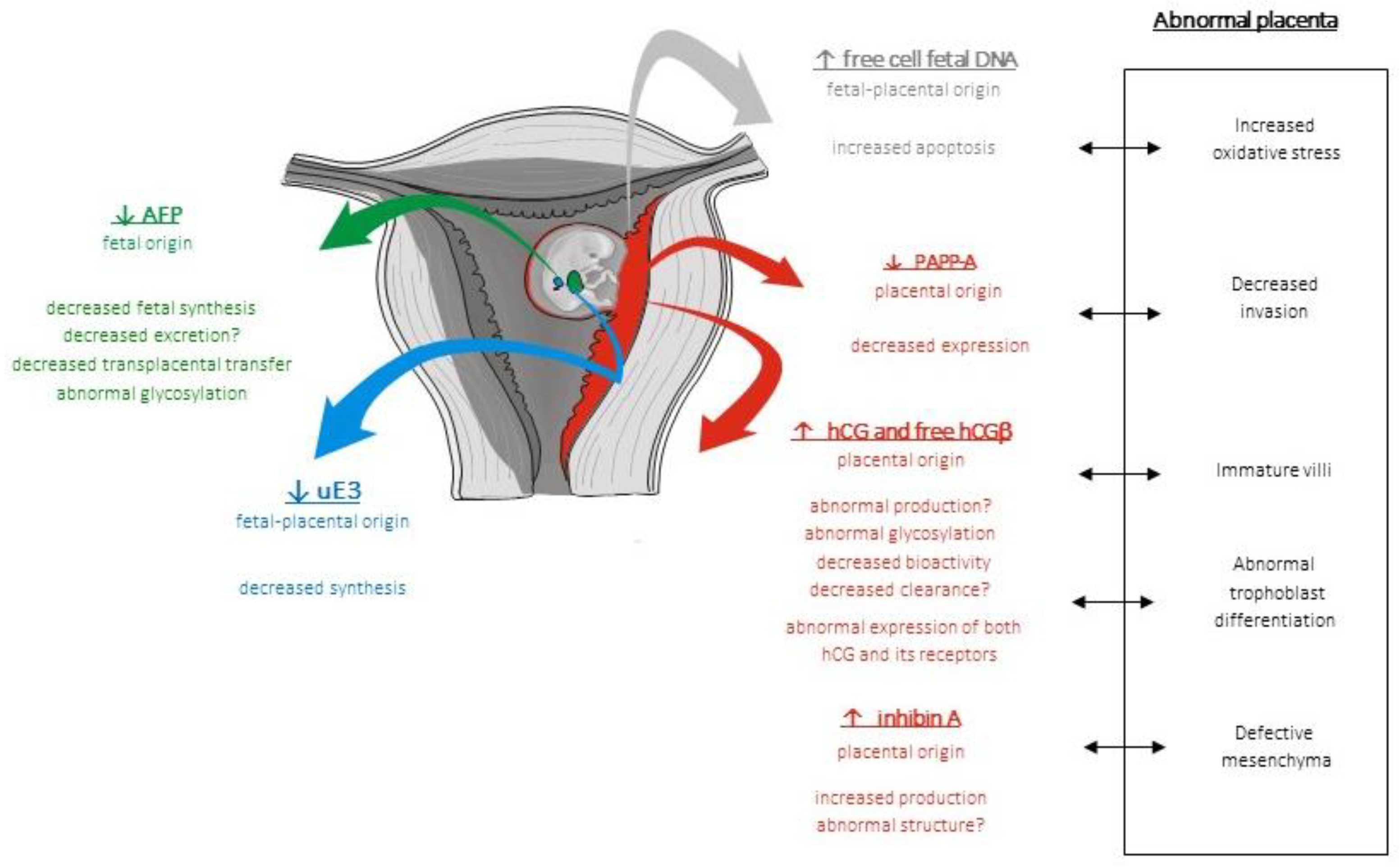
It is now well established that maternal serum markers are often abnormal in fetal trisomy 21. Their determination is recommended for prenatal screening and pregnancy follow-up. However, mechanisms leading to abnormal maternal serum levels of such markers are still debated. Our objective was to help clinicians and scientists unravel the pathophysiology of these markers via a review of the main studies published in this field, both in vivo and in vitro, focusing on the six most widely used markers (hCG, its free subunit hCGβ, PAPP-A, AFP, uE3, and inhibin A) as well as cell-free feto–placental DNA. Analysis of the literature shows that mechanisms underlying each marker’s regulation are multiple and not necessarily directly linked with the supernumerary chromosome 21. The crucial involvement of the placenta is also highlighted, which could be defective in one or several of its functions (turnover and apoptosis, endocrine production, and feto–maternal exchanges and transfer). These defects were neither constant nor specific for trisomy 21, and might be more or less pronounced, reflecting a high variability in placental immaturity and alteration. This explains why maternal serum markers can lack both specificity and sensitivity, and are thus restricted to screening.
Keywords: hCG; hCG free β subunit; inhibin A; PAPP-A; unconjugated estriol; placenta; cell free fetal DNA; prenatal screening; fetal aneuploidy; maternal blood hCG; hCG free β subunit; inhibin A; PAPP-A; unconjugated estriol; placenta; cell free fetal DNA; prenatal screening; fetal aneuploidy; maternal blood
Graphical Abstract